

In entrepreneurship theory (and practice), uncertainty is usually treated as a backdrop—something founders must act within. But entrepreneurs rarely operate alone. They must enroll others, especially financial backers, into their projects. This simple observation shifts the analytical focus from decision-making under uncertainty to agreement under uncertainty.
Under conditions of probabilistic risk, it should be possible for entrepreneurs to share the objective, codifiable information they use to construct their forecasts. They may prefer to keep some private information confidential for strategic reasons (which explains why large firms often rely on internal capital markets rather than outside investors). If they can test their theories of value creation through experimentation and Bayesian updating, then even subjective prior beliefs can be made “objective” for sharing with potential partners. (I share Nicolai’s reservations about this understanding of entrepreneurial experimentation—will post more on that soon.)
What if the entrepreneur’s judgments about the future are tacit, subjective, and difficult (or impossible) to codify or parameterize? Is the entrepreneur then forced to go it alone?
Intersubjective uncertainty
In a new paper forthcoming in Small Business Economics, Nicolai, Samuele Murtinu, and I explore the techniques used by entrepreneurs to convince others to participate in their projects. The core problem is well understood by practitioners: entrepreneurs and stakeholders often hold different visions of the future. These differences are not always reducible to missing information or poor signaling. Rather, they often reflect genuinely incompatible ways of framing a project’s potential. We call this phenomenon intersubjective uncertainty—a lack of shared belief about what the relevant future states are and how a venture’s activities map onto those states.
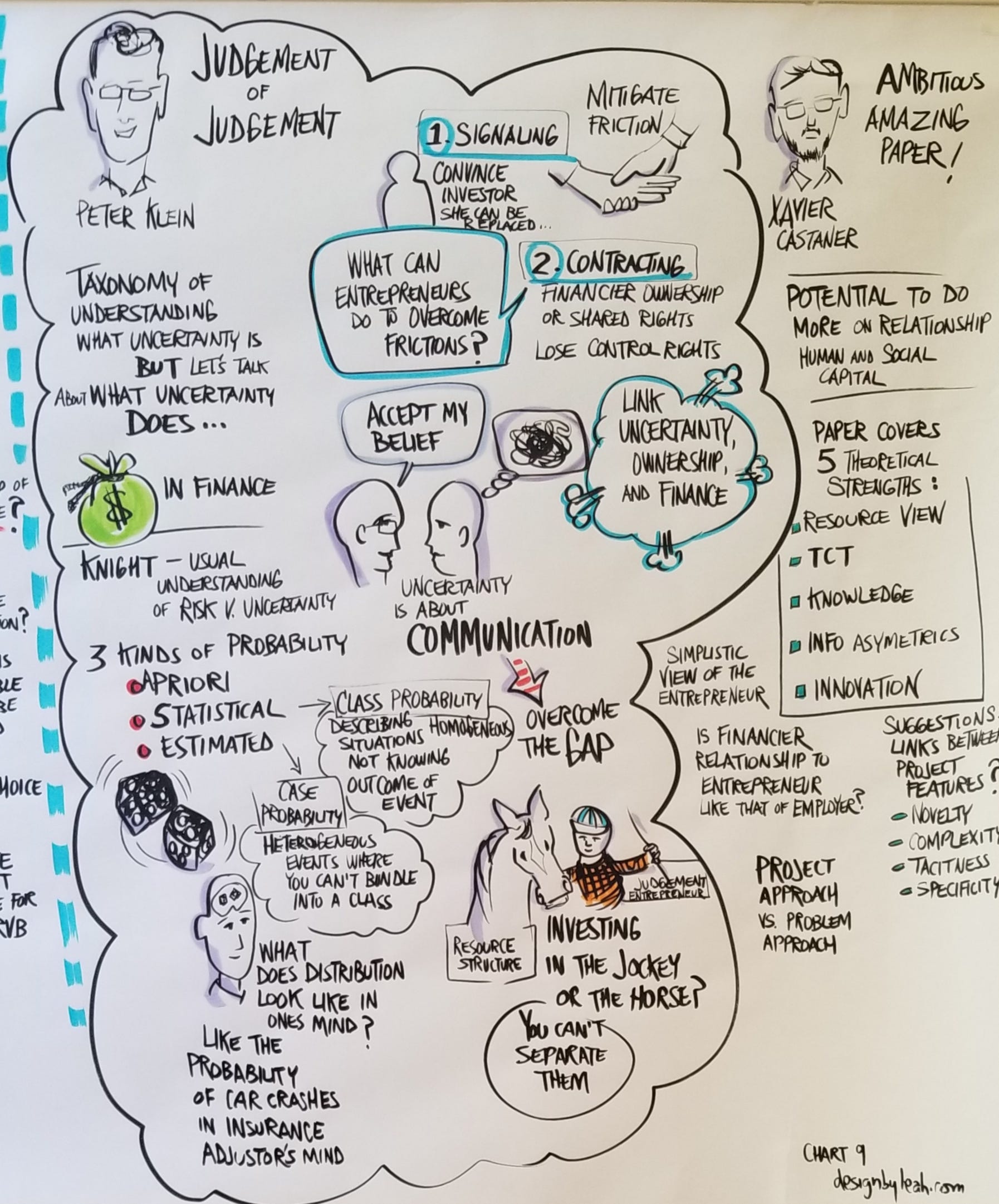
An artist’s summary of a very early version of this paper idea!
In fact, one could even define Knightian uncertainty as the condition under which parties can’t agree about possible futures and their likelihoods. Rather than treat uncertainty as an individual-level epistemic condition—Does the decision-maker believe she is maximizing expected utility under a given probability distribution, or does she believe she is making an intuitive judgment?—we could treat it as a group-level condition. If the parties agree on future possibilities, and can reach agreements to act in certain ways based on these beliefs, then we can say they’re operating under conditions of risk. If they cannot agree, then we can say they are operating under conditions of uncertainty, regardless of what they think they are doing. (The journal reviewers wisely encouraged us to cut this longer discussion from the paper, but I intend to return to it at some point.)
Novelty, opacity, and why some ventures are hard to evaluate
Back to the paper: Two characteristics of entrepreneurial projects help explain why intersubjective uncertainty is so persistent. One is novelty—how far a proposed product or business model departs from familiar categories. The other is opacity—how difficult it is for an outside observer to see the causal linkages between resources, activities, and outcomes.
Novelty and opacity are not the same. A highly novel idea might still be transparent if its logic is easy to grasp; a familiar domain can be opaque if the mechanisms generating value are complex. When either dimension is pronounced, stakeholders may struggle not just to price risk but to interpret what the entrepreneur is actually proposing.

Beyond contracts: Persuasion, framing, and cognitive alignment
Traditional models of entrepreneurial finance emphasize incentives, information asymmetries, and contractual design. These are certainly important. But under deep uncertainty—where probabilities are unknown and mental models differ—contracts alone cannot generate cooperation. What also matters is whether stakeholders can develop sufficiently compatible interpretations of the imagined opportunity.
This helps explain why entrepreneurs devote so much effort to activities that seem peripheral from a purely financial perspective: crafting narratives, staging demonstrations, building prototypes, signaling commitment, and designing governance structures that convey interpretive cues. These practices don’t eliminate uncertainty; they help create enough shared understanding for coordinated action to occur.
Discriminating alignment and the social side of entrepreneurial finance
Our framework, in tradition of Williamsonian discriminating alignment, links project characteristics to the enrollment strategies and financing arrangements most likely to work. Projects that are relatively familiar and transparent can often rely on standard debt or equity financing because stakeholders already share relevant cognitive categories. Others require extended cycles of persuasion and belief revision before external commitments become feasible. In some cases, entrepreneurs begin with self-funding precisely because outsiders cannot yet make sense of the imagined opportunity.
Seen this way, entrepreneurial finance is as much a cognitive and communicative process as a contractual one. Entrepreneurship under uncertainty is not just about making bold decisions; it is also about making the future intelligible enough that others will commit resources. Appreciating this intersubjective dimension helps explain both why promising ventures sometimes struggle to attract support and why successful entrepreneurs often function as interpreters of uncertain possibilities, not merely decision-makers.
The content and sequencing of entrepreneurial persuasion
In a companion paper, forthcoming at the Review of Austrian Economics, we explore a related but distinct aspect of this enrollment problem—namely, the content and sequencing of entrepreneurial persuasion. While the SBE paper focuses on how characteristics of the project shape stakeholder alignment, the companion piece looks more closely at how entrepreneurs structure their communication efforts over time. The key idea is that persuasion under Knightian uncertainty is rarely a one-shot event. Entrepreneurs can often reduce cognitive barriers sequentially, addressing some dimensions of uncertainty before others rather than trying to resolve everything simultaneously.
In particular, we suggest that entrepreneurs may alternate between emphasizing outputs (the envisioned product, market, or value proposition) and inputs (the resources, capabilities, and organizational arrangements needed to realize that vision). Sometimes it makes sense to lead with the ends—clarifying the imagined product or service first and worrying about means later. In other situations, especially when the imagined opportunity itself is hard to categorize, starting with familiar resources or capabilities can create a foothold for shared understanding.
The two papers thus speak to different but complementary questions: one about how project characteristics shape stakeholder alignment, the other about how entrepreneurs actively manage that alignment through the timing and framing of persuasion.

