

In 2026 the late Cuban President Fidel Castro would have turned 100 and his deceased predecessor President Fulgencio Batista would be 125. Fidel died in 2016 at 90 and Fulgencio died in exile in 1973 at 72. Each leader’s past economic policy decisions impacted Cuba’s economy and history in 2026. The study of the policies of these two dead Cuban political leaders is worth remembering. They illustrate why cronyism and communism are economic failures for citizens and nations.
Fulgencio’s cronies received government enrichment, carried out government central planning, and Keynesian economics. Fidel’s communist economy, central planning, and societal control also yielded poor results.
Fulgencio led their military from 1933–1940 then he was elected president in 1940 until 1944. His rule as military chief gave him power and influence. History views his first government as efficient.
Fulgencio’s second term, from 1952–1959, began from a bloodless coup in March 1952, replacing President Carlos Prio Socarras. According to a 2012 dissertation entitled, “Fulgencio Batista’s Economic Policies, 1952–1958,” Carlos’s government,
. . .had initiated a widely endorsed, government managed economic diversification program financed by enormous loans and bond purchases from the United States and Europe. New government financial institutions emerged as a result. When Batista took over, for example, Cuba had a national bank and an agricultural and industrial development bank.
However, Carlos’s government faced growing labor unrest, corruption, and gang violence leading up to the coup. This 2012 dissertation also stated,
. . . Batista launched the largest and most expensive economic stimulus programs in the island’s history. His administration borrowed hundreds of millions of dollars and, through central banking and government managed stimulus, attempted to diversify the Cuban economy to reduce dependency on sugar exports.
The dissertation continues,
The principal aim of economic diversification was to remedy the major inefficiencies and risks of Cuba’s sugar export economy such as: scarcities in innovation, new technology and working capital; seasonal unemployment; inefficient land use; monopolization of capital and labor; political systems based on patronage and wasteful from corruption; risky exposure to international price fluctuations; underutilization of the island’s resources; production directed by inefficient quota systems rather than the market mechanism; little incentive to improve human capital and education; and generally failing to benefit from free market efficiencies thereby creating enormous opportunity costs for the society.
Fulgencio’s second government was dictatorial. He jailed political opponents, had economic interventions, and enriched his cronies. Fulgencio’s economic policy upheavals planted the seeds for Castro’s revolution to take root which began in Cuba’s eastern countryside in December 1956.
Fidel came to power after midnight on January 1, 1959, after two years of guerrilla warfare. Hours before Fulgencio had fled Cuba for initial exile in the Dominican Republic. Castro proclaimed victory in a public speech the same day. It was out with the old and in with the new for Cuba in 1959.
Castro’s government policy authorized confiscating all privately-owned buildings and homes so that the government owned, collected rent for, and maintained every apartment building and home. No compensation was provided to each private property owner from the government confiscation. The quality of buildings in Cuba in 2026 is degradation with central planners authorizing non timely annual maintenance.
Many privately-owned industries came into government ownership, control, and operation with no compensation for owners. Centrally-planned industries, production, and supply quotas were the new normal from Havana.
Any political opposition group, contrary newspaper publications, non-government-operated and -owned schools, etc. were shut down, by force if needed. Free government-operated public school education, with required attendance, began teaching the goodness of communism, the glorious worker revolution, and how communism government and its economy work while capitalism and individual freedom were bad.
Castro’s government provided free medical services and guaranteed employment to all citizens. The Cuban economy saw sluggish annual growth and relied heavily on sugar cane as its primary export. The economic central planning bureaucracy and decision power was led by Castro also. History showed him to be a poor central planner.
Castro transformed Cuba into the first communist nation in the Western hemisphere with a strong economic and political alliance with the USSR until it dissolved in December 1991. Russia’s Cuban economic subsidies and trade eroded. Cuba’s economy struggled through 1993. This was known as “The Special Period” where total national economic output shrank by a minimum of one-third. Their economy has recovered and it is still mired in central planning problems with everyday consumer goods in short supply.
An Atlantic Council article posted on July 9, 2026 entitled “The collapse of Cuba’s state-run economy is years in the making” with a subheading of “Cuba is experiencing what may be its most dramatic economic collapse since the Castro regime first came to power.” The article describes Cuba’s decline in annual cement production, exports, imports, tourism, and aging population.
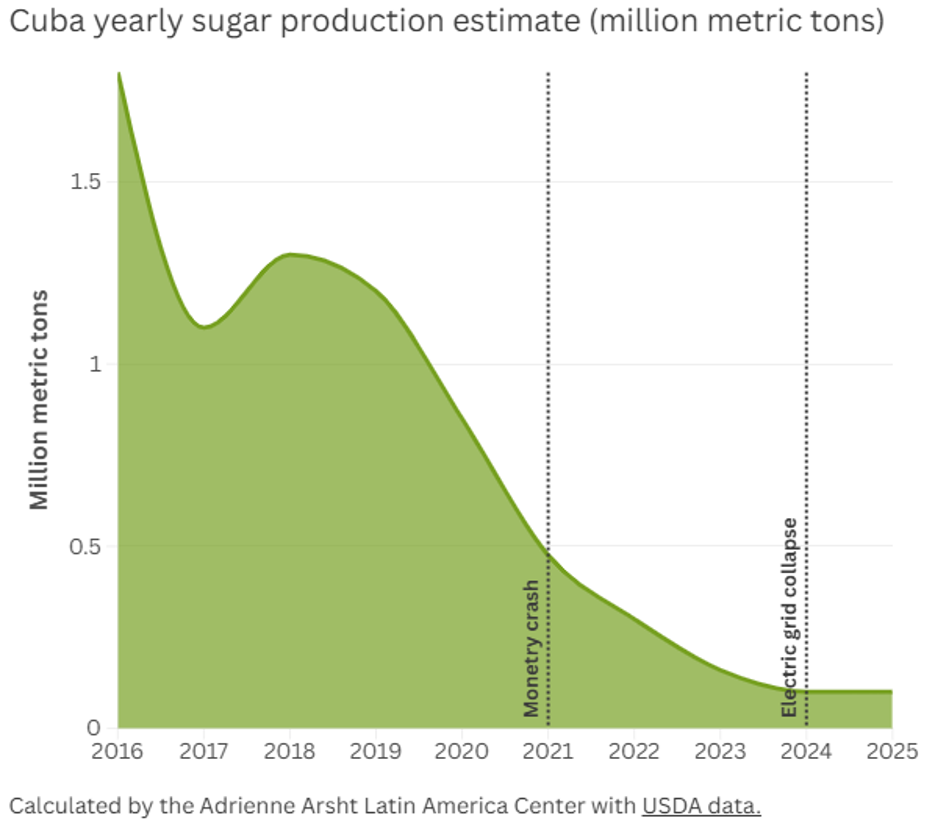
Cuba was known for sugar cane as a primary agriculture product export. Its annual production has plummeted from 1.80 million (MM) metric tons in 2016 to 0.10 MM metric tons in 2025. This 94 percent drop in annual production occurred in less than ten years.
Fulgencio was not elected President of Cuba in 1952 and neither was Fidel in 1959. Fidel was their political leader until 2008 then he was succeeded by his younger brother Raul Castro until he retired in 2018. Cuba is a communist country in 2026. The policy choices of their past presidents—economic intervention, central planning, no private property rights, government owning homes and industries, very limited individual freedom, etc.—reverberate today with a hollowed-out economy long after each man left the presidential office.

