

The prominent international commentator Saifedean Ammous wrote a very didactic article where he claims that Milei has used Austrian economics as a cover to run one of the most inflationary presidencies in the long history of high inflation in Argentina. He wrote, “. . .now it is safe to consider Milei’s presidency a failure,” especially if we compare it with cases such as Ireland.
Writes Ammous, “The biggest promise unfulfilled by Milei was. . .to close the Central Bank, which he claimed was non-negotiable. . . He had a clear mandate from his voters to do so, but. . . he resorted to Keynesian-style nonsense. . . to manage the money supply and revive the peso.” That same peso that he denigrated when he spoke of dollarization.
Since inflation is artificial monetary issuance over market demand, “here are the total increases in the aggregates of the money supply, along with their compound monthly and annual growth rates, as well as the change in the CPI,” according to Ammous:
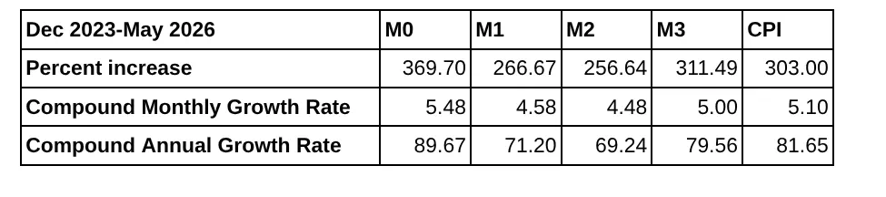
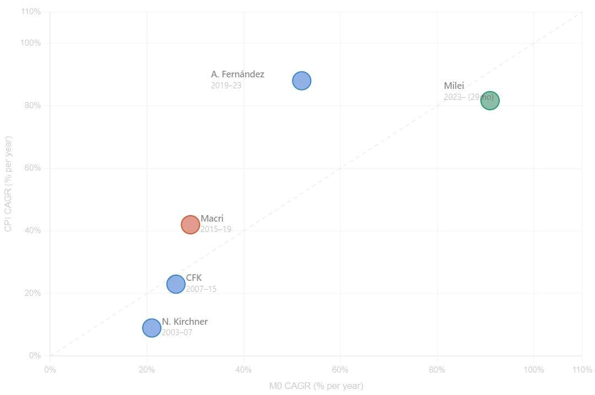
And he continues, “whether it’s analyzing money supply metrics or price increases. . . Milei has so far achieved an annual growth rate of the monetary base higher than that of his four predecessors, and an annual growth rate in the CPI higher than three of the four predecessors”:
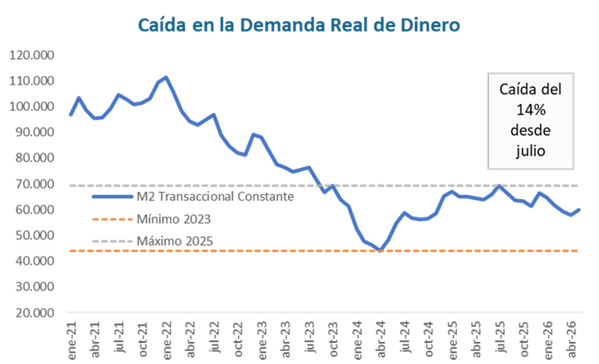
It is not only an issue in absolute terms but also an excess in the face of a demand that falls due to a retraction in activity, particularly in consumption. “Part of the inflationary acceleration had to do with this fall in the real demand for money,” MegaQM states:
Milei had promised to fight chronic indebtedness, Ammous continues, but instead has increased it and, in the process, made the country the IMF’s largest borrower, accounting for about 35 percent of its total portfolio.
By the way, as the economists of the Austrian School say—and Milei himself before becoming president—the IMF is a (multi) state bank against the market since it is dedicated to promoting statism by financing failed governments, which do not get private money, so that they can continue with their destructive policies.
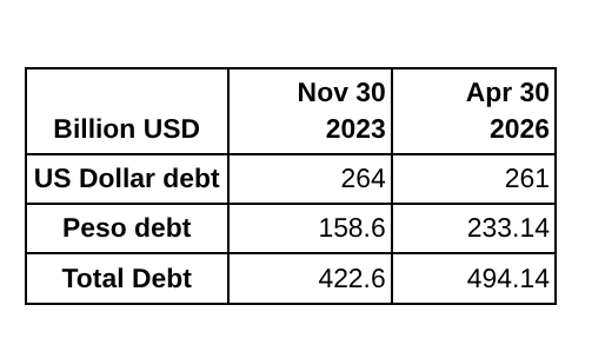
According to Ammous, when the current president took office, Argentina had a whopping debt of $423 billion, and that figure would have risen by $71 billion to $494 billion by the end of last month—a rise of 17 percent—although the currency has been devalued by about 70 percent since he took office.
In other words, simply by devaluing the currency, Milei reduced the dollar value of the peso debt, which he inherited, by 70 percent from $159,000 million to $47,000 million, and yet—by continuing to issue more high-interest peso debt—the total dollar value of the peso debt has reached $233 billion. This means that it has achieved $85,000 million of increase in debt in pesos in just two and a half years:
One of the greatest achievements that the ruling party continues to claim is that the budget would have been balanced, but that seems to be the result of creative accounting. It turns out that the exorbitant interest the government pays on LECAP bonds is not counted as part of expenditures, so the fiscal surplus means little.
As far as investments are concerned, Argentina was last in the ranking of foreign investment in the region in 2025, according to the OECD, when the country received just USD 3,134 million.
The government has minimized these rankings by assuring that there are about $140,000 million of investment planned to be executed in the coming years. But, as the prominent economist Roberto Cachanosky points out, so far there have been announcements—for the arbitrary Incentive Regime for Large Investments, RIGI—for $85,000 million, projects for $25,000 million were approved, but so far only $762 million have entered.
Deregulation has been poor. For example, the recent proposal to modify the “corporations law” in order to encourage investments in artificial intelligence is little more than cosmetic—a true deregulation should start by eliminating state laws of “intellectual property.”
Privatizations are practically non-existent and—although it is very difficult to evaluate—I would dare to say that the state, on the contrary, has been capitalized, not only by the increase in the central bank’s reserves, but also by the fact that—mainly through the Sustainability Guarantee Fund (FGS) of the ANSES—the government has made strong purchases of company shares.
As for the famous “chainsaw,” the percentage of cuts in public employees has been much lower than the loss of private jobs, which gives rise to the paradox that today there are more public employees for every private one, which is what counts.
Low investment does not originate in the lack of savings but in the persistence of an adverse context. Among other reasons, the tax pressure is still high and, although it is very difficult to assess, my impression is that it has risen sharply in the Milei era. Let us bear in mind that—when removing subsidies to public service companies causing a sharp increase in rates—the government did not refund the taxes with which these subsidies were paid, causing a relative increase in the tax burden on the ability to pay after personal fixed expenses.
The “industry” that flourishes, as Ammous rightly points out, is the Ponzi carry-trade, which is more than twice the size of the Argentine stock market and is not simply a minor problem that enriches a few at the expense of the rest, but that this financial Russian roulette absorbs more and more capital away from productive activities.
In a country whose total market capitalization is $90 billion, the carry trade absorbs about $233 billion of investment, all in the purchase of government Ponzi bonds at exorbitant interest rates, which the government can only repay by printing obscene amounts of money.
“In less than two and a half years in office, Milei has added capital equivalent to two Argentine stock markets to the Ponzi scheme of government bonds,” says Ammous, decapitalizing the country causing the closure of an overwhelming number of companies and the destruction of jobs. “Why invest in productive businesses when with the carry trade you get a 2-3 percent monthly return?” asks Ammous.
Even with all this data, the government insists that the economy is on the right track and—according to the state entity that makes the statistics, the Monthly Estimator of Economic Activity (EMAE)—would have grown by 5.5 percent year-over-year in March, the latest data available. This is hard to believe just by walking the streets and seeing the bad mood of the people, with delinquent household debt at record levels, according to data from the central bank, falling wages and galloping productive disinvestment.
The EMAE is calculated in a very arbitrary way, in fact, this increase is due to the weighting and statistical calculation used that accounts for a few sectors (mining, energy, fishing, agriculture, financial, and state activities) that would have grown compared to the rest of the economy that fell sharply. A few that do not manage to change the general mood and that do not promise anything for the future.

