

Aluminum (Al) metal is lightweight—strong and it does not rust. It is used in beverage cans, commercial airplanes, car parts, window frames, industrial parts, etc. President Trump imposed tariffs on US Al imports in February 2025. Bahrain and the United Arab Emirates (UAE) in March 2026 reduced Al production as a result of damage to Al production facilities from incoming Iranian projectiles that were related to the US initiated military operation Operation Epic Fury (OEF). These two US government interventions are impacting global Al supply, demand, and prices.
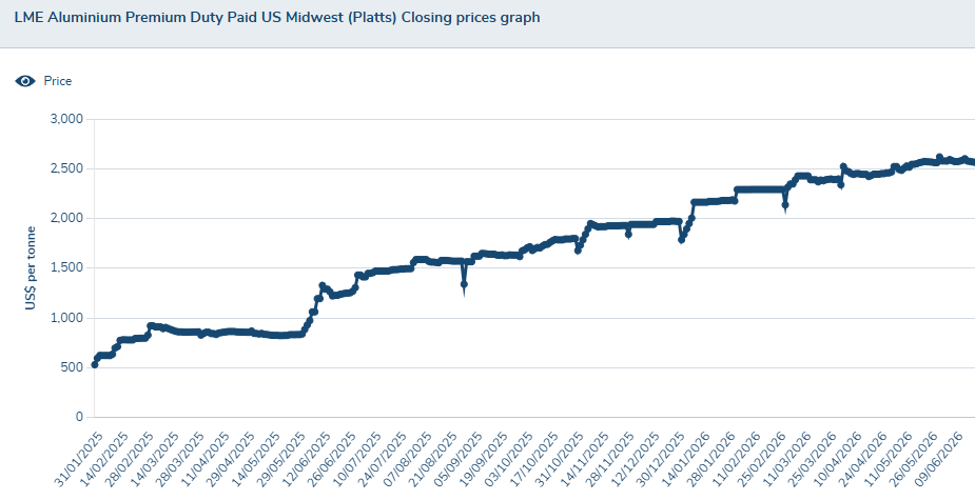
President Trump’s tariffs increased from 10 to 25 percent for Al imports. US Al prices are higher from President Trump’s tariffs measured by the London Metal Exchange (LME) US Midwest closing prices graph from January 31, 2025, approximately $500 per ton to roughly $2500 per ton on June 9, 2026, in the graph below. According to their website, “The London Metal Exchange is the world centre for the trading of industrial metals – the majority of all non-ferrous metal futures business is transacted on our platforms.”
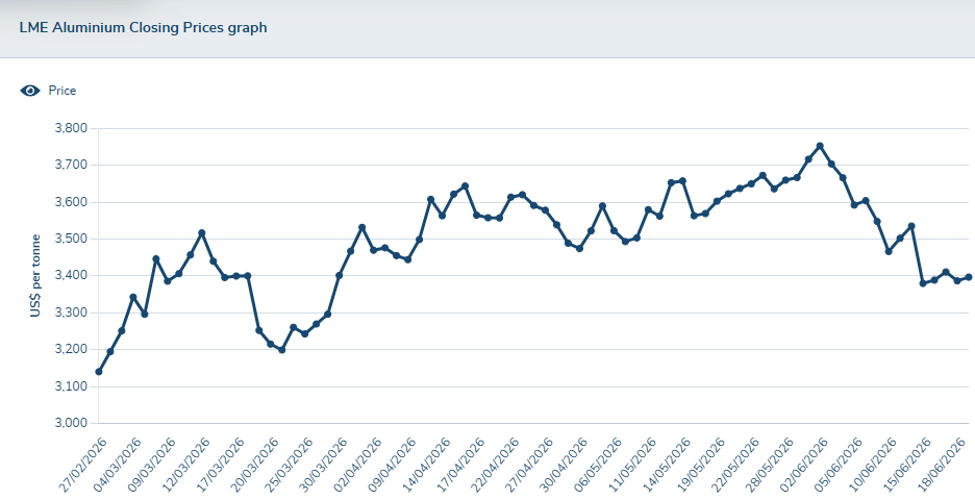
The unintended consequence of Bahrain and UAE Al production facilities damaged and under repair for the rest of 2026 from Iran’s incoming projectiles due to OEF. This Al supply loss lowered worldwide Al supply by roughly nine percent. No other readily-available global Al supply filled this loss as of June 2026. Al closing prices on the LME rose after OEF began on February 28, 2026—from $3,140 per ton on February 27, 2026 to $3,396 on June 19, 2026 in the graph below.
Global Al demand has not decreased since January 2026 and global Al supply sourced from Bahrain and UAE is down hence higher global prices. US domestic demand for recycled Al has increased to meet this supply loss. Prices paid by US metal recyclers are higher in 2026 although finding pricing information online is not readily available.
Al is used every day by almost everyone around the world so finding a quick substitute for this Middle East Al production supply lost from OEF is not feasible.
Global tariff history for the last 200 years is a story of failed government interventions that protect specific producers and increase prices paid by each country’s consumers. The lack of competition inside a nation’s tariff-protected industry leads to less competition, less industry innovation, and lower quality products for consumer choice.
The unintended consequences of both tariffs and war are clearly shown in damaged and curtailed Al production in Bahrain, Qatar, and UAE. Emirates Global Aluminum produces 4 percent of the world’s Al.
Al Bahrain (Alba) owns and operates one of the largest Al single site production smelters in the world. Al is produced from alumina and bauxite received by ships passing through the Strait of Hormuz. Iran’s closure to ship passage through the Strait of Hormuz impacted Alba Al exports, “It’s because what’s happening [sic] in the Strait of Hormuz, we are not able to ship. So we’re producing, but the metal is here in Alba.”
Al is a lightweight metal, but these two US government interventions make Al a global economic heavyweight.

