

December 31, 2025, concludes the first twenty-five years of the 21st century. The US government’s future bankruptcy results from poor personnel, policy, and money decisions that have impacted everyday people. Looking back from 2000 to 2025 showed a numbing expansion of federal government and Federal Reserve Bank power, economic intervention, regulation, and waste. Personal and economic freedoms have declined.
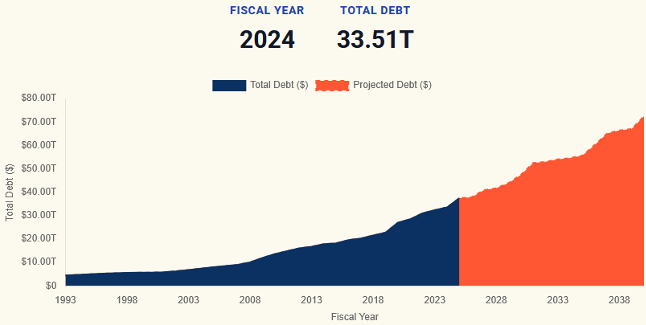
The United States federal government debt at the end of fiscal year (FY) 2000 was $5.67 trillion. It doubled to $11.91 trillion at the end of FY 2009. This doubled again to $26.95 trillion at the end of FY 2020. It stood at $33.51 trillion at the end of FY 2024 and it approaches $37.6 trillion at the end of FY 2025.
The September 11, 2001 Islamic terror attacks in the US brought the Transportation Security Administration (TSA) in November 2001, the Patriot Act enacted in October 2001, the US military invasion of Afghanistan in October 2001 to topple the Taliban government for hosting Osama bin Laden and al-Qaeda terrorists and the Sarbanes Oxley Act enacted in July 2002, to protect investors by making corporate disclosures more accurate. This act resulted from Enron and WorldCom accounting scandals that duped investors.
March 2003 was the military coalition Iraq invasion initiated by the US to topple Iraqi president Saddam Hussein and lead to failed nation state building until the US military formally declared its end in December 2011. Roughly 4,500 US military personnel died, 32,000 physically wounded, many thousands impacted by post traumatic stress disorder (PTSD), $1.7 trillion spent as of 2013, several thousand Iraqi civilians killed in many armed battles. Iraq is not doing well in 2025.
January 2006 brought the US Medicare Part D prescription drug entitlement program leading to new federal regulations, new pharmaceutical drug program choices, prescription drug subsidies for those not able to pay their share of program cost, rising prescription drug prices for people age 65 and even more federal spending.
October 2008 brought the Troubled Asset Relief Program (TARP) with $40 billion US taxpayer dollars lent to Bank of America and Citigroup, $68 billion lent to American International Group (AIG), $206 billion to other banks, $80 billion loaned to Chrysler and General Motors, $31 billion to mortgage programs, $700 billion was initially authorized, but lowered to $444 billion from passage of the Dodd-Frank Act in 2010: “It established a number of new government agencies tasked with overseeing the various components of the law and, . . .financial system.”
The U.S. government bought preferred stock in eight banks: Bank of America/Merrill Lynch, Bank of New York Mellon, Citigroup, Goldman Sachs, J.P. Morgan, Morgan Stanley, State Street, and Wells Fargo. The banks were required to give the government a 5% dividend that would increase to 9% in 2013, encouraging banks to buy back the stock within five years.
The US taxpayer lost $31 billion dollars when the last TARP repayment was made in September 2023. TARP was crony capitalism.
2008 saw the mortgage-backed securities (MBS) failure as part of the residential housing asset bubble. Their MBS purchases began about 2010.
2009 saw the federal bankruptcy of General Motors and Chrysler Corporations with use of US taxpayer TARP dollars. The Obama administration worked with the United Auto Workers union in the bankruptcy negotiation prior to each filing. The US taxpayer lost approximately $12 billion dollars.
March 2010 saw enactment of the Affordable Care Act (ACA) known as Obamacare. Federal government taxpayer-funded subsidies came to lower health insurance premiums, costs, and deductibles to everyday Americans. It required health insurers to cover listed essential benefits. Federal Medicaid eligibility was expanded and extended health insurance coverage to millions of Americans. This federal government intervention did the opposite with health insurance costs, deductibles, and premiums increasing. Obamacare turned 15 years old in March 2025.
Further, “In 2010, Obama eliminated the federal guaranteed loan program, which let private lenders offer student loans at low interest rates. Now, the Department of Education is the only place to go for such loans.” Federal student loan debt climbed higher each year with no loan competition. 2025 has the supply of college graduates exceeding jobs requiring a college degree. The US taxpayer has lost billions of dollars.
March 2011 saw France, US, and UK air force planes and cruise missiles lead by NATO bomb Colonel Muammar al-Qaddafi’s military forces. This bombing supported many Libyan rebel forces fighting to topple Colonel al-Qaddafi. These actions forced him out as Libya’s leader. Libya in 2025 has two opposing governments, no hope for a peaceful settlement, and African immigration to Europe by boat originating here.
2020 brought coronavirus, where the government brought about business closures, incredible unemployment, federal aid payments via the paycheck protection program (PPP) to businesses and individuals, mask mandates, federal coronavirus vaccine and testing requirements, air travel bans, etc. The Fed purchased more government-issued debt with holdings over $6 trillion in the first quarter of 2022. Total known federal government debt as percent of gross domestic product topped 100 percent for the first time since WWII. A nation’s economy topping this metric is mostly at a point of no return.
August 2021 brought the embarrassing and overdue US military withdrawal from Afghanistan known as the graveyard of empires. Alexander the Great around 330 BC, the British empire in the 1800’s, and the Soviet Union from 1979 to 1989 were defeated in their regional conquest. Twenty years of US-led nation building from 2001 to 2021 resulted in roughly 2,400 US military dead, 20,700 injured, many thousands impacted by PTSD, tens of thousands of Afghan civilians killed and over $2 trillion US dollars spent.
2022 brought the Inflation Reduction Act, funding billions of dollars in Amtrak, road and water infrastructure projects, and subsidies to solar and wind industry projects. The Creating Helpful Incentives to Produce Semiconductors (CHIPS) Act was signed into law to develop onshore domestic manufacturing of semiconductors using billions in federal taxpayer dollars. Crony capitalism continues and undisciplined federal spending proceeds.
2025 brought Trump tariffs, needless trade wars with many nations and a near $1.80 trillion deficit in federal FY 2025 spending. The Department of Government Efficiency (DOGE) made an effort to expose and cut wasteful federal government spending, shutdown specific government agencies, and reduce federal employee head count, but it failed. The executive and legislative branches have no will to cut federal spending in 2025. The US government is addicted to the drug of debt.
This brief list shows incredible US federal government overreach in economic intervention, economic central planning, expansive “fourth branch” of government (the administrative state), foreign military interventions, Fed money printing is leading to economic and personal loss of freedom.
The 21st century’s first twenty-five years resulted in US bankruptcy in many facets of federal government policy, banking, education, business, and society. The US future into the next quarter of the 21st century will be the federal government default, not being able to pay the interest and principal on known federal bond debt deadlines. At this point of default, maybe the reality of massive healing can begin for the US as a nation and society.

