
As We Go Marching
Part Two. The Bad Fascism: Germany
ONE FRUITFUL ORIGIN of much of the confusion about fascism in Germany arises out of the variety of people who hate it. Each hates it for some special reason. And while most people here abhor it for its brutal assaults upon the substance and implements of free government, there are many whose hatred is inspired by some special personal or group indignity or injustice suffered at the hands of the Führer. Thus Hitler is execrated by some who are themselves fascists—as, for instance, those fascist dictators whose regimes have rolled under his tanks equally with their democratic neighbors, or some of those former colleagues who were squeezed out of his congregation, or some of those disillusioned businessmen who gambled with him and lost.
A great many books have appeared, written either by these liquidated disciples or religious and political groups ruthlessly oppressed by him. It is a fair statement, however just their deep sense of wrong, that such books have reflected their flaming hatreds rather than their sound intellectual judgments. They have explained fascism in terms of their hatreds. These volumes have had a powerful influence here. They have gone far toward implanting the belief that fascism in Germany is the product of extraordinarily able yet evil men or that it is due to some demoniac possession of the German people themselves.
For the American honestly in search of the seeds of fascism no analyses could be more misleading than these. If fascism is the work of a handful of brutal and lawless men, we need have no fear of it here. We are never without leaders both able and corrupt. But they are not sufficiently numerous and powerful to make very much headway against the peculiar structure of our government. If the phenomenon is merely a manifestation of the paranoid mentality of the German people then certainly we are in no danger of infection unless we, too, are a little demented.
But alas, the most terrifying aspect of the whole fascist episode is the dark fact that most of its poisons are generated not by evil men or evil peoples, but by quite ordinary men in search of an answer to the baffling problems that beset every society. Nothing could have been further from the minds of most of them than the final brutish and obscene result. The gangster comes upon the stage only when the scene has been made ready for him by his blundering precursors.
But the explanation is not quite so simple. Germany is not the only country where fascism has appeared. It took power in Italy a decade before it ruled in Germany. It was in Turkey as soon as it attacked Italy. Indeed in the first days of his fascist adventure Mussolini liked to refer to himself as “the Mustapha Kernel of a Milanese Angora.” If Germany was “outside the stream of Latin culture,” surely this cannot be true of Italy. The fascist microbe has played no favorites. It has penetrated through Protestant Germany, Catholic Spain, Orthodox Greece, and Mohammedan Turkey. In each such country dictators have popped up fitting perfectly into the national background.
It would be impossible to find races of people in Europe differing more widely in history, culture, tradition, and tastes than Germany, Italy, Portugal, and Turkey, nor dictators more sharply distinguished from each other than Hitler, Mussolini, Metaxas, Salazar, and Kernel Pasha. In Italy, Mussolini supported the monarchy; in Germany, Hitler abominates it. In Spain, Franco allies himself devoutly with the Church; in Italy, Mussolini used the Church; in Germany, Hitler castigates it. The German Führer makes anti-Semitism an article of Nazi faith. The Duce ignored it save as a gesture of politeness to the Führer after the alliance. Fascism has made its appearance not only in Italy, Spain, Germany, Greece, Portugal, and Turkey, but likewise in Yugoslavia, Rumania, Poland, and other European countries, with a wide swing to South America and Asia.
It is fatuous to look upon fascism as a growth indigenous to any particular country. And it is equally false to say that it would not have arisen save as the work of Hitler or Mussolini. We cannot escape the significance of the fact that in each of these numerous countries a fascist tyrant sprang up at the right moment and all within a very brief period. It is true that in each case the country itself, its history, manners, culture, tradition, political system have greatly colored the external trappings of its fascism, and in each case the peculiar character of the leader has had an important effect upon the form, practices, techniques, slogans, and rituals of the movement. Had fascism entered Germany in the hands of some other leader than Hitler it would probably have worn different clothes, sung different songs, shouted different oaths, carried different banners and, perhaps, killed different people. But the essence of it would be the same. It is this essence we are trying to discover and identify.
There are other elements of confusion. Fascism is essentially a dictatorship. But dictatorship is not the only feature of the structure. All dictatorships are not fascist dictatorships—as, for instance, the Russian proletarian monstrosity. The economic ingredient of Russian communism is utterly unlike that of fascist Germany. It is a mistake, therefore, to define fascism as a dictatorship, just as it would be a mistake to define an automobile as a vehicle with four wheels. The other ingredients must also be considered. It is these we wish to discover. This emphasis on the dictatorship element in fascism is the cause of endless misapprehension. The dictatorship leads to all the ugly episodes, the brutal, overt acts that make up the daily news of fascist countries. The minds of Americans have been kept busy with the external drama, the shirted troopers, the putsches, the scandals, the obscenities, the assassinations and riots, the personal histories of the unpleasant heroes of the drama. The other and deeper essential elements—the elements which preceded the dictatorships and made them possible—are ignored. For these elements are humdrum and unworthy of the pens of reporters who are in search of action, incidents, drama. In some countries, where the drama has been less vivid, where the dictator is a Salazar rather than a Hitler, and where the amount of bloodletting has been very little, the fascist order has come in for a good deal of very friendly attention from Americans. We are already in danger of drawing a distinction between good fascists and bad fascists, just as we once did between good trusts and bad ones.
One peculiar weakness of the human mind seems to be that it cannot hate the object of its dislike without exaggerating or at least changing the form of the wickedness. Fascism in Germany and in Italy, looked at frankly, seems to me sufficiently hateful as a form of life. Taking it for what it is ought to exhaust the resources of aversion. But apparently fascism as it is seems not nearly ugly enough to satisfy the tastes of some of its more voluble critics. In order to hate it they feel bound to import into it evils it does not possess. This is silly. Because in this deformed and exaggerated shape it is not nearly so frightful because it does not exist. If I find myself in a wilderness I can be intelligently afraid of lions and tigers and reptiles as they are. The man who comes to me with the alarm about approaching man-eating cats and boa constrictors and who describes them to me as they are will fill me with a reasoned fear and induce me to take measures for safety. But the wild-eyed alarmist who rushes up with descriptions of dragons with flames pouring from their nostrils, swallowing two and three men at a gulp, will not excite me at all. I will not believe that such beasts will come upon me. I am afraid of such a beast as fascism just as it is because I know it can exist, that it flourishes not only in some distant jungle but seems to be at home in almost any kind of woods and climate and may actually put in an appearance here. I fear it because I know it may arise in America, taking on the coloration of the American jungle. Let us see, therefore, if we can isolate the real elements of fascism in Germany as a preliminary to searching for them in our own midst.
II · Resetting the SceneTHERE IS a generally held assumption that the German people have always lived under a highly centralized, autocratic government only thinly veneered with parliamentary forms and that therefore they were singularly open to the designs of a fascist regime.
I mention this not as expressing any special virtues among either Italians or Germans but as a fact completely at variance with some popularly accepted notions of these histories. England, France, Russia, Spain long before—centuries in some cases—had been drawn together into national, unitary bonds. Until the middle of the last century Italy remained a land of eight small states, Germany a collection of some thirty-nine separate units.
When, following the Franco-Prussian War, the Germans united in a single state, the new nation was erected not into a single central political unit, but rather into a federal union of many states. The constitution lodged certain very limited powers with the federal government—the empire—and reserved the remainder to the states. The central government had jurisdiction over foreign relations, the army and navy, imports and exports, the postal, telephone, and telegraph system, and nothing else. Even the administration of the federal laws was committed not to federal officials, as with us, but to the several states. Far from being an autocrat, the Kaiser presided over a federal government which actually possessed less powers than the United States federal government.
Its power of taxation was severely limited. It depended for its revenues on import and export duties, excise taxes and stamps on documents, and inheritance taxes—the last a questionable stretching of its powers. Excise taxes could be levied only on sugar, tobacco, spirits, and beer. It could impose no income taxes. The revenues thus collected were never sufficient for the empire. It was forced to depend, therefore, upon another source of funds; namely, the matricular contribution. That is, when the taxes levied by the central government were insufficient to meet its requirements, it could call upon the several states to contribute on the basis of population. But apparently it had no effective means of enforcing these contributions for many of the states remained habitually in arrears. This is a very different picture from that despotic state which is popularly envisioned as the creation of Bismarck.
For forty years after the founding of the empire, the central government made futile efforts to expand its powers. These were forcefully resisted by the several states until after the World War. The states of the German federal government were far more jealous of their sovereign powers than the states of our union.
It would not be true to say that the empire enjoyed parliamentary government in the unrestricted sense of that word. There was an empire parliament composed of a popular assembly, the Reichstag, and the Bundesrath, representing the states. The Reichstag was not so potent an instrument of popular government as the British House of Commons because the Chancellor was named by and responsible, not to it, but to the Emperor. The Chancellor, however, had to do business with the Reichstag since all money bills had to be voted by it and it frequently resisted his demands.
The socialist membership in the Reichstag increased steadily. Bismarck sought to force repressive laws against it but for long without success. Even after an attempt on the life of the King, his proposal for a law to restrict the socialists was defeated by a large majority. It was not until a second attempt to kill the King was made that Bismarck got his law. The Reichstag just before the World War had 100 socialist members, in addition to many liberal groups. It is not difficult to imagine the pious mutterings of horror from our conservatives if our House of Representatives were invaded by a hundred socialist members.
The only purpose of noting these facts about the old German imperial state is to fix in the reader’s mind that the German people up to 1914, while by no means enjoying the fullest measure of political freedom, were far from being an empire ruled by an autocrat. There was a spirit—and a growing one—of resistance to arbitrary tendencies. The Germany that dropped helpless into the arms of Hitler in 1932 did not begin its march to that ignoble destiny from a condition of highly absolutist government such as Russia or even Austria or their Balkan neighbors, but as a civilized community accustomed to many of the techniques of representative government operating on the parliamentary form and exercising many restraints on the executive.
III · The Revolt of the MassesGERMANY was a society in which, the instruments of producing and distributing goods was of the capitalist order. By this I mean that Germany operated under a system in which the tools of production were owned by private individuals or groups, who produced goods and distributed them for profit within the framework of a money economy.
The German states held investments in numerous enterprises—railroads, power companies, municipal transport, mines, forests, and some industrial enterprises. This has led to the impression that the empire had diluted its capitalism with a good deal of socialism. The empire had but little of these enterprises. They were held by the several states. But even here it was not socialism but rather state capitalism, if such a term is permissible. The German states made a point of operating their enterprises for profit as a source of state revenue. It was in no sense an experiment in production “for use” in a classless society. Moreover, while in bulk these enterprises were considerable, they formed only a small fraction of the whole economy. Nevertheless, they did accustom the German mind to the intrusion of the state into enterprise as a normal function of government.
Whatever its shortcomings it remains a fact that Germany between 1870 and 1914 was the most prosperous large country on the continent. But despite this fact, it is equally true that its economic system, in common with that of other countries, was beset by grave difficulties. These may be classified as (a) chronic inability to provide subsistence for a large part of the population and (b) recurring periods of depression.
This brings us to say what is of the utmost importance to this whole subject; namely, that in this system of private capitalism there is an organic flaw of some sort which tends to break it down at intervals and to infect it with a heavy dilution of poverty at all times. I do not say that this defect is irremediable. And obviously no one will say that poverty has increased under the capitalist system. Even so unfriendly a witness as Karl Marx said in 1848, before the greatest creations of capitalism had been produced:
In the years after Marx wrote that paragraph Germany became the most prosperous nation on the continent. But despite this the two great problems—persisting poverty and cyclical depression— grew in virulence as a social irritant. What we see in Germany, therefore, was an economic order that functioned better than in any continental country but which failed to produce enough purchasing power to provide all her people with the means of obtaining a decent share of that production while the system bore within its body some little-understood organism which at intervals brought the whole community to distress. There was nothing new about this. The history of the present economic system in any form is a history of recurring crises. But it is a fact that in the last fifty years, as the capacity to produce rose and the well-being of the people improved and the problem of production seemed almost solved, the problem of crises became more acute.
What is the explanation of this? The economic system of the present century differs from its more rudimentary form in an earlier century in this: (1) It has developed amazingly the power of the machine to produce; (2) it has extended in an extraordinary degree the mechanisms of credit; (3) it has elaborated equally the institutions of organization through the corporation; (4) it has fostered huge organization of mass control through trade associations, labor unions, cartels; (5) it has seen an intricate spread of social control over many of the processes of the economic system.
Whether these forces, while expanding the power to produce, have also contributed to the mechanistic difficulties of the system is a matter to be considered.
This condition is common to the whole capitalist economic world. Germany, even before World War I, was fast in the grip of this difficulty. But what is the explanation of the psychological reaction of the people of Germany to this condition? Grave as it was, the problem was not new. The answer must be looked for in another social rather than purely economic phenomenon. The force behind the great ferment in Germany finds its explanation in what Ortega y Gasset has called the Revolt of the Masses. This he describes as follows:
Ortega then goes on to point out that the traditional mass-man of the past would not have accepted authority external to himself had not his surroundings violently forced him to do so. His surroundings do not violently force him to do so now and so he considers himself the lord of his own existence. This mass-man in Germany, as elsewhere—but of all continental countries, most in Germany—saw what modern life could do for him. He saw poverty banished from among many of his neighbors who were once condemned to it as a normal state of life. Means of transport had enabled his neighbors to move away more easily. He heard of a world of abundance that had appeared beyond his narrow frontiers. The school taught him to read. The newspaper brought him the opinions of many men and the story of the world’s progress. He began to feel that his age-old poverty need not be his inevitable lot. He began to demand more from life and occasionally to taste its sweetness. He got to looking upon the government as an instrument to provide these things and, in Germany, this was a government of most limited powers. There was an impatience with disorder, hunger, depression. Men turned to the government as an agent of the people to correct these ancient evils. What, actually, had happened was that the popular tolerance of poverty and crises was gone.
Ortega is not talking about that kind of proletarian revolt which flamed up so many times in Europe under the pressure of unendurable oppressions. The common people had risen in England under Cromwell, the Russian serfs had poured into the streets under Catherine II as well as Nicholas to be mowed down by grape-shot. The populace of Paris had stormed palace and barricade not only under Louis XVI but in the days of the Commune. In every country and in every age the masses, goaded to desperation, have on occasion rushed upon their oppressors. But this revolt of which Ortega speaks was of a different nature. It was a state of mind that did not necessarily involve force. It was a repudiation of age-old assumption, a new conviction of right and of power. And it took the form not of violent insurrection against the government, but of relentless demands upon the government.
The most powerful organized agency of this revolt was the Socialist party. Germany more than any other country became the center of radical economic explorations and propaganda. Its philosophy permeated the labor movement and percolated into the thinking of all political parties. Grave questionings of the assumed permanence of the capitalist system had gotten about. While the socialists offered their own substitute system, every variety of reformer appeared with all sorts of proposals for the repair of the capitalist society itself. The influence of the old Junker groups waned. The socialists had more than a hundred members of the Reichstag in the year when war was declared. But equally important was the change that had come over the composition of the non-socialist members of that body. Jules Cambon, French Ambassador to Berlin in 1913, warning France of the state of affairs in Germany, wrote: “In the Reichstag for 1878 out of 397 members, 162 belonged to the aristocracy; in 1898, 83; in 1912, 57. Out of this number 27 alone belong to the Right, 14 to the Center, 7 to the Left, and one sits with the Socialists.”
As the shadows of the coming war of 1914 lengthened over Europe, Germany was feeling the effect of one of those economic depressions which then darkened the skies of all Europe and America. The problem of the creaking economic society was reaching the crisis stage. The militant radical elements at the height of their power, the complaining yet not so militant liberal elements joining socialists in halfway reform measures, the conservatives bewildered and angry were ready for an epic struggle for power. Always for the distressed and baffled government in the presence of this threat there is one door open and offering at least momentary escape—war. The imperial government rushed through that door—and to its doom.
The old imperial Germany was a capitalist society governed under a constitutional monarchy on the federal principle with the central government severely restricted. For many years this society exhibited all the characteristics of the capitalist order. It enjoyed a degree of material progress exceeding that of any other continental country, but also it was subject to the appearance, at intervals, of economic depressions and to the presence at all times of poverty in its industrial areas.
As in most countries, the misfortunes of the poor had been looked upon as the province of private charity. But with the rising tide of popular discontent, social welfare, which had been the peculiar property of private philanthropy, became an institution of political activity. The socialists had taught that poverty was the fruit of the system but that pending the recasting of the system it was the duty of the state to mitigate the lot of the poor by various devices. After the second attempt on the Kaiser’s life, Bismarck succeeded in putting into effect his repressive measures against the socialists. But the bitter resistance to these measures and the generally bad impression left in the popular mind brought forcibly to his attention the necessity of doing something himself for the neediest elements of the people. He saw the political benefits he could collect from a program of social welfare to counteract the agitations of the socialists and their fellow travelers. As a result we see added to the German picture the institution of state philanthropy—state social welfare—instituted by the old Junker Bismarck. Beginning in 1883 he put through the first social-insurance law, compensation insurance, and finally, in 1889, the old-age pension and sickness-insurance system. Thus he established the principle in Germany that the state must make itself responsible for those members of society who through physical or economic adversity could not take care of themselves.
IV · Old Devil BudgetSOCIAL-WELFARE MEASURES took some care of the aged, the sick, and the idle. But social-welfare measures will not make an economic system function. If 20 per cent of the people are the victims of want, the remaining 80 per cent must be enabled to continue producing both goods and income for themselves and the victims. Just as social-security and welfare measures became a fixed institution of the Reich to aid the underprivileged, public spending of borrowed funds became gradually an institution of the German capitalist system to keep the functional portion of society alive.
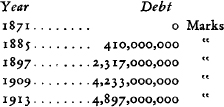
The several states and municipalities also rolled up large debts. The total for all was:
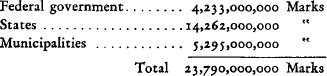
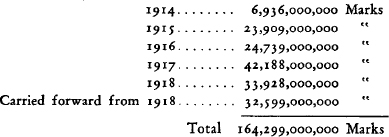
Of this amount 96,929,000,000, or 60 per cent, was borrowed in nine war loans. This was piled on top of the accumulated indebtedness of fifty years.
When the war ended, the republic came into being. It would not be fair to apply to this government between 1920 and 1923 the ordinary rules of fiscal criticism. As it faced its heroic task Germany was best described in the words of Hitler’s former colleague, Otto Strasser: “The past was in ruins, the present shattered, the future without hope.”
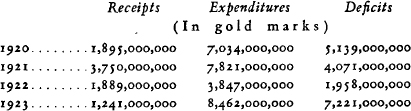
These inadequate receipts were supplemented by the issuance of a floating debt as follows:
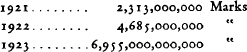
With the collapse Germany went into a profound crisis—unemployment, paralysis of industry, bankruptcy, bewilderment. Gustav Stresemann became Premier. Hjalmar Schacht, president of the Reichsbank, stopped the printing presses, invented a new currency unit—the Rentenmark (equal to a trillion inflation marks)—the Dawes Plan was adopted, and in October 1924 a foreign loan of 800,000,000 gold marks was made to the Reich. Thereupon the country, thus crushed by defeat and inflation, proceeded to stage one of the most spectacular recoveries in the history of business. At the end of the last war America suffered her own moderate-sized depression from 1920 to 1923. At that point we began that amazing upward flight known as the Coolidge Boom or the New Era. Oddly the vanquished Germany, starting almost from scratch just a year later, put on a recovery in many respects even more remarkable than ours, and one which lasted almost the same length of time—until 1929—and ended, as ours did, in a disastrous economic crash.
Where did the money for all this come from? How was it created? What was the secret of this magical increase that appeared so wonderful until the bubble burst? The answer must be that it was accomplished by the use of that same fatal instrument for creating national income—government borrowing. The nation that had been drawn toward a great war by a combination of forces, one of which was its fiscal sins, that saw itself pillaged after that war by one of the most grotesque fiscal disasters in history, now turned once again to the same dangerous weapon. But this time the politicians were supplied with a new theory of national debt by the professors. In the past bewildered ministries had taken refuge in deficits under political pressure. People demand increased spending. Politicians are eager to comply. More expenditures mean heavier taxes. But people resist more taxes. Here are contradictory streams of public desire. Both must be followed. People call on the government to spend while denouncing it for doing so. They cry out for economy but are unwilling to do without the benefits of extravagance. So citizens subscribe to the general virtue of economy and politicians solve the problem of spending more without taxing more. They resort to borrowing. But these old offenders never made any defense of the policy save political necessity. At most they defended it merely as the lesser of two evils.
Here was a combined federal and state deficit over just these five years of 20,801,000,000 marks. Playgrounds, swimming pools, schools, hospitals, and health projects were built and carried on by states and cities with the aid of government financing. Roads—the time-honored extravagance of governments in search of means of spending—were built profusely. Heavy subsidies were paid to agriculture, and great sums were spent on rural resettlement and rehabilitation. States and cities flocked to Berlin with their appeals for funds to restore and overhaul every sort of public and semi-public edifice from museums to post offices.
Arthur Rosenberg in his History of the German Republic (London, 1936) says:
After 1924 the officials lost all sense of the value of money and seemed to believe that money would always be available at any time and in the quantity that was needed for any purpose. Thus it came about that all possible kinds of new buildings and undertakings were embarked upon that were useful and defensible in themselves but were out of keeping with the true economic situation of Germany. In consequence of the general prosperity the Reich government largely increased the salaries of its officials and the state governments and municipalities naturally could not lag far behind.
Rosenberg quotes from a letter written by Gustav Stresemann on November 24, 1927, to Dr. Jarres, chief burgomaster of Duisberg:
I make no secret of the fact that it is above all the policy of the individual states and the municipalities that causes me grave anxiety in the field of foreign affairs. Time and again I have said in my public speeches that it is necessary to distinguish more clearly between reality and appearance. I have no doubt that the will to work in a proper fashion does exist. Nevertheless certain measures have given rise to impressions that do us incalculable harm. The fact that the Prussian state has granted fourteen million marks for rebuilding of the Berlin Opera House and will perhaps make a grant of more than twenty millions in all, creates the impression in the world at large that we are rolling in money. Not a single one of the victorious states has embarked upon such an undertaking. That Herr Adenauer (chief burgomaster of Cologne) has built a marvelous hall, and boasts that it contains the greatest organ in the world, produces the same effect.... The Press Exhibition in Cologne was regarded as the most luxurious affair of its kind that had ever been organized. Frankfort-on-Main was left with a deficit of two and a half million marks as a result of its Music Exhibition. Dresden builds a Museum of Hygiene with the help of a Reich subsidy.... Please tell me what I am to say to the representatives of foreign powers when they tell me of these things awakening the impression that Germany won rather than lost the war. I have no longer any answer to give to these reproaches.
This government spending stimulated private enterprise. And private corporations began to borrow too. Industrial plants, modern stores, mining properties, railroads and utilities, all were built or modernized with funds loaned by the banks. But the banks became overextended. The ratio of bank capital to deposits, which before the war had been four or five to one, became fifteen and twenty to one. Nevertheless, to the outside world here was the spectacle of a resurgent Germany astonishing her neighbors with the swiftness of her recovery. After all, the debt theory was working. Many now forget that while rich America was rollicking in the lush glory of the Coolidge New Era, Germany was basking in the sunlight of her republican new deal.
The magic of the “new economics” worked for a little while—for five years. But in the end the whole thing cracked up. But the apostles of the new economics said their theory had not had a sound test. The trouble lay, they said, with the great external debt imposed by reparations. In a sense this is true. Germany was forced to pay heavy reparation sums to her conquerors. But actually little if any of it came out of her internal revenues. From September 1924 to July 1931 she paid out 10,821,000,000 marks. But the money to make these payments she borrowed from abroad. Loans from abroad totaled, according to Dr. Stolper, some 20 billion marks, or about 18 billions, according to Dr. Angell. In addition around five billion additional marks were invested in German industry by foreigners. It was these foreign loans which became the basis of the credits extended to German industry by the German banks. But the government’s credit at home began to fade as early as 1928 when it was forced to pay 8 per cent for money. But the outside world scarcely dreamed of the extent to which the government was operating in the red.
By this time the country was launched on a full-scale depression with all the familiar scenes and circumstances. Unemployment began to increase. Industries closed their doors and many failed. The banks, which had loaned their short-term deposits on long-term securities to these industries, began to fail. There was a banking crisis. The government declared a banking holiday. It guaranteed the deposits of the great Darmstadter bank, financed its reorganization, and finally forced all banks to become state institutions in fact though remaining private in name. The government forced bank consolidations. As the banks controlled large-scale industry, the nationalization of the banks actually put private industry at the mercy of the government. Dr. Heinrich Bruening, able and incorruptible leader of the Center, became Chancellor. He had inveighed against the irresponsible fiscal policies of the government. But it was too late. Actually it is possible to suggest several courses that would have saved the situation if they had been followed. But it is that fatal if that cannot be expunged from the picture. The courses were not followed because the power of decision to take such courses was wanting. The edifice of republican Germany was crumbling. In two years Hitler would be in power.
The significance of all this lies in its exhibition of the practice of all German governments to use public debt as an instrument of state policy until finally the government which preceded Hitler actually adopted it as a means of creating national income. This it did with the consent and approval of the controlling groups in the society. So that we may say, in view of the surrender of all types of government to this inevitable policy, that it represents a definite stream of opinion and desire in the community—a stream too strong for purely political ministries interested primarily in remaining in power to resist.
V · The Supreme ProjectWE NOW COME to another powerful stream of thought. Probably one of the most completely misunderstood of all modern institutions is militarism. While military organizations take their origin in man’s lust for war, militarism is something more than a mere war machine. By militarism I mean that institution in which the nation maintains large national armies and navies in time of peace, usually raised on the principle of conscription. It cannot be too much emphasized that you do not have militarism until you have the principle of universal military service or some form of conscription in time of peace as a permanent institution of national policy.
Over the past seventy years reformers have fought militarism on the following grounds: (1) that it involves a crushing economic burden; (2) that it draws from the producing mechanisms of the nation great numbers who might be adding to its wealth; (3) that it is an instrument of tyranny; (4) that it is a breeding ground of war.
To the last two propositions there is no answer. But the first two are based on almost complete misconceptions of the most powerful motives back of militarism.
There is another illusion that needs to be dispelled. It is that militarism was the invention and darling of the old Junkers—the Prussian nobles. We will greatly underestimate the danger of militarism if we persist in this error. It has drawn its support from all sorts of social groups. There have been times when it found its chief supporters among the liberals, with the old Junkers actually resisting its expansion. Even socialists have toyed with the idea of militarism. All this will, I am sure, fall upon incredulous ears accustomed to some of the popular perversions of European history.
As time wore on and a great industry grew up around it, the relation of this institution to the economic life of the country became obvious. We have noticed the growing demand upon the government from the indigent and the unemployed and from the swiftly returning crises in industry. And we have seen how the institution of social welfare and the spending of money on all sorts of enterprises enabled the government, by borrowing money, to create income. This income, infused into the blood stream of the nation, vivified industry generally and acted as a stimulant and support of the economic system. But this stratagem, while supplying a temporary stimulus, had the effect of creating a national debt that excited the fears and, finally, the bitter resistance of the tax-paying and investing groups. They will always interpose an impassable opposition to continued public deficits for purely civil enterprises. But they will not object to spending money on armies for national defense. Governments were confronted with this curious paradox; namely, that the most vociferous enemies of unbalanced budgets were also the most willing supporters of expenditures for military power. Statesmen in Germany—and in every European country—found after a while that it was possible to get taxes up to a certain point and borrow funds beyond that for military purposes. And they understood also that money spent on military projects was just as effective in providing supplementary energy to the economic system as funds spent on any other kind of public project. It was those deficits created by vast military expenditures which did for the German economic system what our deficits over the last ten years have done for ours—kept the organization of private business in motion.
The importance of this industry may be judged from the following facts. In 1907 there were 600,000 men in the German Army and 33,000 in the Navy. In addition to these there were about 1,800,000 men in the materials industries, such as mining and metals and forestry and in commerce and trade, whose employment was dependent wholly on the army and naval orders of the German Government. This leaves out of account the number employed in agriculture to feed such persons and the number employed to clothe and house them. Instead of being a burden, therefore, militarism was a great Public Works Administration and Work Projects Administration rolled into one which, with public funds, provided work for a vast army of military men and industrial workers.
It is not to be supposed that this fundamental fact was not known to German politicians but was only discovered recently by discerning Americans. One has but to look through the pages of German public history during the past seventy years to see how it weighed on the consciousness of her political and industrial leaders. The matter was endlessly debated. To critics of army budgets, militarists pointed out that a third of the army expenditures were returned to the taxpayers in some form. The estimate is a modest one. The government industriously cultivated the good will of the farmers from whom they bought vast quantities of hay and grain. But also they made it a special point of good-will policy to pay farmers the most liberal damages for injuries to fields during maneuvers.
This helps in understanding how utterly futile were those feeble appeals for disarmament that preceded the World War, in 1898 and 1907, as well as those made habitually by peace groups since. At these conferences delegates gathered to discuss whether or not Germany and France and Russia—but particularly Germany and France—should dismantle the largest single industry within their borders. The politicians understood this and so did the people, if the simple-minded reformers did not. In 1898, when the proposal for a disarmament conference was sent to the Kaiser, it came back to the Foreign Office with this notation written in the margin: “How will Krupp pay his men?”
Mr. Carr omits the third and most important reason why armament production became the instrument of income production. Peace projects would have served as well. There is always a powerful resistance to public spending and even public borrowing. But it was possible for the statesmen of Europe to break down this resistance when the spending was for armaments. Militarism is a burden as well as a stimulant. But the burdens fell upon unorganized individuals. The benefits fell upon organized groups. And even in a democratic society the unorganized individual is no match for the organized producer. And so unorganized individuals who have to serve in the army and pay taxes had no chance against the organized groups whose very existence was based on militarism—the military caste, the politicians in power, the industries and agriculture which supplied the army and navy, including more than a million workers who owed their jobs to it, the communities which drew sustenance from those industries and the army camps, the farmers who sold hay and grain and food to the armies, and industrialists. Moreover, those who bore only the burden were intimidated by the fear of industrial collapse which would attend the liquidation of militarism and engulf all in its disaster. Over and beyond this was the great opiate of national defense applied to all dissenters. Europe had enmeshed itself in a whole web of slumbering feuds. When a nation embarks upon militarism as a means of supporting its economic life then powerful, active, and vicious external enemies become an economic necessity. The nation must be kept sharply aware of its dangers. War scares are an essential part of the technique of promotion. With these psychological weapons statesmen can extract from their terrified citizens or subjects consent for military outlays when it would be utterly impossible to do so for peacetime enterprises however worthy. And best of all, the most powerful and vocal of all enemies of public spending—the conservative groups—can be drugged with the fears of external—and internal—aggression.
VI · The Planned SocietyFor years employers in pre-Hitler Germany fretted in the harrowing illusion that they produced too much, that they competed too savagely, that they cut one another’s throats, and that overproduction wrecked them all. They devised various ways of combining to eliminate these evils as well as to present a united front against their rapacious workmen. In Germany, as in Italy, combinations were regulated and legalized. The cartel, which originated in Germany, was nothing more than a trade agreement between business rivals to control prices, production, sales policies, quotas, territorial rights. Dr. Gustav Stolper quotes Professor Kleinwächter, an Austrian economist, as saying that the cartel was the “pioneer foundation of a state-controlled economy.” The cartel was an attempt by producers to plan the economy as it affected their product. It could be but a step to substituting the state-organized and supervised cartel for the private one.
The German banks did their bit. The German bank was not precisely like the American. It used its deposits to buy outright shares in industrial and utility corporations. It was a combination bank and investment company. As these banks accumulated vast blocks of shares they became in fact holding companies. As banks amalgamated, their power over industry widened, and their capacity to control and plan it was increased. The German states also owned mines, forests, railroads, power plants, utilities, industrial enterprises. Thus the whole fabric of German enterprise was enmeshed in numerous mechanisms of control—some by the state, some by banks, some by cartels.
Labor, of course, subjected industry to its controls through organized pressure. In Germany, as in Italy, labor and socialism were closely intertwined. And here, too, socialists were deeply implicated in the doctrines of syndicalism. The official party program did not countenance it but, just as in Italy and France, the idea of the syndicalist society as distinguished from state socialism was making headway among the rank and file of the party. In substance the syndicalist believed what the cartelists believed—that the industrial group must be subjected to government and to government of the producers. The cartelists looked upon the employers as the producers; the syndicalists looked upon the workers as the producers. Both shied away from government of industry by the state; both believed in self-government in industry. But were they, in fact, so irrevocably far apart? What was the owner interested in? The security of his investment, the permanence of his profits, continuous operation free from depressions, protection from excessive production and cutthroat competition. What was the worker primarily interested in? The security of his job, the permanence of his employment, and a full share in the product of his labor. Both believed that the producing industry should be a monopoly. Was it wholly unthinkable that men who held these views among employers and workers, under stress of calamitous economic disturbances, might not find a common meeting ground?
Mixed up with all this was a concept of government equally decadent, since it represented the struggle of the baffled capitalist pragmatist to save a part of his capitalist target by amalgamating it with the socialist torpedo. Just as the pinks attempted to unite socialism and capitalism in a companionate marriage, men like Walter Rathenau, Foreign Minister in the republican government, toyed with the idea of uniting autocracy and democracy. There must be a democratic base to society. That is, somewhere down at the bottom, spread out as the ultimate but remote power, is the people. But the superstructure of government built on this proletarian mass must be an autocratic administration, built on the principle of hierarchy. The instrument of this aristocratic autocracy would be an elite. Rathenau had undoubtedly been fiddling with Pareto’s idea of the circulating elite. The elite would run the show—supply the officers of the social hierarchy as it did to the military hierarchy. The masses would be shorn of their power by this political elite just as the army of businessmen would be shorn of their power by the intellectual bureaucracy that would relieve them of the drudgery of making decisions about their affairs.
Wherever these new socialist-capitalist intellectuals bobbed up with their remedies, these took the form of what they called planning. The very word “planning” is blown full with double meanings. No intelligent mind can suggest a reasonable objection to planning for any human institution, including the capitalist system. To one this will mean that the reasonable man will look over that system, locate its faults, ask what are the special factors of life in the system, where and what are the glands which supply it with its vitality, what exhausts and enervates them at one time and surcharges them with unhealthy energy at another. Having answered these questions, he will ask what arrangements ought to be made to make this system function at its highest possible capacity for human good. But this is not the meaning in the idea of “planning” as the word is used by the new school of national socialist planners. With them planning is a continuous function of government. It means blueprinting the structure of every man’s business, charting the course of every industry, centering in great government bureaucracies the initiation and direction of every economic mechanism, making decisions about the behavior of every businessman and every business group flow across a desk in the capital.
Bruck, in his Social and Economic History of Germany, expresses the opinion that the first step toward the final disaster was made by Walter Rathenau. Rathenau was head of the AJlgemeine-Elektrizitäts-Gesellschaft, the leading electrical company of Germany, and was given to philosophical rumination on the economic condition of his country. When the war began he was put in charge of the organization of Germany’s industrial front. He began his work in a small room in the War Office where he and his colleagues began to group the various economic categories essential to the war effort. They began with iron and steel, and little by little almost every important branch of industry was formed into organized bodies under the supervision of the government. Complete compulsory cartels were created. The organization, beginning in a little office, quickly proliferated, spread out until it occupied whole blocks of buildings. Here was a comprehensive cartelization of industry regulating prices, competition, products, qualities, territory—every phase of production and distribution. Here, in fact, was the planned economy actually in effect. It was, therefore, no longer a question whether Germany would have such a thing. She had it. The question was whether she would cease to have it when the war ended. And when the war ended, Rathenau, a leader of the conservatives, wrote:
From the ruins will arise neither a Communist State nor a system allowing free play to the economic forces. In enterprise the individual will not be given greater latitude; on the other hand individualistic activity will be consciously accorded a part in an economic structure working for Society as a whole; it will be infused with a spirit of communal responsibility and commonweal.
When the old imperial government collapsed with Germany’s defeat, the republic was established after a brief interval with the adoption of the Weimar republic. And now we find the republican socialists and liberals toying with these same ideas. The constitution itself, though the socialists did not have a majority in the Weimar assembly, had a socialist tinge. And the new government began straightway to try its hand at some experiments in planning. It amounted to a legalization of the principle of cartelization which had always been strong.
In the disorder following the collapse of the imperial government, workmen’s councils operated in Germany. Under their influence the constitution recognized this institution as a permanent sector of business. Wage earners were entitled to be represented in workers’ councils organized in each local enterprise as well as in district councils in each economic area, all united in national workers’ councils. These workers’ councils were to meet representatives of employers in similar groups. Here was an organization of industry into shop, district, and national councils, with employers and employees represented, under the supervision of the government. Drafts of laws touching social and economic policy had to be submitted by the government to the national economic council before such laws were introduced into the Reichstag. Moreover, the council could itself propose laws to the Reichstag. Benns, commenting on this, observes:
Here was the principle of syndicalism grafted upon a capitalist society. This is what Mussolini was talking about several years later when he proceeded with his corporative state idea. Mussolini then talked the same language as these German republicans because Mussolini was a syndicalist and these German socialists and left-wing liberals were deeply touched with the philosophy of syndicalism. This was the beginning of organizing the society along craft lines rather than geographical lines or at least to provide a double type of parliament—one an economic and the other a political parliament. The radical groups put into writing in the constitution what the conservative Rathenau was talking about in vague phrases.
Rathenau, however, made a substantial contribution to this development. As chief of the War Raw Materials Office, he founded a series of mixed companies—that is corporations in which the government and private industry were partners. These mixed public-private partnerships were permitted to continue after the war. Fritz Thyssen, later to become a financial backer of Hitler, speaks with approval of a kind of industry found in the Rhenish-Westphalian electric works, where the shares were owned partly by private capital and partly by the communes which took their power from these companies, but where the management was in private hands, with the community represented on the directorate. Thyssen, steel magnate and ultra-conservative, says of this:
One argument in later years for this system was that this gave the state all the advantages of ownership without the dangers of management of many industries which would result in the creation of a vast state bureaucracy. The Hitler regime was especially attracted by this scheme and it became an integral part of its whole economic policy. Like everything else it did, however, the whole system and all its techniques were forged for it by that strange collaboration of conservatives and radicals, which must ever remain one of the most singular phenomena of these times.
The Weimar republic invaded the banking field. It organized the Reichskreditgesellschaft. It operated on the same model as the private banks and quickly rose to the rank of the Big Four and finally gave the state dominant position in the banking field. The government owned, as a legacy of the war, enterprises of various kinds. These were transferred to government-owned corporations in which the government held stock through a great government-owned holding company known as Viag (Vereinigte Industrie Aktiengesellschaft) with which was combined the Reichskreditgesellschaft to finance them. By 1926 it is estimated there were 1,200 cartels operating in the Reich. The government was struggling to create a balance between industrial and farm prices—parity—and to this end adopted import and export quotas and embargoes, state monopoly of corn, state purchase of farm supplies, and many other types of regulations of agricultural credits.
Labor laws followed much the same pattern. The republic organized mediation in labor disputes and shop councils. Before the war labor contracts were private. Under the Weimar republic collective bargaining was recognized as an institution in the public interest. Free unions were distinguished from yellow unions (yellow unions being company affairs). Finally, mediators could intervene to force compromise and could issue decisions which, if accepted by one party, were binding on both. This, begun in the interest of the worker, became more and more the rule, gradually breaking down collective bargaining, which remained largely as a fiction. Stolper observes:
Private industry suffered much the same fate. For years the German Government had been slowly evolving as the superintendent of a state-coerced industrial system. Dr. Angell points out that at first the capitalist entrepreneur controlled. Then the bank, a powerful central agency acting for large masses of capital, exercised control. With the war the government took over this function and the Weimar regime embedded the principle in the institutional structure of the state. The politicians became preoccupied with the problems presented by big business on one hand and labor on the other—and the little businessman got lost in the shuffle.
The aim in which Bismarck had failed was accomplished almost at a stroke in the Weimar Constitution—the subordination of the individual states to the federal state. The old imperial state had to depend on the constituent states to provide it with a part of its funds. Now this was altered, and the central government of the republic became the great imposer and collector of taxes, paying to the states each a share. Slowly the central government absorbed the powers of the states. The problems of the individual states and communities, the problems of business groups and social groups were all brought to Berlin. The republican Reichstag, unlike its imperial predecessor, was now charged with the vast duty of managing almost every energy of the social and economic life of the republic. German states were always filled with bureaus, so that long before World War I travelers referred to the “bureaucratic tyrannies” of the empire. But now the bureaus became great centralized organisms of the federal government dealing with the multitude of problems which the Reichstag was completely incapable of handling. Quickly the actual function of governing leaked out of the parliament into the hands of the bureaucrats. The German republic became a paradise of bureaucracy on a scale which the old imperial government never knew. The state, with its powers enhanced by the acquisition of immense economic powers and those powers brought to the center of government and lodged in the executive, was slowly becoming, notwithstanding its republican appearance, a totalitarian state that was almost unlimited in its powers.
Germany, under the republic, was not moving toward the socialist idea of state ownership, but rather toward the syndicalist idea of the organization of society into economic provinces, with property privately owned and regulated tightly by private cartels—in a few of which labor was represented—but all under the paternal supervision of the government. But it was under the supervision of the political state which the old syndicalists abhorred. The state, as Sorel had predicted, with its powers enhanced by the acquisition of immense economic powers, was becoming a totalitarian or despotic state.
VII · Machiavelli’s MenIN ALL that has preceded this the economic factors have, perhaps, been unduly emphasized. This is owing to the fact that in the last two years the tendency has been to ascribe all that has happened in Europe to an explosion of human wickedness, and it has seemed necessary to bring the economic factors back to their place in the picture. Many diverse forces, of course, influence the course of human events. In other periods of social change different social energies have in turn exerted a dominating influence—religion, politics, dynastic ambitions, waves of moral disease or resurgence. In the present era doubtless it has been the economic disorder which has been predominant. But it is not the only one. This era may perhaps be compared to the long period that marked the end of feudalism and the rise of capitalism. Society seems to be struggling toward some new form of economic organization. Whether or not modern capitalism is in its death throes, as so many assure us, I do not undertake to decide. But certainly the economic society which we somewhat loosely term capitalism is passing through a crisis now which may be the culminating crisis in a long series of convulsions of increasing intensity. It may, in a sense, be described as a period of economic decay, presenting all the symptoms of anemia and general debility. Such a period makes a rich breeding ground for other parasitic diseases of the spirit, which have nothing essentially to do with economics, but which thrive in the soil of economic distress.
I have already referred to Ortega’s theory of the revolt of the masses. The nineteenth century, he maintains, had produced a new man and infused into him formidable appetites and growing means of satisfying them. These include social, political, economic, and technical instruments that armed him with a new efficiency in his struggle with nature. His inability to use these instruments as successfully as he hoped has produced in him a quality of “indocility.” Docility and indocility—these are the words which describe the difference between the masses of the eighteenth and those of the twentieth century.
Against these expectations of the masses, the failure of their organized societies to realize them stands in dark and menacing contrast. The unwillingness of the masses to submit to this failure led to a serious loosening of their adhesion to the political principles of government on which these societies were based. Impatience grew to exasperation and to a search for some other instruments of social control better adapted to their appetites. Losing faith in an order of society which had once seemed everlasting and which had promised such rich harvests, they have lost faith in many other ideas and doctrines to which, in their former docility, they clung. The minds of men are now open to all sorts of doctrinaires, promisers, evangelists of the good life. There has been a weakening of the normal and routine inhibitions of the old order.
It has been suggested that we are witnessing a revolt against culture. I am not prepared to admit that there has been a revolt against culture. There is at present, it is true, a vast social upheaval which is the result of the failure not of our culture, but of the arrangements we have made for managing our society.
In societies great masses of men are moved by a deeply rooted desire for quiet, orderliness, routine, the undisturbed round of the day’s duties and distractions, the habits of the seasons, the succession of feasts, and for security. Generally they want to be left alone, whence arises the seemingly paradoxical surrender to public disciplines on what might be called the whole range of traffic. This they look upon not so much as coercion of themselves as a restraint upon others. Having no wish to walk on the grass or drive to the left or to offend against any of the generally accepted understandings that enable large numbers of people to live in a limited space without bothering one another unduly, they are willing that the law should restrain those who itch to defy these arrangements. This trait is found in all urban populations and, of course, nowhere so much as in Germany. There some apologists have explained the German’s tolerance of the ubiquitous verboten sign as a form of the German’s peculiar desire for freedom, for these disciplines leave all who are willing to follow them free from annoyance by the minority that would rebel against the rules. There is something to be said for this. But it can become too much a habit of the spirit, a rule of behavior that after a while may subdue the mind to excessive regulation. When, therefore, governments extend too far their disciplines or fail in the generally accepted objectives of government, the mass of men will remain docile for a long time. However, in Germany their docility was deeply ruffled. This yearning for order restrained them for a long time from overt acts of resistance. The revolt was a revolt of the spirit. It roused their minds against the government, not their hands. It took the form of a slow but progressive loss of tolerance and a deepening suspicion of existing institutions.
Moreover, the war had wrought darkly upon the minds and hearts of many. Sigmund Neumann, pursuing his thesis of permanent revolution, sees the basic faith of the era of liberalism in the ultimate goodness and improvement of mankind profoundly shaken by the war. Four years of war had bred the cult of violence. The heroic virtues became popular. Moral anarchy reigned. Why not? The so-called Christian virtues of humility, love, charity, personal freedom, the strong prohibitions against violence, murder, stealing, lying, cruelty—all these are washed away by war. The greatest hero is the one who kills the most people. Glamorous exploits in successful lying and mass stealing and heroic vengeance are rewarded with decorations and public acclaim. You cannot, when the war is proclaimed, pull a switch and shift the community from the moral code of peace to that of war and then, when the armistice is signed, pull another switch and reconnect the whole society with its old moral regulations again. Thousands of people of all ranks who have found a relish in the morals of war come back to you with these rudimentary instincts controlling their behavior while thousands of others, trapped in a sort of no man’s land between these two moralities, come back to you poisoned by cynicism.
One finds numerous men of this stamp among the rank of the endowed—the academicians, the sons of the rich, the eternal secretaries of foundations and institutes. Removed from the sordid details of money-getting, with leisure to ponder the woes and dreams of the world, holding themselves above and apart from the hard, pragmatic necessities of balancing either a commercial or a community budget, they come to think of themselves as the excellent men of the world, as having a peculiarly enlightened insight into its ways. They develop the itch for world-remolding and work endlessly at the job. In periods of distress they come forward to replace the practical men, who, knowing little of the anatomy of society and the mind, move as complete pragmatists. In moments of crises they go tumbling to the centers of power with their doctrines, their formulae, their programs, blueprints, and all. They swarmed to Berlin when the last war began, and they remained to take over the vast bankruptcy that was left when it ended. Never in history have they been basking in such a paradise as now.
But it is not only the excellent men who come running to the center of things when mischief is afoot. There are what Spengler calls the cosmic men—wholly different from the idealogues. They are a breed upon whom the harness of civilized life sits with discomfort. They are men who, as Spengler says, are “tired to death of money economy.” Such men “hope for salvation from somewhere or other, for some real thing of honor or chivalry, of inward nobility, of unselfishness and duty.” All the grand events in history are carried forward by beings of the cosmic order. Roll the war drum and every soul among them thrills, just as every A string on a harp vibrates when you sound the tuning fork. D’Annunzio inflamed the minds of the Italian youth as he flung incendiary slogans at their restless minds and summoned them to repeat the glories of antique Rome. Germany was well supplied with men of this stripe—so numerous that they need not be named—who lamented more than any other damage done to the fatherland the extinction of the army and the end of that channel to glory. Germany nurtured these types in the disordered years up to 1924. They went into temporary eclipse during the great boom up to 1929. As soon as the bones of the state carcass began to show again, they appeared once more full of the noblest sentiments and the most ardent philosophies and the most glamorous plans for updoing the world and re-creating the glories of Germany. They were, in fact, more numerous than ever, for a whole new generation was back from the battlefields heartbroken at the humiliation of the fatherland and now had planted in their hearts the dream of glorious revenge—of the day when Germany’s great legions would march again and would turn upon her enemies and re-establish her ancient glory.
They believed that war is the natural condition of men, that militarism is the perfect institution because it is the framework of the knightly life, and that imperialism is the natural enterprise of great spirits and the logical basis and occasion of war. Without war men will rot. All they ask is that the war shall have a noble purpose. It may be the spread of religion, the white man’s burden, the nation’s honor or, by a peculiar paradox, war to end war—a noble and glorious and righteous and civilizing war to end that evil institution of war without which men will rot. No matter what the cause, even though it be to conquer with tanks and planes and modern artillery some defenseless black population, there will be no lack of poets and preachers and essayists and philosophers to invent the necessary reasons and gild the infamy with righteousness. To this righteousness there is, of course, never an adequate reply. Thus a war to end poverty becomes an unanswerable enterprise. For who can decently be for poverty? To even debate whether the war will end poverty becomes an exhibition of ugly pragmatism and the sign of an ignoble mind.
Germany had her squadrons of poets and philosophers and professors to perform this service. And they would not seem, if you were to meet them, very different from the tribe anywhere else in the world—scholarly, full of the milk of human kindness and reasonableness, love of order, and concern for the basic virtues of civilization. In England it could be such a soul as John Ruskin, endlessly weeping over the sufferings of the poor while summoning the young men of Oxford to go forth and conquer all the lands they could lay their hands on. Or it could be so great a lover of order as the London Times which, before the last war, bemoaned the long peace. “This nation,” it said, “is a good deal enervated by the long peace, by easy habits of intercourse, by peace societies and false economies (on the army). It wants more romantic action to revive the knightly principle.” In Italy the doctrine would find its evangelists among literary men by the score, and these would include her two foremost scholars and her foremost poet.
There is another batch, not so numerous, but more dangerous -perhaps. They are the men who yearn for power. The opportunity for them to attain power is not always present. And the conditions favorable to one man may not suit the peculiar talents of another. Always there are men of the Mussolini or Hitler stripe present in all societies. But they require the proper conditions for their emergence. It is entirely possible that neither Hitler nor Mussolini would have reached to more than local eminence, and then as public nuisances, had there been no World War I. The cultivation of this evil crop of lawless hunters after power has been ascribed in large measure to the spadework of men like Machiavelli, Nietzsche, and Spengler, especially Machiavelli, who is hailed as the founder of an ever-growing school. But the importance of the Florentine philosopher—as well as the German authors of Zarathustra and Decline of the West—is a good deal exaggerated. The power-hunters did not need Machiavelli or Nietzsche to tell them there was a moral code for the herd and another one for them. Corrupt leaders in New York, Chicago, Kansas City, or Philadelphia in our own day—and throughout history—most of whom never heard of Machiavelli, operate on this principle. They do not recognize the moral law as binding on them. They lie, cheat at elections, graft, bribe voters, and employ violence wherever it will produce results, and feel no need to hold down their heads while doing so. What is more, the people clothe their behavior with a kind of tolerance. They are welcomed in the most respectable circles, sit in the front pews at church, are fawned upon by pastors, and collect for themselves rich majorities at successive elections. Had Machiavelli never lived and Nietzsche been consigned earlier in life to the asylum before he invented the myth of the superman, these ward lords in America and war lords in Europe would have gone their several ways.
It is beyond doubt that Mussolini must have read with glowing pleasure, as indeed he did, the philosophies of Machiavelli and Nietzsche which ran so perfectly with his own concepts of virtue. As for Hitler, he doubtless never read either. There had been going on for a long time a slow erosion of morals, and it may well have been that the frank avowals of the Machiavellis and Nietzsches encouraged the devotees of the new laxity. It must have fallen like a stimulating balm upon the dreams of many a moral outlaw in search of power at some level of the hierarchy to discover that a great Italian savant and a distinguished German philosopher and poet had taught that there was a separate and convenient morality for them as distinguished from the herd.
VIII · WarMY AIM has been to show that Germany, like most European countries, had been for forty-four years preceding the war subject to certain defects seemingly inherent in the economic system; that during those years the nation grew in prosperity and wealth but, despite this, poverty remained in large areas and the whole system was subjected to depressions at frequent intervals. Coincident with this was a growing revolt of the masses which consisted, not in any revolutionary episodes, but in a spiritual discontent and a questioning of the wisdom of leaders and the soundness of the parliamentary structure. Throughout this period ministry after ministry, struggling with the economic and political problems growing out of these conditions, fell into the practice of following certain settled principles of action, and these principles of action were arrived at by a long period of acquiescence in the demands or tolerances of the people. These we have described during the period of the old imperial government as follows:
1. The policy of state debt and spending to supplement the income of the nation and create purchasing power, done haltingly and with misgivings. No matter what kind of ministry was in power all followed this practice because, despite the misgiving, the public demanded results which could be obtained in no other way and was willing to tolerate the practice.
2. There was a settled approval of the policy of the philanthropic state which undertook to quiet the opposition of the indigent through measures of social welfare. No government could have existed that had cut the social-welfare services or those other government services made possible by government borrowing. Hence ministries which did these things ran with and not against the stream.
3. Originating in the aristocratic support of the military caste, pushed further by the general situation in Europe and the demand of the business world for armed might as an ally of foreign relations and by the dreams of the devotees of the knightly spirit, militarism became the greatest economic prop of the existing order, the great and glamorous public-works project of the empire, which withdrew great numbers from the unassimilable labor pools and supported a gigantic industry with public funds. Because of a variety of interests, but chiefly because of the economic interest, militarism had the support of the nation.
4. The old Bismarckian policy of an integrated German empire in Central Europe and an avoidance of the institution of colonial adventure was forced to give way before the growing ambitions of the empire. Militarism could be supported only by a continuous propaganda based on fear and on glory.
5. Next was the widespread demand from every section of the populace for regimentation and control of the economic system, including the principle that control should be exercised by producers in the interest of producers. This led to a widespread belief in, or tolerance for, the idea of corporativism.
6. Along with this went the rising loss of faith in the parliamentary government. This did not comprehend the whole mass of the people but infected large and influential portions of them.
As the years 1913 and 1914 came down on the empire, it was facing the consequences of these policies and opinions—the debts had risen to critical proportions, the demands of the poorer groups were becoming louder, the need for more conservative spending policies was evident, yet this was impossible because the necessity for a great military establishment had been embedded in the popular mind by propaganda, while any cut in military expenditures would have meant an increase in unemployment. The gathering difficulties of industry were pushing the country in the direction of still more extensive efforts at control. War in the Balkans had unsettled affairs in Europe. Great shortages of capital resulted in a disastrous decrease in new enterprises. Government bonds could find no buyers. Bavarian and Westphalian manufacturers were discharging their workmen, unemployment was spreading, and living costs were rising. All the problems of forty years—debt, the capital-labor struggle, the demands of the indigent, unemployment, the cost of militarism, and the ambitions of the imperialists were at climactic levels. Into this disorder—which could have been paralleled in every continental country—a Serbian patriot fired a revolver and set in motion a series of swift events which ended with the Great War and the final defeat of Germany in November 1918.
The war over, a republican government succeeded the imperial one. Thereafter the same forces went to work—the old debts, the struggle between labor and capital, the unemployment, poverty—all many times multiplied by the war. And then the republican government proceeded to do what the old imperial government had done—continued in debt until the vast bubble burst, after which, starting out free of internal debts, it proceeded to create more deficits and debts to create national income, to install more extensive social-welfare institutions, and to extend the mechanisms of regimentation and control to the economic system.
Militarism—not merely Germany’s greatest industry but the industry that was the medium for government spending—was banned by the Treaty of Versailles, which also ended her policies of imperial aggression, though it did not liquidate all the dreamers. The republic did create more democracy rather than less and established an authentic parliamentary government which, alone of its policies, ran counter to a very large section of public opinion. In short, the great streams of opinion and desire remained unchanged by the war save that they were intensified and the effort of the government to comply with them was also intensified.
IX · HitlerWE ARE NOW ARRIVED at the point at which Adolf Hitler makes his appearance on the crest of those deeply running streams we have been describing. Hitler began his career as a political leader in 1919. What was his philosophy? What were his aims? What statement of principles is available as he began?
A national assembly had met at Weimar in February and framed a republican constitution. The socialists had twice as many in the convention as any other party, but they did not control the assembly. They did, however, impart a socialist tinge to that document. They elected a socialist, Friedrich Ebert, as President. In the midst of this Kurt Eisner, socialist Bavarian Premier, was assassinated by a nationalist officer, a Soviet government was proclaimed in Bavaria and put down by the conservative Free Corps, the constitution was accepted by all of Germany, and a socialist, Bauer, was named Chancellor of the republic. The Red terror was frightening the souls of the conservative groups of Germany. Bela Kun headed a Red government in Hungary, the communists were organizing, plotting, threatening everywhere. Munich, after Eisner’s murder, came into the hands of the conservatives and the city became thereafter the center of reactionary activities. It was, however, ablaze with agitation. Unemployment was widespread, food scarce, prices high. Little groups of all shades of opinion were meeting in beer halls and haranguing listeners on street corners. The Free Corps—volunteer roving bands of soldiers under adventurers of various sorts—were numerous, combining military and political ambitions. At this point Hitler began. Stationed just outside Munich with his regiment, he was assigned to collect information about several of these groups. He ended by joining one of them. It consisted of a handful of men who met in a little beer hall and called themselves the German Workers’ party. The first seeds of this agitation, which was one day to split the world, were planted, with a strange irony, by an organization known as the Association for the Promotion of Peace. Thus sponsored, a branch was formed in Munich in 1918 by a locksmith named Anton Drexler. It did not go far, and on January 5, 1919, while communists in Berlin were rioting to overthrow the Ebert provisional government, Drexler reorganized his group into the German Workers’ party. The chief figures in this diminutive movement were Drexler, an engineer named Gottfried Feder, a professor named Dr. Johannes Dingfelder, a journalist named Karl Harrer, and a young reporter named Hermann Esser. Hitler was the sixth man to become a member. With the exception of young Esser there was nothing vicious about these men. Oddly enough there was no very tight agreement among them on doctrine. Each seemed intent on his own brand of social medicine and willing to go along with the others provided they did the same by him. Drexler was a more or less futile, confused person, whose chief fixation was a hatred of labor unions because they had inflicted some injustice on him. Feder, an engineer, had come to the conclusion that the woes of capitalism were traceable to the institution of interest. He expounded the theory that there were two kinds of capital—productive and speculative. To all who would listen he would preach the gospel of “breaking the bond slavery of interest which is the steel axle around which everything turns!” His grand remedy was to nationalize the banks, institute state ownership of land, and substitute the German for the Roman law, and he worked out a theory of money—which was inevitable—a kind of printing-press currency that came to be known later as Federgeld—feather money. He was the precise duplicate of innumerable men of the same stripe and character who may be found in this country at any time.
Dr. Dingfelder was a gloomy philosopher who foresaw nothing less than the downfall of human nature through the failure of production and who was fond of picturing in dark colors the final dreadful catastrophe when Nature herself would go on strike, her fruits growing less and the rest devoured by vermin.
Karl Harrer, the journalist, was a moderate man, who did not like the talk he heard against the Jews. Hermann Esser, on the other hand, a precocious philosopher, was a valiant Jew-hater and harangued small groups on street corners with a confused mixture of anti-Semitism and socialism. Here was a nondescript flock which, with no common philosophy and, while neither wicked nor deranged, was quite as dangerous because of its ignorance. Its members were the type usually described in this country as crackpots. They mustered recruits. There was a definite socialist tinge to their councils and the recruits were mostly socialists or ex-socialists or syndicalists in search of some similar banner. The group could have been duplicated in a score of other spots in Munich. There was no man so poor that he might not found, like Anton Drexler, the locksmith, a political party. The others, however, lacked what the German Workers’ party had, and that was Adolf Hitler.
What was Hitler’s contribution of doctrine to all this? It amounted literally to nothing. His social program might be summed up as follows: That the socialists were scoundrels, the Jews scoundrels, the German race is the greatest race, the Versailles Treaty must be destroyed, Germany’s army must be restored, the Social Democrats must be driven from power.
But all this has little to do with social organization or solving the problems of Germany at that time. It is doubtful if he had any other views than such as might pop up from time to time. In Mein Kampf he confesses that he had rather liked social democracy. “The fact that it finally endeavored to raise the standard of living of the working class—in those days my innocent mind was foolish enough to believe this—seemed to speak rather in its favor.”1 But it is clear that he did not associate Marxism and socialism and really knew little of either. His mind was preoccupied with the reconstruction of the German Army, which he worshiped and which he described as that “army whose organization and leadership was the most colossal affair which the earth has ever seen so far.”2 In the defeat of that wondrous instrument of power he had beheld the impossible and his mind, overpowered by the catastrophe, was filled with hatred of those who had done it. And he believed that the job had been done by the people at home led by socialists and Jews. He drew from the miscellaneous army of people around him his first faltering conviction—Feder’s “interest-bondage” theory, the nationalization of the banks, and state ownership of land. In time the German Workers’ party decided to change its name to the National Socialist German Workers’ party. Its leaders drew up a program of principles which became the famous Twenty-Five Points, a meeting was held, and Hitler read these points to the small crowd. These “points” remained for a number of years the official program of the National Socialist party. It is very important to examine them and to perceive how little resemblance they bear to the ultimate policies of that party.
The points included in this program may be divided into three categories—political, military, economic. They are presented here not in their original order but in the groups named:
Political— Abrogation of the Treaty of Versailles.
All Germans must be included in the same state.
Citizenship in the state for Germans only.
No further admission of non-Germans.
Forcible emigration of all newcomers since August 1914.
Living space for the German people.
The rights of all citizens shall be the same.
A stronger central government—under control of the central parliament.
Military— Return of a national instead of a professional army.
Economic—Confiscation of war profits.
Taking over of all trusts by the state.
Abolition of all unearned incomes.
State share in profits of all large industries.
Confiscation of lands for all purposes without compensation.
Relentless measures against usurers and profiteers.
Bigger and better old-age pensions.
In the political section of this program there was nothing in violent collision with the widely held views of many powerful groups—particularly the nationalists and conservatives—and these views the National Socialist party continued to hold to the end, save the right of all citizens to equal rights and the institution of parliament as the agency of central control. Hitler substituted the idea of the elite and the idea of the hierarchial leader for the principles of equality and parliamentary government. The ideal of a German national army again also had deep roots in Germany and represented no departure from traditional thought. The economic section of the platform, however, was predominantly socialist and, despite the character of the new constitution and the semi-socialist regime then in power, could not have been adopted without a tremendous struggle against the opinions of several powerful minorities—too powerful to be overthrown.
At this period Hitler was a mere amateur in revolutionary technique as compared with Mussolini when he began. While he adopted the platform, his interest was not in its doctrines so much as in the instrument that had come into his hands as a means to power, which distinguished him from his colleagues who were wrapped up in their doctrines. But he did not yet understand how he should or would shape his course in that pursuit. He denounced German parties for cooking up platforms to suit all sorts of people and announced boastfully that he was always ready to make a front against public opinion and that the National Socialist party “would never become a bailiff of public opinion but its ruler.” This, however, is precisely what the National Socialist party did.
New and more capable converts to the party began to arrive and to shoulder out of the way the smaller persons like Feder and Drexler—men like Roehm, Gregor Strasser, Hess, Julius Streicher, Rosenberg, Goering and Goebbels. Strasser, Roehm, and Streicher were socialists. Goebbels had a pet peeve—the war profiteers. Goering was a pure adventurer and nationalist. Hence for a while the party kept to its socialist trend. But Hitler was not too pleased with this. He was himself no socialist. And so, as he sought support from the conservative and military groups, he offered his definition of the word “socialist” as used in the party’s name. “Whoever,” he said in Mem Kampf, “is prepared to make the national cause his own to such an extent that he knows no higher ideal than the welfare of the nation, whoever in addition has understood our great national anthem, Deutschland, Deutschland, über dies to mean that nothing in the wide world surpasses this Germany, people and land, land and people—that man is called a socialist.”
In 1923 he was jailed for his part in his ill-starred beer-hall Putsch. He had plenty of time to think things over and to discuss affairs with fresh recruits. Otto Strasser says that when Hitler emerged from jail he was a changed man. Originally dedicated to the idea of violent revolution, he now determined to proceed by strictly legal means. And then also he began to cultivate closer relations with conservative groups. Dissension began to boil up among his diverse groups of supporters. Otto Strasser asked him what he would do about Krupp’s if he attained power—would he leave it alone or not. “Of course I should leave it alone,” he replied. “Do you think I am crazy enough to ruin Germany’s greatest industry?” The word “socialist” in the party name made it possible for many old social democrats to transfer their allegiance to Hitler without seeming to betray too much their old cause. But now the Social Democrats were no longer exercising so large a share in the government. Germany was on the way back to prosperity. Hitler became aware that he must find his strength somewhere else. Fellows like Feder and other Nazis in the Reichstag were offering bills about “the bond slavery of interest,” etc., but no one seemed to pay any attention to this. Indeed this is a remarkable feature of the whole course of these democratic revolutionary movements. The items of the program seem to count little. The general promises and the party stratagems and the show put on by the leaders count more. Giolitti said he owed it to Mussolini not to be too much concerned with the programs of such leaders as with their tactics. Hitler found that the fight on the Jews had brought him some very influential elements. Erika and Klaus Mann observe that “there was something frightening at the swiftness with which the bar and the medical societies recast themselves to exclude Jews.”3 His relentless battle on all that was summed up in the word “Versailles” was bringing to his side great numbers of businessmen. Germany had gone through the inflation and was now prosperous, but great numbers of businessmen believed that the reparations burden would ruin Germany again. Big business finally moved over to his side. But it was the last convert. Fritz Thyssen made up his mind to back Hitler. He came to this conclusion when the Young Plan was before the country. He tells us he was convinced of the necessity of uniting all parties of the Right against it. And it is interesting to find him classifying national socialism, filled as it was with old socialists like Strasser, Kock, and Streicher, as a party of the Right. With the collapse of business, the Young Plan, according to Thyssen, was the principal cause of the upsurgence of nationalists. And Hitler rode that wave vigorously. Thyssen advanced money to buy the Brown House—the Nazi headquarters—and later contributed a million marks to the party. He introduced Hitler to the entire body of Rhenish-Westphalian industrialists. All the old theories about confiscation of war profits, taking over trusts, ending unearned incomes, confiscation of lands, state sharing of profits of big corporations, were discarded. National socialism had become precisely what fascism was in Italy—a full-fledged organism for preserving and maintaining the system of modern capitalism. Despite all Hitler’s talk about molding public opinion, public opinion had molded him. He did what the old parliamentary leaders of Italy and Germany had done. He searched out the great streams of opinion and desire and demand in Germany and he ran with them, not against them. He ended by getting power when Hindenburg summoned him to be Chancellor of Germany on January 25, 1933.
Once Hitler was in power the moment for mere promises was over. He had to deliver. He had denounced Bruening for the rising unemployment and the whole republican regime for its spending and debts. Now he had to end unemployment. But he had no plan. He had to resort at once to the time-worn device that had been used by Pericles, Augustus Caesar, Louis XIV, Bismarck, Giolitti, and the republican parliament of the Reich. He had to spend money and borrow what he spent. And he had to pretend that all this was quite new and novel.
He spent vast sums on all sorts of things. He outdistanced his neighbors in looking after the submerged tenth. He launched projects to create work. He spent money on projects to increase the birth rate, improve health and reduce crime, on schools, roads, railways, playgrounds, house-building projects, home repairs, farm subsidies, and even on his widely publicized scheme to enable Germans to enjoy at low rates excursions of all sorts. Then after 1935 he launched his grandiose schemes of militarism with the restoration of conscription and a great program of armament building. Some of the money was raised, of course, by heavy taxation. But most of it was obtained by the use of government credit. All this meant unbalanced budgets, just as in Italy and in America. It is very difficult to get reliable budget figures, particularly after 1936. The budget for 1936 was computed by a German economist for a writer in Harper’s4 and this estimate shows 9 billion collected in taxes of which 21/2 billion were delivered to the states, leaving 61/2 billion to spend. The government spent 12 billion, thus having a deficit for the year of 51/2 billion.
I have not been able to find any satisfactory figure of the national debt in this period. Gustav Stolper says the best figure he can arrive at is that the debt rose from 11,700,000,000 marks in 1933 to 40,000,000,000 or more in 1938. But a special dispatch to the New York Times from Berlin dated November 6, 1936—two years earlier—puts the public debt at something more than 50 or 55 billion marks. A dispatch to the New York Herald Tribune, September 1, 1941, fixes the debt as of September 1, 1939, at 107,000,000,000 marks. The data are unsatisfactory and, in each case, probably underestimate the truth. Since the war the debt has risen to 203,000,000,000 marks, according to a report from Berne based on computations of the Reich Ministry of Finance (New York Times, February 23, 1943).
These vast sums were borrowed from the people to as great an extent as propaganda appeals and compulsion could induce them to lend. But the mainstay of borrowing in Germany, as here, despite all the fancy tales told of new and ingenious fiscal inventions by Schacht, were the banks. There has been a good deal of admiration in this country among the devotees of public spending and debt of the so-called magical stratagems of Dr. Hjalmar Schacht. Generally Schacht tried as far as possible to do two things: he tried to keep Germany’s state bonds and treasury paper out of the banks, and he tried to compel private individuals to supply the funds for state enterprises without involving the government in avoidable debt.
For instance, the Treasury would borrow a large sum from the banks. It would give the banks its short-term notes. The banks would give it a deposit. This is an inflationary proceeding. The next step would be to get the whole transaction out of the banks. Schacht would then go to the large steel or munitions or finance companies and “request” them to buy the bonds from the banks out of their profits as a patriotic duty. Thus the bonds would be removed from the banking system and go into the hands of private investors.
He also put into effect a regulation that in any given field of industry or finance—the steel industry, the arms industry, the motor industry, the insurance companies, etc.—when the surplus of cash funds exceeded a certain amount these funds should be invested in government securities. However, Schacht would then go to the industry and inform them that the government had ordered the construction of a large power plant or a great steel works or a huge plane factory. The plant would be built by a private corporation formed at the order of the government or it would be built by an existing private corporation. In this country this method has been followed. But our government borrows the money and lends it to the private corporation. Thus the government has a liability on its bonds, takes the risks and borrows its funds at the bank, thus adding to inflation. In Germany, Schacht would go to these large private steel or finance or other corporations and “request” them to buy the bonds of the private corporation building the new industry. Thus the government’s credit was kept out of the transaction. Billions of dollars have been utilized in this way. However, these devices do not suffice for the immense sums required by the government for its vast enterprises in road and swimming-pool and school and playground and armament building. The banks are gorged with government paper just as in Italy and in America, despite all the highly advertised cleverness of Schacht.
Still another method was to issue promissory notes to contractors, much as Mussolini did, which were not negotiable at the banks for three months, after which time they could be turned in at the banks as collateral, the government extending them automatically every three months. Much cash was obtained by confiscating the property of the Jews, by seizing the funds of trade-unions, as well as the gold reserve accumulated by the republican government and the hundreds of millions of shares owned by government combines and banks. But nothing could save the government from constantly resorting in the end to outright borrowing from individuals and banks, chiefly the latter.
This, of course, was using a very old device. But the German Nazi economists explained very patiently in words of five and six syllables that all this was perfectly in accordance with sound national socialist finance. The old-time fear of state debt was just a silly superstition, the making of these great loans by the state was actually a “dynamic use of public securities” to create greater national income, government debt need never be paid as long as the interest is met, and the interest was not a burden since it was paid by German taxpayers to German bondholders—it was an internal debt and therefore in fact no debt at all. Germany, they explained, had been freed from the shackles of finance. One American writer at least said of it with almost boundless admiration: “The program required money, and Hitler declared the financial obstacles were not to bar the way.”
The beautiful part of this was that it worked—or seemed to. And certain American political financiers pointed out that by this means Hitler had solved Germany’s problems and had created “full-blast employment.” “They have attained what economists call full-blast employment and they are not headed for the financial rocks no matter how ardently we may hope and believe that such a fate must be their end,” said Mr. Dal Hitchcock in Harper’s.5 How could anyone doubt the success of this “new” system of finance? The national income rose from 45 billion in 1933, when Hitler took power, to 76 billion in 1938. There were 6,000,000 unemployed in 1932, 3,745,000 in 1933, and only 164,000 in 1938. Later no one was unemployed and laborers were being imported from all the surrounding countries.6
Of course there is no trick to this at all. Any government can do it. As long as it is able to borrow and spend it can create employment. But no free government can keep this up indefinitely. The old parliamentary Italian government and the old German imperial government borrowed and spent for many years. But they did it on a very moderate scale compared with this and just enough to barely keep out of too much hot water. In the end even these timid debt policies landed them in trouble. But no free government can keep up the massive debt policy of Hitler. The reason is obvious. A time comes, and that soon, when the burdens begin to outweigh the benefits and when the burdens fall not only on the most powerful elements in the community but on all elements. Banks shy away from taking any more bonds. Private investors refuse them altogether. The cost of servicing the debt becomes immense and calls for tax levies, not to create employment, but to pay interest, and those who hold the bonds constitute only a small minority of the community. The people, with the power of life over the personnel of the government, will throw out of office the party guilty of the offense. The state is in desperate fiscal trouble and the vast debt makes the use of further borrowing as an escape impossible. But in a despotic government, where neither people nor banks have anything to say, the dictator may impose his will to continue this practice for a longer time. In the end, however, it is an impossible system of national existence, and even Hitler could not harness his people with it indefinitely save by invoking the patriotic motif and engulfing his nation in war. In such a situation war becomes the only escape even for a dictatorial government.
The policy has had one important consequence. Inevitably it puts the government in complete control of the fiscal department of industry. The government decides what industries are needed and either provides the funds or arranges for them by compulsion. It becomes the universal banker, investment broker, biggest bondholder, and, in many cases, shareholder. Business remains in private hands, but investment becomes socialized. This is what has happened in Germany.
When Hitler came to power he was confronted with his promises to establish the corporative system. Thyssen says that Hitler entrusted to him this task. But when Thyssen began, he discovered, to his dismay, that the Nazi leaders were interested in other matters. The old socialist wing of the party was preoccupied with economic matters and the nationalist element, led by Hugenberg, was equally bent upon bringing the economic system under management. But men like Hitler and Goering and Goebbels and Roehm and their ilk were bent chiefly on power and the multitude of arrangements under way to that end. Thyssen saw that the Nazi leaders had no plans—above all no economic plan. Everything was improvisation. The last visitor with the most attractive and imaginative and sensational drug to be shot into the arm of society was apt to command the Führer’s assent. Otto Strasser, from the Left, and Rauschning confirm this statement. Thyssen says that Hitler was not interested in economics, that he agreed with everybody. Hitler himself confirms the criticism about his attitude toward economic matters. In Mein Kampf he had said that the intelligentsia looked upon the German collapse as of economic origin. But economics, he insisted, was only of second or third importance. “The political, ethical-moral as well as factors of blood and race are of the first importance.” However, a Supreme Economic Council was formed to be the center of planning. It met once and never met again, and Thyssen’s dream of a tightly organized system based on the old guild idea under the command of Germany’s greatest industrialist came to an end.
However, it would not be true to say that the corporative idea was wholly liquidated. There was a pretense of organizing business into craft and professional categories, with the employing groups and workers formed into syndicates in corresponding districts. There is no need to go into the details of these arrangements. They ended, not in the structure of so-called self-governing corporativism, but in a series of organizations which became merely an apparatus for control in the hands of the state. At the head of each employing and each worker group was a leader named by the state whose decisions were absolute. What has emerged is a completely planned economy, planned by the state in an absolute autarchy. In Italy there is an elaborate organization of industry, agriculture, finance, and professions into so-called self-governing guilds. Dr. Salvemini insists, probably with full justification, that in Italy, too, this intricate and detailed fabric of self-governing industry is a fiction and that in fact it, too, is merely an instrument for state control in which the leaders are chosen by the state and dominated wholly by it. My own belief is that this is inevitable in any such system, that any political or economic society must function according to its nature, and that in the nature of things, whatever the original purpose or pretense, the system of industrial self-government in a capitalistic society must end—and swiftly—in complete state control.
The word “corporativism,” therefore, may well lead us astray in forming a judgment of this aspect of fascism. Inevitably economic society, if organized at all, must be organized in economic categories—which means some form of the syndicate or trade association. For many decades, as we have seen, businessmen, labor leaders, conservative political leaders like Hugenberg and radical leaders influenced by the syndicalists, have moved steadily toward the theory that the economic society must be planned and managed, and that the planning and management must be done by the producing groups under the supervision of the state. And it was this theory that drew to Hitler’s side the erstwhile socialists imbued with the syndicalist philosophy and itching for a chance to remodel capitalism in the socialist image, as well as the great industrialists who wanted to complete the cartelization of Germany. And this is what they got, but only after it had passed through the mental processing machine of the Nazi party leaders who composed it all to become purely an adjunct of that organization’s achievement of absolute power. But it is a government-planned and government-managed autarchy, just as Italy is, and just as any fascist state is, since this is one of the essential and characteristic elements of the fascist state.
Planning had come in for much advertisement through the Russian model, but it was, in fact, a pet theme with German philosophers and economists for over a century. But the essential difference between planning in a communist country and planning in a capitalist country was lost on these schemers. A corporation, like the United States Steel Corporation, can, and must of necessity, plan its operations. It can plan because it owns outright all its plants and is complete master of its decisions. It can and must decide what products it will make, what production processes it will use, what its financial policies will be, over what areas it will extend its operations, what its sales and promotion and price policies will be. It must assume the risk involved in these plans. A communist society is, like the United States Steel Corporation, a gigantic holding company, for it owns its steel mills, its railroads, its banks, and every other agency of production and distribution. The production, employment, wage, distribution, price, and promotion policies of this immense holding company—the Soviet Government—must be laid out by that government. But in a capitalist state the government does not own either the production, distribution, or financial organizations. When, therefore, it proposes to plan, the plans are for industries and organizations it does not own. Planning for such a government becomes a wholly different process, unless the government is bent on telling every enterpriser what he must produce, how and when, what and to whom he shall sell, and at what price. The great difference between the communist state and the fascist state is that in the communist state the government plans for the industries of the nation which it owns and in the fascist state the government plans for industries which are owned by private persons.
This means incessant, comprehensive intrusion into the affairs of every business enterprise. This can be accomplished in several ways. The enterprises may be organized into guild or corporative groups that make plans under the supervision of the government and subject to its interference and control and final decision, or the government may make the plans directly, using the guilds or corporatives or trade associations as mere advisory bodies. In theory Mussolini adopted the first method and Hitler the second. Actually, the tendency of this planning, however it begins, is to drift toward the second method and that is what happened in Italy. Accordingly, what emerges in the end is a multitude of colossal bureaus which take over the direction and supervision of all industry and trade and which gradually absorb all the decisions of industry and trade.
It is in this that the true significance of the word “bureaucracy” takes its origin. When government confined itself to managing its own affairs, policing society, managing its armed forces, furnishing a judiciary to society, protecting the health and persons of its people, it operated through agencies which were called bureaus and those who manned them were called bureaucrats. But the modern government bureaus and their bureaucratic managers in the national socialist state are something quite different. The vastness of the modern state, the multitude of human situations it undertakes to regulate and care for, the extension of its directing hand to the affairs of every business unit are such that the bureaucrats participate in the formulation of the policies and making of the decisions of private life. The bureaus are no longer behaving as the servants of the state rendering services to the people as citizens. They are now engaged in managing and operating the private affairs of the people. And while the whole tendency of European states has been in this direction, it has remained for the fascists to adopt the practice as an institution of government upon a general—or to use its favored word—a totalitarian scale.
Of course the first necessity when this is attempted is to have an enclosed state. The government cannot plan for the shoe industry and make its plans stick for any part of it save that part which it can reach with its decrees—that is, that part located in its country. Hence the plans for the shoe industry are necessarily limited to the domestic shoe industry. Those plans include production schedules, qualities, prices, wages, labor terms, forms of organization, conditions and standards of work and of competition. Obviously no government can enforce these conditions against producers of shoes in a foreign country. It will permit no domestic shoe producer to compete unless he conforms to all the conditions. And of course it cannot permit a foreign shoe producer to compete with the domestic producers when he is immune from all these directive regulations. Hence the foreigner must be excluded. It is for this reason that the planned state, the autarchial state, is necessarily an enclosed state. Hitler, Mussolini, and Stalin are the great exemplars of autarchy in our world.
Along with the devices of autarchy and public debt, Hitler of course reintroduced militarism and with it the inevitable plunge toward imperialism. That phase of his program is too well known to call for any additional comment here. The Great War had done to Germany what it did to no other country—it had not merely defeated her and wrecked her economic system but had extinguished completely her greatest industry, militarism. Like other nations she could, as well as she was able, turn to rehabilitating all her other enterprises. But unlike them she was forbidden by the terms of the Treaty from reviving her greatest enterprise and the one she knew most about managing and whose effectiveness as a great job- and income-producing public project she had reason to know so well.
With six million people out of work, with the great Ruhr heavy industries restored, only a great army was needed to absorb large sections of the unemployed as soldiers and as workers in the armament and other industries. Rauschning, who was associated with the Nazi movement at the time, describes the impatience of all hands to get armament quickly under way in order to deal with the unemployment problem. In time the restoration of militarism, supported by a flood of government-created purchasing power, wiped out unemployment in the Reich and made some very deeply disturbed statesmen in the democratic countries look with envy and admiration upon its complete success.
Autarchy or the planned economy, planned consumption or the debt economy, militarism and imperialism—these became the essential elements of Hitler’s brand of fascism, as they did of Mussolini’s. But of course to this was added the fifth element of dictatorship. For all the other ingredients there was ample precedent in Germany and, indeed, the republican government which preceded Hitler had fully developed the two most important—the planned economy and debt. Militarism and imperialism were impossible in republican Germany under the Versailles Treaty, but these ancient evils were deeply rooted in German history. But what of the dictatorship? How was that developed? What preparatory arrangements were to be found in the republic for what Hitler did on that front? The answer must be that before Hitler came into power the dictatorship was already fairly complete. It was far from fixed and rested rather upon the name, the vanishing fame, and the whim of an aged man, President von Hindenburg, who stood upon the edge of the grave. But the fact of dictatorship, however unsteady, had been established. Once in power, the completion of that job was a simple one for Hitler—far simpler for him than for Mussolini.
Article 48 of the Weimar Constitution provided that the President, in an emergency, could govern by decree. The emergency envisaged by the constitution-makers was one growing out of military or other forms of violence. It was never intended that a Chancellor who could not get a majority behind him in the Reichstag could ignore that body and govern independently of it through presidential directives. In the state of party government in Germany it was difficult for a Chancellor to gather a majority. Conservatives, liberals, and radicals were split into several parties. When, in 1930, Heinrich Bruening was named Chancellor in the midst of the new depression and the sweep of the Nazis to public support, he could not get a coalition of parties sufficient to make up a majority. He urged and persuaded President von Hindenburg to govern by decrees under Article 48. This was certainly an abrogation of the democratic process. It is fair to say that the situation was grave, that the Hitler storm troopers were expressing themselves in the technique of thuggery in city streets, and that efforts were being made by several groups to unite with the Nazis to form a government. The shadow of Hitler hung over everything. What Bruening did certainly was to set up a form of dictatorship, and this is none the less true because Bruening was an honest and patriotic man and in no sense a seeker after personal power. This was the first step on the road to the liquidation of the Weimar republic, though it was undertaken with a different objective.
Here we see at work that dread erosion that devours institutions and particularly free institutions. Bruening had a precedent for what he did, and a precedent created by the very people who denounced him most lustily. Dr. Luther, as Chancellor, to make matters easier for the government during the stabilization episode, had invoked Article 48 of the constitution. He knew the article was not intended for such a use. He wrote later: “It must be admitted that at the time these clauses were drafted the author only had in view police or other measures for public safety. In reality this article proved extremely useful in terms of urgent necessity in rendering possible the enforcement of economic measures, especially taxation.”7
Here is the spectacle of a Minister of State justifying the unconstitutional use of a power designed for police purposes to enforce economic and taxation measures on the ground that it was “extremely useful.” Having been done once by upright and patriotic men, it could be done again for some other purpose by equally upright and patriotic men. Bruening, therefore, invoked it to govern without the Reichstag. A motion was made in the Reichstag to force withdrawal of the Bruening decrees and passed by 236 to 225 votes. Bruening therefore advised Hindenburg to dissolve the Reichstag and call new elections. They were held September 14, 1930. They resulted in an enormous gain for Hitler, who polled for his candidates six and a half million votes compared with only 800,000 in the last election, and brought him 107 seats in the Reichstag instead of twelve. In these circumstances Bruening continued to govern by decree, and the Reichstag slid into a kind of feeble acquiescence by referring the constitutional question to a commission.
Luther who began it and Bruening who repeated this stratagem were not evil men. The result of the precedent was all the more damaging for the very reason that Bruening was a man of unimpeachable integrity. He was doubtless the ablest German statesman of the whole period, save perhaps Stresemann, and even that exception may not stand. He was a man of singular probity of life, a devout Catholic, a deeply patriotic, patient, prudent, and courageous intellectual. He had devoted much of his life to editing and leading the Catholic Trade Union movement in Germany. As Chancellor he lived with becoming modesty in a few rooms of the chancellery, using the public taxi instead of an imposing limousine, conducted himself with exacting frugality as an example of high citizenship in a period that called for sacrifices from, everyone, and gave numerous exhibitions of his purity and strength of character. He of course believed that he could save Germany from the danger that hung over her. Yet in the end the desperate measure he adopted merely made the oncoming absolutism easier.
Bruening attempted to call Germany away from the madness of the policies she had been pursuing. By 1930 the country was launched full upon a depression. Unemployment, which was 2,000,000 in 1929, rose to 3,000,000 in 1930 and would be 6,000,000 in two years. Germany could no longer borrow abroad and the central government could no longer borrow at home. Tax revenues declined everywhere. He told Germany she was pursuing an impossible course. Her great external debt required that she should build her export trade. Yet every policy pursued was in the direction of raising prices and labor costs. Desirable as higher wages and good prices were, they had the effect of destroying Germany’s foreign trade at the same time that the state had stabilized the mark at prewar levels. He told Germans they must sacrifice. Yet what chance had this grim counsel, built on reality, against the irresponsible promises of Hitler who, while denouncing the debt policies of the republic, told Germans he would give them security from the cradle to the grave and ensure to them the good life? When in power he would establish systems of compulsory civil service which would find jobs for millions. He promised to build 400,000 houses a year. He held up the vision of a great program of road, street, sidewalk, swimming-pool, and public-edifice building along with painting, plastering, and repairing on a vast scale. Hitler had no notion how he would do this save by pursuing the very policy he denounced—borrowing and spending. Bruening’s policy enraged the Social Democrats, the farmers, the small businessmen—all of that population poisoned by the privations of the depression, the past benefices of the republican ministries, and the hopelessness of more years of sacrifice. In the end he was dismissed by Hindenburg through the machinations of General von Schleicher and Von Papen, and Von Papen was made Chancellor. Von Papen was named without any reference to the Reichstag. His position was wholly illegal from the start. He took the next logical step. He proceeded to govern by decree and to seize the government of Prussia, consolidating the state and federal government under his hand. He dissolved he Reichstag and called new elections. Hitler, who had gotten six and a half million votes in 1930, now got fourteen million for his candidates with 230 seats in the Reichstag instead of 107. At this point, however, the republican government was at an end. It was now a question of what these adventurers would do with the apparatus of government that remained. Hindenburg was a dictator—old, feeble, vacillating, pulled and hauled by a palace cabal headed by his son, Von Papen, and Von Schleicher, and with no fast hold upon the dictatorship. Von Papen became Chancellor in June. He was let out in November to make room for Von Schleicher.
Then in January 1933, on the advice of Von Papen, Von Schleicher was ousted and Hitler called to power by Hindenburg after an election in which his vote was reduced from fourteen million to eleven and a half million. How vain and meaningless it must have been for men in Germany who still clung to the shreds of the tattered democracy to talk against Hitler’s climb to power because of the fear of dictatorship when the men he was to replace had themselves already built the foundations and the superstructure of dictatorship! Hitler had merely to complete the job by ridding himself of reliance on the decrepit Hindenburg. He dissolved the Reichstag, called an election in which his party got seventeen million votes, gained control of the Reichstag, got a vote from the compliant majority giving him full power to rule by decree, suppressed all labor unions and all other parties, and when, sometime later, Hindenburg died, had the office of Chancellor and President consolidated into one. The whole armory of fascism was complete for Hitler when he arrived at the chancellery. The work had been done for him by the men who preceded him and most of all by the men of the republic. For fascism, as it turned out in Germany, as in Italy, bore no resemblance to the heterogeneous collection of principles enunciated by the National Socialists as they set out to capture the German state.
Hitler’s national socialist program of confiscating war profits, taking over all trusts by the state, abolition of all unearned incomes, state share in the profits of all large industries, confiscation of lands without compensation, relentless measures against makers of profits, the right of all citizens to equal rights, and a strong central government dominated by the parliament—all this was swept aside and forgotten. Instead he took over the policies and principles enunciated and practiced by his various precursors—autarchy or the planned economy, government-created purchasing power through debt from the republican government, and militarism and imperialism from the old empire. The dictatorship was all neatly set up for him. Even the destruction of the power of the individual states was well advanced. Under the old Germany the federal government had to depend on the states for part of its revenues. Under republican Germany the states became the mendicants of the central government. In the end the government of Prussia as an independent entity free of the federal state was liquidated. Hitler, instead of molding the new German state in his own mold, permitted the powerful minorities of that state to mold his government. And that German state even presented him with the only instrument that can make an autarchy supported by government debt work—if only for a while—the dictatorship.
On the question of the dictatorship Hitler was a completely practical man. This was a point he had thought about. He proceeded to do all that was necessary to nail it down and perpetuate it in his person. But a dictatorship founded in a modern state that has tinkered with the processes of democracy, particularly a dictatorship that is achieved by demagogic means, must root itself in the tolerance and acquiescence, if not the outright approval, of the people. Hence Hitler adopted a group of devices—the one-party system, the principle of the elite, the military party, the suppression of all opposition of party, press, book, or speech, and the intensified employment of propaganda on the positive side to sell to Germans the aims of the Nazi party through radio, newspapers and movies, schools and colleges. These entailed persecution, the jail, the concentration camp, exile, violence in various forms, and the brutalities that are common to all dictatorships. It is these performances of force that have commanded the attention of the writers and commentators who have denounced Hitler. Yet it is not these that distinguish Hitler from other dictators. It is the dictatorship along with the establishment of an autarchial, militaristic imperialism supported by public debt which makes fascism.
Was Hitler inevitable? He had generated an immense disorder and rendered himself a colossal nuisance. But he moved through a series of crises in each one of which his fate was in the hands of some hostile power that might have crushed him—but did not. What if Bruening had used the power of the state—police and army—to suppress him? To do that Bruening, first of all, would have had to be something other than Bruening. To do that Bruening would have had to be himself a man of violence. And if in addition to his use of the executive decree to legislate and rule he had hunted down and liquidated by violence his most serious political opposition, we would have had then in Bruening the very phenomenon which Hitler symbolized—dictatorship by force. Bruening would have been the dictator instead of Hitler. What if Hugenberg had not made the preposterous mistake of supposing that he could use Hitler? Hugenberg was a leader of the nationalists, dispenser of their war chest, and it was he who decided to bring the nationalist support to Hitler’s party and who persuaded Fritz Thyssen to finance Hitler. What if General von Schleicher, a confirmed nationalist Junker, close to Hindenburg, had not decided he could play a game with Hitler and tie the so-called national socialist energy to his fortunes when he became Chancellor? What if Von Papen had not in turn advised Hindenburg to sack Von Schleicher and make Hitler Chancellor? It is possible that either Von Schleicher or Von Papen might have liquidated Hitler or that Thyssen might have left him and his party to struggle hopelessly without funds. And in this case Hitler could have been barred from power. But none of these “ifs,” had they materialized as facts, would have saved Germany from Hitlerism, by which I mean fascism. And this for the simple reason that had Von Schleicher or Von Papen done this they would have taken Germany into fascism quite as swiftly as Hitler. It might have been different in its scenes, its national episodes, its cast of characters, its tempo, and other characteristics. For those who are pleased with the distinction between good fascism and bad fascism, there might have been a difference. Von Papen was toying with the idea of a great revival of the guild state. Hugenberg was convinced that parliamentary government was done for and that governmental structure must be recast on the model of big business—the model of hierarchy.
I do not mean that Germany could not have been saved from fascism. This is a point that must remain unresolved in history. To maintain such a thesis would be no less than holding that man is the helpless victim of invincible forces in the hands of fate. I do not believe this. Yet it is difficult to escape the conviction that if the great currents of economic and other social forces that push men on are not resisted in time, the moment comes when the decisions are taken out of the hands either of individuals or society. There is good ground for believing that this moment had arrived in Germany when Bruening came to power. The nation was now caught in a flood of forces—unemployment on the increase, the economic system slowing down, a vast internal debt and tax structure weighing down worker and employer alike and paralyzing enterprise, an external debt which imposed an exhausting drain. People were not willing to consider the hard, sacrificial journey toward which Bruening beckoned. Neither orthodox capitalism nor social democracy nor any form of representative government had any friends left. No system had any support save such as embodied in one form or another the several central ingredients of national socialism—autarchy and government debt spending. If Hitler had not come to power someone else would have done so—Roehm or Gregor Strasser or Von Papen or Von Schleicher or some general or statesman selected by the nationalists and Junkers or, conceivably, Germany might have been swept by another Red wave. But the destruction of representative government and private capitalism of the old school was complete when Hitler came to power. He had contributed mightily to the final result by his ceaseless labors to create chaos. But when he stepped into the chancellery all the ingredients of national socialist dictatorship were there ready to his hand.
It will not do to dismiss the Hitler episode in Germany as an upsurge of gangsterism or as the victory of wicked men or the work of soulless big business. That there are evil men in the lead in national socialism and that the weapons and methods of the gangster played a part in bringing them to power are evident. But to isolate these disreputable characters and interpret national socialism wholly in terms of them is gravely misleading. Otto D. Tolischus, long New York Times correspondent in Germany, writes:
Hitler was no mere gangster leader, as mistaken propaganda pictures him. Gangsters do not carry great nations with them. There is a better clue to the Hitlerian strength in Germany than the too simple explanation that Germany is ruled by a gang with guns.8
Louis P. Lochner, Associated Press representative in Berlin from 1924 to 1941, says: “Hitler is convinced of the divine origin of his mission, convinced that he is commissioned by divine Providence to acquire for Germany the leadership of Europe for a thousand years.”9
Hermann Rauschning, who was president of the Danzig Senate until he broke with the party and whose books contain the most scathing repudiations of its behavior, says of the old party members that there was an honest belief among them that they were laboring in the cause of their country. Otto Strasser, brother of Gregor, leader of the socialist wing of the movement until murdered by Hitler, says that when Hitler began he was not an unprincipled demagogue but was genuinely convinced of the righteousness of his cause.
We cannot afford in so serious a matter to take our estimates of this movement from the caricaturists who make hideous pictures of the German leaders. History at the cartoon level isolates only the unpleasant features and events and then exaggerates them to gain its effect. There are men of dark and sinister character in national socialism—a burning and scornful nihilist like Goebbels, a predatory sybarite like Goering, ruthless and sadistic beings like Himmler, Ley, and Streicher. But there were great numbers of men who were, if not good men, at least no worse than certain important politicians to be found in this and other countries. The first apostles—Feder, Drexler, Harrer, and Dingfelder—were the common or garden variety of crackpot which flourishes in this country, where we have some precious specimens at this moment in positions of great influence. The stronger leaders who came later—Gregor Strasser and Kock, socialists, Darré, Frick, and Schacht, Thyssen, Hugenberg, were men representing special theories or powerful groups differing no whit from the type found here. There was that mixture of good, bad, and indifferent men, burning zealots of social theories, practical politicians, industrial, labor, farm, and class leaders of all sorts, approving or winking at acts of violence and sinister deals under the influence of the loose morals of revolutionaries. We are not unfamiliar with this phenomenon in America, where the most respectable citizens in the interest of party solidarity and victory do not draw away from collaboration with such persons as Jimmy Hines of New York, Pendergast of Kansas City, Frank Hague of New Jersey, and that precious collection of statesmen who rule Chicago.
We are accustomed now to look at the men who made national socialism possible through the medium of two monstrous acts—the European war and the persecution of the Jews. Here we have been trying to determine the political and economic content of national socialism and the forces that brought it to power. We are not examining the roots of the World War or the guilt of the attack on Czechoslovakia, Poland, and Russia. In a sense these aggressions were the inevitable consequence of the policy of militarism which national socialism adopted for various reasons and which leads always to war, so that had it not culminated in these attacks it would have struck its blows in some other direction. But it was not the war which brought national socialism to power. It was the policy of Hitler when he came to power rather which produced the war. There were large numbers of leaders and great masses of people who supported the national socialists who did not envisage this war as one of their policies or inescapable results. Fritz Thyssen, who had been close to Hitler and who helped finance him, says:
The German people will experience a great disillusionment with its god, Hitler, who has made war not by reason of his genius, but because he slithered into it. War, in the last analysis, came because nobody knew any longer what to do. Hitler believed he could impress the German people with his attack on Poland and so force them to renewed admiration of their god.10
Dr. Egon Ranshoven-Wertheimer makes this statement:
As far as I am aware, not a single foreign observer who was resident in Germany between Hitler’s rise to power and the outbreak of the second World War has ever suggested that the German nation had any active desire for war. Hitler, who was aware of this mood, assured the nation that he wanted peace and that he was resolved to maintain it. The support of Hitler’s foreign policy (up to the seizure of Prague), even outside the ranks of adherents, rested upon a reluctant admiration for a man who seemed to be able to get so much for Germany without involving her in war. He knew how to create the great myth of being the great redeemer who would stop short war.11
Rauschning tells of an able and patriotic Jew genuinely devoted to his fatherland and brokenhearted by his expulsion from Germany. He said to Rauschning with a tinge of bitterness: “Really, but for the persecution of the Jews and the war on Christianity, this Nazi movement might have gained the world.”
There is no end of testimony for this same attitude toward both Hitler and Mussolini. The crime of which they are held guilty by so many is not the establishment of national socialism or fascism or their doctrines, but the launching of the European war and the persecution of the Jews in the case of Hitler and the desertion of the Western powers in the case of Mussolini. National socialism or fascism itself, divested of these crimes, did not excite that universal execration either in Britain or America or France which it deserved.
Hitler in his unsuccessful race for the presidency had polled fourteen million votes before he became Premier and got possession of the instruments of state coercion. It was not the Junkers and industrialists who were responsible for Hitler. These gentlemen—the Von Schleichers, Von Papens, Thyssens, and Hugenbergs—came in at the eleventh hour when they saw this seemingly irresistible force and foolishly supposed they could seize and use it. In a country that had been humiliated and ruined by war, devastated by inflation, crushed by an impossible external debt, and finally betrayed by a republican regime which could not save it from another depression, it was the little man, the unemployed, the indigent, the many former socialists who had lost faith in their party, plus the great numbers of young and old army men, who formed the backbone of the movement. To these people, of course, the evangel of national socialism was presented in very different terms from those used by its critics here. In America it was described only in its darkest colors. To Germans it was offered as a flaming crusade for liberation and righteousness. Rauschning has made a vivid description of this terrible gospel which I quote:
It was the seduction of liberation! Young and old men and women were suddenly lifted out of their narrow conceptions, out of the pettiness and limitations of their aspirations. A great world, a world of great appetites and passions, was spread before their eyes. This Nazism made them dizzy with the unprecedented opportunities it revealed to them. Satisfaction of ambition, undreamed-of pleasures and freedoms, the strangest and most intoxicating prospects opened before them. Chances grew up in front of them like magic flowers in enchanted meadows. They had only to wish. The blue flower of romance that had satisfied the wishful dreams of earlier generations through the pleasures of the imagination had become a fruit of paradise—a position, a job, that carried a pension, at an unheard-of salary, a post of command.
In Germany as in Italy, in a country that had been for nearly twenty years, save for the brief interval of a crazy boom, ridden by war and depression, it was the day of the promissory evangelists. The unemployed would be put to work, the poor released from their hovels, the little man made secure in his shop, the aged provided with pensions, while youth would own the world; the mortgage-ridden farm and home owner would escape the bond slavery of interest. “We are the standard-bearers for the great struggle for the liberation of mankind,” cried Dr. Ley in Berlin. “The high-spirited effort of the worker to win equality of rights with the middle class was defeated by the materialism and selfishness of the intellectuals who were his false leaders. It has been left to us to assure the worker of his place in our commonweal. No class rule from below, also none from above, but the true classless society of the eternal people, which no longer recognizes parties or special interests, but only duties and rights in relation to the people as a whole.” And Hitler said: “We shall banish want. We shall banish fear. The essence of National Socialism is human welfare. There must be cheap Volkswagen for workers to ride in, broad Reich Autobahns for the Volkswagen. National Socialism is the Revolution of the Common Man. Rooted in a fuller life for every German from childhood to old age, National Socialism means a new day of abundance at home and a Better World Order abroad.”12
Of course they had no key to the secret of abundance save the old, well-rusted keys which all their predecessors had used—spending of borrowed money by the government, plunging it hopelessly into debt, the planned autarchial society in which private business and labor would fall under the iron hand of the bureaucratic state, vast armies to consume the unusable labor of the young, and a huge armaments industry to provide work for the others. It was all a fraud—a fraud these men could perpetrate a bit better than their republican and parliamentarian predecessors because with their dictatorship they could silence the grumbler at taxes and regimentation. It was a fraud, alas, to the soundness of which some of the most eminent and respected persons in Germany had testified in the best manner of their polysyllabic profundity.
Of course the element of fascism that makes it odious to the more sober observers in this country is its hatred of democracy. But there are whole legions of writers and pundits in America ceaselessly vocal in their devotion to democracy who nevertheless are committed to the theory of the autarchial planned state and the principle of the consumptive economy effected by national debt, who like at least a little militarism and do not run away from a little righteous imperialism, but who balk at the war on democracy which the fascists, with more consistency than themselves, carry on. But after all neither Hitler nor Mussolini invented the theory of the circulating elite, the hierarchial government, and the absolute leader which are essential to fascism. A whole series of writers over several generations—German as well as British and French—had given full rein to their scorn of democracy. I do not refer merely to men like Nietzsche and Spengler and Keyserling, the latter of whom when he toured this country was received and entertained with the greatest consideration by many of the same people who now stand aghast at the flowering of the dark philosophy he preached. Nor do I refer merely to men like Houston Stewart Chamberlain, the Britisher, and Gobineau, the Frenchman, and their kind. I have in mind rather some of those men whose names are uttered with the greatest respect and even affection at the present time, some of whom now wear the crown of martyrdom as refugees at the hands of the present German exemplars of the folk and the elite. Walter Rathenau, who was Foreign Minister in the republican cabinet in 1922 and who dreamed of a new guild society or corporative state, said:
Rule everywhere should be autocratic. Every government save the autocratic is powerless and incompetent. Autocracy and democracy are not antitheses which exclude each other. On the contrary, they can only become operative through union. It is only upon a democratic basis that autocratic rule can and should rest; democracy is only justified when it has an autocratic superstructure.
This is precisely what Hitler has provided Germany with—though it doesn’t look so pretty when it crawls out of the doctrinaire’s study and takes over in the citadel of power. Thomas Mann, who is now one of our most petted refugees, was one of those Germans who venerated Kultur with a capital K—as he put it himself. He was an admirer of Nietzsche and in a tract in 1918—Betrachtungen eines Unpolitischen—he produced for his country what he called an “anti-democratic polemic.” In the preface to that work he wrote: “I record my deep conviction that the German people will never be able to love political democracy... that the much-decried authoritarian state is the form of state most suitable to the German people.” He saw the last war as the eternal struggle between this German Kultur with a capital K and the democratic intellectualism of the West for which he did not conceal his dislike. The German idea of culture, he said, “must reject and make war upon the democratic-republican form of state as being something alien to land and folk.” What else has Hitler done? He has produced the planned society of the liberal Rathenau and has created the elite as the basis of the autocratic state and the guardian of the folk. But when it is produced—since it takes an act of violence to produce it, which implies the services of violent men—Mr. Mann does not like it and is now here in flight from the terrible fruit of his teachings. And he is covered with the sympathies of some of those who like to believe that Hitler invented all this wickedness and that it sprang out of the evil souls of a handful of fellows who are the enemies of that civilization which Mr. Mann himself once said was the mortal enemy of German culture.
Hitler did not invent national socialism any more than Mussolini invented fascism, which is the same thing. None of the numerous scholars credited with the dark fame—neither Othmar Spann of Vienna, nor Werner Sombart, nor Pareto—invented it. The whole content of fascism has been suggested from time to time either piecemeal or in large doses even before Fichte. It represents few of the ideas with which either Hitler or Mussolini started their movements. Hitler liked to think that he was “making a front against the entire public opinion” and that national socialism must never become the bailiff of public opinion, never its slave but its ruler. But actually Hitler was forever feeling around for the pulse of the great controlling minorities. He played with them all, coddled them all, promised all, and lied to everyone. He courted the old nationalist Hugenberg while he pampered the socialist Gregor Strasser. He cajoled his old comrade Feder, the enemy of the “bond slavery of interest,” while he made terms with Schacht the banker. He made ambiguous promises to labor while he dealt with Thyssen for funds. He sent Goering to Rome to assure the Vatican that national socialism was rooted in Christianity while Rosenberg attacked religion and preached his weird forms of paganism. He played every card, worked every side of every street until he was able to put his finger on what may be called the great mass pulse and say: here lies power. Until he came into power he sought diligently to locate the great streams of public thought.
These streams or drifts are not necessarily to be found in organized form. A single thought or desire or a single deeply rooted impression or belief or hope or superstition finds a home in the minds of many different men—men of different condition in society. They may have widely hostile opinions about many other things, but it is this dominating belief or dream or aversion that will generally determine their public conduct. The idea draws them together into an inchoate and perhaps even indiscernible sub-mass. Or it may be of such a character involving, let us say, an economic interest, which will lead them to organize. But this is not always so. They become many minds all thinking, wishing, moving in the same direction. They constitute a sort of social psychic stream—millions of minds animated by a common expectation or liking or hatred or appetite. Organized or not, they form a compact minority and, according to the importance or intensity of the conviction, a dynamic one. Such a minority will subordinate other beliefs and even strongly rooted mores to this motivating idea. If the idea is not brought into controversy, is not at issue, these many minds may split into numerous groups. But if the controlling idea is invoked in a public way, these minds move together and sweep along to become a powerful current in the stream of life. There are many such, and they run the gamut of economic, racial, religious, cultural, and every form of social energy. To take an obvious example, we have the aged who, for reasons which have been accumulating over many years, have now become the raw material of such a current and a very powerful one. Every politician recognizes this. All seek to run along with that current. But there are others that are not so readily identifiable and which only the astute politician with a nose for such forces can detect.
Spengler noted this phenomenon. He called these sub-masses cosmic forces and the men able to locate and use them he called cosmic men. The term is not precise but is in accordance with Spengler’s tendency to overstate or overdramatize ideas. In another place he calls these minorities mass units, having all the feelings and passions of the individual, inaccessible to reasoning, masses of men who cohere on the basis of like purpose, like knowledge, like appetites, like hatreds. Crowds of this order of unity, he says correctly, are seized by storms of enthusiasm or, as readily, by panic.
The astute politician is forever concerned in locating these currents or forces and running with them. It is in this that he differs from the philosopher and the reformer and, above all, the Utopian. He is not concerned with altering the course of these streams or in abolishing the force but rather with harnessing its power to his own conquest of power. The reformer or philosopher busies himself with outlining projects that run counter to these streams. He wants to change the topography of the country and create new currents running in different directions. This is why his task is so difficult, indeed in any short period impossible, and why he never or seldom comes to power and why the practical politician, instead, takes power when finally, after generations of teaching and exposition and proving by the reformer, the streams of interest and desire begin to run in a new direction. It is chiefly in this that we find the failure of the socialist movement. It ran against all the existing streams, against every vested opinion and interest. It could win great numbers of intellectual supporters and sympathizers but never enough voters. But it would not be true to say that over the years the socialist movement did not finally set up new and powerful streams of thought and appetite which the practical politicians were forced to see and to use. The politician seeking out and using for his own purposes these great streams of interest and desire is irresistible save against another politician who is more successful in locating these currents and harnessing them.
It is not true, however, that this condition makes the future hopeless save as men surrender helplessly to these powerful psychic currents, however sordid or unreasoning. It is not true, as Spengler says, that these mass units are not susceptible to reason. Many of them are created out of the material or economic needs or interests of the individuals who compose them and this is on a level where, not always but sometimes and, in the end, perhaps always, men can be made to see where their interests lie. The hope of the present crisis lies partly in this. And it lies also in the fact that all streams do not run in the same direction. Nor does it even follow that these forces are necessarily moving in the wrong direction and it is possible to make those who compose them see after a while that the leaders who are shouting with them and whipping them on are not necessarily serving their ends. It is possible for men of sound sense, as well as unscrupulous politicians and brainless Utopians, to run with these streams. And intervals of sober re-examination by the people themselves do appear, in which the forces of reason may shape the direction of things.
Hitler and Mussolini were men who perceived these facts—Mussolini consciously, Hitler intuitively. In Germany and Italy scores of movements resembling theirs were started with dynamic and ruthless leaders. But generally they were movements with hard-and-fast programs built on inflexible doctrines, led by men who did not know how to break out of the prison of doctrine and submit their movements to the molding process of popular desire.
The problem of the leader of this type changes when he comes to power. It is one thing to promise employment, security, and bountiful crops, full-blast production, free from the difficulties of competition. These are the things the masses desire. They do not necessarily desire so ardently the regulations by which these blessed yearnings are to be fulfilled. Very soon the leader in power has critics. Then come taxes, the discomforts of regulation, the irritations and even sufferings at the hands of the compliance machinery. It is when the leader takes power that he begins to run against great and powerful currents of opinion. He must enforce compliance with his policies and his decrees. He must, of necessity, be a dictator.
No free society can extort from its people compliance with all the abrasive rules and ravaging taxes, the endless intrusions into their business affairs that grow and multiply, one rule calling for another to correct its repercussions in unexpected quarters, one intrusion the forerunner of countless others. Free men will not endure it. They will, if they retain their freedom, cast it off by driving the leader out and putting another in his place who will now promise them softer and more amiable conditions of life. Hence the leader who rides to power upon the masses’ hunger for jobs, for security from the cradle to the grave, for the regulation of business against the evils of overproduction, will quickly enough discover, even if his tastes do not already run in that direction, that he must make an end of criticism, that he must suppress opposition, that he must enforce compliance by the application of force and through a comprehensive attack of positive propaganda. Hence he assumes dictatorial power. He liquidates the critics. He introduces all the time-worn instrumentalities of coercion. But now he has in his hands instruments of positive propaganda such as the world has never known—the radio, the moving-picture projector, and the school. After all, the school, which commands the attendance of all youth at the public expense, is something comparatively new. And there the dictator can take possession of the minds of the oncoming generation.
This is the explanation of Hitler’s war not so much upon religion as upon the churches, particularly the Catholic Church. He will endure no competition in the business of indoctrinating the minds of the youth. And this also is the explanation of the cult of adventure and romanticism, the cult of Greatness. For since the dictator, having promised the good life and universal freedom from want and the new kind of freedom implied in this and being forced to exact from his people the most intensive and endless sacrifices, has to hold up before their eyes, particularly the eyes of youth, great super-objectives, glamorous programs of national conquests—conquests of wealth or power or safety—that will distract the mind from the irritations of his system and provide an aim, some grand purpose, some heroic pursuit adequate to the sacrifices demanded. Thus the program which was to give jobs to the unemployed, to put food into the mouths of the poor, provide education and nourishment for all the young, and a niche somewhere in security from want for the old becomes after a while a program in which all, young and old, rich and poor, capitalist and worker, are pouring out their energies and their very lives to achieve the Time for Greatness.
X · Good Fascists and Bad FascistsWE ARE NOW PREPARED to examine some of the forces that are at work here, some of the streams of thought and desires that run in our own society, and to appraise them in the light of what we have seen in Italy and Germany. Before we do this, however, it is well to be clear upon the central point of the foregoing chapter and to be warned about another danger that stands before us.
First let us restate our definition of fascism. It is, put briefly, a system of social organization in which the political state is a dictatorship supported by a political elite and in which the economic society is an autarchial capitalism, enclosed and planned, in which the government assumes responsibility for creating adequate purchasing power through the instrumentality of national debt and in which militarism is adopted as a great economic project for creating work as well as a great romantic project in the service of the imperialist state.
Broken down, it includes these devices:
1. A government whose powers are unrestrained.
2. A leader who is a dictator, absolute in power but responsible to the party which is a preferred elite.
3. An economic system in which production and distribution are carried on by private owners but in accordance with plans made by the state directly or under its immediate supervision.
4. These plans involve control of all the instruments of production and distribution through great government bureaus which have the power to make regulations or directives with the force of law.
5. They involve also the comprehensive integration of government and private finances, under which investment is directed and regimented by the government, so that while ownership is private and production is carried on by private owners there is a type of socialization of investment, of the financial aspects of production. By this means the state, which by law and by regulation can exercise a powerful control over industry, can enormously expand and complete that control by assuming the role of banker and partner.
6. They involve also the device of creating streams of purchasing power by federal government borrowing and spending as a permanent institution.
7. As a necessary consequence of all this, militarism becomes an inevitable part of the system since it provides the easiest means of draining great numbers annually from the labor market and of creating a tremendous industry for the production of arms for defense, which industry is supported wholly by government borrowing and spending.
8. Imperialism becomes an essential element of such a system where that is possible—particularly in the strong states, since the whole fascist system, despite its promises of abundance, necessitates great financial and personal sacrifices, which people cannot be induced to make in the interest of the ordinary objectives of civil life and which they will submit to only when they are presented with some national crusade or adventure on the heroic model touching deeply the springs of chauvinistic pride, interest, and feeling.
Where these elements are found, there is fascism, by whatever name the system is called. And it now becomes our task to look very briefly into our own society and to see to what extent the seeds of this system are present here and to what degree they are being cultivated and by whom.
In the light of all this we can see how far afield we can be led by those who seek for the roots of fascism by snooping around among those futile crackpot or deliberately subversive groups which flourish feebly under the leadership of various small-bore Führers. Some of these groups are outright anti-American like the Bundists. Such an organization had nothing to do and can have nothing to do with introducing a new system of society into America. Its object was to assist Hitler in so far as it could in his war aims here. It was an enemy organization. And an incredibly foolish one. Then there are various groups that are just anti-communist or anti-communist and anti-Semitic, confusing two things as one, like the Christian Fronters, numbering a few hundred nonentities. There are others that are little different from those old exclusion movements—the Know Nothings, the A.P.A., the Klan—directing their fire against some racial or religious group. They are thoroughly evil things. But they have little and in most cases nothing to do with the introduction of fascism in America. Most of them have no more notion of the content of fascism than the gentlemen who write books about them. It is assumed that because the Nazi movement in Germany and the fascist movement in Italy began with small groups of nobodies led by unimportant people fascism will come in the same way here. It is, of course, possible that the great American fascism may rise thus. We have but to see the flowering of the Ham and Eggs crusade in California and the Townsend movement everywhere to realize the possibilities of a powerful movement organized by unimportant leaders. But when fascism comes it will not be in the form of an anti-American movement or pro-Hitler bund, practicing disloyalty. Nor will it come in the form of a crusade against war. It will appear rather in the luminous robes of flaming patriotism; it will take some genuinely indigenous shape and color, and it will spread only because its leaders, who are not yet visible, will know how to locate the great springs of public opinion and desire and the streams of thought that flow from them and will know how to attract to their banners leaders who can command the support of the controlling minorities in American public life. The danger lies not so much in the would-be Führers who may arise, but in the presence in our midst of certain deeply running currents of hope and appetite and opinion. The war upon fascism must be begun there.
There is one other phenomenon that has appeared which seems to contain some danger of infection. The war has brought us allies. One of them is Russia. And already we have seen how our friendly collaboration in the war enterprise has led to a good deal of nonsense about the Russian government. We are willing to believe that it is no longer anti-religious. There is a notable mitigation of the severity with which we appraised communism and the tolerance with which we have forgiven the purges and brutalities of the Soviet regime. But we also have fascist allies. And not only do we look with indulgence upon their policies because they are our allies but also because instead of being aggressors they are victims of bigger and more powerful fascists. Thus we had a fascist regime in Austria under Dollfuss and later under Schuschnigg. The dictator Dollfuss was pursued by the dictator Hitler but he was the close friend and collaborator of the dictator Mussolini. He had his own record of suppressions, notably that dreadful cannonading of the workers’ homes in Vienna. But all this is forgiven and overlooked when Hitler’s assassins murder him. Similarly we overlook the fascist structure of Schuschnigg because Schuschnigg was a profoundly religious man and because he, too, was kidnaped and spirited away by the irreligious Hitler. But Austria was a fascist country. There is no doubt about the fact that Schuschnigg was an honest man, a true patriot prepared to sacrifice himself for Austria, and that he was, in addition, a man of deep and genuine religious nature. All of which warns us once again that we must not make the mistake of supposing that the several ingredients of fascism, taken separately, are evil, and that only evil men espouse this new order.
The same can be said for Portugal where the dictator, Salazar, is a man utterly without the offensive personal characteristics of either Mussolini or Hitler; no ranting, posturing, saber-rattling, no pageantry. On the contrary, he is an aesthete, living a life of frugality, a devout Catholic, his office wall adorned with but a single ornament, the crucifix of Christ, at whose feet he is a humble worshiper. The fascist regime of Portugal is a curiosity among the fascist orders of Europe. Its admirers, of which there are great numbers in this country and Europe, like to call it a “Christian Corporativism.” This it is, modeled on the old medieval guild form of government so much admired and earnestly urged upon Britain and America by some of her most devout socialist and other leaders, such as Hobson and Cole. The case of Portugal is, however, a very special one, molded by peculiar conditions and saved now by the war and Portugal’s alliance with England.
Greece conformed more nearly to the standard pattern of fascist countries, yet because Greece was so cruelly assaulted by Mussolini and made so glorious a defense and because she is now our ally, we do not think of her as essentially wicked because she is fascist. Metaxas, warrior and admirer of the German military system, mounted his cannon in the streets of Athens, liquidated the parliament and the constitution, banished his opponents, branded all opposition as communist, and set himself up as dictator. He put an end to freedom of the press, told editors they “must follow him like soldiers in battle, never consulting, criticizing, or exchanging opinions with him.” He instituted a ruthless regimentation of ideas in the schools and told university professors: “I cannot allow any one of you to have ideas different from those of the state.” He went into power without any program. He made vague promises of the good life, told the Greeks he was “the first peasant and the first artisan” of Greece, went through all the standard welfare measures, minimum wages, eight-hour laws, pensions, free medical services, etc., accompanied by all the well-known fascist techniques of regimentation. And of course he spent money that he borrowed and made the army the greatest project of all, telling the people that “their turn will come someday.”
Many of these dictators had their purges—Kemal Pasha, for instance, to whom we now refer with admiration as “that great man,” yet who, when his old colleagues seemed to be getting a little out of hand, had them strung up by the dozens and gave a great ball the night they were being bumped off. What I am driving at is that we are in a way of doing for fascism what we began to do for the trusts in the early 1900s. We began to talk about “bad trusts” and “good trusts.” Now we are coming around to recognizing “bad fascism” and “good fascism.” A bad fascism is a fascist regime which is against us in the war. A good fascist regime is one that is on our side. Or to repeat what I have already said, a bad fascist regime is one that makes war upon its neighbors and persecutes the Jews; a good fascist regime is one that is jumped on by some stronger fascism and does not alter the long-standing attitude of the country toward either Jews or Christians. And from this beginning there are plenty of Americans who have descanted at length upon the magnificent achievements of Mussolini and the better side of the German regime. And so we flirt a little with the idea that perhaps fascism might be set up without these degrading features, that even if there is to be totalitarian government it is to be just a teeny-weeny bit totalitarian and only a teeny bit militarist and imperialist only on the side of God and democracy.
13A Time for Greatness, by Herbert Agar, Little, Brown, New York, 1942.
14The Thousand-Year Conspiracy, by Paul Winkler, Scribner, New York, 1943. Is Germany Incurable? by Richard M. Bricker, M.D., Lippincott, New York, 1943.
15Germany Must Perish, by Theodore N. Kaufman, Argyle Press, Newark, 1941.
16Political Institutions of the Old World, by Edward Preissig, Ph.D., Putnam and Sons, New York, 1906.
17The Other Germany, by Erika and Klaus Mann, Modern Age Books, New York, 1940.
18Mein Kampf, edited by Dr. George N. Shuster and others, Reynal & Hitchcock, New York, 1940.
19Prince Bismarck, by Charles Lowe, Cassell & Co., New York, 1886.
20Cambridge Modern History, Vol. XII.
21Quoted by Robert Hunter in Revolution—Why, How, and When? Harper Bros., New York, 1940.
22The Revolt of the Masses, by José Ortega y Gasset, W. W. Norton, New York, 1932.
23“Financial Reform in Germany,” by Gustav Cohn, University of Göttingen, Yale Review, Vol. 18, November 1909.
24“Germany’s Serious Financial Dilemma,” by Herr Reinhold Sydow, in the Deutsche Rundschau, summarized in the American Review of Reviews, Vol. 38, December 1908.
25Prince Bismarck, by Charles Lowe, Cassell & Co., New York, 1886.
26“The Secret of Germany’s Budget,” translated from Le Figaro’s reports, Harper’s Weekly, Vol. 53, January 2, 1909.
27Various reasons have been assigned for World War I. The causes of that were doubtless many. But the fiscal policies of the imperial government may well bear their full share. It cannot be said that Germany went to war to escape her fiscal difficulties. It is never so simple as that. But governments have a way of getting themselves into financial jams from which they see no escape, while those very financial troubles are in turn generating other pressures. Statesmen find themselves utterly bewildered in the center of these clamoring problems. The door of war is ajar and beckons as an escape. With the aid of a convenient conscience, they may find some good reason for sinking through its inviting opening. In the light of these observations it is interesting to find M. Jules Cambon, French Ambassador at Berlin, writing to his government in 1913 and offering the following dark prophecy, at a time when the government, pressed for funds, proposed heavy death duties:
“The country squires represented in the Reichstag by the Conservative party want at all costs to escape the death duties which are bound to come if peace continues. [A last resort of the government to meet its fiscal needs. Author’s note.] In the last sitting of the session which has just closed, the Reichstag agreed to these duties in principle. It is a serious attack on the interests and the privileges of the landed gentry. On the other hand, this aristocracy is military in character, and it is instructive to compare the army list with the Yearbook of the Nobility. War alone can prolong its prestige and support its family interest. During the discussion on the Army Bill a Conservative speaker put forward the need for promotion among officers as an argument in its favor. Finally, this social class, which forms a hierarchy with the King of Prussia as its supreme head, realizes with dread the democratization of Germany and the increasing power of the Socialist party, and considers its own days numbered. Not only does a formidable movement hostile to agrarian protection threaten its material interests, but in addition the number of its political representatives decreases with each legislative period. In the Reichstag for 1878, out of 397 members, 162 belonged to the aristocracy; in 1898, 83; in 1912, 57. Out of this number 27 alone belong to the Right, 14 to the Center, 7 to the Left, and one sits with the Socialists.” Quoted in Democracy after the War, by J. A. Hobson, London, 1918.
28German Economy, by Gustav Stolper, Reynal & Hitchcock, New York, 1940.
29The Recovery of Germany, by James W. Angell, Oxford University Press, 1919, 1932.
30It is well to recall that this inflation was produced not by “printing” government currency but by printing government bonds. Germany borrowed this grotesque inflation money on treasury notes and bills from the Reichsbank, accepting Reichsbank notes in payment which the government proceeded to spend, just as if the United States were to borrow money on bonds from the Federal Reserve Bank accepting Reserve currency for its bonds. The whole inflation was accomplished by an ever-widening and extending use of the policy of borrowing from the banks. The printing consisted in the government printing bonds or notes and the Reichsbank printing currency.
31German Economy, by Gustav Stolper, Reynal & Hitchcock, New York, 1940.
32Europe Since 1914, by F. Lee Benns, Crofts Co., New York, 1935.
33German Economy, by Gustav Stolper, Reynal & Hitchcock, New York, 1940.
34The Recovery of Germany, by James W. Angell, Oxford University Press, 1929, 1932.
35Sigmund Neumann in Permanent Revolution (Harper’s, 1942) says: “Nazi fiscal policies have been a challenge to nineteenth century ideas. Running into debt no doubt spelled certain ruin for a government because it indicated that the state was living beyond its means, i.e., its capacity to be taxed. In a period of expanding economy it had become axiomatic that it was private industry which provided all the opportunity for the investment of savings and guaranteed the natural flow of capital. Twentieth-century economics soon realized the limitation of such an automatic self-regulation in a contracting society. It reconsidered, therefore, the essential place of the state in the direction of productive forces through active state interference. It commenced to view ‘national debt’ in a different way. The real concern of modern capitalist society must be whether its total financial wealth, including the national debt, is large enough to permit the production of the national income that its fiscal capacity affords. Such considerations probably opened the way to some kind of financial double morality that conceived of different standards in individual household and state bookkeeping.”
36Twelfth Hour of Capitalism, by Kuno Renatus, Alfred A. Knopf, New York 1932.
37The figures for these deficits are as follows. They are taken from the Basle Report on German Finances made by the Young Plan Advisory Committee, December 23, 1931, and approved by the Bank for International Settlements, which is reported in full in Current History, Vol. 35, February 1932. The receipts recorded here for the central government include only the taxes retained for its own use:
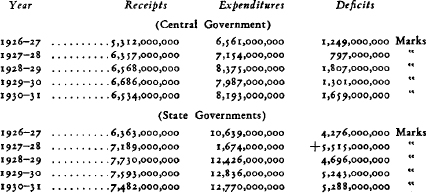
38Quoted in the American Review of Reviews, Vol. 77, January 1928.
39The History of Militarism, by Alfred Vagts, W. W. Norton, New York, 1937.
40The History of Militarism, by Alfred Vagts, W. W. Norton, New York, 1937.
41Roots of National Socialism, by Rohan D’O. Butler, E. P. Dutton, New York, 1942.
42The History of Militarism, by Alfred Vagts, W. W. Norton, New York, 1937.
43Germany and the German Emperor, by Herbert Perris, Henry Holt, New York, 1912.
44The History of Militarism, by Alfred Vagts, W. W. Norton, New York, 1937.
45Ibid.
46From Bismarck to Hitler, by Louis L. Snyder, Bayard Press, Williamsport, Pa., 1935.
47The History of Militarism, by Alfred Vagts, W. W. Norton, New York, 1937.
48In 1907 the army and navy budget was 1,198,000,000 marks. This was more than enough to pay directly the wages of 1,800,000 men, leaving out of account the secondary effects on wages of these payments.
49The Problem of Armaments, by Arthur Guy Enock, Macmillan, New York, 1923, Appendix.
50”National Debt of the German Empire,” by Dr. Adolph Wagner, North American Review, Vol. 174, June 1902.
51The History of Militarism, by Alfred Vagts, W. W. Norton, New York, 1937.
52Conditions of Peace, by Edward H. Carr, Macmillan, New York, 1942.
53An illuminating discussion of this will be found in Rohan D’O. Butler’s recent book Roots of National Socialism, E. P. Dutton, New York, 1942.
54Roots of National Socialism, by Rohan D’O. Butler, E. P. Dutton, New York, 1942.
55Quoted in Social and Economic History of Germany, by Werner Friedrich Bruck, London, 1938.
56Europe Since 1914, by F. Lee Benns, Crofts & Co., New York, 1935.
57I Paid Hitler, by Fritz Thyssen, Farrar & Rinehart, New York, 1941.
58German Economy, by Gustav Stolper, Reynal & Hitchcock, New York, 1940.
59German Economy, by Gustav Stolper, Reynal & Hitchcock, New York, 1940.
60The Revolt of the Masses, by José Ortega y Gasset, W. W. Norton, New York, 1932.
61The Spirit of Modern Philosophy, by Josiah Royce, Houghton, Mifflin, New York, 1892.
“The almost complete disappearance of unemployment prior to the outbreak of the war has certainly supported the Nazi arguments of ‘practical socialism’ in the eyes of hundreds of thousands of workingmen. They had seen their own representatives in the past helplessly grappling with the employment problem and could not help comparing their situation with a past in which they had been condemned to the moral misery of the ‘dole.’ While this has not converted the majority of the industrial workers of Germany, it has made them apprehensive lest the downfall of Hitler might restore, with their political liberties, the liberty of seeking non-existent employment. Such a critical attitude would have been entirely impossible had their own socialist movement bequeathed a record of accomplishment instead of a memory of disappointment.”
- 1Mein Kampf. Reynal & Hitchcock American translation, 1940.
- 2Mein Kampf. Reynal & Hitchcock American translation, 1940.
- 3The Other Germany, by Erika and Klaus Mann, Modern Age, 1940.
- 4“Germany’s Hidden Crisis,” by Willson Woodside, Harper’s Magazine, February 1937.
- 5The German Financial Revolution,” by Dal Hitchcock, Harper’s Magazine, February 1941.
- 6Egon Ranshoven-Wertheimer in Victory Is Not Enough, W. W. Norton, New York, 1942, says:
- 7Hindenburg, by Emil Ludwig, John C. Winston Co., Philadelphia, Pa., 1935.
- 8They Wanted War, by Otto D. Tolischus, Reynal & Hitchcock, New York, 1942.
- 9What About Germany? by Louis P. Lochner, Dodd, Mead & Co., New York, 1942.
- 10I Paid Hitler, by Fritz Thyssen, Farrar & Rinchart, New York, 1941.
- 11Victory Is Not Enough, by Egon Ranshoven-Wertheimer, W. W. Norton, New York, 1942.
- 12Quoted in Men in Motion, by Henry J. Taylor, Doubleday, Doran & Co., Inc., New York, 1943.
- 13Writers like Mr. Herbert Agar lash themselves into a luminous fever of righteousness as they survey the world. Those phenomena in social life they do not like they write down as the fruit of barbarism. And barbarism is just another name for Germany, just as the same word turns out to be a synonym for Russia with others. To Mr. Agar the world suffers from the “German disease,” which contaminates the earth. Germany “has remained outside the stream of Latin culture.”
- 14One recent writer sees Germany as a “thousand-year conspiracy against Greco-Christian civilization” while still another, an eminent psychiatrist, announces that the German people suffer from a paranoid condition, that they are mildly insane, that fascism and the war are therefore the work of crazy men who are incapable of maintaining a stable order. The doctor thinks the problem is one for psychiatric medicine, while still another writer thinks the solution should be entrusted to the surgeons who, by detailing 20,000 of their number, could sterilize all male Germans in one month and all female Germans in three years. One wants to purge the disease out of the Germans, the other wants to purge the Germans out of the world.
- 15One recent writer sees Germany as a “thousand-year conspiracy against Greco-Christian civilization” while still another, an eminent psychiatrist, announces that the German people suffer from a paranoid condition, that they are mildly insane, that fascism and the war are therefore the work of crazy men who are incapable of maintaining a stable order. The doctor thinks the problem is one for psychiatric medicine, while still another writer thinks the solution should be entrusted to the surgeons who, by detailing 20,000 of their number, could sterilize all male Germans in one month and all female Germans in three years. One wants to purge the disease out of the Germans, the other wants to purge the Germans out of the world.
- 16As a matter of history it is a fact that the two peoples of Europe who resisted longest any attempt to bring them under a central, unitary government were Italy and Germany. Many years ago Dr. Edward Preissig called attention to the fact that Germans, one of the most numerous racial groups in Europe, “remained for centuries the most divided nation of Europe.” More recently two younger critics and victims of Hitler, Erika and Klaus Mann, observed that “the German people do not take to centralization. Germany’s structure is regional. The Germans do not care to, and do not actually, accept dictation from Berlin.” The annotator of the Reynal and Hitchcock American translation of Mein Kampf notes this fact. “Manifestly,” he observes, “the Germans have tended to break into groups, and most efforts to keep them together have failed or succeeded only in part. Doubtless the major reason for this divergence is not racial but religious.... After the war Germany very nearly disintegrated again. Movements favoring an independent Rhineland, an independent Silesia, an independent Bavaria gained considerable momentum. Many Germans will tell you that if the Hitler movement should fail, a new breakup of Germany would follow.”
- 17As a matter of history it is a fact that the two peoples of Europe who resisted longest any attempt to bring them under a central, unitary government were Italy and Germany. Many years ago Dr. Edward Preissig called attention to the fact that Germans, one of the most numerous racial groups in Europe, “remained for centuries the most divided nation of Europe.” More recently two younger critics and victims of Hitler, Erika and Klaus Mann, observed that “the German people do not take to centralization. Germany’s structure is regional. The Germans do not care to, and do not actually, accept dictation from Berlin.” The annotator of the Reynal and Hitchcock American translation of Mein Kampf notes this fact. “Manifestly,” he observes, “the Germans have tended to break into groups, and most efforts to keep them together have failed or succeeded only in part. Doubtless the major reason for this divergence is not racial but religious.... After the war Germany very nearly disintegrated again. Movements favoring an independent Rhineland, an independent Silesia, an independent Bavaria gained considerable momentum. Many Germans will tell you that if the Hitler movement should fail, a new breakup of Germany would follow.”
- 18As a matter of history it is a fact that the two peoples of Europe who resisted longest any attempt to bring them under a central, unitary government were Italy and Germany. Many years ago Dr. Edward Preissig called attention to the fact that Germans, one of the most numerous racial groups in Europe, “remained for centuries the most divided nation of Europe.” More recently two younger critics and victims of Hitler, Erika and Klaus Mann, observed that “the German people do not take to centralization. Germany’s structure is regional. The Germans do not care to, and do not actually, accept dictation from Berlin.” The annotator of the Reynal and Hitchcock American translation of Mein Kampf notes this fact. “Manifestly,” he observes, “the Germans have tended to break into groups, and most efforts to keep them together have failed or succeeded only in part. Doubtless the major reason for this divergence is not racial but religious.... After the war Germany very nearly disintegrated again. Movements favoring an independent Rhineland, an independent Silesia, an independent Bavaria gained considerable momentum. Many Germans will tell you that if the Hitler movement should fail, a new breakup of Germany would follow.”
- 19The inadequacy of empire revenues drove Bismarck frequently to attempt purchase of all the German railroads to get their profits for the central government. The states resisted this until after the Great War. They said that with an annual revenue of 800,000,000 marks from the roads Bismarck could tyrannize over the parliament, the stock market, and the states. He tried to erect state monopolies of tobacco to eke out with its profits the state deficits but was balked.
- 20The inadequacy of empire revenues drove Bismarck frequently to attempt purchase of all the German railroads to get their profits for the central government. The states resisted this until after the Great War. They said that with an annual revenue of 800,000,000 marks from the roads Bismarck could tyrannize over the parliament, the stock market, and the states. He tried to erect state monopolies of tobacco to eke out with its profits the state deficits but was balked.
- 21The bourgeoisie during its rule of scarcely one hundred years has created more massive and colossal productive forces than all the preceding generations together. Subjection of nature’s forces to man, machinery, application of chemistry to industry and agriculture, steam navigation, railways, electric telegraphs, clearing of whole continents for cultivation, canalization of rivers, whole populations conjured out of the ground—what earlier century had even a presentiment that such productive forces slumbered in the lap of social labor?
- 22Whereas in past times life for the average man meant finding all around him difficulties, dangers, want, limitations of his destiny, dependence, the new world appears as a sphere of practically limitless possibilities, safe and independent of anyone. Based on this primary and lasting impression, the mind of every contemporary man will be formed, just as previous minds were formed on the opposite impression. For that basic impression becomes an interior voice which ceaselessly utters certain words in the depths of each individual, and tenaciously suggests to him a definition of life which is, at the same time, a moral imperative. And if the traditional sentiment whispered: “To live is to feel oneself limited, and therefore to have to count with that which limits us,” the newest voice shouts: “To live is to meet with no limitation whatever and, consequently, nothing is impossible, nothing is dangerous, and, in principle, nobody is superior to anybody.” This basic experience completely modifies the traditional, persistent structure of the mass-man. For the latter always felt himself, by his nature, confronted with material limitations and higher social powers. Such, in his eyes, was life. If he succeeded in improving his situation, if he climbed the social ladder, he attributed this to a piece of fortune which was favorable to him in particular. And if not to this, then to an enormous effort, of which he knew well what it had cost him. In both cases it was a question of an exception to the general character of life and the world; an exception which, as such, was due to some very special cause.
- 23The German empire set up for business in 1871. It began under peculiarly happy circumstances. It was born out of a short, victorious war that paid for itself and made a profit. Bismarck extracted from France an indemnity of 4,467,096,402 marks. This was enough to enable the empire and the separate states to pay off all their war bonds and have a comfortable balance. The big French indemnity became the parent of a vigorous boom in a new nation which set up for business debt free. One would suppose that this vigorous state, with an industrious and thrifty people devoted to orderliness and discipline, with a passion for good public housekeeping, a large surplus in its hands, and a brilliant and forceful statesman at its head, would have continued to pay its way if that were possible. Yet the empire which began debt free in 1871 was by 1875 going to the moneylenders. The central government’s capacity to tax was limited. It could never collect enough to pay all its bills. The budget was chronically out of balance. Reichstag after Reichstag quarreled with the government about the budget. So that by 1876 Bismarck resumed state borrowing. Despite repeated deficits government spending rose and with it government borrowing and debt. The debt history up to World War I may be stated briefly in round figures thus:
- 24Thus for fifty years the practice of state borrowing was also an institution of state policy. People of all parties continually grumbled about it, but the practice was tolerated by all. However, the public debt became one of the incessant irritants of public life. The speeches of public men and the writings of leading publicists for twenty years preceding World War I complained of Germany’s impossible fiscal policy. By 1908 we find the German imperial Finance Minister writing that “the vital question of Germany’s finances must be solved now” and that “the stability of the empire is exposed to risk.” Yet the Reichstag refused to supply by means of taxes the revenues needed by the Reich. The practice became embedded in the traditional finance techniques of the empire. It was bad but it had popular acquiescence. No one, however, defended it as a scientific arrangement for the purpose of absorbing public savings and creating national income as the economists of the republic did later on and as Hitler’s economists do now.
- 25The policy had another very serious consequence. Oddly conservative Germany, dominated by Junkers and industrialists, became the paradise of state-owned enterprises. This is referred to generally, along with the social-welfare measures, as an example of German state socialism. It was, however, in no sense a surrender to socialist ideas. It was the policy of very hardheaded, pragmatic administrators. The central government and the states, in need of funds and finding the taxpayer reluctant, turned to state enterprise. The various German states owned and operated public utilities, railroads, mines, forests, telegraph and telephone systems, and certain industrial enterprises as a means of making profits for the governments to supplement the inadequate tax revenues. Bismarck made a number of efforts to buy up all the railroads for the central government to solve its revenue problem but was balked by the states. He admitted he was aiming at a monopoly of tobacco and spirits production for the empire as a means of swelling empire revenues. Unable to get the railroads for the central government, he succeeded in having the Prussian state government take them. He did this by issuing government bonds—60 billion marks—for the shares of the private companies.
- 26The extent to which the German federal and state governments had come to depend on the profits of their enterprises to pay their bills may be seen from the following figures compiled by Le Figaro (which explains the use of francs instead of marks) in 1909. This estimate includes the revenue of the empire and the states, which was 9,656,000,000 francs. Of this sum only 3,887,000,000 was collected in taxes. The balance—5,769,000,000—was derived from railroads, mines, post offices and wire systems, forests, and other enterprises. Only 40 per cent of the public revenues was received from taxes.
- 27It must be said here, of course, that a good deal of the public debt arose from public investments in revenue-producing enterprises. This applies chiefly to the debt of the states. Most of the debt of the central government arose out of non-revenue-producing expenditures. It was dead-weight debt.
- 28When Germany declared war in 1914, she proceeded to do on a colossal scale what she had been doing on a smaller scale for fifty years. She borrowed to pay the war bills. In 1900 she had financed the “East Asiatic Expedition”—her share of the Chinese Boxer invasion—amounting to 276,000,000 marks, wholly with borrowed funds, which obligation along with all her other debts was still due as she prepared to invade France in 1914. Her World War I expenditures were as follows. The 1913 budget, for purposes of comparison, was 3,848,000,000 marks:
- 29To the vast internal war debt was added the fantastic external debt—the reparations penalties, not yet fixed but looming at a figure no nation in the world could have paid. With fifty years of precedent by the rich and prosperous empire, it would have been strange indeed if the bankrupt new republic, with only a halfhearted tolerance of the people behind it, could have escaped a continuation of the debt policy. The figures speak for themselves. From 1920 to 1923 the receipts and expenditures were as follows:
- 30This brought Germany to that fantastic episode of inflation which ended by literally extinguishing all debts save the reparations due to her conquerors. While this inflation had wiped out the savings of everyone, had ruined the middle class, extinguished insurance policies, bankrupted all sorts of industries and their creditors, and dislocated all the machinery of production and distribution, it had freed the nation from internal debt.
- 31Germany had lost by the war and the treaty 13 per cent of her territories, 14 per cent of her arable land, 74 per cent of her iron ore, 68 per cent of her zinc ore, 26 per cent of her coal production. She had lost the railways, potash mines, and textile industries of Alsace-Lorraine. She had been compelled to deliver to her enemies all her merchant ships over 1,600 tons and much of the rest, a quarter of her fishing fleet, 5,000 locomotives, 150,000 railway cars, 5,000 motor trucks. She had seen her foreign investments confiscated and had been subjected to a huge reparations bill in money and kind. Yet in the five years from 1924 to 1929 she had built up her industrial production to a point greater than in 1913. In 1927 steel production was back to the prewar figure, railroads and rolling stock were superior to prewar days, her merchant tonnage had increased from 400,000 tons to 3,738,000 tons—all new. Her commercial bank deposits rose from $342,000,000 to $1,657,000,000. Her savings deposits, wiped out by the inflation, had risen to 24,000,000,000 marks. She had regained, says Dr. James W. Angell, a large part of the world leadership she had lost during the war.
- 32Germany had lost by the war and the treaty 13 per cent of her territories, 14 per cent of her arable land, 74 per cent of her iron ore, 68 per cent of her zinc ore, 26 per cent of her coal production. She had lost the railways, potash mines, and textile industries of Alsace-Lorraine. She had been compelled to deliver to her enemies all her merchant ships over 1,600 tons and much of the rest, a quarter of her fishing fleet, 5,000 locomotives, 150,000 railway cars, 5,000 motor trucks. She had seen her foreign investments confiscated and had been subjected to a huge reparations bill in money and kind. Yet in the five years from 1924 to 1929 she had built up her industrial production to a point greater than in 1913. In 1927 steel production was back to the prewar figure, railroads and rolling stock were superior to prewar days, her merchant tonnage had increased from 400,000 tons to 3,738,000 tons—all new. Her commercial bank deposits rose from $342,000,000 to $1,657,000,000. Her savings deposits, wiped out by the inflation, had risen to 24,000,000,000 marks. She had regained, says Dr. James W. Angell, a large part of the world leadership she had lost during the war.
- 33Germany had lost by the war and the treaty 13 per cent of her territories, 14 per cent of her arable land, 74 per cent of her iron ore, 68 per cent of her zinc ore, 26 per cent of her coal production. She had lost the railways, potash mines, and textile industries of Alsace-Lorraine. She had been compelled to deliver to her enemies all her merchant ships over 1,600 tons and much of the rest, a quarter of her fishing fleet, 5,000 locomotives, 150,000 railway cars, 5,000 motor trucks. She had seen her foreign investments confiscated and had been subjected to a huge reparations bill in money and kind. Yet in the five years from 1924 to 1929 she had built up her industrial production to a point greater than in 1913. In 1927 steel production was back to the prewar figure, railroads and rolling stock were superior to prewar days, her merchant tonnage had increased from 400,000 tons to 3,738,000 tons—all new. Her commercial bank deposits rose from $342,000,000 to $1,657,000,000. Her savings deposits, wiped out by the inflation, had risen to 24,000,000,000 marks. She had regained, says Dr. James W. Angell, a large part of the world leadership she had lost during the war.
- 34Germany had lost by the war and the treaty 13 per cent of her territories, 14 per cent of her arable land, 74 per cent of her iron ore, 68 per cent of her zinc ore, 26 per cent of her coal production. She had lost the railways, potash mines, and textile industries of Alsace-Lorraine. She had been compelled to deliver to her enemies all her merchant ships over 1,600 tons and much of the rest, a quarter of her fishing fleet, 5,000 locomotives, 150,000 railway cars, 5,000 motor trucks. She had seen her foreign investments confiscated and had been subjected to a huge reparations bill in money and kind. Yet in the five years from 1924 to 1929 she had built up her industrial production to a point greater than in 1913. In 1927 steel production was back to the prewar figure, railroads and rolling stock were superior to prewar days, her merchant tonnage had increased from 400,000 tons to 3,738,000 tons—all new. Her commercial bank deposits rose from $342,000,000 to $1,657,000,000. Her savings deposits, wiped out by the inflation, had risen to 24,000,000,000 marks. She had regained, says Dr. James W. Angell, a large part of the world leadership she had lost during the war.
- 35But after the war, when the republican government came into power, that peculiar creation—the German professor of economics—inserted himself into the scene. He proceeded to unfold a new theory that fell like manna from above into the bewildered treasury. The old-fashioned fear of national debt, they assured the politicos, was one of the superstitions of “orthodox” economics. The “new” economics had its own fresh theory. Public debt must be sharply distinguished from private debt. Public debt can be expanded almost indefinitely provided it is internally held. In fact, where a government owes merely an internal debt it can be said to be debt free. Of course debts call for interest payments. But the taxpayers merely pay the interest to themselves.
- 36The idea was not new for we find Renatus in his Twelfth Hour of Capitalism, before Hitler came into power, complaining that the idea that internal debt, where the “money remains in the country,” is not dangerous had been used by the old empire government to make the war loans more palatable. That was pressure propaganda during a war to unload mountains of securities. But now economists who believed that principle dominated government thinking. And the theory became an extraordinarily convenient one.
- 37Between 1926 and 1931 the republican government built up another 6,813,000,000 marks of debt and the various state governments had accumulated a new deficit of 13,988,000,000 marks.
- 38This fact was concealed by a device that has not failed to inspire its champions in this country in recent years—namely, the double budget, actually a fake budget. The Germans separated so-called “ordinary” items from “extraordinary” items. The extraordinary items included outlays for “productive” purposes, sometimes euphemistically called “investments.” The chief purpose of this device is to deceive the people and hide the deficits of the government. The first warning the outside world had of the situation came in 1928, when S. Parker Gilbert, Agent General of Reparations, gave the alarm in a paper published in the “Advocate of Peace through Justice.” Gilbert pointed out that while the government borrowed to meet expenses it had increased salaries by 1,250,000,000 marks. There was much agreement within Germany with Gilbert’s apprehensions. But there was also wide approval of the government’s fiscal policy. But government debts are due, not by the people, but by that organized entity known as the government. It can pay its debt charges only when it can get money from the people to do so. And the people can and frequently do refuse to disgorge the necessary funds. When that time comes the ability of the government to borrow is sadly impaired. By 1930 Chancellor Hermann Müller was having difficulty extracting any further taxes from the citizens. He then hit upon a shabby expedient. He began to talk about more social security. Under cover of this pretense he proposed to raise the rates. But what he really had in mind was to greatly increase charges for social security much beyond its cost in order that the government might “borrow” the surplus to meet its expenses. This palpable fraud exposed Müller’s ministry to such violent attack that he was forced to resign.
- 39To think of militarism as a purely military business is to miss completely the gravest aspect of this utterly evil thing in modern society. Alfred Vagts, in his history of the rise and spread of militarism, correctly observes that it “presents a vast array of customs, interest, prestige, actions, and thought associated with armies and wars and yet transcending true military purpose.”
- 40The revolutionists in France called it into being when their country was beset by the armies of the aroused monarchs of Europe. The weapon thus forged for the defense of liberty quickly fell into the hands of the tyrant who used it from 1804 to Waterloo as an instrument of conquest. This led to a demand for its use in Prussia by Blücher as a defense against Napoleon. The chief opposition came from the Junkers. They did not oppose military power. Yet they did not relish this monstrous child of republican France. But they had more substantial reasons. They were interested not so much in conquest as in the preservation of their class. They thought of the army as a weapon in the hands of the monarch against internal attack. Conscription created a mass army of proletarians into whose hands weapons would be placed that might be turned against the throne and the nobility. Moreover, the idea of a mass army was incompatible, they said, with the institution of monarchy. That institution is based on rank. The army provided the means of preserving their rank through the officers’ corps. A great national army would create the need for a far larger number of officers than the nobles could supply. They would have to be recruited from among the middle classes. This was repugnant to the Junker mind. It had to yield, however, because of the imperious necessity of armies so large that only the masses could supply them. The Bourbons ended conscription on the fall of Napoleon for this very reason, and it was not revived until Napoleon III came to power in 1848. From this point on Germany, France, Italy, and Russia contended with each other in the race for conscript armies. But Germany never pressed into service as large a part of her population as France. In 1913 France had 2.10 per cent of her population with the colors while Germany had only 1.2 per cent. As late as 1913, when the military men asked for three more corps, the Prussian Minister of War objected that it would mean “a larger number of officers drawn from circles hardly fit,” and this “aside from other dangers would expose the officers’ corps to democratization.” The Junkers were not against the army. It was their darling and they wished to keep it so.
- 41Liberals must bear their full share of responsibility for the growth of this institution. The parliamentarians of 1848, promulgating the essentials of a constitution, along with freedom of speech and press, equality before the law, removal of social ranks, right of assembly, trial by jury, and other basic rights, called for general military service. In 1861, when liberals formed the German Progress party and were called “democrats,” they produced a crisis by demanding parliamentary control of army budgets which brought the strong hand of Bismarck to the helm to resist them. This episode is frequently described as a growing revolt against a great army. Nothing could be further from the truth. The King wanted a bigger army and three-year enlistments instead of two. The liberals opposed the three-year enlistment. But they were willing to give him as big an army as he wished. Ludwig, in his Life of Bismarck, confirms this, and Vagts says that the liberals asked the German generals if they were sure the army was big enough.
- 42I recall these facts because of their bearing on the important phenomenon which seems to involve liberals along with the reactionaries in some of the most reactionary and suppressive devices of central governments. Those old liberals belonged to the Manchester school. They were for parliamentary government and checks upon the Crown. But they were also for building foreign trade, and they saw the value of military weapons in the event of collision with other economic imperialist empires. To the old Junkers the army had a different meaning. It was an institution to furnish berths to their sons and to preserve the monarchy. “It was the liberals,” says Vagts, and not the conservatives, “who pursued the dreams of the German empire yet to come. It was a Prussian liberal to whom it occurred in 1836 that Holland ought to become Prussian because it was rather a necessity for Prussia and would be a benefit to Holland. It was the same liberal (who said) ‘It might come about that we would demand Alsace and Lorraine from France, the Baltic countries from Russia.’ “ Even the socialists, who had persistently opposed militarism and its handmaiden imperialism, at times toyed with the alluring drug. They could not wholly resist the fascination of the idea that militarism, bad as it was, did in fact put weapons into the hands of the proletarians which might be turned in the right direction when the day of revolt arrived. Jaurès, the French socialist leader, thought the conscript army was to be preferred to the professional army. Engels had advised his colleagues that in the event of hostilities “everyone should be drawn into the service and that the armed nation should assume control over domestic and foreign policies.” I do not wish to say that socialists as a party persistently favored the militarism of Germany. I merely wish to point up the very disturbing fact that people of all sorts and for quite different reasons could see some special virtue in this thing. In maintaining the institution of militarism the imperial government knew that it was running safely with an approved current of thought and desire among the people. And, however men differed for special group reasons in supporting militarism, at bottom the chief reason that paralyzed any strong opposition to it was economic. The institution begins with those who love military power, the expression of national might, and those nationalist groups who yearn for imperialist aggression. But it ends by finding its broadest support in the influence it exerted upon the economic system.
- 43The plain truth is that militarism became Germany’s greatest single industry. It played a role as prop of the economic system as great, if not greater than, let us say, the automobile industry in America. Critics have directed their fire against Krupp and his fellow munitions makers. But it would be a great mistake to suppose that it was Krupp and his colleagues who made militarism possible. It was something more deeply rooted than the interests of the war profiteers. Others have complained of the insupportable burden of armaments. In England increased grants for soldiers were fought on the ground that enlarging the army resulted in withdrawing more men from industry and the production of wealth in the labor market. Mr. Herbert Perris has calculated that while the German Army cost 67 million pounds a year there was a far greater social loss in drawing so many men from productive pursuits who could have earned 100 pounds each had they remained in civil life, and that this loss must be added to the money cost of the army. All this is based on the theory that had these men remained in civil life they would be at work raising crops and producing goods. But, alas, they would have, at most times, merely added to the number of the unemployed. The English critics were right in saying that the army took men out of the labor market. But it was a market glutted with labor. It took the unusable surplus labor. And the problem of government to find work for these men was far more poignant and imperious than the problem of their lost production—when in fact they would have been producing nothing. Actually the employment of hundreds of thousands in the army and of many more hundreds of thousands in the industries which supplied these armies, all paid for by the government with funds partly created by going into debt, had the effect of making work for those who were not in the army and thus increasing the national produce, at least for a time.
- 44Military men, when confronted with the mutterings of disaffected taxpayers, always pointed out how good these government military expenditures were for business. Stumm could imagine no expenditure more productive for the community than those for armies. Schlieffen said, when military economies were discussed: “The national economy, the machine with its thousand wheels, through which millions find a living, cannot stand still for long.” One of the German delegates to the 1898 Peace Conference, Colonel Schwarzhoff, declared that “armies were not impoverishing the peoples and the military service is not a burden.” He said his country owed its prosperity to military service. The German people believed this. Professor Snyder observes that: “In spite of the fact that millions in taxes were required in order to maintain this rapidly increasing naval power, the public in general was pleased with the new naval-ism. People associated prosperity and ‘good times’ with monarchy and its militaristic props, the army and navy, and they seemed to be convinced that this prosperity would continue if the fighting forces of the nation were continually modernized.” It is interesting to note that in our own country this theory of industrial stimulus was accepted by many, for we find Samuel Colt, as far back as 1837, during the depression of that period, suggesting that it might be overcome by large appropriations for armaments.
- 45Military men, when confronted with the mutterings of disaffected taxpayers, always pointed out how good these government military expenditures were for business. Stumm could imagine no expenditure more productive for the community than those for armies. Schlieffen said, when military economies were discussed: “The national economy, the machine with its thousand wheels, through which millions find a living, cannot stand still for long.” One of the German delegates to the 1898 Peace Conference, Colonel Schwarzhoff, declared that “armies were not impoverishing the peoples and the military service is not a burden.” He said his country owed its prosperity to military service. The German people believed this. Professor Snyder observes that: “In spite of the fact that millions in taxes were required in order to maintain this rapidly increasing naval power, the public in general was pleased with the new naval-ism. People associated prosperity and ‘good times’ with monarchy and its militaristic props, the army and navy, and they seemed to be convinced that this prosperity would continue if the fighting forces of the nation were continually modernized.” It is interesting to note that in our own country this theory of industrial stimulus was accepted by many, for we find Samuel Colt, as far back as 1837, during the depression of that period, suggesting that it might be overcome by large appropriations for armaments.
- 46Military men, when confronted with the mutterings of disaffected taxpayers, always pointed out how good these government military expenditures were for business. Stumm could imagine no expenditure more productive for the community than those for armies. Schlieffen said, when military economies were discussed: “The national economy, the machine with its thousand wheels, through which millions find a living, cannot stand still for long.” One of the German delegates to the 1898 Peace Conference, Colonel Schwarzhoff, declared that “armies were not impoverishing the peoples and the military service is not a burden.” He said his country owed its prosperity to military service. The German people believed this. Professor Snyder observes that: “In spite of the fact that millions in taxes were required in order to maintain this rapidly increasing naval power, the public in general was pleased with the new naval-ism. People associated prosperity and ‘good times’ with monarchy and its militaristic props, the army and navy, and they seemed to be convinced that this prosperity would continue if the fighting forces of the nation were continually modernized.” It is interesting to note that in our own country this theory of industrial stimulus was accepted by many, for we find Samuel Colt, as far back as 1837, during the depression of that period, suggesting that it might be overcome by large appropriations for armaments.
- 47Military men, when confronted with the mutterings of disaffected taxpayers, always pointed out how good these government military expenditures were for business. Stumm could imagine no expenditure more productive for the community than those for armies. Schlieffen said, when military economies were discussed: “The national economy, the machine with its thousand wheels, through which millions find a living, cannot stand still for long.” One of the German delegates to the 1898 Peace Conference, Colonel Schwarzhoff, declared that “armies were not impoverishing the peoples and the military service is not a burden.” He said his country owed its prosperity to military service. The German people believed this. Professor Snyder observes that: “In spite of the fact that millions in taxes were required in order to maintain this rapidly increasing naval power, the public in general was pleased with the new naval-ism. People associated prosperity and ‘good times’ with monarchy and its militaristic props, the army and navy, and they seemed to be convinced that this prosperity would continue if the fighting forces of the nation were continually modernized.” It is interesting to note that in our own country this theory of industrial stimulus was accepted by many, for we find Samuel Colt, as far back as 1837, during the depression of that period, suggesting that it might be overcome by large appropriations for armaments.
- 48The funds which the German imperial government was borrowing, were used almost entirely for military outlays. Without such immense appropriations for the army the government might have avoided borrowing. But without these appropriations a million and a half men would have been out of work. To abandon militarism would have meant demobilizing the greatest industry in the land.
- 49Mr. Arthur Guy Enock has made a carefully adjusted table of total defense expenditures by Germany and a parallel table of increase in the national debt by years. It shows that from 1900 to 1920 the military expenditures increased steadily and that the national debt increased every year save two. It also reveals that the army and navy appropriations were greater than the corresponding contemporary increase in national debt. It follows that the increase in debt was necessitated wholly by the armament outlays. Increase in debt could have been eliminated by paring armament payments by the amount of the new debt. In some years as much as half of all military outlays were provided for by borrowing. During the war, of course, the entire military budget was borrowed. These findings are corroborated by Dr. Adolph Wagner, professor of political science in the University of Berlin, who said in 1902 that the loans of the government were due chiefly to the extra outlays for the army and navy and strategic subsidies for the states for the same purpose. Mr. Alfred Vagts makes a very pregnant observation on this point. “The people,” he says, “became inclined to believe in a superior kind of planning which the crisis-beset capitalism did not know how to provide, but which seemed to be inherent in successful military institutions.” In other words militarism, without being designed to do so, came to provide Germany with that instrument which the later-day planners have been demanding—a means of increasing national income by public expenditures through borrowed funds. In truth militarism had become the great accepted and universally tolerated Public Works Administration of Europe. Had it been a mere burden to the peoples by reason of its tax exactions it would never have survived. It was because the tax burden was at least temporarily offset by the increase in national income provided through maintaining with public funds Germany’s biggest industry that it was permitted to continue.
- 50Mr. Arthur Guy Enock has made a carefully adjusted table of total defense expenditures by Germany and a parallel table of increase in the national debt by years. It shows that from 1900 to 1920 the military expenditures increased steadily and that the national debt increased every year save two. It also reveals that the army and navy appropriations were greater than the corresponding contemporary increase in national debt. It follows that the increase in debt was necessitated wholly by the armament outlays. Increase in debt could have been eliminated by paring armament payments by the amount of the new debt. In some years as much as half of all military outlays were provided for by borrowing. During the war, of course, the entire military budget was borrowed. These findings are corroborated by Dr. Adolph Wagner, professor of political science in the University of Berlin, who said in 1902 that the loans of the government were due chiefly to the extra outlays for the army and navy and strategic subsidies for the states for the same purpose. Mr. Alfred Vagts makes a very pregnant observation on this point. “The people,” he says, “became inclined to believe in a superior kind of planning which the crisis-beset capitalism did not know how to provide, but which seemed to be inherent in successful military institutions.” In other words militarism, without being designed to do so, came to provide Germany with that instrument which the later-day planners have been demanding—a means of increasing national income by public expenditures through borrowed funds. In truth militarism had become the great accepted and universally tolerated Public Works Administration of Europe. Had it been a mere burden to the peoples by reason of its tax exactions it would never have survived. It was because the tax burden was at least temporarily offset by the increase in national income provided through maintaining with public funds Germany’s biggest industry that it was permitted to continue.
- 51Mr. Arthur Guy Enock has made a carefully adjusted table of total defense expenditures by Germany and a parallel table of increase in the national debt by years. It shows that from 1900 to 1920 the military expenditures increased steadily and that the national debt increased every year save two. It also reveals that the army and navy appropriations were greater than the corresponding contemporary increase in national debt. It follows that the increase in debt was necessitated wholly by the armament outlays. Increase in debt could have been eliminated by paring armament payments by the amount of the new debt. In some years as much as half of all military outlays were provided for by borrowing. During the war, of course, the entire military budget was borrowed. These findings are corroborated by Dr. Adolph Wagner, professor of political science in the University of Berlin, who said in 1902 that the loans of the government were due chiefly to the extra outlays for the army and navy and strategic subsidies for the states for the same purpose. Mr. Alfred Vagts makes a very pregnant observation on this point. “The people,” he says, “became inclined to believe in a superior kind of planning which the crisis-beset capitalism did not know how to provide, but which seemed to be inherent in successful military institutions.” In other words militarism, without being designed to do so, came to provide Germany with that instrument which the later-day planners have been demanding—a means of increasing national income by public expenditures through borrowed funds. In truth militarism had become the great accepted and universally tolerated Public Works Administration of Europe. Had it been a mere burden to the peoples by reason of its tax exactions it would never have survived. It was because the tax burden was at least temporarily offset by the increase in national income provided through maintaining with public funds Germany’s biggest industry that it was permitted to continue.
- 52Mr. Edward Hallett Carr, who writes with such intelligence of the world’s present dilemma, perceives this. He says: “The economic consequences of the production of armaments are no different from the economic consequences of the production of a pair of silk stockings.... The special features of the demand for armaments which have enabled it to be used for a solution of the unemployment problem are two. In the first place the demand, being unlimited in extent, imposes a system, not merely of planned production, but of planned consumption. Secondly, the plan of consumption is not determined by considerations of price and profit.” All this being so, he thinks we must find a substitute for armaments in the world of planned production and consumption when the demand for armaments has passed away.
- 53GERMANY, like Italy, did not content herself with social-welfare and government spending to buttress her economic society. More perhaps than any other European nation, Germany was the breeding ground for philosophies concerned with planning and managing refractory human nature and its disordered economic machines. Almost one hundred and fifty years ago Johann Gottlieb Fichte built a schematic social philosophy in which the part of each man was arranged for him with the state as the general manager of the works. To escape “commercial anarchy” the society should be “enclosed,” isolated, in order to bring its parts under management. This is autarchy, and enclosure is essential to its aims. You can manage only that portion of society to which your authority extends. Hence if you propose to manage your own society you must exclude the producers and distributors of other societies to whom you cannot apply your arrangements. Each citizen, said Fichte, should be “installed in the possessions suitable to him.” The state alone can do this and unite a number of persons “in a totality.” The citizen should be licensed to engage in that occupation which he desires, but if the occupation is already crowded, this will be denied him. The state will supervise production and trade. Each farmer will be given a quota to cultivate. When he exceeds his quota the state will impound his surplus, issuing him a certificate for it which he may use at some other time. Here was an almost complete outline of autarchy. Fichte proposed a system of foreign trade by barter, with volume, quota, and types of goods designed for export fixed by the state, each district receiving its assigned share and all conducted, not by private exporters and importers, but by the state. To cap it all he emphasized the necessity of the state including within its walls such territories as it might need to render it self-sufficient. Dr. Butler, summing up Fichte’s system as set out in his The Closed Commercial State, says that Fichte argued for a planned economy, total national autarchy, quota systems, artificial production substitutes, intensive armaments, living space, forcible unresisted occupation of territory, complete co-ordination of such territories, transfer of populations, and cultivation of nationalism. This materialistic social organism he supplied with a spiritual stimulant, the spirit of the German Volk, on the principle that the Germans alone preserved in their purity among all the Teuton peoples the original German blood and language. Long before Fichte, of course, the Cameralists, as the Prussian mercantilists were called, had insisted on the idea of the enclosed state. But it was from different motives and theories than those which moved Fichte, nor did they go so far in an all-out regimentation as he. However, Fichte was merely taking another step in a direction in which German, as well as French, thought had been moving. Thus the root concepts of the modern state that we have seen flower in Germany and Italy and other continental countries were kicking around in the German mind for nearly two centuries.
- 54This suspicion was making its way into the minds of a good many radicals—socialists or syndicalists—who, tiring of their bleak proletarian socialist dreams, began to toy with the idea of adapting the doctrines of syndicalism to the capitalist system. This, perhaps, is one of the most destructive intellectual phenomena that appeared in Europe. Socialism and even syndicalism, with all its renunciations of commonplace morality, made a body of beliefs that could be defended as coherent and logical systems. But when the socialist and, even more, the syndicalist, began to propose his nostrums as medicine for the capitalist system, there appeared a diseased and corrupted form of socialism which found its neophytes in the oddest quarters. The famous Dr. Stöcker, the Kaiser’s court preacher, became the center of one of these hybrid schools of imperial socialism, and his equally famous disciple, Friedrich Naumann, tried his hand at establishing a party on these theories which, oddly enough, he called the National Socialist party. Walter Rathenau, a leading industrialist, played with these alluring theories too. Naumann, in a burst of spiritual elation at the universal appeal of his philosophy, said: “We hardly knew that fundamentally we all wanted the same thing: the regulated labor of the second capitalistic period, which can be described as the transition from private capitalism to socialism provided only that the word socialism is not taken to mean the phenomenon of purely proletarian big business, but is broadly understood as folk-ordering with the object of increasing the common profit of all for all.”
- 55A more equal distribution of possessions and income is a commandment of ethics and economy. Only one in the State is allowed to be immeasurably rich: that is the State itself.
- 56It was a recognition that the old type of political legislature gave at best only a haphazard and scrappy representation of the economic interests of the people. According to this scheme, the political legislature would continue to represent the people as individuals and to ensure to them individual liberty; but the functional parliament would represent the great economic groups and corporations. This plan for a separate functional representative body was expected to be “the most original contribution of the German revolution to political thought.”
- 57The result is that a kind of sparring match takes place between the private economic interests on the one hand and the communal interests of the cities and villages on the other. The object is precisely this: to ensure that the private economic interests must not injure the commonweal. The final supervision is, of course, the business of the government.
- 58The experiments in state ownership, state control, state partnerships were numerous. One example was the coal industry. A Reich Coal Council was organized, which applied the principle of planning to the coal industry. The same thing was done for the potash industry. This was done in 1919 but continued to flourish all through the Weimar regime.
- 59There is a tragic irony in the historical development by which the German Revolution first greatly enhanced the importance, strength, and authority of the German unions, only to land them at the end of this period almost in the position of administrative organs of the state, consequently deprived of their real function of constituting a powerful body of workers to face the power of the entrepreneurs.
- 60These economic and human disturbances set the stage for several types of men. The notion that all the immoral or amoral performances that are exhibited in such times of stress as followed Germany’s defeat proceed from the hearts of wicked men is far from the truth. There is a sort of person who is well named by Ortega the “excellent man,” as distinguished from the common man. This excellent man is “one who makes great demands upon himself and for whom life has no savor unless he makes it consist in something transcendental. He does not look upon the necessity of serving as an oppression. When, by chance, such necessity is lacking, he grows restless and invents some new standard, more difficult, more exigent, with which to coerce himself. This is life lived as a discipline.”
- 61These are the men who are the living and active disciples of the German romantic school of philosophy. A few such men, endowed beyond their fellows with sense as well as inspiration, have made the most benign contributions to the world’s progress. But unfortunately there are too many of them, and there is no rule that will guarantee that all of them will know what they are about. In fact, there is a principle that almost guarantees most of them will be wrong. For, like Nietzsche, most of them are enemies of rationalism. They are romanticist first and always. As Josiah Royce puts it, when defining Schiller’s philosophy, their motto is “Trust your genius; follow your noble heart; change your doctrine whenever your heart changes, and change your heart often.... The world is essentially what men of genius make it. Let us then be men of genius and make it what we choose.”

