
As We Go Marching
Part Three. The Good Fascism: America
ON THE night of October 22, 1929, one of America’s most widely known economists addressed a great banquet of credit men. Not only were Wall Street prices not too high, he told his delighted hearers, but we were really only on the threshold of the greatest boom in the nation’s history. The prophecy evoked a burst of applause. Next morning, a few minutes after the great bell announced the opening of trading on the Stock Exchange, the storm broke. The greatest economic depression in our history was formally ushered in—though it had been in progress for some time. From this point on, as the country slowly roused itself to a consciousness of the far-spreading crisis, leaders in politics and business repeated with invincible optimism that it was all just a wholesome corrective. After several years a waggish commentator published a little volume called Oh, Yeah! It was a sardonic recording of the persistent and unconquerable stream of promises of quickly returning health. There you will find recorded the statements of statesmen, financiers, university professors, leading economists, and editors assuring the people that it was all a blessing in disguise, a corrective phenomenon, that the broad highway to renewed prosperity lay just ahead. All of which proved quite conclusively that these men did not know what they were talking about because they had no understanding of the economic system under which they lived.1
Then came the collapse of 1933 on the grand scale—and a resumption of the bright prophecies of happy days. From 1933 to 1937 we beheld the painful ascent up the finicula of government spending and debt. Then, as 1937 ended, came another wave of optimism with predictions of the emergence of the nation into the full sunrise of the greatest boom in our history—this at the very moment when the feeble energy engendered by the emergency alphabetical power units was already spent and we were actually on our way down again into what was called the “recession.”
I recall this to illustrate the arresting phenomenon that the idea which refuses most stubbornly to take root in the American mind is the realization of the fact that the economic system is in grave trouble. We are not in just one of those cyclical depressions that have always afflicted us. We are now arrived in that condition that for a good many years characterized the economies of European societies before World War I.
I do not mean that the system is beyond repair and that we must blunder along helplessly until we are sunk in the degrading condition of communism or fascism. What I have in mind to say is that after long years of growth and vigor our system seems to have fallen into a condition of enervation. One thing at least we are aware of—that we have been in a depression for fourteen years. Yet we are not wholly weaned from the vain assumption that, while booms and crises follow each other up and down the business cycle, on the whole our normal condition is one of good times, interrupted at intervals by occasional crises.
The issues before us are too grave for mere assumptions. Let us look, therefore, swiftly at the last fifty years in America. I base the statements which follow on the well-known chart of business activity prepared by General Leonard Ayres, economist of the Cleveland Trust Company. Some objections can be made to this chart. It cannot presume to measure up to scientific accuracy. The same can be said, however, of almost all such charts. But while they may differ, the general results, so far as the point I have in mind is concerned, will correspond. This chart reveals a fluctuating line which represents the rise and fall of business activity. A straight line running through it represents General Ayres’s conception of normal activity. When the fluctuating index line rises above the straight line, the country is moving into prosperity. When it sinks below the straight line, the country is falling into depression. If we study this chart in the fifty years from 1892 to 1941 we see that there were twenty-four years below and twenty-four years above normal and two at the normal line. The years of prosperity and depression were equally divided, which certainly does not support the assumption that prosperity was our normal state.
The figures given above represent the duration of booms and depressions in time. Now let us compare them in volume. The data indicate that in bulk the depressions were 15 per cent greater than the booms.
Now let us compare the first 25 years with the second. In the first 25 years the proportion of prosperity to depression was 13.6 years of boom to 10 of depression. In the second 25 years the proportion is reversed—13.5 years of depression to 11.6 of boom. If we compare the volume of boom and crisis in these two periods the picture is far darker. In the first 25 years the proportion of boom to depression was 1.1 to 1. In the second 25 years it is 1 of boom to 3 of depression. Indeed, the depression which began in 1929 is the longest in the history of the country.
I do not lengthen out this description as food for the reader’s pessimism. I do it to compel him to look with complete candor on the gravity of the problem which stands before him. If we will examine this chart a little more closely we will become aware of a very sobering fact. In the last twenty-five year period we had two booms. One lasted from 1915 to the middle of 1920. It was a thoroughly unhealthy boom produced altogether by the war inflation. The second was from 1923 to 1929. This was the so-called New Era. Few now make any defense of that. It was generated by a wild, speculative activity that ended in catastrophe. Two booms in twenty-five years and both based on unhealthy phenomena! Is it not time, therefore, that we bring ourselves to complete frankness and realism in the examination of our position? We are now in a crisis which is in no way comparable to those depressions that succeeded booms in a kind of rhythmic fashion. The present crisis is not one of those corrective emergencies in which the infectious elements are washed out by the fever. We are in a condition in which the motor elements in our economic system are definitely enervated. The sources of power and energy are choked. For fourteen years we have been struggling blindly, not knowing what to do, hoping that in some mysterious way some stroke of luck would boost us out of it. Instead, we have become entangled in a war that will push us deeper in, and we must face again the stark realities of a returning economic crisis. We are now at that point in development, though of course on a different level, reached by Germany and Italy before the last war.
We are, of course, not so deeply mired as these European countries. Our natural endowment is great; theirs was not. Our resources are immense; theirs are not. A combination of circumstances for which we are indebted to a kindly good fortune has set us down in a frame far more hospitable to the ways of democracy. We have enjoyed immense growth in the last fifty years in health, education, economic well-being. Thus while the nation moved fitfully up and down the curves of the business cycle there was a steady advance in the general welfare of the people. And a larger number of people were enjoying these advances.
The trouble lies in this—that while we enjoyed this growth, there was at all times a very large number of people who did not share in it or who did not get as large a share as they believed just, and the whole society was subject with increasing frequency and virulence to the disastrous interruption of its well-being by these growing crises—persisting poverty among so many and deepening crises for all. Now the present crisis is the first in our history of the same general character as European crises.
It is not necessary to review here the incidents of this period. Readers will recall that it evoked a whole train of messiahs with evangels of plenty—Milo Reno and his Farm Holiday, Dr. Townsend and his pensions, Huey Long with his Share-the-Wealth movement, Upton Sinclair and his Epic plan, Major Douglas and social credit, Howard Scott and technocracy, Dr. Warren and his gold-purchase plan, General Johnson and his NRA, Henry Wallace and his plowing under of pigs and grain and, of course, the eternal inflationists. Almost at the same time that republican Germany was drinking the bitter beer of its exploded postwar boom, victorious America was doing the same thing and with much the same episodes and incidental music—rising unemployment, fires going out in factory furnaces, stores closing and banks busting, investment paralyzed, and the masses—the modern masses, conditioned to the better life and dreams of still greater abundance—in revolt against Fate and searching for a savior.
In the end the country did what it always does—threw out the party under whose regime the depression rose and installed the opposition party in power. No comparison, of course, can be made between the Democratic party here and the Fascist and Nazi parties in Italy and Germany. There are resemblances, however, which are striking. They are, indeed, more than striking—they are of the first importance. It will be recalled that the fascists when launching their movement proclaimed a platform of eleven points and that the national socialists did the same, expanding theirs to twenty-five points. It will be remembered, however, that, when they came into power, the most important of these points were dropped and a wholly new and different program inaugurated. In the United States, the Democratic party adopted a platform which conformed at all points with the views of the liberal elements of that party. That platform was brief, crisp, cocksure. Here are its main points:
- An immediate and drastic reduction of government expenditures by abolishing useless commissions and offices.
- Maintenance of national credit by a budget annually balanced.
- A sound currency to be maintained at all hazards and an international economic conference to restore trade.
- Advance planning of public works and financial help to states for same.
- Unemployment and old-age pensions under state laws.
- Better financing of farm mortgages and aid to farm co-operatives.
- Adequate army, but based on facts so that in time of peace the nation may not be burdened with a bill approaching a billion a year.
- Strict and impartial enforcement of the anti-trust laws.
- No cancellation of foreign debts, firm foreign policy looking toward peace, etc.
- Statehood for Puerto Rico and independence for the Philippines.
- Regulation of investment banking, holding companies, utility companies, and exchanges.
- More rigid supervision of national banks and other banking reforms.
- Justice to disabled war veterans.
- Simplification of legal procedure.
- Continuous publicity of political contributions.
- Repeal of the Eighteenth Amendment.
The platform denounced the extravagances of the Hoover Farm Board and the “unsound policy of restricting production” and the resistance of government bureaus to curtailment of expenditures. There were a few other unimportant features.
When the victorious Democrats came into power, the administration did precisely what Mussolini and Hitler did—it threw practically all its important “points” into the wastebasket and adopted a wholly different policy. For this it was roundly criticized by its opponents. But what happened in fact is a phenomenon of far deeper significance than this seeming betrayal by the Democrats. In fact, a wholly different party took power. It called itself the New Deal party. It seized possession of the apparatus of the old Democratic party, substituted an entirely different program utterly hostile to the traditional philosophy of the Democrats and, through certain devices which we shall examine, has continued to operate the political apparatus of the Democratic party to remain in power. It is a singular fact, worthy the attention of future historians, that there is in the Democratic party itself little serious adhesion to the doctrines of the New Deal party. Students of government will have to take note of the fact that under certain circumstances a handful of men can actually manage and navigate a whole political party machine in a direction thoroughly opposite to the well-understood beliefs of its leaders.
Here, however, we perceive nothing more nor less than the familiar phenomenon of government, while talking in brave terms and tones of its grandiose plans, actually dropping into the direction and motion of the prevailing streams of thought running deeply in the great organized and unorganized minorities of the people. The administration proceeded to do, not what it proclaimed as its program in its platform, but those things which the people or rather the influential and controlling minorities wished, however confused they may have been about those wishes. It did precisely what the old democratic regimes of Depretis, Crispi, and Giolitti did in Italy and what Mussolini did later; what the republican regime of Germany did after the war, and what Hitler, after denouncing his predecessors, did later. It denounced the extravagance of the more or less conservative Hoover administration, promised to balance the budget, cut expenditures, reduce military expenditures, etc., and then embarked upon the most amazing program of unrestrained outlays carried on with unbalanced budgets that the world has ever seen.
II · The Good DeficitsTHE PRESENCE of the problem of an economic system definitely out of repair did not impress itself on the consciousness of the American public until well after Mr. Roosevelt’s administration had had its try at the situation for one term. After that the solemn truth settled only slowly upon our minds. By 1940 there were few who did not feel that there was something definitely out of joint.
However, as in Italy and Germany, our first attack upon our economic disorder, as it appeared in 1930, took the form of government spending and welfare. This was something quite new with us. Before 1914 public spending of borrowed money was a negligible feature of our economy. The expansion that astonished the world in America up to that time had been the product of private enterprise financed by private credit. In 1912, on the eve of World War I, after a century and a half of growth, the debts of our public bodies were as follows:
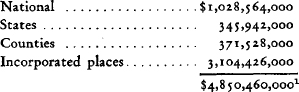
Most of the national debt was a remnant of the Civil War. The bulk of these debts was municipal, incurred for building city utilities such as streets, water works, schools, hospitals, and such.
The war of 1917 marked the beginning of a new era of public spending and borrowing. With the coming of war we had three years of enormous deficits as follows:
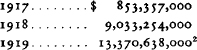
The history of the war measured in national debt may be stated as follows:

State and local debts had risen from $3,821,896,000 in 1912 to $8,689,740,000 in 1922.2
This was due almost wholly to war. After that, however, in the period from 1922 to the depression of 1929, the federal government, instead of borrowing, annually reduced its debt. But the state and local authorities became heavy borrowers. However, no small part of the local debts was contracted for revenue-producing improvement and practically all of this debt was created with provisions for amortization. None of it was arranged as part of any scheme to produce national income, though it had that effect. It arose chiefly out of the demand of local communities for public utilities such as schools, education, health facilities, streets, and from the great demand for roads to make way for the stream of motorcars that poured from our factories. Whatever the purpose, however, the policy did accustom the public mind to public borrowing as a fixed policy of government.
The theory of public spending as an instrument of government to regulate the economic system first appeared in the early part of 1922. The theory was advanced by the Unemployment Conference of that year. Briefly stated, it held that during periods of prosperity, when private industry is supplying all the requirements of national income, the federal and local governments should go slowly on public-works expenditures. They should accumulate a reserve of necessary public-works plans to be put into execution when business activity shows signs of tapering off. However, it was not contemplated that the governments should go into debt for these purposes but should carry them out in accordance with the principles of traditional sound finance. This theory amounted merely to a plan to carry on public building and spending operations in periods of diminished private business activity rather than in time of prosperity.
When the depression appeared in 1929, therefore, Mr. Hoover, on December 4, 1929, sent a message to Congress proposing additional appropriations for public works. He asked anincrease of $500,000,000 for public buildings, $75,000,000 for public roads, $150,000,000 for rivers and harbors, and $60,000,000 to dam the Colorado River.3 He believed this could be done within the budget. Actually the Hoover administration provided $256,000,000 in 1929 and $569,970,000 in 1930 for agriculture, public works, and farm loans while at the same time reducing the public debt by $746,000,000.4 The central theme of these proposals was to use public spending merely as a stabilizer. There was a pretty general agreement with the theory. But as the depression advanced there was a persisting failure of tax funds so that by 1931 there was a deficit of $901,959,000 which increased the next year to nearly three billion dollars.5 A part of this deficit resulted from the public-works expenditures but most of it was caused by a failure of tax revenues. Hoover, of course, never planned an unbalanced budget. However, so imbedded in the public consciousness was the aversion to national public debt that the Democrats in 1932 roundly denounced the Hoover administration for its extravagances and its failure to balance the budget. The platform of June 1932 contained the following as its very first plank:
We advocate:
1. An immediate and drastic reduction of governmental expenditures by abolishing useless commissions and offices, consolidating departments and bureaus and eliminating extravagance, to accomplish a saving of not less than 25 per cent in the cost of the Federal Government; and we call upon the Democratic party in the States to make a zealous effort to achieve a proportionate result.
2. Maintenance of national credit by a federal budget annually balanced on the basis of accurate executive estimates within revenues, raised by a system of taxation levied on the principle of ability to pay.
Mr. Roosevelt, the Democratic candidate, stood strongly behind these declarations. He not only opposed heavy public spending but public borrowing as well. He advised that a “government, like any family, can for a year spend a little more than it earns, but you and I know that a continuation of that means the poorhouse.” He warned that “high-sounding phrases cannot sugar-coat the pill” and begged the nation “to have the courage to stop borrowing and meet the continuing deficits.” Public works “do not relieve the distress” and are only “a stopgap.” And having asked “very simply that the task of reducing annual operating expenses” be assigned to him, he said he regarded it as a positive duty “to raise by taxes whatever sum is necessary to keep them (the unemployed) from starvation.”6
The party itself plastered the nation with huge posters warning that the Republican party had brought it to the verge of bankruptcy and calling on the voters to “throw the spendthrifts out and put responsible government in.” The candidate and the party were quite sincere in these declarations and promises. They were in accordance with the most orthodox American convictions. But practical political leaders, in search of power, besieged by resolute minorities with uncompromising demands for results and bombarded by cocksure merchants of easy salvation, find themselves forced along courses of action that do not square with their public proclamations of principle. Just as Mussolini and Hitler denounced their predecessors for borrowing and spending and then yielded to the imperious political necessity of doing the thing they denounced, so the New Deal, once in power, confronted with a disintegrating economic system and with no understanding of the phenomenon that was in eruption before its eyes, turned to the very thing it denounced in Hoover. But there was a difference. Hoover’s deficits were the result of failure of revenue and were unplanned. Mr. Roosevelt’s first deficit was a deliberately planned deficit. Within a few months of his inauguration he approved a proposal for a $3,300,000,000 public-works expenditure with borrowed funds in the NRA Act of May 1933. He then turned in the following deficits: $3,255,000,000 in 1933–34; $3,782,000,000 in 1934–35; $4,782,000,000 in 1935–36; and $4,952,000,000 in 1936–37.
Nevertheless, despite this record, the administration persisted in its theory that budgets should be balanced. Its platform in 1936 said:
We are determined to reduce the expenses of the government.... Our retrenchment, tax, and recovery program thus reflect our firm determination to achieve a balanced budget and the reduction of the national debt at the earliest possible moment.
In January 1937 the President triumphantly presented what looked like a balanced budget. He said:
We shall soon be reaping the full benefits of those programs and shall have at the same time a balanced budget that will also include provisions for the reduction of the public debt.... Although we must continue to spend substantial sums to provide work for those whom industry has not yet absorbed, the 1938 budget is in balance.
The whole tone of this message was pitched on the growing importance of a balanced budget. Nevertheless, notwithstanding this amazing statement, the budget of that year was not in balance. It showed a deficit of $I,449,626,000. Immediately there was a tremendous drop in the rate of business activity. We began to have what was called a recession, while the President continued to talk about “the extreme importance of achieving a balance of actual income and outgo.” I recall all this now in order to make clear that up to this time no party in this country seriously approved the practice of borrowing as a definite policy. I think it illustrates also with complete finality that the men who were guiding national policy knew nothing about the workings of our economic system. The President made it clear that he was spending and borrowing purely as an emergency device. As late as April 1937 he said:
While I recognize many opportunities to improve social and economic conditions through federal action, I am convinced that the success of our whole program and the permanent security of our people demand that we adjust all expenditures within the limits of my budget estimate.
He then delivered himself of the following extraordinary opinion:
It is a matter of common knowledge that the principal danger to modern civilization lies in those nations which largely because of an armament race are headed directly toward bankruptcy. In proportion to national budgets the United States is spending a far smaller proportion of government income for armaments than the nations to which I refer. It behooves us, therefore, to continue our efforts to make both ends of our economy meet.
Here was a clear recognition of the fact that in Europe for many decades governments had been doing what our government was then doing, spending great sums of money and going into debt for it, but doing it on armaments instead of on peacetime activities as Mr. Roosevelt was doing. But nations which borrow money and pile on vast national debts can go into bankruptcy whether the debts be for armaments or roads, parks and public buildings. European nations were far more deeply stricken in crisis and had been for years. The armaments had become an economic necessity to them. They were not to us. Our government was delivering lectures on sound fiscal policy, deploring the deficits, yet planning new and more extravagant means of spending money, soothing the Haves with promises of balanced budgets and lower taxes, and stimulating the Have-nots with promises of security and abundance. The government was doing, in fact, what Depretis was doing in Italy between 1876 and 1887. Let the reader turn back to the first part of this volume for a description of that record:
He promised every sort of reform without regard to the contradictions among his promises. He promised to reduce taxation and increase public works. He promised greater social security and greater prosperity. When he came to power he had no program and no settled notion how he would redeem these pledges. His party was joined by recruits from every school of political thought. He found at his side the representatives of every kind of discontent and every organ of national salvation. The oppressed tenants along with the overworked and underpaid craftsmen of the towns crowded around him beside the most reactionary landowners and employers to demand the honoring of the many contradictory promissory notes he had issued on his way to office.
Depretis then, for lack of any other weapon, proceeded to do what he had denounced his conservative predecessors for doing—to spend borrowed money on an ever-larger scale. When he did “every district wanted something in the way of money grants for schools and post offices or roads or agricultural benefits. These districts soon learned that the way to get a share of the public funds was to elect men who voted for Depretis, Men who aspired to office had to assure their constituencies that they could get grants for these constituencies from the Premier,” I quote again what the Encylopaedia Britannica said of this episode:
In their anxiety to remain in office, Depretis and the Finance Minister, Magliani, never hesitated to mortgage the financial future of the country. No concession could be denied to deputies, whose support was indispensable to the life of the cabinet, nor under such conditions was it possible to place any effective check upon administrative abuses in which politicians or their electors were interested.
Miss Margot Hentz, writing of the same episode, said:
Pressure was brought to bear through the organs of local administration who were given to understand that “favorable” districts might expect new schools, public works, roads, canals, post and telegraph offices, etc.; while the “unfavorable” might find even existing institutions suppressed.
Depretis’ policy was pursued on a larger scale by his successors, including Giolitti whose administration brought Italy to the eve of World War I and the threshold of bankruptcy. Those who have read the chapter in this volume on Germany will not fail to see the resemblance first on a small scale to the performances of the old imperial government and then on a larger scale to the policies of the republican government that preceded Hitler.
All this, however old, was a new chapter in American policy. When, therefore, these vast expenditures were made, the noblest and most heroic explanations were offered. Having denounced timid deficits, the administration embarked upon a program of huge deficits, but it did it in characteristic American fashion, with proclamations of righteousness as if America had suddenly discovered something new. In fact, it was called a New Deal, Actually, it was America dropping back into the old European procession.
The recession of 1937–38 marked a turning point of the greatest importance in American public policy. Up to this point spending had been done on the pump-priming theory. That is, public funds, flowing out into business, were expected to produce a resumption of business activity. But business utterly failed to respond to this treatment. Apparently the pump itself was seriously out of order. From this point on we hear no more about balanced budgets. We find the administration committed to the same policy that marked the fiscal programs of republican Germany. It turned to the device of public spending and borrowing as a continuing and permanent means of creating national income.
There was a renewal of depression, and the President himself had to admit in his 1939 message that his expectations of recovery when he reduced expenditures were overoptimistic. It had become plain to the political elements in the government that there was something wrong, that the idea of public works during an emergency, used even on an enormous scale, had not produced recovery and was merely a stopgap. The situation of the administration was critical in the highest degree. Almost all its plans had been discarded. The AAA was declared unconstitutional; the NRA was scrapped by the Supreme Court just as it was falling into utter chaos; the devaluation of the dollar and the idea of a managed currency, as well as the gold-buying plan, had proved ineffective; social security was an aid to the unfortunate but did nothing to make the economic system work. Apparently nothing was holding back a tidal wave of deeper depression save the spending and borrowing program which everyone had either denounced or apologized for. The public debt had risen as total depression deficits amounted to 19 billions. What possible avenue of escape opened for the government in the presence of rising unemployment, rising taxes at last, farmers, workers, the aged, investors all clamoring for swift and effective aid and the land filling up again with messiahs and their easy evangels?
About this time a group of young men published a little book—An Economic Program for American Democracy (Vanguard, 1938). It got little enough attention at the time. Its authors styled themselves Seven Harvard and Tufts Economists. It proclaimed boldly that the capitalist system as we have known it was done and that, instead of balancing budgets, the government should adopt the unbalanced budget as a permanent institution; that the only salvation of the nation was in a greater and ever-expanding program of national expenditures met with revenues raised by borrowing.
Completely unknown at the time, these men were actually announcing in this small book the theories that had been worked over by John Maynard Keynes in England and Dr. Alvin H. Hansen in this country. But they were by no means the inventors of them. They had already had a vogue in Germany under the republic, which indeed had been influenced by them in its fiscal policies.
Their theory, very briefly stated, is as follows:
The present capitalist system is no longer capable of functioning effectively. The reasons for this are as follows:
The dynamic element in the capitalist system is investment. Since millions of people save billions of dollars annually, these billions must be brought back into the stream of spending. This can be done only through investment. When private investment is either curtailed or halted, these savings remain sterilized or inert and the capitalist system goes into a depression. Nothing can produce a normal revival of the capitalist system save a revival of investment.
Private investment cannot be any longer revived on a scale sufficient to absorb the savings of the people. Hence recovery through private investment is hopeless.
Private investment cannot be revived because there are no longer open to savers adequate opportunities for investment.
Opportunities for investment are not open any longer for three chief reasons: (1) because the frontier is gone, with its opportunities for territorial expansion and the discovery of new resources; (2) because population increase has slowed down to a snail’s pace; (3) because technological development has matured. That is to say, there is no longer in sight any such great inventions as the railroads, the automobile, etc., which will change all the arrangements of our social life and call for huge money expenditures.
The present capitalist system is therefore incapable of recovering its energy. This is not a mere emergency condition but is a characteristic of the system which will continue indefinitely.
For this reason we must adopt a new type of economic organization. This new type is called the Dual System or the Dual Consumptive System. Under this system the government will become the borrower of those savings funds which private business will not take. It must then spend these funds putting them again into circulation. What we must look forward to, therefore, is a “long-range program of government projects financed by borrowed funds.”
Of course such a program means borrowing perpetually by the government. It means that each year the government debt will increase. When the war ends we will owe not less than $300,000,000,000. Thoughtful men are gravely disturbed as to what course we shall pursue to mitigate the immense burden of this debt. These gentlemen say our course is clear—borrow more. Borrow endlessly. Never stop borrowing.
Of course one asks: What will be the end? How will we ever pay the debt? They reply: It is not necessary to pay public debts. As long as the bondholder gets his interest he is satisfied, and when he wants the principal he can sell his bond, which is all he asks. But how long will this ability to sell his bond last with a government that never stops borrowing and whose credit can become exhausted? This they say, despite all the lessons of history, cannot happen because the more we borrow the higher we build our national income and hence the greater is our ability to borrow. But what about the interest? we ask. Will that not rise to appalling proportions? If our debt is $300,000,000,000 when the war ends, the interest, when we refund the debt, will be at least $9,000,000,000 a year. Before the depression this government never collected more than $3,500,000,000 in taxes. The greatest amount of taxes ever collected by the federal government in peacetime, even after we began to spend on war preparations, was $7,500,000,000 in 1941. But we will have to collect that much in taxes—and an additional $1,500,000,000—just to pay the interest on the national debt. Yet the advocates of this system say that when the war ends we must go on borrowing at the rate of 5 or 10 or even 20 billions a year. Mr. Tugwell estimated it must be around $12,000,000,000 a year in peacetime.
This theory has, in greater or less degree, been adopted by those most influential in the present government. It is not an idea that has infected a few choice spirits on the perimeter of the New Deal. It has become a part of the New Deal—indeed its most essential part. The evidence of this is that the job of planning for the postwar problems of America was taken over by the President himself, was not committed to any of the departmental bureaus, but was installed in his own executive office under his own eyes. For this purpose he organized as a department of his own office the National Resources Planning Board. The man who is the leading exponent of this theory, Dr. Alvin H. Hansen of Harvard, was brought to Washington as economic adviser of the Federal Reserve Board and installed as the chief adviser of the National Resources Planning Board. Six of the seven Harvard and Tufts economists who prepared the published plan were brought to Washington and made economic counsel of various important agencies. Mr. Richard V. Gilbert, one of them, and one of the most vocal apostles of this theory, is at the moment I write guiding the economic destinies of the OPA, which is supposed to be leading the battle against inflation. Most of the others have been given posts of importance in the government. Dr. Hansen has been described by such journals as the New Republic and Fortune as the man “whose fiscal thinking permeates the New Deal.” The board has put out a series of pamphlets designed to outline its guiding ideas. The most important of these was written by Dr. Hansen. Everywhere in Washington, in the most important key positions, are men who have been indoctrinated with this theory.
It is interesting to note that as early as 1936 a little book appeared called Uncommon Sense, by David Cushman Coyle. The book, however, was circulated by the Democratic National Committee and one wonders if the hard-headed men who paid the bills realized what they were doing. It contained this amazing passage:
There are two ways to get out of depression. One is for business to borrow ten or twenty billion dollars from investors and build a lot of new factories, loading itself with debts that the investor will be expected to pay. The other is for the Government to borrow money and build public works, loading itself with debts that the investors will have to pay out of their surplus incomes. Some kind of taxpayer has to carry the debts either way. But business debts have to be paid mostly by the poorest taxpayers, whenever they go to the store to buy a cake of soap. Federal debts have to be paid by the people with better incomes who would not spend all their income anyway. That is why it is better for business and consumers if we get out of the depression by having the Government borrow than by having business do all the borrowing.
It is this incredible yet dangerous piece of nonsense which is at the bottom of the postwar plans that are being made in Washington. Recently Congress, to its amazement, became aware of these plans. It had provided funds for the National Resources Planning Board to work out a program for the postwar period. Of course everyone is in favor of that. It had been hearing about the “projects” which that board was blueprinting. It learned, finally, that the great project upon which the board was working was a project for recasting the whole economic and social system of America along the lines outlined here and based primarily upon a settled conviction that the capitalist system is dead. And it was doing this in the office of the President of the United States. It was the discovery of this fact which led to one of the first congressional revolts in 1943 and compelled the abolition of the National Resources Planning Board by Congress. The liquidation of this Board, however, does not in any particular alter the theories upon which the present government is proceeding. It is merely forced to transfer its revolutionary planning activities to other bureaus and departments.
All this is nothing more than a conscious imitation of the German experiment. Some of the political leaders, including the President, may not realize this, since they are not students. But the men who have been publicizing and promoting the program do. Thus, for instance, we find an article in Harper’s7 describing with a good deal of gusto the financial operations of the Hitler regime. We are told that we must not let the brutality of German political policy “divert our attention from the German financial program. It is revolutionary and it is successful.” The author then tells us that if we will look behind the dictatorship we may possibly find “clues to the nature of our own recent financial ills, indicating what has been wrong and what can be done to strengthen economic democracy now and in the future.” The men who built this German system are called men of unquestioned genius. It is becoming clear that “Germany’s internal financial program is removing the limitations of her financial environment on rates of productive activity. For years prior to the present war German industry operated at capacity. To do these things she is changing capitalism but she is not destroying it.”
Of course there is nothing new about Hitler’s financial operation, as anyone who has read the German chapter of this volume will remember. It is merely the adoption by Hitler of the spending and borrowing tactics of his predecessors, whom he so roundly denounced. Hitler was doing little more than Mussolini was doing, than the republicans and Social Democrats did before him in Germany, and what the old Italian and German Ministers did before the last war. There has been altogether too much nonsense printed about the great financial wizardry of Schacht. Schacht did no more than any banker with his knowledge of modern banking might have done, caught in the same squeeze. Being an experienced financier and having seen one devastating inflation at work, Schacht introduced some clever devices to mitigate the effect of his fiscal policies. For instance, he arranged that when financial or industrial concerns of any category had accumulated large cash reserves, they were compelled to invest them in government bonds, thus relieving the government of the necessity of making inflationary bank loans. Better still, when the government decided that a new steel or munitions plant should be built, the operation would be carried on by a private corporation. It would issue its securities. In this country the government takes those securities through the Reconstruction Finance Corporation, buying them with funds raised by government borrowing on its own bonds or notes, thus plunging the government into debt. Schacht would force large financial institutions to take the securities of the private corporation directly, keeping the government completely out of the financial transaction. This was possible in Nazi Germany under a dictator. A dictator can order such things. A democratic government cannot. The author of the article from which I have quoted tops it off with the admiring observation that “the Nazis by experimentation were learning what to do while Keynes was discussing these theories in England.” This is what is being offered to America. I quote once more:
The irony of this financial revolution that has been unfolded in Germany lies in its implications for the future of economic democracy. What the Nazis have done, in essence, is to begin to chart the unknown realms of the dynamic use of government securities. Tragically for Germany and the whole world the brilliant contribution of her financial genius has been obscured by its diversion to the uses of tyranny and destruction. But can any of these financial methods be utilized so that a wise, self-governing people, determined to preserve individual freedom and anxious to make full use of individual initiative, could make private enterprise and capitalism better serve the purposes of economic democracy? If this is so—and I believe it is—we shall do well to examine the potentialities of this new arithmetic of finance as carefully and dispassionately as we should study, let us say, those of a new German development in aircraft manufacture, and seize upon whatever we can use for our own democratic ends.
This was written in 1941. The author was painfully behind the times. For already in 1938 the administration had practically seized upon this theory of finance.
It is a little astonishing how far the parallel between our fiscal theories and those of Germany go and how, once adopted, quite without design, they led off into the same weird bypaths. For instance, Italy before World War I had already learned how to increase the charges of social security in order to provide the government with money, not for social security but for its regular expenditures, and the same thing appeared in Germany. The present administration did that here until it was stopped by Congress in 1938, and now it is energetically trying to do the same thing again. Recently the New York Sun reported that when auditors got into the books of Mussolini’s treasury, after his fall, they discovered that a large part of his deficit was due to the paying out of huge sums in subsidies to conceal the rise in the cost of living—a plan industriously urged here by the Hansen group and adopted by the President but as yet resisted by Congress. It is a singular fact that at this moment the battle against inflation is in the hands of these Perpetual Debt economists who look upon government spending and borrowing—which are the cause of inflation—as things good and necessary, and who look upon the objections to huge government spending and deficits as “old-fashioned superstition.”
How the funds will be spent or “invested” by the central government is a point upon which all the advocates of this system are by no means agreed. Generally they fall into three groups:
1. The first group insists that the government shall not engage in any activities that either compete with private industry or impinge on its province. The government should put out its funds upon projects outside the domain of the profit system—such as public roads, schools, eleemosynary institutions, playgrounds, public parks, health projects, recreational and cultural activities of all sorts. A possible exception might be the development of power across state boundaries. Another exception would be public housing or housing for the underprivileged, which would not actually compete with private industry since private investors never put any money into housing projects of this kind. They would leave the whole subject of producing and distributing goods to private enterprises.
2. Another group proposes to invest these government funds in the shares and bonds of private enterprises. An eligible list of public investments would be established. The government would thus become the chief investor in private enterprise and in some cases—the railroads, for instance—the government might own all the bonds and perhaps much of the stock. Thus we would have a private corporation operating the utility in which much if not most of the funds would belong to the government. This plan, of course, would enable the general government, as the largest stockholder or holder of the mortgage, to exercise over properties a whole range of authority and power which it could not possibly exercise as a government per se.
3. A third plan is outlined by Mr. Mordecai Ezekiel, economic adviser of the Agricultural Department. He proposes an Industrial Adjustment Administration patterned on the lines of the Agricultural Adjustment Administration. It would work as follows: Industry, organized into local groups united by national councils, would plan each year not the amount of goods it could sell but the amount needed by the nation. This estimate, approved by the government, would be authorized as the production program of the year. Each region and each unit in the region would receive its allocation of what it might produce. Prices would be fixed and all the producing units would proceed to turn out their respective quotas. The government would guarantee the sale of everything produced, underwriting the whole program and taking off the hands of all producers their undisposable surpluses. The risks of business would be transferred almost entirely to the government.8
What is stewing in Washington is a potpourri of all these ideas. The National Resources Planning Board in its report to Congress did actually propose that the government should become a partner in rail-roads, shipping, busses, airlines, power, telephone, telegraph, radio, aluminum, and other basic industries. It proposed also government participation in the financing of industry without setting very much limitation on it. John Maynard Keynes—now Lord Keynes and a member of the Board of Governors of the Bank of England and the most distinguished English-speaking exponent of these theories—speaks of this as “a somewhat comprehensive socialization of investment.” By this he means to distinguish his plan from the socialization of industry. Industry would be operated by private groups but the investment in industry would be socialized. “It is not the ownership of the instruments of production which it is important for the state to assume. If the state is able to determine the aggregate amount of resources devoted to augmenting the instruments and the basic rate of reward to those who can own them it will have accomplished all that is necessary,” says Lord Keynes. The government will interpose itself between the corporate enterprise and the investor. The government will sell its securities to the investor, and as these will be guaranteed securities, the government can fix the rate of interest and therefore the rate of reward to the investor. The government will then invest these funds in industry. The industry is “owned” by a private corporation. But the government owns its bonds, perhaps much of its stock. Thus Lord Keynes thinks he avoids statism or government ownership of industry. What is perfectly obvious, however, is that in one form or another these men are attempting to fabricate a system that will not be communistic and will not involve state ownership but will put in the hands of the all-powerful state not only through institutions of public regulation but through financial investment complete control of the economic system, while at the same time running up vast debts against the government and utilizing the public credit to create employment.
Of course this is fascism. For this principle of the Dual Consumptive Economy, as Dr. Hansen calls it, or the principle of planned consumption, as the fascists call it, by whatever name it is called is in fact one of the ingredients of the fascist or national socialist system. And if we will add to it the other ingredients of fascism or national socialism, we will then have that baleful order in America.
Whether this is a sound system or not is a matter for discussion. But sound or not, as Mr. Dal Hitchcock points out, it is the Nazi system. Whether we shall adopt it or not is hardly any longer a question. We have adopted it. The question is, can we get rid of it, and how? And if we are to continue it, the next question is how can we do so while at the same time continuing to operate our society in accordance with the democratic processes? This point we shall consider later.
America has now stumbled through the same marshes as Italy and Germany—and most European countries. Her leaders had proclaimed their undying belief in sound finance and balanced budgets while they teetered timidly on unbalanced ones. The public clamor for benefits, the cries of insistent minorities for relief and work, the imperious demand of all for action, action in some direction against the pressure of the pitiless laws of nature—all this was far more potent in shaping the course of the administration’s fiscal policy than any fixed convictions based on principle. An unbalanced budget, after all, is a more or less impersonal evil, not easily grasped by the masses; but an army of unemployed men and the painfully conspicuous spectacle of shrinking purchasing power are things that strike down sharply on their consciousness. It is not easy, perhaps, to eat one’s words about balancing the budget. But it is easier than facing all these angry forces with no plan. It is easier to spend than not to spend. It is running with the tide, along the lines of least resistance. And hence Mr. Roosevelt did what the premiers of Europe had been doing for decades. Only he called it a New Deal.
III · The Righteous AutarchyTHE LAST SEVENTY YEARS of American history have been a struggle between the ideal of “free enterprise” and the determination to restrain and regiment it. Beginning with institutions like the Interstate Commerce Commission and the Sherman Anti-Trust Law, the public set out to “regulate” industry and followed that soon with the state regulation of public-utility monopolies. Business leaders called this interference in business. Actually it was not. It was precisely the reverse. Business itself comprises the whole immense web of producing and distributing enterprises. Some men, for various reasons, set out to interfere in the natural workings of this immense organism. They organized first trade associations, then secret combinations, then trusts, then holding companies, then cartels to control production, distribution, trade practices. Some of this proceeded from sheer greed and predatory ambition. But some of it also took its rise in the effort of producers to protect themselves from the unruly hazards of trade. Thus the first combinations in oil were formed not by Rockefeller and the refiners but by the little producers in the oil regions who wanted to protect themselves from overproduction which forced the price of oil down to fifty cents a barrel when they thought by combination they could keep it to five dollars.
Rockefeller took the same course, uniting the bigger men with more brains, more capital, and more combining power to do the same thing for the refiners, but more intelligently. That feverish, helter-skelter, and dramatic episode of American business between 1870 and 1911 was not what so many have painted it—a mere assault by rapacious men upon the nation’s wealth. It was that, but it was something more and also of more importance. There was a definite conviction that the economic system needed control and direction and there was also the conviction, as there was in Europe, that that control and direction should be supplied by the producers. And by producers was meant businessmen. The laws passed by the federal government and the states—particularly the anti-trust laws—were not intended to supply control and direction. They were designed to prevent the control and direction that businessmen attempted to impose. They were laws not to interfere in business but to prevent interference in business by businessmen.
What is more significant, however, is that despite the presence on the statute books of the anti-trust laws the whole development of combinations through trusts, cartels, trade associations, had its highest activity after the passage of these laws. Which is merely one more illustration of the fact that there are always present in the society certain powerful currents of opinion and desire against which even highly organized government makes headway with difficulty.
World War I had a profound effect upon this development. Immediately preceding it President Wilson had carried through the most determined assault upon the whole trend yet made. At the same time, however, the movement took another turn. The operation of an outright monopoly by a single great corporation had become difficult under the laws. But by 1912 business gave the movement another direction. The idea of self-rule, not by one great monopoly, but by great numbers of competitors in a given trade combining to regulate the trade became the new order. This was just making some progress when Wilson leveled an attack upon it with the Clayton Act and the Federal Trade Commission. But then came the war, which suspended the attack and actually brought the very government which had denounced self-rule and combination to the necessity of bringing competitors together for the war effort. This experience shook the whole system of free enterprise to its foundations, as it did in Germany under Walter Rathenau. When the war ended, the new cry for self-rule in business became the central doctrine of organized business. A whole library of books, magazine articles, and pamphlets blossomed into print setting out the necessity of changes in our laws to encourage business groups to unite to establish better systems of ethics, more intelligent supervision of production, prices, credit, labor standards, and all the other features of competition.
Many labor leaders began to be aware of the blessings of combination if it would include the unions. Thus Mr. Matthew Woll, vice-president of the American Federation of Labor, came out around 1924 for the repeal of the anti-trust laws. Labor leaders thought they saw a condition favorable to labor in large combinations of employers on one side and large and powerful unions on the other. Getting together would be easier. There were plenty of instances of employers’ associations and unions entering agreements for mutual protection, labor getting recognition and the closed shop on one side and employers getting complete control of the trade through labor’s refusal to work for employers who refused to co-operate with the combination.
During the administration of President Coolidge at least two-score industries adopted what were called codes of practice. Under cover of agreements to eliminate unethical practices, prices, production, and competition were controlled. This was done under the protection and sponsorship of the Attorney General’s office and the Federal Trade Commission. Herbert Hoover put an end to it when he became President.
In all this we see the development of the syndicalist idea—that the economic system must be subjected to planning and control, that this planning must be done outside the political state, that it must be committed to the hands of the producing groups. In the United States, as in Italy and Germany, employers through their trade associations and workers through their unions were approaching a common ground by different routes. They differed with increasing violence on many points—wage and working conditions—but all the time were drawing closer together on the central idea of syndicalism.
After the depression of 1929 got under way a new school of reformers made its appearance. They were known as the Planners and their theories appeared in books by George Soule, of the New Republic, Stuart Chase, and Dr. Charles Beard. Russia’s Five-Year Plan had excited the admiration of the world. Why could not America have a plan—five years or some other span at least? In fact, what could be said against a community of intelligent beings, which had the means of producing abundance, yet suffered from want, sitting down with forethought and fabricating a plan to possess itself of the abundance within its reach? Thorstein Veblen had infected many younger thinkers with his lucubrations on the capitalist preoccupation with the creation of scarcity through employer sabotage or the withdrawal of efficiency in production to keep down production. Why, therefore, does not America set about working out a five-year plan of its own to set all its producing instruments to work to produce not scarcity in the interests of profits but abundance in the interest of the people? Everyone saw that economic laws were working blindly against us, and there was a powerful appeal in the demand that we control and direct economic law to work for us, as we control the law of gravity, for constructive purposes. The idea of planning is filled with artful suggestion. No one can think of an argument against planning.
I have already outlined briefly the character of the problem involved in business planning and in communist planning. I shall take the risk of repetition to point up again this theory which it is so important for us to understand. For instance, the United States Steel Corporation is an immense holding company, which operates mines, steel plants, railroads, steamships, fabricating industries. It is unthinkable that its directors would not sit down at intervals and determine on their future course—what plants should be operated, what plants should be slowed down or closed or replaced, what products should be pushed most vigorously, what new merchandise should be offered, what prices should be, what markets should be exploited, how funds should be obtained, if at all, by shares or bonds or bank credit. In short, the intelligent directorate of this corporation must operate on a plan. The same is true of Russia. The Soviet is an immense political organization. But it is something more. It is a gigantic holding company which owns every railroad, utility, manufacturing plant, every farm and store in the land. It is an operating enterpriser—the only one—in Russia. Therefore, of necessity it must and can sit down at intervals and lay out a plan for the management of its multitudinous enterprises just like any other owner. Indeed it cannot escape this because, as the price and profit regulator is not there to determine the movement of goods, this has to be done by deliberate fiat of the government entrepreneur. But the United States Government is not a holding company, does not own the producing units of the country. Planning for the economic system by the United States Government would involve a very different problem. It would have to plan for factories, farms, stores, utilities which it does not own, which are owned by private individuals, which private individuals must finance, and in which they must risk their funds in the hope of profits. Such plans would ultimately take the direction of coercion of investors, producers, and distributors, which is unthinkable in a free society. A communist dictatorship can do this. A fascist dictatorship may for a limited time. But a free democratic society cannot do it. Such a society might attempt to tell the laborer where he would work. In a grave enough emergency it may take a worker by the neck and set him down in an arms plant or behind a store counter. But it could never succeed in compelling a man to go into business or to expand a business with his own funds. Only dictators can do this, and then only for a limited time.
The Planners got a good deal of support from unthinking people on the simple score of common sense in the idea of planning as a wise course for all human beings. But the promoters of the idea of planning were thinking of something quite different. They were thinking of a change in our form of society in which the government would insert itself into the structure of business, not merely as a policeman, but as a partner, collaborator, and banker. But the general idea was first to reorder the society by making it a planned and coerced economy instead of a free one, in which business would be brought together into great guilds or an immense corporative structure, combining the elements of self-rule and government supervision with a national economic policing system to enforce these decrees.
This, after all, is not so very far from what business had been talking about. Business wanted the anti-trust laws suspended to enable it to organize into effective trade groups to plan its common activities. It was willing to accept the supervision of the government. This was the general objective of the codes of practice. Critics objected that business wanted to plan for scarcity—they called it protecting themselves against overproduction. Business said that orderly self-government in business would eliminate most of the causes that infected the organism with the germs of crises.
An example of this planning would be that outlined by Mordecai Ezekiel, chief economic adviser of the Agricultural Department, and also one of Vice-President Wallace’s advisers. Under this plan—which he called “Jobs for All”—industry would be organized into categories, that is into trade associations. The planning would actually be done by the employers. In the shoe industry, for instance, the producers and distributors in each locality would determine the number of shoes needed by the people in that community. All the local groups would unite in a regional council which would coordinate these estimates. The regional councils would be brought together in a national council or federation or commission or corporative where employers and employees would be represented. A program of shoe production for the whole period under survey would be outlined together with all the related problems of labor, financing, etc. Sitting over all this would be the government commissar. A program would be agreed on including the number and kinds of shoes to be produced, each region would receive its allocation or quota which in turn would assign to each community and its producers their quota. Then the whole industry would be directed to produce that many shoes, and the government would underwrite the operation, taking off the hands of the producers the surplus, if any, which they could not sell. Thus “full-blast employment,” to use a favorite phrase, would be assured in the shoe and every other industry. This is one type of what is called planning for abundance rather than scarcity.
The vogue of the Planners cannot be explained without attention to one or two features of the passing show of the last twenty-five years. For a long time socialism had made a powerful appeal to the intellectuals. Though he voted consistently the Democratic or Republican ticket, the “intellectual” felt called upon to avow a spiritual acceptance of the socialist philosophy, at least in principle. But the dark history of the Russian experiment, the seeming durability of the old capitalist villainy and the rise of the New Era, contrary to all the best prophecies, shook profoundly the faith of many of the Park Avenue, Greenwich Village, and academic savants who had flirted with the Red dream. Thorstein Veblen, an erratic grumbler, who had a flair for discovering to his own great surprise commonplace truisms that practical men had always known and clothing them in the language of philosophy, exercised a powerful influence over the minds of the youth of the early twenties with his theories about the dictatorship not of the proletariat but of the engineers, along with this device of planning. Veblen added, as a sort of afterthought, the economists to the engineers, and his disciples later took in the whole tribe of professors. Most of his followers were either socialists or the material from which socialists were made. And so they expunged from the philosophy the hateful words of “dictatorship” and “Soviet” which Veblen had used so frankly. They were for “democracy” and, of course, for the dear people and, of course, they were against the businessman as the prime villain of the capitalist system. But they were for capitalism, and they set up as the saviors and planners of a nobler and better form of capitalism which would be organized in the interest of their beloved masses, but would be managed for them by a legion of trained public servants—actually an elite of the professors.
This, of course, differs little from the dream of Fichte in Germany over one hundred and fifty years ago which captivated the German mind and exercised so great an influence over such different beings as Wilhelm II and his Social Democratic successors. Nothing will be left to chance, nothing will be left to the individual. Everything will be foreseen, planned, organized, and directed by the state. Tugwell concluded this speech with this statement:
“From what I know of human nature I believe the world awaits a great outpouring of energy as soon as we shall have removed the dead hand of competitive enterprise that stifles public impulses and finds use only for the less effective and less beneficial influences of man. When industry is government and government is industry the dual conflict deep in our modern institutions will have abated.”
The wide appeal these ideas made to intellectual groups that were presently to have great influence in the government can hardly be overestimated. Here one finds a singular intertwining of the ideals of socialism and the ideas of capitalism. There is an appalling confusion. Yet confusion was the prevailing state of the time. The capitalists, after the debacle of 1929 and still more after 1932, were in hopeless confusion. But, oddly enough, so were the socialists whose whole case had been shaken first by the prosperity of the twenties and then by the brutalities of the Soviet government. This cult of planning offered to minds that in happier days would have yielded to socialism the perfect escape from surrender to orthodox capitalism. They could be for a kind of capitalist socialism without being just socialist.
When Mr. Roosevelt was elected it was as the representative and champion of the liberal wing of the Democratic party. Strangely enough, his predecessor was an engineer with an orderly mind running toward habits of surveying and planning. As a result he had set up a number of commissions to make studies and carry out policies. This practice of Mr. Hoover seemed to excite Mr. Roosevelt’s especial scorn. He denounced regimentation not only when carried on by trade associations but “when it is done by the government of the United States itself.”9 He scored Mr. Hoover for “fostering regimentation without stint or limit.” In March 1930 he said:
The doctrine of regulation and legislation by “master minds” in whose judgment and will all the people may gladly and quietly acquiesce has been too glaringly apparent at Washington these last ten years. Were it possible to find master minds so unselfish, so willing to decide unhesitatingly against their own personal interests or private prejudices, men almost Godlike in their ability to hold the scales of justice with an even hand, such a government might be in the interest of the country. But there are none such on our political horizon, and we cannot expect a complete reversal of all the teachings of history.10
But when Mr. Roosevelt came into power it was not the philosophy of his party as expounded in his pre-election addresses that was put into practice, but measures which corresponded more closely with the teachings of the planners. Which is to say simply this, that the Democratic platform of 1932 shared the fate of the eleven points of Mussolini and the twenty-five points of Hitler. The President entered the White House in the midst of a tremendous economic crisis and the measures he adopted were suggested not by the formal declarations of policy made by politicians based on ideas they supposed to be popular but by the necessities of the times. The reasons upon which Mr. Tugwell’s opinions about planning were based were very different from those of the Chamber of Commerce or the American Federation of Labor. But the idea that there was something wrong in the economic system, that there was disorder, that there ought to be planning of some sort, and that there should be a conscious control and management of the economic system was deeply rooted in all these groups in one form or another. And so as the President settled down to the task of putting policy into effect he ran not with the stream of his oratory, but with the stream of opinion and desire in the minds of the important and dynamic minorities which controlled the thinking of the nation. And so the President who denounced Hoover for his slight, fragmentary efforts at control brought into existence the NRA and the AAA—two of the mightiest engines of minute and comprehensive regimentation ever invented in any organized society. And the masses of the people who had cheered what Mr. Roosevelt had said about regimentation now cheered lustily when he proceeded to impose the regimentation he had denounced, while labor unions and Chamber of Commerce officials, stockbrokers and bankers, merchants and their customers joined in great parades in all the cities of the country in rhapsodical approval of the program.
It is not necessary here to go into the details of the National Recovery Administration (NRA). It was based, not consciously but in fact, almost wholly on the principle of the guild or corporative system which Mussolini was in process of perfecting at that very time. It adopted the Chamber of Commerce’s favorite theory of self-government in industry under government supervision. It suspended the anti-trust laws which the President had vowed to enforce. The codes of practice, which had been drawn up and approved under Mr. Coolidge and which Mr. Hoover had ended, were gotten out, polished up, and strengthened with all sorts of devices to control prices, production, competition in the interest of scarcity and profits. Mr. H. I. Harriman, then president of the Chamber of Commerce, had said a little before:
A freedom of action which might have been justified in the relatively simple life of the last century cannot be tolerated today, because the unwise action of one individual may adversely affect the lives of thousands. We have left the period of extreme individualism and are living in a period in which the national economy must be recognized as a controlling factor.4
Of course the NRA proved to be a colossal failure. The reason was obvious. The innumerable regulations adopted were designed to dictate the behavior of men in the operation of their factories and stores where they had always enjoyed the fullest freedom. However the country may have approved the experiment in theory, in practice enterprisers found themselves subjected suddenly to directives endless in number and complexity, to espionage, and finally to coercions against which they rebelled. Nothing could make this work save the iron hand of a dictatorial and ruthless government that could exist without the approval at the polls of these enterprisers. A dictator in Germany and Italy, answerable to no one save his own mailed fist and with his storm troopers to enforce compliance with his decrees, may, perhaps, operate such a system. But in a democracy it is impossible. Long before the Supreme Court, by a unanimous decision, declared the NRA unconstitutional, it was falling apart for lack of effective compliance machinery.
Thus we saw this experiment in corporativism, planning, and autarchy upon the same general model and for the same reasons as in Germany and Italy. The first condition of a planned economy is that it shall be a closed economy. The perfect example of autarchy would be a nation with an impenetrable wall around it, keeping out everybody and every kind of goods and striving for a complete self-sufficiency. Of course this is not practicable anywhere. Despite our great resources there are essential materials, such as rubber, tin, tungsten, quinine, etc., we do not possess. We must buy them from other nations and in turn sell things to them. But there is a theory that nations should develop their own resources to be self-sufficient as far as humanly possible. The tariff has been used in some measure toward this end, but in a very modified form. However, when planners set out to manage the society, not for self-sufficiency primarily but in order to speed up the economy, it is inevitable that they move toward autarchy. If you seek to plan your economy you must lay down rules for the behavior of manufacturers and distributors and farmers with the object of getting the highest production with the highest wages and the best standards of living. Obviously you cannot let anybody inside that economy compete who does not comply with these regulations. All must pay the agreed wages, work the short hours, provide the minimum health and cultural conditions, pay compensation, old-age, employment, and health insurance, pay the same schedule of high corrective income taxes. Having required this of the producers in your own economy you cannot permit the producers of Germany or Japan or Britain or any other country to bring their products into our market and sell in competition with our producers upon whom we have imposed all these costly regulations. You cannot impose these regulations on the producers of Japan and Germany and Britain. Hence you must exclude their producers for the same reason that you would exclude an American producer who refuses to produce under the requirements of your planned society. Planning means autarchy, and it is interesting to find the adventure of the New Deal in 1933 hailed as such by one of the ardent supporters of its economic policies—indeed the man who was the author of its title, the New Deal. Mr. Stuart Chase said in September 1933:
Since the war effort got under way all the dreams of the planners have been realized. Everything they advocated has been brought about—an economy supported by great streams of debt and an economy under complete control, with nearly all the planning agencies functioning with almost totalitarian power under a vast bureaucracy manned and in many cases guided by the favored elite of the planners. It is no longer a question whether we shall adopt this kind of economy. We have it. The question is, can we get rid of it? It may be a little surprising to ingenuous people now when it is a little late to find that this is precisely what the planners had in mind. Only a few days after the war started, September 20, 1939, Mr. George Soule, most indefatigable planner, was saying in the New Republic:
Under old conditions (of peace) it would have been necessary to wait much longer for the growth of national planning before international planning could be attempted on a large scale. But the war will leave the nation with its own kind of planning agencies and with full economic controls.
Mr. Soule’s statement quoted above is followed by a rather curious observation. It is that when the war is over “the first thing to do is to know how to adapt these to peace objectives and to make the transition smoothly.” The transition, of course, is to an international planned economy. In Washington the Board of Economic Warfare, before its demise headed by Vice-President Wallace and his fidus Achates, Milo Perkins, the State Department, and several other groups have been making their blueprints for what may be called an international WPA, an international PWA, an international AAA, and an international RFC. More than this, they are toying with the idea of carrying on international trade on the national socialist model, that is between nations organized as great trading corporations rather than between the individual importers and exporters of nations.
And while the war is in progress and the minds of the people are upon that vast enterprise and while on a broad range of subjects their thinking is more or less suspended and they are giving to the present government the fullest measure of loyalty, the administration is taking advantage of their trust to advance, through elaborate plans and extensive propaganda carried on with war funds, its proposals for a new economic order in which public debt and economic regimentation will be the central principles—an incredible mixture of autarchy with internationalism, which will never work, which probably can never be started, but which will entangle the nation in a futile and destructive effort toward an impossible end.
What the administration is planning has been made abundantly clear. The National Resources Planning Board was headed by the President’s aged uncle, Colonel Frederic Delano. Its guiding intelligence, however, was Dr. Alvin H. Hansen, who is the leading exponent of the theory of persistent borrowing and deficits as an instrument of public policy. This board has issued a number of pamphlets and reports and has carried on an extensive propaganda in newspapers and colleges for its theory of creating abundance through endless public borrowing. In 1943 the board made an elaborate report to Congress in which it outlined its grandiose program when the war ends. Dr. Hansen had already said in an interview in the Chicago Journal of Commerce that “it is folly to think we can return to normal after the war.” The official report, transmitted to Congress through the President himself, proposed the most amazing and extensive government control when the war ends.
Briefly it proposed (1) that certain war plants which, though not essential, employ many people, shall be kept going to keep up employment and that manufacturing plants financed during the war in regions where no plants existed before shall be kept going; (2) that wartime controls and priorities shall be continued on all scarce materials and plants turning out producers’ goods; (3) continued federal control of industries based on raw materials, or on raw materials whose reserves are diminishing, or industries supplying fuel and power and transportation and other public services; (4) a joint partnership of government and business in aluminum, magnesium, shipbuilding, aircraft, communications, including radio, telephone and telegraph, air transport, synthetic rubber, and certain chemicals; (5) joint partnership and/or government assistance in urban development, housing, transport, terminal reorganization, river-basin development, agricultural rehabilitation, all transport facilities including terminal reconstruction, highway transport, pipe lines, electric power, water power, and rural electrification.
The joint partnerships will be by means of those mixed corporations which Walter Rathenau originated in Germany during World War I and which became the most fruitful means of control under the republic and, on a great scale, under Hitler.
The appearance of this report produced an immense irritation upon the congressional mind, already alarmed at the grandiose schemes of totalitarian government in America, and the National Resources Planning Board, against the most vigorous protests of the President, was abolished. Congress did not object to making plans for postwar problems. It objected to the President utilizing this idea to make plans not to save the present system but to junk it.
IV · Democratic MilitarismAT THIS MOMENT we are at war. There is not much difference of opinion among Americans as to the propriety of a national army raised on the principle of universal service during war. But when the war ends we may be sure that a powerful movement will spring up for a continuance of the principle of universal service during peace. It may be recalled that I defined militarism as a system of conscription in time of peace. If we go in for that we will have militarism, whatever excuse we may offer for doing it.
When the original selective service bill was passed in 1940 the chief argument made for it was the imminent need of a large army because we were in danger of being attacked. Many of those who urged the measure were careful to say that they did so purely as a war measure. But a great many were equally careful to insist that universal compulsory military service was a good thing in itself and something peculiarly suited to the purposes of democracy. A favorite argument, as Representative Mary T. Norton of New Jersey said, was that it would “take our youth and improve it physically and morally and teach it obedience and discipline.” The Minneapolis Spokesman, a colored journal, saw in it “a fine opportunity for colored youth. It will take up some of the slack of the conditions resulting from unemployment and may possibly give them some of the discipline so noticeably lacking among today’s youth, black and white.” Congressman Whittington of Mississippi was especially concerned over our softness. College students by the thousands watch football. Only “twenty-two play and are trained and hardened while thousands watch and remain soft.” Congressman Hobbs, thumping the same drum, declared: “That is what this bill is—a voluntary surrender of our right to grow soft and flabby so that we may strengthen and train ourselves.” Congressman Cox of Georgia mourned the disintegration of our moral fiber. “Since the quest of the frontier,” he declared, “there has been a gradual, yet definitely perceptible attenuation of our individual physical development reflecting the demand for physical strength and well-developed bodies.... In my opinion we are witnessing the attenuation of the moral fiber of the nation as we are witnessing the attenuation of its physical fiber.... Let us train the young men of the nation to be strong in body and mind. Let us reawake the spirit of our ancestors, let us kindle the flame of loyalty to home and fireside, let us reinspire the youth of the nation with the faith of our forefathers”—those robust individualist forefathers who would have chased the conscription officer in peacetime away from their doors with a squirrel gun.
Many others, like Congressman Sabath, saw in universal military training an opportunity for young men to acquire training in skilled trades. And General George C. Marshall, Army Chief of Staff, told Americans that “it is only through discomforts and fatigue that progress can be made toward the gradual triumph of mind and muscle over the softness of the life to which we have all been accustomed.” Thus we can depend on a considerable number of very respectable people who have no wish to engage in aggressiveness to support the institution of militarism because they like armies, feel the taste for them in their blood, and look upon them as a great school of discipline and order and as an expression of our national power.
Bills for universal military service when the war ends as a permanent peacetime policy of the United States have been introduced. Many of those who urged the policy for the war crisis now urge it for the peace. Mr. Arthur Sulzberger, one of the original advocates, and Congressman James Wadsworth, of New York, have both taken a formal stand for the institution. Mr. Wadsworth puts it on the interesting ground that we must show our might to the world. The New York Herald Tribune, which industriously belabors New Deal extravagance, nevertheless says: “The interests of security, of national health and of democratic citizenship, alike point strongly toward the wisdom of maintaining universal compulsory training thereafter as a permanent feature of our peacetime life.” (November 19, 1943.) The Daily News, at the other end of the journalistic spectrum in New York, is equally eager for peacetime conscription. Collier’s Magazine has recently come out for it both for national defense and for the physical good of the youth and for the additional amazing reason that “it is democracy in action.” That is a reason for it which the German generals never thought of. Of course the President has been for it throughout his life.
It is a fact that the first resistance to spending programs by the government will always come from the conservative groups who are as a rule also the taxpaying groups. After all, a long-continued program of government borrowing inevitably ends in a heavy national debt which calls for ever-increasing taxes to service it. Moreover, if the spending and borrowing are continued there is always the threat of inflation. This is always a source of apprehensiveness to people who have money and who are expected to invest it. Inflation threatens the stability of the dollar and holds out to investors the fear that their investments will be returned to them, if ever, in dollars which have lost their purchasing power. And so they can be depended upon to avoid investment. And they can also be depended upon to raise a very potent voice against continued borrowing and spending by the government.
There is another barrier to continuous spending on peacetime projects by the central government. In this country our central government is a federal government. It is not charged with carrying on governmental activities within the states. Almost any public function one can name will be found outside the constitutional limits of federal power. The central government may build schools but these will belong to the states or their government units—counties or towns. Hospitals, playgrounds, roads, eleemosynary activities of all sorts fall within the purview of state and local power. In times of emergency some latitude will be tolerated for the federal government, but even this is greatly limited and is temporary. If the federal government builds schools it must be done through the state authorities, and the same thing applies to almost every other public enterprise. One important consequence of this is that these schools, roads, hospitals, playgrounds, health and recreational activities when completed are in the hands of the local governments and must be maintained by them.
The capacity of the states and cities to support these extravagant public enterprises is limited. Most states and a very large number of cities plunged gaily into debt in the lush days of the twenties and now find themselves saddled with an intolerable burden of debt charges. To this is added the maintenance of those numerous institutions and facilities built for them with federal funds. The states and cities are pretty generally at the end of their rope. The war, with its flood of federal expenditures pouring into the states, on a strictly federal project—war—has, for the moment, rescued the states and cities from the unequal struggle against debt charges and city costs on one side and the dwindling state and city tax resources on the other. But this will not last. When the war ends, states and cities will resume their battle to carry on the activities to which they are now committed. The building of any more institutions or roads or parks or playgrounds, hospitals and various educational and welfare utilities will impose upon them a burden they cannot support. This point had been reached in 1939. At that time the federal government was studying, preparing, and urging on cities and states projects of all sorts, and the states were in a growing number of cases refusing them because they were already pressed to the wall to operate existing facilities. The cities and states wanted federal money but they wanted it without having it flow into new and expanded local and state institutions the support of which would devolve upon these authorities.
As part of the whole theory of spending in a political system such as ours the federal system becomes an almost insuperable barrier. Either the spending program will bog down for lack of projects or the federal system will be itself slowly liquidated. But this has not occurred yet. However, even were it otherwise, the spending government must sooner or later encounter stubborn resistance to spending of borrowed money because of the burden which this policy imposes on taxpayers. I am not concerned with the merits of the taxpayer’s lament; merely with the fact that it inevitably develops and with the further fact that in the end the taxpayer is a very powerful person. The rise in public debt creates a growing interest charge which must be met by taxes. When this war ends, that interest charge alone will be greater by nearly 200 per cent than the whole cost of government before 1929.
These two stubborn forces—the lack of federal projects for spending, with the resistance of the states to spending on local projects that will complicate their already perilous fiscal position, and the resistance of the conservative groups to rising expenditure and debt—will always force a government like ours to find a project for spending which meets these two conditions: It must be a strictly federal project and it must be one upon which the conservative and taxpaying elements will be willing to see money spent. The one great federal project which meets these requirements is the army and navy for national defense. And this, of course, is quite inadequate unless it is carried on upon a scale which gives it all the characteristics of militarism. I do not propose to examine the psychological basis for this devotion of the conservative elements to military might. The inquiry is interesting, but here we are concerned with the fact and it is a fact. It is a fact that military outlays, at least within limits, generally can be counted on to command the support of those elements which are generally most vigorous in the opposition to public spending. At the same time those elements among the workers who are generally opposed to militarism are weakened in this resistance by the beneficial effect which war preparation has upon employment. Thus militarism is the one great glamorous public-works project upon which a variety of elements in the community can be brought into agreement.
This economic phase of the institution, however, is not always stressed, being smothered under the patriotic gases pumped out in its defense. Nevertheless, this economic aspect is never absent from the consciousness of most people who champion militarism. Thus, for instance, in 1940, when the drive for conscription in peacetime was running into some obstacles, the New York Post, which, like all militaristic champions, was for the measure only for the noblest reasons, perceived that a large number of our dumb proletarians resisted the infection. It felt that they should be given a shot of the more sordid ingredients of the militaristic dialectic. It therefore urged that the yokels should be given a dose of the economic argument and that the debate in Congress should be “concentrated on the entire program of 500,000 youths to be trained, with pay, by the National Youth Administration, of the score of new airports to be built by the Work Projects Administration, of the rise of the number of jobs which will follow the letting of ten billions of defense contracts.”
This is the central idea, but it is a mistake to suppose that it is war itself which is the chief weapon used against unemployment and unequal distribution of wealth. War does wipe out unemployment and does create and distribute widely new money income. But far more important than war is the preparation for war. Indeed war itself is often a by-product of this preparation and of the circumstances which lead to preparation. Preparation for war is far more effective than war as an antidote against unemployment. War produces a more complete result but it is temporary, passes swiftly, and leaves behind it immense dislocations. But preparation for war can go on for a long time—for forty years in Germany and France and Italy. War or preparation for war establishes the government as the one big customer for the one big industry to which almost all industries become tributary: the armament industry. Preparation for war—national defense, it is called—can take a million or more men in this country in peacetime out of the labor market and put them in the army while at the same time three times as many can be drawn into the industries which provide them with tanks, planes, guns, barracks, food, clothes, etc., all paid for by the government with funds raised largely if not altogether by debt.
It has been the pacifist, the liberal, and the radical who have been supposed to be the bulwark against militarism—here as elsewhere. Yet even in their armor is a flaw, which originates in the profound economic necessity upon which the true-hearted militarists have floated. A good many years ago William James, an avowed pacifist, could twist out of his own mind an argument for universal service. He wrote:
Reflective apologists for war at the present day all take it religiously. It is a sort of sacrament. Its profits are to the vanquished as well as to the victor, and, quite apart from any question of profit, it is an absolute good, we are told, for it is human nature at its highest dynamic. Its “horrors” are a cheap price to pay for rescue from the only alternative of a world of clerks and teachers, of coeducation and zoophily, of consumers’ leagues and associated charities, of industrialism unlimited and feminism unabashed.
Here was an excellent half-ironic statement of the shallow nonsense that was spread around Great Britain, which was tackling the White Man’s Burden and singing Kipling’s Recessional. But, alas, James was to add:
And so James proposed a conscription of youth for a war upon nature. But James had not put his finger on the mark. It is not war as a discipline and a field of glory for which we must find a substitute. It is war as a source of economic energy for which apparently we must find a substitute, if we are to look upon the subject in that way. Mr. Carr examines this subject more intelligently. War as an economic instrument is possible because it is possible to work up a moral support for war—or for national defense. War produces its economic effects wholly by sending the government off upon a gigantic spree of spending borrowed funds. It would be possible to obtain the same effects by spending borrowed funds on any other sort of project. But there is, as yet, no project behind which the necessary moral energy can be generated. Mr. Carr thinks it can be found. And the eternal liberal or liberal-radical, whatever is the precise name for him, toys dangerously with this idea—dangerously to the point of falling out of whatever cloud he happens to be riding into the militarist band wagon when his support is most helpful to his warrior brothers. Thus such a journal as the New Republic, which, between wars, cries out with indignation and scorn every time the Navy asks another yard of rope for a warship, has to find a crack in its philosophy through which it can squeeze when militarism becomes a more or less realizable ideal. The New Republic allowed, when the issue was presented, that it would like to see something different from the conscription of 1917. It wanted conscription organized as a sort of glorified CCC that would teach young men arts useful in peace as well as in war. However, it had to concede—falling into step with its intellectual predecessors of Italy and Germany and France—that after all democracy was safer with a citizens’ army rather than a professional one. If worst comes to worst democracy is safer “when everyone knows how to shoot than when only a professional minority knows.” This last incredible morsel belongs to the age when every citizen knew how to handle a rifle and had one over the mantel or in the corner. The knowledge of the machine gun and the 75 mm. howitzer will do the citizen in a democracy very little good when no one possesses these expensive toys save the state. And thus the New Republic came out for guns and butter. Actually it was with some such bait that the first conscription proposals were launched. I quote from the New York Times, June 23, 1940, in an article by Luther A. Huston, describing the plan:
The argument of proponents of the plan is that the nation must put itself under discipline within the framework of our democracy or it cannot escape an enforced discipline imposed by autocratic tyrants. They contend that there is a place in democratic society for a communal effort which will enhance the educational resources of the country, strengthen its physical facilities, and preserve its essential democratic principles. Their program, they contend, will provide industry with a reservoir of labor which will enable it to step up production to meet the requirements of the defense program and provide millions of young people with training which will bulwark their position in the national economy. It will provide the armed forces of the nation with the man-power needed to operate the expanded military machinery for the protection of the nation.
Here is a collection of words and ideas to make the angels gasp, but they were admirably adapted to oiling the consciences and reasoning apparatus of the pacifists and radicals who were rapidly sprouting muscles and fangs and raging for a great crusade of some sort. Here was a kind of economic equivalent for war—several million youths inducted by universal service into glorified, militarized CCC camps which would turn them at the same time into skilled artisans and skilled soldiers for use in whatever direction they had to be sent. This is what Mrs. Roosevelt and the New Republic were asking for. And this is what Mrs. Roosevelt is asking for now and what Mr. Roosevelt has always been for from his earliest years. Fundamentally it takes its root in the search for some scheme that will enable the nation to drain off each year a million or two men during peace from the unemployed by putting them into labor camps and soldier camps while putting another three or four million to work in a gigantic arms industry. All sorts of people are for it. Numerous senators and representatives—of the Right and Left—have expressed their purpose to establish universal military training when the war ends; and the companion institution—labor camps—to train youth in military and industrial activities—is a part of the same purpose. The National Resources Planning Board in one of its official pamphlets, sent out from the executive office of the President, estimated an expenditure of five billions a year on defense when the nation returns to peace. This will be plus the nine billions for interest on the war loans.
The great and glamorous industry is here—the industry of militarism. And when the war is ended the country is going to be asked if it seriously wishes to demobilize an industry that can employ so many men, create so much national income when the nation is faced with the probability of vast unemployment in industry. All the well-known arguments, used so long and so successfully in Europe, in Germany, in Italy, and in France, will be dusted off—America with her high purposes of world regeneration must have the power to back up her magnificent ideals; America cannot afford to grow soft, and the Army and the Navy must be continued on a vast scale to toughen the moral and physical sinews of our youth; America dare not live in a world of gangsters and aggressors without keeping her full power mustered; America can find a moral equivalent for war in a great peacetime army which will primarily train our youth for life and health with adequate military training thrown in, and above and below and all around these sentiments will be the sinister allurement of the perpetuation of the great industry which can never know a depression because it will have but one customer—the American government to whose pocket there is no bottom.
Let no one soothe himself, therefore, with the assurance that we in America, having gone in for spending and autarchy, will not add the third fascist or national socialist ingredient to our society—militarism.
V · American ImperialismEMBARKED, as we seem to be, upon a career of militarism, we shall, like every other country, have to find the means when the war ends of obtaining the consent of the people to the burdens that go along with the blessings it confers upon its favored groups and regions. Powerful resistance to it will always be active, and the effective means of combating this resistance will have to be found. Inevitably, having surrendered to militarism as an economic device, we will do what other countries have done: we will keep alive the fears of our people of the aggressive ambitions of other countries and we will ourselves embark upon imperialistic enterprises of our own.
Two words have come into extensive use since the present war began. One is “isolationism”; the other is “internationalism.” Curiously internationalism has come to be a synonym for interventionism. Intervention was a word used to describe the policy of those who insisted that America should intervene in the European war. There were many lifelong and sincere internationalists—men who were warm supporters of the League of Nations or similar plans for world co-operation—who were opposed to American entry into the war. The two words represent wholly different ideas.
Imperialism, too, has come to describe a kind of internationalism, so that one who opposes it is scornfully called an isolationist. Imperialism is an institution under which one nation asserts the right to seize the land or at least to control the government or resources of another people. It is an assertion of stark, bold aggression. It is, of course, international in the sense that the aggressor nation crosses its own borders and enters the boundaries of another nation and what results is an international clash—a clash between two nations. It is international in the sense that war is international. An imperialist nation, therefore, is one which acquires interests as a result of its aggression in territories outside of its own boundaries. These interests by their very nature bring the aggressor nation into clash with other nations across whose aggressive ambitions it cuts. We have clashes between Germany and England and France and Japan over their respective aggressive ambitions in Asia. We have clashes between Germany and Russia over their respective ambitions in the Balkans; between Italy and France over their hostile objectives in northern Africa, and so on. This is internationalism in a sense, in that all the activities of an aggressor are on the international stage. But it is a malignant internationalism.
There is another internationalism which finds its extremist view in the dreams of those who look for the Parliament of Man and the Federation of the World. Pacifists, for instance, who see in the possibility of a world government the hope of world peace are internationalists of this type, and they look upon imperialism as its greatest foe. A curious confusion has arisen out of all this, which should be simple enough to understand. There are several nations which have engaged in extensive imperialist aggression. As a result these nations have colonies all over the world. Having gotten possession of their prizes and acquired a kind of semi-legal claim upon them and having perfected a kind of international tolerance for them through a sort of squatter’s sovereignty, they are now interested in preserving the status quo. This status quo is the result of aggression, is a continuing assertion of aggression, an assertion of malignant internationalism. Now they appeal to this other benevolent type of internationalism to establish a world order in which they, all leagued together, will preserve a world which they have divided among themselves and in which the combined forces and might of the allied aggressors will hold for each what they have. This benevolent internationalism is taken over by the aggressors as the mask behind which the malignant internationalism will be perpetuated and protected. And it is now offered to the world in all the phrases of benevolence and as a dream of world peace.
I have outlined these views chiefly for the purpose of clearing up the ideas and the meaning of words which I am using here. I wish to speak of imperialism and internationalism, but I want to be sure that the two ideas are kept separate and are understood.
I do not see how any thoughtful person watching the movement of affairs in America can doubt that we are moving in the direction of both imperialism and internationalism and that this internationalism is curiously, indeed incredibly, mixed up with the wholly contradictory idea of autarchy. Who can doubt that with the planned economy which is being fabricated for the United States, similar to the planned economies already existing in other countries, we will have an autarchy like our international neighbors and allies? As we have seen, autarchy is very nearly the last word in isolationism—a nation enclosed in a completely planned and managed economic system, whose planning must be protected as of necessity from the impact of external economies. These planned economies will all be brought together into a great international planned economy the members of which will be autarchial states. The problem will be to maintain the isolated autarchial system in each constituent state and to unite all these autarchies in an international economy. This is not the place to discuss the feasibility of this hybrid system. But I throw the idea out here for the benefit of those who think they see a world order based, at least roughly, on the league of American states in the United States of America. The union of the American states was a union of free economies from which all possibility of autarchy was banished by the terms of the Constitution. If tomorrow these states of ours, despite their long union, could be transformed into self-planned autarchies, this union would not last half-a-dozen years. Yet it is an administration in Washington which from the beginning has been struggling toward autarchy here, and which broke up the London Economic Conference in 1933 because it threatened our own autarchial arrangements, which now calls itself a great international regime and actually smears its critics as “isolationists.”
And now of imperialism. This is, of course, nothing more, as I have said, than a form of bald and naked assertion of might. Its origin in the human mind is by no means clear. It does not find its roots wholly in the greed of the merchant adventurers or in the ambitions of military leaders or the dreams of dynasts for extension of their glory. It has had an abundance of support at the hands of gentlemen who hold themselves out as philosophers. Certainly it is unnecessary here to repeat the innumerable declarations made by British historians, philosophers, poets, and publicists in support of Britain’s divine right to seize land anywhere. There is not a statement that has ever been made by a German imperialist that cannot be matched from the pen of a highly respected and highly honored British imperialist. You will find an acquisitive industrialist like Rhodes saying “We are the first race in the world, and the more of the world we inhabit the better it is for the human race.” But you can also find a liberal statesman like Earl Grey saying “In so far as an Englishman differs from a Swede or a Belgian he believes he represents a more perfectly developed standard of general excellence—and even those nations like ourselves in mind and sentiment—German and Scandinavian—we regard as not so excellent as ourselves.” And a scholar like Ruskin, who spent so much time weeping over the poor, could say that England “must found colonies as fast and as far as she is able; seizing every rod of waste ground she can set her foot upon and then teaching these her colonies that their chief virtue is fidelity to their country and that their first aim is to advance the power of England by land and sea.”
But we need not go to England. Professor Washburn Hopkins of Yale said in 1900, when America was considering her first feeble steps in imperialism, “What seems criminal aggression in a large nation against a weak one is justifiable if it conduces to the advantage of the race,” and with characteristic American piety he called this the “higher morality.” We need not suppose that the seeds of this dangerous and malignant philosophy do not lurk deeply in our own national nature. America broke very definitely with her great democratic tradition in 1900 when she decided to hold the Philippine Islands. This was an assertion of power, the power of conquest, the right based wholly on might. At the time some of America’s most distinguished men, statesmen like Senator George Hoar, for instance, warned America that she was introducing a poisonous organism into her system, that she was throwing away principles of human justice which she had asserted with complete confidence and belief in the past, and that, furthermore, she was pushing her western frontier like a long, thin salient into the Orient where every cat-and-dog fight in the future between aggressor nations of Europe and Asia might involve her in a war.
The Philippines turned out to be a very bad bargain from the point of view of imperialist profit, which is the basis on which we remained there, though the bargain was wrapped up in moral gold paper. It was more than thirty years later that we decided to leave the Islands, fixing five years as a period of our departure. But we were too late. We are at war, and we are at war in Asia because we possessed the Philippine Islands. That was the break with our great tradition, and that break had the approval of the American people in 1900 when the presidential campaign was fought almost exclusively on that issue.
Americans of today can hardly realize the nature of the chauvinistic elation which came to us as a result of our new colonial world. I listened to almost all the debates in Congress on that subject. For the first time in our history men began to roll under their tongues the phrase “American empire.” It would be an interesting example of verbal statistics if someone were to go through those debates and number the times the imperialists of that day referred with growing pride to the great American “empire.” The advocates of that policy scoffed at the attempts to apply the principles of the Declaration of Independence and of the Constitution to our new situation. There was no end of statements by the leaders of the day calling attention to the fact that the new American empire had outgrown these simple-minded illusions of the fathers who uttered them. The world had changed and grown and America had expanded and was now an empire. There was a great deal of solid pride in that fact.
The times call for candor. The Philippines are ours forever—country belonging to the United States—as the Constitution calls them, and just beyond the Philippines are China’s illimitable markets. We will not retreat from either. We will not repudiate our duty in the archipelago. We will not abandon one opportunity in the Orient. We will not renounce our part in the mission of our race, trustee under God, of the civilization of the world. And we will move forward to our work, not howling out our regrets, like slaves whipped to their burdens, but with gratitude for a task worthy of our strength and thanksgiving to Almighty God that He has marked us as His chosen people to lead in the regeneration of the world.
Here is the whole complex gospel. Our duty under God to lead in the regeneration of the world on one side, and to stay in the archipelago “beyond which are China’s illimitable markets.” He told the Senate that the Pacific is “our ocean” although half a dozen other large nations had extensive territories along that ocean. And then the senator proceeded with a dramatic and eloquent catalogue of the magnificent resources, extent, and wealth of the Philippine Islands “beyond which lies China’s trade” which he valued at $285,-738,000 of which we were getting only 9 per cent and of which “under God,” as we “regenerate the world,” we should get 50 per cent. Lifting his arm aloft, holding a lump of gold in his hand, he exclaimed dramatically: “I have a nugget of pure gold picked up in its present form on the banks of a Philippine creek. I have gold dust washed out by the crude process of careless natives from the sands of a Philippine stream.” And then he said that it must be our great objective “to establish the supremacy of the American race throughout the Pacific and throughout the East to the end of time.” Self-government for Asiatics, people with savage blood, Oriental blood, Malay blood, and Spanish example—this was not to be thought of. He prophesied that “self-government and the internal development of the country have been the dominant notes of our first century; administration and development of other lands will be the dominant notes of our second century.” And he ended with this rhetorical flourish:
This question is elemental. It is racial. God has not been preparing the English-speaking and Teutonic people for a thousand years for nothing but vain and idle contemplation and self-administration. No! He has made us the master organizers of this world to establish system where chaos reigns. He has given us the spirit of progress, to overwhelm the forces of reaction throughout the earth. He has made us adepts in government that we may administer government among savage and senile peoples.... And of all our race He has marked the American people as the chosen nation to finally lead in the regeneration of the world. This is the divine mission of America.... We are the trustees of the world’s progress, guardians of its righteous peace. The judgment of the Master is upon us: “Ye have been faithful over few things. I will make you ruler over many things.”
When the senator had finished this strange mélange of world duty, world glory, world opportunity, regeneration of savage and senile peoples, 50 per cent of the trade of China and gold nuggets on the banks of streams, imperial destiny and treasure, the venerable Senator Hoar of Massachusetts, who had been shocked at the spectacle of the eloquent young senator summoning America to her imperial destiny and duty and holding aloft a torch of gold to light the way, rose in the Senate and said:
I could hear much calculated to excite the imagination of the youth charmed by the dream of empire.... I could think as this brave young republic of ours listened to what the senator had to say of but one sentence:
“And the Devil taketh Him up into an exceeding high mountain and showeth him all the kingdoms of the world and the glory of them.
“And the Devil said unto Him, ‘AU these things will I give thee if thou wilt fall down and worship me.’
“Then saith Jesus unto him: ‘Get thee behind me, Satan.’”
But, alas, the American people did not make the reply to Senator Beveridge that Jesus made to the devil. Indeed as Beveridge ended his address he was greeted with “long and continued applause” in good earnest and senators crowded around him to shake his hand. I have chosen the Beveridge statement because it was the clearest and most eloquent of numerous speeches made in the House and Senate at the time. For instance, Representative Gibson of Tennessee said what others were saying on the stump and in the pulpit:
Our race has a mission. No devout student of history can misread it. We are the preachers of a new evangel of government; we are the missionaries of a new and higher civilization; we are the apostles of the New World to the Old; and a part of our mission is to evangelize Asia and the islands of the sea.
But this was to be only a beginning, as the congressman made abundantly clear. He continued:
The progress of our race can never be stayed. You can never fix its bounds. No one continent can suffice it. No one ocean can satisfy it. No one zone can contain it. No one hemisphere can circumscribe its powers and activities.
These were not the utterances of black reactionaries. Beveridge became a leader of the rising progressive movement. And here is a singular collection of views from one who can by no stretch of the imagination be called a reactionary. A year before Beveridge spoke America was having trouble with her new ward, Cuba. A most solemn pledge—the Platt Amendment—bound us to respect her independence at the end of the Spanish War. In the midst of these difficulties the following editorial appeared on March 20, 1899:
Riots against the police are occurring in Havana. They will keep occurring. No Latin country governs itself. Self-government is the most difficult thing in the world for a people to accomplish. It is not a matter that a nation acquires by adopting a set of laws. Only Anglo-Saxons can govern themselves. The Cubans will need a despotic government for many years to restrain anarchy until Cuba is filled with Yankees. Uncle Sam, the First, will have to govern Cuba as Alphonso, the Thirteenth, governed it if there is any peace in the island at all. The Cubans are not and, of right, ought not to be free. To say that they are, or that they should be, is folly. Riot will follow riot. Anarchy will rise to be crushed. And unrest will prevail until the Yankee takes possession of the land. Then the Cubans will be an inferior—if not a servile—race. Then there will be peace in the land. Then will Cuba be free. It is the Anglo-Saxon’s manifest destiny to go forth in the world as a world conqueror. He will take possession of all the islands of the sea. He will exterminate the peoples he cannot subjugate. That is what fate holds for the chosen people. It is so written. Those who would protest, will find their objections overruled. It is to be.
That is from the pen of William Allen White in his Emporia Gazette. More than ten years later he was to write in a volume published in 1910 the following paragraph:
And now, nearly forty years later, is not this what we hear? Are we not being told that it is our high destiny to regenerate the world, to administer savage and senile peoples? Senator Beveridge was liberal enough to include the Teutonic along with the Anglo-Saxon peoples as the “master organizers of the world.” Now, of course, the Teutonic peoples are ousted from the great fraternity of the master race and we alone—with our junior partners, the British—claim that proud distinction. We have been chosen by God to establish system where chaos reigns, to overwhelm the forces of reaction throughout the world. We are the trustees of the world’s progress and the guardians of its righteous peace—the “we” referring to the Anglo-American peoples, since our former partners, the Teutons, have been discovered to be criminals for holding these same views though, of course, some of our most generous-souled commentators are willing to acquit them on the plea of insanity. But “we” Americans, above all, are chosen as God’s missionaries to bring freedom and civilization and three square meals a day to all lands everywhere. What Beveridge and his colleagues were talking about were those first feeble steps of ours in the direction of American imperial destiny. Beveridge said prophetically that our first century was taken up with self-government and that the development and administration of other lands will be the dominant note of our second century. Now Mr. Henry Luce, who probably never read this Beveridge speech, bobs up with the glorious evangel and gives to this century its proper name—the American Century.
Nothing could be further from the truth than to suppose that these ideas spring up in the minds of only wicked people. And nothing could be more dangerous than to imagine that these fatal illusions cannot be generated here among men and women who in all the relations of life appear to us as good human beings and good citizens and who can, yet, nourish a philosophy that is not one whit different from that which has driven European aggressors along their careers of cruelty and disaster.
Of course these ideas may be conveyed in the soft, scholarly terms of high religious duty by a scholar like Ruskin or they may be shouted at us in the raucous tones of Hitler in the Sportpalast. When we announce our racial mastery and our intention to use this high privilege for any purpose we do so with a careful choice of words in order to exhibit our intentions in the best light. When we ascribe the same sentiments to some hostile alien aggressor we do it in words designed with equal care to express precisely the same ideas in the worst possible light. The enemy aggressor is always pursuing a course of larceny, murder, rapine, and barbarism. We are always moving forward with high mission, a destiny imposed by the Deity to regenerate our victims while incidentally capturing their markets, to civilize savage and senile and paranoidal peoples while blundering accidentally into their oil wells or metal mines. The truth is that the hateful and destructive doctrine takes its root in different minds in different ways—for religious or racial or commercial or political or economic reasons or for the sake of glory. The urge that in the end drives us forward may be compounded of all these reasons. Generally the condition which is essential to such adventures is economic. But the economic factors are usually subordinated in the public discussions to the ethical and adventurous. The practical men let the preachers and the poets do the talking.
I have called attention, in the chapters on Italy and Germany, to the rise, in times of distress and frustration, of these dangerous ideas. In one form or another the d’Annunzios appear under widely differing manifestations to inflame the imagination of youth and to play upon the strings of national and racial greatness. In Italy it was the philosopher Gentile saying “faith in the necessity of the advent of an ideal reality, a conception of life which must not enclose itself within the limits of fact,” or socialists like Papini taking up the cult of the “dangerous life” talking to Italy of the great anvil of fire and blood on which strong people are hammered and who could see in war “the great reawakening of the enfeebled—as a rapid and heroic means to power and wealth.” Here is the same mixture of glory, spirit, power, and wealth as in the Beveridge evangel. Here is that same spirit Josiah Royce identifies: “Trust your genius, free your noble heart.” Here come the “excellent men” for whom life has no savor unless it has something in it—something transcendental in which they sweep themselves to the achievement of some great purpose, when the normal pursuits of men are sneered at and the nation is summoned off in pursuit of “greatness.” All that is here.
In a period of depression—and we have had this now for fourteen years—facts become after a while exceedingly irksome and bleak companions. Poverty, unemployment, bitter controversy, hatreds, the frustration of the middle classes, the seemingly hopeless struggle between labor and capital, all floating upon a precarious tide of government debt which might run out on us any minute leaving us stranded on the beach—the whole thing seems so difficult, so impossible, so insoluble that men run away from these facts after a while. Young people who in 1929 were twenty years old are now thirty-five. These fairest years of their lives have slipped away from them—the opportunity to build, to make homes, to have children, to get definitely started in some hopeful direction is gone. Little businessmen who for fifteen years have struggled to hold onto their shops and their stores, who were twenty-eight or thirty when the depression started and were moving toward that state of security which is their great objective, are now past forty, moving into middle age. Hundreds of thousands of them have gone under. Hundreds of thousands more have gotten nowhere and middle age approaches with the dream of security almost completely broken and the future for them darker than ever. These are the conditions which make the going easy for the romanticist. Men who run away from facts, from these dark and foreboding facts, do not like to run away frankly. They prefer to give their retreat the character of a great advance in another direction. It is the advance to “greatness.” When the romantics leap up with their bugle calls and banners inscribed with florid slogans summoning to greatness, to high adventure, it is possible to perceive the incredible spectacle of men who have failed to operate their own society and are now in defeat and retreat sounding the drums and raising the banners for a great crusade to do for the whole world what they could not do for themselves.
Thus we find these very poorly disguised admirations of Adolf Hitler:
Here is Mr. Herbert Agar, one of our leading apostles of the cult of greatness, who cannot help observing that Hitler has succeeded and that the practical men who said he could not succeed have been liquidated. I know Mr. Agar does not like to see practical men or others murdered, but he reveals clearly at least implied acceptance of Dr. Gentile’s theory that the world cannot be enclosed in fact and that some kind of leader must arise who does not believe in facts, who does not believe in money, who does not believe in budgets, who does not believe in arithmetic, and who does not believe in history, and who will set the experts and the practical men not to advising him but to contriving means to achieve his ends. There is also the singular illusion in this quotation that the experts who predicted that Hitler would bankrupt Germany were wrong. It all depends upon what one means by the word “bankrupt.” If ever there was a bankrupt nation in this world it is Germany, whether we take the orthodox or the moral meaning of the word.
Yet it is this spirit, brewed in the minds of a frustrated strong people, that will provide the dynamic element which will enable the more pragmatic imperialists to unfurl the banners and weave the philosophies and produce the slogans behind which the nation may be drawn away from its own unsolved problems to the regeneration of the world.
To sum it up, what I am trying to say with as much emphasis as I can is that the germs of a vigorous imperialism are here among us—I mean the moral germs. And if the economic problem of the nation should seem, when the war ends, to lead us off into some imperialist adventures, the moral support of such adventures will not be lacking. Our peculiarly happy geographical situation has in the past kept us free from the powerful temptations to aggression that have overwhelmed other nations. Nevertheless, we have managed to run up a little history of imperial adventure upon a small scale of which we may well be ashamed. It is a long story, but the whole unpleasant business may be summed up in a single short paragraph uttered by the military commander who led most of our little imperialistic expeditions. The late Major General Smedley Butler, who was commander of the Marines, said some years before his death:
I spent thirty-three years and four months in active service in the country’s most agile military force, the Marines. I served in all ranks from second lieutenant to major general. And during that period I spent most of my time being a high-class muscle man for Big Business, for Wall Street and the bankers. Thus I helped make Mexico, and especially Tampico, safe for American oil interests in 1914. I helped make Haiti and Cuba a decent place for the National City Bank boys to collect revenue in. I helped in the raping of half-a-dozen Central American republics for the benefit of Wall Street. The record of racketeering is long. I helped purify Nicaragua for the international banking house of Brown Brothers and Co. in 1909–12. I brought light to the Dominican Republic for the sugar interests in 1916. I helped make Honduras “right” for American fruit companies in 1903. In China in 1927 I helped see to it that Standard Oil went its way unmolested.
These were strong words from a man who felt a deep devotion to and pride in the Marines but resented the uses to which they had been put.
We have managed to accumulate a pretty sizable empire of our own already—far-spreading territories detached from our continental borders—Alaska, Hawaii, the Philippines, Puerto Rico, Guam, American Samoa, Panama Canal Zone, Virgin Islands, with a territorial area of 711,000 square miles or as much as Germany, France, Italy, Belgium, and Holland all combined, and a population of 19,000,000.
We have now managed to acquire bases all over the world—islands as distant as the Australian Archipelago which President Roosevelt seized in 1938 without so much as a by-your-leave from Congress. There is no part of the world where trouble can break out where we do not have bases of some sort in which, if we wish to use the pretension, we cannot claim our interests are menaced. Thus menaced there must remain when the war is over a continuing argument in the hands of the imperialists for a vast naval establishment and a huge army ready to attack anywhere or to resist an attack from all the enemies we shall be obliged to have. Because always the most powerful argument for a huge army maintained for economic reasons is that we have enemies. We must have enemies. They will become an economic necessity for us.
VI · The Last MileTHERE REMAINS the final ingredient—the totalitarian state. Surely that cannot come here! Let us see.
We have seen that already we have introduced:
1. The institution of planned consumption or the spending-borrowing government.
2. The planned economy.
3. Militarism as an economic institution, and
4. Imperialism as the handmaiden of our militarism.
But what of the totalitarian state? Can it be that America will ever complete that job? It may be, I hear the critic say, that we have embraced four of the elements of the fascist state but we will not have fascism or national socialism until we add the fifth—the totalitarian political idea. Between a democratic state seeking to plan and manage its economic life and supporting it by means of national debt, even though it becomes militaristic and imperialist, and the fascist state managing these things through a dictatorship there is a world of difference.
Let us say at once that there is at least a difference—even though it be not a world of difference—between an autarchial public-debt-supported militaristic state managed by a democratic parliament and one managed by a dictator. But let us also admit frankly that the two are perfectly alike in all but that. Let us say to ourselves frankly that we have now adopted four of the factors of the five which make fascism. This may be called the prologue to fascism. Having adopted these four I now lay down the proposition that we must adopt the fifth or abandon the other four. And this I assert because it is impossible to operate a public-debt-supported autarchy save by means of a totalitarian government. The system of planning calls for interferences and intrusions into the private affairs of business organizations and of private citizens. It implies of necessity the multiplication of rules and regulations upon an oppressive scale. It involves endless improvisation of these regulations and the administration of them by vast bureaucratic organizations. All this must be on a scale that will inflict so many irritations and annoyances and oppressions that men will not submit to them save in the presence of overwhelming and ruthless force. No democratic society will submit to them. Only the dictator with the last ounce of coercion in his hands and the willingness to use it can extort compliance.
At this moment we have a planned and managed society. We have but to recognize that fact and survey the scene. Its harrying oppressions are endured because this country is at war. In such a time men surrender upon a large scale their individual interests and personal autonomy in the face of a great national effort. Does anyone really believe that these intrusions, limitations, interferences, regimentations would be submitted to in peacetime in this country under our present form of government, where businessmen, workmen, and citizens can put pressure on their congressmen and senators to resist the regulations of the public managers? They will use their political power to wreck the whole thing, as they did during the NRA episode of evil memory, which was ready for the scrap heap before the Court administered the coup de grâce. It fell down upon the issue of compliance. Let the planners and the autarchists wring their hands in lamentation over that fact. Maybe it is a sad fact that men will not submit more tamely to being thus ruled. But it is a fact which settles definitively the proposition that planning must be carried on by a totalitarian government with unlimited powers of coercion and in which the citizen is powerless to express or enforce his resistance, or the idea must be abandoned.
The same holds true in the matter of public spending to support such a regime. Public spending necessitates heavy taxes to begin with. But under this fascist system a large part of the public spending is made possible by public borrowing. The spending of borrowed money as a permanent policy with a continuous rise in the public debt can have only one effect. As the debt rises, the yearly interest charge increases. In time the interest charge gets to be more than all the other costs of government. Funds for interest can be obtained only by taxes. A rising public debt means a continuously rising interest charge and persistently rising taxes to service the debt. When this war ends, this government will have to collect more money just to pay interest on the debt than it has ever collected for every other purpose in any year up to and including 1941. And this is only the beginning. For as the war ends, the government is planning new and more adventurous and, as it likes to say, “dynamic” uses of public debt than ever. Of course businessmen and individuals will resist such taxes. The free society knows such a device as the “tax strike.” We have seen that happen in our cities within the last dozen years when in some places—Chicago noticeably—schoolteachers had to go unpaid for several years because the payment of taxes ceased. Only in a totalitarian state can these oppressive levies be imposed and enforced. And even in such a state there is a limit. But the limit in the free society is swiftly reached. Mussolini could operate a system like this for twenty-one years in Italy. But he would have come to an end long before if Italy had had a free parliament answerable to the people to make its laws. It is for this reason—and there are other reasons as well—that I make the statement that this managed public-debt-supported autarchy must turn to the totalitarian government or abandon its plans.
1. THE TOTALITARIAN STATE
Does anyone seriously believe that a totalitarian government will appear here? Where is this dictator to come from? Is not our Constitution an impassable barrier to dictatorship? Are we likely to amend it—which requires the consent of thirty-two states—to invite a dictator to govern us? If not, then where is he to come from? Is he to spring out of the ground? No. He will not spring out of the ground. And probably we will not amend our Constitution to oblige him. I say probably, because one cannot be sure. Before the last war, when prohibition by constitutional amendment was proposed, it seemed the most fantastic thing in this world. But a little touch of crisis—a war crisis—and the thing was done with bewildering swiftness. Then men said repeal was impossible. It would never be possible to get the assent of thirty-two states. Clarence Darrow, doughtiest anti-dry, said the hope was utterly illusory. Prohibition, he said, would die by the dead-letter route. Then came another crisis—the depression—and the Eighteenth Amendment vanished almost as swiftly as it came. Crises have a way of dissolving many things—often very old things and sometimes very precious things. Before us now lies another crisis—a momentous one—as great, at least, and perhaps greater than the Civil War crisis, though in a different way. What will vanish amid its dislocations we cannot say.
However, a great deal may be done without constitutional amendment. Here is another point at which we will do well to choose our words with caution. The words dictatorship and totalitarianism are used very loosely as perfectly synonymous. This is not so. The totalitarian government is one which possesses in itself the total sovereignty of the nation. In our government that total sovereignty resides in the people. Only parts of it are delegated through the Constitution to the federal government. A very great part of it—indeed the greatest part—is reserved to the states. And very vital portions of the sovereignty are delegated neither to federal government nor to states but are held wholly by the people.
Our government, then, is the antithesis of the totalitarian government. However, it is possible to imagine a parliamentary government in which the central government would have practically unlimited or total sovereignty. That is true of the English government. The Parliament in England is pretty nearly supreme. It could change the form of government from a monarchy to a republic. It is subject to being elected by the people. But even this limitation is not absolute. Members of Parliament are elected for five years. But that term of office is fixed not by a constitution but by an act of Parliament. Parliament can change it from five to seven or to ten. Indeed in the past Parliament has called off elections and lengthened its life to twelve years once. In this war crisis Parliament by its own vote has deferred general elections until the crisis is over. Parliament could call off elections indefinitely if there were enough votes to support a cabinet in such a course. Our House of Representatives must be elected every two years. That is fixed by the Constitution. There is a long series of popular rights established by tradition and law in England, but Parliament can change the law on every one of them.
A totalitarian government, therefore, is one—whatever its form—which possesses the power to enact any law or take any measure that seems proper to it. That government may consist of a dictator, or a king and cabinet, or a king, cabinet, and parliament, or just a parliament and a president. Provided that government is clothed with the power to do anything without any limitation on its powers, it is totalitarian. It has total power. Now with us the federal government consists of a president and congress. Even if the President and Congress agreed on a measure it could not be adopted unless under the Constitution they have the express or implied power to adopt it. The powers conferred on our federal government are very limited. The governments of our states possess powers which in England reside in the central Parliament. And there are great powers which are not granted either to federal government or state, but are reserved to the people. Not only are the powers of the central government divided among Congress and the President and the Court, but there is an immense range of sovereign powers which the federal government does not possess at all. If our system could be changed so that all the powers of the state legislature could be vested in the central government and all the limitations set out in the Constitution could be repealed, we would have a totalitarian government here even though we preserve the presidency and the Congress and the Court to determine the division of powers among themselves. In theory such a change could not take place here without a constitutional amendment. But it is possible for the powers of states and of Congress itself to be lost by non-use, by slow abdication under powerful economic pressures. It is possible for the central government, under one pretext or another, to draw slowly to itself these powers. We have seen this happen on a limited scale under limited pressures. What may happen under more irresistible pressure we can guess.
We have a dictator when the unlimited powers of a totalitarian government are deposited with the executive or an executive council. No one will admit that he wants a dictator in Washington. But there are many who say with complete frankness that they want the central government to have whatever power is necessary to carry out its will—to have absolute power, some are willing to admit. Of course they do not advocate the abolition of the bill of rights protecting the citizens against abuses by the central government. But no less a person than Vice-President Wallace has expressed the fear that we have put too much emphasis on “bill-of-rights” democracy.
There is a powerful school in Washington that wants to make great fundamental changes in the structure and powers of our federal government which will remove if not all, at least all of the important, restrictions upon its powers. They will not call the product of these changes a totalitarian government. But that is what it will be. They wish to endow the central government with vast powers over every phase of our social and economic life. A dictatorship is a totalitarian government in which all the powers of sovereignty are centered not in a balanced government but in a single man. Our fascist-minded “democrats” want a totalitarian government. No one will admit he wants those powers lodged with a single man—a dictator. Nevertheless, they play even with that fire.
2. THE NEW ORDER
When our government was formed, the great tyrant was the tyrant state. Its founders had seen the tyrant state operated by an absolute monarch like Louis XIV and XV or a parliamentary monarchy like England. They were determined to make an end of the tyrant state in America.
But a state must have power. How endow it with power and yet prevent it from becoming despotic through the abuse of that power? The problem was solved by splitting up the powers of the state and lodging those fractional parts in different agencies. Each agency, the founders rightly believed, could be depended on to guard with jealous vigilance their several possessions of power. The federal government would have a fraction. That fraction would be divided among the Congress, the executive, the Court. Another fraction should be deposited with the states—each in its own territory. Still another should remain, undelegated to anyone, in the source of all power, the people.
This made state despotism impossible. In a world where free societies began to blossom and representative government flourished until the last war, this country almost alone held fast to its freedom. Almost everywhere else those hard-won freedoms have been withering. Now men—men of good will, as they like to think themselves, lovers of freedom as they proclaim themselves, the monopolists of freedom—are busy with plans to junk the structure of government which alone in the world has resisted the erosion of tyranny. The anointed lovers of free government propose to scrap the government which has remained free and to replace it with some pale imitations of the governments which were the first to lose freedom. Incredible? It is no more incredible than the spectacle of social democrats in Germany supporting Von Hindenburg, the Junker, and Junkers supporting Hitler, the iconoclast.
Nevertheless, those men who are in positions of the highest power have now grown utterly weary of the present structure of government in America. The functions of government, they say, are now different. Government must take upon itself the redemption of the economic life and the organization of the whole social structure of the people. It is not just a police force, an army and a navy, a postal system, a diplomatic service along with some minor dabblings in farm and river and harbor aid. Now it is responsible for creating the purchasing power of the nation. Now it must preside over the organization of industry and supervise through great bureaus the prices and distribution of the products of farms, mines, factories. It must engage in vast enterprises of its own, the production of power, the management of transportation by air, sea, and land. Above all, it is to become the great banker and investment trust and finance holding company. It is to be the great insurance company bringing security to old and young, employer and employee, the widow, the maimed, and the halt. It will have billions—incomprehensible billions—to invest. It will build dams and roads and schools and highways and seaways. It will manage our exports and imports. It will do a hundred other things, including educational and recreational and cultural and scientific things.
Obviously such a government, dominating and guiding such vast enterprises, cannot be run by a Congress such as ours. The thing is unthinkable. We must now see the imperious necessity of efficiency. It was only the other day when the same kind of men were pointing with scorn and hatred to our great holding companies and denouncing them as instruments of the devil. They were telling us these evil things must be dissolved, that the stockholders who were the owners must be emancipated and given power over their properties which had been taken out of their hands by bankers and managers. We had won political democracy in which the common man conquered control of his political life. But it was a futile conquest because he did not possess the control of his economic life. We must, they said, set up economic democracy in which the owner of industry, as well as labor, will have something to say about these great corporations. But all that is changed. Now the magnificent efficiency of the great corporation and holding company has fascinated them. Instead of modeling the corporation on the pattern of the democratic state, they wish to alter the state to form it on the model of the totalitarian corporation.
“How many subscriptions,” asked Professor Henry J. Ford, one of the pioneer exponents of this theory, “would a promoter of a new joint stock company get if he used the argument that the interests of the stockholders would be perfectly secured because it had been arranged that they themselves would elect all the employees?” Can citizens, they conclude, suppose themselves to be any more secure because they are called on to elect all their public officials? The point seems to be that the management of a joint stock company and a community of citizens is quite the same thing. The primary end is efficiency of operation. And this view has been expressly approved by our current New Dealers. But, after all, efficiency in the corporate management and efficiency in the state are two very different things. And this for the reason that the product in each case is different. The corporation executives are asked to produce goods and profits. But one of the products of government is social freedom. The corporate management is not called on to secure to all its employees the perfect atmosphere in which to follow their own aspirations and methods of working. All this is laid down for them and the severest compliance is exacted in the most efficient corporations. The government’s objective is to create a climate and an environment in which free men may follow their own dreams and ambitions and forms of living and striving. It will be efficient in proportion as it makes that fully possible. It must, of course, in a modern state, do other things too. But it must never interfere with this greatest and primary aim.
While talking endlessly of freedom, these planners forget it when they make their blueprints for our new state. For they have political blueprints quite as definite as for the economic system. Generally their program is based on the following principle:
The government of divided powers is no longer suited to the modern economic state.
It is necessary that we erect a strong central government whose powers are unlimited.
These powers of the central government should be concentrated in the executive with the Congress acting as a mere supervisory body.
If this is true, it is easy to understand Mr. Laski’s characterization and Mr. Carr’s assurance that the Parliament is “rapidly losing power to the Cabinet and the Prime Minister.” There is, of course, no doubt that the objective of our New Dealers is a government nearer this type—where almost unlimited power is in the hands of the central government but with that power centered mostly in the hands of the executive.
It must not be supposed that these are the views of men who are outside of the New Deal high command. On the contrary. As I have pointed out, the New Deal has had, up to recently, a great planning agency—the National Resources Planning Board. It was a bureau of the President’s own executive office. It was headed by his uncle, a very aged but highly respected gentleman who was mere window dressing. It was supposed to be making blueprints for projects in the postwar world. Actually it was making a blueprint for the new social order. It was this board which was propagandizing the program of Dr. Alvin H. Hansen for unlimited postwar spending of borrowed funds. But it had views also respecting our political mechanisms. Dr. Hansen himself outlined them. In an interview printed in the Chicago Journal of Commerce he said:
Congress will surrender to the administration the power to tax, keeping to itself the right only to establish broad limits within which the administration may move.
Congress will appropriate huge sums; will surrender the power of directing how and when they will be spent.
These views represent the opinions upon which the President’s planning boards operated. They represent the views of most of that group of economists, political scientists, and lawyers who for the last six years have moved around from one bureau to another as their guides and philosophers and who generally are looked upon in Washington as the thinking element of the New Deal. It was, indeed, the rather slow and even reluctant discovery by Congress of the persistence and virility of the drive for these ideas which had much to do with the revolt of Congress, the indignant sweep with which it destroyed the National Resources Planning Board and later turned its wrath upon the Board of Economic Warfare in such a way as to end in its liquidation.
In the light of this movement it is easy to understand the persistent, concerted attacks upon Congress which have featured the last two years of our history. Men like Herbert Agar ask: “In a world that must be first class or nothing can we afford a congress?” He looks upon congressmen as buffoons. Mr. Raymond Clapper, who has leveled a good many rather dull-edged shots at Congress, has informed us that “99 per cent of what you hear in Congress is tripe, ignorance, and demagoguery.” The crime Congress commits is twofold. It disagrees with the columnist and indulges in what is sneeringly called “talk.” Congress would have great difficulty agreeing with columnists since they disagree among themselves as vigorously as congressmen do. And how a democratic chamber is to arrive at any kind of conclusion without discussion, which is carried on by means of talk, it is difficult to say. As a matter of fact, more sapient students and critics of our House of Representatives have complained that debate has been dangerously curtailed. However, no man familiar with the Washington scene and the often weird phenomena of capital propaganda can have the slightest doubt that many columnists, radio announcers, and newspaper editorial columns lent themselves, some unwittingly, to an inspired and directed attack upon the institution of Congress for the purpose of discrediting it in the interest of this new theory of the centralized executive government.
3. THE POWER OF THE PURSE
The greatest weapon in the hands of the people against the irresponsible state is the power of the purse. That power was the instrument by which the commoners of England first drew from the King a recognition of their rights and then erected those rights into a House of Commons and from there went on to possess themselves of complete domination of the government, including the power of life and death over the King. In our Constitution that power is deposited in the Congress and even the Senate is denied the right of originating money bills. Now it is proposed to put the origination of such bills in the hands of the executive, to limit the Congress to a mere approval of large lump-sum or blank-check appropriations, giving to the President the power to allocate those funds. Mr. Harold Laski has suggested that the Congress should “by a self-denying ordinance, which has worked admirably in the House of Commons, deny any member the right to ask for appropriations that is not sought under the direct authority of the President.” Imagine what would be the final result of such a plan. We have seen what can happen when this blank-check method is used, that is, when the Congress grants to the President four or five billions, leaving to him the power to say how it shall be spent.
For many years every session of Congress was featured by what was called a pork-barrel bill. “Pork” was a colloquialism for those appropriations which congressmen asked for their own districts. Every congressman had a pet project for his district which might cost from a few thousand to a few hundred thousand. The district wanted a new post office or federal building, an agricultural experiment station or a fish hatchery, a drydock or army post, a naval station, or some appropriation for roads or other projects within the limited functions of the federal government. All together these appropriations amounted to little more than sixty or seventy millions and probably two thirds of the money appropriated was for useful purposes. Yet each year these pork-barrel bills, exposed to pitiless publicity, evoked a storm of criticism. To get such an appropriation the congressman or senator merely introduced a bill or made application to the Appropriation Committee and the subject was passed on by the whole House.
But in 1933 Congress passed its first “blank-check” bill, handing over to the President $3,300,000,000 to be spent as he chose. When it did that something very fundamental, which nobody bargained for, happened in this country. After that, instead of appealing to Congress for an appropriation, the congressman and senator had to go with his hat in his hand to get his share of the public funds from the President. Overnight that measure put the Congress into the hands of the President. The Congress, indeed, still possessed the power of the purse. But it had handed the purse over to the President filled with money. Now congressmen had to sue at the feet of the President for handouts. Governors and mayors of cities, instead of petitioning Congress, were forced to go as mendicants to the President, who became the dispenser of all good things. The great question in every congressional district was—can our congressman get us our share from the President? How does our congressman stand at the White House? Why, asked constituents, is it that we get nothing while in the next district the people are enjoying all sorts of rich benefits? The answer was simple. The congressman over in that neighboring district votes with the President; our congressman fights him. How can we expect to get anything? What we need in this district is a man who can get along with the President, who will get us playgrounds, high schools, parkways, a magnificent post office, a great dam, and other millions besides.
Congressmen—even Republicans—had to convince their constituents that even though they were in the opposition they were “playing along” reasonably with the administration. Of course the billions voted to the President would one day be exhausted and, presumably, Congress would get a chance to emancipate itself. But the President always had countless hundreds of millions of unexpended balances in his hands from the old bill for which congressmen and senators were scrambling.
Amid the many tons of abuse heaped upon Congress, it must be said in good truth that none was so richly deserved as that which was directed at the Congress from 1933 to 1939. Never in the history of congressional government in this country had Congress sunk to so low a level. It threw away its dignity, its self-respect; it discarded its functions to such an extent that it had to be rebuked by the Supreme Court—unanimously in the NRA case. Congress literally abdicated. Its leaders became the pliant office boys and messengers and stooges of the White House. The President publicly sent “must” bills to it. He lectured it. And his bureaucrats openly sneered at its members. The congresses of those years must remain as monuments of weakness and docility. Worse, they supply to us the complete proof that when the power of the purse is surrendered to the President, the Congress becomes a mere rubber stamp. This is the plan which the remodelers of our government propose to fasten on the nation as its permanent form.
4. THE BUREAUCRATIC STATE
Congress is being incessantly badgered because of its failure to deal to the satisfaction of everyone with all the innumerable problems that demand its attention. The explanation of this takes us to the very center of the great problem of national government, which cannot longer be ignored. For a good many years the people in local communities and in states have been calling upon government to assume first one and then another function hitherto belonging to private arrangement. The problems of farmers, of little and big businessmen, of human welfare, of education, of all sorts of things have been saddled on the government. Along with these has gone another movement to push all those problems toward Washington. Under the interstate-commerce clause of the Constitution almost everything under the sun, including taking a girl on a party across a state line, has been held to be interstate commerce. The most fantastic manipulations of that phrase—interstate commerce—have been invoked to bring the matter under the jurisdiction of the federal government.
The effect of this has been to pile upon the desk of Congress a mountainous heap of problems with which no human beings ever created can possibly deal. The only escape from this impossible assumption of tasks has been to pass them on to some subordinate agency. Congress, therefore, began to create bureaus. And as fast as new functions were thrust upon Congress it expanded the bureaus already created and then created new ones. This practice began before the last war. The war gave the movement a great impetus. The problems of the postwar world added to the tendency. The Great Depression of 1929 gave an immense push to the whole movement. This war has finally completed the job until today, under the pretense of interstate commerce or of emergency or the “general welfare,” the central government has taken jurisdiction over almost every phase of our national life.
Against these bureaus a storm of public damnation has broken. And the very word “bureaucrat” has come to express an extreme brand of public odium. As a matter of fact, there is plenty of justification for this criticism. At first the growth of this bureaucracy was one of those unplanned strategems which an overworked and bewildered Congress turned to in a spirit of frustration. But now the bureaus are defended by a new school which looks upon this institution as the model form of government. This word “bureaucrat” must not be confused with the same word as used in former days. Once upon a time anybody working in a public office was called a bureaucrat and, in its most odious sense, it described nothing more than the official who lived on red tape. The present-day meaning, however, comprises a significance of far more serious character. The old bureaucrat was a public employee who carried out the laws and orders of Congress. But today he is something very much more than this. Congress, in its impotence to deal with the multitude of its assignments, delegates to these bureaus great gobs of its own legislative power, clothes them with the authority to make laws which they call “regulations” and more recently “directives.” But these regulations and directives are actually laws and have the force of law. The grand result of this is that the bureau officials who are appointed by the President are answerable to him and pliant in his hands. And as they have this power through “directives” to enact laws, a vast sector of the power of Congress to legislate has passed to the hand of the executive. Judge Hatton W. Sumners, distinguished chairman of the Judiciary Committee of the House, says that today more law is being enacted by these bureaus than by Congress itself.
More recently the President has taken to creating bureaus without any authority of Congress and without so much as notifying it. With vast sums of money voted to him in lump sums by Congress, he can allocate any amount he chooses to these bureaus, which exercise over the lives and fortunes and affairs of the people the most extensive supervision. This practice has led to a curious experiment in extraconstitutional activity by the executive. The President creates these bureaus, endows them with the most arbitrary powers and the most generous supplies of money. If Congress does not like the bureau or wishes to destroy it, then Congress must pass a law forbidding its continuance or stripping it of its powers. When Congress does that, the President can veto the law and Congress, to pass it over the veto, must have a two-thirds vote. This executive technique of usurping powers he does not possess, until stopped by Congress, is putting into the hands of the President the power to govern without congressional collaboration.
Little by little these bureaus are exercising power over a multitude of subjects that were once the province of the states. They may be exercising unconstitutional powers, but states and individuals and cities are often powerless to resist their ordinances because the executive has in his hands the distribution of such immense sums that the local authorities cannot afford to challenge the power.
This vice takes its origin, however, in the great drift of states, towns, trade and labor and welfare bodies, and every kind of pressure group toward taking their problems to Washington and demanding solution at its hands. As long as this continues, Congress must abandon most of its work to bureaus. And bureaus will always be under the domination of the executive. The whole tendency plays into the hands of the champions of highly centralized executive power. From this there is no escape but to begin to reverse the tendency—to begin to send all those non-federal powers back to the states and the cities where they belong.
5. LIQUIDATING STATE POWERS
Perhaps nothing in this whole movement seems so unlikely to come to pass as the liquidation of the powers of the state. But it will not do to overlook the power and sweep of the forces against which true free government is tending in this world—even in America. The corrosive power of the Great Depression has wrought greatly upon the whole structure of our society—far more than is generally supposed. We have yet to feel the full shock of the war crisis and the far more terrible blow from the postwar crisis which is yet to come.
We must take note here of the plans that are being made for our new order. Under our Constitution the authority of the federal government is very severely restricted. However, the federal government, beginning around 1881, has been slowly extending its power under the general-welfare clause, the interstate-commerce clause, and the so-called “inherent-rights-of-sovereignty” theory during times of emergency. If you will consult the various acts under which the national government has usurped so many powers you will see it is always done under one of these guises. If the general-welfare or the interstate-commerce clauses are not adequate excuse for the invasion, the assumption of emergency will do the work. But generally the proposal to pay federal money to the tune of hundreds of millions into the states or to relieve the states of their own fiscal burdens is sufficient to paralyze all resistance to the invasion. Thus the government, under a color of constitutional observance, has enormously stretched its power over a vast terrain. However, there is a limit even to this sort of thing. Hence some new means of control must be invented. And these means have been found.
A great Wall Street banker who does not own a share of stock in a railroad or utility company and who has no constitutional grant of power to regulate it may, nevertheless, acquire over it an almost autocratic power. He can dictate its policies, name its officials, and elect its directorate. One of the great problems of the last fifty years has been the ascendency of a few powerful banking houses over our railroad and utility systems. This they acquired first by capturing control of the pools of national savings—the banks and the insurance companies and finance companies. They could withhold or grant financial aid to these industrial corporations. They could make available on short notice funds for stock and bond issues by the companies in sums they could get in no other way.
Now the President’s planning groups have been outlining the program of the administration to become the partner or financier or both of transportation, communication, shipping, shipbuilding, radio, basic metals, and other enterprises. By these means it will unite to the vast powers it exercises by political agencies those almost equally great powers it may exercise as investor and banker.
The government, if it carries out its plans for universal insurance with security from the cradle to the grave, will soon be in possession of the great bulk of the savings of the United States. As for private insurance companies—in what will they invest? Private investment will gradually disappear from the scene and they, along with almost every other kind of investment agency, including the savings and commercial banks, will be forced to buy United States bonds.
If you want some mortgage money on your house or wish to buy a home, it will be federal funds which will provide the money or at least the federal government will control its flow through its guarantee and mortgage-insurance agencies. If you have a farm and want to borrow money, it will be from a financial institution either owned or controlled by the federal government.
Most of the states are at the end of the road financially. The same thing is true of the cities. Yet when the war is over the demands upon these local government agencies will be beyond their power. How will the states and cities meet the enormous costs of education? The answer is simple. The government is already laying plans to become their banker and financial fortress—the banker of the states and cities and school districts and counties. Governors, county commissioners, mayors, and school-board members will stand in line at the federal treasury for their handouts. They will stand in line not before Congress but before a federal bureaucrat with almost absolute powers in his hands. Will it be necessary to amend the Constitution to give that bureaucratic spendthrift power over the object of his philanthropy? He will have no constitutional power to require either a state or a city or a school district or an industrial corporation or a building company or a local utility to do anything. But he will have the power to give or not to give, to open the treasury door or not to open it to the suppliant governor, mayor, or corporation executive. The pass admitting them to the vaults of the treasury will be a certificate of compliance with the conditions which the bureaucrat makes for the federal gift.
The Supreme Court held, in the AAA case in which that famous creation of Mr. Henry Wallace was held unconstitutional, that it was based on this very theory, that it undertook to do by indirection what the federal government could not do under a direct grant of congressional power—to govern the farms of America through the power of appropriation, enforcing compliance with otherwise illegal orders by withholding funds. But the Court that made that decision is no more—a new batch of judges owing their appointment to the present executive is in power.
If the present movement should succeed and the powers of the federal government should be pushed to the last limit under the new interpretations of the interstate-commerce and the general-welfare clauses and emergency theories, and these powers should be supplemented with a great bureaucratic structure empowered to engage in almost every kind of enterprise, including chiefly the great enterprise of banking and investment, the power of the federal government over every phase of our national and local functions will be complete. If, along with that, the Congress should consent to forego the exercise of many of its powers while delegating others to the President, contenting itself with the role of a mere supervising and critical agency, making great lump-sum appropriations and adopting yearly a few vague directives instead of laws, then indeed we will have in this country a centralized government with practically unlimited powers, and with those powers for all practical purposes lodged in the hands of the executive. This is as near totalitarian government as the present advocates of our American brand of national socialism believe is necessary. Though, if we arrive at this point, there will be no barrier save an explosion of public resistance to prevent the central government from going to any limit it desires.
6. CAN IT HAPPEN HERE?
I have already observed that no idea is more deeply rooted in the American consciousness than the belief that nothing can deprive us of our long-established freedoms. For this reason it is difficult for us to give very much credence to the possibility that the objectives outlined here will ever be realized. Let us see.
Generally these objectives are:
1. To make appropriations to the executive in lump sums for major purposes and to leave him free to work out all the detailed allocations to specific organization units.
2. To have the Congress, instead of adopting specific legislation, delegate to the President the authority to make the laws within the framework of a general congressional directive.
3. To give the President a complete free hand over the structure of the government.
4. To repeal all the laws that govern procedures in administration and have all this determined by regulations proclaimed by the President.
5. To put the Comptroller General under the authority of the President instead of Congress.
6. To put all the quasi-legislative and quasi-judicial establishments, like the Federal Trade Commission, under the direct authority of the President.
This is the program. Now in respect to this I think the following is a fair statement: That some of these objectives have been already completely achieved, others partly achieved, and that there is not one of them we have not already either done wholly or in part at some time in the last ten years. It is not a question whether or not these things can happen in this country. They have happened.
1. Take the first proposal to have the Congress make appropriations in lump sums leaving it to the President to allocate this money, that is, to spend it as he sees fit—leaving it to him to determine who shall get it. In the last ten years from 40 to 50 per cent of all federal appropriations have been made in that way. The budget of 1933–34 amounted to $7,105,000,000. Of this amount $3,300,000,000 was voted in one big lump sum to the President, leaving it to his judgment (save for a very minor exception) to pay out to whom and in such sums as he chose. This was the beginning of the most dangerous tendency this country has ever known. This practice has been continued to the present time. The blank-check appropriation is not, then, a vague fear of something that may come to pass. It is here and has been here for ten years.
In the last days of the session before the summer recess of Congress in 1943, Secretary of Commerce Jesse Jones was testifying before the Banking and Currency Committee of the Senate. The senators were somewhat surprised to learn that the Board of Economic Warfare had spent about $1,500,000,000. Not one cent of this money had been appropriated by Congress, which had given the board a mere $12,000,000 for administrative expenses. Where did the money come from? asked the astonished legislators. Mr. Jones informed them the money had been appropriated by the Reconstruction Finance Corporation of which he is chairman. Where had it gotten the money? From the Treasury, from which it borrowed it at 1 per cent interest. This vast sum it had handed over to Vice-President Wallace to be spent at his sweet will, without even so much as an accounting. The Reconstruction Finance Corporation had appropriated $34,000,000,000 in the same way to various bureaus. What, asked Democratic Senator McKellar, acting chairman of the Appropriations Committee, is the need around here for such a functionary as myself—an appropriation committee chairman—if Mr. Jones can appropriate $34,000,000,000? What function do I perform? The fact fell upon the minds of the senators with a sense of shock.
Senator Joseph C. O’Mahoney, also a Democrat and for long a supporter of the New Deal, wrote recently:
Lend-Lease, which was created by Congress as a war measure, has become a gigantic financial instrument of the Executive by which, without the advice or consent of Congress, the global shape of things to come is being prepared. Congress has appropriated 18 billion dollars for Lend-Lease. But from funds appropriated by Congress for other purposes some 50 additional billions have been transferred to this agency by Executive order.
It is, of course, sheer nonsense to speculate on whether this feature of the plan to erect the President into a powerful appropriating agent has been made effective. It has been made effective. The job is done. It is the secret of the immense power which the present executive has exercised over the affairs of this country for ten years.
2. The second item in this subversive program is to have Congress adopt a few general directives leaving the President to fill in the details. In other words, to have Congress delegate to the President its constitutional powers of legislation. Surely we have not forgotten the National Recovery Administration—the incredible NRA. In our modern society it is at least a fair assumption to say that two thirds of the domain in which important legislation is enacted is economic. Laws affecting industry and labor and agriculture constitute the most important phase of congressional activity. In 1933, suddenly, with little or no consideration in the great disorder and fever of the collapse, Congress passed the National Recovery Act. That act authorized the President to bring about a complete and comprehensive organization of industry and to make rules and regulations governing every phase of its activities. Under practically every category of industry and finance the entire nation was organized into what the Italians would call “corporatives”; what we called code authorities. These code authorities, under the authority of the President, were empowered to make rules, to regulate production, prices, distribution, competition in all its phases. These regulations had the force of law and under them men could be haled into court on civil and criminal liabilities. Some men were actually jailed for violating them. It is, I think, a fair statement that the President, under the NRA, exercised the right to make laws over at least half, if not more, of the domain within which Congress ordinarily legislates. The Supreme Court, in a unanimous decision, declared this law unconstitutional and based its opinion entirely on the proposition that Congress had delegated its legislative power to the President, who in turn had delegated it to the code authorities. It was an abdication by Congress, said the Court. If there was any part of the legislative power over economic life that remained undelegated, Congress effectively turned that over to the AAA, which was also declared unconstitutional, and to several other bureaus that escape judicial annulment because Congress had divested itself of its powers in somewhat more artful language.
Of course the NRA decision has not put an end to this practice. On the contrary, it has grown. The delegations have been cloaked in seemingly constitutional language. Senator O’Mahoney said recently that in the last ten years the executive branch has adopted and proclaimed from 110 order-issuing agencies over 4,000 executive orders with the force of law, and that this was as many as Congress itself had passed in that time.
The Constitution declares that the President “shall have power by and with the advice and consent of the Senate to make treaties, provided two-thirds of the Senators present concur; and he shall nominate and by and with the advice and consent of the Senate shall appoint ambassadors, other public ministers and consuls....” Yet this constitutional provision, plain enough beyond misinterpretation, is ignored by the present executive. Agreements of all sorts covering almost every field of international arrangement are made by the present executive and the Senate is not always even apprised of the agreements. Mr. Wallace McClure, a member of the staff of the State Department, has just published a volume, International Executive Agreements in which he writes: “The President can do anything by executive agreement that he can do by treaty, provided Congress by law co-operates, and there is a very wide field of action in which the co-operation of Congress is not necessary; indeed where Congress possesses no Constitutional authority to dissent.” And Senator O’Mahoney says that we have today a far greater number of executive agreements than we have treaties.
In the same way the President has begun to ignore the constitutional requirement that diplomatic agents shall be appointed by him with the advice and consent of the Senate. The President names what he calls “his envoys” or “his personal representatives” to various countries without ever submitting their names to the Senate and escapes the necessity of even getting an appropriation to pay them by taking the funds out of the blank-check grants with which Congress has endowed him. He has, upon an extensive scale, done the same thing in the field of domestic appointments, naming men like Mr. Harry Hopkins to the very highest functions in the state, even outranking in importance cabinet officers, without any provision for the office or any appropriation for it or any confirmation of the appointment by the Senate. To these usurpations Congress has bent a compliant neck, shamefully suppressing its own dignity, muttering under its breath until recently when, to the great disgust of the President’s drove of radio and columnar storm troopers, Congress has shown signs of recovering its constitutional self-respect.
3. The third item in the program is to take the hand of Congress completely off the whole subject of the structure of the government. Always Congress has determined, with the approval of the President, how the government shall be organized. Now it is proposed that the President shall have full and free hand, unrestrained by Congress, to determine what departments, bureaus, boards, and commissions shall exist, with power to change or shift powers around from one bureau to another, change the number and character of bureaucrats in those bureaus, and decide what funds shall be allocated to each. The reorganization bill which excited such a violent attack just after the court fight and brought the President a second defeat, involved this feature. The attempt to do this has already been made by the President. And, though beaten in his first attempt, he did succeed in getting some portion of it in the second attempt. Nevertheless, the determination to effect this change has never departed from the program of the New Dealers, and, under cover of the war crisis, the President has accomplished a good deal of this plan. The same observation applies to Number 4, the proposal to have Congress abdicate also the right to make laws affecting administrative procedures.
5. The Comptroller General is an official created by Congress as an agent of Congress to follow and audit and scrutinize all expenditures of money to determine whether or not money is being spent in accordance with the legislative authority granted by Congress. One of the first moves of the present administration was against this office. The Comptroller General’s office stood as a barrier to the free-and-easy expenditure of funds by the executive. The battle against this last shred of congressional power over appropriations once they had been made was finally abjectly surrendered by Congress in one of those very low moments of servile abnegation of which it gave so many exhibitions until its recent redemption. This item in the program has been accomplished and now the Comptroller General is a mere stooge of the executive.
6. The final item is to enable the executive to get rid of those independent quasi-judicial and quasi-legislative bodies such as the Federal Trade Commission or to bring them completely under his control. At present he can appoint their members, which gives him an adequate measure of control. But he cannot direct their activities once they are appointed. One of the earliest acts of the President was to dismiss a Federal Trade Commissioner who refused to obey him. For that act he was rebuked by the Supreme Court. But, once again, let us repeat that the Court has changed. We shall soon see another attempt at control on this same front.
In view of this, what point can there be in asking whether or not the abdication by Congress of its power to the President can happen here? It has happened. It was defeated by a Court which stood on the Constitution. But that Court has changed its face and its character radically. And let it not be forgotten that, because the Court had dared to balk the President in his illegal usurpation of power and his subservient Congress in its illegal abdication, the President attempted in the famous attack upon the Court to acquire complete control over its powers by a packing process. Congress had not been sufficiently subdued to surrender on this point. The surrender was never complete. There was always a considerable body of resistance. But the dark precedents have been established—reactionary precedents of the worst type—and by a so-called liberal regime.
VII Final NoteIF WE WILL LOOK over the scene in America we will see clearly enough that, despite many differences in the character, customs, laws, traditions, resources of the peoples of Italy, Germany, and America, we have been drifting along identical courses and under the influence of the same essential forces. We have been moving away from free enterprise and from the essential features of constitutional government. This movement has been going on for a long time, more slowly here for many years than abroad, because our basic conditions were better, but more rapidly in the last ten years. We have, without knowing it, been turning first to one and then another of those devices for escaping our economic difficulties to which Italy and Germany turned before us. We have been doing this because each of these devices offered the political administration the easiest escape. The alternative has been to make difficult and sacrificial corrections in our system and to make unpopular alterations in our course. These sacrificial measures and these hard corrections are possible and might be made under a courageous and heroic leadership. Instead we have had a confused, selfish, and utterly political leadership which has sought out, not the remedies, but the special demands of great and powerful minorities and set about satisfying those demands—running with the streams even though the streams are running over the abyss. The end of it all is that we are experimenting here with precisely the same economic and political measures which fascist Italy and national socialist Germany have been using. Of course we refuse to admit that. Always we adorn those measures here with decorative and patriotic names, while giving to the same measures in Italy and Germany odious names.
If you would know, therefore, who are the fascists in America, you must ask yourselves not who are the men and women most vocal in their denunciations of Hitler and Mussolini. The most ardent enemies of those two leaders were some of their rival fascist dictators in Europe. The test of fascism is not one’s rage against the Italian and German war lords. The test is—how many of the essential principles of fascism do you accept and to what extent are you prepared to apply those fascist ideas to American social and economic life? When you can put your finger on the men or the groups that urge for America the debt-supported state, the autarchial corporative state, the state bent on the socialization of investment and the bureaucratic government of industry and society, the establishment of the institution of militarism as the great glamorous public-works project of the nation and the institution of imperialism under which it proposes to regulate and rule the world and, along with this, proposes to alter the forms of our government to approach as closely as possible the unrestrained, absolute government—then you will know you have located the authentic fascist. By all means let us liquidate the few hundred or thousand bundists who are Hitler’s ridiculous fifth column in America. Let us locate and point out and, where overt acts are committed, disarm any other fifth columnists playing the game of Italy or Germany or any other foreign country here.
But let us not deceive ourselves into thinking that we are dealing by this means with the problem of fascism. Fascism will come at the hands of perfectly authentic Americans, as violently against Hitler and Mussolini as the next one, but who are convinced that the present economic system is washed up and that the present political system in America has outlived its usefulness and who wish to commit this country to the rule of the bureaucratic state; interfering in the affairs of the states and cities; taking part in the management of industry and finance and agriculture; assuming the role of great national banker and investor, borrowing billions every year and spending them on all sorts of projects through which such a government can paralyze opposition and command public support; marshaling great armies and navies at crushing costs to support the industry of war and preparation for war which will become our greatest industry; and adding to all this the most romantic adventures in global planning, regeneration, and domination all to be done under the authority of a powerfully centralized government in which the executive will hold in effect all the powers with Congress reduced to the role of a debating society. There is your fascist. And the sooner America realizes this dreadful fact the sooner it will arm itself to make an end of American fascism masquerading under the guise of the champion of democracy.
It should be equally clear that all this is in no sense communism. It must stand as a strange commentary on our times that almost all of the criticism leveled at the current course of government in America has been on the theory that it was surrendering to communism and was moving in the direction of Moscow. Nothing could be further from the truth. But it is easy to understand why this is so. In the first place, great numbers of communists have found their way into government service—some of them into key positions. Communist groups have been vocal and, at times, violent in support of what was being done. The explanation of this is perfectly simple once one understands the communist strategy in this as in all countries. Lenin laid down the principle. In a country like America, where communists are only a handful of the population and where there is literally no support for their theories—but a deep hatred of them—it would be folly to suppose they could actually put any portion of communism into effect. The Communist party is utterly different from the old Socialist party. That party was democratic and reformist. It fought honestly and valiantly for various kinds of social and political reforms because it was moved by an interest in the welfare of the masses as well as a devotion to this country. Since it could not force socialism out of hand it battled for such mitigations of the lot of the common man as seemed possible, and it collaborated with the liberal groups to that end. The Communist party fights for no reforms. It takes up various sore spots and irritants in American society. But it has no thought of trying to remedy these evils. On the contrary, it seeks to expand them and use them to further activate them as great irritants. It would be easy to give examples of communist agitators leading movements for perfectly reasonable reforms, yet all the time doing everything possible to make those reforms impossible. The evils aimed at serve the communist purpose as long as they exist as sores into which they can rub sand. In addition to this, the general objective of the party is to produce confusion—confusion everywhere and about everything. The presence of communists in various spots of the New Deal naturally led people to identify New Deal policy as communist.
Another reason for the confusion is the character of the men who are authentic and honest New Dealers but who were not communists. Many of these men are ex-socialists or academic or parlor pinks who had never become outright socialists. This gentry, numerous in New York City, used almost all of the socialist diagnosis of the evils of capitalism and, when on that subject, seemed to be talking the doctrine of socialism. But they always held themselves a little above socialism. They were a kind of radical elite. They flourished on the circumference of the radical movements, never quite forming part of them. The black history of Moscow settled their hash as potential communist philosophers. But it did not end their careers as radical aristocrats. They began to flirt with the alluring pastime of reconstructing the capitalist system. They became the architects of a new capitalist system. And in the process of this new career they began to fashion doctrines that turned out to be the principles of fascism. Of course they do not call them fascism, although some of them frankly see the resemblance. But they are not disturbed, because they know that they will never burn books, they will never hound the Jews or the Negroes, they will never resort to assassination and suppression. What will turn up in their hands will be a very genteel and dainty and pleasant form of fascism which cannot be called fascism at all because it will be so virtuous and polite.
These are the persons from among whom the present government has recruited whole regiments of its bureaucrats—young lawyers steeped in black ignorance of economics and even of history, young economists fascinated by the schemes of Lord Keynes and Dr. Hansen, other young pundits equally fascinated by the guild theories of Dr. Hobson and G. D. H. Cole and a whole train of well-meaning but confused persons whose central doctrine is that the world can be made perfect by the sheer will to make it perfect—men of the Henry Wallace school, a kind of fevered evangelistic school, having almost no doctrines at all, but hating evil and loving goodness, yet withal willing to plunge the world into flames to bring to reality their vague Utopias. There has been a tendency to group all such persons together and brand them as communists. That would not matter if it were not that it distracts us from their real character and the direction in which they are actually going, which is not toward communism but toward national socialism or fascism.
At this moment, in the midst of the war, we have a very close approach to national socialism. Congress has passed simple and vague directives delegating vast powers to the executive, and what powers it failed to give he has taken under the shadow of the needs of war. The lives of the people, the affairs of industry, the local concerns of the states are prescribed, ordered, and supervised by the central government, while the greater part of the industrial system is supported by the raging floods of purchasing power created by the government through the medium of national debt, all of it expended on huge military enterprises, while the government dreams of great programs of world management to lengthen out the crisis of war. The nation endures this because it is at war and looks upon it as a temporary dislocation of its normal life which patriotism demands but which will very soon pass away. But is it not apparent that if the war were to end, people would very soon refuse to submit to such an order and that nothing could induce them to submit but superior force?
Nevertheless, it is part of the government’s plan to continue this new and abrasive order. “Normal” is precisely the condition to which we will not be permitted to return. Its spokesmen have said so a score of times. “We cannot think of discontinuing the wartime controls,” they add more specifically. But in view of the inevitable resistance of the people, how can such a system be continued? The answer is ready. We began this experiment in 1933 under the pressure of an internal economic crisis. We continue and extend it under the stern necessities of a war crisis. When the war ends, with its inevitable chaos, unemployment, and world commitments, we must continue it under the inexorable compulsion of the postwar crisis. And there, indeed, is the secret of this whole black chapter. It is born in crisis, lives on crises, and cannot survive the era of crisis. By the very law of its nature it must create for itself, if it is to continue, fresh crises from year to year. Mussolini came to power in the postwar crisis and became himself a crisis in Italian life. Then he conjured up new crises—the imperious need for Italy’s domination of the Mediterranean, the need for further colonial expansion that produced the Ethiopian crisis, after which crises were produced for him in the aggressions of Hitler to whom he instantly attached himself. Hitler’s story is the same. And our future is all charted out upon the same turbulent road of permanent crisis.
We would do well to cease our storming at bureaucrats and at the small fry of briefless lawyers, youthful instructors, and social-welfare practitioners who flourish in Washington and are supposed to be at the bottom of all this. They are in Washington because they sing the song that is wanted there, because they prattle the theories which conform to the policies our rulers in Washington want and which they adopt not because these little national and planetary remodelers preach the doctrine but because these policies represent the estimate of the administration as to the easiest line to take with the American people.
It was the easiest line ten years ago. However, it is no longer. When the policy of government spending is first launched it produces nothing but benefits—benefits to the man on relief and the man on the PWA job and to the merchant and manufacturer with whom he spends his government pay. But after a time the burdens pile up. The loan of 1933 that pumped three billion dollars into the cash registers of America is now a debt, calling for interest payments, and on top of it are piled all the other debts of the depression and the war. Continuing this policy will no longer run with the great current of desire in America. Regulating business, cutting in as the partner of industry, repressing the labor unions that were encouraged to action, satisfying the aged who were lured on to dream of abundance—all this will present a problem that will call for such drastic impositions upon every section of the population that nothing short of a totalitarian government supported by the weapons of ruthless coercion and the will to use them will bring compliance from the people. We shall presently be presented with the final crisis—the necessity of taking the last few steps of the last mile to fascism in some generated crisis, of ending the prologue and running up the curtain on the swelling theme—or of calling off the whole wretched business in some costly, yet inescapable, convulsion.
If national socialism is not the answer to the troubles of the capitalist system—then what is? The question is a fair one. My own answer is that as between the troubles of the capitalist system and national socialism I will take the present system no matter how great and difficult its troubles. Anything rather than the degenerate, the degrading forms of existence which fascism requires. However, I know that the difficulties of the capitalist society are such—weighing as they do upon the least favored elements of the population—that some intelligent and rational solution must be found or the fraudulent messiahs will have their way. I am convinced that it is possible to formulate a program for the regeneration and salvation of the present system of society and for the preservation of our essential political liberties. But it must be in a wholly different direction from national socialism toward which we now move. This system of society cannot possibly be saved by men who do not believe in it, who are convinced that it is washed up, and who are contriving plans that have been tried over and over again in Europe and always with the same result—despotism and disaster. I did not undertake this book in order to outline a program of action, so that this is not the place to indicate such a program. My only purpose is to sound a warning against the dark road upon which we have set our feet as we go marching to the salvation of the world and along which every step we now take leads us farther and farther from the things we want and the things that we cherish.
1Statistical Abstract of the U.S., 1929, p. 220.
2Statistical Abstract of the U.S., 1941, p. 178.
11Speech before American Economic Association, December 1931.
12“Autarchy,” by Stuart Chase, Scribner’s Magazine, September 1933, Vol. XCIV.
13Conditions of Peace, by Edward H. Carr, Macmillan, New York, 1942.
14The Moral Equivalent of War, by William James. American Association for International Conciliation, February 1910, No. 27.
1556th Congress, 1st Session, Vol. 33, p. 704.
16Congressional Record, February 6, 1900, pp. 1566–66.
17Literary Digest, October 27, 1900.
18The Old Order Changeth, by William Allen White, Macmillan, New York, 1910.
19A Time for Greatness, by Herbert Agar, Little, Brown, New York, 1942.
20A Time for Greatness, by Herbert Agar, Little, Brown, New York, 1942.
21The American Presidency, by Harold J. Laski, Harper’s, New York, 1940.
22Conditions of Peace, by Edward H. Carr, Macmillan, New York, 1942.
23Chicago Journal of Commerce, June 27, 1942.
24Reorganization of the National Government, by Lewis Meriam and Laurence F. Schmeckebier, Brookings Institution, Washington, 1939.
25Mein Kampf. Reynal & Hitchcock, American translation, 1940.
- 1Oh, Yeah! compiled by Edmund Angly, Viking Press, New York, 1931.
- 2Ibid., pps. 230, 251.
- 3The Hoover Administration, by Myers and Newton, Chas. Scribner, New York, 1936.
- 4Ibid. Also Statistical Abstract of the U.S., 1941, p. 230.
- 5Statistical Abstract of the U.S., 1941, p. 176.
- 6Public Papers and Addresses of Franklin D. Roosevelt, 1928–56, Random House, New York, 1938.
- 7“The German Financial Revolution,” by Dal Hitchcock, Harper’s Magazine, Vol. 182, February 1941.
- 8Jobs for All, by Mordecai Ezekiel, Knopf, New York, 1939.
- 9Public Papers and Addresses of Franklin D. Roosevelt, 1928–36, Random House, New York, 1938.
- 10Ibid.
- 11When Mr. Roosevelt came into power it is entirely probable that he never heard of Veblen and certainly knew nothing of his theories. But it fell out that the economist-member of the brain trust was one of Veblen’s most devoted disciples. He proceeded to indoctrinate the candidate and the brain trust with ideas for a capitalist system cast in the mold of Veblenian fascism. This was Mr. Rexford G. Tugwell. Accordingly we find Mr. Tugwell saying, about the time he became Mr. Roosevelt’s chief economic adviser, that “America might have had some such organization as the German cartel system if we had not set out so determinedly forty years ago to enforce competition.” He called attention to the fact that factory managers had learned how to link their machines up in series, so that the product moved from one process to another without interruption. In this he saw the model for the economic system in which whole industries, indeed the whole nation, would be thus linked into what Tugwell, adopting Veblen’s idea, called an “operational whole.” The idea of anything being left to chance and to individual initiative seemed to him appalling. All this would pass away. Society, he said, will be organized just as a great factory is organized. There will be no progress toward “unseen” industries. There will be no railroad or electric industry springing into existence out of the little laboratories of scholars and scientists. There must never again be such a thing as an automobile industry leaping out of the initiative of individual pioneers. The future ahead must be planned always, and the technicians will be set to work to realize the dream in the blueprints. A blueprinted world—this is the vision—the organized, disciplined, planned, and blueprinted society.
- 12Autarchy... is distinctly thinkable and it is probably coming. It is unthinkable unless it be controlled. It must be planned and planned by the Federal government... To introduce it in a society of laissez-faire is economic suicide. It can only be undertaken when governments take power and speculative profits away from businessmen and bankers. Vast and delicate problems of adjustment are entailed, which cannot be left to the clumsy hands of high finance. New industries must be set up; old industries liquidated; industrial research for substitute commodities encouraged on a large scale; millions of potential unemployed steered to new jobs; colossal capital shrinkage adjusted in some fashion; such foreign trade as remains rigidly budgeted by central authority. National planning and economic nationalism must go together or not at all. President Roosevelt has accepted the general philosophy of planning. Under his guidance we may move toward an inevitable autarchy with less trepidation than if we were pushed into it while a Hoover or a Mills still gazed dreamily at the logical harmonies of the nineteenth-century free market.
- 13Mr. Edward Hallett Carr, of the London Times, puts his finger on the central idea in this subject. He sees with clarity that war has performed and still performs a social purpose, even though it be not a moral one. The wars of the last century were gilded with an oblique moral purpose even though they were raw aggressions because nations suffering from scarcity made it a high moral purpose to possess themselves of Asiatic and African territories to provide their people with the necessities of life. There is not too solid a foundation to this pretense, but it was made nevertheless. Now, however, we are told that scarcity is a thing of the past, at least among the great favored nations. But war now finds its social purpose in the struggle against unemployment and inequality. “Against these evils, which democracy and laissez-faire capitalism cannot cure,” says Mr. Carr, “large-scale war provides an effective if short antidote.”
- 14So far as the central idea of this feeling goes no healthy-minded person, it seems to me, can help to some degree partaking of it. Militarism is the great preserver of our ideals, of hardihood, and human life with no use for hardihood would be contemptible. Without risks or prizes for the darer, history would be insipid indeed. So long as anti-militarists propose no substitute for war’s disciplinary function, no moral equivalent for war, analogous one might say to the mechanical equivalent for heat, so long they fail to realize the full inwardness of the situation.
- 15As an example of this let me quote what one of the leaders in this movement had to say. Senator Albert Beveridge, on January 9, 1900, made his first speech in the Senate. He began it with this extraordinary sentence:
- 16The world is its area and the lands of the world its only boundary. Its destiny is to dominate the entire face of the earth, to include all races and all countries and all lands and all continents.
- 17The Springfield Republican lamented that the religious press of the country was almost a unit in support of the imperialism of which these gentlemen were the spokesmen. Dean Farrar said that “imperialism is a natural evolution of vital and aggressive Christianity.”
- 18The best blood of the earth is here—a variated blood of strong, indomitable men and women brought here by visions of wider lives. But this blood will remain a clean, Aryan blood, because there are no hordes of inferior races about us to sweep over us and debase our stock. We are segregated by two oceans from the inferior races, and by that instinctive race revulsion to cross-breeding that marks the American wherever he is found.
- 19A few years ago the “practical men” and the economic scholars were saying that Hitler was the greatest money crank of all. They announced that he had bankrupted Germany. In fact, he had bankrupted the experts and the practical men. Today in the dark continent of his contriving the experts are demoted to the job of finding ways and means of serving Hitler’s will (in the democratic world they are allowed to spend their time explaining why it is impossible to do what man desires) and the practical men in Hitler’s continent can now be divided into three classes—those who have been interned, those who have been in jail, and those who have been blackmailed into becoming Quislings. It would seem that in our forcing-house of history the practical view of life is not a success.
- 20We have made the mistake up to now, so the argument goes, of scattering power in order to weaken the government that it may not oppress us. We have weakened it so that it cannot serve us. The correct principle is to concentrate power, supply the government with unlimited power and adequate force, and then make that government responsible. The way to achieve such government, says Mr. Herbert Agar, one of the more vocal New Dealers, is to “make the responsibilities of the executive absolute and public.” He argues the point thus: “The problem of constitutional government, however, is not merely the problem of how to restrain the use of power. It is not force which is to be feared, but force in the hands of rulers who cannot be held responsible by their fellow men. A government must have unlimited power to act, and at times act fast, or it cannot survive the emergencies of our unquiet world.”
- 21Something like this has already happened in the British Parliament. Mr. Harold J. Laski, economic adviser to the British Labor party, who enjoys peculiarly intimate relationships with our White House, tells us that the British Parliament is hardly to be classed as a formal legislative body any more. “Its real business is to act as the Cabinet’s organ of registration.” And Mr. Carr, of the London Times, confirms this view by assuring us that “the best Parliament can do is to confine itself to vague pronouncements of its intention and then give wide powers to the executive to carry this intention into effect.”
- 22Something like this has already happened in the British Parliament. Mr. Harold J. Laski, economic adviser to the British Labor party, who enjoys peculiarly intimate relationships with our White House, tells us that the British Parliament is hardly to be classed as a formal legislative body any more. “Its real business is to act as the Cabinet’s organ of registration.” And Mr. Carr, of the London Times, confirms this view by assuring us that “the best Parliament can do is to confine itself to vague pronouncements of its intention and then give wide powers to the executive to carry this intention into effect.”
- 23Other extraordinary powers such as, for instance, to effect wholesale social reforms, will be delegated to the administration which will retain most, if not all, of its present extraordinary wartime controls.
- 24The same view is supported by Dr. Charles Merriam, of Chicago University. Dr. Merriam was vice-chairman of the President’s personal planning body—this same National Resources Planning Board. He insists that our government must be streamlined. By this he means that Congress must withdraw as a formal legislative body. It must adopt a few very general directives at each session instead of passing laws. It must do what Carr says is the very most the British Parliament can do—express a “vague pronouncement of its intention and then give wide powers to the executive to carry it into effect.” It must limit itself to granting to the President large lump sums leaving it to him to allocate them as he pleases. Drs. Lewis Meriam and Laurence F. Schmeckebier indicate that the manner of attaining this new form of government will be “to have Congress delegate some of its powers to the President and by having it forego the exercise of some of the powers it possesses. The argument advanced in support of this change is briefly that the President alone represents all the people; the people hold the President responsible for the success of the government; and consequently the President should have power commensurate with that responsibility.”
- 25There is something in all this alarmingly like those ideas which flourished in Hitler’s Germany. “The principle of unconditional connection,” said Hitler, “between absolute responsibility and absolute authority will gradually breed up a choice of leaders inconceivable today in the era of irresponsible parliamentarianism.” The state, he conceded, will not be able to do without these things called parliaments. They, however, “will give counsel, but responsibility can and must be borne by one man.”

