
An Outline of International Price Theories
V. Post-Classical Development of the Monetary Aspects of the Theory of International Price Relationships: 1848–1918
POST-CLASSICAL DEVELOPMENT OF THE MONETARY ASPECTS OF THE THEORY OF INTERNATIONAL PRICE RELATIONSHIPS: 1848–1918
1. The Controversy concerning the Gold Discoveries of 1848–1851
About the middle of the nineteenth century the economic structure all over the world was affected by a series of events among which were the new discoveries of gold in California (1848) and in Australia (1851). The opening up of fresh sources of gold in those countries opened a new chapter in the world’s monetary history, because it made an international gold standard possible and, moreover, stimulated theoretical speculations. The participants in the controversy that ensued and the economists whose writings are examined in the latter part of this chapter greatly forwarded the study of the monetary aspects of the theory of international price relationships.
Among the problems raised in the controversy were the following five: (a) To what extent were prices increased by the new gold supplies? (b) How did the increase of the quantity of the precious metals work out its effect upon prices (the problem of diffusion)? (c) What would be the future of prices? (d) What were the effects, if any, of the increase of the quantity of money on interest rates? (e) Whether the rise in prices brought about by the new gold was really beneficial? It was in connection with those problems, especially (b) and (d), that the actual mechanisms involved in both domestic and international price adjustments were discussed.
Business men were generally of the opinion that the increased production of gold would not cause any rise in the prices of commodities and that it would lower the rate of interest. Therefore, its effects would be mainly beneficial Objections were soon raised to that view by many economists, among whom we may mention Austin, Stirling, and Chevalier. The theoretical foundation of Austin’s argument was the quantity theory in its most extreme form, but he contributed nothing which was really new.1 Like Austin, Stirling2 also tried to prove that, owing to the discovery of new gold mines, gold had actually depreciated. His arguments, however, did not rest on the quantity theory but on the Seniorian theory of money (that the natural value of money was determined by the cost of procuring gold).3 He suggested that, as the cost of production of gold was reduced, the value of gold was bound to fall. As to the effects of the discovery of gold on the rate of interest, he made a concession to the view of the business world. Instead of holding the mechanical view, which denied any relationship between the changes in the volume of the circulating medium and those in the rates of interest, he argued as follows:—
Interest, as is clearly shown by Adam Smith, depends not on the numerical amount of money in circulation, but on the general rate of profits and the amount of capital in the market seeking investment. No doubt during the progress of the great change which we have seen now on the eve of witnessing, an impetus will be given to trade in all its departments; and while the influx of gold continues, the amount of capital for investment will be increased, and the rate of profits, in consequence, temporarily depressed. More remittances, in the first instance, will be made in gold, and fewer in produce. The reserves of the banks will be increased, loanable capita, (so to speak) will for a time be more than usually abundant, and interest will fall. But this effect will be transient. The additional capital will no longer be kept floating but will be sent abroad, or get absorbed in the various departments of domestic production.4
The problem was more elaborately worked out by Chevalier.5 After a careful examination of the conditions of the demand and supply of gold he came to the following conclusion:—
In no direction can a new outlet be seen sufficiently large to absorb the extraordinary production of gold which we are now witnessing, so as to prevent a fall in its value. There is but one way of disposing of these masses of gold, it is by coining them and forcing them into the current of circulation into countries which are already sufficiently provided with a gold currency. This current will absorb them, for it is, so to speak, insatiable; it receives and carries off all that is thrown into it; but the process of absorption and assimilation is on one condition, namely that gold diminishes in value, so that in those transactions where heretofore ten pieces of gold had for example sufficed, eleven, twelve, fifteen, or even more, will be henceforth required. In a word, if gold is to enter into circulation in indefinite quantities, it is by being subjected to the rigorous law of a continually increasing depreciation.6
Adopting a different line of approach, Newmarch7 put himself in opposition to Austin, Stirling, and Chevalier and gave a theoretical foundation for the view prevailing in the business world. According to him increased gold production, though having the tendency to raise prices, had the effect, through its influence on trade, of calling into operation so many tendencies of a contrary nature that the depreciation of its value would proceed with such slowness that it would have no practical significance. Moreover, the increase in prices would not be proportionate to the increase in the quantity of gold, even though the period was long enough to let the increase of gold work out its effects upon prices. He criticized strongly the mechanical version of the quantity theory of money:—
It is not true that the effect of even a largely increased quantity of metallic money in raising prices is a hasty process; nor is it true, that according to the facts of the last three hundred and sixty years, a doubling of the quantity of metallic money has led either hastily or ultimately to a doubling of prices; nor, further, is it true, that the circumstances connected with the diffusion of the larger quantity of metallic money are so purely collateral that they may be left out of view. On the contrary . . . by the process of the Diffusion there are brought into operation causes which go very far to invalidate the a priori inferences adopted on abstract grounds.8
He gave a detailed analysis of the order and the extent of the changes produced by the discoveries of gold, (i) The first and immediate effect of the discoveries was a quadrupling of the wages of all miners. As the remuneration paid to the miners regulated the wages of all other labourers in the same country, the wages of all kinds of labour in the gold-producing countries was also quadrupled, (ii) The expenditure of the labourers correspondingly increased, and the increased expenditure raised the prices of those things which were consumed by them. The extent of the rise of the prices of those things varied during a short period of time. The rise was regulated by the extent to which supplies could be increased. There was an over-supply and consequently an exceedingly low range of prices of imported articles (as supplies could be easily increased), while articles of colonial production remained relatively scarce and consequently dear in price. (iii) Ultimately, by an order of progression, beginning with the lowest class of labourers and ascending to the richest capitalists, larger incomes were provided for all the classes in the gold-producing countries. (iv) In the process of internal diffusion many important economic changes occurred, and of particular note among them the rapid and large “accumulation of real wealth and real resources”. (v) The general increase of income and of expenditure in the gold-producing countries could not fail to increase the demand for foreign goods. The effects of the discoveries of gold extended to the places which supplied goods to the gold-producing countries. It had “extended to the districts which supplied the raw materials of those articles; and, pursuing the same order of progression, the area of the increased demand for Commodities—or, what is a better term, the area within which increased Incomes are expanded—is necessarily wider in each succeeding month”. (vi) Consequently the gold “within those countries to which the Gold has been sent in exchange for commodities has produced the same effects”, namely stimulation of industry, accumulation of capital, and increase of real wealth.9
It was mainly owing to the facts in the fourth and the last propositions that “the range of Prices, neither in Victoria [that is, the gold-producing country] nor in other mercantile countries has been raised in any proportion corresponding to the quantity of New Gold raised and distributed”.10 As the distribution of the new gold was accomplished only by an increased employment of labour for the production of an increased quantity and number of commodities, “the increase of transactions and exchanges arising out of this extended production has ipso facto rendered necessary a large amount of Gold as a Circulating Medium and hence the rising tendency of Prices had been checked. That was substantially the doctrine that money stimulates trade, which was first advanced by Potter, Law, and others. In connection with that doctrine the following passage is worth quoting:—
A similitude employed by Adam Smith will assist us in this difficulty. He compares the function of Money to the function of a Highway. . . . To increase, therefore, the Stock of Money is almost the same thing as to impart to production the impulse which would be communicated by the conversion of a common Turnpike into a Railway. . . . And to increase the Stock of Money year by year, is very much the same thing as to construct, year by year, a new and additional Network of Railways. But if these illustrations have any force it follows that, during some period, longer of shorter, an addition to the Quantity of money is the same thing as an addition to the Fixed Capital of the country; and exerts on production an influence of the same beneficial kind as the provision of imposed harbours, roads, or manufactures.11
Although that might be true only of transitional periods, yet a considerable interval “must elapse before additions to the quantity of Money can be neutralized by corresponding additions to the range of Prices”.12
In connection with the fifth proposition he dealt with the problem of the distribution of the new gold throughout the world. His doctrine was simply the Seniorian doctrine as modified by J. S. Mill. “The New Gold has been distributed throughout the commercial world, in the first instance, in proportion to the skill and resources of each country in the production of Exportable Goods in demand in the Gold Regions; and in the next instance, in proportion to the skill and resources of each country in the production of Exportable Goods, not only in demand in the Gold Regions, but in demand in any other region to which any part of the New Supplies of Gold may have been carried.”13
Finally he examined the extent of the connection between the new gold and the rate of interest.14 He found that, as the new gold flowed into England it naturally increased the cash reserve of the Bank of England, because the latter was “the safest and most convenient place of deposit”. The natural and inevitable result of the large addition to the Reserve “was to reduce the rate of discount and the market rate of interest”.15 “The most immediate consequence of the extreme reduction of the Rate of Interest was to lessen the cost of producing commodities, and to increase the profits of all persons requiring the accommodation of advance for short or long period.” That led to an extension of trade and enterprise. The extension of trade and enterprise itself, however, soon raised the requirements for capital beyond the supply and thereby forced the successive raisings of the rate of discount, in spite of the continuous inflow of specie during the period. Still the continuous inflow of specie (even in the latter stage) could not fail to have beneficial effects, because it had in a great measure enabled England to pass through “perils, and calamities” for many years “without encountering any consequences more disastrous than a rise in the Rate of Interest and Discount”. That analysis was excellent so far as it went,16 but he did not say anything, at least explicitly, of the possibility of the influence of variations in discount rate on prices.17
2. The Same Subject Continued
Newmarch’s History was immediately followed by the works of two eminent economists, Levasseur and Cairnes. Levasseur18 found, first of all, that the increase of the quantity of the precious metals had caused a rise in the prices of all commodities, but that the rise was not uniform for all products. Generally speaking, the prices of natural products, the quantities of which could not be rapidly increased in response to an increased demand, would rise most, while the prices of goods, the supplies of which could be rapidly increased (that was, manufactured goods) would rise least. For example, at the end of the decade following the discoveries of gold in California, the estimated increase of the prices of the natural products of France (which was due to the increase in the supply of gold) was about 42 per cent, while that of the prices of manufactured goods was only about 8 per cent.19 Moreover the increase in the supply of gold had the effect of encouraging trade and industry.20 He also examined the influence of the supply of gold on the rate of interest. Like many other economists, he pointed out that in the long run the rate of interest was determined, on the one hand, by the abundance or scarcity of capital, and on the other by the rate of profit. In short-term relations, however, the increase of gold did have an effect on the discount rate:—
In reality, the instant that the metals begin to reach the market in great quantity, they constitute a floating capital which cannot immediately be employed. The holders of money then offer it cheaply, and interest falls. But the reaction does not delay to come: the borrowers increase; the money finds an employment; the production expands; and, once the movement started, the demand would be sufficient for the consumption of all the precious metals that the mines continue to supply; the old level is re-established, and sometimes even surpassed, because the ardour of speculation has augmented the demand more rapidly than the labour has increased the capital.21
Like Newmarch, however, he did not connect the discount rate with the problem of price changes. Finally, we may note his restatement of the quantity theory of money. He declared that the value of money was determined by demand and supply, meaning by supply “the quantity of metal actually disposable, multiplied by the rapidity of circulation”, and by demand “the total sum of merchandise and services actually for sale, multiplied by the rapidity of their circulation and subtracted (from) the total quantity bought by means of credit”.22 Let T denote the total sum of services and merchandise, C the rapidity of general circulation, Cr credit in all forms, M the quantity of the precious metals, R that part of the precious metals which are fixed in quantity or reserved, C’ the rapidity of the circulation particular to the money metals. Then23
The value of the money metals
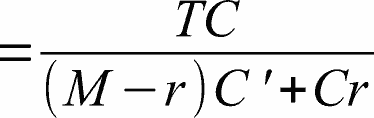
That is very similar to the formula given some fifty years later by Professor Irving Fisher. Fisher’s equation,24
PT = MV + M’V’
may be written as—

While M’V’ and V in Fisher’s equation have respectively the same meanings as Cr and C’ in Levasseur’s equation, the only difference is that we have M instead of M—R and T instead of TC in Fisher’s equation.
In many respects the opinions of Cairnes25 were similar to those of Levasseur. That was true especially of the first of Levasseur’s propositions, namely that the increase of the quantity of the precious metals had caused a rise in the prices of all commodities, but that that rise was not uniform for all products. The theory of money upon which Levasseur had based his conclusion was not, however, exactly the same as that of Cairnes. The latter’s view was more of the Seniorian character, while the former’s view inclined more towards the quantity theory.26 The general position of Cairnes concerning changes in prices was precisely laid down in the following passage:—
When an advance in the price of any of the great staples of industry becomes definitive (and monopoly apart), there are two, and only two, adequate explanations of the fact: either the cost of producing the article (understanding by cost, not the money outlay, but the real difficulties of production) has increased; or the cost of producing or obtaining money has diminished. A change in supply and demand will indeed produce temporary effects upon prices, but apart from the conditions just stated it is incapable of permanently altering them.27
He then traced, step by step, the consequences of the new discoveries of gold on prices and thereby produced one of the best analyses of the “direct” chain of effects that connect money and prices. According to him, “the process by which an increased production of gold operates in depreciating the value of the metal and raising general prices appears to be twofold; it acts, first, directly through the medium of an enlarged money demand and, secondly, indirectly through a contraction of supply.”28 With respect to articles which were exclusively consumed by the productive classes and hence were directly affected by the new money, the sequence of events was as follows: By the discovery of gold, a common labourer was enabled to obtain a quadruple rate of wages. That in turn caused an increase of expenditure and consequently an increase in money demand. That was followed by a temporary rise in prices, in advance of the general movement, and increased production. How long that temporary rise in price would last depended on the nature of the articles themselves. “That portion which consists of finished manufactures, though their price may in the first instance be rapidly increased, cannot continue long in advance of the general movement owing to the facilities available for rapidly advancing the supply; whereas, should the production, from over-estimation of the increasing requirements, be once carried to excess, their prices, in consequence of the difficulty of contracting supply, may be kept for some considerable time below the normal level. . . . Such raw products as fall within the consumption of the classes indicated, not being susceptible of the same rapid expansion as manufactures, may continue for some time in advance of the general movement, and among raw products, the effects would be more marked in those derived from the animal than in those derived from the vegetable kingdom.” After that adjustment of prices and the restoration of equilibrium, there would remain a net permanent rise in prices. Articles which did not come directly within the range of the new demand felt the effects of the discovery of gold differently. The producers of those articles first found that as wages in other branches of industry had been raised they could not continue to pay their workmen at the old rate. When they paid them according to the current rate of wages, their profits fell and a curtailment of production became inevitable. The curtailment of production in turn raised the sale prices of their products. “An increased supply of money thus tends, by one mode of these operations, to raise prices in advance of wages and thus to stimulate production; by another, to raise wage in advance of prices, and thus to check it; in both, however, to raise wages, and thus ultimately to render necessary, in order to maintenance of profits, a general and permanent elevation of prices.”29 He then presented the same proposition as Levasseur that the rise in prices was not uniform for all products. Briefly stated the position of commodities in the upward trend of prices depended upon three things: first the direction of the new expenditure; second the facility for extending the supply which in turn depended upon (a) the extent to which machinery was employed in production, and (b) the degree to which the process of production was independent of natural agencies; and third the facility with which supply could be contracted. Manufactured products, the supply of which was easiest to extend, but most difficult to contract, would have a rise in price quickly corrected by the increased production; and consequently the rise of price was not significant. The opposite was true of raw products, especially the raw animal products.30
The discovery of gold had another effect on the economic conditions of the gold-producing countries, that was by changing their status in foreign trade:—
The essence of the gold discoveries, regarded economically, consisted . . . in the reduction in the cost of raising gold, which was thereby effected—a reduction which, not being shared by other countries, involved a change in the comparative costs of Australian and foreign productions. The consequence of this change has been a corresponding change in the character of her foreign trade, brought about. . . through an action on money wages. Thus Australia, instead of raising her own corn, as under ordinary circumstances she would do, imports the greater portion of it.31
The next problem of importance was how and to what extent the new gold would make its effects felt on the price structures of foreign nations. Generally speaking, as “the supply of gold required, in order to render possible a fall in its value over so large an area of transactions, was immense, money raised throughout the world at large did not, and could not, advance with the same rapidity with which they advanced in the gold countries”.32 The advance, moreover, would be different with different nations. It “will proceed most rapidly in the productions of England and the United States; after these, at no great interval, in the productions of the continent of Europe; while the commodities the last to feel the effects of the new money, and which will advance most slowly under its influence, are the productions of India and China”.33 That was due to three reasons. First, the diffusion of the new gold throughout the world was not uniform over the various countries. It first flowed to the principal markets of England and the United States, and only comparatively small portions went directly to the markets of Asia. Secondly, the currencies receiving the new supplies did not have uniform susceptibility. England, for example, required a less quantity of gold than India to raise her prices to the level of the gold-producing nations, because in England the credit element prevailed and the currency was highly elastic and expansible, while in India the metallic proportion of the currency was much greater. Thirdly, the correctives upon which either country depended for restoring the equilibrium of its price level with the price levels of other countries were not the same. Generally speaking, there were two kinds of correctives. First the most powerful corrective was that “which is supplied by the competition of different nations, producers of the same commodities, in neutral markets”. Second, the less effective corrective was that “which exists in the reciprocal demand of the different commercial countries for each other’s production”. While England and other European states could use both of the correctives, the Asiatic states could use only the latter one.34
Nevertheless, given time, the advance of prices would produce from commodity to commodity and from country to country and ultimately bring about an equal change in all commodities. Thus, he said:—
Now I am quite prepared to admit that an increase of money tends ultimately, where the conditions of production and demand remain in other respects the same, to affect the prices of all commodities and services in an equal degree; but before this result is attained a period of time, longer or shorter, according to the amount of the augmentation and the general circumstances of commerce, must elapse. In the present instance . . . some thirty or forty years.35
Before we examine the contribution of Jevons, we may make a digression on Cairnes’s important criticism of the currency principle or the principle involved in the Bank Charter Act of 1844, which was made ten years after the Act had been passed. The Currency School relied, as indicated above, upon Hume’s law as a part of the theoretical foundation of its banking policy proposals. Hume’s law was opposed by Tooke and Fullarton, who pointed out that changes in the volume of bullion did not necessarily lead to changes in the volume of circulation. Cairnes accepted that proposition. Moreover, he went a step further in refuting the doctrine that gold, in the event of a foreign drain, “can never come back, unless a contraction of the currency really takes place.” Cairnes admitted that “the efflux and influx of gold are in all cases ultimately governed by the relation between our exports and imports” and that by lowering prices at home, which would act as an inducement to exports and a check to imports, a contraction of circulation might bring back the gold. His objection to the doctrine is this, “Though true as far as it goes, it is incomplete.”36 For the state of prices in the trading countries was not the only circumstance affecting importation and exportation. He said:—
The quantity of foreign goods . . . which we import from foreign countries, does not depend solely upon the prices at which these commodities are to be purchased; it depends quite as much on the means at the disposal of people in this country for procurement of such articles. . . . If any circumstance should occur to render industry less profitable, or to diminish the general wealth of the country, the means at the disposal of the community for the purchase of foreign commodities would be curtailed. Without supposing any alteration in prices, therefore, the demand for such commodities would decline and consequently the amount of our imports would fall off. And conversely if the opposite conditions should occur, if the wealth of the country were to increase, we should each on an average have more to spend; a portion of this increased wealth, without necessarily supposing any fall in prices abroad, would go in extra demand for foreign commodities; and our imports would consequently increase. It thus seems plain that any circumstance which has the effect of enriching or impoverishing the country, must operate in augmenting or diminishing the amount of goods which we import from abroad; and what takes place here will of course take place equally in foreign countries. It follows, therefore, that the relation between our exports and imports and, by consequence, the influx and efflux of gold, depends not only on the state of prices here and abroad, but also on the means of purchase which are at the command, respectively, of home and foreign consumers. It is quite conceivable therefore without supposing any alteration in the prices of commodities, and consequently without the necessity of any contraction of the circulation—it is quite conceivable, that the relation between our exports and imports may be altered and, consequently, the exchanges adjusted, simply in consequence of a change having taken place in the comparative wealth of this and other countries. Now such a change takes place . . . when the harvest fails at home, or when the staple of any of our manufactures is deficient, or when large military expenditure is to be supported abroad; in short, when any of the ordinary causes occur which require this country to export gold. The transference of so much gold from this country to foreign countries . . . alters the disposable wealth comparatively of this and other countries; their means of expenditure is proportionally altered, and consequently their demand for each other’s goods. There is thus, in the circumstances attending a transmission of gold from this country, a provision made for its return, quite independently of the state of prices or of the circulation.37
The doctrine contained in the passage quoted above is similar to Thornton’s doctrine of transfer. Like Thornton, moreover, Cairnes was of the opinion that a contraction of the circulation, though a possible means of adjusting the balance of international payments, was a dangerous weapon to use. For a contraction of the circulation would greatly discourage home production, retard or prevent “the fabrication of those manufactures which constitute our only means of purchasing”, back the gold, and consequently defeat the very object of the contraction.38
Not quite consistent with the proposition that a contraction of the circulation would discourage trade and production is his interesting attempt, in his Essays, to refute the doctrine that money stimulates trade and production. According to that doctrine, Cairnes said,
each addition to the circulating medium, forming the basis of a corresponding increase of the demand, gives a corresponding impetus to production; every increase of money thus calls into existence an equivalent augmentation in the quantity of things to be circulated; and the proportion between the two not being ultimately disturbed, prices, it may be presumed, will return to their original level. The least reflection, however, will show that this doctrine has been suggested by a very superficial view of the phenomena. For—not to press the obvious reductio ad absurdum to which this argument is liable—how is this extension of production to be carried out? In the last resort it is only possible through a more extended employment of labour. But when once all the hands in a community are employed, the effect of a further competition for labour can only be to raise wages; and wages once being generally raised, it is plain (supposing all other things to remain the same) that profit can only be maintained by a corresponding elevation of prices. When, therefore, the influence of the new money has once reached wages, it is evident that there will be no motive to continue production to that point which would bring prices to their former level, and that consequently an elevation of price must, at this stage of the proceedings, be permanently established.39
Note the conditioning clause, “when once all the hands in a community are employed.” It is only upon the assumption that an increase in employment would lead to an increase in wages that his criticism could really stand. He also criticized a corollary of the main thesis of the doctrine that money stimulates trade, that the new gold would cause an increase in real wealth. He declared that, while the gold-producing countries would gain because of the lag of the world level of prices behind their local prices, the world as a whole had made no change in its wealth. “The gain of Australia and California from their goldfields is confined to that portion of their trade which they carry on with foreign countries. . . . The operation of the new gold will be confined to causing a new distribution of real wealth in the world without affecting its aggregate amount; and consequently the gain of the gold countries must be reaped at the expense of other nations.”40 A few years later Jevons made an attempt to ascertain the fall in the value of gold.41 After a careful comparison of the prices of thirty-nine chief and seventy-nine minor articles, he found that prices had risen between 1845–50 and 1860–62 by at least 10 1/2 per cent or gold fell in value by 9 1/3 per cent. The value of his contribution, however, lay not so much in his conclusions as in his method of approach—he had, for example, suggested the use of geometrical means to obtain an average change of prices and had shown how a permanent fluctuation of prices might be discriminated from a temporary one. As to the theory of money and trade itself, only two points made by him are worth mentioning here. First he pointed out that even in countries where the credit element prevailed gold still served as the basis of the price structure. “While the elasticity of credit may certainly, as it seems, give prices a more free flight, the inflation of credit must be checked by the well-defined boundary of available capital, which consists at the last resort in the reserve of notes, equivalent to gold, in the Bank of England. Prices temporarily may rise or fall independently of the quantity of gold in the country; ultimately they must be governed by this quantity. Credit gives a certain latitude without rendering prices finally independent of gold.”42 Secondly, he declared that the depreciation of the value of gold would be regressive.43 “If a be the quantity of gold in the world at any time, and b the quantity added in each succeeding year, then at the end of n years, the value of gold is reduced as 1 to a/(a + nb) which is always growing less as n increases, but at a constantly less rate. Thus the fall during the nth year is as 1 to (a + (n - 1)b)/(a + nb) which as n increases constantly approaches unity.”44
In the following years (1864–65) the problem was taken up by Leslie.45 He advanced three important propositions. First of all he came, like Newmarch, to the conclusion that the rise in prices due to the new gold was “temporary in degree and partial in character”.46 Secondly, he emphasized the fact that the effects of the new gold on prices was not uniform. His arguments, being very suggestive, are worth quoting in full:—
The additional money has been unequally distributed by the balance of trade to different countries, and very unequally shared by different classes in the countries receiving it; again it has been spent by the classes receiving it, not upon all commodities alike, but unequally, and the supply of something upon which there has been an additional expenditure has increased very much more than that of others. Moreover, a low range of prices is raised more by a given addition to money than a high one, which is one of the reasons why the change has been the greatest in places once remarkable for their cheapness. And from what has been said it is plain that a change in comparative incomes and prices would have been caused by the new gold alone, since it would increase the incomes and expenditures only of the classes, beginning with the miners, to whose hands it successively came.47
The fact is, that the scale of relative incomes, and of relative prices, in different places, and with respect to different commodities, has been so altered that the old level of profits in different employments and the old rates of expenditure in different situations, have been permanently disturbed, and new elements must be imported into all calculations respecting the best markets to buy and sell in, the cost of living in different localities, the outgoings and returns in different trades, and the rate of interest which different investments will yield.48
Thirdly he called attention for the first time to the fundamental difference between the price revolution of the sixteenth century and the price changes of the nineteenth century. During the sixteenth century the commercial centres of the world were most sensitive to the new supplies of the precious metals, while the remote parts of every country or the remote countries of the world were very little affected by the event. In the nineteenth century the monetary movements of the sixteenth century had been inverted, and the rise of prices had been much greater in the remoter parts of a country than in its capital and greater in the Asiatic countries than in the European countries.49
The literature of the gold discoveries controversy had thus forwarded the study of the monetary aspects of the theory of international price relationships. On the one hand, the quantity theory had been criticized, modified, and restated. On the other hand, the doctrine that money stimulates trade or production had been restated by Newmarch, and it had been criticized by Cairnes. The mechanical doctrine that prices of all commodities would be everywhere uniformly affected by a change in the volume of money had been questioned by Levasseur, Cairnes, and particularly Leslie. The analysis of the “direct” chain of effects that connect money and prices and the problems of diffusion which were first presented in the writings of Forbonnais, Cantillon, Hume, and Senior, were well developed by both Newmarch and Cairnes. The connection between the volume of gold and the money rate of interest was made clear by Stirling, Newmarch, and Levasseur. None of them, however, had said anything about the connection between the current rate of interest and prices. Hence, a complete analysis of the “indirect” chain of effects connecting money and prices was left to later writers. Finally, the institutional approach of Leslie was both suggestive and interesting.
3. Goschen, Bagehot, and Laughlin
During the period discussed in Chapter III, as we have shown, some attempts were made to describe the function of bank rate in the international movement of specie and in international price adjustments. In the latter half of the nineteenth century many excellent works on the subject were published and there was marked progress made in understanding the operation of bank rate.
First of all there was that body of thought which regarded bank rate as a regulator of the international movement of specie, that is by influencing the rate of foreign lending. That body of thought had developed over a long period of time. As early as the sixteenth century Jean Bodin had noticed a connection between interest rates and the international movement of specie. When the controversy concerning the justification or unjustification of the lowering of the rate of interest by law occurred in England in the latter half of the seventeenth century, the opponents of the policy of the lowering of interest by law clearly pointed out that “the Lowering of Interest . . . shall either make the Foreigner call home his money, or your own People backward to lend”.50 In the first half of the nineteenth century Took, Mill, and others51 clearly recognized the function of bank rate in regulating specie movements. But it was Goschen who first produced a systematic exposition of the effects of bank rate.52
In his classic treatise on the foreign exchanges53 Goschen declared that the primary cause which determined the fluctuations in the exchange rates was the balance of international indebtedness.54 That, however, would cause a variation only within the limits of the specie points.55 Sometimes the exchanges did rise or fall much beyond the specie points, and in those cases it was necessary to try to discover the other factors. He found that the state of credit in the money market played an important role. For instance, a stringent money market in the country where the bill was drawn could act “materially upon the exchanges, inducing sellers [of bills] to force sales, and creating a reluctance on the part of purchasers to buy unless absolutely compelled to remit”.56 As regards bills with a certain time to run57 it was necessary to take into consideration, in addition to the state of credit, other determining elements, especially the relative rates of interest in the two countries. He said: “In the rate of exchange for all bills other than bills at sight, there is no element of value so constant and so effective as the rate of interest in the country on which the bill is drawn.”58 Finally fluctuations in the rate of exchange might be caused by a fourth factor, namely differences in currency.59
He analysed the relations between the balance of international payments and the relative rate of interest in the trading nations and concluded that both of them were determining elements of fluctuations in rates of exchange. He found that:—
These two influences will be generally found to be operating simultaneously in opposite directions. Money will be dear and scarce in the country which owes much to foreign creditors, and plentiful in that which has exported much; and high interest will be attracting money to that quarter whence specie is flowing out in payment of foreign debts. The adverse balance of trade will, as far as its power extends, render the bills on the country which is most in debt difficult of sale, and tend to compel it to export specie; whereas the high rate of interest, which is generally contemporaneous with a drain or the prospect of a drain, of specie, will revive a demand for bills on this same country, and enhance their value in other quarters; for there will be a general desire to procure the means of remitting capital to that market where it commands the highest value.60
That leads us immediately to correctives of the foreign exchanges. He pointed out that “when the exchanges are manifestly against any country, and it is perceived that a balance of indebtedness is the cause, the equilibrium can be restored only in two ways: the one being the increase of exports and the diminution of imports; the other an advance in the rate of interest”.61 When the initial cause (that was an adverse balance of indebtedness) was a permanent one, the disequilibrium in trade could be only corrected by the former expedient. He did not say anything, however, as to how exports might be increased or how imports might be decreased. When the derangement was but temporary the latter expedient was the most effective:—
Where a considerable efflux of specie is taking place, the rate of interest will rise in the natural course of things. The abstraction caused by the bullion shipments will of itself tend to raise that rate; and banking establishments will in their own interests (which will be identical with the interests of the public) accelerate this result as far as lies in their power.62
When the English rate of interest advances, there will be a general desire on the Continent to take advantage of this circumstance, and to remit capital to England for temporary advantageous investment; but how is the transmission to England to be effected? Of course in bills, so long as they can be procured; and consequently those who are holders of bills on England, and are willing to sell them, find themselves in possession of an article which is suddenly in great demand, and are thus enabled to make a higher price. Competition raises this price, till remittances by means of bills become almost as expensive as a shipment of bullion itself. . . and as the supply of bills tends to become insufficient, gold is actually sent. This is the technical explanation of the rapid rise of the price of bills on any country as soon as any advance in the general rate of interest obtainable there takes place.63
Almost every advance in the Bank rate of discount is followed by a turn of the exchanges in favour of England; and, vice versa, as soon as the rate of interest is lowered, the exchange becomes less favourable.64
That was the first systematic statement of “the mechanism connecting the bank rate and the international movement of specie” as a corrective of disturbances in the equilibrium of the exchanges and trade.
That doctrine of Goschen was immediately accepted and pushed a step ahead by two Continental economists, whose contributions we shall examine in the next section. It was further developed in the seventies by Bagehot65; and early in the present century by Laughlin.
Laughlin’s primary concern was the problem of the value of money. He started with a criticism of the quantity theory of money.66 He argued that as gold or silver was a commodity its value was determined, on the one hand, by the expenses of its production and, on the other hand, by the condition of demand for it as money and as plate. His analysis came on many points very near to that of Senior.67 He extended his analysis to the problem of international price relationships and of international specie movements. He denied that Hume’s law was a corrective of disturbances in equilibrium. He seemed to have recognized that an adverse balance of international payments might bring about an international movement of specie, for he definitely said that “the movement of gold follows . . . the events which determine the course of international trade”.68 But to him the inflow or outflow of specie could never, in turn, cause the trade balance to change so as to bring about a restoration of equilibrium. Firstly he denied the connection between the movement of specie and internal prices, as described in Hume’s law.69 That was inherent in his refusal to accept the quantity theory. Secondly, he did not see the possibility that a level of prices within a country could be, even in a transitional period, different from that abroad. He said:—
The action of international markets, with telegraphic quotations from every part of the world, precludes the supposition that gold prices could in general remain on a higher level in one country than another (cost of carriage apart) even for a brief time, because, in order to gain the profit, merchants would seize the opportunity to send goods to the markets where prices were high.70
That does not appeal to us as a sufficient argument against a possibility of a connection between price levels and the flow of gold. On the contrary, it amounts to saying that differences in prices, if they do exist at all, will be adjusted quickly by the movement of goods. That was exactly what the classical theorists maintained.
After having attempted to refute the classical theory he presented a theory of his own. According to that theory the interest rate was a much more important factor than the trade balance, and the international movement of capital in the form of securities was much more important than the movement of gold. He said:—
The reason why balances in favour of a country may not be paid in gold is due to the possibility of investing those balances at a higher rate of interest in a foreign country than can be obtained at home. The relative rates of interest have an influence even wider than that upon the movement of balances. It is the rate of interest upon sound international securities as well as the rate in the loan market, which determines whether credit due, for instance, to the United States shall be left abroad or brought home in the form of goods or specie. The general accounting in foreign trade must include the operations of loans, and the movement of capital for investment from one country to another. Indeed, the rate of interest is behind the movement of securities mentioned above. The purchase of securities is, of course, one form of investing capital. Therefore, in determining the causes affecting prices and the movement of gold in international trade, it must be kept in mind that the relative rates of interest in the trading countries will influence the passage of loanable capital to and fro, thereby acting as a factor in adjusting merchandise credits and debits, and seriously affecting the transmission of gold. Instead of gold being the originating cause of new exports and imports, as once generally held, it is the very last thing to move; and even then merchandise balances may be entirely reversed by changes in the rates of interest in New York or foreign centres, which may cause capital to flow from the creditor to the debtor country. The recognition of the force exerted by the rate of interest on the movement of loanable capital gives the final coup de grâce to the old theory, which based its change of general price upon the international movement of specie. The order of events is quite the other way: relative prices cause exports and imports of goods; and the shipment of gold is not necessarily made even to cover balances of merchandise. If gold moves, it goes not merely because of the account in goods and securities, but of the investment of international capital.71
That is very similar to the analysis of Goschen.
Laughlin did not recognize, however, any connection between the money rate of interest and prices. He rejected the proposition that an influx of gold, in the modern banking system, would affect prices through raising bank reserves and expanding the purchasing-power, which was offered for goods. He argued “that, in legitimate banking, loans are made because of satisfactory collateral or actual transfers of goods, and not merely because reserves are high. To be sure, if reserves rise, rate of interest will fall and new loans are possible; but merely because a bank can loan, it does not follow that it does loan. . . . The imported gold first passes into the banks, and only as much as is needed for legitimate business is retained. Having a value in and for itself it can be disposed of as easily as any other form of property”.72 That argument tacitly assumed that the demand for loans was absolutely inelastic; while in truth the assumption had never been found to be true, at least in modern conditions.
4. De Laveleye and Juglar
Goschen’s doctrine of the interest rate as a regulator of international movements of specie was immediately accepted and carried a step further by Laveleye and Juglar. Laveleye’s chief concern was the explanation of business cycles and crises.73 According to him cyclical movements were a phenomenon peculiar to the credit economy and dependent largely upon the state of credit. Countries with a big superstructure of credit, based upon a small volume of gold or silver, were most susceptible of economic perturbations.74 In those countries crises were always the result of a contraction of the media of exchange, money, and credit75; and the contraction of the media of exchange was usually produced by a derangement in the balance of trade.76 The causal sequence leading to a crisis was as follows:—
Unfavourable balance of trade—unfavourable exchange—outflow of gold—rise of the discount rate—contraction of credit media—the crisis.
The rise in the discount rate itself had a remedying effect, for “to raise the rate of interest meant that one prepares to pay a higher rent for the use of cash. It follows that the disposable money in places where it is relatively plentiful and where it is cheaply hired will rush toward the market where people consent to pay dear for it. This is the inevitable consequence of the law of demand and supply”.77 In other words, the very rise in the interest rate, which was consequent on the drain of specie, would encourage foreigners to transfer their loanable money to the centre which was losing specie.
The remedying effect would also be felt through another channel, that was through commodity prices and security prices. He pointed out:—
The certain, undisputed effect of a rise in interest is to depress the prices of commodities and of all securities. It is so because a great number of persons always want credit for maintaining their operations and when credit is contracted they must liquidate and must sell their goods or securities in order to meet their operations. Since commodities and securities fall in prices, it is inevitable that the capitalists of countries where money is still abundant will give some orders of purchase. In order to pay for their purchases, they have to make remittances, and then cash returns to the country where the rise of interest has led to a fall in price [equilibrium would thus be restored].78
Thereby he, on the one hand, connected Goschen’s doctrine of the interest rate as a regulator of the movement of specie with Hume’s law and, on the other hand, connected the cyclical analysis with the theory of international price relationships.
Laveleye also made an important contribution in connection with the problem of how an increase in the volume of the money metals (subsequent to the gold discoveries of Australia and California) worked out its effects on prices. He recognized clearly both the direct mechanism and the indirect mechanism. He said:—
[1. Direct Mechanism]: The enormous quantities of gold have been distributed over the world. A part of that gold has penetrated into the circulation in the form of purchases of products, raising prices without having any effect on the rate of interest.
[2. Indirect Mechanism]: But another part, a much greater one, has passed first into the hands of moneylenders, banks, bankers, and capitalists, who, in seeking for a profitable employment, offer it in the money market, thus contributing to the depression of the interest rate.
This will be the immediate effect. By a second, more remote effect, that new quantity of money will tend to raise prices.79
That was true, however, only when other things were equal. The increase of money or the lowering of the rate of interest itself stimulated the spirit of enterprise and multiplied the volume of production and trade. That in turn offset the tendency towards an increase of prices. “The [increased] money will encourage industry,” he said, “as long as it does not exceed the need of circulation, for the abundance of money facilitates the exchanges and loans . . . and lowers interest without raising prices; beyond that limit, it raises prices without lowering interest.”80
His theory of international price relationships might also be presented in the following way: A country’s trading relations with other countries could be in equilibrium when its imports exactly balance its exports. The infallible indication of the existence or the non-existence of an equilibrium was the state of the exchanges.81 In case there was an adverse balance of trade, the exchanges would turn unfavourable, gold would flow out, and a crisis would result; but that would soon be corrected mainly by the mechanism connecting interest rate and specie movement and to a certain extent also by Hume’s law.
At about the same time Juglar82 presented a similar theory. Like Laveleye, he drew heavily upon Goschen and connected the money market mechanism with the international movement of the precious metals, on the one hand, and business cycles on the other. Since much of his doctrine was identical with that of Laveleye, it need not detain us long. We need only note two points. First he called attention to the fact that ever since 1800 there had been perfect regularity in the increase and decrease of the stocks of metallic reserves of England and France. That rhythmic variation of the stock of specie coincided with the cyclical movement of prices. During the upward trend of the cyclical movement prices rose and specie flowed out. The drain would continue as long as the high level of prices persisted: neither a rise of the rate of discount nor the lowering of the reserve could stop the drain. Then followed the crisis when all the factors would combine to bring down prices. The fall in prices in turn led to a rapid reflux of specie. Thus the international movement of specie was clearly connected with the business cycle.83 Second, he accepted the doctrine that an increase of the quantity of money, by stimulating enterprise and production, increased the demand for money so that the tendency of prices to rise (due to the increase in the supply of money) was checked.84
5. Sidgwick, Giffen, and Marshall
The indirect mechanism which connects money and prices by means of changes in bank reserves and in discount rates is usually associated with the name of Alfred Marshall. The importance of the interest rate in the relations between money and prices had, however, been noticed long before his time. As early as the year 1705, Law gave that factor a place in his doctrine of money. He pointed out that, as the quantity of money increased, money would be more easily borrowed and merchants would deal in larger sums of money. Law, however, came to the conclusion that as the market rate of interest fell, merchants would be able to sell at less profit and all sorts of manufacture would be cheaper. That proposition was, by implication, based upon the inadmissible assumption that the prices of other factors of production remained unchanged as the rate of interest changed. Later very clear statements of the indirect mechanism were found in the writings of Thornton, Ricardo, and other classical economists. In France the mechanism was excellently described by Laveleye, who had gone a step further in associating it with the mechanism connecting the interest rates and international movements of specie. In the eighties that view had, in one form or another, been very commonly, though rather vaguely, held by people in the business world. The contributions of Marshall and his contemporaries lay rather in scientifically presenting the mechanism and in giving due importance to it.
The first writer of the eighties to give a systematic description of the indirect mechanism was Henry Sidgwick.85 In his discussion of the value of money, he pointed out that “the term, ‘value of money’ was used in two ways: in economic structures it usually means the purchasing-power of money or its exchange value measured in commodities other than money; in practical discussions about the ‘money market’ it denotes the rate of interest paid for the temporary use of money”.86 He was of the opinion that there existed a definite connection between those two meanings. He said:—
It should be observed that those who confound the two meanings of “value of money” are not wrong in supposing that the value of the use of money [discount rate] tends to be lowered by an unusual influx of metallic money or bullion, and raised by an efflux; they are only wrong in overlooking the transitoriness of these effects. An increased supply of gold, not accompanied by a corresponding increase in the work that coin has to do (or a rise in the demand for gold otherwise caused), tends ultimately to lower the purchasing-power of money relatively to commodities generally; but, in the first stage of the process that leads to this result, the increment of coin . . . must pass through the hands of bankers, and so increase the amount of the medium of exchange that they have to lend. Hence the price paid for the use of money will tend to fall, and this fall will tend to cause increased borrowing, and consequent extended use of the medium of exchange; and then through the resulting rise in prices generally the greater part of the new coin or bank-notes will gradually pass into circulation. Thus, the fall in the purchasing power of money, consequent on an influx of gold, will nominally establish itself through an antecedent and connected fall in the value of the use of money.87
That is clearly a very able statement of the indirect mechanism connecting money and prices.
Three years later, Giffen88 not only presented a more elaborate statement of the indirect mechanism but also made an attempt to verify it statistically. He found that there was always an intimate connection between the annual supply of gold, on the one hand, and both the rate of interest and the prices of commodities on the other. That connection might be carried out either by a direct mechanism or an indirect one.89 In a simple industrial system (that was one without paper circulation and without an extended credit system) the increase of the annual supply of gold would be immediately distributed and directly connected with prices. “The rate for loans is also directly affected, cash being relatively a very important item of circulating capital.90 There could hardly arise any problem of indirect mechanism which was peculiar to credit economy. In the latter, however, the indirect mechanism played a dominating part in connecting the volume of money and the rates of discount as well as the level of prices. Cash no longer affected prices directly nor did they continue to constitute a significant item of circulating capital.91 It still exerted tremendous influence on both discount rates and prices because of its dual capacity as bankers’ reserves and as small change. As bank reserve it set a limit to a banker’s liabilities; in other words, to his loans and investments which were the condition of his ability to receive deposits. In that way it gave a limit to the bank’s expansion and affected its rates of discount. An increase of cash, by acting on the bank’s reserve, would lower the discount rate, while a diminution of the quantity of money would raise it.92 The rise or fall of the discount rate in turn caused a variation in prices. The fall of the money rate of interest would encourage borrowing. As “borrowers borrow in order to purchase or to avoid selling”, an increase of borrowing tended to raise prices. The opposite was true of a rise in the money rate of interest.93 As small change, cash also set a limit to the variation in prices. “A certain level for wages and prices implies the use by a community at a given time of a corresponding amount per head of notes and cash of different kinds. If wages and prices rise from that level more notes and cash, ‘other things being equal,’ are required. . . . Prices and wages cause a demand for cash as small change, and are necessarily limited by the amount of cash available.”94 Those two uses of money, moreover, were interconnected. On the one hand, it was through the use of cash as small change that an increased reserve (due to an increase of the quantity of cash) could pass the increased money into ordinary circulation. He said:—
An increase of lending [consequent on an increased reserve] tends to raise prices. . . . The rise of prices adds to the nominal capital, and particularly to the nominal capital represented by the loans and deposits of banks. Wages in turn rise, and with their rise . . . requirements for small change are increased, and the banking reserve trenches upon.95
On the other hand, a reserve would be “more efficient if there are large amounts of coin circulating to be drawn upon”.96 Finally, he seemed to have suggested that by the very rise in prices, which was consequent on an increased reserve, the process of expansion would be automatically checked. A rise in prices, as explained above, drained cash from the bank into circulation, reduced the bank reserves and thus turned the price in an opposite direction. He declared:—
The rate of discount and the level of general prices . . . are connected at some points. A change in the level of prices affects the money market. A rise tends to make “money” in demand and to raise discount rates; a fall to make “money” abundant and to lower rates. At the same time a change in the discount rates acts on prices. A rise tends to lower prices; a fall to raise them. Prices in turn react on discount rates. There is incessant action and reaction.97
In his memoranda and evidence before the Gold and Silver Commission of 1887–8, Alfred Marshall98 gave an excellent account of the indirect mechanism. He recognized, first of all, the quantity theory that “other things being equal prices rise or fall proportionately to every increase or diminution in the metal or metals which are used as the standard of value”. But the conditioning clause “other things being equal” was of overwhelming importance, for other things might not remain the same. The methods of doing business might undergo some alteration; the cost of producing the money metals might be increased or diminished; and account had also to be taken of the volume of things on sale, “the average number of times each of these things changes hands during the year,” the use of token coins as well as the velocity of the circulation of money.99 If all those elements were unchanged, prices would rise in proportion to the volume of the money metals.
By what mechanism, however, would an increase of gold in, say, England work out its effects on prices? His answer was given in the following passages:—
It would act at once upon Lombard Street, and make people inclined to lend more; it would swell deposits and bank credits, and so enable people to increase their speculation with borrowed capital; it would, therefore, increase the demand for commodities and so raise prices.100
If there was more gold in circulation than people wanted to do that part of their business which they prefer to do with currency, they would simply send it to the banks. From the banks it would go into the reserve; from the reserve it would go back on to the general market, inflating credit, increasing speculation, enabling people to borrow who could not borrow before, raising prices. When prices had once been raised, say 10 per cent all round, then supposing there to be no dose of arsenic with the incantation, and the habits of business to be exactly the same as before; then people would require 10 per cent more cash in their pockets than they did before.101
In the first of the two passages quoted above Marshall gave a statement of the indirect mechanism in its simplest form, while in the second passage he also took into consideration the quantity of currency people keep in their purses. Although it might be doubtful whether that was exactly the same as Giffen’s cash for small change, the two were really very similar, and both doctrines must be given a place in the historical development of the cash balance approach of the quantity theory.102
In his later work on money and trade,103 Marshall restated his cash balance doctrine as follows:—
In every state of society there is some fraction of their income which people find it worth while to keep in the form of currency; it may be a fifth, or a tenth, or a twentieth. A large command of resources in the form of currency renders their business easy and smooth, and puts them at an advantage in bargaining; but, on the other hand, it locks up in a barren form resources that might yield an income of gratification if invested, say, in extra furniture; or a money income if invested in extra machinery or cattle. . . . Whatever the state of society, there is a certain volume of their resources which people of different classes, taken one with another, care to keep in the form of currency; and, if everything else remains the same, then there is this direct relation between the volume of currency and the level of prices, that, if one is increased by ten per cent, the other also will be increased by ten per cent. Of course, the less the proportion of their resources which people care to keep in the form of currency, the lower will be the aggregate value of the currency, that is, the higher will prices be with a given volume of currency.104
A country’s . . . stock of gold at any time tends to be equal to the amount, which (at that value) equals the purchasing power that the people care to keep in the form of gold either in their own custody or in their banks; together with the amount that the industrial arts of the country will absorb at that value.105
Two other points should be noticed in connection with the indirect mechanism. They were that not all increases of the central bank reserves will act on prices and that not all low rates of interest will stimulate enterprise and raise prices. Whether an increase in the reserve would make the indirect mechanism operate or not depends on the nature of the banking system. Thus he said:—
I do not think that prices are affected by any accumulation of reserves, such as the Bank of France, for instance, may hold.106
When a bank has more gold than it really wants as the basis of its currency which, of course, the Bank of France is supposed often to have had, that gold is to all intents and purposes hoarded. If gold comes out of the hoards of a country it does not act on prices at all . . . It would only act on prices . . . if it came out of coin or bullion which was acting as the basis of currency, or if it affected credit.107
As to the problem whether a low rate of interest would give activity to trade and bring about a permanent rise in prices, he considered the initial cause of the fall of interest as the determining factor. If the fall in the rate of discount was produced by an abundance of loanable capital in the market due either to an increase of saving or to an overcrowding of the field for investment, it could not have that effect; but if it arose from an increase of the money metal it would cause a rise in prices. The difference between those two cases was excellently described in the following passage:—
The mean rate of discount is governed by the mean rate of interest for long loans; that again is determined by the extent and the richness of the field for the investment of capital on the one hand, and on the other by the amount of capital seeking investment. The amount of capital has been increasing so fast that, in spite of a great widening of the field of investment, it has forced down the rate of discount. The fall in the rate of discount so caused failed to stimulate speculation, because it was itself caused by the difficulty of finding good openings for speculative investment; this difficulty being in part due to the fear that prices would go on falling. Equilibrium is found at that rate of interest for long loans (and the corresponding rate of discount for short loans) which equates supply and demand. But next, this equilibrium being established, we set ourselves to inquire what will be the result of a new disturbance, viz. the influx of a good deal of bullion into the City. This does not increase the amount of capital in the strictest sense of the word; it does not increase the amount of building materials, machinery, etc., but it does increase the amount of command over capital, which is in the hands of those whose business it is to lend to speculative enterprise. Having this extra supply, lenders lower still more the rate which they charge for loans and they keep on lowering it till a point is reached at which the command will carry off the larger supply. When this has been done there is more capital in the hands of speculative investors, who come on the markets for goods as buyers and so raise prices. Further, it must be remembered that the influx of bullion would have caused people meanwhile to expect a rise of prices and, therefore, to be more inclined to borrow for speculative investments. Thus it might not be necessary to lower the rate of discount very much. The increased demand would meet the increased supply half-way and, after a time, might outrun it, causing a rise in the rate of discount. But as this rise would be merely an incident in a series of changes which put more command over capital in the hands of speculative investors, it would go with an increased demand for goods and a continued rise of prices. This then is my account of the way in which this extra supply of the precious metals would bring prices up.108
In an earlier work, Marshall had shown how an increase in the demand for goods would lead to a further increase in the demand for goods, and how a rise in prices to a further rise in prices. When the demand for goods was increasing, he said,
producers . . . expect to sell at a profit, and are willing to pay good prices for the prompt delivery of what they want. Employers compete with one another for labour; wages rise; and the employed in spending their wages increase the demand for all kinds of commodities. New public and private Companies are started to take advantage of the promising openings which show themselves among the general activity. Thus the desire to buy and the willingness to pay increased prices grow together; Credit is jubilant, and readily accepts paper promises to pay. Prices, wages, and profits go on rising: there is a general rise in the incomes of those engaged in trade: they spend freely, increase the demand for goods, and raise prices still higher. Many speculators seeing the rise, and thinking it will continue, buy goods with the expectation of selling them at a profit. At such a time a man, who has only a few hundred pounds, can often borrow from bankers and others the means of buying many thousand pounds worth of goods; and every one who thus enters into the market as a buyer adds to the upward tendency of prices, whether he buys with his own or with borrowed money.109
The movement would go on for some time. Then, for one reason or another, the lenders of money capital would find it necessary or desirable to contract their loans. But the demand for loans would continue to increase. The rate of interest would consequently be raised very high, distrust would begin and the movement of prices would turn downward:—
Distrust increases, those who have lent become eager to secure themselves; and refuse to renew their loans on easy or even on any terms. Some speculators have to sell goods in order to pay their debts; and by so doing they check the rise of prices. This check makes all other speculators anxious, and many rush in to sell. . . . When a large speculator fails, his failure generally causes that of others who have lent their credit to him; and their failure again that of others. . . . As credit by growing makes itself grow, so when distrust has taken the place of confidence, failure and panic breed panic and failure. The commercial storm leaves its path strewn with ruin. When it is over there is a calm, but a dull heavy calm.110
Marshall also enriched the theory of international price relationships by restating the classical doctrine with regard to the international comparison of the values of moneys. He first considered a case of trade between two countries, A and B, both with a gold currency. Then “trade tends so to adjust the supplies of gold relatively to the demands for gold in the two countries as to bring gold prices at the sea boards of the two countries to equality, allowance being made for carriage Any deviation from the equilibrium would bring Hume’s law into operation to restore the equality in the values of moneys in the two countries.111 He next considered the case that B had a paper standard, say roubles, instead of a gold standard. In that case, equilibrium would be established when the gold price of B’s paper currency was fixed just at the ratio which gold prices in A bear to the paper-rouble prices in B. If prices were higher in A than in B, there would be a temporary bounty on exportation from B to A and a check to importation. Then the volume of bills offered and those demanded would change, and ultimately equilibrium would be restored.112 He finally came to the case in which B had a silver currency, say the rupee. “This case differs from the preceding only in consequence of the fact that silver is, and the rouble is not, an exportable commodity.” When equilibrium is established, the nature of the equilibrium would be the same in both cases. Trade tended so to adjust the supplies of gold and silver in the two countries relatively to demands as to bring gold prices in A to bear to silver prices in B (after allowing for carriage) a ratio equal to the gold price of silver. However, when the equilibrium was disturbed, whereas adjustment in the second case would take place almost simultaneously with the disturbance, it would be liable to be delayed in the third case. The reason was this. In the former case bills (on the foreign country) that each country held were useful to it only in buying foreign goods. Therefore, when disturbance occurred, it would act at once on imports and exports. In the latter case, on the contrary, foreign bills were useful also in the purchase of the money metals and adjustment might act indirectly through a change in the volume of money.113
6. Knut Wicksell
The theory of bank rate as a regulator both of the international movements of gold and of commodity prices was expounded with singular clarity by Wicksell.114 He stood for the quantity theory of money and pointed out that the most important problem in the theory of money was how an increase of the quantity of money worked out its effects on prices. He showed that in modern times an increase or a decrease of the quantity of money caused the money rate of interest to deviate from the “real rate of interest” and consequently brought about a rise or a fall in prices. In a modern economy, especially when the organization of credit was highly developed, credit had a similar or a more far-reaching influence on prices than metallic money—at least during short periods of time.115 He said:—
If, other things remaining the same, the leading banks of the world were to lower their rates of interest, say 1 per cent below its ordinary level and keep it so for some years, then the prices of all commodities would rise and rise and rise without any limit whatever; on the contrary, if the leading banks were to raise their rate of interest, say 1 per cent above its normal level and keep it so for some years, then all prices would fall and fall and fall without any limit except zero.116
That was the main thesis of his theory of price levels. That thesis, in its pure form, applied only to cases when the two following assumptions were fulfilled: first that other things remained the same, and second that all the leading banks of the world simultaneously raised or lowered their loan rates. “A single bank, of course, has no such power whatever; indeed, it cannot put its rates, whether much higher or lower than prescribed by the state of the market; if it did, it would in the former case lose all profitable business; in the latter case its speedy insolvency would be the inevitable consequence. Not even all the banks of a single country united would do it in the long run; a too high or a too low rate would influence its balance of trade and thereby turn an influx or a reflux of gold in the well-known way, so as to force the banks to apply their rates to the state of the universal money market.”117 In other words, the factor of international payments set a limit to the possibility of deviation of the loan rate from the natural rate. Thereby he recognized the importance of the money rate of interest as a regulator of the international movement of specie.118 There was another limitation, namely the requirements for small change. As prices rose business required greater cash holdings, bank loans increased without corresponding deposits, bank reserves and often bullion reserves began to fall, and the banks were compelled to raise their rates.119 It was necessary to keep in mind, however, that “the influence of credit or the rate of interest is only one of the factors acting on prices; the other is the volume of metallic money itself, especially in our times the supply of gold, and so long as the gold itself remains the standard of value, this factor evidently will take the lead in the long run”.120
Having described his statement of the indirect mechanism connecting money and prices, we may now turn to the problem whether an increase in the volume of circulation would lead to increased production and forced saving. Wicksell was of the opinion that if production was increased at all, the increase must be very limited. He said:—
It is impossible to endorse the widespread view that under suitable conditions a country’s output can be expanded almost indefinitely by “arousing the spirit of enterprise” and the like. This fallacious view is derived by concentrating attention on one single branch of production, provided perhaps with an excess of fixed capital (buildings, machines, etc). In such a single branch of production it would be possible to increase output immediately, but only at the expense of the other branches of production from which labour and liquid capital have to be drawn. The impossibility under normal conditions of a general expansion of production is, I think, demonstrated by the figures of unemployment at different periods, recently collected in various countries. The average number of unoccupied workers is relatively small, about 1 per cent. A general expansion of production would thus be possible only as a result of longer hours—which are neither desirable nor feasible over any length of time—or as a result of further technical progress.121
An increase in the volume of circulation would, however, cause forced saving. He said:—
Different in nature is the benefit conferred by a fall in the rate of interest on those enterprises which employ “more capital”, i.e. in which the period of investment is longer than elsewhere. An expansion takes place in their activities, but on the other hand those enterprises which employ less capital are forced to contract as a consequence of the resulting rise in wages, in prices of raw materials, etc.122
The real saving which is necessary for the period of investment to be increased is in fact enforced—at exactly the right moment—on consumers as a whole; for a smaller quantity than usual of consumption goods is available for . . . consumption.123
In his Lectures124 he made a noteworthy modification or, rather, a shift in emphasis, in his analysis of the mechanism connecting money and prices. That change involved the assignment of a less important role to the bank rate of interest than that given in his Interest and Prices. He said:—
I had formerly, in close accordance with the opinion of the classical school, imagined that this influence is mainly exercised chiefly through the intervention of the rate of interest; gold production in excess of needs ought in the first place to cause an increase in the gold stocks of banks and thereby a reduction of their interest rates, which in its turn should cause a rise in prices. . . . After further reflection I have, however, come to the conclusion that the main emphasis ought rather to be placed on the demand for commodities from the gold-producing countries; if this demand is not offset by an equally large supply of goods from other countries—in other words, by a need for new gold—it must necessarily lead to a rise in prices, and this immediately; thus the money rate of interest is perhaps not at all affected or possibly affected even in the opposite direction.125
Gold flows into the country from abroad to some extent directly in payment for goods. In such a case it should immediately give rise to an increase in commodity prices, and this increase may even precede the arrival of the gold, so that in relation to the continually rising price level there may be no excess of gold and consequently no reason for lowering the rate of interest.126
A rise in prices may be conceived as due to increased demand even before the cases of gold have been received in payment for exported goods, perhaps even long before, since even the preparations for gold mining require large amounts of labour and capital, i.e. of goods which will only be paid for in the future by the newly mined gold, and the capital perhaps may only be partly created by actual savings (and thus by a diminished demand for goods) the rest being brought into being by claims on bank credit. Meanwhile a rise in prices becomes possible and may perhaps be caused in the first instance by a freer use of credit, and interest rates will have a tendency to rise rather than to fall. The increasing gold stocks would then act as a kind of buttress to the price movement, preventing it from falling back, as it would otherwise sooner or later have to do in consequence of the contraction of credit, i.e. as a prop introduced later for a rise in prices which has already started, rather than as its prime cause. . . . We might explain the heavy fall in the value of money, which is usually the consequence of successive issues of paper money in very much the same way.127
In other words he emphasized the “direct” but not the “indirect” mechanism. That did not mean that he no longer held that the rate of interest of money could be a connecting link between money and prices. On the contrary, he still recognized that “to some extent also the new gold enters the country and finds its way to the banks as ‘capital’, i.e. the owner of the gold has not purchased goods for the amount and has no immediate intention of doing so, but wishes to lend the money out at interest. If we now assume, as we may, that large quantities of this gold are deposited in the banks by domestic and foreign capitalists, then the banks, in order to put it—or an equal amount of notes—in circulation must inevitably lower their loan rate, and in accordance with our argument we may further assume that they will succeed in their object, i.e. all commodity prices will rise and business will thus require more media of exchange. As soon as that happens there will be an end to the relative excess of money, the banks will again raise their rates to the normal, i.e. to correspond with the real rate, and at that rate the prices already raised will be maintained”.128
His view on the problem of price relationships of goods of identical technological composition among trading nations was similar to that generally held, namely that “the price of the same commodity cannot vary in two different countries by much more than the import duty and the freight”.129 Using that doctrine as a basis he went into the problem of comparative prices of factors of production in different countries. He declared that wages between one country and another would not generally be equalized. He said:—
Both real and money wages for the same kind of work are, in fact, different in different countries. . . . If despite this we were to endeavour to enforce equal money wages everywhere it would not make commodity prices more variable and could not be realized without customs duties, for it is absurd that one and the same commodity should have different prices on both sides of a duty free frontier.130
As to the problem of the rate of interest of money, he clearly pointed out that banks in every single country were forced to relate their rates to the state of the universal money market.131
What would be the international price relationship when we considered the price structure as a whole? Wicksell adhered in the main to the classical doctrine as described in our third chapter, but made important modifications. He accepted the doctrine of Ricardo and Senior that the relative price levels of different countries depended partly on their distance from the mines which supplied the precious metals. Like Ricardo, Wicksell declared that that factor would be important only “if the conditions of production in all the countries were identical (or uniformly different), so that they all had to compete for the precious metals by means of the same products In the world of reality, however, that factor was unimportant:—
It can easily happen that the general level of prices is higher in a country which imports the standard of value, for instance gold, than in a country where it is produced; provided that gold does not constitute the sole or the main export of the latter country. It can already be seen that the relative price levels of different countries cannot be related to their relative distances from the sources of the precious metal. . . . It is, however, broadly true that if two countries exhibit no particular distinguishing features and if their distances from the sources of the precious metal are fairly equal, then prices in these two countries will be at the same general level: they have to deliver up the same amount of goods in order to obtain a given quantity of gold.132
Wicksell refused to accept the doctrine that differences in the level of prices in different trading countries depended on their differences in the efficiency of labour. Wicksell said:—
The latter factor, as Mill points out, accounts for differences in real wages (which, as a matter of fact, were at that time abnormally low in England) but not differences in prices. If prices moved with money wages, real wages would be no higher in civilized countries than in uncivilized countries: what then would be the advantage to the worker of his greater efficiency?133
Nor did Wicksell accept uncritically Mill’s doctrine, namely that prices would tend to stand highest “in the countries for whose exports there is the greatest foreign demand, and which have themselves the least demand for foreign commodities Wicksell made the following comment:—
This view may be correct when it is a question purely of the direction of the deviation of prices and not of its magnitude. For no matter how eagerly the products of one country may be demanded by another country—the two countries may be separated by a political frontier or they may consist of two neighbouring parts—no appreciable difference of prices can persist when there is a free interchange of goods. In finding an answer to the above question, it is important to differentiate between these two factors (the direction of the deviation on the one hand and its magnitude on the other); for they take their origin in different, though partly interconnected, causes. . . . We can now see what it is that determines the direction of the deviation of general price levels. It does not depend on the fact that one country is superior to other countries in all branches of production, but rather on the fact that its superiority is confined to a small number of branches of production, while the other countries either possess no advantages whatever or possess advantages only in respect of commodities of which the value is small compared with the necessary costs of transport. On the other hand, the magnitude of the deviation is determined by the general level of costs of transport. It therefore depends in particular on the distance between the two countries, on the height of the tariff walls, etc.134
In other words, the state of comparative advantages and the intensity of the reciprocal demands determine the direction of the international deviation of prices, and the costs of conveyance determined the magnitude of the deviation.
In equilibrium the price relationships between countries must also maintain a balance in the international accounts for each of the trading nations. He said:—
The price equilibrium in our and other markets pre-supposes, in the main, that imports and exports balance, and that can never happen so long as one part of our exports is paid for in gold beyond the normal requirements of turnover.135
To him trade, by its nature, always tended towards equilibrium. “Vis-à-vis the goods imported from abroad there is always alternatively a consumer who, in order to obtain possession of the goods, offers an equivalent value, i.e. goods of the same exchange value saleable directly or indirectly to the foreign country.”136 Hence the aggregate sales and the aggregate purchases must be equal.
The principle laid down in the preceding paragraph is the foundation of the theory of transfer which we associate with the name of Wicksell. The main proposition of the theory is that, because of the endeavour of people to maintain a balance of their incomes and expenditures, the balance of payments, if disturbed, would correct itself automatically. Wicksell said:—
Since people as a rule endeavour to improve or at any rate to maintain, their economic position, a surplus of debts or of claims outstanding can really only be conceived on one of the following assumptions. A public calamity or an adverse crisis may occur as a result of which the goods saleable abroad are available in smaller quantities or at lower prices than usual, or else the customary imports rise in price considerably . . . or finally, consumption goods such as grain, usually produced within the country, must be imported to a larger extent than usual owing to a bad harvest or other circumstances. . . . In consequence of persistent drought, for example, the production of milk [at home] is less than usual, the dairies reduce their output of butter, and the farmers therefore receive less money with which to buy coffee [i.e. an imported article]; or the price of timber falls, and with it the wages of the timber workmen who are forced to consume less of the agricultural products of other parts of the country than usual and possibly obtain them at a lower price, or with the same result to the farmers: reduce capacity to buy their usual articles of consumption, including coffee. . . . It may indeed happen that the demand for foreign goods, such as grain, is so great during a famine year that a restriction in the use of other imported goods cannot fully make up the difference. In such a contingency, of course, individuals must obtain credit for consumption purposes, which in this case has the same effect as if they had consumed their own capital. . . . But even a credit for purposes of consumption will in the nature of things be of short duration. The worsening of the individual’s business position must be remedied, and is remedied, partly by diminished consumption and partly also, no doubt, by greater intensity of work in the immediate future, the more so if the State or other great corporations are able to employ their foreign credits for the future benefit of industry, whilst at the same time assisting in the correction of the increased requirements of consumption and the balance of payments. Our purpose here is merely to point out the fact which is often forgotten that an unfavourable balance of trade or payments undoubtedly corrects itself automatically in most cases by the steps taken by individual consumers and producers and this, too, without any serious disturbance of the price or credit structure or, indeed, any influence on the currency other than, at most, a temporary shipment of a part of the gold reserves.137
In an article, published later (1918), Wicksell further elucidated his theory of transfer.138 He contrasted two hypothetical cases: first the case of two countries, which were divided only by a “land-boundary” or, more correctly, which were so close to each other that the costs of transportation might be disregarded entirely; and, second, the case of two countries which were separated by the ocean or, more correctly, between which the costs of transportation were so considerable that they could not be ignored. In the former case, since costs of transport were assumed to be equal to zero, all commodities would be international commodities and prices between two countries must be equalized. He said:—
If these countries were both living under a specie regime there could not possible exist different prices of the same commodity on both sides of the frontier; and if we suppose, which, of course, is not exactly true, that the level of prices in the frontier of each country is materially the same as in the boundary districts, there could be no difference of prices at all between them.139
How, then, would a disturbance in the international balance of payments due to a movement of capital from one country to another be adjusted in the first case? To put the question in another way: How could the imports of the borrowing country be stimulated and its exports discouraged so that the loan could be paid by goods? Wicksell was of the opinion that the stimulus to increased imports and decreased exports in the borrowing country “is not to be found in a difference of prices in the two countries, which would be theoretically impossible and practically confined in very narrow limits; the increased demand for commodities in one country, the diminished demand in the other, would in the main be sufficient to call forth the changes alluded to It was Wicksell’s view that the consequent shifts in the demand curves of the borrowing and lending countries would succeed in making the necessary adjustments, whether the increased buying power in the borrowing country was directed, in the first instance, towards imported goods or towards the home-produced commodities. If the borrowing countries used the money borrowed to buy home-produced commodities, the amount of its commodities available for exports would diminish and its exports would be reduced accordingly. If it used the increased buying-power to buy imported commodities, its imports increased obviously. The result was the same, that was, its imports would exceed its exports to the extent that the loan was transferred by means of goods. Like Ricardo, he admitted that as the borrowing country had a larger quantity of merchandise it would “require” a greater amount of gold to circulate it and that a certain quantity of gold would very likely pass automatically from the lending to the borrowing country in the initial stage of a capital movement of long duration. That movement of gold was different from that posited by the classical doctrine, for it did not serve to increase prices in the borrowing country but merely to maintain them at their original level.
A new factor entered into the consideration of the second case, that of two countries separated by the ocean. That factor was the cost of conveyance. Because of the existence of that factor there would hardly be the same price for any commodity in the two countries. The introduction of the factor of freight charges and the consequent difference in all prices complicated the problem of transfer not only by their mere existence but also by the fact that they might be changed as a result of the international movement of capital. To illustrate the latter point he supposed two countries (America and England), the transportation costs between which were such that, in the initial stage, they were of equal amount in both directions. In such a case the average level of prices in both countries would be about the same. If a disturbance arose from the contraction of a loan by America in England, America would have an excess of imports over exports and freight costs and price relations would be affected as follows:—
The increased number of ships going from England to America with full load, and bound to go back in ballast or with insufficient cargo, must needs increase the transport charges on goods going one way and diminish the cost of sending goods the other way . . . the difference of prices in the two countries shown by the goods carried from England to America will be greater than before, whereas the goods going the opposite way will show a smaller difference of prices than before. Both the imported and the exported commodities, therefore, will have a tendency to rise in America and to fall in England. . . . Consequently the general level of prices will have been raised in America and lowered in England.140
In the case described gold was likely to flow, at the beginning of the borrowing period, from England to America, but “this influx would be the effect, not the cause, of the rise of American prices”.141
There were, according to Wicksell, two other causes of disturbance of the equilibrium in international price relationships. The first cause was abnormal conditions in the money market. His analysis of that cause has been described above. Briefly stated, if the loan rate at home was relatively low, “money, bullion, will necessarily begin to flow out of the country and . . . it will not return of itself, for there exists no direct reason for the public to restrict its consumption.” The direct influence of the banks on the money market was necessary in order to restore equilibrium.142 Secondly, trade might be temporarily unbalanced because of the gold movements which are due to changes in demand and supply for the money metal. There was a natural distribution of gold, and it would automatically stop after the adjustments had been made.143
From what has been said it is clear that Wicksell did not assign an important place to the mechanism of specie flow in the restoration of equilibrium. On the contrary, he attached decreasing importance to gold flows.144 He summed up his criticism of Hume’s doctrine of international price adjustments in the following words:—
In my view the abstract truth of this thesis cannot be denied, but its practical importance, especially under modern commercial conditions, is not so great. A fall of the commodity price level in one country is not in itself desirable unless the level was previously abnormally high, which may possibly, though not necessarily, be the case with an unfavourable balance of trade. It is not impossible that as a result of a heavy fall in our export prices, total money receipts, in spite of larger sales, might be less than before and therefore counterbalance these effects.145
7. Later Restatements of the Classical Doctrines
In the present century the classical doctrines of international price relationships have been very ably restated by two very eminent economists, namely Professor Mises and Professor Taussig. The classical doctrine of the international comparison of the values of moneys is expounded with great clarity by Mises.146 Like Ricardo, Mises declares that the money metal is distributed among different trading countries “according to the extent and intensity of the demand of each for money”.147 While so divided it maintains, upon the assumption of free trade, the same value in all countries. In order to understand the proposition of the international equality of the values of moneys, we should first know the relation between space and the concept of commodity. Of that he says: “Things that are of perfectly identical technological composition must yet be regarded as specimens of different kinds of goods if they are not in the same place and in the same state of readiness for consumption or further production. . . . It is hardly possible to ignore the fact that drinking-water in the desert and drinking-water in a well-watered mountain district, despite their chemical and physical similarity and their equal thirst-quenching properties, have nevertheless a totally different significance for the satisfaction of human wants.”148 He suggests that “two economic goods, which are of similar constitution in all other respects, are not to be regarded as members of the same species if they are not both ready for consumption at the same place”.149 In the case of money, however, he thinks it “permissible in certain circumstances to ignore the factor of position in space. For the utility of money, in contrast to that of other economic goods, is to a certain extent free from the limitations of geographical distance. Cheques and clearing systems, and similar institutions, have a tendency to make the use of money more or less independent of the difficulties and costs of transport”.150 A similar abstraction of differences in the geographical situation would not, however, be admissible in the treatment of other economic goods. Approaching the problem in that way, he gets the following so-called “law for the exchange-ratio between money and other economic goods”:—
Every economic good, that is ready for consumption (in the sense in which that phrase is usually understood in commerce and technology), has a subjective use-value qua consumption good at the place where it is, and qua production good at those places to which it may be brought for consumption. These valuations originate independently of each other; but, for the determination of the exchange-ratio between money and commodities, both are equally important. The money-price of any commodity in any place, under the assumption of completely un-restricted exchange and disregarding the differences arising from the time taken in transit, must be the same as the price at any other place, augmented or diminished by the money-cost of transport.151
Then he comes to the conclusion that the value of money is the same everywhere.152
Mises also states that doctrine in the form of a theory of the foreign exchanges:—
For the exchange-ratio between two or more kinds of money, . . . it is the exchange-ratio between individual economic goods and the individual kinds of money that is decisive. The different kinds of money are exchanged in a ratio corresponding to the exchange-ratios existing between each of them and the other economic goods. If 1 kg. of gold is exchanged for m kg. of a particular sort of commodity, and 1 kg. of silver for m/15 1/2 kg. of the same sort of commodity, then the exchange-ratio between gold and silver will be established at 1:15 1/2.153
He criticizes the allegation of differences in the value of money in different countries. To him those who believe in national differences in the value of money have left out of account the positional factor in the nature of economic goods; otherwise they should have understood that the alleged differences are explicable by differences in the quality of the commodities offered and demanded.154 In effect, “the exchange-ratio subsisting between commodities and money is everywhere the same. But men and their wants are not everywhere the same, and neither are commodities.”155
On the causes disturbing the international equality of the values of moneys or the equilibrium rate of the foreign exchanges, he stands for the doctrine that monetary trouble is the only source of disturbance. “Rates of exchange vary because the quantity of money varies and the prices of commodities vary.”156 Like Ricardo, he denies the possibility of a trade-origin of disturbance:—
International movements of money are not consequences of the state of trade . . . they constitute not the effect, but the cause, of a favourable or unfavourable trade-balance.157
To him the balance of payments theory must be totally rejected. He argues: “The balance-of-payments theory forgets that the volume of foreign trade is completely dependent upon prices; that neither exportation nor importation can occur if there are no differences in prices to make trade profitable.”158 He also criticizes the Malynesian argument. He says: “However strong the desire of the Austrians for foreign bread, meat, coal or sugar may be, they can only get these things if they are able to pay for them. If they wish to import more they must export more shares, bonds, and securities of various kinds. . . . And the balance of payments would be brought into equilibrium, either by the export of securities and the like, or by an increased export of dispensable goods.”159 The most important twentieth-century exponent of the classical theory of international trade and of the classical theory of international price relationships is Professor Taussig. He adopts the doctrine of comparative costs as advanced by Ricardo and calls attention to the fact that in reality “international trade rests largely on absolute differences” in costs.160 He restates Mill’s law of reciprocal demands with the following refinement:—
Something must be added to this. It is not merely the character of the American demand for German goods that has to be considered. Regard must be had also to the demand schedules of the Americans for their own products, of the Germans for theirs. When German linen falls in price, the Americans, while tempted to buy more linen, must consider the fact that in order to do so they must dispense with some wheat which they have been consuming.161
He then follows the examples of Senior and Mill in extending the above doctrines to the analysis of international price relationships and the international comparison of wages and gives a penetrating restatement of the Seniorian doctrine, as modified by Mill. Professor Taussig starts from the supposition that all goods come within the range of international trade. He finds that in that case “the purchasing power of money in terms of goods will be the same in the two countries . . . while money wages vary”.162 The proposition that prices are the same in the trading countries needs no comment since it is based on the assumption that all goods enter into international trade. But the question as to what determines the range of money wages in a given country needs some elucidation. According to Professor Taussig:
Those countries have high money wages whose labour is efficient in producing exported commodities, and whose exported commodities command a good price in the world’s markets.163
Money wages. . . are high in a country which has advantageous terms of international trade, which carries on trade with other countries in such a way as to secure large gains from the trade—favourable barter terms of trade. The main factors on which these gains depend have been sufficiently indicated: an outstanding comparative advantage, and the play of demand in the terms of trade.164
If we remove the assumption that all goods enter into international trade, money wages of the exporting industries would still depend directly on the intensity of foreign demand and on the relative effectiveness of labour, but the proposition that the prices of all goods are equal in two countries no longer holds good. “We must distinguish between the international and the domestic goods: those, on the one hand, which are the objects of import and export trade and are the same in price throughout the international field; and those, on the other hand, which are not imported or exported at all, and do not necessarily have the same price in one country as in another.”165 With respect to domestic goods, Professor Taussig says:—
Prices of domestic goods obey laws of their own. Some of them may be higher in price than abroad, some may be lower; and the general level of domestic prices may therefore be higher or lower. So far as the effectiveness of labour in producing domestic goods is great (great, that is, in comparison with that of labour applied in other countries to the same goods) they will tend to be lower in price. Conversely, they will tend to be higher if the effectiveness of labour in producing them is small.166
Thus, money prices both of goods and of labour will be different in different countries. Moreover, within a country, the absolute value of domestic prices does not necessarily go together with the money wages. “In other words, the prices of domestic goods are not necessarily higher in a country of higher money wages. They will be higher only if the effectiveness of labour is not higher in the purely domestic field.”167 Given the relative effectiveness of labour, however, there are definite relations, on the one hand, between wages and prices within a country and, on the other hand, between wages and prices of one country and those of others. The connecting link of the latter is the wages and prices of the exporting industries. “The determining cause of the general rate of money incomes and wages in a country is to be found in the exporting industries. These set the pace; not for real wages, but for money wages. Whatever is yielded by them tends to become, under the influence of competition, the ruling rate in the country at large—in other industries, as well as in those exporting.”168 The causal sequence runs as follows:—
If anything should occur which served to raise money wages—for example, altered and more favourable terms of international trade—a corresponding change would take place in domestic prices: they would rise to the same extent. . . . Money wages would rise first in the exporting industries; the rise would then spread; eventually prices of goods and money wages in the purely domestic industries would be such as to render them as attractive as the export industries. This assumes, of course, that other things remain the same; that, for example, the technical methods of production remain unchanged—that no inventions or improvements are made which serve to increase the effectiveness of labour in the domestic industries. Such changes may operate to lower the price of a domestic article or series of articles at the same time in which international conditions are tending to lower them.169
That is, in effect, a modern version of the Seniorian doctrine, as modified by Mill.
Professor Taussig’s restatement of Hume’s law is also interesting. Here he makes three refinements. Firstly, he points out that although the whole trend of the reasoning of Hume’s law rests on the assumption of the quantity theory of money, “the thing important for the mechanism of international payments, in relation to the theory of international trade, is not the validity of the complex and guarded” version of the quantity theory. “What signifies is a more special and limited proposition, namely that the specie constituent has a peculiar and determinative effect on the range of prices.”170 Although the effect of specie flow on price movements is different in different countries, doubtless the latter will ultimately be dominated by the former. In countries using deposits and cheques freely, with the pre-War British monetary system as the typical example, the correlation between specie flow and prices is very high.
The links of connection were close: gold inflow and outflow, bank discount rates, the loosening or restriction of loans and deposits, the temper and spirit of the business community, the trend toward rising or falling prices.171
On the Continent of Europe, with France as the typical example, where the use of deposits and cheques is relatively small, and where the banknotes are not restricted in amount or regulated as regards the conditions of issue, the international flow of specie does not have an immediate and direct effect on prices. Yet “no doubt, gold was the dominant factor in the French monetary system. A steadily continuing increase or decrease of the country’s gold could not fail to have its effect on prices”.172 Secondly he declares that Hume’s law is true only in the long run.173 In connection with his discussion of the French monetary system and price structure, he says:—
The situation serves to bring into sharp relief a factor which Ricardo and his followers habitually neglected—the element of time. Given time, a country whose circulating medium consists solely or mainly of gold must find its prices vary with changes in the gold supply. But the time required for any measurable effect on prices may be long; and while the long-drawn-out process is in course of operation, any number of other factors may also come into operation, strengthening or mitigating this one influence and always veiling it.174
The third refinement is connected with the order of events. He says: “In all countries using deposits and cheques freely, the looseness of the connection between bank reserves and bank deposits leads not infrequently to a chronological order different from that assumed in the classical reasoning. An inflow of specie may follow, not precede, an enlargement of the circulating medium and a rise in prices.”175
8. The Theory of R. G. Hawtrey
One of the most detailed statements of the theory of international price relationships along classical lines is found in Mr. Hawtrey’s treatise on currency and credit.176 His chief contributions are a series of refinements of the theory presented with great vigour and an ingenious analysis of the dynamic aspects of the problem, especially upon the assumption of an elastic circulation.
He starts by differentiating between two kinds of products, viz. foreign trade products and home trade products. The behaviour of the prices of those two classes, according to him, are different:—
The prices of home trade products are free to vary in response to any change in effective demand, while the prices of foreign trade products have to preserve a certain relation to world prices. So long as markets work effectively, the wholesale price of any foreign trade product cannot differ from the price of the same product in a foreign country expressed in the same currency by more than the cost of transport to or from the foreign country. . . . The prices of home trade products will be determined by the market at such a level as to equalize demand and supply. Supply depends upon the productive resources of the community itself, and prices must be high enough to prevent demand outstripping the capacity of those resources. On the other hand, the demand for foreign trade products cannot be regulated in this manner. These are world markets to draw upon, and the demand from one country will be in general small in comparison with world supplies. Demand cannot be checked by the limited rise which might occur in world prices, but the equalizing factor is found in the rate of exchange. The rate of exchange is the link between prices at home and world prices. An unfavourable movement of the exchanges is equivalent to a general rise in the prices of foreign trade commodities, a favourable movement to a general fall.177
The key to the understanding of international price relationships is, therefore, found in the connection between those two classes of products, on the one hand, and the foreign exchanges on the other. With regard to the former he points out that the division of the consumers’ outlay between two classes of products “depends upon the consumers’ preferences”,178 and that the apportionment of a nation’s productive power to them depends on the relative prosperity of industries producing each of them.179 In regard to the foreign exchanges he adopts an eclectic view. He recognizes that there is an element of truth in the balance of payments theory. The exchange rate, like any other price, must, in equilibrium, equalize demand and supply. “In this, as in all other trades, a failure of equilibrium is corrected by an adjustment of price.”180 But that is far from a complete theory of foreign exchanges. “When we come to examine any particular market, this general law tells us very little about how the equilibrium price is determined. The excess or deficiency of the supply as compared with the demand is merely a symptom of a maladjustment of price; it is no more than evidence that the price is too high or too low. And this is true of the foreign exchange market. If there is an excess of remittances in one direction over remittances in the other, that is a sign that the rate of exchange is not at the equilibrium point, but this does not throw any light on the conditions which determine where the equilibrium point is.”181 Thus we must investigate what is behind the demand for, and the supply of, remittances. Mr. Hawtrey is of the opinion that it is the price relation which governs the state of international indebtedness, but the price relation which equalizes debits and credits in a nation’s international account is not an international equality of general prices.182 Nor is it a sufficient condition for the establishment of an equality between debit and credit items that prices of foreign trade products are internationally equalized. “The approximation of the rate of exchange to the ratio of purchasing power in terms of foreign trade products does not depend upon equilibrium being reached in the foreign exchange market. It is brought about by the free working of the markets in foreign trade products.”183 What then is the price relation which establishes an equilibrium for the foreign exchange market? Mr. Hawtrey’s answer is similar to that which was given by the classical economists, but is presented in different terminology:—
In every country the relation of the home trade price level and the foreign trade price level depends upon its exporting power. A country which is very rich in some exportable natural products may concentrate its productive resources upon them. Wages will tend to be high enough to make unremunerative the production of any commodities which can be imported at moderate cost. Prices of home trade products will be in proportion to wages, while prices of foreign trade products must, as always, correspond to world prices.184
Having described the conditions of equilibrium of the foreign exchanges and of international price relationships, Mr. Hawtrey turns to the causes and correctives of disturbance of equilibrium. The origin of disturbances might be due to the state of currency and credit or to international commodity or capital movements. In case the disturbance is due to an expansion of credit, the economic consequences under an international gold standard would be as follows:—
There ensues an increase in the consumers’ income and in the consumers’ outlay. The increase in the consumers’ outlay will be applied partly to home trade products, partly to foreign trade products. The increased outlay on home trade products will become increased income to the producers of those products, derived partly from increased output and partly from the higher prices they obtain. The increased outlay on foreign trade products may be met to some extent by increased output on the part of the home producers of such products, but mainly by increased imports and by the diversion of supplies from export to the home market. The pre-existing equilibrium is therefore disturbed. There is an excess of imports to be paid for, and a deficiency of exports to provide the means of paying. . . . The excess of imports causes a scarcity of foreign currencies in the foreign exchange market, and rates of exchange go up to the export gold point. Thereupon gold begins to be exported, and rates of exchange can go no further; the excess of imports begins to be paid for by exports of gold. Equilibrium can be restored either by abandoning the gold standard . . . or by contracting credit till the consumers’ outlay is so reduced as no longer to attract an excessive share of the world’s supply of foreign trade products.185
The external drain of gold in a country, which is caused by an expansion of credit in which its neighbours do not participate, serves, therefore, as a warning to it and finally leads it to curb the expansion if it wants to remain on the gold standard.186 At first sight it would seem that that factor would set a definite limit to the extension of credit. It does not, however, operate in the case of an expansion of credit which is common in the entire gold-using world. In such a case “however great the expansion of credit and the rise of prices may be in one country, there will be no loss of gold if there be an approximately equal expansion of credit and rise of prices everywhere else Thus he says:—
The general employment of the gold standard, combined with the systematic regulation of credit, does not prevent expansions and contractions of credit, but merely secures that they shall be approximately equal and simultaneous everywhere. A movement of gold from one country to another is simply a sign that they are not exactly keeping pace. One lets credit expand a little faster than the others and loses gold; another lags behind and receives gold.187
He then shows how the credit expansion of a country might be spread abroad. That is effected mainly through the medium of the foreign exchanges and by specie movements. Shortly stated, the result is obtained through the export of gold that is caused by an inflation of credit, because the exported gold forms the basis of an expansion in other countries. The gold-using countries as a whole are, therefore, just as exposed to suffer from the inherent instability of credit as much as a closed community. The expansion of credit, once started, would continue until the gold stock of the world was insufficient to meet the demand for internal circulations of various countries.188 Then the only means to restore equilibrium from an excessive credit would be a contraction of credit. The contraction of credit might lead to a financial crisis.189 Where, however, will a crisis, if it does exist, occur? What conditions predispose one country rather than another to be the scene of a crisis when a world credit contraction takes place? Mr. Hawtrey’s answer to that question is as follows:—
The conditions predisposing to a crisis . . . [include] those arising from the state of markets—the sensitiveness of commodity prices, the relations between the internal and the external price level, the state of the balance of payments, capital commitments, speculation. The actual outbreak of a crisis will depend at least as much on monetary conditions at the threatened point. Any country which has difficulty in keeping pace with the world credit contraction is threatened with a loss of gold. The intensity of the credit contraction which it must impose is then governed by the amount of gold it can afford to lose.190
Once a contraction of credit and its consequent crisis are started in any country it would spread to other countries.191 That is effected through two channels, (a) forced liquidation of stocks and (b) contraction of consumers’ demand. (a) The contraction of credit by raising the rate of interest192 discourages borrowing and impels the merchant to redeem his indebtedness. He can do so in two ways. First he restricts orders for new supplies of goods. Such a reduction of orders generally takes a certain time to have any appreciable effect on production, because of the existence of latent demand.193 But when it ultimately causes a restraint on production, the restraint will bring about a proportional contraction in the consumers’ outlay. Secondly, the merchant will press forward to the sale of his existing stocks.194 Now, so far as the home market is concerned, the possibility of selling goods is limited to the amount of the consumers’ outlay. Therefore Mr. Hawtrey argues that the merchant will have a better opportunity in selling in foreign markets. The effects of forced sales are described by Mr. Hawtrey in the following passage:—
Forced sales from a single country probably would not very greatly depress the world price level as a whole. But if, as is often the case, the country specializes in a particular product, forced sales of that product may cause a collapse of the price, and there may result serious embarrassment both among rival producers and among the merchants who hold stocks of it. The collapse and the panic would be thereby intensified, and sales in the world market would no longer afford relief, so far as that product is concerned. . . . Equally catastrophic is a crisis in a country which is a great financial centre. The merchants whom it finances are driven to effect forced sales all over the world, and precipitate falls of prices occur in many of the stable products.195
(b) The contraction of credit causes a diminution of the consumers’ outlay, the country becomes a less favourable market to sell in, foreign trade products are kept out of it, and gold flows into it.196 “As soon as gold begins to flow towards the crisis centre other countries, to safeguard their reserves, must resort to a contraction of credit almost as drastic as in the crisis centre itself.”197 The preceding paragraph is based upon the supposition of an international gold standard. Let us turn now to the case of dissimilar currencies. In such a case, says Mr. Hawtrey, “contracting credit and falling prices in one might exist concurrently with expanding credit and rising prices in the other. The rate of exchange would move against the latter and would maintain equilibrium in the balance of payments.”198 In other words, equilibrium is restored not through changes in the consumers’ income or consumers’ outlay or the unspent margin, but through variations in the exchange rate.199
Besides disturbances of currency origin, there are disturbances which arise from changes in the national balance sheet itself. Suppose, for example, that there is a decline in the output of foreign trade products, such as might be due to a failure of the harvest in a grain-exporting country. Then its exporting power is impaired, its balance of payments turns unfavourable and the equilibrium is destroyed. Equilibrium may be restored either through changes in the consumers’ outlay or through a contraction of credit. With regard to the former Mr. Hawtrey shows that equilibrium might be restored in two ways. First of all, “the immediate effect of the failure of the harvest is to diminish the income of the agricultural population, and therefore the consumers’ income as a whole, to the extent of the deficiency. But this reduction in the consumers’ income will be accompanied by a reduction in the consumers’ outlay. . . . The shrinkage in the consumers’ outlay as a whole will mean a shrinkage upon foreign trade products; that will be a partial though not a complete relief to the foreign exchange market from the effects of the shrinkage in output and exports of such products.”200 Second, simultaneously with the shrinkage in the outlay on foreign trade products there is the shrinkage of outlay on home trade products. That decline in outlay on home products drags down the income derived from home trade products and thereby brings about a further decline in the outlay on foreign trade products.201 There is, however, a short cut to equilibrium, i.e. by means of credit contraction. Credit contraction is the natural result of the unfavourable exchange and the loss of gold.202
9. Summary
During the pre-War period, the development of the theory of international price relationships was stimulated mainly by two events, namely the gold discoveries of California and Australia and the gradual emergence of the international gold standard. The problem of the possible effects of the gold discoveries and the question whether gold or silver or both should be used as the monetary standard led the economists to go more deeply into the intermediate mechanisms which connect money, price, and trade. In the controversy over the gold discoveries of 1848–1851, the direct chain of effects which connect money and prices, on the one hand, and prices in the gold-producing countries and those in non-gold-producing countries on the other, were made clear by the efforts of many writers. Later, in the hands of Goschen, De Laveleye, Juglar, Giffen, Marshall, and Wicksell, the role of the money rate of interest in both intra-national and international price adjustments was examined. To Goschen, Bagehot, and Laughlin it was a regulator of the international movement of specie. To Giffen and Marshall it was a regulator of commodity prices. De Laveleye, Juglar, and Wicksell went a step further and combined those two bodies of thought into an organic whole. Therein lay one of the greatest contributions of the period under review, for the classical theory of international price adjustments, which had been formulated before 1848 only in a skeleton form, was elaborated with details of the intermediate mechanisms, direct or indirect.
Marshall, Wicksell, Mises, Taussig, and Hawtrey enriched the literature on other parts of the theory of international price relationships as well. Marshall and Mises re-stated the classical doctrine of the comparative values of money and the purchasing power parity theory. Wicksell answered many vexed questions on the subject. Most important of all were his modification of the classical doctrine of the differences on the levels of prices in various countries and his theory of transfer. Taussig gave an excellent restatement of the classical theory of international trade and international price relationships and, finally, Hawtrey explained the working of the international gold standard, especially upon the assumption of an elastic credit system.
gs = mr
where g denotes the quantity of goods on sale; s the number of times the goods are resold; m the quantity of money in circulation; and r the number of purchases effected by each piece of money or the rapidity of its circulation (The Principles of Political Economy, London, 1856, pp. 307–8).
Both those statements have the defect of not giving explicitly any place to the term P (a price level) and are hence definitely inferior to the equation of Levasseur.
The “equation of exchange”, including the term P, may be said to have originated with Levasseur. It was later found in Léon Walras, Eléments d’économie politique pure (Lausanne, 1st ed., 1874, p. 180), in Simon Newcomb, Principles of Political Economy (New York, 1885, p. 346), in A. T. Hadley, Economics (New York, 1896, pp. 196–7), and in E. W. Kemmerer, Money and Credit Instruments in their Relation to General Prices (New York, 1906, 2nd ed., 1909, pp. 11 ff.). It was from Newcomb that Fisher got the idea. Their formulæ may be given in the notation of Fisher as follows:—
(a) Levasseur . . MK + M’V’ = PGv
(b) Walras . . . MV + M’V’ = PGv
(c) Newcomb . . MV = PT
(d) Hadley . . . MV = PT
(e) Kemmerer . . MV + M’V’ = PT
In those equations G is the total number of commodities exchanged and v the average velocity of circulation of goods.
n = p(k + rh’)
in which n denotes the total quantity of cash; k the number of consumption units (which are defined as units “made up of a collection of specified quantities of . . . the public’s standard articles of consumption or other object of expenditure”) which the public required in cash; k’ the number of consumption units which the public required in bank credits; r the proportion of the banks’ cash reserves to their deposits; and p the price of a consumption unit. In case no bank money is used, k’ becomes zero and the equation may be written as n = pk. Reference should also be made to Gustav Cassel’s Theory of Social Economy and D. H. Robertson’s Money. In those two works we find how the cash balance approach may be reconciled with the approach of Lavasseur and Fisher.
- 1It is the practice of some economists to divide economic analysis into three departments, viz., statics, comparative statics, and dynamics. Economic statics deals with the conditions of equilibrium, if they exist at all. By conditions of equilibrium we mean those positions in which the price system will remain at rest, once it reaches them, provided that there is no fresh disturbance. That, however, does not imply that conditions of equilibrium must necessarily be reached ultimately by the price system. Comparative statics is concerned with the differences in the conditions of equilibrium in two or more price systems that are due to differences in the given data in the different systems. Economic dynamics deals with the problem, how a change in the fundamental data disturbs the price system and how the disturbances are corrected. It shows us, as Professor Robbins has pointed out, “the actual process of change—the path followed through time between one equilibrium position and the other.” In economic dynamics we have to see whether it is necessary or likely that the original change in data would lead to secondary changes in data. It is mainly because of those secondary changes in data that we have to differentiate between a doctrine of dynamics and one of comparative statics. In the latter we always suppose that when the original data change all other things will remain the same. In dynamics, however, we are not allowed to make the assumption of ceteris paribus.
- 2In dividing history into periods, we find it convenient to use certain dates, but the selected dates are only approximately accurate indicators. Nobody can point to a certain date as marking the exact point of time at which a historical stage or period either terminated or began. Nevertheless, we have to draw some lines of demarcation, however inexact they may be.
- 3The term, quantity theory of money, is sometimes defined as the theory that, in a given period of time, the product of the total volume of goods bought and sold multiplied by the average price of those goods is equal to the volume of the circulation of the medium of exchange. In such general terms, the theory does not indicate whether an increase in the circulation of money would lead to an increase in the volume of the goods or to a rise in their average price. The causal sequence may run either from the volume of the circulation to the average price of the goods transacted, or from the circulation to the volume of those goods. In the strict sense of the term, however, the quantity theory of money assumes the causal relation to run only from the circulation to the average price. We shall, in this essay, use the term in that strict sense. As to the theory that an increase (or decrease) of money would lead to an increase (or decrease) of the volume of goods and transactions, we shall call it “the doctrine that money stimulates trade and production”.
- 4Ibid., p. 34.
- 5Ibid., p. 69.
- 6Ibid., p. 105.
- 7For example, St. Thomas Acquinas, Nicholas Oresme, and Molinæus had developed, or at least indicated, a similar theory.
- 8Hales, op. cit., pp. 87, 115 f.
- 9That “theory of the store of value”, as it might be called, has been wrongly credited to Petty by Suviranta (The Theory of the Balance of Trade, 1923, pp. 52 f.). That theory is the natural outcome of the financial conditions in the sixteenth century and the greater part of the seventeenth century when gold and silver were alone easily exchangeable values, because foreign investment was practically unknown in those days and goods were not so easily exportable as at later periods.
- 10People having “plentie of things” and wanting to store up the surplus would naturally be willing to exchange these things for such wares as would lie in lesse Romes, and contineweth longest with out perishinge, and be carried to and fro with lesse charge, and be most currant at all times and at all places”. Gold and silver were “most of that sort” (Hales, op. cit., p. 72). See also p. 73.
- 11Discourse, Lamond’s ed., pp. 86–7; see also p. 113.
- 12Ibid., p. 35.
- 13That is in essence what has been called after Thomas Mun the balance of trade theory. The theory, in fact, had a long process of development. As early as the last quarter of the fourteenth century we find very definite statements of it in English by one of the officers of the Mint in his evidence before Parliament. The statement is as follows: “. . . As to the fact that gold and silver come not to England, whilst that which is in England is carried abroad, . . . if the merchandise exported from England be well and justly governed, the money which is in England will remain, and great plenty of money will come from abroad. It must be ascertained that no more foreign merchandise come within the realm than the value of the merchandise of this country that goes out of the realm.” However, the exact term balance of trade itself seems to have been coined in 1615 and the term favourable balance of trade in as late as 1767. See W. H. Price, “The Origin of the Phrase ‘Balance of Trade’,” Quarterly Journ. of Economics, xx (1905), pp. 157–167.
- 14Hales, op. cit., p. 102.
- 15Discourse, Lamond’s ed., pp. 88, 65.
- 16Ibid., pp. 47, 51 passim.
- 17Ibid., p. 40, see also pp. 43 ff., 47 f.
- 18It should be noted that the domestic demand for imported goods could not be permanently inelastic. When the balance of payments of the country turns unfavourable and specie flows out, then, other things being equal, the total income of consumers falls. The fall in consumers’ income will sooner or later lead to a reduction in the total value of its imports.
- 19Seigneur de Malestroit (second half of the sixteenth century) was a “member of the royal council of France and comptroller of the Mint”.
- 20“Lon ne peut dire qu’vne chose soit maintenant plus chere qu’elle n’estroit il y a trois cens ans, sinon que pour l’achepter il faille maintenant bailler plus d’or ou d’argent que l’on n’en bailloit alors. Or, est-il que pour l’achapt de toutes choses, lon ne baille point maintenant plus d’or n’y d’argent que Ion en bailloit alors. Doncques puis ledict temps rien n’est encbery en France. Les maxims sont clairs.” (Les Paradoxes sur le faict des Monnyes, Paris, 1578 ed. used, p. 4). Compare Paul Raveau, Précédé d’un Étude sur le Pouvoir d’Achat de la Livre, Paris, 1926.
- 21Les Paradoxes sur le faict de Monnyes, Paris, 1578, p. 15.
- 22Other writers, especially Spanish writers, must have more or less noticed the effects of the influx of the American treasure in raising prices. But there can be no doubt that Bodin is entitled to the credit for first giving due emphasis to the importance of the supply of the money metals and that it was from Bodin and not from others that later writers got that explanation of the price revolution. For that reason we feel ourselves justified in choosing Bodin as the representative exponent of that view. See Earl J. Hamilton, American Treasure and the Price Revolution in Spain, 1501–1650 (Cambridge, Mass., 1934), pp. 283–306 and Bernard W. Dempsey, “The Historical Emergence of Quantity Theory,” Q.J.E., 1935.
- 23Jean Bodin (1530–1596) was bora and educated at Angers. He spent his college days in studying law; became, after his graduation, a lecturer on jurisprudence and later practised law in Paris. Not being very successful at the bar, he entered government service. In 1568 he published his famous Reponse aux paradoxes de M. de Malestroit touchant l’encherissement de toutes les choses et des monnaies, which was followed in 1578 by his Discours sur le rehaussement et diminution des monnaies, pour reponse aux paradoxes de sieur de Malestroit. It is, however, as political philosopher that he is chiefly noted. In political theory he was sometimes considered as “one of the most important figures after Aristotle”. His famous work, Les six livres de la République, was published in 1576. In it he incorporated the substance of his Réponse. The Réponse has an English translation in A. E. Monroe’s Early Economic Thought. The reference is to Monroe’s edition, pp. 123–6.
- 24Ibid., p. 127.
- 25Ibid., pp. 128–131.
- 26Ibid., p. 131.
- 27As early as the Saxon coinage controversy around 1530, the opponents of depreciation put forward arguments suggestive of the quantity theory.
- 28By the Quantity Theory of Money we mean the doctrine according to which, to use the words of Wicksell, “the value or purchasing power of money varies in inverse proportion to its quantity, so that an increase or decrease in the quantity of money, other things being equal, will cause a proportionate decrease or increase in its purchasing power in terms of other goods, and thus a corresponding increase or decrease in all commodity prices.” One may, of course, use the term, quantity theory of money in a broader sense, viz. in the sense that
- 29Réponse (Monroe’s ed.), pp. 138 ff.
- 30Bernardo Davanzati (1529–1606), A Discourse upon Coins (1582). We have used the English translation by John Toland (London, 1696), p. 18.
- 31Ibid., p. 15.
- 32Antoyne de Montchrétien, Traicté de l’économie politique, 1615, Funck-Brentano ed. (Paris, 1889) used, p. 257.
- 33See Professor R. H. Tawney, Introduction to a new edition of Thomas Wilson’s “Discourse upon Usury” (London, 1925).
- 34Ibid., p. 60.
- 35See Memorandum prepared for the Royal Commission on the Exchanges, London, 1564, reprinted in Tudor Economic Documents (edited by Tawney and Power, London, 1924), vol. iii, pp. 346–359.
- 36Ibid., p. 350.
- 37“The Exchange is the gouernere of prices of all warres enterchangablye vented betweene this Realme and the Low Contreyes, because the greateste quantetye of wares transported ether outeward or inwarde is boughte by money taken vppe by Exchange, and also because, althoughe the wares he boughte with his owne moneye, in sellinge of his hondred poundes worthe of wares he Consydered what gaynes he myght have made by Exchange of so muche moneye, and he maketh the price of his wares accordingly or to some Convenyent overpluse.” (Ibid., p. 347.)
- 38See Tawney, op. cit., pp. 138–154.
- 39“Protest against the State Control of Exchange Business,” 1576, reprinted in Tudor Economic Documents, vol. ii, pp. 169–173.
- 40Tudor Economic Documents, p. 172.
- 41See Thomas Milles, The Customers Replie or Second Apologie (London, 1604); The Customers Apologie (London, (1601) 2nd ed., 1609); An out-port-Customers Accompt (London, 1609); and especially Customers Replie, pp. 4–5; ch. x, pp. 14–32.
- 42Thomas Gresham went even so far as to say: “As the exchainge is the thinge that eatts ought [eats out] all princes, to the wholl destruction of ther common well [weal], if itt be nott substantially looked unto, so likewise the exchainge is the cheffest [chief] and richest thinge only above all other, to restore your Majestie and your reallme to fine gowld and sillvar . . .” (“Letter to Queen Elizabeth on the Fall of the Exchanges,” 1558—quoted from Tudor Economic Documents, ii, p. 148). Gresham, it may be noted, has been known for his excellent exposition of the doctrine that bad money drives out good. The doctrine was given the name “Gresham’s Law” by H. D. Macleod in 1858. It had, however, been formulated also by other writers.
- 43Gerrard de Malynes (fl. 1586–1641), the son of an English Mint-master, himself became an Assay Master of the Mint and in 1609 was appointed commissioner on Mint affairs. He had wide experience in trade and was frequently employed by Elizabeth and James I as an adviser on commercial questions. His writings, which bear on the present section, are: A Treatise of the Caker of England’s Commonwealth (London, 1601) and England’s View in Unmasking of two Paradoxes (by De Malestroit) with a Replication unto the answer of Jean Bodin (London, 1603). For his later writings see Sec. 5.
- 44Treatise of the Caker, p. 2.
- 45Ibid., p. 3.
- 46To him the causal sequence ran as follows: “Foreign exchanges—money—commodities.” See also The Maintenance of Free Trade, p. 2.
- 47See Lex Mercatoria, p. 415; The Maintenance of Free Trade, pp. 14–15; The Center of the Circle, pp. 41 f.
- 48Caker, p. 35; see also The Maintenance of Free Trade, p. 61.
- 49Caker, p. 18.
- 50Caker, p. 34.
- 51Ibid., pp. 38–9.
- 52Ibid., pp. 42–3.
- 53Ibid., p. 99.
- 54Ibid., p. 10.
- 55Ibid., p. 11.
- 56England’s View, pp. 55, 60.
- 57“The property of the money . . . is, that plentie of money maketh generally things deare, and scarcitie of money maketh likewise generally things good cheape. Whereas things particularly are also deare or good cheape, according to plentie or scarcitie of the things themselves, or the use of them” (Caker, p. 10). See also England’s View, pp. 7 and 9. In discussing the value of “money” Malynes and his contemporaries (e.g. Mun) had used the term “money” in two senses: firstly in the modern sense, and secondly in the sense of money delivered to (or taken from) foreign countries, i.e. bills of exchange. But in the quotation cited the word “money” is unmistakably used in the modern sense.
- 58Professor J. W. Angell has said of Malynes that he was one who considered the value of money as “something absolute and unchanging” (The Theory of International Prices, p. 18). That is certainly incorrect.
- 59England’s View, p. 65.
- 60Ibid., pp. 65 f.
- 61Caker, p. 35.
- 62England’s View, pp. 65–6.
- 63Ibid., p. 70.
- 64Although he recognized that an inflow of specie could produce opposite results, he was of the opinion that a high rate of exchange did not necessarily cause an inflow of specie. He said that “it would be so, were it not for the tolleration of the monies to go currant farre above their value beyond the seas” (Caker, p. 48). In other words, his theory would apply to countries, the value of whose coins were identical with their metallic contents.
- 65Caker, pp. 117–118.
- 66See, for example, ibid., pp. 106 f.
- 67Discorso intorno allieffett. . . . (1605). See A. E. Monroe, Early Economic Thought (Cambridge, U.S.A., 1927), p. 154. De Santis also stood for an embargo on the exportation of money and for some legal tarif. See Luigi Cossa, An Introduction to the Study of Political Economy (London, 1893), p. 180.
- 68A Brief Treatise on the Causes which can make Gold and Silver Plentiful in Kingdoms where there are no mines (1613, Naples). We have used the English translation in A. E. Monroe, op. cit., pp. 143–167.
- 69Ibid., p. 154.
- 70Ibid., p. 156.
- 71Ibid, pp. 146–153.
- 72It follows that such remedies as the regulation or prohibition of the movement of gold would, according to him, be useless or even harmful. See p. 161.
- 73See P. J. Thomas, Mercantilism and the East India Trade (London, 1926), pp. 8–16.
- 74The following are the most important works in connection with that controversy:—
- 75Edward Misselden (fl. 1608–1654), a prominent merchant, was connected with the East India Company at about the time during which he wrote on economic matters. His economic writings were primarily called forth by the appointment of the standing commission on trade in 1622 and were published, as shown in the preceding note, between 1622 and 1623. In October, 1623, he left England, and “the East India Company invited him to act as one of their commissioners at Amsterdam to negotiate a private treaty with the Dutch”. It is believed that during these negotiations he “must have been brought into close relations with” Thomas Mun. Misselden became deputy-governor of the Merchant Adventurers’ Company at Delft in 1623. He held that post until 1633.
- 76Thomas Mun (1571–1641) “appears to have been early engaged in mercantile affairs in the Mediterranean, especially in Italy and the Levant”. He was very successful and gained a high reputation among merchants. In July, 1615, he was elected a member of the committee or a director of the East India Company, and “he spent his life in actively promoting its interests”.
- 77See, however, Mun, England’s Treasure, ch. xviii, especially pp. 189–190.
- 78Ibid., p. 130 and passim. See also Lewes Roberts, The Treasure of Traffike, 1641 (E.E.T. reprint), p. 110; England’s Great Happiness, 1677 (E.E.T. reprint), p. 262.
- 79Raising of money would have the advantages, he said, of “plenty of money and quickening of Trade in euery mans hand” (Free Trade, p. 106). And when Trade flourisheth, the King’s Revenue is augmented, Lands and Rents improoued, Navigation is encreased, the poor employed” (p. 4).
- 80See The Circle, p. 116, and passim.
- 81In this respect Misselden’s view is not so consistent a balance of trade theorist as Serra and Mun. See Free Trade, chs. i and ii.
- 82The Circle, p. 97.
- 83The Circle, p. 98.
- 84Ibid., p. 100.
- 85Free Trade, p. 104. Too much importance should not be attached to that quotation, significant as it might be, because the term “monies” is here rather ambiguously used.
- 86The Circle, p. 21.
- 87Mun, England’s Treasure, p. 157. See also pp. 143–6, 186, 208, and passim.
- 88Ibid., ch. iii (pp. 127 ff.). It is interesting to note that he had taken into consideration the factor of fishing (p. 130) and that of freight charges (p. 129). That is one of the earliest, if not the earliest, instance of the recognition of the invisible items.
- 89Discourse of Trade, pp. 7–41.
- 90England’s Treasure, chs. 4, 6.
- 91Ibid., ch. 8.
- 92Ibid., ch. 9.
- 93England’s Treasure, p. 158.
- 94“As plenty or scarcity of money [in exchange] do make the price of the exchange high or low, so the over or under balance of our trade doth effectively cause the plenty or scarcity of money.” (Ibid., p. 159.)
- 95Ibid., pp. 128, 133.
- 96Ibid., p. 141 (and also passim).
- 97Ibid., p. 138.
- 98That is not a question of opinion but simply a question whether the elasticity of demand for imports at home and that for exports abroad are greater or less than unity.
- 99Rice Vaughan (fl. 1650), legal writer, son of Henry Vaughan of Machynlleth, Montgomeryshire, barrister of Gray’s Inn from 1638, etc. He died in or shortly before 1672. A Discourse of Coin and Coinage, which “was written while Charles I, Louis XIII, and Ferdinand II reigned and before certain Dutch and French proclamations were repealed”, was published posthumously in London in 1675.
- 100Discourse of Coin, p. 101.
- 101Ibid., p. 19 and passim.
- 102Discourse of Coin, pp. 148–9.
- 103Ibid., pp. 58 f.
- 104The Economic Writings of Sir William Petty, ed. by C. H. Hull (Cambridge, 1899). He held to the mercantilistic doctrine that “the great and ultimate effect of Trade is not Wealth at large, but particularly abundance of Silver, Gold and Jewels, which are not perishable, nor so mutable as other Commodities, but are Wealth at all times, and all places”. (Political Arithmetick, ca. 1676, Writings, pp. 259 f.) For an account of the life of Petty (1623–1687) see Hull’s edition of his works, pp. xiii-xxxiii.
- 105A Treatise of Taxes and Contribution, 1662 (Writings, p. 35). See also Writings, pp. 113, 446.
- 106Ibid. (Writings, p. 36).
- 107Verbum Sapienti, ca. 1664 (Writings, pp. 112–13).
- 108Two of the other earliest statements were found in the works of G. Montanari and Pierre de Boisguilbert. The contributions of Boisguilbert will be described in a footnote below. Other contributions of Montanari may be noted here. Firstly, his statement of the quantity theory was as follows:—
- 109Implicitly, Petty’s doctrine means the recognition of the relation that
- 110“If the largeness of a public Exhibition should leave less money then is necessary to drive the Nations Trade, then the mischief thereof would be the doing of less work, which is the same thing as lessening the people, or their Art and Industry; for a hundred pounds passing a hundred hands for Wages, causes a 10000 1. worth of Commodities to be produced, which hands would have been idle and useless, had there not been this continual motive to their employment” (Writings, p. 36). He agreed, however, with the view that “to prohibit the Exportation of Money . . . is a thing almost impracticable . . . and vain” (ibid., p. 57).
- 111A Treatise of Taxes, Writings, p. 36; see also Writings, p. 446.
- 112Quantulumcunque (1682), Writings, p. 446.
- 113Treatise (Writings, p. 48).
- 114The meaning of the term “specie-points mechanism” or “gold-points mechanism” can be given in the words of George Clare. “By buying gold in one country or shipping it for sale in another, a certain rate of exchange is yielded, which is called a gold-point—the rate produced by buying at home and selling abroad being the export-point, and that produced by buying abroad and selling at home being the import-point. . . . It is of course obvious that, if the price of London paper rises to the export gold-point, and if the remitter is free to export gold, it is immaterial to him whether he buys a draft or sends gold, but that he would never think of paying more; on the other hand, if the price falls to the import point . . . the seller of a bill . . . would certainly refuse to take less; and, provided that the import and export of gold is free, the gold points thus mark the highest level to which an exchange may rise, and the lowest to which it may fall” (The A.B.C. of the Foreign Exchanges, 9th ed., London, 1931, pp. 25–6).
- 115William Potter (fl. 1656) was appointed in 1656 registrar of debentures on “the act for the sale of the late king’s lands”. He was one of the earliest writers on paper currency. He recommended the issue, by means of a land bank, of bills payable at sight to the bearer, under a guarantee of land mortgages. It was to give an account of his scheme that he published the works mentioned in this essay.
- 116Potter, The Key of Wealth (London, 1650), p. 2.
- 117“Let it be supposed, that there is a people amongst whom there is now, ten times as much money as formerly. . . then I say the consequence will be, that both trading and riches will encrease amongst them, much more than proportionable to such increase of money” (ibid., p. 6).
- 118“The Advancement of Trade, consisteth chiefly in the great and quick Revolution of Commodity from Sea or Land, through the hands of Tradesmen, to each particular person for his private life. This Revolution of Commodity, is proportionable to the Revolution of Money, or that which goeth for such. Such Revolution of Money is according to the plenty thereof not hoarded up” (The Tradesmen’s Jewel, London, 1650, p. 5).
- 119Ibid., p. 7.
- 120See The Key, p. 13.
- 121Ibid., p. 14.
- 122See P. J. Thomas, Mercantilism and the East India Trade (London, 1926), especially chaps. 1 and 4.
- 123John Cary (?-c. 1720) was a prominent Bristol merchant. He was engaged in the West Indian sugar trade and took a political interest in commercial matters. The most important of his economic writings is An Essay on the State of England in relation to its Trade, its Poor, and its Taxes, for carrying on the Present War against France, 1695. That essay attracted attention and brought him into correspondence with Locke, who wrote that it “is the best discourse I ever read on that subject”. Its second edition was published in 1719 under the title An Essay towards regulating the Trade and employing the Poor of this Kingdom; and its third edition, after his death, in 1745 as A Discourse on Trade and other matters relative to it. The latter editions differ considerably from the first one. In that work is found his plan for providing workhouses for the poor, which through his efforts was brought into operation in Bristol by an Act in 1697. Although his scheme was a financial failure, it was the model for several local experiments in the eighteenth century. His other economic writings include On the Coin and Credit of England, 1696, and A Proposal for paying off the Publick Debts by erecting a Nation Credit, London, 1719. The former was reprinted along with the second and third editions of his essay on trade. In the latter is found the proposal for a national bank, from which, he claimed in the second edition, “the famous Mr. Laws’ drew his scheme.”
- 124John Pollexfen (fl. 1697), an English merchant, was born about 1638. He became a member of the committee of trade and plantations in 1675 and was elected a member of the Board of Trade in 1696 (which he held up to 1705). In the following year (1697) he published his A Discourse of Trade and Coyn, in which he agitated for the withdrawal of the privileges of the East India Company. When Davenant published his essay in defence of the East India Company Pollexfen produced a reply, entitled England and East India Inconsistent in their Manufactures (London, 1697).
- 125Cary, A Discourse on Trade (London, 1695), p. 1. See also Pollexfen, A Discourse of Trade and Coyn (London, 1697), p. 5.
- 126Pollexfen, Discourse, p. 55.
- 127Ibid., p. 54.
- 128Ibid, p. 55.
- 129Pollexfen, Discourse, p. 62. “Trade governs Interest, and not Interest Trade” (p. 64).
- 130His remarks on paper credit also deserve notice. He said:—
- 131Josiah Child (1630–1699), “the wealthiest Englishman of his time and the most prominent figure in finance and foreign trade,” began his career as a merchant’s apprentice. He rapidly made his way in business and made a fortune. By the fifties he became Mayor of Portsmouth and was M.P. for Petersfield 1659, Dartmouth 1673–8, and Ludlow 1685–7. He was a director from 1677, deputy-governor from 1684 to 1686 and again from 1688 to 1690, and Governor of the East India Company from 1681 to 1683 and from 1686 to 1688 and “for a rule he ruled over the company absolutely”. The most important of his economic writings is New Discourse of Trade, which passed through several stages before it reached its final form. “The first draft was his Brief Observations concerning Trade and Interest of Money (London, 1668), followed the same year by A Short Addition to the Observations concerning Trade. In 1669–1670 he wrote ten additional chapters and the complete work was issued as A Discourse about Trade (London, 1690). In 1693 the same work with little variation, except for an introduction of twenty pages and the name of Child on the title page, appeared as A New Discourse of Trade.” His other writings include The Great Honour and Advantage of East India Trade (London, 1697).
- 132Charles Davenant (1656–1714) was a member of Parliament and an influential Tory politician. He held the office of commissioner of excise from 1683 to 1689. In 1705 he was appointed inspector-general of exports and imports, which office he held until his death. His economic writings are all reprinted in The Political and Commercial Works of Charles Davenant, edited by C. Whitworth (London, 1771).
- 133See Child, A New Discourse of Trade, London, 1693, pp. 137 ff.; Davenant, Works, i, p. 147. They considered the criterion of a general balance as “doubtful and uncertain”, because they had found that since the exportation of bullion to India had begun to increase, especially towards the close of the century, the usual calculations of the balance of trade had ceased to justify the operations of their company.
- 134Child, Discourse, pp. 148–9.
- 135One of the most important reasons given by Davenant is that since large quantities of the imported Indian textiles were re-exported to the Continent, any limitation imposed by England would divert the trade to the Dutch.
- 136Davenant, Works, i, p. 98; see also i, p. 429.
- 137Ibid., i, p. 97.
- 138Ibid., i, p. 100; Child, Discourse, p. 19.
- 139Child, Discourse, Preface (p. A 6).
- 140Ibid., p. 159 and passim. See also Child, Brief Observations.
- 141Davenant, Works, i, p. 382.
- 142Ibid., pp. 440 ff.
- 143Dudley North (1641–1690), a leading Tory of his time, made his way in business so early that when twenty-one years of age he was the leading merchant in Constantinople of the Turkey Company. Having made a large fortune, he returned to England in 1680. In 1683 he became one of the commissioners for the customs and carried out important reforms. His chief work is Discourses of Trade, published posthumously (London, 1691). We have used the reprint in Early English Tracts on Commerce, edited by J. R. McCulloch (London, 1856).
- 144Discourses of Trade, Early English Tracts, p. 513 (or Original, p. viii). See also p. 528 (Original, p. 14).
- 145“The Proposition I chiefly aim to prove . . . is, that Gold and Silver, and, out of them, Money are nothing but the Weights and Measures, by which Traffick is more conveniently carried on, then could be done without them: and also a proper Fund for a surplusage of Stock to be deposited in” (Discourse of Trade, p. 530 of E.E.T.).
- 146Ibid., E.E.T., p. 525 (Original, p. 11).
- 147Ibid., E.E.T., p. 539.
- 148Ibid., E.E.T., p. 513.
- 149Ibid., E.E.T., p. 527.
- 150Discourse of Trade, E.E.T., p. 539.
- 151Ibid., E.E.T., p. 531.
- 152Ibid., E.E.T., p. 518. The author of Considerations on the East-India Trade (1701) and other upholders of the East India Company bad also free trade ideas. But it would be too generous an interpretation to say, as an authority recently did, that they anticipated the doctrine of comparative costs.
- 153See W. Lowndes, An Essay for the Amendment of the Silver Coins (London, 1695). Lowndes, being the Secretary of the Treasury, was in the controversy a more important opponent of Locke than Barbon. But from the point of view of the theory of international price relationships the contributions of Barbon were of much more importance. For that reason we shall deal only with the views of Barbon. For the conditions of currency that were responsible for this controversy, see A. E. Feavearyear, The Pound Sterling (London, 1931), ch. 6.
- 154John Locke (1632–1704) was the son of John Locke of Pensford in Somersetshire, who took great care in the education of his son. The younger Locke took his B.A. degree at Oxford in 1655 and M.A. in 1658. He later spent some time in studying medicine “not with any design of practicing as a physician, but principally for the benefit of his own constitution, which was but weak”. Yet he was very successful in that line. He was known mainly as a great English philosopher. His famous Essay on the Human Understanding was written between 1670 and 1687 and published in 1689. After having served as one of the “commissioners of trade and plantation” and filled other posts, he retired, spending the last fourteen or fifteen years of his life at Oates. He died in the 73rd year of his life. His economic writings are:—
- 155Some Considerations, p. 53.
- 156Ibid., p. 53.
- 157Ibid., p. 60; see also p. 70.
- 158“The Value of Money in respect to those [Commodities] depends only on the Plenty or Scarcity of Money in proportion to the Plenty or Scarcity of those things.” Ibid., p. 45.
- 159Some Considerations, pp. 29, 32.
- 160Ibid., p. 32.
- 161Ibid., pp. 16–17.
- 162Ibid., p. 32. For his calculation of the average cash balance required by each of the several groups of people such as labourers, landlords, tenants, and brokers, see pp. 33 ff.
- 163Some Considerations, pp. 75–6. It follows that money is “not of the same value at the same time, in several parts of the World, but is of most worth in that Country where is the least Money, in proportion to its Trade” (p. 78).
- 164Some Considerations, p. 78. Note that the implicit assumption of this statement is international mobility of labour. Note also that he said nothing about the possibility of “too much” money.
- 165Ibid., pp. 14–15.
- 166Ibid., p. 81.
- 167Although the honour of having given the first descriptions of the specie-point mechanism must be shared by Petty, Locke, and Simon Clement, the description of Clement is the most elaborate of the three. The principal work of Clement is A Discourse of the General Notions of Money, Trade, and Exchanges (London, 1695), from which we may quote a few passages to show the essence of his theory of foreign exchanges:—
- 168Nicholas Barbon (1640?-1698) was the son of Praisigod Barbone. “He studied medecine at Leyden, received a medical degree at Utrecht in 1661, and was admitted as an honorary fellow of the College of Physicians in 1664. After the great fire of 1666 he established the first insurance office in London and participated actively in rebuilding the city. He was a member of Parliament in 1690 and again in 1695; he founded and conducted a land bank in 1695–6.” His writings are mainly concerned with the economic events of the period in which he lived. “He defended his scheme of fire insurance; he advocated building extensions in London; he discussed the possibilities of land-banking,” and he wrote also on money and trade. His contribution to the currency controversy under consideration is A Discourse Concerning Coining the Neiv Money Lighter (London, 1696), and that to the general problem of trade is A Discourse of Trade (London, 1690).
- 169“The Value of all Things, arises from their Use” (Discourse concerning Coining, p. 1). See also ibid, pp. 5, 7, and passim; Discourse of Trade, pp. 13 ff. It is interesting to note, furthermore, that he clearly pointed out that the “Use of all Wares” depended on scarcity:—
- 170Discourse concerning Coining, p. 6; see also p. 10 and passim.
- 171Ibid., p. 8.
- 172Ibid., p. 13.
- 173Discourse concerning Coining, p. 34.
- 174Discourse of Trade, pp. 20–2. He recognized, however, that moneys “change their Value in those Countries, where the Law has no Force, and yield no more than the Price of the Metal that bears the Stamp” (ibid., p. 22). See also Discourse concerning Coining, pp. 21–8.
- 175That is that there is no free coinage.
- 176Discourse concerning Coining, p. 89.
- 177Discourse concerning Coining, pp. 40 and 53. See also Discourse of Trade, p. 77.
- 178Discourse concerning Coining, p. 36.
- 179Ibid., p. 36.
- 180Ibid., pp. 56–9.
- 181Ibid., pp. 56 f.
- 182Discourse concerning Coining, p. 85.
- 183Cf. Angell, The Theory of International Prices, p. 211.
- 184The doctrine that money stimulates trade was closely connected with the concept of money as a circulating medium. Most mercantilists, even Mun and his followers, had the idea that money stimulates trade. But it was in the hands of the writers, with whom we shall deal in the present section, that the idea was not only emphatically developed but also clearly connected with the problems of international trade and international price relationships.
- 185As indicated above, Bodin and his followers had a very simple theory of money, viz. that a change in the volume of Money would lead to a change in the general price. In the hands of Petty, Locke, and others, both the velocity of the circulation of money and the volume of trade were introduced. Thenceforth, we have the formula:
- 186John Law (1671–1729) a Scotch financier, was the son of James Law, an Edinburgh goldsmith. He was “active in all the controversies arising in England at the time of the creation of the Bank of England in 1694”, and elaborated many financial and monetary projects. In 1705 he submitted to the Parliament of Scotland a proposal for the establishment of a national bank on the lines indicated in his famous Money and Trade considered with a proposal for supplying the nation with money, published in the same year. His scheme was to establish a national bank for the issue of paper currency which would be secured by the value of the nation’s land. After the public had gradually become accustomed to this new money, the bank was to extend its activities by engaging in profitable commercial operations in the colonies, in redeeming public debts, etc. The most important precursors of Law were, besides Potter, Hugh Chamberlain, who brought forward a rival scheme to the Bank of England in 1693, John Briscoe, one of the chief promoters of the Land Bank in 1696, and J. Asgill, who in his Several Assertions Proved (London, 1696), an essay of little merit, had presented a doctrine somewhat similar to those of Potter and Law. That project of Law’s was rejected. He then appealed to various European governments to adopt his plan. In 1716 he finally succeeded in winning the confidence of the French Government. In May of that year he was given the patent to establish a Banque Générale. After he had achieved a brilliant success during four years in the issue of paper money and such supplementary activities as redemption of public debts and the conduct of colonial trade, his system collapsed in consequence of a collapse of the confidence of the public. He died in 1729.
- 187That is based upon his use theory of value: “Goods have a Value from the Uses they are apply’d to; and their Value is Greater or Lesser, not so much from their more or less valuable, or necessary Uses; as from the greater or lesser Quantity of them in proportion to the Demand for them. Example. Water is of great use, but of little Value; Because the Quantity of Water is much greater than the Demand for it. Diamonds are of little use, yet of great Value; because the Demand for Diamonds is much greater than the Quantity of them.” (Money and Trade Considered, Glasgow, 1705, p. 3.) He then extended that theory of value to the value of silver: “Silver was Barter’d as it was valued for its Uses as a Mettal, and was given as Money according to its Value in Barter. The additional Use of Money Silver was apply’d to would add to its Value, because as Money it remedied the Disadvantages and Inconveniencies of Barter, and consequently the demand for Silver encreasing, it received an additional Value equal to the greater demand its Use as Money occasioned.” (Ibid., p. 10; see also p. 72.)
- 188Money and Trade Considered, p. 13. Note that the proposition was founded either on the implicit assumption that there was unemployment formerly or that labour was internationally mobile. Thus, in another connection he said: “As Trade depends on Money, so the encrease or decrease of the People depends on Trade. If they have Employment at Home, they are kept at Home: And if the Trade is greater than serves to Employ the People, it brings more from places where they are not Employ’d” (p. 19). Mr. J. M. Keynes, in his recent work The General Theory of Employment, Interest, and Money, gives an excellent demonstration of the connection between the quantity of money and the volume of employment. He seems to have thought that his doctrine is a development of what he calls “the element of scientific truth in mercantilist doctrine”. Although we cannot agree with all his interpretations of the mercantilist doctrines, yet we think that his doctrine may be correctly considered as a continuation of the doctrine of Law.
- 189Money and Trade Considered, p. 117; see also pp. 74 ff.
- 190Ibid., p. 75; see also p. 20.
- 191Money and Trade Considered, pp. 14–15.
- 192Ibid., pp. 115 f.; see also pp. 59 f., 101.
- 193“If Money were given to a People in greater Quantity than there was a Demand for, Money would fall in its value; but if only given equal to the Demand, it will not fall in value.”—Money and Trade Considered, p. 117. See also p. 76.
- 194Money and Trade Considered, p. 89; see also p. 102.
- 195Ibid., p. 19.
- 196Money and Trade Considered, pp. 6 f.
- 197Ibid., p. 104.
- 198Jean François Melon, Essai politique sur le commerce (Paris? 1734); English translation as A Political Essay upon Commerce, translated by David Bindon, Dublin, 1738; (nouvelle édition, augmentée de sept chaptres, Paris?, 1763). Melon was at one time a secretary of John Law.
- 199François Véron de Forbonnais (1722–1800), son of a merchant of Mans, went into trade at the age of 16. By the time that he was about thirty years of age he had collected so much valuable information on maritime and colonial trade that he began to write on economic subjects. In 1753 he published his Théorie et pratique du Commerce et de la Marine, which was soon followed by the Considerations sur les Finances d’Espagne relativement à celles de France. His important Recherches et considérations sur les finances de France depuis 1595 jusqu’a 1721, printed at Basle, 1758, in 2 vols., “experienced the most distinguished reception both in France and other countries” and made Forbonnais well known in his days. In the next year he was appointed inspector of the dépôt of the general financial comptrol. The most important of his economic writings is his Principes Economiques (Amsterdam, 1767).
- 200Principes (1767). We have used the reprint in the Collection des Principaus Economists, ed. by E. Daire and G. de Molinari, Paris, 1843–7, Mélanges, vol. i, pp. 165–240. The reference is to p. 223.
- 201Principes, p. 224.
- 202Ibid., p. 226.

