
An Outline of International Price Theories
IV. The Classical Theory of International Trade
THE CLASSICAL THEORY OF INTERNATIONAL TRADE
1. The Argument for a Separate Theory for International Trade
In the two preceding chapters we have described the development of the doctrines concerning the monetary aspect of the problem of international price relationships up to the middle of the nineteenth century. But these doctrines hardly deal with an important element, viz. the real aspect of the problem. It was only in the hands of Ricardo and his followers that the element began to receive adequate treatment, and there appeared for the first time a systematic theory of international trade. The theory, which was soon known as the classical theory, dominated the field until recent years.1
The following are three of the problems discussed by the classical economists: Firstly, what are the grounds for a separate theory of international trade? Secondly, what determines the international movement of commodities? In other words, what commodities should a country import and what should it export? Thirdly, what are the laws governing the barter terms of trade? We shall describe the answers of the classical economists to the three problems and show how their doctrines of international trade were used as a foundation for their theory of international price relationships.
Ricardo was perhaps the first classical economist to advocate for a separate theory of international trade, as distinguished from the theory of intra-national trade. He definitely said that exchange within one country and exchange between two or more countries were not governed by the same conditions,2 because labour and capital were immobile between nations while they were free to move within one nation.3
That point, unimportant it may appear, has been the subject of much criticism. First there has been the criticism that the difference between international and intra-national trade is only a difference in degree and not a difference in kind.4 On the one hand there are many obstacles to the free mobility of labour and capital within a nation; on the other hand, as economic relations between nations become closer and closer, factors of production, especially capital, tend to be more and more cosmopolitan. Based upon those facts, some critics argue that both internationally and intra-nationally labour and capital are not perfectly mobile5; while others contend that mobility of labour and capital is true of both international and domestic trades.6
To those criticisms a later expounder of the classical theory, J. E. Cairnes, answered: “It is by no means necessary to the truth of the doctrine, as it has been laid down, for example, by Ricardo and Mill, that there should be an absolute impossibility of moving labour and capital from country to country. What the doctrine requires is not this, but such a degree of difficulty in effecting their transference as shall interfere substantially and generally—that is to say, over the whole range of the commodities exchanged—with the action of industrial competition.”7
Granting that the answer of Cairnes is acceptable, the classical economists have still to face another criticism: that the argument used by Cairnes is applicable rather to inter-regional trade than to international trade. The difficulty of the free mobility of labour and capital and the obstacles preventing an equalization of wages and profits exist usually between different regions but not necessarily between neighbouring nations that are very close together. Hence, it would be more accurate to say that the classical economists have advanced a theory of inter-regional trade rather than a theory of inter-national trade.
That criticism, we think, is unimportant. The classical economists never claimed that their definition of “nation” coincided with the political or the generally accepted definition of “nation”.8 They only claimed that their theory was applicable to trade between “non-competing groups”, i.e. groups between which labour and capital did not move freely. Whether the immobility of labour and capital applies to nations or to regions is unimportant if we remember that the classical theory is a theory of trade between non-competing groups.9
2. The Doctrine of Comparative Costs
The next question is what determines the movement of commodities between nations or, what is more correctly, non-competing groups. The answer of the classical economists to the question is found in the doctrine of comparative costs. According to the doctrine, to use the words of Ricardo, “under a system of perfectly free commerce, each country naturally devotes its capital and labour to such employments as are most beneficial to each.”10 By an employment “most beneficial” to a country is meant that in which it enjoys the greatest advantage or that in which it has the least disadvantage compared with other countries. In order to find out what is the commodity in regard to which a country has the greatest comparative advantage, we have to compare the costs of production. Suppose that in countries A and B the efficiencies of labour in the production of commodities M and N were such that—
in A, 1 unit of labour produces 20M or 15N,
in B, 1 unit of labour produces 16M or 8N.
To compare the costs of production of the two commodities in the two countries,11 we have:—
Commodity M, A: B:: 10: 8
Commodity N, A: B:: 10: 5 1/3.
As a result of the comparison, we can see that A has a greater comparative advantage in the production of N than M, while B has a less comparative disadvantage in the production of M than N. It will, therefore, be profitable for A to specialize in the production of N and B in that of M for that would lead to increased total production.
What, according to the classical theory, makes the difference between international and domestic trades? The difference lies in the fact that in certain conditions, from which domestic trade cannot arise, trade between nations might be possible. If A and B in the illustration are two adjacent places within the same country, all labourers will migrate from B to A and have both commodities produced at A. Consequently there would be no trade between A and B. According to the classical theory, therefore, a comparative difference in costs is a sufficient condition for the existence of international trade12; while within a nation the existence of trade between two places requires an absolute difference in costs.13
That is the doctrine of comparative costs as advanced by Ricardo and his disciples. There has been much debate on the question as to who was the first to discover the law of comparative costs. The credit has been assigned to Torrens by E. Lesser and E. R. A. Seligman.14 Torrens advanced the doctrine when he was discussing the influence of a free external trade in corn upon the agriculture of a country. He refuted the doctrine that if corn could be grown as cheaply in England as, say, in Poland, it would be raised in England. That doctrine, he said,
however obvious and natural it may at first sight appear, might, on a closer examination, be found entirely erroneous. If England should have acquired such a degree of skill in manufactures that, with any given portion of her capital, she could prepare a quantity of cloth, for which the Polish cultivator would give a greater quantity of corn than she could, with the same portion of capital, raise from her own soil, then tracts of her territory, though they should be equal, nay, even though they should be superior, to the lands in Poland, will be neglected; and a part of her supply of corn will be imported from that country. For though the capital employed in cultivating at home might bring an excess of profit over the capital employed in cultivating abroad, yet, under the supposition, the capital which should be employed in manufacturing would obtain a still greater excess of profit; and this greater excess of profit would determine the direction of our industry.15
Professor Hollander, however, insisted on the view that Ricardo was the first expounder of the doctrine of comparative costs.16 We think that the correct view is that of Professor Viner. He says:—
There can be no reasonable doubt that Ricardo is entitled to the credit for first giving due emphasis to the doctrine, and that it was from Ricardo and not from Torrens that later economists learned the doctrine. . . . The fact remains, however, that the first published statement of the doctrine was by Torrens and not by Ricardo.17
We may now return to the doctrine of comparative costs itself. We have already indicated that, according to the doctrine, if each country produces the commodity in the production of which it enjoys a comparative advantage, the total production would be increased. Suppose, to return to our illustration, that the two countries have each 10,000 units of labour and that before the opening of trade A employs 40 per cent of its labour in the production of M and 60 per cent in that of N, while B employs half of its labour in each production. Then before they specialize their total production is:—
A’s production: 80,000M. 90,000N.
B’s production: 80,000M. 40,000N.
Total production: 160,000M. 130,000N.
After trade begins and A specializes in the production of N and B in M, the total production becomes 160,000M (produced by B) and 150,000N (produced by A). Is it not clear that they together gain 20,000N?
Critics like Vilfredo Pareto pointed out that that way of calculating gross gain did not always give a correct result. In case the original distribution of labour and capital in production was different, the result would also be different. Suppose countries A and B each employ, before they begin to specialize, 50 per cent of their labour force in the production of each of the two commodities; their original total production would be 180,000M and 115,000N. After they specialize, they together produce 35,000 units more of commodity N but 20,000 less of commodity M. We must assume that the loss of 20,000M can be compensated by the gain of 35,000N in order that we can say that by specialization they will produce more. If the loss of M cannot be compensated by the gain of N, the conclusion arrived at by the classical economist becomes incorrect.18 But normally one should expect the former case to be true. Should the gain of 35,000N fail to become a compensation for the loss of 20,000M, there is no reason to suppose that A should devote, after the opening of trade, all its labour force to the production of N. Normally A would devote 90 per cent of its resources to produce N and 10 per cent to produce M. If so the total production after the division of labour becomes 180,000M and 135,000N—a net gain of 20,000N.19
Mill was wrong, however, when he said that upon the assumption of a zero cost of carriage and a constant cost of production, every commodity would, if trade were free, be either regularly imported or regularly exported and a country would make nothing for itself which it did not also make for other countries.20 Should Mill’s dictum be correct, A must devote, after the opening of trade, all its labour to produce N and consequently Pareto is right in his criticism.21
3. The Same Subject Continued
Although we have assumed that there are only two commodities, the doctrine of comparative costs is applicable to the case of any number of commodities. The doctrine may then be restated as follows: Country A enjoys a comparative advantage over country B in all its export commodities relatively to all its import commodities.22 Let us arrange the various goods in the order of the comparative advantage of B over A so that:—
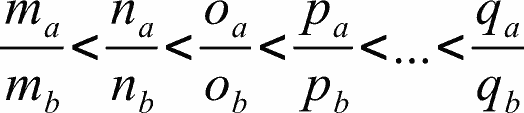
in which ma, na, oa, pa . . . qa denotes the number of units of commodities M, N, O, P . . . Q that one unit of labour produced in A, and mb, nb, ob, . . . the same in B. After the opening of trade, A will produce those goods which are on the right-hand side and B those on the left-hand side.
We cannot, however, draw the dividing line between the category of goods produced by A and that by B, if we only judge from the cost conditions. Hence when the number of commodities is numerous, although “the nature of the problem would not have greatly changed . . . its wording would”, to use the words of Marshall, “have been more complex.” In order to overcome the difficulty Marshall suggested that we might measure all the exportable goods of a country in terms of a common unit or “bale”, which was defined as embodying a constant quantity of labour and capital of the country. Thus the exports of A may be expressed in terms of representative bales or units of A’s goods or in terms of units of a representative commodity N, each unit being equivalent to the produce of a given quantity of labour and capital. The real cost of each unit is constant, but the individual goods that compose the unit may change. In that way the case of more than two commodities may be treated as easily as the case of two commodities.23
Recently the doctrine of comparative costs has been restated in terms of opportunity costs. The work has been excellently done by Professor Haberler. In order to do it he first makes a digression on the connection between the labour theory and the general theory.24 His argument amounts to this: If there is only one factor of production, viz. homogeneous labour, the Labour Theory is correct. In that case, suppose a unit of labour can produce in country A (at constant cost) 20M or 15N. Then, according to the Labour Theory, if A is a closed community, the exchange-ratio between M and N would be 4M/3N, which is equal to the labour-cost-ratio. If money is introduced, the price ratio between the two commodities will be 3 to 4, the reciprocal of 4M/3N. It may also be expressed in terms of opportunity cost. Instead of saying that the cost of 20M is one unit of labour, one now says that the cost of 20M is 15N or the cost of 15N is 20M. The ratio 20M/15N (or, more generally, ma/na) becomes now a substitution-ratio, i.e. the number of units of one commodity which must be forgone in order that one unit of the other commodity may be produced. The price ratio or the exchange ratio between the two commodities will be determined by the substitution ratio. As soon as we reach that point, “we have no further need of the Labour Theory of Value. We can derive the conditions of substitution between the two commodities and express them in the form of a substitution-curve, when many different factors of production are available just as well as when there is only homogeneous labour. However many factors there may be, the relative prices of the two commodities will be determined (given the demand) by their opportunity costs.”25 The assumption of increasing costs does not invalidate the conclusion. The only difference is that the substitution-curve is no longer a straight line (and is concave towards the origin). Similarly, the existence of specific factors of production only makes the substitution-curve to take a different form and does not alter the main proposition, namely that “the exchange-ratio between two commodities will equal their (indirect) substitution-rates or opportunity-cost (in terms of one another)”.26
It follows, he says “that, if the exchange-ratios between commodities are equal to their substitution-ratios, the doctrine of comparative advantage is perfectly valid even if we discard all the simplifying assumptions of the Labour Theory of Value.” He then continues:—
In order to show this, we should have to set out, instead of a series of absolute labour-costs, a series of relative prices or exchange-ratios, using any one commodity as a numeraire with which to measure prices. This series would equally represent the substitution-ratios, since these are the same as the exchange-ratios. Each country would specialize in those branches of production in which it had a comparative advantage or, in other words, would produce those goods whose opportunity costs were relatively lowest.27
To illustrate the argument, let us return to our hypothetical case. The opportunity cost of one unit of N is units of M in A and 2 units of M in B. Obviously A will export N to B. Similarly, the opportunity cost of M in terms of N is smaller in B than in A and A will import M from B.28
4. The Doctrine of Reciprocal Demands
Although Ricardo had demonstrated how nations may gain by trade, he had not shown how the gain by trade is divided among the trading countries, that is to say how the exact ratio of interchange between the trading goods is determined. The ratios of interchange or, what is the same thing, the barter terms of trade, depend not only on the cost conditions, but also on demand conditions. To fill in the gap, a doctrine which makes clear the part played by international demands in the determination of barter terms of trade was advanced by a group of English economists, viz. Longfield, Torrens, Pennington, and Stuart Mill.
The doctrine was advanced partly in connection with the correction of an error committed by James Mill and partly in connection with a controversy concerning the problem of retaliation. James Mill, in the first edition of his Elements,29 committed the error of attributing all the gain to each of the trading countries. In other words, he considered, to use our illustration, the barter terms of trade to be either the ratio 10M:7 1/2N, or the ratio 10M:5N. James Mill’s treatment was criticized by his friends and his son at some time between 1825 and 1826,30 and consequently James Mill removed the error from the third edition of the Elements, where he stated that “the result of competition would be to divide the advantage equally” between the two trading countries.31 The correction that James Mill made is itself a mistake, and he did not succeed in contributing towards the solution of the problem of the determination of the exact ratio of the barter terms of trade. In order to fill up the deficiency, Stuart Mill wrote in 1829–1830 his famous essay on the laws of interchange between nations.32 In that essay Stuart Mill advanced the doctrine that “when two countries trade together in two commodities, the exchangeable value of these commodities relatively to each other will adjust itself to the inclinations and circumstances of the consumers on both sides, in such manner that the quantities required by each country, of the article which it imports from its neighbour, shall be exactly sufficient to pay for one another”. His essay was not published until 1844, and Pennington had in 1840 made a correction of James Mill’s error, without knowing that it had already been removed in the third edition of the Elements. Pennington showed, to use again our illustration, that the barter term of trade would fluctuate between 0.5N per M and 0.75N per M “according to the temporary variation of demand and supply”.33
But Pennington was not the first one to formulate the doctrine that the barter terms of trade were determined by the conditions of international demands (and supplies). Five years before Pennington wrote, Longfield, for instance, had presented the proposition that a decrease or an increase in the demand of a country for its imports would turn the barter terms of trade more or less favourable to it, although he did not connect the proposition with the doctrine of comparative costs.34
The doctrine had also been advanced in connection with a controversy concerning the problem of retaliation in tariff policy that arose in England in the forties. Torrens was the leading advocate, and Senior the leading opponent of the policy of retaliation. It is unnecessary to describe the controversy in this general survey. Suffice it to say that the two economists differed in opinion about the theory of international value, upon which their answers to the problem of tariff policy depended. Torrens’s theory of international value is this:—
The terms of international exchanges are determined, not by cost of production, but by the principle of demand and supply.35
He demonstrated how, due to the mobility of labour and capital within a country, “the cost of production adjusts the relation of demand to supply and, consequently, becomes the ultimate regulator of exchangeable value,” and how, owing to the immobility of labour and capital between countries, the cost of production was no longer the ultimate regulator of international value and “the terms of international exchange are regulated by the reciprocal relations of demand and supply”, or, more briefly, by “reciprocal demands”.36 Therefrom the doctrine has been known as the doctrine of reciprocal demands. Senior, on the contrary, insisted that the cost of production was the regulator of international value. He said:—
Cost of production . . . is the real regulator, not only of domestic, but of international commerce. Everything which can be produced at will, is subject to two different costs of production; the one the minimum, below which price cannot permanently fall, the other maximum, beyond which price cannot permanently rise. The first, which may be called the cost of production to the producer, or seller, consists of the sum of the sacrifices which must be made, or, in other words, the sum of the wages and profits which must be paid or retained by the producer, in order to enable or induce him to continue to produce;—including, of course, the wages of his own labour, and the profit of his own capital. The second, which may be called the cost of production to the consumer, or purchaser, consists of the sum of the sacrifices which must be made by the consumer, if, instead of purchasing, he produce for himself. The amount of the interval between these two extreme is one of the measures of the advantages derived from the division of labour. . . . So far as the price of a commodity is not affected by any natural or artificial monopoly, it coincides with the cost of production to the producer. . . . That this is true with respect to domestic commerce, is obvious; it appears to us obvious, that it is equally true with respect to international commerce. The English spinner sells his yams to the French importer at precisely the price which he charges to his English customer. The French weaver sells his silks to the English importer at precisely the price which he charges to his French customer. In many cases, neither the one nor the other knows for what market he is producing, or to whom he is selling. He produces the quantity for which he expects to get a remunerating price.37
Senior is right in pointing out, first, that when the price of an international commodity is expressed in terms of money it should be equal to the money cost of production and, second, that when costs are expressed in terms of real costs the price of a commodity cannot be higher than the cost to the consumer or lower than the cost to the producer. But Senior is wrong when he thinks that the price of an international commodity coincides with the cost to the producer. As Torrens had pointed out in his reply,38 international value is not a matter of free competition, since labour and capital are not free to move from one country to another.
Torrens’s discussion aroused the interest of Stuart Mill, who was then led to publish the essay written in 1829–1830. Mill restated his doctrine in his Principles. It was, as pointed out by Viner, from Mill’s Principles and not from other works that later economists took over the doctrine.39 For that reason we shall concentrate on Mill’s version of the doctrine.
Mill’s doctrine of international value may be summarized in four propositions.40
(1) The value of an imported article is not determined by the cost of production but by its cost of acquisition or, in other words, “the cost of production of the thing which is exported to pay for it.” That, sometimes spoken of as the first law of international values, is, as pointed out by Hobson, “not a law at all,” because:—
To say that “the value” of an imported article means the cost of production of the thing exported to pay for it merely affirms that the value of the foreign article is equal to (or signifies) the article exported as its equivalent. What we desire to know is, “What determines the quantum of the export goods we pay with?”41
It is to answer that question that Mill presented the other three parts of his doctrine.
(2) What determines the quantity of the exported article which is necessary to pay for a unit of the imported article? What determines the barter terms of trade? Mill said that “the limits, within which the variation is confined, are the ratio between their costs of production in the one country, and the ratio between their costs of production in the other”.42 In our illustration, the two limits are 10M:7 1/2N (i.e. the ratio between the costs of production of M and N in country A) and 10M: 5N (i.e. the ratio in country B). The barter terms of trade cannot go beyond those two limits. Thus, in order to import one unit of M from B, A will not pay more than 0.75N and also must not pay less than 0.5N, for if A be required to pay more than 0.75N, it will pay it better to produce M itself. For the same reason, B will be unwilling to sell M for a price less than 0.5N.
(3) Within those two limits how is the barter term ultimately determined? To answer that question Mill presented his so-called “Law of Equation of International Demands”, which may be given in his own words:—
The produce of a country exchanges for the produce of other countries, at such values as are required in order that the whole of her exports may exactly pay for the whole of her imports.43
If A, in our illustration, exports 6,000N to exchange for 10,000M, the barter terms of trade will be 10M:6N. Consequently, the equilibrium of trade would be established in the following way:—
A sends 6,000N to B at 10N:16.66M, total 10,000M.
B sends 10,000M to A at 10M:6N, total 10,000M.
This part of his doctrine, however, still does not answer the question, because the law of equation of international demands is, as pointed out by J. L. Shadwell,44 simply a re-statement of the problem in a different way. To say that international value is determined at a point at which international balances of payments are balanced is the same thing as to say that it is determined at the point at which it is determined. What we want to know is why A exports 6,000N and not another amount to pay for 10,000M. It was in the fourth part of his doctrine that Mill really gave an answer to the question.
(4) Mill’s answer to the question, what are the forces in operation that produce the equation mentioned in the third part of his doctrine, is found in the following passage:—
The values at which a country exchanges its produce with foreign countries depend on . . . the amount and extensibility of their demand for its commodities, compared with its demand for theirs. . . . The more the foreign demand for its commodities exceeds its demand for foreign commodities,. . . . . . the more favourable to it will be the terms of interchange.45
What is meant by the “amount and extensibility” of demand? He did not give a definite answer. But in one connection at least he came very near to what is known, after Alfred Marshall, as “the elasticity of demand”.46
Professor Graham has passed a criticism on the classical doctrine of international values. He says that the classical economists had tacitly assumed that the two countries were of the same size and the two commodities of the same importance. It was only upon that assumption that the classical economists could come to the conclusion that normally one should expect the barter terms of trade to be well within the two limits set by the conditions of costs. Otherwise the barter terms of trade would be very near to one of its two possible limits.47 Graham’s argument is essentially correct. If a country is so small in size or if a country produces a commodity so important to the trading countries that it can specialize exclusively in the production of that commodity (while other countries cannot do so), the terms of trade will be exclusively in its favour.48
Like the doctrine of comparative costs, the classical doctrine of reciprocal demands is applicable also to the case of more than two commodities. There are, however, two necessary modifications. First, by the doctrine that the exports of each country must exactly pay for its imports is meant “now the aggregate exports and imports and not those of particular commodities taking singly”.49 In other words it is a necessary condition of equilibrium that the credit side and the debit side of the balance of payments are equal. Arrange the commodities M, N, O, P, Q . . . in such an order as that described above. That condition will help us to determine the exact position of the line dividing the commodities which country A imports from those which it exports—whether between M and N or between N and O, and so on. Second, “the introduction of several commodities on each side will produce a steady effect.”50 For if there is a great number of actual and potential export-goods and import-goods it will require only a slight alteration in the terms of trade to bring many goods into the category of exports or to take many goods out of the category of imports. Hence the terms of trade will be more stable when the number of commodities exported and imported is large.51
We may conclude with a word about the classical theory of value. The classical economists based their theory of international trade upon the Labour Theory of Value. Authorities are still divided on the question whether and to what extent the deductions obtained with the aid of the Labour Theory of Value do or do not depend upon the validity of that theory of value. Since that question is related more to the pure theory of international trade than to the theory of monetary international trade, we do not propose to examine it in the present survey.52
5. Marshall’s Restatement of the Theory of International Value
Although Mill presented a comprehensive theory of international value, he did not succeed in getting rid of all obscurities and difficulties. The apparatus employed by him is inadequate. In order to fill in the gap Alfred Marshall devised an ingenious geometrical apparatus which is now known as the Marshall curves.53
Marshall began by making the following five assumptions. First, there were two countries carrying on trade with each other but only with each other. Second, the pure theory of domestic values had provided the means of measuring the value in any one country (say A) of all the various articles exported by it in terms of any one of them (say N). Similarly, a representative article (say M) might be chosen for the other country (say B). Third, the two countries “are not under any obligation to make foreign payments excepting those arising from trade, so that in equilibrium the exports of each country exchange for her imports”. Fourth, the processes of production were not completed until the commodities are delivered to the importing nations. In other words, each country bore the expense of delivering her exports to the other’s frontier; and their values were reckoned on that basis. The supposition enables us to avoid all discussion of the costs of transport. Fifth, every merchant was supposed to do an all-round trade, and to bring back the goods which were obtained in return for his exports, so that he did not need to draw any bill against his exports. Thus the problem of the foreign exchanges does not arise.
Marshall then presented his mathematical apparatus. In order to explain it clearly we better begin with a numerical illustration. Let us suppose that trade is opened between country A and country B, with N and M as their respective representative export goods. Let us construct A’s supply schedule and B’s demand schedule for commodity N.54
| A’s Supply Schedule for Commodity N | ||
|---|---|---|
| (1) Price of N in terms of M. M | (2) Quantity of N supplied. N |
(3) (1)x(2) M |
| 0.10 | 10,000 | 1,000 |
| 0.20 | 20,000 | 4,000 |
| 0.30 | 30,000 | 9,000 |
| 0.35 | 40,000 | 14,000 |
| 0.40 | 50,000 | 20,000 |
| 0.46 | 60,000 | 27,600 |
| 0.55 | 70,000 | 38,500 |
| 0.68 | 80,000 | 54,400 |
| 0.78 | 90,000 | 70,200 |
| 0.83 | 100,000 | 83,000 |
| 0.86 | 110,000 | 94,600 |
| 0.885 | 120,000 | 106,200 |
| B’s Demand Schedule for Commodity N | ||
|---|---|---|
| (4) Pries of N in Terms of M. |
(5) Quantity of N demanded. |
(6) (4)x(5) |
| M. | N. | M. |
| 2.30 | 10,000 | 23,000 |
| 1.75 | 20,000 | 35,000 |
| 1.43 | 30,000 | 42,900 |
| 1.22 | 40,000 | 48,800 |
| 1.08 | 50,000 | 54,000 |
| 0.95 | 60,000 | 57,000 |
| 0.86 | 70,000 | 60,200 |
| 0.825 | 80,000 | 66,000 |
| 0.78 | 90,000 | 70,200 |
| 0.76 | 100,000 | 76,000 |
| 0.745 | 110,000 | 81,950 |
| 0.7375 | 120,000 | 88,500 |
Of those two schedules, we may note the following two points. Firstly, column (2) is numerically the same as column (5). Secondly, we can easily change the first schedule to a demand schedule of A for commodity M. If we divide one by the numbers in column (1) so that the barter terms of trade are expressed in terms of N per unit of M, column (3) becomes a column representing the quantities of M demanded, and column (2) becomes a column representing the total quantity of N for which A is willing to part with the respective quantity of M demanded. By the same way, B’s demand schedule for commodity N may be transformed into B’s supply schedule for M. Therefore, we may call the first schedule, A’s “demand-for-M-and-supply-of-N schedule” and the second schedule B’s “demand-for-N-and-supply-of-M schedule”, or, more briefly, A’s and B’s “trading schedules”.
Those schedules may be represented graphically. Let distances measured along a fixed straight line Ox (Fig. 1) represent the number of units of N and distances measured along a straight line Oy at right angles to Ox represent the number of units of M. Let a curve OA (which may be called A’s curve) be drawn to represent the terms on which A is willing to trade. Thus, if P be a point moving along it and PN be drawn always perpendicular to Ox, then ON represents successively the numbers in column (2), NP (or OM) will represent the corresponding numbers in column (3). Similarly, let B’s curve, OB, be drawn to represent the terms on which B is willing to trade. Thus if Q be a point moving along it and Qn be drawn always perpendicular to Ox, then On represents successively the numbers in column (5), and nQ (or Om) will represent the corresponding numbers in column (6). The pair of curves obtained are Marshall’s curves.
In order to explain clearly the characteristics of those curves and to consider the problems of international demands and of equilibrium by the aid of this apparatus we need first to express these two curves analytically.
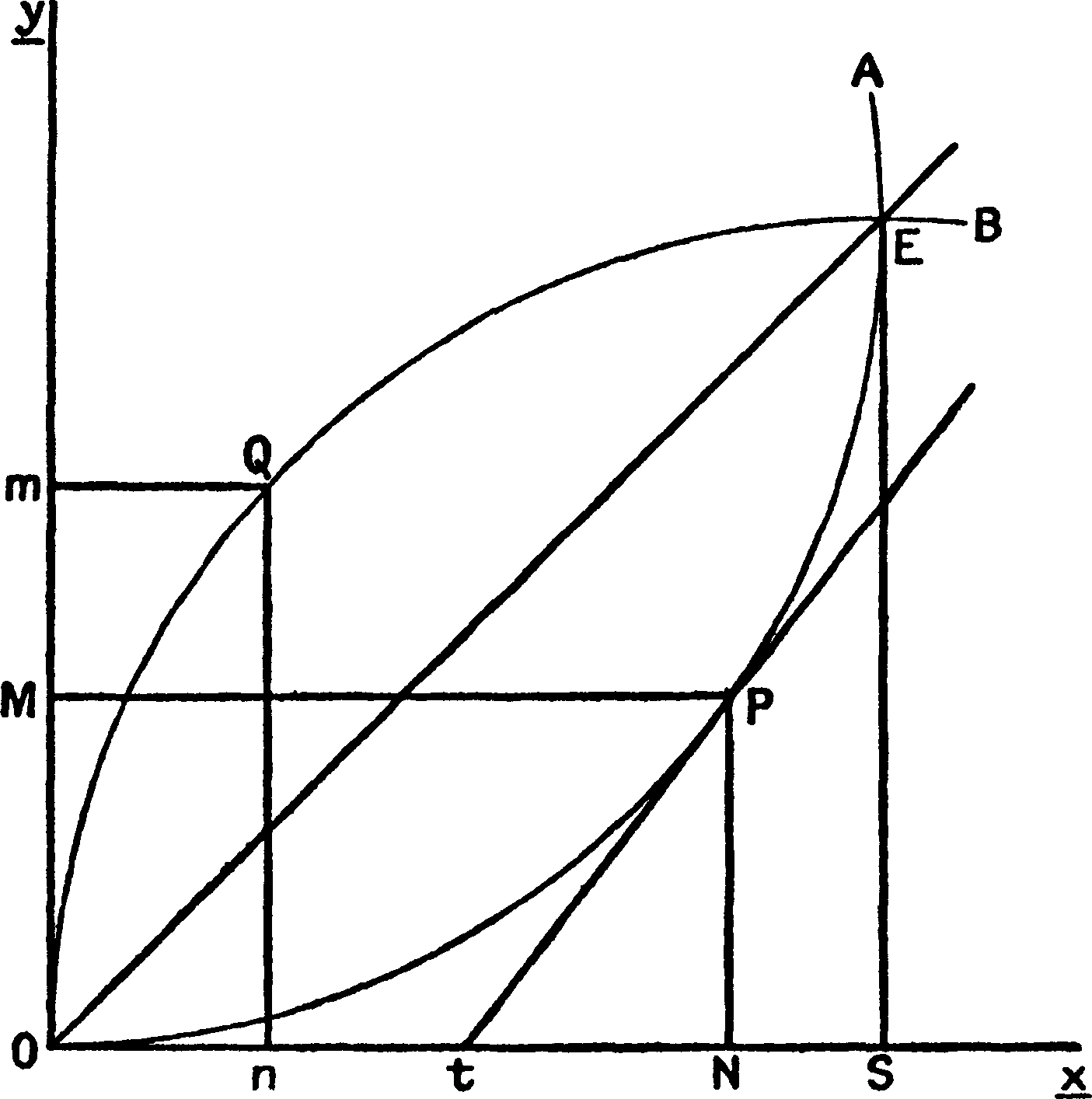
Fig. 1.
Let p be the price of M in terms of N and, then 1/p represents the variables in columns (1) and (4). Let Dam and Dbn denote A’s demand for M and B’s demand for N respectively. Then Dam, p Dam, Dbn, and 1/p Dbn represent respectively the successive numbers in columns (3), (2), (5), and (6). We can express the pair of Marshall’s curves by:—
F[(Dam). (pDam)] = O (A’s curve)
f[(1/p Dbn), (Dbn)] = O (B’s curve)
We may proceed now to some of the geometrical features of the two curves. Firstly, they are symmetrical in the sense that both the ordinates and abscissae are homogeneous quantities each representing totals. Every statement as to the shape which it is possible for A’s curve to assume has corresponding to it a similar statement as to the shape which it is possible for B’s curve to assume; but wherever x-axis occurs in the former statement, y-axis will occur in the latter and vice versa. Secondly, the curves must start from the origin, because when Dam = O, p Dam = O. Thirdly, since
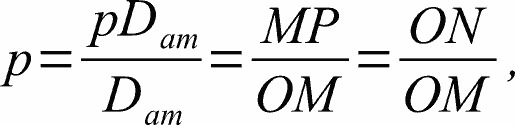
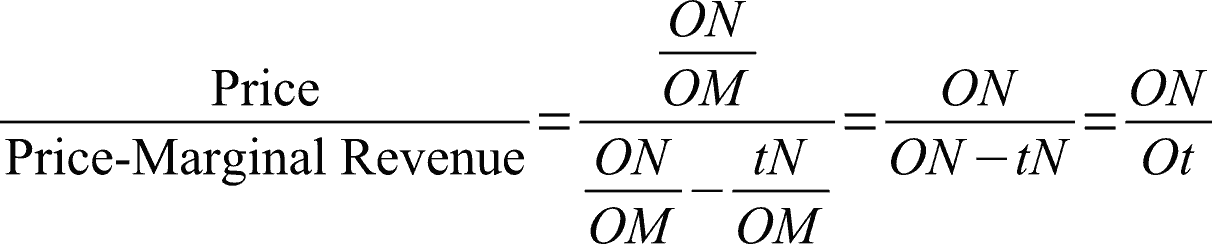
the price of M in terms of N is represented by the tangent of the angle POM. Fourthly, the elasticity of demand for A’s curve is measured geometrically by55:—
Fifthly, the curve OA cannot be cut more than once by a horizontal line in any case and the curve OB cannot be cut more than once by a vertical line. In other words, for a given value of Dam, there could not be two values of pDam. For if it did, it would imply, say, that 4,000M are just capable of being sold for the expenses of producing 20,000N as sold for the expenses of producing 40,0002V. That is clearly impossible.
If the demand conditions are normal, there are five more characteristics, (a) Every increase in Dam (or NP) is accompanied by an increase in 1/p (or OM/ON). (b) It follows that if P be any point on OA, every point on that portion of OA which is between O and P must lie below the straight line OP and every point on the remaining portion of OA must lie above the straight line OP. Therefore OA cannot cut twice any straight line through the origin. (c) It can be proved directly from the last point that the portion of OA which is adjacent to O lies below that portion of OB which is adjacent to O. (d) The curve OA cannot cut the same vertical line more than once, (e) The curves OA and OB cannot cut each other in more than one point (besides O).
Finally he came to the problem of equilibrium. He said that “every point in which the two curves cut one another corresponds to an equilibrium of the trade”. When the demand conditions are normal, there is only one equilibrium point.
The Theory was only privately printed and his analysis was not made public until two decades later (1889) in a book by Pantaleoni.56 In 1889 also appeared a book by Auspitz and Lieben,57 in which a similar mathematical apparatus, i.e. curves of import demand and export supply in the total form, was independently worked out. But the Auspitz-Lieben curves are not entirely the same as Marshall’s curves, because in the former, total money value or cost was consistently adopted as ordinate while in the latter the units of commodities had been used. Later, in 1894, Edgeworth made, in his series of articles on “The Theory of International Trade”,58 a brilliant application of the Marshallian graphics to a variety of problems and gave an algebraic description of equilibrium. Those works, important as they are in certain problems of international trade, are not directly connected with the problem of international price relationships and may hence be passed over.
6. Cost of Transport as a Factor in International Trade
In our description of the classical theory we have hitherto ignored the cost of carriage. When the cost of carriage is introduced there are, according to the classical economists,59 three important effects. The first effect is that the international movement of goods will depend not only upon the comparative costs of production but also upon the cost of transport. The condition, ma/mb < na/nb is no longer sufficient for the establishment of trade between A and B in the way described in the preceding sections. It requires two more conditions, viz. ma/m’b < na/nb and ma/mb < n’a/nb, in which m’b denotes the number of units of M which just requires a unit of B’s labour both to produce and to deliver it to A and n’a that of N which just requires a unit of A’s labour both to produce it and to carry it to B. If 1M be the cost of carrying mb of M from B to A and 1N that of carrying na of N from A to B, then m’b = mb—1M and n’a = na—1N. The second effect is that on international value. Before we introduce costs of carriage, the ratio of interchange between commodities M and N is the same in both countries and its two possible limits are common to both countries, namely 10M = 7 1/2N and 10M = 5N. As soon as we introduce carrying costs, then for every ratio of interchange between M and N in A there is a corresponding, but different, ratio in B. Similarly, the two limits for the ratio of interchange are not the same in the two countries though there is a definite relation between those limits in the two countries. The limits for A are now 10M = 7 1/2N and 10M = 5 5/14N, while those for B, 10M = 7 1/32N and 10M = 5N. For either A or B the limits are narrower. That is natural because the existence of carrying costs means a lessening of the gain by foreign trade. As to the final determination of international value, it would still “depend on the play of international demand”. The third effect of the introduction of transport costs is that it gives rise to goods of domestic trade, i.e. goods which are neither exported nor imported. Any article, the transport cost of which is so great that when we introduce money and have all costs expressed in terms of money, the transport cost exceeds the difference between the costs of production of A and B, will fall within the category of domestic goods. There is, however, no fixed line of demarcation between domestic goods and international trade goods. Any change in the conditions of international demands may shift an article from one category to another.
Henry Sidgwick60 was the most distinguished economist who, before the war, had dealt with the cost of transport as a factor in international trade. He went so far as to attempt to advance a theory of international trade exclusively on the ground of the existence of transport costs. He declared that the importance of the element of distance, instead of immobility of labour and capital, was the real ground for a separate study of international trade.61 There are, according to him, five cases in which commodities may be produced at a considerable distance from their consumers (i.e. in a foreign country) and still be produced remuneratively: (a) commodities like metals and products of special quality which are generally demanded but “cannot be produced at all except in certain localities situated at a considerable distance from important sections of their consumers”; (b) commodities including many important products of agriculture which, though could be generally produced in many places, can be most economically produced only at “certain places which offer special natural advantages for their production”; (c) commodities which “can be most economically produced for distant markets not on account of any special advantages afforded by the place in which they are made, but because the cost of carriage is outweighed by the economic gain through co-operation and division of labour, obtained by the concentration of a manufacture—or of several connected manufacturers—in one locality”, that is by the economic gain of large scale production; (d) food, fuel, and certain other commodities required in large quantity for the ordinary consumption by the large, closely packed masses in modern industrial towns; and (e) the case of comparative differences in costs which can be a cause of foreign trade only in “so far as physical or social obstacles render the mobility of labour temporarily or permanently imperfect”.62 He then turned to the problem of international values and declared that “the peculiarity of the theoretical determination of the values of the products of such trade depends primarily not on the imperfect mobility of labour, but on the cost of carriage”. The following passage exactly summarizes his doctrine of international values:—
In explaining the determination of international values—or rather of the values of wares interchanged between distant places—we have to take into account not merely the expense of conveying wares into the foreign country, but also the expense of bringing home their value in some form or other. If we take this double cost of carriage into account we shall find that the “cost of production including carriage” has an important relation to the determination of the price of the products of foreign trade, as giving the limits between which the competitive price tends to vary according to the varying conditions of demand for foreign products in each country.63
In other words, “the home cost of production together with double cost of carriage gives us a maximum value, and home cost of production without cost of carriage a minimum value.” Within those two limits, “the division of double cost of carriage between the two countries will depend upon the degree in which the demand in either country for the foreign wares of the other is more easily extensible than the corresponding demand on the other side . . . The more this is the case, the larger will be the share of the double cost of carriage that will tend to be added to the imports of the country in question.”64 That doctrine is useful as a supplement to the classical theory but cannot be considered, as Sidgwick claimed, to be an independent theory.
7. The Classical Theory of International Trade as the Foundation of the Classical Theory of International Price Relationships
Having described the classical theory of international trade, we may now see how it has been used as the foundation of the classical theory of international price relationships. As soon as we come to the problem of international price relationships, we are introducing the element of money. According to the classical doctrine, indirect exchange with money as the medium of exchange obeys the same laws as direct exchange without money, and all trade is ultimately barter. That proposition is based upon two doctrines, namely, first, the so-called doctrine of the natural distribution of precious metals among commercial nations and, second, Hume’s law. According to the former, “gold and silver having been chosen for the general medium of circulation, they are, by the competition of commerce, distributed in such proportions amongst the different countries of the world, as to accommodate themselves to the natural traffic which would take place if no such metals existed and the trade between countries were purely a trade of barter.”65 If for any reason trade by means of money fails to conform with trade by barter, Hume’s law would work so that the accommodation of the former to the latter will ultimately be produced. If it happens that the price level in A is higher or lower than what would make trade conform with barter, gold will flow into or out of A, and the price level of A will rise or fall until the equilibrium point is reached.
The classical theory of international trade does not help us to have any better understanding of the classical theory of the comparative values of money among nations than that presented in the previous chapter. But the theory of trade, as given in the preceding sections, is the basis upon which the classical theory of the relations of the wage-levels of the trading nations is built. We shall now turn to the connections between the two theories.
As the doctrine of comparative costs shows us the direction of the movement of the two commodities between the two countries and the two limits within which the barter terms of trade may vary, it also helps us to set the two limits of possible variations of the relative levels of wages. Let us turn to the hypothetical case. The cost data gives us the following ratios:—
Commodity M, A: B:: 10: 8.
Commodity N, A: B:: 10: 5 1/3.
From those ratios we can see that the average wage of B cannot be higher than 80 per cent of that of A and not be lower than 53 1/3 per cent. Let us suppose that the wage per unit of labour in A is £5 or 100s. Then in country A:—
The money-cost or price per unit of M is 5s. 0d.
The money-cost or price per unit of N is 6s. 8d.
If B’s wage is 80s. (i.e. 80 per cent of that of A), then:—
The price per unit of M is 5s. 0d.
The money cost per unit of N is 10s. 0d.
If B’s wage is 53s. 4d. (i.e. 53 1/3 per cent of that of A), then:—
The price per unit of M is 3s. 4d.
The money cost per unit of N is 6s. 8d.
It is obvious that only within those two limits A can export N to B and at the same time B can export M to A. If B’s wage is more than 80 per cent of that of A, then it pays for B to import both M and N from A. The balance of payments of B becomes unfavourable and Hume’s law would work to bring down B’s wage-level within the upper limit. Similarly B’s wage cannot fall below the lower limit.
It may be noted that when B’s wage-level reaches its upper limit, the barter terms of trade are at the limit which is exclusively in B’s favour, i.e. 10M: 7/12N. When B’s wage level reaches its lower limit the barter terms of trade are 10M: 5N, exclusively in A’s favour.
That can also be expressed algebraically. In the hypothetical case, the cost ratios are such that ma/mb < na/nb. The ratio ma:mb represents the upper limit of the wage of B relative to A and also the lower limit of the wage of A relative to B. Similarly na: nb represents the lower limit of B’s relative wage-level and the upper limit of A’s. Let Wa denote the money wage (per unit of labour) in A and Wb that in B. Let R denote the rate of exchange, i.e. the number of units of A’s currency which exchange for one unit of B’s currency. Then Wa/(Wb x R) cannot be smaller than ma/mb and also cannot be greater than na/nb. If there are more than two commodities, whose cost-data are such that
the wage ratio, Wa/(Wb x R), has ma/mb and qa/qb as its two limits: it cannot be smaller than the former nor greater than the latter.
It is clear, therefore, that the relative efficiency of labours in the trading countries influences the relations of the wage or income levels between countries in two ways. First it shows us whether A will have a higher wage-level than B, or A will have a lower one, or A will have either. In the case ma/mb < na/nb, (a) if both mb < ma and nb < na, the wage-level in A will be higher than that of B; (b) if both mb > ma and nb> na, the wage-level in A will be lower than that of B; (c) if mb > ma but nb < na, then the wage-level in A may be either higher or lower than that of B. Second it sets the limits (viz: ma/mb and na/nb) beyond which the average wage or income level of a trading country (relative to that of the other country) cannot move. That doctrine is, in effect, a part of what we call the Seniorian doctrine of international discrepancies in wages.66
The cost-data alone, however, do not determine the exact point of equilibrium and hence do not establish the actual relation between the wage-level of A and that of B. The exact position is determined by the demand-and-supply conditions.
Generally speaking, within the limits set by the cost-data, the wage-level of a country is high (relative to the other country) when the barter terms of trade are in the former’s favour. Thus like the barter terms of trade, the relative wages of trading countries are a problem which the classical doctrine of reciprocal demands helps to solve. We may lay down in accordance with that classical doctrine the following three general propositions: (i) When the capacity of a country as a market and as a producer is greater than that of the other country, the barter terms of trade tend to be favourable to the latter and the level of wages tends to be high in the latter, (ii) The more the relative importance of N in comparison with M, the lower the wage-level of B relative to A. (iii) Other things being equal, the less elastic the demand of a country (say A) for the export article (M) of the other country (B), or the more elastic the latter’s demand for the former’s export (N), the higher will be the relative wage-level of the former (A) in comparison with that of the latter (B). Those three propositions amount to Mill’s modifications of the Seniorian doctrine.
One more word may be said of the relation between the ratio of the wage-level of A to that of B and the barter terms of trade. Under the simplifying assumptions of two countries producing altogether two goods which are both subject to the law of constant costs, the wage ratio and the barter term of trade will always move together. Let us express the barter term of trade in terms of a number of units of M per unit of N. Then we have the following equation:—

Under the assumption of constant cost, mb/ma becomes a constant; the relation between the barter terms of trade and the wage ratio is a clear linear relation. If production is subject to varying costs, the relation, though still definite, is more complex.
It is useful, therefore, to distinguish between the concept of barter terms of trade, which may also be called commodity terms of trade, and the concept of “factorial terms of trade”. The factorial terms of trade of a country may be defined as the number of units of factors of production of the other country which produces the quantity of products that will exchange for the output of one unit of the factors of production of the country under consideration. In the case that we are examining, i.e. the case of only one factor of production (viz. homogeneous labour), the factorial terms of trade become the number of units of B’s labour which produces that quantity of M which will exchange for the output of one unit of A’s labour. If the commodity term of trade is Qm/Qn, Qm and Qn being the quantity of M and N respectively, the factorial term of trade is:—
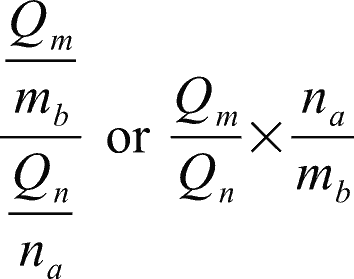
or, according to the equation given in the preceding paragraph, Wb/(Wb R), i.e., the wage ratio.67
When there are more than two commodities that enter into international trade, it is no longer convenient or even possible to express the commodity term of trade in terms of physical units of the trading commodities. In that case it is common to measure the commodity term by the ratio between the index of export prices and the index of import prices. But the relation between the commodity term of trade and the factorial term of trade remains the same.68
The preceding paragraphs deal only with the relations of the levels of factor prices among the trading nations. Nothing has been said about the international relationships of product prices. That is natural because we have hitherto assumed a zero cost of carriage. Abstracting cost of carriage, the prices of all goods must be equal in both countries and very little is necessary to be said about it. The introduction of cost of carriage makes the case different. The chief difference will then be that M and N will no longer exchange for each other at precisely the same rate in both countries. M will be dearer in A by the cost of carrying it from B to A, and N will be cheaper in A by the expense of transporting it from A to B. Suppose the cost of carrying mb of M from B to A be 1M in the sense that in order to deliver 15M at A, B has to pay the transportation company 16M. Suppose, in the same sense, the cost of carrying na of N from A to B be 1N. Then the price of 15N in A should be the same as 14N in B and that of 15M in A, the same as 16M in B. Let the indices of the import price level and the export price level in B be both equal to 100. Then in comparison with B, A’s index for import prices (M) should be 106 2/3 and that for export prices (N) 93 1/3. Algebraically:—
Pan = Pbn x n’a/na
and Pam = Phm x mb/m’b
in which Pam and Pan denote the prices respectively of M and N in country A and Pbm and Pbn those in B. It is obvious from the equations that if the cost of carrying N from A to B is increased, other things being equal, Pan and hence the general price level in A will be lower in comparison with B. Similarly if cost of carrying M from B to A is increased, other things being equal, Pam and hence the general price level in A will be relatively higher. It is partly in that sense that the classical economists come to the conclusion that cost of carriage plays an important role in the determination of relative prices between trading countries.
The wage relations between A and B are also affected by the introduction of transport cost. The limiting ratios will now be ma/m’b and n’b/nb that is to say Wa/(Wb x R) cannot be smaller than ma/m’b and also cannot be greater than n’a/nb. Let the costs of carriage be the same as those supposed in the preceding paragraphs (i.e. 1M and 1N). Suppose the wage per unit of labour to be fixed in A, say at 100s. Then in country A:—
The money-cost per unit of M is 5s. 0d.
The price per unit of N is 6s. 8d.
If B’s wage is 75s. (i.e. 75 per cent of that of A), then:—
The price per unit of M at B is 4s. 8 1/4d.
The cost of carrying a unit of M to A is 3 3/4d.
The price per unit of M at A is 5s. 0d.
The money-cost per unit of N at B is 9s. 4 1/2d.
If B’s wage is 57s. 1 5/7d. (i.e. 5per cent of that of A), then:—
The price per unit of M at B is 3s. 6 5/7d.
The money-cost per unit of N at B is 7s. 1 6/7d.
The cost of carrying 1N from A to B is 5 6/7d.
Obviously, B’s wage cannot be higher than 75 per cent nor lower than 57 1/7 per cent of that of A.
“Two men can both make shoes and hats, and one is superior to the other in both employments; but in making hats be can only exceed his competitors by one-fifth, or 20 per cent, and in making shoes he can exceed him by one-third, or 33 1/3 per cent. Will it not be for the interest of both that the superior man should employ himself exclusively in making shoes, and the inferior man in making hats?”
It does not follow, however, that the division of labour among persons and that among countries are entirely the same. As pointed out by Haberler, there are two important differences. “(a) The former often consists in different persons performing different processes in the production of a common product, as in a factory, so that their individual products are not exchanged against one another. The division of labour between occupations corresponds much more closely to the international division of labour, since the products of the farmer, baker, tailor, and so on, are exchanged against one another. (b) The other, and more important, distinction is that specialization by persons increases the capacity of each to perform the task on which he specializes; practice makes perfect. We do not think of this circumstance, or at any rate not primarily, when we speak of the advantage of division of labour between countries.” (Gottfried von Haberler, The Theory of International Trade, English ed., p. 130.)
Country A, 1 unit of labour can produce 20M or 15N
„ B, „ „ „ 16M or 18N
Under that condition it is possible to have both international and domestic trade—A will specialize in producing M and B in N. The following is an example of equal differences in costs from which neither foreign nor domestic trade can arise:—
Country A, 1 unit of labour can produce 20M or 15N
„ B, 1 „ „ „ 16M or 12N
(See Taussig, International Trade, pp. 3–33.) Those cases can also be expressed algebraically. Let ma denote the number of M that one unit of labour produces in A; mb that in B. Let na denote the number of N a unit of labour produces in A; and nb that in B. Then there is an absolute difference in costs if ma/mb> 1 > na/nb, or ma/mb < 1 < na/nb. There is a comparative difference in costs if 1< ma/mb< na/nb, or, ma/mb > na/nb > 1. There is an equal difference in costs if ma/mb = na/nb.
He next suggested an alternative doctrine of international value. “The principle, however, which governs the case, is the same as that which applies to the products of different classes of labourers within the same country. An article which a farm labourer has produced in a day does not exchange for one which a watchmaker has spent an equal time in producing, because the latter is a more skilful operation, and the remuneration of labour depends upon its efficiency as well as on the irksomeness. In the same way, a country in which labour is highly efficient is able to procure commodities from other countries whose labour is less efficient on more favourable terms than the producing countries themselves . . . To the question what determines the value of a foreign commodity, it may be answered that it depends on three things, the cost of production, the difference between the efficiency of labour in the two countries, and the cost of carriage.” (Ibid., p. 405.) It may be noted that with the exception of his objection to Mill’s doctrine of international values, he accepted the main conclusion of the classical economists.
- 1It is the practice of some economists to divide economic analysis into three departments, viz., statics, comparative statics, and dynamics. Economic statics deals with the conditions of equilibrium, if they exist at all. By conditions of equilibrium we mean those positions in which the price system will remain at rest, once it reaches them, provided that there is no fresh disturbance. That, however, does not imply that conditions of equilibrium must necessarily be reached ultimately by the price system. Comparative statics is concerned with the differences in the conditions of equilibrium in two or more price systems that are due to differences in the given data in the different systems. Economic dynamics deals with the problem, how a change in the fundamental data disturbs the price system and how the disturbances are corrected. It shows us, as Professor Robbins has pointed out, “the actual process of change—the path followed through time between one equilibrium position and the other.” In economic dynamics we have to see whether it is necessary or likely that the original change in data would lead to secondary changes in data. It is mainly because of those secondary changes in data that we have to differentiate between a doctrine of dynamics and one of comparative statics. In the latter we always suppose that when the original data change all other things will remain the same. In dynamics, however, we are not allowed to make the assumption of ceteris paribus.
- 2In dividing history into periods, we find it convenient to use certain dates, but the selected dates are only approximately accurate indicators. Nobody can point to a certain date as marking the exact point of time at which a historical stage or period either terminated or began. Nevertheless, we have to draw some lines of demarcation, however inexact they may be.
- 3The term, quantity theory of money, is sometimes defined as the theory that, in a given period of time, the product of the total volume of goods bought and sold multiplied by the average price of those goods is equal to the volume of the circulation of the medium of exchange. In such general terms, the theory does not indicate whether an increase in the circulation of money would lead to an increase in the volume of the goods or to a rise in their average price. The causal sequence may run either from the volume of the circulation to the average price of the goods transacted, or from the circulation to the volume of those goods. In the strict sense of the term, however, the quantity theory of money assumes the causal relation to run only from the circulation to the average price. We shall, in this essay, use the term in that strict sense. As to the theory that an increase (or decrease) of money would lead to an increase (or decrease) of the volume of goods and transactions, we shall call it “the doctrine that money stimulates trade and production”.
- 4Ibid., p. 34.
- 5Ibid., p. 69.
- 6Ibid., p. 105.
- 7For example, St. Thomas Acquinas, Nicholas Oresme, and Molinæus had developed, or at least indicated, a similar theory.
- 8Hales, op. cit., pp. 87, 115 f.
- 9That “theory of the store of value”, as it might be called, has been wrongly credited to Petty by Suviranta (The Theory of the Balance of Trade, 1923, pp. 52 f.). That theory is the natural outcome of the financial conditions in the sixteenth century and the greater part of the seventeenth century when gold and silver were alone easily exchangeable values, because foreign investment was practically unknown in those days and goods were not so easily exportable as at later periods.
- 10People having “plentie of things” and wanting to store up the surplus would naturally be willing to exchange these things for such wares as would lie in lesse Romes, and contineweth longest with out perishinge, and be carried to and fro with lesse charge, and be most currant at all times and at all places”. Gold and silver were “most of that sort” (Hales, op. cit., p. 72). See also p. 73.
- 11Discourse, Lamond’s ed., pp. 86–7; see also p. 113.
- 12Ibid., p. 35.
- 13That is in essence what has been called after Thomas Mun the balance of trade theory. The theory, in fact, had a long process of development. As early as the last quarter of the fourteenth century we find very definite statements of it in English by one of the officers of the Mint in his evidence before Parliament. The statement is as follows: “. . . As to the fact that gold and silver come not to England, whilst that which is in England is carried abroad, . . . if the merchandise exported from England be well and justly governed, the money which is in England will remain, and great plenty of money will come from abroad. It must be ascertained that no more foreign merchandise come within the realm than the value of the merchandise of this country that goes out of the realm.” However, the exact term balance of trade itself seems to have been coined in 1615 and the term favourable balance of trade in as late as 1767. See W. H. Price, “The Origin of the Phrase ‘Balance of Trade’,” Quarterly Journ. of Economics, xx (1905), pp. 157–167.
- 14Hales, op. cit., p. 102.
- 15Discourse, Lamond’s ed., pp. 88, 65.
- 16Ibid., pp. 47, 51 passim.
- 17Ibid., p. 40, see also pp. 43 ff., 47 f.
- 18It should be noted that the domestic demand for imported goods could not be permanently inelastic. When the balance of payments of the country turns unfavourable and specie flows out, then, other things being equal, the total income of consumers falls. The fall in consumers’ income will sooner or later lead to a reduction in the total value of its imports.
- 19Seigneur de Malestroit (second half of the sixteenth century) was a “member of the royal council of France and comptroller of the Mint”.
- 20“Lon ne peut dire qu’vne chose soit maintenant plus chere qu’elle n’estroit il y a trois cens ans, sinon que pour l’achepter il faille maintenant bailler plus d’or ou d’argent que l’on n’en bailloit alors. Or, est-il que pour l’achapt de toutes choses, lon ne baille point maintenant plus d’or n’y d’argent que Ion en bailloit alors. Doncques puis ledict temps rien n’est encbery en France. Les maxims sont clairs.” (Les Paradoxes sur le faict des Monnyes, Paris, 1578 ed. used, p. 4). Compare Paul Raveau, Précédé d’un Étude sur le Pouvoir d’Achat de la Livre, Paris, 1926.
- 21Les Paradoxes sur le faict de Monnyes, Paris, 1578, p. 15.
- 22Other writers, especially Spanish writers, must have more or less noticed the effects of the influx of the American treasure in raising prices. But there can be no doubt that Bodin is entitled to the credit for first giving due emphasis to the importance of the supply of the money metals and that it was from Bodin and not from others that later writers got that explanation of the price revolution. For that reason we feel ourselves justified in choosing Bodin as the representative exponent of that view. See Earl J. Hamilton, American Treasure and the Price Revolution in Spain, 1501–1650 (Cambridge, Mass., 1934), pp. 283–306 and Bernard W. Dempsey, “The Historical Emergence of Quantity Theory,” Q.J.E., 1935.
- 23Jean Bodin (1530–1596) was bora and educated at Angers. He spent his college days in studying law; became, after his graduation, a lecturer on jurisprudence and later practised law in Paris. Not being very successful at the bar, he entered government service. In 1568 he published his famous Reponse aux paradoxes de M. de Malestroit touchant l’encherissement de toutes les choses et des monnaies, which was followed in 1578 by his Discours sur le rehaussement et diminution des monnaies, pour reponse aux paradoxes de sieur de Malestroit. It is, however, as political philosopher that he is chiefly noted. In political theory he was sometimes considered as “one of the most important figures after Aristotle”. His famous work, Les six livres de la République, was published in 1576. In it he incorporated the substance of his Réponse. The Réponse has an English translation in A. E. Monroe’s Early Economic Thought. The reference is to Monroe’s edition, pp. 123–6.
- 24Ibid., p. 127.
- 25Ibid., pp. 128–131.
- 26Ibid., p. 131.
- 27As early as the Saxon coinage controversy around 1530, the opponents of depreciation put forward arguments suggestive of the quantity theory.
- 28By the Quantity Theory of Money we mean the doctrine according to which, to use the words of Wicksell, “the value or purchasing power of money varies in inverse proportion to its quantity, so that an increase or decrease in the quantity of money, other things being equal, will cause a proportionate decrease or increase in its purchasing power in terms of other goods, and thus a corresponding increase or decrease in all commodity prices.” One may, of course, use the term, quantity theory of money in a broader sense, viz. in the sense that
- 29Réponse (Monroe’s ed.), pp. 138 ff.
- 30Bernardo Davanzati (1529–1606), A Discourse upon Coins (1582). We have used the English translation by John Toland (London, 1696), p. 18.
- 31Ibid., p. 15.
- 32Antoyne de Montchrétien, Traicté de l’économie politique, 1615, Funck-Brentano ed. (Paris, 1889) used, p. 257.
- 33See Professor R. H. Tawney, Introduction to a new edition of Thomas Wilson’s “Discourse upon Usury” (London, 1925).
- 34Ibid., p. 60.
- 35See Memorandum prepared for the Royal Commission on the Exchanges, London, 1564, reprinted in Tudor Economic Documents (edited by Tawney and Power, London, 1924), vol. iii, pp. 346–359.
- 36Ibid., p. 350.
- 37“The Exchange is the gouernere of prices of all warres enterchangablye vented betweene this Realme and the Low Contreyes, because the greateste quantetye of wares transported ether outeward or inwarde is boughte by money taken vppe by Exchange, and also because, althoughe the wares he boughte with his owne moneye, in sellinge of his hondred poundes worthe of wares he Consydered what gaynes he myght have made by Exchange of so muche moneye, and he maketh the price of his wares accordingly or to some Convenyent overpluse.” (Ibid., p. 347.)
- 38See Tawney, op. cit., pp. 138–154.
- 39“Protest against the State Control of Exchange Business,” 1576, reprinted in Tudor Economic Documents, vol. ii, pp. 169–173.
- 40Tudor Economic Documents, p. 172.
- 41See Thomas Milles, The Customers Replie or Second Apologie (London, 1604); The Customers Apologie (London, (1601) 2nd ed., 1609); An out-port-Customers Accompt (London, 1609); and especially Customers Replie, pp. 4–5; ch. x, pp. 14–32.
- 42Thomas Gresham went even so far as to say: “As the exchainge is the thinge that eatts ought [eats out] all princes, to the wholl destruction of ther common well [weal], if itt be nott substantially looked unto, so likewise the exchainge is the cheffest [chief] and richest thinge only above all other, to restore your Majestie and your reallme to fine gowld and sillvar . . .” (“Letter to Queen Elizabeth on the Fall of the Exchanges,” 1558—quoted from Tudor Economic Documents, ii, p. 148). Gresham, it may be noted, has been known for his excellent exposition of the doctrine that bad money drives out good. The doctrine was given the name “Gresham’s Law” by H. D. Macleod in 1858. It had, however, been formulated also by other writers.
- 43Gerrard de Malynes (fl. 1586–1641), the son of an English Mint-master, himself became an Assay Master of the Mint and in 1609 was appointed commissioner on Mint affairs. He had wide experience in trade and was frequently employed by Elizabeth and James I as an adviser on commercial questions. His writings, which bear on the present section, are: A Treatise of the Caker of England’s Commonwealth (London, 1601) and England’s View in Unmasking of two Paradoxes (by De Malestroit) with a Replication unto the answer of Jean Bodin (London, 1603). For his later writings see Sec. 5.
- 44Treatise of the Caker, p. 2.
- 45Ibid., p. 3.
- 46To him the causal sequence ran as follows: “Foreign exchanges—money—commodities.” See also The Maintenance of Free Trade, p. 2.
- 47See Lex Mercatoria, p. 415; The Maintenance of Free Trade, pp. 14–15; The Center of the Circle, pp. 41 f.
- 48Caker, p. 35; see also The Maintenance of Free Trade, p. 61.
- 49Caker, p. 18.
- 50Caker, p. 34.
- 51Ibid., pp. 38–9.
- 52Ibid., pp. 42–3.
- 53Ibid., p. 99.
- 54Ibid., p. 10.
- 55Ibid., p. 11.
- 56England’s View, pp. 55, 60.
- 57“The property of the money . . . is, that plentie of money maketh generally things deare, and scarcitie of money maketh likewise generally things good cheape. Whereas things particularly are also deare or good cheape, according to plentie or scarcitie of the things themselves, or the use of them” (Caker, p. 10). See also England’s View, pp. 7 and 9. In discussing the value of “money” Malynes and his contemporaries (e.g. Mun) had used the term “money” in two senses: firstly in the modern sense, and secondly in the sense of money delivered to (or taken from) foreign countries, i.e. bills of exchange. But in the quotation cited the word “money” is unmistakably used in the modern sense.
- 58Professor J. W. Angell has said of Malynes that he was one who considered the value of money as “something absolute and unchanging” (The Theory of International Prices, p. 18). That is certainly incorrect.
- 59England’s View, p. 65.
- 60Ibid., pp. 65 f.
- 61Caker, p. 35.
- 62England’s View, pp. 65–6.
- 63Ibid., p. 70.
- 64Although he recognized that an inflow of specie could produce opposite results, he was of the opinion that a high rate of exchange did not necessarily cause an inflow of specie. He said that “it would be so, were it not for the tolleration of the monies to go currant farre above their value beyond the seas” (Caker, p. 48). In other words, his theory would apply to countries, the value of whose coins were identical with their metallic contents.
- 65Caker, pp. 117–118.
- 66See, for example, ibid., pp. 106 f.
- 67Discorso intorno allieffett. . . . (1605). See A. E. Monroe, Early Economic Thought (Cambridge, U.S.A., 1927), p. 154. De Santis also stood for an embargo on the exportation of money and for some legal tarif. See Luigi Cossa, An Introduction to the Study of Political Economy (London, 1893), p. 180.
- 68A Brief Treatise on the Causes which can make Gold and Silver Plentiful in Kingdoms where there are no mines (1613, Naples). We have used the English translation in A. E. Monroe, op. cit., pp. 143–167.

