
An Outline of International Price Theories
IX. Conclusion
CONCLUSION
1. The Present Position of the Theory of International Price Relationships
The subject of international price relationships, as pointed out in the first chapter, comprehends four distinct problems, viz. (1) the relation between the value of money in one country and the value of money in other countries; (2) the relation of the price level of one country to the price level in other countries; (3) the price relations of goods of identical technological composition among trading countries; and (4) the comparison of prices of factors of production, especially labour, in different countries. Let Va denote the value of money in country A; Vb that in country B; Pa the general price level in A; Pb the price level in B; pa the price of an article in A; pb the price of a technologically similar article in B; Wa the average wage of labour in A; Wb the average wage in B; and R the rate of exchange, i.e. the number of units of A’s currency that a unit of B’s currency is exchanged for. Then problem (1) becomes the problem of the relation between Va and VbR; problem (2) that between Pa and PbR; problem (3) that between pa and pbR; and problem (4) that between Wa and WbR.
Upon the assumptions of simple production, of free mobility of both factors of production and products, and of zero cost of transport, international price relationships would, in equilibrium, be as follows:—

The relation RVb = Va represents the classical doctrine of the international comparison of the values of moneys. The relations RPb = Pa, Rpb = pa, and RWb = Wa follow from the assumption that both factors and products could freely move from one country to another without any cost of transport.
If we discard the assumption that factors of production are perfectly mobile between countries and introduce the assumption underlying the classical analysis, viz. that labour and capital are immobile between nations, equation (1) becomes:—

in which Pn is the average export price of country A; Pm the average import price of A, or the average export price of B; na denotes the efficiency of A’s labour in the production of its exports (i.e. the quantity of goods that an average unit of labour will produce in A); mb denotes the efficiency, of B’s labour in the production of B’s exports. The relation

is only another way of writing an equation given in Chapter IV, Section 7 above, (Pn ÷ Pm) representing the barter term of trade.
We may also abandon the unrealistic assumption that the cost of carrying products from one country to another is zero. As soon as we introduce transport cost, however, we are introducing four important changes. Firstly the price of goods of identical technological composition is not the same for all trading countries. The price in the importing country is normally higher than that in the exporting country by the cost of carriage. Let us assume that the cost of carrying an article from A to B is the same as that from B to A and is equal to t. If pa is the price of any article in A, then the price (pb) of an article of identical technological composition in B, when expressed in terms of A’s currency, cannot be greater than (pa + t) and cannot be less than (pa—t). In the former case it is an article exported from A and in the latter case it is an article imported to A. Thus for every article which enters into international trade we have:—
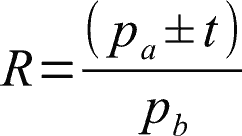
Secondly there appears a new class of goods, viz. domestic goods, which do not enter into international trade. Although it remains true that the price of a domestic good in A cannot be greater than the price of a similar good in B plus the cost of carrying it from B to A and cannot be smaller than its price in B less the cost of carrying it from A to B, the prices of domestic goods are more or less independent of international markets and will stand in no direct connection with the rate of exchange. Thirdly, the general price levels become different in different countries. The degree of the difference between the general price level of A and that of B depends partly on the costs of transport and partly on the price levels of domestic goods of the two countries. Finally, the relation between the wage level of A and that of B is also somewhat different. We have now the following relation—
WaPmm’b = RWbPnna
in which Pm (i.e. the average import price of A) is no longer the same as the average export price of B. The term m’b is equal to mb x (the average export price of B ÷ the average import price of A). Thus the equation of foreign exchanges now has the following form:—

in which h represents the difference in the price levels of the two countries.
If we discard the assumption of simple production and introduce the case of joint production, the price relations between countries become closer in many ways. The nature of the price relations is that described in Chapter VIII, Section 3 above.
2. The Same Subject—Continued
The next important question in the theory is that of the possible causes of disturbances.1 Broadly speaking, we may classify causes of disturbances into two groups: first, monetary disturbances and, second, disturbances connected with the state of the balance of international payments. The latter include changes in any of the following factors: (1) the desires and wants of the consumers, (2) the conditions of ownerships of factors of production, (3) the supply of factors, (4) the efficiency and productivity of factors, (5) the technical conditions of production, (6) the non-commodity or invisible items, and (7) the costs of carriage. Changes in any one of the above factors will lead to changes either in prices or in the rate of exchange or in both.
The last but the most important part of the theory is that dealing with the mechanism which corrects the disturbances.
In discussing the problem of monetary disturbances, one should distinguish between the case of a fixed rate of exchange and that of a varying rate of exchange. The international gold standard is a typical example of the former, while paper currencies are typical examples of the latter. International price adjustments under an international gold standard have been dealt with by the authors described in Chapter V above. International price adjustments under paper currencies form the subject matter of Chapter VI, in which we have already given the present position of the theory concerning the correction of monetary disturbances in paper currencies.
To the disturbances arising from the state of international balance of payments, we have also devoted a separate chapter, i.e. Chapter VII.
One interesting problem connected with the dynamics of the theory has not yet been explicitly dealt with in the present essay. That is the question whether movements of prices in different countries are in the same direction. Upon the assumption of an international gold standard, we may lay down the following general rule: When disturbances are caused by monetary factors, the movement of prices of factors of production and of their products in one country tends to be in the same direction as the movement of factor prices and product prices in another country; but when disturbances originate from the state of the balance of payments, the movement of prices in one country and that in the other are in opposite directions. In the case of dissimilar currencies, although it remains true that disturbances originating from the balance of payments would lead to opposite movements of prices, it is not certain whether monetary disturbance would lead to similar movements of prices.
There is, of course, much room for improvement, especially in the dynamics of the theory. Professor Robbins has recently pointed out
that it does not contain sufficient analysis either of imperfect competition or of the international aspects of short-run oscillations . . . are criticisms . . . of the present state of the theory. It is not clear how much we really do not know as regards imperfect competition in international markets. My impression is that most of the knowledge does exist, scattered about in works on particular problems, and that the main business here is to give it coherent shape. But as regards short-run oscillations there is no doubt much more to do.2
In that passage Professor Robbins indicates the directions in which progress may be made in the theory of international trade and the theory of international price relationships.
- 1It is the practice of some economists to divide economic analysis into three departments, viz., statics, comparative statics, and dynamics. Economic statics deals with the conditions of equilibrium, if they exist at all. By conditions of equilibrium we mean those positions in which the price system will remain at rest, once it reaches them, provided that there is no fresh disturbance. That, however, does not imply that conditions of equilibrium must necessarily be reached ultimately by the price system. Comparative statics is concerned with the differences in the conditions of equilibrium in two or more price systems that are due to differences in the given data in the different systems. Economic dynamics deals with the problem, how a change in the fundamental data disturbs the price system and how the disturbances are corrected. It shows us, as Professor Robbins has pointed out, “the actual process of change—the path followed through time between one equilibrium position and the other.” In economic dynamics we have to see whether it is necessary or likely that the original change in data would lead to secondary changes in data. It is mainly because of those secondary changes in data that we have to differentiate between a doctrine of dynamics and one of comparative statics. In the latter we always suppose that when the original data change all other things will remain the same. In dynamics, however, we are not allowed to make the assumption of ceteris paribus.
- 2In dividing history into periods, we find it convenient to use certain dates, but the selected dates are only approximately accurate indicators. Nobody can point to a certain date as marking the exact point of time at which a historical stage or period either terminated or began. Nevertheless, we have to draw some lines of demarcation, however inexact they may be.

