
Liberty or Equality
Chapter VI. Hus, Luther and National Socialism; The Genesis of a Totalitarian Movement, I
The Genesis of a Totalitarian Movement—I
1. INTRODUCTION
THE last two chapters of this book deal with two aspects of the genesis of National Socialism: (1) the problem of the Lutheran fatherhood of National Socialism itself, and (2) the origins of the Nazi party, the N.S.D.A.P. These two chapters are, therefore, only occasionally and incidentally a “prehistory” of Nazi thought. The pedigree we are offering here is by its very nature incomplete; it is merely a contribution to an investigation which necessarily should have a wider scope. The present chapter is primarily a sample of the history of ideas, whereas Chapter VII aspires to be a fragment of straight historical research. Nevertheless, the problems which dominate this book—authority, freedom, equality, orthodoxy and heresy—still figure here on almost every page.
From the point of view of the history of ideas we are convinced that Hus exercised some influence on Luther, on Mussolini, and on the Czech socialist (the Social Democratic) party. (We will refer to the forerunners of Hus only very cursorily, since almost all threads lead through him.) Luther, in turn, together with Calvin, has through a long process of dialectics stimulated the growth of modern democracy. The French Revolution has roots which go back to Calvin and, perhaps, also to Jansenius. Czech socialism fathered Czech National Socialism, which also claims some of the Hussite (Taborite) heritage. Hus also inspired nineteenth-century German nationalism. German nationalism produced Jahn; Jahn influenced Miroslav Tyrš; Tyrš is the most important figure in Czech nationalism. Democracy and ethnic nationalism co-operated in Europe most closely.
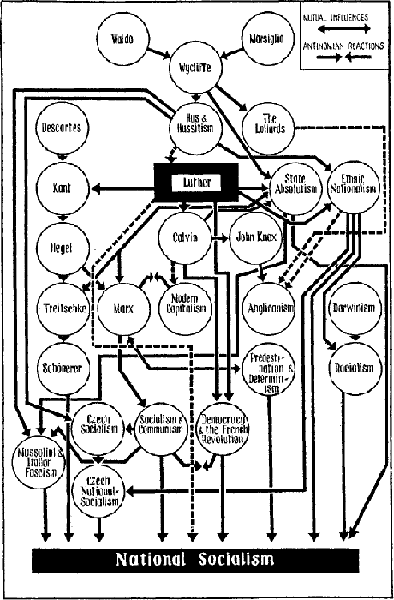
Fig. 1. THE GENEALOGY OF NATIONAL SOCIALISM
Luther is also a forerunner of Hegel; Hegel is the mentor of Marx and Treitschke, hence the trailblazer of socialism, nationalism and statism. Marx gave his doctrine to German, Austrian and Czech socialists alike. Treitschke, on the other hand, influenced Schönerer, and Schönerer influenced Hitler. Marx is also behind French socialism, which produced Sorel, who in turn is admittedly the spiritual father of the young socialist Mussolini, the admirer of Hus. And Mussolini influenced Hitler. (For a schematic representation of some of these currents of influence, see Fig. 1.)
Czech National Socialism (inspired by Hus) provoked in Bohemia and Moravia a National Socialist political organization among the Germans of these two provinces (the so-called Sudeten Germans). Hitler, far from being the founder of nazism, merely entered a small but well established movement.
Almost all of these ideologies—socialism, ethnic nationalism, fascism, National Socialism of the Czech as well as of the German pattern—claimed to be democratic. None of them claimed to be liberal. All were hostile in varying degrees towards Catholicism. All have common ancestors. All ceaselessly influenced each other, and their prehistory is nothing but an endless and ceaseless repetition of “incestual” alliances and inbreeding.
All these philosophies are anti-Catholic, anti-monarchical, anti-traditional; they look solely to the future, want to build a new society, and are “dawnist.” They are opposed to the freedom of the person and are collectivistic; they divide human beings into specific categories, and they all favour the rise of an omnipotent state. They are materialistic, and claim to be “progressive.” All of them have their affinities with the French Revolution. The whole bitter struggle among them is desperate and pitiless on account of its fratricidal nature. They do not see in each other strange opponents, but competing heresies with a common origin.
2. THE PREHISTORY OF LUTHERANISM
The Oxford cleric, in turn, is the first Protestant in our sense. In his De eucharistia he opposed Transubstantiation, and thus completely “annulled” the concept of priesthood, whose status is primarily based on the supranatural power to transform bread and wine into the body and blood of Jesus Christ. Wycliffe’s “poor preacher” was merely a popularizer of the Gospels. In this Reformer’s De officio regis the next logical step was taken, by proclaiming royal power supreme in a secularized state and society.
To these, and probably also to other writings, Luther referred again and again. In mid-February 1520 he wrote to Spalatin in full admiration of Hus, but emphasized again his previous ignorance of the Czech Reformer’s writings:
Luther’s testimony in this matter is full of contradictions; his admissions are counterbalanced by denials like the following:
Whereas we cannot see with full clarity the influence of Hus on Luther prior to his disputation with Eck (July 4–5, 1520), it is difficult to doubt that the Reformer was acquainted with his Bohemian forerunner; it is, moreover, certain that the stature of Master John was growing in Luther’s eyes during the following years, and that he read at least some of his works. Luther’s identification of the papacy with Antichrist is most typically Hussite.
3. LUTHERANISM IN THE RISE OF NATIONAL SOCIALISM
In order to come to a fuller understanding of the inner aspects of National Socialism we have made statistical maps (see Figs. 2–4), based on the Kreise division of Germany, showing the interrelationship of political and religious affiliations. We have chosen, as a medium of comparison for the religious distribution, the results of the 1934 census; and, as an index for the Nazi votes, the election of July 31, 1932. (The latter was decided upon only after prolonged deliberation. Two more elections were held, in November, 1932, and in March, 1933. The November election showed a decline of Nazi votes, and was no indication of their full popular potential. The March elections were held under the influence of the Reichstag fire, and we also have proof that in certain areas, especially in southern Bavaria, the results of these elections were falsified.)
The comparison of the religious map with the electoral maps demonstrates at first glance that there is the most obvious connection between the two, and that the Protestant areas, with exceedingly few exceptions, were the main “producers” of the Nazi votes. In those Protestant districts where the Nazis were relatively few, we find a high percentage of Communist votes. This is especially the case in Western Saxony, and in Thuringia, with an extremely big Communist vote. (The inclusion of these areas—both west of the Elbe River—in the Soviet zone of occupation, thus placing the Russian domain within 120 miles of the Dutch border, had clearly not only strategic but also political implications.) Still, one cannot fail but be impressed by the religious aspect of the map showing the National Socialist votes, an aspect detectable only after detailed calculations in relation with the Communist vote. And yet, Communism no less than National Socialism was vigorously opposed by the Catholic Church.
In East Prussia we are faced by the odd situation of the Lutheran Polish Masurians voting overwhelmingly Nazi, while the German Catholic Varmians living in the heart of East Prussia remained in opposition to the Brown Creed. (The map showing the distribution of Nazi votes features this horizontal line of ethnic division.) It is interesting, by the way, that whereas the Lutheran Polish Nazi voters were allowed to remain undisturbed, the German Varmians who voted anti-Nazi were deported in the years 1945–1947.
In the Christian Century, a leading liberal American Protestant weekly, an acrimonious debate about Luther’s guilt went on during 1946. And in the past we have seen Lutheran publishers and authors in the United States producing and printing gems like the following, which—in spite of the admiration of certain Catholics for Mussolini—could hardly be matched in the “opposite camp”:
So far, so good. Yet the guilt of Luther in the rise of nazism in Germany, if it exists at all, must be specified and proved with more solid arguments. Our investigation has first to deal with the views and the teachings of Luther in order to find whether his ideology (his philosophy and theology) has strong Nazi implications. (It is obvious that a few affinities exist between most ideologists, and that the accusation of an intellectual paternity must be well substantiated. Even Communism is unthinkable without the Christian background.)
This characteristic of Luther’s theology has to be kept in mind in order to understand its other aspects. Instead of the strict, all-embracing “logicalism” of the Scholastics, we find a mixture of emotionalism and fideism which fostered a certain mobility and facilitated, at a later period, the rise of anti-nomian reactions. At the same time it can be argued that Lutheranism, through the abandonment of the rational elements in its theology, restricted itself to a relatively small community (i.e., the North Germans and Scandinavians), and never gained the world-wide importance of either Catholicism or Calvinism. Reason and objective truth (as well as the striving for them), know no boundaries and have a universality of their own.
In his “Evangelium am 23. Sonntag nach Trinitatis” Luther wrote:
A similar idea is expressed in the Reformer’s “Ermahnung zum Frieden auf die 12 Artikel der Bauernschaft in Schwaben”:
The same has been said in his “Ob Kriegsleute auch im seligen Stande sein können”:
Or in “Von weltlicher Oberkeit wie weit man ihr Gehorsam schuldig sei”:
Such views are natural if we bear in mind his exclamation:
The idea that those enjoying a position of command are “gods” or in God’s place finds frequent representation, as, for instance, in his “Sermons on the Fifth Book of Moses”:
Indeed, Luther truly revelled in the idea of subordination and subjection, or brutal punishment and terrorization, in all spheres of life. He even laments the impertinence of servants, which he attributes to the laxity of the pope and the machinations of the devil:
The same attitude can be found in matters political:
Even stronger, and completely lacking in charity, is the following:
Luther’s savagery apparently knew no limits when he dealt with a fellow Reformer like Thomas Münzer, the egalitarian peasant leader and Anabaptist. In a letter Luther complained that the (Catholic) bishop who made Münzer a captive did not use a torture effective enough to break him down:
This attitude of the Reformer is by no means simply the spirit of the times. He constantly harps on the theme that generosity, laxity and kindness are Catholic survivals which he would eliminate in time:
The complete wickedness of the world demands the existence of brutal princes devoid of piety:
You should know that an intelligent prince has been a rare bird ever since the world has existed; yet a much rarer bird is a pious prince. They are usually the greatest fools or the worst rogues.
It is quite evident that Luther’s political views suffer from the old confusion between power and authority. As a Realpolitiker and a person alien to the concept of legitimacy (a shortcoming he shared with Calvin) he expressed the belief that all those in possession of factual political power have an absolute claim to obedience:
This agrees with the general tenor of Luther’s outlook on life, which distinguished clearly between the ethos of this world and that of the next:
In his Iom Schem Camphoras und vom Geschlecht Christi Luther implored the authorities to treat the Jews in the following way:
Knowing that popular concepts rather than historical truth affect the imagination of the masses, we could brush the whole Luther thesis aside and deny that there is any connection between the German reformer and the National Socialist mass movement. We are, nevertheless, prevented from dropping the case by the irrefutable argument of the election maps. The fact that the Catholics had their big Centre Party (including the Bayrische Volkspartei) while the Protestant political groups never achieved prominence does not invalidate this particular accusation. The distribution of Socialist or Communist votes almost never follows the pattern of the denominational map. We have thus to shift our investigation to the character of Protestantism in general and of German Lutheranism in particular.
The last-mentioned step is all the more necessary because there is the puzzling Scandinavian example of a number of Lutheran countries remaining stalwart defenders of liberalism and (a composite form of) democracy. The survival of these forms in Scandinavia, as well as the relative immunity of these nations from the Nazi virus, has a variety of reasons. We want to enumerate merely the five most important ones:
2. The Scandinavian countries did not go through the same politico-military crises and disappointments as Germany.
3. Small lakes have only small ripples.
4. The monarchical institutions of the main Scandinavian countries are above the parties, and play an important psychological rôle.
5. The Scandinavian countries lack the so-called “German” inflexibility and hankering after the Absolute, which in the German world is due to the fact that almost half of the German-speaking community is Catholic. The Germans inside and outside of the “Reich” have a tradition of thinking in absolutes, of gravitating towards extremes, of disdaining compromises, and thus of being basically allergic to the demo-parliamentary system. Their religious composition has prevented the Germans (as a collective unit) from becoming a “Protestant nation” in the sense the English, the Scots or the Americans are today Protestants. Most Evangelical Germans lived in the shadow of Catholicism, in the shadow of medieval cathedrals, on the “far horizon” of the Mediterranean and, until 1806, in the Holy Roman Empire. Catholicism is present in the works of Goethe, Schiller and Wagner. In modern Germany, if the Federal Chancellor was a Catholic (which was frequently the case since 1917), he participated in Berlin’s public Corpus Christi procession. The Lutherans never protested. The corresponding situation could not be expected in the United States.
Although German Protestantism went through evolutions similar to those of the Evangelical creeds abroad, and thus prepared the soil for the realization of parliamentary democracy, this process could be only partially completed, just because Germany is hybrid and not really Protestant. A solidly Protestant or a solidly Catholic Germany would never have produced the Nazi phenomenon as we know it. There could have been aberrations, but these would have remained within limits. It is the combination of the degenerative process of Protestantism with Catholic absolutism and extremism which became such a dangerous explosive mixture. Old heretical strains from Bohemia were necessary to stimulate the refuse of Catholic Germandom—men like Hitler, Himmler and Goebbels—who in turn were acclaimed by the Protestant masses. Without the control and the necessary corrective of monarchy, these forces could develop freely within the loose frame of a parliamentary democracy; and they carried the very heart of the Old World to its doom.
4. THE EVOLUTION OF PROTESTANTISM AND EUROPEAN POLITICS
Having put the evolutionary aspects of Protestantism under the magnifying glass, we have to come to the conclusion that the slow change of the Evangelical creeds from a rigoristic movement to a fertile ground of secularism, sectarian liberalism and “democracy” is a factor of the utmost importance for the understanding of newer European history. Geneva, which had seen the totalitarian tyranny of Maître Jehan Cauvin, produced Rousseau and became the seat of the Red Cross and the League of Nations; Boston, once a Jerusalem of the Puritans, became the centre of New England Unitarianism and transcendentalism. Is this evolution the result of the dialectics of Protestantism? Or is it a logical evolution moving in a straight line from the original premises? Or is it a “reaction” pure and simple?
Probably we find all three elements responsible for the change. Yet whereas the last is a matter of psychological speculation, and the first is of an extremely involved nature outside the grasp of a simple and ready-made explanation, it seems to us that the factor of logical evolution not only explains the transformation with comparative ease, but also figures as the most powerful reason for this phenomenon.
When we concern ourselves primarily with this factor, we will soon make the discovery that we have to deal separately with theological tenets producing intrinsic, and with those producing extrinsic or exogenous effects. When Calvin, for instance, taught that salvation and damnation are preordained by God, the psychological relationship between the believer and his Master was automatically put on a basis different from that in the old Church. But when the Reformers disestablished papal (i.e., central, commanding) authority in dogmatic matters, they hardly foresaw the ultimate consequences in the whole religious, cultural and political spheres of human existence. (The results of the former changes are often wanted or expected; those of the latter are rarely foreseen.)
Typical of this situation is the absence of a modern Protestant novel. There is not, even in the United States, a Protestant Periodical Index, as there is a Catholic Periodical Index. Catholicism in the United States has become to a certain extent the religion—and this in spite of its wide unpopularity. The reason is an entirely mechanical one: Protestantism does not lend itself easily to pictorial representation. Especially in a nation of visual publicity, a nun is more expressive of the concept “religious woman” than a praying stenographer or a meditating housewife. The fact, moreover, that the material and external has an important bearing on the spiritual and internal was unluckily ignored by the Reformers. Their psychology was even weaker than their philosophy.
We are faced here with a paradoxical situation; the Reformers, who had such a low opinion of man, crippled so thoroughly by original sin, completely overestimated his strength as to the resistance he might be able to develop against a visually secularized civilization. It simply cannot be doubted that the process of external as well as internal secularization has made for greater progress in Protestant than in Catholic countries. But this secularization is not only the psychological result of the planned policy and the convictions of the Reformers; it is also the result of the “new mobility” which Luther and Calvin brought into the world. Once the central authority was destroyed, reason attacked, and personal feelings and sentiments made the arbiter of truth and law, the boat of religion, torn loose from its moorings, was carried away by the stream of the “world”—i.e., the natural, secular tendencies of man.
Thus all the rigoristic efforts of the Reformers, their appeals to Verinnerlichung and Entäusserlichung, their calls to simplicity, earnestness and severity, came to naught. From their personal point of view the experiment has failed; and we are almost certain that Calvin or Luther would feel more at home in a modern Benedictine monastery than in a “progressive” church in New York. Protestant neo-orthodoxy is deeply conscious of this failure, but does not deem it inevitable.
Thus the Austrian Social Democrats were more revolutionary-minded than their parallel organization in Prussia. Modern Protestant countries (which have broken with the notion of orthodoxy) are rather evolutionary, while Catholic countries are revolutionary. The reasons for this are manifold:
1. The completeness (catholicity) of Catholicism which, by its very nature, is antagonistic to all other “complete” ideologies (Weltanschauungen).
2. The Catholic tendency to think in absolutes.
3. Catholic personalism, which is opposed to collectivism and to concerted societal action. Co-operation and the team spirit are not well developed in Catholic civilizations. There is a reluctance to “come to terms”—unless it is done in a spirit of cynicism. No virtue is attached to it.
But all these superstitions are only to a very limited extent descended from the original Protestant heritage. All these trends and beliefs, so illusory in their character, are deeply rooted in human nature. In their aggregate they can become substitutes for religious feelings of a more genuine pattern; in a “historic sense” they are inseparable from the traditional picture of sectarian liberalism with democratic and bourgeois overtones.
If we look at the purely religious aspect of the Nazi vote in the Protestant regions, we will never be able to tell exactly whether the excessive strength of the Party in these areas was due to Protestantism as such or to the powerful agnostic inroads which characterized Evangelical Germany. There can be no doubt that irreligion in the Protestant parts of the Reich was greater than in the Catholic districts. We will not deny that Lutheran doctrines have here and there favoured the growth of the National Socialist ideology, but the capital guilt of modern Lutheranism (and of Protestantism in general) in the triumph of the Brown Creed can only be maintained effectively if we accept the Protestant fatherhood of modern democracy, and the democratic fatherhood of National Socialism. This is a guilt which, in the perspectives of modern and recent history, most decidedly transcends the boundaries of Germany. Thus, morally speaking, only the sincere anti-democrat should in good conscience support the Lutheran thesis of the origins of National Socialism.
The author then insisted that the Jewish race could well-nigh serve as a pattern for this new racialism. The break with the past and the advent of the republic was a very fortunate one:
5. THE OTHER THREADS IN THE IDEOLOGICAL DEVELOPMENT TO NAZISM
Of greater importance than Luther’s authoritarianism was probably the elimination of the age-old antithesis between secular and ecclesiastical government—a tension which in Catholic countries always prevented the creation of a monolithic state of the Prussian or Russian pattern. Italian fascism, for instance, never became as totalitarian as either nazism or Russian communism because it had to cope (a) with the Church, (b) with the monarchy, and (c) with the latent anarchism of a Catholic nation.
Heinrich Boehmer’s enthusiasm over the termination of this forceful dialogue strikes one today as rather odd. The great German biographer of Luther (died 1927) wrote as follows:
There is even something prophetic in the way Boehmer describes the attitude of Lutheran peoples towards bad government:
This is indeed a picture different from that of the Catholic nations, with their history rich in assassinations and revolutions. We want here to recall the fact again that the black colour in Europe symbolizes not only the Catholics (and the “clerical parties”) but also the anarchists. Thus to Catholics the attitude of Pastor Niemöller remained incomprehensible, when he offered in 1939 his services to Hitler as a U-Boat captain. He was then already in a concentration camp and suffered for his religious convictions. Hitler had power and therefore, in the pastor’s eyes, also authority. Thus Niemöller’s “act of surrender” was nothing of that sort, but merely an action strictly in keeping with Lutheran theology.
The organizational aspects, the rise of the Nazi Party, will be dealt with in the next chapter of this book. But it is evident that the little-known history of the Party cannot be entirely divorced from the ideological development. The material and the spiritual are always interconnected.
Yet the final implications of agnosticism, creating dangerous vacuums, and the teleology of democracy, are full of ominous menaces—not only for Germany subjected to a super-Versailles, but for the world at large. The dictum of Joseph de Maistre, written down a century and a quarter ago, still holds true:

