
International Economic Disintegration
Chapter XIX: The Effects of Industrialization
TO study the effects of industrialization is a task of the widest scope. It can be roughly divided into a study of the effects on the country itself and of those on the world at large, especially on the old industrial countries. Both sorts of effects have been dealt with extensively in recent literature.1 For the purpose of the present report it may be permissible, therefore, to mention only some salient points on that aspect which is of the greatest interest for the Western World, i.e. on the effects of industrialization on the old industrial countries.
The gist of the matter has already been made clear. It consists in the problem of whether the reasons adduced in favour of an optimistic view are still as valid to-day as before the war. There is a strong presumption that, generally speaking, the question is to be answered in the affirmative. That is to say: experience and reasoning still suggest that the industrialization of an agricultural country, while being detrimental to individual industries in the old industrial countries and forcing them to make painful adjustments, develops those compensating factors previously mentioned. In this way we would get the final result of a more intensive world economy in which the old industrial countries, while leaving certain industries to the new industrial countries, would be exporting all the more of other kinds of industrial goods. The structure of the old industrial countries would undergo a more or less painful change, which would be determined by the range of industries developing in the new countries. Since the process of industrialization usually starts with certain consumption goods industries—particularly with the simpler kinds of textile industry—it is to be expected that the share of consumption goods, especially of the simpler kinds, in the total export trade of the old industrial countries would decrease in favour of capital goods and durable consumption goods.2 We would get a progressive diffusion of the production of consumption goods over the whole earth while the production of capital goods would remain largely concentrated in a few highly developed and old-established industrial countries. At the same time the importance of foreign trade in the newly industrialized countries for total world trade would increase rather than decrease. It is especially the latter consequence which is clearly illustrated by the accompanying diagrams (5-12) showing the development of foreign trade in a number of newly industrialized countries after the war. It is especially noteworthy that in most of these countries the share of their foreign trade in total world trade shows an ascending trend.
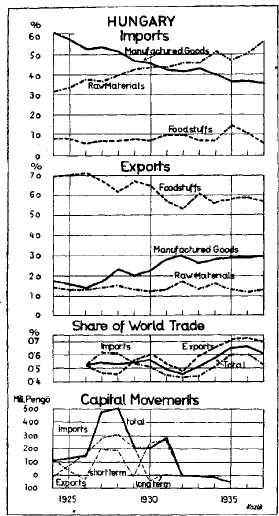
Diagram 5
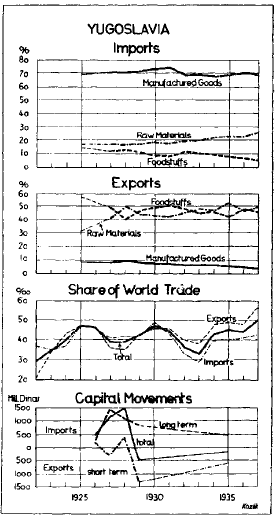
Diagram 6
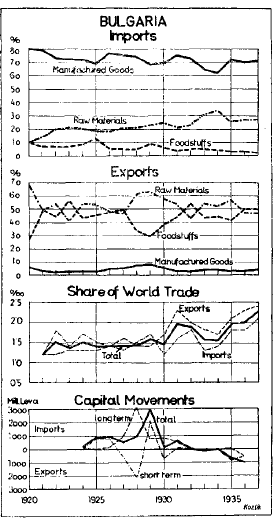
Diagram 7
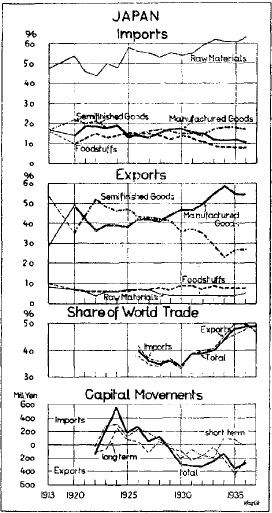
Diagram 8
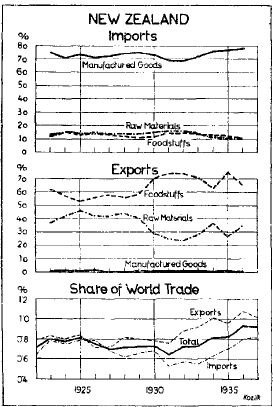
Diagram 9
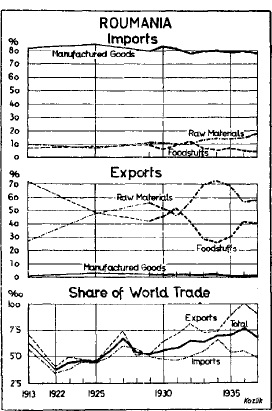
Diagram 10
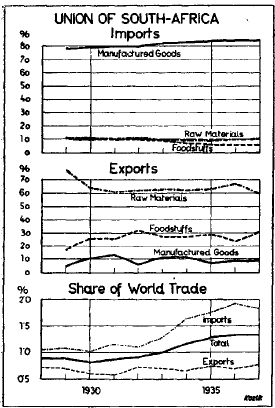
Diagram 11
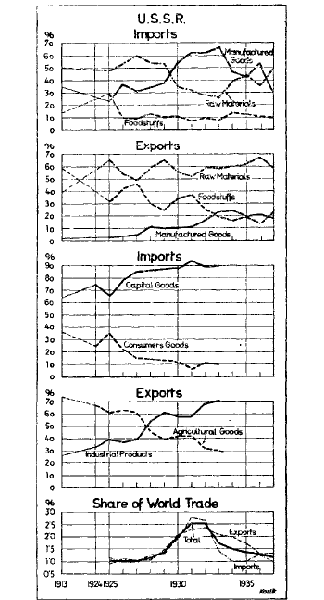
Diagram 12
It is hardly possible to dispute the essential truth of these statements, but it is equally impossible to overlook the necessity of making many reservations and qualifications. It is here where the really interesting and difficult part of the problem begins.
To begin with, there is the question of the many implications of the transformation of the industrial structure in the old countries in the direction of a greater importance of the capital-goods industries and of the industries producing durable consumption goods. As the example of England with her “special areas” shows, the process of transition may be protracted and highly painful. Furthermore, it has to be asked whether the growing importance of the capital-goods industries does not lead to a greater cycle-sensitiveness of the economic system3 and to more industrial concentration with all its serious consequences. More fundamental even is the question of how far the optimistic theory of overcompensation is really applicable to-day. For example, is it true that the industrialization of a country must invariably engender an increase of purchasing power and thereby a widening of the market for new industrial products to be imported? It would surely be curiously dogmatic to take this for granted. If, for example, the Eskimos, inspired by Manoilesco’s theory, wanted to industrialize Greenland by the well-tested methods of duties, import embargoes and exchange control, it is obvious that they would make themselves merely poorer and less capable of importing industrial products. It is quite pertinent to ask whether industrialization as it is being practised to-day in some countries does not come closer to this hypothetical case of Greenland than the industrialization practised before the Great War. The method in which the industrialization is being carried through is therefore of decisive importance for judging its effects. It is under this aspect especially that the collectivist-autarkic industrialization of Soviet Russia must be studied. It is a well-known fact that in this case the industrialization—after the initial phase characterized by an enormous increase of the imports of capital goods—finally resulted in a decreasing importance of foreign trade. Whether such a rapid approach to autarky is possible in a newly industrialized country depends, of course, in the last analysis also on the specific economic structure of the country, which in the case of Russia makes such a development exceptionally easy. For this reason it is difficult to apply any general rule. It seems, on the contrary, that every case must be studied largely on its own merits.4 Of some importance is, furthermore, the fact that industrialization to-day seems to be much less supported by foreign capital and foreign entrepreneurs than formerly, a fact which can hardly fail to foster the inclination toward industrial autarky. Whereas industries based on foreign capital and enterprise are often those exploiting raw material resources for export, industries developed by national capital and enterprise and encouraged by the government will be more devoted to finishing raw materials for the home market.
Looking further ahead into the future we perceive a final problem which must be squarely faced. It is questionable whether, even under the most optimistic assumptions, this industrialization of the earth can be continued indefinitely, so that all countries would become richer and richer and so that world trade would consist more and more in the interchange between industrial countries. Our answer must, of course, be that whole nations cannot live by taking in each other’s washing. In other words: the industrial superstructure of the whole world must, and always will be, kept in proportion to primary production, which is the foundation supporting that superstructure. If the industrial superstructure becomes too large the relation between the prices of industrial products and those of primary products will shift in such a way that the increasing profitability of primary industries and the decreasing profitability of secondary industries will engender a restriction of the latter and an extension of the former. It is difficult to say beforehand in which countries the one or the other result will happen. This will depend not only on the unforeseeable economic policy of the different countries, but also on the future prospects of production in both manufacturing industry and primary production.
__________________
5 G. E. Hubbard, Eastern Industrialization and its Effect on the West, 2nd edn., London, 1938; M. Mitnitzky, “The Economic and Social Effects of Industrial Development in Hungary,” International Labour Review, April, 1939; Der deutsche Aussenhandel unter der Einwirkung weltwirtschaftlicher Strukturwandlungen (Ausschuss zur Untersuchung der Erzeugungs- und Absatzbedingungen der deutschen Wirtschaft), vol. ii, Berlin, 1932; Max Ilgner, Exportsteigerung durch Einschaltung in die Industrialisierung der Welt, Jena, 1938; Richard Linder, Die schwedische Landbevölkerung unter dem Einfluss der Industrialisierung, Greifswald, 1938; Carl Major Wright, Economic Adaptation to a Changing World Market, Copenhagen, 1939; Otfried Fröhlich, Die Wirkungen der Industrialisierung junger Länder auf ihre Einfuhr, Dresden, 1936; and an extensive literature on the industrialization of special countries.
6 How far the exports of simpler consumption goods may shrink is illustrated by the fact that in 1938 the British exports of cotton fabrics had fallen to the 1850 level. On the other hand, it is significant that the increase of total exports of manufactured goods from a country like Switzerland during recent years is entirely due to the increased exportation of capital goods.
7 A. Loveday, Problems of Economic Insecurity, World’s Economic Future, London, 1938, p. 37.
8 There is, for instance, the interesting case of Hungary which recently has become also a clear exception to the rule that industrialization is followed by more dependence on foreign trade. Another case is that of British India where the deterioration of agriculture by deforestation and the ensuing soil erosion leads some pessimists to believe that the increase of national income and the standard of living brought about by industrialization may be more than compensated, in the. long run, by a gradual fall of rural income.
- 1Cf. my paper “A Value Judgment on Value Judgments” in which I am explaining my attitude in this very important methodological question. It will probably be published in the “American Economic Review.”
- 2The following pages are largely based on a memorandum which the author wrote together with Professor Alexander Rüstow (University of Istanbul) in the summer of 1938.
- 3See also: W. Röpke, Die entscheidenden Probleme des weltwirtschaftlichen Verfalls, Zeitschrift für schweizerische Statistik und Volkswirtschaft, 1938, No. 4.
- 4In current literature there is already some evidence that the understanding of the scientific situation outlined above is growing. See E. F. M. Durbin, “Methods of Research—A Plea for Co-operation in the Social Sciences,” Economic Journal, June, 1938; A. Löwe, Economics and Sociology: a Plea for Co-operation in the Social Sciences, London, 1935: F. Akerman, Das Problem der sozialökonomischen Synthese, Lund, 1938. The essential things have been said on a wider scientific scale by A. N. Whitehead, Science and the Modern World, New York, 1926; and by Ortega y Gasset, El Tema de Nuestro, Tiempo, Madrid, 1923.
- 5The purpose of this book is to make a new and more promising approach to the diagnostics of that long-run crisis in international economic relations which is one of the most striking symptoms of the general economic, social, and political crisis of occidental society. I believe that the urgent necessity of such an approach has been enhanced rather than diminished by the outbreak of the war. However, I would betray my own philosophy if I regarded this book as anything more than a mere beginning, an invitation to constructive criticism, and a way of opening or furthering a discussion for which the world seems to be ripe. In submitting this book to criticism, I am not afraid to expose myself as one who believes not only in the scientific legitimacy but even in the utmost scientific necessity of employing a measure of judgments, which is ultimately based on a definite conception of what is wrong with the world, and of what should be done in order to put it right again. Those who are shocked by such an attitude may be reassured that I gave more thought to this methodological problem than I am able to explain on this occasion.
- 6(b) This crisis puts social science in a new situation, which is itself highly critical and which no partial investigation in any field of this science whatever can ignore without running the risk of missing its aim. Nobody conversant with the current development of the social sciences can overlook the fact that the feeling of being on insecure ground is becoming more and more widespread, until even the most tenacious followers of the traditional lines of approach sense the need for reorientation. The growing literature on methodological questions even in countries like England, where it was formerly distinctly unpopular, is a sure token of this scientific situation, as is also the fact that it has been felt necessary to open the present report in such a roundabout way as would have appeared rather strange even five years ago.
- 7As the present historical crisis finds its first, its most painful and its most conspicuous manifestation in the economic sphere, and since the nineteenth century has accustomed us to treat the economic problems as the main ones, it is easy to understand why the crisis is conceived primarily as an economic one and why, therefore, the traditional approaches of economics have been relied upon thus far. Whether or not this traditional conception corresponds to the inner convictions of our scholars and statesmen, it is at least exemplified in the character of by far the greater part of scientific activity in our field. Accordingly, men and means have been mobilized, during the last ten years, on an unprecedented scale. Facts have been piled up sky-high; conferences have been held in endless succession; economic analysis has been brought to an ever greater degree of refinement (and, incidentally, to an ever greater degree of unreality); vast and detailed programmes of research have been elaborated; a complicated machinery of institutionalized science has been set up; and questionnaires have been sent to almost every country and to every section of the population. It would surely be no pessimistic over-statement to say that nobody feels that this hectic activity has brought us any nearer the fundamental diagnosis which alone could serve as the basis for effective therapy.
- 8The real cause of this deficiency in the social sciences seems to lie just in the narrowness of our economic conception and the lack of courage and ability in really synthetic interpretation to connect the economic phenomena with the wider aspects of society. There is, in fact, increasing evidence that the real epicentre of the earthquake does not lie by any means in the strictly economic sphere, but rather that the economic disturbances are only the external manifestations of a deeper organic disease, of which overemphasis on economic matters—a legacy of the nineteenth century—is only one of the many symptoms. If that is true, then it becomes clear that the traditional approach is doomed to failure and that a new point of departure has to be found.

