
International Economic Disintegration
Chapter II: The Quantitative Aspect of International Economic Disintegration
TO give a fairly correct picture of the quantitative development of world economy, even of that part of it which consists in the exchange of commodities, is a task presenting a great number of difficulties which are partly due to the lack of reliable statistical data and partly to inherent methodological problems. These difficulties become still greater if we attempt to assess the relative importance of world trade at different stages by comparing it with the development of national magnitudes of value, especially as expressed in the figures of total production, income or turn-over. For these reasons all calculations of this kind should be judged with the greatest caution, and the best possible result one could expect to obtain would be a fairly correct idea of the order of magnitudes involved.
The continuous upward trend of world trade before the Great War is as well known as it is undisputed, so that no statistical tabulation seems necessary. Even for that peaceful and normal period, however, the measurement of the development of the relative importance of world trade presents so many problems and difficulties that it was not only possible for a fiery dispute about the movement of the so-called “export-quota” to arise, but to remain unsettled almost to the present day. Was the importance of foreign trade in comparison with internal production parallel to the absolute rise, was it increasing or, in spite of the absolute increase, decreasing? The question appears so simple, that one would think it could be settled definitely by irrefutable figures, yet closer analysis reveals its great complexity. As is always the case, the interaction of trend, long waves and cyclical movements is very disturbing; it has to be decided whether a quantum or a value index is to be used, and other problems crop up.1 On the average, however, the evidence seems to support the theory of increasing export quotas before the war, rather than the opposite view. On the whole, we shall be justified in assuming that up to the Great War world trade, as far as it can be measured quantitatively, was increasing not only in absolute figures, but also in relative importance.
In tracing now the post-war development, let us start from the base of the development of world trade in absolute figures. The following table gives an approximate idea of what happened:
| Volume of World Trade2 | ||||||||||
| 1900 | - | - | - | 62 | 1929 | - | - | - | 130 | |
| 1913 | - | - | - | 100 | 1934 | - | - | - | 86 | |
Without considering the moot question as to whether the development from 1913 to the critical point in 1929 does not, in spite of the further increase, already show some sign of flagging in the rate of increase, we shall proceed to a closer examination of the period of dramatic decline after 1929. This decline is so heavy that it is conspicuous whatever the statistical method adopted, but the difficulties begin when we want to know exactly how far the drop went and what headway has been made by the recovery after the worst years of the Great Depression. It is a matter of general knowledge that very different results are obtained according to whether world trade is measured in gold value or in quantum figures, the first giving an appreciably lower fall and slower recovery than the former, while a measurement in sterling prices gives intermediate values which are somewhat nearer to the quantum than to the gold value figures.
Development of World Trade, 1929-37
(Base: 1929 = 100)
| 1930 | 1931 | 1932 | 1933 | 1934 | 1935 | 1936 | 1937 | |
| Gold value | - 81 | 57.9 | 39.1 | 35.2 | 33.9 | 34.7 | 37.5 | 46 |
| Quantum | - 93 | 85.5 | 74.5 | 75.5 | 78 | 82 | 86 | 97 |
| Sterling value | - 81 | 62 | 54 | 52 | 55 | 58 | 618 | — |
Source: League of Nation’s Review of World Trade and World Economic Survey.
In view of the wide divergence between the measurements in gold value, quantum and sterling value, there arises the question as to which measurement gives the truest picture of the extent of the decline and of the subsequent recovery of world trade. It is difficult to make a definite decision, since every figure has its special significance which has to be borne in mind. It is evident, however, that every measurement of the decline and recovery of world trade during the last years would give a distorted picture, if that part of the shrinkage in gold value which is due to price declines were not eliminated as far as possible; and that is just what quantum measurement tries to do. It is only by adjusting the common denominator of world trade statistics to the price changes since 1929 that we can keep the development of world trade, together with the national magnitudes of value, within the same system of co-ordinates and make it comparable with the situation in the base year.3 There seems to be little doubt then, that, for the present purpose of finding in world trade statistics an expression of the contraction of world economy, quantum figures are generally to be preferred, despite their highly problematical nature due to the element of arbitrariness in calculating them. Consequently, the picture given by gold value figures appears much too spectacular, though the degree of decline suggested by quantum figures is impressive enough. On the other hand, however, it must not be forgotten that the elimination of price changes from the values of goods entering international trade is far from satisfactory in every respect, not only because of the doubtful statistical procedures involved, but especially for the reason that the heavy decline in, prices is itself largely an expression and an effect of international economic contraction. Due consideration of this complication, however, may be postponed to the next section, where the functional aspects of international economic distintegration will be examined.
After having considered the movement of world trade in absolute figures, the next step would be to find some measure of the decline relative to the development of national economic activity as expressed especially by production figures. The general trend may be roughly illustrated by the accompanying diagram showing the development of world trade and world production. As will be seen from this, the relative development of world trade since the outbreak of the Great Depression is marked by a rather strong power of resistance during the early years of the depression compared with the development of production, while later on, during the years of recovery after 1933, world trade definitely lagged behind world production. In this respect, however, the difference between foodstuffs, raw materials and manufactured goods should be noted.
With foodstuffs the contraction of the world trade quantum compared with world production has been uninterrupted and indisputable since the beginning of the depression, the former always, remaining appreciably below the pre-depression level, while the latter shows even a slight increase. It seems safe to assume that this is a true reflection both of the natural inelasticity of agricultural production and of the effect of the policy of agricultural protection. In the case of raw materials we find that at the depth of the depression production contracted equally with world trade, but that, whereas both started the upward movement parallel to each other, production soon showed a tendency to outrun world trade. An interpretation of this singular movement would have to stress the great elasticity of production in this sector and the function of stocks. With regard to manufactured goods, the tendency of world trade to decline more slowly than production during the first years of the depression may reflect not only the greater elasticity of industrial production, especially in monopolized or semi-monopolized industries, and the clearance of stocks, but also the fact that the cyclical decline of production is most marked in the production of capital goods, whose share in world trade is smaller than that in internal trade. The opposite tendency, during recovery, for world industrial production to outrun world trade shows the reverse effect of these factors and, in addition, the consequences of the strictly national policies of business recovery carried through with a good deal of disregard for the development of international trade and even partly in the shelter of undisguised autarky.
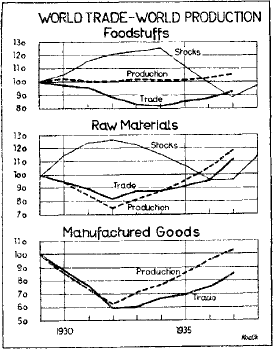
Diagram 1
Source: Statistische Jahrbücher für das Deutsche Reich.
Many other attempts at measuring the relative decline of world trade could be made, though even researches of this kind are subject to the law of diminishing utility and the problems of statistical procedure tend to increase. It would not be difficult, for instance, to calculate time series of per capita quotas of international trade for the most important countries, but the value of the results would seem rather limited, at least for the present purpose of measuring the movement of the relative importance of international trade. The following table showing the changes in export-quotas in a number of countries may also serve to throw some light on the problem:
Changes of Export-Quotas in different Countries
(Base: 1928 = 100)
| 1929 | 1930 | 1931 | 1932 | 1933 | 1934 | |||
| France (quantum) | - | - | 92 | 78 | 76 | 75 | 69 | 74 |
| Great Britain (quantum) | - | 97 | 87 | 73 | 74 | 72 | 69 | |
| Germany (quantum) | - | - | 114 | 123 | 137 | 113 | 93 | 69 |
| Austria (quantum) | - | - | 101 | 102 | 100 | 71 | 68 | 69 |
| United States (quantum) | - | 102 | 101 | 91 | 77 | — | — | |
| Poland (quantum) | - | - | 105 | 127 | 152 | 128 | 126 | 118 |
| World total (value) | - | - | 95 | 91 | 79 | 68 | 55 | 49 |
Sources: R. Wagenführ, I.e. and the literature named there. It seems hardly necessary to stress the merely approximate nature of all such calculations.
Bearing in mind that the rise of the export-quota in Germany during the depression up to 1932 reflects the pressure put on her exports by the credit crisis and the fact that these evidently served as an outlet for the stifled home market, the general downward trend is obvious enough. If all these statistical data are amalgamated and the available figures for the contraction in other spheres of world economy added, it is certain to give an impressive confirmation of what everybody knew before: the unprecedented decline of world trade after the break which occurred in the Great Depression.
It is possible, however, that one may still feel that the formidable machinery of economic nationalism built up since that time might have led us to expect a still greater contraction of world trade. Indeed, it is almost amazing how relatively well world economy has stood the terrible strain of sky-high tariffs, quotas, exchange controls, clearing agreements, import monopolies and currency tampering; and it seems certain that this relative resistance of world economy has a deep significance, revealing both the high adaptability of the trading world and the strength of the inner forces of world economy. It is very important to stress this point in order to disarm those who, consciously or unconsciously, are helping to prepare the right ideological atmosphere for economic nationalism by spreading the view that the vitality of world economy is giving out. But, at the same time, the actual development of world trade cannot blind us to the extent to which economic nationalism has done its work—in spite of the inner vitality of world economy. Nor is there any reason to regard the recovery which had occurred during the last few years (up to 1938) with anything like definite relief.
First, this recovery was far from being complete and still further from being anything like stable. It is true that the volume of world trade did, in 1937, almost reach the 1929 mark; but, on the other hand, the fact that the gold value of world trade was, even in this year of greatest recovery, still below half of what it was in 1929 must not be ignored, despite the general preference we must give in this respect to the volume figures compared with the value figures. Furthermore, it must be noted that, under normal circumstances, figures surpassing even the 1929 level should be expected, if the former upward trend of the general economic development were to be maintained. How unstable was even such recovery as had been attained, is revealed by the relatively sudden and heavy decline which has occurred since the beginning of 1938.
This brings us to the second point: that there is much evidence to support the impression that, in general, world trade has become much more fickle and erratic than before. This point will be dealt with later in more detail. The third point is that, even during the last period of recovery, next to nothing has been done to alleviate the formidable pressure of economic nationalism, and until this has been accomplished to at least a noticeable degree, one must view with grave suspicion any temporary recovery in the figures of world trade, let alone those functional disturbances of which more will be said in the following section.
The present machinery of economic nationalism throughout the world, however, is so much tied up with long-run tendencies of general economic and social policy and with structural changes of the widest range, that it is hard to see how any fundamental change in international economic policy can be expected without deep-set structural changes, so that no sensational alteration in the picture seems imminent. As things are at present, there will be a strong tendency for world trade to be driven into temporary outlets, which offer no assurance whatever of putting it on a permanent and stable level. Such temporary outlets include the trade in war materials, commodities exchanged on pure barter terms and goods that serve no other purpose than to build up autarky in the countries importing them, as in the case of deliveries to Soviet Russia.
This leads us to a last but very important point, which can be briefly stated as follows. The last depression, like every other depression, was essentially a period of slackening investments. In some countries, like England or Denmark, the introduction of new protective tariffs or the increase of old ones has been instrumental in helping to turn the tide of the depression by instigating investments, which appeared profitable in the light of the new protection. In many other countries, however, the depression ran its course accompanied throughout by higher and higher protection, which was unable to stimulate the necessary amount of new investments. As long as this was the case, protectionism did restrict international trade, but it did not correspondingly breed new industries under the shelter which it offered. Therefore, when recovery set in, international trade was to expand considerably on account of increased demand, but at the same time the awakening of investment activity, which accompanies recovery, made it inevitable that behind the snug shelter of hyper-protection there should now be growing up the new productive capacities, which are the normal, the most obnoxious and the most durable effect of protection. In other words, the recent recovery of world trade is, to a considerable extent, due to an abnormal “lag” between the immediate effect of protectionism—the restriction of demand for foreign goods—and its secondary effect—the expansion of domestic supply.
This abnormally great lag, in its turn, owes its origin to two facts: the severity of the depression (postponing the expansion of domestic supply) and the retention during recovery of the machinery of protection inherited from the last depression. If this argument is well founded, there is good reason to assume that the world is still far from having reaped all the fruits of economic nationalism and that, because of this lag, much of the recent recovery of world trade can only be temporary. The only way of averting these after-effects would have been to use the breathing-space of the last recovery substantially to diminish protectionism, before it had time to exert its distorting influence on the national structures of production. Besides, this reasoning should help to make it clear that it would be entirely wrong to deduce from the recent recovery of world trade that the new hyper-protectionism, far from having permanent devastating effects, has only redirected world trade. The outcry for a more liberal commercial policy is not based on a sort of false alarm, but entirely justified.
__________________
4 Cf. the careful analysis by R. Wagenführ, Die Bedeutung des Aussenmarktes für die deutsche Industriewirtschaft, Sonderhefte des Instituts für Konjunkturforschung, No. 41, 1936.
5 Source: Statistisches Jahrbuch für das Deutsche Reich, 1935, p. 118.* The volume of world trade has been calculated by dividing the actual value figures by a combined price index, so as to eliminate the price changes. Since 1930 this method has been changed by the Statistisches Reichsamt, but the figure given above for 1934 is that calculated after the old method. The difference between the figures obtained by the old and those obtained by the new method is considerable, a fact which proves again the limited usefulness of those indices. They give an idea of the general direction of a movement, but must be used with great caution as far as the actual degree of the movement is concerned, especially over longer periods.
6 Cf. A. M. Fox, “Quantitative and Qualitative Changes in International Trade During the Depression,” American Economic Review, vol. xxvii, No. 1, Supplement, March, 1937, pp. 13-15.
- 1Cf. my paper “A Value Judgment on Value Judgments” in which I am explaining my attitude in this very important methodological question. It will probably be published in the “American Economic Review.”
- 2The following pages are largely based on a memorandum which the author wrote together with Professor Alexander Rüstow (University of Istanbul) in the summer of 1938.
- 3See also: W. Röpke, Die entscheidenden Probleme des weltwirtschaftlichen Verfalls, Zeitschrift für schweizerische Statistik und Volkswirtschaft, 1938, No. 4.
- 4The purpose of this book is to make a new and more promising approach to the diagnostics of that long-run crisis in international economic relations which is one of the most striking symptoms of the general economic, social, and political crisis of occidental society. I believe that the urgent necessity of such an approach has been enhanced rather than diminished by the outbreak of the war. However, I would betray my own philosophy if I regarded this book as anything more than a mere beginning, an invitation to constructive criticism, and a way of opening or furthering a discussion for which the world seems to be ripe. In submitting this book to criticism, I am not afraid to expose myself as one who believes not only in the scientific legitimacy but even in the utmost scientific necessity of employing a measure of judgments, which is ultimately based on a definite conception of what is wrong with the world, and of what should be done in order to put it right again. Those who are shocked by such an attitude may be reassured that I gave more thought to this methodological problem than I am able to explain on this occasion.
- 5(b) This crisis puts social science in a new situation, which is itself highly critical and which no partial investigation in any field of this science whatever can ignore without running the risk of missing its aim. Nobody conversant with the current development of the social sciences can overlook the fact that the feeling of being on insecure ground is becoming more and more widespread, until even the most tenacious followers of the traditional lines of approach sense the need for reorientation. The growing literature on methodological questions even in countries like England, where it was formerly distinctly unpopular, is a sure token of this scientific situation, as is also the fact that it has been felt necessary to open the present report in such a roundabout way as would have appeared rather strange even five years ago.
- 6As the present historical crisis finds its first, its most painful and its most conspicuous manifestation in the economic sphere, and since the nineteenth century has accustomed us to treat the economic problems as the main ones, it is easy to understand why the crisis is conceived primarily as an economic one and why, therefore, the traditional approaches of economics have been relied upon thus far. Whether or not this traditional conception corresponds to the inner convictions of our scholars and statesmen, it is at least exemplified in the character of by far the greater part of scientific activity in our field. Accordingly, men and means have been mobilized, during the last ten years, on an unprecedented scale. Facts have been piled up sky-high; conferences have been held in endless succession; economic analysis has been brought to an ever greater degree of refinement (and, incidentally, to an ever greater degree of unreality); vast and detailed programmes of research have been elaborated; a complicated machinery of institutionalized science has been set up; and questionnaires have been sent to almost every country and to every section of the population. It would surely be no pessimistic over-statement to say that nobody feels that this hectic activity has brought us any nearer the fundamental diagnosis which alone could serve as the basis for effective therapy.

