
International Economic Disintegration
Chapter III: The Qualitative Aspect of International Economic Disintegration (Functional Disturbance)
(a) GENERAL APPRAISAL
THE preceding chapter attempted a quantitative measurement of the extent of international economic disintegration. The resultant picture is disquieting enough, but even this does not tell the whole story. It must be completed by an analysis of the qualitative aspect of international economic disintegration, which essentially escapes quantitative measurement. Such an analysis seems all the more necessary, as the qualitative aspect of world economy is curiously neglected in most treatments of the subject, so much so that it appears to be almost new ground which has to be broken here.1
Starting from the general problem of the importance of international trade for our economic system as a whole and for a particular country, we realize at once that all measurements of trade volumes and foreign trade quotas for the different countries fail to grasp almost their every qualitative, potential or functional aspect, aspects as elusive as these expressions suggest. It is a very curious fact that those very advocates of economic nationalism, who are generally so ready to claim for the national economy the character of an organism, are trying to minimize the importance of world economy by overlooking its organic functions and reducing it to a mechanical phenomenon of mere numbers. This is, surely, a social philosophy “by double entry,” which does more honour to the political zeal of its champions than to their intellectual probity. In point of fact, however, thinking in mere terms of quantitative mechanics instead of “structure” and “functions” is, in the case of the international aspect of economic relations, just as incomplete and misleading as in that of the purely national aspect. Let us make our meaning clearer by becoming more concrete.
If we are being told that, e.g., in the United States the amount of surpluses necessary to export is, in normal times, less than 10% of the total domestic production, the inference is that the importance of foreign trade for that country must be given a corresponding low index, so that the sacrifice of autarky appears equally negligible.2 The important point is, however, that this 10% covers functions which are vital even for a country like the United States, to which foreign trade seems to mean less than to any other highly developed country. Thus it has been pointed out by various writers that for many American industries it is just the exported part of their production which forms that marginal quantity which, by making possible the actual extent of mass production, helps to support the whole structure of production and industry. In this way, we understand the full significance of the fact that the export-quota in a number of the most important industries amounts to 20, 30 and more per cent. What is interesting in this, is not so much the commonplace fact that the dependence of certain industries on foreign trade is above the average, as rather the function of this higher percentage for the whole economic structure of a country; but it is hard to see how the importance of this function can be measured statistically.
Just as important as the functional analysis of exports is that of imports, if we are to gain a better understanding of them than that provided by tables of import-quotas and similar statistics. In this connexion, an interesting study has been made for the United States showing the different functions of the various kinds of imports for the year 1927. It reaches the rather arresting conclusion that almost 90% of the total imports into that country were strictly non-competitive.3 But even such a study, much as it assists a better understanding of the functions of imports into the country in question and to dispel purely quantitative notions, does not go to the bottom of the matter, as it does not—and cannot—show the real significance of those imports for the working of the economic process of that country. In order to see this, one has to ask first, what part regular imports play in providing industry with indispensable raw materials, semi-finished and production goods, in establishing competitive conditions on the home market and in giving domestic production the incentive of foreign competition, and then the further question as to what this, in turn, means for national economic equilibrium. The present position of Germany, where it is clearly realized that foreign trade has a key position quite out of proportion to its relative quantity, considerably helps to elucidate this question. In that country the provision of raw materials by foreign trade has long been recognized as the prime condition of regular industrial activity.4
But even all this does not exhaust the subject of the qualitative aspects of international trade. What has been said so far goes to show that international trade is an essential part of a highly complex structure, in which it serves functions which cannot be measured quantitatively on the basis of the actual trade figures. In other words, the actual amount of international trade is not a sufficient measure of its functional importance. But still it is the actual trade which has this importance. What has to be shown now is that equal importance attaches to that international trade which is not actually taking place but which, at every moment, is on the verge of taking place and will take place at the slightest tipping of the scales.
The mere existence of a world economy, whatever the use being made of it in the concrete case, and the ever-present possibility of switching trade from internal to external markets (and vice versa) or from one external market to another, has a value for the rational functioning of national economies which no juggling of statistical figures could possibly gauge. Whereas the actual world trade considered previously works like a hormone or a vitamin, the biological value of which is quite out of proportion to the active quantity, the potential world trade considered here may be compared to a catalyst in a chemical process which does not enter into the compound at all, but is yet essential for the process itself. It is acting, like the British fleet, “in being,” and what this means will be discovered only when it can act no more.
The morphological importance of potential world trade, it must be admitted, is a rather vaporous subject, and one very difficult to handle without drifting into empty speculation; but that it is there and that it deserves the greatest emphasis cannot be denied. It would be easy, moreover, to show that it is really nothing more than a special case of a general phenomenon pervading the whole economic process, and to name examples in other fields where it has been much better recognized than in this special one of economic theory. It seems certain that a careful and sober analysis of this subject would yield a number of interesting results, and it is also to be hoped that it would help to bring some fresh air into the somewhat stuffy atmosphere of the traditional theory of international trade, which is still too much centred around the hoary quantitative-mechanical notions of the classical school. In such an analysis much stress would have to be laid on the fact that the term “potential world trade” also covers all those concepts like “confidence,” “expectation,” “elasticity,” “continuity” and “security,” which are so much to the fore in present-day economics. In this connexion, it seems particularly worth while considering the question of what the potentialities of world trade mean for the incentives to that private investment activity, both at home and abroad, which plays such a conspicuous and well-deserved role in contemporary economic thought as the prime condition of the optimum equilibrium of economic life.
Having thus considered the qualitative aspects both of actual and of potential world trade, we can now draw a twofold conclusion regarding the economic importance of world economy. First that, for the world as a whole and even more so for a single country like the United States, relatively low figures of international trade may well go together with a high morphological importance quite out of proportion to the actual quantities involved. The second, conclusion is that relatively high figures of international trade may well go together with a loss in functional value and a diminution in quality out of proportion to a possible diminution in quantity, if and in so far as there is a disintegration in the structure of world economy which prevents it from fulfilling its normal functions.
It is this second conclusion which is so important for a proper judgment of the present situation of world economy. As has been shown, the quantitative development of actual world trade at the present time is far from being reassuring, but the sum total does not seem to suggest a real catastrophe. The important point, however, is that these figures do not reveal the great qualitative disturbances which have occurred. Therefore, the real extent of the present disintegration of world economy cannot be properly judged without a special study of at least the more important of those qualitative disturbances.
(b) THE BREAK IN THE INTERCOMMUNICATING CHARACTER OF WORLD ECONOMY (BILATERALISM AND FORMATION OF ECONOMIC BLOCS)
In describing the qualitative structure of pre-war world economy in an earlier chapter (pp. 14-18), the first point mentioned was the interdependent and intercommunicating character of the world economy as it existed then. It was further stated that, as an intercommunicating system, world economy was necessarily also a multilateral system in the sense, now made familiar, of actual and potential (virtual) multilateralism. It should be obvious that a world economy worthy of the name cannot exist and exert its functions without this constant and practically unhampered intercommunication, which is the essential feature of every economic integration national or international. Inasmuch as this intercommunication is being broken up by bilateralism and the formation of blocs, so is world economy being split up into fragments. To the same extent world trade figures cease to be the total quantitative expression of world economy; they become the mere addition of sales on disconnected markets, the significance of which is not appreciably greater than that of sales on the wheat exchanges at Winnipeg, Chicago and Liverpool. World economy abdicates from reality to become a mere and rather misleading name; its disintegration as a real international economy appears, then, as complete, and what we get instead will be a series of separate international relations.
Now it is common knowledge that this disintegration through diminishing intercommunication of world economy has been one of the most outstanding features of the development of world trade during the last ten years. Differential tariffs, import and export quotas, the growing insignificance of the most-favoured-nation clause, the alliance of exchange controls and clearing agreements, barter trade, import and export monopolies—they have all had the combined effect of forcing international trade more and more into disconnected and strictly controlled channels, and thus impeding the intercommunication between them to the same extent. The complicated wiring system of world economy has been, as it were, “short-circuited.”
In measuring the extent to which international trade has been put into the strait-jacket of bilateralism, one has to proceed very carefully.5 The calculations of the total bilateral trade of to-day compared with that of ten years ago, made by the Secretariat of the League of Nations,6 represent only a first approximation, though the notable increase they show clearly indicates the trend of development. Besides not being free from statistical defects, they fail to show that the trend toward bilateralism is more accentuated in one group of countries than in another; whereas the share of a country like the United States in the increase of bilateralism is below the average, it is extremely high in Germany, Switzerland and other countries which have to a large extent resorted to the kind of commercial and monetary policy conducive to bilateral balancing of trade, especially the combination of exchange control and clearing agreements or the policy of import quotas. Furthermore, the importance of multilateral trade does not lie so much in its actual volume, as in the extent to which it can be resorted to whenever this is thought to be expedient. It is theoretically possible that some increase of bilateral trade might have happened in the natural course of things, although, in point of fact, it is unlikely that it would have. In other words, only that part of the increase of bilateralism should be counted which has been forced upon trade. On the other hand, it should not be forgotten that the devastating effects of this part can be discovered only by a far-reaching study of the deep-set changes in the structure of world economy brought about by compulsory bilateralism, even if the measured increase in actual bilateralism is far from sensational.
In general, it should be quite obvious that, if the word “disintegration” is to have any meaning at all, international economic disintegration can hardly be better defined than by the present trend toward compulsory bilateralism, which really means that the world economy is tending to disintegrate into a number of more or less independent “international economies” which have but little intercommunication. Whether this is a change for the better or for the worse is another matter, and one on which opinions may differ, but no disagreement seems possible on the fact itself that the world economy as a coherent reality is crumbling to pieces.
In reality, however, it must be borne in mind that, while an important group of countries has already travelled far along the road to that logical end, the rest have still preserved the essential liberty of multilateralism, so that the whole world economy appears to be composed to-day of two main sectors: the “free” sector, made up by the countries with no exchange control and not hedged in on all sides by clearing agreements, and the “blocked” sector, made up of those compressed into the bilateral blocs (see diagram 2 showing the development and the extent of both sectors). While the free sector is, by implication, still largely a coherent and intercommunicating system, the blocked sector is, by the same implication, hardly more than a mere name for a series of as many blocs as there are bilateral systems, which latter have generally as little communication with each other as with the free sector. Consequently, the international trade of the blocked sector not only loses mobility, but also contact with the price and cost system of the free sector.7
The free and the blocked sector in world trade
By “blocked sector” is understood all countries with exchange control proper. Because the number of countries with exchange control has risen, the importance of the blocked sector has likewise grown. This is shown by the upper part of this diagram. It shows the percentage of the blocked and the free sectors in world trade. That means that each year there is added the external trade of each country with exchange control during that year. The proportion of the blocked sector reached 29.5% in 1937. A country was counted as on exchange control if such control was in existence the greater part of the year. Since Germany did not adopt exchange control until July, 1931, the sudden increase in the blocked sector is shown on the diagram in 1932.
In the lower half of the diagram is shown the development of the external trade of all countries which had exchange control at the end of 1938. The proportion of their trade to that of world trade in 1929 is taken as 100. Till the year 1931—the beginning of exchange control—the relative position of these countries in world trade was practically unchanged. Since that year there has been evident a diminution of their portion of world trade, and it is probable that this is a consequence of their exchange control. This conclusion becomes still more probable if one considers the following facts: the effectiveness and extent of the exchange control in the different countries varies considerably. There are countries which only have control as far as certain other countries with exchange control are concerned. If one considers only those countries which have very strict and complete exchange control, the restriction of their share in world trade is all the greater. With 1931 taken as 100 their proportion in 1936 was only 82, while that of all countries with exchange control was 91.
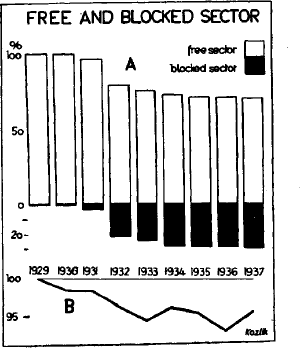
Diagram 2
The diagram shows on the one hand that the proportion of the blocked sector has increased sharply, and on the other that the foreign trade of the blocked countries has been more restricted than world trade.
Another fact, not shown in the diagram, is that the trade of the blocked countries has shifted away from the free countries to the other blocked countries. For this reason the external trade of all countries with exchange control with free countries has decreased more than their total foreign trade.
It might be objected that the diagram is deficient in that some of the free exchange countries also have clearing agreements (with exchange control countries). It should be borne in mind, however, that the only purpose of the diagram is to show the share in world trade of the countries which preserved the essential liberty of multilateralism and of those which did not.
Price-disparities
To demonstrate the price-disparities in different countries, the wholesale prices of paper, sheet metal, iron bars and steel girders were chosen. The following countries have been considered:
Sheet metal—
Germany: 4-76 m.m. and more, Kessel. S.M. Güte, Bas. Essen.
Belgium: toles fortes:
(a) 5 m.m. and more, free committer’s station.
(b) ¼ inch, f.o.b. Antwerp.
France: toles fortes, 5 m.m. and more; base: eastern plant.
England: Middlesbrough, ship plates:
(a) free committer’s station.
(b) f.o.b. export.
U.S.A.: Pittsburgh, tank plates; base: plant.
Girder—
Germany: Grundpreise, Bahn Oberhausen.
Belgium: poutre norm:
(a) free committer’s station.
(b) f.o.b. Antwerp.
France: grosses pontrelles; base: eastern plant.
England: Middlesbrough, joists, free committer’s station.
U.S.A.: Pittsburgh, beams; base: plant.
Iron bars—
Germany: Grundpreise, Bahn Oberhausen.
Belgium: barres:
(a) free committer’s station.
(b) f.o.b. Antwerp.
France: aciers march.; base: eastern plant.
England: Middlesbrough, rounds and squares;  -3 ins., free committer’s station.
U.S.A.: Pittsburgh, steel bars; base: plant.
Paper: Printing paper for newspapers—
Germany: free committer’s station.
Canada: Quebec; base: plant.
Sweden: base: plant.
The sheet-steel, iron bars and girders in Germany, Belgium and France are fabricated by the Thomas-process, in Great Britain by the Siemens-Martin-process, and in the United States by the Bessemer-process. The price-disparities here considered have to do with the countries with the highest and lowest prices. The absolute amount of disparity has diminished since 1929. But this does not give an adequate picture of the real development. It is not the absolute disparity which is important, but the disparity in relation to the price of the goods Therefore the diagram shows the disparity in per cent, of the lowest price. To make comparable the disparities in these four goods, their proportion to the lowest price in 1929 is considered as 100.
This proportion rose between 1929 and 1932 because the prices of iron and steel products in Belgium, the country with the lowest prices, declined very sharply.
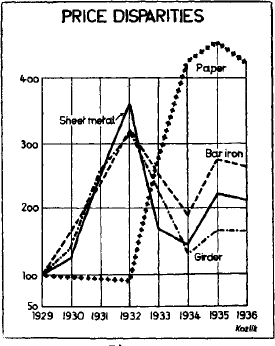
Diagram 3
As bilateralism extends, the economic space of each of the participating countries is shrinking, and in these watertight compartments the price level of traded commodities will tend to be driven above that of the free sector, which represents the real world market. The competitive strength of the blocked countries in the free sector will be diminished accordingly, and this, in its turn, leads them to try to keep it up artificially by systems of organized dumping, so as to preserve some access to the free sector, which they need if they are to maintain a minimum of mobility and procure those commodities which must be bought outside the bilateral bloc. Since these consequences affect both partners in bilateral relations, the gain in selling goods above the price level of the free sector is largely illusory, as it will tend to be balanced by the disadvantage of buying, in exchange, the imported commodities at an equally enhanced level. Yet it would be unwarranted to exclude the possibility of a net gain to one or the other partner. One also has to consider that, within the country concerned, it will more often than not be a different part of the population which enjoys the enhanced export prices to that which bears the burden of the increased import prices.8
It goes without saying that the strong mutual dependence of countries bound by bilateral trading may easily develop into a one-sided dependence, which starts by being economic and ends as political. This latter would be the fate of small countries tied bilaterally to greater nations, so that the disintegration of world economy by bilateralism would endanger the economic independence of the small countries more or less to the same extent as the disintegration of the political world will endanger their political independence. In both spheres, the economic as well as the political, bilateralism—whatever its advantages in other directions—means disintegration, lack of intercommunication and balance, and thus growing advantage of the greater political units over the smaller ones. It should be clear enough by now that the trend toward bilateralism is bound to have a far-reaching and disquieting effect on international political relations, in which connexion more will be said in due course. It is only by looking at these larger issues that the effects of the present disintegration of world economy by bilateralism and its concomitant developments (preferentialism, regional blocs, decay of the most-favoured-nation clause) can be seen in the right perspective. On the other hand, however, it should not be overlooked that these trends owe their origin to a very complicated set of causes in which the monetary-financial disturbances of world economy rank equal with the recent excesses of agrarian and industrial protectionism.
Having stressed the general significance of the present trend toward bilateralism, the next task is to go into the detail. In this respect, the tendency of bilateralism to reduce the volume of world trade is particularly conspicuous. Since it is the main feature and the declared purpose of bilateral trade agreements to equalize trade balances and to put international trade on a base of strict reciprocity of selling and buying, it is obvious that any attempt at bilateral equalization, at any point in the multilateral chain connecting a whole series of countries, will have far-reaching repercussions, which will force one country after another to adjust its commercial relations in the direction of equalizing trade balances. It is more than likely, however, that these all-round adjustments will be made by cutting down imports to the level of lower exports, rather than by raising them to the level of higher exports.9 A modification of this commonly accepted view has recently been advanced, that trade relations based on strict bilateralism may withstand the impact of a world depression better than multilateral trade relations; and in proof of this it is pointed out that, during the recession of world trade since the beginning of 1938, the trade volume of countries having bilateral agreements with Germany showed a particularly strong resistance.10 It is indeed remarkable that, e.g., Roumania lost, during the first quarter of 1938, 65.5% of its exports to Great Britain and 42.6% of its exports to France, but only 20% of its exports to Germany, as compared with the same period in 1937. The fact itself, therefore, cannot be denied, but it seems hardly possible to attribute it to the influence of bilateralism, instead of to the fact that Germany, by dint of its particular economic policy, was able temporarily to maintain full employment more or less independently of the depressive tendencies abroad.
To these quantitative effects of bilateralism must be added the qualitative one which, just because it is qualitative, cannot be adequately described except by a minute and detailed study in particular fields of international trade. In general, it is clear that every “short-circuiting” of economic interchange is bound to interfere with the process of orderly and economical exchange of goods and to lead to the acceptance of commodities which, in the case of multilateral interchange, would not have been taken at all or only in smaller quantity.11 The recent history of clearing agreements is full of instances of deliveries which, though not satisfying real demands, had to be accepted by one partner or another in order to “clear” the clearing account of an embarrassing surplus, so that the term “clearing agreement” seems rather an ironical misnomer for what might more appropriately be called a “choking agreement.” It is within this general framework that all specific disturbances of international trade caused by bilateralism are to be understood, especially the difficulties in the supply of raw materials to those countries which are most afflicted with this serious disease of world economy.12
That bilateralism—especially in the form of clearing agreements—amounts to an intolerable strait-jacket for the countries concerned by depriving them of that minimum of free manœuvring which is indispensable even for the most autarkic of economic systems, is a fact amply proved by the example of Germany. In that country, a sequence of two disappointing harvests, especially in cereals, together with miscalculations as to the necessary imports of fats and meat, was sufficient to upset very seriously, in 1937 and 1938, her foreign trade plan, which was largely based on bilateral trade relations. The problem of providing Germany with her food during this recent period could not be solved without drawing heavily on the “free sector” of the world market—by making use of her reserves of freely negotiable devisen, i.e. by going back to the principle of multilateralism. As has been frankly stated by a semi-official German publication, the principle of bilateralism was put out of action by the force of events, since it became impossible to increase exports to those countries to which she would have had to have recourse for the additional imports, to the necessary extent and within the required time.13
A situation like this is especially dangerous, because additional import requirements of this kind will be concentrated on a few staple products, while additional exports, being those of finished goods in the greatest variety, will always be composed of a very large number of different and separate transactions, which will take longer where the countries importing them are less developed, and that is just the case under the conditions of bilateral trading. Consequently, the additional imports have to be scraped together in a very cumbersome way, wherever small lots can be squeezed out of bilateral trade relations, and usually at enhanced prices, while the remainder has to be bought with free devisen obtained from what multilateralism is left in the world. In spite of the great efforts made by Germany in the first direction, it is admitted that the amount of additional imports which she had to buy with free devisen in those years (1937-1938) was rather large. Hungary and Yugoslavia were practically the only countries where a compensation of larger imports by a corresponding increase of exports proved possible, while, on the other hand, the enormous increase of imports of cereals and fodder from a country like Argentina (from 17.5 millions RM in 1935-36 to 69.6 in 1936-37 and to 168.8 in 1937-38) evidently entailed a heavy sacrifice of free devisen.
It goes without saying that, at the other end of the bilateral trade relations, the raw material countries are by no means in a better position. None of them has gone so far as to rely entirely on bilateral trade relations, because none of them ignores the immense danger of losing, by such a policy, not only economic but also political independence and that minimum of play indispensable for the working of their national economy. All endeavour to find opportunities of extending that part of their foreign trade, which is not canalized by clearing treaties, by accepting lower export prices, admitting some liberty in exchange transactions (private clearing, tolerance of black markets for free devisen, &c.), or by soliciting credits from the countries belonging to the free sector of world economy.
The foregoing conclusions, which are based equally on experience and reasoning, form a striking contrast to the efforts made to present the principle of bilateralism as the last word in modern commercial policy and to claim for it superiority to the principle of multilateralism under present conditions. The simple truth is, that even those countries where these efforts are most conspicuous and which have made the most of the principle of bilateralism, would find themselves in a catastrophical position if their boasts, were taken so seriously by the rest of the world that every country introduced watertight systems of exchange control and clearing payments. In other words, the free sector of world economy is not only holding up what is left of a proper world economy, but also supporting the blocked sector. Bilateralism is like a good number of other devices in international economic policy, in that its universal application deprives it of all the possible advantages it may have had for a single country. So all those countries which have sold themselves to it must combine with their public praise of it the silent wish that there will still be left some important countries which do not adopt it.14 The resemblance of this case to that of gold as an international standard of value is particularly striking, for here, too, there must be at least one country left with a fixed gold value, if the value of gold is to have any anchor at all.
In order to understand more fully the present trend toward compulsory bilateralism we should, before going on, consider two further facts. The first is, that the principle and the working of bilateralism (“buy where you sell!”) is clear to the simplest mind while the working of multilateralism is much less easily understood. Consequently, the present predilection of so many people and governments for bilateralism appears to be largely a matter of resentment against something they do not understand, i.e. multilateralism. The second fact is that bilateralism is the kind of foreign trade regulation toward which a totalitarian régime quite naturally inclines. Totalitarianism demands that foreign trade be regimented like internal economic activity, but the only way in which this can be effectively done is by exchange control and compulsory bilateralism, since it is practically impossible to regiment multilateralism.
As has been suggested at several points, bilateralism, in the strict technical sense of compulsory suppression of multilateral trade by clearing agreements, represents only a special and very striking case of a more general tendency, i.e. that to destroy the unity and the intercommunicating character of world economy by breaking it up into different compartments. This tendency also finds expression in the increasing importance of regional groups and economic blocs, in so far, at least, as this is not a natural, but an artificial development brought about by measures of preferential commercial policy. Though it can be admitted that there are other factors, beside governmental measures, working towards intensifying international trade within regional groups and economic “empires,” the advance of a conscious policy directed toward this end is so obvious that the development as a whole may safely be regarded as more the result of commercial policy than of natural forces. To this extent, however, regionalism appears to be compulsory (contrived) and, from what has been said above, detrimental to the normal structure of world economy. The general effect of this development can be summed up by saying that great politically united or otherwise affiliated areas tend to be hedged-off economically from the rest of the world.
(c) THE ERRATIC CHARACTER OF WORLD TRADE
Our study of the qualitative aspects of international economic disintegration, as distinct from the mere quantitative shrinkage, leads us from the dissolution of the intercommunicating character of world economy to another feature which is closely connected with the foregoing. It is what might be conveniently called the erratic character of world trade to-day.
The significance of a given volume of world trade will be very different, according to whether it is the result of stable and continuous international trade relations or is rather the sum total of laborious transactions based on fickle conditions. Anybody even faintly familiar with the present state of the world knows that the latter type of trade is exactly that with which we have to do to-day. The volume of total world trade may compare not too unfavourably with that of ten years ago, but this is only a facade behind which we must look in order to get a right estimate of the damage being done. What we see then is the hand-to-mouth character of world trade; the nervous endeavours to find, now here, now there, gaps in the commercial hedges of the nations; the abrupt closing or opening of trade channels by changing political enmities or friendships; the continuous mending of short-term trade agreements; the choking of clearing accounts; the hasty advantage taken of temporary outlets for profitable exports; the sudden change brought about in market conditions by exchange depreciation, export subsidies or purely political measures. And the result of all this is that world trade becomes more and more hazardous and erratic, a rough-and-tumble of nations vying with each other in their efforts to scrape together by any means whatever exports they can find and hampered by the general tendency to look on imports as a matter of good luck, political benevolence or, at best, as a passing-necessity. That most of this is in some way or another connected with “planning” and glorified as such, is an example of that kind of involuntary humour in which our times are so rich.15 As everybody knows, the bitter truth is that the main effect of this entire development is to deprive world economy of stability, reliability and continuity. If we live now in a world where it has hardly become possible to plan more than a week ahead let us remember that this is what some people call with involuntary sarcasm “the age of planning.” But once the deep significance of the general crisis of our time is understood, there is hardly any room for surprise that this is so.16
The more erratic character in world economy
There are two groups of causes for the changes in trade between two countries: first, those causes which change the total external trade of these countries; and second, those that bring about a shifting in the trade between the countries. Since we shall consider only the second group of causes, we must eliminate the effects of the first.
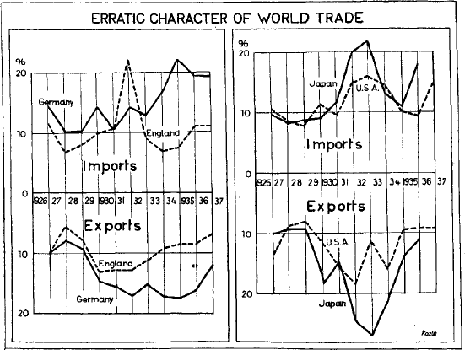
Diagram 4
We may suppose that the external trade of a country A with countries B and C would alter in the same proportion if only the first group of causes are operating, so that the percentage of both B and C of the trade of A would be unchanged. If there is a change in the percentage of B and C of the trade of A, then we can say that it is an effect of the second group of causes. The greater the shifting in the external trade of A, the greater the change in the percentage of B and C on its trade. The addition of the change of the percentage of B and C thus gives a measure of the shifting of A’s external trade. If a1 and a2 are the foreign trade of country A in two successive years and e1 and e2 the foreign trade of A with a country E (any of the n countries with which A has relations), then the shifting of the foreign trade of A is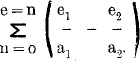
In this way there was shown the shifting in the foreign trade of Germany, Japan, the United States and England. There were compared Germany and England on the one hand and Japan and the United States on the other. The upper part shows the shifting of imports and the lower part the shifting of exports. Both diagrams show that the shifting of external trade in the two blocked countries (Germany and Japan) is in almost each year greater than the shifting of external trade of the two free countries.
It is easy to see that this erratic character of world economy is closely connected with every development, which tends to make it less and less a thoroughly competitive and intercommunicating market. As has been shown by other authors, it is especially bilateralism which is working in this direction. “It makes what trade is permitted a pure business of horse trading. And since, bilateralism or no bilateralism, the conditions of production and demand are continually changing, there is no reason to suppose’ that this business can reach any sort of stable conclusion. The trade connexions of one country with another may be ruthlessly set aside overnight in order that the second country may be in a better position to bargain with a third. The execution of bargains which have been made involves the imposition of controls which themselves react on the volume of trade and in turn necessitate further bargains. Far from establishing a tendency toward greater stability and equilibrium, bilateralism seems to tend toward cumulative instability.”17 To this may be added that there is another explanation of the thoroughly unstable equilibrium of trade relations based on bilateral clearing agreements in the fact that the market situation created in this way is, with certain reservations, to be conceived as a bi-monopolistic one with its well-known range of indeterminateness. More generally, it can be stated that world trade becomes more and more erratic the more the law of great numbers is rendered (by bilateralism and similar developments) unable to exert its smoothing and equilibrating influence.
World trade is becoming less and less an affair of countless traders of all nations doing their business on well-established and relatively stable conditions, within a price-cost structure determined by the competitive mechanism and in an “open” market, where sudden changes may be evenly distributed over a large space. The open and intercommunicating market is being broken up into different compartments; conditions are getting more and more precarious and fickle; and trade is carried on by ever larger and fewer units, either governments or monopoly organizations, growing in the shadow of the state.18 Thus world economy is getting lumpy and jerky at the same time, like the rest of the economic and social system of our times.
The new methods of commercial policy and the increased share of governments in handling or regulating international trade mean growing “politicalization” of international economic relations. This, in turn, means less dependence on the laws of competitive supply and demand, which are largely calculable and (in a wide market) little subject to jerky movements, and more dependence on governmental whims, which are incalculable—especially in the absence of any well-defined principles of economic policy limiting the state’s field of action—and given to sudden changes at any moment. This is what politicalization of the economic process invariably means wherever it occurs, but it is nowhere more pronounced than in the field of international economic relations, which is where the dissolution of norms and principles, the anarchy and arbitrariness, the discontinuity and hand-to-mouth character of modern life are most conspicuous to-day, and where everybody without reluctance or consideration follows the fashionable motto: “Do what you will.”
But there is even more in the problem than this. The larger the units are which stand behind international trade—the private business units pampered by the state and finally, in more or less disguised form, the state itself—the more varied are the possibilities of making export prices independent of the unit cost of production by using the different national economies as large business pools and by allotting to export prices that share of the cost of production which, at any given moment, is thought useful. Goods are exported, then, for whatever they may bring, the domestic consumer or taxpayer paying the difference. The national economies tend to resemble gigantic department stores, where the total cost is distributed among the different articles according to the principle of “what the traffic can bear.” By monopolistic price differentiation, export subsidies of every description, governmental foreign trade monopolies, special favours granted by bilateral agreements, and by highly elaborate schemes of currency and debt manipulation, the world market becomes a vast dumping-ground where trade is carried on according to the rules of “catch-as-catch-can” and all firm foundations are lost. The result of this hectic activity is that, when the total volume of trade is added at the end of the month or the year, though the figure may be far from negligible, its significance has changed entirely.
By looking at the recent development of world trade in this way, it becomes immediately clear that one must be most sceptical of all attempts to present the new commercial policy responsible for it as rational. There are not wanting authors who seem to believe that it would only benefit world trade if every national economy were insulated from the rest of the world in such a way that imports would have to go through a “sluice” (according to recent terminology in Germany) before reaching the home market, while exports of typical goods of national production should be stimulated by all possible means.19 At the same time, there are ardent defenders of bilateralism and clearing agreements.20 It is rather difficult to understand what is meant by these advocates of a development which, after what has been said above, can only be regarded as highly pathological. They seem, however, to be led by the more or less vague idea that it is essential to organize and equilibrate national economies, and that world economy will then take care of itself and fare better than it did before when national economies were unstable. In this way, it is widely held, it seems to be possible to combine the highest degree of foreign trade regulation with a working world economy.
In the light of what has been put forward here, this whole trend of thought appears as a rather strange confusion or, at best, as an unsuccessful attempt at rationalizing an irrational and unprincipled practice. This practice is one of the main factors in disintegrating world economy and depriving it of its most useful functions. On the other hand, it should be noted that it is at the same time both effect and condition of that policy, so popular all over the world, which aims at stabilizing national economies with a minimum of regard to what such policies mean for the stability of external economic conditions (“autonomous business cycle policy”). This kind of stabilization policy is being carried through, with the express purpose of gaining in internal stability what, if necessary, may be lost in external stability—a philosophy which can be most clearly observed in the policy of deliberate exchange instability and in its underlying “Doctrine of alternative stability.”21
World economy, then, becomes little more than a vast playground open to every sort of economic vivisection and unrestraint, pari passu with the increased restraint put upon national economic activity by policies of planning. While a closer analysis of these policies and their international implications will be reserved for a later occasion (Part VII), mention should be made here of the one fact that world economy is nothing else than the sum total of the external economic relations of all nations, while no single nation has an exclusive patent right to the policies referred to. Consequently, it is hard to see how these policies can be pursued without the most serious and damaging repercussions on the different national economies. It may well be that efforts will then be made to cope with those repercussions by still more radical measures of national economic isolation and disregard for international economic relations until, by a particularly vicious circle, we arrive at the national economic dictatorships, the dynamics of which will be studied separately later on (Part VII).
In connexion with these effects of the new trend of economic policy on the erratic character of world trade, special attention should be paid to the discontinuities brought about by the late increase of agricultural protectionism. Agricultural production, being subject to the caprices of nature, is in general an erratic factor of the first magnitude in economic life, and this probably is all the more true the more intensively the soil is cultivated.22 The yearly crop fluctuations, therefore, are apt to give international trade a certain erratic character in any case. Now, present conditions differ from previous ones in two respects. In the first place, statistics seem to bear out the presumption that, in important parts of the world, agricultural production has been made more erratic in yield than before by over-intensification of soil cultivation, which, in its turn, is due either to agricultural protectionism (as in some European countries) or to short-sighted speculation (as in the semi-arid areas of the United States, the present “Dust Bowl”). In the second place, the effect of these tendencies has been much strengthened by the present policies of food autarky.
In order to understand this, one has to remember that formerly it was one of the main functions of a well-integrated world economy to level out as far as possible the crop fluctuations of the different parts of the world, which rarely coincide with each other, and thus to make the world trade of agricultural products more steady both in volume and prices. The new system of agricultural protectionism, however, means that agricultural imports are being reduced to a mere safety valve to be applied in the event of an emergency arising from internal crop failures. In the industrial countries agricultural production is being pushed to the utmost limit of intensity by keeping out imports and enhancing prices as far as possible, and it is only when nature intervenes, by sending a bad harvest, that the sluice will be cautiously opened and the necessary additional supply sought in the markets of the world. This applies especially to cereals, whereas in other agricultural products the tendency is much less marked. It is obvious that all this adds appreciably to the present jerkiness of world trade, especially as all-round dumping in agricultural products has become almost an accepted rule of the game.
It has to be remarked, of course, that it would be wrong to attribute the more erratic character of world trade, as we observe it to-day, entirely to the immediate effects of economic policy or to structural changes brought about by such a policy. On the contrary, it should be carefully studied how far international trade to-day is reflecting, in this respect, certain tendencies toward greater “bumpiness” of economic life, which are to be observed in every sphere and which grow out of more general conditions. It is impossible not to mention, in this context, the effects on world economy of the present jerky movements of international short-term capital, which, while being one of the major problems of the international economic relations of the present time, represent a much too complex phenomenon to be treated as the mere outcome of political measures. This is still more true of other factors of unsteadiness which are now making themselves felt in international economic relations and which are likely to become more important in the future. In this connexion, much stress should be laid on the fact that the growing importance of products having a high degree of demand elasticity is bound to make international trade also much more sensitive to changes in incomes and tastes. This applies particularly to producer’s goods and durable consumption goods like automobiles, electric appliances, &c. At the same time, there appears to be ample evidence that the rapidity of technological changes has increased rather than slackened.23
It would be easy to complete this list of the factors of growing unsteadiness and make this account rather impressive. On the other hand, however, it is equally easy to overrate their real importance. There is no denying the fact that the general policy of economic nationalism, while to some extent being engendered by these factors of economic unsteadiness, is at the same time enhancing them and making the whole world much less bump-proof, so that the shocks they administer seem to be magnified. In other words: if the world economy of to-day had preserved more of its former normal aspect, if it were more intercommunicating and less erratic on account of present commercial and monetary policy, and if it provided larger and therefore more stable markets, it is to be presumed that the shocks coming from other sources—cyclical oscillations, changes in tastes, or the progress of the technique of production—would be absorbed more easily.
(d) THE BREAK IN THE INTERNATIONAL MONETARY AND FINANCIAL SYSTEM
What has happened during the last decade to the international monetary and financial system of the world is generally so well known that it would be quite sufficient here to reduce the confused events in this field to their essentials, and to point out their fundamental significance for the disintegration of the international economic system. Since, however, this monetary aspect of international economic disintegration will be dealt with separately later (Part vi), it will be enough at this point just to mention it for the sake of completeness and to ask the reader to keep the monetary aspect firmly in mind as one of paramount importance.
(e) THE INCREASED INTERNATIONAL IMMOBILITY (NATIONALIZATION) OF PRODUCTION FACTORS
An enumeration of the functional disturbances of world economy at the present time would be incomplete without due reference to the well-known fact that the gap between the economic integration existing within the borders of the various countries and that of the world economy has been considerably widened by a process which can be called the growing nationalization of production factors or, to be more specific, of capital and labour. In other words, the international mobility of capital and labour has decreased during the last ten years, that of labour much earlier, whereas it is only recently, after an outburst in the ’twenties, that the international flow of capital has become stickier. This means that there has been an absolute decrease, and that the relative share of factor movements in international transactions has diminished, while the share of commodity movements, whatever their absolute amounts, has increased. In this connexion, there are two points to be considered for the purpose of the present chapter. The first is the order of magnitude in the decrease of the international mobility of production factors, and the second its significance for the process of international economic disintegration.
If certain precautions are taken, it is possible to make statistical measurements to ascertain the order of magnitude of factor nationalization, but the danger of rashly accepting such figures must again be stressed, as it has been in earlier sections. What we want to emphasize is the distinction to be drawn between actual and potential factor mobility and the fact that the latter is even more important than the former. But the statistics only show the decrease of the former and not that of the latter, at least not explicitly and accurately. What we want to know is not only to what extent international movements of capital and labour have decreased, but also the possibilities of their taking place in case they should appear economically rational. But the only way of drawing conclusions about this from the statistics of actual movements is by inference. The full truth, therefore, will only be known if the statistical picture is completed by an account of the growing obstacles put in the path of economically rational factor movements by (a) legislation and other state interference, and (b) by a perverse state of psychology leading to irrational movements. As far as the first group of obstacles is concerned, it is sufficient to point to restrictive migration policies, exchange control, capital embargoes and other measures, which have been applied the world over and which have become one of the most striking features of the present state of world economy. With regard to the second, it is a matter of common knowledge that the factors making for irrational movements of capital and labour have become numerous and very active, from which it may be inferred that the effect has been to decrease rational movements correspondingly. That refers especially to international capital movements, which are being directed more and more by nervous considerations of safety rather than by interest differentials.
Turning now to the significance of the increased immobility of production factors for the process of international economic disintegration, we may safely assume that this can hardly be contested, though it must, at the same time, be admitted that it is a rather intricate task to analyse the full economic meaning of this development.24 That the growth of international immobility of capital and labour is a factor of international economic disintegration can be shown in different ways. To begin with, it is a process which makes the localization of production on the international plane less rational than it would otherwise be. The rational distribution of productive forces over the entire world—a process which, under normal circumstances, is already being hindered by powerful counterforces—is bound to suffer, if there is less mobility of production factors, and no differences of opinion as to its desirability can do away with the fact that it is a correct measure of economic integration. Approaching the subject from a different angle, we arrive at the same result by showing that the less the international mobility of production factors, the wider will be the gap between the different national scales of factor prices (wages and rates of interest) and the less efficient the ways of equalizing those differences. Thus, with distinctly national price systems not only for commodity but also for factor prices, the different national economies come to live more and more on separate economic planets.
It should be noted, however, that all this would be substantially different if the decrease in the international mobility of production factors were compensated by an increase in international commodity trade. Even this would be a situation where the international economic integration would be inferior to that prevailing under conditions of an all-round mobility. According to the law of comparative costs (however formulated), it would, however, also be a situation where a flourishing international trade would be possible and profitable to all parties, with only this modification: that the disadvantages of an irrational distribution of productive forces between the countries concerned would make themselves felt in a difference of factor prices, which would be mitigated, but not eliminated, by commodity trade. But the point is that a brisk international commodity trade is no longer a compensating factor, since the international mobility of commodities has decreased to the same extent as the mobility of production factors. Thus, the disintegrating effect of the nationalization of capital and labour is to-day unmitigated and complete.
There are two special points to be mentioned. The first is the paradoxical fact that international economic disintegration has to some extent led to an increase of international capital and labour movements. That is happening in so far as the restriction of commodity trade is reaching such a degree that it becomes profitable to establish branch factories in the protectionist country, the reason being that what is saved on duties overcompensates the loss caused by the partial transfer of production to the protectionist import country. How high the duty must be in order to make this transfer profitable depends, of course, on the degree in which the new localization of production is less rational than the old one. It would seem advisable to make further investigations into these relationships, investigations which would be interesting from several points of view. In particular, it should be noted that this is a problem closely connected with that of the industrialization of new countries, which will be considered in a later chapter. One thing, however, should be already clear at the present juncture, i.e. that, because of its special nature, this increase of international movements of capital and labour does not lead to more, but to less international economic integration. A further conclusion would be that it can hardly be other than temporary and that it will flourish only at a certain degree of protectionism. In order to elicit the transfer of foreign capital and labour, protectionism, for the reason mentioned above, must not be too low, but, on the other hand, it must also not be too high or take on any autarkic flavour lest it deter foreign capital and, perhaps, also foreign labour. If a severe exchange control makes it next to impossible to send home profits and wage savings, the country in question is likely to lose its power of attraction. It is very likely, however, that it is just the inflow of foreign entrepreneurial capital which, sooner or later, will make it appear desirable to increase economic nationalism to a point where it ceases to attract capital from abroad. The foreign capital will be welcome, but not the controlling influence which it entails. So, as far as the attraction of foreign capital is concerned, there is a self-defeating tendency in economic nationalism.
There is one last point; whether the decrease of international factor mobility applies equally to the factor of “entrepreneurial ability.” In general, one would be inclined to assert that it does, though perhaps in a minor degree, but until this point has been further investigated, we must confine ourselves to mentioning it and thus completing the picture of the disintegrating influence of the nationalization of production factors.
(f) THE INFLUENCE OF THE NEW CHARACTER OF PROTECTIONISM
In a previous chapter in which the pre-war structure of world economy was characterized (I, 1), the statement was made that the world economy of that time was practically untrammelled by prohibitive import duties, having the free-trade area of Great Britain as its nucleus. There was, to be sure, enough protectionism in the world at that time, and the general tendency was for it to increase rather than decrease, but neither was the height of the customs tariffs prohibitive nor were the instruments of protectionism non-conformable, i.e. of such a character as to interfere with the pricing process itself and to be incompatible with the principle of market economy. Looking back on that period, we are certainly justified in regarding its commercial policy as essentially liberal, which we are the more inclined to do when we compare it with the present era of economic nationalism. To characterize this new era and to assess its significance for the structure of world economy is the purpose of this section which, by describing the framework of world economy set up by commercial policy, completes our analysis of the qualitative (structural) aspect of the present state of world trade. This new commercial policy is largely the source from which the structural changes discussed originate.
To begin with, protectionism of whatever kind has risen quantitatively to such a height that quantity is turning into quality. World trade is able to assimilate an astonishingly large amount of protective measures, until suddenly the breaking-point is reached. Customs duties may be, in general, a conformable measure of protectionism, but when they are raised to the point of becoming prohibitive, they change into a non-conformable measure. On the other hand, even so-called prohibitive duties are rarely so absolutely prohibitive and so prompt in accomplishing the effect of prohibition that, if this effect is ardently desired, there is not a strong temptation to resort to more drastic measures belonging, in spirit and technique, to another category of state intervention, viz., to that of planning and “non-conformability.” The fact that tariffs as an instrument of commercial policy have become the accompanying bass, while the leading melody has been taken up by other measures (quotas, exchange control and clearing agreements, administrative protectionism, foreign trade monopolies, &c.), amply testifies not only to the limits of using tariffs for the more ambitious purposes of present-day commercial policy, but also to the qualitative distinction between these two groups of instruments.
Turning now from the merely quantitative aspect of the new commercial policy as it can be seen in the formidable rise of customs duties, to the new trends, directions and instruments of modern economic nationalism, we find that the most striking feature of the new measures is that they aim, directly and consciously, at a planned quantitative regulation of international economic transactions. Taken together, they represent what may be called a planned commercial policy, in contrast to the former liberal one, meaning a commercial policy consisting largely of non-conformable measures25 which interfere with the market process itself and correspond to an internal economic system which becomes more and more a generally controlled and directed economy (“command economy”). Instead of leaving it to the reactions of the market itself to give foreign trade more or less the desired volume and shape, these reactions are being anticipated by governmental decree; it is the law and the administrative office which, by taking over some of the functions of the market, give to foreign trade the desired shape directly, consciously and by central action. And the shape desired is that of a foreign trade which is left as little as possible to the regulative forces of competition—of a foreign trade which is reduced to the dimensions and diverted into the directions demanded by an economic nationalism that is more pronounced than ever and in some cases amounts to “autarky.” It is, further, a foreign trade which fulfils two conditions: that it rigidly corresponds at any moment to what the government thinks it should be in volume and composition; and that this rigid structure can be swiftly and efficiently changed into another. And, finally, it is a foreign trade which is so controlled that it becomes part of a national economy based entirely or partially on the principle of planning, while at the same time it does not exert any seriously disturbing influence on the home market or create new conditions for internal economic equilibrium. Whereas commercial policy was formerly dominated by customs duties, which were fixed or bound over long periods by commercial treaties for the sole purpose of protecting or fostering certain industries, the new protectionism tends to become an instrument for a general market and price protection and the counterpart of an elaborate system of internal interventionism. More and more it develops into one of the most important pieces of the formidable machinery of “managed capitalism.” All that is true of the quota system as well as of the other devices of modern economic nationalism like exchange control, clearing treaties, embargoes, trade monopolies and similar measures, though, of course, there are important distinctions between the countries with a more conventional type of foreign trade policy and those which gave themselves up whole-heartedly to the new idea.
It should be quite obvious that the present policy of economic nationalism must not be regarded as a mere accentuation of former trends, but as something new both in spirit and technique, in means and in ends. It is not so easy, however, to give a satisfactory and exhaustive definition of this new era. Therefore, no effort must be spared in trying every means of interpreting it. One way is to regard the old era as one of a liberal commercial policy and the new as the age of planned commercial policy, while another is offered by the distinction between mere “protectionism” of the past and “autarky” of the present. It was on these distinctions that the preceding considerations were based. It goes without saying that the contours given by these terms to the new trend of foreign trade policy are far from being sharply outlined and distinct. On the contrary, there is plenty of room for a more precise definition of these terms, especially of “planning” and “autarky,” despite the efforts that have already been made in current literature.26 At the present juncture, it is not possible to fill this want, nor is it, perhaps, entirely necessary for an understanding of the essentials. But it seems useful to look at it another way. The completeness of the change of scenery in present-day foreign trade policy may also be understood by contrasting the world trade conditioned by the former policy, as “individual trade,” with that conditioned by the new policy, as “controlled” or “collective trade.” Because the old commercial policy was content to introduce only a new datum into the mechanism of international trade, it left the individual nature of international economic transactions essentially untouched; and only the general conditions of trade, not its concrete quantity, direction and composition, were made the subject of commercial treaties. But now we are more and more encountering a new type of commercial policy in which the subject of commercial agreements is no longer only the general framework, but also the real contents of foreign trade, which, while still being conducted by individual firms, become a matter of mutual arrangement between governments. The new devices of trade policy allow them to force international trade into the desired channels, and to conclude agreements which look as if they were barter contracts between individual firms: so many tons of coal against so many tons of butter (England-Denmark) or even so many tourists (Germany-Switzerland). Thus a hybrid form of international trade has come into existence which is still individual and competitive in form, but in its real contents, is collective and monopolistic. The curious theoretical problems arising out of this new situation are still largely unexplored, while the enormous practical difficulties engendered by it are also far from being solved, especially by those countries which are not yet equipped with the new devices and are, therefore, still unable to take part in this new game. The latter is well illustrated by the rather helpless attitude of the Western countries before the present war towards Germany’s conquest of the Southern-European markets. The extreme case of this collectivization of foreign trade is, of course, reached by Russia, in whose system of foreign trade policy customs duties have naturally become rather meaningless. Looked at properly, the whole development shows only a new facet of that general trend characterized earlier by the terms planning and autarky.
However we may define the essential character of the new era of protectionist policy, it is clear that its effects are visible in these structural changes of world economy which have been discussed in the preceding paragraphs; and we shall remember that these changes are all in the direction of the disintegration of world economy. The new era of protectionist policy means especially three things. First, it means less international trade in general and greater distortion of that distribution of productive forces over the whole world which, measured by the standards of market economy and of material wealth, can reasonably be described as rational.
Secondly, the new era means that there is going to be greater differentiation in space as to the conditions set by commercial policy. That is to say, that the new devices of commercial policy are, by their very nature or by intention, highly discriminatory and liable to foster bilateralism. Thus it is not to be wondered at that the new development goes hand in hand with a process of undermining the working of the most-favoured-nation clause, which latter, as has been stressed on several previous occasions, is essential for an integrated system of world economy as an interdependent, unified and intercommunicating system of international trade relations. It is, indeed, due to the influence of the new commercial policy that the most-favoured-nation clause has become largely a sham. The simultaneous development on an unprecedented scale of the old device of preferential treatment in customs tariffs, of which the Ottawa treaties between the members of the British Empire are the outstanding example, is all in accordance with this trend.
The third point is that the new commercial policy is also characterized by a greater discontinuity in time, which means that changes in the conditions of international trade brought about by commercial policy are, on the whole, much more frequent to-day than before. This is due both to the greater changeability of the autonomous commercial policy of the different governments and to the shorter average duration of commercial treaties. Both correspond to the more erratic character of world trade to-day, which has been treated in a special section.
__________________
27 For an exception in current literature see e.g.: B. Kuske, Die historischen Grundlagen der Weltwirtschaft, Jena, 1926, pp. 20-21.
28 See S. Crowther, America Self-Contained, New York, 1933, a book which a. central organization of the American chemical industry has had the remarkable frankness to mark as its own product of propaganda. It is interesting à titre de document, though the record in this sort of literature is held by a German book (Ferdinand Fried, Autarkie, Jena, 1932).
29 A. Rühl, Vierteljahrshefte für Konjunkturforschung, Sonderheft 25, Berlin, 1932, where the following tabulation is given:
| % of total imports | ||
| A. | Commodities which supplement rather than compete with domestic production— | |
1. Imports arising from the impossibility of domestic production . . . . . . . . . . . . |
13.1 | |
2. Imports arising from lacking, though possible, domestic production . . . . . . . . . . |
21.5 | |
3. Imports arising from lacking production of a certain variety |
4.9 | |
4. Imports arising from lacking production of a certain quality |
10.3 | |
5. Imports arising from peculiar consumption habits of immigrants . . . . . . . . . . |
0.8 | |
6. Imports arising from seasonal differences between foreign and domestic production . . . . . . . |
0.2 | |
7. Imports arising from different technological developments abroad and at home . . . . . . . . |
4.2 | |
8. Imports arising from the quantitative insufficiency of domestic production . . . . . . . . |
34.3 | |
| 89.3 | ||
| B. | Commodities being imported in spite of their competitive character | |
1. Because of unfavourable transport conditions for domestic production |
3.5 | |
2. Because of unfavourable cost situation of domestic production |
7.2 | |
| 10.7 |
100.0
See also: U.S. Tariff Commission, Economic Analysis of Foreign Trade of the United States in Relation to the Tariff, Senate Document, No. 180, Washington D.C., 1933.
30 Cf. W. Röpke, “Trends in German Business Cycle Policy,” The Economic Journal, September, 1933; W. Lautenbach, “Die Kreditausweitung im Aufschwung,” Wirtschaftskurve (Frankfurter Zeitung), October, 1936, pp. 247-249.
31 Cf. especially the studies made by F. Hilgerdt in The Approach to Bilateralism—A Change in the Structure of World Trade, Index, August, 1935, and in Review of World Trade, League of Nations (annually).
32 See Review of World Trade (League of Nations).
33 On the great price disparities between different countries to-day, as one of the results of the international economic disintegration, see diagram 3.
34 Bilateral trade as it has been developed between Germany and the countries of South-eastern Europe during the last years has temporarily benefited the agricultural population of those countries, while the burden of higher import prices for industrial commodities is largely being borne by the urban population.
35 Cf. Bertil G. Ohlin, International Economic Reconstruction, Joint Committee of Carnegie Endowment and International Chamber of Commerce, Paris, 1936, pp. 93-96; Enquiry into Clearing Agreements (League of Nations), Geneva, 1935.
36 Report of the Reichs-Kredit-Gesellschaft for the first semester of 1938 (Deutschlands wirtschaftliche Entwicklung im ersten Halbjahr, 1938), pp. 86-87.
37 See W. Röpke, Die Lehre von der Wirtschaft, Vienna, 1937, p. 44-45.
Curiously enough, the clearing system is sometimes defended on the ground that it raises the price of exports, and we sometimes hear people ask, in feigned innocence, what more could be wanted than that the highest possible prices be obtained for products sold. It is hardly necessary to reply: (1) that the higher export prices will in all probability be balanced by higher import prices or by a lowering of the quality of the imported products; (2) that the higher export prices are furthermore an illusion for the country as a whole, since the range of commodities that can be bought with the money receipts from the sale of such exports is restricted to those commodities which the other country is able or willing to deliver; (3) that the higher export prices may be exactly the price for which the country is selling its economic and political independence; (4) that the growing dependence on the other country will gradually lower export prices, increase import prices and impair the quality and the freedom of choice of the imported products. It is a significant fact that to-day Germany stands almost alone in the world in her defence of the bad case of the clearing system, while her smaller partners, especially the Balkan countries, which in the beginning were equally in favour of the system, are now beginning to perceive that they have fallen into a trap.
38 Cf. particularly Folke Hilgerdt, op. cit., and his studies in the successive memoranda on “World Trade,” League of Nations.
39 Lothar Mischke, “Der Nahrungsmittelbedarf in der Einfuhrplanung,” Deutscher Volkswirt, No. 2, 14th October, 1938.
40 “The totalitarian methods of foreign trade are not precedents to be imitated by other countries. On the contrary, it has been possible to pursue them so far only because the other countries have not followed the totalitarian example, and they have been pursued at the expense of these other countries, with the result that there have been increased disturbances and a further disintegration of world economies.” A Feiler, “International Trade under Totalitarian Governments,” Social Research, November, 1938, p. 441.
41 Cf. L. Robbins, Economic Planning and International Order, London, 1937; W. Röpke, Crises and Cycles, London, 1936, pp. 11-12.
42 On diagram 4 an attempt has been made to give some graphical picture of the more erratic character of world trade to-day.
43 L. Robbins, Economic Planning and International Order, London, 1937, pp. 109-110.
44This is exemplified by the fact that, before the present war, in Germany about twenty firms were doing roughly one third of the German export business (M. Ilgner, Exportsteigerung durch Einschaltung in die Industrialisierung der Welt, Jena, 1938, p. 25).
45 Since this is the official opinion held in Germany, it is especially the current literature in this country which best reflects the philosophy mentioned in the text.
46 Cf. for example: Paul Einzig, The Exchange Clearing System, London, 1935; John Donaldson, review of “World Economic Survey, 1932-33,” Weltwirtschaftliches Archiv, September, 1934, pp. 142-143.*
47 Cf. W. Röpke, Crises and Cycles, London, 1936, pp. 164-173.
48 Cf H. W. Graf Finckenstein, 130 Jahre Strukturwandel und Krisen der intensiven europäischen Landwirtschaft, Berlin, 1937, pp. 27-30.
49 For a fuller discussion of the problems of economic change, Allan G. B. Fisher’s book, The Clash of Progress and Security, London, 1935, should be consulted. Cf. also his paper on “International Problems of Economic Change,” International Affairs, March-April, 1938.
50 See on this point especially: B. Ohlin, Interregional and International Trade, Cambridge, Mass., 1933.
51 See on this terminology p. 17.
52 For an elucidation of the meaning of “planning” see my own book Crises and Cycles, pp. 193-196, and G. Haberler, Liberale und planwirtschaftliche Handelspolitik, Berlin, 1934. For the clarification of the proper meaning of “autarky” cf. especially the “Rapport préliminaire sur la réorientation économique de la Belgique,” Revue du Travail, September, 1936, for which Professor Dupriez is mainly responsible.
- 1Cf. my paper “A Value Judgment on Value Judgments” in which I am explaining my attitude in this very important methodological question. It will probably be published in the “American Economic Review.”
- 2The following pages are largely based on a memorandum which the author wrote together with Professor Alexander Rüstow (University of Istanbul) in the summer of 1938.
- 3See also: W. Röpke, Die entscheidenden Probleme des weltwirtschaftlichen Verfalls, Zeitschrift für schweizerische Statistik und Volkswirtschaft, 1938, No. 4.
- 4In current literature there is already some evidence that the understanding of the scientific situation outlined above is growing. See E. F. M. Durbin, “Methods of Research—A Plea for Co-operation in the Social Sciences,” Economic Journal, June, 1938; A. Löwe, Economics and Sociology: a Plea for Co-operation in the Social Sciences, London, 1935: F. Akerman, Das Problem der sozialökonomischen Synthese, Lund, 1938. The essential things have been said on a wider scientific scale by A. N. Whitehead, Science and the Modern World, New York, 1926; and by Ortega y Gasset, El Tema de Nuestro, Tiempo, Madrid, 1923.
- 5See Der deutsche Aussenhandel unter der Einwirkung weltwirtschaftlicher Strukturwandlungen, l.c., pp. 362-363.
- 6The vast literature on this subject has recently been enriched by M. J. Bonn, The Crumbling of Empire, The Disintegration of World Economy, London, 1938; and by Lionel Robbins, The Economic Causes of War, London, 1939.
- 7See my own approaches to these problems given in the article: “Kapitalismus und Imperialismus,” Zeitschrift für schweizerische Statistik und Volkswirtschaft, 1934, pp. 370-386; and in my book Crises and Cycles, pp. 4-6.
- 8Cf. Röpke, Crises and Cycles, London, 1936, p. 88n.
- 9In anticipation of a probable objection, it may be noted that if the development caused by population increase is put under the heading “extensification,” the “intensification” referred to previously (pp. 11-12) appears inexact. In order to get “net intensification” that part would have to be deducted which is due to “vertical extensification,” an operation which is impossible.
- 10F. Hilgerdt (The Approach to Bilateralism—A Change in the Structure of World Trade, Index, August, 1935) gives about 20% as normal.
- 11A somewhat fuller description may be found in the Review of World Trade, 1934, League of Nations, Geneva, 1935, pp. 69-70.
- 12On the distinction between “conformable” and “non-conformable” interventions, see W. Röpke, Crises and Cycles, l.c., p. 195. The distinction has been used expressly with regard to protectionism by L. Einaudi, “Delle origini economiche della grande guerra, della crisi e delle diverse specie di piani,” Rivista de Storia Economica, 1937, No. 3.
- 13The ominous significance of pre-war protectionism is much more to be sought in its distorting influence on the economic and socio-political structure in general, especially on the growth of monopolies. For the very instructive example of Germany, see W. Röpke, German Commercial Policy, London, 1934.
- 14World Economic Survey, 1933-34, League of Nations, Geneva, 1934, p. 45.
- 15It is difficult to escape the temptation to quote, even at this early stage of the enquiry, this disquieting sentence with which Rostovtzeff closes his book: “The ultimate problem remains like a ghost, ever present and unlaid; is it possible to extend a higher civilization to the lower classes without debasing its standard and diluting its quality to the vanishing point? Is not every civilization bound to decay as soon as it begins to penetrate the masses?” See also the suggestive passages in Chr. Dawson’s Progress and Religion, chap. ix.
- 16To the best of the author’s knowledge, the first comprehensive treatment of the problem is to be found in a doctoral thesis by A. Lieber accepted by the University of Amsterdam.
- 17A succinct and well-reasoned account is to be found in F. Rörig’s Mittelalterliche Weltwirtschaft, Blüte und Ende einer Weltwirtschaftsperiode, Jena, 1933, while for a fuller treatment H. Pirenne’s book on Economic and Social History of Medieval Europe, New York, 1937, should be consulted.
- 18So in a letter from the Florentine merchants in Bruge to the Hansa in 1457 (quoted from Rörig).
- 19Cf. R. F. Wright, Medieval Internationalism: the Contribution of the Medieval Church to International Law and Peace, 1930; R. Wallach, Das abendländische Gemeinschaftsbewusstsein im Mittelalter, 1930; I. Hashagen, “Internationalismus und Nationalismus im Mittelalter,” Friedenswarte, 1938, No. 1.
- 20Cf. for example: Paul Einzig, The Exchange Clearing System, London, 1935; John Donaldson, review of “World Economic Survey, 1932-33,” Weltwirtschaftliches Archiv, September, 1934, pp. 142-143.*
- 21Cf. W. Röpke, Crises and Cycles, London, 1936, pp. 164-173.
- 22Cf H. W. Graf Finckenstein, 130 Jahre Strukturwandel und Krisen der intensiven europäischen Landwirtschaft, Berlin, 1937, pp. 27-30.
- 23For a fuller discussion of the problems of economic change, Allan G. B. Fisher’s book, The Clash of Progress and Security, London, 1935, should be consulted. Cf. also his paper on “International Problems of Economic Change,” International Affairs, March-April, 1938.
- 24See on this point especially: B. Ohlin, Interregional and International Trade, Cambridge, Mass., 1933.
- 25See on this terminology p. 17.
- 26For an elucidation of the meaning of “planning” see my own book Crises and Cycles, pp. 193-196, and G. Haberler, Liberale und planwirtschaftliche Handelspolitik, Berlin, 1934. For the clarification of the proper meaning of “autarky” cf. especially the “Rapport préliminaire sur la réorientation économique de la Belgique,” Revue du Travail, September, 1936, for which Professor Dupriez is mainly responsible.
- 27The purpose of this book is to make a new and more promising approach to the diagnostics of that long-run crisis in international economic relations which is one of the most striking symptoms of the general economic, social, and political crisis of occidental society. I believe that the urgent necessity of such an approach has been enhanced rather than diminished by the outbreak of the war. However, I would betray my own philosophy if I regarded this book as anything more than a mere beginning, an invitation to constructive criticism, and a way of opening or furthering a discussion for which the world seems to be ripe. In submitting this book to criticism, I am not afraid to expose myself as one who believes not only in the scientific legitimacy but even in the utmost scientific necessity of employing a measure of judgments, which is ultimately based on a definite conception of what is wrong with the world, and of what should be done in order to put it right again. Those who are shocked by such an attitude may be reassured that I gave more thought to this methodological problem than I am able to explain on this occasion.
- 28(b) This crisis puts social science in a new situation, which is itself highly critical and which no partial investigation in any field of this science whatever can ignore without running the risk of missing its aim. Nobody conversant with the current development of the social sciences can overlook the fact that the feeling of being on insecure ground is becoming more and more widespread, until even the most tenacious followers of the traditional lines of approach sense the need for reorientation. The growing literature on methodological questions even in countries like England, where it was formerly distinctly unpopular, is a sure token of this scientific situation, as is also the fact that it has been felt necessary to open the present report in such a roundabout way as would have appeared rather strange even five years ago.
- 29As the present historical crisis finds its first, its most painful and its most conspicuous manifestation in the economic sphere, and since the nineteenth century has accustomed us to treat the economic problems as the main ones, it is easy to understand why the crisis is conceived primarily as an economic one and why, therefore, the traditional approaches of economics have been relied upon thus far. Whether or not this traditional conception corresponds to the inner convictions of our scholars and statesmen, it is at least exemplified in the character of by far the greater part of scientific activity in our field. Accordingly, men and means have been mobilized, during the last ten years, on an unprecedented scale. Facts have been piled up sky-high; conferences have been held in endless succession; economic analysis has been brought to an ever greater degree of refinement (and, incidentally, to an ever greater degree of unreality); vast and detailed programmes of research have been elaborated; a complicated machinery of institutionalized science has been set up; and questionnaires have been sent to almost every country and to every section of the population. It would surely be no pessimistic over-statement to say that nobody feels that this hectic activity has brought us any nearer the fundamental diagnosis which alone could serve as the basis for effective therapy.
- 30The real cause of this deficiency in the social sciences seems to lie just in the narrowness of our economic conception and the lack of courage and ability in really synthetic interpretation to connect the economic phenomena with the wider aspects of society. There is, in fact, increasing evidence that the real epicentre of the earthquake does not lie by any means in the strictly economic sphere, but rather that the economic disturbances are only the external manifestations of a deeper organic disease, of which overemphasis on economic matters—a legacy of the nineteenth century—is only one of the many symptoms. If that is true, then it becomes clear that the traditional approach is doomed to failure and that a new point of departure has to be found.
- 31That the development of world economy has been, first of all, a process of intensification is as important as it is evident. It can be deduced from the fact that the most highly developed countries showed the greatest percentage of world trade, which, in view of the reciprocal nature of trade, proves that the bulk of world trade must have belonged to economic interchange within the high-capitalistic sphere itself. This deduction is corroborated by a number of calculations of the relative intensity of this “intraindustrial” economic interchange. One of these calculations, made by the Kiel Institut für Weltwirtschaft und Seeverkehr, shows that the commodity trade between the industrial countries of Europe (Belgium, Germany, France, Great Britain and Ireland, Italy, Austria and Switzerland) amounted in 1913 to 30.2 milliard RM (=$7.2 milliard), which was equal to about one-third of the total reciprocal trade between all industrial and agricultural countries of the world. The same story is told by the calculation that out of average total exports of industrial Europe (comprising the same countries) during the years 1909–1913 slightly more than one half (51%) constituted an exchange of goods among these countries themselves. It is also a well-known fact that such leading countries as England and Germany were practically each other’s best customers. In 1913, for example, exports from the United Kingdom to Germany formed 7.74% of the total export trade of the former (higher than the percentage of any other country except British India), while imports from Germany into the United Kingdom as a percentage of the total import trade (11.56%) were surpassed only by those from the United States. Another very interesting illustration of the same tendency is to be found in the development of reciprocal trade between the two leading industrial countries outside of Europe, i.e. the United States and Japan.
- 32There is no denying the fact that world economy and capitalism have been to a large extent forced upon the “new” countries by political pressure and in some cases—as in the opening-up of China—by undisguised war. The problems thus presented are, at the present moment, far from a universally accepted solution; but it seems clear that no satisfactory study of international economic integration and disintegration could evade them. This holds especially true for one of the many aspects of the problem of economic imperialism—the difficult question of whether and how far extensification and intensification of world economy were, and perhaps still are, correlated to each other. In other words, was it not just the spatial expansion of capitalism which kept the whole mechanism of dynamic development going, by providing more and more new markets for the surplus production which constantly increased as productive technique improved, by giving the necessary stimulus to entrepreneurial initiative and speculative optimism and by allowing the “play” essential for any working mechanism? Allowance must also be made for the possibility that the existence of an economic “frontier” in world economy may have been instrumental in providing that psychological atmosphere essential for the breadth of outlook, which is the basis of a liberal commercial policy. This refers not only to the exploitation of new markets, but also to the opening of overseas territories to human settlement. Thus the vast problem of international migrations would also have to be studied in this context.
- 33There is no denying the fact that world economy and capitalism have been to a large extent forced upon the “new” countries by political pressure and in some cases—as in the opening-up of China—by undisguised war. The problems thus presented are, at the present moment, far from a universally accepted solution; but it seems clear that no satisfactory study of international economic integration and disintegration could evade them. This holds especially true for one of the many aspects of the problem of economic imperialism—the difficult question of whether and how far extensification and intensification of world economy were, and perhaps still are, correlated to each other. In other words, was it not just the spatial expansion of capitalism which kept the whole mechanism of dynamic development going, by providing more and more new markets for the surplus production which constantly increased as productive technique improved, by giving the necessary stimulus to entrepreneurial initiative and speculative optimism and by allowing the “play” essential for any working mechanism? Allowance must also be made for the possibility that the existence of an economic “frontier” in world economy may have been instrumental in providing that psychological atmosphere essential for the breadth of outlook, which is the basis of a liberal commercial policy. This refers not only to the exploitation of new markets, but also to the opening of overseas territories to human settlement. Thus the vast problem of international migrations would also have to be studied in this context.
- 34Full treatment of this set of problems must wait till a later occasion. At this juncture let it suffice to emphasize that this is not only important for a full appraisal of the past development, but even more so for a diagnosis of the present situation of world economy and for a prognosis of its future. It is obvious that it would make a tremendous difference if it were really true that spatial expansion (for both goods and men) has been one of the indispensable and irreplaceable springs behind the development of a highly integrated world economy up to 1914. Here, then, is another of those strategic factors we are looking for, though it seems probable, even at the present stage of enquiry, that the result would be a refutation rather than a corroboration of popular views. But, since here as elsewhere popular views are a very important element in shaping actual policies, a convincing refutation amounts in itself to a constructive action. It may be added that, if there is a grain of truth in this theory, the “saving-investment” approach made familiar by recent developments in business cycle theory will probably indicate the most promising direction of analysis. The problem, therefore, will be encountered again in that part of this investigation reserved for the relationship between economic stabilization and economic nationalism.
- 35There is another, though more unusual, sense in which the development of world economy can be conceived as a process of extensification. Spatial extension of capitalism means, in the last resort, not the incorporation of additional square miles, but of additional men living and working on them. The same effect, however, can be achieved by population increase within the orbit of the old trading area; and this is, of course, what happened during the nineteenth and early twentieth century on an unprecedented scale. Spatial (horizontal) extension, then, finds its counterpart in demographic (vertical) extension; and the analysis of both can be largely, though not entirely, conducted on similar lines. Considering the present slackening in the rate of increase of the population of the Western World and the probability that the time is soon coming when this will remain constant, no proof is needed of the importance of an elucidation of this problem for a diagnosis and prognosis of present developments in international capitalism.
- 36World economy as an intercommunicating system was also a multilateral system, and this in a double sense which is not always duly recognized: (1) in the sense that a large part of the world’s commodity trade was actually carried on in a multilateral way; and (2) in the sense that almost the total world trade was virtually multilateral. The latter was at least just as important as the former, since the ever-present latent possibility to change from bilateral to multilateral interchange completed the intercommunicating character of world trade; but, whereas the actual multilateralism can be calculated statistically, the virtual, of course, can not. For this reason the multilateral character of world trade in the combined sense of actual and virtual multilateralism escapes quantitative measurement. All we can say is that it was multilateralism which made world trade possible as an intercommunicating system. It was multilateralism that enabled the industrial countries to procure by roundabout exports via third, fourth and more countries their raw materials and foodstuffs without any difficulties giving rise to a “problem of raw materials,” and at uniform world prices. And it was again multilateralism which enabled the countries producing raw materials to sell their products on a uniform world market, to pay interest and amortization on their foreign debts, and to keep up the value of their currencies without chronic difficulties. It is against this background that a picture of the actual scheme of international division of labour and of the complicated network of international trade relations of that period should be traced, with due emphasis on the basic differentiation between industrial and agricultural countries. At the same time, it should not be forgotten that this multilateral system found support in a number of essential conditions, of which the existence of an international monetary system (gold standard), the prevalence of equalizing clauses in commercial treaties (most-favoured-nation treatment, open-door policy, and in some cases national treatment), bearable duties, smoothness of the international credit machinery and a reasonable co-ordination of the movements of goods and capital were the outstanding ones.
- 37World economy as an intercommunicating system was also a multilateral system, and this in a double sense which is not always duly recognized: (1) in the sense that a large part of the world’s commodity trade was actually carried on in a multilateral way; and (2) in the sense that almost the total world trade was virtually multilateral. The latter was at least just as important as the former, since the ever-present latent possibility to change from bilateral to multilateral interchange completed the intercommunicating character of world trade; but, whereas the actual multilateralism can be calculated statistically, the virtual, of course, can not. For this reason the multilateral character of world trade in the combined sense of actual and virtual multilateralism escapes quantitative measurement. All we can say is that it was multilateralism which made world trade possible as an intercommunicating system. It was multilateralism that enabled the industrial countries to procure by roundabout exports via third, fourth and more countries their raw materials and foodstuffs without any difficulties giving rise to a “problem of raw materials,” and at uniform world prices. And it was again multilateralism which enabled the countries producing raw materials to sell their products on a uniform world market, to pay interest and amortization on their foreign debts, and to keep up the value of their currencies without chronic difficulties. It is against this background that a picture of the actual scheme of international division of labour and of the complicated network of international trade relations of that period should be traced, with due emphasis on the basic differentiation between industrial and agricultural countries. At the same time, it should not be forgotten that this multilateral system found support in a number of essential conditions, of which the existence of an international monetary system (gold standard), the prevalence of equalizing clauses in commercial treaties (most-favoured-nation treatment, open-door policy, and in some cases national treatment), bearable duties, smoothness of the international credit machinery and a reasonable co-ordination of the movements of goods and capital were the outstanding ones.
- 38World economy, with the free trade area of Great Britain as its nucleus, was untrammelled by prohibitive import duties. Protectionism had been on the increase ever since the ‘seventies and was becoming a more and more serious problem, and this increase was sowing the seed of disintegration. It cannot be denied, however, that up to 1914 state interference with foreign trade was kept within limits, which made it compatible with the working of the world economy as a highly integrated and intercommunicating system. Assimilable duties, most-favoured-nation treatment and the relative stabilization of commercial policy by long-term commercial treaties combined to bring this about. In this respect one must not be misled by the bitterness with which the struggle about protectionism was fought before the Great War. The issue was serious enough to justify some of this fierceness, but in the light of present experiences it must be admitted that prewar protectionism usually remained within the sphere of “conformable” interventions, so that the impression is justified that both liberals and protectionists had overrated the importance of the height of duties as such. It is a notable fact that world trade expanded by leaps and bounds just during the last period of pre-war capitalism, when protectionism was practically everywhere in the ascendancy. This proves that, up to 1914, in the race between the restrictive influence of protectionism and the expansive forces of world trade, the latter had kept the upper hand, and that if it was the aim of protectionism to hinder the growth of international economic integration it failed more flagrantly than liberalism in its opposite aim. Here is a problem which, in any case, deserves close and special study.
- 39World economy, with the free trade area of Great Britain as its nucleus, was untrammelled by prohibitive import duties. Protectionism had been on the increase ever since the ‘seventies and was becoming a more and more serious problem, and this increase was sowing the seed of disintegration. It cannot be denied, however, that up to 1914 state interference with foreign trade was kept within limits, which made it compatible with the working of the world economy as a highly integrated and intercommunicating system. Assimilable duties, most-favoured-nation treatment and the relative stabilization of commercial policy by long-term commercial treaties combined to bring this about. In this respect one must not be misled by the bitterness with which the struggle about protectionism was fought before the Great War. The issue was serious enough to justify some of this fierceness, but in the light of present experiences it must be admitted that prewar protectionism usually remained within the sphere of “conformable” interventions, so that the impression is justified that both liberals and protectionists had overrated the importance of the height of duties as such. It is a notable fact that world trade expanded by leaps and bounds just during the last period of pre-war capitalism, when protectionism was practically everywhere in the ascendancy. This proves that, up to 1914, in the race between the restrictive influence of protectionism and the expansive forces of world trade, the latter had kept the upper hand, and that if it was the aim of protectionism to hinder the growth of international economic integration it failed more flagrantly than liberalism in its opposite aim. Here is a problem which, in any case, deserves close and special study.
- 40In this respect it is of considerable interest to note, first, that even the period of expanding world economy has by no means been a continuous and uninterrupted development toward greater and greater integration and expansion. On the contrary, there have been periods of hesitation and even recession in the development of world trade which, for all their relative insignificance compared with major crises like the present, should not be overlooked. Of greatest interest in this respect is the long wave of depression reaching roughly from 1875 until 1895 during which the value of world trade remained practically stagnant with a slight increase in physical volume, in spite of the fact that some of the most important dynamic factors—especially the increase of population and technological progress—retained all their force. At the same time, it was the period of the steep retrogression in commercial policy from the preceding era of liberalism in Western Europe toward increasing protectionism, and it is no accident that it was also the period to which modern historians date the beginning of the “Age of Imperialism” (Friedjung). Nor is it insignificant that it was marked by a more than average degree of internal and external political tension, which perhaps reached its climax toward the end of the ’eighties. Moreover, it also resembled the present period of disintegration in that it followed upon a cyclical crisis of an unusually severe character, that of 1873. World economy had to undergo a painful process of adaptation to meet deep structural changes in world production, of which the development of low-cost production of cereals on the virgin soils of America was the most notable. In view of these striking resemblances, it is not difficult to understand that at the beginning of the present period of world economic disintegration it was widely held that these two periods, as long-run recessions of world trade, were of the same order of magnitude and belonged to the same class. This opinion found support in the fact that during the years 1930 and 1931 the decline in the quantum of world trade was less than that in the quantum of the world’s industrial production and in 1931 less than both the decline in the quantum of industrial and of raw material production.
- 41As far as the disintegration of the economic and social system of the ancient world is concerned, much material for preliminary orientation will be found in M. Rostovtzeff’s monumental Social and Economic History of the Roman Empire, while new aspects may be expected from research work which is in progress at the present moment. It seems, however, that it is in the history of the rise and decline of the world-wide economic system of the Arabic Empire that our present knowledge most requires to be carried beyond certain generalities. In the case of the “world economy” of the medieval time, we are much more fortunate, since the problem has recently been successfully attacked by a number of modern historians, though here, too, the last word has still to be said. These historians (Pirenne, Rörig, Espinas, Kuske, Strieder and others) have made it progressively clearer that the older views about the more or less idyllic backwardness of medieval economy, and the continuous economic integration from the “regional economy” of the Middle Ages through the “national economy” of the mercantilist period to the “world economy” of capitalism, are very badly in need of thorough revision.
- 42As far as the disintegration of the economic and social system of the ancient world is concerned, much material for preliminary orientation will be found in M. Rostovtzeff’s monumental Social and Economic History of the Roman Empire, while new aspects may be expected from research work which is in progress at the present moment. It seems, however, that it is in the history of the rise and decline of the world-wide economic system of the Arabic Empire that our present knowledge most requires to be carried beyond certain generalities. In the case of the “world economy” of the medieval time, we are much more fortunate, since the problem has recently been successfully attacked by a number of modern historians, though here, too, the last word has still to be said. These historians (Pirenne, Rörig, Espinas, Kuske, Strieder and others) have made it progressively clearer that the older views about the more or less idyllic backwardness of medieval economy, and the continuous economic integration from the “regional economy” of the Middle Ages through the “national economy” of the mercantilist period to the “world economy” of capitalism, are very badly in need of thorough revision.
- 43Though what seems to have been the real situation is certainly too complicated to be described by a simple formula, there is overwhelming evidence to show that toward the end of the Middle Ages, i.e. roughly from 1300 to 1500, there was a highly developed economic system of an international character, in which the urban centres of commercial activity in Europe intercommunicated with each other on a quantitative scale and with a commercial technique which, relative to the general stage of the economic and technological development of that time, were altogether remarkable. From the material available there is every reason to assume that, in contrast to previous views, this economic system of the “High Middle Ages” was certainly not based on the idea of autarky, at least not in that category of goods where technical reasons made long-distance trade at all possible. Nor is there any lack of proof that the people of that time seem to have been conscious of what they called “communis omnium nationum mercancia,” the true equivalent of the “world economy” of modern terminology, and of its interdependent character.
- 44Though what seems to have been the real situation is certainly too complicated to be described by a simple formula, there is overwhelming evidence to show that toward the end of the Middle Ages, i.e. roughly from 1300 to 1500, there was a highly developed economic system of an international character, in which the urban centres of commercial activity in Europe intercommunicated with each other on a quantitative scale and with a commercial technique which, relative to the general stage of the economic and technological development of that time, were altogether remarkable. From the material available there is every reason to assume that, in contrast to previous views, this economic system of the “High Middle Ages” was certainly not based on the idea of autarky, at least not in that category of goods where technical reasons made long-distance trade at all possible. Nor is there any lack of proof that the people of that time seem to have been conscious of what they called “communis omnium nationum mercancia,” the true equivalent of the “world economy” of modern terminology, and of its interdependent character.
- 45As in other periods, this international economic system was only made possible by a corresponding political, legal and moral system which gave it the necessary security and continuity, despite the fact that respect for unwritten laws and moral codes had largely to take the place of written laws and treaties. Now, the most significant fact is that this international economic system broke down (between 1500 and 1600) contemporaneously with the disintegration of the international political system brought about by the formation of centrally organized national states and the growth of isolationist economic policy (mercantilism). In spite of the discovery of overseas territories, there set in a process of contraction of the economically integrated space down to the area of the new “national economies” in which the forces were slowly accumulating for the rapid development of the later world economy of the capitalist age. The inscription over the Antwerp Stock Exchange, In usum negotiatorum cujusque nationis ac linguae, which had been put there in 1531, was not effaced, but it reflected the spirit of an age gone by.
- 46By looking at the recent development of world trade in this way, it becomes immediately clear that one must be most sceptical of all attempts to present the new commercial policy responsible for it as rational. There are not wanting authors who seem to believe that it would only benefit world trade if every national economy were insulated from the rest of the world in such a way that imports would have to go through a “sluice” (according to recent terminology in Germany) before reaching the home market, while exports of typical goods of national production should be stimulated by all possible means. At the same time, there are ardent defenders of bilateralism and clearing agreements. It is rather difficult to understand what is meant by these advocates of a development which, after what has been said above, can only be regarded as highly pathological. They seem, however, to be led by the more or less vague idea that it is essential to organize and equilibrate national economies, and that world economy will then take care of itself and fare better than it did before when national economies were unstable. In this way, it is widely held, it seems to be possible to combine the highest degree of foreign trade regulation with a working world economy.
- 47In the light of what has been put forward here, this whole trend of thought appears as a rather strange confusion or, at best, as an unsuccessful attempt at rationalizing an irrational and unprincipled practice. This practice is one of the main factors in disintegrating world economy and depriving it of its most useful functions. On the other hand, it should be noted that it is at the same time both effect and condition of that policy, so popular all over the world, which aims at stabilizing national economies with a minimum of regard to what such policies mean for the stability of external economic conditions (“autonomous business cycle policy”). This kind of stabilization policy is being carried through, with the express purpose of gaining in internal stability what, if necessary, may be lost in external stability—a philosophy which can be most clearly observed in the policy of deliberate exchange instability and in its underlying “Doctrine of alternative stability.”
- 48In connexion with these effects of the new trend of economic policy on the erratic character of world trade, special attention should be paid to the discontinuities brought about by the late increase of agricultural protectionism. Agricultural production, being subject to the caprices of nature, is in general an erratic factor of the first magnitude in economic life, and this probably is all the more true the more intensively the soil is cultivated. The yearly crop fluctuations, therefore, are apt to give international trade a certain erratic character in any case. Now, present conditions differ from previous ones in two respects. In the first place, statistics seem to bear out the presumption that, in important parts of the world, agricultural production has been made more erratic in yield than before by over-intensification of soil cultivation, which, in its turn, is due either to agricultural protectionism (as in some European countries) or to short-sighted speculation (as in the semi-arid areas of the United States, the present “Dust Bowl”). In the second place, the effect of these tendencies has been much strengthened by the present policies of food autarky.
- 49It has to be remarked, of course, that it would be wrong to attribute the more erratic character of world trade, as we observe it to-day, entirely to the immediate effects of economic policy or to structural changes brought about by such a policy. On the contrary, it should be carefully studied how far international trade to-day is reflecting, in this respect, certain tendencies toward greater “bumpiness” of economic life, which are to be observed in every sphere and which grow out of more general conditions. It is impossible not to mention, in this context, the effects on world economy of the present jerky movements of international short-term capital, which, while being one of the major problems of the international economic relations of the present time, represent a much too complex phenomenon to be treated as the mere outcome of political measures. This is still more true of other factors of unsteadiness which are now making themselves felt in international economic relations and which are likely to become more important in the future. In this connexion, much stress should be laid on the fact that the growing importance of products having a high degree of demand elasticity is bound to make international trade also much more sensitive to changes in incomes and tastes. This applies particularly to producer’s goods and durable consumption goods like automobiles, electric appliances, &c. At the same time, there appears to be ample evidence that the rapidity of technological changes has increased rather than slackened.
- 50Turning now to the significance of the increased immobility of production factors for the process of international economic disintegration, we may safely assume that this can hardly be contested, though it must, at the same time, be admitted that it is a rather intricate task to analyse the full economic meaning of this development. That the growth of international immobility of capital and labour is a factor of international economic disintegration can be shown in different ways. To begin with, it is a process which makes the localization of production on the international plane less rational than it would otherwise be. The rational distribution of productive forces over the entire world—a process which, under normal circumstances, is already being hindered by powerful counterforces—is bound to suffer, if there is less mobility of production factors, and no differences of opinion as to its desirability can do away with the fact that it is a correct measure of economic integration. Approaching the subject from a different angle, we arrive at the same result by showing that the less the international mobility of production factors, the wider will be the gap between the different national scales of factor prices (wages and rates of interest) and the less efficient the ways of equalizing those differences. Thus, with distinctly national price systems not only for commodity but also for factor prices, the different national economies come to live more and more on separate economic planets.
- 51Turning now from the merely quantitative aspect of the new commercial policy as it can be seen in the formidable rise of customs duties, to the new trends, directions and instruments of modern economic nationalism, we find that the most striking feature of the new measures is that they aim, directly and consciously, at a planned quantitative regulation of international economic transactions. Taken together, they represent what may be called a planned commercial policy, in contrast to the former liberal one, meaning a commercial policy consisting largely of non-conformable measures which interfere with the market process itself and correspond to an internal economic system which becomes more and more a generally controlled and directed economy (“command economy”). Instead of leaving it to the reactions of the market itself to give foreign trade more or less the desired volume and shape, these reactions are being anticipated by governmental decree; it is the law and the administrative office which, by taking over some of the functions of the market, give to foreign trade the desired shape directly, consciously and by central action. And the shape desired is that of a foreign trade which is left as little as possible to the regulative forces of competition—of a foreign trade which is reduced to the dimensions and diverted into the directions demanded by an economic nationalism that is more pronounced than ever and in some cases amounts to “autarky.” It is, further, a foreign trade which fulfils two conditions: that it rigidly corresponds at any moment to what the government thinks it should be in volume and composition; and that this rigid structure can be swiftly and efficiently changed into another. And, finally, it is a foreign trade which is so controlled that it becomes part of a national economy based entirely or partially on the principle of planning, while at the same time it does not exert any seriously disturbing influence on the home market or create new conditions for internal economic equilibrium. Whereas commercial policy was formerly dominated by customs duties, which were fixed or bound over long periods by commercial treaties for the sole purpose of protecting or fostering certain industries, the new protectionism tends to become an instrument for a general market and price protection and the counterpart of an elaborate system of internal interventionism. More and more it develops into one of the most important pieces of the formidable machinery of “managed capitalism.” All that is true of the quota system as well as of the other devices of modern economic nationalism like exchange control, clearing treaties, embargoes, trade monopolies and similar measures, though, of course, there are important distinctions between the countries with a more conventional type of foreign trade policy and those which gave themselves up whole-heartedly to the new idea.
- 52It should be quite obvious that the present policy of economic nationalism must not be regarded as a mere accentuation of former trends, but as something new both in spirit and technique, in means and in ends. It is not so easy, however, to give a satisfactory and exhaustive definition of this new era. Therefore, no effort must be spared in trying every means of interpreting it. One way is to regard the old era as one of a liberal commercial policy and the new as the age of planned commercial policy, while another is offered by the distinction between mere “protectionism” of the past and “autarky” of the present. It was on these distinctions that the preceding considerations were based. It goes without saying that the contours given by these terms to the new trend of foreign trade policy are far from being sharply outlined and distinct. On the contrary, there is plenty of room for a more precise definition of these terms, especially of “planning” and “autarky,” despite the efforts that have already been made in current literature. At the present juncture, it is not possible to fill this want, nor is it, perhaps, entirely necessary for an understanding of the essentials. But it seems useful to look at it another way. The completeness of the change of scenery in present-day foreign trade policy may also be understood by contrasting the world trade conditioned by the former policy, as “individual trade,” with that conditioned by the new policy, as “controlled” or “collective trade.” Because the old commercial policy was content to introduce only a new datum into the mechanism of international trade, it left the individual nature of international economic transactions essentially untouched; and only the general conditions of trade, not its concrete quantity, direction and composition, were made the subject of commercial treaties. But now we are more and more encountering a new type of commercial policy in which the subject of commercial agreements is no longer only the general framework, but also the real contents of foreign trade, which, while still being conducted by individual firms, become a matter of mutual arrangement between governments. The new devices of trade policy allow them to force international trade into the desired channels, and to conclude agreements which look as if they were barter contracts between individual firms: so many tons of coal against so many tons of butter (England-Denmark) or even so many tourists (Germany-Switzerland). Thus a hybrid form of international trade has come into existence which is still individual and competitive in form, but in its real contents, is collective and monopolistic. The curious theoretical problems arising out of this new situation are still largely unexplored, while the enormous practical difficulties engendered by it are also far from being solved, especially by those countries which are not yet equipped with the new devices and are, therefore, still unable to take part in this new game. The latter is well illustrated by the rather helpless attitude of the Western countries before the present war towards Germany’s conquest of the Southern-European markets. The extreme case of this collectivization of foreign trade is, of course, reached by Russia, in whose system of foreign trade policy customs duties have naturally become rather meaningless. Looked at properly, the whole development shows only a new facet of that general trend characterized earlier by the terms planning and autarky.

