
Requiem for Marx
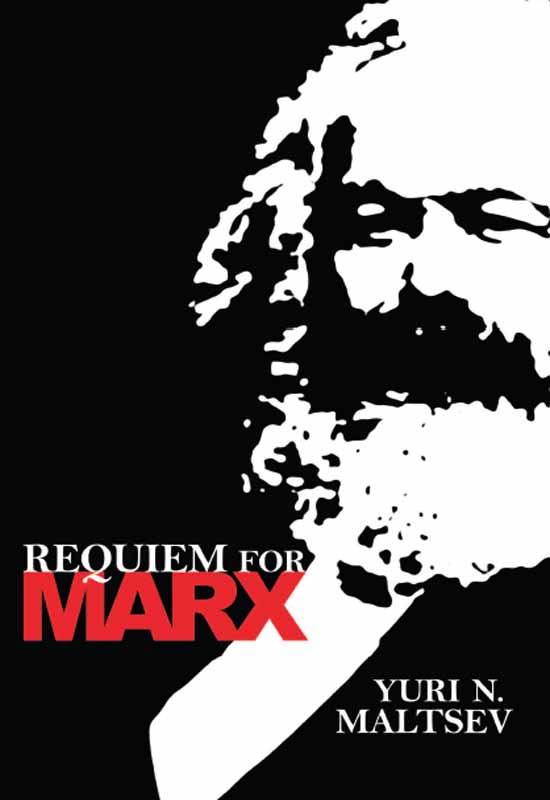
Title Page
REQUIEM
for MARX
Edited with an introduction by
Yuri N. Maltsev
LUDWIG VON MISES INSTITUTE |
Ludwig von Mises Institute Auburn University, Alabama 36849-5301 |
Copyright Page

Copyright © 1993 by the Ludwig von Mises Institute
All rights reserved. Written permission must be secured from the publisher to use or reproduce any part of this book, except for brief quotations in critical review or articles.
Published by Praxeology Press of the Ludwig von Mises Institute, Auburn University, Auburn, Alabama 36849.
Printed in the United States of America.
Institute
The Ludwig von Mises Institute gratefully acknowledges the generosity of its Members, who made the publication of this book possible. In particular, it wishes to thank the following Patrons:
Mark M. Adamo
O. P. Alford, III
Anonymous (2)
Everett Berg
EBCO Enterprises
Burton S. Blumert
John Hamilton Bolstad
Franklin M. Buchta
Christopher P. Condon
Charles G. Dannelly
Introduction
Lenin’s slogan, “Marxism is Almighty Because It Is True,” was displayed practically everywhere in the former Soviet Union. My first encounter with Karl Marx came in the first grade of elementary school in the city of Kazan on the bank of the great Volga River. His picture was printed on the first page of the first textbook I opened. “Dedushka Marx” (Grandfather Marx), said the teacher pointing to the picture. I was thrilled, for both of my grandfathers died during Stalin’s purges in the 1930s. I ran home to my grandma to tell her she was wrong.
1. The Marxist Case for Socialism
David Gordon
Karl Marx believed that “with the inexorability of a law of nature” capitalism was doomed. In the past, capitalism aided the growth of production; now that sys-tem had become a “fetter on the forces of production.” Since in Marx’s view the forces of production must develop, the pressure on capitalism would sooner or later prove impossible to contain. Under socialism, the economic system next on the historical agenda, the forces of production will grow to unheard of heights.
2. Marxist and Austrian Class Analysis
Hans-Hermann Hoppe
First I will present a series of theses that constitute the hard-core of the Marxist theory of history. I claim that all of them are essentially correct. Then I will show how these true theses are derived in Marxism from a false starting point. Finally, I want to demonstrate how Austrianism in the Mises-Rothbard tradition can give a correct but categorically different explanation of their validity.
3. The Marx Nobody Knows
Gary North
Much of my immediate motivation to investigate the life and teachings of Marx came when I read a seminal essay on Marx by Louis J. Halle. I came across “Marx’s Religious Drama” shortly after it was published in October of 1965. Halle asked a very important question at the beginning of the essay: Why did Marx become so important? His answer: Marx’s religious vision.
4. Marxism, Method, and Mercantilism
David Osterfeld
Scientific truth is always a paradox, if judged by every-day experience, which catches only the delusive appearance of things.
Karl Marx (1973b, p. 42)
5. Classical Liberal Roots of the Marxist Doctrine of Classes
Ralph Raico
Few ideas are as closely associated with Marxism as the concepts of class and class conflict. It is, for instance, impossible to imagine what a Marxist philosophy of history or a Marxist revolutionary theory would be in their absence.
