

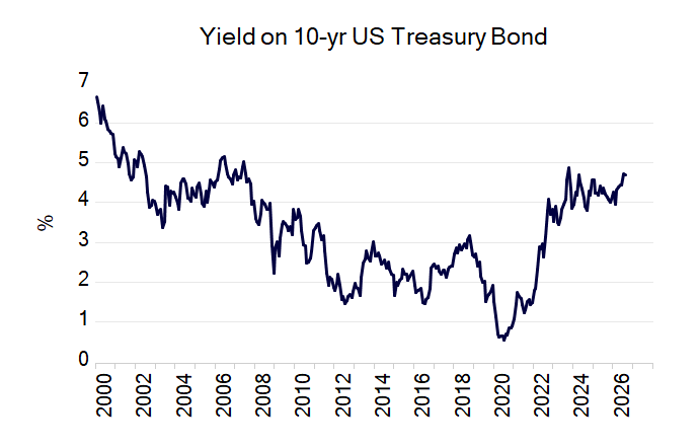
After closing at 4.26 percent in January this year the yield on the 10-year US Treasury Bond settled at 4.70 percent at the end of August.
By popular thinking, whenever the central bank raises the growth rate of the money supply through the buying of financial assets such as Treasuries this pushes the prices of Treasuries higher and their yields lower. This is called the monetary liquidity effect. This effect is inversely correlated with interest rates. Furthermore, an increase in the money supply after a time lag strengthens economic activity and this pushes interest rates higher. Note, there is a positive correlation between economic activity and interest rates.
After a much longer time lag, the increase in the growth rate of the money supply will exert an upward pressure on the prices of goods and services. Once prices begin to move higher, the inflation expectations effect emerges. Consequently, this will exert a further upward pressure on the market interest rates.
Hence, by popular thinking, liquidity, economic activity, and inflation expectations are seen as key factors in the interest rate determination process. This process is set by the central bank’s monetary policies, which influences monetary liquidity. The monetary liquidity effect, in turn, gives rise to two other effects. This way of thinking originates from the writings of Milton Friedman.
Note that the popular theory of interest rates is not established from a sound theoretical framework but derived from observations. In this sense, the popular theories of interest rates do not explain but only describe. Furthermore, the popular view will not be able to explain the formation of the interest rates in the absence of the central bank.
Time Preference and Interest Rates
Humans are goal-oriented, that is, For most individuals, maintaining their life and wellbeing is the ultimate goal. According to Carl Menger:
To the extent that the maintenance of our lives depends on the satisfaction of our needs, guaranteeing the satisfaction of earlier needs must necessarily precede attention to later ones. And even where not our lives but merely our continuing well-being (above all our health) is dependent on command of a quantity of goods, the attainment of well-being in a nearer period is, as a rule, a prerequisite of well-being in a later period.
Thus, an individual will assign greater value to present goods than to identical goods in the future. This also means that an individual will prefer the consumption of present goods rather than in the future.
Consider a case where an individual has just enough to keep himself alive. This individual is unlikely to invest or lend his paltry means. The cost of investing or lending will be very high—it might even cost him his life. Once an individual’s available goods start to expand, the cost of investing or lending starts to diminish. Saving and investing for the future will be less costly. Deferred consumption and the allocation of goods for future consumption is called saving. Production and saving allows for capital investment, which, if successful, can lead to even greater production, greater efficiency, and more consumption. Savings sustain various individuals engaged in various stages of capital investment.
Voluntary, private saving lowers the extent of the premium of present goods versus future goods (i.e., a decline in the originary interest rate). Conversely, factors that undermine saving increase the premium of the present goods versus the future goods (i.e., an increase in the interest rate). Thus, increased saving lower individuals’ time preferences whereas decreased saving raises time preferences, all other things being equal.
According to the mainstream understanding, changes in economic activity are positively associated with interest rates. However, if the increase in economic activity is because of the expansion of voluntary saving, this will produce a decline in the time preferences and thus to the lowering of interest rates and not an increase as suggested.
Interest Rates and Credit Expansion
When money and credit are inflated out of thin air and injected into the economy, this sets in motion an exchange of nothing for something. The earlier receivers of the newly-injected money can now divert to themselves goods from the producers of these goods. Similar to the counterfeiter, the earlier receivers can now increase the purchases of various goods and assets, thus pushing their prices higher and their yields lower. This exchange of nothing for something weakens the process of market production.
As long as production and private savings are expanding, all other things being equal, it is possible for individuals’ time preferences to decline (i.e., a decline in the market interest rates will take place). Conversely, production and savings falter, all other things being equal, individuals’ time preferences will increase (i.e., market interest rates will increase).
When a central bank is attempting to counter the rising interest rate trend by means of injecting monetary liquidity, this is likely to make the rising trend steeper, all other things being equal. The increase in the monetary liquidity sets in motion an exchange of nothing for something thereby weakening market production. This means that there will be an oscillation of the market interest rates along the rising trend. The oscillation emerges because the central bank, by pushing the monetary liquidity, temporarily lowers the market interest rates. However, the rising trend, on account of the decline in savings, pushes the interest rate trend upward.
Interest rates in a free market will correspond to individuals’ time preferences. Whenever, individuals’ lower their time preferences this means that they are signaling businesses to arrange a suitable structure of production in order to be ready for the increase in the demand for the consumer goods in the future.
Higher Individual Time Preferences Are the Key
The increase in long-term interest rates is likely in response to the sharp decline in the pool of savings brought about by reckless government and Fed policies. The fact that individuals pursue conscious, purposeful actions implies that causes in the world of economics emanate from individuals and not from various factors. Every individual assesses changes in various factors against his goals. It follows that neither monetary liquidity, nor economic activity, nor inflation expectations are the essence of interest rates determination. It is individuals’ decisions regarding present consumption versus future consumption that is the key determinant of interest rates. Monetary policies only distort interest rates signals, thereby causing misallocation and distortions in the structure of production, which leads to the boom-bust cycles.
Conclusion
The strong increase in the long-term yields on US Treasuries most likely mirrors an increase in individuals’ time preferences. A key factor behind this increase is the reckless policies of the Fed and the government that have severely damaged the process of production and savings formation. According to certain mainstream thought, market interest rates are determined by changes in monetary liquidity, economic activity, and inflationary expectations. In this framework, the causes originate from various factors and not from individuals. It depicts individuals as robots that mechanistically react to monetary liquidity, economic activity, and inflationary expectations. It is individuals’ conscious and purposeful action regarding present consumption versus future consumption that is the key determinant of interest rates.

