

On April 15, Americans face the deadline for sending to the federal Internal Revenue Service a report on all their income. Most Americans do this because failure to do so is likely to result in fines and possibly imprisonment. If one obstinately resists this, of course, one will find himself subject to deadly force from state agents.
For most people, however, tax day isn’t about taxes of all kinds. It’s primarily about federal taxes. In those states with state income taxes, the state taxes are usually a relatively minor part of the tax bill. Tax day is also a reminder of the huge amount in taxes paid out in federal payroll taxes throughout the year. For those who are self employed, they have the privilege of paying the “self-employment” tax, which is like a payroll tax on steroids.
The main reason to primarily connect tax day mostly to federal taxation is the fact that the federal government collects far more tax revenue from hapless Americans than state and local governments do. Thanks to the federal income tax, payroll taxes, and federal excise taxes, most Americans are exploited to a much larger degree by the federal government than they are by more local government organizations.1
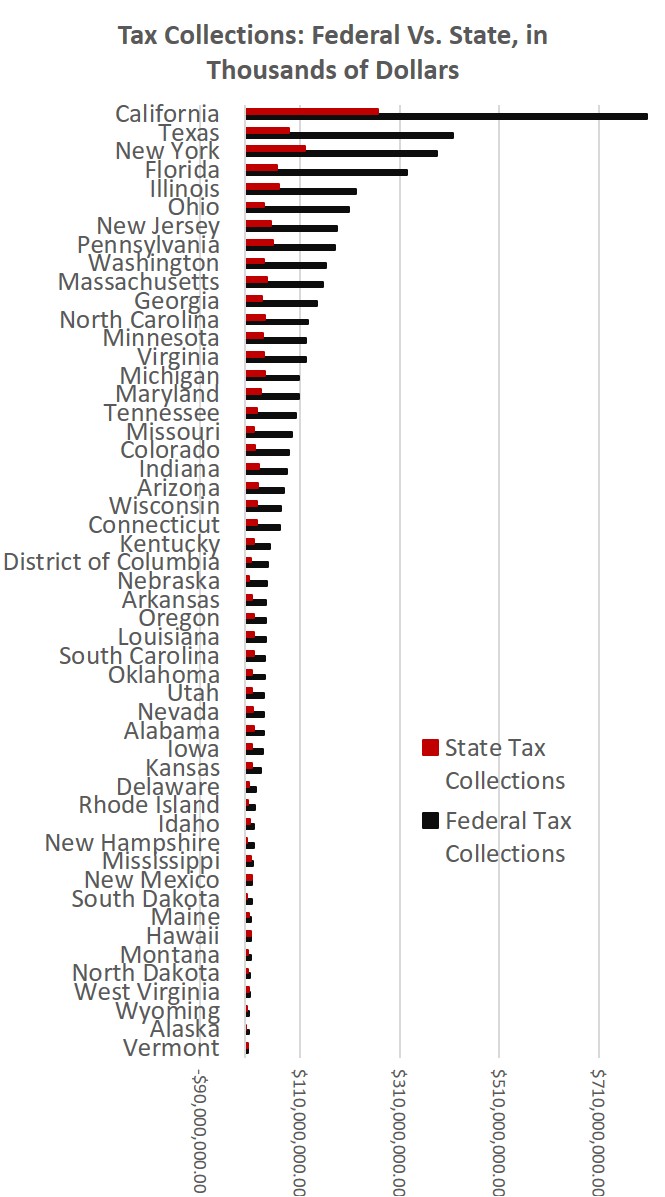
For example, in 2024, the Internal Revenue Service’s tax collections—including income tax, payroll taxes, and other lesser tax programs—collected a total of $5.1 trillion in taxes from Americans. State governments, on the other hand, collected $1.47 trillion during the same period.2 For every tax dollar extracted by state governments, the federal government demanded nearly three-and-a-half dollars. Even in high-tax states like California, the federal government is, by far, the level of government that collects the most taxes. In 2024, Californians overall paid more than $805 billion in taxes to the federal government. The California state government, on the other hand, collected $266 billion in taxes. Only in one state—New Mexico, where low incomes combine with relatively high taxes— does the state government collect more tax revenue than federal tax collectors. In every other state, residents pay more to the feds than to state revenue agents. In many states the difference is stark. In twelve states —including Nebraska, Ohio, Missouri, Florida, Colorado, and Texas—federal tax collections are about four times larger than the state tax collections. In Colorado for instance, residents paid out more than $86 billion in 2024 to the federal government. State taxes, however, amounted to less than $20 billion. The graph below shows the overall proportion of federal taxes as compared to the combined federal-state tax bill. In nearly every state, federal taxes account for more than 60 percent of the total bill.
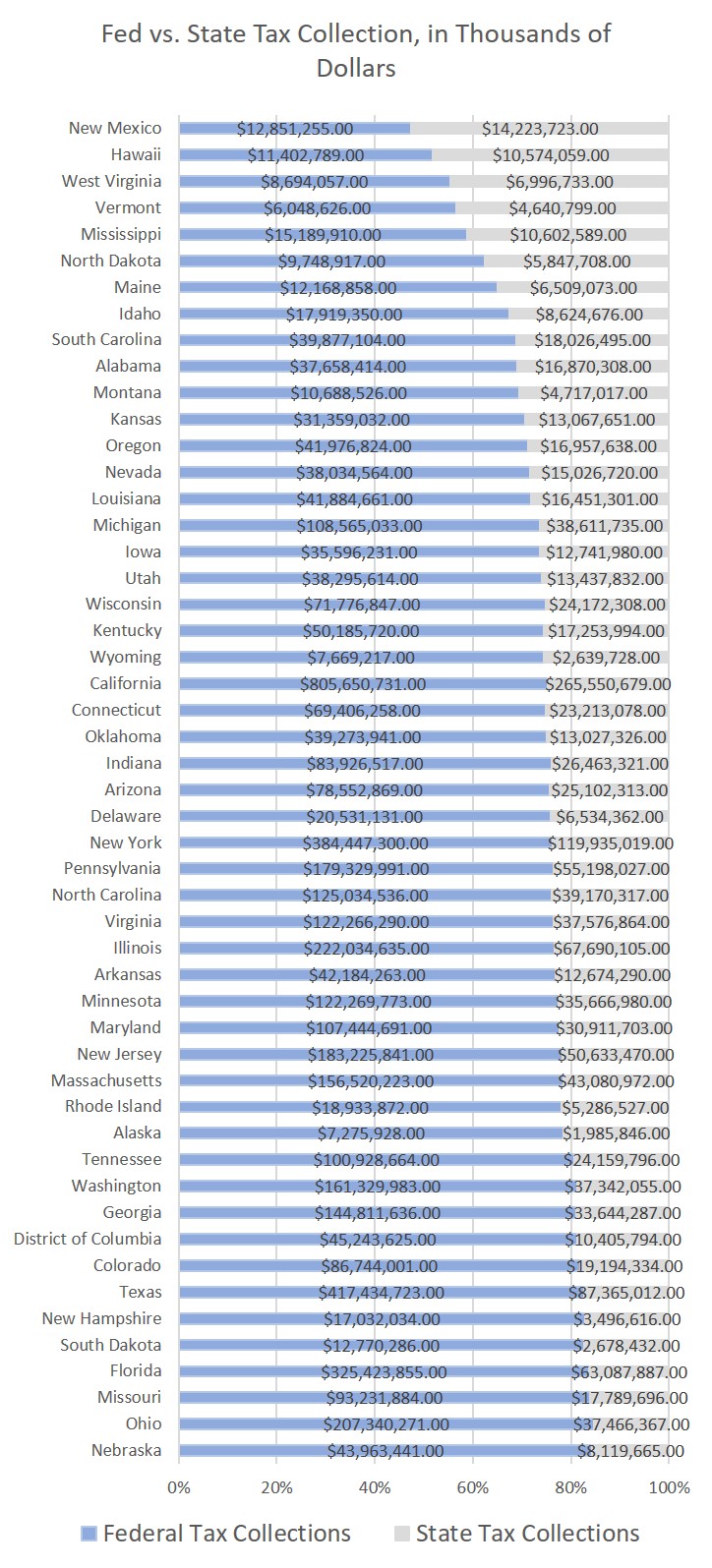
So, it’s not just in our imaginations that tax day seems to be mostly about the feds.
Nor is this significantly changed if we add in local taxes. As we noted above, in 2024, taxpayers paid more than $5.1 trillion to the federal government and about $1.47 trillion to the state governments. Local governments, on the other hand, collected $1.1 trillion during that same period.3 State and local tax revenue combined, therefore, amounts to about $2.5 trillion. That’s less than half of federal tax collections. Only during periods of recession or weak economic performance, when income taxes crash, does the combined state-local bill ever exceed fifty percent of the total federal tax collections.4
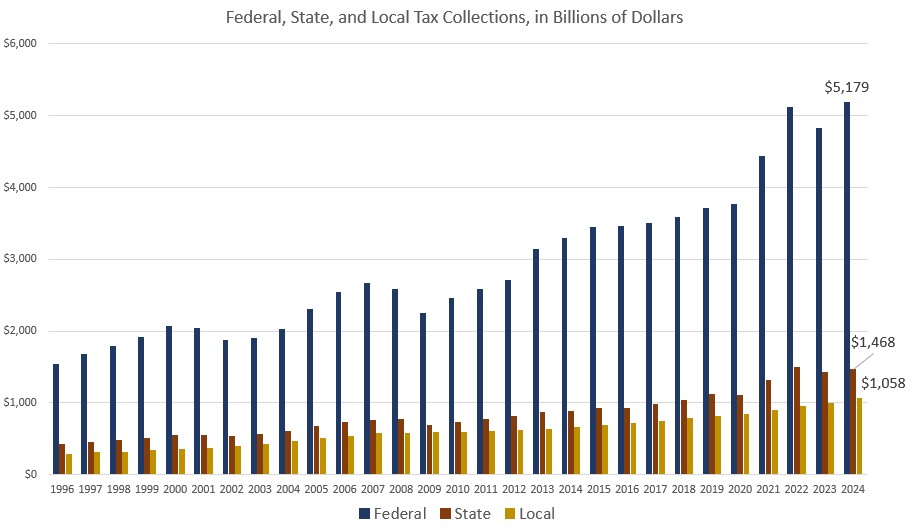
These facts all help serve as reminders that, when it comes to exploiting the wealth and income of Americans, the federal government is far more powerful than any state government. Every year, year after year, it’s the federal government that extracts more than three times as much as any state government and uses it to reward favored special interests, pay the bloated war machine, and send billions to rogue, nuclear-armed foreign states like Israel. State and local government are hardly efficient, but they are small-time bandits compared to the federal government. Moreover, when one pays taxes to a local government, one is more likely to actually experience the benefits of that spending. Local tax revenues go to parks and streets and law enforcement which might conceivably benefit the actual local taxpayers.
The enormity of the federal government tax-farming operation, compared to the states and locals, also helps illustrate why social democrats and other leftists so vehemently oppose decentralization of the welfare state or any other government program. If, say, health care or old-age social programs were handed over to state governments, the Left knows that tax revenue and government spending would come under pressure in a way that virtually never matters at the federal level. Federal taxation is bigger, easier, and more insulated from political pressure. That’s why special interests—both Left and Right—go to the federal government as much as possible to take advantage of the tax-funded gravy train. The interest groups know that federal spending programs—and the taxes they require—are bigger, more lucrative, and more permanent than at the state level. And, if tax revenues ever come up short, the federal government can simply issue trillions in government bonds at artificially low interest rates made possibly by the central bank’s debt-monetization mechanisms.
Moreover, Americans can more easily escape state and local taxes that become especially crippling. Relatively speaking, taxpayers can change their tax fortunes significantly by moving across state lines—with state taxes—or even just moving down the road a few miles—as with local taxes. When American regime-bootlicker types in America suggest that “you can just leave you don’t like it,” everyone knows this is not a serious suggestion. The costs of international migration are much, much higher than the cost of interstate migration, and the regime knows it. Language barriers, combined with the cost of visiting friends and family over large distances, ensure that few can escape from federal taxation without abandoning one’s community wholesale. Not even emigration frees Americans from federal taxes. The US regime is one of the few countries that demands income taxes from citizens who don’t even live in the United States.
So, on tax day, it’s always a good thing to remember the many ways that governments exploit and impoverish ordinary people. But it’s the federal government that is the worst culprit of all.
- 1
See the IRS website for federal tax totals. State revenue information comes from the Census’s American Community survey.
- 2
American Community Survey, “State Tax Collections Detailed Table: US and States: 2024.” https://www.census.gov/programs-surveys/stc/data/tables.html
- 3
To find these numbers, it is necessary to understand the terminology used in calculating receipts at the federal, state, and local levels. For example, “tax receipts” at the federal level, strictly speaking, do not include social security and Medicare payroll taxes. These taxes are rather ridiculously classified under “contributions for government social insurance.” So, it becomes necessary to use overall “federal government current receipts” to get the more accurate number that includes payroll taxes. With state and local receipts, on the other hand, it is best to use only “tax receipts” because total receipts include “transfer receipts” which are tax revenues from other branches of government—mostly from the federal government. These numbers are all found through the BEA’s interactive tables.
- 4
Source: US Bureau of Economic Analysis. National GDP and Personal Income, Interactive Data Tables, Section 3: Table 3.2 “Federal Government Current Receipts and Expenditures.;” Table 3.20 “State Government Current Receipts and Expenditures;” Table #.21, “Local Government Current Receipts and Expenditures.”

