

The culmination of Murray Rothbard’s (2009b) economic analysis of the unhampered market economy in Man, Economy, and State is found in chapter 11, “Money and Its Purchasing Power.” In his introduction to the chapter, Rothbard (755) remarks, “The time has come to draw the threads of our analysis of the market together by completing our study of money and of the effects of changes in monetary relations on the economic system.” He proceeds by defining the supply of and demand for money, explaining the causes and consequences of changes in the money relation, explaining the unique features of money, and then correcting various errors within the Keynesian and monetarist frameworks regarding money.
One of Rothbard’s (2009b) primary tasks throughout Man, Economy, and State was to formalize and build on the strong foundation laid by Ludwig von Mises in his treatise, Human Action, and other works like The Theory of Money and Credit. In his foreword to the latter, Rothbard (2009a, p. 5) writes, “This book performed the mighty feat of integrating monetary with micro theory, of building monetary theory upon the individualistic foundations of general economic analysis.” Rothbard claims that Mises’s monetary theory successfully bridges the gap between “micro-” and “macroeconomics,” where those in the neoclassical and Keynesian schools (and, by extension, the later attempts at neoclassical synthesis) failed.
One error that Rothbard (2009b, p. 265) sought to correct was the “fallacy in the distinction that some writers make between ‘circulating’ money and money in ‘idle hoards.’” He explains: “In the first place, all money is always in someone’s cash balance. It is never ‘moving’ in some mysterious ‘circulation.’ It is in A’s cash balance, and then when A buys eggs from B, it is shifted to B’s cash balance. Secondly, regardless of the length of time any given unit of money is in one person’s cash balance, it is performing a service to him, and is therefore never in an ‘idle hoard.’” Elsewhere, Rothbard refers to this fallacy as a “grave error” (761). This particular error leads to many more, including those associated with the “velocity of circulation” and the quantity theory of money; the spending illusion (Salerno 2024); and the Keynesian circular flow model of the economy, which is at the base of later Keynesian models such as the income-expenditure “Keynesian cross,” IS-LM, and aggregate supply and aggregate demand models.
The purpose of this article is to show that Rothbard (2009b) did not completely avoid this error in his own treatment of money, especially in his explanation of changes in the money relation. The error is easily fixed, however, with a refinement to Rothbard’s analysis. Far from being a critical departure, the refinement makes Rothbard’s monetary theory more “Rothbardian,” so to speak. We will show that the refinement brings Rothbard’s monetary theory in line with what he saw as Mises’s great achievement in “building monetary theory upon the individualistic foundations of general economic analysis.” The individualistic foundation of monetary theory that is missing in parts of Rothbard’s (2009b) analysis is the plain state of rest (PSR). Rothbard skips over the PSR in analyzing changes in the money relation, which makes it appear as if there are temporary monetary disequilibria that drive equilibrating changes in prices and spending; however, we will show that PSR equilibria are essential “stopping points” as market participants react to monetary shocks and demonstrate changes in their own marginal utility of money.
The Error and Its Implications
The error arises when Rothbard discusses monetary equilibrium (the total stock of money equals the total demand for money) and how it is reestablished after a change in either the stock of or the demand for money. Consider, for example, Rothbard’s (2009b, p. 762) explanation of what occurs if the purchasing power of money (PPM) happens to be higher than its equilibrium level:1 “Suppose now that the PPM is slightly higher than 0B [referring to figure 1]. The demand for money at that point will be less than the stock. People will become unwilling to hold money at that exchange-value and will be anxious to sell it for other goods. These sales will raise the prices of goods and lower the PPM, until the equilibrium point is reached.”
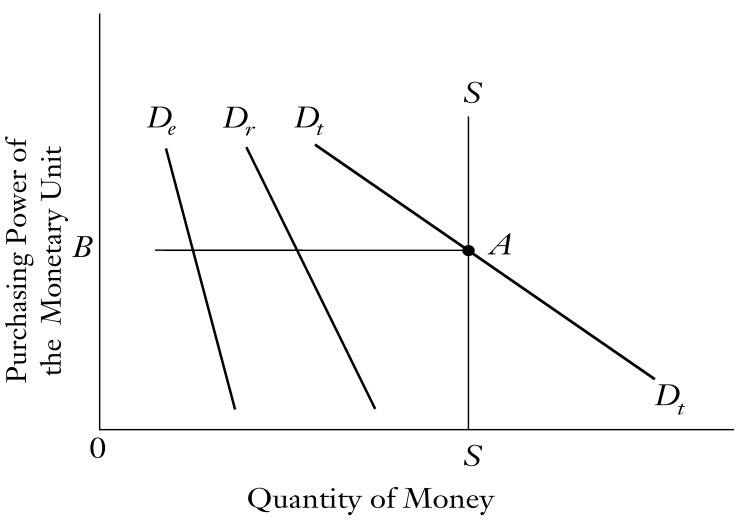 Figure 1. Determination of the equilibrium point for the purchasing power of money (Rothbard)
Notice the claim that “people will become unwilling to hold money at that exchange-value.” But how can people be unwilling to hold money that they currently hold? This seems to contradict Rothbard’s (2009b, p. 265) earlier claim that money held in one’s cash balance “is performing a service . . . and is therefore never in an ‘idle hoard.’” And in his description of the reservation demand for money, he says, “How much he decides to retain in his cash balance is uniquely determined by the marginal utility of money in his cash balance on his value scale” (759). Thus, at any given moment, all money resides in individuals’ cash balances as an intentional retention of purchasing power based on the individual’s marginal utility of money for the services that it uniquely provides. As such, it is impossible for the total stock of money to exceed the total demand for money at any given moment.
Notice also Rothbard’s (2009b, p. 762) inadvertent suggestion of the spending illusion: “These sales will raise the prices of goods and lower the PPM.” Later, Rothbard (770) falls into the spending illusion more explicitly: “The pressure of spending then lowers the PPM again to the true equilibrium point.” The spending illusion is “the fallacious assumption that spending is a causal factor in determining prices and quantities” (Salerno 2024). Salerno (2024) describes a proper understanding of how changes in the money relation result in a new array of prices and spending:
At any given moment, the market process determines a structure of money prices or, inversely, the purchasing power of money. An increase in the money supply would cause a fall in the marginal utility of money relative to goods on the value scales of the recipients of the new money. All other things equal, this would cause a bidding up of the prices of various goods and a decline in the purchasing power of money, which in turn would entail the handing over of more units of money for some goods and, therefore, increased total spending on all goods. Aggregate spending is a passive resultant, not a cause, of the height or scale of money prices.
Both issues (the “idle hoard” problem and falling into the spending illusion) stem from Rothbard’s conclusion that what drives changes in the PPM is a gap between the total stock of money and the total demand for money. This is made clear in the preceding example when Rothbard (2009b, p. 762) says, “The demand for money at that point will be less than the stock.” We will show, however, that there can never be such a gap. The endogenous changes brought about by a change in the money relation are driven by changes in the marginal utility of money, not by a gap between money supply and money demand that is eliminated by increases or decreases in spending.
Refining Rothbard
Rothbard (2009b, p. 762) explains what occurs after an increase in the demand for money:
The purchasing power of money is therefore determined by two factors: the total demand schedule for money to hold and the stock of money in existence. It is easy to see on a diagram what happens when either of these determining elements changes. Thus, suppose that the schedule of total demand increases (shifts to the right). Then (see figure [2]) the total-demand-for-money curve has shifted from DtDt to Dt′Dt′. At the previous equilibrium PPM point, A, the demand for money now exceeds the stock available by AE. The bids push the PPM upwards until it reaches the equilibrium point C.
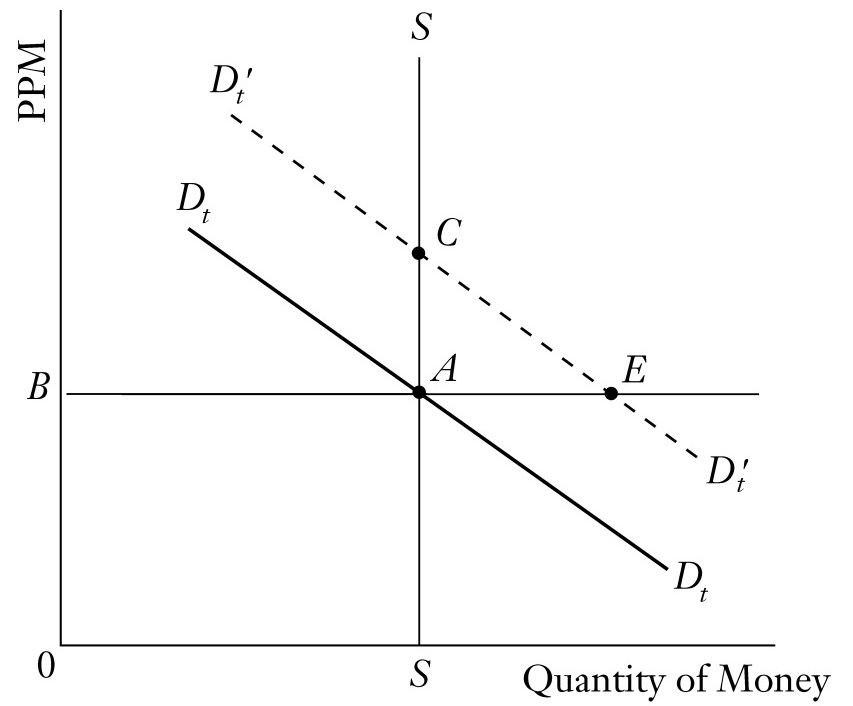 Figure 2. Effect of a change in the total demand for money (Rothbard)
Once again we see Rothbard allude to a mismatch between the total stock of money and the total demand for money as driving the market toward a new, higher PPM. Yet Rothbard’s description of how new prices emerge opens the door for refinement: Rothbard (2009b, p. 762) says that “the bids push the PPM upwards until it reaches the equilibrium point C.” New PPMs are established as market participants exchange at new prices step-by-step, each step representing a PSR in which market participants have momentarily exhausted mutually beneficial trades. In fact, the only way for market participants to demonstrate an increase in money demand is by decreasing their demands for nonmoney goods and/or increasing their supplies of nonmoney goods. The resultant prices are established moment-by-moment, altering the array of prices and therefore the PPM, but each step represents a new momentary monetary equilibrium along the way. An example of this process is depicted in figure 3.
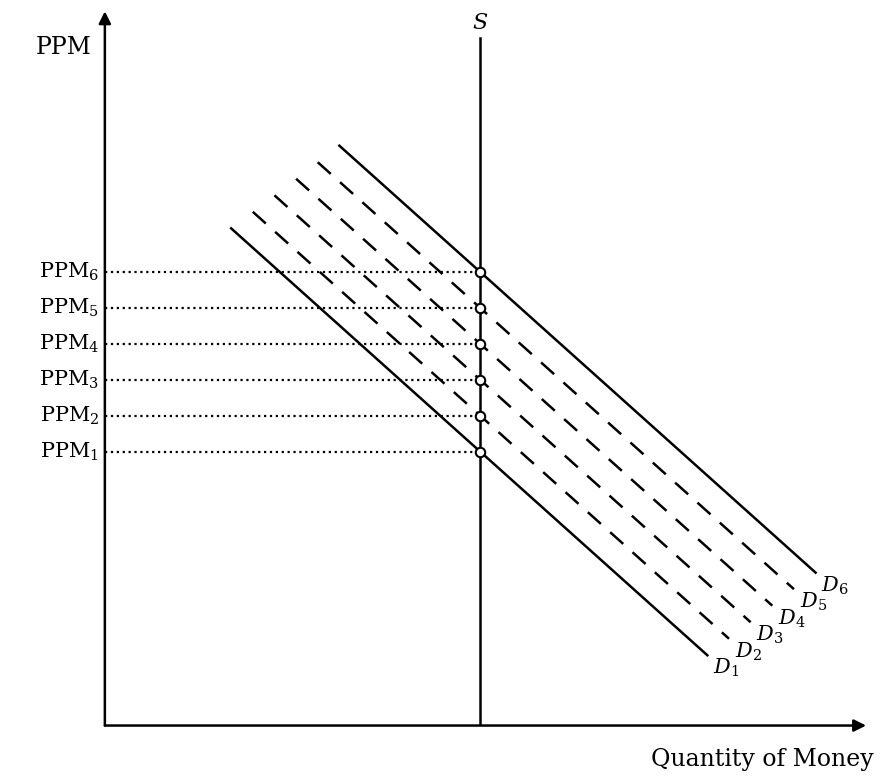 Figure 3. The total stock of money and an increase in demand for money
The money relation begins in equilibrium with money stock S and money demand D1. The two curves intersect at the initial equilibrium PPM, PPM1. Now let us posit that at least one individual demonstrates an increase in money demand via a decrease in demand for nonmoney goods. The prices of these goods fall, and plain states of rest are achieved according to the revised value scales, resulting in a slightly higher PPM, represented by PPM2. Those who sold these goods at lower prices receive lower incomes than they would have received at the previous array of prices. They may demonstrate a higher marginal utility of money by reducing their own demands for nonmoney goods, resulting in a new array of slightly lower prices for the goods they purchase, corresponding to PPM3. This sequential process continues until all prices and markets have been fully adjusted to the initial increase in the demand for money. The intermediate dashed money demand curves (D2 through D5) and the corresponding PPMs (PPM2 through PPM5) represent the PSR stopping points as the prices of certain goods fall before those of others. The process, punctuated by new PPMs, continues until all of the endogenous changes instigated by the initial shock run their course and a final equilibrium PPM (PPM6) is established with money demand D6 and a total stock of money that remained constant.
Instead of considering the PSR stopping points from one equilibrium to another, Rothbard (2009b, p. 762) posits a disembodied change in money demand that reflects the market’s ultimate stopping point after all endogenous changes have run their course. Our refinement inserts the steps toward that ultimate equilibrium: the PSR equilibria. These PSRs do not feature a mismatch between the total stock of money and the total demand for money, which means it is not monetary disequilibrium that drives the market toward its ultimate equilibrium, but step-by-step changes in the marginal utility of money in which a sequence of market participants repeatedly establish momentary monetary equilibria by changing their supplies of and demands for nonmoney goods.
While some market participants may plan to buy and sell at lower prices before those prices are realized, those plans remain plans until the participants’ preferences are demonstrated in action and PSR prices emerge (Newman 2025a). At no point in the process can the observing economist diagnose an excess of money demand beyond the total stock of money, unless widespread price controls prevent market participants from asking or bidding lower prices. An economist who diagnoses monetary disequilibrium may not consider the PSR equilibrium construct (in which money supply equals money demand) as the relevant equilibrium construct. He may favor some other equilibrium construct, such as the Wicksteedian state of rest (WSR) or the final state of rest (FSR), in which no further endogenous changes occur. This decision is ultimately up to the economist, but even so, the economist ought not disregard the nature and implications of the momentary PSR equilibria that punctuate the path from one WSR or FSR to the next.
It is worth pointing out that this process explains price changes for nonmoney goods as well. While money is unique in some respects, its price is determined in the same way the prices for nonmoney goods are determined. There is no scientific basis for considering some disembodied increase in demand for money or nonmoney goods as separate from what is demonstrated in action and exchange (Newman 2025a). All realized prices reflect a momentary equilibrium in which the quantity supplied equals the quantity demanded, which means it is erroneous to say that an increase in demand results in excess demand while the price remains temporarily “stuck” below the market-clearing equilibrium (Newman 2025b).
Let us now consider a different kind of change in the money relation: an increase in the total stock of money. Here is Rothbard’s (2009b, p. 762–63) analysis: “The effect of a change in the total stock, the demand curve remaining constant, is shown in figure [4]. Total quantity of stock increases from 0S to 0S′. At the new stock level there is an excess of stock, AF, over the total demand for money. Money will be sold at a lower PPM to induce people to hold it, and the PPM will fall until it reaches a new equilibrium point G.”
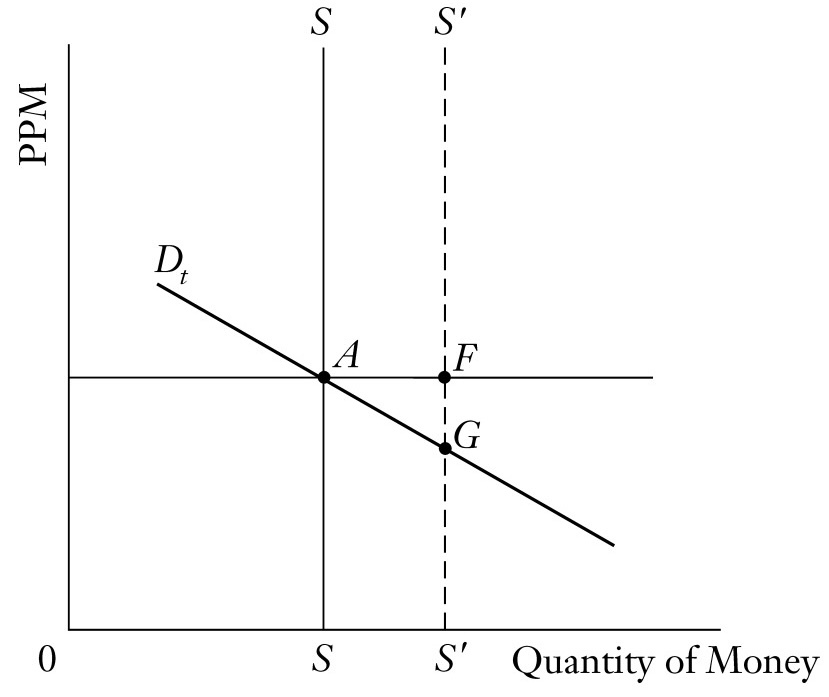 Figure 4. Effect of a change in the total stock of money (Rothbard)
Once again, Rothbard indicates that the change in the money relation immediately results in a mismatch, this time with an “excess of stock” (763). This contradicts his earlier claims about how the total stock of the money commodity is held in cash balances (760) and his definition of the reservation demand for money as “post-income demand” to hold money in one’s cash balance (750). How can there be an “excess of stock” while all money is held in individuals’ cash balances, satisfying their reservation demand for money?
Our refinement of Rothbard’s analysis in this case requires a more substantive change: We dispute that there can be constant money demand with a change in the stock of money. At any given moment, all money is held in cash balances, which means that additions to the stock of money first enter specific individuals’ cash balances and simultaneously represent an equal increase in their reservation demand for money. Subsequently, those with the new influx of money demonstrate their lower marginal utility of money by offering higher prices for goods and services. These bids lower the PPM in a step-by-step process. Such a scenario is depicted in figure 5.
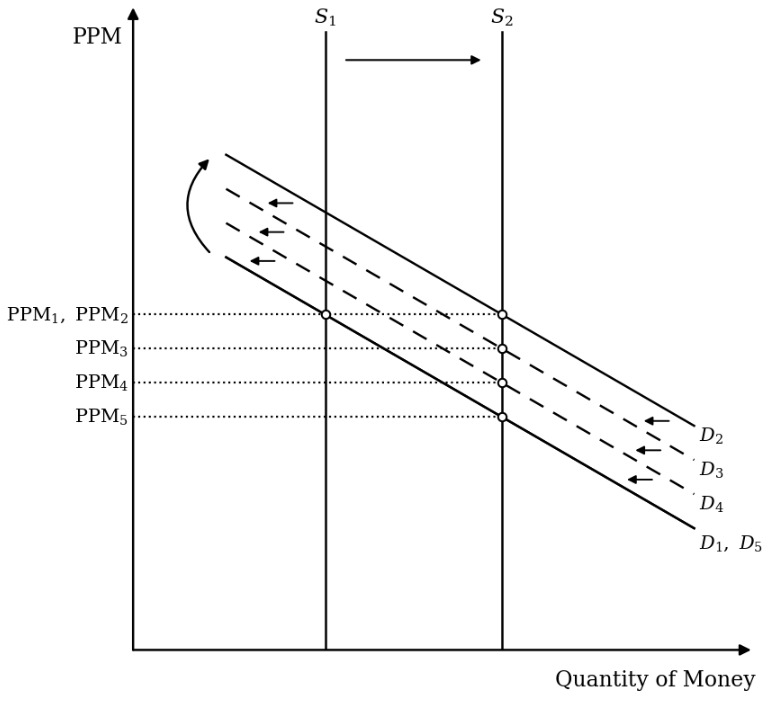 Figure 5. An increase in the total stock of money and changes in money demand
The original equilibrium is found at the intersection of D1 and S1, with PPM1. The stock of money increases to S2, and a simultaneous increase in money demand, to D2, occurs as the new money enters some individuals’ cash balances and momentarily satisfies their reservation demand for money. There is no immediate change in the array of prices and the PPM, so it remains momentarily constant at PPM2. In other words, the demand for money “snaps” to the new stock of money while the PPM remains constant. As the first receivers of the new money demonstrate their lower marginal utility for money (and decrease in demand for money to D3) by increasing their bids for various goods, the prices of those goods increase, resulting in a new, higher array of prices and a lower PPM at PPM3. After all the nonneutral, endogenous changes from the initial increase in the stock of money run their course, the new monetary equilibrium is reached at the intersection of S2 and D5, with PPM5. Due to the nonneutrality of money, there is no reason to assume that the final equilibrium PPM would correspond to the intersection of the original demand curve for money, D1, and the new stock of money, S2, though for pedagogical reasons it may be useful for the demand for money to return to its starting position.
This explanation satisfactorily accounts for the well-known relationship between the stock of money and the array of prices without recourse to a temporary “monetary disequilibrium” in which there is an excess supply of money. This excess supply of money is left unaccounted for in Rothbard’s analysis, as it does not result in a simultaneous increase in reservation demand. It is floating out and about without an owner. But as Rothbard (2009b, p. 265) correctly notes, “All money is always in someone’s cash balance. It is never ‘moving’ in some mysterious ‘circulation.’” Thus, our refinement reconciles Rothbard’s conclusion (an increase in the stock of money results in a lower PPM) with his understanding that all money resides in individuals’ cash balances.
- 1
Following Rothbard, we are abstracting from the important fact that the “price level,” which Rothbard often places in scare quotes for obvious reasons, and the PPM, or the exchange-value of money, cannot be reduced to a single number: “There is no single ‘price level’ or measurable unit by which the value-array of money can be expressed” (756).

