

The province of Somaliland declared separation from the nation of Somalia in 1991 as the republic of Somaliland. It was first recognized as a sovereign nation by Israel on December 26, 2025. This is an example where Ludwig von Mises wrote in Omnipotent Government in chapter 4 “Etatism and Nationalism” section I “The Principle of Nationality” “. . .every nation should form an independent nation, including all members of the nation.” And, “The extent of a nation’s territory is determined by nature.”
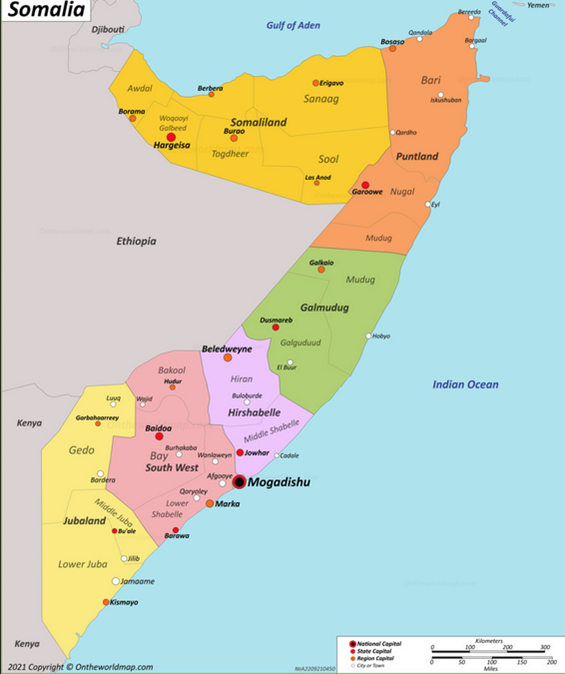
The nation of Somalia—located on the eastern horn of the African continent—went through a devastating civil war in 1991. Somalia, after 1991, was divided into tribal regions, designated as Somaliland, Puntland, Galmudug, Hirshabelle, South West, and Jubaland shown in the map below:
According to one explanatory source,
Somaliland traces its current borders and right to exist to the colonial period. In 1884 the British Empire began negotiating with different clans in Somaliland in order to supply meat to the British garrison, at the Port of Aden, in Yemen. Following more treaties Britain established the protectorate of Somaliland. . . British Somaliland achieved independence from Britain on June 26th 1960 and was initially recognized by over 30 countries. . . Upon independence from Britain, Somaliland’s parliament voted for union with Italian Somaliland to form the modern country of Somalia which took effect on July 1st, 1960, five days after their initial independence.
Thirty-one years later, in 1991, after the civil war, Somaliland leaders decided to separate their region from Somalia and its national capital Mogadishu where corruption and governing dysfunction continued. Somaliland was recognized after 1991 by the European Union, United Nations, and several other nations as a separate Somali province, but not a sovereign nation.
Somalia is dominated by different tribes and tribal culture. Many tribes are Sunni Muslim including over 99 percent of the Somali population. Here is a comparison of Somalia and Somaliland history going back several hundred years.
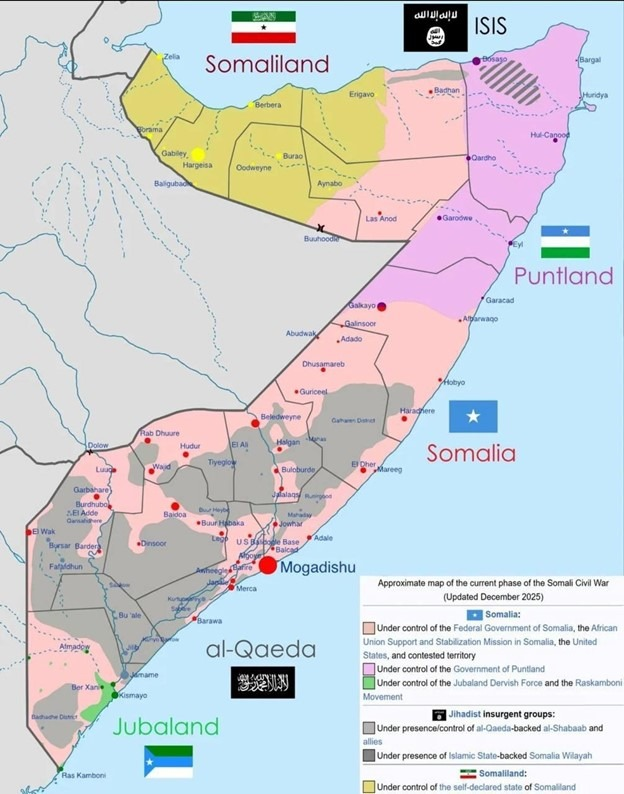
Somaliland’s declared independence led them to issue its own passport (starting in 1996), currency (introduced in 1994), central bank (established in 1994), and country calling code, even though it is not recognized as a sovereign country as of November 2025. Somalia has not been united as a country to govern since 1991 with the presence of al Qaeda, Al-Shabaab, and Islamic State Sunni Muslim terrorist groups controlling varying square miles of Somalia. The map below shows Somalia divided in December 2025.
Somalia ranked 179 out of 180 countries on the worldwide corruption index in 2024. Somalia needs more effective government, lower levels of corruption and more sensible policy decisions originating at the local level.
One source describes,
In 2001, 10 years after breaking away from Somalia, Somaliland still was not internationally recognized as an independent country. Undeterred, the government held a referendum that year, the results of which clearly showed that Somaliland’s inhabitants supported the region’s claim of independence.
The Mogadishu government, many majority Sunni Muslim nations around Somaliland, and Iran (Shia Muslim majority) rejected this sovereign nation recognition by Israel in December 2025 as a violation of Somalia’s territorial sovereignty. The majority Sunni Muslim populations of Morocco and United Arab Emirates and Sunni Muslim ruled nation of Bahrain were not critical of Israel’s Somaliland nation recognition. These three nations are signatories to the Abraham Accords. Somaliland as a new internationally recognized nation is a decentralization or secession celebration.

