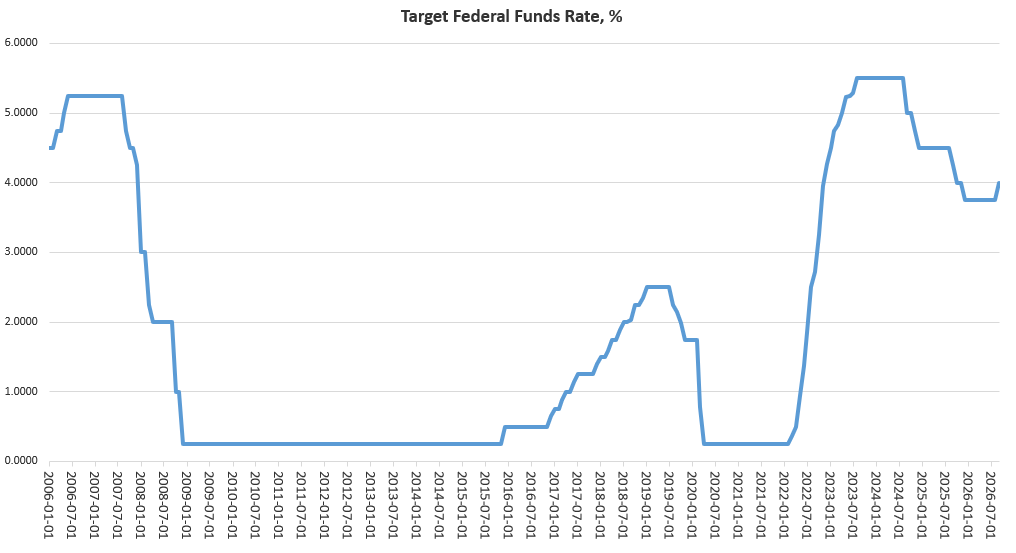
The Federal Reserve’s Federal Open Market Committee (FOMC) today announced that it will increase the target federal funds rate by 25 basis points to 4.0 percent. This comes after nine months of the FOMC holding the policy rate at 3.75 percent.
The rate hike was no surprise and had been widely predicted by numerous observers. Stubbornly high price-inflation levels, coupled with August’s relatively stable employment data gave the FOMC political cover for a rate hike.
Nor did today’s FOMC press conference with Fed Chair Kevin Warsh offer any surprises. The FOMC press release offered the usual anodyne language designed to calm markets:
Economic activity is expanding at a solid pace. While uncertainty remains elevated owing, in part, to geopolitical developments, domestic spending has been resilient. Productivity growth is strong, and capital investment is robust. Job gains have kept pace with the workforce, and the unemployment rate has changed little.
Inflation remains elevated. Today’s policy action will support a timelier return to the Committee’s 2 percent goal. The Committee will deliver price stability.
The Real Cause of Price Inflation
As is usual, the Fed blamed something other than monetary expansion for price inflation. Under Powell, the cause of price inflation was “Putin’s price hike” and the logistical problems caused by covid lockdowns. Now, under Warsh, it’s generic “geopolitical events” since Warsh, apparently, doesn’t wish to draw attention to Trump’s elective war with Iran as the source of rising energy prices.
Yet, rising energy prices does not cause a “general increase in prices” which is what is meant by the phrase “price inflation.” Were the money supply actually stable—instead of relentlessly increasing to historic highs—an increase in energy prices would only bring rising prices in some sectors while causing falling prices in other sectors. A supply shock, even if involving energy inputs, does not cause all prices to increase, and cannot cause a general increase in prices—unless there is an expanding money supply.
Yet, Warsh and the Fed would have us believe that the Fed’s five-year-long inability to bring price inflation down to the Fed’s two-percent target has nothing at all to do with the Fed’s own policy. This is one of the great myths perpetuated by the Fed and its allies.
Is a Hike of 25 Basis Points Enough?
But whatever the Fed may have us believe is the cause of price inflation, it is clear that the Fed felt it had to raise the target rate, if for no other reason than to calm the bond markets. Yet, a hike of a mere 25 basis point may prove to be much ado about nothing.
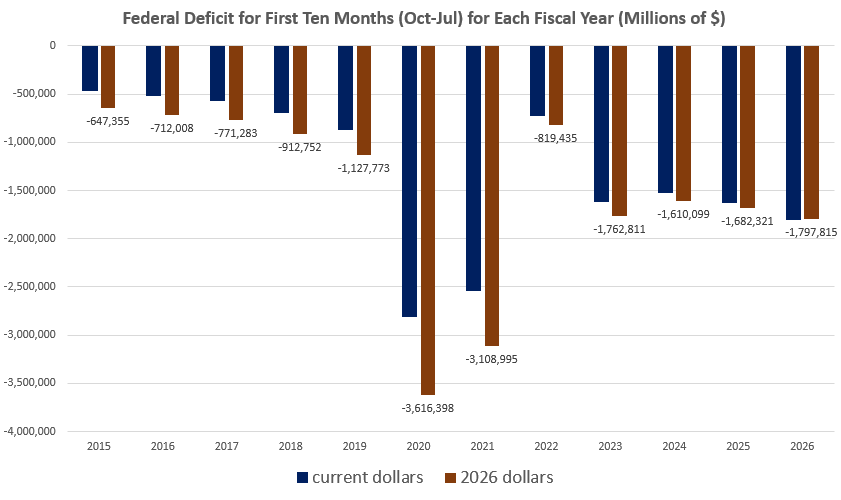
We’ll know more when we see what bond yields do in coming days, but for now, the reaction to the rate hike in bond markets has been muted—and that’s bad news for the Fed. The 10-year still finished the day at about five percent, while the 30-year yield remained above 5.3 percent. Both are now at or near multi-year highs. We’ll see where yields are in coming days, and if there is little downward movement—or even an upward surge—this will emphasize for us how ineffective a micro-hike of 25 basis points is in the face of mounting federal deficits and ongoing price shocks, thanks to Trump’s foreign policy. This is a recipe for high inflation expectations and higher yields for long bonds and mortgages. 25 basis points is unlikely to be enough to distract from these grim realities.
The fact that the vote on the FOMC was unanimous—with even the most extreme doves voting for a hike—illustrates just how alarmed the FOMC members are by the rising yields of recent weeks. Fed policy is now likely focused on just preventing new surges in yields, rather than on actually bringing interest rates down. That latter goal is likely unattainable so long as Trump barrels toward a $2 trillion deficit this fiscal year.
Trump Demands Lower Interest Rates
Ridiculously, President Trump responded to the FOMC’s rate hike with new demands for a huge cut to the target rate. CNBC reports:
President Donald Trump on Wednesday demanded the Federal Reserve slash interest rates to 1% “or less,” hours after the central bank announced its first rate hike since 2023. ... “We are ‘carrying’ almost every country in the World, and that cannot go on any longer,” Trump wrote in a Truth Social post.
“LOWER THE INTEREST RATES FOR THE UNITED STATES OF AMERICA, AND FAST!” he wrote.
If anything, this sort of thing will have the opposite effect of bringing rates down. If Trump is committed to applying pressure to the Fed to lower interest rates—and if bond investors think Trump can succeed in doing so—this will increase price-inflation expectations and will drive yields even higher.
It is unclear, however, how much influence Trump will have on Fed policy in coming months and years. Thanks to his mismanagement of the Iran war, his fracturing political base, the weakening labor market, and rising prices, Trump’s political capital has been greatly eroded. Once the GOP sustains big losses in November—as is widely expected—Trump will be, in many ways, a lame duck. The Fed and FOMC may conclude that it will be better to turn to other bases of political support beyond the failing and increasingly isolated White House. So, bond markets may soon regard Trump’s loud calls for ultra-low interest rates as little more than noise.
Trump may indirectly get his wish, however. If rising yields do trigger some sort of economic, fiscal, or financial crisis, the Fed will use it as an excuse to slash rates, even down to one-percent or less. The collapse in demand that would accompany a crisis would also help reduce price-inflation rates. The Fed will then claim that it somehow “fixed” inflation, and will return to quantitative easing and ultra-easy money. Yet, it’s entirely possible that longer-term yields could continue to rise through it all, leading to an extended fiscal crisis. If any of this happens, of course, Trump’s political fortunes, along with the GOP’s, will implode.