

By now, the decolonization narrative should be well known to anyone who pays any attention to leftwing rhetoric. In the Americas, the term “decolonization” virtually always means “de-Europeanization” and is premised largely on the idea that much of what we call “the West” exists on “stolen land” taken from indigenous peoples. These lands, we are told, must be abandoned and returned to the real natives.
American conservatives have historically scoffed at these claims and denounced the “decolonization” narrative as dangerous or absurd. But now some conservatives are pushing this same narrative as part of an effort to undermine opponents of the State of Israel.
This has become increasingly apparent in recent months as the US has ratcheted up its support for the repressive Moroccan regime against Spain. This stems from two ongoing phenomena. The first is the Trump administration’s continuing effort to draw Morocco closer into a US-Israeli alliance. For decades, the US has worked to ally itself with repressive and corrupt Arab regimes which can be bought with foreign aid and turned into pro-Israel adjuncts of the Washington-Tel Aviv axis. (Saudi Arabia is the textbook case.) In the case of Morocco, this was formalized in late 2020 when the first Trump administration managed to convince Rabat to normalize relations with Israel.
But how did the administration manage this? It did this by supporting Moroccan imperialist claims over Western Sahara. Moroccan claims in the region are contested by local rebels. But now the US has increased its “decolonization” pandering with the GOP’s July 2026 statement that “the Spanish-administered cities of Ceuta and Melilla are located in Moroccan territory.” In other words, the GOP now wants the “decolonization” of Morocco. What this really means, of course, is the “de-Europeanization” and the concomitant “de-Christianization” of north Africa. After all, the European outposts of North Africa are the only places in the region where Christianity can be practiced freely. and without fear of prosecution and repression against so-called proselytism. In Morocco, it is a criminal act to “undermine the faith of Muslims.” In effect, any effort to “decolonize” North Africa is a direct attack on Christianity.
This is what Trump supporters now defend.
Now, why should the US regime be so interested in all this? Well, the answer lies in US ties to the State of Israel. In fact, supporters of the Israeli regime have taken to repeatedly denouncing the Spanish exclaves as illegitimate European “colonization.”
Yair Netanyahu, the son of Benjamin Netanyahu, has been making comments to this effect since at least as early as 2019. For example, in May of 2019, he wrote “Dear Arabs and Muslims. Want to free occupied Arab Islamic lands? Here’s a good start!” This statement is accompanied by a map of European outposts along the north African coast.
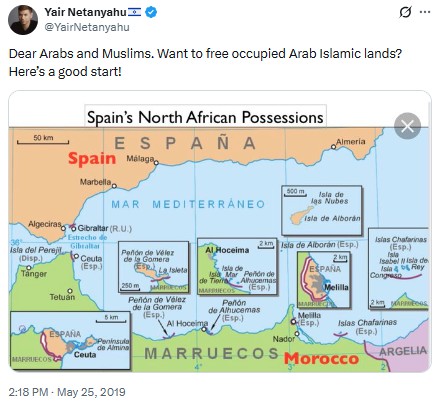
And now the conservative American Enterprise Institute is doing the same. In March of 2026, just months before the Trump administration declared its decolonization goal for Morocco, AEI senior fellow Michael Rubin called for Morocco’s conquest of the Spanish exclaves. He wrote:
Moroccans should gather, send bulldozers to the border, and then enter Ceuta and Melilla unarmed to raise the flag. Sánchez and the Spanish press bleat, but they have no grounds to act. Nor, for that matter, would NATO, even if Moroccan forces entered the towns to restore order and organize the dispatch of settlers across the Strait of Gibraltar and back to Spain.
In a later article, he continued with the decolonization narrative, stating:
Ceuta is seven square miles. Its history is one of colonial conquest. In 1415, the Portuguese captured the town. After Spain and Portugal united toward the end of the sixteenth century, Spanish settlers flocked to the town. After the two countries split again, Portugal ceded Ceuta to Spain.
Melilla, slightly smaller at 4.7 square miles, has a similar history. It suffered Spanish conquest in 1497. Madrid has refused to relinquish control ever since.
Like his fellow decolonizers on the Left, Rubin is being deliberately obtuse to make a pro-Israel political point. The larger purpose of Rubin’s anti-Spain campaign has been to denounce Spain for being insufficiently supportive of Tel Aviv’s conquest of Gaza and its joint war with the US against Iran. So, like Trump, Rubin now sides with the Moroccan Islamists over European civilization.
His historical narrative is wrong, of course. Rubin completely ignores the reality of the conflict between Spain and the Moroccans which was primarily defined by Arab-Islamic imperialism in Iberia. The Spaniards were fighting a defensive war against Arab invaders. It took 800 years for the Spaniards to expel the Muslim occupiers and colonizers—who were essentially based in Morocco. Moreover, the Spaniards would have been perfectly justified and in continuing their Reconquista into North Africa, where they could also have liberated the descendants of Romans, Catholics, and Berbers from Arab invaders. Unfortunately, the work of liberation ended on the northern side of the strait.
After all, the Arab regimes that today rule North Africa are the legacy of Caliphate imperialism of earlier centuries. The idea that Spaniards are colonizers, while the Arabs are “indigenous” is quite a stretch.
Not that Rubin cares. He purpose is manifestly to support the agenda of a specific state (Israel), and create a narrative to further justify the looting of American taxpayers in favor of that foreign state. He knows that most Trump supporters will fall into line if Marco Rubio and friends tell them to, and soon we’ll be hearing from many more American conservatives about the need to kick the Europeans off “stolen land”—land stolen by Arabs from the Roman African natives a few centuries prior.
Of course, comments like these tend to set off a sort of decolonization arithmetic in which the supporters of each side claim to have established their settlements further in the past then the other side.
Yet, with the exception of places like Iceland and Cape Verde—and other places settled in the relatively recent past—it’s exceptionally hard to determine who is the “indigenous” population. On most of the earth, it is unworkable to simply declare who is the indigenous population and then hand over everything to people who claim to be part of that group. Moreover, this sort of policy would be insane since it would lead to endless war in most places.
I’ve covered this phenomenon in some detail in a 2025 article titled “Are Any Peoples Truly Indigenous?“
Unless the “indigenous” group was kicked off its lands recently enough to be able to provide actual documentation, claims of indigeneity are virtually always unprovable. For example, the Ute Indians—whose members have been legally identifiable and part of a documented group since being expelled from their lands in the late nineteenth century—could make a realistic claim to much of the land in western Colorado and eastern Utah. Once we get beyond that sort of recent time horizon, things get a lot more murky.
Rubin, of course, claims that the Jewish Israelis are indigenous, and thus to be contrasted with the Spanish “colonizers.” But the Israeli claim is based on vague claims from the mists of the distant past. Not only can no specific legal claim be made to any particular land, but it’s not even clear that the people who claim to be descended from the first-century inhabitants actually are what they claim to be. Genetic tests showing some small percentage of Levantine “blood” in a person does not establish property rights in any particular place that could reasonably trump the clearly claims made by the current residents who can trace back ownership for centuries.
Unfortunately, the game of declaring “we’re indigenous,” as it is usually used, is little more than a tactic to justify attacks on private property rights. This is certainly how the State of Israel uses the tactic in the West Bank. It’s the same tactic now used by the Trump administration in Morocco, and nearly everywhere else that politicians say they want to “decolonize” some outpost of European civilization.

