What You Should Know About Inflation
31. How to Wipe Out Debt

When it was pointed out to the Eisenhower Administration, as it was to its Democratic predecessors, that our huge national debt continues to mount, a favorite defense was that it had not risen as a percentage of the national income.
Such a reply ignores the fact that the national income has gone up (in dollar terms) in large part because prices have gone up, and that prices have gone up because of the currency debasement brought about partly by the very deficit financing that increased the debt. What this defense amounts to, in short, is a boast that the burden of the national debt has not increased because it can now be paid off in debased dollars.
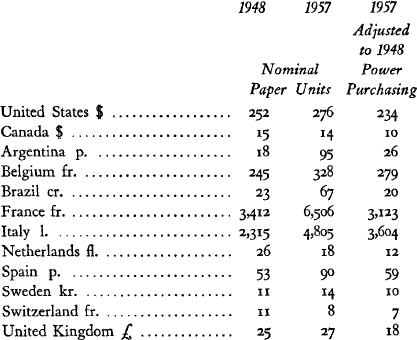
There are few governments today that cannot make such a boast. At the end of this chapter is a table, taken from the August 1957 issue of Pick’s World Currency Report, showing what happened in the preceding nine years to the national public debts of a dozen leading countries. Only three of them were smaller in terms of their own currencies; the other nine were all larger in terms of their own currencies. Yet in spite of the fact that they owed more in nominal currency units than a decade previously, the United States, Brazil, France, Sweden, and the United Kingdom owed much less in real terms than a decade previously. Though the U.S. debt increased 24 billion in dollars since 1948, the reduced purchasing power of the dollar wiped out the equivalent of $42 billion of that debt. Though France increased its debt since 1948 from 3,412 billion to 6,506 billion francs, it also wiped out 3,383 billion francs of the 1948 purchasing power of such a debt.
This is the way governments are today cheating their creditors—precisely the citizens who responded to their patriotic appeals for help.
There is nothing new about this process. It was old when Adam Smith denounced it in “The Wealth of Nations” in 1776: “When national debts have once been accumulated to a certain degree, there is scarce, I believe, a single instance of their having been fairly and completely paid. The liberation of the public revenue, if it has ever been brought about at all, has always been brought about by a bankruptcy; sometimes by an avowed one, but always by a real one, though frequently by a pretended payment.
“The raising of the denomination of the coin has been the most usual expedient by which a real public bankruptcy has been disguised under the appearance of a pretended payment. . . . A pretended payment of this kind . . . extends the calamity to a great number of other innocent people. . . . When it becomes necessary for a state to declare itself bankrupt, in the same manner as when it becomes necessary for an individual to do so, a fair, open, and avowed bankruptcy is always the measure which is both least dishonorable to the debtor, and least hurtful to the creditor. The honor of a state is surely very poorly provided for, when, in order to cover the disgrace of a real bankruptcy, it has recourse to a juggling trick of this kind, so easily seen through, and at the same time so extremely pernicious.”
Adam Smith then goes on to show how “almost all states . . . ancient as well as modern” have “played this very juggling trick.” It may be added that, since the substitution of paper for metallic money, the trick has become much easier and therefore more frequent. It may also be added that the debtor class today, including as it does most corporation stockholders, is probably as rich as the creditor class, which includes savings-bank depositors and owners of savings bonds.
NATIONAL DEBTS
(In billions of currency units)