
Prosperity and Depression
9. Definition and Measurement of the Business Cycle
——————
§ 1. INTRODUCTION
“Crisis” and “Depression”.
There is complete unanimity among economists that the problem of the recurrence of periods of economic depression and the cognate problem of acute economic or financial crises cannot fruitfully be discussed in isolation from the major problem of which they form part—viz., the problem of the business or trade cycle; by which is meant, a wavelike movement affecting the economic system as a whole. It is therefore with the major problem that this study is concerned.
To define “depression”, we must also define “prosperity”: for the two are correlated concepts, since each is the negative of the other.
Before we try, however, to define more precisely these two concepts, it may be well to say a word about the meaning of the two related terms “crisis” and “depression”. They are frequently used indiscriminately. Throughout this paper, they will be sharply distinguished.
“Depression” will be used to mean a process or a continuous state of affairs of more or less extensive duration, which will be described and defined in following sections of this chapter.
The term “crisis” has two meanings. In the technical sense of business cycle theory, it means the turning-point which marks the passage from prosperity to depression. In the ordinary sense of everyday language, in which it is used also by the financial Press and frequently in economic writings, it means a state of acute financial stringency, panic, runs on the banks, drain of gold, bankruptcies, etc. A “crisis” in the technical sense—i.e., a turn from prosperity to depression—is usually (but not always) accompanied by an acute “crisis” in the ordinary sense. On the other hand, an acute financial crisis may, and occasionally does, occur at a time when there is no “crisis” in the technical sense; in other words, it does not always mark the turn from a period of prosperity to a period of depression, but occurs sometimes during a depression or even during a prosperity period without turning the latter into a depression.1
§ 2. DEFINITION OF PROSPERITY AND DEPRESSION IN THE GENERAL SENSE
A closed economy.
Depression and prosperity may exist in the case of a branch of industry, a region, a whole country or the whole world.
The international aspects and complications of the cyclical movement will be considered in Chapter 11 below. In the earlier chapters, the reference will always be to the case of a closed economy—by which is meant, not a completely isolated country, but a country in possession of all the attributes which we shall find necessary for the full development of the trade cycle. We may therefore have occasion to allow for outside influences on our “closed” country, even before we turn in extenso to all the complications and qualifications in the argument necessitated by the fact that in the real world we are concerned, not with a number of independent economic systems, but with a system of interdependent and interrelated countries.
Alternative criteria.
Depression means a state of affairs in which real income consumed or volume of consumption per head, real income produced or volume of production per head2 and the rate of employment are falling or are subnormal in the sense that there are idle resources and unused capacity, especially unused labour.
Prosperity, on the other hand, means a state of affairs in which the real income consumed, real income produced and level of employment are high or rising, and there are no idle resources or unemployed workers, or very few of either.
Depression and prosperity differ in degree rather than in kind. It is not so much a question of a sharp line of demarcation between the two, as of a scale of more or less depressed or more or less prosperous conditions, ranging from deep depression to high prosperity and from severe unemployment to full employment of all the factors of production.
Real income consumed, real income produced, rate of employment—the three are comparatively precise concepts and even to some extent measurable quantities. There is little to be gained by looking deeper, though it is always possible to regard each of the three as in one way or another an index or a measure of a more fundamental magnitude, i.e., of economic welfare. But “economic welfare” is a vague expression which itself calls for definition in terms of more precise and measurable magnitudes—and, as such, real income consumed, real income produced and rate of employment are at once indicated. For all practical purposes, therefore, prosperity and depression are sufficiently precisely defined in terms of one or the other or all three of these magnitudes.3
“Employment” criterion.
In recent years, unemployment has frequently been taken as the sole criterion of the economic situation of a country. It must not be forgotten in this connection that a certain amount of unemployment is always present (frictional unemployment), and that there is a seasonal fluctuation of employment in many trades and countries. Even if these two factors are disregarded, the fact remains that in some countries unemployment remains on a high level over long periods—e.g., in England or Austria after the war. In such a case, we speak of a chronic depression: but this does not mean that cyclical fluctuations are absent. They are merely superimposed on the mass of “structural” unemployment.
Even with all these qualifications—which are equally applicable incidentally to the two other factors of real income consumed and real income produced—the employment index cannot be regarded as an unfailing criterion in all cases. In agricultural countries, for example, depressions, whether due to crop failures or to low prices, are not commonly accompanied by unemployment. The farmers and agricultural workers indeed may even work harder, and more people may be called in to work—wives and children, for example—in bad times than in good. The same may be true, to a certain extent, in countries such as Japan or Yugoslavia where industrial labour is not completely divorced from the soil. Even in a purely industrial country, if wages were perfectly plastic, unemployment could possibly—although this is an open question—be reduced to a very low point. On the other hand, there are cases where unemployment is due to rapid technological progress: in such cases one can hardly speak of depression or deterioration of the situation in spite of the high or rising level of unemployment.4
In such cases, we fall back on the two other criteria above mentioned—namely, real income consumed and real income produced.5 The difference between the two consists in the fact that real income consumed is confined to consumers’ goods and services—that is to say, is equivalent to “volume of consumption” or, if we disregard changes in stocks of consumers’ goods, to “flow of goods and services ready for consumption”,6 while real income produced includes also additions to the stock of goods of a higher order (producers’ goods, raw materials, etc.).
“Consumption” criterion.
If wages or incomes in general are flexible, and unemployment is avoided more or less completely by a fall in wages rapid enough to offset the deterioration in the economic situation, the deterioration will take the form of a fall in the real income consumed by the community. In the case mentioned above of an agricultural country, the rate of employment and the volume of production may even rise in spite of the prevailing depression, if the foreign demand for the product of the country has fallen as a result, e.g., of a depression in certain foreign countries or the expansion of a competitive source of supply.7 The criterion of the deterioration is then a fall in the real income consumed represented by a reduction of the consumption of imported goods due to the fall in price of home-produced exports.
“Production” criterion.
In a closed economy, the situation is usually less involved. But even here the movements of the volume of consumption and real income produced may diverge. It is conceivable that the volume of consumption should remain constant or even rise while the volume of production falls—e.g., in the case of a community living on its capital. Obviously, in such a case, the volume of production and the rate of employment have to be taken as criteria rather than the volume of consumption.8
On the other hand, if a community adds to its capital equipment, the volume of production may rise or remain constant, while the volume of consumption falls or does not rise so rapidly. In this case, clearly the volume of production and the rate of employment should be regarded as the true criteria.
This situation frequently arises, to a greater or smaller extent, when business is recovering from a deep depression. The production of producers’ goods rises and additions are made to the capital stock; but the flow of consumers’ goods and services usually rises only to a lesser extent.
Conclusion.
We may conclude that a combination of the three indices—(1) employment, (2) real income consumed and (3) real income produced—can be regarded as the criterion of the existence, and measure of the degree, of prosperity and depression and changes in the same. If all three indices point in the same direction, the situation is clear. If they diverge, it is as a rule possible to arrive at some indication on the basis of the considerations above set forth.
We shall see that the fluctuations are usually so marked that the doubtful cases are of no practical importance. But, before we proceed to statistical examples, we may discuss briefly two other criteria which are often used in the literature on the subject.
Other criteria.
Fluctuations in profits (and losses) are frequently regarded as the essential characteristic of the business cycle: but it would not seem advisable to rank them with the three fundamental elements indicated above. The term “profit” is vague and misleading. What are recorded statistically as “profits” (e.g., profits of corporations) do not consist purely of profits in the sense in which economic theory uses the term: they are, rather, a mixture of interest, rent, monopoly gains, etc. Profits in the sense in which economic theory uses the term are part of the national income and, as such, are included in “real income”. The absence of profits—or losses—in this, the strict, sense of the word is the very essence of perfect equilibrium of the economic system; and a state of perfect economic equilibrium, with full employment of all available resources, is surely a state of high prosperity.
The term “loss” also lacks precision. An individual, commercial loss need not be a loss to the community. The invention of a new productive process, for example, may involve losses on the fixed plant used in the process supplanted: but such losses do not constitute a deterioration in the economic situation of the community. Profit-and-loss statistics are no doubt a valuable symptom of the business cycle in the technical sense: but they are not an unfailing criterion of the business cycle in the general sense (§ 3).
Our employment- and production-criterion seems to express precisely what is meant by “economic activity”, which is frequently used, more or less loosely, as criterion of prosperity and depression. Evidently, if it is to be at all useful as such a criterion, the concept must be capable of quantification, and if we ask ourselves how the degree or intensity of economic activity is to be measured, the answer will be in terms either of input or output, in terms, that is to say, of the effort applied or the result achieved. This is doubtless equivalent to measuring it in terms of employment (not necessarily of the available labour factor only) or of production.
§ 3. THE BUSINESS CYCLE IN THE GENERAL SENSE AND IN THE TECHNICAL SENSE
The business cycle in the general sense may be defined as an alternation of periods of prosperity and depression, of good and bad trade. This definition is, however, provisional, for it is obviously too wide. It covers more than the business cycle in the technical sense of business-cycle theory. That the general economic situation is subject to fluctuations, that the volume of production, national income and level of employment should sometimes be above and sometimes below the average or trend is not indeed surprising. An alternation of periods of depression and prosperity is what we should normally expect. What calls for explanation is, in the first place, the duration and wide amplitude of the fluctuations—particularly those in the negative direction, since the upward movement, the approach to full employment, might be explained as a natural consequence of the inherent tendency of the economic system towards equilibrium. Why do we not find short irregular oscillations around a trend, but long swings in both directions?
It is not merely, however, the magnitude of the fluctuations, but their peculiar nature, which constitutes the problem of the cycle. What that nature is can be indicated at this point only in negative terms. With the positive explanation of these fluctuations, the whole of the rest of this study is concerned. The mysterious thing about them is that they cannot be accounted for by such “external” causes as bad harvests due to weather conditions, diseases, general strikes, lock-outs, earthquakes, the sudden obstruction of international trade channels and the like. Severe decreases in the volume of production, real income or level of employment as a result of crop failures, wars, earthquakes and similar physical disturbances of the productive processes rarely affect the economic system as a whole, and certainly do not constitute depressions in the technical sense of business-cycle theory.9 By depression in the technical sense we mean those prolonged and conspicuous falls in the volume of production, real income and employment which can only be explained by the operation of factors originating within the economic system itself, and in the first instance by an insufficiency of monetary demand and the absence of a sufficient margin between price and cost.
If external disturbances of the kind referred to have a causal relation to the occurrence of depressions in the technical sense—which is unquestionably the case—it is not so much the material obstruction of the production process that accounts for the fall in the volume of production as the peculiar response of the economic system.10
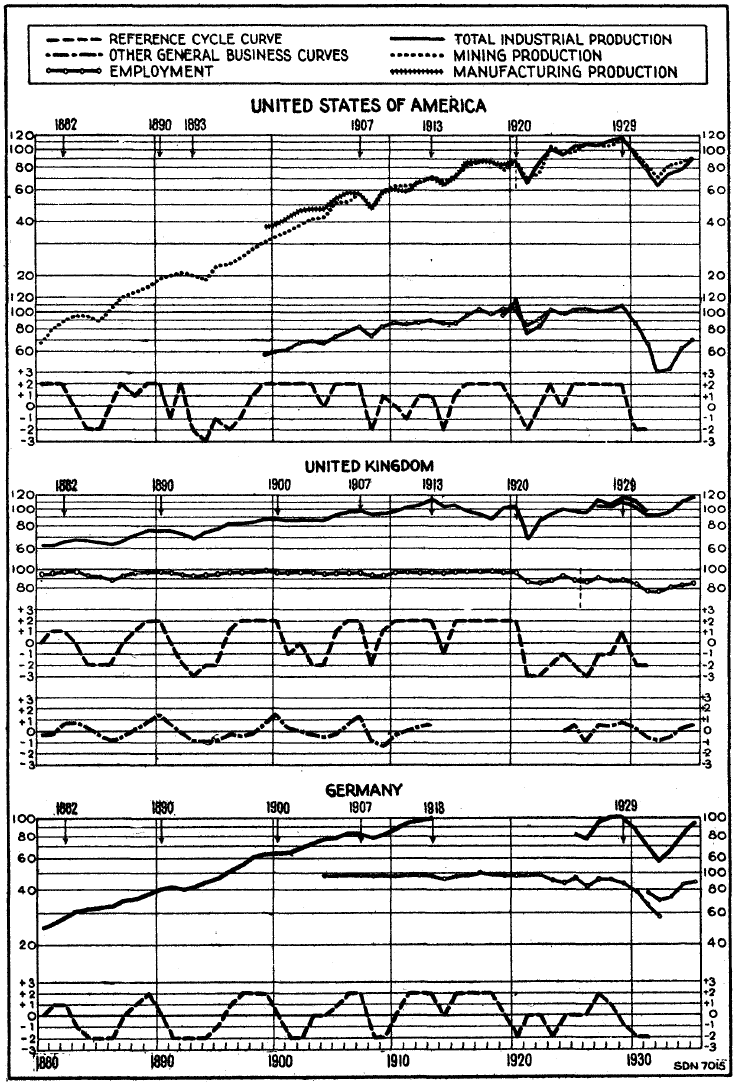
GENERAL INDICES OF CYCLICAL MOVEMENT IN VARIOUS COUNTRIES
For explanations, see Appendix I, page 509.
The principal crises are indicated by arrows.
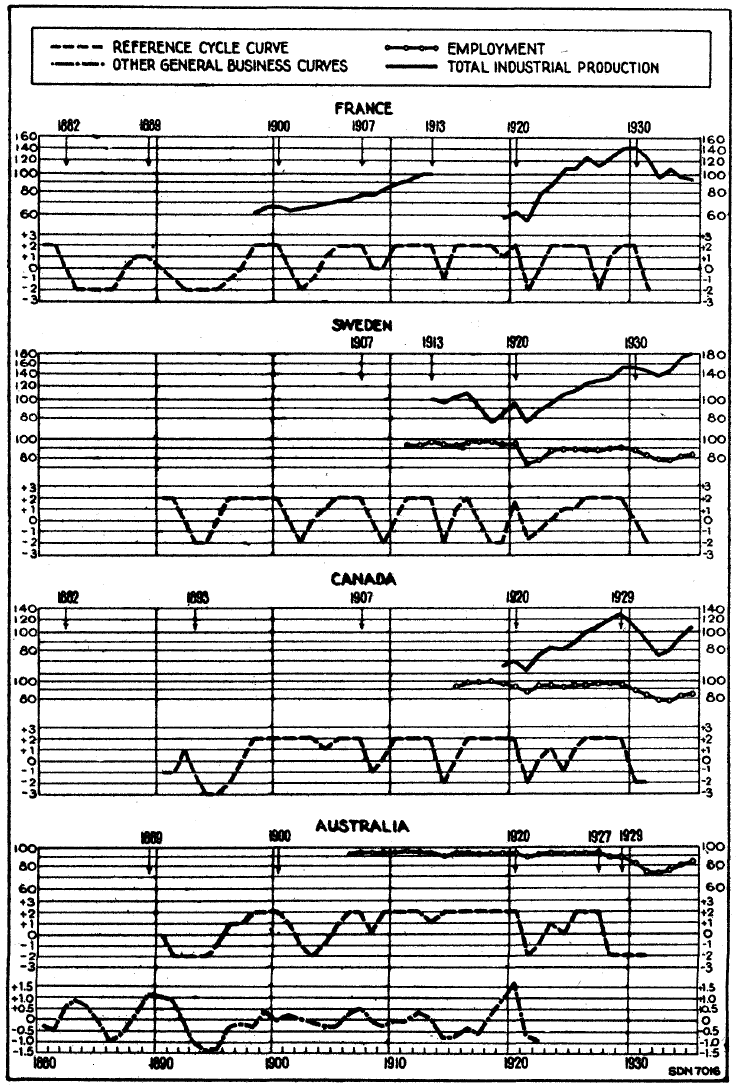
GENERAL INDICES OF CYCLICAL MOVEMENT IN VARIOUS COUNTRIES
For explanations, see Appendix I, page 509.
The principal crises are indicated by arrows.
The continuance of production is materially perfectly possible. The necessary capital equipment is there; so is the labour-power: so are the raw materials and semi-finished products. Yet somehow a large part of the factors of production cannot be put to work; the economic machine does not function smoothly: the price system is out of equilibrium.
§ 4. BASIC FACTS ABOUT THE BUSINESS CYCLE
Four phases of the cycle.
In any attempt to apply our fundamental criteria of prosperity and depression in order to locate and measure in exact form, over any considerable length of time, the phenomenon which is the subject of our study, we are at once confronted with the difficulty that the statistical data, especially for the earlier periods, before the war and in the nineteenth century, are very inadequate. Indices of national income and employment (or unemployment) are very unreliable, and in the case of a number of countries do not exist at all. Indices of the volume of production are also far from being complete or sufficiently representative.
The fluctuations with which we are concerned are, however, so marked and extend over such a wide range of phenomena that it is possible to identify them with a high degree of accuracy on the basis of the existing material, even in periods for which the latter is not so complete. We begin with the attempt to determine the length of the successive periods of prosperity and depression in the case of a number of countries by fixing as exactly as possible the turning-points from boom to slump and slump to boom. The whole cycle is divided into four phases or parts:
(1) The upswing (prosperity phase, expansion);
(2) The downswing (depression phase, contraction);11
(3) The upper turning-point—that is, the turn from prosperity to depression (down-turn, crisis in the technical sense);12
(4) The lower turning-point—that is, the turn from depression to prosperity (up-turn, revival).
This distinction of four phases, or rather two phases and two turning-points, should not be taken to imply more than is actually said. It is not suggested that the duration of cycles should necessarily be counted either from trough to trough (from revival to revival) or from peak to peak (from crisis to crisis). It is not maintained that each cycle (whether counted this way or that way) is to be regarded as (so to say) an individual unit or an indivisible whole, so that it must be explained by a single principle, or, again, that one phase grows out of the previous one and must be explained with reference to it. Such statements may have a definite meaning and value at the end, or in a later stage, of a study such as the present one. At this early stage, we shall do no more than register certain basic facts.13
Various indices recording the cycle.
In the preceding graphs, the cyclical movement in a number of countries is represented by various indices, a description of which is given in Appendix I. An inspection of the diagrams shows an, almost perfect concordance in the movements of different curves. There are sometimes slight deviations; out they seldom exceed one year. They can often be explained by inaccuracies in the figures or in the description in the annals. The conventions which have been adopted for the graphical representation of the “Annals” must be kept in mind, if a misleading impression is to be avoided. Only a few gradations of prosperity and depression are distinguished, so that neither the amplitude of fluctuations nor the speed of recovery and decline at various points can be adequately indicated. Both the high and the low conjunctures tend to be represented by horizontal straight lines masking the tarning-points which come either in the latter part of the last year of the horizontal or in the first part of the following year.
It must also be remembered that, whereas the production indices show a pronounced trend movement, on which the cyclical fluctuations are superimposed, in the employment series—except in the case of the United States of America—and the Reference Cycle Curve, the trend is eliminated by the method of their construction.
These curves represent the business cycle in the general sense—that is to say, they record the changes in production and employment irrespective of the cause. But there is no doubt that, with a very few exceptions, the ups and downs of production in our curves are not the direct effect of material obstructions to the production process caused by strikes, earthquakes, etc. The direct influence of the weather on the volume of agricultural production plays no rôle, since our production and employment figures relate to industry alone.
Since reliable direct measurements of our fundamental criteria—employment and volume of production—are not always available, it is necessary to have recourse to other statistical series, which are either themselves constituent parts of the index of production, or are empirically so closely related that they can be taken as highly symptomatic for the direction of the movement or magnitude of fluctuations in the fundamental variable. Such “auxiliary” or “symptomatic” series, as they may be called, are bank clearings, bank deposits, other monetary series, price series, transportation figures, bankruptcies, etc.
§ 5. THE SECULAR TREND
Various components of time-series.
The economic cycle in which we are primarily interested is that alternation of relatively prosperous and depressed times, together with all the concomitant changes in all parts of the economic system, which extends over the period of three to twelve years. This movement we call the business cycle proper.
Besides (i) the business cycle proper, we find other movements reflected in the time-series of important economic magnitudes—namely, (2) a secular trend, (3) seasonal variations within the span of one year, (4) occasional disturbances attributable to erratic forces from outside the economic system in the strict sense, and (5) the so-called “long waves” covering periods of fifty years or more.
The meaning of the trend in different series.
The secular trend relates to the continuous rise in volume of production, real income, production of particular commodities, real wages, etc., which has taken place, with relatively short setbacks, during the nineteenth and twentieth centuries. Such a tendency of the fundamental magnitudes to grow is the criterion of a progressive economy. As we usually think of societies as progressive, we assume—and have hitherto been lucky enough to find—upward-sloping trend curves for production and consumption. But it is by no means necessary that the secular change should take place at a constant rate, or that it should always slope upward along a smooth curve which can confidently be extrapolated into the future. Nor is it excluded that the forces which create the trend may tend to operate spasmodically or cyclically.
Furthermore, it is evident that the secular trend may have quite a different significance according to the economic magnitude concerned. A gradual rise of the total volume of production and consumption is the natural consequence of growth of population. An upward-sloping trend of physical quantities of production and consumption per head of the population is the essence of material progress due to the accumulation of capital and the increasing stock of technical knowledge. Obviously, the situation is quite different in the case of money prices and money values. Rising prices and money values are not an essential characteristic of material progress. It is quite conceivable that, because of the peculiar working of the money-profit-price mechanism in an individualistic economy, a certain trend of prices is required to ensure the smooth, uninterrupted working of the productive apparatus, and to make possible the complete and rapid realisation of all the benefits of technological progress. But this is only a hypothesis, as to which there is unfortunately no agreement among economists. Some writers believe that prices should gradually fall when production expands: others predicate a stable price level: others, again, incline to think a slightly rising trend of prices is the most beneficial for the working of the economic machine. In any case, it seems to be clear that a price trend—if there is one—should be interpreted in quite a different way from a trend in the physical quantities of production.
At this stage, being primarily interested in cyclical movements of the order of magnitude of three to twelve years, we are concerned not so much with the “secular trend” as with the departures from it which our series exhibit. As for the other movements in the various economic magnitudes, the seasonal fluctuations—not shown in the annual data—do not constitute a serious theoretical problem, nor do the irregular changes or disturbances, such, for example, as the general strike in the United Kingdom in 1926.
§ 6. BUSINESS CYCLES AND LONG WAVES
A word of justification and explanation must, however, be said as to why we concentrate on the short cycle instead of on the long waves which according to many writers (KONDRATIEFF, WOYTINSKI and others) show themselves quite clearly in a number of long series such as those of production, wages and prices. These long waves or trend cycles extend over a period of fifty to sixty years; and the short cycles, for which we reserve the expression “business or trade cycle”, are superimposed on them (in much the same way as the seasonal fluctuations are superimposed on the business cycle).
Facts about the long waves.
Avoiding figurative language and leaving aside all speculations and dubious hypotheses, the broad facts about these long waves seem to be as follows.
It is possible to distinguish during the nineteenth and twentieth centuries alternating periods in which depression years and prosperity years respectively predominate. These periods extend from twenty to thirty years, and each of them comprises two to five complete business cycles of the short type. These periods are, according to Professor SPIETHOFF, for Western Europe (1) 1822-1842, (2) 1843-1873, (3) 1874-1894, (4) 1895-1913.14 The first of these periods contains two business cycles in which the depression phase was much longer than the prosperity phase. In this whole period, Professor SPIETHOFF counts nine prosperous and twelve depressed years. In the second period (1843–1873) prosperous times prevail. In three and a-half business cycles there are twenty-one prosperous and ten depressed years, depressions being short and mild. The third period (1874–1894) begins with the prolonged and extremely severe depression of the seventies. It contains two and a-half cycles, and Professor SPIETHOFF counts six prosperous and fifteen depressed years. This gloomy period is followed by a fourth period (1895–1913) which is overwhelmingly prosperous. It contains two and a-half cycles, the last one being interrupted by the world war. Only four depression years stand against fifteen years of prosperity, depressions being short and mild.
Necessity for previous analysis of short waves.
We do not deny that there is an interesting phenomenon in the “long waves” which calls for explanation. Some prima facie plausible hypotheses have been put forward to this end. There are stimulating and depressing forces, which do not exhaust themselves within the span of one short cycle but persist through a number of them, such as the up-and-down trends of gold production, the exploitation of technical innovations (equipment of a country with railroads) or newly discovered countries.15 These forces may conceivably produce a long wave in production and prices. But is not that a purely fortuitous phenomenon? Is each of these long cycles the result of the same type of force? Is there the slightest probability that a cycle of fifty years or so will always be produced? Are we at all justified in extrapolating these waves? Is there any sense in such statements as that the depression of the nineteen-thirties was so severe because we were not only in the downgrade of a short, but also of a long, wave? Why is it that periods which are under the spell of one of these long-range forces are themselves divided into shorter periods of prosperity and depression? It would seem that all these and other sceptical questions about the nature of the long waves can be answered only after a fairly full insight into the mechanism of the short cycles has been attained. For the forces which are said to produce the long waves do not work independently of, and alternatively to, those that produce the short cycle. They work through the latter—e.g., by tending to increase continuously the supply of money (gold production), or by continual creation of new investment opportunities (e.g., railway development of a country or rapid growth of its population). Until the working of the mechanism of the short cycle has been explored, the nature of the long waves cannot be understood. We are therefore compelled to attack first of all the problem of the business cycle.
§ 7. IS A GENERAL THEORY OF THE CYCLE POSSIBLE?
Each cycle an historical individual.
Until now we have discussed the essential characteristics of the business cycle—that is, those qualities in the absence of which the phenomenon “business cycle” does not exist. Besides these, there is an endless variety of changes in all spheres of economic and social life which, without being essential features of the cycle, are more or less regular concomitants of its progress. These concomitant changes furnish the material which we have to seek out and analyse in order to find such clues to the causation of the cycle as will enable us to verify or reject the explanatory hypotheses (theories of the cycle) which we find in the literature.
Most of these changes do not appear regularly in all cycles. Close inspection of the facts reveals very many irregularities and far-reaching differences between the characteristics of the various cycles—over and above the differences in the length and amplitude of the cycles (as defined in terms of our fundamental criteria). Each cycle, each period of prosperity or depression, has its special features which are not present in any, or not in many, others. In a sense, each cycle is an historical individual: each is embedded in a social-economic structure of its own. Technological knowledge, methods of production, degree of capital-intensity, number, quality and age-distribution of the population, habits and preferences of consumers, Social institutions in the widest sense including the legal framework of society, practice in the matter of interventions of the State and other public bodies in the economic sphere, habits of payment, banking practices and so forth—all these factors change continuously, and are not exactly the same in any two cases. It is therefore not at all surprising to find great dissimilarities between cycles in different countries and different periods. On the whole, it may be said that the differences and dissimilarities between different cycles are much greater than many cycle theorists seem to assume.
A general theory possible.
This point with regard to the dissimilarities between different cycles raises the question whether it is possible to make any general statements at all as to the causes and conditions of cycles—in other words, whether the same theory holds for the cycles in the first half of the nineteenth century and for those in the second quarter of the twentieth century, for the cycles in the industrial countries of Western Europe and the United States and for those in the agricultural countries of Eastern Europe and overseas. (“Cycle” is here used in the technical sense as defined previously, disregarding those changes in volume of production, employment, etc., which can be attributed to the direct influence of the interruption or obstruction of the productive process by external disturbances.)
The question cannot be answered a priori. Logically, it is quite conceivable that, under different social and economic conditions, periods of prosperity and depression should be produced by entirely different sets of causes, so that for different groups of cycles separate theories would have to be devised.
We believe, however, that this is not the case. We believe, on the contrary, that a very general theory of the most important aspects of the cycle can be evolved, which will not on the one hand be so formal as to be useless for practical purposes, while, on the other hand, it will have a very wide field of application. The precise conditions of its applicability will be discussed in the following pages. They relate to monetary and banking arrangements, the wage-price system and some elementary technological facts—all deeply rooted in our present individualistic money-price economy.
It should be noted that the mere fact that each cycle is an historical individual is not a sufficient argument against a general theory. Are there two men who are in all respects alike? Does this dissimilarity in many respects destroy the possibility and practical usefulness of anatomy, physiology, etc.? That each cycle is unique in many respects does not prevent all cycles from being similar in other respects, over and above those similarities which constitute the fundamental elements of the cycle. These latter do not constitute causes of the cycle any more than pauvreté is the cause of poverty. In other words, that each upswing shows a rise in production and employment and each downswing exhibits a fall of the same is not surprising, since that is how we have defined the cycle. But, if there are other similarities, they may, as symptoms, throw light on the causes.
Order of the argument.
It will be shown that any economy organised on such lines is liable to cumulative, self-reinforcing processes of expansion and contraction. The first thing to prove is that these processes are self-reinforcing—that is to say that, once expansion or contraction has started (for whatever reason), forces are released which make for further expansion or contraction. In other words, certain deviations from the equilibrium are not corrected automatically, but lead the system farther away from equilibrium. (This is, of course, figurative language. Its purpose is not to prove a proposition, but to convey a general meaning. It will presently be replaced by precise analysis.)
The next step will then be to discuss why these processes of expansion and contraction always come to an end. Must they come to an end? Cannot they go on indefinitely? Why does expansion not lead to stable equilibrium? Are periods of expansion interrupted and reversed by accidental disturbances, or do they necessarily give rise to maladjustments?
We shall see that in these respects various possibilities are open, which do not exclude one another, and that there is no reason to postulate a single solution which must apply to all cases.
The guiding principle of our approach is to proceed cautiously step by step. We do not assume from the outset that there is a cycle in the sense that prosperity must necessarily be followed by depression and vice versa. That may be the final conclusion of such a study as the present; but it cannot be assumed from the beginning. Therefore we start with the most general aspects of the problem, which do not yet imply the existence of a cycle in the strict sense just indicated, and then proceed to less and less general features, where the conclusions depend to an increasing extent on the particular social-economic environment. This procedure has the advantage that it does not close the door to more ambitious theoretical constructions. But it would seem that such constructions cannot be safely undertaken except on the basis of such preparatory analyses.
§ 8. TWO REGULAR FEATURES OF THE CYCLE
Parallelism of production and monetary demand.
There are two features which we can observe in every cycle, probably without exception, although they are not implied by our definition of the cycle. They are therefore of the utmost suggestive value and must be kept in mind from the beginning. The one is the fact that the cyclical ups and downs of production and employment are accompanied by a parallel movement of the money value of production and transactions; the second is the fact that the cyclical fluctuations are more marked in connection with the production of producers’ goods than in connection with the production of consumers’ goods.
The first of these facts is so indubitable that it hardly calls for special statistical verification at this point. It is only necessary to recall that production rises in the upswing, falls in the downswing, while prices in general (including factor prices, especially money wages and prices of real estate and property rights) rise or remain constant16 in the upswing and fall in the downswing. It follows that the money value of production and of transactions rises and falls. In other words, the volume of work which the medium of exchange has to perform expands and contracts with the rise and fall of the business cycle. MV, the quantity of money × velocity of circulation—i.e., the flow of money against goods or the aggregate demand for goods in terms of money per unit of time—grows during prosperity and shrinks during depression. This proposition is certainly true of the money value of production and the money value of transactions relating to goods—of the “industrial circulation”, to use an expression of Mr. KEYNES. It may not always be true—or at any rate irregular fluctuations may occur—if stock-exchange transactions (that is, the “financial circulation” in Mr. KEYNES’ terminology) are included.
It should be noted that these propositions do not follow from the definition of prosperity and depression, and are by no means self-evident.17 It is not a logical necessity that fluctuations in thy material volume of production should always be accompanied be parallel changes in its money value. Fluctuation in real income need not show itself by fluctuation in money income. Prices might conceivably fall during the upswing and rise during the downswing.18 That the contrary is true, that a higher national income in terms of goods always appears as higher money income, is a highly significant additional fact which calls for explanation; and its explanation is almost bound to afford clues to the understanding of the business cycle.19
It would be rash to conclude from the fact that the monetary circulation (in the sense of MV) rises and falls with the general movement of the cycle that money—or rather monetary forces in the sense of monetary policy (i.e., action on the part of the monetary authorities)—is the impelling cause of the cyclical expansion and contraction of production and employment. We shall come back to this point later. At this stage, we cannot answer the question definitely; we must confine ourselves to pointing out that money may conceivably play a rôle of minor importance. It is possible that in some, or even in all circumstances it adjusts itself to changes in production without exerting an active influence.
Specially wide fluctuations in producers’ goods.
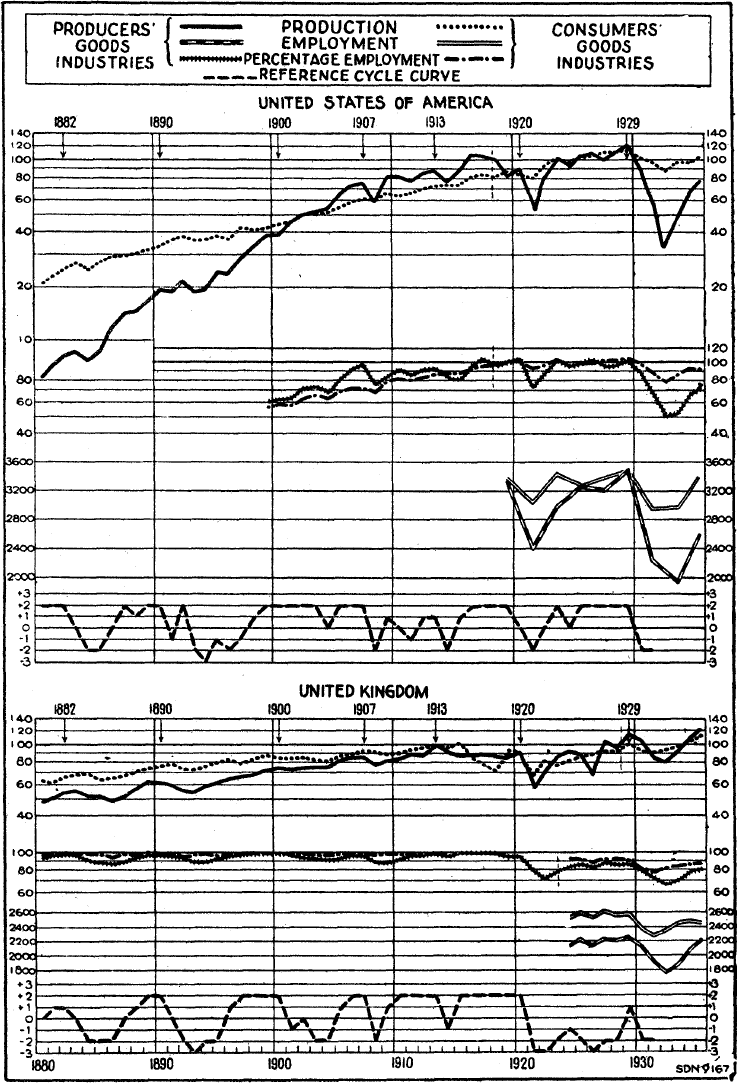
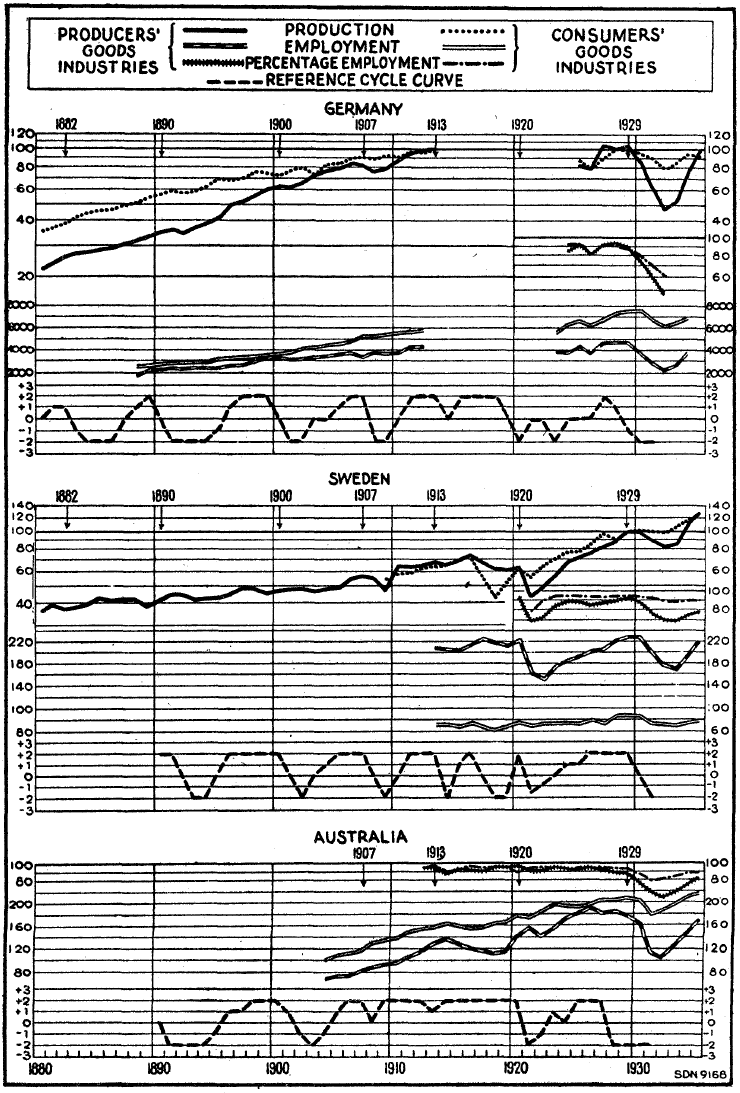
We pass to the second regular feature of the cycle, a less self-evident feature—namely, the fact that the production of producers’ goods fluctuates much more violently than the production of consumers’ goods. As may be seen from the following graphs, this is true in a relative, and in many cases also in an absolute, sense. If we measure the amplitude of the cycle either by changes in the total volume of production or by changes in the total number of unemployed or employed workers, we often find that the changes in the volume of production of producers’ goods (goods of higher order) and changes in the number of unemployed in these industries contribute more to the change of the total than do changes in the volume of production of consumers’ goods and in the number of workers employed thereon. Historically speaking, with the accumulation of capital, the producers’ goods industries have grown relatively to the consumers’ goods industries, till to-day they are in many countries approaching or outstripping the latter in importance, as measured, e.g., by the number of workers employed in both branches. It may happen, however, in countries or semi-closed economies where the producers’ goods industries are relatively undeveloped, that the absolute magnitude of these fluctuations in production is greater in the consumers’ goods industries. But in almost all cases it will be found that the amplitude of the fluctuations measured with reference to “normal” production (i.e., the relative fluctuations) is greater in the producers’ goods industries. Moreover, not only is their amplitude greater, but the fluctuations in these industries are much more regular, and conform much more closely with the business cycle in general, than the fluctuations in the consumers’ goods industries.
PRODUCTION AND EMPLOYMENT BY GROUPS OF INDUSTRIES.
For explanations, see Appendix II, page 512.
The principal crises are indicated by arrows.
PRODUCTION AND EMPLOYMENT BY GROUPS OF INDUSTRIES.
For explanations, see Appendix II, page 512.
The principal crises are indicated by arrows.
When we speak of consumers’ goods, we mean perishable consumers’ goods (such as food) and semi-durable goods (such as clothing, shoes and furniture). Durable consumers’ goods (such as apartment houses) show very wide fluctuations, and belong rather to the category of capital goods, for reasons which have already been discussed and will be touched upon again.
________________
20 But, as has been touched upon in connection with the discussion of the “psychological” theories, the “detonation” of a financial crisis is likely to deteriorate the general situation, even if it does not bring about an actual turn from prosperity to depression.
21 Professor Fisher, in his various writings, defines “national income” as volume of consumption (see his Nature of Capital and Income, New York, 1912, his Theory of Interest, New York, 1930, and his article “Der Einkommensbegriff im Lichte der Erfahrung” in Die Wirtschaftstheorie der Gegenwart, Vol. III, Vienna, 1928, page 28). It has, however, become more and more usual to define national income as consumption plus net investment—that is, for a closed economy, the same as what we have called above “national income produced” or “volume of production”. Since investment can be negative (disinvestment, dissaving, capital consumption), the volume of consumption may exceed the national income. In Chapter 10, we shall have to come back to these questions of definition. (Cf., e.g., Eric Lindhal: “The Concept of Income” in Economic Essays in Honour of Gustav Cassel, London, 1933, pages 399 et seq., and the statistical literature which has sprung up in recent years.)
22 The precise definition of the three variables—real income consumed, real income produced and rate of employment—and the method of measuring them open up, of course, the possibility of infinite discussion and raise a host of intricate problems. The whole literature on the construction of index-numbers of the price-level and volume of production and the cognate problems which they raise, has its relevance in this connection. It need not, fortunately, detain us at this point, since (as we shall see) the fluctuations with which we are concerned are so marked as to be visible, whichever of the current definitions and methods of measurement of the fundamental magnitudes is adopted. Exceptional cases are conceivable where reference to other criteria is indicated—for example, where adverse influences on the real income consumed or the real income produced are offset by harder work. In such a case, though the real income consumed and real income produced are unchanged, we are compelled to record a deterioration of the position, because the economic welfare is reduced. The additional criterion which must be introduced in this case is the length of the working-day. An alternative would be to define real income in such a way as to cover the quantum of leisure achieved and to make allowance in some manner for the toil and trouble involved. The statistics, however, afford no ground for supposing that such exceptional cases are of any considerable practical importance. Hence we may refrain from going into the matter in greater detail.
23 No reference is made in this connection to statistical difficulties in the measurement of unemployment—a frequent source of spurious changes in unemployment figures. The introduction of schemes of unemployment relief or insurance and alterations in existing relief schemes always involve changes in the number of registered unemployed, for the reason that numbers of persons previously not registered are included in the registration, while numbers of persons previously registered are excluded. Changes in the situation in regard to unemployment relief are also bound to influence the real volume of unemployment owing to changes in wage-rates and the willingness of the workers to accept work at the prevailing rates.
24 It may be urged that, in manufacturing industries, which are not dependent upon the weather, a divergence between volume of production and rate of employment is impossible in the short run. But this is not the case—even apart from the destruction caused by earthquakes, fires, explosions and the like. Where there is no reduction in the labour strength, a fall in the volume of output is conceivable, if less capitalistic methods of production are employed. There are theorists who maintain that this actually happens during the depression. Quantitatively speaking, however, in the absence of unemployment, fluctuations in production would certainly be reduced to relatively small proportions.
Professor F. Machlup says: “If wages were perfectly flexible, there would perhaps be no sharp fluctuations in employment, but there would be fluctuations in wage-rates instead” (“Professor Knight and the Period of Production” in Journal of Political Economy, Vol. 43, October 1935, page 624). See also J. Robinson on “Disguised Unemployment” in Economic Journal, June 1936, reprinted in Essays in the Theory of Employment, London, 1937, pages 82 et seq.
25 It is convenient to regard durable consumers’ goods (such as motorcars or dwelling-houses) as goods of a higher order, and their services as the finished product. Professor Irving Fisher’s Nature of Capital and Income (New York, 1912) would seem to contain the most satisfactory discussion of the various accounting problems which arise in this connection.
26 It is worth pointing out that the term “volume of production” may be defined as meaning, not the volume of home production, but the final outcome or result of the national labour, including (that is) the volume of goods obtained for that part of the product which is exported to foreign countries. Volume of production = amount produced at home—exports + imports. If we adopt this definition, the discrepancy in this case between volume of production and real income consumed is avoided.
27 Volume of consumption can be taken as the criterion, if the time element is introduced. A community living on its capital is prosperous for the time being; but the prosperity cannot last.
28 This by no means excludes the possibility of such external disturbances having an indirect influence on the business cycle in the technical sense. On the contrary, we shall see that those disturbances play their role by starting or reversing, retarding or accelerating, internal processes of expansion and contraction of output and employment.
29 This is clearly revealed by the fact that external disturbances, such as a war or an earthquake, which directly obstruct the productive process and destroy wealth, nevertheless frequently tend to bring about an expansion rather than a contraction of employment and production.
30 The terms “expansion” and “contraction” are sometimes used in the purely monetary sense of expansion and contraction of credit or money. We shall use them, where no other meaning is implied by the context, to denote the complex phenomenon—expansion and contraction of production and employment plus expansion and contraction of the circulating medium. For the purely monetary aspect, we shall usually employ the terms “inflation” and “deflation”.
31 See page 257.
32 Various writers have elaborated different typical cycle patterns. The Harvard Economic Service, eg., distinguishes five phases: depression, recovery, business prosperity financial strain, industrial crisis. Spiethoff has a still more complicated scheme. But these schemes are based from the outset on a particular view as to the causation of these fluctuations. They imply generalisations which do not fit all cases. Therefore they cannot serve as starting-points, but are the result of the analysis.
33 According to other investigators, the dates are approximately the same.
34 This is Professor Schumpeter’s hypothesis about the long waves.
35 The best-known case of constant or even falling prices is that of the 1926-1929 boom in America. Even in this case it was only true of commodity prices: factor prices and stock-exchange prices rose.
36 This has, e.g., clearly been overlooked by Mr. R. F. Kahn, in his Rejoinder to my Comments on his review of the first edition of this book. (Economic Journal, Vol. 48, June 1938, page 335, last sentence of second paragraph.)
37 Where the fall in the volume of production is due to a physical obstruction of the process of production, unaccompanied by changes on the money side, that is what one would expect.
38 Mr. R. F. Harrod, in his book, The Trade Cycle (London, 1936), has also found it worth while to lay special stress on this fact.
- 1Cf. J. M. Clark, Strategic Factors in Business Cycles, New York, 1935. pages 4-5 and passim.
- 2See especially Tinbergen: “Suggestions on Quantitative Business Cycle Theory” in Econometrica, Vol. Ill, No. 3, July 1935, page 241.
- 3What is to be regarded as “outstanding” and “plausible” is, of course, a matter of dispute. As there is always something happening somewhere, it is always possible to find some external events which can be made the basis of a tentative explanation.
- 4This special purpose explains the difference between the following exposition and the classification of theories and theorists given in such works as A. H. Hansen: Business Cycle Theories, Boston, 1927; W. M. Persons: “Theories of Business Fluctuations” (Quarterly Journal of Economics, Vol. 41, reprinted in Forecasting Business Cycles, New York, 1931); F. A. Hayek: Monetary Theory and the Trade Cycle, London, 1933; Macfie: Theories of the Trade Cycle, London, 1934.
- 5See his book: Strategic Factors in the Business Cycle, passim.
- 6Trade and Credit, London, 1928, page 98.
- 7For this reason, anything like perfect regularity in respect of the amplitude, length, intensity and concomitant symptoms of the cyclical movement is a priori improbable.
- 8Currency and Credit, 3rd ed., London, 1928, page 153.
- 91913, page 186.
- 10Monetary Reconstruction, 2nd ed., London, 1926, page 135.
- 11See his paper “Money and Index-Numbers” in Journal of the Royal Statistical Society, 1930, reprinted in The Art of Central Banking, pages 303-332.
- 12Op. cit., page 171.
- 13The Lessons of Monetary Experience, page 131.
- 14It has been questioned whether this process of saving and investment runs smoothly. A great number of writers believe that the process of saving is likely to produce serious disturbances (a) because saving produces depression in the consumption industries which then spreads to the higher stages, (b) because money which is saved frequently disappears on the way and is not invested (deflation), (c) because increased investments eventually bring about an increase in the production of consumers’ goods, which cannot be sold at the prevailing prices unless the flow of money is increased. But it is not with these alleged frictions and disturbances that we are here concerned. They will have to be discussed at a later stage of our enquiry. The theorists now under review believe that ordinarily the process of saving and investment runs smoothly. According to them, troubles arise only if voluntary saving is supplemented from “inflationary sources”, that is, by new bank credit or by expenditure from money hoards (which is equivalent to by a rise in the velocity of circulation of money).
- 15The concept “forced saving” has a long history (cf. F. A. HAYEK, “A Note on the Development of the Doctrine of Forced Saving” in Quarterly Journal of Economics, Vol. 47, page 123). In addition to the writers of the present group, Professor Schumpeter has given it a prominent place in his account of the upward phase of the cycle. (See his Theory of Economic Development, English translation from the last German edition, 1934. First German edition, 1911.) Unlike the monetary over-investment theorists, however, he does not use the alleged peculiarities of forced saving to explain the crisis. This point will be taken up later (cf. Ch. 5, § 3). Recently the doctrine of forced saving has been attacked by Mr. Keynes (The General Theory of Employment, Interest and Money, pages 79-81, 183). But, as Professor Robertson has pointed out (cf. “Some Notes on Mr. Keynes’ General Theory of Employment” in Quarterly Journal of Economics, Vol. 51, 1936, page 178), Mr. Keynes’ objections are purely verbal. He banishes the word, but is forced to recognise the thing which the word denotes, though in another dress, when he says that, under the pressure of investment which is imperfectly foreseen, there may occur a “temporary reduction of the marginal propensity to consume” (loc. cit., pages 123 and 124).
- 16Kapital und Produktion, Vienna, 1934, page 195, and “Die Produktion unter dem Einfluss einer Kreditexpansion”, in Schriften des Vereins für Sozialpolitik, Vol. 173, 1928.
- 17Cf. his Trade Depression and the Way Out, 2nd ed., pages 29-31 and 133-135, Capital and Employment, pages 85-87, “A Credit Deadlock”; and his contribution to The Lessons of Monetary Experience (edited by A. D. Gayer), “The Credit Deadlock”, pages 129-145.
- 18No attempt has been made to establish priorities or to trace the various lines of thought to their historical origins.
- 19Banking Policy and the Price Level, 1932 ed., page 48.
- 20The real distinction—in some cases—is between controllable and uncontrollable factors. The weather, e.g., is uncontrollable, while institutional factors are at least in theory controllable. Among factors, furthermore, which can in principle be controlled, there are those which one does not find it desirable, for one reason or another, to control or to eliminate altogether—e.g., inventions, or the liberty of the recipient of income to spend his income or to save it, or to exercise freedom of choice in regard to his consumption or occupation. Needless to say, opinion as to what it is possible and desirable to control or influence varies from time to time and from person to person.
- 21It has been attempted to give more precision to the distinction between exogenous and endogenous theories by saying that the former assume movements in the data, while the latter suppose the data to remain constant. This distinction is precise enough once the general theoretical system on which a writer builds his theory of the business cycle has been determined and accepted; but it is not possible to lay down beforehand once and for all what phenomena are to be regarded as accepted data and what are magnitudes to be explained and determined in the light of those data. What the theory of yesterday accepted as data, we try to explain to-day; and the independent variables (data) on which we build to-day may become dependent variables to-morrow. All attempts to make a definite distinction between data and results lead back to the earlier conception which regards forces or movements of a “non-economic” nature or “external” to the economic system as the “data” of economic theory. But this distinction between “economic” and “non-economic” phenomena is a purely conventional one. There is no reason why forces or movements not to be classified as economic should not become “dependent” or “explained” variables of a general—as distinct from an economic—theory.
- 22One methodological rule of thumb may be suggested at this point, however, although it will find its full justification only later. For various reasons, it seems desirable, in the explanation of the business cycle, to attach as little importance as possible to the influence of external disturbances. In the first place, large swings in the direction of prosperity and depression as we find them in real life are difficult to explain solely by exogenous forces; and this difficulty becomes an impossibility when the alleged “disturbances” do not themselves show a wavelike movement. Even if a periodic character is assumed (e.g., in the case of crops or inventions), the hypothesis is full of difficulty. The responses of the business system seem prima facie more important in shaping the business cycle than external shocks. Secondly, historical experience seems to demonstrate that the cyclical movement has a strong tendency to persist, even where there are no outstanding extraneous influences at work which can plausibly be held responsible. This suggests that there is an inherent instability in our economic system, a tendency to move in one direction or the other. If it is possible (as we believe) to demonstrate that such a tendency exists and to indicate the conditions under which it works, it will be comparatively easy to fit all kinds of external perturbations, including all State interventions, into the scheme. Exogenous forces will then figure as the originators or disturbers of endogenous processes, with power to accelerate, retard, interrupt or reverse the endogenous movement of the economic system.
- 23The scope of the following analysis of theories has been defined in the Introduction (page I). The method followed in the exposition is thereby largely determined. No attempt has been made to present the various theories in chronological order or to picture the theoretical and sociological background of the various writers (except in so far as it may have been necessary in order to elucidate their doctrines). It has been preferred to present the theories in a systematic order, beginning (so far as possible) with the less complicated and proceeding thereafter to the more complicated. Frequently it happens that the latter cover all the factors on which the former lay stress, while drawing attention to others which the former have overlooked or treated as irrelevant or put aside by means of a convenient simplifying assumption (e.g., by a ceteris paribus clause).
- 24With very few exceptions, all serious explanations are neither purely exogenous nor purely endogenous. In almost all theories, both the “originating factors” and the “responses of the business system” (to use the expression of J. M. CLARK) play a rôle. On the one hand, a purely exogenous theory is impossible. Even if one assumes a weather cycle, the peculiar response of the business system, which converts harvest variations into a general alternation of prosperity and depression, has still to be explained. On the other hand, a purely endogenous theory is hardly satisfactory. It is not likely that, without outside shocks, a cyclical movement would go on for ever: and, even if it did go on, its course would certainly be profoundly influenced by outside shocks—that is, by changes in the data (however these may be defined and delimited by economically explained variables).
- 25“If the restriction of credit did not occur, the active phase of the trade cycle could be indefinitely prolonged, at the cost, no doubt, of an indefinite rise of prices and an abandonment of the gold standard.”
- 26One methodological rule of thumb may be suggested at this point, however, although it will find its full justification only later. For various reasons, it seems desirable, in the explanation of the business cycle, to attach as little importance as possible to the influence of external disturbances. In the first place, large swings in the direction of prosperity and depression as we find them in real life are difficult to explain solely by exogenous forces; and this difficulty becomes an impossibility when the alleged “disturbances” do not themselves show a wavelike movement. Even if a periodic character is assumed (e.g., in the case of crops or inventions), the hypothesis is full of difficulty. The responses of the business system seem prima facie more important in shaping the business cycle than external shocks. Secondly, historical experience seems to demonstrate that the cyclical movement has a strong tendency to persist, even where there are no outstanding extraneous influences at work which can plausibly be held responsible. This suggests that there is an inherent instability in our economic system, a tendency to move in one direction or the other. If it is possible (as we believe) to demonstrate that such a tendency exists and to indicate the conditions under which it works, it will be comparatively easy to fit all kinds of external perturbations, including all State interventions, into the scheme. Exogenous forces will then figure as the originators or disturbers of endogenous processes, with power to accelerate, retard, interrupt or reverse the endogenous movement of the economic system.
- 27The process of contraction is cumulative no less than the process of expansion. “When credit has definitely turned the corner, and a contraction has succeeded to an expansion, the downward tendency of prices is sufficient to maintain the process of contraction, even though the rate of interest is no longer, according to the ordinary standards, high.”
- 28In his earlier writings Mr. HAWTREY had already mentioned the theoretical possibility of a complete credit deadlock arising. That is a situation where even exceedingly low interest rates fail to evoke a new demand for credit. In such a situation, the ordinary means of bank policy prove wholly ineffective. In his Good and Bad Trade he ascribes this phenomenon to the fact that “the rate of depreciation of prices” may be so rapid that “nothing that the bankers can do will make borrowing sufficiently attractive” to lead to a revival in the flow of money.
- 29But even so, Mr. HAWTREY thinks, the recurrence of the breakdown is not inevitable. The expansion could go on indefinitely, if there were no limits to the increase in the quantity of money. The gold standard is, in the last resort, responsible for the recurrence of economic breakdowns. Under the gold standard, it is the slow response of people’s cash balances which prevents the banks from stopping expansion or contraction in time. “If an increase or decrease of credit money promptly brought with it a proportionate increase or decrease in the demand for cash, the banks would no longer either drift into a state of inflation or be led to carry the corresponding process of contraction unnecessarily far.” Given, however, this slow response of the people’s cash balances, “so long as credit is regulated with reference to reserve proportions, the trade cycle is bound to recur”.
- 30To complete the picture of Mr. HAWTREY’S theory, a word must be said as to the policy banks should pursue in order to eliminate the credit cycle, and with it the trade cycle. The banks, and especially the leaders of the banking system, the central banks, should not watch the reserve proportions so much as the flow of purchasing power. The demand for goods, the flow of money, is the important thing—not the outstanding aggregate of money units. The aim of banking policy should be to keep the consumer’s outlay constant, including (as has been pointed out) outlay for new investment. But account should be taken of changes in the factors of production—not merely the growth of population, but also the growth of capital—and allowance ought to be made for the proportion of skilled labour of varying grades and for the appropriate amount of economic rent. In other words, the aim should be to stabilise, not the price level of commodities, but the price level of the factors of production.
- 31“Thus there is a principle of the instability of velocity of circulation, which is quite distinct from the principle of the instability of credit, but is very apt to aggravate its effect.”
- 32In more recent publications, under the impression of the slump of the nineteen-thirties, Mr. HAWTREY has modified his views to some extent. He now doubts whether it can be legitimately assumed that “the expectation of falling prices is (always) the result of a preceding experience of a prolonged actual fall” and that such a condition of stagnation is not possible except in the course of a reaction from a riot of inflation.
- 33If the rate of interest falls because of increased savings, the demand for capital can be satisfied to a greater extent and the equilibrium point moves down along the curve of demand for capital. Investments which were extra-marginal under the higher rate now become permissible. Factors of production are shifted from the lower to the higher stages of production. The production process is lengthened and eventually the output of consumers’ goods per unit of input (in terms of “original factors” of production) is raised.
- 34This comes about in the following way. Entrepreneurs who want to invest are provided with purchasing power by the banks and compete for capital goods and labour. Prices will rise or be prevented from falling—this last case we shall discuss in detail later—and consumers’ goods industries (the demand for the pro-duct of which has not risen, or not risen so much as the demand for capital goods, which is swollen by the newly created purchasing power) will be unable to retain at the enhanced prices all the factors of production which they used to employ. They will be compelled, therefore, to release means of production for use in the higher stages of production—that is, for the production of additional capital goods.
- 35Treatment of these theories is complicated by the fact that there is as yet no agreement as to the exact use of the expression “forced saving”. It has been used to indicate the extra saving created by the transfer of resources and incomes from creditor to debtor, from rentier to State, from wage-earner (at least temporarily) to employer, as the result of inflation. Professor STRIGL has objected to this theory of forced saving that, if those with relatively fixed incomes get less and are obliged to restrict consumption, others expand their incomes to a corresponding amount and, unless they refrain voluntarily from expanding consumption to the required extent, there cannot be a net increase in capital formation. In other words, there is no forced saving, but only ordinary, voluntary saving.
- 36In more recent publications, under the impression of the slump of the nineteen-thirties, Mr. HAWTREY has modified his views to some extent. He now doubts whether it can be legitimately assumed that “the expectation of falling prices is (always) the result of a preceding experience of a prolonged actual fall” and that such a condition of stagnation is not possible except in the course of a reaction from a riot of inflation.
- 37A feature of particular interest in Mr. HAWTREY’S monetary theory of the business cycle is the demonstration and analysis of the cumulative nature of the process of expansion and contraction. In this respect, there is, as we shall see, much agreement between theorists of different schools of thought. Mr. HAWTREY’S propositions on this point, largely taken over from MARSHALL and the Cambridge tradition, have found a place in the theory of a great number of writers.
- 38Apart, however, from the increase of saving as a result of what Professor PIGOU styles a “doctoring of past contracts”, there is a more direct channel whereby additional bank credits may increase investment. This is the process which Professor ROBERTSON discusses at length in Banking Policy and the Price Level under the head of “Automatic Stinting”. Either dishoarding or the expenditure of newly created money, he says, “brings on to the market an additional daily stream of money which competes with the main daily stream of money for the daily stream of marketable goods, secures a part of the latter for those from whom the additional stream of money flows, and thus deprives the residue of the public of consumption which they would otherwise have enjoyed”. As PIGOU argues in the particular case of the expansion of bank credits: “What in substance has happened is that the bankers have transferred to business-men purchasing power and, through purchasing power, real stuff in the form of wage goods and so on, formerly belonging to other people. They have done this by giving new money titles to business-men while leaving the money titles in other people’s hands untouched in exactly the same way as they would have done had they taken money titles from other people and handed them to business-men.”

