
Prosperity and Depression
13. The Multiplier, Institutional Rigidities and Public Spending
§ 1. FURTHER OBSERVATIONS ON THE THEORY OF THE MULTIPLIER
In Chapter 8, § 4, the basic ideas of the multiplier have been discussed. Since that was written the theoretical discussion about the usefulness of the approach has been continued and numerous attempts have been made to determine statistically the magnitude of the multiplier.1 As is always the case, the application of a theory to concrete figures tends to clarify the issues and to bring to light difficulties and ambiguities which before had escaped proper attention.
A problem which must be faced squarely in any concrete investigation concerns the nature of the units in which the magnitudes, related by the multiplier, are to be expressed. The main choice is between real and monetary units. The theoretical analysis usually runs in real terms—employment (wage units, labour days, etc.) or units of physical output. Mr. COLIN CLARK, on the other hand, measures ail relevant magnitudes in money units. “It is proposed that the multiplier to be used should be a money-income multiplier, and should relate money expenditure on investment goods to changes in the money level of gross national income as a whole.”2 The main reason seems to be that in this formulation the multiplier analysis is applicable also to the full employment case where an economic stimulus arising from investment expenditure cannot lead to a larger output or employment but only to a rise in prices.
The choice of the units of measurement seems to be connected also with the question of whether the multiplier is to be interpreted as an instantaneous, timeless relationship or as a ratio which tends to be established through a series of successive expenditures. An intermediate position is the interpretation as a lagged relationship—investment today with income at some later date.
In Chapter 8, § 4, we discussed chiefly the timeless instantaneous interpretation of the multiplier as put forward by Mr. KEYNES. It may be appropriate to add a few words on what might be called the “successive-spending” approach represented by Professor J. M. CLARK3 and recently by Professor MACHLUP4 which is gaining more and more in popularity.5 The fundamental idea is so simple that it might be called the common sense approach. Suppose I dollars are spent on new investment and that the marginal propensity to consume, c, is constant. By marginal propensity to consume we now designate the fraction of increments in income that will be spent on consumption in the next income period.6 The total income generated in successive periods, by the initial expenditure of I dollars will be:
|
.7 |

Here we have again our familiar multiplier formula but with a different interpretation: The income is spread out over many successive periods and the generating expenditure need not be investment expenditure; any type of expenditure will generate a series of increments to income.8 All magnitudes are defined in monetary units (dollars) and it is immaterial whether and to what extent an increase in money income will be translated into increased output and employment or will be reflected only in a rise of prices.
Suppose now we have not one additional expenditure, but a whole series of such expenditures of, say, 100 dollars each in successive periods and suppose c is  that is to say 80 per cent of the increment in income during any period is spent on consumption in the following period. In successive periods we obtain then the following series of expenditures representing increases in income:
TABLE I
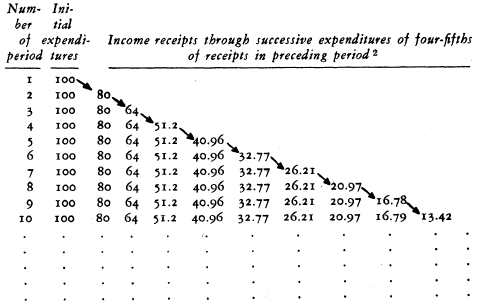
In this table the diagonal sums, as those indicated by the arrow, represent the successive income generated by the primary expenditures. They approach 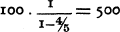 , if continued long enough. The horizontal sums (in each line) represent the sum total of income generated in the period which corresponds to the line in question by the initial expenditure in that period plus the indirect contribution to the period in question of all the previous original expenditures through the re-expenditure in each period of four-fifths of the receipts in the preceding period. This sum too approaches eventually (for remote periods) 500 dollars. The ratio of this sum to the primary expenditure again can be regarded as the multiplier. It measures the income per unit period which will eventually be generated by a continual stream of primary expenditures.9 Obviously this multiplier is different from the one measured diagonally in our table. But the two meanings are not distinguished carefully enough in the literature on the subject.10
A number of baffling questions arise in connection with this serial interpretation of the multiplier. First, is it possible at all, in this case, to speak of the multiplier? Is the multiplier not different according to the length of the period which we take into consideration? One answer to this question has been to treat the infinite series as if it could run its course instantaneously. This is a rather confusing procedure and really amounts to ignoring the problem altogether or to interpreting the multiplier in the instantaneous, timeless sense. In this case the interpretation of the multiplier as the result of an infinite series has no economic meaning.11
Mr. COLIN CLARK is only slightly more explicit. “The various stages of the readjustment take place in very quick succession (a very large part of the whole national income is always spent within a week of its being earned) and, thinking in terms of the three-month time unit which we are using, can be regarded as immediate.”12 This can only be described as slurring over a major difficulty.13 “Each stage of the series 1 + c + c2 + . . . after the first involves a complete income circuit” and “considerably more time than one week must be allotted to each of the multiplier savings.”14 Professor MACHLUP offers a careful theoretical discussion of the type of income period that is involved, but nobody has, so far as I know, made an attempt to determine it statistically.
Next the question arises about the relationship between the instantaneous multiplier and the one reached through successive spending. The question has never been faced squarely, but it can be surmised that the answer will be that in case of a change it takes time before the multiplier (i.e., the marginal propensity to consume for society as a whole) reassumes its “normal” magnitude. In the short run, it is subject to distortions, but it speedily returns to its normal level. Therefore, it is said, in the very short run one would not expect to find a stable relationship between ΔI and ΔY; a lag must be allowed, but the question about its length is still a moot one as far as theoretical reasoning is concerned.
Mr. COLIN CLARK assumes the marginal propensity to consume to be constant over considerable periods, and bases this assumption on his statistical findings. This assumption is in contradiction to the Keynesian doctrine according to which the multiplier ought to become smaller with rising real income. The justification of Mr. CLARK’S procedure may be that linearity is a good approximation for the range of income changes which occurred during the period covered by his investigations. This is at the same time the only valid justification for using a money-income rather than a real income multiplier. For if there had occurred changes in real income large enough to make the assumption of a constant income rate of saving untenable, it is pretty clear that, in the case of divergence between real and money income, precedence must be given to the former. That is to say, one is more likely (apart from transitional disturbances) to find a stable consumption function with respect to real rather than to money incomes.15
Another question which has caused much difficulty among economists outside the group of multiplier addicts is the nature of the “leakages.” What happens to the money that leaks out of circulation at each round? Is it assumed to be all hoarded? 16 The answer is: not necessarily. It must not be forgotten that the multiplier traces income propagation only through one of several possible channels, namely, through successive consumer spending. It is not excluded thereby that there are other vehicles of propagation, although most multiplier enthusiasts pay little or no attention to them. If, for example, money not spent on consumption found an outlet in investment (as it is sometimes assumed), from the point of view of the multiplier analysis it would still be regarded as having “leaked from the circulation,” although in a real sense it has not.
We shall now discuss first the application of the multiplier analysis to a special problem, viz., to exports, imports and the foreign balance and then the combination of the multiplier with the acceleration principle in dynamic model sequences.
§ 2. THE FOREIGN TRADE MULTIPLIER
The multiplier analysis has been applied by various writers to international trade problems. In fact, if an attempt is made to evaluate the multiplier statistically, it is imperative to come to a decision on how to treat exports and imports, etc., in the calculation. The concept of a “foreign trade multiplier” has been introduced and given a different meaning by different writers.17
The most natural and easiest method of dealing with international trade relations in the multiplier analysis would seem to be to adjust the multiplicand (and not the multiplier). In a closed economy the multiplicand is the value of (net) investment18 (expressed in monetary or real terms). In an economy which has trade relations with other countries, investment must be so interpreted as to include the “foreign balance.” This is, for instance, Mr. KEYNES’ approach. “It is most important to understand”, he says, “that the effects of loan expenditure [by the Government, which he treats as investment] and of the foreign balance are in pari materia.” 19
What is meant by “foreign balance” is, on the whole, pretty clear, although there may be room for disagreement with respect to certain minor details. Suppose, first, the balance of payments consists exclusively of the following items: (1) Exports and imports of goods and services (including transportation, shipping, insurance services and tourist expenditure); (2) capital movements (equivalent to exports and imports of securities and other “evidences of indebtedness”,20 short and long term); (3) currency movements (gold and paper money). In that case the foreign balance which has to be treated as part of the multiplicand is simply the difference between exports and imports of goods and services, the trade balance in the narrower sense. The reason is this: an increase in exports, unaccompanied by an increase in imports, “will generate income without increasing the quantity of goods available, and thereby start an upward fluctuation”21; similarly, a decrease in exports, unaccompanied by a decrease in imports, will cause a drop in income and will tend to start a downward movement.22
Suppose, secondly, that there are other items in the balance of payments such as interest and dividend payments, immigrant remittances, political tributes like reparations, etc. Then “foreign balance” must be defined so as to include all these payments along with the balance of trade. For example, “a decline in the annual amounts payable overseas on account of interest and dividends has exactly the same effect as an increase in export income, and should be included with it.”23 The foreign balance should be defined then as the difference between the sum of payments made to and received from foreign countries.24
Let us now elaborate the multiplier formula given in Chapter 8 by introducing the foreign trade items. In addition to the previously used symbols I (investment), C (consumption), Y (income), S (saving), let us employ the following notation; X = value of exports (standing for all the active items in the balance of payments), M = value of imports (standing for all the passive items in the balance of payments), V = expenditure on investment goods (home produced and imported) minus replacement25, c = propensity to consume . In most cases we shall use all these terms in the marginal or incremental sense, omitting, however, for simplicity, the Δ sign.
We may now formulate this first method of introducing international economic relationships into the multiplier formula as follows: Total net investment, the multiplicand, is defined inclusive of the foreign balance: I = V + X − M and

The multiplier,  is not different from the multiplier discussed in §4, Chapter 8 (page 223 above).
Another approach is to take account of the international trade factors not only in the multiplicand but also in the multiplier. There are various ways of doing it. Mr. HARROD proposes the following:26 What generates income, he says, is not the excess of exports over imports but the volume of exports, or more precisely that part of it that does not represent the re-export, during the same period, of imported raw materials. Similarly, of the total investment outlay only that part should be taken which is spent on wages and home produced materials and implements. The multiplicand—Mr. HARROD calls it the “base” of the multiplier calculation—thus becomes (V − Mν) + (X − Mx) where Mν stands for the value of imports of investment goods and Mx for the value of imports of materials to be embodied in exports. If Mc denotes the value of imports of consumption goods, Mν + Mx + Mc = M (total imports). The new multiplicand is greater by Mc than the multiplicand of formula (1):

Hence the multiplier must be made smaller in the same proportion. As Professor ROBERTSON has shown, it becomes  , if by q we denote the proportion of consumption expenditure spent on imported consumption goods
 . It follows that cq =
  . It is the proportion of income spent on imported consumption goods and may be called the “(marginal) propensity to import consumption goods.” Moreover, c − cq is the proportion of income spent on home produced consumption goods and may be called the “(marginal) propensity to consume home produced goods.” Mr. HARROD’S multiplier formula becomes:

It is easy to see that this formula gives the same result as formula (1).27 As Professor ROBERTSON says, the difference between the two is only that “whereas in (1) the q factor is implicit in the multiplicand, in (2) it is explicit in the multiplier.”28
In terms of the successive spending interpretation of the multiplier, we can derive formula (2) as follows: Suppose there is an increase in investment expenditure and exports. National income generated in the first round is (V − Mν + X − Mx). Of this a fraction of c is spent by the recipients on consumption. But since cq is spent on foreign consumption goods, only (c − cq) is spent on home-made consumption goods. The whole series of income generated in successive expenditures becomes: (V − Mν + X − Mx). [1 + (c − cq) + (c − cq)2 + . . .] which approaches (V − Mν + X − Mx).  when the number of rounds becomes very large.
Mr. HARROD’S formula has not been used in practical statistical work so far as I know. Anyway it would be difficult of application because the Mx cannot easily be determined.29
A somewhat different formula which is much easier to apply statistically has been used by Messrs. CLARK and CRAWFORD in their Australian study. They use a multiplicand which is greater than that of formula (2), viz., investment expenditure plus total exports: V + X = I + M. Therefore, they must make allowance for total imports in the multiplier, making it smaller than in (2).
The formula becomes:

where q′ denotes the proportion of total income spent on imports, i.e.,the (marginal) propensity to import30  This formula gives the same result as (1) and (2).31
We must now ask the question: what are the criteria for choosing between these different formulae? We saw that they are compatible with one another. One can be translated into the other by simple algebraic operations. Does this imply that there is nothing to choose between them? In a sense it does imply that. If all data are given, it does not matter which formula we use. Formula (2), however, requires more data than either one of the others; this makes it less useful. Formula (3) does not require more data than formula (1). It is true it contains the q′ factor, which is not explicitly contained in (1). But this factor defined as  can be computed from items contained in formula (1).
From the practical-statistical point of view the situation is somewhat different. We never have complete statistical information on all the magnitudes of the formula. If we had, there would be no point in going to all the trouble of calculating the multiplier. The essence of the matter is that the multiplier analysis is a useful device, only if—and in so far—as the multiplier can be assumed to be fairly stable over time (or else if its law of change were known), so that it can be determined independently and be extrapolated with some confidence. If it were subject to just as rapid and unpredictable changes as the multiplicand and hence had to be computed for each period anew there would be no advantage in separating the determining factors of national income (or of anything else) into a multiplicand and a multiplier.
We saw32 that an attempt has been made to establish the relative stability of the ordinary multiplier in a closed economy by linking it with certain psychological traits in the human mind, namely, with the “propensity to consume” in the psychological sense, which can be assumed to be stable with a certain plausibility. We saw also that the link between the multiplier and its psychological basis is not so close as the first proponents of the multiplier believed it to be and that the stability of that basis itself may be less than it was thought. But let us assume that these doubts are exaggerated and that as a matter of statistical fact—by chance, we almost might say—the multiplier is sufficiently stable to make it a useful analytical device. Is there a reason to believe that the more complicated multipliers of formula (2) and (3) are more stable, or at least as stable, as the simpler one of formula (1)?
It has never been maintained that it is (because the problem has never been approached from this point of view); but since the formulae (2) and (3) contain the factor q and q′ in addition to c, there is a prima facie assumption that the more complicated multipliers are less stable than the simple one.33
Since formulae (2) and (3) can be converted into (1) by simple algebraic operations, it is not a valid argument to say that (2) and (3) are superior to (1) for the reason that what generates income and acts as a stimulant is an increase in exports, as such, rather than in the excess of exports over imports (foreign balance). This idea seems, however, to be in the mind of many writers on the subject. Mr. HARROD, for example, puts forward a lengthy argument to the effect that what matters is “volume of exports” rather than “excess of exports.”34 But his reasoning is unconvincing, though here only a few remarks will be made. In Chapter 12, above,35 it has been discussed at great length under what kind of international monetary arrangements a change in exports (imports) brought about by (say) a tariff or a shift in demand will be automatically offset by an equal change in imports (exports)36; and under what circumstances or assumptions a parallel shift in exports and imports (in contradistinction to an export or import surplus) will be a stimulating or depressing factor. There it was pointed out that an increase in exports accompanied by an increase in imports (without a lag) is equivalent to a shift in demand from goods displaced by imports to export goods. Similarly a simultaneous decrease in exports and imports is equivalent to a shift in demand from export goods to goods competing with imports. Now, it is not impossible that a shift in demand will, on’ balance, stimulate aggregate effective demand (cf. pages 99–100, above). If new investment in plant and equipment are induced in the industries where demand has risen and only replacement of outworn equipment falls away where demand has fallen, there will be an increase in aggregate effective demand. This reasoning can readily be applied to export and import industries when exports and imports both rise or fall.
The point is that what will happen depends on special conditions, whilst in the case of an excess of exports over imports (or the opposite) the primary effect is clearly stimulating (or depressing). It follows that on the level of abstraction and simplification on which the multiplier analysis is carried out traditionally, dealing as it does with broad aggregates and averages, only an excess of exports over imports can be regarded as a stimulating factor, whilst a parallel shift upward of both exports and imports must be assumed to be neutral.37
There is, of course, an entirely different situation if, following an increase in exports, imports rise with a lag. Then there is temporarily an export surplus. It is possible that the secondary and tertiary effects (multiplier plus acceleration effect) of this export surplus are so strong that the subsequent rise in imports will not interrupt the expansion. In other words, a cumulative process may be started which gathers momentum so that it is not interrupted by a later rise in imports. But such a development can no longer be understood and analysed by means of the multiplier alone.
Messrs. CLARK and CRAWFORD introduce foreign trade into the multiplier analysis with the following statement: “In the short period there is no necessity that an increase of exports should be followed by an increase of imports, and, therefore,38 an increase in either the volume or price of exports will generate income without increasing the quantity of goods available and thereby start an upward fluctuation.”39 This statement implies or at least suggests that an increase in exports will exert a stimulating influence, only if—and insofar as—it leads to an export surplus; in other words, if it is not at once offset by an equal rise in imports. Later on, however, the two authors distinguish between what they call “autonomous” and “consequential” changes in imports.40 The distinction is not unimportant. Consequential changes in M are those which are induced by prior changes in income. Autonomous changes are those caused by other factors, e.g., tariffs and other protective measures, currency depreciation, changes in consumers’ demand. Mr. CLARK believes that in the case of Australia they succeeded in separating statistically the two types of import changes. Autonomous changes—decreases—in M they found in the years 1928–29 and 1929–30 and instead of taking care of this factor by adjusting the multiplier, for these two years they made allowance for the “autonomous” changes of imports in the multiplicand.41
This procedure could possibly be defended on the ground that it makes the multiplier a more stable and predictable magnitude.42 Mr. CLARK gives, however, another reason which is very misleading and has actually led him into error. He points out, rightly, that “an autonomous increase in imports has exactly the same effect as a decline in exports” and will “neutralize the stimulating effect of an [equal] rise in exports.” But he continues that this is not true in the case of consequential increases in imports.43 This reasoning cannot be accepted. Any increase in imports, whether of the one or the other sort, is a negative factor, a “leakage.”44 According to Mr. CLARK’S own formula, it either reduces the multiplicand or the multiplier, the latter through increasing q′, the propensity to import.45 It is misleading to say that while autonomous changes in imports are a cause, consequential changes are an effect of changes in national income.46 If consequential imports were different from what they are, that would clearly influence national income in the next period. They are “causally relevant,” although by assumption they can be explained as the effect of a change in income in a previous period.
The essence of the matter is that all these new concepts as the marginal propensity to import, the multiplier, etc., become really useful only if they are a part of a truly dynamic theory, that is to say, a period or sequence analysis which carefully distinguishes between successive periods. Such analyses were clearly envisaged by Professor ROBERTSON in his saving-investment-hoarding studies and have been worked out in increasing number by such writers as LUNDBERG, TINBERGEN, SAMUELSON, etc. In such a scheme there is then no difficulty in assigning a dual role of cause and effect to the various elements.47 A rise in export due, say, to an increase in foreign demand in period i will raise income, which will be spent in period 2 and will lead to a rise in imports in period 3, which constitutes a “leakage” and prevents income from rising as high as it otherwise would.
A few observations may now be added on the relationship between the new type of analysis of the cyclical implication of foreign trade changes and the more traditional approaches on which Chapter 12 of the present study is based. The concepts of the foreign-trade multiplier and the marginal propensity to import are new, but the underlying ideas can be traced back a long way in the history of economic thought, though sometimes only in a rudimentary form.
It has always been held that an excess of exports (favorable foreign balance) will lead to a rise in prices and incomes. It is true that a large part of traditional (“classical”) analysis was carried out under the assumption of full employment. In consequence too much emphasis was laid on changes in the price level, although the critics of the classical theory should not forget that a price rise implies also a rise in money incomes; hence income changes were not completely neglected. In any case it is not difficult to amplify the theory by pointing out that if there are idle productive resources available, incomes, in monetary and real terms, can rise even without a change in the general price level. Similarly, when the foreign balance becomes unfavorable, incomes will fall not only when prices fall, but also if prices are rigid and remain unchanged. In the latter case the fall in incomes is brought about by a fall in output and employment.
It is true that traditional theory has laid much stress on gold flows as a necessary condition for price and income changes, while the modern analyses tend to minimise the importance of gold flows.48 In the traditional theory it is often assumed that if an export surplus is offset by an inflow of gold, prices and incomes will rise, but not if it is offset by an outflow of capital. This conclusion depends upon the full employment assumption and the assumption of a constant MV or at least V, which is made frequently, but by no means always. This assumption can, however, be dropped. If it is assumed that the supply of loanable funds is perfectly elastic, an export surplus will bring about a rise in prices and/or incomes irrespective of whether it is financed by an import of gold or an export of capital.
Another difference between the “classical” analysis and the “modern” approach is this: In traditional theory, capital movements are usually regarded as an active, autonomous, factor which induces a change in the trade balance. In the modern view this relationship is almost reversed: It is assumed that if exports rise (or imports fall) the gap is likely to be filled by induced capital movements. The trade balance does not become favorable because there was a capital export, but the other way round: there was a capital export because the trade balance became active.49 In certain circumstances and within limits, (e.g., under a sterling exchange standard) this is clearly possible: Foreign balances may be piled up by the banks or clearing offices of the country with the favorable trade balance, or private individuals may be induced by changes in interest rates to acquire foreign assets. It should, however, not be forgotten that this is never a purely automatic process, but the result of a deliberate policy: somebody, private banks, central banks, government, stabilization funds, clearing offices or private individuals must decide to hold the foreign assets. The situation will be different under different institutional arrangements and policies. These matters have been widely discussed; much can be said about them, but easy and sweeping generalisations as those underlying a mechanical multiplier analysis are rather a step backward than forward.
The concept of the marginal propensity to import seems to have been introduced first by Mr. PAISH.50 The underlying idea is, however, an ancient one. An increase in imports induced by a rise in incomes is an integral part of the classical model of the international trade mechanism.51 The modern innovation consists essentially in the assumption of a fairly constant and predictable relationship between changes in income and imports. The traditional theory, on the other hand, does not try to establish a stable relationship but insists that the rate at which income changes induce import changes depends on many other factors; among them the degree of employment prevailing in a country; and hence the phase of the cycle is certainly a very important one: If a high degree of employment has been reached (near the cyclical peak) a rise in income will lead to a sharper increase in imports than in the case where there is much slack and unemployment.
If we want to formulate the difference of the two approaches in one sentence we could say this: These new theories try to analyse sequences, transitions from one equilibrium to another in concrete terms, while the traditional theories were more interested in the description of equilibrium positions and have a tendency to minimise transitional processes. But it is a difference in degree rather than in kind.
§ 3. THE COMBINATION OF THE MULTIPLIER AND THE ACCELERATION PRINCIPLE IN DYNAMIC MODELS
In many places of this book52 it was stressed that the reciprocal stimulation of consumption and investment is an integral part of many cycle theories. The cumulative nature of expansion and contraction processes is explained largely by the interplay of producers’ spending (investment) and consumers’ spending. The two-way relationship between consumption and investment has been discussed by economists under the heading “multiplier” (influence of investment on consumption) and “acceleration principle” (influence or consumption, or rather changes in consumption or income on investment). The technique of the theoretical analysis of these relationships has been greatly improved in recent years. The analysis has become more explicitly dynamic,53 that is to say the relationships in question are all interpreted so as to imply time lags; the magnitudes are being carefully “dated” (HICKS). Moreover, a number of writers have constructed complete models showing that cyclical fluctuations can be obtained with the help of these two relationships without having recourse to anything else. These simple models are, of course, purely theoretical. A system which runs in terms of these two relationships only cannot claim to be realistic. Of this their authors are well aware, but it seems that most of them believe, and they certainly convey the impression, that the factors and relationships which enter these models are more important than those stressed in older theories: changes in price levels, interest rates, wage rates, efficiency of labour, etc., have receded somewhat into the background.
The following writers may be mentioned in this connection: Mr. N. KALDOR,54 Mr. M. KALECKI,55 Mr. E. A. RADICE56 and Professor P. SAMUELSON.57
Of these schemes, the one worked out by Professor SAMUELSON is the simplest and at the same time technically most perfect. It states all assumptions clearly and is therefore best suited as a starting point for the discussion of some general principles underlying this type of analysis.
Following a suggestion by Professor HANSEN, Professor SAMUELSON has elaborated the pure multiplier model sequence of the type represented in Table I of the preceding section by assuming that changes in consumption induce private investment. The “additions to the national income consist [now] of three components: (i) governmental deficit spending, (2) private consumption expenditure induced by previous public expenditure, and (3) induced private investment, assumed according to the familiar acceleration principle to be proportional to the time increase of consumption.”58 In the pure multiplier analysis only the first two components are considered.
The following numerical assumption will illustrate the possible implications of these assumptions. “We assume governmental deficit spending of one dollar per unit period, beginning at spme initial time and continuing thereafter. The marginal propensity to consume, c59 is taken to be one-half. This is taken to mean that the consumption of any period is equal to one-half [of the increment in] the national income of the previous period. Our last assumption is that induced private investment is proportional to the increase in consumption between the previous and the current period. This factor of proportionality or relation, ß, is taken to be equal to unity; i.e., a. time increase in consumption of one dollar will result in one dollar’s worth of induced private investment.
“In the initial period when the government spends a dollar for the first time, there will be no consumption induced from previous periods, and hence the addition to the national income will equal the one dollar spent. This will yield fifty cents of consumption expenditure in the second period, an increase of fifty cents over the consumption of the first period, and so according to the relation we will have fifty cents worth of induced private investment. Finally, we must add the new dollar of expenditure by the government. The national income of the second period must therefore total two dollars. Similarly, in the third period the national income would be the sum of one dollar of consumption, fifty cents induced private investment, and one dollar current governmental expenditure. It is clear that, given the values of the marginal propensity to consume, c, and the relation, ß, all succeeding national income levels can be easily computed in succession. This is done in detail in Table II. It will be noted that the introduction of the acceleration principle causes our series to reach a peak at the 3rd year, a trough at the 7th, a peak at the 11th, etc.”60
From a pure multiplier sequence no such oscillatory movements could be obtained. It will be noted that in this particular case the oscillations are damped, that is to say, the violence of the fluctuations (amplitude) decreases rapidly as they go on in spite of the fact that the force which brings them about—government spending—continues at a constant rate.
Professor SAMUELSON then shows that by merely changing the assumptions about the magnitude of the marginal propensity to consume and of the relation qualitatively different results emerge. If, for example, the relation is very small no oscillations in national income result from a constant stream of governmental expenditure, but an asymptotic approach to the pure multiplier level . If c = ½ and ß = 2, regular undamped fluctuations are produced. If c and ß are greater, the oscillations become explosive (“anti-damped”), that is their amplitude increases from cycle to cycle. For still higher values of the two coefficients a constant level of governmental expenditure will result in an ever increasing national income without any oscillations.
TABLE II
The Development of National Income As a Result of a Continuous Level of Governmental Expenditure When the Marginal Propensity to Consume Equals One-Half and the Relation Equals Unity
(Unit: one dollar)
| Period | Current governmental expenditure |
Current consumption induced by previous expenditure |
Current private investment proportional to time increase in consumption |
Total national income |
| 1 | 1.00 | 0.00 | 0.00 | 1.00 |
| 2 | 1.00 | 0.50 | 0.50 | 2.00 |
| 3 | 1.00 | 1.00 | 0.50 | 2.50 |
| 4 | 1.00 | 1.25 | 0.25 | 2.50 |
| 5 | 1.00 | 1.25 | 0.00 | 2.25 |
| 6 | 1.00 | 1.125 | −0.12561 | 2.00 |
| 7 | 1.00 | 1.00 | −0.125 | 1.875 |
| 8 | 1.00 | 0.9375 | −0.0625 | 1.875 |
| 9 | 1.00 | 0.9375 | 0.00 | 1.9375 |
| 10 | 1.00 | 0.96875 | 0.03125 | 2.00 |
| 11 | 1.00 | 1.00 | 0.03125 | 2.03125 |
| 12 | 1.00 | 1.015625 | 0.015625 | 2.03125 |
| 13 | 1.00 | 1.015625 | 0.00 | 2.015625 |
| 14 | 1.00 | 1.0078125 | −0.0078125 | 2.00 |
| .. | ..... | ......... | .................... | .................... |
62Negative induced private investment is interpreted to mean that for the system as a whole there is less investment in this period than there otherwise would have been. Since this is a marginal analysis, superimposed implicitly upon a going state of affairs, this concept causes no difficulty.
Professor SAMUELSON gives a brilliant general solution dividing all possible combinations of c and ß into four groups in such a way that each group comprises all those combinations which give rise to a type of behaviour which is qualitatively different from the results of combinations belonging to another group.
The assumptions on which these model sequences rest are, of course, very rigid and unrealistic. But in many respects they can be relaxed easily without materially changing the results. Naturally what holds of governmental expenditure holds also of other types of investment and consumption expenditure. Moreover, in many cases the qualitative results are not changed if, instead of a continual stream of governmental expenditure, a finite number of expenditures is assumed; even then oscillations damped, undamped or antidamped, follow for certain values of the two coefficients. What is changed by assuming a finite number of impulses (expenditures) instead of a continual stream is, as Professor SAMUELSON shows, the level around which the oscillations play rather than their nature.
It is, of course, impossibly unrealistic to adhere to the assumption of a constant marginal propensity to consume and relation. In real terms they cannot remain constant when the movement is in the upward direction; for when full employment is reached (or approached with bottlenecks) a further rise of consumption and investment in accordance with a constant multiplier and relation is physically impossible. In monetary terms the expansion could conceivably continue unchanged even then; but in that case prices would have to rise, and moreover a perfectly elastic credit supply would have to be presupposed. If credit supply is not perfectly elastic, the rate of interest (or some sort of credit rationing) has to be introduced as an additional factor influencing investment. There are a hundred other ways in which these simple sequences would in practice require to be elaborated and complicated. But even in their simplest forms they are useful because they reveal the implications of assumptions which are frequently made more or less loosely in business cycle theory. And as the simplest cases clearly demonstrate, these implications are such that it is absolutely impossible for the untutored eye to foresee them in all their complexity. This is naturally still more true if the assumptions are made more realistic and therefore more complicated.
Mr. LUNDBERG in his Studies in the Theory of Economic Expansion63 has worked out a number of more complicated model sequences, and Professor TINBERGEN has tructing such models, not theoretically, but statistically for concrete countries and in considerable detail. He does not assume, hypothetically, a limited number of relationships; he tries on the basis of theoretical reasoning and statistical researches to select those relationships that are actually significant and to measure lags and coefficients instead of assuming arbitrarily certain values for them.64 This is, of course, a tremendously ambitious undertaking. A general dynamic theory comprising the economic system as a whole in great detail is reminiscent of LAPLACE’S famous world formula. Given the state of the economic universe at a single point of time (or during a short period) such a formula would enable the human mind to reconstruct the course of economic events into the remote past and to foresee its evolution in the distant future; to an intellect equipped with such a theory “nothing would be uncertain and the future as well as the past would be present before its eyes” (LAPLACE).
Everybody is aware, however, that this is a distant unattainable ideal. Nobody, least of all Professor TINBERGEN himself, would dare to extrapolate these dynamic models in either direction (past or future) far beyond the limits of the period for which it was constructed. On the other hand, some extrapolation, some prediction of the future (or of the past) must be possible if the scheme has any value, not only from the practical, but also from a purely scientific, point of view. Of course these predictions need not concern the movement of the system as a whole (as a true world formula would do) but only certain aspects or reactions to certain impulses (disturbances) from the outside.
It is impossible here to go into the question of the actual degree of extrapolation that is possible, in other words into the question of the concrete explanatory value or validity of Professor TINBERGEN’S models. That would require not only an extensive discussion of his statistical data and techniques, but also of fundamental epistemological questions. At this point we could indicate only the logical nature of the ideal to which it aspires.
§ 4. THE PROBLEM OF THE TURNING POINTS
If we were in possession of a perfectly endogenous theory of the kind discussed in the preceding pages, the problem of the turning points would present itself in a different light from that in which it was viewed in Chapter 11 of the present study. In fact, as Professor TINBERGEN argues,65 no special explanation (theory) of the turning points is needed in that case. The assumed relationships together with the concrete magnitude of the coefficients which constitute the theory explain the cumulative process in either direction as well as why it comes to an end and reverses itself. If, for example, in the table above we ask for an explanation of the downturn in income from period 4 to period 5, the only adequate answer can be a reference to, and a further elucidation of, the equations which constitute the model.
Does it follow that there is no sense in the question for the reason of the turning point, that there is no merit in a special turning point analysis—an analysis, that is to say, which tries to find out what happens during the period in which a depression or revival begins? This does not follow by any means. First, it is always possible that a turning point may be brought about by a disturbance from outside, that is to say by a factor which even the most ambitious and optimistic theorist cannot hope to include in his system. But, second, even if we disregard such hopelessly exogenous factors, there is no, or should be no, overlooking the fact that complete sequence models of the kind discussed in the last section are still in the theoretical stage; they constitute a sort of ideal which may perhaps be reached in the future but is far from realisation at present. What we now hold in our hands are short threads, and any fabric woven of such material must be tentative and full of loose ends. In other words, we have only short causal links, some of untested strength, which in many places can be connected only by tentative hypotheses and hence cannot yet be forged into a solid band capable of spanning whole cycles. We must always be on the lookout for possible modifications and improvements of the tentative models which we set up. Turning point theories and analyses of particular turning points may be regarded as phases of model construction or modification. There is always the possibility that we may find it necessary or expedient to explain a turning point by going outside or modifying a model which we may have set up tentatively instead of by applying it. To go back to the example mentioned before, we may say that the turning point between period 4 and 5 would not have occurred (at that time, or not at all) if the marginal propensity to consume or the relation were greater than assumed. Or we might go still further outside the model and say that the turning point would come earlier, if the marginal propensity to consume were assumed to become smaller when income increases and vice versa (instead of being constant).
Thus, special turning point analyses seem to be called for not only for the purpose of testing but also for. the construction of theoretical models. The testing of assumed relationships would seem to be particularly fruitful under the most extreme circumstances (maximum and minimum output and employment) offered by the business cycle, that is at the turning points. Relationships which hold well to a constant level during long stretches of, say, the upswing, may change their value when full employment is being approached. The marginal propensity to import may be an example.
We may summarise by saying that special turning-point theories have their place in business-cycle analysis, although it may eventually be possible to incorporate them into a general theory which is capable of explaining the cycle in all its phases.
We now turn to some specific theories of the upper turning-point.
§ 5. PROFESSOR HAYEK’S RICARDO EFFECT
In an interesting new article66 which has not yet attracted the atten-tion which it deserves, Professor HAYEK has modified his original theory which was discussed in Chapter 3 of the present study. The new version is potentially more comprehensive than the old one: Professor HAYEK sketches a whole theory of the cycles,67 and not only a theory of the upswing and the crisis (as he did in his original exposition); but the theory of the expansion and the upper turning point is worked out more fully than the theory of the contraction and the lower turning point.
It will be remembered that his original theory assumed full employment from the start. But while for the description and analysis of the cumulative process of expansion the full employment assumption was unnecessary and, in fact, inadmissible68—because an expansion could not well develop, if no idle factors could be drawn into employment—for the Hayekian theory of the upper turning point the full employment assumption seemed to be essential and also less objectionable.69
Now, according to the new version of his theory full employment is no longer necessary. Nor is it necessary for the rate of interest to rise and for consumers’ goods industries to entice away factors from the higher (earlier) stages of production. The rate of interest and money wages are assumed to remain unchanged throughout the upswing (or even throughout the whole cycle). Professor HAYEK does not say that in fact the rate of interest does not change. But he believes that it is more stable (sticky) than it is assumed in pure theory; and he tries to show that even if it remained perfectly stable throughout the upswing (i.e., if the supply of loanable funds were perfectly elastic at a constant rate of interest), the breakdown of the boom would come just the same. The function, which in his earlier writings was attributed to changes in the rate of interest, is now performed by changes in the rate of profit.
Expansion is now brought to an end and depression started by a drop in the inducement to invest. The fall in investment demand is not due to a rise of interest rates or to a rise in factor prices or to the fact that scarce factors are drawn away from investment industries (earlier stages of production) into consumption industries (later stages of production);70 nor is it due to an absolute decrease in consumption expenditure or to a decrease in its rate of growth. The real reason, according to Professor HAYEK’S new version is, paradoxically, a rise in consumers’ goods prices brought about by an increase in expenditure on consumption and the approach of full employment of factors of production attached to the consumption goods industries. In other words, the fall in the inducement to invest is explained by a rise (beyond a certain limit) in the rate of profits in consumer goods industries.71 This rather perplexing conclusion, which is about the opposite of the acceleration principle, is based on the so-called Ricardo effect. “Its substance is contained in the familiar Ricardian proposition that a rise in [real] wages will encourage capitalists to substitute machinery for labor and vice versa.”72 Assume that, with constant money wages and unchanged interest rate, product prices rise. This, it is asserted, will entail a shift in the relative profitability of more and less “capitalistic” (“capital in-tensive,” “round-about”) methods of production in favour of the latter. Hence methods of production will tend to become less capitalistic; that is, less capital will be used per unit of output73 and investment may decrease. In a slightly different form the proposition will sound more familiar: an increase in prices of finished goods—money wages remaining constant—is equivalent to a decrease in real wages; and with the rate of interest unchanged, a fall in real wages will induce a substitution of labor for capital.
We may now summarise Professor HAYEK’S theory as far as it concerns the upswing and the upper turning point as follows: in the later stages of an expansion real wage rates fall. This brings about a shift to less capitalistic methods of production, reduces demand for loanable funds and spells depression.
A similar development in the opposite direction is sketched for the depression: real wages rise and this rise eventually, by inducing a substitution of capital for labour, that is the adoption of more capitalistic methods of production, stimulates investment demand and brings about a general revival. Whilst, however, for the upswing and the upper turning point the sketched theory is put forward as an exclusive explanation74 (apart, probably, from the possibility that external disturbances may interrupt an expansion), it is not clear whether the same principle is meant to apply to all contractions and revivals to the exclusion of other explanations. At any rate the theory is not a fullfledged cycle theory. It is not worked out as a complete sequence model; hence it is difficult to decide whether the elements presented are formally sufficient to explain cyclical oscillations or whether it is necessary to supplement them by other factors such as “secondary deflation”, “speculative exaggerations” and the like in order to obtain oscillations.
We shall therefore confine our critical examination of this interesting theory to the following points: (i) The validity of the Ricardo effect as an abstract proposition. Is it true that there is a tendency to shift to less capitalistic methods when, other things being equal, product prices rise? (2) What, according to Professor HAYEK, is the typical course of an expansion which tends to bring the Ricardo effect into play? (3) Is it at all realistic to assume that in the short run methods of production can be shifted sufficiently to bring about the contemplated results? (4) Is it really “one of the best established empirical generalisations about industrial fluctuations that at this stage [at a point somewhere half-way through a cyclical upswing’] prices of consumers’ goods do as a rule rise and real wages fall?”75
We shall take up these four points in order.
(1) Professor HAYEK explains the Ricardo effect by means of the following schematic example. Suppose that for the production of one particular product there are several methods available which differ with respect to “the time which must elapse before the commodity can be brought to the market” (RICARDO). The length of the production period is 2 years, 1 year, 6 months, 3 months and 1 month, respectively. Suppose furthermore that at the outset these methods are equally profitable (on the margin)—6 per cent per annum. Now the price of the product rises by, say, two per cent, all other things—wages, rate of interest, etc.—remaining unchanged. In that case the per annum rate of profit of these various methods will rise, but it will rise by more for the shorter than for the longer methods of production, as shown in the following table:
| Labor invested for | |||||
| 2 years | 1 year | 6 months | 3 months | 1 month | |
Initial amount of profit on each turnover in per cent. |
12 | 6 | 3 | 1½ | ½ |
| (all corresponding to 6 per cent per annum) | |||||
Add 2 per cent additional profit on each turnover due to rise of price of product. |
14 | 8 | 5 | 3½ | 2½ |
Resulting profit rate per annum (compound interest neglected). |
7 | 8 | 10 | 14 | 30 |
There is nothing wrong or mysterious about this result; it is correctly deduced from the assumptions. But let us make the situation quite clear by a more detailed example. We assume “point-input and point-output” production, i.e., that all investment is done at one point and all output appears at one point (no cooperating labor being required between input and output)76; in that case the “total” investment period is equal to the “average” investment period. Suppose we have to compare a one-year and a half-year method. One hundred dollars’ worth of input yields 106 dollars’ worth of output in one year, corresponding to a per annum rate of profit of 6 per cent. If the 6 months method is to be equally profitable, 100 dollars’ worth of input must yield 103 dollars’ worth of output in 6 months. Compound interest neglected, 100 dollars invested for one year in the 6 months method will then also yield 6 per cent. However, the total annual output per 100 dollars in investment will be nearly twice as large in the 6 months method than in the one year method; it is 206 dollars’ worth in the 6 months method compared with 106 in the one-year method. Hence, if the price of the product rises by 2 per cent, gross receipts rise for the 6 months method by 4.12 dollars (206 dollars, plus 2 per cent) and for the one year method by only 2.12 dollars (106 dollars, plus 2 per cent). Since it was assumed that input (labour cost) has remained unchanged, net profits rise more for the 6 months than for the one-year method.77
(2) From the RICARDO effect it only follows that an increase in consumer demand that leads to a rise in prices and fall in real wages may bring about a decrease in investment. Professor HAYEK elucidates his theory by relating it to the acceleration principle. The acceleration principle in its simplest form (“first approximation”) assumes a constant relation between investment and increases in consumption. “The demand for capital goods according to this theory is the result of final demand multiplied by a given coefficient. We shall refer here to the two factors which determine this product as the “multiplicand” and the “multiplier” respectively, the former being final demand and the latter the ratio at which this final demand is translated into demand for capital goods.”78 (This multiplier is, of course, Mr. HARROD’S relation, the ß in Professor SAMUELSON’S model, and not the Keynesian multiplier.)
It has been discussed at different points in the present study, why this multiplier will not remain constant.79 It was pointed out that the methods of production adopted, and hence the amount of investment induced per dollar increase in consumption, will depend among other things upon the rate of interest. If the rate of interest is low, more durable equipment will be used than if the rate of interest is high.
Professor HAYEK’S new theory amounts to saying that, assuming the rate of interest constant, the multiplier of the acceleration principle depends on the rate of profit. If the profit rate rises, the multiplier tends to become smaller. If the profit rate falls, the multiplier becomes larger. What happens to investment during the upswing will depend on the relative movement of multiplicand and multiplier. The multiplicand rises, for final demand goes up. But it is maintained that the multiplier will fall sooner or later so that the product of the two, i.e., investment demand, will fall.
The multiplier will fall because profits in the later stages of production are bound to rise sooner or later. So long as they are relatively low, investment will be stimulated by each rise in the demand for consumption goods. Each increase in investment must, in turn, give rise to an increase in consumers’ expenditure, unless investment were financed by “voluntary saving.” This is, however, excluded by the assumption that the rate of interest remains unchanged, which implies an elastic supply of loanable funds. Professor HAYEK here80 describes the cumulative process in very much the same way as it was described above in Chapter 10, Section A, of the present volume. Up to a certain point the impasse to which an expansion is likely to lead and the maladjustment which brings about the crisis and ushers in the depression is described in a way reminiscent of what was said above in Chapter 11, § 5 (especially pages 367 to 370). There it was argued that during an upswing which starts from a position of low employment capital goods industries are likely to be stimulated to a level of output which can be maintained only so long as all industries expand capacity. Hence, when full employment is reached (or if the general expansion is stopped or slowed down for other reasons) demand for investment goods will fall abruptly.81 This might be described by saying that capital widening cannot continue beyond full employment.82 It is impossible to shift to capital deepening sufficiently quickly so as to counteract the drop in investment caused by the cessation of capital widening; nor is it possible to transfer factors quickly from the capital goods to the consumers’ goods industries.
Professor HAYEK envisages a situation which is similar in many respects to the one just indicated. “There is . . . every reason to doubt whether full employment with the given distribution of labour between industries can be a stable position. This distribution is the legacy of former booms” which led to an over expansion of “the earlier stages of capital goods industries” “But so long as the capacity for producing consumers’ goods is not much increased by a transfer of labour from the capital goods industries to the consumers’ goods industries . . . all attempts to create full employment . . . will come up against the difficulty that with full employment people will want a larger share of the total output in the form of consumers’ goods than is being produced in that form.”83
The difference between Professor HAYEK’S position and the present writer’s (which, it is believed, is being shared by Mr. KALDOR) is this: first, according to Professor HAYEK investment activity could continue if the propensity to save were larger than it is, because this would prevent a rise of the rate of profits in the consumers’ goods industry or would even reduce it. With a sufficiently low rate of profit, deepening of capital would be undertaken and the level of investment could be maintained. The present writer, on the other hand, believes that a sufficiently large shift to deepening cannot be expected in the short run. Secondly, Professor HAYEK believes that a high propensity to consume will bring about a “shortening of capital” (opposite of deepening), implying a drop in investment demand. Now, the present writer would agree that, in the particular situation described above, which is characterized by a cessation of capital widening, a decline in investment activity cannot be forestalled by a rise in the propensity to consume. But the reason is different from the one given by Professor HAYEK: It lies in the scarcity of labour and not in the high rate of profits. Even if demand for consumers’ goods is high, the consumption industries would find it impossible to maintain the rate of expansion which was possible so long as there existed unemployed workers who could be drawn into employment. Consumption industries cannot expand any more and, therefore, do not add any more to their equipment.84 The resulting drop in demand for capital equipment is independent of whether in the consumers’ goods industries the rate of profits is low (if, e.g., trade unions are able to exact higher wages) or high (if wages lag behind prices).
(3) These differences seem to have their root in a different judgment about the possibility in actual life of rapid changes in the relative utilisation of capital and labour. It seems to the present writer that Professor HAYEK tremendously overestimates the short-run possibility of substituting labour for capital and vice versa in response to changes in the rate of profit (or the rate of interest).85 This is, of course, an empirical question which can only be settled definitely by factual investigation. Such an investigation cannot be undertaken at this point. But certain empirical investigations into the analogous problem of the influence of the rate of interest and of changes in real wages on investment86 suggest that in the short run the opposite assumption from the one made by Professor HAYEK comes closer to the truth; that is to say, it is more correct to assume that labour and capital are complementary (must be used in a fixed proportion), than that they can be easily substituted for one another.87 It is certainly misleading and unrealistic to assume that producers are able and ready to choose and shift freely and quickly between different methods of production involving such enormous differences in the length of the average period of production (or, to put it differently, in capital intensity) as suggested in the numerical example (quoted above) by means of which Professor HAYEK explains the Ricardo effect. Mr. T. WILSON88 has called attention to the fact that if we assume a choice between investment periods of, say, 3, 4, 5 years (which probably corresponds better to reality than a choice between periods of 1, 3, 6 months, etc., as assumed in Professor HAYEK’S example), a rise in product prices by 2 per cent will raise the annual rate of profit from 6 per cent to 6.8, 6.6 and 6.5 per cent respectively (and not to 10, 14 and 30 per cent as in Professor HAYEK’S example). The resulting differences in the relative profitability of different methods (0.1 to 0.3 per cent) are quite negligible.89 It would seem that factors other than change? in the profit rate are much more important in determining the volume of investment.
Experience suggests that when demand for a product increases and its price goes up the short run reaction of producers will be to produce more, using the available methods of production which are actually in use or ready for application. If there is excess capacity of fixed equipment, there will be little investment. If there is no excess capacity, investment will be larger. How much will be invested, to what extent the producer will try to do without investment in plant and will instead work overtime or introduce double shifts, will depend primarily on his expectations90 with respect to the duration of the higher prices (or stronger demand), availability of equipment, perhaps to some extent on the rate of interest. But it sounds rather fantastic that, given all these factors, if the price of his product rises he should be induced to invest less than he would have invested if the price had not gone up.
(4) The last point which we have to make concerns the alleged fact that “somewhere half-way through a cyclical upswing” real wages always fall.91 It is interesting to note that Mr. KEYNES in his General Theory made a similar or even bolder generalisation. “It will be found,” he says, “that the change in real wages associated with a change in money wages, so far from being usually in the same direction, is almost always in the opposite direction. When money wages are rising, that is to say, it will be found that real wages are falling; and when money wages are falling real wages are rising.”92 Since money wages rise in upswings and fall in downswings of the cycle, it would follow that real wages move against the cycle.
These widely accepted generalisations have not been supported by statistical investigations. Dr. DUNLOP in his well-known study93 came to the conclusion that almost exactly the opposite is true. “Statistically, real wage rates generally rise with an increase in [money] wage rates, rise during a first period after the peak and then fall under the pressure of severe wage reductions.”94 It is true that Dr. DUNLOP also finds that “on most occasions, though not always, the cost-of-living index outran wages just at the top of the boom” (page 430). Moreover, Professor HAYEK could argue that for his theory it is really the rate of profit and not real wages that matter. Even if real wages rise in the upswing, profits may rise too. But in any case the facts are more complicated and uncertain than Professor HAYEK would make us believe, and one cannot help getting the impression that he builds his theory on a rather shaky empirical foundation.
§ 6. PRICE INFLEXIBILITY, WAGE RIGIDITY AND UNEMPLOYMENT
There is still much disagreement and confusion concerning the question whether a régime of flexible prices and wages would be compatible with the existence of involuntary unemployment. Would it not be possible to reduce or even to abolish unemployment and (what need not be the same thing) mitigate or cure economic depressions of a cyclical or secular nature by making all prices and wages flexible? These problems which we have already touched upon in various places95 can be viewed from many different angles. We shall deal here only with a few aspects of the matter which can be clarified by theoretical reasoning. It is one of those problems where it is still necessary to formulate the crucial questions and to direct attention to the real empirical issues which, though not entirely overlooked, have been neglected and overlaid with much faulty reasoning and tautological pseudo-solutions.
It is not easy to define precisely and to measure unambiguously price rigidity and flexibility. Much has been written on this subject but none of the proposed definitions and measures is quite satisfactory.96 We shall not go into these questions of definition and measurement, although they are very interesting and important. What we have to say can be said by contrasting ideally extreme cases where the difficulties of defining and measuring price rigidity and/or “stickiness” do not arise. We shall consider on the one hand the case of perfect competition (especially in the labour market) where prices are quite flexible97 and on the other hand a case where prices remain unchanged in the face of changes in demand and cost conditions. We shall have to distinguish also between short run and long run rigidity. Our interest at this point is mainly in the short run rigidity, that is the lack or insufficiency of response of prices and wages to cyclical fluctuations in aggregate effective demand. Long run or structural rigidity, i.e., delay or insufficient response to long run changes in relative demand and cost conditions, is a less controversial matter; most economists agree that price flexibility in that sense is desirable.98
With respect to the desirability and consequences of cyclical price and wage rigidity and flexibility, there are still two almost diametrically opposed schools of thought. There are first many economists who believe that there could be no or only little and temporary (“frictional”) unemployment if prices and wages were perfectly flexible. To that group belong Professors WILFORD I. KING,99 F. H. KNIGHT,100 L. MISES, HENRY SIMONS,101 J. VINER102 and others; perhaps we might count here also Mr. G. MEANS who seems to go at least as far as Professor KNIGHT in suggesting that a flexible price system would exert a stabilising influence on output.103
Secondly, we have the large group of economists who believe that rigid prices and wages exert a stabilising rather than a de-stabilising influence on output. To this group belong Mr. KEYNES and his followers and Professors HANSEN and HICKS.104
Professors PIGOU,105 SCHUMPETER and H. S. ELLIS106 may be mentioned as holding a more qualified intermediate position with leanings towards the first group.
The strong argument of the first school of thought is that (involuntary) unemployment107 and flexible wages and prices are incompatible with each other. So long as there is unemployment under a regime of perfect price flexibility, wages and prices would fall until everybody who wants to work at the prevailing rate has found employment. This proposition is incontrovertible, but it does not mean very much, unless it can also be shown that this point of full employment will be reached at a reasonable level of real wages. This second proposition is not so evident as the first, in fact it is not evident at all, but it is probably in most cases tacitly implied by those who state or criticise the first proposition.
Mr. KEYNES and still more his popularisers like Dr. LERNER are, for that matter, very optimistic when they assume that real wages will not have to fall when money wages are reduced, because prices must fall pari passu with money wages.108 The “classicist” Professor PIGOU is much more cautious and pessimistic in this matter when he says that in certain situations (under slump conditions) wages sometimes would have to fall to zero in order to bring about immediately full employment.109
In order to arrive at a definite conclusion on this question, it would be necessary to work out a whole theory of employment and output in dynamic terms. We would have to study wage changes in their influence on costs as well as demand (buying power of the worker). The relative speed of the various reactions and the order in which they occur would be very important. If, e.g., a reduction of labour cost induced producers to expand output quickly, payrolls may remain unchanged or even rise, and unfavourable reactions on the demand side would be forestalled. If there is a delay in entrepreneurs’ reactions, payrolls and workers’ demand will fall initially and this may discourage any expansion of output.110 Influences exerted via expectations of producers with respect to further changes in prices and wages are of the utmost importance.111 The mobility of labour as between different industries and localities and the adjustability and versatility of management is certainly an extremely important factor. The more immobile and the more separated in non-competing occupational and local groups the unemployed labour force is, the lower will real wages have to fall, unless the existing occupational and local distribution is, by chance, the one which is needed.
Even a cursory examination of all these matters would be a task of major proportions which cannot be undertaken at this point. It is certainly utterly insufficient to assume, or to derive from, very general considerations, the shape (elasticity) of the demand schedule for “labor in general” and then to read off the result of a given wage change.
We shall confine ourselves to probing a little deeper into a solution of the problem which runs in terms of the few broad aggregate magnitudes and their interrelations which constitute Mr. KEYNES’ system. This type of analysis, which has been considerably improved and elaborated by Professor HANSEN,112 seems to cut the Gordian knot and to solve the problem without going to the trouble of making all the laborious investigations which were deemed necessary in the above sketch.
It has been pointed out on pages 240–241 above that any influence, even the most direct one, of a reduction in money wages on total output and employment must be describable in terms of a change of M (quantity of money in real terms, wage units), the schedules of the marginal propensity to consume, the marginal efficiency of capital and the liquidity preference.113 The influence on M and from M via the liquidity preference on the rate of interest is the most clear-cut. If wages and prices fall, M (in real terms, Mr. KEYNES’ “wage units”) rises, and the rate of interest is reduced in accordance with the liquidity preference schedule; this stimulates investment as determined by the schedule of marginal efficiency of capital and raises consumption by way of the multiplier. Thus in Mr. KEYNES’ usual case full employment is being restored.114 Only by making special and extreme assumptions about the shape of some of the various functions, or by making them variable in a certain way, is it possible to arrive at other conclusions. It may be, for example, that the liquidity preference schedule is perfectly elastic, that is to say demand for idle balances may be infinitely elastic at the ruling interest rate; or, in still other words, people may be prepared to hoard unlimited amounts of money, in which case the rate of interest will not fall. (See Chapter 8, pages 218–220, above.) Or the marginal efficiency of capital may be quite inelastic with respect to changes in interest rates, in other words investment demand may be insensitive to a fall in the interest rate. That is what many authorities now assume to be the case.115
Both these assumptions are very extreme. But let us make them for argument’s sake. Let us assume, that is to say, that the rate of interest does not fall or else that its fall does not induce additional investments, because the schedule of marginal efficiency of capital is inelastic or because it is shifted to the left by the fall in prices so as to leave investment unchanged.116
In that case there are good reasons to believe that equilibrium with full employment will be restored by a rise in the propensity to consume. This was argued at greater length in Chapter 11 above,117 although the argument was couched in a different terminology. When prices and wages fall, more and more money is released from transaction duties. Idle funds grow in terms of money and still faster (without any limit even if the quantity of money remains unchanged or decreases) in real terms.118 It was argued that sooner or later when money hoards (inactive deposits, Mr. KEYNES’ M2) have reached a certain level people will stop saving (that is, in this case, they will cease to add to their hoards). That amounts to saying that the rate of saving is not only an increasing function of the level of (real) income, but also a diminishing function of the wealth the individual holds.119
This is strongly suggested by a consideration of the possible motives for saving. Any desire for security (however strong) for oneself as well as for one’s children can be satisfied by larger money holdings. So long as there is a positive rate of interest the desire for future income can also be satisfied. If the rate of interest should fall to zero (without inducing new investment!) larger amounts of money will be needed to satisfy the desire to save, but even then a point will come when the thirst for saving will be completely quenched.120
We might even make the assumption that people will continue for ever to save a certain portion of their incomes, in other words, that the propensity to save will not fall with increasing wealth. In that case (if the rate of saving is greater than the current rate of investment),121 prices and wages would have to fall for ever. But the insatiable desire to save, i.e., to add to one’s wealth, could be satisfied by the ever-increasing value of the existing money stock.122 Hence no fall in employment and output need result.123
All that will strike the reader as abstract and superficial; and it is so in fact. The problem is much too complex to be solved by the manipulation of a very few broad aggregate quantities.124 But it serves to direct the discussion into more fruitful channels. Futhermore, what has been said should not be interpreted as a plea for laissez faire, for a policy of inaction relying entirely on price and wage flexibility and perfect competition for the cure of slump conditions. That this implication is not intended has been made clear in Chapter 11, but deserves to be stressed once more. There are many aspects of the matter which have not been touched upon. One is the influence of a sharp fall in prices on outstanding contracts. The creditor class would be favored at the expense of debtors, entailing wholesale bankruptcies and/or a re-distribution of income, which would be a very serious matter, reacting probably unfavorably upon the propensity to consume and the marginal efficiency of capital.125
The real difficulty which a régime of perfectly flexible prices would have to face is that it may make the price level very unstable and thereby affect unfavorably the marginal efficiency of capital. If prices were subject to much greater and more frequent changes than they actually are, people might become so uncertain about the future that they would be reluctant to invest. Especially a protracted fall of the price level would probably create expectations for a further fall which is bound to discourage investment (and reinvestment!). If the marginal efficiency of capital (including reinvestment) falls sharply, the level of real wages at which full employment could be reached would also fall possibly to a very low level.
The possibility of an unstable general price level resulting from too much flexibility has been stressed by Professor HICKS, Mr. T. DE SCITOVSZKY (loc. cit.) and others. They emphasize the likelihood of price rises engendering expectations of further price rises and of price falls making people believe that prices will fall further. However, on the level of abstraction on which their—and our—discussion has been carried on, it is impossible to speak of more than possibilities and rather vague guesses about what might happen. It is quite possible that the fear of violent instability is exaggerated and that comparatively small fluctuations in price and wage levels would be sufficient to maintain fairly full employment, especially if some time is allowed for adjustments in employment and output.
As was indicated at the end of Chapter 11, from a practical point of view the situation is much less serious than might be thought on the basis of our theoretical analysis: By combining a policy of wage and price flexibility with a policy of monetary expansion (including if necessary, an active spending policy), it would be possible to make absolutely sure that no runaway deflation follows from price and wage cuts.
Here the question will be asked, why not rely entirely on monetary expansion? Why couple it with a politically and socially extremely difficult and frictional policy of making prices and wages more flexible? There is some justification in that attitude. But the problem goes beyond the scope of the present essay. A few additional observations, however, may be made: There is universal agreement that structural, long-run flexibility of (relative) prices and wages is desirable from the point of view of optimum allocation of resources and material progress. There is also much agreement that some of the most powerful forces which make for cyclical movements in output and employment, namely, technological progress, capital accumulation, discoveries, etc., are identical with those factors which shape the secular trend in real income and wealth and necessitate structural changes in relative prices. It seems to follow that complete cyclical rigidity of prices and wages would not be compatible with structural flexibility.
There is, however, an essential difference between cyclical and long-run flexibility: The latter is conceived of as requiring only changes in relative prices, leaving the price level unchanged, while cyclical flexibility necessitates changes in the price level (value of money), if it is to operate through influencing the rate of interest and through providing an outlet for saving in larger cash balances. The question may be asked: is it possible to make relative prices flexible without changing the price level? (We are considering, of course, a free enterprise economy and not a controlled war or totalitarian economy where economically all these problems become much easier because they are reduced to questions of political and administrative feasibility and efficiency.) Should we then recommend, in a depression, that some prices and wages ought to be reduced and others to be raised in order to avoid a change in the price level? Obviously that would not be advisable. Fortunately, however, we need not be afraid that any change in the general price level will upset stability. Only protracted and violent changes will. Hence a workable compromise can be easily found. Perfect flexibility, implying instantaneous downward adjustment of wages and prices as soon as demand falls may court disaster.126 But delayed, selective and moderate adjustments would be sufficient to assure structural price flexibility without provoking serious instability. Such a policy would, of course, have to rely if necessary on strong expansionary policies, including deficit spending.
§ 7. ON CERTAIN LIMITATIONS TO A SPENDING POLICY
A few words may be added on certain limitations to a spending policy which have been much neglected in the literature on the subject. The reason for this neglect is that this literature in recent years was essentially depression economics; that is to say, it was developed under the influence of the Great Depression and proceeded with few exceptions on the tacit or explicit assumption of excess capacity and unemployed resources in practically all sections of the economy, in investment and consumption industries alike.
In such a situation it is easy to bring about a rise in output and employment. A spending policy can confidently be expected to achieve that purpose, provided a few conditions are satisfied—conditions which are sometimes politically difficult to realize in view of existing prejudices rooted in the acceptance of the taboos of “sound finance,” the exigencies of the international situation of a country and similar obstacles, but which must be considered as much less serious limitations to a successful policy than those which we are going to discuss in this section. Some of these conditions are, briefly: The government deficit must be so financed as not to restrict the supply of investible funds for other uses: the objects of expenditure must be so chosen and the policy so managed as to avoid unfavorable repercussions upon private investment decisions; the spending policy must not be coupled with cost-raising measures.
If these conditions are fulfilled by and large (or else if the volume of spending is such as to overcome the existing obstacles), it does not matter where and on what the government spends. Wherever the new money stream is directed in the first instance and wherever it flows from there through the expenditure by the successive recipients, it always meets elastic supply and induces an increase in output rather than a rise in prices.
Gradually, however, the situation changes when full employment is being approached in the course of the upswing. The elasticity of supply of factors and products decreases in different places and industries, bottlenecks make their appearance and price rises begin to take the place of increases in output in response to the continuously expanding volume of monetary demand.127 All this need not be elaborated in greater detail. The analysis so far has followed conventional lines and there is nothing controversial or mysterious about the fact that with the approach of full employment the expansion of monetary demand, whether propelled by the cumulative forces of the economic system or fed by government spending, must taper off, lest outright price inflation ensue. The limitations and difficulties of a spending policy which we have in mind at this point are different and more serious. They are connected with the situation which was described and analyzed in Chapter 11, above.128
There it was pointed out, it will be recalled, that when in the course of a cyclical upswing the physical expansion hits a ceiling—because full employment has been reached or an intractable bottleneck situation has arisen—the economic system is not likely to be in an equilibrium situation at which it might come to a rest. Owing to the operation of the acceleration principle the investment goods industries are likely to have been overexpanded during the upswing—that is, they were expanded to a level of output which can be maintained only so long as the system as a whole is expanding and adding to its equipment. In Mr. HAWTREY’S convenient terminology we may describe the situation by saying that so long as unused resources, mainly labour, were available, capital widening took place. When the supply of unemployed labour is exhausted, demand for capital for widening purposes comes to an end. Theoretically, of course, it is conceivable that deepening of capital (utilisation of more capital per unit of labour and output) will take the place of widening and so the volume of investment and full employment will be maintained. But this conclusion is too optimistic; it rests on an exaggerated impression about the adjustability of the production structure and the mobility of labour. In reality this situation will lead to a collapse of investment demand (marginal efficiency of capital) which will usher in a more or less serious depression.
Let us now ask whether, given this situation, the onset of the depression could be prevented by an appropriate spending policy (assuming that there are no monetary, political, psychological obstacles). No doubt demand for investment goods could be maintained; the government could step into the breach left by the cessation of capital widening, and spend on the same things or on things to the production of which the investment goods industries could turn without delay. The problem is no longer just a question of the volume of spending, but also one of spending in the right direction, on the right things. For example, expenditure on consumption would not do any good because, in the assumed situation, there are no unemployed factors in the consumption industries.
But that is not all. Since a spending policy can at best choose the point of injection of money, but has no control over the money after it has been spent, inflation would ensue, whether the money was or was not spent in the correct places in the first instance. A large part of the money spent by the government would be re-spent on consumption and, since the production of consumption goods can no longer expand (as it could up to the point where excess capacity and unemployed resources had been absorbed), prices would have to rise. This is the dilemma which we have had in mind: If government spending is continued, inflation is brought about; if spending is discontinued, investment demand collapses and depression ensues. A mere spending policy (even if it is directed in the right direction) cannot solve the problem of maintaining output without interruption.129 That could be achieved only if government spending were coupled with a policy designed to control the rate of saving. In our case an increase in the rate of saving (reduction of the propensity to consume) would be required: if people could be persuaded or compelled to save more (e.g., by means of an appropriate tax policy), demand for investment could be maintained and at the same time an excessive (or any) rise in prices of consumption goods prevented. This is certainly a much more difficult task than a spending policy pure et simple. The result of our analysis can be summarised by saying that it is comparatively easy to lift the economic system out of a deep depression, but that it is much more difficult to maintain the high level of employment and output which is reached at the end of the upswing.
This situation has been considered as a (possible and likely) outgrowth of an ordinary cyclical expansion. The analysis permits, however, application to situations other than cyclical peaks and to types of policies other than government spending. For example, if it were possible, when capital widening comes to an end at the top of a boom, to induce deepening of capital by an easy money policy (if, that is to say, the short-run elasticity of investment demand for capital deepening with respect to the rate of interest were high), the same dilemma would arise: If the easy money policy is undertaken, inflation will ensue; if it is not undertaken, investment will collapse and depression set in. Only by bringing the propensity to consume under control, could the dilemma be avoided.130
In recent years pre-war armament booms and war booms offer several examples of essentially similar situations, although tremendously complicated by other factors which cannot be gone into at this point. Germany in her armament boom reached virtually full employment round about 1935. If at that time she had stopped or curtailed armament expenditure, investment industries would have collapsed. A simple continuation of expenditures, on the other hand, would have led straight into price inflation. Hence a complicated policy of controlling consumption (and of private investment and many other things) had to be evolved. Great Britain entered this phase during the war and the United States is entering it only now. But it is not the purpose of this book to deal with war economy.
________________
131 See especially the various writings of Colin Clark. A brief review of the statistical work done will be found in his book, The Conditions of Economic Progress, London, 1940, Chapter XV. Several important new works have appeared recently, too late to be considered in the text: J. W. Angell, Investment and the Business Cycle, New York, 1941, A. H. Hansen, Fiscal Policy and Business Cycles, New York, 1941, H. H. Villard, Deficit Spending and National Income, New York, 1941, and b. Higgins and R. A. Musgrave, “Deficit Finance—The Case Examined”, in Public Policy, Vol. II, Cambridge, Mass., 1941.
132 “Determination of the Multiplier”, Economic journal, September 1938.
133 The Economics of Planning Public Works.
134 “Period Analysis and Multiplier Theory”, in Quarterly Journal of Economics, Vol. 54, November 1939, pages 1-27. See also the suggestive article by E. S. Shaw, “A Note on the Multiplier,” in Review of Economic Studies, Vol. VI, October 1938.
135 It has been embraced also by Colin Clark, loc. cit., pages 439-440.
136 This evidently corresponds to Professor Robertson’s concept of saving (cf. page 177, above).
137 The formula for the sum of any geometric series is:  , as will be seen at once if the equation is multi1plied by c and the equation so obtained is subtracted from the original one. If, now, c < 1 and n approaches infinity this expression becomes
  .
.
138In the field of government finance the concept “net income creating expenditure” has been coined as a substitute for “investment,” because it has been realised that the classification of all government expenditure in excess of tax receipts as investment is in many cases somewhat artificial. There are other expressions for the same magnitude, such as “net contribution to buying power or to disposable cash income”, “stimulating expenditure and depressive withdrawals”. Monthly series of income creating expenditures of the Federal Government have been developed by L. Currie, Arthur Gayer and Martin Krost. For a comprehensive discussion and references to the literature and sources see H. H. Villard, Deficit Spending and National Income (1941), Part III, and a forthcoming volume published by the “Conference on Research in the Field of Fiscal Policy” of the National Bureau of Economic Research.
For an analysis of analogous problems in another field, viz., in the field of consumer credit, see the forthcoming study, Haberler, Consumer Instalment Credit and Economic Fluctuations (National Bureau of Economic Research, Monograph No. 9 of the Financial Research Program, New York, 1941).
139 The figures are taken from the more elaborate table in Professor Machlup’s article, loc. cit., page 18.
140 For further exercises in the mechanics or rather arithmetics of these schemes see J. M. Clark and F. Machlup, loc. cit. There is one further property of the series which is worth pointing out because it has been the source of a tangle of confusion. It will be observed that the sum of the successive differences of the diagonal series is equal to the initial investment expenditure which started the series: (100-80) + (80-64) + (64-51.2) + (51.2-40.96) . . . = 100. In general terms, the sum of the successive differences of the series 1 + c + c2 + c3 . . . is: (1–c) + (c–c2) + (c2–c3) + (c3–c4) + . . . = 1. It will also be observed that these successive differences are nothing but the amounts saved in successive periods—saving in each period being defined in the Robertsonian sense as income received in the preceding period minus consumption of the given period. Hence we may say: aggregate saving induced in successive periods by any act of investment approaches the amount of the initial investment, implying that S and I, are different for any finite period, the difference becoming smaller with the length of the period. It is interesting that Mrs. Robinson and Mr. Kahn, both champions of the Keynesian equality or rather identity of S and I, have adopted that way of looking at the matter. (See J. Robinson, Introduction to the Theory of Employment, pages 20 and 21, and Mr. Kahn’s first statement of the multiplier theory, “The Relation of Home Investment to Unemployment” (Economic Journal, June 1931). They deduce that nobody needs to worry lest investment might exceed saving and thus cause inflation, because each act of investment automatically draws all the necessary saving in its wake. It is probably no longer necessary to unravel at length the tangle of confusion contained in this argument.
141 The reason is probably that they are numerically equal, if we have a constant stream of primary expenditures. If this stream is not constant, diagonal and lateral sums will not tend to be equal.
142 See J. Robinson and Mr. Kahn, loc. cit., and in Harrod, International Economics (1939 edition), Chapters VI and VII, passim.
143 Loc. cit., p. 439.
144 Messrs. R. W. Jastram and E. S. Shaw have demonstrated in detail this and other shortcomings and defects of Mr. Clark’s procedure. “Mr. Clark’s Statistical Determination of the Multiplier”, in Economic Journal, June 1939, pages 358-365. See now also Villard, loc. cit.
145 Jastram and Shaw, loc. cit., page 364.
146 The opposite assumption, if adhered to à outrance would imply too much reliance in the power of what older writers called the “money illusion” and would involve a denial of what is now called “the homogeneity postulate”, that is, the postulate “that all supply and demand functions with prices taken as independent variables and quantity as dependent one, are homogeneous functions of the zero degree” (see W. Leontief, “The Fundamental Assumption of Mr. Keynes’ Monetary Theory of Unemployment” in Quarterly Journal of Economics, November 1936, page 192). Mr. Tobin, in his “Note on the Money Wage Problem” (Quarterly Journal of Economics, Vol. 55, May 1941), has called attention to the fact that Mr. Keynes assumes a somewhat contradictory behaviour of the same people in their capacity as wage earners and as savers. “Whereas Keynes’ wage-earners are cortcerned with their money wages and are not at all conscious of the price level, Keynes’ consumers keep an eagle eye on the price level and are solely concerned with their real incomes.” (page 514).
147 The leakage through imports will be considered in connection with the foreign trade multiplier in the following section.
148 See the illuminating note by Professor Robertson: “Mr. Clark and the Foreign Trade Multiplier”, in Economic Journal, June 1939.
149 There are certain conceptual difficulties (apart from statistical ones) involved in the separation of replacement from net investment. It is frequently said that replacement (reinvestment) also generates income and should be included in the multiplicand along with net investment. On the other hand, it seems obvious that “current” replacement cannot be regarded as income along with current consumption, because this procedure would clearly involve double counting. The solution must hinge upon the distinction between current replacement and replacement in the historical sense; and this distinction, in turn, depends on the length of the period for which the calculation is made. For example, if at the bottom of a long depression, investment activity revives, it may be regarded as re-investment in the (historical) sense that the capital structure is brought back to the level of the preceding peak. But from the point of view of the depression low the same activity has to be counted as new investment. It is this latter interpretation that matters for the multiplier analysis.
150 The Means to Prosperity, London, 1933, page 36.
151 The authors of the annual Department of Commerce Bulletin, The Balance of International Payments of the United States, use that expression (see the 1937 edition, page 5). For example, a statement of a bank about the creation or change of a deposit balance in favour of a foreigner must be regarded as the export of an evidence of indebtedness (of the bank to the foreign deposit holder).
152 C. Clark and J. G. Crawford, The National Income of Australia, London, 1938, page 93.
153 A similar argument holds with respect to a decrease in imports unaccompanied by a fall in exports. If imports fall because, say, a spontaneous or a tariff-induced shift of demand from imported to home-produced goods has taken place, expenditure on home-produced goods increases, which is, as Mr. Keynes says, in pari materia with home investment or government deficit spending. If imports fall because of a prior fall in national income, the situation is not different in the respect which matters for us. Some writers speak in this case of “consequential” as against “autonomous” changes in imports. We shall come back to it on page 469, below.
154 Loc. cit.
155 It might be objected that amounts received from abroad on account of different transactions are not equally likely to be spent and respent. E.g., a larger proportion of money received as interest will be saved than of money received for agricultural exports. This is quite true, but it does not affect the formal theory of the multiplier, although it affects the concrete magnitude of the multiplier and should be allowed for in the evaluation of the multiplier. It also throws further doubt on the alleged stability of the multiplier. This stability, although not a necessary condition for the validity of the logical theory of the multiplier, is essential for its practical usefulness. It must not be forgotten that all objections and doubts concerning the multiplier technique as such apply also to the foreign trade multiplier.
156 V is thus the increment in the real capital stock. If replacement were not deducted, we would have an act of double counting. (See footnote 2, page 461, above.) Furthermore, it should be understood that individual acts of expenditure on producers’ goods cannot, or can only in rare cases, be identified either as net investment or replacement.
157 The Trade Cycle, pages 149 and 153-4, and International Economics, revised edition, 1939, Chapters VI-VIII.
158  the left hand side of the equation reduces to Y.
159 Loc. cit., page 354.
160 The situation is, of course, different in different countries. As Mr. S. Laursen pointed out to the present writer, it is possible to determine Mx in a country like Denmark, because there is a fairly constant ratio between feed imports and the export of refined agricultural products.
161 Including imports for investment and for export purposes.

163 Chapter 8, § 4.
164 There is, however, the logical possibility that c-cq (or c-q′) is more stable than either c or q (or q′) if there were a tendency for fluctuations in both elements to offset one another. The writer cannot, however, think of any good reason why that should be the case and it has never been asserted that it is. Clark and Crawford in their Australian study determine c and q′ separately and assume them both constant over the relevant period, implying that their sum is not more stable than each part.
165 International Economics, 2nd ed., 1939, page 143, et seq.
166 Page 444, ff.
167 A strictly bilateral clearing system which completely excludes currency and capital movements by preventing the accumulation of clearing balances is a case in point. Under most other arrangements temporary balances do occur, but exchange control usually holds them down to small proportions.
168 Those who maintain that changes in exports must be put into the multiplicand irrespective of whether they are or are not accompanied by parallel changes in imports, may have a point; but they are stepping outside the multiplier analysis. There is no objection to that provided that the conditions under which the stimulating effects of the increase in exports exceed the depressing effects of the increase in imports are precisely stated. This has, in fact, not been done. It is worth noting that, if the case is correctly stated, it follows that also a decrease in exports may have to be regarded as a stimulating factor if it is accompanied by a decrease in imports, because the stimulating effects felt by the industries favoured by the fall in imports may be greater than the depression caused in the export industries.
169 Not in italics in the original.
170 Op. cit., page 93.
171 Loc. cit., p. 95. See also Clark’s paper, “Determination of the Multiplier”, in Economic Journal, September 1938, page 438 et seq. and his “Comments on Mr. Robertson’s note”, Economic Journal, June 1939, page 356. See also William A. Salant, “Foreign Trade Policy in the Business Cycle” in Public Policy, Vol. II, 1941, pages 208-231.
172 Hence their formula is, strictly speaking, not (3), but a slightly different one which may be written:  where Ma denotes autonomous imports and q′ is redefined so as to represent the ratio of M—Ma (“consequential” imports) to Y.
173 This presupposes, of course, that autonomous changes in imports are not too frequent or else can be predicted and measured from independent sources. Unfortunately, this will rarely be true, as Mr. Clark’s own experience with the English case shows.
The matter throws further light on the limitations and presuppositions of the multiplier technique as such. Even in the ordinary multiplier for a closed economy it may be necessary or at least useful to distinguish between autonomous and induced changes in consumption. For clearly consumption may change for other reasons than prior changes in investment. Such changes in consumption could and should be taken care of by putting them into the multiplicand (rather than by adjusting the multiplier). In the case of “collective consumption” through governmental channels this is actually done, though under the guise of treating government expenditure as “honorary investment” as Professor Robertson has put it.
174 Economic Journal, September 1938, pages 438 and 439.
175 It must not be forgotten, however, that imports will affect favourably national income of the countries where they are exports. This will lead to increased exports—“consequential exports” of the first country. Hence imports cannot be treated unqualifiedly as leakages. Only if we deal with a small country as against the rest of the world can that be done. (See on this point Machiup, “Period Analysis and Multiplier Theory,” Quarterly Journal of Economics, Vol. 54, November 1939, page 21.)
176 In the English case, Mr. Clark was not able statistically to separate autonomous from consequential changes in imports. He deals with this situation by putting all imports into the multiplicand, which becomes V + X − M as in formula (1). Naturally he has to adjust the multiplier, making it larger as compared with (3). However, on the theory that the multiplicand has been made too small by deducting not only autonomous but also consequential imports, he overadjusted the multiplier, making it larger than in formula (1). He thus obtains a formula which is clearly wrong. (For details see Professor Robertson’s note, page 355, and Villard, loc. cit., pages 172-5.)
177 National Income of Australia, page 100.
178 In Professor Tinbergen’s statistical models, imports and exports have always figured among the variable elements. A theoretical model à la Lundberg, with special reference to imports and exports, has been constructed by Mr. Svend Laursen in an unpublished doctoral thesis (Harvard 1941).
179 See esp. Harrod, op. cit., passim.
180 This was very clearly brought out by Mr. Keynes in his famous discussion with Professor Ohlin on the transfer of reparations.
181 See reference on page 410 above. See also Hayek, Monetary Nationalism and International Stability, 1937, and Imre De Vegh, “Imports and Income in the United States and Canada” in Review of Economic Statistics, Vol. 23, August 1941.
182 Again it must be said that many writers have overemphasized the rôle of general price changes and have overlooked the possibility of equilibrating income changes without any price changes whatsoever. The view which stresses this possibility is called by Mr. Carl Iversen in his well-known study, International Capital Movements (ist ed., 1935), the “modern theory” as against the “classical theory.” But Mr. Iversen himself is able to trace the modern theory almost as far back in the history of economic thought as the classical theory.
183 See, e.g., page 344.
184 Mr. Keynes’ system is still completely static. Mr. Harrod’s system is incompletely dynamized; he introduces the dynamic acceleration principle but he still interprets the multiplier as an instantaneous relationship.
185 “A Model of the Trade Cycle,” Economic Journal, March 1940, page 78. Mr. Kaldor’s analysis is somewhat encumbered by the use of the clumsy and vague terms ex ante and ex post saving and investment. Moreover, investment is made a function of the level of “activity” rather than its rate of change, which makes his model a shade more unrealistic than the others. But as far as its formal structure is concerned it can be translated into a straightforward dynamic sequence or period analysis.
186 “A Theory of the Business Cycle”, Review of Economic Studies, February 1937, reprinted in Essays in the Theory of Economic Fluctuations.
187 “A Dynamic Scheme for the British Trade Cycle, 1929-1937”, Econometrica, Vol. 7, January 1939. This is the only attempt to apply such a simple scheme to a concrete case.
188 P. A. Samuelson, “Interactions between the Acceleration Principle and the Multiplier,” Review of Economic Statistics, May 1939, and “A Synthesis of the Principle of Acceleration and the Multiplier”, The Journal of Political Economy, Vol. 47, December 1939.
189 Review of Economic Statistics, Vol. 21, 1939, page 75.
190 Professor Samuelson calls it a.
191 Loc. cit., pages 75-6.
192 London, 1937. See esp. Chapter 9.
193 See especially his two volumes, Statistical Testing of Business-Cycle Theories, League of Nations, 1939. Very interesting elucidations of the theoretical and statistical foundations of his work will be found in his article, “Econometric Business Cycle Research”, in The Review of Economic Studies, Vol. VII, February 1940, and in his reply to Mr. Keynes’ criticism of the volumes mentioned above in the Economic Journal, 1939. See also T. Koopman’s “The Logic of Econometric Business-Cycle Research” in Journal of Political Economy, Vol. XI, April 1941.
It should be noted, however, that Professor Tinbergen does not make use of the acceleration principle. He uses instead other dynamic relationships, explaining investment by profits (and/or changes in the. profit stream [representing the influence of “speculation”]) in a preceding period. (See, for example, the simple theoretical model, illustrating the formal nature of the system in the introduction to Vol. II of Statistical Testing of Business-Cycle Theories, League of Nations, 1939, pages 15-18.)
194 Review of Economic Studies, Vol. VII, 1940, pages 84-5.
195 “Profits, Interest and Investment” which is the first paper in a collection of essays published under the same title, London, 1939 (pages 3-71). In this volume most of the articles by the author which are quoted in other parts of the present book are reprinted. The capital theory underlying Professor Hayek’s views of economic fluctuations is now set forth in great detail in his voluminous monograph, The Pure Theory of Capital, Macmillan, 1941, which appeared too late to be considered in the text. See also Tom Wilson, “Capital Theory and the Trade Cycle” (Review of Economic Studies, Vol. VII, June 1940, pages 169-180), which contains the only critical discussion which Hayek’s new ideas have drawn until now.
196 He limits the scope of his article by saying: “This paper does not attempt to give a comprehensive or complete account of the causes of industrial fluctuations. It provides merely another theoretical model which ought to help to elucidate certain essential relationships” (loc. cit., page 6). This statement does, however, not restrict his theory to certain phases of the cycle, but seems to indicate that the theory is not worked out in full detail and that alternative explanations (models) are not excluded.
197 For a discussion of this point, see pages 63-64, above.
198 See pages 50-51, above.
199 At one point, however, a rise in certain raw material prices is mentioned as a factor which adversely affects investment (loc. cit., pages 30-31). This is reminiscent of the old version of Hayek’s theory, but seems to be unnecessary for (although not incompatible with) his new version.
200 Rate of profit must be interpreted as the expected rate. The point of Professor Hayek’s theory is not, as it might be thought, that a high actual rate may create doubt with respect to the stability of the situation.
201 Loc. cit., page 8 et seq. The passage in Ricardo referred to is in Principles, Chapter I, Section V, Works, ed. McCulloch, page 26 f.
202 On the question of the precise definition and measurement of “capital intensity” of production see N. Kaldor, “The Recent Controversy on the Theory of Capital”, Econometrica, July 1937; “On the Theory of Capital: A Rejoinder to Professor Knight”, ibid., April 1938; “Capital Intensity and the Trade Cycle”, Economics, February 1939 and his controversy on this subject with Dr. Hawtrey in Economica, February 1940. Professor Hayek states that he uses these concepts in “very much the same sense” as Mr. Kaldor (loc. cit., page 17).
203 “Once the cumulative process has been entered upon the end must always come through a rise in profits in the late stages [that is, at the consumption end] and can never come from a fall in profits or an exhaustion of investment opportunities.” (Loc. cit., page 56.)
204 Loc. cit., page 11.
205 As in the wine and forest examples in pure capital theory.
206 Mr. Tom Wilson, loc. cit., page 177, draws another conclusion. He makes the same assumption about “point-input and point-output” as we made above, and derives the formula: “net-profit = gross receipts – (initial cost + interest charges on initial cost)” (We disregarded interest on initial cost, but that does not materially affect the outcome.) He concludes: “It is clear at once that changes in real wages will have no influence on the choice in method, for net profits will be changed by the same amount on all methods” (page 177). Now, this is a non sequitur. Mr. Wilson overlooks the fact that for the shorter methods gross receipts per unit of dollar invested per unit of time must be greater than for the longer method, if net profit per unit of time and dollar invested is to be the same for both methods before the change in price has occurred. Hence by a given change in price, the profitability of the shorter method will be affected more than the profitability of the longer method.
It will be observed that real wages must be defined in terms of the immediate product of the industry concerned. If it is an industry which does not produce wage goods but luxuries or producers’ goods, real wages in the welfare sense need not fall.
207 Hayek, loc. cit., page 19.
208 See page 96 et seq. and esp. page 307, above.
209 See loc. cit., esp. pages 52-56.
210 A similar although more elaborate analysis has been offered by N. Kaldor in “Stability and Full Employment” (Economic Journal, Dec. 1938; see esp. page 652) and “Capital Intensity and the Trade Cycle” (Economica, February 1939) and his discussion with Mr. Hawtrey on this subject (ibid., February 1940).
211 Full employment must, of course, always be interpreted cum grano salts. A bottleneck situation may be equivalent to it.
212 Loc. cit., pages 59-60.
213 It might be objected that they will try to use more labour-saving equipment, more “automatic” machines than before. But the point is that such a shift to other methods of production (implying as it does a deepening of capital) cannot be accomplished quickly enough to provide an offset for the drop in widening demand for capital.
214 An entirely different matter is, of course, a change in the proportion of utilisation of capital and labour which is brought about by changes in technological knowledge. It may also be advisable to distinguish changes in the above proportion induced by a mere change in the rate of profit (which Professor Hayek primarily has in mind) from those changes which are induced by an acute scarcity of labour. Furthermore, it should be pointed out that large shifts in the labour-capital proportion may result when excess capacity is taken up by increasing employment. But what Professor Hayek and we are interested in at this point is what might be called the normal ratio of capital and labour under full utilisation of equipment. (For a more careful discussion of this distinction, see N. Kaldor, “Capital Intensity and the Trade Cycle,” loc. cit.)
215 Cf. H. D. Henderson, “The Significance of the Rate of Interest” and J. E. Meade and P. W. S. Andrews, “Summary of Replies to Questions on Effects of Interest Rates” in Oxford Economic Papers, No. 1, October, 1938. T.N.E.C. Monograph No. 5, Washington, D. C, 1940. See esp. Part II, Chapter IV, “Changes in Technology,” pages 136-137.
216 This assumption is made by Mr. Kaldor in his article, “Stability and Full Employment” (Economic Journal, December 1938) and finds support in Professor W. W. Leontief’s study, The Structure of American Economy, 1919-1920, Cambridge, Mass., 1941, pages 39-41.
217 Loc. cit., page 170.
218 It is true that price changes can be assumed to be of a much higher order of magnitude. It must, however, be remembered that it is the excess of the price rise over the rise in money wages which matters. See point (4) below.
219 Professor Hayek tries to dispose of the objection that the influence on expectations of a price rise is more important that the Ricardo effect. But what he says is not convincing because it is based on the extreme assumptions of his numerical example, loc. cit., pages 16-18, esp. footnote, page 18.
220 Loc. cit., page 11.
221 General Theory, page 10. It goes without saying that Mr. Keynes does not draw the same conclusions as Professor Hayek.
222 “The Movement of Real and Money Wage Rates”, Economic Journal, September 1938. Dr. Dunlop’s pioneer work has evoked much discussion and some criticism. (See L. Tarshis, “Changes in Real and Money Wages”, Economic Journal, March 1939; J. H. Richardson, “Real Wage Movements”, Economic Journal, September 1939; R. Ruggles, “The Relative Movements of Real and Money Wage Rates”, Quarterly Journal of Economics, November 1940.) But nobody has tried to re-establish the “generalisation” which Dr. Dunlop demolished in his article. The criticism was concerned with matters which are unrelated to our present subject.
223 Loc. cit., page 434.
224 (Cf. especially Chapter 8, § 5, pages 237 et seq. and Chapter 11, § 9, pages 395 et seq.) These passages should be consulted in conjunction with the following analysis.
225 See especially the various writings of Gardiner C. Means: Industrial Prices and Their Relative Inflexibility (74th Congress, 1st Session, Document No. 13, Washington, 1935); The Structure of the American Industry, Part I (National Resources Committee, Washington, 1939); Caroline F. Ware and G. C. Means, The Modern Economy in Action; E. S. Mason, “Price Inflexibility”, in Review of Economic Statistics, May, 1938; E. Doblin, “Some Aspects of Price Inflexibility” in Review of Economic Statistics, November 1940.
226 It does not follow that rigid prices and monopoly prices are the same thing. Only under special circumstances will monopoly lead to price rigidity. Professor Hicks speaks of “monopolistic action of the sleepy sort which does not strain after every gnat of profit, but prefers a quiet life” (Value and Capital, page 265). It is not clear why under an aggressive monopoly unhampered by fear of government intervention or public opinion prices would be more rigid than under competition.
227 See, e.g., Hansen, Fiscal Policy and Business Cycles, page 314.
228 “Are We Suffering from Economic Maturity?” in Journal of Political Economy (Vol. 48, October 1939) and “Can Production of Automobiles be Stabilized by Making Their Prices Flexible?” (Journal of the American Statistical Association, Vol. 34, December 1939). He answers the question in the affirmative in criticism of the contributions of C. F. Roos, V. v. Szeliski and others, The Dynamic of Automobile Demand. It must be remembered, however, that the problem of price flexibility and employment with respect to a particular industry is very different from what it is for industry as a whole. In the case of a single commodity it may always be argued that the elasticity of demand is low and hence price cutting of no avail. Against this argument the advocate of price flexibility will answer, that in that case consumers will save money which they will spend on something else. It would be wrong, however, to conclude that the elasticity of demand for goods in general with respect to price must be unity. That would amount to the assumption that MV remains constant. (See pages 396, above, et seq.)
229 “The Business Cycle, Interest and Money” in Review of Economic Statistics, Vol. 23, May 1941. In a free market, Professor Knight says, the dislocations caused by cyclical changes in effective demand—he prefers to say “effective money in active use”—“would be temporary but even then they might be serious”; but “with important markets as unfree as they actually are—and prices as sticky and labor and capital as immobile—the results take on the proportions of a social disaster” (page 65).
230 See, e.g., his review of The Structure of the American Economy, Vol. 2, especially of Professor Hansen’s contribution to that volume on “Price Inflexibility” (See Review of Economic Statistics, November, 1941).
231 See his statement that “in the absence of price rigidities substantial fluctuations in this ratio [of employed to employable resources] are inconceivable.” J. Viner, “Business Cycle Theory-Can Depressions Be Tempered or Avoided?” Lectures in Current Economic Problems, U. S. Dept. of Agriculture, Graduate School, November 1936, pages 31-45. Quoted by J. Mosak, “Some Theoretical Implications of the Statistical Analysis of Demand and Cost Functions for Steel” in Journal of the American Statistical Association, Vol. XXXVI, March 1941. p. 109.
232 None of these writers, however, goes so far as to “explain business fluctuations in terms of price movements” (Hansen, Fiscal Policy and Business Cycles, page 316). Professor Hansen contrasts this “explanation of the business cycle” with another one according to which business fluctuations are due to “fluctuations in the rate of investment.” It is not clear who the writers are who hold the first view. But as far as the writers who were mentioned in the text are concerned, it is safe to say that they do not deny the importance of fluctuations in investment, but at the same time maintain that a given drop in the inducement to invest will have less serious consequences if prices are flexible than if they are rigid. The two explanations of the cycle which Professor Hansen distinguishes are perfectly compatible with one another.
233 In the case of Professor Hicks, one is left in doubt whether he wants merely to say that rigid prices tend to stabilize the price level or whether he is thinking also of output. Probably he means both, regarding a stable price level as a condition for stable output. But he attempts to give something like a proof only for the first proposition, that rigid prices stabilise the price level.
234 See his Industrial Fluctuations (1929), Theory of Unemployment (1934) and Equilibrium and Employment (1941).
235 See his well-balanced and impressive paper “Monetary Policy and Investment,” passim (American Economic Review, Vol. XXX, Supplement, March 1940). See also William Fellner, “The Technological Argument of the Stagnation Thesis” in Quarterly Journal of Economics, Vol. 55, August 1941.
236 We shall only consider involuntary unemployment, but defined in the traditional sense according to which a worker is involuntarily unemployed, if he wants to work and would accept work at the prevailing money wage rate but cannot find it. (The elements of this definition are best discussed in Pigou’s Theory of Unemployment. For Mr. Keynes’ rather unusual definition, see above, pages 237-8.) Voluntary unemployment, that is, cases where people do not work because they do not care for it at the prevailing wage (even if they would work if the wage were higher) are usually not counted as unemployment.
237 The assumptions underlying this contention have been well analysed and their unreality and inconsistency with other assumptions made in Mr. Keynes’ theory conclusively demonstrated by Mr. James Tobin in “A Note on the Money Wage Problem,” in Quarterly Journal of Economics (Vol. 55, May 1941, pages 508-16). The Keynesians deny, of course, that a price and wage decline will necessarily lead to full employment. But it will be shown that this denial is untenable. What could be denied is that full employment will be reached at a real wage level short of zero.
238 See pages 242-44, above. The argument could be put also in terms of employment rather than in terms of unemployment. But it should be observed that even in the short run (with the total labour population unchanged) a given change in unemployment does not necessarily imply an equal change (in the opposite direction) of employment. In the event, e.g., that unemployment decreases in response to a fall in wages, employment may increase by more if the supply curve of labour is positively inclined, i.e., if more people are eager to work and if workers are eager to work longer hours at a lower wage than at a higher one. Or a given decrease in unemployment may be associated with a smaller increase in employment, if the supply curve of labour is negatively inclined, i.e., if fewer people care to work at a lower wage level than at a higher one.
These relationships are important and must be kept in mind in practical discussions about the level of unemployment. It has, for example, been said that the unemployment figures in this country are misleading, because if a part of the unemployed found work other members of their families would no longer seek work. Hence to eliminate a certain amount of unemployment, employment need rise only by less. For a discussion of these matters, see the article by Russell A. Nixon and Paul A. Samuelson, “Estimate of Unemployment in the United States” in Review of Economic Statistics, Vol. 22, August 1940, pages 101 et seq. and W. S. Woytinsky, ibid., May 1941, pages 68-77.
In order to make the proposition at all interesting some lag must be allowed between the wage reduction and its effect on employment. In the very short run which is insufficient to make the necessary technical arrangements for more employment the elasticity of demand for labour may be close to zero.
239 In order to get rid of the pure lag effect it might be possible to make wage reductions contingent upon the maintenance of payrolls.
240 For some further elaborations see Chapter 11, § 9, pages 395 et seq. above and compare Keynes, General Theory, Chapter 19; Pigou, Industrial Fluctuations and Theory of Unemployment; R. M. Bissel, “Price and Wage Policies and the Theory of Employment” in Econometrica, Vol. 8, July 1940, and his forthcoming volume on employment.
241 Fiscal Policy and Business Cycles, Chapter XV, “Price Flexibility and Full Employment,” pages 313-340. This chapter was originally published as a contribution to The Structure of the American Economy, Part II: Towards Full Use of Resources (National Resources Planning Board, Washington, 1940).
242 This is not an empirical statement but follows tautologically from the definition of the Keynesian concepts.
243 Professor Hansen seems to have a different interpretation of the Keynesian system. He criticises the classical argument that a rise in the propensity to save will not produce unemployment, because it will depress the rate of interest and so automatically stimulate investment. (A fairly unqualified recent statement of that position will be found in Professor Schumpeter’s Business Cycles, Vol. I, e.g., Page 188. See also Professor Robertson, Essays in Monetary Theory, pages 18-20.) Professor Hansen’s argument is as follows: “The low rate of interest is, however, the result of the fact that the economy is depressed” in consequence of “the impact of an increase in thrift upon consumption expenditure and, therefore, upon the income level.” “The depressed condition causes the low rate of interest, and the rate of interest continues low only as long as the economy is depressed. Under these circumstances, the decline in the rate of interest will not stimulate investment sufficiently and, therefore, cannot bring the economy back to full employment” (loc. cit., pages 329-30). Even if we accept without reservation Mr. Keynes’ theory, Professor Hansen’s conclusion is correct only if prices and wages are rigid. In that case the rate of interest can fall only if the physical volume of transactions falls, that is to say, if the economy becomes depressed. Professor Hansen overlooks, however, that his argument does not hold any longer (except under special circumstances), if wages and prices fall. He continues on page 330: “This is not to say that a low rate of interest achieved through monetary policy has no effect on the volume of investment. If one assumes no change in thriftiness and, therefore, no decline in the volume of consumption expenditures, a fall in the rate of interest brought about through the action of the monetary authority would inject a positive new factor into the situation. Consumption expenditures being maintained, the low rate of interest might in certain areas bring about an expansion of investment.” It must, however, not be forgotten that in Mr. Keynes’ system a fall in money wages and prices is equivalent to a rise in M. Mr. Keynes put that very drastically by saying that “we should, in effect, have monetary management by the trade unions, aimed at full employment, instead of by the banking system”, if whenever there was less than full employment money wages were sufficiently reduced “to make money so abundant . . . that the rate of interest would fall to a level compatible with full employment” (General Theory, page 267).
To make his point, Professor Hansen must rest his case not on Mr. Keynes’ usual case but on special assumptions with respect to the shape of some or all of the determining propensities, e.g., on the assumption that the demand for investment is inelastic with respect to the rate of interest or that the liquidity preference schedule is perfectly elastic, etc. These possibilities are further discussed in the text.
244 See Hansen, loc. cit., page 330-31; Hicks, Value and Capital, pages 225-6. “Interest is too weak for it to have much influence on the near future; risk is too strong to enable interest to have much influence on the far future; what place is left for interest between these opposing perils?” See also J. F. Ebersole, “The Influence of Interest Rates on Entrepreneurial Decisions in Business”, Harvard Business Review, Vol. 17, pages 35-39; J. E. Meade and P. W. S. Andrews, “Summary of Replies to Questions on Effects of Interest Rates”, in Oxford Economic Papers, No. 1. Prof. Tinbergen also is inclined to believe that the influence of the rate of interest has been exaggerated by economists. See, however, Trygve Haavelmo’s criticism of Tinbergen’s analysis, “The Effect of the Rate of Interest on Investment: A Note”, in Review of Economic Statistics, Vol. 23, February 1941, pages 49-52.
245 The still stronger assumption, that investment may fall because the marginal efficiency of capital shifts so sharply to the left as to overbalance the possible effect of the fall in the interest rate, will be introduced later.
246 See especially page 403 and also page 242. It should not be regarded as a novelty, but as inherent in the classical position.
247 It should be noted that there is no limit imposed on the speed of that accumulation process. Prices can be slashed overnight!
248 Mr. T. de Scitovszky in his interesting paper, “Capital Accumulation, Employment and Price Rigidity” (Review of Economic Studies, Vol. VIII, February 1941, page 71), makes the same assumption. He adds: The assumption “that the accumulation of wealth diminishes the desire to save I have never seen mentioned,” (page 72) which exemplifies a curious but widespread colour blindness for everything that is not presented in the familiar jargon. He believes that the proposition “is unlikely to hold good about individuals but is probably true when we consider several successive generations” (page 72).
In the text it will be argued that it holds rather of individuals. It is probable that the situation is very different for different kinds of wealth. It sounds possible or even probable that, if there are investment opportunities and a positive rate of interest and hence wealth takes the form of real goods, the desire to save will go unchecked or almost so by the accumulation of wealth; but when all investment opportunities are exhausted and, therefore, wealth cannot be accumulated except in the form of money balances, the desire to save will rapidly vanish.
249 This will, of course, not be a point where nobody saves, but a point where saving by some people is offset by dissaving of others. It is also likely that a high degree of liquidity will make people more willing to assume risk and to invest. We might describe this as a shift to the right in the schedule of marginal efficiency of capital.
We may add to the list of motives for saving the quest for power, influence, ostentation. It seems reasonable, however, to assume that these desires too can be satisfied by increasing cash holdings. Moreover to a large extent they will give rise to expenditures which can be construed according to the objects on which expenditures are made, either as a strengthening of the marginal efficiency of capital or of the propensity to consume.
250 It is difficult to see why “a perfectly flexible price system, undisturbed by technological change, will always tend toward an equilibrium position in which there is no net investment” (Hansen, loc. cit., page 334). One may, of course, be of a different opinion from Böhm-Bawerk, his followers and from Professor Knight who believe that there are almost unlimited investment opportunities at any moment of time even without advance in technological knowledge, which gradually will be exploited when the rate of interest falls. But, however that may be, the situation should be the same under a rigid and a flexible price system.
251 Professor Hansen seems to overlook this, when he speaks of “the fundamental fact that people desire to save a part of their income and that they would wish to continue to do so, regardless of how the prices of consumption goods might fall relatively to money income” (loc. cit., page 327), and draws the conclusion that unemployment would persist, even with perfectly flexible prices and wages, unless the rate of saving was sufficiently reduced.
Only if we assumed that people à tout prix insist on not consuming a part of their real income, in other words, that their desire to save, to add to their wealth cannot be satisfied by the rise in the value of their money holdings, we would reach an impasse. Perfect flexibility of prices is inconsistent with that assumption. Prices would fall to zero, at once, not steadily as in the case discussed in the text. The system would collapse. But we would have gratuitously assumed the catastrophe by sticking à outrance to the assumption that people do not want to consume their whole output even if all conceivable purposes of saving can be achieved by the accumulation and appreciation (in terms of real goods) of their money holdings. This assumption cannot be considered an established empirical fact. Saving statistics prove that other things being equal saving is an increasing function of individual income. They are not incompatible with the assumption that saving is also a decreasing function of an individual’s wealth (in general or of special kinds of wealth such as money balances) and still less that an unsatiable desire to save cannot be satisfied by larger money holdings (in real terms).
252 It might be objected that the argument holds only for money other than credit money, that is for money which is somebody’s liability. In the case of credit money (e.g., bank deposits or bank notes if we conceive of the latter as a liability of the bank of issue) the increase in the real value of the asset of the creditor is cancelled by the increase in the value of the liability of the debtor. It would be reasonable, however, to assume that the institutional debtors who issue money (especially the banks of issue, but also to an increasing extent the commercial banks) display a different behaviour from the public. They are, after all, the “monetary authorities” and thus subject to different rules of conduct. Hence what is nominally credit money can be safely treated as “real” money like gold. Moreover, what holds of money holds also of certain other “old assets” such as precious stones, art objects, etc., whose prices can be bid up and which can thus satisfy the desire to save.
253 This is not to say that what Professor Schumpeter calls the “aggregative method” and what we called the “macroscopic approach” (page 248) is not permissible. Any manageable theory must utilise aggregates. But their number must not be too small and correspondingly their content too large.
254 But it could conceivably be overcome by adjusting debts for price changes, that is, by the introduction of a “tabular standard for long contracts” (see Pigou, Industrial Fluctuations, Part II, Chapter IV).
255 Writers who like mechanical analysis will find comfort in the fact that in mechanical theory complete absence of friction is not generally assumed to assure stability. Cf., for example, the following remark by Professor Knight: “Incidentally, it is interesting to note that economic theory has generally treated the absence of friction as a condition requisite for establishing and maintaining equilibrium. Pure mechanical theory generally has the opposite implication, that only the presence of friction will put an end to oscillations, and only a particular kind of friction (fluid viscosity) will result in a position of rest coincident with the position of theoretical equilibrium.” (“Business Cycle, Interest, and Money,” in Review of Economic Statistics, Vol. 23, May 1941, page 54.) Professor Schumpeter frequently expressed the view that a certain amount of friction is necessary to prevent the economic system from developing violent fluctuations which might have disastrous consequences.
256 This does, however, not exclude that price inflation may start before full employment has been approached. Suppose aggressive trade unions force wage increases when employment rises, prices may be driven up all along the line even if supply is still elastic in almost all directions.
257 Pages 365-377, 370. See also N. Kaldor, “Stability and Full Employment”, in Economic Journal, Vol. 48, December 1938, esp. pages 651-652; and Robertson, “Survey of Modern Monetary Controversy”, in Essays in Monetary Theory, esp. page 146.
258 A spending policy could, however, prevent the cumulative process from pushing output and employment far down. Although a fall in investment cannot be avoided (except at the price of inflation), it could be prevented from reacting upon consumption, consumers’ outlay could be maintained and the cumulative process arrested. This analysis sheds some light on the much debated question of the correct timing of a spending policy. Should spending be started at once after the upper turning point (during Mr. Harrod’s “breathing spell”) or only after some downward adjustments have taken place?
259 The question may be asked: what would happen in this case if wages and prices were perfectly flexible? What are the implications of our analyses in the preceding section upon the present case? The answer seems to be that no unemployment could result, but probably at least a temporary drop in investment activity could not be prevented and hence real wages would have to fall to a low level. The case needs, however, further analysis for which space is lacking.
- 1Cf. J. M. Clark, Strategic Factors in Business Cycles, New York, 1935. pages 4-5 and passim.
- 2See his book: Strategic Factors in the Business Cycle, passim.
- 3See especially Tinbergen: “Suggestions on Quantitative Business Cycle Theory” in Econometrica, Vol. Ill, No. 3, July 1935, page 241.
- 4For this reason, anything like perfect regularity in respect of the amplitude, length, intensity and concomitant symptoms of the cyclical movement is a priori improbable.
- 5The Lessons of Monetary Experience, page 131.
- 6Ibid., page 131, and Monetary Reconstruction, page 133.
- 7Capital and Employment, page 86.
- 8What is to be regarded as “outstanding” and “plausible” is, of course, a matter of dispute. As there is always something happening somewhere, it is always possible to find some external events which can be made the basis of a tentative explanation.
- 9This special purpose explains the difference between the following exposition and the classification of theories and theorists given in such works as A. H. Hansen: Business Cycle Theories, Boston, 1927; W. M. Persons: “Theories of Business Fluctuations” (Quarterly Journal of Economics, Vol. 41, reprinted in Forecasting Business Cycles, New York, 1931); F. A. Hayek: Monetary Theory and the Trade Cycle, London, 1933; Macfie: Theories of the Trade Cycle, London, 1934.
- 10Cf. his Trade Depression and the Way Out, 2nd ed., pages 29-31 and 133-135, Capital and Employment, pages 85-87, “A Credit Deadlock”; and his contribution to The Lessons of Monetary Experience (edited by A. D. Gayer), “The Credit Deadlock”, pages 129-145.
- 11Trade and Credit, London, 1928, page 98.
- 12Currency and Credit, 3rd ed., page 155.
- 13No attempt has been made to establish priorities or to trace the various lines of thought to their historical origins.
- 14“Monetary Expansion and the Structure of Production” in Social Research, Vol. I, New York, November 1934, pages 434 et seq. Similar objections had been raised by Piero Sraffa, Economic Journal, March 1932.
- 15Currency and Credit, 3rd ed., London, 1928, page 153.
- 16See below Ch. 3, §§ 8,16, and Part II, Ch. 11.
- 171913, page 186.
- 18A. H. Hansen and H. Tout, in “Investment and Saving in Business Cycle Theory,” Econometrica, April 1933, have pointed out the underlying assumptions.
- 19Monetary Reconstruction, 2nd ed., London, 1926, page 135.
- 20The fact that the production of consumers’ goods can be expanded only at the expense of a reduction in the production of producers’ goods and vice versa does not, of course, hold if there are idle factors of production available. Furthermore, it does not preclude the possibility that, besides this physical connection between the production of the two categories of goods, there may be connections of another nature—e.g., an increase in the production of consumers’ goods may tend to stimulate the production of producers’ goods, as postulated by the “acceleration principle” (see below, § 17 et seq. of this chapter), or there may be a causal connection in the opposite direction as postulated by the so-called “multiplier” (see below, passim).
- 21Ibid., page 58.
- 22Cf., e.g., the highly interesting analysis of the cyclical movement on the basis of the Cassel-Spiethoff theory by Professor Georg Halm in his article “Das Zinsproblem am Geld- und Kapitalmarkt” in Jahrbücher für Nationalökonomie und Statistik, Vol. 125, 1926, pages 1-34 and 97-121.
- 23See his paper “Money and Index-Numbers” in Journal of the Royal Statistical Society, 1930, reprinted in The Art of Central Banking, pages 303-332.
- 24Ibid., page 57.
- 25Mr. Durbin argued that if the rate of increase of production is constant (say 10% per year) an increasing amount of money can be put into circulation without raising prices, because the absolute increase in output per unit of time increases (the 10% is reckoned from an are ever-increasing total). Evidently, different quantitative assumptions can be made, and it is impossible to say which one corresponds best to reality. For further comments on the failure of the writers of the present school to make their assumptions quantitatively precise, see the following paragraph.
- 26It has been questioned whether this process of saving and investment runs smoothly. A great number of writers believe that the process of saving is likely to produce serious disturbances (a) because saving produces depression in the consumption industries which then spreads to the higher stages, (b) because money which is saved frequently disappears on the way and is not invested (deflation), (c) because increased investments eventually bring about an increase in the production of consumers’ goods, which cannot be sold at the prevailing prices unless the flow of money is increased. But it is not with these alleged frictions and disturbances that we are here concerned. They will have to be discussed at a later stage of our enquiry. The theorists now under review believe that ordinarily the process of saving and investment runs smoothly. According to them, troubles arise only if voluntary saving is supplemented from “inflationary sources”, that is, by new bank credit or by expenditure from money hoards (which is equivalent to by a rise in the velocity of circulation of money).
- 27Hayek, op. cit., pages 160 and 161.
- 28See Les Crises industrielles en Angleterre, Paris, 1913 (translated from the Russian). For further references, see A. H. Hansen, Business Cycle Theory, 1927, Ch. IV.
- 29The concept “forced saving” has a long history (cf. F. A. HAYEK, “A Note on the Development of the Doctrine of Forced Saving” in Quarterly Journal of Economics, Vol. 47, page 123). In addition to the writers of the present group, Professor Schumpeter has given it a prominent place in his account of the upward phase of the cycle. (See his Theory of Economic Development, English translation from the last German edition, 1934. First German edition, 1911.) Unlike the monetary over-investment theorists, however, he does not use the alleged peculiarities of forced saving to explain the crisis. This point will be taken up later (cf. Ch. 5, § 3). Recently the doctrine of forced saving has been attacked by Mr. Keynes (The General Theory of Employment, Interest and Money, pages 79-81, 183). But, as Professor Robertson has pointed out (cf. “Some Notes on Mr. Keynes’ General Theory of Employment” in Quarterly Journal of Economics, Vol. 51, 1936, page 178), Mr. Keynes’ objections are purely verbal. He banishes the word, but is forced to recognise the thing which the word denotes, though in another dress, when he says that, under the pressure of investment which is imperfectly foreseen, there may occur a “temporary reduction of the marginal propensity to consume” (loc. cit., pages 123 and 124).
- 30The following statement of a prominent adherent of the monetary over-investment theory is significant: “This theory does not make the pretence of being the only explanation of all cycles and crises that have ever occurred, nor does it pretend that it states unconditional necessities” (F. Machlup, “Professor Knight and the ‘Period of Production’” in Journal of Political Economy, Vol. 43, October 1935, page 622.
- 31Les crises économiques, Paris, 1922; 2nd ed., 1930.
- 32Kapital und Produktion, Vienna, 1934, page 195, and “Die Produktion unter dem Einfluss einer Kreditexpansion”, in Schriften des Vereins für Sozialpolitik, Vol. 173, 1928.
- 33Banking Policy and the Price Level, 1932 ed., page 48.
- 34See, in particular: Keynes: A Treatise on Money, London, 1930. Robertson: Banking Policy and the Price Level, and the controversy in Economic Journal of the following dates: Robertson, “Mr. Keynes’ Theory of Money”, September 1931; Keynes, “A Rejoinder to Mr. Robertson”, September 1931; Robertson, ‘‘Saving and Hoarding”, September 1933, and three notes on “Saving and Hoarding”, by Keynes, Hawtrey and Robertson, December 1933.
- 35It is not quite clear whether his Swedish colleagues all agree on this.
- 36“A Suggestion for a Theory of Industrial Depressions” in Quarterly Journal of Economics, May 1903.
- 37See F. Vito: “Il Risparmio forzato e la teoria di cicli economici” in Revista internazionale di scienze sociali, 1934, and “Die Bedeutung des Zwang-sparens für die Konjunkturtheorie” in Beiträge zur Konjunkturlehre, 1936.
- 38In the earlier versions of the theory, the assumption was made, more or less explicitly, that the discrepancy between the equilibrium rate and money rate of interest is always brought about by a lowering of the money rate—that is, from the supply side. It is now pretty generally accepted that the situation is more complex and that the equilibrium rate is likely to move upward under the influence of psychological forces, price changes, inventions and discoveries, etc.
- 39It may be noted once more that these words used by Professor Ohlin are rather misleading. Strictly speaking, no process is needed, because S and I ex post are equal at any moment of time. The word “process” suggests—erroneously—that there is only a tendency towards their becoming equal at the end of the process and that they are unequal at the beginning and during that process. In reality, according to the definition given, they are equal at any moment of time.
- 40Since the appearance of the first edition of this book, a very lucid analysis, also in “real” terms but much more elaborate than the above, has come to the author’s notice: Autour de la crise américaine de 1907, ou Capitaux-réels et Capitaux-apparents, by Marcel Labordère (enlarged reprint from the Revue de Paris of February 1st, 1908), Paris, 1908. This important study has been entirely overlooked by the whole literature on the subject.
- 41Professor Hayek in particular has laid down the methodological rule that the analysis of the cyclical movement should never start on the assumption of existing unemployment, because that would beg the question of why unemployment can exist at all. This postulate would seem to narrow down unduly and quite unnecessarily the scope of such analyses.
- 42This problem has been well discussed by E. Lundberg, loc. cit., passim.
- 43Such an over-narrow interpretation of the “Austrian” theory seems to be implied in Professor D. H. Robertson’s article: “Industrial Fluctuations and the Natural Rate of Interest” in Economic Journal, Vol. 44, 1934, Page 653.
- 44Geldwertstabilisierung und Konjunkturpolitik, Jena, 1928, pages 56-61.
- 45An excess of ex ante saving over ex ante investment, we have seen, leads to a deficiency of demand for consumers’ goods and causes losses to the retailers. This is one of the “processes” which bring about equality between S and I ex post. Clearly, if this construction is to make sense, ex ante saving cannot be interpreted as saving out of a future income. That could not affect retail sales now. To be sure, expectations about future income may affect present saving as a motive. But so will expectations about a hundred other things, and the manner in which, and extent to which, they affect the present situation is by no means uniquely determined.
- 46Ibid., page 167.
- 47Beiträge zur Geldtheorie, ed. by Hayek.
- 48This qualification is necessary, because there are other facts which influence the proportion mentioned in the text. If, for example, two or more successive stages of production are merged and run by a single firm instead of by two independent firms, the transfer of the intermediate goods from the former to the latter will from that time on be accomplished without the help of money. The amount of money required in the business sphere is reduced by such an act of integration.
- 49HAYEK: Prices and Production, 2nd ed., London, 1934, page 57.
- 50We need not go into the causes which give a country an advantage in the production of this or that type of goods. They range from climatic conditions and the quality of the soil to the structure of the tariff and social legislation. Cf. B. Ohlin, Interregional and International Trade, passim, Cambridge, Mass. (U.S.A.), 1933.
- 51See footnote 1 on page 40 above.
- 52In so far as entrepreneurs repay loans to the banks, they find themselves in possession of a real surplus, since their obligations have remained unchanged, while their receipts, etc., have risen owing to the rise in prices. This surplus may, and probably will, to a certain extent be utilised for increased consumption. Professor Robertson has drawn attention to this consideration: see his Banking Policy and the Price Level, 2nd ed., London, 1932, page 73. A further factor which operates in the direction of increasing demand for consumers’ goods is the fact that, with rising prices, the consuming public is likely to dishoard and “to hurry on with the purchase of goods (such as clothes and motor-cars) of which the exact moment of purchase can be varied within pretty wide limits” (Robertson, op. cit., page 75).
- 53See Theory of Social Economy, revised ed., London, 1932, Vol. II (translated from the German).
- 54If competition in the labour market and the mobility of labour are imperfect, the condition of full employment can, of course, be relaxed.
- 55See Spiethoff’s article “Krisen” in the Handwörterbuch der Staatswissenschaften, Vol. VI, 4th ed., Jena, 1925, page 49.
- 56Professor J. R. Hicks, too, in his book Value and Capital (which appeared—Oxford, 1939—when this edition was already in print) distinguishes between “real capital” theories of interest and “loanable funds” theories (page 153). He calls this a “serious division of opinion” which marks a “real dispute” But the real dispute has lately been complicated by a sham dispute within the ranks of those who adhere to the monetary approach.” This refers to the dispute between Mr. Keynes and his followers on the one hand, and the demand-for-and-supply-of-loanable-funds theorists on the other hand.
- 57Ibid., page 199. Mr. Keynes realises that this is not quite correct, because “the amount of cash which an individual decides to hold to satisfy the transactions- . . . and precautionary-motive is not entirely independent of what he is holding to satisfy the speculative motive”.
- 58“A Theory of the Business Cycle”, in Review of Economic Studies, Vol. IV, February 1937, pages 77 et seq., reprinted in Essays in the Theory of Economic Fluctuations, London, 1939.
- 59The durable means of production constructed during the upswing outlast, of course, the boom. But the contention is that they are lost economically. They are not used at all or axe used in such a way that their marginal product does not cover the cost of reproduction. It should, however, be noted that important qualifications are called for in respect of permanent goods or instruments where the cost of maintenance is negligible compared with production cost.
- 60Op. cit., page 74.
- 61*Negative induced private investment is interpreted to mean that for the system as a whole there is less investment in this period than there otherwise would have been. Since this is a marginal analysis, superimposed implicitly upon a going state of affairs, this concept causes no difficulty.
- 62−0.125*
- 632nd ed., pages 55 et seq.
- 64Loc. cit., page 251.
- 65Hayek: “Capital and Industrial Fluctuations” in Econometrica, Vol. II, April 1934, page 161. Reprinted as Appendix to 2nd ed. of Prices and Production. See also E. F. M. Durbin: Purchasing Power and Trade Depression, London, 1933, pages 153-155. The latter concludes that the crisis is a purely monetary phenomenon, brought about by the refusal of the banks to continue the expansion of credit.
- 66Cf. C. Bresciani-Turroni, “The Theory of Saving” in Economica, 1936, pages 165 et seq.
- 67This idea is fundamental to the Neo-Marxian theory of Imperialism of such writers as Rosa Luxemburg, Akkumulation des Kapitals, and Fritz Sternberg, Imperialismus (1928). For a brief review, criticism and references to this literature compare H. Neisser, Some International Aspects of the Business Cycle, Philadelphia, 1936, pages 161-172.
- 68In some contexts, Mr. Keynes and many other writers make a stronger assumption: they assume that when incomes rise, not only the absolute amount of saving rises, but also the proportion of income saved goes up. This is, for instance, implied by the widely accepted proposition that a more unequal distribution of the national income tends to increase the amount saved by society as a whole.
- 69Hence we must conclude that Dr. Lange is not right when he attributes, rather unqualifiedly, to Mr. Keynes, not his general theory, but a special case of it—viz., that case where the “interest elasticity of the demand for liquidity is infinite” (page 19). It seems fair to say that Mr. Keynes holds that this situation obtains under special circumstances—viz., in deep depressions. It is “depression economics” (as Dr. Hicks, loc. cit., says) and not the “general theory” For further discussion of this special case, see the text below, page 218.
- 70See especially L. Robbins: The Great Depression, London, 1934.
- 71“A Non-monetary Cause of Fluctuations in Employment” in Economic Journal, September 1914.
- 72Mr. Keynes has not included in his theoretical scheme (although he has made some slight allusions to it) the obvious fact that investment (demand for capital), must be assumed to depend, not only on the rate of interest, but also on the level of income.
- 73See: Crises and Cycles, London, 1936 (translated from the German). “Geldtheorie und Weltkrise” in Deutscher Volkswirt of September 25th, 1931. “Praktische Konjunkturpolitik” in Weltwirtschaftliches Archiv, 34. Band, 1931. “Trends in German Business Cycle Policy” in Economic Journal, September 1933.
- 74This statement is somewhat simplified for purposes of exposition. It is here tacitly assumed that the demand for, and supply of, the finished product jumps suddenly at the beginning of a new year to the extent of 10 per annum. Simultaneously, new machines must be available to the extent of 50, which, added to the replacement output of 50 per annum, brings the total machine output for the year to 100. It would be more realistic perhaps to suppose that the rise in demand comes about gradually and evenly in the course of the year. In this case the machine output would, as before, be 100 (i.e. an increase of 50 over the year before the expansion began); but the augmentation of the output of the finished product would amount only to 10/2=5. It is further assumed that machines retain their productive efficiency unimpaired throughout their lifetime.
- 75Kapital und Produktion, Vienna, 1934, pages 208 et seq.
- 76See especially L. Robbins: The Great Depression, London, 1934.
- 77See the above-mentioned article by Frisch.
- 78On this subject, compare M. W. Holtrop: De Omloopssnelheid van het geld, Amsterdam, 1928, and “Die Umlaufsgeschwindigkeit des Geldes” in Beiträge zur Geldtheorie, ed. by Hayek, Vienna, 1933, pages 115-211. Compare further J.Marschak: “Volksvermögen und Kassenbedarf” in Archiv für Sozialwissenschaft u. Sozialpolitik, Vol. 68, 1932, pages 385-419, and “Vom Grössensystem der Geldwirtschaft,” loc. cit., Vol. 69, 1933, pages 492-504. H. Neisser: Der Tauschwert des Geldes, Jena, 1928. “Der Kreislauf des Geldes” in Weltwirtschaftliches Archiv, 1931, Vol. 33, pages 365-408. “Volksvermögen und Kassenbedarf “in Archiv für Sozialwissenschaft u. Sozialpolitik, Vol. 69, 1933, pages 484-492. A. W. Marget: “A Further Note on Holtrop’s Formula for the ‘Coefficient of Differentiation’ and Related Concepts” in Journal of Political Economy, Vol. 41, pages 237-241 and “The Relation between the Velocity of Circulation of Money and the Velocity of Circulation of Goods”, loc. cit., Vol. 40, 1932, pages 289-313 and 477-512. J. Schumpeter: “Das Sozialprodukt und die Rechenpfennige” in Archiv für Sozialwissenschaft u. Sozialpolitik, Vol. 44, pages 627-715. The whole literature on this subject is well reviewed and summarised by Professor H. S. Ellis, German Monetary Theory 1905-1933 (Cambridge, Mass., 1934), Part II, and by A. W. Marget, The Theory of Prices. A Re-examination of the Central Problems of Monetary Theory, Vol. I, New York, 1938, passim.
- 79The term “unused capacity” must be interpreted with great care. There is always some inferior capacity which can handle an increase of demand.
- 80This argument has been frequently expressed in recent years. See, for instance, J. M. Keynes, General Theory, page 174, and Economic Journal, 1937, pages 250-251; A. P. Lerner, “Mr. Keynes’ General Theory of Employment, Interest and Money” (International Labour Review, Vol. 34, October 1936, page 435; R. F. Harrod, Zeitschrift für Nationalökonomie 1937, page 494. R. F. Kahn, Economic Journal, Vol. 47, 1937, Page 671.
- 81Strigl, op. cit., Anhang I. It may be added that, owing to the existence of the various reserves which will have been accumulated during the depression, the expansion can go far with little or no help from the banks.
- 82See his criticism of Harrod’s rather unqualified utilisation of the acceleration principle in The Quarterly Journal of Economics, Vol. 51, May 1937, pages 509 et seq. (now reprinted in Full Recovery or Stagnation, New York, 1938).
- 83Ibid., page 167. Precisely the same definition has been given by Professor Albert Hahn in his Volkswirtschaftliche Theorie des Bankkredits, Tübingen, 1920.
- 84See, however, Bresciani-Turroni, “The Theory of Saving” in Economica, May 1936, pages 172-174.
- 85Criticism by C. O. Hardy before the American Statistical Association, December 1931. Quoted by J. M. Clark in Journal of Political Economy, October 1932, page 693.
- 86Compare Professor H. Neisser’s criticism in his article: “Notenbankfreiheit?” in Weltwirtschaftliches Archiv, Vol. 32, pages 446-461, and Vera Smith, The Rationale of Central Banking, London, 1936.
- 87But how, it may be asked, does he describe this maladjustment from which there is no escape except through a more or less severe crisis? “It is the steep rise of the absolute amount of investments which matters, not the fact that our economic system must rely on credit expansion to make this rise possible.” And again: “The scale of investment grows, and so long as the rate at which it grows remains constant, or even increases, the boom has the power to last. Eventually, however, the moment must come when investment is not suddenly broken off certainly, but ceases to grow at the previous rate. We cannot always be building and ‘rationalising’ further, always constructing new electricity works, etc.—especially as the power of the credit system to go on continually financing this investment delirium is finally exhausted. At this point, the boom must come to an end, since the shrinkage of the capital goods industries is unavoidable.”
- 88Everybody means by “the rate of interest” the rate of interest on money loans—money loans of different duration, security, etc. By a money loan, we mean a loan which is expressed in terms of money. Interest and principal could be expressed in terms of other things than money. But even if they are expressed in money, the loan need not be paid out or repaid in money (cash). It may be given and repaid in kind and still be a money loan. Hence, what is needed is a numéraire and not actual money of exchange.
- 89See his book, Börsenkredit Industriekredit und Kapitalbildung, Vienna, 1931, pages 161-178.
- 90These quotations do not make the situation envisaged by our author perfectly clear; but it is the nearest we can get to his meaning. In the second part of this book (see § 5 of Chapter II) it is proposed to work out a situation which perhaps covers what Professor RÖPKE really has in mind.
- 91Ibid., pages 140, 165, 184 and 185.
- 92Capital and Employment, 1937, Chapter VII. See also Mr. Kaldor’s reply to Mr. Hawtrey’s criticism of Mr. Keynes, “Mr. Hawtrey on Short and Long Term Investment in Economica, November 1938, pages 464 and 465.
- 93Whilst there can be little doubt that we have here a possible source of inflation (whatever its quantitative importance), it is difficult to see in this factor any independent cyclical significance.
- 94Ibid., page 195.
- 95Compare footnote 1 on page 59 (Chapter 3, § 6). The locus classicus of the discussion of these problems is Professor Marget’s Theory of Prices, New York, 1938.
- 96Therefore, the statement made in the text is perfectly compatible with the free-trade argument. The qualifications made should be sufficient to exclude protectionist measures from the arsenal of a rational depression policy.
- 97Ibid., page 170.
- 98Ibid., page 197.
- 99See especially R. Nurkse: Internationale Kapitalbewegungen, Vienna, 1935. Ch. V, pages 187-211.
- 100A very instructive mathematical and diagrammatic exposition of these relationships and of Mr. Keynes’ General Theory, in toto, has been given by Dr. Hicks: “Mr. Keynes and the Classics”, Econometrica, April 1937, and by O. Lange: “The Rate of Interest and the Optimum Propensity to Consume”, in Economica, February 1938, pages 12 et seq. Of the latter, Mr. Keynes says that it “follows very closely and accurately [his] line of thought”. (Economic Journal, Vol. 48, June 1938, page 321.)
- 101Mr. Keynes himself states his theory sometimes in terms of liquidity preference in the wider sense and sometimes in terms of liquidity preference proper. An example of the latter will be found in Economic Journal, 1937, page 250. “If we mean by ‘hoarding’ the holding of idle balances, then my theory of the rate of interest might be expressed by saying that the rate of interest serves to equate the demand and supply of hoards”.
- 102Loc. cit., page 12.
- 103None of these writers, however, goes so far as to “explain business fluctuations in terms of price movements” (Hansen, Fiscal Policy and Business Cycles, page 316). Professor Hansen contrasts this “explanation of the business cycle” with another one according to which business fluctuations are due to “fluctuations in the rate of investment.” It is not clear who the writers are who hold the first view. But as far as the writers who were mentioned in the text are concerned, it is safe to say that they do not deny the importance of fluctuations in investment, but at the same time maintain that a given drop in the inducement to invest will have less serious consequences if prices are flexible than if they are rigid. The two explanations of the cycle which Professor Hansen distinguishes are perfectly compatible with one another.
- 104Cf. Durbin: The Problem of Credit Policy, 1935; Bresciani-Turroni, “The Theory of Saving” in Economica, May 1936, pages 175 and 176.
- 105Ibid., page 667.
- 106Ibid., pages 663 et seq.
- 107The Trade Cycle, Oxford, 1936.
- 108See “Vorbemerkungen zu einer Theorie der Ueberproduktion” in Jahrbuch für Gesetzgebung, Verwaltung und Volkswirtschaft, 1902. “Krisen” in Handwörterbuch der Staatswissenschaften, 1925.
- 109Economic Journal, Vol. 47, 1937, page 666.
- 110See, e.g., The Downfall of the Gold Standard, Oxford, 1936. Like Mr. Hawtrey, he believes that “the economic development of post-war times has been so strikingly dominated by great monetary disturbances that trade cycles of the earlier kind are no longer applicable” (The Theory of Social Economy, Vol. II, page 538).
- 111This point was also made by T. W. Hutchinson: The Significance and Basic Postulates of Economic Theory, London, 1938, pages 44 and 45.
- 112Economic Journal, Vol. 48, 1938, page 319.
- 113G. Cassel: The Theory of Social Economy, revised ed., London, 1932, page 552.
- 114See footnote 1 page 321, in Economic Journal, June 1938.
- 115See the penetrating critical analysis by Professor G. Halm (loc. cit., pages 30-34).
- 116Ibid.
- 117Compare the definition of this concept given above on page 210.
- 118Recent statistical studies have made it very doubtful whether such a lag actually exists. Compare, e.g., Professor J. Tinbergen in Statistical Testing of Business-Cycle Theories II. Business cycles in the United States, 1919-1937. In preparation.
- 119The same difficulties have to be faced by any two-dimensional analytical apparatus when applied to such a complex phenomenon as the demand for idle balances and the rate of interest. Compare on this point M. Millikan, loc. ext., pages 254 et seq.
- 120Economica, February 1938.
- 121The Theory of Social Economy, Vol. II, page 649.
- 122Hicks, op, cit., page 154.
- 123When put in terms of asset prices, it becomes clear that it is an optical illusion to say that the rate of interest cannot fall farther because it is “so near to zero” Between, say, one per cent and zero per cent, there are still as many intermediate positions as there are between the price at $400 of a $100 4% bond (corresponding to a capitalisation at an interest rate of 1%) and the infinitely high, price of the same bond corresponding to a capitalisation at a rate of zero per cent.
- 124See The Theory of Economic Development, Cambridge, Mass., 1934. (Translated from the German. The first German edition was published in 1911.) It must, however, be noted that Professor Schumpeter puts forward this theory, not as an explanation of the lower turning-point, but of the movement of the system away from equilibrium. He believes that it is possible to divide the upswing as well as the downswing in two sharply distinguishable phases: a movement towards equilibrium called revival and recession respectively, and a movement away from equilibrium, prosperity (or boom) and depression. Revival and prosperity constitute the upswing, recession and depression the downswing. The recuperative forces of adjustment inherent in the economic system are sufficient, so Professor Schumpeter believes, to lift output and employment from the subnormal level to which it has been reduced by the vicious spiral of deflation during the depression phase; no special incentives are needed to explain the lower turning-point. Professor Schumpeter’s “genial entrepreneur” and the crowd of imitators who follow him come in later during the upswing and prevent the system from settling down for any length of time at an equilibrium position.
- 125General Theory, page 203.
- 126Studien für Geschichte der Handelskrisen in England, Jena, 1901.
- 127See Chapter 6, § 2, page 148 below.
- 128It should be understood that, according to Mr. Keynes’ theory, the two policies are alternative means only in one respect, which is, however (in the present context), the important one. Both policies serve to increase the quantity of money in terms of real purchasing power, “in terms of wage units” as Mr. Keynes says. On page 234 of his General Theory, Mr. Keynes says, for example: “The only relief [for an excessive liquidity preference—that is, for an extreme desire to hoard]—apart from changes in the marginal efficiency of capital—can come . . . from an increase in the quantity of money, or—which is formally the same thing—a rise in the value of money.” (Note that this passage contains an explicit statement to the effect that a fall in wages and prices will eventually bring relief. We wish, however, by no means to deny, nor does Mr. Keynes, that in many other respects the two policies are very different and cannot be regarded, from a practical point of view, as good substitutes. Cf. § 5 of this chapter below.)
- 129Published by the University Institute of Economics, Oslo, 1938. See also article by the same author, “Reinvestment Cycles” in the Review of Economic Statistics, Vol. 20, February 1938.
- 130Les crises périodiques de surproduction, Paris, 1913.
- 131The real distinction—in some cases—is between controllable and uncontrollable factors. The weather, e.g., is uncontrollable, while institutional factors are at least in theory controllable. Among factors, furthermore, which can in principle be controlled, there are those which one does not find it desirable, for one reason or another, to control or to eliminate altogether—e.g., inventions, or the liberty of the recipient of income to spend his income or to save it, or to exercise freedom of choice in regard to his consumption or occupation. Needless to say, opinion as to what it is possible and desirable to control or influence varies from time to time and from person to person.
- 132With very few exceptions, all serious explanations are neither purely exogenous nor purely endogenous. In almost all theories, both the “originating factors” and the “responses of the business system” (to use the expression of J. M. CLARK) play a rôle. On the one hand, a purely exogenous theory is impossible. Even if one assumes a weather cycle, the peculiar response of the business system, which converts harvest variations into a general alternation of prosperity and depression, has still to be explained. On the other hand, a purely endogenous theory is hardly satisfactory. It is not likely that, without outside shocks, a cyclical movement would go on for ever: and, even if it did go on, its course would certainly be profoundly influenced by outside shocks—that is, by changes in the data (however these may be defined and delimited by economically explained variables).
- 133It has been attempted to give more precision to the distinction between exogenous and endogenous theories by saying that the former assume movements in the data, while the latter suppose the data to remain constant. This distinction is precise enough once the general theoretical system on which a writer builds his theory of the business cycle has been determined and accepted; but it is not possible to lay down beforehand once and for all what phenomena are to be regarded as accepted data and what are magnitudes to be explained and determined in the light of those data. What the theory of yesterday accepted as data, we try to explain to-day; and the independent variables (data) on which we build to-day may become dependent variables to-morrow. All attempts to make a definite distinction between data and results lead back to the earlier conception which regards forces or movements of a “non-economic” nature or “external” to the economic system as the “data” of economic theory. But this distinction between “economic” and “non-economic” phenomena is a purely conventional one. There is no reason why forces or movements not to be classified as economic should not become “dependent” or “explained” variables of a general—as distinct from an economic—theory.
- 134One methodological rule of thumb may be suggested at this point, however, although it will find its full justification only later. For various reasons, it seems desirable, in the explanation of the business cycle, to attach as little importance as possible to the influence of external disturbances. In the first place, large swings in the direction of prosperity and depression as we find them in real life are difficult to explain solely by exogenous forces; and this difficulty becomes an impossibility when the alleged “disturbances” do not themselves show a wavelike movement. Even if a periodic character is assumed (e.g., in the case of crops or inventions), the hypothesis is full of difficulty. The responses of the business system seem prima facie more important in shaping the business cycle than external shocks. Secondly, historical experience seems to demonstrate that the cyclical movement has a strong tendency to persist, even where there are no outstanding extraneous influences at work which can plausibly be held responsible. This suggests that there is an inherent instability in our economic system, a tendency to move in one direction or the other. If it is possible (as we believe) to demonstrate that such a tendency exists and to indicate the conditions under which it works, it will be comparatively easy to fit all kinds of external perturbations, including all State interventions, into the scheme. Exogenous forces will then figure as the originators or disturbers of endogenous processes, with power to accelerate, retard, interrupt or reverse the endogenous movement of the economic system.
- 135In more recent publications, under the impression of the slump of the nineteen-thirties, Mr. HAWTREY has modified his views to some extent. He now doubts whether it can be legitimately assumed that “the expectation of falling prices is (always) the result of a preceding experience of a prolonged actual fall” and that such a condition of stagnation is not possible except in the course of a reaction from a riot of inflation.
- 136In more recent publications, under the impression of the slump of the nineteen-thirties, Mr. HAWTREY has modified his views to some extent. He now doubts whether it can be legitimately assumed that “the expectation of falling prices is (always) the result of a preceding experience of a prolonged actual fall” and that such a condition of stagnation is not possible except in the course of a reaction from a riot of inflation.
- 137He still believes that “a failure of cheap money to stimulate revival” is “a rare occurrence” but he admits that “since 1930, it has come to plague the world and has confronted us with problems which have threatened the fabric of civilisation with destruction”.
- 138One methodological rule of thumb may be suggested at this point, however, although it will find its full justification only later. For various reasons, it seems desirable, in the explanation of the business cycle, to attach as little importance as possible to the influence of external disturbances. In the first place, large swings in the direction of prosperity and depression as we find them in real life are difficult to explain solely by exogenous forces; and this difficulty becomes an impossibility when the alleged “disturbances” do not themselves show a wavelike movement. Even if a periodic character is assumed (e.g., in the case of crops or inventions), the hypothesis is full of difficulty. The responses of the business system seem prima facie more important in shaping the business cycle than external shocks. Secondly, historical experience seems to demonstrate that the cyclical movement has a strong tendency to persist, even where there are no outstanding extraneous influences at work which can plausibly be held responsible. This suggests that there is an inherent instability in our economic system, a tendency to move in one direction or the other. If it is possible (as we believe) to demonstrate that such a tendency exists and to indicate the conditions under which it works, it will be comparatively easy to fit all kinds of external perturbations, including all State interventions, into the scheme. Exogenous forces will then figure as the originators or disturbers of endogenous processes, with power to accelerate, retard, interrupt or reverse the endogenous movement of the economic system.
- 139One methodological rule of thumb may be suggested at this point, however, although it will find its full justification only later. For various reasons, it seems desirable, in the explanation of the business cycle, to attach as little importance as possible to the influence of external disturbances. In the first place, large swings in the direction of prosperity and depression as we find them in real life are difficult to explain solely by exogenous forces; and this difficulty becomes an impossibility when the alleged “disturbances” do not themselves show a wavelike movement. Even if a periodic character is assumed (e.g., in the case of crops or inventions), the hypothesis is full of difficulty. The responses of the business system seem prima facie more important in shaping the business cycle than external shocks. Secondly, historical experience seems to demonstrate that the cyclical movement has a strong tendency to persist, even where there are no outstanding extraneous influences at work which can plausibly be held responsible. This suggests that there is an inherent instability in our economic system, a tendency to move in one direction or the other. If it is possible (as we believe) to demonstrate that such a tendency exists and to indicate the conditions under which it works, it will be comparatively easy to fit all kinds of external perturbations, including all State interventions, into the scheme. Exogenous forces will then figure as the originators or disturbers of endogenous processes, with power to accelerate, retard, interrupt or reverse the endogenous movement of the economic system.
- 140The scope of the following analysis of theories has been defined in the Introduction (page I). The method followed in the exposition is thereby largely determined. No attempt has been made to present the various theories in chronological order or to picture the theoretical and sociological background of the various writers (except in so far as it may have been necessary in order to elucidate their doctrines). It has been preferred to present the theories in a systematic order, beginning (so far as possible) with the less complicated and proceeding thereafter to the more complicated. Frequently it happens that the latter cover all the factors on which the former lay stress, while drawing attention to others which the former have overlooked or treated as irrelevant or put aside by means of a convenient simplifying assumption (e.g., by a ceteris paribus clause).
- 141In more recent publications, under the impression of the slump of the nineteen-thirties, Mr. HAWTREY has modified his views to some extent. He now doubts whether it can be legitimately assumed that “the expectation of falling prices is (always) the result of a preceding experience of a prolonged actual fall” and that such a condition of stagnation is not possible except in the course of a reaction from a riot of inflation.
- 142“If the restriction of credit did not occur, the active phase of the trade cycle could be indefinitely prolonged, at the cost, no doubt, of an indefinite rise of prices and an abandonment of the gold standard.”
- 143Under the automatic working of the gold standard, “the length of the cycle was determined by the rate of progress of the processes on which the cycle depended, the absorption of currency during the period of expansion and its return during the period of contraction”.
- 144A feature of particular interest in Mr. HAWTREY’S monetary theory of the business cycle is the demonstration and analysis of the cumulative nature of the process of expansion and contraction. In this respect, there is, as we shall see, much agreement between theorists of different schools of thought. Mr. HAWTREY’S propositions on this point, largely taken over from MARSHALL and the Cambridge tradition, have found a place in the theory of a great number of writers.
- 145But, as Professor NEISSER has shown, there is no reason to expect this return to the old arrangement, if the new roundabout methods of production have been brought to completion. When they are completed, the flow of consumers’ goods which was temporarily reduced will rise again, and will even reach a higher level than that from which the expansion started, so that consumers can safely expand their consumption. Forced saving will cease to be necessary when the new processes of production are completed. When they are completed, all that is required to maintain them is that the entrepreneurs—not the consumers—should refrain from “disinvestments”, that is, from consuming capital or from spending amortisation quotas on consumption. There is no reason why the old proportion between money spent for consumers’ and for producers’ goods should be restored. It is not true that the whole of newly injected money becomes income either at once or after a while. Part of it must be retained by the entrepreneurs in order to pay for intermediate goods (in contradistinction to payments for the original factors of production). In other words, only a part of the new money becomes income. Another part remains permanently in the business sphere. It is only if entrepreneurs “dissave”—i.e., if they eat up their capital and refrain from investing that part of their gross receipts which is not net income (working capital and amortisation quotas)—that the pre-inflation arrangement is restored.
- 146The process of contraction is cumulative no less than the process of expansion. “When credit has definitely turned the corner, and a contraction has succeeded to an expansion, the downward tendency of prices is sufficient to maintain the process of contraction, even though the rate of interest is no longer, according to the ordinary standards, high.”
- 147With the purely monetary explanation of the business cycle, it is comparatively easy to account for various kinds of international complications. The analysis of any given international constellation involving two or more countries must invariably turn on the question of how the money supply in each of these countries is likely to be affected. This analysis has not yet been worked out systematically from the standpoint of the explanation of the business cycle. But the instruments of the analysis are ready to hand. The theory of the international money mechanism under different monetary standards is one of the most fully elaborated chapters of economic science.
- 148In his earlier writings Mr. HAWTREY had already mentioned the theoretical possibility of a complete credit deadlock arising. That is a situation where even exceedingly low interest rates fail to evoke a new demand for credit. In such a situation, the ordinary means of bank policy prove wholly ineffective. In his Good and Bad Trade he ascribes this phenomenon to the fact that “the rate of depreciation of prices” may be so rapid that “nothing that the bankers can do will make borrowing sufficiently attractive” to lead to a revival in the flow of money.
- 149It sounds perhaps paradoxical that a general increase in demand for consumers’ goods should have an adverse influence on the production of capital goods in general, which derive their economic value from the consumers’ goods which they help to produce. The paradox has puzzled many writers, but it is not difficult to explain. It should be borne in mind in the first place that the proposition holds good only if all factors of production are reasonably well employed or if at least some of the factors attracted to consumers’ goods trades would otherwise have been employed elsewhere. In other words, under full employment, the production of consumers’ good or that of producers’ goods are alternatives. At the end of the boom, the condition of reasonably full employment can as a rule be assumed to be true. Secondly, it is assumed that the demand for consumers’ goods rises relatively to the demand for producers’ goods. This second assumption excludes the possibility of a compensatory expansion of credit, since, if credit for the purpose of acquiring producers’ goods could be expanded pari passu with the increased demand for consumers’ goods, it would no longer be true that the proportion between demand for consumers’ goods and producers’ goods has changed. The change involves a rise in interest rates; for prosperity in consumers’ goods industries holds out good prospects of profits in the higher stages of production. Producers in the higher stages of production will be eager to continue lengthening the productive structure and will try to raise the necessary funds by borrowing from the banks. Demand for credit rises; but supply is unchanged, or not sufficiently changed—for it is assumed that credit ceases to expand, or does not expand sufficiently. This entails a rise in interest rates; and such a rise, as Professor HAYEK has shown, falls more heavily on production costs in the higher than in the lower stages of production. The situation is now, therefore, that money cost has risen, but demand has not risen (or not sufficiently risen), because the necessary funds are no longer forthcoming.
- 150But even so, Mr. HAWTREY thinks, the recurrence of the breakdown is not inevitable. The expansion could go on indefinitely, if there were no limits to the increase in the quantity of money. The gold standard is, in the last resort, responsible for the recurrence of economic breakdowns. Under the gold standard, it is the slow response of people’s cash balances which prevents the banks from stopping expansion or contraction in time. “If an increase or decrease of credit money promptly brought with it a proportionate increase or decrease in the demand for cash, the banks would no longer either drift into a state of inflation or be led to carry the corresponding process of contraction unnecessarily far.” Given, however, this slow response of the people’s cash balances, “so long as credit is regulated with reference to reserve proportions, the trade cycle is bound to recur”.
- 151It sounds perhaps paradoxical that a general increase in demand for consumers’ goods should have an adverse influence on the production of capital goods in general, which derive their economic value from the consumers’ goods which they help to produce. The paradox has puzzled many writers, but it is not difficult to explain. It should be borne in mind in the first place that the proposition holds good only if all factors of production are reasonably well employed or if at least some of the factors attracted to consumers’ goods trades would otherwise have been employed elsewhere. In other words, under full employment, the production of consumers’ good or that of producers’ goods are alternatives. At the end of the boom, the condition of reasonably full employment can as a rule be assumed to be true. Secondly, it is assumed that the demand for consumers’ goods rises relatively to the demand for producers’ goods. This second assumption excludes the possibility of a compensatory expansion of credit, since, if credit for the purpose of acquiring producers’ goods could be expanded pari passu with the increased demand for consumers’ goods, it would no longer be true that the proportion between demand for consumers’ goods and producers’ goods has changed. The change involves a rise in interest rates; for prosperity in consumers’ goods industries holds out good prospects of profits in the higher stages of production. Producers in the higher stages of production will be eager to continue lengthening the productive structure and will try to raise the necessary funds by borrowing from the banks. Demand for credit rises; but supply is unchanged, or not sufficiently changed—for it is assumed that credit ceases to expand, or does not expand sufficiently. This entails a rise in interest rates; and such a rise, as Professor HAYEK has shown, falls more heavily on production costs in the higher than in the lower stages of production. The situation is now, therefore, that money cost has risen, but demand has not risen (or not sufficiently risen), because the necessary funds are no longer forthcoming.
- 152In his Prices and Production, Professor HAYEK argues that, even where the extension of the structure of production which entrepreneurs were induced to undertake by the artificial cheapening of credit is completed, the old arrangement tends to be restored later on for the reason that consumers will “attempt to expand consumption to the usual proportion” and “the money stream will be re-distributed between consumptive and productive uses” in the same, or nearly the same, proportion as it was distributed before such proportion was artificially distorted from the normal by the injection of money.
- 153The most prominent writers in this group are Professors A. SPIETHOFF and G. CASSEL. In the writings of these two authors (of SPIETHOFF especially), we find the culmination of a very important line of thought which can be traced back to MARX. Spiethoff’s immediate forerunner was the well-known Russian author TUGAN-BARANOWSKI. Both SPIETHOFF and CASSEL have had a great influence on business cycle theory, particularly in Germany, but also in the Scandinavian and Anglo-Saxon countries. WICKSELL himself adopted SPIETHOFF’S explanation of the cycle.
- 154To complete the picture of Mr. HAWTREY’S theory, a word must be said as to the policy banks should pursue in order to eliminate the credit cycle, and with it the trade cycle. The banks, and especially the leaders of the banking system, the central banks, should not watch the reserve proportions so much as the flow of purchasing power. The demand for goods, the flow of money, is the important thing—not the outstanding aggregate of money units. The aim of banking policy should be to keep the consumer’s outlay constant, including (as has been pointed out) outlay for new investment. But account should be taken of changes in the factors of production—not merely the growth of population, but also the growth of capital—and allowance ought to be made for the proportion of skilled labour of varying grades and for the appropriate amount of economic rent. In other words, the aim should be to stabilise, not the price level of commodities, but the price level of the factors of production.
- 155In his Prices and Production, Professor HAYEK argues that, even where the extension of the structure of production which entrepreneurs were induced to undertake by the artificial cheapening of credit is completed, the old arrangement tends to be restored later on for the reason that consumers will “attempt to expand consumption to the usual proportion” and “the money stream will be re-distributed between consumptive and productive uses” in the same, or nearly the same, proportion as it was distributed before such proportion was artificially distorted from the normal by the injection of money.
- 156Against this objection, the following argument has been advanced. It is true, in an economy where the output, owing to improvements in the methods of production, grows at a constant rate, that a steady expansion in terms of money may be made: that is to say, per unit of time a constant amount of new money may be put into circulation. But even if this is just enough to keep the price level of finished goods constant, prices of factors of production will rise continuously. Hence, successive additions to the money stock will only be able to buy successively diminishing amounts of the factors of production. But, to render the completion of the newly initiated processes of production possible, the entrepreneurs in the upper stages must be enabled to absorb factors of production àt a constant rate; and, as the prices of factors of production rise, a credit expansion at an increasing rate will be necessary to enable them to do so. The conclusion is that a relative inflation, such as can be made within the limits of a constant price level, is not sufficient to allow of the completion of the new roundabout methods of production which have been initiated under the stimulus of the expansion. Either the rate of expansion of credit will be sufficiently increased and prices will be driven up and the inevitable breakdown will be postponed, or the boom will collapse at once owing to an insufficiency in the capital supply.
- 157If the rate of interest falls because of increased savings, the demand for capital can be satisfied to a greater extent and the equilibrium point moves down along the curve of demand for capital. Investments which were extra-marginal under the higher rate now become permissible. Factors of production are shifted from the lower to the higher stages of production. The production process is lengthened and eventually the output of consumers’ goods per unit of input (in terms of “original factors” of production) is raised.
- 158Against this objection, the following argument has been advanced. It is true, in an economy where the output, owing to improvements in the methods of production, grows at a constant rate, that a steady expansion in terms of money may be made: that is to say, per unit of time a constant amount of new money may be put into circulation. But even if this is just enough to keep the price level of finished goods constant, prices of factors of production will rise continuously. Hence, successive additions to the money stock will only be able to buy successively diminishing amounts of the factors of production. But, to render the completion of the newly initiated processes of production possible, the entrepreneurs in the upper stages must be enabled to absorb factors of production àt a constant rate; and, as the prices of factors of production rise, a credit expansion at an increasing rate will be necessary to enable them to do so. The conclusion is that a relative inflation, such as can be made within the limits of a constant price level, is not sufficient to allow of the completion of the new roundabout methods of production which have been initiated under the stimulus of the expansion. Either the rate of expansion of credit will be sufficiently increased and prices will be driven up and the inevitable breakdown will be postponed, or the boom will collapse at once owing to an insufficiency in the capital supply.
- 159The most prominent writers in this group are Professors A. SPIETHOFF and G. CASSEL. In the writings of these two authors (of SPIETHOFF especially), we find the culmination of a very important line of thought which can be traced back to MARX. Spiethoff’s immediate forerunner was the well-known Russian author TUGAN-BARANOWSKI. Both SPIETHOFF and CASSEL have had a great influence on business cycle theory, particularly in Germany, but also in the Scandinavian and Anglo-Saxon countries. WICKSELL himself adopted SPIETHOFF’S explanation of the cycle.
- 160This comes about in the following way. Entrepreneurs who want to invest are provided with purchasing power by the banks and compete for capital goods and labour. Prices will rise or be prevented from falling—this last case we shall discuss in detail later—and consumers’ goods industries (the demand for the pro-duct of which has not risen, or not risen so much as the demand for capital goods, which is swollen by the newly created purchasing power) will be unable to retain at the enhanced prices all the factors of production which they used to employ. They will be compelled, therefore, to release means of production for use in the higher stages of production—that is, for the production of additional capital goods.
- 161To sum up, we may say that the theory has not proved rigorously that a stabilisation of prices in a progressive economy must always lead to over-production, crisis and depression. The practical importance of this conclusion is considerable in view of the American prosperity in the twenties, a notable feature of which was the fact that wholesale prices did not rise.
- 162The following authors have developed the acceleration principle—Albert AFTALION, BICKERDIKE, Mentor BOUNIATIAN, T. N. CARVER, and MARCO FANNO. In recent years, it has been expounded most fully by J. M. CLARK, SIMON KUZNETS, A. C. PIGOU and R. F. HARROD. W. C. MITCHELL, D. H. ROBERTSON, and A. SPIETHOFF have incorporated it into their account of the cycle as a contributory factor. Mr. HARROD has, without much reference to the previous literature, rechristened the principle as “the Relation”.
- 163Treatment of these theories is complicated by the fact that there is as yet no agreement as to the exact use of the expression “forced saving”. It has been used to indicate the extra saving created by the transfer of resources and incomes from creditor to debtor, from rentier to State, from wage-earner (at least temporarily) to employer, as the result of inflation. Professor STRIGL has objected to this theory of forced saving that, if those with relatively fixed incomes get less and are obliged to restrict consumption, others expand their incomes to a corresponding amount and, unless they refrain voluntarily from expanding consumption to the required extent, there cannot be a net increase in capital formation. In other words, there is no forced saving, but only ordinary, voluntary saving.
- 164Apart, however, from the increase of saving as a result of what Professor PIGOU styles a “doctoring of past contracts”, there is a more direct channel whereby additional bank credits may increase investment. This is the process which Professor ROBERTSON discusses at length in Banking Policy and the Price Level under the head of “Automatic Stinting”. Either dishoarding or the expenditure of newly created money, he says, “brings on to the market an additional daily stream of money which competes with the main daily stream of money for the daily stream of marketable goods, secures a part of the latter for those from whom the additional stream of money flows, and thus deprives the residue of the public of consumption which they would otherwise have enjoyed”. As PIGOU argues in the particular case of the expansion of bank credits: “What in substance has happened is that the bankers have transferred to business-men purchasing power and, through purchasing power, real stuff in the form of wage goods and so on, formerly belonging to other people. They have done this by giving new money titles to business-men while leaving the money titles in other people’s hands untouched in exactly the same way as they would have done had they taken money titles from other people and handed them to business-men.”
- 165(a) Professor RÖPKE has studied the question in various publications and has come to the conclusion that the process of deflation has a tendency to become cumulative and self-perpetuating. Genetically, it is true, it is connected with the extravagances of the preceding boom and the real maladjustment which the boom has produced. But the intensity of the deflation by no means necessarily corresponds to the extent of the over-investment. It is also untrue, he believes, that the deflation contributes (as is more or less vaguely suggested by the other authors of the monetary over-investment school) to bringing about the necessary adjustment (shortening) in the process of production. Once started, the deflation is propelled by its own momentum and by a number of institutional factors. What these factors are and how they work, we shall discuss at greater length in another connection. HAWTREY, KEYNES, PIGOU and ROBERTSON have contributed most towards the understanding of this phenomenon.
- 166In a later article, Professor OHLIN has given important elucidations of his theories. He explains there that his ex ante concepts of savings, investment as well as the other closely related pair of concepts—viz., demand and supply of credit—are intended to mean the same thing as demand and supply schedules. “Ex ante saving” means the schedule showing how much people are willing to save at different hypothetical rates of interest. And “ex ante investment” is the schedule showing how much people are planning to invest at different interest rates.
- 167The following authors have developed the acceleration principle—Albert AFTALION, BICKERDIKE, Mentor BOUNIATIAN, T. N. CARVER, and MARCO FANNO. In recent years, it has been expounded most fully by J. M. CLARK, SIMON KUZNETS, A. C. PIGOU and R. F. HARROD. W. C. MITCHELL, D. H. ROBERTSON, and A. SPIETHOFF have incorporated it into their account of the cycle as a contributory factor. Mr. HARROD has, without much reference to the previous literature, rechristened the principle as “the Relation”.
- 168Professor Francesco VITO uses the expression “forced savings” for what is usually called “corporate saving”. If a business firm or company fails to distribute its entire profits to the shareholders, this may mean that the latter have been “forced” to save (against their will) by the directors of the corporation. Professor VITO believes that this type of forced saving is likely to cause the same troubles as the type envisaged by Professor HAYEK.
- 169The writers of the group under review are, however, well aware of the great danger that the discrepancy between the money rate and the equilibrium rate of interest, which prevailed during the depression, will at once be succeeded by a discrepancy in the opposite direction. In view of the falling prices and the state of pessimism and discouragement, the money rate during the downswing stands above the natural rate. When the fall of prices comes to an end and pessimism gives way to a more optimistic outlook, the current money rates, without being changed, will soon stand below the equilibrium rate. In other words, the equilibrium rate is likely to rise above the money rate. In terms of supply and demand, this can be expressed by saying that the credit demand curve will move to the right or, loosely speaking, that demand will rise. At the same time, the banks will be in a liquid position, and there is every reason to expect that they will liberally comply with the increased demand for credit. The barrier between the money market and the capital market is broken down, and the funds accumulated behind the barrier flow into the investment market.
- 170It should be observed that the diagram does not show savings and investment ex post; nor does it depict “the process”, set in motion by the ex ante difference between saving and investment, which brings about the equality ex post between saving and investment.
- 171But suppose it had become impossible to carry through this ambitious plan. Suppose the Government had come to the conclusion half-way that the population could not stand the enormous strain and had decided to change the policy. In such a case, they would have been forced to give up the newly started roundabout methods of production and produce consumers’ goods as quickly as possible. They would have had to interrupt the construction of power-plants, steel works and tractor factories and try instead to produce as quickly as possible simple implements and tools to increase the output of food and shoes and houses. That would have involved an enormous loss of capital, sunk in the abandoned construction works.
- 172It is convenient at this point to introduce the question of the existence of unused productive resources of all kinds. The explanation given by the writers of the school under review for the upswing, or rather for the boom, almost invariably starts from an equilibrium position with full employment of the means of production. But the argument can easily be adapted to the other case. If there are unemployed resources, evidently the expansion of credit may go on much longer than when all resources are employed. There need, then, be no shift of factors from the lower to the higher stages, but only the absorption of unused resources predominantly in those stages of production which are especially stimulated by the expansion—namely, in the upper stages (capital goods industries). Arguing along the lines of the theory under review, one has to assume that the unemployed resources are mainly put to work in the higher stages (capital-goods industries). But, so long as there is a reserve of unemployed resources, the reaction from excess investment, which consists (as we have seen) of a comparative rise in the demand for consumers’ goods, will not produce a breakdown, since there is no necessity to detach factors of production from the higher stages. Prices need not rise much. The expansion of credit can go on.
- 173The choice of the length of the unit period which suits Professor OHLTN’S theory is not to be made on the basis of the same principles as the choice of the length of Professor ROBERTSON’S unit period. The latter, Professor ROBERTSON’S “day”, is chosen so as to make it impossible, in view of the existing habits of payment, that money received during the day should be spent during the same day; Professor OHLIN’S unit period rests on the postulate that plans should remain unchanged during the period.
- 174Furthermore, it can be shown that a mere stoppage of expansion without actual contraction is very likely to lead to serious trouble. The process of expansion and investment involves the banking system in heavy commitments for the future, not in the legal but in the economic sense. The newly started roundabout methods of production can be completed only if a flow of capital is available over a considerable period. If this flow is not forthcoming, the completion of the new schemes is impossible. This must not be interpreted in too narrow a sense. What is meant is not merely that the construction of an indivisible piece of investment, a railway line or a power-plant or a new Cunarder, may have to be interrupted. A much more important case is where a higher stage in the structure of production has been so much developed that it can work with full capacity only if the lower stages are adding to their equipment. If the steel industry, for example, has been developed to satisfy the needs of a rapid expansion in the building or automobile industry, it may suffer a contraction as soon as the building or automobile industry—without actually contracting—stops expanding and no longer adds to its equipment. This proposition will be discussed in greater detail in connection with the so-called “acceleration principle”. It explains or helps to explain why the transition from expansion to a stationary state is so difficult.
- 175Professor MISES gives the following answer to the question why the cycle of prosperity and depression recurs again and again. The behaviour of the banks is responsible for the occurrence of the business cycle. If the banks did not push the money rate below the natural rate by expanding credit, equilibrium would not be disturbed. But why do the banks make the same mistake again and again? “The answer must be: because the prevailing ideology among business-men and politicians looks on the reduction of the rate of interest as an important aim of economic policy, and because they consider an inflationary expansion of credit the best means to attain that objective” (page 58). “The root cause of the phenomenon that one business cycle follows the other is thus of an ideological nature” (page 60).
- 176Let us now concentrate on what happens during any unit period. Professor OHLIN draws for the credit market an analogy with a village market for eggs where people appear with “alternative purchases and sales plans” as represented in their demand and supply curves. It is not quite clear how far the author wishes to carry this analogy, but if he carries it sufficiently far by taking a very short period, his theory really coincides with that of Professor Robertson, for ex ante saving then becomes saving out of the income received on the day before. Perhaps he would not want to go so far, because ex ante saving would then no longer be savings out of a future, expected and uncertain income, but out of an income which has already been received. On the other hand, the alternative construction presents very serious difficulties. Clearly, if planned savings were to mean savings out of a future income, which might not materialise at all, it would not be possible to say that “the price of 3% bonds—and thus the long-term rate of interest—is fixed on the bond market by the demand and supply curves in the same way as the price of eggs or strawberries on a village market” and to explain that planned savings constitue a part of the demand for bonds. How can future savings constitute supply of credit and affect the bond market before they are actually made?
- 177Mr. KEYNES holds that the rate of interest, contrary to the traditional view, according to which it is “the reward of not spending” (on consumption), is “the reward of not hoarding”, “the reward for parting with liquidity for a specified period”. It “is a measure of the unwillingness of those who possess money to part with their liquid control over it. The rate of interest is not the ‘price’ which brings into equilibrium the demand for resources to invest with the readiness to abstain from present consumption. It is the ‘price’ which equilibrates the desire to hold wealth in the form of cash with the available quantity of cash.”
- 178The following authors have developed the acceleration principle—Albert AFTALION, BICKERDIKE, Mentor BOUNIATIAN, T. N. CARVER, and MARCO FANNO. In recent years, it has been expounded most fully by J. M. CLARK, SIMON KUZNETS, A. C. PIGOU and R. F. HARROD. W. C. MITCHELL, D. H. ROBERTSON, and A. SPIETHOFF have incorporated it into their account of the cycle as a contributory factor. Mr. HARROD has, without much reference to the previous literature, rechristened the principle as “the Relation”.
- 179The whole stream of money or flow of purchasing power—that is, the demand for goods in terms of money per unit of time—is at any given point of time divided between producers’ goods and consumers’ goods. Since the productive process is split up into numerous successive stages—or, in other words, since the original factors of production (whatever that may mean) have to undergo numerous successive transformations before they are ready for final consumption—the money volume of transactions in producers’ goods per unit of time is a multiple of transactions in consumers’ goods. Much more money is spent per unit of time on producers’ goods in all stages than on consumers’ goods. If a part of income is saved and invested, ceteris paribus the proportion between the demand for consumers’ goods and the demand for producers’ goods is modified in favour of the latter; and it must be permanently modified because, by the act of saving, the stock of capital, as well as the volume of transactions in capital goods, has been permanently increased.
- 180An analogous change in the proportion between money spent for consumers’ and producers’ goods may be induced by injections of bank credits for production purposes. But in that case, in contradistinction to the case of voluntary saving, there is a strong probability that individuals will tend to restore the old proportion. “Now, the sacrifice is not voluntary and is not made by those who will reap the benefit from the new investments. It is made by consumers in general who, because of the increased competition from the entrepreneurs who have received the additional money, are forced to forgo part of what they used to consume. . . There can be no doubt that, if their money receipts should rise again, they would immediately attempt to expand consumption to the usual proportion.” And receipts will rise sooner or later, for the new money is spent partly to hire labourers, partly to buy capital goods of all sorts; and in both cases the money, partly at once, partly after a while, becomes additional income in the hands of the owners of the factors of production.
- 181An interesting question is how the composition of exports and imports of a country changes during the different phases of the cycle. It might be supposed that capital imports during the upswing are bound to be effected through the import of capital goods. As a general statement, this would, however, be wrong. In any given situation in respect of tariffs or otherwise, what a country imports will depend on the comparative cost situation or, in other words, on the comparative facilities of the various countries for the production of different types of goods. It is conceivable that capital for investment purposes may be imported, not in the shape of capital goods (raw materials, machinery, electrical equipment, etc.), but in the shape of consumers’ goods. This will be the case in a country where capital-goods industries and the production of raw materials are well developed, while consumers’ goods industries are less so.
- 182For a long time, the theory of interest has had two distinct branches or stages. There is (a) the “pure” theory of interest in essentially non-monetary terms explaining the rate of interest as the price of capital, determined by the marginal productivity of capital in a technological sense and by certain psychological factors (time-preference) influencing the relative urgency of present and future needs; Professor MARGET calls these doctrines “real capital theories”. (That some writers, chiefly the followers of Böhm-Bawerk, go on to interpret marginal productivity of capital in terms of a lengthening or shortening of the period of production, whilst other writers object to that interpretation, has been mentioned on an earlier occasion.)
- 183There is another factor which tends to swell the demand for consumers’ goods. Bookkeeping is more or less based on the assumption of a constant value of money. Periods of major inflations have shown that this tradition is very deeply rooted and that long and disagreeable experiences are necessary to change the habit. One of the consequences is that durable means of production—such as machines and factory buildings—figure in cost accounts at the actual cost of acquisition, and are written off on that basis. If prices rise, this procedure is illegitimate. The enhanced replacement cost should be substituted for the original cost of acquisition. This, however, is not done, or is done only to an insufficient extent and only after prices have risen considerably. The consequence is that too little is written off, paper profits appear, and the entrepreneur is tempted to increase his consumption. Capital in such case is treated as income. In other words, consumption exceeds current production.
- 184The most prominent writers in this group are Professors A. SPIETHOFF and G. CASSEL. In the writings of these two authors (of SPIETHOFF especially), we find the culmination of a very important line of thought which can be traced back to MARX. Spiethoff’s immediate forerunner was the well-known Russian author TUGAN-BARANOWSKI. Both SPIETHOFF and CASSEL have had a great influence on business cycle theory, particularly in Germany, but also in the Scandinavian and Anglo-Saxon countries. WICKSELL himself adopted SPIETHOFF’S explanation of the cycle.
- 185It sounds perhaps paradoxical that a general increase in demand for consumers’ goods should have an adverse influence on the production of capital goods in general, which derive their economic value from the consumers’ goods which they help to produce. The paradox has puzzled many writers, but it is not difficult to explain. It should be borne in mind in the first place that the proposition holds good only if all factors of production are reasonably well employed or if at least some of the factors attracted to consumers’ goods trades would otherwise have been employed elsewhere. In other words, under full employment, the production of consumers’ good or that of producers’ goods are alternatives. At the end of the boom, the condition of reasonably full employment can as a rule be assumed to be true. Secondly, it is assumed that the demand for consumers’ goods rises relatively to the demand for producers’ goods. This second assumption excludes the possibility of a compensatory expansion of credit, since, if credit for the purpose of acquiring producers’ goods could be expanded pari passu with the increased demand for consumers’ goods, it would no longer be true that the proportion between demand for consumers’ goods and producers’ goods has changed. The change involves a rise in interest rates; for prosperity in consumers’ goods industries holds out good prospects of profits in the higher stages of production. Producers in the higher stages of production will be eager to continue lengthening the productive structure and will try to raise the necessary funds by borrowing from the banks. Demand for credit rises; but supply is unchanged, or not sufficiently changed—for it is assumed that credit ceases to expand, or does not expand sufficiently. This entails a rise in interest rates; and such a rise, as Professor HAYEK has shown, falls more heavily on production costs in the higher than in the lower stages of production. The situation is now, therefore, that money cost has risen, but demand has not risen (or not sufficiently risen), because the necessary funds are no longer forthcoming.
- 186Both Professors SPIETHOFF and CASSEL emphatically assert that the business cycle is characterised by changes in the production of capital goods, especially of fixed capital equipment. The production of consumers’ goods does not exhibit the same regularity of change during the business cycle. Professor SPIETHOFF makes the point that upswings have occurred during which consumption has actually fallen. This was the case, according to him, in Germany in the years 1845-1847/48, when the economic situation of the working classes positively deteriorated because of rising food prices due to a series of crop failures. But, even if no account is taken of changes in agricultural production, which are only remotely connected with the ups and downs of industrial production, “the production of consumption goods shows no marked dependence on trade cycles. This means that the alternation between periods of boom and slump is fundamentally a variation in the production of fixed capital, but has no direct connection with the rest of production.”
- 187This “common-sense” explanation of the rate of interest, and the more elaborate theory behind it, has been criticised by Mr. KEYNES and other writers. He has replaced it by a purely monetary theory, in which the rate of interest is completely divorced from the demand and supply of saving and explained instead by means of the “liquidity preference schedule” and the quantity of money.
- 188Mr. KEYNES believes, furthermore, that it is roughly true that the total amount of money, M, can be divided into two parts, M1 and M2, of which the first part, M1, is held to satisfy the transactions and precautionary-motives and the second part, M2, to satisfy the speculative-motive. M1 may thus be called active or circulating money, whilst M2 is hoarded or idle or inactive money. M1 varies with the level of income or, rather, with the volume of transactions. M2 depends on the interest rate in such wise that it rises when the interest rate falls and falls when the interest rate rises.
- 189The skeleton of Mr. KEYNES’ theory, as it is represented precisely in diagrammatic form by Professor LANGE, is essentially static. There are no time-lags, and all the data and variables relate to the same point of time. There are, however, many allusions to dynamic relationships in incidental remarks and illustrative observations which are thrown out in great number all over the book. Moreover, dynamic theories can be grafted upon (or, as it is more correct to say, may be expressed in terms of) Mr. KEYNES’ system. This has been done, for example, by Mr. HARROD, who introduced the dynamic acceleration principle (and seems to interpret the multiplier dynamically). Another example is Mr. M. KALECKI’S theory, which introduces a lag between investment decisions as determined by the current situation and the actual volume of investment.
- 190If this cannot be achieved—and the chances that it will be achieved are almost nil—the new extensions to the structure of production are doomed to collapse. With some slight exceptions which are introduced as after-thoughts and treated as theoretical curiosities of no practical importance, the authors of the monetary over-investment school conclude that every credit expansion must lead to over-investment and to a breakdown. It is asserted over and over again with great emphasis that it is impossible to bring about a lasting increase in the capital stock of society as a whole by means of forced saving and that no permanent extension of the structure of production can be accomplished with the help of an inflationary credit expansion. What is thus built up during the upswing will inevitably be destroyed in the breakdown.
- 191The monetary side of this process is not closely analysed. But Professor SPIETHOFF admits that “credit is an indispensable means to the upswing”. Professor CASSEL is less explicit in this respect. But it can be inferred from various remarks which he lets fall that he realises the necessity for an elastic currency supply. Both writers seem to believe that monetary funds are accumulated during the depression, on which the producers can draw during the upswing to finance the expansion. It follows that no positive steps need be taken by the banking system, at any rate during the first phases of the upswing. It is, however, not denied that, after a certain point, support by the banks is required to carry on. These monetary conditions and the monetary mechanism of credit expansion have been more thoroughly explored by the monetary school. In the writings of Professor ROBERTSON, Mr. KEYNES and Professor PIGOU (all of whom have much in common with SPIETHOFF and CASSEL) will be found the best synthesis of the monetary and non-monetary aspects of the process.
- 192In his Prices and Production, Professor HAYEK argues that, even where the extension of the structure of production which entrepreneurs were induced to undertake by the artificial cheapening of credit is completed, the old arrangement tends to be restored later on for the reason that consumers will “attempt to expand consumption to the usual proportion” and “the money stream will be re-distributed between consumptive and productive uses” in the same, or nearly the same, proportion as it was distributed before such proportion was artificially distorted from the normal by the injection of money.
- 193We may well start the discussion of this section with a famous metaphor from Professor SPIETHOFF’S forerunner—Michael TUGAN-BARANOWSKI. TUGAN-BARANOWSKI likens the working of the business-cycle mechanism to that of a steam-engine. “The accumulation of free, loanable capital plays the role of the steam in the cylinder; when the pressure of the steam on the piston attains a certain force, the resistance of the piston is overcome, the piston is set in motion and moves to the end of the cylinder; an opening appears for the steam and the piston recedes to its old position. In the same manner the accumulating free loan capital, after having attained a certain pressure, forces its way into industry, which it sets in motion; it is spent and industry returns to its earlier position.”
- 194It is evident that no collapse would occur if the credit expansion could go on indefinitely. It follows—the point is made by Professor HAYEK himself—that a crisis is equally inevitable in the case of voluntary saving if the flow of saving is suddenly reduced. It is, however, asserted—although the reasons given are not always quite convincing—that sudden changes are not likely to occur in respect of voluntary saving, while forced saving must come to an end abruptly. It is therefore very important to ask why should the expansion of credit stop. The answer is that in a closed economy, leaving out of account purely monetary and institutional factors (inability of the banking system to continue expansion within the limits fixed by the gold standard or some other legal or customary rules), the continuance of the expansion will involve a progressive rise in prices. A progressive rise in prices and the danger of a complete collapse of the monetary system is the only insurmountable barrier which prevents an indefinite continuation of the expansion.
- 195In any case, the theory in its fully developed form seems to make the emergence of a serious disequilibrium dependent upon relatively small fluctuations in the rate of forced saving. This being so, the question arises whether fluctuations of this order of magnitude are not equally likely to occur in the flow of voluntary savings. If they do occur, evil consequences must be expected, even in the absence of credit inflation. (We shall see, in connection with the discussion of other theories, that there are numerous other disturbances possible which may interrupt the upswing and start a vicious spiral downward—disturbances which are probably of the same, or even of a higher, order of magnitude than the fluctuations in the rate of forced or voluntary saving discussed above.)
- 196The question of international complications has not been exhaustively and systematically treated by the theorists of the present group; but it is in principle not very difficult to imagine how the cyclical movement in one country must be assumed, from the point of view of the non-monetary over-investment theory, to influence other countries and to be influenced by international trade conditions. What has been said in this respect in connection with the monetary over-investment theory applies also to the non-monetary version of the over-investment school. It has been mentioned already that the opening of investment opportunities in new territories is considered to have been one of the most potent incentives for the revival of investment during the 19th century.
- 197Criticising this scheme, Mr. KEYNES rightly points out that the amount saved depends, not only on the rate of interest, but also on the level of income. In fact, most writers agree concerning the manner in which the rate of saving depends on the level of income: the higher the income level of an individual, the higher tends to be the amount saved. It is not so clear, on the other hand, how a rise in interest rates will affect the rate of saving.
- 198It would appear from the foregoing discussion that Mr. KEYNES’ views on the question of how the rate of interest is influenced by changes in the propensity to consume (save) are not so radically different from the views of other authors as may at first sight appear. In a very recent exposition of his theory, Mr. KEYNES has himself suggested this. “The analysis which I gave in my General Theory of Employment is the same as the ‘general theory’ by Dr. LANGE on page 18 of his article.” On this page, Dr. LANGE states that “the traditional statement that the rate of interest . . . moves in the opposite direction to the propensity to save holds fully in our generalised theory”.
- 199The theory of the depression is not nearly so fully elaborated by the authors of the monetary over-investment school as the theory of the boom. The depression was originally conceived of by them as a process of adjustment of the structure of production, and was explained in non-monetary terms. During the boom, they argued, the process of production is unduly elongated. This elongation has accordingly to be removed and the structure of production has to be shortened or, alternatively, expenditure on consumers’ goods must be reduced (by retrenchment of wages and other incomes which are likely to be spent wholly or mainly on consumers’ goods) sufficiently to make the new structure of production possible. This involves a lengthy and painful process of rearrangement. Workers are thrown out of work in the higher stages, and it takes time to absorb them in the lower stages of production. In modern times especially, with inflexible wage systems and the various other obstructions represented by all kinds of State intervention, this process of shifting labour and other means of production is drawn out much longer than is necessary for purely technological reasons.
- 200The following authors have developed the acceleration principle—Albert AFTALION, BICKERDIKE, Mentor BOUNIATIAN, T. N. CARVER, and MARCO FANNO. In recent years, it has been expounded most fully by J. M. CLARK, SIMON KUZNETS, A. C. PIGOU and R. F. HARROD. W. C. MITCHELL, D. H. ROBERTSON, and A. SPIETHOFF have incorporated it into their account of the cycle as a contributory factor. Mr. HARROD has, without much reference to the previous literature, rechristened the principle as “the Relation”.
- 201To return to the dependence of the rate of saving upon the level of income: for each income level, a separate curve showing how much would be saved at different interest rates ought to be drawn. This being agreed upon, the next step in Mr. KEYNES’ criticism follows conclusively: the demand and supply curves of saving are not independent of one another. If, for instance, there appears a new stimulus to investment, if, that is to say, the investment demand curve shifts upward, income will, in general, rise and the supply curve of saving will shift too. Likewise, a shift in the latter will make the demand curve shift.
- 202(a) Professor RÖPKE has studied the question in various publications and has come to the conclusion that the process of deflation has a tendency to become cumulative and self-perpetuating. Genetically, it is true, it is connected with the extravagances of the preceding boom and the real maladjustment which the boom has produced. But the intensity of the deflation by no means necessarily corresponds to the extent of the over-investment. It is also untrue, he believes, that the deflation contributes (as is more or less vaguely suggested by the other authors of the monetary over-investment school) to bringing about the necessary adjustment (shortening) in the process of production. Once started, the deflation is propelled by its own momentum and by a number of institutional factors. What these factors are and how they work, we shall discuss at greater length in another connection. HAWTREY, KEYNES, PIGOU and ROBERTSON have contributed most towards the understanding of this phenomenon.
- 203Take the following—static—situation. The value of the yearly output of (say) shoes is 100. The original and replacement cost of the fixed capital equipment—that is, of durable means of production which we shall call “machines”—required for this output is 500, 10% of which must be replaced each year, because the machinery wears out at that rate. In other words, the lifetime of such a machine is ten years. Under this assumption, new machines at the cost of 50 must be constructed each year for replacement. Now suppose the demand for shoes rises, so that, if it is to be satisfied, production must be increased by 10% to no a year. If there is no excess capacity and if methods of production are not changed, this increase necessitates an increase of 10% in the stock of fixed capital—that is, an additional production of machinery of 50, which brings the total production of machines from 50 to 100. So an increase of 10% in the demand for, and production of, finished goods necessitates an increase of 100% in the annual production of equipment. The absolute magnification of the change in demand is from 10 to 50; an increase in current production of 10 requires new investment of 50.
- 204The most coherent theory of the depression along these lines is that of Professor STRIGL. He admits that the breakdown of the boom induces a process of hoarding and deflation. After the breakdown of the boom, the banks will not merely stop expansion: they will contract credit in order to increase their liquidity. Under the influence of the general feeling of insecurity and pessimism, industrial firms will also seek to strengthen their cash reserves, and amortisation quotas will be kept in liquid form instead of being invested. This general struggle for liquidity involves hoarding. It means that money, whose function it is to be the vehicle of investment of real capital, fails to fulfil this function and is sterilised for the time being in swollen cash reserves or, in the case of bank money (deposits), annihilated altogether. The general price fall which ensues operates as a further deterrent to investment. The profit rate falls below the money rate. Perhaps the most important external symptom of this process is the intense liquidity and the extremely low rates on the money market which develop during the depression. The low money rates are caused by the fact that the overflow of funds from the money market to the capital market is impeded by an invisible barrier of distrust and pessimism.
- 205It goes without saying that the writers of the group not only admit, but even stress, the fact that the pressure of deflation is intensified and prolonged by all kinds of ill-advised intervention by the State and other public bodies, such as the competitive raising of tariffs, the scramble for gold in order to liquidate existing gold-exchange standards, and all similar measures designed to keep up prices and incomes.
- 206The assumption that replacement demand is constant calls for a quantitative qualification to which Professor FRISCH has drawn attention. If capital equipment is being continuously increased by equal amounts per unit of time, the demand for replacement must rise after a while to a new level. In our numerical example, this point would be reached after ten years, when the 50 additional machines of the first year are worn out and must be replaced. If at this point the demand for the finished product ceases to rise, the disappearance of the demand for additional machines will be compensated by the increase in replacement demand. Hence it is not quite correct to say that a decrease in the rate of increase of demand for the finished product must always lead to an actual decrease in the derived demand. It is worthy of note, however, that in each situation (under the conditions assumed) there is one, and only one, state of demand for finished goods—sometimes a rising or falling, sometimes a constant, demand—which will preserve stability in the demand for machines. The exact relationship between the various magnitudes involved could be formulated mathematically. We shall see later that a number of restricting and modifying qualifications must be made: it seems hardly worth while therefore at this point to attempt an absolute precision which cannot in any case be maintained in applying the theorem.
- 207The concept “effective quantity of money” is very complicated. It is not easily defined in theory and is hopelessly difficult to measure statistically. The difficulty comes in principally through the factor “V”. The velocity of circulation meant is not the transaction velocity, nor is it the income velocity. One might perhaps call it trade velocity, the term being understood to cover all transactions which involve an exchange of goods in all stages of production, but to exclude financial transactions (e.g., on the stock exchange). If the quantity and the transaction velocity of money remain constant, but at the same time the requirements of the financial circulation rise, the result will be a decrease in the effective quantity of money as defined above. But these qualifications are not yet sufficient. Allowance must also be made for integration and disintegration of the process of production. If two or more successive stages in a particular line of industry (such as spinning and weaving), which are carried out by independent firms, are integrated by the formation of a vertical trust, the transfer of the intermediate product from the higher to the lower stage, which formerly gave rise to monetary transactions, may in future be effected by mere entries in the books of the new firm. Thus the merger may set free a certain amount of money. The trade velocity of money need not be changed, but the supply of money ought to be restricted; otherwise inflationary consequences will ensue.
- 208We spoke of changes in “the requirements for capital equipment”. If we want to substitute for this “demand” for, or “production” of, capital goods, we must consider that demand and production cannot become negative. As soon as the production of capital goods falls to zero—the demand for the finished product continuing to decline—excess capacity will develop; and, when demand for the finished product rises again, the production of capital goods will not be resumed until after the accumulated surplus has been absorbed. So long as there is unused capacity (or dealers are overstocked), the acceleration principle of derived demand will not come into play.
- 209In a few cases, however, another definition is given of hoarding—viz.: “the quantity of money minus what is required to satisfy the transaction-motive” —in other words, idle or inactive money, including notes, coins and deposits or whatever is regarded as money. Net hoarding or dishoarding during a given period means, then, an increase or decrease of idle balances. This definition would seem to be roughly equivalent to the general meaning of the term. On some occasions, however, the two concepts are used interchangeably although what holds true of one of these concepts need not and will not be true of the other. In particular, the theory that any attempt of the public to hoard can only push up the interest rate, but cannot increase the aggregate amount hoarded unless the banking system increases the amount of money, is correct only if hoarding is defined in the wider (unusual) sense. If it is defined as an accumulation of idle balances, the public can hoard without any help from the banks. Even if the quantity of money is kept constant, the amount of idle balances can be increased by the public at the expense of active balances.
- 210The writers of the group under review are, however, well aware of the great danger that the discrepancy between the money rate and the equilibrium rate of interest, which prevailed during the depression, will at once be succeeded by a discrepancy in the opposite direction. In view of the falling prices and the state of pessimism and discouragement, the money rate during the downswing stands above the natural rate. When the fall of prices comes to an end and pessimism gives way to a more optimistic outlook, the current money rates, without being changed, will soon stand below the equilibrium rate. In other words, the equilibrium rate is likely to rise above the money rate. In terms of supply and demand, this can be expressed by saying that the credit demand curve will move to the right or, loosely speaking, that demand will rise. At the same time, the banks will be in a liquid position, and there is every reason to expect that they will liberally comply with the increased demand for credit. The barrier between the money market and the capital market is broken down, and the funds accumulated behind the barrier flow into the investment market.
- 211In this less ambitious sense, its validity can hardly be doubted. It should, however, be noted that this does not preclude the possibility of (a) there being causal connections between the production of consumers’ goods and investment of a different sort than the one postulated by our principle and even operating in the opposite direction in certain cases, and (b) the production of capital goods (investment) being influenced, not only by changes in the demand for consumers’ goods, but by other factors as well. It may perhaps be said that any investment, directly or indirectly, is looking forward to, and is made in the expectation of, a future demand for consumers’ goods. But, as Professor HANSEN has pointed out, there are types of investment which look forward for their utilisation to a very distant future—e.g., the opening up of a new region by the construction of a railroad. In such cases, the connection between the investment and the present state and recent movement of the demand for consumers’ goods is very slender. Long-run expectations determine investment decisions of this sort, and the influence of the current output of finished goods on these expectations can hardly be assumed to follow a uniformly defined quantitative pattern.
- 212Mr. KEYNES holds that the rate of interest, contrary to the traditional view, according to which it is “the reward of not spending” (on consumption), is “the reward of not hoarding”, “the reward for parting with liquidity for a specified period”. It “is a measure of the unwillingness of those who possess money to part with their liquid control over it. The rate of interest is not the ‘price’ which brings into equilibrium the demand for resources to invest with the readiness to abstain from present consumption. It is the ‘price’ which equilibrates the desire to hold wealth in the form of cash with the available quantity of cash.”
- 213This process has never been analysed so closely as the process of expansion starting from a position of full employment. But, applying the same type of reasoning, the conclusion seems to be as follows: A disequilibrium between the higher and the lower stages is produced by the fact that the unemployed resources are not distributed among the different stages of production in the way they ought to be if ultimate equilibrium is to emerge. A larger amount is absorbed into the higher stages than can in the long run be employed there with the given rate of voluntary saving. Thus the recovery from the depth of the depression has a wrong twist from the beginning.
- 214It has sometimes been assumed that, in order to utilise the acceleration principle for the explanation of the general business cycle, one has to presuppose a cyclical alternation of expansion and contraction in consumers’ demand. The acceleration principle then serves to explain the larger fluctuations in the capital-goods industries. The situation is, however, much more involved, because consumers’ demand and capital production (investment) interact on one another.
- 215Professor MISES believes, furthermore, that the commercial banks alone without the support of the central bank can never produce a dangerous credit inflation, because they would immediately lose cash and become insolvent. It is only with the backing of the central bank that it is possible to expand credit sufficiently to produce a dangerous boom. The ability of the central banks to increase the circulation is due to the monopoly which they hold of the issue of bank-notes. If the issue of notes were not a monopoly, if competition were restored in this field of the central banks’ activities—that is to say, if every bank had the right to issue notes, convertible into legal tender money (gold)—a dangerous expansion of credit and reduction of the interest rate would be impossible. The unsound banks would quickly be eliminated, and the sound banks would learn by experience that expansion is punished by bankruptcy.
- 216Crises and Cycles, page 110.
- 217About the definition of the rate of interest, there is no real difference of opinion. Everybody means the same by “rate of interest” (at least, by the “explicit” rate of interest)—viz., “the price of debt” or of a loan which is evidently the same as a debt. Disagreement arises only when it comes to explaining the factors which determine the level of and fluctuations in the rate of interest.
- 218Professor MACHLUP has called attention to one factor which helps to explain the recurrence of the cycle and throws into relief the passive rôle of the banks, at any rate during the first phase of the upswing. It is this. A considerable portion of the payments which have to be made during a given period, say a year, are not evenly distributed, but are concentrated at certain dates, some of them at the end of each month and others at the end of each quarter. Therefore, even with the most elaborate clearing and compensation arrangements, no complete continuous offsetting of the debts and liabilities of each firm is possible. At the critical dates, at the end of the month and of the quarter, there is therefore always a strong demand for short-term credit and a resultant strain on the money market. If the banks were not able and willing to relieve this monthly and quarterly tightness of money by granting temporary credits, individual firms would be compelled to provide for their requirements at the critical dates by accumulating cash during the intervals between them. But, as the banks lend money to overcome these difficulties—credit expansion for such a temporary stringency being generally regarded as perfectly legitimate and safe—it is not necessary to accumulate cash, and the sums involved can be invested instead.
- 219It is not clear whether he has visualised the theoretical possibility of replacement demand’s stepping into the shoes of new investment in such wise as to bring about a smooth transition to a stationary equilibrium.
- 220At first sight, this theory seems indeed revolutionary and to run counter to many well-established doctrines. This impression is strengthened by Mr. KEYNES’ apparent denials that an increase in the rate of saving, ceteris paribus, tends to lower the rate of interest; that a rise in the marginal efficiency of capital (demand for loanable funds) resulting, say, from a new invention or from a turn of the general sentiment towards optimism tends, ceteris paribus, to raise the rate of interest. He seems to imply, furthermore, that any increase in the quantity of money, ceteris paribus, tends to depress the interest rate (at least in the first instance, notwithstanding indirect and psychological repercussions).
- 221Weighty arguments against the assumption that the expected rate of long-term interest (asset prices) is likely to persist unchanged for any length of time, in spite of a fall in the current short-term rate, have been brought forward by Mr. HAWTREY. We need however, not go into this matter more thoroughly, because Mr. KEYNES himself (quite rightly, it would seem) believes that this contingency of an “absolute liquidity-preference” is a theoretical possibility which has actually not yet arisen. “But whilst this limiting case”, in which “the monetary authority would have lost effective control over the rate of interest” (and in which, we may add, no fall in wages and prices could depress the rate of interest by releasing money from the transaction sphere), “might become practically important in future, I know of no example of it hitherto. Indeed, owing to the unwillingness of most monetary authorities to deal boldly in debts of long term, there has not been much opportunity for a test.” Nor, we may add, has the alternative to a policy of increasing the quantity of money—viz., a sustained fall of all prices and wages—been put to a real test.
- 222It is clear that we have here a source of inflation; and the inflation, according to Professor MACHLUP, will not be confined to the single occasion of the first introduction of these “ultimo loans”, but will tend to recur cyclically. “While the utilisation of temporary surplus cash together with (inflationary) bank credit created the possibility of initiating illicitly long processes of production, the depression, after the elimination of the untenable enterprises, will release these sums again” (pages 175 and 176). During the depression, the investment of these sums is impossible, and they accumulate on the money market; but, as soon as the spirit of enterprise revives, they can be utilised for financing the boom for a long time without any, or with very little, additional bank credit.
- 223Mr. KEYNES distinguishes three motives for holding money: (i) the transactions-motive, (ii) the precautionary-motive and (iii) the speculative-motive. The transactions-motive is defined as “the need of cash for the current transactions of personal and business exchanges” and is split up into the “income-motive and business-motive”. “One reason for holding money is to bridge the interval between the receipt of income and its disbursement . . . and, similarly, the interval between the time of incurring business costs and that of the receipt of sales proceeds.” In other words, a certain amount of money is required to “handle” a certain income and a certain volume of transactions. How much money is needed depends on the velocity of circulation of money and is determined by the habits of payment and other factors which have been touched upon in an earlier chapter, where references to the relevant literature are to be found.
- 224Mr. KEYNES distinguishes three motives for holding money: (i) the transactions-motive, (ii) the precautionary-motive and (iii) the speculative-motive. The transactions-motive is defined as “the need of cash for the current transactions of personal and business exchanges” and is split up into the “income-motive and business-motive”. “One reason for holding money is to bridge the interval between the receipt of income and its disbursement . . . and, similarly, the interval between the time of incurring business costs and that of the receipt of sales proceeds.” In other words, a certain amount of money is required to “handle” a certain income and a certain volume of transactions. How much money is needed depends on the velocity of circulation of money and is determined by the habits of payment and other factors which have been touched upon in an earlier chapter, where references to the relevant literature are to be found.
- 225Any improvement in the balance of payments—that is to say, any increase in the demand for the means of payment of a given country in terms of the money of other countries—will have an expansionist influence. This improvement may be due to a great variety of circumstances—changes in the demand for particular commodities, crop changes, capital movements, etc. The erection of new tariff walls by an individual country, if not followed by compensatory action on the part of other countries, will have a favourable influence on the international monetary situation of the country which has raised its tariffs. In other words, it will enable the latter to expand its circulation without a deterioration of its exchange rate. Thus, the immediate influence of protectionist measures may be a stimulation of prosperity or an alleviation of depression. But the conditions in which this is true must be borne in mind. If many countries pursue this policy at the same time, the stimulating influence is lost. In the long run, the raising of tariff walls impairs the national dividends of all the countries involved. Indirect effects (e.g., on capital movements) may prevent even the immediate stimulation afforded by protectionist measures. Finally, an improvement in the balance of payments can always be utilised as a means of increasing the gold and foreign-exchange reserve in lieu of expanding the circulation.
- 226By the speculative-motive, Mr. KEYNES means the inducement to hold money for the purpose “of securing profit from knowing better than the market what the future will bring forth”. If, for instance, one expects the price of debt (e.g., of bonds) to go down—that is, the rate of interest to rise—one will try to change from debt to money, to sell bonds and hold money. Mr. KEYNES believes that “general experience indicates that the aggregate demand for money to satisfy the speculative-motive usually shows a continuous response to gradual changes in the rate of interest—i.e., there is a continuous curve relating to changes in the demand for money to satisfy the speculative-motive and changes in the rate of interest as given by changes in the price of bonds and debts of various maturities”.
- 227By the speculative-motive, Mr. KEYNES means the inducement to hold money for the purpose “of securing profit from knowing better than the market what the future will bring forth”. If, for instance, one expects the price of debt (e.g., of bonds) to go down—that is, the rate of interest to rise—one will try to change from debt to money, to sell bonds and hold money. Mr. KEYNES believes that “general experience indicates that the aggregate demand for money to satisfy the speculative-motive usually shows a continuous response to gradual changes in the rate of interest—i.e., there is a continuous curve relating to changes in the demand for money to satisfy the speculative-motive and changes in the rate of interest as given by changes in the price of bonds and debts of various maturities”.
- 228In arguing on the basis of the over-investment theory, special attention must be paid to international capital movements. They not only affect the purely monetary situation by stimulating or retarding the expansion or contraction of credit: they have also a bearing on the structure of production. An individual country may finance a boom, wholly or partly, by capital imports from other countries instead of by an internal expansion of credit and forced saving. So long as this is possible, the reaction which the theory under review holds responsible for the breakdown—namely, a corresponding rise in the demand for consumers’ goods—may be staved off. Thus, in so far as a particular country is concerned, the boom may be prolonged. On the other hand, international capital movements are subject to risks and disturbances which are absent in the case of an internal expansion.
- 229This would seem to be the most important new relationship introduced by Mr. KEYNES; new, not in the sense that it has never been suggested in the literature, but in the sense that it has never been carried through consistently. We may formulate this theorem also by saying that hoarding tends to be stimulated by a fall, and checked by a rise, in interest rates. Hoarding becomes cheaper when interest rates fall, and costly when they rise. In still other words, we may say that the velocity of circulation of money is positively correlated to the rate of interest.
- 230It will be convenient in the following analysis to distinguish sharply between liquidity preference in the wider sense and in the narrower sense. By the former, we mean the demand for money for all purposes, inclusive of the transaction purpose (M1 + M2); by the latter, demand for idle balances, M2, alone. The narrower definition corresponds better to the everyday meaning of the term “liquidity preference”. We shall therefore call it “liquidity preference proper” If somebody sells an asset against money and keeps the proceeds idle or if he refrains from spending all his money receipts as usual, we may describe that as an increase in his liquidity preference. Suppose, on the other hand, that wages rise but interest rates remain constant because the banks increase the money supply; then the average cash holdings of the working population will rise, and we have to describe that in Mr. KEYNES’ terminology as a rise in liquidity preference in the wider sense: more money is held for transaction purposes.
- 231There seems to exist, however, a real difference of opinion between Mr. KEYNES and the classical school concerning the influence of a fall in money-wages on employment. Mr. KEYNES expresses the view that, “with a given organisation, equipment and technique”, an increase in output and employment necessitates a fall in real wages. But whilst the “classical theory assumes that it is always open to labour to reduce its real wage by accepting a reduction in the money-wage”, Mr. KEYNES’ contention is that “there may exist no expedient by which labour as a whole can reduce its real wage to a given figure by making revised money bargains with the entrepreneur”; the reason being that “prices change in almost the same proportion, leaving the real wage . . . practically the same as before”. Mr. KEYNES is, however, careful to add that “this argument would . . . contain . . . a large element of truth, though the complete results of a change in money-wages are more complex”. In Chapter 19, “Changes in Money-Wages”, he discusses the question in detail, and introduces many modifications into the original simple argument; but the argument is sometimes presented by economists in its simple unmodified form. A closer analysis of this chapter seems to suggest that there is no fundamental difference between Mr. KEYNES’ results and those reached by those more orthodox writers (such as Professor PIGOU in his Industrial Fluctuations) who pay attention to possible short-period repercussions of wage reductions. Since there is substantial agreement, except in terminology, between Mr. KEYNES’ analysis and the one given in Chapter 11, § 9, of the present book, only a few points will be raised in this connection.
- 232With respect to the desirability and consequences of cyclical price and wage rigidity and flexibility, there are still two almost diametrically opposed schools of thought. There are first many economists who believe that there could be no or only little and temporary (“frictional”) unemployment if prices and wages were perfectly flexible. To that group belong Professors WILFORD I. KING, F. H. KNIGHT, L. MISES, HENRY SIMONS, J. VINER and others; perhaps we might count here also Mr. G. MEANS who seems to go at least as far as Professor KNIGHT in suggesting that a flexible price system would exert a stabilising influence on output.
- 233The most valuable and original contributions of the monetary over-investment theory are (1) the analysis of the maladjustment in the structure of production brought about by the credit expansion during the prosperity phase of the cycle and (2) the explanation of the breakdown as consequent on that maladjustment. But our analysis has also shown that the theory is not in all respects complete. The claim to exclusive validity is open to doubt. It is a little difficult, for example, to understand why the transition to a more roundabout process of production should be associated with prosperity and the return to a less roundabout process a synonym for depression. Why should not the original inflationary expansion of investment cause as much dislocation in the production of consumers’ goods as the subsequent rise in consumers’ demand is said to cause in the production of investment goods?
- 234In Mr. KEYNES’ terminology, case (b) would have to be construed as a decrease in the liquidity preference of those who are “willing to release cash” which cancels the increase in the liquidity preference of the entrepreneurs and thus leaves the interest rate constant.
- 235In a recent contribution, “The ‘Ex-Ante’ Theory of the Rate of Interest”, Mr. KEYNES has modified, and elucidated, his theory in a way which makes its similarity with the loanable fund theory still clearer. In his General Theory, he explained that the demand for money depended on the rate of interest (determining the demand for idle balances) and on the actual level of activity (determining the demand for circulating balances). This, it is now admitted, was an incomplete statement. “The additional factor, previously overlooked, to which Professor OHLIN’S emphasis on the ex-ante character of investment decisions has directed attention, is the following.” There is a third factor affecting the demand for money—viz., the necessity of providing what Mr. KEYNES proposes to call “finance” for planned investment. Before activity has actually gone up, funds for the intended outlay must be secured. “During the interregnum—and during that period only—between the date when the entrepreneur arranges his finance and the date when he actually makes his investment, there is an additional demand for liquidity without, as yet, any additional supply of it necessarily arising” (page 665). The adherents of the loanable-fund theory would merely substitute “credits” for the word “liquidity” in this sentence.
- 236The skeleton of Mr. KEYNES’ theory, as it is represented precisely in diagrammatic form by Professor LANGE, is essentially static. There are no time-lags, and all the data and variables relate to the same point of time. There are, however, many allusions to dynamic relationships in incidental remarks and illustrative observations which are thrown out in great number all over the book. Moreover, dynamic theories can be grafted upon (or, as it is more correct to say, may be expressed in terms of) Mr. KEYNES’ system. This has been done, for example, by Mr. HARROD, who introduced the dynamic acceleration principle (and seems to interpret the multiplier dynamically). Another example is Mr. M. KALECKI’S theory, which introduces a lag between investment decisions as determined by the current situation and the actual volume of investment.
- 237The most prominent writers in this group are Professors A. SPIETHOFF and G. CASSEL. In the writings of these two authors (of SPIETHOFF especially), we find the culmination of a very important line of thought which can be traced back to MARX. Spiethoff’s immediate forerunner was the well-known Russian author TUGAN-BARANOWSKI. Both SPIETHOFF and CASSEL have had a great influence on business cycle theory, particularly in Germany, but also in the Scandinavian and Anglo-Saxon countries. WICKSELL himself adopted SPIETHOFF’S explanation of the cycle.
- 238One point regarding Mr. KEYNES’ theory of “finance” has given rise to an interesting discussion which throws much light on the whole issue. It is Mr. KEYNES’ insistence that “finance is essentially a revolving fund . . . . As soon as it is ‘used’ in the sense of being expended, the lack of liquidity is automatically made good and the readiness to become temporarily unliquid is available to be used over again.”
- 239With regard to Professor CASSEL, it must be remarked that we are here dealing primarily with the theory as expounded in the earlier editions of his Theory of Social Economy. In his later books and especially in his popular writings, he has more or less accepted a purely monetary explanation, at least so far as the 1929-1936 depression is concerned.
- 240Some misunderstanding seems to have arisen in this connection from different interpretations of the ceteris-paribus clause. The classical writers, when they are not dealing with money and the business cycles, are in the habit of taking total monetary outlay as constant; it is included in the cetera that remain the same. Then a decrease in one division (consumption spending) implies an increase in the other (investment). Assuming the marginal efficiency of capital to be constant, this implies a fall in the interest rate. Mr. KEYNES, on the other hand, includes liquidity preference among the other things that remain unchanged; then, since M has remained unchanged, the rate of interest cannot fall.
- 241Professor ROBERTSON objected that finance funds which have been spent can be made available for new financing only if they are saved (in Professor Robertson’S sense) by one of the successive recipients. Mr. KEYNES’ reply clearly indicated that there is no disagreement except a terminological one, due to the different definition of the concept of saving. Mr. KEYNES explains: “The demand for cash falls away unless the completed activity (associated with the expenditure of the finance funds) is being succeeded by a new activity.” It would appear that this condition might well be accepted by Professor ROBERTSON: for the primary activity will be succeded by a new one, if the money is again spent on consumption; if it is saved, the “chain of activities” is interrupted, the demand for cash falls away unless the saving leads to a fall in interest rates which stimulates investment, or unless the marginal efficiency of capital rises—changes which are excluded by Mr. KEYNES’ ceteris-paribus assumption.
- 242Both Professors SPIETHOFF and CASSEL emphatically assert that the business cycle is characterised by changes in the production of capital goods, especially of fixed capital equipment. The production of consumers’ goods does not exhibit the same regularity of change during the business cycle. Professor SPIETHOFF makes the point that upswings have occurred during which consumption has actually fallen. This was the case, according to him, in Germany in the years 1845-1847/48, when the economic situation of the working classes positively deteriorated because of rising food prices due to a series of crop failures. But, even if no account is taken of changes in agricultural production, which are only remotely connected with the ups and downs of industrial production, “the production of consumption goods shows no marked dependence on trade cycles. This means that the alternation between periods of boom and slump is fundamentally a variation in the production of fixed capital, but has no direct connection with the rest of production.”
- 243It would appear from the foregoing discussion that Mr. KEYNES’ views on the question of how the rate of interest is influenced by changes in the propensity to consume (save) are not so radically different from the views of other authors as may at first sight appear. In a very recent exposition of his theory, Mr. KEYNES has himself suggested this. “The analysis which I gave in my General Theory of Employment is the same as the ‘general theory’ by Dr. LANGE on page 18 of his article.” On this page, Dr. LANGE states that “the traditional statement that the rate of interest . . . moves in the opposite direction to the propensity to save holds fully in our generalised theory”.
- 244If we have correctly interpreted Professor SPIETHOFFS’ theory, his diagnosis of the disequilibrium at the end of the boom is substantially the same as that given by the monetary over-investment school. The allocation of factors of production to the various stages of production does not correspond to the flow of money. The lower stages in the structure of production are under-developed; the higher stages which produce capital goods are over-developed.
- 245“The new level of income, however [Mr. KEYNES elaborates], will not continue sufficiently high for the requirements of M1 to absorb the whole of the increase in M; and some portion of the money will seek an outlet in buying securities or other assets until the rate of interest has fallen so as to bring about an increase in the magnitude of M2 and, at the same time, to stimulate a rise in Y to such an extent that the new money is absorbed either in M2 or in the M1 which corresponds to the rise in Y caused by the fall in the interest rate. Thus at one remove this case comes to the same thing as the alternative case where the new money can only be issued in the first instance by a relaxation of the conditions of credit by the banking system”, and thus automatically entails a fall in the interest rate.
- 246Now the loanable-fund theorists would not deny that this might happen, but they would describe it differently: people may hoard the money which they fail to spend. In Mr. KEYNES’ theory, this has to be described as a rise in liquidity preference proper; demand for money for “speculative purposes”, M2, has risen. This implies a decrease in M1, which is connected with the fall in activity. Thus total demand for money and the quantity of money remaining unchanged, the rate of interest remains unchanged too.
- 247Such a situation is clearly possible, although it looks superficially paradoxical. The phenomenon (alleged to be frequent) of consumers’ goods industries feeling the setback of the depression much later than the capital-goods industry is regarded as a verification of the theory. Another question, which will be raised in connection with the discussion of rival theories, is whether this is the only possible outcome of the boom, or whether there is not another cause of the breakdown just as conceivable as a shortage of capital in the sense of a relative over-development of producers’ goods industries, which is again equivalent to under-saving or over-consumption.
- 248Apart from terminological innovations, the real contribution brought by Mr. KEYNES’ General Theory of Interest would seem to consist, as we have seen, of the proposition that hoarding is a function of the rate of interest. This does not of course mean that factors other than the rate of interest may not also exert an influence as strong as that of the interest rate on the amount of inactive balances. In other words, even in the short run, shifts of the liquidity-preference schedule may be at least as important as movements along the curve.
- 249It would appear from the foregoing discussion that Mr. KEYNES’ views on the question of how the rate of interest is influenced by changes in the propensity to consume (save) are not so radically different from the views of other authors as may at first sight appear. In a very recent exposition of his theory, Mr. KEYNES has himself suggested this. “The analysis which I gave in my General Theory of Employment is the same as the ‘general theory’ by Dr. LANGE on page 18 of his article.” On this page, Dr. LANGE states that “the traditional statement that the rate of interest . . . moves in the opposite direction to the propensity to save holds fully in our generalised theory”.
- 250In the first phase of the upswing, he says, the increase in production runs parallel to, or is even caused and encouraged by, a corresponding shift in the flow of money. That is to say, there is a strong tendency towards an acceleration of the formation of capital—i.e., an increase in the flow of savings. In the later phases, capital accumulation in this sense slows down, while the production of fixed capital equipment increases. The discrepancy between the flow of money and the trend of production eventually brings about the crisis. “The typical modern trade boom does not mean over-production, or an over-estimate of the demands of the consumers or the needs of the community for the services of fixed capital, but an over-estimate of the supply of capital, or of the amount of savings available for taking over the real capital produced. What is really over-estimated is the capacity of the capitalists to provide savings in sufficient quantity.”
- 251If such a situation exists,—i.e., if the demand for money-to-hoard (liquidity preference curve proper) is perfectly elastic— “a rise in the schedule of the marginal efficiency of capital only increases employment, and does not raise the interest rate at all”. Likewise, a rise in the rate of saving (propensity to consume) decreases employment without decreasing the rate of interest. The idea that such a situation might arise is original and is of considerable theoretical interest.
- 252The reason for the existence of a minimum, below which the rate of interest cannot possibly fall, we may paraphrase in the words of Dr. HICKS: “If the costs of holding money can be neglected, it will always be profitable to hold money rather than lend it out, if the rate of interest is not greater than zero. Consequently, the rate of interest must always be positive. In an extreme case, the shortest short-term rate may perhaps be nearly zero. But if so, the long-term rate must lie above it, for the long rate has to allow for the risk that the short rate may rise during the currency of the loan, and it should be observed that the short rate can only rise, it cannot fall. This does not only mean that the long rate must be a sort of average of the probable short rates over its duration, and that this average must lie above the current short rate. There is also the more important risk to be considered—that the lender on long term [e.g., bondholder] may desire to have cash before the agreed date of repayment, and then, if the short rate has risen meanwhile, he may be involved in a substantial capital loss.” Thus, in the words of Mr. KEYNES, “the rate of interest is a highly conventional phenomenon. For its actual value is largely governed by the prevailing view as to what its value is expected to be.” The argument is perhaps more intelligible when put in terms of asset prices (e.g., bond prices) instead of interest rates. If asset prices are expected to fall (long-term rates to rise), asset prices cannot remain at a level much higher than the expected price, because people would prefer, to keep their resources in cash, in spite of very low short rates.
- 253Many further details can be, and have been, added to the picture. Psychological and sociological factors can be adduced which may play a rôle in bringing about an acceleration or retardation in the response of entrepreneurs to existing opportunities for profitable investment. The psychological factors will be analysed separately. At this point, however, we may mention the explanation which Professor SCHUMPETER has offered for the fact that innovations appear en masse. One must distinguish, he says, between additions to our technological knowledge (that is, inventions which create the possibility of innovations in the productive processes actually employed) on the one hand and the practical introduction of the new methods on the other hand. What matters is not the discovery in the laboratory of a new process but the actual application of a new technique—it may be, a technique the feasibility of which was discovered a long time ago. There is no reason why inventions should not be distributed more or less evenly in time; but there are good reasons for believing that, in practice, new methods come into use in a mass. Only a few business-men have the imaginative power and energy successfully to introduce innovations such as new productive processes for the production of goods already on the market or the introduction of new types of goods, opening-up of new markets, improved methods of marketing and the like. But, while only a few are able to take the lead, many can follow. Once someone has gone ahead and demonstrated the profitability of a “new combination of the factors of production” (as Professor SCHUMPETER puts it), others can easily imitate him. Thus, whenever a few successful innovations appear, immediately a host of others follow them. (While Professor SCHUMPETER’S account of the revival and the description of the cumulative process of expansion fits in perfectly well with Professor SPIETHOFF’S theory, his story of the upper turning-point is quite different and will be considered later.)
- 254The reason for the existence of a minimum, below which the rate of interest cannot possibly fall, we may paraphrase in the words of Dr. HICKS: “If the costs of holding money can be neglected, it will always be profitable to hold money rather than lend it out, if the rate of interest is not greater than zero. Consequently, the rate of interest must always be positive. In an extreme case, the shortest short-term rate may perhaps be nearly zero. But if so, the long-term rate must lie above it, for the long rate has to allow for the risk that the short rate may rise during the currency of the loan, and it should be observed that the short rate can only rise, it cannot fall. This does not only mean that the long rate must be a sort of average of the probable short rates over its duration, and that this average must lie above the current short rate. There is also the more important risk to be considered—that the lender on long term [e.g., bondholder] may desire to have cash before the agreed date of repayment, and then, if the short rate has risen meanwhile, he may be involved in a substantial capital loss.” Thus, in the words of Mr. KEYNES, “the rate of interest is a highly conventional phenomenon. For its actual value is largely governed by the prevailing view as to what its value is expected to be.” The argument is perhaps more intelligible when put in terms of asset prices (e.g., bond prices) instead of interest rates. If asset prices are expected to fall (long-term rates to rise), asset prices cannot remain at a level much higher than the expected price, because people would prefer, to keep their resources in cash, in spite of very low short rates.
- 255We may well start the discussion of this section with a famous metaphor from Professor SPIETHOFF’S forerunner—Michael TUGAN-BARANOWSKI. TUGAN-BARANOWSKI likens the working of the business-cycle mechanism to that of a steam-engine. “The accumulation of free, loanable capital plays the role of the steam in the cylinder; when the pressure of the steam on the piston attains a certain force, the resistance of the piston is overcome, the piston is set in motion and moves to the end of the cylinder; an opening appears for the steam and the piston recedes to its old position. In the same manner the accumulating free loan capital, after having attained a certain pressure, forces its way into industry, which it sets in motion; it is spent and industry returns to its earlier position.”
- 256The state of depression is interrupted (a) because it creates automatically a situation favourable to the revival of investment, (b) because pessimism disappears with the lapse of time, and (c) because of the introduction of stimuli from outside. Professor SPIETHOFF would probably subscribe to Professor PIGOU’S theory of the mutual generation of errors of optimism and pessimism (which will be discussed later on).
- 257Weighty arguments against the assumption that the expected rate of long-term interest (asset prices) is likely to persist unchanged for any length of time, in spite of a fall in the current short-term rate, have been brought forward by Mr. HAWTREY. We need however, not go into this matter more thoroughly, because Mr. KEYNES himself (quite rightly, it would seem) believes that this contingency of an “absolute liquidity-preference” is a theoretical possibility which has actually not yet arisen. “But whilst this limiting case”, in which “the monetary authority would have lost effective control over the rate of interest” (and in which, we may add, no fall in wages and prices could depress the rate of interest by releasing money from the transaction sphere), “might become practically important in future, I know of no example of it hitherto. Indeed, owing to the unwillingness of most monetary authorities to deal boldly in debts of long term, there has not been much opportunity for a test.” Nor, we may add, has the alternative to a policy of increasing the quantity of money—viz., a sustained fall of all prices and wages—been put to a real test.
- 258There is, however, an idea vaguely indicated at various points in Professor SPIETHOFF’S writings which can be used for the explanation of the regular recurrence of cycles of prosperity and depression. I mean the idea that the massing of the construction of fixed capital equipment at certain dates or during certain short periods of time gives rise to the recurrence of such outbursts of investment, or rather re-investment, in the future, owing to the fact that machinery and other durable equipment installed around a certain date will come up for replacement massed, although probably less densely, around a certain date in the future. This idea that, given an initial boom in capital construction, replacement tends to assume a cyclical pattern, that re-investment moves in cycles, can be traced back to Karl MARX. It has been fully elaborated with all necessary qualifications by Dr. Johan EINARSEN, who has also written its history and has applied the principle to a concrete case with the help of modern statistical devices in his admirable study, Reinvestment Cycles and their Manifestation in the Norwegian Shipping Industry.
- 259The following authors have developed the acceleration principle—Albert AFTALION, BICKERDIKE, Mentor BOUNIATIAN, T. N. CARVER, and MARCO FANNO. In recent years, it has been expounded most fully by J. M. CLARK, SIMON KUZNETS, A. C. PIGOU and R. F. HARROD. W. C. MITCHELL, D. H. ROBERTSON, and A. SPIETHOFF have incorporated it into their account of the cycle as a contributory factor. Mr. HARROD has, without much reference to the previous literature, rechristened the principle as “the Relation”.

