
Property, Freedom & Society
29. Securitization and Fractional Reserve Banking
Nikolay Gertchev
For good economists, the link between the operation of a fractional reserve banking system and the recurrence of boom-bust cycles is of little doubt. One of the paramount figures who has contributed to the intellectual elaboration of this relationship and to its transmission to young economists, among which the present writer has had the pleasure to count himself, is Professor Hans-Hermann Hoppe. Professor Hoppe has embedded the economic analysis of banking within a fairly general and carefully constructed theory of property rights.1 In this way, he has further substantiated the relationship between an inflating banking system and the growing, illegitimate government invasion of property rights that Ludwig von Mises and Murray Rothbard have exposed.2 Furthermore, he has demonstrated the consequences of state monopolies of money production (fiat paper monies) on international politics.3
While central banks, which provide fractional reserve banks (FRBs) and financial markets with liquidities created ex nihilo, have been systematically shown as the driver of inflation and of business cycles, other financial institutions have received significantly less attention in this respect. The purpose of this article is to investigate the extent to which securitization has played a role similar to that of central banks. Securitization has been growing for the last few decades and, like the use of derivatives, it has become a salient feature of present-day financial systems.4 Despite lawyers’, economists’, and practitioners’ analyses, and the renewed interest it has sparked since the 2007 subprime debt crisis, securitization’s broad macroeconomic effects have not been fully expounded yet.5 The goal of this contribution to Professor Hoppe’s Festschrift is to suggest an economic interpretation of securitization. The first section defines this financial technique, presents a short history thereof and broadly quantifies its significance. Section two details its operational aspects when used by FRBs. Section three systematizes the main economic features of securitization by banks and offers a broad assessment of the technique.
DEFINITION, RATIONALE, AND SCOPE OF SECURITIZATION
In the course of production for exchange, economic actors obtain rights to future payments of money. For instance, a car dealer that sells his cars on credit for five years gets a claim on future receivables in exchange of his cars. Such credits are relatively illiquid because their characteristics tend to be sector- and client-specific. In some cases, non-financial companies may want not to get involved in the business of making credit. For these, and other possible reasons, economic actors who own claims on future payments may prefer to exchange them for an amount of money that is available now.6 Each of these claims can be individually passed to an economic actor that has just the opposite preferences. Or, relatively similar claims, possibly coming from different owners, could be grouped together within a single holding entity that could then create standardized claims on them to be sold to interested investors on the financial markets. This process of putting together relatively illiquid assets, of using them as collateral for backing new securities, and of using the proceeds from the sale of the securities to fund the owners of the illiquid assets is called securitization: “Securitization is the process of pooling and repacking loans into securities that are then sold to investors.”7 The general features of securitization can be presented by means of ordinary T-accounts (Table 1).8
Table 1
Synthetic Balance Sheets of Companies

In aggregate, firms A, B and C have total liabilities of 700 (350 in owned capital and 350 in debts), out of which 550 are invested in production and 150 are lent to clients. In case all three firms securitize their credits to clients, economic relations can be summarized in the following way (after consolidation of A’s, B’s and C’s books):
Table 2
Entities Involved in the Process of Securitization
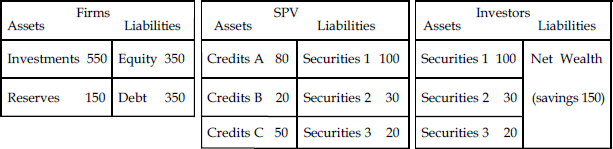
Firms sell their credits to a Special Purpose Vehicle (SPV) which makes the purchase with proceeds obtained through the issuance of securities bought by investors. The firms can use the reserves of 150 for consumption, investment or repayment of existing debts. The SPV is a separate legal structure, also referred to as a conduit, that issues asset-backed securities (ABSs). These securities can be structured in a variety of ways.9 Some of them may be actual ownership titles in the SPV that give a pro rata property title on the credits held (pass-through ABSs). Others can be debentures that promise a rate of return that is only collateralized by the credits held (pay-through ABSs). Any of these types of ABSs can be issued in different tranches (three in our example), in which case the payment of income on a more junior tranche, i.e., with lower rating, is conditioned on the prior payment of income on the most senior tranches.10 For investors, ABSs represent an additional opportunity for their savings.
On a technical level, other actors are involved also. The collection of the future receivables (repayment of the credits A, B and C) may be fulfilled by a specialized servicer.11 The servicer’s activities may be monitored by a trust that defends investors’ interests. More importantly, the very issuance of ABSs, especially when they are structured, requires the involvement of banks and rating agencies. Banks provide various degrees of liquidity facilities and credit-enhancement schemes that are crucial, together with tranching, for the evaluation of ABSs by rating agencies. In turn, this evaluation assesses the expected risk of investment in the ABSs, and determines the interest rate at which they could be issued. Analysts observe that securitization depends crucially on the rating process: “Rating agencies may be the single most important players in the securitization process.”12 However, to obtain a good rating seems to be a rather weak constraint for the success of an ABS issuance: “A securitization sponsor can theoretically structure the securitization to get any rating(s) it wants.”13
From an economic point of view, securitization merely intermediates savings. One intuitive rationale for this rather roundabout technique is that competition between firms pushes them to accommodate clients with the financing of their purchases. Securitization then is the way to provide the funds, whose ultimate beneficiaries are the firms’ clients. Clients, i.e., the ultimate debtors, may well appreciate and therefore remunerate that additional service enough for the ABSs to offer attractive yields to the investors. Firms may find this arrangement the best way to expand their turnover, rather than financing a more aggressive sales policy through additional fund raising that would become ever more expansive as it deteriorates their equity-to-debt ratio. There may be even a direct financial advantage for them, to the extent that market participants judge their activities riskier than the default risk of their clients. Under all circumstances, firms pass the credit risk of their assets to other market participants that are more willing to bear it.14
It is commonly admitted that securitization was created in 1970, when the Government National Mortgage Association (Ginnie Mae) issued a mortgage-backed security (MBS) in the form of a pass-through.15 If the contemporary rise of this technique is indeed rooted in mortgage loans, securitization first occurred in the eighteenth century as a means for financing the West Indies plantations. Deon Deutz, a Dutch businessman, issued bonds with the proceeds of which he financed mortgage loans to plantation owners in Suriname. The bonds’ yield was dependent on the return of the plantation loans, themselves guaranteed by the plantations and crops. These plantation loans “can be viewed as the forerunners of modern mortgage-backed securities.”16 Present-day MBSs developed in the US under the patronage of government-sponsored enterprises (GSEs) such as Fannie Mae and Freddie Mac that aim at creating a secondary market for home mortgage loans.17 MBSs went through some innovations, such as the creation of collateralized mortgage obligations (CMOs) in 1983 and of Real Estate Mortgage Investment Conduits (REMICs) that facilitate the issuance of CMOs. CMOs are specifically designed to address the prepayment risk in the event of falling interest rate, through the cushion system of the tranches.18 Based on the model of MBSs, banks started issuing ABSs in the 1980s. Besides mortgage loans, ABSs use automobile, credit card and student loans as underlying assets. They are offered on the market either as long-term corporate bonds or as short-term commercial paper, better known as asset-backed commercial paper (ABCP).
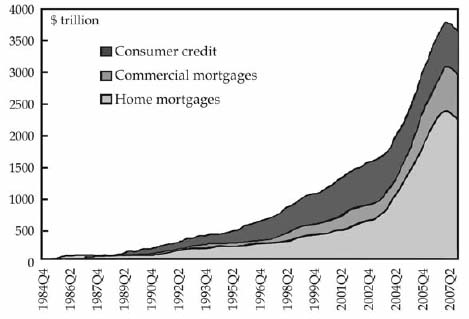
Securitization has had an exponential growth (Chart 1). Securities issued by GSEs reached $7.5 trillion in the beginning of 2008, ABSs rose to $3.6 trillion, while the amount of ABCP stood at $0.8 trillion. If securitization represented only 2.5 percent of credit-market debt owed by all sectors in 1970, that ratio reached 24.0 percent in 2008. Home mortgages, which are almost the exclusive asset held by GSEs, have been in the portfolio of ABS-issuers varying from 35 percent of total assets in 2000 to 64 percent in 2006 (Chart 2).19
Evidence shows that securitization concerns mainly loans granted by banks, and not credits made by producers or distributors of commodities. The next question that needs to be addressed, therefore, is how the general principles of securitization change when this financial technique is carried out by modern banks.
Chart 1
Growth of Securitization (1970–2008)20
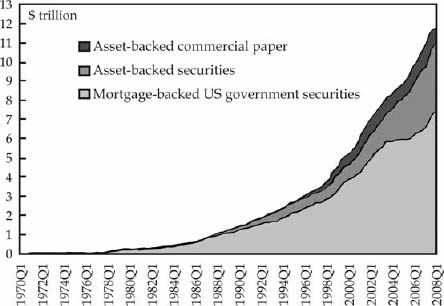
Chart 2
Structure of assets underlying ABSs (1984–2008)21
FRACTIONAL RESERVE BANKS AND SECURITIZATION
Contemporary commercial banks combine two essentially different functions. First, they serve as intermediaries between saver-capitalists and investor-entrepreneurs. Banks issue a debt instrument (bonds or commercial paper) only in order to lend the funds thereby collected to economic agents that need financing. As financial intermediaries, banks transform the maturity, risk and currency profile of existing savings.22 This activity itself implies specific risks (credit, interest, currency, etc.) that banks may be willing to bear wholly, to manage partially or to hedge completely. Whatever their position toward these transformation-induced risks, their activity qua intermediaries consists in pooling and channeling existing savings. Because the loans that banks make come from actual wealth that is only transferred from one individual to another, one can speak of real credit. Real credit is the very foundation of capital accumulation and economic growth.
Second, banks act as fractional reserve depository institutions. This means that they are legally obliged to keep in reserves only a (very small) fraction of any amount of money that is deposited with them. The part of the money in excess of that fraction can be used for granting credits, i.e., for creating an additional deposit that is made available to the receiver of the credit. It follows that contemporary banks, in addition to channeling existing savings, are also creating deposits that they lend out. Since such deposits are not brought about by existing savings, one can speak of bank (as opposed to real) credit.23 It is precisely their ability to create bank credit through new deposits that makes banks specific and different from other companies, financial or not. The capacity to create deposits implies the capacity to increase the supply of media of exchange, for deposits are used as media of exchange. Since this is the particular feature of contemporary banks, we have to analyze securitization by banks especially in relation to its possible monetary impact. In order to do this, let us first briefly outline the operation of a fractional reserve banking system (Table 3).
Table 3
Synthetic Balance Sheet of a Fractional Reserve Banking System
| Bank A | Central Bank | |||||||
| Assets | Liabilities | Assets | Liabilities | |||||
| Reserves | 200 | Capital | 1,000 | Gold & Forex | 100 | Deposits | 350 | |
| Credits | 12, 500 | Debt | 600 | Lending | 550 | Banknotes | 400 | |
| Investments | 900 | Deposits | 12,000 | Investments | 200 | Capital | 100 | |
Bank A has to comply with two basic regulations. It must keep reserves equal to 2 percent of its overall deposits and its capital (equity) should represent at least 8 percent of its credits.24 Bank A’s total assets include its liquidity reserves in the form of a deposit at the Central Bank (200), its credits to economic agents (12,500) and its investments in real estate and securities (900). Bank A has obligations towards its creditors (600) and towards depositors (12,000). The net difference between assets and liabilities is equilibrated by A’s capital (1,000). The typical Central Bank’s balance sheet also reports some of these asset and liability elements. Deposits held at the Central Bank (350) contain A’s reserves among deposits from other institutions (other banks and government). The Central Bank’s lending (550) is partly reflected in A’s debt (as well as in the debt of government and of other financial institutions). The Central Bank’s investments (200) represent holdings of securities, some of which may have been issued by A, as part of its debt. The other figures have been adjusted in order to equilibrate the balance sheet.25
It appears that A does not respect the liquidity reserve requirement. Assuming that it does not want to lose its shares on the deposit market, it needs to increase its reserves by 40, i.e., to replenish its account at the Central Bank. One means to achieve this consists in obtaining a credit by the Central Bank through open-market operations. A cedes a total of 40 worth of assets to the Central Bank, which creates a corresponding liquidity that is credited to A’s account.26 The Central Bank’s total liabilities increase by that same amount, while A’s total assets remain constant, due to the substitution of reserves and other assets. An alternative means for A would be to obtain liquidity from economic agents that have excess liquidity. Securitizing 40 of its credits is the proper way to capture that liquidity. This would also improve the capital-adequacy ratio. There is a substitution between different assets on A’s balance sheet, while the Central Bank’s total liabilities remain unaffected. From the standpoint of an individual bank, securitization appears, therefore, tantamount to refinancing at the Central Bank, the difference being that it does not imply an increase of total liquidities in the economic system, but only redistribution thereof among banks. The question then arises as to how securitization functions from the standpoint of the entire banking system.
From a systemic viewpoint, we must reject the assumption of liquidity shortage or excess. Let us consider A’s balance sheet from Table 3, after refinancing at the Central Bank for 40 in exchange for part of its investments, as the consolidated banking system balance sheet. The question now is to identify how securitization economically affects the banking system, and how this is translated in accounting terms. One bank’s mortgages are used to pay house builders, who in turn pay workers, producers of building material, etc. The latter spend the new monetary units on consumption and investment goods. Among the variety of goods that the receivers of the new deposits purchase are securities, some of which are ABSs.27 When ABSs are purchased, bank checks are written or money order payments are made that de facto transfer ownership of bank deposits to the issuing SPVs. The SPVs then pass the ownership of the deposits on to the banks, from which they acquire mortgage or other type loans. The credit-selling banks thereby obtain claims on customers’ deposits held by themselves or by other banks. After compensation, the system’s deposits decrease exactly by the amount of credits sold to the SPVs, i.e., purchased by banks’ customers. From the standpoint of the entire banking system, securitization implies, therefore, a simultaneous reduction in credits and deposits. If we turn back to our numerical example now, if 10 percent of all credits are securitized, credits that remain on the banks’ books amount now to 11,250, while their obligations to depositors decrease concomitantly to 10,750. At this stage, total deposits of 10,750 are backed by reserves of 240, while total equity of 1,000 guarantees credits of 11,250. The liquidity reserve ratio increases from 2 percent to 2.23 percent, while the capital adequacy ratio rises to 8.89 percent. Securitization leads to excess liquidity and to improved compliance with capital provision regulations despite the fact that the Central Bank has not increased its total liabilities and additional savings have not been channeled into the banking industry.
What will then be the next step of the banking system, given the excess liquidity? Banks will grant new credits until the existing excess reserves (25, i.e., the existing 240 minus 2 percent of 10,750 of deposits) are just enough to cover the new deposits created through bank credit. Ignoring liquidity outflows driven by a higher demand for banknotes and by purchases abroad, it is straightforward that banks can grant as much new loans as credits have been securitized. Then the process can be repeated again and again, as long as there is demand for asset-backed securities, without ever returning to the Central Bank for refinancing. Securitization allows fractional reserve banks to grant more loans, while keeping total deposits, i.e., the money supply in the broad sense, constant in the economy. This is explained by the fact that the securitized credits are purchased by the SPVs by means of those same deposits that were created by banks in the very process of granting the credits. As a matter of fact, banks create both the object to be sold (credits) and the means by which it can be purchased (deposits). It is this aspect of FRBs that makes their use of securitization special.28
The operational aspects of securitization having been outlined, let us now address its economic characteristics.
THE ILLUSION OF SAVINGS-DRIVEN GROWTH
AND THE SPREAD OF SECURITIZATION
Securitization allows FRBs to withdraw from the market the liquidities they have created and lent out. It reduces the money supply by the amount of liquid assets used to purchase the asset-backed securities. Therefore, it hides the reverse side of bank credit—the increase in the money supply, i.e., inflation. It makes the economic environment appear less inflationary than it should be, given individuals’ growing indebtedness to banks. Securitization portrays a bank-credit driven boom as non-inflationary, savings driven growth. It contributes to the widespread illusion that more factors of production are available than in reality, and becomes thereby a factor in the generation of the error-induced boom-bust cycle.29
To a certain extent, economists have already recognized that securitization restrains the money-supply growth during a credit boom. From a different approach, central bank economists have come to the conclusion that securitization decreases the power of monetary policy: “securitization has likely weakened the impact of any policy move.”30 This, of course, means that securitization insulates banks’ lending activity from the central bank’s liquidity policy, which confirms our main conclusion and is even overtly stated by other economists: “Using a large sample of European banks, we find that the use of securitization appears to shelter banks’ loan supply from the effects of monetary policy.”31 The central bankers’ perspective is that of growing concern about loosening their grasp of the money supply. Such a concern implicitly admits that securitization disconnects the money-supply growth from bank-credit growth.32
To a certain extent, our analysis is in conformity with the increasingly common view among economists, at least as far as the outer description of the phenomenon is concerned. However, when it comes to understand what contributes to the spread of securitization, we must part with the traditional approach, which mentions three main factors. First, securitization is presented as a way to circumvent capital adequacy regulations, because it transfers the credit risk of the loans from bank’s books to the investors in the asset-backed securities. Second, the “originate and distribute model,” according to which credits are only originated by banks and then distributed to investors who fund them, appears more attractive than the “originate and hold model” because of higher frequency of banking fees. Third, asset-backed securities add to the choice of investment opportunities and contribute to the efficiency of financial markets.33 While these assertions may be true in themselves, it is not true that they systematically render securitization the best solution for FRBs.
Indeed, securitization improves banks’ capital-adequacy ratio, as shown in our numerical example. However, given that banks have to raise capital only up to 8 percent of their new credits, it is never too expensive for them to pay dividends to new capital in order to grant 12.5 times more loans. In addition, the interest on the securitized loans is lost for the banks. Securitization, therefore, is not really saving the cost of capital raising, for expenses on capital are not an obstacle to the expansion of banks’ activity.34 The “originate and distribute” model does have the advantage of increasing banks’ fees, but it has also the inconvenience of depriving the originator of the credit of the interest yield, which is transferred to the buyers of the asset-backed securities. There is no guarantee that the accumulation of servicing fees from securitized loans would be higher than the interest rates received on even a smaller amount of credits kept on the balance sheets. Finally, the assets-backed securities allow investors to obtain the same risk-revenue exposure as the one they would have obtained if investing in the banks and if banks have kept the loans on their books. It is therefore not clear in what sense there are new investment opportunities offered on the market.
All three traditional explanations of securitization assume that origination and funding of the securitized loans are two unrelated processes.35 Our analysis shows that, to the contrary, they are two analytically inseparable aspects of FRBs’ operation. As a matter of fact, securitization is of interest for economists only insofar as it is used by FRBs to dissimulate the inflationary impact of credit expansion. From this perspective, a full assessment of securitization needs, indeed, to explain how it became a widely used technique. The crucial point, from bankers’ points of view, is to create a demand for part of their loans, repackaged as structured securities. It follows that securitization relies critically on the ABSs’ quality as perceived by investors. Securitization by FRBs can work only if securitized loans are presented to the public as actually different from what they are. Hence, factors that change investors’ preferences favorably toward these financial assets are the real determinants of the success of this technique. In a sense, securitization is based on institutions that create and maintain an illusion.36
Three illusion-creating institutions can be identified: government, rating agencies, and credit default insurers. All three contribute, in different ways, to change investors’ perceptions of the ABSs’ risk-return profile. Government, which was historically related to the modern inception of securitization in the USA, was providing an implicit guarantee of refinancing Fannie Mae and Freddie Mac.37 Rating agencies grant quality labels to privately issued ABSs. Credit insurers help enhance these labels through promises, namely to pay for defaulted creditors, that objectively cannot be carried out in the event of a systemic crisis.38 All three contribute to an over-valuation of ABSs relatively to other financial assets.
CONCLUSION
Securitization is a financial technique that permits the exchange of relatively non-marketable credit claims for liquidities. As such, it exploits an exchange opportunity between individuals with opposite liquidity valuations in their preference scales. Its modern usage by fractional reserve banks has dissociated the growth of credit expansion from the growth of the money supply. Securitization has provided banks with an alternative source of liquidity, different from central banks’ open-market operations, thereby weakening the latter’s control of the total amount of credit in the economy. It has contributed to de-monetizing bank credits, thereby containing inflation under conditions of growing indebtedness. Securitization has therefore become a tool for spreading the illusion of savings-driven economic growth and for creating the economic cycle. 
Nikolay Gertchev (ngertchev@gmail.com) is an economist with the European Commission, Brussels, Belgium. The views expressed in this article are strictly personal and do not engage the responsibility of the European Commission.
39Hans-Hermann Hoppe, “Banking, Nation States and International Politics: A Sociological Reconstruction of the Present Economic Order,” Review of Austrian Economics 4 (1990): 55–87; idem, “How is Fiat Money Possible?—or, The Devolution of Money and Credit,” Review of Austrian Economics 7, no. 2 (1994): 49–74; Hans-Hermann Hoppe, Jörg Guido Hülsmann, and Walter Block, “Against Fiduciary Media,” Quarterly Journal of Austrian Economics 1, no. 1 (1990): 19–50.
40Ludwig von Mises, Theory of Money and Credit (Indianapolis, Ind.: Liberty Fund, 1981 [1912]); idem, Human Action: A Treatise on Economics, Scholars ed. (Auburn, Ala.: Mises Institute, 1998 [1949]); Murray N. Rothbard, What Has Government Done to Our Money? (Auburn, Ala.: Mises Institute, 1990 [1963]). Even though Mises and Rothbard are not the first to have demonstrated how the monopoly of money production can be used as a means of expropriation, they are the closest, by intellectual affinity and scholarly heritage, to the essentialist and ethical flavor of Hoppe’s particular analysis.
41Hans-Hermann Hoppe, “Government, Money, and International Politics,” Etica & Politica/Ethics and Politics 5, no. 2 (2003).
42Two technical specialists of the field even advance that securitization is as crucial as capital markets: “Securitization is as necessary to any economy as organized financial markets.” Frank Fabozzi and Vinod Kothari, “Securitization: The Tool of Financial Transformation,” Yale International Center for Finance, Working Paper No. 07-07 (2007), p. 11.
43Since 1996, the area is the central topic of a journal of its own—The Journal of Structured Finance. References to the large variety of legal studies, as well as basic treatment of the fundamental legal issues raised by securitization, can be found in Claire Hill, “Securitization: A Low-cost Sweetener for Lemons,” Washington University Law Quarterly (Winter 1996): 1061–1120 and Steven Schwarcz, “The Alchemy of Asset Securitization,” Stanford Journal of Law, Business and Finance 1 (1994): 133–54. The following technical presentations were all published by the research departments of central banks: Randall Pozdena, “Securitization and Banking,” Weekly Letter, Federal Reserve Bank of San Francisco (July 4, 1986); Charles Carlstrom and Katherine Samolyk, “Securitization: More than Just a Regulatory Artifact,” Economic Commentary, Federal Reserve Bank of Cleveland (May 1, 1992); Christine Cumming, “The Economics of Securitization,” Federal Reserve Bank of New York Quarterly Review (Autumn 1987): 11–22; Ronel Elul, “The Economics of Asset Securitization,” Business Review, Federal Reserve Bank of Philadelphia (Q3 2005), pp. 16–25; Emre Ergungor, “Securitization,” Economic Commentary, Federal Reserve Bank of Cleveland (August 15, 2003). Practical issues, such as the impact of securitization on interest rates and on monetary policy, have been developed by James Kolari, Donald Fraser and Ali Anari, “The Effects of Securitization on Mortgage Market Yields: A Cointegration Analysis,” Real Estate Economics 26, no. 4 (1998): 677–93; Arturo Estrella, “Securitization and The Efficacy of Monetary Policy,” FRBNY Economic Policy Review 8, no. 1 (2002): 242–56; Yener Altunbas, Leonardo Gambacorta & David Marquès, “Securitisation and the Bank Lending Channel,” European Central Bank Working Paper Series no. 838 (2007); and ECB, “Securitisation in the Euro Area,” Monthly Bulletin (February 2008): 81–94. A complete multidisciplinary study, meant also to be a practitioners’ guide, is Vinod Kothardi, Securitisation—The Financial Instrument of the Future (Wiley Finance, 2006).
44The underlying ultimate cause of these exchanges is rooted in individuals’ time preference rates that are higher than the current interest rate. On the importance of time preference for the process of civilization in general and for economic analysis in particular, see Hans-Hermann Hoppe, Democracy—The Gold that Failed: The Economics and Politics of Monarchy, Democracy, and Natural Order (New Brunswick, N.J.: Transaction Publishers, 2001), especially chap. 1.
45Ergungor, “Securitization,” p. 1.
46All numbers, in tables and in the text, refer to a quantity of well-defined monetary units (dollars, euros, ounces of gold, etc.), which we will avoid to mention systematically in order to avoid redundancy.
47This explains why securitization is often considered as part of the broader area of structured finance, i.e., the engineering of structured financial products.
48Tranching is considered to be a form of insurance for the owners of the senior securities. Indeed, the junior securities act as cushions for losses on the credit portfolio of the SPV to the extent that these losses do not exceed the income payments on the junior securities.
49It is most common for the firms who made the credits, often referred to as originators of the credits, to play this role. Securitization then allows a new business model with regard to credits—“originate and distribute” as opposed to “originate and hold.”
50Joel Telpner, “A Securitisation Primer for First Time Issuers,” Global Securitisation and Structured Finance 2003 (Greenberg Traurig, 2003), p. 5. This is not an isolated opinion: “Rating agencies dictate a significant amount of the structure of securitization transactions. When the transactions were initially being structured, the rating agencies were heavily involved.” Hill, “Securitization,” p. 1071.
51Telpner, “A Securitisation Primer,” p. 5.
52As noted by an analyst: “The securitization process allows the company to separate financial assets from credit, performance and other risks associated with the company itself.” Telpner, “A Securitisation Primer,” p. 1. For a detailed and still clear-cut explanation of the possible benefits of securitization for all parties involved, see Philip R. Wood, Title Finance, Derivatives, Securitisations, Set-off and Netting (London: Sweet & Maxwell, 1995), pp. 41–68.
53Carlstrom and Samolyk, “Securitization,” p. 2.
54K. Geert Rouwenhorst, “The Origins of Mutual Funds,” Yale International Center for Finance, Working Paper no. 04-48 (2004), p. 5.
55A general account of the activities of Fannie Mae and Freddie Mac can be found in Scott Frame and Lawrence White, “Fussing and Fuming over Fannie and Freddie: How Much Smoke, How Much Fire?,” Journal of Economic Perspective 19, no. 2 (2005): 159–84 and Richard Green and Susan Wachter, “The American Mortgage in Historical and International Context,” Journal of Economic Perspectives 19, no. 4 (2005): 93–114, while Gordin Sellon and Deana VanNahmen, “The Securitization of Housing Finance,” Economic Review, Federal Reserve Bank of Kansas City (July/August 1988): 3–20 present an early synthesis on their more specific role in the spread of securitization.
56With falling interest rates, fixed-rate borrowers are inclined to refinance their mortgages, thereby letting the lender bear the interest rate risk. Early repayment also changes the duration of a lender’s portfolio, which may compromise other aspects of his investment strategy. Let us note that long-term home loans with fixed interest rates and low loan-to-value ratio are the outgrowth of government intervention during the Great Depression that aimed at rescuing bankrupt banks. Prior to the creation of the Federal Housing Administration in 1936 and of Fannie Mae in 1938, a typical mortgage had flexible rates, a maturity of up to five years, and a loan-to-value ratio of 50 percent. Green and Wachter, “The American Mortgage in Historical and International Context,” pp. 94–96.
57The securitization growth trend has been less pronounced in Europe, where, for instance, ABCP represents only 30 percent of the commercial paper market, to compare with 50 percent in the US. FitchRatings, “The Importance of Liquidity Support in ABCP Conduits,” ABCP/Global Special Report (October 25, 2007), p.1. The total outstanding volume of ABSs in the European market was estimated at €1.3 trillion in September 2007, 60 percent of which was eligible as collateral for liquidity at the European Central Bank. ECB, “Securitisation in the Euro Area,” p. 92.
58Source: Flow of Funds Accounts of the United States. Data for ABCP since 2006 has been extracted from the Ecowin Reuters database. Government securities, i.e., privately issued securities that are eligible for open-market operations, are not to be confused with Treasury securities.
59Source: Flow of Funds Accounts of the United States. Mortgage-backed securities pooled and issued by GSEs are not included.
60The relations involved by this intermediation could be represented by the last two balance sheets of Table 2, where the SPV is to be replaced by the financial intermediary. Thinking of the SPV as of a standard financial intermediary strengthens our view that the most plausible rationale for securitization on the free market is to provide convenience to customers. As a matter of fact, they do not have to deal with the financial intermediary, but only with the seller (firms A, B and C in our example) who is in charge of the financial arrangement, precisely through securitization.
61For a full-fledged theory of this important distinction, and a complete analysis of the legal and economic consequences of bank credit as opposed to real credit, see Jesus Huerta de Soto, Money, Bank Credit, and Economic Cycles (Auburn, Ala.: Mises Institute, 2006). Huerta de Soto convincingly shows, in line with findings by Chester Arthur Phillips and Milton Friedman, that from the standpoint of the entire banking sector, the limit on granting bank credit is a multiple of any initial monetary deposit, irrespective of which bank is the first to receive that money. The lower the required reserve ratio and individuals’ demand for banknotes, the higher that multiple is.
62We borrow these numbers, for the sake of an example, from current practices in the euro area, according to which banks have to keep average reserves of 2 percent of their deposits, and from the Basle II capital requirements.
63Other figures are not commented upon insofar as they do not concern the issue of securitization. The discussion of issues such as international monetary arrangements, demand for banknotes and central banks’ histories would, of course, require elaborating on these other elements.
64We speak of cession rather than of selling, because open-market operations may take a variety of legal forms: outright purchases of Treasury securities (as conducted by the FED), extendable repurchase agreements (also typical of the Fed), or simply renewable short-term collateralized loans (as carried out by the European Central Bank). The economically relevant fact is the creation of liquidity for Bank A, not the concrete legal form it takes. For details on open-market operations, see FED, The Federal Reserve System: Purposes and Functions <www.federalreserve.gov/pf/pdf/pf_complete.pdf> (June 2005 [1939]); ECB, The Implementation of Monetary Policy in the Euro Area: General Documentation on Eurosystem Monetary Policy Instruments and Procedures <http://www.ecb.int/pub/pdf/other/gendoc2008en.pdf> (November 2008).
65Our sequence of distributing new liquidity in the economic system starts with the construction sector, but it could start with any other economic sector, including the financial sector itself.
66Banks that keep total reserves can make only real credit, i.e., they can lend out only funds collected through the issuance of securities (shares and bonds). Consecutive waves of securitization would imply consecutive reductions in investors’ money holdings, whether cash or deposits, that could not be countered by the banking system.
67Jörg Guido Hülsmann, “Toward a General Theory of Error Cycles,” Quarterly Journal of Austrian Economics 1, no. 4 (1998): 1–23.
68Estrella, “Securitization and The Efficacy of Monetary Policy,” p. 1.
69Altunbas et al., “Securitisation and the Bank Lending Channel,” p. 4.
70Further evidence of the acceptance of this result by other economists is easy to find: “securitization provides an ever-growing funding source to banks and may well be the most important engine of growth in bank lending.” Ergungor, “Securitization,” p. 4.
71That third reason is presented sometimes as an overt syllogism: “For the issuer, the bottom line is to create a set of new securities that are worth more in aggregate than the value of the underlying assets.” Lakshman Alles, “Asset Securitization and Structured Financing: Future Prospects and Challenges for Emerging Market Countries,” IMF Working Paper WP/01/147 (2001), p. 5.
72If all outstanding asset-backed securities ($11.9 trillion at the beginning of 2008) were kept on US banks’ balance sheets, this would have required, over the last 30 years, an additional capital injection of up to $ 952 billion. For comparison, at the beginning of 2008, the market value of all US corporate equities was $19.4 trillion, out of which $4.1 trillion were financial corporations’ equities (Flow of Funds Accounts of the United States, Table L.213).
73Alles, “Asset Securitization and Structured Financing,” p. 15.
74To a certain extent, the illusionary nature of securitization by banks has been well captured by a legal analyst: “Securitization, in short, brings to financial technology what the sought-after philosopher’s stone promised to bring to base metals—the ability to turn them into gold!” Schwarcz, “The Alchemy of Asset Securitization,” p. 154.
75That guarantee became explicit in September 2008, when both companies were nationalized.
76The very important question of whether “credit insurance” is an instance of insurance rests out of the scope of the present paper. Let us, however, note here that, following Mises and Hoppe, we may conclude that credits cannot be insured, as the events “going bankrupt” are not independent, uncorrelated elements with an identifiable class probability. See Mises, Human Action, pp. 105–19; Hans-Hermann Hoppe, “On Certainty and Uncertainty, Or: How Rational Can Our Expectations Be?,” Review of Austrian Economics 10, no. 1 (1997): 49–78; idem., “The Limits of Numerical Probability: Frank H. Knight and Ludwig von Mises and The Frequency Interpretations,” Quarterly Journal of Austrian Economics 10, no. 1 (2007): 3–21. This implies that the very notion of credit insurance contributes to the creation of an illusion.
- 1Professors Hoppe’s publications, including links to translations and a detailed bibliography, are available at his website, www.hanshoppe.com.
- 2“Hans-Hermann Hoppe: Potret Intelektual Anti-Intelektual” [“Interview with Hans-Hermann Hoppe, an Anti-Intellectual Intellectual”], interview by Sukasah Syahdan, Akal dan Kehendak (Indonesia) (Apr. 28, 2008) (English translation available at www.hanshoppe.com/publications).
- 3“Principles of the Property and Freedom Society,” available at www.propertyandfreedom.org (quoting the Opening Declaration from the Inaugural Meeting: Bodrum, Turkey, May 2006).
- 4Hans-Hermann Hoppe, A Theory of Socialism and Capitalism: Economics, Politics, and Ethics (Boston: Kluwer Academic Publishers, 1989), chs. 2 & 7; idem, The Economics and Ethics of Private Property: Studies in Political Economy and Philosophy, 2nd ed. (Auburn, Ala.: Ludwig von Mises Institute, 2006 [1993]), chs. 11–13, 15, and “Appendix: Four Critical Replies.”
- 5Idem, Democracy.
- 6Idem, “Government and the Private Production of Defense,” in idem, ed., The Myth of National Defense: Essays on the Theory and History of Security Production (Auburn, Ala.: Ludwig von Mises Institute, 2003).
- 7On immigration, see Hans-Hermann Hoppe, “The Case for Free Trade and Restricted Immigration,” Journal of Libertarian Studies 13, no. 2 (Summer 1998): 221–33; idem, “Natural Order, the State, and the Immigration Problem,” Journal of Libertarian Studies 16, no. 1 (Winter 2002): 75–97.
- 8Idem, “On Time Preference, Government, and the Process of De-Civilization,” p. 24, n. 25.
- 9Cf. Hoppe’s discussion of Robert Nozick’s “disparate or loosely jointed arguments, conjectures, puzzles, counterexamples, experiments, paradoxes, surprising turns, startling twists, intellectual flashes, and philosophical razzle-dazzle,” in “Murray N. Rothbard and the Ethics of Liberty,” Introduction to Murray N. Rothbard, The Ethics of Liberty, 2nd ed. (New York and London: New York University Press, 1998), pp. xxiv.
- 10Stephan Kinsella & Jeffrey Tucker, “The Ordeal of Hoppe,” The Free Market 26, no. 4 (April 2005).
- 11Ibid., p. 71; and Hans-Hermann Hoppe, Eigentum, Anarchie und Staat: Studien zur Theorie des Kapitalismus (Opladen: Westdeutscher Verlag, 1987).
- 12Hoppe, Democracy, p. 74; and Hans-Hermann Hoppe, The Economics and Ethics of Private Property: Studies in Political Economy and Philosophy (Boston: Kluwer, 1993).
- 13Hoppe, Democracy, p. 71.
- 14Domenico Losurdo, Nietzsche il Ribelle Aristocratico: Biografia Intelettualle e Bilancio Critico (Turin: Bollati Boringhieri, 2002).
- 15Hans-Hermann Hoppe, Der Gott, der keiner ist, Robert Grözinger, trans. (Waltrop & Leipzig: Manuscriptum Verlagsbuchhandlung, 2003), pp. 7–8 (English translation from Hans-Hermann Hoppe, “Demokratie. Der Gott, Der Keiner Ist,” LewRockwell.com (December 5, 2003)). See also similar comments in Hoppe, Democracy, pp. x–xi; and xxiii, noting that “both Mises and Rothbard had a soft spot for democracy and tended to view the transition from monarchy to democracy as progress.”
- 16Caspar von Schrenck-Notzing, Charakterwäsche: Die Politik der amerikanischen Umerziehung in Deutschland (Graz: Ares Verlag, 2004); and Ernst von Salomon, Der Fragebogen, seventeenth ed. (Rowohlt Taschenbuch Verlag, 2007).
- 17Stephan Kinsella, “The Undeniable Morality of Capitalism [review essay of Hoppe’s The Economics and Ethics of Private Property (1993)],” St. Mary’s Law Journal 25 (1994), p. 1434.
- 18Hans-Hermann Hoppe, “Reflections on the Origin and the Stability of the State,” LewRockwell.com (June 23, 2008).
- 19Alan Pendleton Grimes, American Political Thought (New York: Holt, 1960), p. 283.
- 20Michael Vorenberg, Final Freedom: The Civil War, the Abolition of Slavery, and the Thirteenth Amendment (Cambridge: Cambridge University Press, 2001), p. 64.
- 21Merle Curti, The Roots of American Loyalty (New York: Columbia University Press, 1946), p. 175.
- 22Karl Marx to Friedrich Engels, October 29th–November 17th, 1862, in Karl Marx on America and the Civil War, Saul K. Padover, ed. (New York, McGraw-Hill, 1972), p. 263.
- 23James A. Rawley, The Politics of Union: Northern Politics during the Civil War (Lincoln: University of Nebraska Press, 1980), p. 184.
- 24Abraham Lincoln to H.L. Pierce et al. (April 6th 1859), Collected Works, vol. II, p. 375.
- 25Just as an example, in the late Nineteenth century John W. Burgess offered a definition of sovereignty as an “original, absolute, unlimited, universal power over the individual subject and over all associations of subjects,” and of “the State . . . [as] the source of all titles to land and of all powers over it,” John W. Burgess, Political Science and Comparative Constitutional Law (Boston-London: Ginn, 1891), vol. I, pp. 47, 52.
- 26Fries, “Staatstheorie and the New American Science of Politics,” p. 403.
- 27Benjamin Zipursky, “Pragmatic Conceptualism,” Legal Theory 6, no. 4 (December 2000): 462.
- 28Ibid., pp. 462–23.
- 29Anthony T. Kronman, “Wealth Maximization as a Normative Principle,” Journal of Legal Studies 9, no. 2 (March 1980): 240. Despite the fact that conclusions of Kronman and Austrians in this particular normative question coincide, we shall, for the sake of fairness, not forget that his approach to criticism of Posner is heavily influenced by the neoclassical notion of economics. Kronman, for example, uses utils and without hesitation engages in an interpersonal comparison of utility. Walter Block once rightly raised this objection in his reply to Kronman. See Walter Block, “Alienability, Inalienability, Paternalism, and the Law: Reply to Kronman,” American Journal of Criminal Law 28, no. 3 (Summer 2001): 351–71.
- 30Richard A. Posner, “Utilitarianism, Economics, and Legal Theory,” Journal of Legal Studies 8, no. 1 (1979): 119.
- 31Posner, “Efficiency Norm,” p. 500.
- 32Posner, “Utilitarianism, Economics, and Legal Theory,” p. 125.
- 33Dworkin, “Is Wealth a Value?,” p. 208. Dworkin indeed asserts that under present conditions, it would be for most people today “impossible to repurchase the right to their labor, because the value of that labor represents more than half of their present wealth.” Ibid., p. 209.
- 34Ian Shapiro, The Flight from Reality in the Human Sciences (Princeton, N.J.: Princeton University Press, 2005), p. 111.
- 35Jules L. Coleman, “Efficiency, Exchange and Auction: Philosophic Aspects of the Economic Approach to Law,” California Law Review 68, no. 2 (March 1980).
- 36Kronman, “Wealth Maximization as a Normative Principle,” pp. 240–41.
- 37Posner, The Economics of Justice, p. 77 n. 57.
- 38Hans-Hermann Hoppe, “Law and Economics,” Lecture delivered at Mises University, Mises Institute, Auburn, Alabama, Friday, August 5, 2005. Available at http://mises.org/multimedia/mp3/MU2005/mu05-Hopp2.mp3.
- 39Eventually, Hoppe turned into a full-blown Austrian when, in the early 1980s, he went to the United States on a prestigious Heisenberg fellowship. This time his research project concerned political philosophy, but it was again squarely built on Austrian economics. In 1986, he became Rothbard’s colleague at the University of Nevada, Las Vegas (UNLV), where he would teach for the next 21 years. After Rothbard’s untimely death in 1995, Professor Hoppe assumed a place of uncontested leadership among Austro-libertarian scholars, becoming the editor of the Journal of Libertarian Studies, a co-editor of the Review of Austrian Economics, and then a co-editor of the Quarterly Journal of Austrian Economics. Professor Hoppe, now Professor Emeritus of Economics at UNLV and Distinguished Fellow with the Ludwig von Mises Institute, also serves on on the editorial board of Libertarian Papers. In addition to authoring numerous scholarly articles, his important books include Handeln und Erkennen (1976), Kritik der Kausalwissenschaftlichen Sozialforschung (1983), Eigentum, Anarchie, und Staat (1987), A Theory of Socialism and Capitalism (1989), The Economics and Ethics of Private Property (1993, enlarged 2nd edition 2006), Democracy—The God that Failed (2001), and The Myth of National Defense (editor, 2003). His works have been translated into at least 21 languages, not counting English.
- 40Among Professor Hoppe’s many achievements we should stress in particular his brilliant critique of positivist methodology as applied to the social sciences, a new praxeological approach to political philosophy, an encompassing comparative analysis of socialism and capitalism, and a theory of secession as a means of political reform. Most importantly, in his book Democracy—The God that Failed, Professor Hoppe has delivered a profound critique of democracy, as well as an original reinterpretation of Western history in the twentieth century, both of which have stirred international debate in academia and among the wider public. Other influential works from his pen have dealt with the role of migrations within a free society, and with the role of public intellectuals in political transformation processes. Moreover, he has excelled as an historian of thought and made path-breaking contributions to other areas such as monopoly theory; the theory of public goods; the sociology of taxation; the positive methodology of the social sciences; the theory of risk; the production of security; the transformation of formerly socialist countries; and the evolution of monetary institutions and their impact on international relations. And Professor Hoppe’s work is ongoing: he is currently working on a major book project that will restate and elaborate on his previous work in the fields of epistemology and ethics—more generally, the nature of human rationality. The goal of the book is to provide “a systematic and interdisciplinary reconstruction of human history (pre-history, hunter-gatherer societies, agricultural societies, industrial societies).”
- 41for justly acquired private property, freedom of contract, freedom of association—which logically implies the right to not associate with, or to discriminate against—anyone in one’s personal and business relations—and unconditional free trade. It condemns imperialism and militarism and their fomenters, and champions peace. It rejects positivism, relativism, and egalitarianism in any form, whether of “outcome” or “opportunity,” and it has an outspoken distaste for politics and politicians.
- 42Hoppe’s axiom of private property is also of crucial importance. If you debate about ethical issues, it means that you presuppose your own right, as well as the right of other people, to debate the issue. This acceptance implies that you do respect the rights of others people involved in the debate to control their own bodies. And the conclusion is crucial: if you even begin debating what is right and what is wrong, it means that you already have acknowledged that private property is necessary and inescapable for any moral judgment. This applies even to those who try to argue against private property. The ethical ground for private property has never been so strong and deep before.
- 43There are also many other fields where Hans Hoppe has pushed the limits of political and economic science. Monarchy is not as bad as democracy, he argues. This was and still is unacceptable to many intellectuals, and most people have followed the lead of the intellectuals because they have had no good arguments to the contrary. A simple reference to the “strong hand” of a dictator was not only politically incorrect and old fashioned, but also contrary to the goals and the image of society most people actually have. Hoppe provides a clear explanation to sort through this intellectual mess. The absence of democracy in public decision-making does not necessarily mean dictatorship and the most terrible exploitation of the people. On the contrary: democracy is the system which leads to dictatorship, exploitation of others, ignorance, and vulgarity.
- 44The private provision of security is another topic which has benefitted from Hoppe’s insights. Every decent person often feels that the police are actually not providing adequate protection. But what is the alternative? Better this than nothing, or so many of those unsatisfied with government tend to conclude. An army of intellectuals is ready to help them reach this conclusion. Hoppe provides sound arguments and explains the economics of the private production of defense. No serious scholar can ignore Hoppe’s important arguments. Those who claim that there will be no security without government are simply mistaken. Now, you can direct them to Hans Hoppe’s works.
- 45Immigration, democracy, regulation—so many bad ideas abound concerning all of these issues, and Hoppe addresses them so well in his writings and speeches.
- 46Hans knows how to present an argument in a way which is very understandable, even to a man of average intellectual capacities. His examples are sometimes so unexpected and direct that they really help or even force you to rethink what you have thought about the world before. It appears very natural for him, for example, to put a footnote in a book with a short explanation why public slavery is even worse than private slavery. It does not mean that Hans tries to be simple. He is just very straightforward. He does not hesitate to criticize even free-market advocates who are not consistent in their argumentation. If you say something absurd or make flawed arguments, he usually will not hide the fact from you. Perhaps for this reason, some people even seem to be intimidated by Hans Hoppe. Understandably, it is not always pleasant to have your arguments smashed in public.
- 47Hans does not present himself as a big scholar. On the contrary, his ambition is not very great when he speaks about the role of the scholar (including himself) in society. It is not his ambition to invent some completely new theory or find a terra incognito. On the contrary, Hoppe claims that the role of a decent scholar is, first of all, to preserve what is already found, explained, and discovered. Not to waste the knowledge of the mankind, but to preserve and explain it in modern language to new generations, is to him an already ambitious task. He does it perfectly. Contrary to many of those who are happy with their ambitious and often fallacious new theories, or with “philosophical razzle-dazzle,” he is always stressing the role of his teachers and predecessors, Rothbard and Mises.
- 48Courage is another thing which goes well with Hans Hoppe’s name. Political correctness is not a good principle to hold to when you are looking for the truth, and while many people pay lip service to the importance of truth, not everyone will defend it even when his own career and name are at stake. But when liberty and the truth are at the stake, Hans Hoppe will never give up. The well-known controversy surrounding an example given about the different time preferences among different groups of people perfectly illustrates this courage.
- 49Significantly, Hans does not hold back in criticizing monarchies for doing in a quite primitive way what democratic administrations have succeeded in accomplishing with less fallout, which is monopolizing power. Like democrats, kings tried to marginalize their opposition by declaring all political authority to be a prerogative of the centralized state. Monarchical sovereignty was a prelude to democratic sovereignty, and it was based the same “original sin,” “the monopolization of the function of judge and peacemaker.” The best form of authority for Hans is, in fact, “the natural order,” one that is “[t]he natural outcome of the voluntary transactions between various private property owners” and which is “decidedly nonegalitarian, hierarchical, and elitist.” Any effort to bring this about in our democratic, late modernity is hailed as a positive step: “Thus, in addition to advocating the abdication of democracy, it is now of central strategic importance that at the same time ideological support be given to all decentralizing or even secessionist social forces.”
- 50Significantly, Hans does not hold back in criticizing monarchies for doing in a quite primitive way what democratic administrations have succeeded in accomplishing with less fallout, which is monopolizing power. Like democrats, kings tried to marginalize their opposition by declaring all political authority to be a prerogative of the centralized state. Monarchical sovereignty was a prelude to democratic sovereignty, and it was based the same “original sin,” “the monopolization of the function of judge and peacemaker.” The best form of authority for Hans is, in fact, “the natural order,” one that is “[t]he natural outcome of the voluntary transactions between various private property owners” and which is “decidedly nonegalitarian, hierarchical, and elitist.” Any effort to bring this about in our democratic, late modernity is hailed as a positive step: “Thus, in addition to advocating the abdication of democracy, it is now of central strategic importance that at the same time ideological support be given to all decentralizing or even secessionist social forces.”
- 51A question that might be raised is whether the generality of humankind would endorse the tendencies that Hans is promoting. Would democratic populations (who have ceased to be citoyens (citizens) or Staatsbürger in any meaningful sense) really want to live in the decentralized, elitist society that Hans recommends, one in which a “natural elite” possess “natural authority,” and, because of “selective mating” and the “laws of civil and genetic inheritance,” these “positions of natural authority are more likely than not passed on within a few noble families.” Why would the majority want to acknowledge these “authority persons,” who presumably would arbitrate conflicts on the basis of the social deference that others extend to them? It is hard to see why most people would accept such arrangements, as opposed to a democracy, in which the promise is made and often fulfilled of redistributing goods to the voters. The question is not whether the democratic state robs from Peter to pay Paul (it obviously does that!) but whether Hans’s “natural order” offers most people what they want. The answer is an emphatic “no” and therefore this order (which looks a bit like Friedrich Hayek’s conception of “spontaneous order”) depends for its realization on the possibility of “decentralization and secession.” Absent such a possibility, this order is in no way feasible.
- 52Two other observations may be appropriate for understanding more fully the libertarianism of the Right that Hans exemplifies. One, this libertarianism is a recognizable subspecies of what the Italian Marxist Domenico Losurdo calls “aristocratic radicalism,” which he explores in voluminous works on Friedrich Nietzsche (1844–1901). According to Losurdo, Nietzsche’s “critique of modernity” is based on his opposition to the leveling tendencies that he perceives in democracy and socialism. It was therefore perfectly consistent for Nietzsche to praise aristocratic societies, including the Indian caste system, and to advocate liberty in the Western world of his time. That is because the state, as Nietzsche understood it, was becoming an instrument of equalization; and its attack on property relations would belong to a larger effort to remove all social and gender distinctions. Nietzsche, as Losurdo points out, also disliked Christianity, because he thought the “slave morality” that pervaded this religion and the culture it nurtured rendered them ineffective against the Left. He therefore broke with classical conservatives, who had viewed established religions as bulwarks against revolution. From Nietzsche’s perspective, Christianity and the Left were related worldviews, and only a new aristocratic order, one that had shed its Christian past, could save civilization from the unfolding of the egalitarian ideal, going from democracy into socialism and feminism.
- 53“Politically incorrect” is what the rulers and in particular the victors among the rulers proclaim. The great victor of the 20th century, in particular as far as Germany is concerned, is the USA. Hence, the USA has determined the “correct” interpretation especially of recent history. Defeated Germany was not only occupied, but also reeducated. Germany’s schools and universities, under almost complete government control, and the governmentally licensed mass media, have proclaimed to this day the official American view of history and in particular of the 20th century as a triumph of good over evil.
- 54It is hard to ignore the likely connection between Hans’s detestation of the “State” in all of its modern manifestations and the use of postwar public administration in West Germany, perhaps even more than in the Communist East, to humiliate his nation. His sense of what was done to “reeducate” defeated Germans after the War, which is documented in detail in Caspar von Schrenk-Notzing’s Charakterwäsche: Die Politik der amerikanischen Umerziehung in Deutschland, has left Hans understandably skeptical about the modern democratic project. His relation as a student to Jürgen Habermas, the German thinker and publicist who more than anyone else in his country has called for a rejection of a German national identity and for the creation of a new “constitutional patriotism,” based on supposedly universal democratic values, may explain even more about Hans’s intellectual odyssey.
- 55His study at the Johann Wolfgang Goethe University with Habermas and Karl-Otto Apel was time well spent, however, as it shaped Hoppe as a first class social scientist and helped him to put forth an “argumentation ethics” defense of individual rights, based in part on the discourse ethics theories of the Frankfurt School. His intellectual independence prevented him from accepting his mentors’ apology for socialism and their anti-capitalist mentality. As one reviewer noted, “Hoppe believes his former teacher Habermas’s discourse-ethics theories, while correct at core, are applied incorrectly by Habermas to yield a socialistic ethic; Hoppe feels that Habermas’s theories, if correctly applied (as Hoppe himself does), yield the libertarian non-aggression norm.”
- 56The first and foremost task of the intellectual anti-intellectuals, then, is to counter this dogmatic slumber of the masses by offering a precise definition of the state, as I have done at the outset, and then to ask if there is not something truly remarkable, odd, strange, awkward, ridiculous, indeed ludicrous about an institution such as this. I am confident that such simple, definitional work will produce some serious doubt regarding an institution that one previously had been taken for granted.
- 57Lieber’s doctrine is “a prophetic conception,” according to Vernon Parrington, based on “the principle of an evolving state that draws all lesser sovereignties into its orbit by the law of attraction.” Parrington was well aware of the importance of Francis Lieber, who “provided a philosophical background” to the legal theory of Joseph Story. “Under the combined legal and philosophical attack the compact theory found its philosophical breastworks leveled, its natural rights theory undermined, and its commanding position effectively turned.” Alan Grimes places Lieber at the transition between “the constitutional and legal approach to an understanding of the nature of the American Union, and the rise of the organic concept of the nation.” The importance of the German professor in shaping the ideas which Lincoln exploited fully has been noticed by other historians. Lieber “had indeed argued before the war that the original Constitution was insufficient to the needs of the nation . . . in the 1830s and 1840s, he had gained prominence, North and South, by attacking the idea of a fixed Constitution.” A staunch advocate of federal growth, he thought “that federal power should expand slowly and organically—and thus constitutionally—as the nation grew. . . . He believed that the war would solidify the Union and thus fulfill his dream, nurtured during his school years in Germany, of living in a modern nation-state.” Later on, during the war Lieber became very popular, wrote dozens of articles and pamphlets in order “to popularize his distinctive brand of nationalism.” In practice, “[h]is many public statements used the South’s insurrection to justify an expansion of federal power beyond what the Constitution expressly sanctioned.”
- 58Lieber’s doctrine is “a prophetic conception,” according to Vernon Parrington, based on “the principle of an evolving state that draws all lesser sovereignties into its orbit by the law of attraction.” Parrington was well aware of the importance of Francis Lieber, who “provided a philosophical background” to the legal theory of Joseph Story. “Under the combined legal and philosophical attack the compact theory found its philosophical breastworks leveled, its natural rights theory undermined, and its commanding position effectively turned.” Alan Grimes places Lieber at the transition between “the constitutional and legal approach to an understanding of the nature of the American Union, and the rise of the organic concept of the nation.” The importance of the German professor in shaping the ideas which Lincoln exploited fully has been noticed by other historians. Lieber “had indeed argued before the war that the original Constitution was insufficient to the needs of the nation . . . in the 1830s and 1840s, he had gained prominence, North and South, by attacking the idea of a fixed Constitution.” A staunch advocate of federal growth, he thought “that federal power should expand slowly and organically—and thus constitutionally—as the nation grew. . . . He believed that the war would solidify the Union and thus fulfill his dream, nurtured during his school years in Germany, of living in a modern nation-state.” Later on, during the war Lieber became very popular, wrote dozens of articles and pamphlets in order “to popularize his distinctive brand of nationalism.” In practice, “[h]is many public statements used the South’s insurrection to justify an expansion of federal power beyond what the Constitution expressly sanctioned.”
- 59During and after the Civil War, Northern intellectuals developed the incipient organic theory, which at first did not reach the rank and file even in the North. In the Old World the organic theory was likewise serving the integral type of nationalism that had largely replaced the older, humanitarian variety of the early nineteenth century.
- 60In the words of Karl Marx, the Civil War was a “world-transforming . . . revolutionary movement.” Dating from the year 1862, this must be considered as one of his few correct prophecies, albeit an easy one.
- 61The Supreme Court, under Chase . . . upheld the constitutionality of the Legal Tender Act. Before the end of Reconstruction, Greenbackers were clamoring for more paper money. Few citizens before the war had contributed directly to the treasury. By the war’s close everyone and everything was taxed.
- 62In the end, it was the presidency of Lincoln—the very statesman who said “the principles of Jefferson are the definitions and axioms of free society”—that wrote finis to those very same principles and ended the American experiment in limited government and self-government. One of the major consequences of the metaconstitutional theory of the Union as an end in itself (and of equating its dissolution with a “moral catastrophe”) embraced by Abraham Lincoln was that of making American political thought more receptive to European theories. America proceeded towards a “normalization” of sorts, growing ever more similar to Europe. And this process of “convergence” was to reach its peak during the last century. Lincoln “normalized” America, thus opening the door for the Americanization of the world.
- 63In the end, it was the presidency of Lincoln—the very statesman who said “the principles of Jefferson are the definitions and axioms of free society”—that wrote finis to those very same principles and ended the American experiment in limited government and self-government. One of the major consequences of the metaconstitutional theory of the Union as an end in itself (and of equating its dissolution with a “moral catastrophe”) embraced by Abraham Lincoln was that of making American political thought more receptive to European theories. America proceeded towards a “normalization” of sorts, growing ever more similar to Europe. And this process of “convergence” was to reach its peak during the last century. Lincoln “normalized” America, thus opening the door for the Americanization of the world.
- 64In conclusion, we must turn again to the American Staatstheorie professors. It is true that their dominance in the profession faded after World War I, and their ultimate failure might be linked to the fact that they were “unable to apply the German idea of the state to the American Political tradition.” But this is true only from a purely theoretical perspective. Abraham Lincoln was not engaging in such a complex pursuit. He did not have to render the two traditions compatible, but rather to burn the bridges with the old American notion of “liberty vs. government.” In addition, he did not have to win any sophisticated scholarly dispute, as he had better weapons than continental authorities on the subject of liberty and the State. It was his army that, in fact made every citizen, North and South of the Potomac, appreciate the notion that there was an identity of interest between the individual and the State (by now understood as the Nation).
- 65Austrians like Hoppe are not alone in this particular criticism of L&E. Benjamin Zipursky, a representative of so called “pragmatic conceptualism,” challenges the theory of economic analysis of tort law. According to him, tort law is, in essence, “backward-looking.” If we turn to the factory example, the right way of looking at the situation is to investigate the past, determine the structure of rights that was in place before the pollution, describe the actions of both plaintiff and defendant and, on this basis, decide who is to be held liable. On the other hand, the economic (Posnerian) approach is “forward looking;” the initial distribution of rights is of no importance—“where liability should lie ultimately depends on an answer to a question about the future, not about the past.” This, unfortunately, leads us to the conclusion that, for L&E what is right and what is wrong are merely contingent. A just legal system can hardly be based on the contingent notions of right and wrong.
- 66Austrians like Hoppe are not alone in this particular criticism of L&E. Benjamin Zipursky, a representative of so called “pragmatic conceptualism,” challenges the theory of economic analysis of tort law. According to him, tort law is, in essence, “backward-looking.” If we turn to the factory example, the right way of looking at the situation is to investigate the past, determine the structure of rights that was in place before the pollution, describe the actions of both plaintiff and defendant and, on this basis, decide who is to be held liable. On the other hand, the economic (Posnerian) approach is “forward looking;” the initial distribution of rights is of no importance—“where liability should lie ultimately depends on an answer to a question about the future, not about the past.” This, unfortunately, leads us to the conclusion that, for L&E what is right and what is wrong are merely contingent. A just legal system can hardly be based on the contingent notions of right and wrong.
- 67The principle of wealth maximization necessarily favors those who already have money, or the resources with which to earn it, and are therefore able to pay more than others to have a new legal rule defined in the way that is favorable to them.
- 68A less welcome implication of the wealth-maximization approach is that people who are very poor . . . count only if they are part of the utility function of somebody who has wealth.
- 69According to Posner, not only property rights to chattels are to be instrumentally distributed according to the wealth maximization principle. Posner seeks to present a universal, normative benchmark for allocation of all sorts of rights, including the self-ownership of one’s own labor. In other words, the issue of initial assignment of property rights is considered, since it is “the starting point for a market system.” The fact that people own their own lives and labor is, according to Posner, explicable by the wealth maximization principle itself; assignment of these rights to “natural owners” is a result of calculus. States Posner:
- 70This is the economic reason for giving a worker the right to sell his labor and a woman the right to determine her sexual partners. If assigned randomly to strangers these rights would generally (not invariably) be repurchased by the worker and the woman respectively.
- 71Dworkin challenges this assertion by pointing out that we cannot simply assume, as Posner does, the rights to be repurchased by their natural owners. These people must be willing and able to pay for them what the random possessors of the right would demand on the market. But all this necessarily depends on the initial assignment of rights itself. The reasoning is, again, circular. As Ian Shapiro notes, the example assumes “exactly what Posner has to establish if his theory is to make any sense.”
- 72Dworkin challenges this assertion by pointing out that we cannot simply assume, as Posner does, the rights to be repurchased by their natural owners. These people must be willing and able to pay for them what the random possessors of the right would demand on the market. But all this necessarily depends on the initial assignment of rights itself. The reasoning is, again, circular. As Ian Shapiro notes, the example assumes “exactly what Posner has to establish if his theory is to make any sense.”
- 73The difficulty was recognized by Kronman who, building on Coleman’s earlier work, restated the problem in terms of auction. No one has anything at his disposal and attends the auction where the rights are to be sold to the highest bidder. The result of auction will satisfy the wealth maximization principle, but the bids will have a form of mere stipulation—for the time being the bidders have nothing to pay with. The auction may result in enslavement of A by B if the auctioneer concludes that the work of A will be better managed and allocated in more valuable uses by B than if it was assigned to its “natural owner,” i.e., A.
- 74The difficulty was recognized by Kronman who, building on Coleman’s earlier work, restated the problem in terms of auction. No one has anything at his disposal and attends the auction where the rights are to be sold to the highest bidder. The result of auction will satisfy the wealth maximization principle, but the bids will have a form of mere stipulation—for the time being the bidders have nothing to pay with. The auction may result in enslavement of A by B if the auctioneer concludes that the work of A will be better managed and allocated in more valuable uses by B than if it was assigned to its “natural owner,” i.e., A.
- 75The objections of legal thinkers are very similar to those made by Austrians. Hans-Hermann Hoppe, using Posner’s own example, showed that adherence to wealth maximization may well lead to the denial of self-ownership and justification of slavery. Suppose an alternative universe in which Henry Ford decided not to become an automobile manufacturer but a Trappist monk. In this universe, people would be poorer compared to our actual world; the wealth would be lowered. The notion of wealth maximization leads us to the conclusion that we could
- 76enslave Ford and put him into the Ford factory and just tell him: “Hey, keep on being the Ford that you were supposed to be instead of just being a Trappist monk.”

