
Property, Freedom & Society
16. Against Standard Law & Economics: Austrians and Legal Philosophers on Board
Martin Fronĕk and Josef Šíma
Hans-Hermann Hoppe made a lasting impact on the first generations studying (not only) economics in the Czech Republic and Slovakia after the fall of the Iron Curtain. We have repeatedly invited him to be a lecturer for our free-market summer program, the “Liberalni Institute Summer University.” He also gave talks for journalists, academicians, and university students in Prague and recently has been awarded the “Franz Cuhel Memorial Prize for Teaching Excellence” and delivered a lecture at the opening day of the 2009 Prague Conference on Political Economy. He has been making an impact on Czech and Slovak students through his writings and lectures, both in English and Czech, for more than a decade. Consequently, he made a defense of property—a central point of his academic focus—a keystone of scholarly investigation for many young researchers, including the current authors.

The Law & Economics movement emerging from the University of Chicago in the 1960s revolutionized the American legal academy. “Economic analysis of law” became a standard part of the top universities’ curricula. Brian Bix, a leading legal theorist, considers this particular approach to law the most influential line of thought in contemporary jurisprudence.1 Notwithstanding the prominence it has gained so far, the initial reaction of many influential legal thinkers to some assumptions and insights of L&E was suspicious rather than laudatory. Likewise, on the part of the economics profession, it was Austrian economics and its proponents who raised eyebrows when they first explored the writings of what is here referred to as “a standard Law & Economics,” i.e., mainly the thought of judge Richard Posner.2
While we appreciate the importance of alternative paradigm building and the Austrian method of deriving conclusions from first principles, this time our aim is different and rather modest. We seek to point out the similarities between the criticisms of standard L&E, particularly the principle of “wealth maximization,” presented by various legal philosophers (such as Jules Coleman, Ronald Dworkin, Anthony Kronman, Benjamin Zipursky and others) on one hand, and by Austrians on the other, and hence “build bridges.” We will indicate that both lines of critique are, in many respects, compatible, though they rarely even recognize each other’s existence.3
WEALTH MAXIMIZATION PRINCIPLE—POSITIVE ANALYSIS
Building on Coase’s insight that any conflict is of reciprocal character,4 the general idea of Posner’s Economic Analysis of Law is that any human activity has an impact on many people “if only by changing the prices of other goods.”5 However, Coasian bargaining that would maximize the joint production of all parties is likely to be prevented in the real world of transaction costs (not to mention the existence of the income effect, which may spoil the “invariability of the outcome” conclusion).6 Thus, there will be conflicts among people due to losses inflicted on some that must be solved in non-market ways to assure an efficient outcome. Posner claims that this role of efficient problem solvers must be performed by judges and the legal system. Judges must assign property rights (liability) similar to how the market would have done so if transaction cost had not existed.7
Posner considers economics to be a source of insight regarding cost-benefit properties of alternative legal structures, which then can be used to mimic the market—i.e., redesign the legal system (and decide legal cases) that would lead to higher production in a broad sense. In short, Posner’s principal idea is that judges should manipulate the limits of property rights in order to get an optimal—efficient—level of economic output.
The issue is rarely property right or no property right, but rather . . . limited property rights or unlimited property rights, with the limitation designed to induce the correct (not an insufficient or excessive) level of investment in the exploitation of a valuable resource.8
The criterion that should help judges in their endeavors is the “wealth maximization principle,” which states that goods (resources, rights) should be assigned to those who value them most, i.e., to those who are willing and able to pay for them. Posner acknowledged that “wealth maximization,” in fact, is the same as the well-known Kaldor-Hicks Efficiency.9 A rule, decision or action in general is efficient, according to this view, if and only if those who benefit from it could potentially fully compensate those who loose and still have a net gain. Whether the actual payment to those made worse-off eventually takes place is, in this regard, irrelevant. We shall return to this aspect later.
The Role of Prices
To say anything meaningful about two states of the world when using the Kaldor-Hicks criterion, there have to be monetary prices to enable us to compare the actual gains and losses on both sides. Without prices, we could merely observe whether any transactions take place at all. If they do, from that very fact we could, in Rothbardian fashion, infer that the transaction makes both parties better off, at least ex ante.10 Nothing more, nothing less. We would not be in a position to know whether the transaction is wealth-maximizing (or Kaldor-Hicks efficient) since the very concept presupposes the existence of prices. As Jules Coleman, a Yale law philosopher, put it, “only exchanges that involve prices can be wealth maximizing.”11 Thus, in a barter economy, a Posnerian judge would have to either “refuse to decide”12 or resort to some other principle that would guide his decision.
Not only barter economies pose problems for a Posnerian judge. This is where Austrians have a lot to say. Even if we assume that there are relative monetary prices generated in the market, the judge’s inference from what he can observe at the moment is of little value. Building on Mises’s insight about the nature of market prices as the mere data of economic history, Stringham denies the usefulness of such observation for any meaningful pro futuro decision. The willingness to pay and the prices change constantly, “so it would make no sense to base decisions on prices that no longer have relevance.”13 A similar point was made by Coleman as well. When he wrote about the need of prices for the application of the Kaldor-Hicks test, he stressed the importance of fixed relative prices.14 There are no fixed relative prices out there, however. One of the important insights of Austrian economists is that individual actions of people on the real market generate prices in a never-ending process, or as Mario Rizzo put it, a “continual flux.”15 As such, they never be assumed to be fixed.
The unrealistic assumption of the “price fixedness” is essential for wealth maximization to hold its own. It is thus incoherent. The change of legal rules in the real world in the passage of time may have an impact on the structure of relative prices. The change of relative prices, however, affects the judge’s previous calculation. At the time of the decision, the judge might conclude that to maximize wealth it is necessary to assign a right to A. Consequently, a new price structure emerges. If the judge was forced to decide the case again under the new circumstances he would assign the right to B. The need for a shift between legal rules becomes constant and immense uncertainty floods the system.16 In other words, if we take into consideration what Austrians have always stressed in opposition to neoclassical economics—the dynamic nature of the market process in which no stable equilibrium can be achieved17—we can claim, concurring with legal philosophers, the wealth maximization principle to be unworkable.
Playing the Market
The above described criticisms of wealth maximization by both Austrians and some legal thinkers are relevant, but things are even worse. We have so far dealt with the problem of applying the wealth maximization principle as if the Posnerian judge were to operate in a real world context.18 However, if the celebrated principle is in fact the same as the Kaldor-Hicks criterion, we enter the domain of pure fantasy—the judge is expected to weigh and compare the willingness to pay in the absence of the transaction itself and to consider the potential compensations of the victims. As has been repeatedly shown by Austrians, such a task is plainly impossible.19 Posner himself admits in the first edition of his textbook (p. 139) that to determine who has the greater long-run accident-avoidance potential is “an intractable question, in most cases.”20
Ronald Dworkin, the most cited legal philosopher of our times, eloquently summarizes the position of Posner and others:
They concede . . . or rather insist, that information about what parties would have done in market transaction can be obtained in the absence of the transaction, and that such information can be sufficiently reliable to act on.21
Dworkin, for the sake of his particular argument against wealth maximization, accepts this. Needless to say, such concession is not very fortunate in general. Despite Posner’s mere claims to the contrary,22 no one has ever shown how a third party, be it a judge or a central planner playing the market, can get into the minds of potential parties to the transaction, find out their preferences and then do what they themselves would have done had the circumstances been different.
The similarity and impossibility of tasks that stand before both Posnerian judges and socialist planners is striking. In both cases, someone aspires to engage in non-price (non-market) allocation of resources. It is believed in both situations that more peace and more prosperity can be attained by such a device; that someone saves some resources by knowing in advance what the result of complex social phenomena will be; that one can conceive of markets without people really having and making markets. This belief is completely fallacious. Under socialism, as most of the economy got closer to the “socialist ideal” of non-market allocation, the less socialist planners knew about the real needs of the economy (the people) and the more pervasive was the ensuing chaos. The same will be true for the emergence of chaos and the spread of pure arbitrariness in law, the closer we get to the Posnerian “ideal.” To claim otherwise would amount to requiring the judge to transform himself into a “cognitive superman.”23
IMPLICATIONS OF L&E FOR INDIVIDUAL (PROPERTY) RIGHTS
Deficiencies in the positive arm of the L&E approach leads us to look into effects the Posnerian judge would bring about in reality if he was strictly adhering to wealth maximization.
The Continency of Right and Wrong
In his Economics of Justice, Posner illustrated how a judicial system would proceed to maximize social wealth in cases where external effects play a role.24 Hoppe offers a summary:
A factory emits smoke and thereby lowers residential property values. If property values are lowered by $3 million and the plant relocation cost is $2 million, the plant should be held liable and forced to relocate. Yet if the numbers are reversed—property values fall by $2 million and relocation costs are $3 million—the factory may stay and continue to emit smoke.25
The task of a judge is to reshape the existing structure of property rights. In fact, these rights do not count at all. The value of the rights is at stake. As the value cannot (as prices cannot), be assumed as fixed, there is no stable criterion by which we could determine ex ante who is going to prevail in each case. Whether property rights are allocated in a wealth maximizing manner “can only be determined ex post.”26 Moreover, seconds after the dispute is settled, the value of property rights changes—at that moment the judge’s calculation might be completely different if he were to decide the case again. This is something we would not expect of what we call law. The results of adjudication should, at least to some extent, be predictable. The wealth maximization negates this postulate.
Austrians like Hoppe are not alone in this particular criticism of L&E. Benjamin Zipursky, a representative of so called “pragmatic conceptualism,” challenges the theory of economic analysis of tort law. According to him, tort law is, in essence, “backward-looking.”27 If we turn to the factory example, the right way of looking at the situation is to investigate the past, determine the structure of rights that was in place before the pollution, describe the actions of both plaintiff and defendant and, on this basis, decide who is to be held liable. On the other hand, the economic (Posnerian) approach is “forward looking;” the initial distribution of rights is of no importance—“where liability should lie ultimately depends on an answer to a question about the future, not about the past.”28 This, unfortunately, leads us to the conclusion that, for L&E what is right and what is wrong are merely contingent. A just legal system can hardly be based on the contingent notions of right and wrong.
The Irrelevance of (Some) Autonomous Individuals
The reliance on the wealth maximization principle has some unwelcome implications. If the redistribution of rights is based on willingness and ability to pay, what about those who are at the bottom of the society, who are willing but not able to pay? They simply do not count. As Anthony T. Kronman, a former dean of the Yale Law School, put it:
The principle of wealth maximization necessarily favors those who already have money, or the resources with which to earn it, and are therefore able to pay more than others to have a new legal rule defined in the way that is favorable to them.29
The nature of the proposed theory was acknowledged by its founder too when he stated:
A less welcome implication of the wealth-maximization approach is that people who are very poor . . . count only if they are part of the utility function of somebody who has wealth.30
It is no surprise that Posner’s insights outrage legal philosophers. The theory that aspires to be universal cannot count only some people while making others irrelevant for the sole fact that they are not endowed with enough wealth. This brings us to the problem of the initial assignment of rights.
According to Posner, not only property rights to chattels are to be instrumentally distributed according to the wealth maximization principle. Posner seeks to present a universal, normative benchmark for allocation of all sorts of rights, including the self-ownership of one’s own labor. In other words, the issue of initial assignment of property rights is considered, since it is “the starting point for a market system.”31 The fact that people own their own lives and labor is, according to Posner, explicable by the wealth maximization principle itself; assignment of these rights to “natural owners” is a result of calculus. States Posner:
This is the economic reason for giving a worker the right to sell his labor and a woman the right to determine her sexual partners. If assigned randomly to strangers these rights would generally (not invariably) be repurchased by the worker and the woman respectively.32
Dworkin challenges this assertion by pointing out that we cannot simply assume, as Posner does, the rights to be repurchased by their natural owners. These people must be willing and able to pay for them what the random possessors of the right would demand on the market. But all this necessarily depends on the initial assignment of rights itself. The reasoning is, again, circular.33 As Ian Shapiro notes, the example assumes “exactly what Posner has to establish if his theory is to make any sense.”34
The difficulty was recognized by Kronman who, building on Coleman’s earlier work,35 restated the problem in terms of auction. No one has anything at his disposal and attends the auction where the rights are to be sold to the highest bidder. The result of auction will satisfy the wealth maximization principle, but the bids will have a form of mere stipulation—for the time being the bidders have nothing to pay with. The auction may result in enslavement of A by B if the auctioneer concludes that the work of A will be better managed and allocated in more valuable uses by B than if it was assigned to its “natural owner,” i.e., A.36
The objections of legal thinkers are very similar to those made by Austrians. Hans-Hermann Hoppe, using Posner’s own example,37 showed that adherence to wealth maximization may well lead to the denial of self-ownership and justification of slavery. Suppose an alternative universe in which Henry Ford decided not to become an automobile manufacturer but a Trappist monk. In this universe, people would be poorer compared to our actual world; the wealth would be lowered. The notion of wealth maximization leads us to the conclusion that we could
enslave Ford and put him into the Ford factory and just tell him: “Hey, keep on being the Ford that you were supposed to be instead of just being a Trappist monk.”38
ETHICS VS. “POSNERIAN ECONOMICS”
It should be clear now how crucially important it is to contrast an ethically-based approach to property (such as self-ownership and its extension) to the efficiency theory of rights. Whereas the former approach (built-upon by Hoppe as a leading exponent of the Austrian approach and other prominent philosophers) gives us clear guidance, a Posnerian judge cannot perform the task assigned to him.
Whereas the former approach defends property as a building block of every viable social order, Posner dilutes its importance entirely. Over time, he adopted an even less property-friendly approach. He refuses, as he himself states, to keep the “faith in the power of science to take religion’s place as the deliverer of final truth.”39 Soundness of theoretical arguments is not to be any more decisive because, as Posner claims,
in my view the ultimate criterion should be pragmatic; we should not worry whether cost-benefit analysis is well grounded in any theory of value. We should ask how well it serves whatever goals we have.40
The Kaldor-Hicks concept of efficiency, the concept that was the cornerstone of the Chicago approach to Law & Economics, has been abandoned and nothing has been put in its place. As Posner put it:
I do not want to stake my all on a defense of the Kaldor-Hicks concept of efficiency. For me the ultimate test of cost-benefit analysis employing that concept is a pragmatic one: whether its use improves the performance of government in any sense of improvement that the observer thinks appropriate.41
It is crucial to realize that “any sense of improvement that the observer thinks appropriate” may mean virtually anything from increasing taxes to building labor camps—a sad end of a once ambitious research project.
CONCLUSION
Our aim in the present paper was to show that the standard Law & Economics approach has to be challenged due to its shortcomings, and that scholars in both economic and legal fields understand that. Unfortunately, while presenting their arguments, they often ignore scholarship which could make their case stronger. Consider this quote from Markovits, an eloquent critic of using efficiency criteria in law:
In fact, several highly respected economists and lawand-economics scholars have written well-known articles that make arguments purporting to justify the claim that economically efficient decisions are always just and/or desirable—arguments that they have not explicitly disavowed and that no other economist had refuted.42
This is simply not true, and we sought to provide sufficient evidence to support this claim. Austrian authors have written over the years a growing number of publications doing just that. The Austrian broad approach to the study of social reality is something which legal theorists could very much benefit from. Regrettably, most of them seem to be unaware of the Austrian tradition,43 and hence—to their detriment—work within the framework of neoclassical economics.
On the other hand, Austrians, too, rarely quote legal philosophers for the support of their thoughts, even though both groups may, in many respects, be developing, in essence, the same arguments. This fact alone should encourage Austrians to study more of their works. 
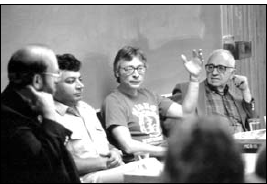
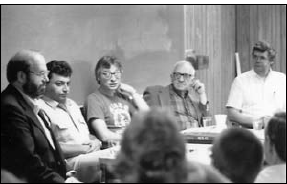
1991 Mises University. From left: Lew Rockwell, Yuri Maltsev, Hans Hoppe, Murray Rothbard, and Roger Garrison
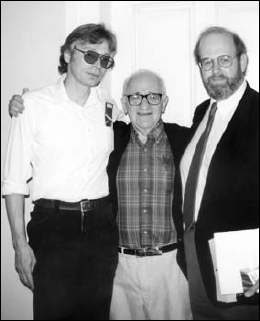
1992 at Jekyll Island From left: Hans Hoppe, Murray Rothbard, and Lew Rockwell
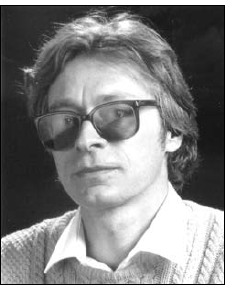
Undated photo
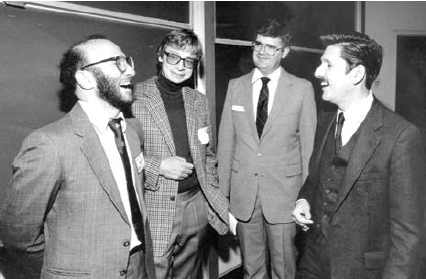
From left: Walter Block, Hans Hoppe, Roger Garrison, and Richard Ebeling
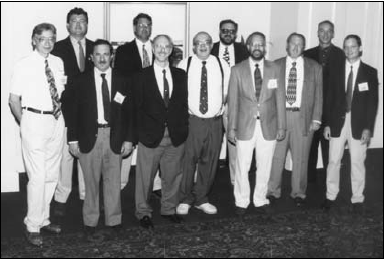
1996 Mises University Faculty. Front row, from left: Hans Hoppe, David Gordon, Robert Batemarco, Ralph Raico, Joseph Salerno, Andy Barnett, and Jeffrey Herbener. Back row: Mark Thornton, Thomas DiLorenzo, John Sophocleus, and Guido Hülsmann
Undated photo
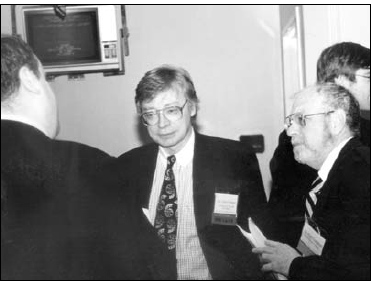
Undated, with Norman Singleton and Paul Gottfried
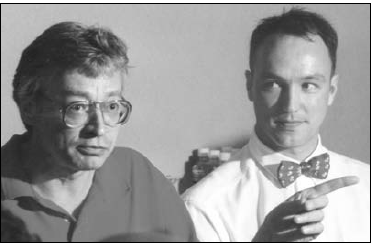
With Guido Hülsmann at the 1999 Mises University
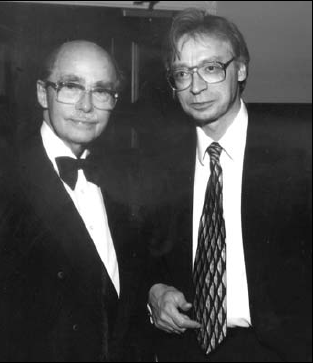
With Otto von Habsburg at the 1999 Mises Institute Supporters Summit and Schlarbaum Award presentation

Left: With Joseph Salerno at the going-away party for Pat Barnett in 2001
Below: 2002


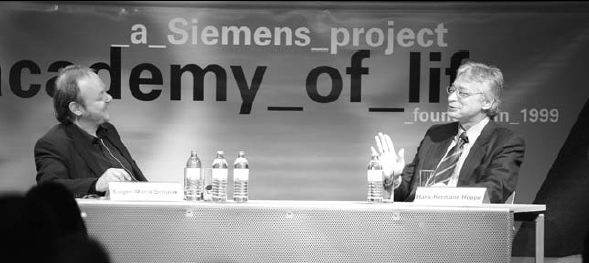
Above: With Eugen-Maria Schulak, September 2005

With his wife Gülçin Imre in Denmark, 2006
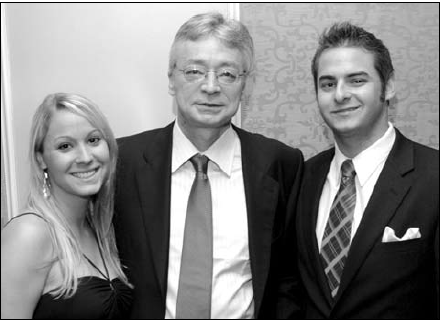
With Emily and Nicholas Hoppe, children from his first marriage, in Auburn, Alabama, 2006

With Gülçin in Bodrum, Turkey, 2007
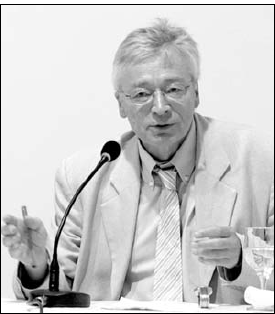
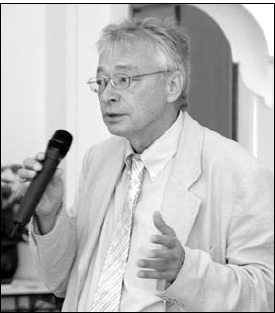
At the 2007 meeting of the Property and Freedom Society, Bodrum, Turkey
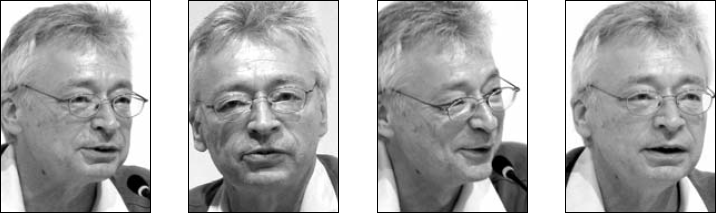
2008 meeting of the Property and Freedom Society

Below: With David Gordon
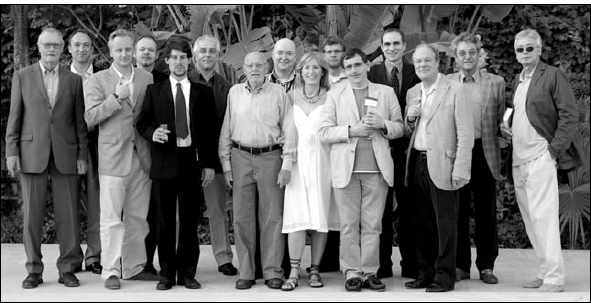
Gülçin Imre (center), with members of the Property and Freedom Society writing for the German libertarian monthly magazine “eigentümlich frei.” From left: Bruno Bandulet, Guido Hülsmann, Carlos Gebauer, Eugen-Maria Schulak, Rahim Taghizadegan, Andreas Tögel, Paul Gottfried, André Lichtschlag, Martin Stefunko, Sean Gabb, Robert Grözinger, Anthony Daniels, Christoph Schmidt-Krayer, and Hans-Hermann Hoppe, Bodrum, Turkey, 2009

With Robert Higgs, Bodrum, Turkey, 2009

Lee Iglody, Doug French, Hans Hoppe, and Steve Sailer, Bodrum, Turkey, 2009
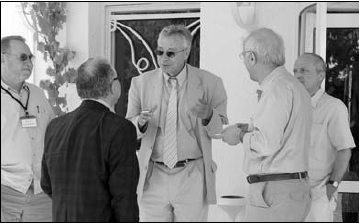
From left: Andy Barnett, Anthony Deden, Hans-Hermann Hoppe, Andreas Acavalos, and Witold Falkowski, Bodrum, Turkey, 2009
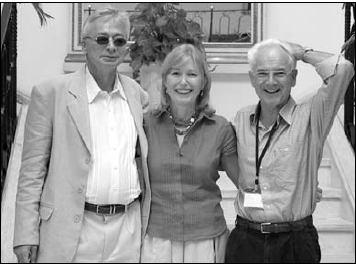
Hans, Gülçin, and Peter Duesberg, Bodrum, Turkey, 2009
Martin Fronĕk (fronek@libinst.cz) is a resident researcher at the Liberalni Institute, Prague, focusing on legal doctrines. He translated Bruno Leoni’s Freedom and the Law into Czech. Josef Šíma (sima@vse.cz) is a professor and chairman of the Department of Institutional Economics, University of Economics, Prague. The authors would like to thank David Lipka for valuable comments and suggestions.
44Brian Bix, Jurisprudence: Theory and Context, 4th ed. (London: Sweet & Maxwell, 2006), p. 189.
45We have argued elsewhere that Austrian praxeology provides a much better framework for the study of the mutual relationship between economics and law than the Posnerian “economic” approach. See Josef Šíma, “Praxeology as Law & Economics,” Journal of Libertarian Studies 18, no. 2 (2004): 73–89.
46But to the contrary, see Edward Stringham and Mark White, “Economic Analysis of Tort Law: Austrian and Kantian Perspectives,” in Law and Economics: Alternative Economic Approaches to Legal and Regulatory Issues, Margaret Oppenheimer and Nicholas Mercuro, eds. (New York: M.E. Sharpe, 2004), pp. 374–92.
47Ronald H. Coase, “The Problem of Social Cost,” Journal of Law and Economics 3 (October 1960).
48Richard A. Posner, Economic Analysis of Law, 5th ed. (New York: Aspen Law & Business, 1998 [1973]), p. 14.
49Walter Block, “Coase and Demsetz on Private Property Rights,” Journal of Libertarian Studies 1, no. 2 (1977); idem, “Ethics, Efficiency, Coasian Property Rights, and Psychic Income: A Reply to Harold Demsetz,” Review of Austrian Economics 8, no. 2 (1995).
50This interventionism is in the Coasean-Posnerian world “obviously desirable” even “ when it is possible to change the legal delimitation of rights through market transactions.” See the founding article of the Chicago approach, Coase, “The Problem of Social Cost,” p. 19.
51Posner, Economic Analysis of Law, p. 42.
52Richard A. Posner, “The Ethical and Political Basis of the Efficiency Norm in Common Law Adjudication,” Hofstra Law Review 8, no. 3 (Spring 1980): 491.
53Murray N. Rothbard, “Toward a Reconstruction of Utility and Welfare Economics,” in Mary Sennholz, ed., On Freedom and Free Enterprise: Essays in Honor of Ludwig von Mises (New Haven, Conn.: D. Van Nostrand 1956).
54Jules Coleman, “Efficiency, Utility, and Wealth Maximization,” Hofstra Law Review 8, no. 3 (Spring 1980): 523.
55Which, in standard account, “is not morally acceptable, since people expect access to justice.” See Aleksander Peczenik, On Law and Reason, 2nd ed (Dordrecht: Springer 2008), pp. 26–27.
56Edward Stringham, “Kaldor-Hicks Efficiency and the Problem of Central Planning,” Quarterly Journal of Austrian Economics 4, no. 2 (Summer 2001): 43.
57Coleman, “Efficiency, Utility, and Wealth Maximization,” p. 524.
58Mario J. Rizzo, “Law amid Flux: The Economics of Negligence and Strict Liability in Tort,” Journal of Legal Studies 9, no. 2 (March 1980).
59Coleman calls this inconvenience a “circularity-of-preferences problem.” Coleman, “Efficiency, Utility, and Wealth Maximization,” p. 525.
60Gregory Scott Crespi, “Exploring the Complicationist Gambit: An Austrian Approach to the Economic Analysis of Law,” Notre Dame Law Review 73, no. 2 (January 1998): 325–26.
61Except for the fixed prices assumption.
62In more difficult cases the complications multiply. As Rizzo explains:
The efficiency approach requires not only the testing of hypotheses about the defendant’s negligence, but also investigation into the (contributory) negligence of the plaintiff. If, however, the doctrine of contributory negligence is to be interpreted as a lesser-cost avoider defense, our task is still not complete. If we find that both defendant and plaintiff have been negligent, we must still determine which party could have avoided the accident at less cost. Therefore, we are driven to compare two counterfactual hypotheses. . . . The issue is not to compare or evaluate what has happened but, rather to speculate about what might have happened in two alternate worlds and then to compare the outcomes.
Rizzo, “Law amid Flux,” p. 292; citations omitted.
63Here he has been quoted by Rizzo. He also reminds us that Posner omits this phrase in subsequent editions of his book. Ibid., p. 308.
64Ronald Dworkin, “Is Wealth a Value?,” Journal of Legal Studies 9, no. 2 (March 1980): 198.
65Richard A. Posner, The Economics of Justice (Cambridge, Mass.: Harvard University Press, 1981), p. 62.
66Dieter Schmidtchen, “Time, Uncertainty, and Subjectivism: Giving More Body to Law and Economics,” International Review of Law and Economics 13, no. 1 (March 1993): 78, quoting Bruce Ackerman, “Law, Economics, and the Problem of Legal Culture,” Duke Law Journal 1986, no. 6 (December 1986).
67Posner, The Economics of Justice, p. 62.
68Hans-Hermann Hoppe, “The Ethics and Economics of Private Property,” LewRockwell.com (Oct. 11, 2004). It must be admitted that Posner uses this example to show a possible divergence of wealth maximization from “happiness maximization”; nevertheless, it illustrates the alleged role of judges and how it would look like.
69Ibid.
70Benjamin Zipursky, “Pragmatic Conceptualism,” Legal Theory 6, no. 4 (December 2000): 462.
71Ibid., pp. 462–23.
72Anthony T. Kronman, “Wealth Maximization as a Normative Principle,” Journal of Legal Studies 9, no. 2 (March 1980): 240. Despite the fact that conclusions of Kronman and Austrians in this particular normative question coincide, we shall, for the sake of fairness, not forget that his approach to criticism of Posner is heavily influenced by the neoclassical notion of economics. Kronman, for example, uses utils and without hesitation engages in an interpersonal comparison of utility. Walter Block once rightly raised this objection in his reply to Kronman. See Walter Block, “Alienability, Inalienability, Paternalism, and the Law: Reply to Kronman,” American Journal of Criminal Law 28, no. 3 (Summer 2001): 351–71.
73Richard A. Posner, “Utilitarianism, Economics, and Legal Theory,” Journal of Legal Studies 8, no. 1 (1979): 119.
74Posner, “Efficiency Norm,” p. 500.
75Posner, “Utilitarianism, Economics, and Legal Theory,” p. 125.
76Dworkin, “Is Wealth a Value?,” p. 208. Dworkin indeed asserts that under present conditions, it would be for most people today “impossible to repurchase the right to their labor, because the value of that labor represents more than half of their present wealth.” Ibid., p. 209.
77Ian Shapiro, The Flight from Reality in the Human Sciences (Princeton, N.J.: Princeton University Press, 2005), p. 111.
78Jules L. Coleman, “Efficiency, Exchange and Auction: Philosophic Aspects of the Economic Approach to Law,” California Law Review 68, no. 2 (March 1980).
79Kronman, “Wealth Maximization as a Normative Principle,” pp. 240–41.
80Posner, The Economics of Justice, p. 77 n. 57.
81Hans-Hermann Hoppe, “Law and Economics,” Lecture delivered at Mises University, Mises Institute, Auburn, Alabama, Friday, August 5, 2005. Available at http://mises.org/multimedia/mp3/MU2005/mu05-Hopp2.mp3.
82Richard A. Posner, Overcoming Law (Cambridge: Harvard University Press, 1996), p. 394.
83Richard A. Posner, “Cost-Benefit Analysis: Definition, Justification, and Comment on Conference Papers,” Journal of Legal Studies 29 (June 2000): 1156.
84Ibid., pp. 1155–56.
85Richard S. Markovits, “On the Relevance of Economic Efficiency Conclusions,” Florida State University Law Review 29, no. 1 (Fall 2001): 5.
86For an author praising the humanistic approach of the Austrian economics see e.g. Michael Novak, “Economics as Humanism,” in Edward Younkins, ed., Three in One (Lanham, Md.: Rowman & Littlefield, 2001).
- 1Professors Hoppe’s publications, including links to translations and a detailed bibliography, are available at his website, www.hanshoppe.com.
- 2“Hans-Hermann Hoppe: Potret Intelektual Anti-Intelektual” [“Interview with Hans-Hermann Hoppe, an Anti-Intellectual Intellectual”], interview by Sukasah Syahdan, Akal dan Kehendak (Indonesia) (Apr. 28, 2008) (English translation available at www.hanshoppe.com/publications).
- 3“Principles of the Property and Freedom Society,” available at www.propertyandfreedom.org (quoting the Opening Declaration from the Inaugural Meeting: Bodrum, Turkey, May 2006).
- 4Hans-Hermann Hoppe, A Theory of Socialism and Capitalism: Economics, Politics, and Ethics (Boston: Kluwer Academic Publishers, 1989), chs. 2 & 7; idem, The Economics and Ethics of Private Property: Studies in Political Economy and Philosophy, 2nd ed. (Auburn, Ala.: Ludwig von Mises Institute, 2006 [1993]), chs. 11–13, 15, and “Appendix: Four Critical Replies.”
- 5Idem, Democracy.
- 6Idem, “Government and the Private Production of Defense,” in idem, ed., The Myth of National Defense: Essays on the Theory and History of Security Production (Auburn, Ala.: Ludwig von Mises Institute, 2003).
- 7On immigration, see Hans-Hermann Hoppe, “The Case for Free Trade and Restricted Immigration,” Journal of Libertarian Studies 13, no. 2 (Summer 1998): 221–33; idem, “Natural Order, the State, and the Immigration Problem,” Journal of Libertarian Studies 16, no. 1 (Winter 2002): 75–97.
- 8Idem, “On Time Preference, Government, and the Process of De-Civilization,” p. 24, n. 25.
- 9Cf. Hoppe’s discussion of Robert Nozick’s “disparate or loosely jointed arguments, conjectures, puzzles, counterexamples, experiments, paradoxes, surprising turns, startling twists, intellectual flashes, and philosophical razzle-dazzle,” in “Murray N. Rothbard and the Ethics of Liberty,” Introduction to Murray N. Rothbard, The Ethics of Liberty, 2nd ed. (New York and London: New York University Press, 1998), pp. xxiv.
- 10Stephan Kinsella & Jeffrey Tucker, “The Ordeal of Hoppe,” The Free Market 26, no. 4 (April 2005).
- 11Ibid., p. 71; and Hans-Hermann Hoppe, Eigentum, Anarchie und Staat: Studien zur Theorie des Kapitalismus (Opladen: Westdeutscher Verlag, 1987).
- 12Hoppe, Democracy, p. 74; and Hans-Hermann Hoppe, The Economics and Ethics of Private Property: Studies in Political Economy and Philosophy (Boston: Kluwer, 1993).
- 13Hoppe, Democracy, p. 71.
- 14Domenico Losurdo, Nietzsche il Ribelle Aristocratico: Biografia Intelettualle e Bilancio Critico (Turin: Bollati Boringhieri, 2002).
- 15Hans-Hermann Hoppe, Der Gott, der keiner ist, Robert Grözinger, trans. (Waltrop & Leipzig: Manuscriptum Verlagsbuchhandlung, 2003), pp. 7–8 (English translation from Hans-Hermann Hoppe, “Demokratie. Der Gott, Der Keiner Ist,” LewRockwell.com (December 5, 2003)). See also similar comments in Hoppe, Democracy, pp. x–xi; and xxiii, noting that “both Mises and Rothbard had a soft spot for democracy and tended to view the transition from monarchy to democracy as progress.”
- 16Caspar von Schrenck-Notzing, Charakterwäsche: Die Politik der amerikanischen Umerziehung in Deutschland (Graz: Ares Verlag, 2004); and Ernst von Salomon, Der Fragebogen, seventeenth ed. (Rowohlt Taschenbuch Verlag, 2007).
- 17Stephan Kinsella, “The Undeniable Morality of Capitalism [review essay of Hoppe’s The Economics and Ethics of Private Property (1993)],” St. Mary’s Law Journal 25 (1994), p. 1434.
- 18Hans-Hermann Hoppe, “Reflections on the Origin and the Stability of the State,” LewRockwell.com (June 23, 2008).
- 19Alan Pendleton Grimes, American Political Thought (New York: Holt, 1960), p. 283.
- 20Michael Vorenberg, Final Freedom: The Civil War, the Abolition of Slavery, and the Thirteenth Amendment (Cambridge: Cambridge University Press, 2001), p. 64.
- 21Merle Curti, The Roots of American Loyalty (New York: Columbia University Press, 1946), p. 175.
- 22Karl Marx to Friedrich Engels, October 29th–November 17th, 1862, in Karl Marx on America and the Civil War, Saul K. Padover, ed. (New York, McGraw-Hill, 1972), p. 263.
- 23James A. Rawley, The Politics of Union: Northern Politics during the Civil War (Lincoln: University of Nebraska Press, 1980), p. 184.
- 24Abraham Lincoln to H.L. Pierce et al. (April 6th 1859), Collected Works, vol. II, p. 375.
- 25Just as an example, in the late Nineteenth century John W. Burgess offered a definition of sovereignty as an “original, absolute, unlimited, universal power over the individual subject and over all associations of subjects,” and of “the State . . . [as] the source of all titles to land and of all powers over it,” John W. Burgess, Political Science and Comparative Constitutional Law (Boston-London: Ginn, 1891), vol. I, pp. 47, 52.
- 26Fries, “Staatstheorie and the New American Science of Politics,” p. 403.
- 27Benjamin Zipursky, “Pragmatic Conceptualism,” Legal Theory 6, no. 4 (December 2000): 462.
- 28Ibid., pp. 462–23.
- 29Anthony T. Kronman, “Wealth Maximization as a Normative Principle,” Journal of Legal Studies 9, no. 2 (March 1980): 240. Despite the fact that conclusions of Kronman and Austrians in this particular normative question coincide, we shall, for the sake of fairness, not forget that his approach to criticism of Posner is heavily influenced by the neoclassical notion of economics. Kronman, for example, uses utils and without hesitation engages in an interpersonal comparison of utility. Walter Block once rightly raised this objection in his reply to Kronman. See Walter Block, “Alienability, Inalienability, Paternalism, and the Law: Reply to Kronman,” American Journal of Criminal Law 28, no. 3 (Summer 2001): 351–71.
- 30Richard A. Posner, “Utilitarianism, Economics, and Legal Theory,” Journal of Legal Studies 8, no. 1 (1979): 119.
- 31Posner, “Efficiency Norm,” p. 500.
- 32Posner, “Utilitarianism, Economics, and Legal Theory,” p. 125.
- 33Dworkin, “Is Wealth a Value?,” p. 208. Dworkin indeed asserts that under present conditions, it would be for most people today “impossible to repurchase the right to their labor, because the value of that labor represents more than half of their present wealth.” Ibid., p. 209.
- 34Ian Shapiro, The Flight from Reality in the Human Sciences (Princeton, N.J.: Princeton University Press, 2005), p. 111.
- 35Jules L. Coleman, “Efficiency, Exchange and Auction: Philosophic Aspects of the Economic Approach to Law,” California Law Review 68, no. 2 (March 1980).
- 36Kronman, “Wealth Maximization as a Normative Principle,” pp. 240–41.
- 37Posner, The Economics of Justice, p. 77 n. 57.
- 38Hans-Hermann Hoppe, “Law and Economics,” Lecture delivered at Mises University, Mises Institute, Auburn, Alabama, Friday, August 5, 2005. Available at http://mises.org/multimedia/mp3/MU2005/mu05-Hopp2.mp3.
- 39Richard A. Posner, Overcoming Law (Cambridge: Harvard University Press, 1996), p. 394.
- 40Richard A. Posner, “Cost-Benefit Analysis: Definition, Justification, and Comment on Conference Papers,” Journal of Legal Studies 29 (June 2000): 1156.
- 41Ibid., pp. 1155–56.
- 42Richard S. Markovits, “On the Relevance of Economic Efficiency Conclusions,” Florida State University Law Review 29, no. 1 (Fall 2001): 5.
- 43For an author praising the humanistic approach of the Austrian economics see e.g. Michael Novak, “Economics as Humanism,” in Edward Younkins, ed., Three in One (Lanham, Md.: Rowman & Littlefield, 2001).
- 44Eventually, Hoppe turned into a full-blown Austrian when, in the early 1980s, he went to the United States on a prestigious Heisenberg fellowship. This time his research project concerned political philosophy, but it was again squarely built on Austrian economics. In 1986, he became Rothbard’s colleague at the University of Nevada, Las Vegas (UNLV), where he would teach for the next 21 years. After Rothbard’s untimely death in 1995, Professor Hoppe assumed a place of uncontested leadership among Austro-libertarian scholars, becoming the editor of the Journal of Libertarian Studies, a co-editor of the Review of Austrian Economics, and then a co-editor of the Quarterly Journal of Austrian Economics. Professor Hoppe, now Professor Emeritus of Economics at UNLV and Distinguished Fellow with the Ludwig von Mises Institute, also serves on on the editorial board of Libertarian Papers. In addition to authoring numerous scholarly articles, his important books include Handeln und Erkennen (1976), Kritik der Kausalwissenschaftlichen Sozialforschung (1983), Eigentum, Anarchie, und Staat (1987), A Theory of Socialism and Capitalism (1989), The Economics and Ethics of Private Property (1993, enlarged 2nd edition 2006), Democracy—The God that Failed (2001), and The Myth of National Defense (editor, 2003). His works have been translated into at least 21 languages, not counting English.
- 45Among Professor Hoppe’s many achievements we should stress in particular his brilliant critique of positivist methodology as applied to the social sciences, a new praxeological approach to political philosophy, an encompassing comparative analysis of socialism and capitalism, and a theory of secession as a means of political reform. Most importantly, in his book Democracy—The God that Failed, Professor Hoppe has delivered a profound critique of democracy, as well as an original reinterpretation of Western history in the twentieth century, both of which have stirred international debate in academia and among the wider public. Other influential works from his pen have dealt with the role of migrations within a free society, and with the role of public intellectuals in political transformation processes. Moreover, he has excelled as an historian of thought and made path-breaking contributions to other areas such as monopoly theory; the theory of public goods; the sociology of taxation; the positive methodology of the social sciences; the theory of risk; the production of security; the transformation of formerly socialist countries; and the evolution of monetary institutions and their impact on international relations. And Professor Hoppe’s work is ongoing: he is currently working on a major book project that will restate and elaborate on his previous work in the fields of epistemology and ethics—more generally, the nature of human rationality. The goal of the book is to provide “a systematic and interdisciplinary reconstruction of human history (pre-history, hunter-gatherer societies, agricultural societies, industrial societies).”
- 46for justly acquired private property, freedom of contract, freedom of association—which logically implies the right to not associate with, or to discriminate against—anyone in one’s personal and business relations—and unconditional free trade. It condemns imperialism and militarism and their fomenters, and champions peace. It rejects positivism, relativism, and egalitarianism in any form, whether of “outcome” or “opportunity,” and it has an outspoken distaste for politics and politicians.
- 47Hoppe’s axiom of private property is also of crucial importance. If you debate about ethical issues, it means that you presuppose your own right, as well as the right of other people, to debate the issue. This acceptance implies that you do respect the rights of others people involved in the debate to control their own bodies. And the conclusion is crucial: if you even begin debating what is right and what is wrong, it means that you already have acknowledged that private property is necessary and inescapable for any moral judgment. This applies even to those who try to argue against private property. The ethical ground for private property has never been so strong and deep before.
- 48There are also many other fields where Hans Hoppe has pushed the limits of political and economic science. Monarchy is not as bad as democracy, he argues. This was and still is unacceptable to many intellectuals, and most people have followed the lead of the intellectuals because they have had no good arguments to the contrary. A simple reference to the “strong hand” of a dictator was not only politically incorrect and old fashioned, but also contrary to the goals and the image of society most people actually have. Hoppe provides a clear explanation to sort through this intellectual mess. The absence of democracy in public decision-making does not necessarily mean dictatorship and the most terrible exploitation of the people. On the contrary: democracy is the system which leads to dictatorship, exploitation of others, ignorance, and vulgarity.
- 49The private provision of security is another topic which has benefitted from Hoppe’s insights. Every decent person often feels that the police are actually not providing adequate protection. But what is the alternative? Better this than nothing, or so many of those unsatisfied with government tend to conclude. An army of intellectuals is ready to help them reach this conclusion. Hoppe provides sound arguments and explains the economics of the private production of defense. No serious scholar can ignore Hoppe’s important arguments. Those who claim that there will be no security without government are simply mistaken. Now, you can direct them to Hans Hoppe’s works.
- 50Immigration, democracy, regulation—so many bad ideas abound concerning all of these issues, and Hoppe addresses them so well in his writings and speeches.
- 51Hans knows how to present an argument in a way which is very understandable, even to a man of average intellectual capacities. His examples are sometimes so unexpected and direct that they really help or even force you to rethink what you have thought about the world before. It appears very natural for him, for example, to put a footnote in a book with a short explanation why public slavery is even worse than private slavery. It does not mean that Hans tries to be simple. He is just very straightforward. He does not hesitate to criticize even free-market advocates who are not consistent in their argumentation. If you say something absurd or make flawed arguments, he usually will not hide the fact from you. Perhaps for this reason, some people even seem to be intimidated by Hans Hoppe. Understandably, it is not always pleasant to have your arguments smashed in public.
- 52Hans does not present himself as a big scholar. On the contrary, his ambition is not very great when he speaks about the role of the scholar (including himself) in society. It is not his ambition to invent some completely new theory or find a terra incognito. On the contrary, Hoppe claims that the role of a decent scholar is, first of all, to preserve what is already found, explained, and discovered. Not to waste the knowledge of the mankind, but to preserve and explain it in modern language to new generations, is to him an already ambitious task. He does it perfectly. Contrary to many of those who are happy with their ambitious and often fallacious new theories, or with “philosophical razzle-dazzle,” he is always stressing the role of his teachers and predecessors, Rothbard and Mises.
- 53Courage is another thing which goes well with Hans Hoppe’s name. Political correctness is not a good principle to hold to when you are looking for the truth, and while many people pay lip service to the importance of truth, not everyone will defend it even when his own career and name are at stake. But when liberty and the truth are at the stake, Hans Hoppe will never give up. The well-known controversy surrounding an example given about the different time preferences among different groups of people perfectly illustrates this courage.
- 54Significantly, Hans does not hold back in criticizing monarchies for doing in a quite primitive way what democratic administrations have succeeded in accomplishing with less fallout, which is monopolizing power. Like democrats, kings tried to marginalize their opposition by declaring all political authority to be a prerogative of the centralized state. Monarchical sovereignty was a prelude to democratic sovereignty, and it was based the same “original sin,” “the monopolization of the function of judge and peacemaker.” The best form of authority for Hans is, in fact, “the natural order,” one that is “[t]he natural outcome of the voluntary transactions between various private property owners” and which is “decidedly nonegalitarian, hierarchical, and elitist.” Any effort to bring this about in our democratic, late modernity is hailed as a positive step: “Thus, in addition to advocating the abdication of democracy, it is now of central strategic importance that at the same time ideological support be given to all decentralizing or even secessionist social forces.”
- 55Significantly, Hans does not hold back in criticizing monarchies for doing in a quite primitive way what democratic administrations have succeeded in accomplishing with less fallout, which is monopolizing power. Like democrats, kings tried to marginalize their opposition by declaring all political authority to be a prerogative of the centralized state. Monarchical sovereignty was a prelude to democratic sovereignty, and it was based the same “original sin,” “the monopolization of the function of judge and peacemaker.” The best form of authority for Hans is, in fact, “the natural order,” one that is “[t]he natural outcome of the voluntary transactions between various private property owners” and which is “decidedly nonegalitarian, hierarchical, and elitist.” Any effort to bring this about in our democratic, late modernity is hailed as a positive step: “Thus, in addition to advocating the abdication of democracy, it is now of central strategic importance that at the same time ideological support be given to all decentralizing or even secessionist social forces.”
- 56A question that might be raised is whether the generality of humankind would endorse the tendencies that Hans is promoting. Would democratic populations (who have ceased to be citoyens (citizens) or Staatsbürger in any meaningful sense) really want to live in the decentralized, elitist society that Hans recommends, one in which a “natural elite” possess “natural authority,” and, because of “selective mating” and the “laws of civil and genetic inheritance,” these “positions of natural authority are more likely than not passed on within a few noble families.” Why would the majority want to acknowledge these “authority persons,” who presumably would arbitrate conflicts on the basis of the social deference that others extend to them? It is hard to see why most people would accept such arrangements, as opposed to a democracy, in which the promise is made and often fulfilled of redistributing goods to the voters. The question is not whether the democratic state robs from Peter to pay Paul (it obviously does that!) but whether Hans’s “natural order” offers most people what they want. The answer is an emphatic “no” and therefore this order (which looks a bit like Friedrich Hayek’s conception of “spontaneous order”) depends for its realization on the possibility of “decentralization and secession.” Absent such a possibility, this order is in no way feasible.
- 57Two other observations may be appropriate for understanding more fully the libertarianism of the Right that Hans exemplifies. One, this libertarianism is a recognizable subspecies of what the Italian Marxist Domenico Losurdo calls “aristocratic radicalism,” which he explores in voluminous works on Friedrich Nietzsche (1844–1901). According to Losurdo, Nietzsche’s “critique of modernity” is based on his opposition to the leveling tendencies that he perceives in democracy and socialism. It was therefore perfectly consistent for Nietzsche to praise aristocratic societies, including the Indian caste system, and to advocate liberty in the Western world of his time. That is because the state, as Nietzsche understood it, was becoming an instrument of equalization; and its attack on property relations would belong to a larger effort to remove all social and gender distinctions. Nietzsche, as Losurdo points out, also disliked Christianity, because he thought the “slave morality” that pervaded this religion and the culture it nurtured rendered them ineffective against the Left. He therefore broke with classical conservatives, who had viewed established religions as bulwarks against revolution. From Nietzsche’s perspective, Christianity and the Left were related worldviews, and only a new aristocratic order, one that had shed its Christian past, could save civilization from the unfolding of the egalitarian ideal, going from democracy into socialism and feminism.
- 58“Politically incorrect” is what the rulers and in particular the victors among the rulers proclaim. The great victor of the 20th century, in particular as far as Germany is concerned, is the USA. Hence, the USA has determined the “correct” interpretation especially of recent history. Defeated Germany was not only occupied, but also reeducated. Germany’s schools and universities, under almost complete government control, and the governmentally licensed mass media, have proclaimed to this day the official American view of history and in particular of the 20th century as a triumph of good over evil.
- 59It is hard to ignore the likely connection between Hans’s detestation of the “State” in all of its modern manifestations and the use of postwar public administration in West Germany, perhaps even more than in the Communist East, to humiliate his nation. His sense of what was done to “reeducate” defeated Germans after the War, which is documented in detail in Caspar von Schrenk-Notzing’s Charakterwäsche: Die Politik der amerikanischen Umerziehung in Deutschland, has left Hans understandably skeptical about the modern democratic project. His relation as a student to Jürgen Habermas, the German thinker and publicist who more than anyone else in his country has called for a rejection of a German national identity and for the creation of a new “constitutional patriotism,” based on supposedly universal democratic values, may explain even more about Hans’s intellectual odyssey.
- 60His study at the Johann Wolfgang Goethe University with Habermas and Karl-Otto Apel was time well spent, however, as it shaped Hoppe as a first class social scientist and helped him to put forth an “argumentation ethics” defense of individual rights, based in part on the discourse ethics theories of the Frankfurt School. His intellectual independence prevented him from accepting his mentors’ apology for socialism and their anti-capitalist mentality. As one reviewer noted, “Hoppe believes his former teacher Habermas’s discourse-ethics theories, while correct at core, are applied incorrectly by Habermas to yield a socialistic ethic; Hoppe feels that Habermas’s theories, if correctly applied (as Hoppe himself does), yield the libertarian non-aggression norm.”
- 61The first and foremost task of the intellectual anti-intellectuals, then, is to counter this dogmatic slumber of the masses by offering a precise definition of the state, as I have done at the outset, and then to ask if there is not something truly remarkable, odd, strange, awkward, ridiculous, indeed ludicrous about an institution such as this. I am confident that such simple, definitional work will produce some serious doubt regarding an institution that one previously had been taken for granted.
- 62Lieber’s doctrine is “a prophetic conception,” according to Vernon Parrington, based on “the principle of an evolving state that draws all lesser sovereignties into its orbit by the law of attraction.” Parrington was well aware of the importance of Francis Lieber, who “provided a philosophical background” to the legal theory of Joseph Story. “Under the combined legal and philosophical attack the compact theory found its philosophical breastworks leveled, its natural rights theory undermined, and its commanding position effectively turned.” Alan Grimes places Lieber at the transition between “the constitutional and legal approach to an understanding of the nature of the American Union, and the rise of the organic concept of the nation.” The importance of the German professor in shaping the ideas which Lincoln exploited fully has been noticed by other historians. Lieber “had indeed argued before the war that the original Constitution was insufficient to the needs of the nation . . . in the 1830s and 1840s, he had gained prominence, North and South, by attacking the idea of a fixed Constitution.” A staunch advocate of federal growth, he thought “that federal power should expand slowly and organically—and thus constitutionally—as the nation grew. . . . He believed that the war would solidify the Union and thus fulfill his dream, nurtured during his school years in Germany, of living in a modern nation-state.” Later on, during the war Lieber became very popular, wrote dozens of articles and pamphlets in order “to popularize his distinctive brand of nationalism.” In practice, “[h]is many public statements used the South’s insurrection to justify an expansion of federal power beyond what the Constitution expressly sanctioned.”
- 63Lieber’s doctrine is “a prophetic conception,” according to Vernon Parrington, based on “the principle of an evolving state that draws all lesser sovereignties into its orbit by the law of attraction.” Parrington was well aware of the importance of Francis Lieber, who “provided a philosophical background” to the legal theory of Joseph Story. “Under the combined legal and philosophical attack the compact theory found its philosophical breastworks leveled, its natural rights theory undermined, and its commanding position effectively turned.” Alan Grimes places Lieber at the transition between “the constitutional and legal approach to an understanding of the nature of the American Union, and the rise of the organic concept of the nation.” The importance of the German professor in shaping the ideas which Lincoln exploited fully has been noticed by other historians. Lieber “had indeed argued before the war that the original Constitution was insufficient to the needs of the nation . . . in the 1830s and 1840s, he had gained prominence, North and South, by attacking the idea of a fixed Constitution.” A staunch advocate of federal growth, he thought “that federal power should expand slowly and organically—and thus constitutionally—as the nation grew. . . . He believed that the war would solidify the Union and thus fulfill his dream, nurtured during his school years in Germany, of living in a modern nation-state.” Later on, during the war Lieber became very popular, wrote dozens of articles and pamphlets in order “to popularize his distinctive brand of nationalism.” In practice, “[h]is many public statements used the South’s insurrection to justify an expansion of federal power beyond what the Constitution expressly sanctioned.”
- 64During and after the Civil War, Northern intellectuals developed the incipient organic theory, which at first did not reach the rank and file even in the North. In the Old World the organic theory was likewise serving the integral type of nationalism that had largely replaced the older, humanitarian variety of the early nineteenth century.
- 65In the words of Karl Marx, the Civil War was a “world-transforming . . . revolutionary movement.” Dating from the year 1862, this must be considered as one of his few correct prophecies, albeit an easy one.
- 66The Supreme Court, under Chase . . . upheld the constitutionality of the Legal Tender Act. Before the end of Reconstruction, Greenbackers were clamoring for more paper money. Few citizens before the war had contributed directly to the treasury. By the war’s close everyone and everything was taxed.
- 67In the end, it was the presidency of Lincoln—the very statesman who said “the principles of Jefferson are the definitions and axioms of free society”—that wrote finis to those very same principles and ended the American experiment in limited government and self-government. One of the major consequences of the metaconstitutional theory of the Union as an end in itself (and of equating its dissolution with a “moral catastrophe”) embraced by Abraham Lincoln was that of making American political thought more receptive to European theories. America proceeded towards a “normalization” of sorts, growing ever more similar to Europe. And this process of “convergence” was to reach its peak during the last century. Lincoln “normalized” America, thus opening the door for the Americanization of the world.
- 68In the end, it was the presidency of Lincoln—the very statesman who said “the principles of Jefferson are the definitions and axioms of free society”—that wrote finis to those very same principles and ended the American experiment in limited government and self-government. One of the major consequences of the metaconstitutional theory of the Union as an end in itself (and of equating its dissolution with a “moral catastrophe”) embraced by Abraham Lincoln was that of making American political thought more receptive to European theories. America proceeded towards a “normalization” of sorts, growing ever more similar to Europe. And this process of “convergence” was to reach its peak during the last century. Lincoln “normalized” America, thus opening the door for the Americanization of the world.
- 69In conclusion, we must turn again to the American Staatstheorie professors. It is true that their dominance in the profession faded after World War I, and their ultimate failure might be linked to the fact that they were “unable to apply the German idea of the state to the American Political tradition.” But this is true only from a purely theoretical perspective. Abraham Lincoln was not engaging in such a complex pursuit. He did not have to render the two traditions compatible, but rather to burn the bridges with the old American notion of “liberty vs. government.” In addition, he did not have to win any sophisticated scholarly dispute, as he had better weapons than continental authorities on the subject of liberty and the State. It was his army that, in fact made every citizen, North and South of the Potomac, appreciate the notion that there was an identity of interest between the individual and the State (by now understood as the Nation).
- 70Austrians like Hoppe are not alone in this particular criticism of L&E. Benjamin Zipursky, a representative of so called “pragmatic conceptualism,” challenges the theory of economic analysis of tort law. According to him, tort law is, in essence, “backward-looking.” If we turn to the factory example, the right way of looking at the situation is to investigate the past, determine the structure of rights that was in place before the pollution, describe the actions of both plaintiff and defendant and, on this basis, decide who is to be held liable. On the other hand, the economic (Posnerian) approach is “forward looking;” the initial distribution of rights is of no importance—“where liability should lie ultimately depends on an answer to a question about the future, not about the past.” This, unfortunately, leads us to the conclusion that, for L&E what is right and what is wrong are merely contingent. A just legal system can hardly be based on the contingent notions of right and wrong.
- 71Austrians like Hoppe are not alone in this particular criticism of L&E. Benjamin Zipursky, a representative of so called “pragmatic conceptualism,” challenges the theory of economic analysis of tort law. According to him, tort law is, in essence, “backward-looking.” If we turn to the factory example, the right way of looking at the situation is to investigate the past, determine the structure of rights that was in place before the pollution, describe the actions of both plaintiff and defendant and, on this basis, decide who is to be held liable. On the other hand, the economic (Posnerian) approach is “forward looking;” the initial distribution of rights is of no importance—“where liability should lie ultimately depends on an answer to a question about the future, not about the past.” This, unfortunately, leads us to the conclusion that, for L&E what is right and what is wrong are merely contingent. A just legal system can hardly be based on the contingent notions of right and wrong.
- 72The principle of wealth maximization necessarily favors those who already have money, or the resources with which to earn it, and are therefore able to pay more than others to have a new legal rule defined in the way that is favorable to them.
- 73A less welcome implication of the wealth-maximization approach is that people who are very poor . . . count only if they are part of the utility function of somebody who has wealth.
- 74According to Posner, not only property rights to chattels are to be instrumentally distributed according to the wealth maximization principle. Posner seeks to present a universal, normative benchmark for allocation of all sorts of rights, including the self-ownership of one’s own labor. In other words, the issue of initial assignment of property rights is considered, since it is “the starting point for a market system.” The fact that people own their own lives and labor is, according to Posner, explicable by the wealth maximization principle itself; assignment of these rights to “natural owners” is a result of calculus. States Posner:
- 75This is the economic reason for giving a worker the right to sell his labor and a woman the right to determine her sexual partners. If assigned randomly to strangers these rights would generally (not invariably) be repurchased by the worker and the woman respectively.
- 76Dworkin challenges this assertion by pointing out that we cannot simply assume, as Posner does, the rights to be repurchased by their natural owners. These people must be willing and able to pay for them what the random possessors of the right would demand on the market. But all this necessarily depends on the initial assignment of rights itself. The reasoning is, again, circular. As Ian Shapiro notes, the example assumes “exactly what Posner has to establish if his theory is to make any sense.”
- 77Dworkin challenges this assertion by pointing out that we cannot simply assume, as Posner does, the rights to be repurchased by their natural owners. These people must be willing and able to pay for them what the random possessors of the right would demand on the market. But all this necessarily depends on the initial assignment of rights itself. The reasoning is, again, circular. As Ian Shapiro notes, the example assumes “exactly what Posner has to establish if his theory is to make any sense.”
- 78The difficulty was recognized by Kronman who, building on Coleman’s earlier work, restated the problem in terms of auction. No one has anything at his disposal and attends the auction where the rights are to be sold to the highest bidder. The result of auction will satisfy the wealth maximization principle, but the bids will have a form of mere stipulation—for the time being the bidders have nothing to pay with. The auction may result in enslavement of A by B if the auctioneer concludes that the work of A will be better managed and allocated in more valuable uses by B than if it was assigned to its “natural owner,” i.e., A.
- 79The difficulty was recognized by Kronman who, building on Coleman’s earlier work, restated the problem in terms of auction. No one has anything at his disposal and attends the auction where the rights are to be sold to the highest bidder. The result of auction will satisfy the wealth maximization principle, but the bids will have a form of mere stipulation—for the time being the bidders have nothing to pay with. The auction may result in enslavement of A by B if the auctioneer concludes that the work of A will be better managed and allocated in more valuable uses by B than if it was assigned to its “natural owner,” i.e., A.
- 80The objections of legal thinkers are very similar to those made by Austrians. Hans-Hermann Hoppe, using Posner’s own example, showed that adherence to wealth maximization may well lead to the denial of self-ownership and justification of slavery. Suppose an alternative universe in which Henry Ford decided not to become an automobile manufacturer but a Trappist monk. In this universe, people would be poorer compared to our actual world; the wealth would be lowered. The notion of wealth maximization leads us to the conclusion that we could
- 81enslave Ford and put him into the Ford factory and just tell him: “Hey, keep on being the Ford that you were supposed to be instead of just being a Trappist monk.”
- 82Whereas the former approach defends property as a building block of every viable social order, Posner dilutes its importance entirely. Over time, he adopted an even less property-friendly approach. He refuses, as he himself states, to keep the “faith in the power of science to take religion’s place as the deliverer of final truth.” Soundness of theoretical arguments is not to be any more decisive because, as Posner claims,
- 83in my view the ultimate criterion should be pragmatic; we should not worry whether cost-benefit analysis is well grounded in any theory of value. We should ask how well it serves whatever goals we have.
- 84I do not want to stake my all on a defense of the Kaldor-Hicks concept of efficiency. For me the ultimate test of cost-benefit analysis employing that concept is a pragmatic one: whether its use improves the performance of government in any sense of improvement that the observer thinks appropriate.
- 85In fact, several highly respected economists and lawand-economics scholars have written well-known articles that make arguments purporting to justify the claim that economically efficient decisions are always just and/or desirable—arguments that they have not explicitly disavowed and that no other economist had refuted.
- 86This is simply not true, and we sought to provide sufficient evidence to support this claim. Austrian authors have written over the years a growing number of publications doing just that. The Austrian broad approach to the study of social reality is something which legal theorists could very much benefit from. Regrettably, most of them seem to be unaware of the Austrian tradition, and hence—to their detriment—work within the framework of neoclassical economics.

