
International Monetary Economics
VII. Monetary Parities
MONETARY PARITIES
(1)
WHILE the rate of exchange corresponds to any momentary situation in the foreign-exchange market, a monetary parity represents a longer-run relation between monetary units of different countries. A parity between two currencies is the price of one expressed in terms of the other, which is maintained effectively over longer periods of time allowing for minor fluctuations due to changes arising daily in the foreign-exchange market. Thus a parity is a sort of equilibrium rate of exchange, a centre of economic gravity around which actual quotations move; it is a rate of equilibrium by comparison with which a currency may be overvalued or undervalued in relation to another, a rate which will tend to be restored once the market quotation has diverged from it. This last feature of a monetary parity is particularly important; if the parity does not represent a rate around which, and in the close neighbourhood of which, most of the effectively quoted rates are to be found, then it does not represent an economically interesting relation. Hence the question arises, how is a parity determined, what is the “operational” meaning1 of that concept?
Before attempting to give an answer to this question, we must define with precision another concept, that of a monetary standard (or currency standard). In brief, a monetary standard is a commodity2 the price of which, in terms of the national monetary unit, is fixed by the monetary law of the country and held stable by the monetary authorities of that country. It may be gold or silver, it may be a foreign currency,3 it may be, theoretically, any commodity susceptible of having its price stabilized through the policy of monetary authorities.
When two countries adopt the same monetary standard the situation which results is one in which the same commodity has its price fixed in terms of two different national monetary units; if, further, that commodity enjoys freedom of trade between the two countries, the national monetary units in question become related to one another through the medium of their common standard. If A and B are each separately equal to C, they are also equal to one another. If gold is the monetary standard in the United States and in Switzerland and if a certain quantity of gold costs, e.g. 10 dollars in the United States and 50 francs in Switzerland, then 10 dollars will be equal to 50 francs. This equality results from the fact that gold bought for 10 dollars in the United States can be sold for 50 francs in Switzerland, both prices being guaranteed by the respective monetary laws.4 Thus the parity between the two currencies is, in our example 5 to 1, i.e. five francs for one dollar.
In the case of a common standard, parities between national currencies are determined by the prices of the standard commodity which are fixed by the respective monetary laws. The maintenance of these parities5 depends upon the maintenance of the common standard and of the provisions of the respective monetary laws regarding the definition of the monetary unit in terms of the standard.6 In the last instance it depends upon the functioning of the “mechanism” of adjusting balances of payments and of preserving their durable equilibrium.7
(2)
The parity as defined above comes very close to the so-called “mint-par” of which it is a generalization.8 Let us see at present whether parities between national currencies can be defined in the absence of a common standard, or indeed even in the absence of national monetary standards. This assumption implies a definition of “parity” in terms of the various elements which constitute the economic life of countries concerned. In order to provide a numerically determined result, these elements must find a clear numerical expression. There has been, to my knowledge, only one attempt to define a monetary parity in such a way; and this, though it is due to several economists writing independently, is particularly well known under the name of “purchasing power parity” given to it by Professor Cassel.
Considering the reciprocal trade between two countries, A and B, Cassel arrives at the following conclusions regarding the relations between the two respective currencies:
“Clearly, there must be a position . . . where A buys from B exactly as much as it sells to B, and where the balance of trade will be in equilibrium. We assume that all commodities are immediately paid for; in other words that the one country extends no credit to the other, at least not for a period longer than is technically necessary for adjusting the mutual payments. This position, then, represents the equilibrium position for the rate of exchange, for in any other position a constant scarcity of foreign currency would be felt in one of the countries, and the price of this foreign currency would of necessity rise. Only a rate of exchange at which the balance of trade is in equilibrium can possess a permanent stability. This rate of exchange is termed the purchasing power parity. . . . A direct comparison between the purchasing power of money in two different countries is not possible in an exact sense. If everything in France is nominally—that is to say, reckoned in the currency unit of the country—about one hundred and twenty-four times as dear as in England, then it is obvious that the public will find that the French currency is only a hundred and twenty-fourth part as valuable as the English. . . . The natural rate of exchange for the pound sterling, measured in French francs, thus lies in the neighbourhood of 124. At this rate of exchange the purchasing power of money in the two countries is approximately the same. The rate of exchange must . . . fix itself in such wise. . . . that when one currency is changed into another a certain sum represents approximately the same purchasing power.”9
This notion of parities is based on the assumption that “other nations as a rule buy the currency principally because it represents purchasing power on the internal market”.10 This is partly correct, of course, but other motives can play their part too, e.g. one may buy foreign currency in order to pay one’s debts or to earn on it a higher interest than one can earn at home, or one buys it because one finds the economic, social and political outlook of the foreign country more reassuring than that of one’s own country, and so on. More fundamentally, that theory is based upon the over-simplified idea that international trade is the only source of international payments and that its structure depends entirely upon the internal price levels of the respective countries.11 Both these assumptions are incorrect. Capital movements and short-term credit operations now play a very important part in international economic relations and are often responsible for one-third or one-half of payments made from country to country. To reduce the balance of payments to the balance of trade is an over-simplification amounting to a very serious mistake. Nor is there any reason to suppose that developments in the field of international trade influence parallel developments in that of international finance. Thus one of the main intellectual pillars of the purchasing power parity conception falls down. The other pillar, according to which payments between countries depend principally (or, rather, exclusively) upon price levels prevailing in these countries, is no stronger. It is clear that financial transactions are only to a very small extent (if at all) related to price movements. They are determined by the alternative considerations of returns or of safety. Now larger returns may be a consequence of certain price developments in the country in which capital is invested—but the relation is neither necessary, nor direct, nor regular. The fact that there are financial transactions detracts very much from the influence that price changes can exercise upon international payments. Let us grant, however, the assumption which makes of trade transactions the essence of the balance of payments, and see whether then prices are the only determining factor. Cassel’s theory has been often criticized on the ground of taking into consideration all prices and not only prices of goods entering international trade.12 The criticism should in fact go even deeper. What prices can be expected to be equalized all over the world by the means of the rate of exchange? Certainly not prices of goods which do not enter international trade. Nor indeed prices of goods which, though they enter international trade, have no world market. We are then left with goods having a world market and a world price. They are commodities of standard quality which can be the object of international arbitrage. It is that arbitrage which tends to equalize their price all over the world, due allowance being made for transport costs and for tariffs. If, after having introduced these necessary corrections, one finds that the goods in question have the same price in all countries, after translating one currency into the other by the means of the rate of exchange, this is just the result of arbitrage transactions which consist in buying the commodity in the markets where it is cheaper and selling it in the market where it is most expensive.13 The fact that rates of exchange equalize nominal prices expressed in various national currencies in the case of commodities having a “world price” is an element of the very notion of “world prices”.14 To say that it is prices of commodities having a world market which determine parities between currencies, would be absurd. As regards other prices, however, which are not being internationally equalized by the rates of exchange, the ratio between their statistical averages cannot possibly have any clear significance. If this is granted we can still argue that price-changes affect to a varying extent international trade and the amounts of international payments due to it, but there is no reason for expecting any precise quantitative relation to hold good, nor indeed for defining monetary parities in terms of price levels.
Finally, as regards the causal relationships involved, Cassel maintains that causation goes only in the direction from prices to parities. Even if we should grant the rest of the theory, this one-way causality could not be accepted in the light of what we know about the effects of exchange fluctuations upon prices. In any country internal prices depend on prices of imported commodities to an extent varying with the varying importance of foreign trade for that country’s national economy. An appropriate central bank policy may counteract, to some extent, the effects upon prices of foreign-exchange fluctuations which result then in changes in the relative prices of goods entering that country’s foreign trade in comparison with the prices of the remaining ones. Whatever the final outcome of the process, one cannot deny that foreign exchanges affect internal prices. From this point of view also, the purchasing power parity theory is unacceptable.
The foregoing observations dispose of the basis for the purchasing power parity theory. Let us discuss in addition the statistical concepts and methods involved.
As regards the notion of “price level”, enough has been said about it in discussing the connection between gold output and prices. For the present purpose it is sufficient to note that given a certain schedule of prices, index-numbers calculated on its basis may differ very widely, according to what methods of averaging and weighting have been used. The arbitrariness of weighted index-numbers takes all objectivity away from the result of calculations. As has been pointed out in the preceding chapter, the purchasing power of money theory of foreign exchanges need not necessarily employ the price level concept because its objective consists in explaining tendencies of change and their causes; it is therefore sufficient for that theory to consider changes in prices. Not so for a theory of parities. A parity must be a numerically precise magnitude with which particular quotations can be compared; in order to obtain such an exact figure concrete price-magnitudes must be compared, and since the purchasing power parity theory consists in comparing the purchasing power of money in various countries as expressed by price-averages, the use of index-numbers becomes unavoidable. Hence a misleading appearance of precision covering up not only more or less arbitrary methods, but also rather confused concepts. As has been observed before,15 money is, rather than has, purchasing power, and attempts at representing the “general purchasing power of money” by calculated price-averages are misleading if they are not fallacious. The widespread use of such methods is not to be considered as its own justification! Incidentally, the theory propounded by Professor Cassel cannot provide us with a precise formulation of parities; it can only indicate a change of parity made necessary (according to that theory) through changes in national price levels. Cassel recognizes this himself when he says that “. . . an exact comparison between the purchasing power of money in different countries is not possible. We have no trustworthy measure for the absolute purchasing power of a currency in its own country. . . . If changes in internal purchasing power of the currencies take place the new purchasing power parity arising out of these changes may be calculated by multiplying the old purchasing power parity by the ratio of the changes in the internal purchasing power of the currencies.”16 If an old parity has been R1, and the price levels, at the time, were P1A and P1B in countries A and B respectively, and if the price levels moved to new positions P2A and P2B, then the new purchasing power parity will be
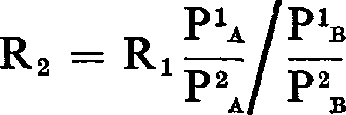
It is necessary, of course, to know R1 and to be certain that it was a parity corresponding to the comparative purchasing power of money in countries A and B. It is clear that R2 depends on the method of calculating the index-numbers, P1A, P2A, P1B, and P2B, and that given a certain R1, one can obtain a great number of various R2 according to the methods of calculation used. What is more important is that all these R2 are not approximations to some parity that exists but cannot be directly ascertained, but are merely various statistical constructions calculated on the basis of a given list of prices. The purchasing power parity theory holds its ground no better statistically than logically.
In appraising Cassel’s theory it is important to remember that he first formulated it in 1916 and further developed it in the period of great inflations immediately following the World War.17 In that period, inflations and the more or less considerable rise of prices which they produced were the primary cause of the prevailing international monetary instability. Under these conditions advocates of the purchasing power parities were justified in considering the price movements as the primary and most important factors in the situation and everything else as minor, complicating factors. As Cassel put it: “Important changes in the internal purchasing power of money have a much greater influence on the rates of exchange than any other alterations in the real conditions of international trade that come into consideration.”18 However, the factors which were minor ones in the age of great inflations may, under different conditions, become very important and even more active than smaller changes in internal prices. A theory must bring out all the factors both major and minor, and in allocating their order of importance one must be careful not to confuse historical accident with logical necessity.
The purchasing power parity theory has been frequently applied even during the present period of international monetary instability. In search for new parities one often proceeds by applying the formula indicated above19 to pre-depression parities and to price movements (expressed by changes in index-numbers) that have taken place since that time.20 In the present conditions however, capital movements and short-term credit operations play such an important part in international economic relations that the purchasing power parity hardly represents (even if we grant its economic and technical bases) the “natural” or “normal” parity between currencies. Hence its application in looking for a new parity for the French franc, for example, in 1936, was entirely out of place and the result obtained by that method has proved not to be lasting.
(3)
Since the purchasing power parity between currencies is found to be an inadequate conception, is there any alternative to suggest? Is there any method, more satisfactory, of finding out what parity between two currencies corresponds to the various elements constituting a given economic situation? And, more generally speaking, is there such a thing as a “natural” or “normal” parity between units of the various national currencies?21
We have seen that the mint-par between two currencies on a common standard is a clearly defined notion resulting in a precise numerical relation. Its basis is the simple fact that two things, each of which is equal to a third, are equal to one another: the price of a certain quantity of gold being 100 units of one currency and 200 units of another, it follows that the parity between these two currencies is 1 to 2. The problem consists merely in maintaining that relation, in which case exchange quotations between the two currencies would merely oscillate around the parity; whether this will happen or not depends upon the developments that occur in international transactions and upon the resulting position of the balances of payments of the respective countries. Hence the maintenance of parities depends upon the maintenance of a long-term equilibrium22 in international payments, a problem which we shall presently examine. If that long-term equilibrium cannot be maintained then the parity cannot be maintained either. When currencies are on the same standard a “mechanical” reaction may set in to bring equilibrium back every time it is disturbed; thus gold movements from country to country start, in the system of an international gold standard, a series of measures the effect of which is to restore equilibrium in international payments. When the various currencies are not based on a common standard there is no mint-par between their respective units; but even in that case certain measures can maintain a durable equilibrium in balances of payments provided that the various countries pursue appropriate policies. The question that arises in either case is whether such measures can be adopted in practice without creating undue internal difficulties and whether the international situation allows their adoption. The most important of these measures23 consists in influencing short-term capital movements. This is only possible if a differential change in the rate of interest attracts foreign deposits24; we have seen that this may not be the case in view of a lack of confidence in the country which needs the inflow of foreign funds. If the anticipation is that the parity can in no case be maintained, not only will there be no inflow of foreign funds, but there will be an outflow of funds both foreign and domestic25. A flight of capital induced by an anticipation of devaluation is a well-known phenomenon; a lack of confidence in a currency may well provide in the end its own justification. In other words, if there is no confidence in the possibility of maintaining a parity, that parity is very likely to be abandoned in the end. This need not be the case if domestic policies, such as balancing the budget, and so on, restore confidence before it is too late.26 If nothing of this kind happens devaluation may follow devaluation provoked time after time by massive flights of capital.27
A further means of equilibrating international payments consists in influencing price movements. Stability of exchange rates supposes that prices in the various countries remain in a certain relation to one another, but the relation has nothing precise about it, and it is only when the competitive position of a country on international markets is weakened that one notices divergencies in price movements that took place elsewhere. The effect may be a falling-off of exports and, ceteris paribus, a disturbance of equilibrium in international payments of the country. The adjustment may be obtained through an appropriate price policy, but if its size is considerable and if its direction is downward it may not be possible without great internal difficulties. It must be observed that the maladjustment may be due to price movements at home, or to price movements abroad, or to foreign devaluations. In a case of great historic importance the maladjustment was brought about by the revaluation of a national currency to a higher parity (England in 1925). If the maladjustment cannot be easily removed through internal price adjustments it may happen (and so it does in actual practice) that movements of short-term funds will occur in a way which may aggravate the disequilibrium of the balance of payments, and the maintenance of the parity will ultimately be impossible. Thus the price factor plays a part, and even an important one, in the problem of maintaining parities—but a part which is very different from that attributed to it by the purchasing power parity theory. If a price adjustment is to take place at all, its size is not given by any a priori consideration but must improve the competitive position of particular industries28 of the country on markets to the required extent. Here it becomes necessary to make a general methodological observation similar to that made when discussing the problem of the adequacy of foreign gold supplies.29 There is no direct method of ascertaining whether price developments in various countries go in step or not; it is only when certain consequences in the field of international trade follow, when a country sees the competitive position of its industries getting weaker, that the inference concerning relative price developments is made. Thus it would be arguing in a circle to say that a country is losing foreign trade because its prices are too high, since we only know that prices must be too high because the country can no longer compete with success in foreign markets. When such a situation is found to exist one concludes that either prices must be adjusted or the parity modified, and we speak of an “overvalued currency”. Now the notion of “overvaluation” or “undervaluation” of a currency in foreign exchange markets is only clear if we accept a certain, numerically precise, parity as normal and if this parity is established by comparing prices in the various countries; hence the dependence of these notions upon the concept of purchasing power parities, of which they are merely corollaries. But as the concept of purchasing power parities has not been found acceptable upon careful examination, we must also, regretfully, dismiss from our vocabulary notions of over and undervalued currencies. We can only speak about situations where the combination of a certain price situation with certain parities contributes to the maintenance or to the destruction of the long-run equilibrium in a country’s balance of payments. All the rest, though a very tempting way of speaking and reasoning, and one which is very much employed, is unfortunately based on unacceptable assumptions and must be abandoned. This view is rather challenging and tends to replace a pleasingly simple and precise instrument of thought and action by a more clumsy one, but I hope to have proved that the advantages of the former are illusory and that the latter, though it appears to be much less satisfactory, is made of a sturdier substance.
Whether a situation of disequilibrium can best be corrected by price adjustments or by parity adjustments is a question which we shall discuss presently.30 Here it suffices to point out that unless the necessary internal or external correctives are introduced, capital movements of the type described above31 will happen and further upset balances of payments and, ultimately, monetary stability. Now it does not seem possible, in the light of the foregoing analysis, to say in advance what parity will correspond most closely to given conditions and will win general confidence. Therefore we arrive at another way of looking at the problem. There is no a priori rate of exchange which can be considered as representing the normal or natural parity between the respective currencies, for there is no legitimate way of calculating such a rate on the basis of the various economic data. This is the fundamental and inescapable conclusion that follows from our analysis. From this it further follows that the test of a parity is in the way it operates. A parity is appropriate if the mechanism of adjusting balances of payments can function on its basis.32 It is not an appropriate one, if its maintenance involves price “adjustments” which are impracticable, or a “crisis” of confidence, or both33; in any of these cases the parity must be changed. The choice of a parity is a matter more of judgment than of reasoning; it is an art rather than a science, as is the case of very many items in the field of economic policy. The proof of the adequacy of a parity is to be found in its operation.34
- 1There is much difference between the views that are widely held in this matter in Great Britain and the United States, and views that are commonly accepted on the Continent. This explains the emphasis laid on that issue. Vide infra, pp. 68 and 69.
- 2The reader may find it useful in this context to contrast the United States’ unified monetary system, now embodying a Federal Reserve System, with what would have existed had each of the 48 States of the Union sovereign powers over its particular monetary system.
- 3The word “international” is used, of course, with utter disregard of its etymological significance; but this usage is universally recognized.
- 4F. A. von Hayek, Monetary Nationalism and International Stability, London, 1937.
- 5loc. cit., p. 4.
- 6Except when a World State exists.
- 7i.e., “real” factors of production (goods), monetary factors (capital) and, thirdly, labour.
- 8“In the last analysis . . . it is the political factor which gives rise to the economic problem of international monetary transfer. If historical accident had not created independent sovereign states . . . no such ‘problem’ would have arisen”. Lionel Robbins, Economic Planning and International Order, London, 1937, pp. 279–80.
- 9To change the weight of a coin (“debasement”) is analogous to the modern forms of devaluation. While, as we shall see presently, the expression “changes in the gold contents of a currency unit” is open to criticism, it shows at least clearly the analogy in question. But what Sovereign Prince of the days gone by would have accepted an international undertaking never to debase the currency? And even if he did accept it, this would be an analogous matter to the type of international monetary convention mentioned in an earlier part of this chapter. The Latin Union was to some extent an example of a limited convention of this kind. But it all goes to show that not even a general limitation of monetary circulation to precious metals would automatically insure a system which would work internationally in the same manner as a monetary system works within a country in regulating the supply of money in the different regions.
- 10loc. cit., pp. 270–80.
- 11Cf. my “Monetary Internationalism and its Crisis”, a chapter in The World Crisis, London, 1938, pp. 348 et seq.
- 12I expect to discuss it at considerable length in my book on the Theory of Banking which is in the course of preparation.
- 13For example England, the United States, etc. Vide infra, chap. ix.
- 14Statements to the contrary which can be found in economic literature rest obviously on a misunderstanding. Thus, for example, Professor Cassel writes (The Theory of Social Economy, New Edition, 1932, vol. ii, p. 458): “On a gold standard there is no sharp division between the quantity of money and the stock of gold.” If Professor Cassel means “an all-gold currency” then this statement is correct; but it is much more likely that the gold standard is really meant: and then this statement is essentially wrong. What is worse is that most of Cassel’s theory on the relations between gold and prices and on the role of gold in the monetary system rests on that assumption expressed in the sentence quoted. One cannot emphasize too often the fact that a gold-standard currency is a paper currency attached to gold (and sometimes convertible into gold); it is not a gold currency. Vide infra, chaps. iii and iv.
- 15It is important to note that the so-called “going-off the gold standard” is not tantamount to the suppression of gold as monetary metal. In the latter case we should have to speak of “demonetization of gold”. Vide infra, p. 177.
- 16Relations between gold and prices are particularly undetermined when the system existing is a de facto system consisting in Central Banks (or Treasuries) buying gold at prices fixed by them, while the regular gold standard is suspended. The price of gold is then subject to variations, but at the price prevailing at every particular moment, monetary authorities are buyers of gold, which as we shall see is one of the features of the gold standard. On the other hand, when the gold standard is suspended there are no longer any provisions about the gold cover of notes, and the value of gold stocks may become indeterminate. All this makes relations between gold stocks and prices very vague indeed, without making them non-existent.
- 17Cf. with the Macmillan Report (Committee on Finance and Industry Report), London, 1931, H.M.S.O., Cmd. 3897, para. 45.
- 18Thus, for example, The Economist wrote the following in its Editorial of 15 May 1937 (p. 404): “The world, in fact, has learned a new lesson. The value of a country’s gold stock does not merely depend upon the physical quantity of gold lying in the vaults of the Central Bank or the Treasury. It depends also upon the price of each ounce of gold expressed in the national currency.” (The italics are mine. I fear that for many it has really been a “new lesson”!)
- 19vide Appendix.
- 20I find myself in substantial agreement with conclusions reached by A. D. Gayer in his book on Monetary Policy and Economic Stabilization, p. 63, though his criticisms are considerably less severe than the ones I have developed in this chapter. Charles O. Hardy says, similarly, in the book Is There Enough Gold?: “Other factors, such as the use of bank deposits as money, and changes in the absorption of gold by India, are brought into Cassel’s analysis to account for the major deviations of the price trend from the ‘relative supply of gold’, (p. 22.) If, as Cassel believes, the increase in the amount of gold stock required to maintain prices during the 60 years before the war corresponded accurately or even approximately to the growth of production, it was because for the period as a whole these other important factors cancelled each other out.” (p. 24.) As a matter of fact these factors did not cancel each other out as there were considerable price movements in the course of these 60 years. Cancellation can only have existed in so far as prices were more stable than they would otherwise have been.
- 21In his study On Quantitative Thinking in Economics, Oxford, 1935, p. 107, Cassel says in this connection the following: “During the period within these limits Great Britain was on the gold standard and, in addition, was essentially a free-trade country. British prices, therefore, may be taken fairly well to represent gold standard prices in the world market, and British index-numbers to reflect the variations of the general price level in terms of gold.” Still it does not follow that prices in Great Britain depend upon the size of world stocks of gold! In the same context Cassel says, rightly, that “the analysis must be confined to a period in which the general system of money has been essentially unaltered”. But in the period 1850–1910 this has not been true even for Great Britain, where the great development of banking took place precisely in the second half of the nineteenth century; the fact of staying on the gold standard does not exclude the possibility of great changes taking place in the internal organization of the monetary system. If the statement that in that period of sixty years “the general system of money has been essentially unaltered” is not true for Great Britain it is much less true for the world at large; thus the condition which Professor Cassel recognizes himself as a necessary prerequisite of his analysis has not been fulfilled in the period to which he applies that analysis.
- 22This, not the “price level”, is the subject that deserves our interest, though it is clear that, thus formulated, the changes cannot be expressed by a single numerical time-series. How to represent them adequately is a problem for statisticians to solve!
- 23A change of the price of gold may, of course, affect quantities produced, besides affecting their value and the value of existing stocks.
- 24Gustav Cassel, The Downfall of the Gold Standard, Oxford, 1936, p. 7.
- 25Neither has Cassel done anything to demonstrate this sweeping statement.
- 26Ibid., pp. 3–4.
- 27Which is merely a statistical construction to be accepted for what it is worth. Vide Appendix.
- 28This is, for example, the position taken by Professor Rist. Vide infra.
- 29And, of course, the policy of commercial banks, which is more or less closely connected with that of the central bank.
- 30In The Theory of Social Economy (1932 edition, vol. ii, p. 494), he says that “there is no obvious reason why an increase of the gold supplies should cause a permanent alteration in the average proportion between means of payment and bank reserves. . . . We shall therefore find it quite natural that the gold supply completely controls the secular variations of the curve of the general price level.” Now the fact is that this proportion did change, and did change very considerably if we include, in the total of existing means of payment, demand deposits transferable by cheque.
- 31The Theory of Social Economy, 1932 edition, vol. ii, p. 495.
- 32In Cassel’s opinion “it is sufficient for upholding the quantity theory, to assume that the total demand for gold is proportional to the general price level” (The Theory of Social Economy, 1932, vol. ii, p. 459); this view is shared by some economists but I think that it is inaccurate and may lead to regrettable misunderstandings. There is no mention of gold as such in the “quantity theory”; it relates the total volume of monetary circulation to the “general price level”, not the “demand for gold”. Gold can be brought into the picture only indirectly, because of institutional arrangements, and never enters into the “quantity theory” as one of the variables.
- 33The Theory of Social Economy, vol. ii, p. 496.
- 34Ibid., pp. 496–7.

