
International Monetary Economics
II. The Place of Gold in The Monetary System
THE PLACE OF GOLD IN THE MONETARY SYSTEM
(1)
AS the one successful experience of widespread monetary internationalism which the world has known thus far was under the gold standard, we must evidently inquire into the working of that system. If it has been such a success, was its success due to some special virtue of the standard adopted—or was it the result of economic policies and conditions which existed at the time? In order to be given a clear answer the question will call for a careful analysis. Before proceeding with that analysis it is necessary however to inquire into the relations between gold and prices. Much has been written about this matter, and several theories have received widespread attention and a more or less general acceptance. On the other hand the notion of gold price is perhaps more frequently used than carefully defined, and the opposition of gold values to nominal or paper values does not seem to have been a subject of careful methodological inquiries. Moreover statistical inductions have led to certain bold conclusions which are not generally integrated into the deductive system of economic theory. And yet it is important to proceed to such an integration if one wants to determine correctly the place of gold in the monetary system, and to appreciate its significance as a monetary standard and its relation to “monetary internationalism”.
(2)
Let us begin by making a sharp distinction between an all-gold currency and a currency based on gold (that is, a gold-standard currency). An all-gold currency exists when all money in circulation consists of gold coin, and only then. In this case goods are paid for with a commodity money, i.e., with gold coin of specified weight and fineness, and prices are gold prices in a rigorous sense of the word. This is the only proper use of the terms “gold currency” and “gold prices”.
A currency is based on gold when the circulating medium is convertible into gold at a specified price. This implies, as we shall see presently, the keeping of certain gold reserves by the currency-issuing authority, and limits the issuing power of that authority. In order to have a currency based on (or convertible into) gold it is not necessary to have gold coin in circulation. The system known before the war was a mixed system, combining a gold currency with a currency based on gold.
We shall discuss the latter case at greater length when speaking of the gold standard. Under that monetary system the circulating medium consists essentially in bank notes convertible into gold and in “bank money” convertible into bank notes. Prices are not “gold prices” in the strict sense of the word since payments are made in notes or cheques, and not in gold. Some confusion has been due to the fact that the pre-war gold standard was a mixed system.
It is necessary to make it quite clear that from the time when the use of bank notes became widespread onwards, the circulating medium ceased to be commodity-money. The fact that currency can be converted on demand into some one commodity (say, gold) at a fixed price, does not make that currency a commodity. It is merely a currency based on a commodity standard, and the relations between the currency and the standard may become rather loose. Paper currency should not be said to “represent” gold held by the central bank if, e.g., only 40 per cent of the total volume of that currency is actually fully covered by gold. As for demand deposits subject to cheque, their gold cover is rarely more than 3 per cent. They should not even be considered as “representing” bank notes. The development of the bank note system, and later the development of deposit creation and of payments by cheque, have definitely taken away from currency its commodity quality. Money has become dematerialized. Hence prices became “nominal” prices instead of being “commodity” (say, gold) prices. Similarly incomes, fortunes, debts are being expressed in abstract monetary units, not in units representing certain weight of a commodity, say of gold. It is important to realize this in order to get a clear idea of the place of gold in a monetary system based on that metal.
It must be added at once that the current use of terms is somewhat loose in this field (as in so many other fields). Thus the expression “gold prices” is frequently used when speaking of prices that are established in an economy the monetary system of which is merely based on gold.
A corollary to the preceding remarks is the discussion of the notion of the “purchasing power of gold”. Here too the current use of terms is imprecise, to say the least. Purchasing power is the power to purchase; it is the principal attribute of money, particularly, of legal-tender money. Money is purchasing power, rather than has purchasing power, and the dematerialized money constituted by bank notes and cheques is nothing but purchasing power. This is why it is a means of payment. And it is because money is purchasing power indifferently to the passage of time, that a money fund is a “store of purchasing power”. On the other hand all economic valuations are expressed in money units—the same units in which the circulating medium is labelled—and therefore future commitments are also expressed in terms of monetary units. This is usually expressed, loosely again, in the phrase that “money is a standard of deferred payments”.
Now money (i.e., the circulating medium) is purchasing power, and prices are expressed in money-units. Changes in prices affect the power-to-buy that is inherent in an instrument of payment of the value of one money-unit.1 Hence one proceeds to say that changes in prices effect or reflect changes in the purchasing power of money.2 On the whole it would be clearer and more correct to speak only of changes in prices, incomes, debt, etc., rather than of changes in purchasing power of money. While it is not possible to discuss that difficult problem here at any length, I should like to point out that while money has the general attribute of having a power of purchasing, this power has no primary quantitative measure. “The proof of the pudding is in the eating”, says the proverb—and the proof of how much power-to-buy a unit of money does have is to be found in actual prices. To try to endow money with an objective purchasing power by the means of index-numbers of prices has hardly been a happy thought and is responsible for a considerable amount of confusion in economic thinking.
(3)
Let us now return to the notion of “purchasing power of gold”. The sense of this expression would be clear if gold were the only circulating medium. In other words, for an all-gold currency, “purchasing power of gold” means “purchasing power of money”, since gold is the only money in existence. Not so, of course, in a gold-standard currency, that is, a currency based on gold. Here I find myself in a strong disagreement with the authoritative definition given by the Gold Delegation in its Final Report. The definition follows:
“The reverse of the purchasing power of any currency is the price level expressed in terms of that currency.3 The term variations in the purchasing power of gold is therefore synonymous with the term variations in the levels of prices in countries on the gold standard.”4
The definition quoted contains a logical salto mortale which amounts almost to loose terminology. It is one thing to say that variations in the purchasing power of a monetary unit are the same thing as variations of the reverse of the price level calculated for the country in which prices are expressed in terms of the monetary unit in question,5 and this under the gold standard as under any other standard; and it is something entirely different to conclude that under the gold standard the purchasing power thus determined is that of gold. The latter conclusion is entirely mistaken. Quite apart from the question whether the price level is really an expression, or even a synonym, of purchasing power of money, it is unacceptable to confuse in such a way a currency solely consisting of gold, and a currency in which there is a certain quantity of gold held by the central bank as backing for bank notes, and in which the price of gold is fixed by the monetary law of the country. As we have seen, the difference is quite fundamental.
(4)
Let us stress the point again: there is gold currency in existence only when the commodity gold serves as money—and when nothing but gold accomplishes that function. Then also—and then only—prices are gold prices.6 If only iron or only wheat served as circulating medium, then prices would be respectively iron or wheat prices. When abstract monetary units printed or written on pieces of paper (bank notes, cheques), or even “printed on metal”, serve as circulating medium, then prices are abstract prices and have a precise meaning only within a schedule of other prices, or of monetary valuations in general. If we say that something costs one pound sterling in present-day England, that statement acquires an exact meaning only when we know what other prices, incomes, etc., are at the same time. Not so, of course, when only gold coin of standard weight and fineness is used as money. Then one pound means such-and-such an amount of gold; it has an intrinsic, not only a relative, significance. But is it so under the gold standard? What was the situation, let us say, in 1928 or even in 1913? In 1913 there was a mixed system with gold coin in circulation; in 1928 anybody who wanted to buy 400 ounces of gold in bars, or more, could obtain it at the standard price at the Bank of England against bank notes.7 But does this mean that prices then quoted were gold prices? Not in the least! If gold had been the only money in existence, prices would have been expressed by very different and much smaller figures from what they were in fact in 1913 or in 1928. And as the mechanism of bringing money into circulation is different when only gold coin circulates, from what it is when bank notes and cheques are used, it is very likely that relative prices were different under the conditions prevailing in 1913 or 1928 from what they would have been if at these dates England had had a pure gold currency.8 If one speaks of gold prices when referring to prices quoted in units of a gold-standard currency, one uses an elliptic phrase which is inaccurate and may cause serious misunderstandings. To speak of “gold prices” in a country which is off the gold standard and to oppose to them, as “nominal”, the prices which are effectively quoted, is conducive to even worse misunderstandings. This happens whenever one speaks of changes in gold prices in a country where the monetary system has been previously connected with, but is now divorced from, gold. One does that quite frequently without realizing that such a procedure has a very limited validity and that, if abused, it opens the door to grave misrepresentations of what really happens in the economic and monetary processes of the country in question. The underlying reasoning is dangerously simple: the price of gold has gone up after the currency’s going off the gold standard, i.e., the monetary unit has depreciated in terms of gold; nominal prices have gone up more or less (or not at all, as in England at the end of 1931); in order to ascertain the “true” prices that would exist were it not for the devaluation of currency, one must “adjust” the nominal prices by reducing them to the old gold base; this is done by applying to them a coefficient corresponding to the degree of devaluation of the circulating currency in terms of gold. It is very simple—but is it a significant and correct procedure? According to all our preceding remarks, it is not. What one has done is to replace one series of figures corresponding to prices which have really resulted from the economic process by another, calculated series, which represents these prices reduced in proportion to the increase in the price of gold.9 This series does not represent gold prices in the sense in which we defined them above, and this for three reasons: (1) figures composing the series have only a statistical, but not an economic, significance; they did not result from the economic process, but from arithmetical operations applied to primary economic data;10 (2) it is probable that if no devaluation had taken place relative prices would not have been identical with prices observed in the period following the devaluation; therefore the calculated series probably gives a wrong idea of the would-be relative prices; (3) prices quoted before the devaluation have not been gold prices—as our preceding argument has demonstrated.
(5)
It follows that we cannot consider such calculated series of “gold prices” as an expression of actual price movements. This narrows very much the scope for using such series. Their use is legitimate only for the sake of certain international comparisons. In the international markets commodities (and services) must appear with prices expressed in a common language. That language might well be the monetary unit used on the market where goods coming from the different foreign countries meet in competition. Whenever they actually do come to a market this in fact happens. But one may wish to test in advance the competitive qualities of goods produced in a country. Then one must calculate a secondary price series by applying to prices quoted a corrective co-efficient representing the changes in the rates of exchange of the foreign importing country. In order to save time and not to do such calculations for the many different currencies, one may adopt the simplifying device of adjusting home prices to changes in the price of gold. Such a simplification rests on the assumption that normally and almost everywhere the price of gold is fixed by monetary laws and that gold in its international movements acts as a sort of international money. This also is true only in a limited sense, and comparisons obtained by such a “reduction to a stable gold base” (or “parity”), are less precise and less instructive than the type mentioned before. In a general way they may, however, be useful.
Another question is whether such adjustments to the gold price should be made for prices of individual commodities, or for an index of the “general price level”. Without entering into the question whether the notion of a “general price level” has any clear meaning or not, let us observe that for the purposes here envisaged only individual prices are of interest. We want to test the competitive quality of home-produced goods on foreign markets, and that of foreign goods on the home market. We must therefore proceed to make comparisons between prices of certain well-specified goods (including substitution goods); the study of general price-averages may rather obscure than clarify the matters under investigation. One more case might be mentioned when “reduction” of nominal prices to a gold basis may be used as a simplifying device: such a case arises whenever it is necessary to evaluate a world total, such as the total value of international trade, or when one wants to compare with one another national totals (e.g., the value of total production of different countries, or the value of their foreign trade and so on). Of course, one might use some single national currency for that purpose, but gold values may be preferable when exchange rates are subject to wide fluctuations. One may have some legitimate doubts, however, about the meaning of such gold values when exchange rates between different currencies are subject to wide fluctuations, and some currencies are considered to be “undervalued” and others “over-valued” in relation to gold (a notion which we shall analyse in a later chapter).
In conclusion, prices that exist under the gold standard are no more gold prices than are prices existing under a monetary system without any links with gold. The fact that the price of gold is fixed by the monetary laws of the country, and that there is a relation between the gold stock and the total volume of circulating medium, does not make the currency a gold one nor prices expressed in that currency gold prices. Nor can any statistical calculation convert nominal prices to gold prices.
(6)
What is then the relation between gold and prices—or, more precisely, between the changes that take place in the stocks of monetary gold of a country and changes in prices in that country? We shall attempt to reduce the problem to its logical terms and shall, in another chapter, compare the results thus obtained with the conclusions reached by some important statistical inquiries.
There can be no doubt about the existence of a quantitative relation between changes in the volume of circulating medium and changes in prices, even though this relation is not so simple as the “quantity theory” usually assumes.11 A relation exists between changes in the total amount of the circulating medium and price changes, taking due account of changes in cash reserves held by individuals or firms; of changes in the volume of business payments caused by structural economic changes; of changes in the way in which money is put into circulation; of changes in the physical schedule of transactions; etc. It is also important to take into consideration the effect of changes in the supply of circulating medium upon the supply of investible capital funds. This last point is of considerable theoretical interest and far from being solved; it is hardly possible to discuss it in this book though it seems appropriate to refer to it.12 To sum up, the monetary factor affecting the formation of prices consists in the changes of the volume of circulating medium and in the changing way in which it circulates. It is the former that we must consider at present, by examining three typical situations.
1. When the circulating medium consists of a gold currency only, the relation between changes in the stock of monetary gold and the formation of prices is a direct one, since the stock of gold constitutes the whole volume of money in circulation. Changes in the gold stock are identical with changes in the volume of the circulating medium.
2. On the other extreme, the relation between changes in the gold stock and the price-changes is non-existent when the monetary system is entirely divorced from gold. (In this case there is no “monetary gold” at all.)
3. Between these two extremes we have a considerable number of intermediate positions representing the different varieties of the gold standard and of a sort of de facto gold standard which, as recent experiences have shown, can exist in countries formally off the gold standard.13
Under the gold standard there exists a relation between the stock of monetary gold and the total volume of currency in circulation, but it is more or less loose according to the organization of the monetary system.14 Monetary circulation can consist under the gold standard of three principal elements: (a) gold coin; (b) bank notes; (c) demand deposits subject to cheque. We may leave gold coin out of the picture, which it only affects if it is very large compared to the other two items, a case in which we come very close to the situation 1 above. There remain bank notes and demand deposits. Now the issue of notes depends on the stock of gold held by banks issuing these notes, or by the central bank where the issue of notes is concentrated in one institution. With almost the sole exception of England, where since the Peel Act the maximum amount of the “fiduciary issue” is fixed by law and all the rest of the circulation must have a 100 per cent gold cover, the relation between the gold stock and the note issue is determined by a minimum ratio of gold reserve to the note issue which is fixed by law. In either case there is a maximum note issue determined by the amount of gold in the vaults of the central bank. But there is a possibility of considerable fluctuations before this maximum is reached. Therefore an increase or a decrease of the gold stock exercises its effect by raising or by diminishing the maximum which the volume of note issue cannot exceed. If the reserve ratio is very high as compared to the legal reserves, an outflow of gold from the country is less likely to affect the note issue than an inflow; if the reserve ratio is nearer the minimum requirements, the reverse situation arises. In response to a change in the volume of gold reserves, currency in circulation may increase proportionately more or proportionately less, or may contract proportionately more or proportionately less, as the case may be, according to the situation. If gold reserves are very large as compared to the legal requirements there may even be situations where changes in the gold stock will not affect the volume of note issue at all. In deciding about their issuing policy, generally speaking, central banks can exercise discretionary powers to a considerable degree.
The existence of demand deposits subject to cheque effects a further loosening of the relations between the stock of gold and the volume of circulating medium. The relation between the total volume of demand deposits held by a bank and the cash holdings of that bank may be fixed by law as in the United States, or by custom as in England, but in both cases what is fixed is only a maximum, just as in the case of notes issued by a central bank the gold reserves fix merely a maximum. Until that maximum (or its neighbourhood) is reached the regulation is not effective and the issuing institutions can exercise their own discretion. It is hardly necessary to add that both the legal and the customary ratios can be changed in the course of time, thus affecting the influence of the reserves upon the volume of circulating medium based upon them. Under such circumstances the relations between the stock of gold and the volume of circulating medium are ever looser and getting more so as the rôle of commercial banks as creators of deposits transferable by cheque on demand increases.
Moreover the increase of gold, the issue of notes and the increase in the volume of demand deposits through the lending operations of commercial banks differ as to the way in which new money is brought into circulation. There are also differences in the modes of retirement. Therefore, according to the structure of the total circulation, an increase (or decrease) of the amount of money in circulation may act differently upon the structure of prices, causing now one, now another, sort of changes. We are thus even further removed from a direct effect of changes in gold stocks upon the formation of prices.
We can conclude the preceding remarks by saying that the extent and the nature of the influence that changing gold stocks exercise upon the structure of prices depend very largely, even principally, upon the nature of the institutional arrangements composing the monetary system of a country (or of the different countries) and not upon any intrinsic characteristics of gold. These relations are particularly close in the case of a gold currency and non-existent when gold is neither potentially nor virtually a monetary metal.15 When gold is a monetary standard and not money, that is, under a gold-standard currency, the relation between gold and prices is indeterminate.16 It exists but its nature depends on institutional factors. This is particularly important when envisaging long periods of time in the course of which the institutional set-up is subject to many changes. Thus, for example, the last hundred years have seen the spread of the use of gold as monetary metal throughout the world, the development in vast regions of the world of the use of “bank money” issued by commercial banks, and the great diminution in the use of gold as money, to mention only the most significant changes. The effect of all these factors is to make the relations between gold and prices vague, uncertain and very indirect. The less direct they are, the larger is the share of monetary policies, as compared with changes in the volume of gold reserves, in influencing movements of prices. Only an all-gold currency (or any other single-commodity currency) is automatic. The farther the development proceeds in the direction indicated the more the currency becomes managed.17
(7)
In the preceding discussion, the expression “gold stocks” (or “gold reserves”) was used in the sense of “value of the gold stocks expressed in monetary units”. This value depends both on the physical volume of gold and on its price. One should hardly need to emphasize this, were it not that until very recently discussions of this kind were conducted essentially in terms of physical quantities of gold. This is incorrect for two reasons: (1) because it is only the value of gold reserves which can be related to money in circulation (of which the volume is the same as the value!); and (2) because it leaves out of account the important (and obvious) fact that the money-value of monetary gold stocks may vary, not only with varying physical volume, but also with the varying price of gold. It appears to be quite obvious that the monetary gold stocks must be measured in units of money-value in order to be comparable to the other monetary magnitudes, and that the money-value of gold stocks depends on the two variables just mentioned. And yet this has often been overlooked in discussions about the relation between gold production and gold stocks, on the one hand, and prices, on the other.18 We shall see in the next chapter that some of the most important statistical inquiries about the relation between gold and prices tacitly assume the stability of the price of gold and compare changes in physical stocks (or in the physical volume of output) of that metal to price-changes. Such a procedure cannot but lead to laying undue emphasis on the physical component of the value of monetary gold stocks (and production), and to leaving out of account the price component. Now recent experience makes it quite unnecessary to emphasize what important changes in the size (expressed in money) of gold stocks (and production) may be due to variations in the price of the metal.
Note on the Composition of Monetary Circulation
It may be of interest to picture by a formula the structure of the monetary circulation. I shall assume, for the sake of simplicity, a currency based on gold by the means of legal minimum reserve requirements, and a circulation of “bank money”; also demand deposits subject to cheque, against which banks hold cash reserves (central bank money) of a minimum height determined by law or by custom. Gold reserve requirements and cash reserve requirements are, by hypothesis, determined as a percentage of central bank money or of deposits subject to cheque respectively. I shall use the following notations:
G gold reserves
M issue of central bank money
M1 the part of M which is actually circulating
M2 the part of M which is held by banks
a M2 as a percentage of M
r rate of legal gold reserves as percentage of M
m amount by which the actual M falls short of the issue that can be made on the basis of G, with due regard to r.
(Thus m = G/r—M)
M’ volume of demand deposits subject to cheque
r’ ratio of legal or customary cash reserves against demand deposits subject to cheque as a percentage.
m’ amount by which the actual M’ falls short of what it might be on the basis of M2 with due regard to r’.
(Thus m’ = M2/r’—M’)
The following relations can be easily established:
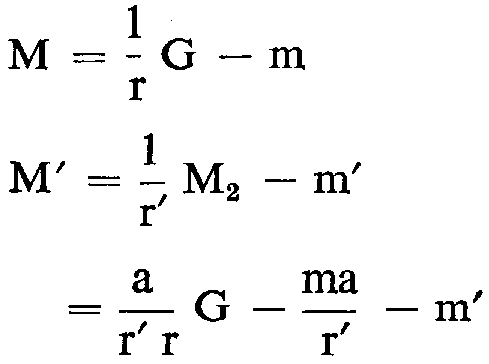
Total volume of circulating media
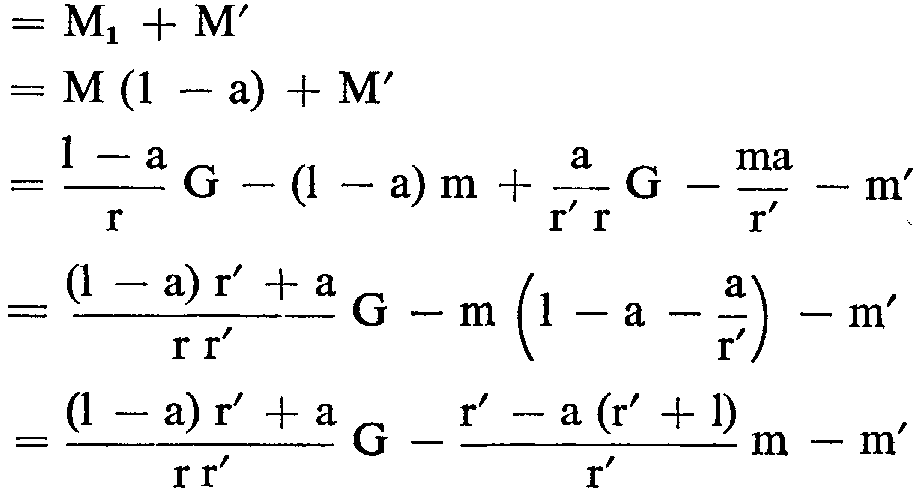
The last formula shows that the total of the monetary circulation is represented by 5 variables, besides the volume of gold reserves. These variables are a, r, r’, m and m’. Relations between them are far from simple, and they can vary from one set of institutional arrangements to another. The formula here given represents a frequent and rather simple case. It is not intended to prove anything, and has no causal significance; it only illustrates the fact, referred to in the chapter to which the present note is appended, that under modern monetary systems, even when attached to gold, the relation of gold to the volume of circulating media is very vague and indirect and depends upon a number of factors, every one of which is subject to its own variations.
- 1There is much difference between the views that are widely held in this matter in Great Britain and the United States, and views that are commonly accepted on the Continent. This explains the emphasis laid on that issue. Vide infra, pp. 68 and 69.
- 2The reader may find it useful in this context to contrast the United States’ unified monetary system, now embodying a Federal Reserve System, with what would have existed had each of the 48 States of the Union sovereign powers over its particular monetary system.
- 3The word “international” is used, of course, with utter disregard of its etymological significance; but this usage is universally recognized.
- 4F. A. von Hayek, Monetary Nationalism and International Stability, London, 1937.
- 5loc. cit., p. 4.
- 6Except when a World State exists.
- 7i.e., “real” factors of production (goods), monetary factors (capital) and, thirdly, labour.
- 8“In the last analysis . . . it is the political factor which gives rise to the economic problem of international monetary transfer. If historical accident had not created independent sovereign states . . . no such ‘problem’ would have arisen”. Lionel Robbins, Economic Planning and International Order, London, 1937, pp. 279–80.
- 9To change the weight of a coin (“debasement”) is analogous to the modern forms of devaluation. While, as we shall see presently, the expression “changes in the gold contents of a currency unit” is open to criticism, it shows at least clearly the analogy in question. But what Sovereign Prince of the days gone by would have accepted an international undertaking never to debase the currency? And even if he did accept it, this would be an analogous matter to the type of international monetary convention mentioned in an earlier part of this chapter. The Latin Union was to some extent an example of a limited convention of this kind. But it all goes to show that not even a general limitation of monetary circulation to precious metals would automatically insure a system which would work internationally in the same manner as a monetary system works within a country in regulating the supply of money in the different regions.
- 10loc. cit., pp. 270–80.
- 11Cf. my “Monetary Internationalism and its Crisis”, a chapter in The World Crisis, London, 1938, pp. 348 et seq.
- 12I expect to discuss it at considerable length in my book on the Theory of Banking which is in the course of preparation.
- 13For example England, the United States, etc. Vide infra, chap. ix.
- 14Statements to the contrary which can be found in economic literature rest obviously on a misunderstanding. Thus, for example, Professor Cassel writes (The Theory of Social Economy, New Edition, 1932, vol. ii, p. 458): “On a gold standard there is no sharp division between the quantity of money and the stock of gold.” If Professor Cassel means “an all-gold currency” then this statement is correct; but it is much more likely that the gold standard is really meant: and then this statement is essentially wrong. What is worse is that most of Cassel’s theory on the relations between gold and prices and on the role of gold in the monetary system rests on that assumption expressed in the sentence quoted. One cannot emphasize too often the fact that a gold-standard currency is a paper currency attached to gold (and sometimes convertible into gold); it is not a gold currency. Vide infra, chaps. iii and iv.
- 15It is important to note that the so-called “going-off the gold standard” is not tantamount to the suppression of gold as monetary metal. In the latter case we should have to speak of “demonetization of gold”. Vide infra, p. 177.
- 16Relations between gold and prices are particularly undetermined when the system existing is a de facto system consisting in Central Banks (or Treasuries) buying gold at prices fixed by them, while the regular gold standard is suspended. The price of gold is then subject to variations, but at the price prevailing at every particular moment, monetary authorities are buyers of gold, which as we shall see is one of the features of the gold standard. On the other hand, when the gold standard is suspended there are no longer any provisions about the gold cover of notes, and the value of gold stocks may become indeterminate. All this makes relations between gold stocks and prices very vague indeed, without making them non-existent.
- 17Cf. with the Macmillan Report (Committee on Finance and Industry Report), London, 1931, H.M.S.O., Cmd. 3897, para. 45.
- 18Thus, for example, The Economist wrote the following in its Editorial of 15 May 1937 (p. 404): “The world, in fact, has learned a new lesson. The value of a country’s gold stock does not merely depend upon the physical quantity of gold lying in the vaults of the Central Bank or the Treasury. It depends also upon the price of each ounce of gold expressed in the national currency.” (The italics are mine. I fear that for many it has really been a “new lesson”!)

