
International Monetary Economics
III. Recent Theories Connecting Gold Supply and Price Movements
RECENT THEORIES CONNECTING GOLD SUPPLY AND PRICE MOVEMENTS
WE have arrived at the conclusion, in the preceding chapter, that, under the gold standard, there is no clear and direct relation between stocks of monetary gold and changes occurring in them, on the one hand, and prices, on the other. Nevertheless several well-known statistical inquiries reached the conclusion that such a relationship exists. We must therefore turn now to examining the results of these investigations and see whether they challenge the conclusions of the preceding chapter.
A. Professor Cassel’s Theory1
(1)
Professor Cassel’s theory rests upon the examination of the relations between gold and prices observed during a period of time which has been selected “in such a wise that the general level of prices is the same at the beginning and at the end of it; for in that case the increase in the stock of gold during the period as a whole has had no influence on the general level of prices, but merely corresponds with what is required in order that the growth of the stock of gold should keep pace with the general economic development.”2
Now Cassel observed that the Sauerbeck index-number of wholesale prices stood in 1850 at almost the same level as in 1910 (77 for 1850 and 78 for 1910). This observation, linked up with the theoretical assumption just quoted, is the cornerstone of Cassel’s theory. He accepts the estimate according to which the total gold stock of the world was equal to 10 billion gold marks (£490 million) in 1850. For 1910 he estimates the gold stocks as being equal to 52 billion gold marks (£2,545 million).3 From this the average yearly increase of the gold stock is calculated as being equal to 2.79 or, in round figures, 2.8 per cent. Allowing 0.2 per cent for wear and tear, Cassel arrives at 3 per cent as the rate of yearly increase of the gold stock necessary to keep the price-level stable.4 Allowing for price fluctuations due to the business cycle, Cassel arrives at the following conclusion regarding the influence of gold on the price level:5
“. . . if the world’s stock of gold had grown by exactly 2.8 per cent during each year of the period, it is clear that no one could have thought of ascribing the fluctuations of the general level of prices to fluctuations in the supply of gold. We should in that case have had an absolutely uniform increase of the world’s stock of gold, and this increase would have sufficed to keep prices at the same level at the end of the period as at the beginning. It could, then, neither be said that the increase in the stock of gold was on the whole excessive or defective, nor that it had, by its irregularities, caused changes in the general level of prices.”
Cassel calls “such a uniform increase in the stock of gold, leaving the general level of prices unchanged at the end of a certain period”, a normal increase, and calls “normal gold stock” the stock that is obtained by applying to the initial stock the “normal” yearly rate of increase, and concludes that
“It is now obvious that, as far as changes in the general level of prices in the period 1850–1910 may be traced to variations in the world’s supply of gold, they must be ascribed entirely to the divergence of the actual gold stock from the normal.”6
Changes which cannot be traced to variations in the world’s gold stocks are in Cassel’s opinion those that result from business cycle fluctuations.
In applying this point of view to the period 1850–1910, Cassel finds a close correspondence between the variations of the price level and variations of the “relative stock of gold”, a term by which he denotes the ratio of the actual to the “normal” stock of gold. (See diagrams 1 and 2, page 35.) This confirms his view that “the secular variations7 in the general level of prices are mainly due to variations in the relative gold stock, and for the rest to certain irregularities in the normally uniform increase in the demand for gold”.8
In order to obtain a further and independent confirmation of his theory, Cassel makes an estimate of the “rate of economic progress of countries of European civilization”. The following quotation sums up the procedure followed:
“In the period 1850–1907, the world’s production of pig-iron increased on an average by 4.2 per cent. Now, the growth of the iron industry may be regarded as characteristic of the whole industrial development of the world. The agricultural development has of course been much slower and may perhaps be put at the figure of 1.2 per cent per year, which seems to correspond fairly well to the growth of the population and the improvement of its nourishment. If we assume that food represents a third of social income and that the other two-thirds of this income have grown proportionally to the industrial development, we arrive at an average rate of progress of 3.2 per cent. If, on the other hand, we give the rates for food and industrial production the same weight in our calculation of the average progress, this average would be 2.7 per cent. This figure ought to be regarded as the lower limit for our estimate of the world’s average economic progress. As it seems necessary to give the industrial production a somewhat higher weight than the agricultural, we stand on fairly solid ground if we reckon with a figure of round 3 per cent as characteristic of the economic development during the period 1850–1910.
“This corresponds closely to the result of our inquiry into the world’s gold supply. It is possible that the average rate of economic progress for the world as a whole, if it could be calculated exactly, would prove to have been during the period in question, not greater than 2.8 per cent per year. If the rate was some decimal points higher, this must be explained by a relative economy in the use of gold having been attained, in spite of the growing application of the gold standard, by the use of cheques and other means of making the system of payment more effective.”9
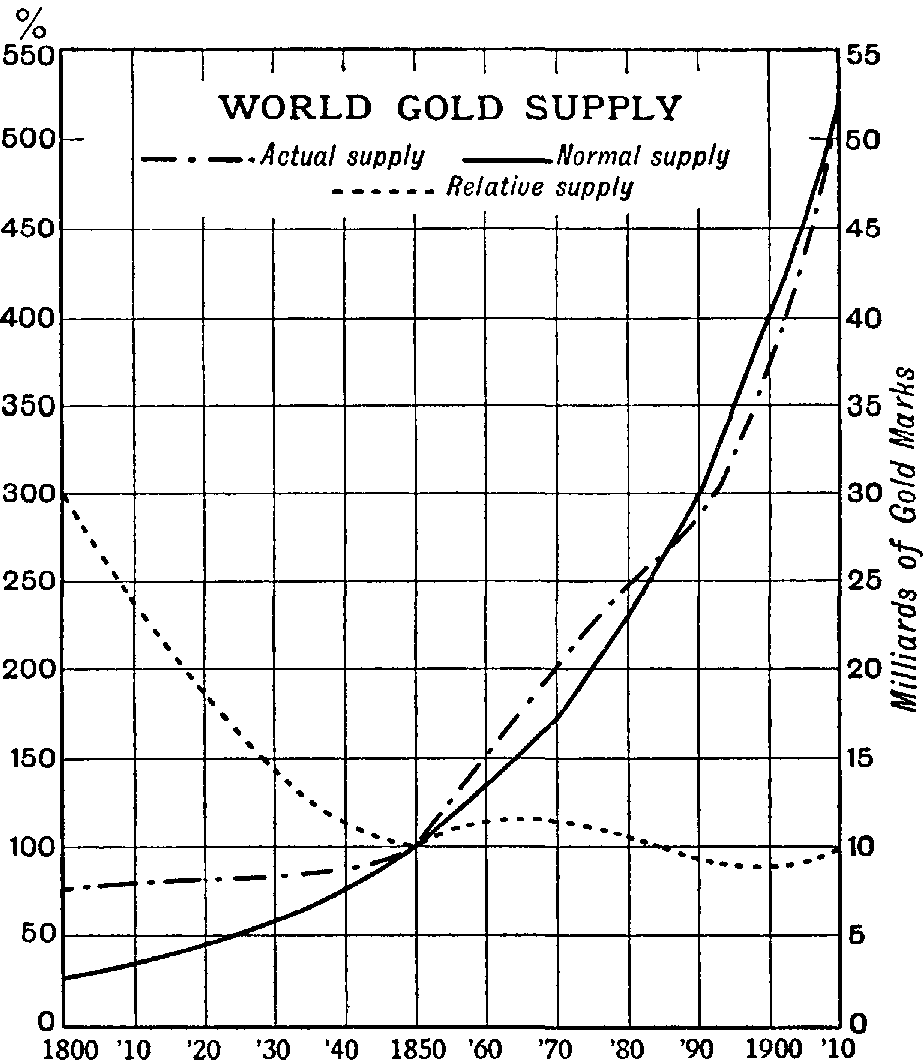
Diagram 1
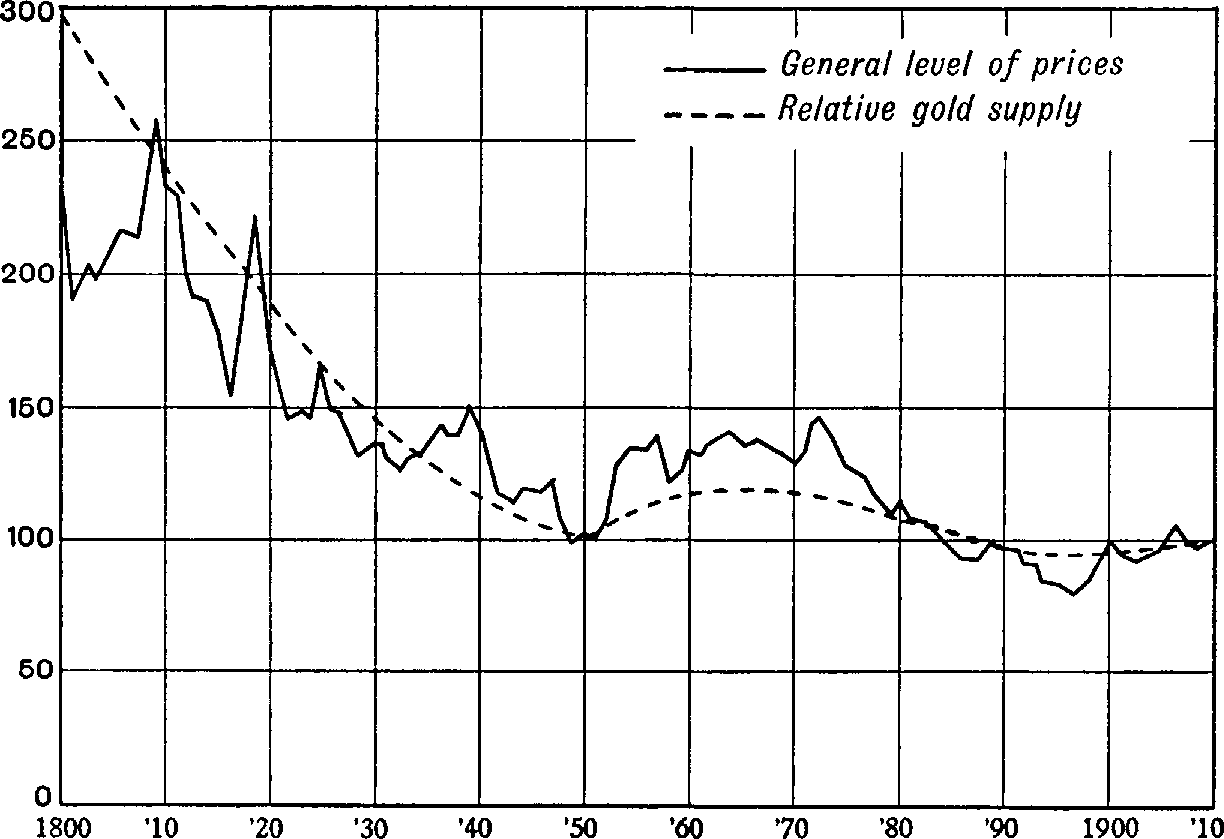
Diagram 2
I shall discuss the merits of that calculation later; here I want to stress only the rather incidental way in which Cassel treats the consequences of the development of banking facilities and particularly of the spreading use of cheques as means of payment in the period 1850–1910. It is a striking element of Cassel’s theories that they underestimate the consequences of this development, which tends to diminish the rôle of gold in determining prices and, in any case, causes the influence of gold stocks on prices to be more and more indirect.
(2)
Having seen the substance of Professor Cassel’s theory, let us now examine its validity. Criticisms of that theory fall into one of two categories: they can either admit the foundations of the theory as sound and acceptable and confine themselves to examining Cassel’s statistical estimates; or they can challenge the very foundations of Cassel’s theory. Most criticisms to which this theory has been subjected belong to the former category, and result in a different estimate of the rate of increase of gold stocks which is considered necessary for maintaining a stable price level. Thus, e.g., Kitchin bases his estimates on monetary gold, not on the total gold stocks; Mlynarski and Wilcoxen introduce into their calculations both gold and silver; and so forth.10 On the other hand, some purely statistical criticisms of Cassel’s method have been formulated.11 I shall not discuss these criticisms here, as in my opinion the very basis of Cassel’s theory is unacceptable—and if this is granted, then for the purpose of this study the details of Cassel’s method are not worth examining.
Let us note first of all that in 1850 the Sauerbeck index of wholesale prices of Great Britain stood at an exceptionally low level, around which it oscillated from 1848 to 1852 and which was not attained again until 1884. In 1910 the index was rising after a deep depression and the figure for that year is incidental in that movement. Even using Cassel’s figures, the price level had reached, in the years 1848–52, its lowest level in the 84 years from the beginning of the century till 1884. The figure for 1910 is less exceptional but hardly very characteristic. Thus the whole reasoning rests on the accidental fact that index figures for two dates 60 years apart from one another have been almost identical, both figures being rather exceptional. Of course Cassel might just as well end the period chosen for his analysis in 1884 when the index stood at 76, or in 1906 when it was exactly 77 again (while it was 78 in 1910). There is a strong touch of the accidental combined with the arbitrary about the choice of the period under investigation, and yet this choice is the corner-stone of the theory.12
This however is not the fundamental point in my criticism. What is even more open to doubt is the very essence of Professor Cassel’s contentions, particularly his assumption that index figures for 1850 and for 1910 being equal they mean the same thing. Now is this acceptable? The Sauerbeck index is an unweighted average of prices; such an average is an arithmetic construction without a clear economic meaning and has been often and rightly criticized; as basis for a theory it is inacceptable. But even if it were a more acceptable index, would it be correct to consider that an average of prices quoted at one date is significantly comparable to another average of prices of the same commodities calculated for over half a century later? In the meantime the aggregate of physical production has very considerably changed, commodities have acquired a new significance, new commodities have appeared, technical methods have been improved, standards of living have risen, taste has changed, the structure of production and the structure of prices have undergone many deep changes, and so have the size and the structure of incomes, the structure of monetary systems, of commercial organization and so on. How can one, in face of a world that has profoundly changed, attribute the same significance to two crude price averages and base upon their accidental equality a whole theory of price formation? Index-numbers of prices can be constructed only in certain circumstances, and with great care and numerous limitations, if they are to give a correct picture of economic developments; in fact, in order to be truly significant they must represent changes in the total money-value of certain organically, not arbitrarily, constructed aggregates of goods.13 The Sauerbeck index does not satisfy these conditions and limitations, and I must conclude that the theory we are now discussing is an arithmetic exercise not conducive to acceptable conclusions about the relations between gold stocks and the formation of prices. Even if the index used were perfectly correct and acceptable I should doubt that a comparison between index figures for years far removed from one another is a reasonable procedure. This last point I cannot, of course, prove. I can only appeal to the reader’s common sense.
The independent computation of the “rate of economic progress” yields no better results as it is entirely based on arbitrary statements. The assumption that “the growth of the iron industry may be regarded as characteristic of the whole industrial development of the world” is one of these statements which are made without any proof or justification. The estimate of the “rate of agricultural development” as being 1.2 per cent per year is acceptable only if we are told how this is computed;14 but it appears from the context that it is pure guesswork. Also the assumption that one-third of the social income is spent on food and two-thirds on all the remaining items of expenditure is quite arbitrary if not supported by statistical evidence. So of all the elements of that calculation only one is acceptable and that is the average growth of the output of pig-iron; the remaining elements are arbitrary. The principal misconception is however much deeper: to try to represent by a single figure the “rate of economic progress” is a hopeless effort.15 The phrase “the rate of economic progress of Europe has been between 1850 and 1910, on average, 3 per cent a year” is a completely meaningless statement even though it sounds plausible. It is one thing to say that during a certain period of time monetary expansion must have corresponded to the development of the volume of transactions settled in money, so as to prevent important changes in the order of magnitude of prices, and quite another thing to try to express by one single figure the “rate of economic progress”. The former statement is based, as it were, on “circumstantial evidence” and on the assumption that there is a relation between the volume of circulating media, the volume of transactions to settle16 and the order of magnitude of price quotations.17, 18 It is an “ex post” statement. The latter statement, involving a numerical expression for the “rate of economic progress”, belongs to a group of statements that cannot be accepted as significant and rational.19
Thus neither of the two aspects of Professor Cassel’s theory strikes me as acceptable. It is, on the contrary, surprising to observe the good reception which this theory enjoyed in economists’ circles. Thus, for example, Professor Hardy writes that “Cassel’s work is worth careful study because of the great influence it had upon monetary thinking, and because it seems impossible to make anything that can be called inductive study of the subject except by some modification of the method which he has used”. Now I have very much esteem for many of Professor Cassel’s important contributions to economic theory; his work on monetary problems seems to me however to have been the least successful. The primary reason of this lies probably in Cassel’s partiality to simple formulae and in the all too indiscriminate use he makes of arithmetical calculations. Inductive studies are certainly necessary and possible, but I differ from Hardy in that I consider a complete change of method as indispensable if such quantitative statistical studies are to yield reasonable and significant results.
(3)
Having thus dealt with the fundamental reasons why Cassel’s theory is not acceptable, let us discuss some of the specific points.
(a) The relative stock of gold is obtained by comparing the actual stock of gold at any date with what it would have been had the yearly increase been from year to year uniformly 2.8 per cent. This yearly increase is based on the period 1850–1910 merely because the Sauerbeck unweighted index of British wholesale prices happened to be the same for 1850 as for 1910. We have seen already what importance can be attached to that fact and how it is that this equality of index-numbers cannot be significantly interpreted, (1) because the operation simply of averaging prices of a group of heterogeneous commodities does not lead to results which possess an economic significance, and (2) because the comparison of prices, and particularly of index-numbers of prices, has no economic meaning when the intervening period is long and full of important changes. Prices have a meaning only in the whole context of money-values to which they belong—a context which reflects relations between various elements of economic processes. It would be a different matter to find out how the price-structure and the production-structure changed between the middle of the nineteenth century and the World War. The changes that took place during that period were profound, both with regard to things produced and with regard to the price-structure. If one carried out such an inquiry—which is not an easy one—there would be hardly any need for calculating the average rate of growth of gold stocks during this period of time, nor indeed for speaking of a “relative stock of gold”. However, even if we were to admit all the elements of Cassel’s theory, there seems to be no ground to assume that the “price level” would have been stable, except for business cycle fluctuations, if only gold stocks had increased at the steady rate of 2.8 a year. Nor does his theory give any justification for that assumption. Indeed, if we consider that the structure of the monetary systems underwent many changes during the period under consideration, that the gold standard has spread through the world, that the use of bank notes and cheques became very much generalized, the last two particularly in England and in the United States, then indeed the action of gold on prices must be considered as so indirect that any regularity in the relation between changes in the output of gold and price changes must strike us as accidental and due to the cancelling-out of the many different factors and influences involved.20
(b) Cassel compares the “price level” in England with the world stocks of gold. Now this is certainly incorrect; even if we granted everything else, the fact would remain that English prices would have to depend upon, and be compared with, English gold stocks. Compared to the other objections to Professor Cassel’s analysis this one is of minor importance;21 let us observe however that changes in the world stocks of gold can exert an influence only in so far as they affect stocks of that metal held by the monetary authorities of the different countries. What one has to consider, therefore, besides the changes in the world stocks of gold is (1) their changing distribution between different countries and (2) the relations between stocks of metal and the volume of circulating media in the different countries. I should suggest that this is the direction in which “inductive” research ought to proceed in order to yield useful results. Even then it remains to be seen what is really the relation between the volume of circulating media and the formation of prices. The relationship is certainly much more complex than admitted by the “quantity theory”. Thus there is a long way to go from the size of gold stocks and changes that take place therein to the changes in the structure and scale of magnitude of the money- values.22
(c) Finally let us observe that Cassel assumes throughout a constant price of gold. Now we have seen that the size of monetary stocks of gold should be expressed in money units—which Cassel does—and it therefore depends both on the physical quantity of the metal and on its price. Thus the size of gold stocks can vary not only with varying production but with varying price. We shall discuss this question in greater detail in a later chapter; here it is enough to mention the matter in connection with certain conclusions that Cassel draws from his theory and which read as follows: “If we have to face in the future a gradual exhaustion of the South African gold-mines, and if no new gold discoveries make up for this loss, a serious fall in the absolute gold production is unavoidable, and we may easily come down to a gold production amounting to less than half of what is necessary for the stability of the price level”. But surely this need not be the case if one can alter the price of gold; an increase in price might compensate the decrease in quantity. Is this however compatible with the nature of the gold standard? That is a question to be discussed later; let us only note in passing that the problem here discussed is not quite correctly stated if one does not make an allowance for a modification of the price of gold.23
(4)
The conclusions of Professor Cassel’s investigations have been summed up by him frequently in various publications; the following is quoted from one of his latest writings:
“During this period (i.e. 1850–1910) deviations of the actual gold supply from the normal gold supply are responsible for the greater part of the long-term variations in the value of gold, and . . . the rest of these variations are naturally explained as a result of particular and well-known variations in the monetary demand for gold.”24
He considers that “thus there is no room for the many other explanations that have been offered, and the least that can be said of them is that nothing has been done to establish their validity.”25
Hence he attributes all the “long-term” price fluctuations from 1850 till the war to the effects of the gold standard, to the variable “value of gold”; hence follows the condemnation of the gold standard as a monetary system.
In criticizing the pre-war gold standard, Cassel claims, rightly in my opinion, that it was not an automatic system and says:
“For the sake of security central banks had to keep larger gold reserves than those legally required and were therefore in a position both to export and to import gold without letting these gold movements necessarily influence the country’s volume of means of payment or its internal price level. The gold supply of a country exercised such an influence only via the policy of the central bank and its regulation of the market by means of its rate of discount and its open market operations. Thus the currency necessarily became a ‘managed currency’, whose value depended entirely on the policy of the central bank. True, the management was subject to the obligation that the currency should be redeemable in gold, but even if this condition were fulfilled—which was not always the case—it did not exclude temporary variations in the purchasing power of the currency. In every business cycle such variations took place on a large scale and the supposed automatic functioning of the international gold standard was further infringed by the movement of capital.” “. . . it was possible to prevent gold imports or exports from having any influence on the price level of the country and on the purchasing power of its currency.”26
But if there are such different causes of price fluctuations, and if the value of currency depended entirely on the policy of the central bank, how is it that the Sauerbeck index of wholesale prices in England is taken to represent the “value of gold” due to deviations of “actual gold supply from the normal gold supply”? Is it banking policy and the interest rate or is it the supply of gold which determines prices? Cassel seems to arrive at two conclusions which are by no means analogous:
(1) that the supply of gold is not steadily growing, a fact which causes, ipso facto, changes in the “long-run level of prices”;27 and (2) that the gold standard has never been automatic and that the price level in fact depended entirely on the policy of the central bank.
Now these two statements cannot be reconciled without some qualifications.
Thus one might attribute the leading influence to the supply of gold and consider banking policy as a mere corollary of changes in that supply.28 On the other hand one might consider central banking policy to be the essential factor29 but agree that changes in the gold supply may, under the gold standard, influence that policy indirectly by making expansion easier or more difficult, in view of the obligation of convertibility.
This latter is the view of Professor Cassel. He admits, rather mistakenly I think, that the “average proportion between means of payment and bank reserves” is constant over time,30 and that there is a tendency for monetary circulation to rise to the maximum compatible with existing reserves. But the means by which monetary circulation is regulated, is the bank rate.31 Under the gold standard the bank rate was fixed in such a way as to “regulate the price level in its secular variations according to the world’s gold supply, and consequently in agreement with a certain price level which is determined exclusively by this gold supply in accordance with the quantity theory.32 On the other hand, the rate policy of the banks has not prevented ‘annual’ variations in the general price level.”33 This way of putting it is open to various criticisms which I presented in the earlier part of this chapter. To say that the bank-rate policy practised under the gold standard “will produce a price level having its secular variations in inverse proportion to the value of gold”34 is to raise the whole issue of what is the “value of gold” as distinct from the “value of the currency expressed by a certain price level and dependent upon the total supply of that currency”. We have seen35 that—except for a pure gold currency—the notion of “gold prices” and of the “value of gold” is a secondary notion, not a primary datum. What Cassel really means is that it was the desire to maintain the gold standard which resulted in a banking policy leading to price development, accounted for by the rest of Cassel’s theory analysed above. He therefore makes the gold standard responsible for the observed “secular” price fluctuations. But, he continues, if the bank policy can “produce a price level having its secular variations in inverse proportion to the value of gold”,36 one can “infer from this that a bank policy, which aims at the fixing of any other price, could produce the same result”, which leads him to his proposals for price-stabilization. Now here we have a theory considerably different from the one that we discussed above; the way in which the two are combined seems to be open to objection. The latter brings Cassel in effect very closely to the ideas of Knut Wicksell,37 and I consider it as coming much nearer the truth. If Cassel had said that the pre-war gold standard involved a monetary policy which fell considerably short of keeping prices stable, nobody could object to that statement; from that he could then have easily proceeded to discussing alternative monetary policies. It is by no means certain that the pre-war policies were the only ones compatible with the maintenance of the gold standard. Cassel’s deductions from an historical event are over-bold extrapolations; and combined with the quest for very simple quantitative relations they led him to formulate the theory which we analysed and found wanting. This quest for quantitative simplicity has been also the reason for the adoption by Cassel of the theory of purchasing power parities which we shall discuss later38 and which is also hardly acceptable. In the case of the influence of gold supply on prices, Cassel’s theory is not only impossible to accept, but is unnecessary for the structure of his general theory which, taken by itself, might better explain the phenomena in question. It is to be regretted that it is the less satisfactory of the two theories which has had in the last 15 years by far the greater influence in the discussion of the “gold problem”.
B. Professor Rist’s Theory39
(1)
We have seen that Professor Cassel’s theory consists in a combination of two elements: the empirical relations between the “relative stock of gold” and the “price level”, and the theory about the effect of the rate of interest upon the “price level”. The second element could exist without the first and would thus make Cassel’s position much stronger; it is however the first, the empirical correlation, which has earned widespread attention and Cassel himself attaches a great importance to it, in his search for simple numerical formulae. These two elements are connected through Cassel’s contention that under the gold standard the interest rate must be fixed in such a way as to cause the appropriate empirical relation to hold good. Hence his condemnation of the gold standard as a system under which the price level cannot be stable.
Now Professor Rist’s theory is not only empirical but exclusively empirical; and conclusions that Rist draws from his findings are very different from these reached by Cassel. As it is a theory not merely accepted by numerous Continental economists, but one that leads to important practical conclusions, we must examine it in detail.
Let us note in the first place that Rist dismisses rather summarily that part of Cassel’s theory in which the rate of interest is attributed a leading influence upon the “price level”. In Rist’s opinion Cassel does not base that theory on “new and scientifically verified observations”; on the contrary it is based merely “upon a series of purely logical deductions, lacking any experimental support and curiously reminiscent of the dialectical method of Marx”. Hence he arrives at a “series of general propositions, each of which taken separately is inexact, but which make the impression of following logically one another”. This series of propositions “has the effect of distracting the attention of the reader away from the inflow of gold as element of the price level in order to fix it upon the rate of discount”. Now this Rist considers as entirely wrong; in his opinion “it is not the rate of discount but the convertibility of credits into gold which makes the price level vary in relation with the supply of gold”. Whereas in Cassel’s opinion the object of the discount policies carried out by banks is “to allow gold to exercise its action upon prices, while maintaining the convertibility of credit”, Rist considers that “all that banks are doing thus far is to help to maintain this convertibility, leaving to the price level the task of finding its own level in relation to gold”.40
The opposition between Cassel and Rist goes, in reality, deeper, in that Cassel realizes that it is the total monetary circulation which governs the “price level” and considers the rate of interest as the factor determining the size of the monetary circulation. Not so Rist, who denies the rôle of the rate of interest and considers that “a large quantity of monetary instruments” enter circulation “without any intermediary of credits, through the simple increase of cash-holdings, by the means of notes and deposits which represent them”.41
This view calls for certain comments. In reality the only portion of monetary instruments that is brought into circulation without the means of credit operations, is the portion which is issued in payment for gold (or, generally, for precious metals). Without credit operations, the amount of circulating medium can be increased only through an inflow of gold into the country (which is bought by the note-issuing authority against newly issued notes). Even the change of the price of gold and the re-valuation of gold stocks could only lead to an increase of monetary circulation if followed by new credit operations.
All the monetary instruments which are not issued in payment for newly purchased gold, get into circulation by the way of credit: the discounting of bills, the buying of securities (namely government securities), the extension of credits by commercial banks to customers. And this part of the monetary circulation is governed by a number of factors, one of which is the rate of interest. While Marshall, and after him, Cassel and others err by attaching to the rate of interest too exclusive an importance in influencing the formation of prices, it is certainly one of the elements and a very important one. Other elements are open-market policies, changes in individual holdings of cash reserves and so on. The increase of circulation through the inflow of gold is certainly one of the important elements, but only in certain circumstances is it a leading one.
In order to establish his point of view, Rist is obliged to penetrate still deeper into the nature of monetary circulation. This he does in stating that:
“In our days—and particularly since the World War42—the circulating medium (whenever the Central Bank fulfils its obligation of convertibility) consists of the bank note or the cheque; but the standard of value is gold into which either of them is convertible and which remains in the shape of bars in the vaults of Central Banks, so that in reality it is gold which circulates, but through the medium of paper.”43
The last statement is the key to Rist’s disagreement with Cassel and to his theory about the relation between gold and prices. If gold, while kept in vaults, is the thing that really circulates, and notes and cheques are only the outward appearance of this circulation, then indeed gold and gold only can exercise an influence upon prices and no other explanation is needed. But can we accept such a view? Can we say that the monetary system of England or the United States, or indeed of any modern country, is essentially a gold currency (in the sense in which I defined that term in Chapter II) and that all its other components (notes, cheques) are merely various ways in which gold circulates? This view would amount to a gold mysticism which is entirely unacceptable. Gold in vaults does not circulate since it is kept at the central banks. What circulates are notes and “bank money” (and coin if there is any in circulation). It is the volume of notes in circulation and the volume of demand deposits transferable by cheque which compose the total volume of circulation and which act upon prices, as has been shown at some length in Chapter II above and in the Note44 to that chapter. To say that “in reality it is gold that circulates” under such conditions is to make a very unrealistic and misleading assumption. It is, however, only such an hypothesis that can dispense an economist from investigating the various factors which influence the volume of notes and demand deposits, and the effects of the changing volume of monetary circulation upon prices, and enable him to relate price-changes directly to changes in the supply of gold.
It is clear that where there exists a monetary system in which gold is only a “standard of value” and the circulating medium is related to gold through the double convertibility (a) of bank notes into gold (under specified conditions) and (b) of demand deposits (and cheques drawn against them) into bank notes, it is difficult to relate price changes directly to changes in the supply of gold. If one wants, however, to work out such a direct relation, one must resort to one of the following two procedures, each of which is subject to important reservations:
(A) One procedure consists in declaring that changes in the volume of circulating medium are determined by a policy of which the only aim is to correlate price-changes with changes in the supply of gold;
(B) The other procedure is to base the whole argument upon an assumption which takes all importance away from the changing volume of circulating medium and relates price-changes directly to changes in the supply of gold as it were by definition.
(2)
Cassel resorts to the former procedure and it leads him, as we have seen, to adopt an over-simplified and inaccurate theory. Rist, on the other hand, adopts the latter procedure, which allows him to remain in the sphere of pure empiricism. The idea that gold confined to the vaults of central banks is that which circulates “in reality”, is a necessary basis of Rist’s “theory”: for that “theory” does not explain in any other way how changes in the gold supply produce changes in prices.
Having defined the theoretical foundations of Rist’s empirical inquiry, let us now examine the method and results of that investigation.45
Professor Rist bases his conclusions upon the comparative movement of two curves: the one is the curve of yearly increases of the world-stock of gold (as a percentage of each preceding year); the other is the curve of the gold-price level of France (see diagram 3, page 54). Rist acknowledges Cassel’s influence in deciding upon the method to be used. The curve of prices leaves aside the years 1914–19, because of the “quasi-impossibility with artificially maintained exchange rates, of calculating the French gold prices”. From 1920–8 they are established on the basis of the dollar quotations. After 1928 “the legal stabilization of the franc makes of French prices real gold prices”.46 To these two curves Rist adds a third representing “long-run price movements through the elimination of cyclical fluctuations by the means of drawing straight lines joining together maximum and minimum points of the price curve, until 1914”.47 In commenting upon the method employed for eliminating cyclical fluctuations Rist finds that no objection can be made to it for the period 1872–1914. As for the period 1850–72, he thinks that one might suggest dividing it up into two shorter periods 1850–6 and 1856–72 and drawing the straight lines accordingly; he similarly admits that the division might be made into periods 1850–9 and 1859–72, and that instead of ending the period in 1872 one might do so in 1869 or 1874 without much effect upon conclusions reached.
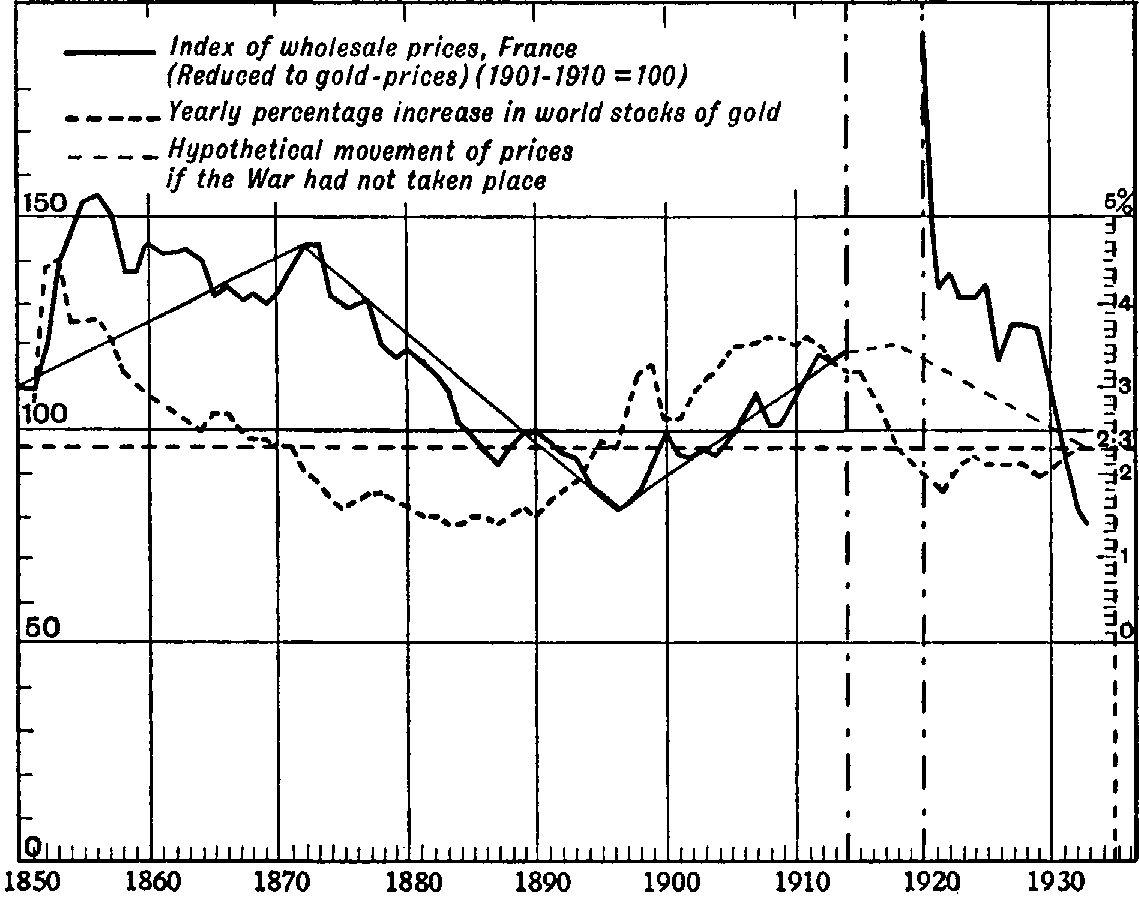
Diagram 3
The next stage in Rist’s method consists in drawing a horizontal line at the level of 2.3 per cent of yearly increases in the production of gold. Then he finds that “in the first period, as long as the increases in the production (of gold) remain above 2.3 per cent, prices are rising or remain stationary. They are falling, on the other hand, when the increases in the production of gold fall below that level. In the second period the fall (of prices) continues as long as the increases remain below that level. The third period, going until the war, is characterized by increases constantly superior to 2.3 per cent and the rise of prices is uninterrupted”. This leads Rist to the following conclusion:
“The experience of 1850 till 1914 can be summed up as follows: An increase (of the gold production) smaller than 2.3 per cent does not suffice to maintain a stable or rising price level. An increase larger than 2.3 per cent maintains stable or rising prices.”48
Having gone thus far, Rist takes another step: he makes the assumption that the 2.3 per cent increase has a permanent significance and he finds that the rate of increase of the production of gold, which has a falling tendency since 1911, falls in 1919 below that mark. From this he concludes that “the rise in prices should not have continued beyond 1919” and that “it should even have slowed down considerably between 1914 and 1919”.49 In 1919 the price level should hardly have been higher than in 1914, “if the war had not taken place”. After 1919 the price level should have been falling. On Rist’s diagram this hypothetical curve is shown by a broken line, reaching by 1933 or 1934 the level of “about 100 or 110 for example”.50 On the basis of these constructions and findings, Rist arrives at the conclusion that “provided our deductions are plausible, one notices immediately the enormous difference between what one might call the probable level of prices and the actual level. The difference between the two . . . only ceases around 1931 or 1932 if one admits that our hypothetical curve is likely.”51
From this Rist draws very important practical inferences, which I shall discuss presently.
(3)
As we see, Rist’s method of inquiry is statistically far less elaborate than Cassel’s. Some of the general criticisms that were formulated in discussing the latter should be repeated here. Besides these there are however some other serious reservations to be formulated.
(1) The price curve is composed of three segments: the first is calculated on the basis of French prices quoted in the market (1850–1914); the second is based on calculated prices, quoted prices being “adjusted” by the means of the fluctuating dollar /franc exchange; the third segment is again based upon franc prices quoted, though the price of gold is not the same in the period 1928–35 as it was in the period 1850–1914. Thus the three segments of the curve are not comparable with one another. It is true that the first is divided from the second by a gap of 5 years—but this is due, as Professor Rist himself explains, to the difficulty of making a satisfactory computation. The methodological heterogeneity does not seem to prevent Rist from drawing one curve for the whole period 1850–1935. Now, as the reader will easily see in applying to this problem the concepts established in Chapter II, we can have one of two sorts of curves covering the whole period under investigation:
(a) a curve of prices expressed in francs and quoted in the market,52 or even more correctly, of prices at which transactions were carried out at the different time moments;
(b) a curve of prices “calculated” by reducing quoted prices (or prices at which transactions were made) to a common gold price. As we have seen, these are not real “gold prices”, and their significance is very dubious; still they may be useful for certain comparisons. It should not be forgotten that this procedure is based on the assumption that changes in the price of gold are reflected by simultaneous and proportional changes in nominal prices. This assumption is however quite unacceptable.
Now Rist’s price curve is in two segments a curve of nominal prices,53 while the middle segment is based on calculated data, established by the means of the rates at which the dollar was quoted in Paris during the period of monetary instability, 1919–28. It is not legitimate to combine this segment with the other two into one curve.
(2) The second curve, which is supposed to illustrate the long-run price movements, is even more open to criticism. There are many methods of establishing “trends”; the one used by Rist is the simplest and the least commendable. The device of linking maxima and minima by straight lines does not eliminate effects of cyclical fluctuations and does not, therefore, establish a “trend”,54 because obviously, the maxima and minima are effects, not only of the “trend”, but also of cyclical fluctuations. It is an open question whether one should try to “eliminate” cyclical fluctuations at all; personally I think that series resulting from such statistical “eliminations” are fanciful rather than representative of real phenomena. But if one decides to adopt such methods, one has at one’s disposal very elaborate methods. That used by Rist is not acceptable even if one admits the validity of the statistical operation as such. It must also be emphasized that the choice of periods to which Rist applies his method is arbitrary, and this arbitrariness further diminishes the usefulness of the “secondary” curve obtained.
(3) The curve calculated for the period 1914–35 and called the curve of the “probable price level” is also open to serious reservations. First of all Rist does not tell us how he established its shape; hence a suspicion of arbitrariness. But even besides this serious criticism, it is not clear what is the meaning of the curve. Had there been only gold in circulation in the previous period, and had the exact action of gold upon prices been ascertained for the case of a pure gold currency, then one could calculate a price curve which one thinks would have existed if the monetary system had remained unchanged. But in the case before us the situation is very different. Professor Rist only claims that prices are falling if the yearly output of gold increases from year to year by less than 2.3 per cent; he says nothing about the degree of that fall. There is therefore no reason to suppose that the downwards shape of the hypothetical price curve since 1919 should be what it is on Rist’s diagram.
(4) So far in speaking of the “probable price level” I have granted Rist’s other assumptions. But are they at all acceptable? There is no explanation of the 2.3 which is the basis of his calculation. Even Cassel’s 3 per cent seems better founded. The 2.3 is a purely empirical datum; but then have we any reason for assuming that it has “a permanent significance”? None whatever unless it be demonstrated that this rate is an economic constant. Thus far Rist has provided no such demonstration, nor can I see how such a notion is at all conceivable. Rist does not even say how he obtained that rate, and we are obliged to suppose that it is derived simply from looking at the diagram. But then it depends upon the trend lines which, as we have seen, cannot be accepted, and upon an arbitrary choice of dates for establishing these lines. How can we thus attach any meaning to that figure, 2.3, and base further reasoning on it?
(4)
In the light of these criticisms it seems hardly possible to accept Professor Rist’s thesis. A theory has to explain the relation between the phenomena for which it is supposed to account. Rist’s theory does not do so. He is led to attach great importance to a purely empirical relation, which furthermore is obtained through the use of statistical methods which are open to objection. Even if we were to concede to the figure of 2.3 per cent the sense and significance Rist attributes to it, there seems to be no reason whatever for using it as a basis for extrapolation. It might be (and probably would be) purely fortuitous, even if it were proved to be correct (which it is not). In order to ascertain the action of stocks of monetary gold and of changes occurring therein upon prices, we should need to know more about the mechanism by means of which changes in gold stocks affect prices. We are given nothing of the sort. Instead we find the view, discussed above, that under the gold standard it is gold which circulates “in reality” even though it is confined to the vaults of central banks. This is an inadequate substitute for the missing mechanism. Elsewhere Rist claims that the volume of credit (by which is meant the totality of monetary instruments created by means of extensions of credits) adapts itself to the level of prices which is determined by the gold situation. This view is equally hard to accept, considering that the changing total volume of circulating medium acts upon prices, not one part of it only, and this the part which does not really circulate and only serves as partial “cover” to the rest. Thus Rist is also holding a view which it would be difficult to defend (though several Continental economists hold it) that the quantity theory of money is in effect a theory about the action of changes in the stock of precious metals upon prices.55 The result of this general attitude is a theory which does not explain the phenomena under investigation. To affirm something is a different thing from proving it—and, in spite of the statistical inquiry, which we found wanting, Rist does not go far beyond the former.
Before showing what practical conclusions are drawn from that theory, let us point to a curious omission, which has also been made by Cassel in his theory examined above:56 it is left out of consideration that the value of the monetary gold stock can be altered by changing the price of gold. This omission singularly diminishes the weight of some of the conclusions reached, because even if everything else be granted, there remains an alternative systematically ignored by both Rist and Cassel: changing the price of gold. We shall further discuss that possibility in a later chapter.
(5)
Let us now turn to Professor Rist’s conclusions. The principal among them is as follows:
“The continuous fall of prices is thus nothing but normal though the intensity of that fall between 1930 and 1934 has evidently a particular character. In other words one should have recognized, as early as 1919, on the basis of past experience, the impossibility of maintaining the level of gold prices at a level which so completely disagreed with older experiences. One should have realized sooner that the level of gold prices which was adopted between 1922 and 1928 as basis of the world monetary reconstruction, i.e. the level of American gold prices, had no justification whatever (considering the rhythm of gold production) and that it was due to an extraordinary series of coincidences. Had one realized at the time that truth, one would not have tied world gold prices to the American price level. . . . One would also have renounced all hope of maintaining by the means of a systematic credit policy the level of gold prices at the height to which it was brought by the war. All the experience of a hundred years proves that the quantity of credit does not command the price level but tends to adapt itself to the level of prices which results from the relations between the production of gold and that of commodities.”57
As regards, therefore, the “Great Depression”, Rist concludes that “It is through extremely painful difficulties and resistances, that the world returned gradually to a level of prices in conformity with the nature of things”.58
In order to understand how Professor Rist reaches his conclusions regarding recent monetary developments, it is necessary to consider some additions to the theory summed up in the preceding paragraphs.
First of all, Rist considers that the price level that existed in the United States during and after the war was not representative of what he calls “world gold prices”. He accounts for this by the following argument:
“The issue of paper money in the United States during the World War caused, as it always does, an artificial rise in prices, while Europe’s uninterrupted shipping of gold to that country, made it possible to maintain the convertibility of paper into metal. Under any other circumstances that maintenance of convertibility would have been impossible. One had therefore to consider American prices as gold prices. They were not however world gold prices as one thought because of a very natural optical illusion.”59
What does this mean? It means that Rist makes a distinction between gold prices, which are prices that exist in a country where paper money is convertible into gold, and “world gold prices”. The latter notion is left undefined but we can suppose that “world gold prices” are prices in gold-standard countries when convertibility exists in most countries of the world and when there is no “maldistribution” of gold, i.e. no accumulation of the metal in some one or few centres.60
Secondly, Rist introduces a certain notion of “normality”, of conditions that are “in the nature of things” and against which it is hopeless and vain to fight. Amplifying, in a later statement, his observations about American gold prices during and after the war, Rist exemplifies his attitude in a striking way:
“If somebody,” he says, “had maintained in 1922 or 1925, that it was impossible for American prices to stay at the level they had reached by then, one would have considered him—particularly in the United States—as being a visionary. And yet a clear view of that situation would have rendered the greatest service in showing the vanity of an individualistic or co-ordinated effort at fighting against the inevitable.”61
It is particularly important to note that Rist considers a co-ordinated action to be in this case as ineffectual as an individual policy.62 He clearly considers that there is a price level corresponding to the nature of things and from which no lasting deviation is possible. This naturally correct price level must “correspond to what seems to be called for by the relation between the world production of gold and the world production of commodities”.63 The difficulty of finding out what is the rate of the world production of commodities is realized by Professor Rist; he finds a way out of it by adopting the Snyder “Index of world production”,64 which shows that world production is rising very regularly; all irregularities in the movements of prices being due to monetary factors, or in Rist’s view, to the changing rate of gold output. Rist adopts Snyder’s “Index” with a slight reservation: “This curve,” he says, “is not perfect, but we must be satisfied with it as long as we have no better method of measuring the production of commodities and its growth.”65
Having then circumvented the difficulty (or impossibility!) of measuring changes in the total world production of goods, Rist is left with the exclusive action of the supply of money upon prices. As we have seen, however, in countries where paper money is convertible into gold he reduces the supply of money to the supply of gold; he considers all the other components of monetary circulation as merely different ways in which gold circulates.66 All this follows from Professor Rist’s basic ideas about the nature of money and of monetary systems based on gold. These are views which do not correspond to the realities of the world in which we are living67—but one cannot deny their consistency. With Rist’s various assumptions which have been explicitly stated in the preceding pages, but particularly with his conception of the rôle of gold in a monetary system tied to that metal, stands or falls his theory of the relations between gold and prices.
(6)
It may be interesting, in conclusion, to contrast once more the theories of Rist and of Cassel. Professor Rist refuses to admit any particular rate of increase in the production of gold as “normal”; his own, 2.3 per cent rate he considers as a purely empirical datum. While considering this rate as important, and basing on its extrapolation his conclusions relative to post-war developments, he draws different conclusions from Cassel’s, from the fact that there are deviations between that rate and the effective rates of increase in the production of gold:
“In saying that the normal price level has been lower than the real level, I don’t maintain in the least that the gold supply was insufficient. It is the level of gold prices which has become completely falsified through the war, through the issue of paper currency by all the great countries and through the artificial concentration of gold in the United States, that is through a series of measures resulting all of them from the will of men. To say that the production of gold in the world for the last twenty years called for a price level different from the actual level, and that the crisis is the means by which we come closer to a level corresponding to what that production demands, is not to declare that gold is insufficient. . . .”68
In other words, while Professor Cassel considers that the production of gold was insufficient to maintain the stability of prices at the level which they happened to have attained and that an undesirable deflation was the outcome, it is the opinion of Rist that the actual price level was wrong and had to be adjusted to the gold situation even at the cost of a severe deflation. The diagnosis made by both economists is similar, but conclusions drawn from it are exactly opposite. It may be said that each of these two distinguished scholars gets conclusions which are consistent with his general theoretical position. Neither of them however succeeds in proving the diagnosis, i.e. that gold does exercise such an influence upon prices. Cassel thinks that the “great deflation” was inevitable under the gold standard and therefore desires to see the abolition of that monetary system; for Rist it was necessary because demanded by the gold situation, that mystical criterion of economic developments. Neither of them considers that (1) the “great deflation” might have been due to other causes and (2) that if their diagnosis were correct, equilibrium might have been restored through a simultaneous change of the price of gold throughout the world. Cassel attempts to indicate a mechanism through which gold acts upon prices, though it is an over-simplified one; Rist gives no mechanism whatever. It may not be unfair to conclude that the “inductive theories” do not add much to our knowledge of the relations between gold and prices.
(1) Interprétation de la Chute des Prix depuis 1925, article published in Mélanges offerts à Ernest Mahaim, Paris, 1935, vol. i, pp. 232–41; also published in pamphlet form. (To be quoted below as Rist 1935.)
(2) Histoire des Doctrines relatives au Crédit et à la Monnaie, Paris, 1938. (To be quoted below as Rist 1938.) This book embodies inter alia, the substance of several important articles published in the Revue d’Economie Politique, which therefore are not separately quoted here.
- 1There is much difference between the views that are widely held in this matter in Great Britain and the United States, and views that are commonly accepted on the Continent. This explains the emphasis laid on that issue. Vide infra, pp. 68 and 69.
- 2The reader may find it useful in this context to contrast the United States’ unified monetary system, now embodying a Federal Reserve System, with what would have existed had each of the 48 States of the Union sovereign powers over its particular monetary system.
- 3The word “international” is used, of course, with utter disregard of its etymological significance; but this usage is universally recognized.
- 4F. A. von Hayek, Monetary Nationalism and International Stability, London, 1937.
- 5loc. cit., p. 4.
- 6Except when a World State exists.
- 7i.e., “real” factors of production (goods), monetary factors (capital) and, thirdly, labour.
- 8“In the last analysis . . . it is the political factor which gives rise to the economic problem of international monetary transfer. If historical accident had not created independent sovereign states . . . no such ‘problem’ would have arisen”. Lionel Robbins, Economic Planning and International Order, London, 1937, pp. 279–80.
- 9To change the weight of a coin (“debasement”) is analogous to the modern forms of devaluation. While, as we shall see presently, the expression “changes in the gold contents of a currency unit” is open to criticism, it shows at least clearly the analogy in question. But what Sovereign Prince of the days gone by would have accepted an international undertaking never to debase the currency? And even if he did accept it, this would be an analogous matter to the type of international monetary convention mentioned in an earlier part of this chapter. The Latin Union was to some extent an example of a limited convention of this kind. But it all goes to show that not even a general limitation of monetary circulation to precious metals would automatically insure a system which would work internationally in the same manner as a monetary system works within a country in regulating the supply of money in the different regions.
- 10loc. cit., pp. 270–80.
- 11Cf. my “Monetary Internationalism and its Crisis”, a chapter in The World Crisis, London, 1938, pp. 348 et seq.
- 12I expect to discuss it at considerable length in my book on the Theory of Banking which is in the course of preparation.
- 13For example England, the United States, etc. Vide infra, chap. ix.
- 14Statements to the contrary which can be found in economic literature rest obviously on a misunderstanding. Thus, for example, Professor Cassel writes (The Theory of Social Economy, New Edition, 1932, vol. ii, p. 458): “On a gold standard there is no sharp division between the quantity of money and the stock of gold.” If Professor Cassel means “an all-gold currency” then this statement is correct; but it is much more likely that the gold standard is really meant: and then this statement is essentially wrong. What is worse is that most of Cassel’s theory on the relations between gold and prices and on the role of gold in the monetary system rests on that assumption expressed in the sentence quoted. One cannot emphasize too often the fact that a gold-standard currency is a paper currency attached to gold (and sometimes convertible into gold); it is not a gold currency. Vide infra, chaps. iii and iv.
- 15It is important to note that the so-called “going-off the gold standard” is not tantamount to the suppression of gold as monetary metal. In the latter case we should have to speak of “demonetization of gold”. Vide infra, p. 177.
- 16Relations between gold and prices are particularly undetermined when the system existing is a de facto system consisting in Central Banks (or Treasuries) buying gold at prices fixed by them, while the regular gold standard is suspended. The price of gold is then subject to variations, but at the price prevailing at every particular moment, monetary authorities are buyers of gold, which as we shall see is one of the features of the gold standard. On the other hand, when the gold standard is suspended there are no longer any provisions about the gold cover of notes, and the value of gold stocks may become indeterminate. All this makes relations between gold stocks and prices very vague indeed, without making them non-existent.
- 17Cf. with the Macmillan Report (Committee on Finance and Industry Report), London, 1931, H.M.S.O., Cmd. 3897, para. 45.
- 18Thus, for example, The Economist wrote the following in its Editorial of 15 May 1937 (p. 404): “The world, in fact, has learned a new lesson. The value of a country’s gold stock does not merely depend upon the physical quantity of gold lying in the vaults of the Central Bank or the Treasury. It depends also upon the price of each ounce of gold expressed in the national currency.” (The italics are mine. I fear that for many it has really been a “new lesson”!)
- 19vide Appendix.
- 20I find myself in substantial agreement with conclusions reached by A. D. Gayer in his book on Monetary Policy and Economic Stabilization, p. 63, though his criticisms are considerably less severe than the ones I have developed in this chapter. Charles O. Hardy says, similarly, in the book Is There Enough Gold?: “Other factors, such as the use of bank deposits as money, and changes in the absorption of gold by India, are brought into Cassel’s analysis to account for the major deviations of the price trend from the ‘relative supply of gold’, (p. 22.) If, as Cassel believes, the increase in the amount of gold stock required to maintain prices during the 60 years before the war corresponded accurately or even approximately to the growth of production, it was because for the period as a whole these other important factors cancelled each other out.” (p. 24.) As a matter of fact these factors did not cancel each other out as there were considerable price movements in the course of these 60 years. Cancellation can only have existed in so far as prices were more stable than they would otherwise have been.
- 21In his study On Quantitative Thinking in Economics, Oxford, 1935, p. 107, Cassel says in this connection the following: “During the period within these limits Great Britain was on the gold standard and, in addition, was essentially a free-trade country. British prices, therefore, may be taken fairly well to represent gold standard prices in the world market, and British index-numbers to reflect the variations of the general price level in terms of gold.” Still it does not follow that prices in Great Britain depend upon the size of world stocks of gold! In the same context Cassel says, rightly, that “the analysis must be confined to a period in which the general system of money has been essentially unaltered”. But in the period 1850–1910 this has not been true even for Great Britain, where the great development of banking took place precisely in the second half of the nineteenth century; the fact of staying on the gold standard does not exclude the possibility of great changes taking place in the internal organization of the monetary system. If the statement that in that period of sixty years “the general system of money has been essentially unaltered” is not true for Great Britain it is much less true for the world at large; thus the condition which Professor Cassel recognizes himself as a necessary prerequisite of his analysis has not been fulfilled in the period to which he applies that analysis.
- 22This, not the “price level”, is the subject that deserves our interest, though it is clear that, thus formulated, the changes cannot be expressed by a single numerical time-series. How to represent them adequately is a problem for statisticians to solve!
- 23A change of the price of gold may, of course, affect quantities produced, besides affecting their value and the value of existing stocks.
- 24Gustav Cassel, The Downfall of the Gold Standard, Oxford, 1936, p. 7.
- 25Neither has Cassel done anything to demonstrate this sweeping statement.
- 26Ibid., pp. 3–4.
- 27Which is merely a statistical construction to be accepted for what it is worth. Vide Appendix.
- 28This is, for example, the position taken by Professor Rist. Vide infra.
- 29And, of course, the policy of commercial banks, which is more or less closely connected with that of the central bank.
- 30In The Theory of Social Economy (1932 edition, vol. ii, p. 494), he says that “there is no obvious reason why an increase of the gold supplies should cause a permanent alteration in the average proportion between means of payment and bank reserves. . . . We shall therefore find it quite natural that the gold supply completely controls the secular variations of the curve of the general price level.” Now the fact is that this proportion did change, and did change very considerably if we include, in the total of existing means of payment, demand deposits transferable by cheque.
- 31The Theory of Social Economy, 1932 edition, vol. ii, p. 495.
- 32In Cassel’s opinion “it is sufficient for upholding the quantity theory, to assume that the total demand for gold is proportional to the general price level” (The Theory of Social Economy, 1932, vol. ii, p. 459); this view is shared by some economists but I think that it is inaccurate and may lead to regrettable misunderstandings. There is no mention of gold as such in the “quantity theory”; it relates the total volume of monetary circulation to the “general price level”, not the “demand for gold”. Gold can be brought into the picture only indirectly, because of institutional arrangements, and never enters into the “quantity theory” as one of the variables.
- 33The Theory of Social Economy, vol. ii, p. 496.
- 34Ibid., pp. 496–7.
- 35Vide supra, chap. ii.
- 36The Theory of Social Economy, vol. ii, p. 497.
- 37See Wicksell’s Interest and Prices (first published in German in 1898; English translation published in 1936).
- 38Vide infra, chap. vii.
- 39See the following publications by Professor Rist:
- 40Rist 1938, pp. 309–10.
- 41Ibid., p. 308.
- 42A limitation which is hardly valid for England and the United States.
- 43Rist 1938, p. 338 (italics are mine).
- 44Vide supra, p. 30.
- 45See, particularly, Rist 1935.
- 46Rist 1935, p. 235.
- 47Ibid.
- 48Rist 1935, p. 236.
- 49Ibid.
- 50Ibid., p. 237.
- 51Rist 1935, p. 237 (the italics are in the text).
- 52I do not repeat again all the objections to price averages and index-numbers of the “general price level”. Vide Appendix for detailed comments on that matter.
- 53For the distinction between gold prices and prices that exist under the gold standard, vide supra, chap. ii.
- 54I must leave aside the question of whether such “eliminations” are at all significant. The critical and sceptical observations which the reader will find in the Appendix apply to this problem as well. I cannot discuss further here the question whether the application of a “linear trend” is at all justified.
- 55“. . . des adversaires de la théorie quantitative qui sont en réalité les adversaires de toute théorie accordant à l’accroissement des métaux précieux une action sur les prix”, Rist 1935, p. 233.
- 56Vide supra, p. 44.
- 57Rist 1935, pp. 237 and 238.
- 58Rist 1938, p. 282. (Italics are mine.) The italicized phrase reads in French as follows: “le monde est revenu graduellement à un niveau de prix conforme à la nature des choses”.
- 59Rist 1935, p. 234. (Italics are in the text.)
- 60This distinction is rather confusing because there is no strict delimitation possible between “world gold prices” and the other “gold prices”. I suggest that the definitions given in chap. ii above are preferable, since they are clear cut and do not give rise to either “illusions” or misunderstandings!
- 61Rist 1938, p. 282.
- 62This sweeping view appears to me unacceptable. Vide infra, p. 71. Cf. also my study of Monetary Internationalism and its Crisis, published in The World Crisis, London, 1938, pp. 350–1.
- 63Rist 1935, p. 238.
- 64Carl Snyder, Overproduction and Business Cycles, in the Proceedings of the Academy of Political Science, vol. xiv, No. 3, New York, June 1931.
- 65Rist 1935, p. 238. Snyder’s “Index” is one of the statistical constructions the basis of which is discussed in the Appendix and found open to serious objections. It should not be used at all; it is better not to have any index of production than to be misled by one that is void of any economic significance!
- 66Vide supra, p. 51.
- 67Cf. with the analysis given in chap. ii above.
- 68Rist 1935, p. 241.

