
Interest and Prices
Chapter 9: Systematic Exposition of the Theory:
CHAPTER 9
SYSTEMATIC EXPOSITION OF THE THEORY
A. The Causes which Determine the Natural Rate of Interest on Capital
It is to the brilliant work of Jevons and Böhm-Bawerk that we mainly owe the enormous advance which has recently taken place in our knowledge of the nature of interest and of the part played in production by capital. Though they differ somewhat in formal outlook, the substance of these two writers’ contributions is very nearly identical.
Jevons opens1 with the observation that the customary division of productive capital into liquid (circulating) and fixed capital is a scientific conception of little significance, and that its function is better served by the antithesis between free and invested capital. “The notion of capital”, he says, “assumes a new degree of simplicity as soon as we recognise that what has been called a part is really the whole. Capital, as I regard it, consists merely in the aggregate of those commodities which are required for sustaining labourers of any kind or class engaged in work.... The current means of sustenance constitute capital in its free or uninvested form. The single and all-important function of capital is to enable the labourer to await the result of any long-lasting work,—to put an interval between the beginning and the end of an enterprise.”2
Fundamentally this line of approach is certainly correct. But Jevons commits the error of confusing the part with the whole. Even if it is agreed that fixed capital is merely the temporary product of labour and free capital, the costs of production which are advanced out of the latter can never be resolved entirely into wages. The rewards of the other factors of production, and particularly of land, must be taken into account.
It might be supposed that even interest itself is partly advanced out of capital. This would appear to be the case when interest is paid before the final product is available. But from the economic point of view, this is not an advance out of capital, but a retention of part of the capital, involving an encroachment on its effective amount. While it is usual for the debenture holders of a company, and occasionally even for the shareholders, to receive interest and so-called dividends during the preparations for the work that they are financing, in reality they are merely receiving back a part of their capital which has failed for the moment to fructify, at any rate in this particular enterprise.
Capital in its “free and uninvested form” consists not only of the means of sustenance by which labourers can defray their consumption, but it also provides for the owners of other factors of production, above all for the owners of land. In its essence it is not merely a “wages fund” but also a “wages and rent fund”.
This oversight of Jevons’ is in keeping with the traditional but fallacious statement of the English economists that the rent of land “does not . . . form any part ... of the advances of the capitalist”.3 (We shall deal later with the complication which arises when the landlord is himself an entrepreneur.)
According to Böhm-Bawerk,4 the characteristic of capitalist production lies simply in the fact that a portion—in a highly developed capitalist economy usually the main portion—of the available labour and land is employed for the purposes, not of current consumption, but of consumption in the more or less distant future; and current consumption is mainly made up of the mature product yielded by labour and land employed in the past. At any moment there are in existence in various stages of maturity certain preliminary and intermediate products; these are called capital. But, according to Böhm-Bawerk, they are to be regarded as symptoms of the capitalist process of production rather than as its essence, which simply consists in the devotion to future needs of current productive forces.
This line of approach penetrates more deeply, and for the case of a monadic economy5 (or of the economic system as a whole) it is also the more correct. In a monadic economy the means of sustenance do not really constitute capital: it is rarely the case that these are accumulated with a view to entering on some fresh branch of production, as is done by the “Urfischer” of Roscher (and Ricardo). Consumption goods are usually consumed as soon as they are ready, provided that the requirements of nature or of technique do not stand in the way. The thing that is “saved” is rather a portion of the labour power—available, though relying on the provision of means of sustenance,—and of the disposable service of land, which are partly withheld from meeting current needs and are devoted to the needs of the future.
But the monadic economic system is to-day an exception. Almost the whole of labour and a large part of land are employed by their owners in the service of others. The payment that is received (wages and rents) is devoted by the workers and landlords purely to the purchase of consumption goods, in so far as they do not themselves accumulate capital. Such a process could theoretically, by means of payments in kind, be carried on without the use of money. In this sense consumption goods might be regarded as constituting the original (free) capital by which labour and land are purchased.
It is not difficult to generalise this proposition. Those trades in which workers or landlords are themselves entrepreneurs are always subject in some degree to the general influences of the market. Each such worker or landlord can be imagined to pay out to himself his wages or rent at the normal rates, as determined in the market, until his product is completed or ready for sale, so that capital is necessary, whether it is owned by the individual himself or borrowed from others, and whether he really spends the money on his own consumption or partly saves it and so converts it into capital.6
In this way the whole thing gains enormously in simplicity and clearness, and the lines of approach of Jevons and of Böhm-Bawerk are made to coalesce. With the exception of that part which is consumed by the capitalists them-selves in the form of interest, the total amount of consumption goods produced yearly, monthly, or weekly can be regarded, on the assumption of a stationary state, as a fund for the payment of wages and rents. This fund represents the (real) demand for labour and land. An equivalent amount is provided by the combined operation of labour and natural forces and this is added to the country’s stock of capital (invested capital), assuming various forms in succession. Beginning with “labour applied to the land”, it appears successively as tools, machines, raw material, half-finished goods, and finally in the form of the finished product (in which, partly or wholly, the capital is once again free). Of this finished product, the capitalist7 again retains a part for himself as interest or exchanges it against other products for his own consumption. The main portion he invests afresh: he employs it, either directly or after exchanging it for the products of other entrepreneurs, for buying or hiring labour and land for the purpose of further production. Thus at any moment of time a cross section of the actual capital in existence (liquid and fixed) would indicate that nearly all of it (indeed all of it, if we adopt a more accurate or more ideal point of view) assumes the form of invested capital. But if a “lengthwise section” were taken, it would be seen that each individual piece of capital travels, slowly or rapidly as the case may be, around a circular path, and that both at the beginning and at the end it takes the form of free capital, that is to say, of consumption goods.
For the purposes of a closer treatment of the problem of capital and particularly of a theoretical determination of the rate of interest (as well as of wages and of rents), some further analysis of the meaning of capital is, I think, indispensable, and it is necessary to turn back to the classical distinction between fixed and mobile capital. There are certain products of man’s labour which have a very high and sometimes unlimited durability. Examples are provided by houses, streets, railways, canals, certain improvements in land, certain kinds of machines. While by origin, having regard to the manner by which they are obtained, they have the attributes of capital and of other capital goods, they play a part in further production which comes nearest to that played by land. I have therefore proposed8 that they shall be regarded, not as capital goods, but as a kind of “rent-earning goods”, which contribute to output, either with or without the assistance of further labour and land, and earn for their owners a certain rent (analogous to the rent of land). Under stationary conditions—which, as the simplest possible assumption, should serve as a starting-point in all economic discussions—these goods will not actually be produced at all, they will be merely maintained; but the labour which is applied to them can on each occasion be regarded as representing a new investment of capital. Indeed, the gradual replacement of worn-out units (such as houses) by new units can also be looked at in this way, at any rate from the economic point of view, if a large body (of houses) is taken as the unit. On the other hand, it is one of the main characteristics of a rapidly developing economic system that a considerable part of the available capital is invested for a long term; in other words, it is converted into our rent-earning goods. As soon as the transformation has been accomplished, the new rent-earning good competes only with the other rent-earning goods of the same type. It gives rise to a rent, and unlike real capital goods, it is not offset by the payment of interest.
By capital, in the narrow sense of the word, I mean only tools, machines, improvements in land, etc., of relatively low durability (though the dividing line has to be drawn somewhat arbitrarily), furthermore raw materials and semi-manufactured products, and finally stocks of finished consumption goods.
For example, I regard a house, not as a capital good, but as a rent-earning good, which, with or without the co-operation of labour and other factors of production, supplies the consumption good “shelter”. Every time that the owner renovates his house (say every ten years) he makes a new short-term investment of capital. The annual rent must in the first place be sufficient, over the period of ten years, to pay for the amortisation and interest on this capital (the cost of repairs), assuming that the house involves no other costs of upkeep. This is equivalent to an annual payment of about one-tenth of the capital sum and, as can easily be seen, to five years’ interest on this sum. The surplus is to be regarded as the rent of the house. The fact that at the same time it is equal to the interest on the capital value of the house is of secondary importance; this capital value depends equally on the amount of the net rent. And it is a matter of complete indifference whether or not this rent corresponds to the interest on the capital originally invested when the house was built, perhaps a hundred years ago. Even the so-called cost of reproduction exerts only an indirect influence on the capital value of the site and building. The cost of reproduction may exceed the capital value to an almost unlimited extent (for instance in a regressive community). The opposite is also often the case, for the new houses which are to compete with the old houses must usually be built in less convenient districts. It is usual to try to draw a distinction between the value of the building itself and the value of the site. But this is a pure matter of book-keeping, because it is in fact impossible to separate the building from the site without heavy cost.
In the above classification, regard is being paid only to the most important economic categories. It is clearly impossible to assign every form of social wealth to one or other of these compartments. For instance, a very significant amount of capital is often invested in the development of human capacities, but these capacities cannot be included under the conception of capital, neither in the narrow nor in the wide sense of the word. They must be regarded rather as the basis for a particular kind of labour (skilled labour), and it must then be remembered that in certain circumstances some of the available capital of a community may be converted into, or invested in, the form of labour (the capacity to do work).
Furthermore, there are sources of income, such as monopolies based on discoveries, patent rights, business secrets, goodwill, which may represent the fruit of capital invested in the past. But they are not imbued with the properties of capital goods in the real sense nor with those of “rent-earning goods”. They are a thing sui generis, and follow their own particular laws.
Finally, it must not be forgotten that a very substantial amount of economic production and consumption is connected with the running of the state and of other autonomous bodies; but by its nature this is excluded from the realm of free economic competition and depends on the decisions of the taxing authorities.
We are merely concerned with obtaining a sufficiently clear perspective of the general direction in which economic forces operate, and we are not attempting any quantitative estimates. The various circumstances which have just been mentioned can therefore be neglected.
In the same way, we neglect the fact that capital often changes hands before it has completed the full circle. We are supposing, in other words, that once capital has been invested it becomes free only when the finished consumption goods find their way into actual consumption.
Let it be supposed, for example, that in the present year a producer A pays l1 in wages and r1 in rents in order to produce a machine (of low durability). Suppose now that another producer B buys this machine in the subsequent year, and in his turn expends l2 in wages and r2 in rents in producing a certain quantity of raw materials, the machine being worn out in the process. Suppose finally that in the third year C buys these raw materials, and after spending l3 on wages and r3 on rents, produces a stock of finished goods, which he sells at the end of the year. Then, on the basis of the above treatment, the capital that has been devoted to production amounts to
(l1 + l2+l3) + (r1+r2+r3)=l + r = k,
where l and r represent the total amount of wages and of rent. The average period of investment is
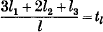 in the case of wages,
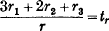 in the case of rent,
and
 years
years
and finally
for the whole of the invested capital. This is all on the assumption that wages and rents are paid out in advance at the beginning of each year. Otherwise the period of investment would clearly be somewhat shorter, but it can always be calculated without difficulty.
If the machine were more durable, and if the final product were disposed of only gradually, the average period of investment could again be worked out without any difficulties that are worth mentioning.9
The amount of capital k and its period of investment t can be derived in this manner for each individual industry, or rather for the production of each individual class of consumption good. Then the amount of capital employed in industry as a whole amounts to K =Σk, and its average period of investment T is given by the equation

where K = ΣK represents the aggregate value of the consumption goods invested at any moment in the form of capital, valued either in terms of any one of them or in terms of money.
It is not, of course, easy, and sometimes it is logically impossible, to determine how much labour and land, and consequently how much capital, have been involved in the production of any particular consumption good. The difficulty arises whenever several commodities are produced in the course of one and the same process (the case of by-products—joint supply according to Marshall’s terminology). But this does not prevent a theoretical enquiry into the amount of the total “circulating” capital and of its average period of investment.
If T is expressed in years the quotient K/T represents the amount of capital that becomes free in the course of a year—the amount, that is to say, of finished products which are available each year to pay for the services of labour and land (or other rent-earning goods), and it constitutes the annual wages-and-rent fund. K itself, the value of the whole of the “circulating” capital, can be regarded as the aggregate, wages-and-rent fund, although it is not all free and liquid at any one moment, but becomes so only over a period of time; and the conclusions of the prematurely discarded “wages fund theory” can be successfully applied to this quantity, as Böhm-Bawerk has elegantly demonstrated10 (though it has, of course, to be borne in mind that at any time it lies within the power of the capitalists to increase this fund by new saving or to diminish it by augmenting their own consumption). It must, however, be remembered that this fund has to last not merely for one year, but for a number of years equal to the average period of investment of the capital. This period, like all the other quantities that we are now discussing, is subject to certain variations, of which the nature will shortly be indicated.
The matter can be put as follows: If A represents the number of available workers, B the total amount of available land, l and r the average rates of wages and of rent per unit of land, the following relation is approximately true under ah conditions:
(A.l+B.r).T = K.
This equation simply tells us that all labour and all land, and in its turn all capital, are always seeking employment and are always more or less fully employed.
B.r really stands for the sum of all “rent-earning goods” (peculiarly durable capital goods), each measured in terms of its own unit (for instance, cubic metres of content in the case of dwelling-houses or factories, kilometres in the case of railways) and multiplied by the corresponding rent.
Everything else now follows from the Economic Principle, viz. that the entrepreneur strives for the greatest possible profit. Furthermore, there is the important fact that we have throughout to deal with fairly plastic, and not with rigidly invariable, magnitudes and relationships.
If it could be assumed that in practice the production of the goods consumed in the course of the year always involves a constant proportion of labour to land (or of other “rent-earning goods”), there would be no principle whatever for the determination of the relative level of the wages of labour and of the rent of land (or of “rents” in general), as they would obtain under free competition. There would necessarily be a permanent excess either in the number of workers or in the amount of available land (assuming that the population was not correspondingly diminished in the one case as a result of emigration, or increased in the other case as a result of immigration or natural growth). Theoretically, such an excess would depress either the level of wages or of rents, as the case might be, to an unlimited extent. But this is an assumption which is completely opposed to the facts of reality. In the first place, labour and land can to some extent be substituted for one another (intensive or extensive production) even in the production of one and the same commodity. Far more important, there are no two commodities of which the production requires exactly the same proportions of these two factors. Suppose now that wages fall as a result, for instance, of an excess in the number of workers. Then the production of those goods which require relatively much labour and relatively little land becomes more profitable than the production of the opposite kind of goods—more profitable, that is to say, to the entrepreneur as such, not to the owner of land. The production and consumption of the former kind of goods expands, while there is a relative diminution in that of the latter class of goods. The demand for labour increases, the demand for land (and for other rent-earning goods) diminishes, until finally economic equilibrium is restored, after a certain period of oscillation; and all available factors of production will find employment at prices determined by the market situation—these prices being such that for the individual entrepreneur, or for the aggregate of entrepreneurs, profits are unaffected by a small change in the proportion of labour to land and rent-earning goods.
Actually the complications are greater. We have been making the implicit assumption that the relative values of commodities in exchange remain unaltered. But they are, of course, affected by the change in the conditions of production, and they in their turn exert an influence on the conditions of production. The only scientific method of dealing with the problem consists in paying simultaneous regard to all these factors, in the manner first demonstrated very clearly by Léon Walras.11
The average level of the rate of interest on capital is determined in a completely analogous manner. Let us suppose, for instance, that as a result of increased thriftiness (whether production becomes more efficient or not) there is an increase in the available amount of liquid capital. Then competition between capitalists will raise wages and rents, and there will be a corresponding fall (as compared with the level that it would otherwise have attained) in the earnings of capital, or its rate of interest.12 But it is to be noticed that it is the rate of interest only on liquid capital itself that falls, not the earnings of exceptionally durable capital (rent-earning goods), which, at first at any rate, take part in the rise enjoyed by rents and wages.
This effect, which by itself might rapidly depress the rate of interest to a very marked degree, is not decisive. Just as the various branches of production require different proportions of labour and land, so too they require different amounts of (liquid) capital. In terms of our definitions, this means nothing more than that the relative lengths of the period of production and the period of investment are different in different cases. If there is a fall in the rate of interest, those processes which for technical reasons involve a long period of production will become relatively more profitable, while those processes where the period of production is short will become relatively less profitable. There will ensue an expansion in the one and a contraction in the other. The final result of these changes is that the average period of investment of the aggregate of (circulating) capital is lengthened; and the portion of the wages-and-rent fund which becomes available in any one year is consequently diminished.13 As a result, wages and rents are once again lowered, but not of course right down to the level which obtained before the increase in capital took place.
The case of a relative diminution in the amount of circulating capital is exactly the contrary.
The significance of this procedure is enhanced by bearing in mind Böhm-Bawerk’s observation, often misunderstood but certainly quite valid, that in almost every enterprise it is possible to increase the efficiency of the factors of production by appropriately lengthening the period of production (by introducing preparatory processes, mechanical methods, etc.). Logically this assumption can now be seen to be by no means indispensable. It is possible to explain the equilibrium, in Böhm-Bawerk’s sense, of capitalist production without making use of the assumption, a point which raises an objection against opponents of the Böhm-Bawerk theory.14
It would be necessary for the sake of completeness to consider the influence exerted by all these various changes on capital structure itself. It has further to be remembered that the quantity of durable capital goods (“rent-earning goods”) is in general capable of expansion; such an expansion will take place when their earnings increase or when the rate of interest falls, so that their capital value now exceeds their cost of reproduction. The main characteristic of, and condition for, a stationary state is that this capital value shall be not more than, or a little less than, this cost of reproduction. Such considerations will not be followed up any further in this place. They impose no essential restrictions on the above line of reasoning, but they provide a basis for the practical possibility that in a rapidly progressive society the rate of interest may be maintained at a relatively high level over a considerable period of time in spite of continual accumulation of capital.
For a further discussion of Böhm-Bawerk’s theory of capital, I may perhaps be allowed to refer, not only to Böhm-Bawerk’s own fundamental works, but to my Über Wert, Kapital und Rente and to the first part of my Finanztheoretische Unter-suchungen.
B. The Use of Money
The nature of the natural rate of interest on capital, and the causes that are responsible for determining its level, should by now have been made sufficiently clear—on the assumption, of course, of universally free competition. No distinction has been made between the original15 (uncontrolled16) rate of interest and the contractual17 (lending) rate of interest. In dealing with most economic questions, it is legitimate to make this simplification. For the difference between the two rates, which constitutes the entrepreneurs’ profit as such, constantly tends towards zero under the influence of competition among entrepreneurs; or at least it tends towards a certain small amount which is not very different from zero. There is only one case in which the difference cannot be neglected. This arises when it is a question of a change in the average level of commodity prices expressed in money. For such a change takes its real origin in the existence of such a difference between the two rates of interest. This has already been explained, and will now be dealt with in a more systematic manner.
It is possible for a considerable difference between the uncontrolled rate and the contractual rate to persist, and consequently for entrepreneur profits to remain positive or negative, as the case may be, for a considerable period of time. It has already been mentioned that this possibility arises out of the fact that the transfer of capital and the remuneration of factors of production do not take place in kind, but are effected in an entirely indirect manner as a result of the intervention of money. It is not, as is so often supposed, merely the form of the matter that is thus altered, but its very essence. For real capital goods can no longer be supposed to be actually borrowed and lent; they are now bought and sold. An increase in the demand for real capital goods is no longer a borrowers’ demand which tends to raise the rate of interest, but a buyers’ demand which tends to raise the prices of commodities. But money, which is the one thing for which there is really a demand for lending purposes, is elastic in amount.18 Its quantity can to some extent be accommodated—and in a completely developed credit system the accommodation is complete—to any position that the demand may assume.
The two rates of interest still reach ultimate equality, but only after, and as a result of, a previous movement of prices. Prices constitute, so to speak, a spiral spring which serves to transmit the power between the natural and the money rates of interest; but the spring must first be sufficiently stretched or compressed. In a pure cash economy, the spring is short and rigid; it becomes longer and more elastic in accordance with the stage of development of the system of credit and banking.
For the purposes of a complete demonstration of the influence on prices of a deviation between the two rates of interest, it is permissible to make a number of simplifying assumptions. These assumptions are made purely for the sake of simplicity and clarity; not a single one of them is essential to the validity of the general conclusion. It will indeed become apparent, as I shall have occasion to point out, that the transition from our hypothetical assumptions to the facts of reality will, in more than one respect, strengthen the plausibility of our conclusions.
We imagine a country in which everything is completely stationary, except for the changes that we are considering and the effects of such changes. We assume, in particular, that the capital goods which have been invested for a long time (“rent-earning goods”) are subject to no other change than the repairs which are necessary for their maintenance. It has also to be supposed that the liquid real capital which has to be renewed year by year is maintained by the capitalists at a constant amount. We suppose further that the length of the period of production is the same in every business, and amounts to one year, as would be the case if technical conditions firmly prevented any extension or contraction. Actually the period of production is not only very different in different branches of production, but in any given branch it is variable. It is, as we have seen, this very circumstance, combined with the possibility of transferring capital from one business to another, that is responsible for the determination under conditions of free competition of the relative levels of real wages, of rents, and of the rate of interest itself. Now, however, we are not dealing with changes in these magnitudes. We are trying to see how their expression in terms of the money unit would alter if their real value were to remain unchanged. We shall nevertheless take into special account such factors as actually lead to a change in the average period of production, and consequently to a change in the level of real wages, etc.
We may assume further that production begins everywhere at the same moment of time, at the beginning of the economic year, which need not, of course, coincide with the calendar year; and we may assume that the final product, the consumption goods, are not completed or available for exchange until the end of the year. This would correspond in some ways to the situation of former times, when in many districts the exchange of commodities was concentrated on one, or a few, great annual markets.
The total quantity of consumption goods is then the same thing as the quantity of liquid real capital in its free form; or rather it is the same thing as the quantity of this capital, inclusive of the amount with which the owners of capital have the right annually to credit themselves as remuneration for the capital employed in the previous year and which they consume on their own account during the current year.
In order to make a clear distinction between the rôles of capitalists and of entrepreneurs, we may imagine that the latter work entirely on borrowed money and that they derive this money, not directly from the capitalists, but from a special institution, a bank. At the same time, the capitalists may be supposed to be dealers in commodities. To make the matter as clear as possible, let us assume that wages and rents (including rents of houses, etc.) are paid out in advance at the beginning of the year, and that the workers, landlords, and also the entrepreneurs themselves, then provide themselves with sufficient stocks to meet a complete year’s consumption. The capitalist dealers are thus released from the necessity of holding substantial stocks, and we may imagine that the profit obtained by actual trade is quite small or we can neglect it altogether.
It goes without saying that this assumption is taking us a long way from reality. Trade must be regarded as an important element in the act of production, and it involves the use of considerable amounts of labour, of advances in respect to capital, etc., for which an appropriate remuneration has to be paid. It might seem better to enrol the traders in the category of entrepreneurs. But we want to be able to assume that the entrepreneurs have to pay off their old debts at the end of the year before they can borrow for the next period of production. This they can do only if they can dispose of their products to somebody who himself possesses money, and, according to our assumptions, this is not yet the case with the majority of actual consumers (workers, landlords, etc.).
Our imaginary procedure is then as follows: At the beginning of the year the entrepreneurs borrow their capital from the banks, in the form of a sum of money K. This is equal to the value of the total amount of available real capital, that is to say, of the total amount of consumption goods completed during the previous years minus the interest drawn in the previous year by the capitalist. This money capital is now paid to the workers and to the landlords; and at the same time entrepreneurs allocate to themselves an amount (to be considered shortly) as remuneration for their own labour, risk taking, etc., and pay the normal competitive rents for such “rent-earning goods” (sites, buildings, machines) as may be in their own possession. With the aid of this money, the whole of the available commodity capital is now bought up by the consumers, and the money capital K returns once again to the banks in the shape of deposits made by the capitalist dealers.
Strictly speaking, it is a matter of indifference in what form the money is employed. It is true that if use is made solely of metallic money, the banks are unable under normal conditions to provide at any one moment the whole of the necessary amount of money. But we can suppose that they lend as much money as belongs to them—their own capital—to a group of entrepreneurs. This sum is then employed to pay a group of workers, and it next serves to purchase part of the commodity capital. When the money is now returned to the banks by the capitalist dealers, it can be lent out to a new group of entrepreneurs. And so on. In the end this sum of money will have effected the whole body of transactions, and it will then remain in the banks’ tills until the end of the year. If the banks have the right to issue notes in excess of the amount of their holding of cash, the quantity of means of exchange which they can issue at any moment is correspondingly greater. It is still greater if all payments are effected by means of cheques, which are normally subject to far more lenient legal restrictions than are notes. In the extreme case, it can be supposed that at one and the same moment the banks open credits to the entrepreneurs to the full amount K; that the entrepreneurs pay their workers, etc., by means of drafts on their banking accounts; that these drafts are used to pay for goods, and so reach the hands of the capitalist dealers; and that finally the drafts find their way back to the banks and give rise to corresponding credit balances in the accounts of the capitalists.
The goods are completed only at the end of the economic year, and it is only then that the entrepreneurs can meet their liabilities. It follows that the credit which is granted by the banks to the entrepreneurs partakes of the character of one-year loans.
In practice, the borrowed money capital is far less in amount than the available (liquid) real capital that is employed in production. The reason is that in many cases the entrepreneur is himself a capitalist (even in the narrow sense in which the term is here being employed). But this concerns us only in so far as it affects the proportion between the two quantities. We shall return to this question below.
Let the contractual rate of interest be i. Then the entrepreneurs have at the end of the year to repay to the banks the sum  . The deposits of the capitalists can be regarded as fixed for a term of one year. The rate of interest that is paid on deposits is always somewhat lower than the rate charged by banks on loans.19 The difference between these two rates remunerates the bank, first of all for the trouble and the risk involved and then for holding in its till a certain stock of metallic money which earns no interest and for holding liquid securities which carry only a moderate rate of interest. But on our assumptions, the necessary cash holdings of the banks are reduced to a minimum. (This does not, of course, mean that the bank or its owners need not possess sufficient property of their own to sustain the confidence of the public.) We are also neglecting the banks’ running costs. We can therefore assume that the rates of interest on loans and deposits are equal, or nearly equal—in any case a pretty harmless assumption.
So the banks have assets on the one side and liabilities on the other side, both amounting to  , and both falling due at the end of the year. While the business of lending money and of exchanging commodities remains at a standstill throughout the rest of the year, production sets in at the beginning of the year and continues without interruption until the end.
The fruits of production belong in the first place to the entrepreneurs themselves. Their size, or the price that is obtained for them, determines whether the profits are big or small or whether a loss has been incurred. In a completely undisturbed and stationary state, we have seen that the entrepreneur meets with neither a profit nor a loss; he merely obtains the same return for the trouble of conducting his business as he would have obtained for con-ducting a similar business on behalf of others, for instance of a company. (We have referred20 to the modification of this proposition which is necessitated by the existence of unavoidable risks of enterprise.)
Thus at the end of the year the entrepreneurs have earned no more on the average than the rate of interest i. In other words, the value of the total product at the normal level of prices is  . The capitalist dealers now draw on their banking accounts, which amount to precisely this sum. They may, for instance, purchase the finished goods from the manufacturers by means of drafts on the banks. The manufacturers then use these drafts to repay their debts to the banks (though they will immediately be desirous of obtaining fresh loans). Their debts amount to exactly . It follows that at the end of the year both the banks and the entrepreneurs are cleared of all assets and liabilities. The capitalists, on the other hand, are in possession for the moment of their own capital in its primitive form—in the form of goods.
They first realise the interest that is due to them, which amounts to  . We are supposing that they do this by exchanging among themselves a corresponding amount of goods and putting them on one side for the purposes of their consumption during the coming year. The monetary transactions that are involved in this operation may be effected by means of drafts on the banks; but each individual account is finally credited and debited with equal amounts, and consequently each account remains with a zero balance. The rest of the goods, which at the existing price level amount to K in value, are available as real capital for the coming year. This process goes on repeating itself.
It has now to be supposed that, for some reason or other, a difference arises between the natural rate of interest and the contractual rate of interest. This may be due, for instance, to a fall in the level of wages (brought about by a relative increase in the number of workers), or to a fall in the rent of land or of other rents, or finally to a rise in the productivity of labour and natural forces as a result of technical progress. Suppose that the natural rate is raised to i +1 per cent., while the banks maintain their customary rate of discount i.
To whose advantage will this difference accrue? In the first place, of course, it accrues to the entrepreneurs. At the end of the year their product, valued at the normal price level, will amount to  while the amount that they owe is only . They have thus obtained a surplus profit of
  , and they can realise this profit by exchanging among themselves the corresponding quantity of goods and laying them on one side for the consumption of the coming year; while they offer the rest of their stocks to the capitalists at the normal prices, that is to say, for a total sum of money . In the first place, therefore, the level of prices remains unaltered.
This illustration might be modified in various ways without affecting the nature of the conclusion. Suppose, for instance, that the entrepreneurs offer the whole of their goods to the capitalists, including the one per cent, which represents their surplus profit. This need not necessarily bring about any fall in prices. It is true that the capitalists must apply to the banks for the excess of the necessary means of payment over their own capital. But the entrepreneurs now realise their surplus profit in the form of money (bank drafts). While they pay in an amount , they owe only and , they are thus able at the beginning of the next year to raise their demand for goods by . It follows that if wages and rents remain unaltered, supply and demand continue to be equated at the existing level of prices. This will still be the case if it is supposed that the entrepreneurs are themselves dealers, or if we allot the function of dealing to yet another group, different both from the entrepreneurs and from the capitalists.
Even if it were desired to associate the increase in the quantity of goods with a tendency for a fall in prices, the fall that could on such grounds be expected would be a very small one. More important, it would, so far as I can see, occur only once and for all, and it would thus be put completely in the shade by the cumulative effect on prices that is to be ascribed to a difference between the two rates of interest.
If entrepreneurs continue, year after year perhaps, to realise some surplus profit of this kind, the result can only be to set up a tendency for an expansion of their activities. I emphasise once again that so far it is purely a question of a tendency. An actual expansion of production is quite impossible, for it would necessitate an increase in the supply of real factors of production, labour and land, or an expansion in the amount of fixed and liquid real capital, so that the available original factors of production could be employed in a longer, and therefore more productive, process. Such changes require time to be effected, and we need not consider them at this point. We suppose that everything remains as before, or that at the most, as a result for instance of longer working hours, there is a certain non-cumulative increase in production, of which the influence on prices is not progressive and will therefore be neglected.
It is impossible to endorse the widespread view that under suitable conditions a country’s output can be expanded almost indefinitely, by “arousing the spirit of enterprise” and the like. This fallacious view is derived by concentrating attention on one single branch of production, provided perhaps with an excess of fixed capital (buildings, machines, etc.). In such a single branch of production it would be possible to increase output immediately, but only at the expense of the other branches of production from which labour and liquid capital have to be drawn. The impossibility under normal conditions of a general expansion of production is, I think, demonstrated by the figures of unemployment at different periods, recently collected in various countries. The average number of unoccupied workers is relatively small, about 1 per cent. A general expansion of production would thus be possible only as a result of longer hours—which are neither desirable nor feasible over any length of time—or as a result of further technical progress.
Different in nature is the benefit conferred by a fall in the rate of interest on those enterprises which employ “more capital”, i.e. in which the period of investment is longer than elsewhere. An expansion takes place in their activities, but on the other hand those enterprises which employ less capital are forced to contract as a consequence of the resulting rise in wages, in prices of raw materials, etc.
The tendency towards an expansion of output is, nevertheless, in operation, and brings about an increase in the demand for labour and other factors of production—and under actual conditions also for raw materials, semi manufactured goods, and the like. Money wages and money rents are forced up, and although there is no general expansion in production, entrepreneurs are obliged to borrow more capital from the banks for the production of the current year. It is impossible to tell directly how much wages will go up, and therefore by how much industrial capital has to be increased. But on our assumption it is possible to fix a limit. If entrepreneurs are not reckoning for the moment on any rise in future prices, the upper limit to the possible rise in wages is the fall in the rate of interest. For the sake of simplicity, it will be supposed that this upper limit is immediately attained and that the capital demanded from the banks is now 1·01K.
This increase in the demand for loans can be met by the banks just as easily as the former, or any other, demand. It does not necessitate any rise in the rate of interest, and we shall suppose that this is maintained at i per cent. It might, nevertheless, be thought that the rise in wages must deprive the entrepreneurs of the whole of the surplus profit for which they are hoping in respect to the current year. But what actually happens? If the workers and landlords raise their demands for goods for the consumption of the current year to the extent that money wages and money rents have gone up, this increased demand is met by the same amount of commodity capital as before. It necessarily results in a rise in all prices—a rise which it is simplest to regard as proportional to the increase in demand. It follows that the amount paid for the whole of the commodity capital, of which the value was previously K, is now 1·01K. The dealers receive this increased sum in the form of money (bank drafts); but they have to bear in mind that, owing to the rise in prices, this sum represents only the same amount of real capital as before. Let us therefore suppose that they hand over to the banks this money capital, 1·01K. If they do not do so, but in their turn increase their own consumption of commodities, so that their demand more than corresponds to the interest that they are earning, then prices will clearly go up even more, and the workers and landlords, in spite of their increased money incomes, will obtain less than the normal amount of consumption goods. This must be the case, because the quantity of real capital will actually decline as a consequence of the increased consumption of the capitalists. We neglect such a possibility; we assume that during the process under consideration the quantity of real capital remains constant (either absolutely or relatively to the population).
The position at the beginning of the economic year, after the exchange of goods has taken place, is as follows: The banks have obtained claims on the entrepreneurs, falling due at the end of the year, which, inclusive of interest, amount to 1·01K i.e. approximately and they owe to the capitalists the same amount of money, falling due at the end of the year. Wages and rents have gone up on the average by 1 per cent., but the same is true of commodity prices, so that real wages and real rents are on the average at the same level as before. This does not, of course, mean that a particular group of workers or landlords may not be obtaining rather more than before, and thus attain an actual rise in their real wages and rents at the expense of the real incomes of some other group.
The further developments are a consequence of that law of continuity and inertia to which several references have already been made. According to this law, prices that are once attained persist indefinitely unless some independent cause brings about a fall or a further rise. This persistence is intensified in practice by the fact that business is fairly stable and does not proceed in the discontinuous jumps that we are here assuming. This is the reason, unless I am very much mistaken, why price movements take place very much more rapidly than we have been assuming. For once a higher level of prices has been established, it may, after only a few months, weeks, or even days, become the basis for new contracts, wage agreements, and rent agreements. At the same time there comes into operation that immediate rise, to which we referred above, in the demand for, and the prices of, the raw materials and services employed in long-term enterprises, to the extent that these move in sympathy with the easing (absolute or relative) in the terms of credit. It is impossible to make even an approximate estimate of the extent of the change in prices which will be brought about by a given (relative) change in the terms of credit over a certain period, say a year; but we need not say more than that in all probability it is sufficiently great to provide a perfectly natural explanation of all such variations in prices as occur in actual practice. And now it would be as well to return to our hypothetical conditions.
The total amount of consumption goods produced in the course of the year is no more than it was at the end of the previous year. Their value was then and since prices have gone up by 1 per cent., it is now 1.01 or approximately  It follows that if the entrepreneurs exchange among themselves 1 per cent, of the total amount of goods, just as they did in the previous year, they can sell the remainder to the capitalists for a sum of and they are then able to repay their bank loans. Since the capitalists have taken precisely this sum out of the banks, all the banking accounts once again show zero balances at the end of the year. It can easily be seen that the entrepreneurs have earned as a surplus profit over and above their “wage” an amount equal to 1 per cent, of the capital—precisely that amount per cent, by which the natural rate exceeded the contractual rate.
Let us now suppose that at the beginning of the third year the banks raise their lending rate to the natural rate, i + 1. The upward movement of prices now of course ceases, but prices do not return to their original level. It is true that the entrepreneurs are now deprived of the opportunity of earning surplus profits, and they are under no further inducement to expand their activities or to increase their demand for labour. Equally, they are under no inducement to diminish their demand for labour. The workers and landlords will naturally try to maintain wages and rents at the new levels, and these wages can be paid by the entrepreneurs at the new level of prices without incurring “losses”, i.e. without suffering a diminution of their own “wages”. It follows that everything is in equilibrium, at a higher level of money prices, wages, and rents.21
If, on the other hand, the banks maintain the old rate of interest, the whole process described above will be once again repeated. Wages and prices rise by another, say, 1 per cent., and when at the end of the year the entrepreneurs have disposed of their stocks at this new level of prices, they once again, in spite of the rise in wages, obtain a surplus profit equal to 1 per cent, of the capital.
The borrowed capital of the entrepreneurs and the deposits in the banks now both amount to 1·02K, and on both the rate of interest i is paid. But since prices have now gone up by 2 per cent., the annual output is worth 1.02 while the entrepreneurs have to pay back only 1.02 . There is no need to set out the further stages in this process.
It is possible in this way to picture a steady, and more or less uniform, rise in all wages, rents, and prices (as expressed in money). But once the entrepreneurs begin to rely upon this process continuing—as soon, that is to say, as they start reckoning on a future rise in prices—the actual rise will become more and more rapid.22 In the extreme case in which the expected rise in prices is each time fully discounted, the annual rise in prices will be indefinitely great.
We have already pointed out that our picture does not correspond to reality. It has to be remembered that actual processes of exchange and payment do not take place at these annual intervals but follow on one another in rapid succession, so that one transaction is constantly “infecting” another, to use Marx’s phrase. Furthermore, one particular lot of goods is in the normal run of business speculatively bought and sold many times over if the prospect of profits provides a sufficient inducement. There is thus no doubt that tremendous fluctuations in prices may be brought about by some cause which is quite trivial in itself although it has real and lasting effects.
We have been assuming that the capitalists deposit an ever-increasing nominal amount of money with the banks, and receive the-normal rate of interest. It follows that their demand in terms of money for consumption goods expands pari passu with that of the workers and landlords. This is equally true of the entrepreneurs, whose “wages” are, of course, calculated on the basis of the current level of commodity prices. The distribution of the product of industry is thus the same as before, except for the surplus profit which accrues to the entrepreneurs at the cost of the capitalists.
It must be conceded that in practice these results require some modification. Thus it is certain that some of the capitalists will prefer to become entrepreneurs themselves, in order to share in the higher entrepreneur profits. To the extent that this happens, there is a necessary contraction in the amount of business carried on by means of borrowed money. Incidentally, this must exert a certain retarding influence on the further movement of prices. The position of workers and landlords, on the other hand, may be worse than we have supposed. The enterprises which par excellence are in a position to draw labour and land to themselves as a result of an actual or virtual easing in the terms of credit are those for which the period of investment of capital is relatively long; for it is here that a rise in wages and rents, with a constant price of the final product, has relatively little significance.23 Production will consequently tend to be diverted in such a way as to increase the average length of the period of investment of capital, and liquid capital will tend to be converted into fixed capital. The result must be a diminution in the amount of real capital that is annually available, and a fall in real wages and rents. As for the classes who receive fixed money incomes, it is obvious that they must suffer when prices rise.24
Little need now be said about the opposite movement of prices which must be set in operation when the lending rate of interest remains permanently above the natural rate. Not only will the entrepreneurs now fail to obtain any surplus profit, but they will suffer losses, which they will cover in the first place out of their wages or out of the income derived from their own fortunes. To prevent this, they will desire to confine their activities to the more profitable channels, and there will be a corresponding contraction in their demand for labour and land. But workers and landlords will respond by scaling down their claims for wages and rents, and on the whole activity will be maintained at its former level. (It is not, however, to be denied that there may be a more or less permanent, though not progressive, loss of employment by some of the workers—the industrial reserve.)
These diminished wages and rents have to be set against an unaltered amount of consumption goods (real capital). The result is a corresponding fall in the prices of commodities, and entrepreneurs are unable to avoid a loss, which is expressed by the difference between the two rates of interest, or at any rate by a part of that difference (if it is possible for the entrepreneurs to transfer the remainder on to the shoulders of workers and landlords).25 There ensues a further fall in money wages, etc., which results in its turn in a fresh fall in prices. And so the movement continues. Prices will cease to fall only when either the natural rate once again rises or the banks decide to lower their rates of interest.
It remains only to mention that though the facts are essentially in complete agreement with theory, they often present a somewhat different appearance. The reason is that a movement of prices, which is here being treated as an isolated phenomenon, is in practice superimposed on some other and independent movement of wages, etc., dissimilar and possibly opposite in nature. Suppose, for example, that the rise in the natural rate of interest is caused by a diminution (absolute or relative) in the amount of real capital (as at a time of war or of a rapidly expanding population). Then real wages must fall. If the money rate rises with the natural rate, money wages and real wages fall together; but if the money rate remains unaltered, or actually falls (as can easily happen, for instance, through the issue of paper money by a belligerent power), money wages may remain unaltered or rise but money prices will then rise more than money wages. Incidentally, this possibility may perhaps constitute the origin of the widespread view that wages rise more slowly than prices.
If, on the other hand, the natural rate falls as a result of the accumulation of real capital (which at the same time involves a rise in real wages), while the money rate is maintained at its previous level, it is easily possible for the downward movement of prices to leave money wages, etc., apparently unaffected. This is precisely the phenomenon which characterises the movements of prices of recent decades. It may, therefore, be legitimate to examine the matter more closely.
We are to suppose that capital is continually accumulating, and that, though possibly with some delay, the efficiency of production is always increasing (that is essential—for otherwise the natural rate would soon sink to zero). The downward movement of prices then proceeds somewhat as follows. The money rate of interest remaining unaltered, entrepreneurs continue at first to borrow from the banks the usual quantity of money, which they employ for the payment of wages and rents at the full rates. But against this “money capital” now has to be set, not a constant, but a somewhat increased amount of real capital. For the capitalists do not themselves consume the whole of the product that was due to them in respect to interest at the end of the previous year; part of it they save. It follows that their demand for commodities is diminished a little, let us say by 1 per cent, of the capital. Prices must therefore fall, and wages and rents, which remain unaltered in terms of money, really go up somewhat. Now it is always simplest to assume that a price level which is once attained will persist until there arises some adequate reason for an alteration. Thus prices may remain at the lower level at the end of the year, and the entrepreneurs, who were previously making neither profit nor loss, must now suffer a loss, which will amount to 1 per cent, of the capital.
The result, other things being equal, would be a diminution in the demand for labour, etc., and a fall in (money) wages and rents. But, as a result of industrial progress, average productivity will have increased, and the output of the current year might be expected to increase by 1 per cent.26 It would thus appear as though entrepreneurs could carry on in the usual way and pay the usual wages and rents; for the expected increase in output compensates for the fall in prices that has already occurred.
At the same time, however, the amount of real capital must be supposed to have increased yet further as a result of new saving. (It is to be noted that it has already increased by the one per cent, which the entrepreneurs had to reckon as a loss and which they will now make good by diminishing their consumption in the current year; without the intervention of the capitalists, it would thus be maintained at the same amount as at the beginning of the previous year.) A further fall in prices is the inevitable consequence. Real wages and rents rise still further, while remaining unaltered in terms of money, and in spite of the increase in productivity, the entrepreneurs are again unable to avoid a loss.
The process might continue in this way, the fall in prices becoming ever greater while money wages and rents remain unaltered. The total quantity of money lent by the banks and the total quantity of their deposits would remain constant27 while the amount of real capital and annual output continually increases. It might thus appear as though the downward movement of prices took its origin “on the side of goods”, to use the usual manner of speaking, rather than “on the side of money”. The immediate cause, however, of the fall in prices is in this case just the same as in the case where the quantity of capital and of output remain unaltered: the immediate cause is the excess of the money rate of interest over the natural rate of interest. If no such divergence had existed—if, for example, at the very beginning of the period under consideration, the banks had lowered their lending (and deposit) rate of interest so as to bring it into line with the natural rate (lowered by the increase in the amount of real capital)—the quantity of “money” would have kept step with the quantity of goods, and there would have been no fall whatever in prices. This can easily be shown as follows:
Let us assume that the banks had already lowered their rate of interest to i - 1 per cent, at the beginning of the first economic year. To the entrepreneurs is again offered a surplus profit of one per cent, of their capital—at any rate, so it appears to them, and that is all that matters. The entrepreneurs’ demand for factors of production is therefore increased, and there is a rise of, say, one per cent.28 on the average in all wages and rents. The process has already been discussed,29 but in the case that was described above, the surplus profit was retained by the entrepreneurs because the rise in wages brought about an immediate rise in prices. This will not happen in the present case, for we are assuming that the amount of real capital has simultaneously increased by some one per cent, as a result of the savings of the capitalists. It follows that prices remain unaltered. The entrepreneurs have to pay out one per cent, more in wages and rents, so that it is clear that at the end of the year there is no surplus profit available for them. They have borrowed “money capital” amounting to 1·01K, and, including interest at the rate of i - 1 per cent., at the end of the year they owe 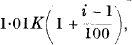 or approximately The year’s output is as yet unaltered, and at the current level of prices amounts in value to . The entrepreneurs thus make neither a profit nor a loss, just as under normal conditions.
If everything else remained the same, they would be able (as a result of the maintenance of easier credit conditions) to continue to pay the higher level of wages and rents; but they would now be under no incentive to raise their demand for labour, etc. Now, however, there are introduced those improvements in technique which, without any increase in costs, would lead to an increase in output. The hope of surplus profits is once again aroused, the demand for factors of production is once again stimulated, but the result is the same as before—the level of wages and rents (of real wages as well as of money wages) is raised. Entrepreneurs are once again disappointed in their expectations, for the rise in prices which would have secured them surplus profits again fails to take place—because of the simultaneous increase in the amount of real capital.
At the beginning of the previous year, the real capital amounted in value to 1-01-rT, and an equal sum was deposited by the capitalists in the banks. At the end of the year, the capitalists are thus credited with , and with this they purchase the goods produced during the year. But their share in respect to interest now amounts only to  and but for the new savings, the amount of capital would remain the same as it was at the beginning of the year, viz. 1·01K. We are, however, assuming that there are new savings amounting to 0.01K, or in other words, that the capitalists devote only
  to the consumption of the following year. It follows that the amount of real capital at the beginning of this year amounts to 1.02K.
Whether the capitalists, whose incomes have diminished as a result of the fall in the deposit rate of interest, will be able or willing to save the same amount as before is a separate question which need not concern us here.
————
Many of the above statements must, in their relation to the traditional treatment, appear almost paradoxical. It would appear, for instance, that the distribution of the product of industry between capitalists and entrepreneurs depends on nothing more than their subjective dispositions or caprices. It has, however, to be remembered that we are here dealing with moods and influences which, arising out of a single motive, are common to all individuals and call for uniform treatment. The effect is, therefore, the same as though there were conscious co-operation for a common end. At the same time, it is scarcely open to doubt that by means of economic co-operation the capitalists and entrepreneurs, who control the subsistence-fund of society, could diminish the share of labour and other factors of production to an almost unlimited extent, and bring about a corresponding increase in their own share in the product. On the other hand, the individual capitalist or entrepreneur is in this respect practically powerless. He has to follow the stream—and while it is true that he himself forms a part of this stream, its force is irresistible.
It might further be asked whether we are right in suggesting that it lies in the power of the credit institutions, acting in cooperation only with the entrepreneurs, to determine the direction of production and consequently the period of investment of capital, without paying any heed to the actual capitalists, the owners of goods. Here too there can be no doubt that this really is the case (though in practice this power cannot be so absolute as we are supposing). We have been assuming throughout that the period of investment of (liquid) capital is one year. Suppose now that the banks lend a portion of the “money” at their disposal (i.e. of the credit that is extended) for two years, while the whole of their deposits remain fixed for only one year. Will not this lead to the insolvency of the banks, or at least to great commercial difficulties? Nothing of the sort. The actual consequence will merely be that at the end of the first year. a somewhat smaller amount of consumption goods will be completed; for those entrepreneurs who borrowed money for a term of two years have probably devoted it (and the productive services which they have purchased with it) to a process of production that lasts two years and is consequently not yet complete. When the capitalist dealers come to purchase the available quantity of finished products at the normal prices (as is likely to be the case), they do not require to use the whole of their capital and leave a portion of it deposited at the banks (corresponding to those bank loans which are not yet due). If, however, the capitalist dealers do devote the whole of their capital to the purchase of goods, this can only lead to a rise in prices, and the excess now accrues to the producers of the available consumption goods, and can be employed as capital by them. No matter what view is taken of the matter, it will be found that the money immediately flows back to the banks, or that the sum withdrawn by means of cheques returns in the form of deposits. The real saving which is necessary for the period of investment to be increased is in fact enforced—at exactly the right moment—on consumers as a whole; for a smaller quantity than usual of consumption goods is available for the consumption of the second year. At the end of the year (the beginning of the next year), when the two years’ period of production comes to an end and the available quantity of consumption goods has increased correspondingly, the consumers will receive some reward for their abstinence.
These considerations are of extreme importance in relation to actual economic events, but they are usually overlooked in the customary treatment of the theory of money, being regarded as relevant only to a natural economy.
_____________
30 Theory of Political Economy, chap. vii.
31 [Ibid., second and later editions, p. 223; first edition (worded slightly differently), p. 214.]
32 J. S. Mill [Principles of Political Economy, book ii., chap, xvi., § 6]. Cf. my Finanztheoretische V’ntersuchungen, p. 44 ff.
33 Positive Theorie des Kapitales, first edition, book i., chap, ii.; book ii., chap. ii. ff. [third edition, and Smart’s translation, book i., chap, ii.; book ii., chap. iii. ff.]
34 [“isolierte Wirtschaft” in original.]
35 In other words, we separate out the functions of workers, landlords, capitalists (and entrepreneurs) even though they may be actually combined in one and the same person.
36 We assume that normally the entrepreneur receives no profit (cf. above, p. 104), though we shall see that such a profit may accrue under special conditions.
37 Über Wert, Kapital und Rente, pp. 93, 121, 137; Finanztheoretische Untersuchungen, p. 28.
38 CJ. my Finanztheoretische Untersuchungen, p. 29.
39 Positive Theorie des Kapitales, first edition, p. 450 [third edition, p. 644; Smart’s translation, p. 419].
40 Éléments d’économie politique pure, 1st ed., section iv.; cf. also my Über Wert, Kapital und Rente, chap, ii., section vi.
41 How the process works out in reality, when money serves as a medium of exchange and of payment, will be shown below (p. 151).
42 A very clear picture is provided by Böhm-Bawerk’s well-known graphical illustration of the varying rapidity with which the product “ripens”; loc. cit., p. 114 ff. [third edition, p. 188; Smart’s translation, p. 107].
43 Ricardo was already aware of the possibility referred to in the text, but his treatment, though the same in essence, is rather different in form (cf. Principles, chap. i., section v.).
44 [“originären” in original.]
45 [“ Verkehrs” in original.]
46 [“ausbedungenen” in original.]
47 Cf. above, p. 110.
48 Still more so, of course, for deposits on current account. These do not concern us here.
49 P. 104, above.
50 The entrepreneurs now borrow 1·01K of capital from the banks at a rate of interest of i + 1 per cent. They do this without incurring any loss, inasmuch as their annual output is, at the new level of prices, worth 1·01
51 Cf. p. 96, above.
52 Cf. p. 133, above.
53 Cf. p. 1, above.
54 Thus whether the movement is one of contraction or of expansion, workers and landlords may suffer. This is not really remarkable, for the fact that any violent change is bound up with what Laplace calls a certain “loss of vis viva” applies equally to economics.
55 If production had increased already in the first year, there would be no divergence whatever between the two rates of interest. Prices would continue at their previous level, and everything else—wages, capital, and interest—would merely have risen uniformly.
56 But the capitalists enjoy the fruit of their savings, for the constant amount of money capital is ever growing in value.
57 In fact the rise would be somewhat smaller, but that is of no consequence.
58 P. 144 ff., above.
- 1Wicksell always insisted that this reasoning did not mean more than an amplification of the old quantity theory. Moreover, he always regarded his own contribution as a doubtful hypothesis and never became as convinced of its tenability as did some of his pupils. He explicitly rejected the idea that his theory provided an explanation of the business cycle. He was critical of Mises’ idea that mistaken credit policy is the origin of the tendencies towards booms and depressions. A brief quotation will indicate his position: “Our conclusion is, therefore, that although the changes in the purchasing power of money, caused by credit policy, are under present conditions intimately bound up with the business cycle and without any doubt also influence the latter, above all by giving rise to crises, yet it does not seem essential to assume that there is, by the nature of things, any necessary connection between these two phenomena. The main cause of the business cycle, and a sufficient cause, seems to be the fact that technical and commercial progress cannot by its very nature give rise to a series which proceeds as evenly as the growth in our time of human needs—due above all to the organic increase in population—but is now accelerated now retarded. In the former case ... a mass of circulating capital is transformed into fixed capital, a process which, as I have said, accompanies every rising business cycle: it seems as a matter of fact to be the one really characteristic sign, or one in any case which it is impossible to conceive as being absent.”. . . “If the banks already at the beginning of a rising period sufficiently raised their interest rates, but on the other hand reduced them energetically when the depression was about to set in”, then the price level would probably remain stable, although raw materials for fixed capital would rise in price during periods of good trade and fall during times of bad trade. “Under such circumstances the chief crises-causing factor would probably have disappeared, and what remained would be only a quiet wave movement between periods of accelerated formation of fixed capital and periods when the new capital assumed . . . other forms.” . . . “Increase in commodity stocks is probably the most important form of real investment during so-called bad trade.”
- 2Wicksell always insisted that this reasoning did not mean more than an amplification of the old quantity theory. Moreover, he always regarded his own contribution as a doubtful hypothesis and never became as convinced of its tenability as did some of his pupils. He explicitly rejected the idea that his theory provided an explanation of the business cycle. He was critical of Mises’ idea that mistaken credit policy is the origin of the tendencies towards booms and depressions. A brief quotation will indicate his position: “Our conclusion is, therefore, that although the changes in the purchasing power of money, caused by credit policy, are under present conditions intimately bound up with the business cycle and without any doubt also influence the latter, above all by giving rise to crises, yet it does not seem essential to assume that there is, by the nature of things, any necessary connection between these two phenomena. The main cause of the business cycle, and a sufficient cause, seems to be the fact that technical and commercial progress cannot by its very nature give rise to a series which proceeds as evenly as the growth in our time of human needs—due above all to the organic increase in population—but is now accelerated now retarded. In the former case ... a mass of circulating capital is transformed into fixed capital, a process which, as I have said, accompanies every rising business cycle: it seems as a matter of fact to be the one really characteristic sign, or one in any case which it is impossible to conceive as being absent.”. . . “If the banks already at the beginning of a rising period sufficiently raised their interest rates, but on the other hand reduced them energetically when the depression was about to set in”, then the price level would probably remain stable, although raw materials for fixed capital would rise in price during periods of good trade and fall during times of bad trade. “Under such circumstances the chief crises-causing factor would probably have disappeared, and what remained would be only a quiet wave movement between periods of accelerated formation of fixed capital and periods when the new capital assumed . . . other forms.” . . . “Increase in commodity stocks is probably the most important form of real investment during so-called bad trade.”
- 3Wicksell always insisted that this reasoning did not mean more than an amplification of the old quantity theory. Moreover, he always regarded his own contribution as a doubtful hypothesis and never became as convinced of its tenability as did some of his pupils. He explicitly rejected the idea that his theory provided an explanation of the business cycle. He was critical of Mises’ idea that mistaken credit policy is the origin of the tendencies towards booms and depressions. A brief quotation will indicate his position: “Our conclusion is, therefore, that although the changes in the purchasing power of money, caused by credit policy, are under present conditions intimately bound up with the business cycle and without any doubt also influence the latter, above all by giving rise to crises, yet it does not seem essential to assume that there is, by the nature of things, any necessary connection between these two phenomena. The main cause of the business cycle, and a sufficient cause, seems to be the fact that technical and commercial progress cannot by its very nature give rise to a series which proceeds as evenly as the growth in our time of human needs—due above all to the organic increase in population—but is now accelerated now retarded. In the former case ... a mass of circulating capital is transformed into fixed capital, a process which, as I have said, accompanies every rising business cycle: it seems as a matter of fact to be the one really characteristic sign, or one in any case which it is impossible to conceive as being absent.”. . . “If the banks already at the beginning of a rising period sufficiently raised their interest rates, but on the other hand reduced them energetically when the depression was about to set in”, then the price level would probably remain stable, although raw materials for fixed capital would rise in price during periods of good trade and fall during times of bad trade. “Under such circumstances the chief crises-causing factor would probably have disappeared, and what remained would be only a quiet wave movement between periods of accelerated formation of fixed capital and periods when the new capital assumed . . . other forms.” . . . “Increase in commodity stocks is probably the most important form of real investment during so-called bad trade.”
- 4As Wicksell worked on monetary problems for almost three decades after the publication of the Geldzins, it may be worth while to say something here about the changes which his views underwent. These were not, as a matter of fact, considerable. Although he was always ready to question his own reasoning, his lively discussions with other Swedish economists do not seem to have left many traces on his theory. Take, for instance, his discussion with Professor Davidson. In 1906 Davidson, whom Wicksell held in the highest esteem, suggested that during periods of rapid technical progress and increasing productive efficiency a greater stability of business would be ensured if commodity prices fell in proportion to the increase in output than if they remained stable. Davidson asserted that if the money rate of interest and business profits (Wicksell’s natural rate) stood in a normal relation to one another before the increase in efficiency, then they would continue to do so if prices fell in proportion to the latter. There would be no need for a change in the money rate of interest. If it were reduced to prevent a fall in the price-level, it would be too low in relation to profits, and a process of an inflationary character would start. To this Wicksell replied: “In the case which Davidson has chosen it may appear that the increase in profits due to increased productivity and the reduction in profits due to the fall in prices, caused on his assumption by the former, would offset one another. But surely this would only happen if the price movement could be anticipated beforehand and estimated, or if it were so even and had lasted for so long that it had come to be generally regarded as something constant? In general, however, the individual business man will make his calculations for the future, and so fix his demand for labour, raw materials, and credit on the basis of current prices.” Hence, prices would rise if the money rate were not immediately raised, and when some time later the increase in productivity had led to a greater supply of finished goods, so that prices would fall, business men would make losses and the situation would be disturbed.
- 5As Wicksell worked on monetary problems for almost three decades after the publication of the Geldzins, it may be worth while to say something here about the changes which his views underwent. These were not, as a matter of fact, considerable. Although he was always ready to question his own reasoning, his lively discussions with other Swedish economists do not seem to have left many traces on his theory. Take, for instance, his discussion with Professor Davidson. In 1906 Davidson, whom Wicksell held in the highest esteem, suggested that during periods of rapid technical progress and increasing productive efficiency a greater stability of business would be ensured if commodity prices fell in proportion to the increase in output than if they remained stable. Davidson asserted that if the money rate of interest and business profits (Wicksell’s natural rate) stood in a normal relation to one another before the increase in efficiency, then they would continue to do so if prices fell in proportion to the latter. There would be no need for a change in the money rate of interest. If it were reduced to prevent a fall in the price-level, it would be too low in relation to profits, and a process of an inflationary character would start. To this Wicksell replied: “In the case which Davidson has chosen it may appear that the increase in profits due to increased productivity and the reduction in profits due to the fall in prices, caused on his assumption by the former, would offset one another. But surely this would only happen if the price movement could be anticipated beforehand and estimated, or if it were so even and had lasted for so long that it had come to be generally regarded as something constant? In general, however, the individual business man will make his calculations for the future, and so fix his demand for labour, raw materials, and credit on the basis of current prices.” Hence, prices would rise if the money rate were not immediately raised, and when some time later the increase in productivity had led to a greater supply of finished goods, so that prices would fall, business men would make losses and the situation would be disturbed.
- 6As Wicksell worked on monetary problems for almost three decades after the publication of the Geldzins, it may be worth while to say something here about the changes which his views underwent. These were not, as a matter of fact, considerable. Although he was always ready to question his own reasoning, his lively discussions with other Swedish economists do not seem to have left many traces on his theory. Take, for instance, his discussion with Professor Davidson. In 1906 Davidson, whom Wicksell held in the highest esteem, suggested that during periods of rapid technical progress and increasing productive efficiency a greater stability of business would be ensured if commodity prices fell in proportion to the increase in output than if they remained stable. Davidson asserted that if the money rate of interest and business profits (Wicksell’s natural rate) stood in a normal relation to one another before the increase in efficiency, then they would continue to do so if prices fell in proportion to the latter. There would be no need for a change in the money rate of interest. If it were reduced to prevent a fall in the price-level, it would be too low in relation to profits, and a process of an inflationary character would start. To this Wicksell replied: “In the case which Davidson has chosen it may appear that the increase in profits due to increased productivity and the reduction in profits due to the fall in prices, caused on his assumption by the former, would offset one another. But surely this would only happen if the price movement could be anticipated beforehand and estimated, or if it were so even and had lasted for so long that it had come to be generally regarded as something constant? In general, however, the individual business man will make his calculations for the future, and so fix his demand for labour, raw materials, and credit on the basis of current prices.” Hence, prices would rise if the money rate were not immediately raised, and when some time later the increase in productivity had led to a greater supply of finished goods, so that prices would fall, business men would make losses and the situation would be disturbed.
- 7In his rejoinder Wicksell admitted that this case required more attention than he had so far given to it. Davidson’s reasoning depended, however, on “the tacit assumption that the supply of real capital has been increased in the same proportion as productivity. Davidson is obviously of the opinion that money wages remain unaltered; thus if commodity prices have fallen, real wages would have been subject to an increase, but how can they be raised without an increased supply of real capital?” Making reference to Böhm-Bawerk’s theory of capital, Wicksell asserted that this is impossible, and continued: “If the quantity of real capital is increased the real rate of interest will fall even if prices remain unaltered and thus money wages rise. . . . Naturally, however, my assumption is that ‘other things remain equal’; i.e. that real capital and real wages are not subject to any change. . . . An increase in productivity when the supply of real capital is unaltered must necessarily mean a rise in the real rate of interest, and equilibrium on the market can never exist unless the money rate is made to coincide with the latter, i.e. unless it is in this case raised.” Although it was possible that prices might temporarily fall, a tendency for a cumulative rise in prices would set in unless the money rate was raised.
- 8In his rejoinder Wicksell admitted that this case required more attention than he had so far given to it. Davidson’s reasoning depended, however, on “the tacit assumption that the supply of real capital has been increased in the same proportion as productivity. Davidson is obviously of the opinion that money wages remain unaltered; thus if commodity prices have fallen, real wages would have been subject to an increase, but how can they be raised without an increased supply of real capital?” Making reference to Böhm-Bawerk’s theory of capital, Wicksell asserted that this is impossible, and continued: “If the quantity of real capital is increased the real rate of interest will fall even if prices remain unaltered and thus money wages rise. . . . Naturally, however, my assumption is that ‘other things remain equal’; i.e. that real capital and real wages are not subject to any change. . . . An increase in productivity when the supply of real capital is unaltered must necessarily mean a rise in the real rate of interest, and equilibrium on the market can never exist unless the money rate is made to coincide with the latter, i.e. unless it is in this case raised.” Although it was possible that prices might temporarily fall, a tendency for a cumulative rise in prices would set in unless the money rate was raised.
- 9I have come to regard this side of the Wicksellian theory as more important than his other attempt to combine price theory and monetary theory—by his identification of the rate of interest which would maintain the price level constant with the rate as determined in the theory of pricing and distribution, the latter being termed alternatively natural rate, i.e. the marginal productivity of capital, and normal rate, i.e. the rate which equalises supply and demand of savings. The general theory of pricing and distribution is, after all, static in character and its concepts are not likely to lend themselves to the more dynamic analysis of, say, problems of inflation. Rather than build monetary theory on this static analysis, it would seem more natural to pursue the monetary analysis of the actual determinants of the various rates of interest in a dynamic world and then, in the light of such analysis, to revise the theory of distribution. Work along this line seems to me to be the natural consequence of the first-mentioned innovation of Wicksell’s. It would bring monetary theory into harmony with price theory by making the latter more dynamic and would probably give up not only concepts like the natural rate of interest but the whole idea of a monetary equilibrium and thus also the concept of a normal rate of interest defined in equilibrium terms.
- 10Let me return now to the third modification, introduced by Wicksell in the first Swedish edition of his Vorlesungen (1906). It concerns the influence of gold production on prices: “I had formerly, in close accordance with the opinion of the classical school, imagined that this influence is mainly exercised chiefly through the intervention of the rate of interest; gold production in excess of needs ought in the first place to cause an increase in the gold stocks of banks and thereby a reduction of their interest rates, which in its turn should cause a rise in prices. . . . After further reflection I have, however, come to the conclusion that the main emphasis ought rather to be placed on the demand for commodities from the gold-producing countries; if this demand is not offset by an equally large supply of goods from other countries—in other words, by a need for new gold—it must necessarily lead to a rise in prices, and this immediately; thus the money rate of interest is perhaps not at all affected or possibly affected even in the opposite direction.” “The increasing gold stocks would then serve as a sort of ‘hook’ behind the price movement, preventing it from receding again . . . i.e. not as the first cause of the rise in prices but as a foundation which has been inserted after the beginning of the price movement. ... I mention this only in passing as a conceivable hypothesis. ... A similar treatment seems to be called for by the rapid reduction of the value of money which is as a rule the consequence of successive issues of paper currency.” “In this case, too, the rise in prices is, strictly speaking, the primary factor, the increase in the quantity of means of payment the secondary factor, and it is at least conceivable that under such conditions no real surplus of paper currency and consequent fall in the rate of interest emerges.” Two years later, however, in a discussion with Davidson, Wicksell seems to have returned to his old position; he made an attempt to deal with the case of gold production as a mere special instance of a discrepancy between the normal rate and the money rate of interest. “In so far as the new gold does not exercise a depressing influence on the interest rates of the banks, it will instead increase business profits, by enabling business men to sell in a market with higher prices after having bought in one with lower prices; in this way the discrepancy between the two factors, the money rate and the natural rate, will remain about the same.”
- 11In the second Swedish edition of the Lectures (1915), Wicksell introduced a modification of more far-reaching character, although he did not himself regard it as important. In the Preface he writes: “I have not found myself called upon to modify my general standpoint, if one does not count as such a certain concession to my critics concerning the mutual effect on one another of the money rate and the natural rate of interest”. This concession reads as follows: “It has been objected that a reduction of the money rate ought to have a depressing effect on the real (natural) rate; thus, the stimulus to a further rise in prices would disappear. This possibility cannot in general be denied. A reduction of the real rate requires, other things being equal, new real capital, i.e. increased savings.” Wicksell admits that the tendency towards an increase in savings may be much stronger than the opposite tendency, so that the rise in prices which has begun may stop. However, he regards this reaction between savings and the real rate of interest as a “secondary factor”.
- 12The chief reason why Wicksell changed his views so little was undoubtedly that the criticism which his theory met did not go down to fundamentals. During his last years Wicksell was again questioning the whole structure of monetary theory; this was not, however, due to the criticism which he had received but to his own doubts about the reliability of the explanation of war-time inflation which he, like all other Swedish economists, had presented and defended.
- 13In my opinion, the bearing of this objection is much wider than Wicksell supposed. The analysis of Lindahl and of Myrdal has demonstrated that the existence of “credit and of money rates of interest are included as elements in the construction by which the natural rate is determined”. “It is impossible to conceive of relative barter terms whose development is independent of the absolute monetary units in which credit contracts are concluded.” In other words, Wicksell’s concept of a natural rate of interest proves to be of little use in dynamic analysis.
- 14During his last years Wicksell came more and more to doubt the solidity of what had been regarded as the cornerstone of his monetary theory:—the idea that if the money rate coincided with a normal rate of interest, which brought about equality between savings and investment, the commodity price level would remain constant. To what extent his earlier discussion with Davidson influenced him we cannot say. To judge from his last paper, it was discussions with business men on the causes of war inflation, especially the influence of a reduction in the supply of commodities, which caused the alteration in his views.
- 15Let me return now to the third modification, introduced by Wicksell in the first Swedish edition of his Vorlesungen (1906). It concerns the influence of gold production on prices: “I had formerly, in close accordance with the opinion of the classical school, imagined that this influence is mainly exercised chiefly through the intervention of the rate of interest; gold production in excess of needs ought in the first place to cause an increase in the gold stocks of banks and thereby a reduction of their interest rates, which in its turn should cause a rise in prices. . . . After further reflection I have, however, come to the conclusion that the main emphasis ought rather to be placed on the demand for commodities from the gold-producing countries; if this demand is not offset by an equally large supply of goods from other countries—in other words, by a need for new gold—it must necessarily lead to a rise in prices, and this immediately; thus the money rate of interest is perhaps not at all affected or possibly affected even in the opposite direction.” “The increasing gold stocks would then serve as a sort of ‘hook’ behind the price movement, preventing it from receding again . . . i.e. not as the first cause of the rise in prices but as a foundation which has been inserted after the beginning of the price movement. ... I mention this only in passing as a conceivable hypothesis. ... A similar treatment seems to be called for by the rapid reduction of the value of money which is as a rule the consequence of successive issues of paper currency.” “In this case, too, the rise in prices is, strictly speaking, the primary factor, the increase in the quantity of means of payment the secondary factor, and it is at least conceivable that under such conditions no real surplus of paper currency and consequent fall in the rate of interest emerges.” Two years later, however, in a discussion with Davidson, Wicksell seems to have returned to his old position; he made an attempt to deal with the case of gold production as a mere special instance of a discrepancy between the normal rate and the money rate of interest. “In so far as the new gold does not exercise a depressing influence on the interest rates of the banks, it will instead increase business profits, by enabling business men to sell in a market with higher prices after having bought in one with lower prices; in this way the discrepancy between the two factors, the money rate and the natural rate, will remain about the same.”
- 16Wicksell’s opinion of the character of the business cycle is perhaps most clearly presented in his paper “The Riddle of Crises”. Here he pointed out that there are two entirely different methods of explaining the comparatively regular ups and downs of business. One is to assume that some extraneous forces work intermittently and so cause oscillations. The other makes use of the hypothesis that the present economic system will, by its very nature, react in an oscillatory manner to any irregular forces which tend to make it move. It might be imagined to be like a rocking-horse. Wicksell undoubtedly inclined towards the latter view, while maintaining that intelligent credit policy—at least under most conditions—could prevent the rocking tendency from growing violent.
- 17In his rejoinder Wicksell admitted that this case required more attention than he had so far given to it. Davidson’s reasoning depended, however, on “the tacit assumption that the supply of real capital has been increased in the same proportion as productivity. Davidson is obviously of the opinion that money wages remain unaltered; thus if commodity prices have fallen, real wages would have been subject to an increase, but how can they be raised without an increased supply of real capital?” Making reference to Böhm-Bawerk’s theory of capital, Wicksell asserted that this is impossible, and continued: “If the quantity of real capital is increased the real rate of interest will fall even if prices remain unaltered and thus money wages rise. . . . Naturally, however, my assumption is that ‘other things remain equal’; i.e. that real capital and real wages are not subject to any change. . . . An increase in productivity when the supply of real capital is unaltered must necessarily mean a rise in the real rate of interest, and equilibrium on the market can never exist unless the money rate is made to coincide with the latter, i.e. unless it is in this case raised.” Although it was possible that prices might temporarily fall, a tendency for a cumulative rise in prices would set in unless the money rate was raised.
- 18Briefly expressed, Wicksell’s doctrine—which on this point coincided on the whole with Cassel’s—amounted to this: if more money is lent to investors, and used by them for real investment, than is saved, then total purchasing power is increased, and prices rise. But if equilibrium is maintained between savings and investment, purchasing power is kept constant and prices cannot rise, at least not more than in proportion to any reduction in the available volume of commodities. Discussing the influence of war-time scarcity of commodities, Wicksell observed that in this kind of reasoning is reflected a “lack of a clear conception of the term purchasing power. It is only money purchasing power which here comes into question. It therefore stands to reason that a general rise in the market prices of both goods and services itself creates the purchasing power required for meeting the higher prices.” In addition is needed only “an increase in volume of the medium of exchange. If all payments were made on a cheque basis this increase would, of course, take place quite automatically.” The velocity of means of payments of every kind would increase, for most people are more conservative in regard to their habits of consumption than in regard to their habits of making payments. Besides, a new demand for credit would arise from people who wanted to increase their holdings of cash. It cannot be regarded as certain that credit restrictions will keep down such a demand for credit. “A rise in the rate of interest is certainly an almost infallible means of restricting the demand for credit on the part of all producers, but it can hardly have a similar effect on those who merely desire to strengthen their cash position in view of the increase in the volume of exchange.”
- 19Wicksell was, of course, quite right in pointing out that the fundamental concepts, not only of purchasing power or income, but also among others of savings and investment, had not been defined sufficiently clearly. When that has been done, it will, in my opinion, be possible to use the Wicksellian approach to the study of price movements with greater advantage. Although Wicksell’s tools were deficient, his scientific genius led him to an insight into the character and morphology of the movements of the price system which will, I think, always be regarded as a great scientific achievement, even when such concepts as his natural or normal rate of interest have long since been discarded. Nobody would have rejoiced more than Wicksell at the present questioning of the very fundamentals of monetary theory, his own contributions included, had he lived to witness it. His truly scientific and humble attitude towards monetary problems is well revealed in one of the concluding remarks, intended very seriously, in his last paper: ‘As to the period after the War, with its irrational and often puzzling price fluctuations, I am loth to confess that I would far sooner listen to somebody who could express an authoritative opinion on these matters than essay an explanation myself ”.
- 20But so long as business continues to be conducted on normal lines, it is not to be supposed that there will be any cumulative movement of prices in the manner of an avalanche. Through its influence on supply and demand, an expectation of a rise in prices in the future is by its very nature capable in itself of bringing about only a somewhat smaller rise than is actually expected. For a buyer could not obtain any profit if the whole of the expected rise were included in the actual price, and the seller will almost always prefer a smaller but more secure profit to a profit which is somewhat larger but less certain.
- 21“That a reduced rate of interest has no necessary tendency to raise the prices of commodities. On the contrary, it is a cause of diminished cost of production, and consequently of cheapness.”
- 22Cf. p. 96, above.
- 23Cf. p. 133, above.
- 24In my opinion, the bearing of this objection is much wider than Wicksell supposed. The analysis of Lindahl and of Myrdal has demonstrated that the existence of “credit and of money rates of interest are included as elements in the construction by which the natural rate is determined”. “It is impossible to conceive of relative barter terms whose development is independent of the absolute monetary units in which credit contracts are concluded.” In other words, Wicksell’s concept of a natural rate of interest proves to be of little use in dynamic analysis.
- 25Thus whether the movement is one of contraction or of expansion, workers and landlords may suffer. This is not really remarkable, for the fact that any violent change is bound up with what Laplace calls a certain “loss of vis viva” applies equally to economics.
- 26If production had increased already in the first year, there would be no divergence whatever between the two rates of interest. Prices would continue at their previous level, and everything else—wages, capital, and interest—would merely have risen uniformly.
- 27But the capitalists enjoy the fruit of their savings, for the constant amount of money capital is ever growing in value.
- 28In fact the rise would be somewhat smaller, but that is of no consequence.
- 29In my opinion, the bearing of this objection is much wider than Wicksell supposed. The analysis of Lindahl and of Myrdal has demonstrated that the existence of “credit and of money rates of interest are included as elements in the construction by which the natural rate is determined”. “It is impossible to conceive of relative barter terms whose development is independent of the absolute monetary units in which credit contracts are concluded.” In other words, Wicksell’s concept of a natural rate of interest proves to be of little use in dynamic analysis.
- 30See, for instance, his preface to the German edition of his Vorlesungen, II.: Geld und Kredit, 1922.
- 31Ibid., p. 198.
- 32Lectures, II.: On Money and Credit, 3rd Swedish ed., p. 197.
- 33In Wicksell’s opinion the money rate should be raised to ensure equilibrium on the capital market and prevent a rise of the price level; see Wicksell’s answer.
- 34See the following papers in the Ekonomisk Tidskrift: (i) Davidson, “On the Concept of the Value of Money”, 1906; (ii) Wicksell, “The Stabilisation of the Value of Money, a Means of Preventing Crises”, 1908; (iii) Davidson, “On the Stabilisation of the Value of Money”, 1909; (iv) Wicksell, “Money Rate of Interest and Commodity Prices”, 1909. Cf. also Brinley Thomas, “The Monetary Doctrines of Professor Davidson”, Economic Journal, March 1935.
- 35Loc. cit., 1908, p. 211.
- 36Loc. cit., 1909, p. 64.
- 37Loc. cit., pp. 65, 66.
- 38An analysis of these questions is to be found in my Swedish book, Monetary Policy, Public Works, Subsidies and Tariffs as Remedies for Unemployment, 1934. A revised English version will appear in 1936 under the title The Theory of Expansion.
- 39Preface.
- 40Lectures, 2nd Swedish ed., p. 202. See also Cassel, Theory of Social Economy, § 48.
- 41Only recently has a change in this respect come about as a result of Lindahl’s The Means of Monetary Policy (in Swedish), 1930, and of Myrdal’s “Der Gleichgewichtsbegriff als Instrument der geldtheoretischen Analyse”, Beiträge zur Geldtheorie, edited by F. A. v. Hayek, 1933, (published in Swedish in the Ekonomisk Tidskrift, volume of 1931 but printed in 1932).
- 42Ibid., p. 393.
- 43“The Monetary Problem of the Scandinavian Countries,” Ekonomisk Tidskrift, 1925; translated below, p. 199 ff.
- 44Lectures, II., 3rd Swedish ed., p. 156.
- 45Statsökonomisk Tidskrift, Oslo, 1917.
- 46The increased supply of real capital would raise real wages; thus, if the commodity price level were unchanged, money wages must rise.
- 47Pp. 201, 202, below.
- 48P. 210, below.
- 49In an article on “Der Bankzins als Regulator der Warenpreise”, Jahrbücher für Nationalōkonomie und Statistik, vol. 68, 1897, I may have expressed myself rather too hastily. At any rate I had as yet failed to take account of the considerations which follow above.
- 50An Inquiry into the Currency Principle, p. 123; History of Prices, vol. vi., Appendix xv., p. 636. The italics are mine.
- 51It is possible in this way to picture a steady, and more or less uniform, rise in all wages, rents, and prices (as expressed in money). But once the entrepreneurs begin to rely upon this process continuing—as soon, that is to say, as they start reckoning on a future rise in prices—the actual rise will become more and more rapid. In the extreme case in which the expected rise in prices is each time fully discounted, the annual rise in prices will be indefinitely great.
- 52It must be conceded that in practice these results require some modification. Thus it is certain that some of the capitalists will prefer to become entrepreneurs themselves, in order to share in the higher entrepreneur profits. To the extent that this happens, there is a necessary contraction in the amount of business carried on by means of borrowed money. Incidentally, this must exert a certain retarding influence on the further movement of prices. The position of workers and landlords, on the other hand, may be worse than we have supposed. The enterprises which par excellence are in a position to draw labour and land to themselves as a result of an actual or virtual easing in the terms of credit are those for which the period of investment of capital is relatively long; for it is here that a rise in wages and rents, with a constant price of the final product, has relatively little significance. Production will consequently tend to be diverted in such a way as to increase the average length of the period of investment of capital, and liquid capital will tend to be converted into fixed capital. The result must be a diminution in the amount of real capital that is annually available, and a fall in real wages and rents. As for the classes who receive fixed money incomes, it is obvious that they must suffer when prices rise.
- 53The Means of Monetary Policy (in Swedish), 1930.
- 54These diminished wages and rents have to be set against an unaltered amount of consumption goods (real capital). The result is a corresponding fall in the prices of commodities, and entrepreneurs are unable to avoid a loss, which is expressed by the difference between the two rates of interest, or at any rate by a part of that difference (if it is possible for the entrepreneurs to transfer the remainder on to the shoulders of workers and landlords). There ensues a further fall in money wages, etc., which results in its turn in a fresh fall in prices. And so the movement continues. Prices will cease to fall only when either the natural rate once again rises or the banks decide to lower their rates of interest.
- 55The result, other things being equal, would be a diminution in the demand for labour, etc., and a fall in (money) wages and rents. But, as a result of industrial progress, average productivity will have increased, and the output of the current year might be expected to increase by 1 per cent. It would thus appear as though entrepreneurs could carry on in the usual way and pay the usual wages and rents; for the expected increase in output compensates for the fall in prices that has already occurred.
- 56The process might continue in this way, the fall in prices becoming ever greater while money wages and rents remain unaltered. The total quantity of money lent by the banks and the total quantity of their deposits would remain constant while the amount of real capital and annual output continually increases. It might thus appear as though the downward movement of prices took its origin “on the side of goods”, to use the usual manner of speaking, rather than “on the side of money”. The immediate cause, however, of the fall in prices is in this case just the same as in the case where the quantity of capital and of output remain unaltered: the immediate cause is the excess of the money rate of interest over the natural rate of interest. If no such divergence had existed—if, for example, at the very beginning of the period under consideration, the banks had lowered their lending (and deposit) rate of interest so as to bring it into line with the natural rate (lowered by the increase in the amount of real capital)—the quantity of “money” would have kept step with the quantity of goods, and there would have been no fall whatever in prices. This can easily be shown as follows:
- 57Let us assume that the banks had already lowered their rate of interest to i - 1 per cent, at the beginning of the first economic year. To the entrepreneurs is again offered a surplus profit of one per cent, of their capital—at any rate, so it appears to them, and that is all that matters. The entrepreneurs’ demand for factors of production is therefore increased, and there is a rise of, say, one per cent. on the average in all wages and rents. The process has already been discussed, but in the case that was described above, the surplus profit was retained by the entrepreneurs because the rise in wages brought about an immediate rise in prices. This will not happen in the present case, for we are assuming that the amount of real capital has simultaneously increased by some one per cent, as a result of the savings of the capitalists. It follows that prices remain unaltered. The entrepreneurs have to pay out one per cent, more in wages and rents, so that it is clear that at the end of the year there is no surplus profit available for them. They have borrowed “money capital” amounting to 1·01K, and, including interest at the rate of i - 1 per cent., at the end of the year they owe or approximately The year’s output is as yet unaltered, and at the current level of prices amounts in value to . The entrepreneurs thus make neither a profit nor a loss, just as under normal conditions.
- 58Ibid., p. 394.

