
Interest and Prices
Chapter 2: Purchasing Power of Money and Average Prices
CHAPTER 2
PURCHASING POWER OF MONEY AND AVERAGE PRICES
IF between two different points of time the prices of all commodities had risen or fallen in exactly the same proportion, it would be perfectly justifiable to state that the purchasing power of money over commodities had decreased or increased in this same proportion. But such a case scarcely ever arises. For even though there may be one general force operating on all prices in the same direction, calculated to bring about a perfectly uniform change, other forces usually come into play, arising out of the constantly changing conditions of production and consumption, and these must result in a different system of relative prices. The final result is shown in a somewhat greater rise in the prices of some commodities than of others, sometimes indeed in a fall in the prices of one or more groups of commodities when all other prices rise.
It is always possible to say that the real change in the purchasing power of money over commodities must lie somewhere between the two extreme values of all the various price changes. But to secure a more accurate measure, in a manner to which it would be impossible to object, constitutes a rather difficult problem.
It is clear a priori (as is now generally admitted) that a satisfactory solution is possible only if regard is paid to the quantities of goods actually exchanged; in other words, to the varying economic significance of different groups of commodities. If this is not done the whole question of average prices becomes vague and uncertain, and the method ordinarily employed may under certain circumstances lead to contradictory results. This can easily be demonstrated:—
In the interests of simplicity we consider only two commodities, or groups of commodities. Let the prices (index numbers) of these commodities at a given point of time be denoted as usual by 100. At a later point of time it may be supposed that commodity A has doubled in price, so that its index number is now 200, while the price of commodity B has fallen by one-half, so that its index number is only 50. According to the ordinary method, involving the use of the arithmetic mean, the General Index Number, or average price, of the two commodities would now be ½(200 + 50) = 125; this would denote a rise in the average price level of 25 per cent.
But we might just as well have started off from the later point of time, denoting its prices by 100. Then at the earlier point of time the index numbers of the two groups of commodities would be expressed by 50 and 200 respectively, and the General Index Number would then be ½(50 + 200) = 125; this would indicate, in opposition to the conclusion of the last paragraph, that the average price had decreased by 20 per cent, during the interval under consideration.
The mistake is not to be found in the adoption of the arithmetic mean but in the failure, already referred to, to take into consideration the quantities of the commodities. The ordinary method of determining index numbers has a true meaning only on the supposition that it is applied to such quantities of commodities as could each of them, at the moment adopted as a base, be purchased for the same sum of money, for instance for 100 million marks. If at a later point of time such a composite commodity, say a kg. of coffee + b kg. of sugar, costs 200 + 50 = 250 million marks instead of 200 million marks as at first, it can be said without a doubt that its price, and to that extent the average price of the two commodities, has risen by 25 per cent. If, on the other hand, the prices at the later point of time were each denoted by 100 we should be really presupposing quite a different composite commodity, made up of ½ a kg. of coffee +26 kg. of sugar—these being the quantities which can be purchased for 100 million marks—; and it can easily be seen that the price of such a composite does not rise but falls in the course of the period under consideration.
The method recommended by Jevons, of using the geometric mean, has the formal advantage that the same result is obtained whether one proceeds forwards or backwards. While that has to be admitted, in other respects the method is completely arbitrary. It pays no regard whatever to the quantities of the various commodities and may thus lead under certain circumstances to impossible results. The employment of the so-called harmonic mean, which is sometimes recommended, offers no substantial advantages over the ordinary method. (As is well known, it involves taking the arithmetic mean of the reciprocals of the prices and then once again the reciprocal; in other words, instead of being applied to the money value of the unit of commodity it is applied, so to speak, to the commodity value of the unit of money.) And if no regard is paid to the quantities actually consumed this method, like the other one, would lead to impossible, or to contradictory, results.
Provided that it is possible to ascertain approximate values of the quantities actually consumed in an economic system, it is not difficult to obtain a measure of the rise or fall in the average level of prices; in other words, of the decrease or increase in the purchasing power of money. But this is only feasible on the assumption that these quantities are the same at the two points of time which are under comparison, or that they all alter in the same proportion. Taking the former case (from which the latter one can easily be deduced), let us call the quantities of the commodities, each measured in terms of some conventional unit, m1 m2, ....., and the prices per unit p1, p2, ...., at the earlier point of time, p11, p22, .... , at the later point of time. Then by solving for x the equation
(m1p1 + m2p2 + . . . .) : (m1p11 + m2p22 + . . . .) = 100 : (100 ± x),
the percentage rise or fall in the average level of prices is obtained without any ambiguity.
In general the composition of the complex of commodities actually consumed will often be a quite different one, particularly when the two points of time are very widely separated.
When this happens, our problem is essentially insoluble, or rather the data are insufficient to provide a solution. This can be immediately demonstrated by assuming that consumption at the two points in question is made up of entirely different commodities, for instance a predominantly meat diet in the place of a vegetarian one, wheat in the place of rye, tea and coffee in the place of alcohol, coal and petroleum in the place of firewood and oil. To decide whether food, drink, heating, lighting, have become dearer or cheaper in the course of years, it would not be sufficient to know the various prices. It would at the very least be essential to be able to compare the different commodities in respect to their nutrition value, flavour, combustion value.
This point is rightly stressed by Lehr (in opposition to Drobisch): two different composite commodities involve quantities which are not directly comparable.1 Nevertheless Lehr tries himself to solve the problem which he has already acknowledged to be insoluble. This is of course made possible only by the introduction of new and arbitrary assumptions, which are sometimes in tolerably good agreement with the facts but sometimes in direct contradiction to them.
Lehr employs the conception “unit of satisfaction”, by which he means that quantity of a given commodity which could on the average over the period in question be purchased for a unit of money (for instance, one mark). Retaining the symbolic representation employed above, let us call the quantities consumed at the later point of time m11, m22, . . . Then it can easily be seen that the magnitude of such a unit of satisfaction can be expressed as approximately  for commodity
 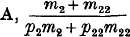 for commodity B, and so on. The number of units of satisfaction of commodity A that are consumed at the earlier point of time is
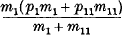
(i.e. the quantity m1 divided by the magnitude of a unit of satisfaction), and at the later point of time the number is
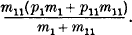
Similarly for commodity B. And so on. Finally we obtain for the average price of a unit of satisfaction at the earlier point of time the quantity

that is to say, the total amount of money paid out divided by the total number of units of satisfaction consumed. And, in the same way, at the later point of time

The ratio of P11 to P1 is then supposed to express the average rise or fall in prices that takes place during the intervening interval.
Lindsay2 regards this formula as “correct and sufficient for all reasonable demands”, but objects that it “comprises too much”, because it sets out “to measure at the same time the change in consumption, which does not form part of the problem”. The objection does not seem to me to be either valid or indeed intelligible, for the various quantities of consumption are not measured, i.e. deduced, but are provided as part of the necessary data for working out the change in prices. But I find it equally difficult to follow how Lindsay can accept the formula. In my opinion one is forced on a priori grounds to regard Lehr’s method as theoretically inapplicable. It may under certain conditions lead to entirely anomalous results, as the following example will show.
Suppose an economic system in which at a certain period, owing to the high price of wheat, bread is made almost entirely of rye. At a later period let the price of rye have fallen by 10 per cent, and the price of wheat by 25 per cent, and suppose that in consequence of these changes bread is now made entirely of wheat, so that next to no rye is now consumed. If Lehr’s formula were being used to determine the change in the purchasing power of money over bread, it would obviously be necessary to put m1 = 0, m22 = 0 (wheat being commodity A and rye commodity B). Then


Therefore
In other words, the conclusion would be that the average price of the raw materials of bread has remained perfectly constant. But that cannot possibly be right, for both kinds have ex hypothesi fallen in price. (For a correct method of evaluation see below.)
It is of importance, in this as in all similar cases, to draw a sharp distinction between what is known and what so far is not, or cannot, be known. If the quantities actually consumed at the two points of time are known, it is possible for instance to start from the consumption of the first point and calculate what the cost of the composite commodity appropriate to it would be if each constituent were purchased at the price of the later point. Use of the above formula (p. 9) then clearly provides one measure of the change that has taken place in the average level of prices. Next it would be possible to take the quantities appropriate to the later point, m11, m22, etc., and work out how much this composite commodity would have cost at the prices that ruled at the earlier point. The corresponding relation
(m11p1 + m22p2 + . . . .) : (m11p11 + m22p22 + . . . .) = 100 : (100 ± x)
provides a different measure of the change, but in itself it is just as natural and reliable.
If now these two ratios are almost equal—as will often be the case—it is justifiable to regard the concordant figure as the true measure of the change. If, on the other hand, there is a substantial divergence it is, I think, necessary to remain content with the results so far obtained. For practical purposes one might adopt some kind of average of the two figures—the arithmetic mean would be the simplest—; but it would have a purely arbitrary significance. The data are no longer sufficient to supply the required information. It would be necessary to undertake a more intimate study of the various kinds of commodities and of their relative importance to the individuals who comprise the community—in so far as such a comparison is at all feasible.
In the example given above, if we start from the consumption of corn in the earlier period, when it consisted entirely of rye, we come to the conclusion that the price of the raw material of bread has fallen by 10 per cent. This figure gives us a lower limit to the extent to which corn has in fact become cheaper, for it would have been applicable even if the members of the community had remained consumers of rye. But inasmuch as the transition to wheat would not have taken place if it had not offered some economic advantage, it may be concluded that the actual gain to consumers provided by the change in prices is somewhat greater. If, on the other hand, we were to calculate in terms of the consumption of the later period, when only wheat is purchased, we would conclude that prices have fallen by 25 per cent. But this is in excess of the actual cheapening of the raw materials of bread, because the consumption of corn in the earlier period was not made up of wheat, but of rye, which was then relatively cheaper. It follows that the real cheapening of the raw materials of bread lies somewhere between 10 and 25 per cent. To fix it more closely it would be necessary to compare the two nutriments. Suppose, for example, that it were known that, on account of its higher nutritive value, etc., wheat is 10 per cent, better than rye for most purposes of consumption. Let the price of rye in the earlier period be 200M., the price of wheat in the later period 187M. Then we have quite simply that
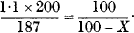
Hence X = 15, and the extent of the real cheapening is measured by 15 per cent., whereas the arithmetic mean of the two limiting values determined above would have suggested a cheapening of  per cent.
It is obvious that this kind of reduction of one kind of commodity to terms of another kind is at best possible only in a rough and ready kind of way, and is often altogether impossible.
—————
We come now to the no less difficult question as to which objects are to be included in considering the conception of average price level or average purchasing power of money. At first sight it would appear, at any rate from the theoretical point of view, as though it would be necessary to include everything in exchange for which money is taken or given. It would in other words, as Wasserraab3 expresses it, “ make no difference whether it is articles of trade or real estate and houses which are involved, or whether it is services for which the money equivalent is paid in the form of daily or contract wage, salary, fee or honorarium, or of some other kind of price (for instance, freight or carriage in the case of transport undertakings, or tax or other due in the case of state services)”.
Apart from these practical difficulties (which could possibly be overcome), it appears very doubtful whether such an extremely general statement of the problem does not involve too distant a goal and the introduction of extraneous elements.
Other authors, on the other hand, as for instance H. H. Powers in his criticism of Irving Fisher’s Appreciation and Interest (Annals of the American Academy, January 1897), regard it as obvious that the only thing which can be of importance is the determination of changes in the prices of actual commodities, indeed only wholesale commodities, for on these it entirely depends whether entrepreneurs and other large users of credit have been working at a profit or a loss. But this is going too far in the opposite direction, for the interests of the entrepreneur are by no means the only interests which are affected by an alteration in the purchasing power of money.
What one really wants to know is whether “living”—ordinary consumption—has become cheaper or dearer. It is true that this consumption comprises not only commodities in the strict sense of the term but also services and even the use of capital—but only if they enter directly into consumption, as in the case of domestic service, houses, etc. If, on the other hand, we include, in addition to the prices of the products, the prices of the factors of production—whether labour, the service of land, or the use of capital—or of capital goods themselves (e.g. houses, sites, etc.), it can only result either in quite useless double counting or even in more or less erroneous conclusions.
If wages, for example, have gone up in proportion to the prices of commodities, their rise can in general be regarded as a simple corollary of the rise in prices—whether it is considered to be cause or effect. If wages have gone up more than prices, it must mean either that labour itself has become more productive or that workers are now obtaining a relatively greater share of the product as against land owners or capitalists. But this has an influence on the purchasing power of money over articles of consumption only in so far as the general level of wages affects the remuneration of those services that enter directly into consumption.
In the same way the price or capital value of land will, other things being equal, alter pari passu with the prices of agricultural produce. Otherwise some cause or other must have been at work to bring about a change in real rents. This does not affect the general cost of living except to the extent that a rise in urban ground rents usually carries with it a rise in the rent of houses. But since the former is already included in the latter, there is no need to take special account of it.
It is quite true that increased activity in the sale of houses and sites, or the payment of higher wages, dividends, rents, etc., increases the need for money and to this extent may occasion a change in the value of money. That, however, is an entirely different question. (It arises equally when the same commodity changes hands several times before entering into consumption, as is usually the case at times of crisis. But in calculating a General Index Number it would be undesirable to reckon one and the same commodity as many times over as it is sold and purchased.)
It seems to me, therefore, that the ideally correct pro-cedure4 for observing and measuring the general price level is to confine the calculation to objects of (direct) consumption, but over this range to make it as complete as possible, including not only commodities, but rents of houses, certain services, and the like. If the same money income serves at two different points of time to provide equally for the needs of nourishment, clothing, house-room, amusements, travel, education, etc., it is in accordance with ordinary usage to say that the purchasing power of money has remained constant. This is the case even though the prices of securities or sites have risen in the meantime, on account of a fall in the rate of interest or for some similar reason; or even though workers now receive higher wages than before.
If, on the contrary, house-rents or the cost of direct services have gone up it would certainly be said that things have become dearer and that the purchasing power of money has diminished, even though there has been no rise in the prices of actual commodities.
The problem being narrowed down in this way, it is scarcely necessary to point out that the usual methods of dealing with average prices are far removed from the conditions here stipulated for a satisfactory computation. These methods are, for the most part, applied only to wholesale prices. That is to say, raw materials and half-finished goods have in part to take the place of finished consumption goods. Services and the use of capital are entirely omitted, and the relative importance of different commodities is taken into account only in a very superficial kind of way. But it must be remembered that the main purpose of these estimates was merely to establish the much disputed fact of fluctuations of prices. We owe them to the diligence of a few scholars who had to work with limited means and on material which, collected originally for quite other purposes, was in many respects incomplete. In this connection the labour of men like Soetbeer and Sauerbeck must not be supposed to be wasted. Indeed, the control calculations of Palgrave and others have shown that the introduction of the quantities of the commodities involves no such substantial modification to the final results as might a priori have been expected.
But a much more precise calculation of the average price level will become essential once it is generally accepted that appropriate choice and management of the measure of value would result in a stable level of prices and a constant purchasing power of money. When the goal is set as high as this the means of reaching it will be provided by an appropriate development of official statistics.
It all therefore depends on obtaining a clear view of the causes that influence the value of money and of the means that are available for regulating it. This is the question which forms the subject-matter of the following chapters and to which we now turn.
_____________
5 Beiträge zur Statistik der Preise (Frankfurt a/M., 1885). I quote from Lindsay, who in his Die Preisbewegung der Edelmetalle seit 1850 (Jena, 1893) gives a fairly complete compilation of the various proposals for measuring the average level of prices; though I cannot agree with him at every point in his opinions of the methods which he mentions.
6 Op. cit.
7 Preise und Krisen (Stuttgart. 1889), p. 75.
8 Perhaps something ought to be said about the view put forward by Pareto (Cours d’économie politique, vol. i., p. 264 ff.). He holds that by the purchasing power of money ought really to be meant the abstract marginal utility that can be procured with one extra unit of money (l’ophélimité élémentaire indircete de l’or). It follows that this quantity would never be the same for two individuals or classes of the community, but would vary according to their wealth. In the same way, for example, at a time of increasing national welfare it would be necessary to speak of a falling purchasing power of money, even though the prices of all commodities remain perfectly constant. This is scarcely in accordance with ordinary usage. Yet such a definition of the value of money ought fundamentally to be the least open to theoretical objection. I confess that I do not venture to come to a decision as to its practical usefulness.
- 1See, for instance, his preface to the German edition of his Vorlesungen, II.: Geld und Kredit, 1922.
- 2Lectures, II.: On Money and Credit, 3rd Swedish ed., p. 197.
- 3See the following papers in the Ekonomisk Tidskrift: (i) Davidson, “On the Concept of the Value of Money”, 1906; (ii) Wicksell, “The Stabilisation of the Value of Money, a Means of Preventing Crises”, 1908; (iii) Davidson, “On the Stabilisation of the Value of Money”, 1909; (iv) Wicksell, “Money Rate of Interest and Commodity Prices”, 1909. Cf. also Brinley Thomas, “The Monetary Doctrines of Professor Davidson”, Economic Journal, March 1935.
- 4Loc. cit., 1908, p. 211.
- 5Wicksell always insisted that this reasoning did not mean more than an amplification of the old quantity theory. Moreover, he always regarded his own contribution as a doubtful hypothesis and never became as convinced of its tenability as did some of his pupils. He explicitly rejected the idea that his theory provided an explanation of the business cycle. He was critical of Mises’ idea that mistaken credit policy is the origin of the tendencies towards booms and depressions. A brief quotation will indicate his position: “Our conclusion is, therefore, that although the changes in the purchasing power of money, caused by credit policy, are under present conditions intimately bound up with the business cycle and without any doubt also influence the latter, above all by giving rise to crises, yet it does not seem essential to assume that there is, by the nature of things, any necessary connection between these two phenomena. The main cause of the business cycle, and a sufficient cause, seems to be the fact that technical and commercial progress cannot by its very nature give rise to a series which proceeds as evenly as the growth in our time of human needs—due above all to the organic increase in population—but is now accelerated now retarded. In the former case ... a mass of circulating capital is transformed into fixed capital, a process which, as I have said, accompanies every rising business cycle: it seems as a matter of fact to be the one really characteristic sign, or one in any case which it is impossible to conceive as being absent.”. . . “If the banks already at the beginning of a rising period sufficiently raised their interest rates, but on the other hand reduced them energetically when the depression was about to set in”, then the price level would probably remain stable, although raw materials for fixed capital would rise in price during periods of good trade and fall during times of bad trade. “Under such circumstances the chief crises-causing factor would probably have disappeared, and what remained would be only a quiet wave movement between periods of accelerated formation of fixed capital and periods when the new capital assumed . . . other forms.” . . . “Increase in commodity stocks is probably the most important form of real investment during so-called bad trade.”
- 6Wicksell always insisted that this reasoning did not mean more than an amplification of the old quantity theory. Moreover, he always regarded his own contribution as a doubtful hypothesis and never became as convinced of its tenability as did some of his pupils. He explicitly rejected the idea that his theory provided an explanation of the business cycle. He was critical of Mises’ idea that mistaken credit policy is the origin of the tendencies towards booms and depressions. A brief quotation will indicate his position: “Our conclusion is, therefore, that although the changes in the purchasing power of money, caused by credit policy, are under present conditions intimately bound up with the business cycle and without any doubt also influence the latter, above all by giving rise to crises, yet it does not seem essential to assume that there is, by the nature of things, any necessary connection between these two phenomena. The main cause of the business cycle, and a sufficient cause, seems to be the fact that technical and commercial progress cannot by its very nature give rise to a series which proceeds as evenly as the growth in our time of human needs—due above all to the organic increase in population—but is now accelerated now retarded. In the former case ... a mass of circulating capital is transformed into fixed capital, a process which, as I have said, accompanies every rising business cycle: it seems as a matter of fact to be the one really characteristic sign, or one in any case which it is impossible to conceive as being absent.”. . . “If the banks already at the beginning of a rising period sufficiently raised their interest rates, but on the other hand reduced them energetically when the depression was about to set in”, then the price level would probably remain stable, although raw materials for fixed capital would rise in price during periods of good trade and fall during times of bad trade. “Under such circumstances the chief crises-causing factor would probably have disappeared, and what remained would be only a quiet wave movement between periods of accelerated formation of fixed capital and periods when the new capital assumed . . . other forms.” . . . “Increase in commodity stocks is probably the most important form of real investment during so-called bad trade.”
- 7As Wicksell worked on monetary problems for almost three decades after the publication of the Geldzins, it may be worth while to say something here about the changes which his views underwent. These were not, as a matter of fact, considerable. Although he was always ready to question his own reasoning, his lively discussions with other Swedish economists do not seem to have left many traces on his theory. Take, for instance, his discussion with Professor Davidson. In 1906 Davidson, whom Wicksell held in the highest esteem, suggested that during periods of rapid technical progress and increasing productive efficiency a greater stability of business would be ensured if commodity prices fell in proportion to the increase in output than if they remained stable. Davidson asserted that if the money rate of interest and business profits (Wicksell’s natural rate) stood in a normal relation to one another before the increase in efficiency, then they would continue to do so if prices fell in proportion to the latter. There would be no need for a change in the money rate of interest. If it were reduced to prevent a fall in the price-level, it would be too low in relation to profits, and a process of an inflationary character would start. To this Wicksell replied: “In the case which Davidson has chosen it may appear that the increase in profits due to increased productivity and the reduction in profits due to the fall in prices, caused on his assumption by the former, would offset one another. But surely this would only happen if the price movement could be anticipated beforehand and estimated, or if it were so even and had lasted for so long that it had come to be generally regarded as something constant? In general, however, the individual business man will make his calculations for the future, and so fix his demand for labour, raw materials, and credit on the basis of current prices.” Hence, prices would rise if the money rate were not immediately raised, and when some time later the increase in productivity had led to a greater supply of finished goods, so that prices would fall, business men would make losses and the situation would be disturbed.
- 8As Wicksell worked on monetary problems for almost three decades after the publication of the Geldzins, it may be worth while to say something here about the changes which his views underwent. These were not, as a matter of fact, considerable. Although he was always ready to question his own reasoning, his lively discussions with other Swedish economists do not seem to have left many traces on his theory. Take, for instance, his discussion with Professor Davidson. In 1906 Davidson, whom Wicksell held in the highest esteem, suggested that during periods of rapid technical progress and increasing productive efficiency a greater stability of business would be ensured if commodity prices fell in proportion to the increase in output than if they remained stable. Davidson asserted that if the money rate of interest and business profits (Wicksell’s natural rate) stood in a normal relation to one another before the increase in efficiency, then they would continue to do so if prices fell in proportion to the latter. There would be no need for a change in the money rate of interest. If it were reduced to prevent a fall in the price-level, it would be too low in relation to profits, and a process of an inflationary character would start. To this Wicksell replied: “In the case which Davidson has chosen it may appear that the increase in profits due to increased productivity and the reduction in profits due to the fall in prices, caused on his assumption by the former, would offset one another. But surely this would only happen if the price movement could be anticipated beforehand and estimated, or if it were so even and had lasted for so long that it had come to be generally regarded as something constant? In general, however, the individual business man will make his calculations for the future, and so fix his demand for labour, raw materials, and credit on the basis of current prices.” Hence, prices would rise if the money rate were not immediately raised, and when some time later the increase in productivity had led to a greater supply of finished goods, so that prices would fall, business men would make losses and the situation would be disturbed.

