
Interest and Prices
Chapter 6: The Velocity of Circulation of Money :
CHAPTER 6
THE VELOCITY OF CIRCULATION OF MONEY
A. A Pure Cash Economy
THE subject of velocity of circulation, so important for a proper appreciation of monetary questions, is treated very scantily in most economic text-books. Even the best writers sometimes display a certain lack of conviction with regard to the true meaning and bearing of the conception. Thus we find J. S. Mill making the singular assertion1 that “rapidity of circulation . . . must not2 be understood to mean the number of purchases made by each piece of money in a given time. Time is not”, states Mill, “the thing to be considered. . . . The essential point is, not how often the same money changes hands in a given time, but how often it changes hands in order to perform a given amount of traffic”, and so on.3
If Mill were taken literally the whole definition would end up as a mere tautology. For in order to discover how often a certain sum of money changes hands in effecting the sale and purchase of a given quantity of goods, it is necessary to know the average price of the goods in question, which is precisely the quantity for the determination of which the (amount and) velocity of circulation of money are to be utilised. In other words, velocity of circulation as defined by Mill could not be regarded as an independent factor in the determination of average price. The real purport of Mill’s somewhat obscure explanations is as follows: The commodity price level depends not only on the quantity of available money and its velocity of circulation (in the sense in which everywhere else Mill himself uses the term), but also on the quantity of goods which are exchanged in the appropriate interval of time with the aid of this quantity of money. This, however, is obvious and applies generally to the Quantity Theory: excess or deficiency of money can be thought of only in a relative sense, that is to say, in relation to the quantity of goods exchanged for cash.
So our definition of velocity of circulation is simply this: the average number of times the available pieces of money change hands during the unit of time, say a year, in connection with buying and selling (excluding lending).
Just as important a conception is the reciprocal of velocity of circulation, the average interval of rest of money. It is the mean interval which elapses between two purchases effected by means of the same sum of money. During this interval the money lies idle in safe or coffer.
To arrive at these quantities, several routes are theoretically available. Though they all lead to the same goal, it is of some interest to compare them.
(1) If we know the total value, P, of goods exchanged against cash in the course of the year and also the quantity, M, of money in circulation, then clearly the mean velocity of circulation of money is given by the ratio of P to M.
(2) If it were possible to trace the movements of the individual pieces of money (units of money) through the economic system and to discover how often each one changes hands in the course of the year, the arithmetic mean of the individual frequencies of circulation would give the value of the mean velocity of circulation of money. The result would be precisely the same as before. For the total number of circulations of all the money units is the same as the total value of goods exchanged, and the number of money units is equal to the quantity of money.
(3) Thirdly, an attempt could be made to ascertain the intervals of rest of all the pieces of money during the given period, the actual processes of exchange being regarded as confined to single points of time. The arithmetic mean of these intervals of rest could then be obtained (intervals at the beginning and end of the given period would not be counted separately but would be combined). This would give the mean interval of rest of money, and, expressed as a fraction of the unit of time (the year), its value would be equal to the reciprocal of the velocity of circulation of money, as worked out above. This is as it should be. For the arithmetic mean of the intervals of rest of all the units of money is equal to their sum divided by their number, and consequently the reciprocal is equal to the number of intervals of rest divided by their sum. But the number of intervals of rest (as defined above) is clearly equal to the number of circulations of all the units of money, or, what is the same thing, the total value, P, of the goods exchanged. And the sum of the intervals of rest clearly comprises all the intervals of rest of each individual piece of money, which, expressed as fractions of the unit of time, add up in each case to exactly a year (to the unit of time itself). The total sum is therefore equal to the number of units of money, i.e. to the quantity, M, of money in circulation. The ratio of P to M is thus once more obtained.
(4) This calculation takes no account of the sequence in which the intervals succeed one another. It can therefore be carried out in a different manner. The practical feasibility of this method is not to be altogether excluded from consideration, and we shall see in any case that it has a certain theoretical significance. Suppose that it were possible, for each individual till, to calculate the amount of money which (in the processes of exchange) flows through it in the course of the year (most simply, if not quite accurately, regarded as half the sum of receipts and payments), and also the mean interval of rest of this money in the till. Let the former quantities be represented for the various tills by a, b, c, etc., the latter by r, s, t, etc. Then the mean interval of rest is given by the formula
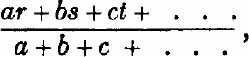
and its reciprocal
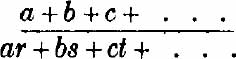
is the mean velocity of circulation of the money in circulation in the given economic system. The numerator of the latter fraction, a + b + c + . . . , is clearly equal to the sum of receipts, or of payments, in the system, that is to say, to the total value of the goods exchanged. It follows that the denominator, ar + bs + ct + . . . , must measure the quantity of money in circulation, as can be proved directly in the manner indicated above.
The question now arises whether the magnitude of this velocity of circulation can be regarded as determined by independent factors; or whether rather, as is sometimes maintained, it is not merely the resultant, given the quantity of goods exchanged and of available money, of the particular level of commodity prices, themselves determined by quite different causes.
That there is some degree of truth in this is not only probable, but quite understandable. For instance, if the general level of prices or of business activity rises or falls while the quantity of money remains initially unchanged, the velocity of circulation suffers a purely automatic increase or decrease.
At a higher price level, other things being equal, everybody pays out more from his till; more, however, flows in. This necessarily results in a shorter interval of rest of money in the tills and so to a higher velocity of circulation. Or if money is lacking for certain purchases, they are postponed until sufficient money has been accumulated; if we think in terms of a circular flow of money between people in economic relations with one another, A buys from B, B from C, C from D, and so on, in more rapid succession than was the case before—the circulation of money is accelerated. The situation is reversed when prices fall.
It is a big jump to the assertion that velocity of circulation has no independent existence at all—that rather the whole theory which is based on the influence of this factor on the demand for money “proves to be nothing more than empty and barren formalism”.4 It is at once clear that the purely physical conditions under which money can be paid and transported set a definite limit to the magnitude of the velocity of circulation. Money cannot circulate faster—at any rate in a pure cash economy—than a messenger boy can run; its speed cannot exceed that of the mail van, train, or steamer to which is consigned the cash used for making a payment. For it is clearly impossible for a sum of money, in the course of its journey to the recipient, to effect a second payment. But the importance of this consideration is very greatly diminished by the modern developments of transport, by the concentration of population in large towns, etc. Moreover, payments over greater distances have, of course, for a long time been made by means of the transfer, or rather the exchange, of claims (bills of exchange), with the result that at the most it is merely a residual balance that has actually to be paid over in money. It is only at times of severe crisis that at one and the same moment money is being sent in opposite directions between distant places, for instance between London and New York. Ordinarily, the well-known procedure, often explained, is in operation. Suppose A in London desires to make a payment to B in New York. He purchases the money claim which C in London holds against D in New York. And so on. The result is that the two sums of money which are owed, instead of having to be taken across the ocean in opposite directions, need only travel over the shorter distances between different business houses inside London and New York.
There is, however, in actual practice an important factor which sets both upper and lower limits to the magnitude of the velocity of circulation. It is the time during which each piece of money has to lie unused in the till between two successive payments. This interval, which depends on the conditions of the market and on the purchasers’ arrangements, is subject to exceedingly great variation from one period to another and from one piece of money to another. It might therefore appear that its mean value, averaged over considerable sums of money and over long periods of time, is again a purely arbitrary factor, having no independent importance. But this is not so. It is easy to see that the average interval of rest of the money in my till is the same thing as the ratio of the amount of money in the till to my average daily (weekly, or monthly) payments. That the size of a cash holding is in no sense arbitrary (when credit is unobtainable) but within fairly narrow limits bears a definite relation to the turnover of the business, is a fact of which every business man is aware.
Retaining our supposition of a pure cash economy, in which credit is neither given nor received, let us now try to specify the most important factors which influence the size of the cash holding.
First of all, there are certain technical and natural features which sometimes cause a concentration of receipts at one time and of payments at another time, for instance at different seasons. If, as a result of the nature of his business, a man obtains most of his receipts in the spring and, on the other hand, has to make most of his payments in the autumn, then on the above supposition he must necessarily keep by him a fairly considerable sum of money throughout the summer. In the opposite case, where the receipts accrue mainly in the autumn and the payments become due in the spring, an appropriate holding of cash is necessary through the winter. Imagine a case where the whole of the annual business of a country is concentrated in two markets, at each of which one half of the population appear as buyers and the other half as sellers, nobody being both buyer and seller at one and the same market. Then the mean period of circulation (or rather interval of rest) of money would be just a half-year, and twice the total quantity of money would be equal to the total value of the goods annually exchanged.
It is unnecessary to point out that this case is purely imaginary. Though formerly it was very usual for the business of exchange to be concentrated into a few big markets or fairs, an overwhelming proportion of the goods were not disposed of in final exchange for money, but by means of the intervention of money (or of temporary credits) for other goods; this is in contradiction to the above assumption, with the result that in actual fact the circulation of money could proceed very much faster.
There is a point which may be noted in passing. In a pure cash economy the most essential cash holdings are those which are destined for definite payments at given points of times in the future. It is precisely these which in an advanced credit economy can most easily be dispensed with, for loans or commodity credits, falling due on definite dates, provide a perfect substitute.
So much for payments which can be foreseen. In the second place, we have to consider those more or less unforeseen disbursements which occur in every business. To meet them, a larger or smaller amount of money must be kept in reserve. It is true that the size of this reserve depends, not only on the nature of the particular business, but in part also on the personal predilection of the owner. Yet the extreme upper and lower limits are much closer than might at first sight be supposed. “Chance” is never, of course, completely irregular, and the truth of the so-called “Law of Large Numbers” can be verified under the most diverse conditions. According to this law, chance deviations in one direction or the other are most of them densely concentrated about a certain mean value; much bigger deviations are rare, the probability of the occurrence of a particular deviation, or its relative frequency, falling off much faster proportionally than the magnitude of the deviation.
Suppose that experience has shown that in a particular business the sum of the payments (or rather the excess of payments over simultaneous receipts) at a certain season tends to oscillate from year to year about a certain mean value, a. Let the “probable deviation” be b: this means that the odds are even—on the basis, once again, of the experience of this particular business—in favour of the payments over the period in question lying between a+b and a-b. If the business man is satisfied with this so-called simple margin of safety, he must have by him a cash holding of a + b. But if he demands a greater degree of security against the possible exhaustion of his till, his cash holding must of course be somewhat larger. With a cash holding of as little as a + 2b, the betting on the total exhaustion of his till over the period in question would, according to the laws of probability, be more than 9 to 1; with a cash holding of a+ 3b it would be more than 44 to 1; and with one of a+ 5b it would actually be more than 2600 to 1, i.e. the till would be exhausted only about once in three thousand five hundred years.
The business man has never heard of the Calculus of Probability, but his empirical line of reasoning is on the whole valid: deviations from the normal course of business which have not occurred either in his own experience or in the experience of his predecessors are not very likely to occur in the future; and although the business man’s experience seems to be the result of pure chance, the measures that he adopts in regard to his holding of cash will be scarcely altered from year to year so long as the circumstances remain the same. This stability becomes even more marked when it is the average of all businesses in a particular field that is under consideration.
In the third place, considerable sums of money accumulate from time to time, particularly in the hands of people who possess large fortunes, as a result of the sale of individual blocks of capital or the like, whose owners cannot for the moment find suitable employment for the proceeds. These money balances are, strictly speaking, merely a particular kind of cash holding, for here too the money is destined to return sooner or later into circulation. But their magnitude is clearly subject far more than that of real business holdings to individual caprice and to the influence of trade conditions. In an undeveloped economic system, where security is lacking, the most prominent function of gold is, of course, to act as a store of value; the large and small hoards, which are withheld from circulation for years on end, may constitute the major portion of the available stock of money. At times of stress in India, for instance, in the regularly recurring years of famine, an enormous quantity of little hoards emerge from under the bedsteads, where they have been buried in the ground, and serve to push up prices, particularly those of corn, to an abnormal level. But in the civilised countries of Western Europe this kind of thing no longer happens. Moreover, the development of banking ensures that all large sums of money are temporarily entrusted to the banks, so that they are never completely withdrawn from circulation at all.
It would thus appear, on the assumptions that have been made, that, with the possible exception of the last-mentioned category, the average interval of rest, and consequently the average velocity of circulation of money, is of almost constant magnitude. It would react immediately against accidental expansion or contraction.
B. Simple Credit
So far we have imagined a pure cash economy without credit or the lending of money. This is a purely hypothetical case, for at no stage of economic progress can the phenomenon of credit have been entirely absent. If we proceed now to take it into account the whole situation would appear to be altered; the ground would at once seem to have been cut away from under the Quantity Theory. But no substitute for money is provided by simple merchandise credit or simple lending of money from one person to another. What they do is to provide a powerful pulley for accelerating the circulation of money. Indeed there would be absolutely no theoretical limit to the extent of this influence if it were possible to leave out of account those practical obstacles of which we shall be speaking shortly.
In the example discussed above, one half of the population appeared as sellers in the spring and to an equal extent as buyers in the autumn, while the other half appeared as buyers in the spring and as sellers in the autumn. It followed that in a pure cash economy the necessary stock of money would be equal to half the value of the total annual output. But with the aid of some form of credit, the need for money and the amount of cash holdings could be diminished to an unlimited extent. According to our assumption, the sellers are able to find a use for their money only after half a year has passed. It follows that they might just as well deliver their goods on half-yearly credit (and, in the absence of risk, without charging any interest). At the next annual market, which takes place after six months have elapsed, buyers and sellers will not group themselves in the same pairs as before, and it would not be possible simply to annul the old claims against the new ones which now come into existence as a result of the new transactions. But as soon as a sum of money, no matter how small, were brought into circulation in the market, it would zigzag rapidly backwards and forwards between buyers and sellers ; the money received at any moment in exchange for goods would immediately be employed for the repayment of debt, and the money thus received in the repayment of debt would find a use in the purchase of goods.
And equally in the case where credit takes the form of loans rather than of merchandise credit. Any sum of money, no matter how small, would be sufficient. It might, for example, be lent by a seller A to a buyer B, who in his turn might employ the money for the purchase of goods from a seller C; C might then in his turn lend the sum of money to a buyer D; and so on.
It is easy to see that the procedure here outlined is perfectly general. No matter how great the economic complications, money must always be somewhere; and provided that it is not at the actual moment being employed in effecting a payment, it can be lent by its present owner to some other person, who can complete a payment with its aid. So there is no “theoretical” limit to the velocity of circulation of money other than that provided by its physical mobility or speed of transport. Were it possible to increase these to an unlimited extent a very large proportion of all the world’s business of exchange and lending could actually be paid for in cash by sending backwards and forwards (very rapidly, it is true) one single ten-mark piece (or, for all I care, one single ten-pfennig piece). This may sound odd, but it is essentially less remarkable than the well-known fact that nowadays an enormous amount of such business is settled entirely without the use of money— through the transfer and exchange of claims.
Reality is, of course, far removed from this ideal representation, so far as it is simple credit between private individuals, not organised credit (as provided by a banking system), that is being taken into consideration. The reason is obvious. In the first place, many people, in fact the overwhelming majority of people, are so poor that they have little or no facilities for obtaining credit—an evil which can be alleviated by no system of credit; only a general improvement in economic welfare can make a difference. But quite apart from that, it is of course only in a very limited circle of people that it is possible to enter into individual transactions of credit or lending, whether in the capacity of creditor or of debtor. Moreover, if abuse of confidence is to be prevented such transactions involve precautionary measures which are burdensome and tedious both to the creditor and the debtor. Consequently, it will never occur to anybody, so long as he is actuated merely by his own interests, to consent to a loan or to a delay in payment when he is confronted with the prospect of himself running short of funds and having to borrow, perhaps in a few days’ time. Or at least he would have to be certain of being able to satisfy his own needs for money on more advantageous conditions than he himself demands. Otherwise he would be undertaking, all to no purpose, the trouble of a double transaction, and be running in addition the risk involved by lending.
The matter can be put in other words as follows: A system of simple, unorganised credit certainly does to some extent reduce the necessity for holding cash balances; but the necessity still exists, particularly in regard to those balances which serve as reserves against unforeseen payments. The velocity of circulation of money is now seen to be a somewhat elastic quantity, but it still possesses sufficient powers of resistance against expansion or contraction for the conclusions of the Quantity Theory to retain the appearance of substantial validity.
Under special conditions simple credit may itself be capable of a significant degree of expansion, for instance at times of speculation as a result of the attractiveness of higher profits, or of the offer of ever higher prices or of a higher rate of interest. But as soon as this incentive disappears, the contraction is correspondingly catastrophic, as is revealed in the period of crisis that ensues. Everybody now hastens to fortify his balances, which appear much too small in relation to the new level of prices. The demand for goods contracts, their supply increases, and prices fall, for a time possibly far below their normal level—particularly if confidence has been strained and general mistrust prevails. We shall return to this subject in another connection.
C. An Organised Credit Economy
We have seen how simple merchandise credit and the lending of money from one individual to another, while not capable of providing a definite substitute for money, do give rise to an increase in the velocity of circulation. And theoretically there is no limit at all to the extent of this influence. But in practice it is held in narrow bounds; for, in the first place, the opportunities which are open to any single individual for receiving and providing credit are usually very limited, while at the same time an acceleration in the circulation of money is necessarily bound up with a (relative) fall in the size of balances below the level which is dictated in an undeveloped credit economy by foresight, and to some extent by custom.
In a developed credit economy both these obstacles are removed, and either actually or virtually a higher velocity of circulation is provided—or, more correctly, the velocity of circulation is capable of being increased more or less at will. The available means can be placed in two main categories: the transfer of claims (the use of bills of exchange) and the centralisation of lending in monetary institutions; and in addition there is the combination of the two classes which characterises the modern system of banking and bourses (discounting, the use of cheques, clearings, notes, etc.).
Let us suppose that several individuals, A, B, C, D, etc., have been given credit (e.g. merchandise credit) by one another, so that A owes money to B, B to C, C to D, etc. The repayment of these debts requires that a certain sum of money shall pass from A to B, from B to C, etc. If all the promissory notes fall due on the same date and involve equal sums, then repayment can be accomplished in a very short space of time and with the aid of the same pieces of money. Now if at least one of these individuals, for example A, is a man whose credit is generally accepted, his promissory note can be utilised by B, C, D, etc. for making their payments, so that one single payment in money is all that is in fact necessary, namely, from A to the last person in the line. It is of course usual for the acceptability of such a promissory note to be further strengthened through each endorser undertaking by means of his endorsement a subsidiary liability. A payment made by means of a bill of exchange is therefore not final, for if the bill fails to be met the money can be demanded from the endorser. It is precisely for this reason that bills provide a great source of strength to the credit system (this was particularly the case in earlier times). While every expansion of simple credit is necessarily bound up with increasing risk, the security of a bill as a commercial instrument increases with the number of endorsements that it carries, and consequently with the number of money payments that it has provided the means of obviating.
Let us suppose that the standing of each individual endorser (including the acceptor and the drawer) is so small that the odds are no more than even in favour of his remaining solvent during the currency of the bill. Then if the bill carries, let us say, ten names, the probability of all these individuals becoming insolvent simultaneously is only one in 210, i.e.  assuming that they are commercially independent of one another, an assumption which is not of course always valid.
It is only on account of their relative inconvenience, and for similar reasons (taxation of bills, etc.), that this original use of bills has gradually become less prevalent since banking was perfected. Bills no longer pass from hand to hand so much as formerly; they are discounted at some bank, and usually then remain in the bank’s portfolio until they become due (at any rate so far as domestic bills are concerned). In other words, the employment of a bill of exchange has become purely a form of lending money.
But let us leave this out of account and consider the original system of bills, as for instance it took shape at the beginning of the century5 in Lancashire and elsewhere. We have seen that the subsidiary liabilities which are incurred as a result of endorsement are completely discharged only when the bill is finally paid. It might thus be imagined that the sum of money in question had actually been passed along the whole line of intermediaries, B, C, D, etc. It turns out therefore that bills merely provide once again a method of causing a virtual acceleration in the circulation of money. Their superiority over simple merchandise credit here lies in the greater security and negotiability of the promissory documents, which can be included in cash holdings and in reserves almost in the same way as money (sometimes, indeed, when the coinage is in bad condition, they are better than money), and they can thus actually dispense with money.
As the monetary system becomes more developed, particularly if bills are mainly accepted by great business or banking houses which are furnished with numerous connections, it will more and more frequently happen that, in the process of effecting payments, a bill returns into the hands of the acceptor before the date on which it falls due, or that the acceptor exchanges it when it falls due for some other bill that he has in his possession. The circle of payments is then completed without the employment of any money whatever. This need be no matter for wonder when it is remembered that in its essence money plays a purely formal part as an instrument of exchange, being really destined to return to its original owner after passing round a greater or smaller circuit.
This procedure too might be regarded as an acceleration of the circulation of money. For the necessary quantity of money can be supposed to be infinitely small, and its (virtual) velocity of circulation to be infinitely great. Then its power of making payments would be represented mathematically by the expression 0 × ∞ . The bills might be finally discharged by an indefinitely small sum of money being passed round among the interested parties, paying off at each step the outstanding debt.
There can scarcely be any doubt that the use of bills might, under favourable conditions, have developed so far as to have dispensed almost completely with the use of money.
A more powerful influence in this direction has been exerted under the head of our second category, the development of the banking system. When a man does not require his money until a certain date in the future he has no longer to rely upon the former method—insecure and tedious, and therefore often not used at all—which involved searching out a private borrower of sufficient solidity. He simply entrusts his money to a bank,6 which is usually in the position to lend it immediately to some second person. The money now serves as an instrument of exchange or payment, and when it has accumulated in the hands of individuals in sufficiently great sums it is deposited for the same reasons as before in the same or another bank, which lends it out once again. And so on. So that during the time when it would otherwise have lain idle with its original owner it changes hands, and effects purchases, perhaps ten or twenty times.
This centralisation of lending in the banks (or on the bourse) has an important effect in gradually obviating the necessity for any precise insistence on fixed dates of repayment when loans are granted or received. The increase in the velocity of circulation or the diminution in cash holdings may thus extend even to money which is intended to serve as a stock of cash for immediate payments or as a reserve against unforeseen payments.
Let us suppose that a number of business men keep their holdings, no matter for what reason, in one and the same place, for instance that they entrust them to the management of a bank. Then experience shows that the aggregate holding is subject to relatively much smaller variations than the individual holdings. This is partly due to the regularity of chance, the “Law of Large Numbers”,7but still more to the real interdependence of firms, a payment by one firm resulting, directly and indirectly, in a corresponding receipt by another. The consequence is that the bank, with the permission of the owners, can always lend a part of the sums that are entrusted to it, either to some different party or to the depositors themselves by granting them the right to withdraw up to a certain limit in excess of their balances. If the bank is intelligently managed it can do this without running any danger of being unable to meet its liabilities, even though the money may be repayable on demand.
It may happen in a particular business that in the course of each month the regularly recurring receipts and payments balance one another. Or it may be that at certain seasons there is an excess of payments but that this can be largely foreseen, so that the necessary funds can be secured by the normal use of credit—on the basis of claims falling due and the like. But at the same time the business man needs a certain reserve against irregular receipts or unforeseen payments. We have already discussed the amount of this reserve, from both the theoretical and the practical points of view. Let us suppose that experience has shown that over a course of years the excess of payments has never varied in one direction or the other by more than a certain amount. If the business man is provided on the average (for instance at the beginning of each month) with, say, two or three times this amount he is secured to a high degree of probability against the exhaustion of his holding. Let us call the amount of this reserve r. Imagine now a collection of one hundred such firms, which have to be supposed to be completely independent of one another. Then according to the laws of probability the variations of the aggregate holding would only be  times as great as that of the individual holdings (and so relatively only one-tenth as great). It follows that to the same very high degree of probability an aggregate holding of 10r would be sufficient to cover the unforeseen payments of all the firms.
If a bank were acting as cashier to all the firms it could content itself with laying by the sum of  in respect to each individual firm without running any risk of impinging on its other funds. It could then concede to these firms the right to withdraw, if necessary, in excess of their balances without limit. Such a right would be available only in a bona-fide case of real need. This would be shown in practice by each firm’s balance standing as often above as below the sum originally deposited. The necessary reserve of each firm would then be diminished to one-tenth of what would be necessary in the absence of a banking system, and the velocity of circulation of the money would be increased ten times. With a greater number of depositors the necessary amount of the aggregate holding would be relatively still less, the absolute amount increasing only with the square root of the number of customers.
(It should be mentioned that this does not purport to be a mathematical system for the running of a bank. We are merely utilising a simple numerical example in an attempt to throw some light on what appears to be the essential nature of these very complicated phenomena.)
But in all applications of the theory of probability there is always the possibility of so-called constant errors. If the bank’s customers belong to one and the same branch of industry—if, for example, they are all agriculturists or all cattle dealers—not only will their regular payments all be greatest at the same time of year but the random variations will probably be closely correlated. The result is that the aggregate holding of reserves has to be substantially greater.
On the other hand, the variations will be even smaller than is indicated by the above calculation if the bank’s customers have business relations with one another; so that a payment by one necessarily implies a receipt by another. Finally, if the bank rules over a completely closed system it is clearly no longer a question merely of “chance”, but the algebraical sum of deposits and withdrawals will always remain equal to zero.
The greater the number of the bank’s customers, and the more diverse their occupations and their positions in life, the smaller is the stock of cash which the bank has to maintain in relation to the total extent of its business ; and the greater pro tanto is the velocity of circulation of money. When the bank’s customers do business with one another cash may be withdrawn for the purpose of making a payment and be returned to the bank before the day is over.
It is possible to go even further. There is no real need for any money at all if a payment between two customers can be accomplished by simply transferring the appropriate sum of money in the books of the bank. It can be written off the account of the debtor (the buyer) and credited to the account of the creditor (the seller). Suppose now that this system, which is known by the name of the Virement, Giro, or cheque system, is developed up to the point where everybody possesses a banking account. Then all payments could be effected by such bookkeeping transfers, except possibly those for which small change suffices. It is true that a substantial amount of capital would be required to instil confidence and to meet unavoidable risks. But whether the banks are branches of one single monetary institution serving the whole country (like the Austrian Post Office Savings Bank 8) or independent establishments connected by a common clearing house (on the English or American pattern), they would require no stock of cash—not at any rate for purely domestic business.
A pure credit system has not yet, even in England, been completely developed in this form. But here and there it is to be found in the somewhat different guise of the banknote system. A bank note is essentially to be regarded as a kind of deposit-receipt or cheque, which passes through a number of hands before it is presented to the bank either for redemption or as a deposit. In those countries where notes can be issued for small denominations, they are always preferred to coins on account of their greater convenience. In Holland, Sweden, and the United States, for instance, a gold coin may not be seen for years on end. This is the case in Sweden in spite of the fact that all the banks of issue are obliged to redeem their notes in gold. Such an obligation is, of course, of the greatest significance. For it causes the discount policy of the banks to be regulated, more or less automatically, by the state of the exchanges ; so that the general level of commodity prices is governed by that in foreign countries. This will be a matter for later discussion. But so far as purely domestic business is concerned, the cash reserves of such countries are now nothing more than a matter of tradition.
In Sweden it rarely happens that gold is consigned even to foreign countries; for the big banks prefer to maintain balances with foreign banks, and to draw on these balances or, in case of necessity, on foreign credits.
The bank-note system presents a rather complicated phenomenon, partly for inherent reasons and partly as a result of legal restrictions of a somewhat arbitrary nature. Notes can be obtained only on payment of interest (or in exchange for commodities), but they earn no interest for their owners. Private individuals are therefore unwilling to stock them in large quantities, and they flow back to the banks in the shape of deposits or are lent to others in return for interest. At the same time, temporary use is made of other instruments of credit, such as bills or merchandise credit, “in order to economise notes”. The matter can be put in other words as follows : Notes provide in themselves the basis for a more or less elastic system of credit, and they circulate with a velocity which is more or less variable. It is for this reason that it was never possible for even the older supporters of the Quantity Theory to provide a satisfactory demonstration of the exact relationship which they held to exist between the price level and the quantity of notes (and coin).
The essential characteristic of notes, regarded as a substitute for metallic money, does not consist in their being used for making payments in the place of coin. For even where notes are in common use, payments could in fact be effected by means of metallic money. It would merely be necessary for each buyer and seller to arrange to meet at the bank, and instantaneously to convert notes into coin and then the coin back again into notes. (This is to some extent what actually took place at earlier stages of the history of banking and note issue.) The essential characteristic of notes consists in their taking the place of coin in the cash reserves of private individuals and of those banks which do not themselves issue notes.
Current accounts (under the Giro system) provide a similar service; and they have the further advantage that they usually earn interest, so that they tend more easily than notes to dispense with other forms of credit. Cheques scarcely ever circulate: they effect but a single payment. Theoretically they have the advantage of greater simplicity, but in practice notes are far more convenient, at any rate for small payments (provided that notes of small denominations are available).
We intend therefore, as a basis for the following discussion, to imagine a state of affairs in which money does not actually circulate at all, neither in the form of coin (except perhaps as small change) nor in the form of notes, but where all domestic payments are effected by means of the Giro system and bookkeeping transfers. A thorough analysis of this purely imaginary case seems to me to be worth while, for it provides a precise antithesis to the equally imaginary case of a pure cash system, in which credit plays no part whatever. The monetary systems actually employed in various countries can then be regarded as combinations of these two extreme types. If we can obtain a clear picture of the causes responsible for the value of money in both of these imaginary cases, we shall, I think, have found the right key to a solution of the complications which monetary phenomena exhibit in practice. (A close examination of such a simplified system should also be of service, as we shall see, in settling certain other economic questions.)
For the sake of simplicity, let us then assume that the whole monetary system of a country is in the hands of a single credit institution, provided with an adequate number of branches, at which each independent economic individual keeps an account on which he can draw cheques. In order to meet foreign, and perhaps also industrial, demands, the Bank must maintain a certain stock of gold. It may be imagined that this stock of gold, or rather its average value, R, comprises the property of the Bank itself. On this assumption, the Bank’s claims on the public must be exactly equal to its debts to the public. If the sum of the credit balances is K, the sum of the debit balances must be K, or rather - K ; so that the algebraical sum of all balances always remains equal to zero.
But this is true only in respect to pure domestic transactions. When the foreign balance of trade or balance of payments is such that the Bank has to give up part of its cash to foreign countries, it finds itself with an equal excess of domestic claims. And, on the other hand, when gold flows into the country and is delivered to the Bank, the sum of the credit balances rises correspondingly above the sum of the debit balances ; and the Bank owes more to the public than the public owes to the Bank. A similar situation is created according as more or less gold is being devoted to industrial uses at home than is being imported (or mined).
On these assumptions, the more important kinds of credit and monetary transactions would be conducted in the following kind of way.
The actual exchange of commodities proceeds very simply. The buyer draws a cheque on his balance (or on his credit) for the appropriate sum, and the seller cashes the cheque, the sum being thus credited to him by the Bank. But within a short space of time goods must be paid for by goods. It follows that the sum of the amounts debited must be equal to the sum of the amounts credited, not only for all the Bank’s customers taken together (for that must always be the case), but also for each individual customer ; so that by the end of the day or of the week each account will always show the same balance as at the beginning.
A certain interval will, however, elapse between the sale of one lot of goods and the purchase of another equivalent lot. During this time, the sellers are in reality extending credit to the buyers to the amount of the sum in question (or a part of it), although on the surface the payment has the appearance of being immediate. This is brought about as a result of the facilities and the guarantees provided by the Bank. Let us return to our former illustration, where one half of the inhabitants of a country offer their produce for sale in the spring and the other half in the autumn. In the extreme case, the first half would appear as creditors in the books of the Bank during, say, the summer and the second half as debtors, to a total sum equal to half the value of the annual produce. But in the winter claims and debts would be completely cancelled, and all the accounts would show zero balances. Or, to take a more probable case, the aggregate amount of claims and of debts might remain almost constant during the whole year, and equal to a quarter of the value of the annual produce, each half of the population appearing in the books of the Bank alternately as creditors and debtors. Finally, every possible combination of these two extreme cases is possible ; but, in accordance with our assumption, the average amount over the year of claims and of debts must always be equal to a quarter of the value of the annual produce. The period of circulation of money in such a pure cash economy would be half a year ; but if it is assumed that cash is turned over n times a year, then it is easy to see that the average amount of claims and of debts in the Bank’s books would be  where W stands for the value of the annual produce, or rather of the annual turnover of commodities.
Even if the Bank held a stock of gold equal in value to the amount of deposits paid in (though on our assumptions this is in no way necessary), the velocity of circulation of money would be doubled.
According to Essar’s 9 figures, the aggregate turnover on current account (half the sum of the amounts credited and debited) in 1890 was in the case of the French Bank equal to 135 times the average amount outstanding on current account, 146 times for the Belgian Bank, and as much as 190 times for the German Reichsbank. The turnover of the French Bank was 54 thousand million francs and this was effected by an amount of money of about 400 million francs.
But these figures do not fully indicate the velocity of actual circulation. Essar is concerned purely with credit balances, where the account cannot be overdrawn. The Bank would be all the less anxious to keep in reserve the full amount of such balances, and would lend most of them away or employ them as cover for the note issue. The same money would thus in fact be fulfilling its function even more frequently.
We have so far dealt with the interval of time, dependent on nature and technique, which separates a purchase from the corresponding sale. But actual long-term credit itself has a part to play. Many people require in their businesses, either regularly or at certain periods, more capital than they themselves possess, while others possess more capital than they are able or willing to find a use for. The resultant lending and borrowing can be supposed to be effected through the intervention of our Bank. Capital is accumulated (or saved) when a customer allows part of his balance to remain at the Bank, and increases it from time to time by depositing fresh sums (in the shape of cheques received in exchange for goods and the like). The Bank must of course pay interest, at any rate on long-term deposits (the rate bearing little relation to the rate which it itself demands). For otherwise its depositors would withdraw their money, and lend it out on their own account. But all that they would have to do would be to draw cheques on the Bank, and there need be no drain on its cash reserves, though an approximately equal amount of its outstanding loans would probably be repaid by borrowers anxious to avail themselves of the more favourable terms now offered by private lenders, and the extent of its business would be contracted.
Against these long-term deposits there stand loans, which are renewed when they fall due and run on in actual fact for a lengthy term. But we have seen that there is no need to postulate any precise equivalence. It might well be that the greater part of the deposits are kept at the Bank for several years, while the corresponding loans are granted for only three months and are never directly renewed. On the other hand, it might happen that the deposits are frequently withdrawn, while the loans are granted for a long term. The total sum deposited is nevertheless equal to the total sum withdrawn. This is a purely mechanical relation ship, necessitated by our assumptions, which indicate that, at any rate in the case of domestic transactions, for every cheque drawn an equal sum of money must be deposited in the Bank.
It would be quite possible for all the country’s lending to be concentrated in the Bank, but there is no need to make such a supposition. In practice, every bank avoids locking up money in risky and protracted enterprises. This is far more the business of individual capitalists, who risk a portion of their property, or stake their rights to it over a long period of time, in order to take a share in such profits as the enterprise will secure if it meets with success. This does not upset our system. Such individuals form no part of the circle entailed in the Bank’s credit activities ; they deal directly with one another by way of debentures, shares, mortgages, limited companies, and the like. A simple illustration is afforded by the case of an entrepreneur who is enabled to build, let us say, a house through the temporary provision of bank credit. When his undertaking is completed, he either sells the house or raises a mortgage upon it. The money raised in this way is withdrawn from the purchaser’s or lender’s banking accounts by means of cheques, and the entrepreneur uses these cheques to repay the loan extended to him by the Bank.
It is important to notice that the long-term rate of interest (the bond rate of interest 10) must correspond somewhat closely to the short-term rate of interest (the bank rate of interest), or at any rate that a certain connection must be maintained between them. It is not possible for the long-term rate to stand much higher than the short-term rate, for otherwise entrepreneurs would run their businesses on bank credit—this is usually feasible, at any rate by indirect means. Similarly it cannot stand lower than the short-term rate, for otherwise most capitalists would prefer to leave their money at the Bank (or to use it in discounting bills of exchange).
It is to be remarked in passing that we have not yet come across anything which corresponds to the customary method of explaining how the rate of interest is determined by the supply and demand of “capital”. It would appear rather that the rate of interest—the short-term rate in the first place, and so indirectly the long-term rate—is completely subject to the discretion of the Bank. The rights of this matter will be examined later.
An extremely interesting question now arises : What is it in our system, and so by inference in the real world, in so far as its conditions correspond to those which we are postulating, that determines the exchange value of money and the general level of commodity prices? No money circulates, and for the purposes of domestic trade no money need be kept in reserve. Means of payment, or purchasing power, can be provided in accordance with the dictates of choice and necessity. The Quantity Theory of Money would appear to be deprived of its very foundations.
This question calls for an answer: that is to-day almost universally recognised. It ran like a red thread through the familiar, and in many ways so instructive, discussions of the English Commission of 1887-88, which had to examine the causes of relative variations in the value of silver and gold. In the course of the evidence, the question arose again and again how it was possible at the present stage of economic development for the quantity of gold in the banks, or anywhere else, to exert an influence on prices ; and how, in particular, the surplus of gold possessed at that time by the banks and the prevailing low rates of discount could be compatible in the light of the Quantity Theory with the falling level of prices. England’s most distinguished monetary theorists and practitioners were summoned before the Commission, but I have not been able to discover that this fundamental question received any solution worthy of the name. Some of the witnesses, for instance H. H. Gibbs,11 a Bank director who appeared several times, became involved in a veritable net of self-contradictory argument. At one time they would ascribe the low rates of interest and the ease with which the banks could maintain their stocks of gold to the decline in business and to the low level of prices, and then they would explain these latter phenomena as being due to a relative scarcity of gold. By far the most valuable contribution towards a solution of this question was, in my opinion, supplied by Professor Alfred Marshall in the course of an examination which lasted for three days.12 But Marshall seems to me to lay too much emphasis on the direct influence that he alleges is exerted by the magnitude of banking reserves on the rate of interest and consequently on prices. This view cannot easily be reconciled with the instances which the members of the Commission themselves brought against him, and still less with the increase which took place later in the reserves of the Bank of England and in the cash holdings of the other central banks of the world. Nevertheless, the second volume of Marshall’s Principles, in which he intends to publish a full discussion of monetary questions, will be awaited with the greatest interest.
This question is also touched upon in the well-known, and often quoted, discussion of Erwin Nasse, “Über das Sinken der Warenpreise während der letzten fünfzehn Jahre”.13 In order to demonstrate the difficulty of ascribing the fall in prices which had actually taken place to a scarcity of gold, Nasse mentions the astonishing development in almost all countries during recent decades in the use of instruments of credit as a means of payment. This development had gone “hand in hand with the growth in trade and the increase in the need for means of payment” and had brought about an “ever-growing independence” of “the available stock of gold”. “It will be contended”, continues Nasse, “that the foregoing considerations leave the value of gold entirely in the air, since they free it from the influence of the scarcity of the precious metals. If the means of payment could be increased at will according to the needs of trade, no limit would be set by monetary conditions to the most arbitrary rise in prices, such as takes place when speculation is rife and enterprise feverishly active. It is impossible to see how the available quantity of means of payment, if it could be increased at will, could determine and limit the purchasing capacity of buyers and consequently the general level of prices.”14
Nasse then answers this objection himself. “International trade provides a rôle for cash payments which is entirely different from the rôle which they fulfil in connection with domestic payments in highly developed countries.” . . . “An unhealthy movement which is proceeding faster in some country or area than in the rest of the world causes the balance of payments to become unfavourable; the country’s cash reserves, that is to say, its Bank’s stock of cash, is consequently contracted; and an arbitrary rise in prices is prevented. For it then lies with those in control of the Bank to restrict credit, and so, by exerting a downward pressure on prices and putting an end to unhealthy speculation, to restore the international equilibrium of prices.”15
There is no need to emphasise the inadequacy of this account of the determination of “the general level of prices”. It does not really amount to more than saying that the level of prices in one country cannot move entirely independently of that of other countries, and so of the level of world prices. That is of course perfectly true, but it fails to provide any information on the question which awaits an answer. It merely gives rise to the further question of what it is that determines the prices of the “other” countries—the world prices themselves. The situation may be such, as we shall see later, as to cause prices to move in the same direction in several, or all, countries. Clearly then there will be no occasion for international movements of gold, and it is difficult to see what it is that can govern such a general movement of prices. It might be that prices would ultimately rise until the banks’ stocks of gold appear inadequate to the needs of international payments; or, on the other hand, prices might fall so low that the superabundance of these stocks becomes intolerable. But having regard to the actual size of the central banks’ stocks of gold and to the relative insignificance of such shipments of gold as do in fact take place between them, it is clear that the limits provided by these factors are too wide to be regarded as directly governing the level of prices.
But Nasse does not adhere to this opinion. He is inclined rather to adopt the view, popularised by Tooke, that the real cause of movements in prices is to be found “on the side of goods”, that is to say, in changes in the conditions of production and transportation of the commodities themselves. This view was carefully examined above,16 and it was argued that only a supporter of the strict Quantity Theory or of the Cost of Production Theory of Money could find such a position tenable. Nasse has declared himself an opponent of both these theories, and it seems clear that his argument about the probable influence of increases of efficiency on prices 17 is without any logical foundation.
But even if it were justifiable to regard the magnitude of bank reserves as definitely governing commodity prices, it would still be necessary to examine the mechanism by which this result is brought about. Nasse has done no more than to point out, quite correctly, that when an “unhealthy” (disproportionately great) rise in prices takes place in a single country, and money consequently leaves that country, the banks, particularly the Central Bank, have the power to “exert a downward pressure on (domestic) prices” “by means of restriction of credit” (raising the discount rate, selling securities, and so forth).
This must not be held to support the somewhat one-sided view of the school of Ricardo, according to which every shipment of gold must be caused or accompanied by a change in prices in the countries concerned. Moreover, credit restriction is by no means the only method by which the international equilibrium of prices can be re-established after a disturbance. A more important factor is the rise in the supply of imports, and the fall in the demand for exports, which is brought about by a rise in domestic prices, for this in itself exerts a downward pressure on prices. The main purpose of a temporary rise in the banks’ rate of discount is merely to bring about a postponement of the payments that are immediately falling due to foreigners until such time as a change in the conditions of export and import has produced a more favourable balance of payments. On these and similar points the objections of the school of Tooke against the classical theory may in many ways be justified.18 But they seem to touch purely upon side issues, and they are without fundamental importance in deciding the main question.
But, it might well be asked, does the power of monetary institutions over prices operate only in this direction? Is it not logically necessary to suppose that under suitable conditions they can exert an influence in the opposite direction—that is to say, that they can raise prices? And is it reasonable to maintain that this influence in either direction can only appear in exceptional circumstances, such as the extreme conditions presented by a crisis? Should it not rather be supposed that the banks’ discount policy, or more generally their credit policy—no matter how it may be determined—is always exerting a certain influence on the level of prices, either maintaining or disturbing it? If so, is this influence to be regarded as confined within narrow limits, such changes in the general level of prices as actually occur being brought about by other forces? If so, what is the nature of these forces? Or is it a characteristic of the banks that their power is unlimited, so that in a pure credit economy they could bring about any desired rise or fall in prices by pursuing a uniform policy with regard to the rate of interest? Is it possible that we have here found the general cause of the price fluctuations which occur under present conditions, when it is becoming more and more usual for instruments of trade and credit to pass through the hands of the banks? Does it follow that the most powerful instrument for stabilising prices lies in appropriate regulation of banking policy?
In the following chapters we will try to find answers to these questions, which are clearly of the greatest importance for a final solution of the monetary problem, though they are seldom referred to in current monetary discussions.
_____________
19 Principles, book iii., chap, viii., § 3.
20 [The italics are the author’s.]
21 Similarly James Mill: “By rapidity circulation is meant, of course, the number of times the money must change hands to effect one sale of all the commodities” (Elements of Political Economy, third edition, p. 134).
22 R. Hildebrand, Theorie des Geldes, p. 41.
23 [Of the nineteenth century.]
24 Or what is essentially the same thing, he buys securities or bills on the bourse.
25 Cf. Knies, Der Credit, vol. 2, 1879, p. 247. A fuller account is given by Edgeworth in his “Mathematical Theory of Banking”, Journal of the Royal Statistical Society, 1888.
26 For an account of the much discussed development of this quite unique institution, see an article by Ed. Tobisch, “Der Check-und Clearingverkehr des k. k. österreichischen Postsparkassenamts” Conrad’s Jahrbuch, 1892.
27 “La Vitesse de la circulation de la monnaie”, Journal de lasociété de statistique de Paris, 1895, p. 143 ff.
28 [“Börsenzinsfuss” in original.]
29 Gold and Silver Commission, First Report, Q. 5328 ff.
30 [Marshall, Official Papers, pp. 32-169.]
31 Jahrbücher für Nationalökonomie und Statistik, vol. 51., 1888.
32 Ibid., p. 156.
33 Ibid., p. 157.
34 P. 26 ff.
35 Loc. cit., p. 55 ff.
36 See p. 82 ff., below.
- 1See, for instance, his preface to the German edition of his Vorlesungen, II.: Geld und Kredit, 1922.
- 2Ibid., p. 198.
- 3Statsökonomisk Tidskrift, Oslo, 1917.
- 4Lectures, II.: On Money and Credit, 3rd Swedish ed., p. 197.
- 5See the following papers in the Ekonomisk Tidskrift: (i) Davidson, “On the Concept of the Value of Money”, 1906; (ii) Wicksell, “The Stabilisation of the Value of Money, a Means of Preventing Crises”, 1908; (iii) Davidson, “On the Stabilisation of the Value of Money”, 1909; (iv) Wicksell, “Money Rate of Interest and Commodity Prices”, 1909. Cf. also Brinley Thomas, “The Monetary Doctrines of Professor Davidson”, Economic Journal, March 1935.
- 6Loc. cit., 1908, p. 211.
- 7Loc. cit., pp. 65, 66.
- 8An analysis of these questions is to be found in my Swedish book, Monetary Policy, Public Works, Subsidies and Tariffs as Remedies for Unemployment, 1934. A revised English version will appear in 1936 under the title The Theory of Expansion.
- 9Preface.
- 10Lectures, 2nd Swedish ed., p. 202. See also Cassel, Theory of Social Economy, § 48.
- 11Ibid., p. 393.
- 12In Wicksell’s opinion the money rate should be raised to ensure equilibrium on the capital market and prevent a rise of the price level; see Wicksell’s answer.
- 13“The Monetary Problem of the Scandinavian Countries,” Ekonomisk Tidskrift, 1925; translated below, p. 199 ff.
- 14Loc. cit., 1909, p. 64.
- 15Pp. 201, 202, below.
- 16P. 210, below.
- 17Only recently has a change in this respect come about as a result of Lindahl’s The Means of Monetary Policy (in Swedish), 1930, and of Myrdal’s “Der Gleichgewichtsbegriff als Instrument der geldtheoretischen Analyse”, Beiträge zur Geldtheorie, edited by F. A. v. Hayek, 1933, (published in Swedish in the Ekonomisk Tidskrift, volume of 1931 but printed in 1932).
- 18This term is by Wicksell used as synonymous with “natural”.
- 19Wicksell always insisted that this reasoning did not mean more than an amplification of the old quantity theory. Moreover, he always regarded his own contribution as a doubtful hypothesis and never became as convinced of its tenability as did some of his pupils. He explicitly rejected the idea that his theory provided an explanation of the business cycle. He was critical of Mises’ idea that mistaken credit policy is the origin of the tendencies towards booms and depressions. A brief quotation will indicate his position: “Our conclusion is, therefore, that although the changes in the purchasing power of money, caused by credit policy, are under present conditions intimately bound up with the business cycle and without any doubt also influence the latter, above all by giving rise to crises, yet it does not seem essential to assume that there is, by the nature of things, any necessary connection between these two phenomena. The main cause of the business cycle, and a sufficient cause, seems to be the fact that technical and commercial progress cannot by its very nature give rise to a series which proceeds as evenly as the growth in our time of human needs—due above all to the organic increase in population—but is now accelerated now retarded. In the former case ... a mass of circulating capital is transformed into fixed capital, a process which, as I have said, accompanies every rising business cycle: it seems as a matter of fact to be the one really characteristic sign, or one in any case which it is impossible to conceive as being absent.”. . . “If the banks already at the beginning of a rising period sufficiently raised their interest rates, but on the other hand reduced them energetically when the depression was about to set in”, then the price level would probably remain stable, although raw materials for fixed capital would rise in price during periods of good trade and fall during times of bad trade. “Under such circumstances the chief crises-causing factor would probably have disappeared, and what remained would be only a quiet wave movement between periods of accelerated formation of fixed capital and periods when the new capital assumed . . . other forms.” . . . “Increase in commodity stocks is probably the most important form of real investment during so-called bad trade.”
- 20Wicksell always insisted that this reasoning did not mean more than an amplification of the old quantity theory. Moreover, he always regarded his own contribution as a doubtful hypothesis and never became as convinced of its tenability as did some of his pupils. He explicitly rejected the idea that his theory provided an explanation of the business cycle. He was critical of Mises’ idea that mistaken credit policy is the origin of the tendencies towards booms and depressions. A brief quotation will indicate his position: “Our conclusion is, therefore, that although the changes in the purchasing power of money, caused by credit policy, are under present conditions intimately bound up with the business cycle and without any doubt also influence the latter, above all by giving rise to crises, yet it does not seem essential to assume that there is, by the nature of things, any necessary connection between these two phenomena. The main cause of the business cycle, and a sufficient cause, seems to be the fact that technical and commercial progress cannot by its very nature give rise to a series which proceeds as evenly as the growth in our time of human needs—due above all to the organic increase in population—but is now accelerated now retarded. In the former case ... a mass of circulating capital is transformed into fixed capital, a process which, as I have said, accompanies every rising business cycle: it seems as a matter of fact to be the one really characteristic sign, or one in any case which it is impossible to conceive as being absent.”. . . “If the banks already at the beginning of a rising period sufficiently raised their interest rates, but on the other hand reduced them energetically when the depression was about to set in”, then the price level would probably remain stable, although raw materials for fixed capital would rise in price during periods of good trade and fall during times of bad trade. “Under such circumstances the chief crises-causing factor would probably have disappeared, and what remained would be only a quiet wave movement between periods of accelerated formation of fixed capital and periods when the new capital assumed . . . other forms.” . . . “Increase in commodity stocks is probably the most important form of real investment during so-called bad trade.”
- 21Wicksell’s opinion of the character of the business cycle is perhaps most clearly presented in his paper “The Riddle of Crises”. Here he pointed out that there are two entirely different methods of explaining the comparatively regular ups and downs of business. One is to assume that some extraneous forces work intermittently and so cause oscillations. The other makes use of the hypothesis that the present economic system will, by its very nature, react in an oscillatory manner to any irregular forces which tend to make it move. It might be imagined to be like a rocking-horse. Wicksell undoubtedly inclined towards the latter view, while maintaining that intelligent credit policy—at least under most conditions—could prevent the rocking tendency from growing violent.
- 22Wicksell always insisted that this reasoning did not mean more than an amplification of the old quantity theory. Moreover, he always regarded his own contribution as a doubtful hypothesis and never became as convinced of its tenability as did some of his pupils. He explicitly rejected the idea that his theory provided an explanation of the business cycle. He was critical of Mises’ idea that mistaken credit policy is the origin of the tendencies towards booms and depressions. A brief quotation will indicate his position: “Our conclusion is, therefore, that although the changes in the purchasing power of money, caused by credit policy, are under present conditions intimately bound up with the business cycle and without any doubt also influence the latter, above all by giving rise to crises, yet it does not seem essential to assume that there is, by the nature of things, any necessary connection between these two phenomena. The main cause of the business cycle, and a sufficient cause, seems to be the fact that technical and commercial progress cannot by its very nature give rise to a series which proceeds as evenly as the growth in our time of human needs—due above all to the organic increase in population—but is now accelerated now retarded. In the former case ... a mass of circulating capital is transformed into fixed capital, a process which, as I have said, accompanies every rising business cycle: it seems as a matter of fact to be the one really characteristic sign, or one in any case which it is impossible to conceive as being absent.”. . . “If the banks already at the beginning of a rising period sufficiently raised their interest rates, but on the other hand reduced them energetically when the depression was about to set in”, then the price level would probably remain stable, although raw materials for fixed capital would rise in price during periods of good trade and fall during times of bad trade. “Under such circumstances the chief crises-causing factor would probably have disappeared, and what remained would be only a quiet wave movement between periods of accelerated formation of fixed capital and periods when the new capital assumed . . . other forms.” . . . “Increase in commodity stocks is probably the most important form of real investment during so-called bad trade.”
- 23As Wicksell worked on monetary problems for almost three decades after the publication of the Geldzins, it may be worth while to say something here about the changes which his views underwent. These were not, as a matter of fact, considerable. Although he was always ready to question his own reasoning, his lively discussions with other Swedish economists do not seem to have left many traces on his theory. Take, for instance, his discussion with Professor Davidson. In 1906 Davidson, whom Wicksell held in the highest esteem, suggested that during periods of rapid technical progress and increasing productive efficiency a greater stability of business would be ensured if commodity prices fell in proportion to the increase in output than if they remained stable. Davidson asserted that if the money rate of interest and business profits (Wicksell’s natural rate) stood in a normal relation to one another before the increase in efficiency, then they would continue to do so if prices fell in proportion to the latter. There would be no need for a change in the money rate of interest. If it were reduced to prevent a fall in the price-level, it would be too low in relation to profits, and a process of an inflationary character would start. To this Wicksell replied: “In the case which Davidson has chosen it may appear that the increase in profits due to increased productivity and the reduction in profits due to the fall in prices, caused on his assumption by the former, would offset one another. But surely this would only happen if the price movement could be anticipated beforehand and estimated, or if it were so even and had lasted for so long that it had come to be generally regarded as something constant? In general, however, the individual business man will make his calculations for the future, and so fix his demand for labour, raw materials, and credit on the basis of current prices.” Hence, prices would rise if the money rate were not immediately raised, and when some time later the increase in productivity had led to a greater supply of finished goods, so that prices would fall, business men would make losses and the situation would be disturbed.
- 24As Wicksell worked on monetary problems for almost three decades after the publication of the Geldzins, it may be worth while to say something here about the changes which his views underwent. These were not, as a matter of fact, considerable. Although he was always ready to question his own reasoning, his lively discussions with other Swedish economists do not seem to have left many traces on his theory. Take, for instance, his discussion with Professor Davidson. In 1906 Davidson, whom Wicksell held in the highest esteem, suggested that during periods of rapid technical progress and increasing productive efficiency a greater stability of business would be ensured if commodity prices fell in proportion to the increase in output than if they remained stable. Davidson asserted that if the money rate of interest and business profits (Wicksell’s natural rate) stood in a normal relation to one another before the increase in efficiency, then they would continue to do so if prices fell in proportion to the latter. There would be no need for a change in the money rate of interest. If it were reduced to prevent a fall in the price-level, it would be too low in relation to profits, and a process of an inflationary character would start. To this Wicksell replied: “In the case which Davidson has chosen it may appear that the increase in profits due to increased productivity and the reduction in profits due to the fall in prices, caused on his assumption by the former, would offset one another. But surely this would only happen if the price movement could be anticipated beforehand and estimated, or if it were so even and had lasted for so long that it had come to be generally regarded as something constant? In general, however, the individual business man will make his calculations for the future, and so fix his demand for labour, raw materials, and credit on the basis of current prices.” Hence, prices would rise if the money rate were not immediately raised, and when some time later the increase in productivity had led to a greater supply of finished goods, so that prices would fall, business men would make losses and the situation would be disturbed.
- 25In his rejoinder Wicksell admitted that this case required more attention than he had so far given to it. Davidson’s reasoning depended, however, on “the tacit assumption that the supply of real capital has been increased in the same proportion as productivity. Davidson is obviously of the opinion that money wages remain unaltered; thus if commodity prices have fallen, real wages would have been subject to an increase, but how can they be raised without an increased supply of real capital?” Making reference to Böhm-Bawerk’s theory of capital, Wicksell asserted that this is impossible, and continued: “If the quantity of real capital is increased the real rate of interest will fall even if prices remain unaltered and thus money wages rise. . . . Naturally, however, my assumption is that ‘other things remain equal’; i.e. that real capital and real wages are not subject to any change. . . . An increase in productivity when the supply of real capital is unaltered must necessarily mean a rise in the real rate of interest, and equilibrium on the market can never exist unless the money rate is made to coincide with the latter, i.e. unless it is in this case raised.” Although it was possible that prices might temporarily fall, a tendency for a cumulative rise in prices would set in unless the money rate was raised.
- 26I have come to regard this side of the Wicksellian theory as more important than his other attempt to combine price theory and monetary theory—by his identification of the rate of interest which would maintain the price level constant with the rate as determined in the theory of pricing and distribution, the latter being termed alternatively natural rate, i.e. the marginal productivity of capital, and normal rate, i.e. the rate which equalises supply and demand of savings. The general theory of pricing and distribution is, after all, static in character and its concepts are not likely to lend themselves to the more dynamic analysis of, say, problems of inflation. Rather than build monetary theory on this static analysis, it would seem more natural to pursue the monetary analysis of the actual determinants of the various rates of interest in a dynamic world and then, in the light of such analysis, to revise the theory of distribution. Work along this line seems to me to be the natural consequence of the first-mentioned innovation of Wicksell’s. It would bring monetary theory into harmony with price theory by making the latter more dynamic and would probably give up not only concepts like the natural rate of interest but the whole idea of a monetary equilibrium and thus also the concept of a normal rate of interest defined in equilibrium terms.
- 27Let me return now to the third modification, introduced by Wicksell in the first Swedish edition of his Vorlesungen (1906). It concerns the influence of gold production on prices: “I had formerly, in close accordance with the opinion of the classical school, imagined that this influence is mainly exercised chiefly through the intervention of the rate of interest; gold production in excess of needs ought in the first place to cause an increase in the gold stocks of banks and thereby a reduction of their interest rates, which in its turn should cause a rise in prices. . . . After further reflection I have, however, come to the conclusion that the main emphasis ought rather to be placed on the demand for commodities from the gold-producing countries; if this demand is not offset by an equally large supply of goods from other countries—in other words, by a need for new gold—it must necessarily lead to a rise in prices, and this immediately; thus the money rate of interest is perhaps not at all affected or possibly affected even in the opposite direction.” “The increasing gold stocks would then serve as a sort of ‘hook’ behind the price movement, preventing it from receding again . . . i.e. not as the first cause of the rise in prices but as a foundation which has been inserted after the beginning of the price movement. ... I mention this only in passing as a conceivable hypothesis. ... A similar treatment seems to be called for by the rapid reduction of the value of money which is as a rule the consequence of successive issues of paper currency.” “In this case, too, the rise in prices is, strictly speaking, the primary factor, the increase in the quantity of means of payment the secondary factor, and it is at least conceivable that under such conditions no real surplus of paper currency and consequent fall in the rate of interest emerges.” Two years later, however, in a discussion with Davidson, Wicksell seems to have returned to his old position; he made an attempt to deal with the case of gold production as a mere special instance of a discrepancy between the normal rate and the money rate of interest. “In so far as the new gold does not exercise a depressing influence on the interest rates of the banks, it will instead increase business profits, by enabling business men to sell in a market with higher prices after having bought in one with lower prices; in this way the discrepancy between the two factors, the money rate and the natural rate, will remain about the same.”
- 28In the second Swedish edition of the Lectures (1915), Wicksell introduced a modification of more far-reaching character, although he did not himself regard it as important. In the Preface he writes: “I have not found myself called upon to modify my general standpoint, if one does not count as such a certain concession to my critics concerning the mutual effect on one another of the money rate and the natural rate of interest”. This concession reads as follows: “It has been objected that a reduction of the money rate ought to have a depressing effect on the real (natural) rate; thus, the stimulus to a further rise in prices would disappear. This possibility cannot in general be denied. A reduction of the real rate requires, other things being equal, new real capital, i.e. increased savings.” Wicksell admits that the tendency towards an increase in savings may be much stronger than the opposite tendency, so that the rise in prices which has begun may stop. However, he regards this reaction between savings and the real rate of interest as a “secondary factor”.
- 29In my opinion, the bearing of this objection is much wider than Wicksell supposed. The analysis of Lindahl and of Myrdal has demonstrated that the existence of “credit and of money rates of interest are included as elements in the construction by which the natural rate is determined”. “It is impossible to conceive of relative barter terms whose development is independent of the absolute monetary units in which credit contracts are concluded.” In other words, Wicksell’s concept of a natural rate of interest proves to be of little use in dynamic analysis.
- 30As Wicksell worked on monetary problems for almost three decades after the publication of the Geldzins, it may be worth while to say something here about the changes which his views underwent. These were not, as a matter of fact, considerable. Although he was always ready to question his own reasoning, his lively discussions with other Swedish economists do not seem to have left many traces on his theory. Take, for instance, his discussion with Professor Davidson. In 1906 Davidson, whom Wicksell held in the highest esteem, suggested that during periods of rapid technical progress and increasing productive efficiency a greater stability of business would be ensured if commodity prices fell in proportion to the increase in output than if they remained stable. Davidson asserted that if the money rate of interest and business profits (Wicksell’s natural rate) stood in a normal relation to one another before the increase in efficiency, then they would continue to do so if prices fell in proportion to the latter. There would be no need for a change in the money rate of interest. If it were reduced to prevent a fall in the price-level, it would be too low in relation to profits, and a process of an inflationary character would start. To this Wicksell replied: “In the case which Davidson has chosen it may appear that the increase in profits due to increased productivity and the reduction in profits due to the fall in prices, caused on his assumption by the former, would offset one another. But surely this would only happen if the price movement could be anticipated beforehand and estimated, or if it were so even and had lasted for so long that it had come to be generally regarded as something constant? In general, however, the individual business man will make his calculations for the future, and so fix his demand for labour, raw materials, and credit on the basis of current prices.” Hence, prices would rise if the money rate were not immediately raised, and when some time later the increase in productivity had led to a greater supply of finished goods, so that prices would fall, business men would make losses and the situation would be disturbed.
- 31During his last years Wicksell came more and more to doubt the solidity of what had been regarded as the cornerstone of his monetary theory:—the idea that if the money rate coincided with a normal rate of interest, which brought about equality between savings and investment, the commodity price level would remain constant. To what extent his earlier discussion with Davidson influenced him we cannot say. To judge from his last paper, it was discussions with business men on the causes of war inflation, especially the influence of a reduction in the supply of commodities, which caused the alteration in his views.
- 32In his rejoinder Wicksell admitted that this case required more attention than he had so far given to it. Davidson’s reasoning depended, however, on “the tacit assumption that the supply of real capital has been increased in the same proportion as productivity. Davidson is obviously of the opinion that money wages remain unaltered; thus if commodity prices have fallen, real wages would have been subject to an increase, but how can they be raised without an increased supply of real capital?” Making reference to Böhm-Bawerk’s theory of capital, Wicksell asserted that this is impossible, and continued: “If the quantity of real capital is increased the real rate of interest will fall even if prices remain unaltered and thus money wages rise. . . . Naturally, however, my assumption is that ‘other things remain equal’; i.e. that real capital and real wages are not subject to any change. . . . An increase in productivity when the supply of real capital is unaltered must necessarily mean a rise in the real rate of interest, and equilibrium on the market can never exist unless the money rate is made to coincide with the latter, i.e. unless it is in this case raised.” Although it was possible that prices might temporarily fall, a tendency for a cumulative rise in prices would set in unless the money rate was raised.
- 33Briefly expressed, Wicksell’s doctrine—which on this point coincided on the whole with Cassel’s—amounted to this: if more money is lent to investors, and used by them for real investment, than is saved, then total purchasing power is increased, and prices rise. But if equilibrium is maintained between savings and investment, purchasing power is kept constant and prices cannot rise, at least not more than in proportion to any reduction in the available volume of commodities. Discussing the influence of war-time scarcity of commodities, Wicksell observed that in this kind of reasoning is reflected a “lack of a clear conception of the term purchasing power. It is only money purchasing power which here comes into question. It therefore stands to reason that a general rise in the market prices of both goods and services itself creates the purchasing power required for meeting the higher prices.” In addition is needed only “an increase in volume of the medium of exchange. If all payments were made on a cheque basis this increase would, of course, take place quite automatically.” The velocity of means of payments of every kind would increase, for most people are more conservative in regard to their habits of consumption than in regard to their habits of making payments. Besides, a new demand for credit would arise from people who wanted to increase their holdings of cash. It cannot be regarded as certain that credit restrictions will keep down such a demand for credit. “A rise in the rate of interest is certainly an almost infallible means of restricting the demand for credit on the part of all producers, but it can hardly have a similar effect on those who merely desire to strengthen their cash position in view of the increase in the volume of exchange.”
- 34Wicksell was, of course, quite right in pointing out that the fundamental concepts, not only of purchasing power or income, but also among others of savings and investment, had not been defined sufficiently clearly. When that has been done, it will, in my opinion, be possible to use the Wicksellian approach to the study of price movements with greater advantage. Although Wicksell’s tools were deficient, his scientific genius led him to an insight into the character and morphology of the movements of the price system which will, I think, always be regarded as a great scientific achievement, even when such concepts as his natural or normal rate of interest have long since been discarded. Nobody would have rejoiced more than Wicksell at the present questioning of the very fundamentals of monetary theory, his own contributions included, had he lived to witness it. His truly scientific and humble attitude towards monetary problems is well revealed in one of the concluding remarks, intended very seriously, in his last paper: ‘As to the period after the War, with its irrational and often puzzling price fluctuations, I am loth to confess that I would far sooner listen to somebody who could express an authoritative opinion on these matters than essay an explanation myself ”.
- 35The chief reason why Wicksell changed his views so little was undoubtedly that the criticism which his theory met did not go down to fundamentals. During his last years Wicksell was again questioning the whole structure of monetary theory; this was not, however, due to the criticism which he had received but to his own doubts about the reliability of the explanation of war-time inflation which he, like all other Swedish economists, had presented and defended.
- 36In his rejoinder Wicksell admitted that this case required more attention than he had so far given to it. Davidson’s reasoning depended, however, on “the tacit assumption that the supply of real capital has been increased in the same proportion as productivity. Davidson is obviously of the opinion that money wages remain unaltered; thus if commodity prices have fallen, real wages would have been subject to an increase, but how can they be raised without an increased supply of real capital?” Making reference to Böhm-Bawerk’s theory of capital, Wicksell asserted that this is impossible, and continued: “If the quantity of real capital is increased the real rate of interest will fall even if prices remain unaltered and thus money wages rise. . . . Naturally, however, my assumption is that ‘other things remain equal’; i.e. that real capital and real wages are not subject to any change. . . . An increase in productivity when the supply of real capital is unaltered must necessarily mean a rise in the real rate of interest, and equilibrium on the market can never exist unless the money rate is made to coincide with the latter, i.e. unless it is in this case raised.” Although it was possible that prices might temporarily fall, a tendency for a cumulative rise in prices would set in unless the money rate was raised.

