
The Economics of Prohibition
3. A Theory of Prohibition
The historical, biological, and statistical sources, however, yield little in the way of verifiable facts or properly constructed data. The conclusions typically drawn after a reading of this literature vary about as widely as the alleged facts and are frequently derived without the aid of elementary logic.
—Robert J. Michaels, “The Market for Heroin before and after Legalization”
Despite the heated debate little progress has been made toward a theoretical understanding of prohibition. Economists and other social scientists have spent much more effort on empirical investigations and cost-benefit analyses than on theory. Historical experience has added somewhat to our understanding, but only at the cost of decades of misguided public policy.
Legal prohibitions are legislative acts which forbid the production, exchange, and consumption of a product. To provide a solid foundation of understanding from which particular events and historical episodes can be studied, and as a basis for the formulation of public policy and law, where permanence rather than transience is desired, a theory of prohibition should remain general. It should not refer to a particular product, whether “addictive” or not, or a particular time, any more than a theory of price controls or inflation should do so.
In chapter 2, rent-seeking interests were discovered to be the key element in the adoption of prohibitions. To establish the argument for prohibition, these interests will be assumed to coincide with the public interest.
The arguments in favor of prohibition include:
1. Expenditures formerly made on prohibited goods would be put to better use on items such as life insurance, food, shelter, and savings.
2. Sobriety of the worker increases efficiency, reduces absenteeism, and reduces work-related accidents.
3. Consumption of prohibited products causes harm to the health of the consumer. Illness reduces time on the job, increases the demands on health-care facilities, and increases the cost of government-provided health care.
4. Addiction, compulsive behavior, and habits are problems beyond individual control and must therefore be placed in the control of the state.
5. Use of certain products causes violence and criminality in individuals who otherwise would not indulge in such behavior. Prohibitions help reduce crime, corruption, and social vices.
6. Use of certain products impairs education, family life, and participation in the democratic process. Therefore, prohibition is a way of defending the American way of life.
7. Use of certain products is infectious and would quickly spread to all socioeconomic groups, possibly leading to the addiction of substantial segments of the population.
8. Use of these drugs is unnecessary and has no beneficial social function.
9. Prohibition is the best possible policy available for the problems set forth above. It is effective, and the benefits of enforcing the policy far outweigh the costs.
10. Given a properly established policy with appropriate penalties and adequate resources, potential users will be discouraged from experimenting, and current users will be isolated or forced to abandon their habits. In the long run, then, prohibition can virtually abolish the product from the market.
The first eight statements offer plausible reasons for prohibition. Many of the expressed goals are laudable, but most would draw a great deal of disagreement.1 Points 9 and 10 claim the superiority of prohibition over alternative policies and establish the necessary conditions for success. It is to these points that I address the following analysis. Ludwig von Mises described the economic approach of analyzing public policy:
We are exclusively concerned with those acts of interference which aim at forcing the entrepreneurs and capitalists to employ the factors of production in a way different from what they would have done if they merely obeyed the dictates of the market. In doing this, we do not raise the question of whether such interference is good or bad from any preconceived point of view. We merely ask whether or not it can attain those ends which those advocating and resorting to it are trying to attain. ([1949] 1977, 734)
Before analysis, it is no more the job of economists to argue with government dictates than it would be for them to argue with the tastes and preferences of consumers. Rather, it is the job of the economist to analyze policy and determine its ability to achieve intended goals.
THE BASIC ANALYTICS OF PROHIBITION
Prohibition is designed to curtail the production, exchange, and consumption of a good with the ultimate goal of extinguishing it. While prohibition is an unusual and extreme form of government intervention, its effects can be analyzed within the framework of other interventionist polices such as taxation or regulation.
Penalties such as fines, confiscation of assets, and jail terms are established to discourage activity in the market. Enforcement of prohibition requires the use of resources to make the penalties effective in discouraging these activities. The diversion of existing enforcement facilities may involve some savings but does not eliminate the need for additional resources. The amount of resources devoted to the enforcement of prohibition will (with a given penalty structure) determine the degree of risk placed on market participants and therefore the effects prohibition will have on production and consumption.
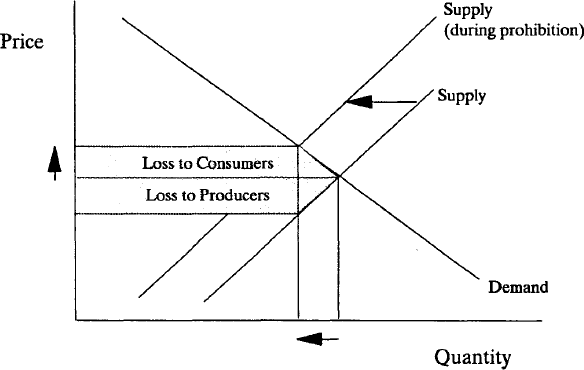
Figure 1. Prohibition’s Impact on the Consumer and Producer.
Prohibition is a supply-reduction policy. Its effect is felt by making it more difficult for producers to supply a particular product to market. Prohibition has little impact on demand because it does not change tastes or incomes of the consumers directly. As supply is decreased, however, the price of the product will rise, the quantity demanded will fall, and demand will shift to close substitutes. For example, consumers of narcotics might shift their demand to alcohol and tranquilizers as their prices become lower in relation to narcotics as a result of prohibition.
The direct consequence of prohibition is to harm the consumers and producers of the product. The consumers lose utility because of the higher price and the substitution of goods of lower value. Producers lose income and utility by accepting occupations which differ from those dictated by their comparative advantage. These results are shown on figure 1.
As resources are allocated to enforcement, and prohibition becomes effective, the supply of the product is reduced (shifts to the left). Consumers are now worse off as a result of higher prices, loss of consumer surplus, and the substitution of lower-valued substitutes. Producers are likewise worse off as they suffer from increased production costs and risks, or from the transition to less desirable occupations.
The ultimate goal of prohibition is to eliminate supply of the good. It is difficult to imagine this result without fundamental changes in the “American way of life” that prohibition is designed to preserve. As a practical matter, an optimal, or cost-effective level of enforcement, rather than complete enforcement, is sought.
Efficiency in economics is the search to equate the marginal cost of an activity with its marginal benefit. For the individual, this means that the number of apples consumed depends on each apple’s being valued at more than its cost. In public policy the situation is more problematic.
In simple terms, the marginal cost of prohibiting one unit of a product is the cost of the law enforcement necessary to bring about this result. Every dollar spent on prohibition enforcement means one less dollar that can be spent on alternative public policies such as national defense, shelters for the homeless, or Congressional postal privileges. If taxes are increased to fund prohibition enforcement, individuals will have less to spend on food, medical insurance, and lottery tickets. Initially, the declaration of prohibition, the use of excess law-enforcement capacity, and the existence of marginal users make expenditures on prohibition enforcement highly productive. Also, these resources can be diverted away from the least important policies or consumer expenditures and therefore can be obtained at a low cost. After these initial conditions, the price of additional enforcement increases, its productivity declines, and the cost of expended resources increases. The marginal cost of increased prohibition is therefore increasing, as illustrated in figure 2.
Disregarding the losses to consumers, the benefits of prohibition can also be generalized. The value of the first unit of a good is of the highest value. Additional units provide an individual with decreasing levels of satisfaction (utility). This law of decreasing marginal utility is a basic economic proposition on which this description of the benefits of prohibition is based.2
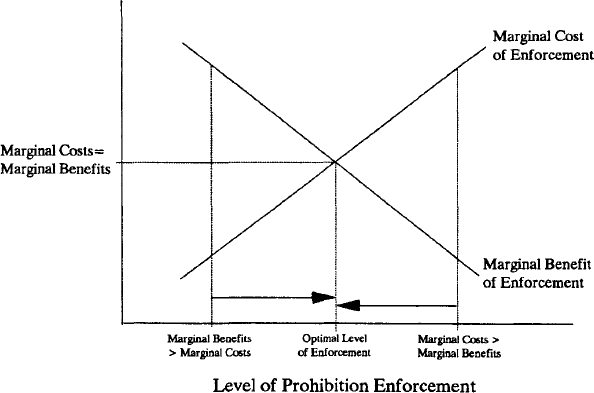
Figure 2. The Traditional Approach for Determining the Optimal Level Prohibition Enforcement.
The policymaker must find the optimal level of enforcement by determining the benefits provided by enforcement (in deterring production and consumption of the prohibited product) and the costs of this effort (which at present are limited to the direct costs of enforcement). By using the “traditional approach” described above to make these determinations, one can clarify the relationship between the cost of law enforcement and the price and quantity of the prohibited product. The results explain why prohibitions are never fully enforced in democratic nations—the costs of total enforcement far outweigh the benefits.
The traditional approach to policy based on the preceding analysis focuses attention on setting optimal levels of enforcement and determining the proper type and administration of enforcement. The approach also balances expenditures between enforcement and demand-reduction policies, such as drug education.
Much more has become known about prohibition through decades of painful and costly experience. For example, one notable observation is that drug addicts will sometimes resort to criminal activity to pay the high prices of prohibited products. The traditional approach is a static analysis that retains assumptions of neoclassical analysis, such as a homogeneous product of a given quality. This oversimplification places important limitations on the analysis. A more detailed theoretical knowledge of prohibition is provided by the Austrian, or market-process, approach to economics.
Market-Process Approach
The Austrian, or market-process, approach to economic analysis is best exemplified in the works of Mises ([1929] 1977, [1936] 1951, 1922, [1949] 1977), F. A. Hayek (1937, 1945), and Israel M. Kirzner (1973, 1985). It begins with the truism that human action is purposeful and aimed at enhancing individual utility amid uncertainty and imperfect knowledge. Economic development occurs through exchange, learning, entrepreneurship, innovation, and the evolution of institutions. The market economy generates solutions to social problems; for example, the introduction (or evolution) of money reduces the transaction costs of exchange. The generation of such solutions is a discovery process because it requires alertness to opportunities and interaction between numerous individuals over time.
The market-process approach employs a multidimensional view of competition, whereas orthodox economists often rely on simplifying assumptions, such as homogeneous products. The market-process approach reminds us that goods are subjectively evaluated by individuals, who base their evaluations on many features of products. For example, a car is evaluated on the basis of age, design, style, color, size, power, materials used, fuel efficiency, and reliability, and many of these categories have multiple dimensions. The market produces a variety of products—determined largely by subjective choices from among the available technological possibilities.
This elaboration of the capitalist process indicates that entrepreneurs do more than drive prices to equilibrium levels. The entrepreneurial search for profits results in a competition based not only on price but also on alterations of the product and the development of new products. The market-process approach views disturbances of equilibrium as entrepreneurial moves to create new products and markets, to enhance products or information about the product, or to reduce cost. For example, one key element of the market process and economic development is advertising.3 Advertising increases knowledge of a product, allowing the consumer to make better decisions while reducing search costs.4 Advertising also assists in the development and introduction of new products and products with new characteristics.
Elements of the market-process approach have been integrated into modern economic orthodoxy. An important aspect of this integration is the “modern microeconomic synthesis,” in which market-process elements have been synthesized with the neoclassical paradigm. A notable contribution in this area was by Lancaster (1966). His “new approach to consumer behavior” improved the understanding of product differentiation, complements and substitutes, advertising, and many other aspects of economic analysis that had become the “black holes” of the neoclassical paradigm.5
This new approach begins with the notion that economic goods consist of attributes and that these attributes (not the goods themselves) are what provide utility to users. Attributes of goods can be altered so as to enhance the utility derived from goods. The supply and demand for attributes follow the normal economic laws, and over time provide utility enhancement for the consumer (given free entry).
Interventionism and the Market Process
Interventionism is an alternative form of economic organization to capitalism or socialism, a form that involves governmental control or direction of resources that were private property. This popular form of organization includes price controls and regulations that are known to impose heavy direct costs on the economy, such as shortages and surpluses, inefficiency, and waste. Prohibition is an extreme form of government intervention that has important implications on the entrepreneurial discovery process.
In addition to the direct effects of interventionism, economists have discovered important “unintended consequences” of interventions, such as the racial discrimination that results from minimum-wage laws. The costs of these unintended consequences have often been found to be greater than either the direct costs of interventionism or the perceived benefits derived from the intervention. Policymakers and orthodox economists do not anticipate (theoretically) these unintended and undesirable consequences because they are unaware of the causal relationship between interventionism and these effects, or simply deny the existence of such relationships.6
These consequences are predictable when the market-process approach is used to model interventionism. While all unintended consequences cannot be predicted in detail, they can be categorized in a way suggested by Kirzner (1985). Kirzner’s four categories of results can be profitably applied to the policy of prohibition. As an extreme form of interventionism, prohibition can be expected to have more pronounced effects than other forms of intervention, such as regulation or price controls.
The Undiscovered Discovery Process
The undiscovered discovery process refers to the market’s ignorance or impatience with the progress toward solutions. It is difficult to imagine political solutions, however, without market discovery. Car safety features and nonsmoking sections in restaurants, for example, could not be mandated unless the market had first discovered them.
The demand for interventionist policies such as prohibition arises from the perception that the market process has caused an inefficient outcome or that the market will not correct inefficiencies. It may also be the result of the perception that the market should correct inefficiencies in a “perfect,” instantaneous, and complete fashion.
The market’s tendency for correction takes place under conditions of imperfect knowledge. Corrections take time, may not be immediately recognized, and are never complete in a world where equilibrium is never actually achieved. In other words, the market corrects for inefficiencies in an efficient manner, that is, resources are directed away from the least-valued uses toward the most highly valued applications. As Hayek (1945) has demonstrated, information in the market is dispersed and the policymaker can hope to gather only a small fraction of the vast amount of relevant information that exists. In contrast, the market uses all this information.
As shown earlier, prohibitions were often preceded by long periods of government intervention, rather than a pure market process. Prohibition was imposed because the harms of the prior intervention and the benefits of voluntary, market-based measures were not understood.
The market’s discovery process results in less expensive, higher quality, and safer products. Prohibition terminates the discovery process and replaces it with a black market and a bureaucratic process, each with its own evils.
The Unsimulated Discovery Process
Prohibition establishes bureaucracy not to intervene in the market but to replace it. Government direction of economic activity is inherently different from the market process. Whereas market activity (production) takes place in a competitive, profit-directed environment, government direction (prohibition enforcement) is carried out in a bureaucratic, rule-guided environment. Entrepreneurs are motivated and directed by profits; bureaucrats are directed by rules and are precluded from receiving profits.
The general inefficiency of bureaucracy is well known and unavoidable. Because they lack incentives to do so, bureaucrats do not minimize the costs of production. William Niskanen (1971) found that bureaucracies could behave like monopolies because of their informational advantage over politicians. Bureaucracies themselves provide most of the information on which elected representatives base their votes on budgetary requests. Stigler (1977) found that bureaucracies were captured by the interests of regulated industries. C. M. Lindsey (1976) found that bureaucracies moved production out of desired activities and into observable activities. Bureaucrats find it to their (budgetary) advantage to allocate resources to produce “noticeable” results rather than uncountable, but more valuable, services. Even in the unlikely event that none of these incentive problems were present, bureaucracies would still face the information problems described by Mises ([1944] 1969).
Businesses are spurred on to implement new production methods, cost-cutting techniques, product enhancements, and new services in order to avoid losses and achieve profits. The discovery process is made easier because the market consists of many entrepreneurs who develop innovations that are generally recognizable and readily copied.
The bureaucrat has no such luxury. Bureaus are centrally directed and guided by rules; they have little access to innovations from outside sources. There is no systematic process that would result in less efficient bureaucrats being replaced or efficient bureaucrats being promoted, even if bureaucrats are assumed to be well intentioned. In fact, the Peter Principle suggests the opposite—bureaucrats rise to the highest level of their incompetence. Further, there is little scope for encouraging discovery by bureaucrats or for rewarding bureaucrats for discovery.
Thus bureaucracies cannot simulate the discovery, or successes, of the market. They have no way of knowing what the market would do in given circumstances and little incentive to find out. The lack of incentives results in less discovery of cost-cutting techniques and production techniques. In fact, successful bureaucracies often find their budgets cut, and innovative bureaucrats are often chastised, demoted, or dismissed. For example, two of the most successful Prohibition agents, Izzy Einstein and Moe Smith, were dismissed for doing their jobs in an honest and effective manner. “The two of them had raided three thousand speakeasies and arrested 4,900 people. They had confiscated five million bottles of bootleg liquor and smashed hundreds of stills. In every household from coast to coast Izzy and Moe were living proof that prohibition agents could be honest and incorruptible. But to be famous for honesty might seem an empty accomplishment when it was rewarded by dismissal” (Coffey, 1975).
The Stifled Discovery Process
Not only are bureaucracies incapable of discovery, they also stifle the discovery process of the market. Prohibition completely ends the discovery process of the market with respect to the outlawed good.
Some direct effects of government intervention are well known. Rent controls lead to housing shortages; minimum-wage laws cause unemployment. These results can be viewed on supply-and-demand diagrams, but these basic effects are not the only costs of government intervention.
In addition, intervention also discourages the development of new techniques, products, product characteristics, safety features, and sources of supply. These are the very types of discoveries that, given time, would make the call for intervention unnecessary, but which cannot take place because of the intervention.
Although we cannot know the magnitude of these stifled opportunities, they are costs of the intervention. In the case of prohibition, this cost is significant because the discovery process of the market is not merely stifled but destroyed altogether for the good in question and is severely curtailed or distorted for related goods.
The Wholly Superfluous Discovery Process
The elimination or control of a particular economic activity produces profit opportunities that previously did not exist. These profit opportunities will likely disrupt the plans of bureaus and undercut the pursuits of regulators and government policymakers. The severity of the intervention will determine the extent of these new (black-market) profit opportunities. Therefore, the wholly superfluous discovery process is particularly relevant to prohibition.
The profit opportunities created by prohibition will result in new methods of production, transportation, inventory, distribution, and marketing. The product, its quality, and attributes will experience tremendous change moving from a competitive market environment to one dominated by prohibition. These changes should of course be attributed to intervention, not to the market. Cave and Reuter (1988) found that entrepreneurs (smugglers) learn from experience; such increased knowledge can result in lower prices even during periods of increased enforcement efforts.
Bureaucrats are also subject to this wholly superfluous discovery process. Bureaucrats are normally unable legally to reap profit opportunities as residual claimants of their bureaucracies. Profit opportunities created by prohibitions, however, can be extended to bureaucrats by black marketeers in return for protection or selective enforcement. Bribery and corruption are unintended but nonetheless expected results of government intervention. Again, because prohibition is an extreme form of government intervention, corruption due to prohibition will occur to a greater extent than corruption associated with a price control or regulation.
In order to compare the severity of prohibition with other interventions, imagine a milk-price support established at $150 per gallon. Even at current levels, the milk price support program entices new suppliers of milk into the market. It encourages the development of special dairy cows, the use of special hormones and chemicals, and expensive feeding techniques. Even small amounts of smuggling and corruption can be detected. At a support level of $150 per gallon, one can imagine that missiles containing dried milk might be shot into the United States, that artificial forms of milk would be produced in basement chemistry laboratories, and that economists would become dairy farmers.
In summary, prohibition is advocated on the basis of misconceptions of the market’s ability to solve social problems (although rent seeking is typically required for prohibitions to be enacted, as shown in chapter 2). Bureaucracies established by prohibition are inherently inefficient and unable to discover the knowledge required to solve social problems. Prohibition also suppresses the market’s ability to solve social problems, so that little or no progress is made while prohibitions are in effect. And finally, prohibitions create profit opportunities which add to the problems prohibition is intended to solve.7
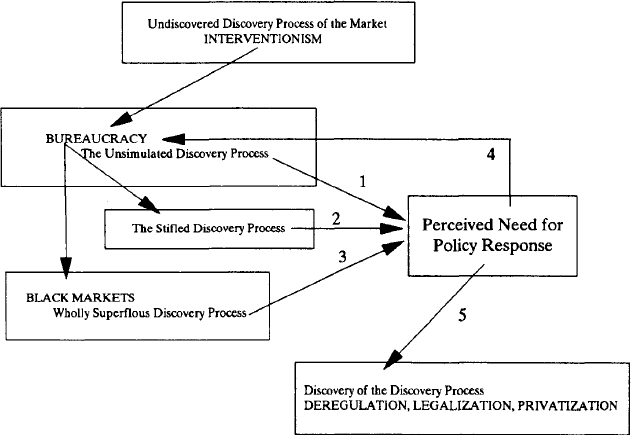
Figure 3. The Process of Progressive Interventionism (and exit).
THE POLITICAL ECONOMY AND PROHIBITION
The general tendency for one act of government intervention to lead to further acts of intervention has been modeled by James M. Buchanan and Gordon Tullock (1965). More recently, Bruce L. Benson (1984) has pointed out that each change in property rights establishes a new set of rent-seeking (and defending) possibilities. The process of this “progressive” interventionism is described in figure 3. Here, the expansion of intervention occurs for three reasons. Bureaucracy is inherently inefficient at achieving the sought-after results of policy, and initial failure leads to the call for more resources and powers for the bureaucracy to carry out its mission (1). The market has been stifled and therefore is unable to address social problems (2). And the activities of the bureaucracy create distortions and new problems in the market which “necessitate” (in the minds of bureaucrats and policymakers) further intervention (3).
The connection between the perceived need for policy response and more interventionism (4) is based on the institutional-based incentives of bureaucrats, politicians, and voters. Bureaucrats seek to expand their influence and power in order better to accomplish their original duties. This tendency for bureaucracies to grow is not dependent on the bureaucrats’ being either selfish or public spirited. In any case, the bureaucrats do not perceive “failure” as the result of their own inefficiency. They are also unlikely to blame their own bureaucracy for problems generated from the wholly superfluous discovery process. Politicians who are ultimately responsible for bureaus receive benefits from them, and they are unlikely to admit failure or engage in the costly and uncertain procedure of dismantling a bureaucracy. Voters will perceive easily recognizable gains from the application of bureaucratic solutions, but they will not see the total cost. Bureaucracies tend to set the price of their outputs below cost (usually zero), resulting in a gain to the voter and a loss to the taxpayer. One result of this pricing policy is long lines for government services and the perception that more government is required. In the case of prohibitions, there never are enough enforcement agents to stop the problem.
The process of progressive intervention can only be reversed (5) by the electorate’s discovery of both the true cause of the problem (intervention) and an alternative solution (the market). Because of the extensive transition and realignment costs, it is unlikely that elected representatives will act to dismantle a prohibition without extensive public support. In the event of the repeal of an intervention, bureaucracies must be quickly and thoroughly disbanded; else they will likely “discover” some new rationale for their existence.
Progressive interventionism is a recurring theme in the literature of political economy. It is a theme in which the policy of prohibition is often cited as a critical illustration. F. A. Hayek, Ludwig von Mises, and James M. Buchanan have pointed out the pernicious effects of using political institutions to intervene in economic activity and personal liberty.
Hayek’s classic Road to Serfdom ([1944] 1977) was a warning that government planning of the economy was a threat to basic freedoms and that the acceptance of planning would result in socialism and totalitarianism. He noted: “Because of the growing impatience with the slow advance of liberal policy, the just irritation with those who used liberal phraseology in defense of antisocial privileges, and the boundless ambition seemingly justified by the material improvements already achieved, it came to pass that toward the turn of the century the belief in the basic tenets of liberalism was more and more relinquished” (19). Prohibition was just one part of the acceptance of planning by the people, “because they have been convinced that it will produce great prosperity” (61). According to Hayek, the acceptance of planning and interventionism is a break with the rule of law, a primary condition for a well-functioning economy. Hayek (72–87 and elsewhere) has written that this same rule of law is the basis for maintaining other freedoms. He quotes Max Eastman, a one-time Socialist, concerning the connection between economic planning and “democratic freedoms”: “He (Marx) is the one who informed us, looking backwards, that the evolution of private capitalism with its free market had been a precondition for the evolution of all our democratic freedoms. It never occurred to him, looking forward, that if this was so, these other freedoms might disappear with the abolition of the free market” (104–5).
In discussing the economic results of planning, interventionism, and “the close interdependence of all economic phenomena,” Hayek raises an issue for which planners cannot supply an easy answer: how can planning be controlled or limited? He notes that the results of economic planning “make it difficult to stop planning just where we wish and that, once the free working of the market is impeded beyond a certain degree, the planner will be forced to extend his controls until they become all-comprehensive” (Hayek [1944] 1977, 105).
Another economist who stressed this important aspect of intervention was Ludwig von Mises. In dealing with the issue of interventionism, Mises stressed the important political consequences of direct interference with consumption as it relates to the prohibition of drugs:
Opium and morphine are certainly dangerous, habit-forming drugs. But once the principle is admitted that it is the duty of government to protect the individual against his own foolishness, no serious objections can be advanced against further encroachments. A good case could be made out in favor of the prohibition of alcohol and nicotine. And why limit the government’s benevolent providence to the protection of the individual’s body only? Is not the harm a man can inflict on his mind and soul even more disastrous than any bodily evils? Why not prevent him from reading bad books and seeing bad plays, from looking at bad paintings and statues and from hearing bad music? The mischief done by bad ideologies, surely, is much more pernicious, both for the individual and for the whole society, than that done by narcotic drugs.
These fears are not merely imaginary specters terrifying secluded doctrinaires. It is a fact that no paternal government, whether ancient or modern, ever shrank from regimenting its subjects’ minds, beliefs, and opinions. If one abolishes man’s freedom to determine his own consumption, one takes all freedoms away. The naive advocates of government interference with consumption delude themselves when they neglect what they disdainfully call the philosophical aspect of the problem. They unwittingly support the case of censorship, inquisition, religious intolerance, and the persecution of dissenters. (Mises [1949] 1977, 733–34)
Therefore, the consequences of prohibition include its direct effects, the unintended consequences, and the tendency for intervention to influence the philosophy, size, and scope of government.
This aspect of political economy has received attention recently by the Nobel laureate James M. Buchanan. He showed that individuals can restrict the behavior of others at low cost by using the democratic process. This method of resolving conflicts is, however, deceptive and dangerous. “The majoritarian institutions of modern democratic politics are exceedingly dangerous weapons to call upon in any attempts to reduce conflicts in areas of social interdependence. They are dangerous precisely because the institutions are democratic and open to all citizens on equal terms . . . [and] preferences are as likely to be imposed upon as imposed” (Buchanan 1986, 339). Buchanan goes on to discuss the economics of partitioning issues that involve the prohibition of various activities. He notes that whereas the majority may benefit from a prohibition, the minority may suffer greatly. The democratic system as a method of conflict resolution allows issues to be partitioned and freedom of consumption to be taken away. Nothing exists in the purely democratic system to stop this process once the Pandora’s box has been opened. Buchanan states: “Let those who would use the political process to impose their preferences on the behavior of others be wary of the threat to their own liberties, as described in the possible components of their own behavior that may also be subjected to control and regulation. The apparent costlessness of restricting the liberties of others through politics is deceptive. The liberties of some cannot readily be restricted without limiting the liberties of all” (340).
Before turning to specific results of prohibition, it is worth noting that its implications are much wider than basic economic analysis reveals. It is not mere speculation or chance that the macropolitical implications described above go hand in hand with prohibition and that these consequences are greater than those generated within a prohibited market.
________________
8For example, point 3 offers the concern that consumption of certain products causes harm to the health of the consumer. According to a survey by the National Institute on Drug Abuse, however, the majority have considered only the consumption of heroin and the daily consumption of LSD, cocaine, amphetamines, barbiturates, or five alcoholic drinks to be harmful. In no case did more than 90 percent of those surveyed find the consumption of these drug products of great risk for harm to the user.
9When the losses to consumers and producers are disregarded this is a reasonably accurate description. Prohibitionists, such as Irving Fisher, often claim, however, that the marginal benefits of enforcing prohibition actually increase. This inconsistency of stated (rather than demonstrated) preferences is also revealed in an ABC News public-opinion poll, which indicates that most Americans favor spending “as much money as necessary to stop the flow of drugs into this country” and that most realize that “drug abuse will never be stopped because a large number of Americans will continue to want drugs” (ABC News, New York, May 8–13, 1985).
10Advertising is also a good example of the distinction between the Austrian-subjectivist approach to the market process and the neoclassical approach to markets. Austrian economists view advertising as an important, beneficial, indeed, crucial element in the market process. From a neoclassical viewpoint, however, advertising is inherently redundant, wasteful, and a tool to manipulate the consumer. The modern orthodoxy seems to have sided with the Austrian approach. On some of these issues see Hayek 1961 and Robert B. Ekelund and David S. Saurman 1988.
11Even “deceptive” advertising can convey knowledge of products and enhance consumer awareness. See Ekelund and Saurman 1988.
12Lancaster’s analysis does not completely close the gap between process-oriented and orthodox neoclassical economists. His framework is static in nature, and value is objectively determined.
13Policymakers may be unconcerned with unintended consequences, unaware of their possibility, or unaware of the connection between interventionist policies and the resulting unintended consequences. Economists may know of the existence of these results, but they often fail to incorporate these consequences into policy analysis and recommendations.
14I will apply this theory primarily to the prohibitions against drugs and the prohibition of alcohol during the 1920s. These results are, however, equally applicable to the prohibition of other goods, such as books, pornography, prostitution, gambling, etc.
- 1See Friedman 1989.
- 2Ekelund and Tollison’s conclusions are based in part on Thornton 1986, an earlier version of chapter 4 of this book.
- 3Postmillennial pietists believe that there will be a thousand-year kingdom of God on earth and that it is man’s responsibility to establish the necessary conditions as a prerequisite for Jesus’ return.
- 4In a sobering passage, Newcomb (1886, 11–13) used the drinking of alcohol (i.e., “gratifying the morbid appetite”) to distinguish correctly between the sphere of moralists and the role of political economists—to separate “the totally different . . . questions whether an end is good and how an end can best be attained.” Newcomb suggests that the “economist might say in conclusion” that he knows “of no way in which a man can be made to accept that which he desires less in preference to that which he desires more, except positive restraint.”
- 5Boswell 1934, 48; also see Fox 1967, 104–5. Most American economists of this time took a dim view of alcohol use. It is interesting to note that Veblen built his concept of “conspicuous consumption” partly on the basis of goods such as alcohol, tobacco, and narcotics.
- 6Fisher’s main contributions to the study of Prohibition include those published in [1926] 1927, and 1930. A biography of Fisher by his son, Irving Norton Fisher (1956), details Fisher’s activist approach to social problems.
- 7The attention received for this distinction is described in Fisher’s biography (I. N. Fisher 1956, 48–50). Edgeworth’s review of Fisher’s dissertation appeared in the March 1893 issue of Economic Journal.
- 8In recent years economists have led the fight to legalize—actually, to relegalize—drugs. The Nobel Prize-winning economist Milton Friedman has been the outspoken leader of the relegalization forces. His open letter to “Drug Czar” William Bennett, published in the Wall Street Journal, is just his latest salvo against the prohibitionist establishment. Friedman began this battle in the 1960s, writing in Newsweek that the prohibition of drugs was ineffective and that more reasonable and prudent approaches to the problems of drug abuse were available. He (with his wife, Rose Friedman) later attacked drug prohibition in Free to Choose and The Tyranny of the Status Quo, linking the harm it causes with the experience of alcohol prohibition in the 1920s. The Friedmans are careful observers of history who oppose drug prohibition both on ethical and practical grounds.
- 9The growing importance of and interest in prohibition has led some economists to include discussions of laws against alcohol, drugs, gambling, and pornography in their textbooks. Normally restrained and politically neutral, several writers of economic text books have taken a skeptical view of all prohibitions. For example, when examining the current drug prohibition, Edwin G. Dolan and John C. Goodman (1989, 35) present “misgivings raised on grounds of efficiency, equality, and liberty.” Robert B. Ekelund and Robert D. Tollison (1988, 108) find that “(e)conomic analysis casts doubts on the effects of directing increased resources into enforcement without careful analysis of the probable consequences of such programs,” and they suggest “that government expenditures would be better directed to the demand side of the problem.”
- 10Many of the founding members were raised in puritanical households of postmillennialist pietism. During their days as university students many became atheists, substituting a secular approach to perfectionism for the religious approach of their parents. Some, such as Richard T. Ely, adopted a prosocialist orientation, while others, such as John Bates Clark, adopted a “dog-eat-dog” evolutionary perspective on capitalism. What they shared was an evangelical outlook and a strong dislike of such products as alcohol.
- 11Many of the founding members were raised in puritanical households of postmillennialist pietism. During their days as university students many became atheists, substituting a secular approach to perfectionism for the religious approach of their parents. Some, such as Richard T. Ely, adopted a prosocialist orientation, while others, such as John Bates Clark, adopted a “dog-eat-dog” evolutionary perspective on capitalism. What they shared was an evangelical outlook and a strong dislike of such products as alcohol.
- 12On this argument, Patten formed the economic rationale for prohibition and helped set the alcohol agenda of American economists. Like William Graham Sumner and John Bates Clark, he perceived that survival of the fittest would eventually eliminate the drunkard from society. The interventionist bias in his education, however, propelled Patten to conclude that prohibition combined with evolutionary competition would achieve the desired results (total abstinence) much quicker than evolution alone.
- 13Fisher’s staunch support of Prohibition helped to insulate the policy from criticism. He wrote three books on Prohibition in which his academic status and objectivity thinly cloaked his avid support. He promoted the claims that Prohibition would reduce crime, improve the moral fabric of society, and increase productivity and the standard of living. Indeed, he maintained that Prohibition was partly responsible for the economic prosperity of the Roaring Twenties.
- 14The thesis was applauded by Francis Yisdro Edgeworth, who repudiated aspects of his own theory after reading Fisher’s work. Vilfredo Pareto wrote Fisher an eight-page letter in which he spoke scornfully of the “adversaries of mathematical methods,” and praised Fisher’s distinction between utility of “that which cannot be useful, and that which is really useful.” It was this distinction that Fisher used later in the analysis of alcohol consumption.

