
Austrian Business Cycle Theory
Part 1: The Foundation of Economic Growth
Part 1
The Foundation
of Economic Growth
BEFORE WE CAN UNDERSTAND HOW an economy “goes wrong,” we first need to understand how an economy “goes right.”
The most basic component of any economy is the transaction that takes place between two people. In any free-market transaction, we make two basic assumptions: people are acting voluntarily and property rights are clearly defined. In other words, there is no force, coercion, or fraud. Under these conditions, when two people trade, each side expects to benefit, both psychologically and materially. Under the premise of the double coincidence of wants, each side must place a higher value on what they are trading for than on what they are giving up. For example, if person A has apples and person B has blueberries, then person A must value the blueberries more than the apples and person B must value the apples more than the blueberries. If this condition is not met, then no trade will occur. Thus because each trade represents a double coincidence of wants, we must conclude that each trade brings at least a psychological benefit to both traders.
By understanding the benefits that accrue to individual traders, we can by extension see how an entire economic community benefits from trade. Through the law of comparative advantage, we can also conclude that when people specialize in their lowest-opportunity-cost activity and then trade, both sides also become materially better off (see Ayau [2007] for clear examples and an uncomplicated discussion of how this law works). The power of the law of comparative advantage is found in the reduction of costs. When the cost of production is reduced, it is straightforward to understand how the cost reducer benefits directly. For example, if a person finds a more efficient way to organize his tools, then that person will get his job done more quickly and will have more free time left afterward. Yet how is this benefit passed on to others?
Let us suppose that there is a manufacturing business selling one thousand units a day at a price of $10 and a cost of $8 per unit. A quick calculation reveals that the company is making $2,000 per day (Profit = Revenue − Costs, so for this business, $10,000 − $8,000 = $2,000). In order to increase its profits, the company can change its prices, reduce its costs, or try a combination of both. If the company chooses to raise the price of its units, it will lose some customers. If it loses too many customers (due to consumers’ high price sensitivity—the demand is elastic), then its total revenue will fall. The company could instead cut the price to attract more customers (due to elastic demand), but the price decrease might outweigh the influx of new customers. In reality, companies are fairly good at balancing these strategies. They know that if they raise their prices, their customers will be attracted to competitors and that if they lower their prices, they will lose revenue. Both choices cut into profits. As a result, when a company tries to increase its profit margin in the real world, it focuses on cutting costs rather than on increasing revenue.
Suppose that our fictitious company finds new ways to make its manufacturing operations more efficient so that it can cut its costs from $8 to $6 per unit. The benefits of this cost reduction can manifest in three ways. The most obvious is that higher profits accrue to the owners ($10,000 − $6,000 = $4,000). They now have more purchasing power to spend on consumer and investment goods. The second benefit comes in the form of higher wages for workers. In equilibrium, factors of production command prices according to the value that they contribute to production. If workers increase their productivity, then over time their wages will increase and they will have more purchasing power. Finally, the company may recognize that with a lower cost per unit, it can lower its output price (from $10) and attempt to take some customers away from its competitors. The lower price benefits the consumers directly. In each instance, the firm is able to free up resources by cutting costs. These additional resources lead to an increase in the supply of consumer goods, investment goods, or both.
This process of economic growth through expanding supply has gone by many names, perhaps the most popular being Say’s law. Say’s law starts by pointing out that money is a medium of exchange, a connector of one person’s production and other people’s production. Then it shows that we must produce before we can consume. I have called this idea the “magic” formula for economic growth (of course, there is nothing magical about it; see figure 1).
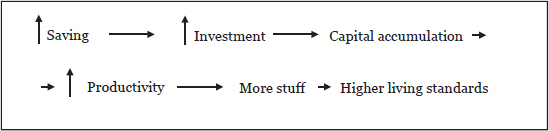
Figure 1: The “magic” formula for economic growth
Let us work through this formula by starting at the end and working in reverse. We can begin by asking, “What is the goal of the economy’s participants?” Generally, we can answer that people would like to become better off (i.e., have a higher standard of living). This conclusion leads to the question, “How can we improve our living standard?” The most generic answer is by gaining more “stuff.” Of course, “stuff ” is not limited to physical items. It can include intangibles like free time. However, in order to gain a higher standard of living, one thing is true: we must create more of something. But how?
Throughout history, some societies have gained this extra “stuff ” through conquest. However, earlier we stated that free-market transactions are free of coercion, so conquest is ruled out as a legitimate way to increase output. Another option is to discover new resources. Untapped resources were discovered and put in use as humanity spread across the globe. However, while some undiscovered resources remain, this option is not really viable, since the occurrence of discoveries is irregular and unreliable. This leaves only one other alternative avail-able—increasing our productivity (i.e., increasing our output using the same amount of time and/or resources or maintaining the same output using less time and/or resources). Without new frontiers and without conquest, new techniques, machines, tools, and equipment are required to increase productivity. In other words, we become more productive through capital accumulation.
Market investments are the source of capital accumulation. Funding is needed to build and establish capital goods and to implement new techniques. Markets are critical to properly allocate investment funds into profitable ventures and to avoid inefficient ones.
The source of investors’ funds is savings, also known as deferred consumption. Savings comprise more than the money we keep in our bank accounts or in cash. They also include the profits that companies reinvest into their business activities (retained earnings). By choosing not to spend, savers set off a chain reaction. It first impacts consumer prices, pushing them down, and then spreads through the whole of the economy. Simply holding cash has the same effect as other forms of savings.
In summary, the “magic” formula for economic growth shows that an increase in savings leads to an increase in investment. The increase in investment allows more and better tools, machines, and equipment to be used in production (capital accumulation). These tools increase the productivity of workers, which places upward pressure on their wages. The higher level of productivity also means that we can have more goods and services, which are now sold at lower real prices, with the same or fewer inputs. This increase in “stuff ” is what allows us to have higher living standards.
The “magic” formula for economic growth focuses our attention on some important conclusions. First, saving is the necessary first step toward economic growth. Even a good idea cannot make an economic impact if there is not the wherewithal, savings, to implement it. Second, contrary to Keynesian theory, we cannot consume our way to prosperity. While consumption is the ultimate goal of all production, we must produce in order to consume; this insight is the essence of Say’s law. If an economy consumes capital, instead of accumulating capital through savings, then incomes and living standards will fall. Third, government spending is not necessary to foster economic growth. Economic growth is strictly a private sector activity. Finally, and very importantly, economic growth that follows the “magic” formula leads to gently falling prices. In other words, economic growth that arises from gains in productivity leads to natural deflation and this natural deflation is good (conversely, even with a constant money supply, a shrinking economy would experience inflationary pressures; see Hayek [1999, 215]). The idea that an economy needs any level of inflation to grow is simply untrue.

