
Chapter X: Consequences and developments of the two preceding chapters
CHAPTER X
Consequences and developments of the two preceding chapters.
LET us always return to the point of departure. An animated being, and especially man, is endowed with sensibility and activity,* with passion and action, that is to say with wants and means. While we were considering the manner in which our riches are formed, we might be charmed with our power and the extent of our means; in fact these are sufficient to render the species prosperous, and give it a great augmentation, both in number and in force.
Chapter XI: Of the employment of our Riches, or of Consumption
CHAPTER XI
Of the employment of our Riches, or of Consumption.
AFTER having seen how our riches are formed, and how they are distributed among us, we are arrived at the point of examining how we use them, and what are the consequences of the different uses we make of them. This is what will complete the illustration of the whole course of society, and show us what things are really useful or hurtful, as well to the public as to individuals.
Chapter XII: Of the Revenues and Expenses of a Government, and of its Debts
CHAPTER XII
Of the Revenues and Expenses of a Government, and of its Debts.
THIS subject is still very vast, although it is but a part of that of which we have just treated. Many writers would divide it into three books, which they subdivide each into several chapters: but I prefer not to separate these matters, that I may not cause my readers to lose sight of their mutual dependance; and I feel the necessity for considering them principally in mass, and under a general and common aspect.
Chapter XIII: Conclusion
CHAPTER XIII
Conclusion.
WE are now arrived at a remarkable point on the road over which I had proposed to travel. I ask permission to stop here for a moment. I will again repeat to the reader, that what he has just read is not properly a treatise on political economy. It is the first part of a treatise on the will, which ought to have two other parts; and which is itself but the sequel of a treatise on the understanding. Every thing here then ought to be co-ordinate with what precedes, and what will follow.
Index
Index
Adams, John, xii
Augustus (Roman Emperor), 135
von Böhm-Bawerk, Eugen, iv
Bonaparte, Napoleon, ii
Cabanis, ii
Cassel, Gustav, iv
Ceres, xxviii, 54
Charles II (King of England), 170
Charles IX (King of France), 136
Charles V (King of France), 136
Chaucer, Geoffrey, xviii
Clovis I (King of the Franks), 155
Backcover
New Directions in Austrian Economics
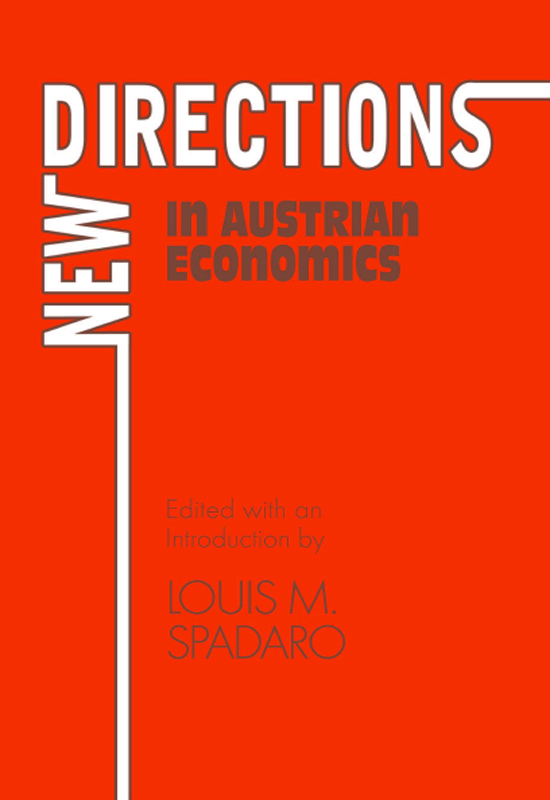
New Directions in Austrian Economics
New Directions in Austrian Economics
Advancing the scholarship of freedom
Other titles in Studies in Economic TheoryLaurence S. Moss, Series Consultant
Other titles in Studies in Economic Theory
Laurence S. Moss, Series Consultant
America’s Great Depression, Murray N. Rothbard (1975)
The Economic Point of View, Israel M. Kirzner (1976)
The Economics of Ludwig von Mises: Toward a Critical Reappraisal, ed. Laurence S. Moss (1976)
The Foundations of Modern Austrian Economics, ed. Edwin G. Dolan (1976)
Capital, Interest, and Rent: Essays in the Theory of Distribution, by Frank A. Fetter; ed. Murray N. Rothbard (1977)
Title Page
New Directions in Austrian Economics
Edited by Louis M. Spadaro
SHEED ANDREWS AND McMEEL, INC.
Subsidiary of Universal Press Syndicate
Kansas City
