
Chapter XIII
KING EDWARD VII died 6 May, 1910. During the early part of 1911, the Belgian Ministers in London, Paris and Berlin report some indications of a less unfriendly policy towards Germany on the part of the British Government. In March of that year, Sir Edward Grey delivered a reassuring speech on British foreign policy, on the occasion of the debate on the naval budget.
Chapter XIV
THIS was the famous “Agadir incident,” of which we have all heard. Did it mean that the worm had turned, that Germany had changed her attitude and was determined to go to war? It has been so represented; but there are many difficult inconsistencies involved in that explanation of the German Government’s act, and there is also an alternative explanation which fits the facts far better. In the first place the Panther was hardly more than an ocean-going tug. She was of 1000 tons burden, mounting two small naval guns, six machine-guns, and she carried a complement of only 125 men.
Chapter XV
LET us glance at British political chronology for a moment. King Edward VII, the chief factor in the Entente, the moving spirit in England’s foreign alliances, had been dead a year. In December, 1905, the Liberal party had come into power. In April, 1908, Mr. H. H. Asquith became Prime Minister. In 1910, Anglo-German relations were apparently improving; in July, 1910, Mr. Asquith spoke of them in the House of Commons as “of the most cordial character.
Chapter XVI
MR. LLOYD GEORGE’S speech at the Mansion House in July, 1911, after the German gunboat Panther had anchored off the Moroccan coast, gave an immense impulse to the jingo spirit in France, because it was taken as definite assurance of England’s good faith in seeing her secret agreements through to a finish. M. Caillaux, the French Premier, appears to have had his doubts, nevertheless, inasmuch as the British Foreign Office did not give a straight reply to the French Foreign Office’s inquiry concerning British action in case the Germans landed a force in Morocco. He says:
Chapter XVII
THE Balkan war took place in 1912, and the whole history of the year shows the most mighty efforts of European politicians—efforts which seem ludicrous and laughable in spite of their tragic quality—to avert with their left hand the war which they were bringing on with their right. Mr. Lloyd George is right in saying that no one really wanted war. What every one wanted, and what every one was trying with might and main to do, was to cook the omelette of economic imperialism without breaking any eggs.
Chapter XVIII
THE French war-party, represented by MM. Poincaré, Millerand and Delcassé, came into political predominance in January, 1912, and consolidated its ascendancy one year later, when M. Raymond Poincaré became President of the French Republic. All through 1912 there was an immense amount of correspondence and consultation between the French and Russian Governments, and all through 1913 Russia showed extraordinary activity in military preparation. In England, Mr.
Chapter XIX
ON 25 April, 1912, the German Reichstag put through its first reading a bill, with only perfunctory debate, for an increase in the German army and navy. This measure has been regularly and officially interpreted as a threat. Yet nearly a year after, on 19 February, 1913, Baron Guillaume, writing from Paris about the prospects of the Three Years Service bill, reports to the Belgian Foreign Office that the French Minister of War “does not regard the measures taken by Germany as a demonstration of hostility, but rather as an act of prudence for the future.
Chapter XX
THE train of powder, however, had been laid by the diplomatic engagements. Austria-Hungary and Serbia came into collision in the spring of 1913 over the Scutari incident. In December, 1912, M. Sazonov had urged Serbia to play a waiting game in order to “deliver a blow at Austria.” But on 4 April, 1913, Baron Beyens reports from Berlin that the arrogance and contempt with which the Serbs receive the Vienna Cabinet’s protests over Scutari
God’s Gold
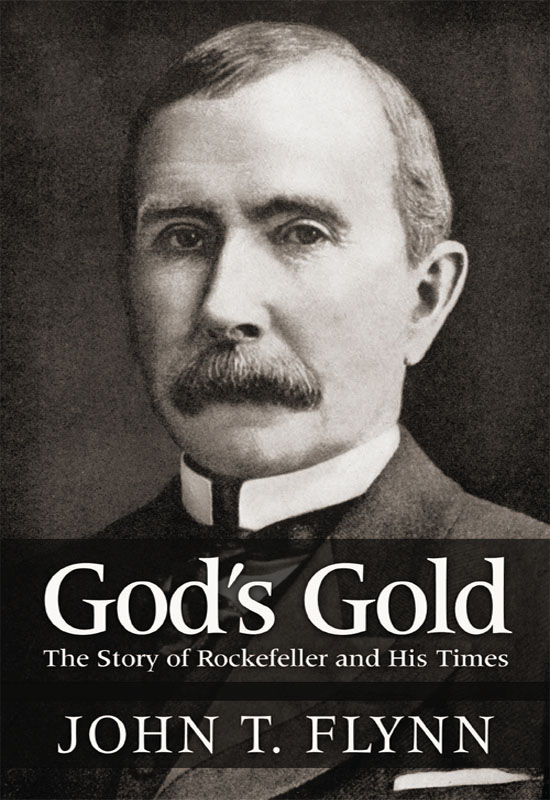
Title Page
God’s Gold
THE STORY OF
ROCKEFELLER AND HIS TIMES
BY JOHN T. FLYNN

HARCOURT, BRACE AND COMPANY
NEW YORK
