
Illustrations
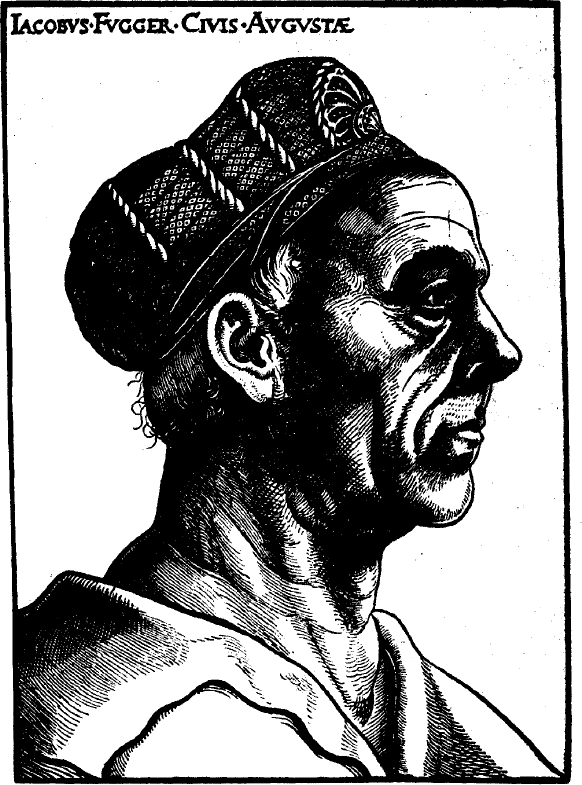
JACOB FUGGER
JOHN LAW
NATHAN ROTHSCHILD
ROBERT OWEN
CORNELIUS VANDERBILT
HETTY GREEN
HACHIROBEI MITSUI AND HIS WIFE
CECIL RHODES
BASIL ZAHAROFF
MARK HANNA
JOHN D. ROCKEFELLER
J. P. MORGAN
Historical Pictures
Historical Pictures
JACOB FUGGER
I. Fugger the Rich: Organizer of Capitalism
ORGANIZER OF CAPITALISM
II. John Law: Money Magician
MONEY MAGICIAN
III. The Rothschilds: Imperialist Bankers

IN THE Rothschilds we come upon an elemental energy that can be described as nothing less than an organized appetite. The founders of this fortune were driven by nothing short of an acquisitive fury.
Interlogue One: I. Cosimo De’ Medici
COSIMO DE’ MEDICI
THE TEMPTATION to include in this volume whole chapters about three men was not easy to resist. They were Cosimo de’ Medici, Sir Thomas Gresham, and Jacques Coeur. The essentials in the stories of these men were quite the same. They were the chief pioneers in organizing the forms of the new capitalist system in Italy, England, and France, respectively.
IV. Robert Owen: The Reformer
THE LONG annals of money getting have produced but one Robert Owen. If you can imagine one of the largest employers in America—Mr. Henry Ford, for instance—becoming the leader of the labor movement, or Mr. Tom Girdler taking the field for factory reform, or Mr. Owen D. Young going up and down the land clamoring for a recovery scheme not unlike Mr.
V. Cornelius Vanderbilt: The Rail King
THE RAIL KING
A SMALL CATBOAT scudding the waters of the bay from Stapleton to Battery Pier; at the tiller a big hulk of a youth, large-faced, broad-chested, blue-eyed, bursting with health and blood and self-assurance. This is the sixteen-year-old ferryman of Staten Island—Cornelius Vanderbilt—who has just plunged into business for himself.
VI. Hetty Green: The Miser
EARLY IN 1833 a young man arrived in the town of New Bedford and went at once to the offices of Isaac Howland, Jr., & Company. His name was Edward Mott Robinson and thereafter he was the “Company” in that important firm of merchant-adventurers. He was a dashing figure, tall, erect, handsome, distinguished in his bearing.
Interlogue Two: I. Misers
MISERS
THERE CAN be little doubt that Hetty Green satisfied most of the elements in the definition of a miser. Whatever other ingredients this definition ought to contain, certainly a French version—literally translated—is not amiss: “The love excessive of the silver for it to accumulate.”
