
VI. A Reviewer’s Notebook
Back
The Myth of a Guilty Nation
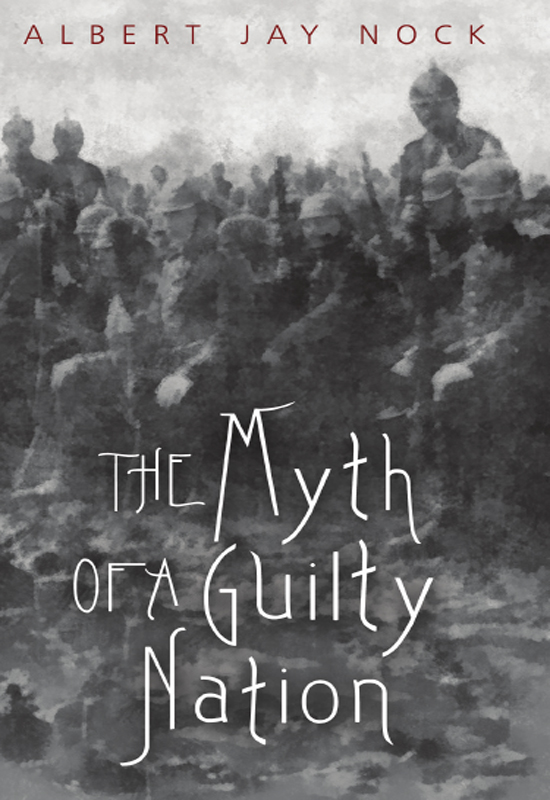
The Myth Of A Guilty Nation
Title Page
BY
ALBERT JAY NOCK
(“HISTORICUS”)

Copyright Page

Originally published in 1922 by B. W. Huebsch, Inc.
Published in 2011 by the Ludwig von Mises Institute.
Published under the Creative Commons Attribution License 3.0.
http://creativecommons.org/licenses/by/3.0/
Ludwig von Mises Institute
518 West Magnolia Avenue
Auburn, Alabama 36832
Introduction
by Anders Mikkelsen
Albert Jay Nock wrote one of the first American books of WWI Revisionism—revising the received story of why WWI began. As a lover of history, what is particularly fascinating about his book The Myth of a Guilty Nation is not whether this is the best explanation for WWI. What is fascinating is the great contrast Nock makes between two wholly different views of the origin of the war. What “everyone knew” about the origins of The Great War at the time are quite different from what “everyone knows” now.
Preface
THIS book is made up of a series of articles originally published in the Freeman. It was compiled to establish one point and only one, namely: that the German Government was not solely guilty of bringing on the war. I have not been at all concerned with measuring the German Government’s share of guilt, with trying to show that it was either great or small, or that it was either less or more than that of any other Government or association of Governments. All this is beside the point.
Chapter I
THE present course of events in Europe is impressing on us once more the truth that military victory, if it is to stand, must also be demonstrably a victory for justice. In the long run, victory must appeal to the sense of justice in the conquered no less than in the conquerors, if it is to be effective. There is no way of getting around this. Mr. Gilbert K.
Chapter II
IN examining the evidence let us first take Mr. Lloyd George’s own statement of the theory. Except in one particular, it presents the case against Germany quite as it has been rehearsed by nearly every institutional voice in the United States. On 4 August, 1917—after America’s entry into the war—the British Premier said:
What are we fighting for? To defeat the most dangerous conspiracy ever plotted against the liberty of nations; carefully, skilfully, insidiously, clandestinely planned in every detail, with ruthless, cynical determination.
