
18. The Closed Shop
THERE ARE economists (as we have seen—pp, 15–16) who feel that there would be little harm in groups of workers agreeing among themselves about what remuneration they are willing to accept, provided only that certain admitted abuses of this process could be eliminated. They believe, that is, that the right to exert strike-threat pressures can be tolerated as long as those who organize for this purpose have no right or power, under any conditions whatsoever, to restrain the employment of others.
19. Conclusion
THE BROAD conclusion of the analysis presented above is self-evident and hardly needs reiteration. The strike-threat system is an intolerable abuse of economic freedom. The strike is a type of warfare under which privileged groups can gain at the expense of the unprivileged. The system provides no acceptable shield against monopsonistic exploitation.
Index of AuthorsCited or Mentioned
Cited or Mentioned
Index
Alchian, A. A., and Allen, W. R., viii, 40, 61, 74
Alchian, A. A., and Kessel, R. A., 159, 162, 183, 194
Alterman, J., 243, 249
Anderson, Benjamin, 260
Ashton, T, S., 34, 41
Bakke, E. Wright; Kerr, Clark; and Anrod, C. W., 162, 193, 205
Becker, Gary, 170, 184, 191-192, 194
Berg, E. J., 82, 90
Black, Mr. Justice, 275, 280
Böhm-Bawerk, E. von, xi, 134-135, 144-145, 150-151
Back
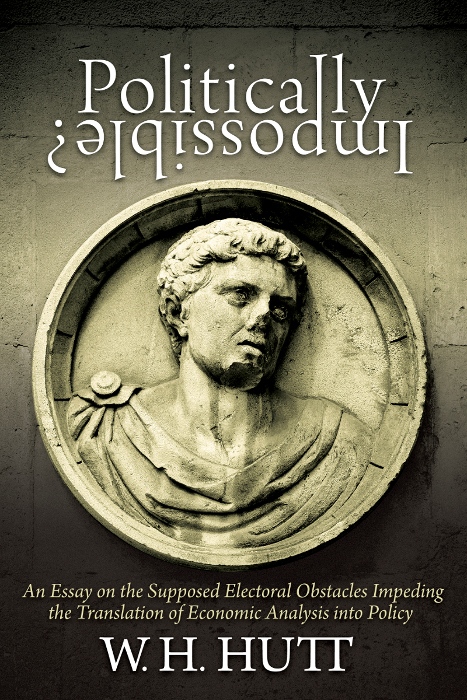
Politically Impossible
Title Page
AN ESSAY ON THE SUPPOSED ELECTORAL OBSTACLES IMPEDING THE TRANSLATION OF ECONOMIC ANALYSIS INTO POLICY
or
WHY POLITICIANS DO NOT TAKE ECONOMIC ADVICE
W H HUTT
Published by
THE INSTITUTE OF ECONOMIC AFFAIRS 1971

Copyright
First published 1971
© The Institute of Economic Affairs 1971
All rights reserved
SBN 255 36017–7
Printed in Great Britain by
WESTERHAM PRESS LIMITED WESTERHAM KENT
Set in Monophoto Baskerville
Preface
FOR OVER a decade the Institute has conceived studies of subjects it considered had been overlooked, or on which there was an imbalance of research and writing, commissioned the best available economists to work on them, and published their work in lengths varying from short papers to full-length books. It has often been asked to show how the policies emerging from these economic analyses could be put into practice, and why some had seemed to influence thinking in business and government while others seem to have been ignored.
Author’s Note
I RECENTLY told a leading American economist that I was writing an essay on the concept of ‘the politically impossible’. He at once suggested a definition of the notion: ‘All the reforms which would be really worth while undertaking.’
