I. Theory: The Dilemma
II. A Solution: The Dual Formula
IN 1934, in a lecture at the London School of Economics, Pigou referred to the severe temptation to which the ambitious economist was subject ‘to make slight adjustments in his economic view, so that it shall conform to the policy of one political party’. But, he added, ‘for the student to yield to that temptation is an intellectual crime.
III. Illustration: Monetary Policy
SUPPOSE AN economist is convinced that the most appropriate international monetary system in a civilized age is one in which the measuring rod of money in every country has a common, defined value; and, further, that the ideal money unit in such a system will have a value consistent with stability in a price index weighted, as far as practicable, so as to give equal proportionate importance to all components of real income (the flow of productive services).
IV. Illustration: Income Transfers
CHANGING EXPERIENCE in the working of representative democracy has been largely conditioned by the failure to entrench (by constitution or powerful convention) what may be called ‘the Tocqueville principle’, namely, that majorities should have no right to enrich themselves at the expense of minorities via the voting mechanism. John Stuart Mill, in his classic advocacy of representative government, insisted that the beneficiaries of relief payments should be denied the franchise.
V. Illustration: Keynesianism
THE HARM wrought through the failure of economists to bring political economy and vote-gaining imperatives realistically into the study of economic problems can be further illustrated by the Keynesian phenomenon. The clash between Keynes and those he called ‘classical’ economists arose ultimately out of issues clouded by vague tacit assumptions on both sides about the ‘politically possible’.
The classical analysis and prescription
VI. Illustration: The Strike-threat System
A STRONG tradition of leniency towards the implications of union activities had existed among the pre-Keynesian economists.
VII. Pessimism and Prospect
A DEPLORABLE pragmatic tradition has thus developed under which economists have tended to inhibit careful exposition of ‘politically impossible’ solutions. And that very inhibition has contributed to the ‘impossibility’. Alternatively economists have come to believe themselves not to be concerned with ‘political’ issues, yet have in practice allowed a subconscious self-censorship to condition their thought and teachings — a censorship based on their tacit judgment of what electorates will welcome, stomach or reject.
VIII. The Key: Communication
THE DEFECTS in the present system of representative government may be traceable to successive extensions of the franchise, motivated by vote-hungry politicians who sought additional voters for their election or re-election with little concern for the consequences in decades to come.
A Note on Readings for the Student of Political Economy
I HAVE mentioned in footnotes the contributions which I believe will be most fruitful for the student who wishes to delve more deeply into the problems raised here. I have not referred, however, to James Mill’s trenchant Essay on Government which, before the big extension of the franchise in Britain, drew attention to the dangers lurking in representative government (which James Mill advocated).
The following brief comments on other works (mostly mentioned in the text) may prove useful.
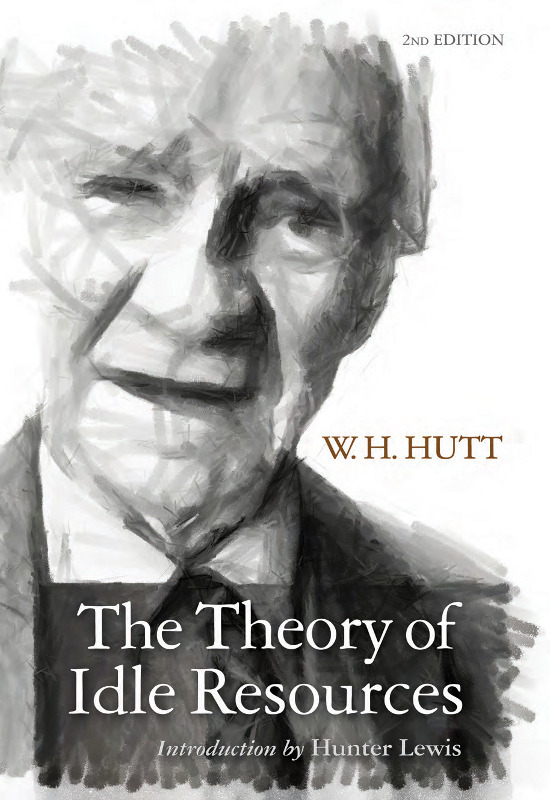
The Theory of Idle Resources