
17. The Bantustans
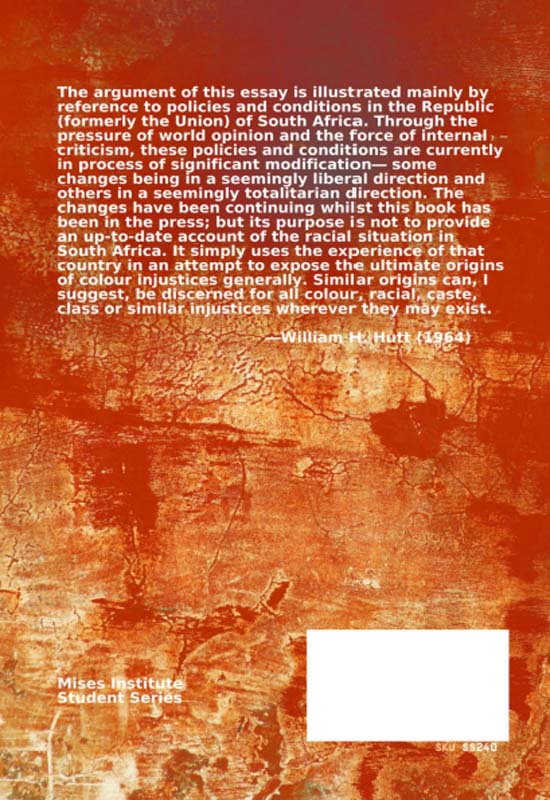
DURING the gradual change of emphasis from ‘baasskap’ to ‘separate development’ in the interpretation of apartheid, the most important gesture has been towards the ultimate establishment of ‘Bantustans’1 – areas within which Africans are to be accorded a measure of political autonomy.
18. The Market is Colour-Blind
THROUGHOUT the description and analysis of South African developments the reader will have perceived the interaction of two sets of opposed forces, the first tending powerfully to liberate the non-white peoples of the world from inertias and coercions which would otherwise perpetuate historical inferiorities of occupation, training and status, the second tending to maintain or strengthen the coercions which hold the non-Whites in economic subjection.
Statistical Appendix
POPULATION (1960 Census)
Bibliography
De Kiewiet, C. W., A History of South Africa, Social and Economic, O.U.P., 1950; The Anatomy of South African Misery, O.U.P., 1956.
Doxey, G. V., The Industrial Colour Bar in South Africa, O.U.P., 1961.
Economic Commission for Africa, Economic and Social Consequences of Racial Discriminatory Practices, United Nations, New York, 1963.
Fagan, H. A., Co-existence in South Africa, Juta, 1963.
Frankel, S. Herbert, The Economic Impact on Under-developed Societies, Blackwell, 1953.
Index
ACT OF UNION 1910, 17, 19
African Mine Workers Union (N. Rhodesia), 108-9
African National Congress, 103
African, The, leisure preference of, 49-50, 51 (f.n.), 54, 90; ‘tsotsi’, 25;
urbanisation of, 87-100; women, influx of from the reserves, 93
Afrikaans, 14-17;
and English, 42-43
Afrikaners, passim
colour attitudes of, 38-44;
poverty among, 32-37
Back
The Theory of Collective Bargaining

The Theory Ofcollective Bargaining
THE THEORY OF
COLLECTIVE BARGAINING
Title Page
THE THEORY OF
COLLECTIVE
BARGAINING
A HISTORY, ANALYSIS AND CRITICISM
OF THE PRINCIPAL THEORIES WHICH
HAVE SOUGHT TO EXPLAIN THE
EFFECTS OF TRADE UNIONS AND
EMPLOYERS’ ASSOCIATIONS UPON THE
DISTRIBUTION OF THE PRODUCT OF
INDUSTRY
By W. H. Hutt
WITH A PREFACE BY LUDWIG VON MISES
THE FREE PRESS, GLENCOE, ILLINOIS
Copyright Page

COPYRIGHT 1954 BY THE FREE PRESS, A CORPORATION
PRINTED IN THE UNITED STATES OF AMERICA
DESIGNED BY SIDNEY SOLOMON
