

The Congressional Budget Office (CBO) and the Social Security Administration now estimate that Social Security’s retirement trust fund is projected to run out of reserves in 2032 under current law. Or, put another way, according to the trustees’ report: “the Old-Age and Survivors Insurance (OASI) Trust Fund will be able to pay 100 percent of total scheduled benefits until the fourth quarter of 2032.” After that, Social Security recipients will be looking at cuts, unless, of course, the law is changed to allot more tax money to the program.
Now, it is important to keep in mind that there is no Social Security “trust fund” in any true sense. There is no special savings account somewhere in which is stored the funds “paid in” by workers who are now retired. Rather, the so-called trust fund is a legal fiction and is little more than a line item in the budget which reflects the amount of tax revenue that is allotted to Social Security payments. The amount of money allotted to the program is determined by current legislation. It is not determined by how much revenue existed in the past, or by how much current Social-Security recipients “paid in” back when they were paying payroll taxes on income.
Indeed, the federal courts have been very clear that there is not any sort of legally binding contract between the federal government and current recipients of Social Security payments. The amount paid out by the program can be modified at will by changes in legislation. Moreover, revenues available for the program are completely determined by current taxpayers. The funds available to the program have no connection at all to tax revenue in the past. All that matters is current revenue, and what current policymakers determine ought to be paid into the system.
To get a better sense of how this system works, let’s consider the social security system as a transaction between two people. Say, for example, that a wage earner is walking down a road one day. He is then suddenly confronted by a highway robber who threatens the wage earner with a gun and makes the following demand:
“Give me some of your money. I know you’d rather keep your money, but I’ll make you a deal: in thirty years I’ll give you back even more money that I’m taking from you right now.” The wage earner hands over the money and waits thirty years to get it back.
Thirty years later, the wage earner—now about to retire—walks down the same road and sees the same robber. The wage earner asks for his money as promised. The robber tells the wage earner that he doesn’t have the money anymore. “But there is one way I can still get your money” the bandit says. “Your children walk down this same road, so I can steal money from them, and then hand it over to you. So, you’ll get the money after all.”
“That’s a great idea,” the wage earner says. “Go rob my children so I can get back the money I paid in.”
This is how social security works.
There is no trust fund. There is no contract. And the government—i.e., the highway robber—spent the money long ago. Thus, the only way the retiree can get more money out of the government is to have the government steal money from current wage earners, and hand it over to retirees. It is nothing more than a wealth transfer from one group to another. Functionally, in terms of public finance, Social Security is simply a welfare program in which funds are taken from current revenues, and handed over to others in accordance with whatever current legislation says.
That is, Social Security is based on having the highway robber steal from the children to give to the retirees.
That’s all it is.
This is clear in the reasons given in the CBO report and Social Security trustees’ report explaining why the program will not be fully funded after 2032. The report notes that under new estimates,
[T]he assumed ultimate total fertility rate was lowered from 1.90 children per woman to 1.75 children per woman. Second, estimated historical and assumed near-term and ultimate net total immigration are lower this year. These two demographic changes lowered the projected number of workers, projected taxable payroll, and projected GDP over the long range.
Note that the viability of Social Security is tied closely to how many younger current wage earners are available to tax. If the population is declining—whether due to changes in immigration rates or birth rates—then there are fewer workers to tax, and that means less money to hand over to retirees.
This tax money is, of course, not the rightful property of current Social-Security recipients. The money is the rightful property of the current workers who are being taxed. Whatever money was “paid in” by current retirees was spent by the federal government long ago.
No amount of retirees haranguing young workers about “my money” will change this. Indeed, the fact that Social-Security revenue comes from current taxes is understood by many retirees well enough. We see this in a 2025 poll from the CATO Institute which showed that 89 percent of respondents over the age of 65 favored raising taxes on young workers to maintain funding for Social Security.
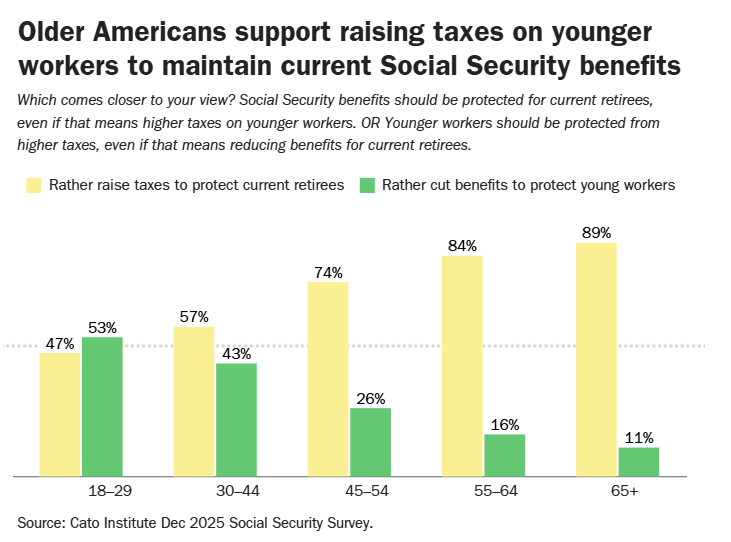
Since Social Security relies on taxing current wage earners—who often are working parents with children—this means these young families must be exploited even more to pay the increasing needs of the Social Security system.
This is why, in the fable above, the retired wage earner demands that the highway robber go steal from the wage earners’ children in order to “pay back” what the thief had promised long ago.
Higher taxes—paid by others—may be the preferred “solution” for current retirees. But higher taxes are not the only solution. There are at least two other ways to bring these costs under control and avert the need for higher taxes.
The first solution is to end Cost-of-Living Adjustments (COLA) that are applied to Social Security payments. For decades, politicians have added these adjustments on to Social-Security calculations to, in part, defray the cost of price inflation. In some years, the adjustments have been substantial. In 2023, for example, the COLA was an increase of 8.7 percent. As a method to bringing program costs under control, the payments should simply be frozen in place. This would have the added political benefit of further showcasing the true costs of inflation—which are caused, after all, by the state itself. An end to COLAs would also help bring to bear more political opposition to the regime’s inflationary policies. Inflation would become far less politically viable if pensioners correctly viewed inflation as a devaluation of their Social-Security payments.
Secondly, the age of eligibility for Social Security should be increased to at least 75. In a 2023 column, I examined how the Social-Security retirement age no longer reflects the fiscal and physical realities of pensions. As retirees live longer and collect Social-Security for longer, the fiscally responsible thing to do—other than ending the program, of course—is to raise the age of eligibility.
These perfectly reasonable—and extremely moderate—solutions to cut the costs of the welfare state are unlikely to be adopted, thanks to the realities of interest group politics. The groups that vote more, are better organized, and have greater political influence—i.e., groups that represent over-65 retirees—will get what they want at the expense of others. Those “others” are current full-time workers who pay most of the bills for Social Security, Medicare, Medicaid, and host of other welfare programs.

