

On Wednesday, The US government sold $39 bilion worth of 10-year notes to investors, with the high yield for the auction at 5.3 percent. There was solid demand at the auction and put to rest some fears that a rapid bond sell-off might spiral as demand for bonds deteriorated. So, Wednesday’s auction showed that bonds are unlikely to be dumped wholesale in the near future.
Yet, the auction hardly showed that investors are clamoring for Treasurys at low yields. After all, the auction established a new higher yield for new debt, at 5.3 percent, and well above where yields were just a year ago. In other words, there were indeed buyers for the bonds at the auction, but investors were demanding a higher return to make bond-buying worth it. It is always possible to get investors to buy bonds when the price is low enough and the yield is high enough. Investors do buy so-called “junk bonds,” after all. All that is necessary is a high-enough yield.
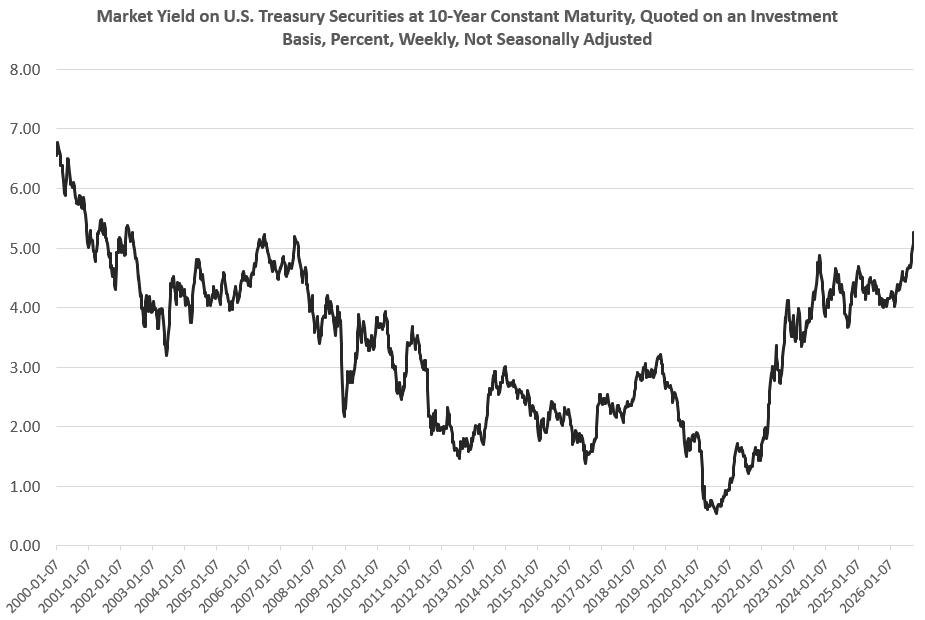
Nor does this upward surge in the 10-year yield appear to be a mere temporary blip in the data. Bond yields tend to move in fairly long cycles. The US government is now $40 trillion in debt, and is adding approximately $2 trillion more per year. That’s going to require a lot of new Treasurys hitting the market as the Federal government must continually take on more debt and refinance the debt it has.
Yes, the central bank can attempt to bring down interest rates somewhat by inflating the currency to buy up debt and create artificial demand. But there are political limits to how much price inflation the regime can get away with.
So, we should expect continued upward pressure on long-term yields (i.e., 10-year, 20-year, and 30-year yields) unless Congress starts slashing federal spending or if expected inflation rates suddenly plummet, even after the Fed has missed its 2-percent target now for 66 months in a row.
Mortgage Rates and Rising Yields
This brings us to mortgage rates, which—like corporate bonds—are closely tied to the 10-year Treasury yield. As Kiplinger’s reminds us, “Why are mortgage rates tied to the 10-year Treasury yield? Since mortgages last longer than shorter-term lending options tied to the federal funds rate, they require a benchmark, where the duration reflects the average mortgage. ...This is why the 10-year Treasury yield comes in, because it lasts about as long as the average homeowner has a mortgage.”
So, not surprisingly, in recent years, the average interest rate on 30-year mortgages has been going up. In fact, the average mortgage rate has increased by more than 4.5 percent since late 2020, when the average mortgage rate was under 3 percent. Back then, the Federal Reserve was flooding the market with newly created money and buying up trillions in mortgage backed securities. This helped artificially suppress interest rates. But as price inflation has soared since 2022, the Fed has been forced to abandon its purchases of MBS. So, over the past year, the average rate has increased from 6.2 percent during October of last year, to 7.4 percent this month.
Moreover, home sales have fallen significantly in that time. For example, in late September, pending home sales were down 9 percent, year over year. As Housing Wire reports, “Inventory is moving more slowly. Active inventory increased to 895,398 homes, up 3.8% year over year, while the national median days on market held at 70 days.”
Indeed, the housing markets appear to be in the midst of what some are calling a “deep freeze” as few homeowners are putting their homes up for sale, and few buyers are prepared to buy.
Prices, Not Mortgage Rates Are the Central Issue
This is being blamed on rising mortgage rates. The reason interest rates are to blame, we are told, is because few people are interested in buying homes when interest rates are so “high.” After all, the monthly payment on a $500,000 home loan is about $3,300 per month at 7 percent. (That’s not counting taxes and insurance.) But the monthly payment is only $2,200 per month at 3.5 percent.
This then creates the so-called “lock-in” effect on mortgage in sales. This occurs because so many current home owners have mortgages from 2020 when mortgages rates could often be had at well under four percent. So, many are reluctant to give up their 3.5 percent mortgages and then be on the hook for a new mortgage at 7 percent. And, of course, there are the first time homebuyers. The increase in mortgage rates has caused many of these to give up on buying a house at all given the much higher monthly payments at 7 percent.
But are today’s “high” mortgage rates really to blame for all this?
Not really.
First, of all, it’s important to note that there is nothing particularly high about a mortgage rate of 7 percent, or even 7.5 percent. Historically, this is a very normal rate, and anyone buying a house during, say, the 1990s, would have regarded a seven-percent mortgage as nothing remarkable at all.
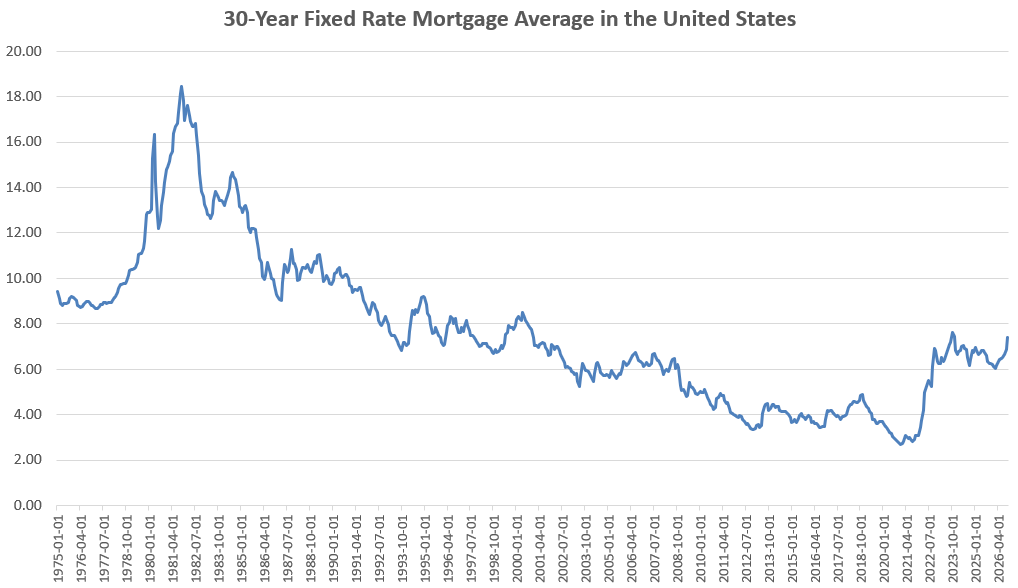
But, after 25 years of relentless efforts on the part of the central bank to reduce interest rates in general, and mortgage rates in particular, mortgage rates fell to historic lows between 2011 and 2022. Between 2008 and 2022, the Federal Reserve bought up $2.7 trillion in mortgage backed securities and trillions more in Treasurys. Not surprisingly, mortgage rates also fell.
If mortgage rates seem “high” right now, it’s only because they were so artificially low thanks to quantitative easing and other interventionist policies designed to suppress interest rates in the wake of the Global Financial Crisis. Nonetheless, the lock-in effect is real. After a period of unnaturally low interest rates, many potential home sellers really do have to think twice about abandoning one’s 3 percent mortgage in exchange for a 7 percent mortgage, all else being equal.
Prices Change to Fit New Realities
The key phrase here, however, is “all else being equal.” There is another big piece of the puzzle that we’ve not discussed, and that is home prices. Interest rates are certainly not the only factor in determining monthly mortgage payments. The price of the home is the other big factor, and it is in prices where we see the real cause of declining home sales and the “lock-in effect.”
As we saw above, interest rates are tied to major fiscal and monetary factors such as government debt, inflation expectations, and other macro factors. Because so many of these factors are cyclical and tied to factors completely outside the real estate industry, it doesn’t make much sense to hope and pray for falling interest rates as the means to making homes more affordable or “unfreezing” the housing market.
Many Americans will nonetheless turn to government and demand that it find ways to lower interest rates to make homes more affordable. This makes sense since American have become accustomed to real estate agents, mortgage brokers, and home builders begging the central bank to drive down mortgage rates as a means of subsidizing home purchases. Americans have become very accustomed to endless government intervention in the supposedly “capitalist” real estate markets.
But we don’t need to rely on central bankers to “fix” the frozen real estate market. We simply have to be realistic about home prices and let the market’s pricing mechanisms work. If houses are “too expense” with 7-percent mortgages, the answer lies in lowering the price. Yes, monthly payments go down when the mortgage rate falls. But monthly payments also go down when the price goes down.
This isn’t exactly a groundbreaking observation, but the solution of falling prices is generally ignored because many sellers and homebuilders are still living a fantasy land where home prices will be resilient, even as mortgage rates rise. This may be true in the short term, but it’s only a matter of time until sellers start coming to terms with what their houses are really worth when the buyers have to take out a home loan at 7 percent.
Simply put, the reason that so few homes are selling right now is not that mortgage rates are too high. It’s that prices are too high. After all, anything will sell once the price falls far enough. And few will buy when the product is overpriced. Most homes right now are overpriced given the realities of interest rates, so few buyers are interested. Those homes will find buyers once to price falls far enough to make it worth it.
This is true for both current homeowners and first-time homeowners going forward. Current owners don’t want to give up their 3-percent mortgages because buying another house requires buying an overpriced house at an interest rate double what the homeowner currently has. Most people—even those who already own a house—can’t afford to do that. Similarly, first-time homebuyers will indeed start buying houses when prices fall far enough to make a 7-percent mortgage affordable.
This is how markets are supposed to work. Prices go up and down an accordance with changes in the cost of lending, demographics, the income levels of potential buyers, and other factors. Many sellers are still holding out, thinking that mortgage rates will fall significantly “any day now,” or that there will be, for some reason, a surge in demand.
What is most likely to actually happen is we’ll start to see prices creep downward slowly and consistently. We’re already seeing it in new home sales since homebuilders can’t just sit on their houses indefinitely, hoping that conditions improve. Builders are offering both price cuts and “buy downs” on mortgages, meaning they are offering adjustable rate mortgages that start out with “low” rates and then go up to market rates after a few years. But however the sellers package it, the fact is that prices are going to have to fall.
At some point, existing-home sales will capitulate as well. Whether due to aging, or unemployment, or the need to move for other reasons, sellers will have to lower their prices to make purchases feasible at higher interest rates. Many who can’t afford a home now will finally be able to buy—if we will let the market work.

