

The Treasury Department released its monthly statement on Friday and has now confirmed what we all suspected: the US federal government, under the Trump Administration, will finish the 2026 fiscal year with an annual fiscal deficit of about $2 trillion.
To be precise, the federal deficit for the 2026 fiscal year, which ended on September 30, is $1.99 trillion. That’s the third largest deficit ever recorded. From fiscal year 2025 to 2026, the deficit grew by 12 percent and that’s the largest growth rate since 2023. Last year, the federal deficit was $1.84 trillion, which was slightly smaller than the 2024 deficit of $1.95 trillion.
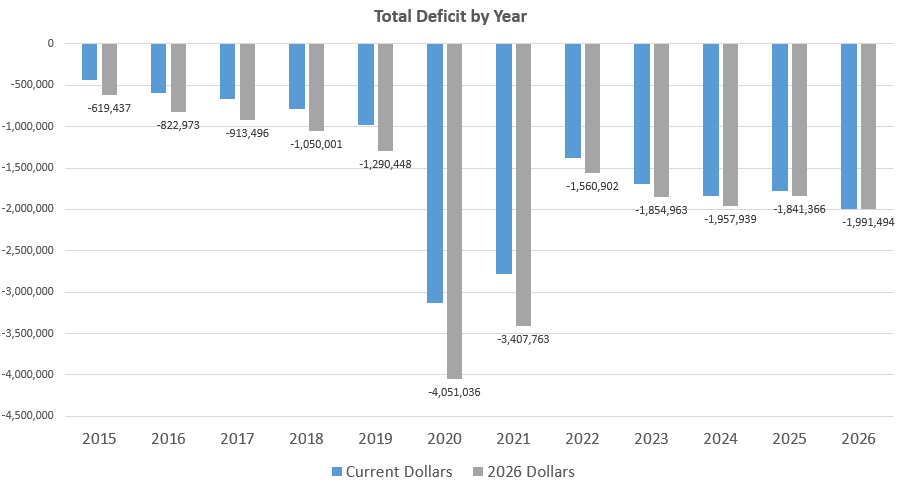
Even when adjusted for CPI inflation, however, 2026’s deficit remains the third largest ever, even including the Second World War, when the deficit in 2026 dollars reached an eye-watering $1 trillion.That was considered an off-the-charts deficit at the time. Today, World-War-Two style spending looks quaint compared to Covid-era spending and the past two years of Trump deficits.
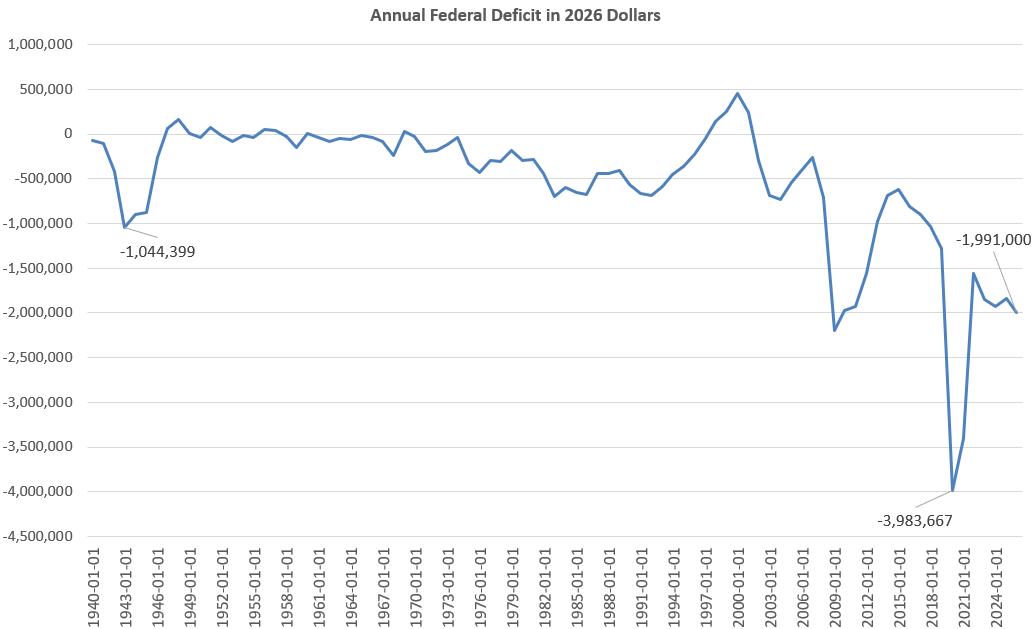
Moreover, 2026 is the 25th annual deficit in a row, with the last federal surplus having been recorded during the 2001 fiscal year (measured in nominal dollars.) The US federal government now appears locked in to perennial mega-deficits exceeded only by the runaway spending of the Covid lockdowns when the federal government embarked on an unprecedented effort to spend out trillions of dollars to essentially pay Americans to stay home and not revolt as businesses closed and jobs evaporated.
Since then, federal deficits never even returned to the pre-Covid “normal.” Trump-administration spending during his first term was unprecedented for peace time spending outside of a major recession. This helped pave the way for the out-of-control spending that came during the Covid years. The $4 trillion deficit of 2020, of course, occurred entirely during the Trump administration, with Joe Biden taking over four months into the 2021 fiscal year.
Tax receipts have been largely stable, and the Trump administration has repeatedly bragged about raising import taxes on Americans. Studies have shown—including this study from the New York Fed—that Americans pay the lopsided majority of the tariff revenue collected by the administration. Therefore, the rising deficits are being largely driven by continued increases in federal spending. As the new treasury report makes clear. most of this spending comes from entitlement programs like Social Security, Medicare, and Medicaid. Yet, a new major factor under this administration has been rising obligations to pay debt service. The Treasury report shows that interest on the national debt—which now exceed $40 trillion—totals about $1.3 trillion for 2026. That’s up from 2025’s total interest outlay of $1.2 trillion. Interest on the debt is quickly moving toward becoming the second or third largest expense category, behind Social Security and health care.
If the Trump administration has anything to say about it, however, the category with the most enormous outlays will be “national defense,” and the administration has repeatedly demanded a 50-percent increase to defense spending, totaling $1.5 trillion.
Even without such enormous increases, the Trump White House continues to double down on its joint war with the State of Israel against Iran. This is likely to drive significant new military expenses in coming years as the US must scramble to replenish its missile stockpiles which have been largely depleted in recent months.
In other words, there is no end in sight for current spending trends, and the Trump administration has entirely abandoned whatever attempts at fiscal restraint had been announced earlier in the administration. A year ago. we heard a lot about the so-called DOGE cuts, but these amounted to virtually nothing, and the US is now adding trillions of dollars more to the national debt every year.
It took the United States more than 200 years to build up a national debt in excess of $1 trillion. Since Trump was sworn in for his second term—less than two years ago—the national debt has grown by more than $4 trillion.
This will continue to drive up the need for trillions of dollars in payments on debt service alone. That is, American taxpayers will see nearly one-fifth of all their tax payments go to nothing more than paying off the costs of old welfare payments and lost military debacles of yesteryear. Americans will soon likely see more than a quarter of their tax bill go just to interest. Rising deficits will also put upward pressure on interest rates as the federal Treasury must issue new trillion-dollar piles of debt to the existing hoard of Treasurys that now finance the national debt.
Yet, the federal government also can’t allow interest rates to increase substantially, because that would lead to unmanageable levels of interest expense, potentially leading to an eventual sovereign debt crisis. So, we can expect the Federal Reserve to intervene to manipulate interest rates downward by buying up Treasurys. This, however, will lead to inflation since the Fed’s intervention will be done with newly created dollars. The result will be a rising cost of living for ordinary people.
Not that inflation weighs on the conscience of Donald Trump. Indeed, in recent weeks, Trump has even suggested outright devaluation of the dollar as a means of inflating away the national debt. In a Time magazine interview published October 1, Trump said, “Certain levels of inflation will also pay off that debt very rapidly. Very rapidly.” Trump then went on the say that the Fed is allowing interest rates to move too high—which is another way of saying that the Fed isn’t using enough monetary inflation to push interest rates downward.
Needless to say, the massive federal debt, and the continual piling on of trillions of dollars every year, is not going to end in any sort of fiscally sound reform. What is most likely to happen is the federal government will do what Trump has suggested—and what bankrupt Latin American regimes have often done: the US government will inflate away the real value of the debt and continually rely on monetary inflation as the method of managing multi-trillion-dollar annual deficits.
As the Republicans have made very clear in recent years, there is no interest in fiscal reform, even among the allegedly “fiscally conservative” politicians.

