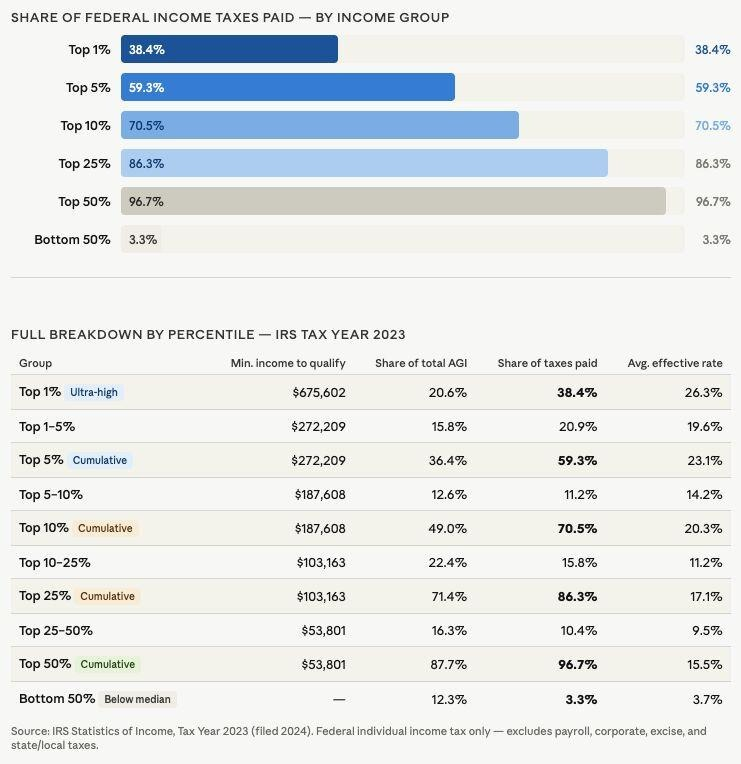
The chart below was posted by economist Julia R. Cartwright. It shows that the top five percent of income earners paid about 60 percent of the total taxes collected by the federal government in 2023 while the bottom 50 percent made 3.3 percent of total tax payments in that year. Excluding income earned in the form of unrealized capital gains, which are not taxed, the average effective tax rate of the highest 5 percent was 23.1 percent compared to the 3.7 percent average effective tax rate levied on the lowest 50 percent. As you can see the tax rates are progressive, increasing as incomes increase.
Now many conservatives consider the progressive rate structure of the income tax grossly unfair and maintain that it distorts consumption, investment, and production and is therefore “nonneutral” to the market. They argue that a “flat tax,” which involves taxing everyone’s income at exactly the same rate, is fair, efficient, and neutral. But this is completely false. On the market, people do not pay prices for goods in proportion to their incomes. Billionaires like Elon Musk and Jeff Bezos are not charged $2,000 for a loaf of bread or $20,000 for a pound of ribeye steak. They pay the same price as everyone else who purchases these items at a supermarket. (Imagine if every individual paid a price for every good in proportion to his or her incomes! There would be no incentive to earn a higher income and the entire economy would break down).
As economist Murray Rothbard pointed out, for a tax to approximate neutrality to the market, it must be a true flat tax, or what is called a “poll tax,” in which every citizen pays the same absolute sum of dollars for government services. Of course, because the lowest income earners would be unable to afford very much, the tax would have to be very low indeed, say $500 or $1,000 per year. Thus, in one fell swoop, the imposition of a real flat-tax regime would cut the federal government down to size. But even this type of tax is inefficient, distortive, and nonneutral to the market because it does not give individuals the freedom to choose whether or not to purchase specific services the government offers. If we uphold voluntary exchange on the market as the standard of fairness, then the only neutral tax is one that is flattened to zero percent for everyone.