
Value, Capital & Rent
I. The New Theory of Value
1—The concept of value according to Jevons, Walras and the Austrian school
An account of the recent theory of value can suitably begin with a revision of Adam Smith’s rule already mentioned—the rule that the value in use and the exchange value are independent of one another. With de Quincey and Mill, we have seen that such a complete independence does not exist; on the contrary the value in use—understood as the benefit or enjoyment which a person thinks he has or expects to gain from an object—must necessarily be greater in the case of the object taken in exchange than in the case of the object given in exchange, and this for each of the exchanging persons. In the last-mentioned statement of fact an important state of affairs is already expressed; for it follows from this with mathematical necessity that the objects which are about to be exchanged for one another must stand, in respect of their value in use for one of the parties to the exchange, in a sequence opposite to that in which they stand for the other. In other words, the value in use of an object is no constant magnitude, but changes with different persons and under different circumstances; and this attribute of value in use is a necessary condition of exchange and consequently of exchange value. Not to have considered this, is a fundamental defect of Smith’s reasoning. The value in use is for him, as can easily be seen, the average utility, or perhaps even the greatest possible utility which an object or a certain quantity of goods of the same kind can possibly have. This utility does not, however, determine the exchange value; the latter is on the contrary regulated by what Jevons calls final utility and Wieser marginal utility: by the smallest utility which an object or the quantity of goods concerned really possesses or presumably will possess.1
This matter becomes especially simple if one thinks of the very unequal degree of utility which any quantity of consumer goods can possess for us and of the unequal value which we are therefore accustomed to ascribe to them, according to whether we are already provided for a certain period of consumption with a greater or smaller supply of the article in question. Let us consider an example which Böhm-Bawerk gives of a colonist living alone in the virgin forest, whose entire wealth consists of a supply of corn which he has just harvested and which must suffice until the next harvest. One sack of corn will be absolutely necessary to him if he is to maintain life during the winter; another sack gives him enough nourishment to preserve his health and bodily strength; a third sack would be superfluous, but is nevertheless valuable because it enables him to keep poultry, and thus procures for him a desired change in an otherwise purely cereal diet; a fourth sack he converts into spirits. If, finally, he possesses in addition to that a fifth sack, he can procure for himself in exchange for it no greater increase of his well-being than, for example, the amusement of feeding parrots.
If we now suppose that our Robinson Crusoe is offered some other commodity in exchange for one of his sacks of corn, then it is clear that the value (according to his estimate) of the quantity of corn which he would dispose of, would be wholly determined by the least urgent of the above-mentioned modes of application, or by the need to which it corresponds. The sack he disposes of will not be one of the first four, but only the fifth; in other words, if he thinks the utility of the commodity offered him high enough to compensate him for the amusement of keeping parrots, he on his part will be prepared to make the exchange. If, however, he is asked afterwards to part with a further sack of corn and consequently to give up the enjoyment of spirits, which the possession of this sack had made possible for him, the object which is offered him now must be considerably more tempting than would be necessary in the previous case; and of course far more tempting still, if he is to be induced to exchange the third sack also, after which he would not be able to procure for himself animal food. Since the last two sacks are of fundamental importance for his life and health, he will not be able to make up his mind to exchange these even under the strongest temptation.2
From this very nicely chosen example one learns at the same time, at least in its general features, the role which scarcity on the one hand and costs of production on the other—the two sources from which, according to the older theory, the natural value alternatively arises—really play in determining exchange value. Scarcity itself cannot, of course, increase the utility which the commodities in question are able to provide; but scarcity does, indirectly, ensure that, amongst the needs which can be satisfied at all by a certain kind of goods, only the most urgent ones will in fact be covered, so that even the least among them, which becomes the determining one for the exchange value, will still have a high significance. If our colonist had harvested instead of five sacks only three, the exchange of a single sack would already have deprived him of the possibility of procuring for himself animal food, etc.
As regards cost of production, one sees immediately that the colonist’s valuation of the different sacks by no means rises or falls with the expenditure of labour or with the effort which production of these has cost him. More probably, the opposite is the case. If he had been content with the production of only one or two sacks of corn, he could, perhaps, have achieved this by a working-time of merely one or two hours daily, and an effort so moderate would probably have given him more enjoyment than trouble. With each lengthening of working-time the laboriousness of labour increases, while the utility of the product, even if for every new amount of labour it is quantitatively the same, becomes smaller and smaller. When finally the toil becomes so great and the value of the probable product so small that, according to the estimate of the colonist, they approximately counterbalance each other, labour must logically cease.
We can, therefore, not speak positively of an intrinsic, value-creating power in labour. Labour, labour-time, or energy of labour is, on the contrary, to be understood as a commodity like every other, the subjective estimation of which, if it is still in the possession of the worker himself, depends on how much of it he has already disposed of or, according to the established order of labour, will dispose of, and how much he has consequently left for himself for sleeping, meals, family life, recreation purposes, etc. Every process of production, whether carried on with capital or without, can, resolved into its elements, always be understood as a kind of exchange, whose only fundamental condition is that, like every exchange, it must bring a gain of utility (Nutzgewinn) to both sides.
This, however, does not prevent the proportionality between exchange value and employed quantity of labour or other costs of production from holding good within certain limits, but it does so only as a secondary law (Böhm-Bawerk), since, in the case of free competition, capital, labour and natural resources are always attracted to the most remunerative branches of production until, through an increased supply (diminished scarcity) of the goods concerned, their exchange value decreases, and at the same time the conditions under which they are produced usually become more difficult, so that finally this branch of production becomes no more remunerative than the others.
All the facts mentioned here are, as will be admitted, of the simplest and most obvious kind, and it can scarcely be supposed that they could have been unknown to the great thinkers who have occupied themselves with economic problems. The novelty lies in the idea of establishing the variability of the value in use or of the subjective estimate of value—that small thing, so easily overlooked—as the sole principle of the whole theory of exchange value.
Once found, this principle is seen to be not only sufficiently general to include all the phenomena of exchange, but also so exact that full mathematical precision and sharpness can be given to it, and through it to the whole theory of exchange.
Let us first of all take the simplest case—from which the more complicated one can later be derived—that a certain commodity is not available (for the period concerned) by direct production, that it cannot be replaced by another kind of goods, and finally, that it can be divided in any way one pleases and consumed in any quantities. According to what we said before, it is clear that the utility of a new unit of quantity of this commodity can be regarded as a function in the mathematical sense—a decreasing function—of the quantity of the possessed supply as the (sole) variable. If, furthermore, one thinks of this supply as successively diminished, every unit of quantity to be omitted represents a new, different utility, and the sum of these utilities can be nothing else but the total utility of the supply in question. The marginal utility appears, therefore, as the differential coefficient of the total utility, as its first derivative with respect to the possessed quantity of goods as variable.
It is seldom a question of measuring this total utility itself. This can sometimes even be regarded as infinite or immeasurably great; usually only smaller changes of the supply or of the usual quantities of consumption of a commodity are concerned. However, the marginal utility is only measured in so far as it is compared with the marginal utility of other goods or of the same commodity under changed circumstances. But the possibility of doing this, in other words, the notion of values in use of different goods as commensurable, not incommensurable, is a postulate of the modern theory of value. As we shall see, the principle of thrift demands in the case of the simple exchange of goods which can be divided in any way, that exchange is carried out up to the point at which the small quantities of goods which are the last to be exchanged have the same utility—for each of the exchanging persons. If the commodities on both sides are measured according to conventional units of quantities, then this may also be expressed as follows : after having settled the exchange, the marginal utilities on both sides must stand in the same proportion as their respective prices. In the end, therefore, it may be possible to alter Smith’s rule already mentioned in such a way, perhaps, as to say that the exchange value of goods is really proportional to their value in use, namely to the value in use, or the utility, of the last unit of quantity of the commodity in question, given or taken in exchange.
Moreover, as we have already indicated above, ratios of exchange, real values of exchange, occur only under the influence of the market, and there also only approximately.
In the case of the individual exchange, both contracting parties can in general still find their profit in the exchange within rather wide limits; what the price will be within these bounds—in other words, in what proportions the goods in question will at last be exchanged against each other—depends on a great many circumstances : on the power of judgment, habits, and equanimity of each of the contracting parties, on the fair-mindedness of both, etc. Only in the open market, where most of these individual attributes and considerations are neutralized by universal competition, as we know from experience, there will be approximately only one price for every commodity, as is in fact assumed by the theory.
In this chapter as well as in the following one, I shall avail myself rather extensively of the method introduced by Jevons and Walras, which uses mathematical signs and symbols. Although this method is becoming increasingly common in economic literature, it will perhaps be appropriate to say a few words in justification thereof. The older attempts (by Canard amongst others) at a mathematical mode of treatment are said not to have been very happy. For the majority of economists it was, for a long time at any rate, a settled question that greater exactitude in the modes of reasoning and an extension of our knowledge cannot be gained in this way. Stuart Mill (in his Logic) also expresses the same thought. He reminds us of the fact that even in one of the highly mathematical sciences, astronomy, a problem so simple at first sight as that of the mutual attraction, and the movement caused thereby, of three celestial bodies (the famous three-body-problem), has so far defied all attempts at an exact mathematical treatment. All the more, he argues, must this be so in the case of the infinitely more complicated economic phenomena.
However, the example chosen would only have been convincing if Mill had shown that, whilst a mathematical treatment of the three-body-problem has never been attempted with success—this, by the way, is only true of the general aspect of this problem—some other mode of treatment of the problem might be attempted with more success. This would obviously be absurd. But the same is probably true of every science that deals with measurable quantities, whose mutual relations it tries to investigate. In so far as it does this, it is undoubtedly a mathematical subject. If the subject cannot be treated to some extent in a mathematical way, it cannot be treated at all: it contains at best a description of the phenomena in question, but it can never throw light upon their inner relationship.
It is another question, of course, whether we shall be able to pursue economic events and their laws so far that the use of mathematical formulae, equations, etc., will prove really useful—that is to say, really help to clarify and sharpen the reasoning. In this respect, I think, the works of Walras and Jevons can speak for themselves. In particular, I should like to draw attention to the equations which, in the problem of exchange of three (or several) commodities, express the quantities of goods exchanged and their prices. Without the help of mathematical symbols it would not be easy to express or derive these relationships with sufficient precision. It is also worth mentioning that the economists of the Austrian school, which avoids the use of mathematical symbols on principle, have not touched upon this problem at all, although it is fundamental for the whole theory of exchange (in so far as its discussion brings out clearly the significance of trade as well as of money).
I hope, too, that the mathematical dress in which, in the second chapter, I shall clothe Böhm-Bawerk’s theory of the relationship between capital interest and wages, will be found to give greater simplicity and clarity to this fine theory; just as the completion of this theory, which I myself first put forward,3 and which also takes into consideration rent, could scarcely be given in any other form than a mathematical one.
One must, of course, beware of expecting from this method more than it can give. Out of the crucible of calculation4 comes not an atom more truth than was put in. The assumptions being hypothetical, the results obviously cannot claim more than a very limited validity. The mathematical expression ought to facilitate the argument, clarify the results, and so guard against possible faults of reasoning—that is all.
It is, by the way, evident that the economic aspects must be the determining ones everywhere: economic truth must never be sacrificed to the desire for mathematical elegance. In my opinion, neither Jevons nor Walras has transgressed this rule, but their German follower Launhardt has done so several times.
2—Different uses of the same kind of commodity
The simplest form of exchange is that in which the owner of a quantity of goods can and will make different uses of its different parts. The above-mentioned colonist, for example, will keep for himself, his poultry and parrots only a part of his stock of corn for food purposes; the rest he will convert into spirits. It is obvious, then, that he must proportion the two parts to each other in such a way that the marginal utility on both sides becomes the same—in such a way, that is to say, that the last quantity of the remaining corn gives him the same enjoyment as the last quantity of the corn converted into spirits.
Put into an analytical form, this would be expressed as follows: The smallest enjoyment of one unit—for example, one kilogram of corn (the marginal utility of corn)—is conceived as a diminishing function of the supply which still remains after converting part of it into spirits. If, for example, the original supply consisted of a kilograms of corn, and x kilograms of it have already been converted into spirits, so that a–x kilograms of corn are left, the marginal utility of corn, which was originally F(a), has now risen to F(a–x). In the same way the smallest enjoyment of one kilogram of corn converted into spirits (marginal utility of spirits or, more properly, of corn used for making spirits) is a diminishing function of the quantity of corn used in this way, and can consequently be expressed by f (x). Then the solution of this problem consists simply of equating these two functional values:
F(a – x) = f (x) (1)
Or one could conceive the marginal utility of spirits directly as a function of the quantity of spirits produced. If we suppose that from m kilograms of corn one obtains one litre of spirits, the supply of spirits produced amounts to  litres. The enjoyment of the last litre of spirits produced must then be expressed by
  , where f1 represents a new function. But now, when equilibrium has occurred, this enjoyment must be as great as the enjoyment of the last m units of the remaining corn, or, which is the same, the marginal utility of spirits (enjoyment of one litre of spirits) must be m-times as great as the marginal utility of corn (enjoyment of one kilogram of corn).5 We therefore write

and the problem would be solved—if one knew the forms of the functions F( ) and f( ) or f1( ), and could replace them by exact mathematical expressions. Then it would only remain to solve the first or the second of the above equations for x, which would be a purely mathematical task. Our colonist solves the same problem by the experimental method, without having heard anything of this theory. When he has produced too little spirits, he distils some more ; if he has produced too much, so that the remaining supply of corn is insufficient for his purposes, he will take particular note of this experience for the next year.
But even without knowing the exact forms of the functions, from these equations one can draw an important conclusion, which can, of course, also be easily arrived at without using any symbols. For one could also conceive the whole utility or value in use of the remaining supply of corn or of the quantity of corn converted into spirit as functions of the quantities in question—functions which, of course, grow with the variable quantities, but more slowly than these. If we express them by ϕ(a − x) and ϕ(x), the marginal utilities F(a − x) and f (x) are, as we have already shown, their differential coefficients, the former with respect to(a − x), the latter with respect to x.
If one sets oneself the task of determining x in such a way that
ϕ(a − x) + ψ(x)
becomes a maximum, this problem can, as is known, be solved by making the differential coefficient of the sum with respect to x equal to zero. One consequently has

or, since

and
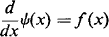
F(a − x) = f (x)
which is the same equation as the one found at the beginning.
In other words, the solution of our original problem forms at the same time the solution of the problem of distributing the supply of corn between its two uses in such a way that the greatest possible total utility or total enjoyment arises from it.
This, however, is self-evident; for the purpose of the production of spirits was just to obtain from one part of the supply of corn a higher enjoyment than was obtainable by its direct consumption; and the production will be continued as long as a further gain of utility is obtainable, that is to say, until the greatest possible utility is attained.
Beyond this, almost nothing, as was said before, is known a priori about the behaviour of the functions ϕ( ) and ψ( ) or F( ) and f( ). At the outset it is only certain that ϕ( ) and ψ( ) grow with the variable quantities under the sign of the function, but more slowly than these, and when these disappear, they become zero themselves. From this it follows that their differential quotients F( ) and f( ) are diminishing functions. The simplest approximating formula which satisfies these conditions is the one in which z indicates any variable quantity:
ϕ(z) = αz − βz2, ψ(z) = α’z − β’z2
consequently
F(z) = α − 2βz, f (z) = α’ − 2β’z
where α and β, α’ and β’ respectively are positive constants, whose values must be determined for each case. If here, for example, β is very small compared with α, then at first ϕ(z) increases almost proportionally with z, but afterwards more and more slowly, reaching a maximum for  ; after that it decreases, finally becoming zero and even negative. The same is true of ψ(z), if one replaces α and β by α’ and β’ respectively.
F(z) and f (z), on the contrary, have for small values of z almost the constant values α and α’ ; if z increases, they always decrease ; they become zero where and  respectively; and beyond that they become negative.
In this there is nothing which is inconsistent with experience, for the total utility as well as the marginal utility of a quantity of goods can finally become ‘negative,’ that is to say, can change into disutility, if the existing quantity becomes much too great. For example: water, manure, dross, sawdust, etc.
But what it does not show is whether so simple an approximating formula meets even one single case sufficiently exactly to be applicable. In most cases, this is even most improbable. Launhardt, however, has made the most extensive use in his work6 of precisely this formula, without really examining even once how far it corresponds to the facts. It is at least doubtful, therefore, whether the fine results and conclusions which, by the help of this approximating formula, he has found and printed in italics, have anything to do with reality.
Nevertheless, it will be possible to assert, according to the analogy of physical events, that, if it is only a question of variations within certain narrower limits, such an approximating formula can be substituted within this sphere for the exact form of the functions, whatever the nature of the latter may otherwise be.
If, for instance, in our example above it is quite certain in advance that the value of x sought7 must lie between two limits b and c, which are known to lie not too far apart, it will be possible within these limits to use without hesitation the approximating formulae; that is to say, instead of equation (1)
F(a − x) = f (x)
we write
α − 2β(a − x) = α’ − 2β’x
In order to be able in this case to determine the constants α, β, α’, β’, it is necessary to know for at least two values of x which belong to this sphere, the corresponding four values of the functions of the marginal utilities F(a − x) and f (x).8 If we suppose that for x = b the marginal utility of corn is ν and the marginal utility of the corn converted into spirits ν’, and that for x = c their values are w and w’ respectively, α, β, α’, β’ can easily be expressed by ν, w, ν’ and w’, and we obtain

or

This expression is, as can be seen, homogeneous in relation to the magnitude of ν, ν’ , w and w’ and of degree zero. In other words, the value of x remains unchanged, irrespective of the measure according to which the marginal utility is estimated; only for both kinds of commodities or uses in question this measure must be one and the same. This, of course, cannot be otherwise. The utility of a commodity is something sui generis; it can be measured neither in metres nor in kilograms; it is comparable only with itself or with the utility of other goods.
The understanding of the whole matter is greatly facilitated if one conceives it geometrically according to the method employed by Gossen, Jevons and others. The successively diminished supply of corn and the marginal utilities belonging to it, both measured according to an optional unit, can be represented as abscissa and ordinate of a curve, whose area9represents the total utility according to the principles of the integral calculus. In the same way the marginal utility of the quantity of corn converted into spirits can be expressed by the ordinate of another curve whose abscissa, which represents this quantity itself, is measured from point a towards the left.
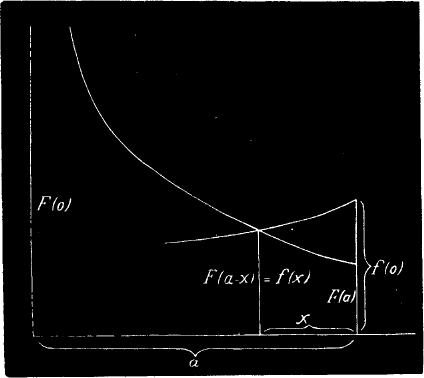
The solution of this problem now consists simply in finding the point of intersection of these two curves. The use of the approximating formula simply tells us that both curves can be regarded as straight lines near the point of intersection (as is usual, if it is a question of short pieces).
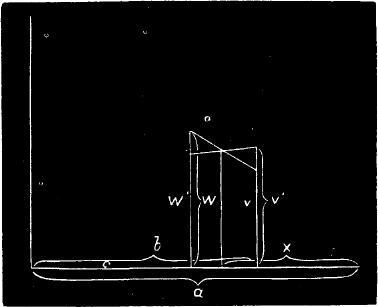
The rest will then simply be interpreted geometrically.
3—Exchange at given prices
If we now turn to exchange in its real sense, we can first deal with the simple case, where the proportion of exchange of two commodities—or, if we conceive one of them as the price commodity10 and the other as the commodity, the price of the latter—is already fixed in advance, as, for example, is approximately the case in the retail trade. The buyer of the commodity then provides himself with so much of it and disposes of so much of the price commodity—in a proportion of exchange which has been fixed by the seller—so that finally the proportion of the marginal utilities of both commodities for the intended consumption period just equals the price.
Let us suppose, for example, that he has at the beginning the quantity b of the price commodity, or b units, but is still without the commodity, and that he must give for one unit of the commodity p units of the price commodity. If we then express the marginal utility of the commodity by F( ) and the marginal utility of the price commodity by f( ), we get
F(x) = p . f (b − y)
where x indicates the number of the acquired units of the commodity and y the number of units of the price commodity given in exchange. Moreover, we have here
y = p . x
so that the problem is solved as soon as the forms of the functions F( ) and f( ) are known. Very often it will happen that the function f( ) is a constant. If, for example, the price commodity is money, its marginal utility is determined by the income or even by the total wealth of the buyer, and these magnitudes do not as a rule vary noticeably by a single exchange. We have then quite simply
F(x) = p . ν
if by ν we express the constant utility of the unit of money (for the buyer), or what is usually called the ‘value of one £’ or of One florin,’ and if the price of one unit of the desired commodity amounts to p£ or florins at the moment. Within suitable limits, one could, of course, also use here an approximating formula of the first degree for F( ) [ and f( )] ; for instance, when x lies near a,

after which
F(x) = p . ν
becomes

p1 expresses here the average price of the commodity, a the quantity of it which the buyer in question usually buys ; w and c are two constants, which, for the sake of symmetry, we have chosen in such a way that w shall express a magnitude of value or utility, and c a quantity of goods. The last equation, then, tells us that if the price demanded is a little under or over the average price, the buyer in question will purchase and consume more or less than usual of the commodity for the consumption period concerned in proportion to the difference of price.
That the price on the part of the seller is unalterably fixed, supposes, of course, that for him neither the marginal utility of the commodity nor that of the price commodity is altered by the exchange. This can happen either through the fact that his supply of the commodity concerned is very large in comparison with the quantity to be exchanged, or through the fact that he himself is only the connecting link between the real barterers, as in the wholesale trade. How in the last case the price is in fact determined, is a problem in itself, which we cannot deal with for a long time yet. It is clear, of course, that here also a maximum problem is solved. Suppose that for the buyer the total utility of the quantity of goods is expressed by ϕ(x) and the total utility of the price commodity by ψ(b − y). If he now wants to gain the greatest possible utility, that is to say, if ϕ(x) + ψ(b − y) is to be a maximum, we must get
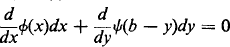
But according to what has gone before,
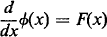
and

We therefore obtain
F(x)dx = f (b – y)dy
dx and dy express here the small quantities of goods last exchanged against each other. Their proportion is consequently the constant price p. Or, which is the same, from the equation y = p . x we obtain dy = pdx. We have consequently
F(x) = p . f (b − y)
as above.
4—Isolated exchange
If for both the exchanging persons the marginal utility of one or other of the commodities in question, which we will call (A) and (B), is altered by the exchange, and consequently the price is not fixed in advance, then—supposing the exchange to be completely isolated, that is to say, supposing that other possibilities of obtaining the desired commodity do not exist—one cannot possibly speak of a fixed proportion of exchange which can be theoretically determined: the problem is indeterminate. Only this much is certain, that an exchange will take place wherever both contracting parties derive, or believe that they derive, advantage from it, and that it will continue as long as it promises a further gain of utility on both sides, be it ever so small. If we suppose in particular, as we also did in the previous cases, that it is a matter of continuous quantities, that is to say, of commodities which are optionally divisible and can also be consumed in optional quantities, it can be asserted that the exchange will cease only at the point at which the proportion of the marginal utility of the one commodity to that of the other is equal on both sides. If this condition is not yet fulfilled there will always exist on both sides a reason for continuing the exchange. If, after the exchange has taken place, in the estimation of the original possessor of (A) one unit of the commodity (B) is still equal in value to three units of the commodity (A), whilst the possessor of (B) estimates that this quantity is equal to only 2½ units of the commodity (A), then both believe that they will obtain an increase if the second of the contracting parties gives to the former another or several units of the commodity (B) against, for example, 2¾ units each of the commodity (A). But this tells us neither in what proportion the previous exchange took place nor how great the quantities were, nor consequently in what average proportion both commodities finally change their possessors.
The mathematical manner of treatment reflects this fact clearly. Let us suppose that one possessor has a units of the commodity (A), but as yet no units of (B); and that the other possessor has no units of (A), but b units of (B). Let us further assume that the function of marginal utility of the commodity (A) is F( ) for the former possessor and J( ) for the latter, and that the corresponding functions of the commodity (B) are f( ) and j( ) respectively. Then the exchange is continued up to the point where
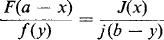
(3)
x and y denote here the number of the exchanged units of (A) and (B) respectively.
But we have here only a single equation between two unknown quantities. The problem is consequently indeterminate; it has an infinite number of solutions. It could even appear as if, for each value of x, a y belonging to it could be found, and vice versa. This, however, is not so, because, as can easily be seen, the limiting condition must be added, that each of the exchanging persons ought to exchange with profit or at least without loss. The possible solutions consequently lie between two limits (margin pairs of x and y), in which cases the one or the other of the contracting parties has no profit at all (but also no loss). To determine these limits, when the functions of marginal utility are given on both sides, is a problem of the integral calculus. Let us think of the planned exchange as split up into an infinite number of partial exchanges, so that each time infinitesimal quantities, dx and dy, are exchanged against each other. If, then, the original possessor of commodity (A) gains nothing when he gives dx of (A) in exchange for dy of (B), the ratio  of the marginal utilities to him of (A) and (B) must be the inverse of
  We therefore obtain each time
F(a − x).dx = f (y).dy
or, if we add up from zero to x and y on both sides,
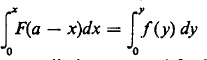
in which case the upper limits must satisfy the integral of the equation (3).
Both these integrals, as can easily be seen, represent, for the possessor of (A), the total utility of the quantity of the commodity (A) given in exchange, and of the quantity of the commodity (B) taken in exchange, respectively. If, therefore, these functions of the total utility, now found by integration, are expressed by ϕ( ) and ψ( ) respectively, we get
ϕ(a) − ϕ(a − x) = ψ(y)
By this equation, in combination with equation (3), the values in question of x and y can be determined.
In the same way, if the analogous functions in respect of the possessor of (B) are expressed by χ and ω, the other limit of the possible proportions of exchange is given by
χ(x) = ω(b) − ω(b − y)
always in combination with (3). Between the limits thus determined, every proportion of exchange must be declared possible.
In order to make the foregoing a little clearer by an example, we may be allowed to make the simplifying assumption that for both the exchanging persons (which we will call A and B), the functions of marginal utility of the same commodity are identical, so that J( ) is identical with F( ) and j( ) with f( ), and their values depend only on the possessed or exchanged quantity of goods, not on the personal dispositions or other circumstances of A and B. Moreover, let us suppose that both functions of marginal utility can be replaced by approximating formulae of the first degree, α − 2βx and α’ − 2β’y, and this over the whole sphere of the problem, which, of course, as already mentioned, can only be the case under special circumstances. The equation (3) then turns into

and if here numerator is added to numerator and denominator to denominator, each of these fractions becomes
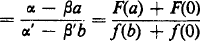
The ratio of the marginal utilities of the two goods, when equilibrium has been attained, is therefore, under the above assumptions, constant, independently of the values of x and y concerned, and equal to the proportion of the average marginal utilities of the quantities possessed. In whatever proportion the commodities here change hands by a repeated exchange, the last exchange which leads to equilibrium will always take place in the same proportion.11
Suppose that A has 10 oxen and B has 100 sheep, and that the marginal utility of oxen is expressed by 200 — 10x, and the marginal utility of sheep by 10 — 0·1y. That is to say, in B’s estimation, if he does not yet possess on ox, one ox is worth 200 (e.g. 200 Marks, if the value of 1 Mark is regarded as constant); for every ox which he takes in exchange, the value of an ox will seem to him 10 (10 Marks)) less, etc. The same is true for A, so that he, if he still possesses all the 10 oxen, estimates the value of 1 ox as 100 Marks only, but for every ox which he gives in exchange he will increase that value by 10 Marks, etc. In an analogous way the same is true of the marginal utility function of the sheep.12 Properly speaking, we are dealing here with oxen in the same way as with sheep, namely as optionally divisible continuous quantities; so that it would be more correct to say that B estimates the first fraction, for example the first hundredth of an ox, as worth 2 Marks, the second hundredth as worth 1 Mark 90 Pfennig, etc.
We therefore have here
α = 200, 2β = 10, α’ = 10, 2β’ = 0· 1
When equilibrium has been attained, we necessarily get

or, written in a shorter way,
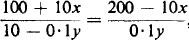 , consequently,
as follows by the addition of numerator to numerator and denominator to denominator. The last fraction expresses the constant and on both sides equal proportion of the marginal utilities in case of equilibrium, and consequently also the proportion in which both commodities are at last always exchanged.
The above equation finally reduces itself, as can easily be found, to
10x + 3y = 200
This equation must always be fulfilled after the exchange has taken place, but otherwise, within the above-mentioned limits, all possible proportions of exchange can occur. In order to determine these limits, we put, as we have already ascertained, supposing that A exchanges without any profit,

or
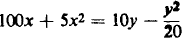
But if B exchanges without profit,
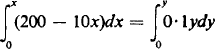
or
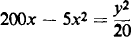
each time in conjunction with the equation
10x + 3y = 200
From these equations we obtain for the one limit

and for the other limit

The possible proportion of exchange will consequently be able to fluctuate between about 1 ox against 61 sheep and 3·4 oxen against only 55 sheep (or on an average 1 ox against about 16 sheep). In the first case B, and in the second A, will have exchanged without any profit (but also without loss).
As the proportion of marginal utility amounts in the end always to ‘1 ox worth 30 sheep,’ it could, for example, be supposed that both the contracting parties had from the beginning agreed to exchange in just this proportion. One would then have, beside the equation
10x + 3y = 200
which is always fulfilled, the equation
x = 30y
so that x = 2 and y = 60; that is to say, A gives 2 oxen to β and gets in return 60 sheep. It is easy to show that the gain of utility then becomes the same on both sides, namely 200 (Marks)13
But if, for instance, β knows how to direct the proportions of exchange to his advantage, 3 oxen against only 56⅔ sheep (on an average 1 ox against 19 sheep) might be given by A. But A might perhaps not be inclined to do this in a single exchange, for although at first he values 1 ox as equivalent to 10 sheep, this proportion of marginal utility would have risen to ‘1 ox worth 30 sheep’ after the exchange, so that the transaction could appear to him as of doubtful use, though in reality it would bring him no loss according to our assumptions.
But supposing that he was first expected to exchange 1 ox for 13 sheep, then a second ox for 17⅔ sheep, then ½ ox for 11 sheep and finally another ½ ox for 15 sheep, then there would remain for him after each exchange respectively a proportion of exchange between sheep and oxen of more than 1 : 13, 1 : 17⅔, 1 : 22 and finally of just 1 : 30, so that each single exchange would have to seem to him undoubtedly profitable, although he has in fact finally exchanged just 3 oxen for not quite 57 sheep.
In the case of isolated exchange, too, of course, a kind of maximum problem is solved, for each of the exchanging persons strives after the greatest possible profit and is inclined to continue the exchange until he can derive no further profit from it. But since the whole problem is indeterminate, one can speak of a definite solution only when new conditions are added.
Such a condition would be, for instance, to determine the quantities of goods which are to be exchanged in such a way that the gain of utility attained by both the contracting parties together, in other words, approximately the ‘economic’ profit, becomes the greatest possible one. It is self-evident that, if this aim is attained by the exchange which has taken place, the proportion of marginal utility of both commodities on each side must be the same and that consequently the equation (3) must be fulfilled, for otherwise the exchange could always, as we have seen, be continued with a gain of utility on both sides, so that the gain of utility already attained could not possibly be the greatest possible one. But this does not mean that the solution of this problem belongs to the possible solutions mentioned above.
The mathematical treatment of this problem is very simple; one has only to express that the sum of the gains of utility on both sides, or, which is the same, the sum of the total utility attained on both sides
ϕ(a − x) + ψ(y) + χ(x) + ω(b − y)
is to be as great as possible. Since x and y are here independent of each other, one must consequently have at the same time
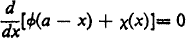
or, differently expressed,
F(a − x) = J(x)
and

By this the equation (3) is obviously exactly fulfilled; but whether the pair of values of x and y, so determined, really lies within the limits of the possible exchange, has still to be decided.
The matter becomes especially simple, if, as in our chosen example, the marginal utility functions are conceived as identical on both sides, F( ) with J( ) and f( ) with j( ). In this case the equations
F(a − x) = J(x) and f (b − y) = j(y)
are obviously fulfilled by  and
and  and in consequence of the general characteristics of the marginal utility functions, it is clear that they can have no other (real) solutions. In other words, the greatest possible total utility is attained under these assumptions if the existing supply is simply distributed in equal shares between both the exchanging persons. This, by the way, is evident.
In our example, therefore, A would give 5 oxen to β and would get 50 sheep for them. Thereby the conditioning equation
10 x + 3y = 200
is indeed fulfilled and the proportion of marginal utility turns out to be such that 1 ox is estimated on both sides as equal to 30 sheep, as was required by the theory. But this exchange lies far beyond the possible limits. Indeed, it would bring to A a loss instead of a profit, and is consequently excluded, if each of the exchanging persons pursues his own profit. (Compare, moreover, section 5.)
In what has gone before we set out from the hypothesis that the commodities which are to be exchanged cannot replace each other in any way, so that the marginal utility only depends on the possession of the commodity in question, but not on the possession of the other. In reality, however, this is not always, and perhaps never wholly, the case. In our example, therefore, it cannot in fact be without significance for the valuation of an ox, whether the possessor in question has or has not, besides a certain number of oxen, also sheep. Therefore it would correspond more to reality if, as Edgeworth14 has done, one conceived the total utility for A of oxen and sheep together as a general function U of x and y, whereby the partial derivatives of U in relation to x and y (taken positively) obviously express the marginal utility for A of the oxen and sheep respectively. If V is the corresponding function for B, one obtains as a conditioning equation of the exchange (called ‘contract curve’ by Professor Edgeworth) the very elegant expression
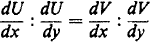
which turns into the above equation (3), as soon as one is allowed to suppose that
U = ϕ(a − x) + ψ(y)
and
V = χ(x) + ω(b − y)
that is to say, when the utility (total utility as well as marginal utility) of each commodity only depends on the possessed quantity of this commodity.
5—Exchange in the open market
We have treated the individual exchange in such great detail merely in order to be able to demonstrate by means of a simple example the most important fundamental principles of the exact manner of treatment, not for the sake of its practical importance, for this is small. In modern economic life almost all proportions of exchange are determined by the open market or indirectly by its influence.
In the market, however, an element is added which causes the problem which we just now had to declare indeterminate, to appear relatively determinate. Jevons calls this the law of indifference, but it is in fact nothing other than competition, the mutual competition of buyers and sellers. Under the influence of competition, as we are accustomed to say, only one price can rule on the market and in its neighbourhood, so that all partial exchanges are carried out approximately in one and the same proportion of exchange.
It would, of course, be possible, and indeed it occurs quite often, that the one or the other party in the market attains in the first instance by an initial restraint a price higher than the one which later proves compatible with the general situation of the market; but then there is always the danger that some members of the party, cleverly using this good opportunity, might dispose of their whole stock at this artificially raised price, with the result that for the others the situation of the market would become so bad that in the end this procedure would bring them more loss than profit. It is just this latter circumstance that marks the principal difference between the market and the individual exchange. If one tries to avoid this danger by agreements in respect of the quantities of goods to be sold and bought, that is to say by cartels, etc., the conditions of the individual exchange are more or less repeated.
We simply suppose here as a fact that on the market one price or a proportion of exchange between every two commodities establishes itself within a short time for each commodity in which afterwards the bulk of the transactions are done. And supposing only two commodities are present on the market and are going to be exchanged against each other, let us set ourselves the task of finding out the proportion of exchange at which equilibrium is attained on the market. If this proportion is 1 : p so that p units of the commodity (B) are given against one unit of the commodity (A), each of the exchanging persons will exchange in just this proportion and he will, exactly as in the case of fixed prices treated above, exchange up to the point where for him the proportion of the marginal utility of the commodity (A) to that of the commodity (B) becomes p : 1. Let us suppose that there are m possessors of the commodity (A) and n possessors of the commodity (5), each of whom we suppose, for the sake of simplicity, to be originally provided with only one of the two commodities. If we then express the marginal utility function of the commodity (A) for the different possessors of this commodity and for those of the commodity (B) by F1( ), F2( ). . . Fm( ) and J1( ), J2( ). . . Jn( ) respectively, and the marginal utility function of the commodity (B) for those possessors by f1( ), f2( ). . .fm( ) and j1( ), j2( ) . . . jn( ) respectively, we get the system of equations:
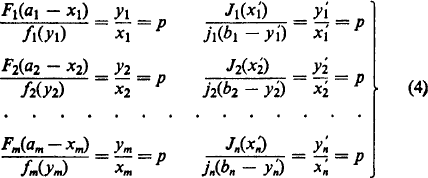
in which a1, a2 . . . express quantities initially owned by the various possessors of the commodity (A), x1, y1, x2, y2, . . . express the quantity of (A) and (B) which each of them has given and taken in exchange respectively, and b1, b2 . . .; x’1, y’1, x’2, y’2 . . . have the same significance in relation to the original possessors of (B).15
We have here, therefore, 2m + 2n equations. To these, two other equations have to be added, which tell us that the sum of the quantity of goods given in exchange and the quantity of goods taken in exchange must be equal for each of the two commodities ; consequently
x1 + x2 + . . . + xm = x’1 + x’2 + . . . + x’n (5)
and
y1 + y2 + . . . + ym = y’1 + y’2 + . . . + y’n (6)
Of the two latter equations, however, each can be derived from the other with the help of the equations (4).16 We consequently obtain altogether 2(m + n) + 1 equations, which are independent of each other, or just as many as the number of the unknown magnitudes: x1 . . . xm, y1 . . . ym, x’1 . . . x’n, y’1 . . . y’n and p. Our problem is consequently theoretically solved. We will undertake the discussion of these equations and their discontinuities later on, when we deal with supply and demand.
It would simplify matters somewhat if we were permitted to suppose that the marginal utility function of one or the other commodity depended only on the quantity possessed, but not on the personal disposition of the exchanging persons, so that the functions F1 . . . Fm, J1 . . . Jn could approximately be replaced by one and the same function, perhaps F( ), just as the functions f1 . . .fm, j1 . . . jn can all be replaced by the function f( ). If, further, we suppose what seems more doubtful still, however, and can indeed apply only to one special case, namely that F( ) and f( ) can both be expressed sufficiently exactly for the whole field of this problem by one approximating function of the first degree, α − βx and γ − δy respectively, then we obtain by the addition of numerator to numerator and denominator to denominator in the equations (4) and with the help of (5) and (6)
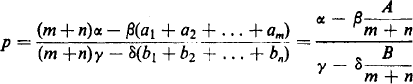
provided that by A and B we express the size of the existing total supply of (A) and (B). The equilibrium price appears here, therefore, as about the proportion of the average marginal utilities of the commodities (A) and (B), or of those marginal utilities which would result if the existing supply were distributed equally amongst all exchanging persons. The equilibrium price depends only on the number of barterers and on the size of the total stock, but not on its original distribution. When p is already determined in this way, one obtains the other unknown magnitudes of the problem, x1, x2, etc., very simply by an equation of the first degree in each case.
This observation, which is at any rate interesting, was made by Launhardt. It is open to doubt whether any practical importance can be attached to it. As we have already several times remarked, this rule can only be generally valid, i.e. valid for all forms of functions, if it is a question of very small deviations, that is to say, if all exchanging persons are from the outset or by previous exchange in possession of approximately equal quantities of the same commodity, so that the marginal utility of the commodity (A) as well as that of the commodity (B) is already nearly equal for all of them. This, however, will not often come about in reality; for even if the marginal utility function were identical throughout, the amounts of property would nevertheless be different. From this it follows that this function can indeed be replaced by a series of different approximating functions, but not by one and the same formula,17as the validity of the rule requires.
The treatment of the problem of exchange given above derives from Walras. Jevons, who has also availed himself of the mathematical method, but in a less correct way, believed that he could summarize the solution in two equations by regarding all possessors of the one as well as of the other commodity as a trading body. According to Jevons, for each of these trading bodies, in respect of each of the commodities, a kind of collective marginal utility holds good, which can be regarded as a function of the possessed or acquired total supply. If A and β are the total supplies of the commodities (A) and (B), and X and Y the exchanged total quantities of these, and if the mentioned collective marginal utility is expressed by F( ),J( ),f() and j( ) respectively,18 we obtain

In this case the proportion of exchange to be determined is of course given by 
But Jevons never says clearly what is really meant by this collective marginal utility of a trading body, and it seems as if he himself had not formed a sufficiently clear idea of it. The marginal utility of a commodity for a trading body can scarcely be anything else but the average marginal utility, the arithmetical mean, or else any mean of the individual marginal utilities of its members. But neither is it clear how the proportion of exchange can depend on this average marginal utility in the way Jevons demands, nor can one understand how it could be conceived as a function of the size of the possessed total supply, since the average marginal utility in fact also depends on the distribution of this supply and, what is more, on the distribution after the exchange, which is still unknown.19
If the members of the party, instead of operating each for himself on the market, were to buy and sell on joint account, in other words, if they formed a real trading body instead of a trading body which was only feigned, then we could indeed speak of their collective marginal utility; but then the reciprocal competition would be excluded. We should still be in the sphere of isolated exchange and there would be no fixed equilibrium price.
Jevons’s solution is therefore insufficient, although he has correctly grasped the fundamental idea of the theory.
But if with Walras one takes, instead of the exchanged total quantities themselves, their proportion, namely the average proportion of exchange, as the independent variable, it is indeed possible, as we shall soon see, to unite the equations of the exchange in one single formula, which is then nothing other than the mathematical expression for the equality of supply and demand.
In the case of exchange in the open market also, as well as in the cases treated previously, a maximum problem is solved ; but only in the sense that each of the exchanging persons (and consequently all of them together) obtains the greatest possible gain of utility which can be attained by him (or them) at the price fixed on the market. On the other hand, this would obviously not be the case if a uniform price were fixed in advance in some other way, e.g. by governmental order. That being so, only one market party, the one not favoured, could exchange until saturation was reached; but at no time could all the members of the other party, or perhaps even a single member, sell such a great amount of their goods as would be profitable for them at this price. Equilibrium on the market would then be impossible, since the supply of the favoured commodity would always exceed the demand.20
It can, however, not be asserted that the gain of utility attained by all the exchanging persons together is necessarily smaller in the latter case than in the case of entirely free competition.
Generally speaking, of course, this will prove true; for if the fixed price deviates very much from the equilibrium price, the exchanged quantities of goods become in the end so small that the gain of utility on both sides, too, lags behind the gain of utility attainable in the case of free competition. Up to a certain limit, however, the profit of the favoured party is increased with each such shifting of the price; and it cannot generally be proved that the profit of the other party decreases thereby in a corresponding degree.
Still less can it be asserted that the distribution of the com modities which is most favourable economically, that is to say, the greatest possible general satisfaction, arises from free competition. If this problem is conceived in the absolute sense, its solution, as can easily be seen, requires that the marginal utility of all exchanging persons should become the same in relation to each separate commodity.21 But this situation will quite often lie beyond the limits of the possible exchange, as it would bring to some of the exchanging persons loss instead of profit. This, however, does not prevent the problem from being solved in the relative sense, that is to say, in so far as it is compatible with the fundamental condition of exchange. But this could obviously only happen if the individual transactions were carried out at different prices, instead of at the single joint price required by free competition.22
But after all, the question of the most suitable distribution of goods forms a problem which is entirely different from that of the theory of exchange. For it supposes that utility or satisfaction can also be compared for different persons, whilst the theory of exchange only proceeds from the possibility of comparing the utilities of different commodities for one and the same person; which is quite a different matter.
6—Exchange of several goods. Indirect exchange
If three or more commodities come to be exchanged on the market, not only do our formulae become, in a corresponding degree, more complex, but quite a new phenomenon appears, which is of the greatest importance from the economic point of view, namely the indirect exchange, which consists in the fact that a commodity is taken in exchange, not in order to be kept and consumed, but in order to be again given in exchange.
Suppose, for example, that three commodities (A), (B) and (C) are present on the market, which are to be simultaneously exchanged for one another. It could now seem as if each possessor of the commodity (A) would simply relinquish part of his possession of (A) against a certain quantity of (B) and another part of (A) against a certain quantity of (C), according to the law of the proportionality of the corresponding marginal utilities—and similarly with the possessors of (B) and (C)—so that the quantity of (A) given by the possessors of (A) to the possessors of (B) would constitute the remuneration for the quantity of (B) obtained, etc. This, however, win generally not be the case, for a general equilibrium on the market would thereby not yet be attained. Rather, the direct exchange is almost always followed by an indirect one, since at least some of the possessors of (A) derive their advantage by exchanging against each other certain quantities of (B), in order to exchange them afterwards for corresponding quantities of (C), or vice versa. An analogous operation can, of course, also be undertaken by the possessors of (B) or of (C), or simultaneously by the members of the different parties.
The same result can also be attained with the help of credit or money. The possessors of (A) then surrender certain quantities of (A) to the possessors of (B) without direct remuneration, or for money. On the other hand, they obtain from the possessors of (C) a corresponding quantity of (C) without direct remuneration, or for the money which they have just received from the possessors of (B). Finally, the possessors of (B) surrender a corresponding quantity of (B) to the possessors of (C) for just this sum of money, or against the claim which the possessors of (A) have on the possessors of (B) and which they have transferred to the possessors of (C); so that either the money finally returns to the starting-point or the claims are discharged. The result will be the same as in the case originally supposed, save that the quantities of (B), which previously went through the hands of the possessors of (A) as middlemen, are now transferred directly to the possessors of (C).
If credit and money transactions as well as wholesale trade are excluded for any reason, then the quantities of goods which are surrendered on both sides—one of one sort for one of another—must certainly be exchanged directly. But then the three proportions of exchange between (A) and (B), between (B) and (C) and between (C) and (A) will stand in no relation whatsoever; so that if, for instance, in the trade between the possessors of (A) and (B), two units of (A) are given for every unit of (B), and in the exchange between (B) and (C), three units of (B) are given for every unit of (C), then, in the exchange between (C) and (A), perhaps five, seven, or any number of units of (A) whatsoever, can be exchanged for each unit of (C), whilst in the case of free exchange, exactly six units of (A) would have to be given for every unit of (C).
Or vice versa. If we suppose that the proportions of exchange of the three commodities are dependent on each other, so that one of them is always determined, in the simple way indicated above, by the other two, then we cannot make the further stipulation that the quantities of goods finally sold should pay for each other, or should be directly exchanged against each other. The problem would then be overdeterminate.
We are here obviously confronted with one of the most important questions of the theory of exchange. The ‘exchange between three’ forms, so to speak, a connecting link, which leads from the state of primitive exchange to that of developed economy, where two producers or other possessors of commodities, as we know from experience, almost never exchange their goods directly. A will give his commodity to B, B will give the one he possesses to C, C his to D, etc., until the chain is completed, usually by way of various ramifications.
In order to simplify the mathematical treatment of this problem as far as possible, it is perhaps best to unite the different possessors of commodities not in several, but in one single group, each of whose members is already from the outset conceived as possessor of certain quantities of all these goods, and therefore, on the assumption of only three commodities, as the possessor of all three. Initially, one or two of these quantities can, of course, be zero.23
Suppose the number of all the exchanging persons is n.
One of them has at the outset the quantities ar, br and cr of the commodities (A), (B) and (C) respectively, where r is an optional index number. After the completed exchange, he will possess the quantities ar + xr, br + yr and cr + zr in which at least one of the magnitudes xr, yr, zr must be negative and therefore expresses a quantity of goods given in exchange instead of a quantity of goods taken in exchange. But also two of these magnitudes could be negative, if the person concerned had originally possessed (at least) two of the three commodities, and had given away certain quantities of both for each quantity of the third commodity.
If we further suppose that the equilibrium prices of the three commodities, measured according to an optional standard, are pa, pb and pc, 24 the principle of thrift (the principle of the greatest possible profit for everyone) demands that the possessor in question exchange up to the point at which, for him, the marginal utilities of the three commodities stand in the same proportion as their prices. We consequently have, if the marginal utilities of the three commodities for him are expressed by Fr( ), Gr( ) and Hr( )
Fr(ar + xr): Gr(br + yr): Hr(cr + zr) = pa: pb: pc
(7)
This amounts to two independent equations.
For each of the exchanging persons there exist two similar equations or, altogether, 2n equations.
We have now in addition to express the fact that for each possessor the amount realized by the goods taken in exchange is equal to the amount realized by the quantity of goods which he gave for them from his original stock of goods. We thus obtain, as can easily be seen, n equations of the type
xr pa + yr pb + zr pc = 0
(8)
But finally, three other equations must be considered here—to the effect that the algebraic sum of the (positive) quantities of each of the three commodities taken in exchange and the (negative) quantities given in exchange must be zero. We have therefore in addition
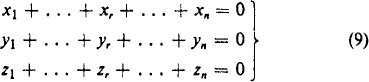
Of these equations, however, only two are independent, since the third can always be obtained from the others with the help of the n equations (8) (by their addition), as can easily be seen.
For the same number of unknowns, namely the 3n quantities x1 . . . xn, y1 . . . yn, z1 . . . zn and the two proportions of the three prices, we obtain therefore altogether 3n + 2 equations ; for instance

is then determined.
The absolute level of these prices themselves cannot, of course, be ascertained here, since they were reckoned according to an optional measure which cannot be exactly determined.
If, on the contrary, we had chosen one of the commodities, e.g. (A), as the standard of value, so that we had pa = 1, pb and pc could, of course, be determined. They would then represent the price of (B) and of (C) respectively, expressed in terms of (A).
As we see, no difference is made here between the possessors of different commodities. It would be quite easy, however, to do this. We should then—assuming that, for instance, each person possesses at first only one commodity—have to divide the exchanging persons into three groups, in which case, according to our notation, all initial quantities b and c in the first group, the quantities c and a in the second group, and a and b in the third group would be zero. The other way of dealing with this problem would be exactly the same as above. But if one wanted to introduce here at the same time the condition that the sum of the y’s in the first group and the sum of the x’s in the second group, multiplied by pb and pa respectively, should be equal to one another (from which it follows directly that the sum of the z’s in the first group, multiplied by pc and the sum of the x’s in the third group, multiplied by pa must also be equal to one another as well as to the sum of the z’s in the second group and the sum of the y’s in the third group, multiplied by pc and pb respectively)—in other words, supposing that the transacting persons only obtain possession of the commodities by direct exchange—then the problem is overdeterminate and cannot be solved. We should then have not merely 3n + 2, but 3n + 3 equations, which would be independent of each other, whilst there are only 3n + 2 unknown magnitudes to be determined.
On the other hand one could easily introduce the condition of direct exchange, if one conceived the three proportions of exchange between (A) and (B), between (A) and (C) and finally between (B) and (C) as three magnitudes which are independent of each other.25 The unknowns of the problem would then be increased by one, and would then amount to 3n + 3.
This is how Jevons treats the problem,26 except that, as in the case of exchange between two commodities, he introduces the vague concept of the marginal utility of a ‘trading body,’ by which means he believes that he is able to reduce the number of equations to only 2 x 3 = 6.
But Jevons does not seem to have noticed that the state of equilibrium expressed by his equations excludes, in principle, the possibility of the wholesale trade as well as money and credit transactions, and that, if these are admitted, the equilibrium would immediately be disturbed afresh. He reminds us that the same pair of goods can only have one proportion of exchange in the same market, but he never mentions that in the case of a completely free exchange of three commodities there can only be two independent proportions of exchange (and generally in the case of n commodities only n − 1); indeed he treats these proportions of exchange as if all three would be independent.
Finally, so far as the question of the greatest possible profit is concerned, much the same applies here as in the case of exchange between two commodities only. Each party to the exchange attains, at the equilibrium prices fixed by free competition, the greatest possible profit attainable by him at just these prices. It is here specially to be remarked that, if initially only direct exchange is permitted, but subsequently the market is entirely freed, each of the exchanging persons will acquire a greater profit by the wholesale trade or stock-exchange operations which then take place, and in this way the total profit also can become greater. But the state of equilibrium thus attained will generally be different from that which would occur if trade were entirely free from the very beginning. For this reason it cannot be asserted that in the case of entirely free trade a greater total profit can invariably be obtained than if, for instance, only direct exchange were allowed. It can, however, easily be seen that this must on the whole be the case, and the more so, the more the division of labour is already carried through—which means that fewer direct exchange transactions can occur at all.
7—Supply and demand
We are, of course, still very far from being able to give our equations hitherto formulated a practical application, or from being able to test them in this way. The bare number of equations required makes this impossible. To be able actually to formulate these equations, it would be necessary to know exactly the plans of every single consumer in regard to each of the different commodities and the size of the existing individual supplies, which is, of course, impossible.
Secondly, it was assumed in the foregoing that all the commodities to be exchanged are optionally divisible and that their consumption, in relation to a certain period of consumption, represents, even within the individual economy, a continuously variable magnitude.
Neither the one nor the other holds good in reality without qualification. In the case of several commodities, only a limited number of separate specimens can be used at a time in individual consumption. But even if the commodities are themselves optionally divisible, the consumption will in most cases only be able to vary by discontinuous steps; which renders a mathematical treatment of the above kind more difficult still, or makes it impossible.
But the case is different if we speak of the total sum of commodities which are exchanged on the market or consumed within the economic territory concerned. Firstly, the quantities of goods in question could then, as a rule, be much better determined statistically. Secondly—and this is nearly as important for an exact treatment—their total consumption, by virtue of the law of great numbers, will almost always be able to be regarded as a magnitude continuously varying, even if the individual consumption only changes by discontinuous steps. Jevons was therefore perfectly right in trying to unite the exchanging persons into groups or ‘trading bodies’; only, as we have seen, not much can be done with the concept of marginal utility of such a group. But we attain our end if, as Walras did, we conceive the prices or proportions of exchange of the commodities as variable and, what is more, as the only independent variables of the problem, or—which comes to the same thing—if we consider the exchange procedure from the point of view of supply and demand.
Let us first of all return to the exchange of two commodities.
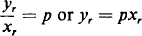
If we solve all equations (4) in relation to x1, y1, x2, y2, . . .x’1, y’1 etc., every x and y and every x’ and y’ can be regarded as functions of p, where p is conceived as variable, if we leave out of account for the time being the equations (5) and (6). In other words, whenever both commodities are exchanged in the proportion of 1 : p, which in one way or another has been fixed in advance, then from every single possessor Ar of the commodity (A) comes a certain supply xr of this commodity and with it also a certain demand yr for the commodity (B), where xr and yr each by itself, are functions of p, which must always stand to each other in the simple relation
In the same way, from every possessor Bq of the commodity (B) comes a certain supply y’q of the commodity (B) and a certain demand x’q for the commodity (A). y’q and x’q, too, are functions of p, and stand in the same relation to each other as above. This we express better by

since all the x’ express here supply and all the y’ demand. p therefore denotes the price of the commodity (A) expressed in terms of (B); consequently  or π denotes the price of the commodity (B) expressed in terms of (A).27
If now we add together all the x’s and call the resulting sum X, then this sum expresses the total supply of the commodity (A). In the same way we obtain by addition of all the y’s the total demand Y for the commodity (B).
In the same way Y’, the sum of all the y’, expresses the total supply of (B), and X’, the sum of all the x’, the total demand for (A).
All these magnitudes become, therefore, functions of p or of π, the prices of the commodities reciprocal to each other, and, what is more, generally constant functions, even if the individual supplies and demands only vary by steps. If p rises a little and π consequently falls, the magnitudes X, Y, X’ and Y’ will, as we know from experience, rise by a very small amount, and fall respectively; and vice versa, if p falls and π rises. X, therefore, is transformed into X + dX (where dp and dX can also be negative) or into  etc., if p changes into p + dp.
But this generally does not happen in such a way that with every shift of prices the possessors of (A) now increase or decrease their consumption of (B) by, perhaps, one hundredth each—which might not even be possible, according to the nature of the commodity (B). Most of them are probably not in the least disposed to increase or restrict their consumption of the goods concerned by the change in prices which has taken place. But some of them, while the price was still p, were presumably just about to consume the commodity (B) not yet used, or, on the contrary, to give up partly or completely their consumption of (B). For these, the rise or reduction in price dp is, as it were, the drop which causes the vessel to overflow. These alter their consumption and, what is more, not by an infinitely small, but by a relatively considerable amount, which, however, will be very small in comparison with the consumption of the majority of the consumers. This on the whole will be unchanged.
Let us now consider the equations (5) and (6). The former reduces itself to
X = X’
(10)
and simply expresses the fact that supply and demand of the commodity (A) must be equal in the case of equilibrium of the prices. By this the equation (6), or
Y = Y’
(11)
is also fulfilled, since Y is obviously = pX and Y’ = pX’. Equality of supply and demand of the one commodity causes the same relation in respect of the other commodity. Using either of these equations, p can now be determined, if we have found out the forms of the functions X and X’ or Y and Y’.
However, a more detailed examination shows that equality of supply and demand is indeed a necessary, but, at least from the theoretical point of view, not a sufficient condition for the equilibrium of the market, supposing the latter to be stable— if, that is to say, the proportion of exchange would automatically return to (approximately) the same position after an accidental shifting.
If, for instance, it is a matter of demand and supply of the commodity (A), it can generally be asserted that, if p [the price of (A) expressed in terms of (B)] increases, the demand for (A) always falls; if, on the contrary, p decreases, the demand for (A) will always increase.28 If we could now be certain that, on the contrary, the supply of (A), at least near the equilibrium price found [i.e. the value of p, ascertained from (10) or (11)] would increase when the price rose, and would decrease when the price fell, then the stability of the equilibrium would obviously be secured ; for in the case of an accidental deviation of the price upwards the supply would be greater than the demand; in the case of a deviation downwards, the demand would, on the contrary, exceed the supply; in both cases the inequality of supply and demand would necessarily drive back the price to approximately the earlier position.
But we know in regard to the supply of (A) that this magnitude, multiplied by the price of (A), represents the demand for (B) (Y = pX).
If now the demand for (A) decreases when the price of (A), expressed in terms of (B), rises, then the demand for (B) must for the same reason diminish when the price of (B), expressed in terms of (A), rises, and consequently increase if the price of (A), expressed in terms of (B), rises. If therefore we put the demand for (A) or X’ = ϕ(p) and the demand for (B) or Y = ϕ(p), then ϕ(p) is consequently a decreasing function (when p increases); ψ(p), on the other hand, is an increasing function of p. We therefore obtain for the supply of (A) or X the expression

which product, for different values of p, can under certain circumstances increase with increasing p, but also decrease. If ψ(p) increases more rapidly than p, this product increases; if ψ(p), on the other hand, increases less rapidly than p, it decreases.
When the price rises, therefore, not only the demand but also the supply of the commodity in question can decrease. If, now, the demand decreases more rapidly than the supply (and therefore, on the contrary, increases more rapidly when the price falls), the stability of the equilibrium is, as can easily be seen, even in these circumstances still secured. But there is nothing to prevent  from decreasing or increasing even more rapidly than ϕ(p), near the value of p in question, since supply and demand of the same commodity proceed from different persons and are consequently totally independent of each other.29
If this is the case, no real equilibrium of the price exists, but only a temporary equality of supply and demand; for as soon as the price moves even in the least degree upwards the demand will be greater than the supply and the price must consequently rise higher and higher, until the demand, decreasing, finally catches up with the decreasing supply once more. In the same way a small shift of the price downwards will cause the supply to exceed the demand, and leads therefore to lower and lower prices, until the demand, increasing, again catches up with the increasing supply.
In both cases equilibrium is finally reached, but the equilibrium price will in each case be a different one. Thus the further peculiarity arises, that not only one, but two different (stable) states of equilibrium of the market would theoretically be possible.
Walras, and Launhardt after him, have drawn supply and demand curves in hypothetical form. By this means the price is represented as abscissa of a right-angled system of coordinates, and the quantities of goods demanded or supplied as ordinates of the different curves. Mangoldt, by the way, in his Grundriss der Volkswirtschaftslehre, which was published in 1863, had already drawn similar curves, which, however, were eliminated by the editor of the later edition of his work.
I reproduce on the next page Launhardt’s diagram, in which, certainly, the peculiarity mentioned above does not appear.30Here, for the sake of greater clarity, two of these curves are drawn beneath the axis of the abscissae. If p is zero, i.e. if the commodity (A) is to be had for nothing, everybody, and consequently the possessors of (B) also, will provide themselves with it until saturation is reached, but they will not desire an infinite quantity of it. The demand curve therefore cuts the axis of ordinates at a certain distance from zero. If p increases, the demand for (A) on the part of the possessors of (B) decreases, and at a certain price this demand becomes zero.
The demand curve for (B) would now follow a similar course if the abscissae represented, instead of the price of (A) expressed in terms of (B), the price of (B) expressed in terms of (A)—that is to say, if w were chosen as abscissa. But in that case the demand for the commodity (B) will only begin at a value of p
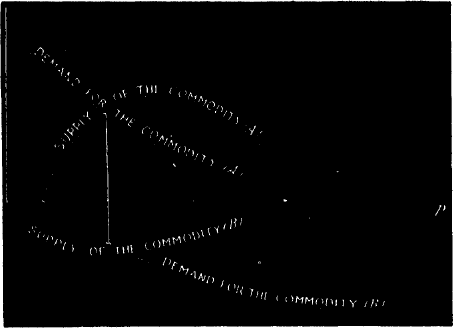
different from zero. From then on the demand for (B) increases as p increases, but will never be able to exceed a certain magnitude, namely the quantity of (B) which would be desired if p were infinite and consequently  were = 0, that is to say, if the commodity (B) could be had for nothing. The demand curve for (B) therefore approaches asymptotically a straight line which is drawn at this distance parallel to the axis of the abscissae. The two curves mentioned so far, by the way, are absolutely independent according to our assumptions.
Each of the other two curves, on the contrary, is totally determined by the form of each of the previous curves. If the demand for (A) is given by the function ϕ(p), the supply of (B), as we have seen, is necessarily represented by p. ϕ(p); in the same way  expresses the supply of (A), if ψ(p) expresses the demand for (B).
A direct consequence of this is, that the point of intersection of the supply and demand curves of (A) must lie vertically above the point of intersection of the supply and demand curves of (B). Both points of intersection determine one and the same value of p, namely the equilibrium price.
As regards the supply curve of the commodity (A) in particular, this has, as can be seen, a highest point and approaches afterwards the axis of the abscissae asymptotically. But although it is quite independent of the form of the demand curve of the same commodity, its intersection point with the latter can lie just as well on the right side of the highest point as on its left side (as in the figure). These two positions of the intersection point correspond to our two above-mentioned cases of stable equilibrium of the price. But this does not prevent these two curves from being able to have more than one point, and if so at least three points of intersection in common, as, for example, is shown by the dotted line [representing the demand for (A)] drawn in our figure.31 If this is the case, the two extreme intersection points, as we can easily convince ourselves, determine prices of stable equilibrium. The middle intersection point, on the contrary, shows no real equilibrium of prices, as was mentioned above, but only a temporary equality of supply and demand.
This interesting result of the theory, which was first noticed by Walras, is impugned in the well-known work by Auspitz and Lieben,32 who assert that ‘the simultaneous validity of both demand curves [of the commodities (A) and (B)] is founded on assumptions which contradict each other.’ In this case, the authors go on to argue, one would have to assume firstly that ‘the prices or proportions of exchange of all other articles’ excluding the commodity (B) are constant against one another; and consequently, that the prices, on both sides, of all articles excluding the commodity (A), but including the commodity (B), are constant.
This objection seems to me to be unfounded. In Walras’s presentation as well as in our examination up to now, no account is taken in principle of the presence of other articles on the market; it is assumed that the demand for (A) comes exclusively from the possessors of the commodity (B) and that the demand for (B) comes exclusively from the possessors of the commodity (A), But we do not at all need to confine ourselves to this purely abstract assumption. If we put instead of the commodity (B) the sum total of all commodities on the market excluding the commodity (A), or what comes to about the same, if by one of the two commodities we understand money, then, at variable money prices of the commodity (A), the demand for (A) (which now comes from all other possessors of goods or consumers) as well as the supply of (A) [which is now determined by the demand on the part of the possessors of (A) for all other commodities] will on the whole have to follow the same course as in the case of only two commodities which we have considered.
The reciprocal proportions of exchange or the money prices of the other commodities exercise their influence, of course; but all these prices can be regarded, in otherwise unchanging circumstances, as dependent on the money price of the commodity (A). A demand and a supply curve of (A), as well as supply and demand curves of money dependent on them [those of the possessors of (A)], will consequently really exist; the supply curve of (A) will, if one draws the variable money price of (A) as abscissa, have a highest point, and from there it will approach the axis of the abscissae asymptotically, etc. The existence of differently characterized intersection points between these curves, as well as the possibility of several intersection points simultaneously, cannot therefore, at least a priori, be denied. The former result can even be regarded as a well-attested fact.
If, to be sure, one assumes, as Auspitz and Lieben do, that the valuation of money on the part of all exchanging persons is constant, then the supply curve of every single commodity must indeed always take a rising course, and we cannot then speak of several intersection points of the curves. This assumption can indeed be made in some cases, but by no means in all.
Let us take a few concrete examples. If, while the yield of the harvest and the size of supplies remain constant, the prices of corn for the year are for any reason higher than usual, and if importation of corn is excluded, one can by no means declare a priori that the supply of this commodity must now grow. It may be that the farmers—hitherto perhaps obliged to deny themselves much—desire to be better fed, now that their income has risen, or else to increase their own consumption of corn. The supply of corn will then, on the contrary, decrease. This, of course, supposes that the valuation of money on the part of the farmers has now decreased considerably; otherwise the raised price would induce them to increase their supplies and consequently to restrict their own consumption.
Or let us take as the commodity to be considered, the so-called ‘commodity labour.’ It is quite a common complaint amongst well-to-do people, that in times of relatively high wages people ‘do not want to work’; and this complaint is probably founded on fact. The worker allows himself more leisure than before if he is better paid, and the supply of labour decreases instead of increasing. At least, this is a possible consequence. But let it be repeated, this can happen only if we assume that the valuation of money on the part of the workers has decreased just because of their increased wages.
The descending part of the supply curve is consequently in both these cases cut by the demand curve (which always follows a descending course). If in these circumstances the two curves chance to run close together for a certain distance, the possibility of several intersection points, i.e. of several states of equilibrium of the same market at different prices, obviously exists.
In most cases, of course, only a very short segment of the theoretically possible supply and demand curves can in reality exist, since greater price fluctuations do not often occur because of other possibilities of purchasing and selling.
When the proportions of exchange of three or several (m) commodities are to be found, we obviously have to consider the total supply and the total demand of each commodity as functions of all proportions of exchange or prices of the commodities concerned. The equalization of the supply and demand of each separate commodity supplies m equations,33 amongst which, however, only m — 1 are independent. The variable prices are here also m — 1 in number in that, for instance, one of the commodities itself is taken as the standard of value.34
A geometrical interpretation is, of course, excluded here. At best, if it is a question of only three commodities, we could speak of supply and demand surfaces, if the quantities of goods concerned, together with the two prices or proportions of exchange of the three commodities, are drawn as co-ordinates in three dimensions.
These indications may suffice to show that the conventional teaching of supply and demand, by means of the marginal utility theory, seems to be capable of considerable extension and deepening. It is true that one is very soon confronted thereby with an almost hopeless entanglement of interacting economic relationships; but if the exact mode of treatment can do nothing else, it will at least be able to distinguish sharply between that which we know or are able to penetrate, and that about which we know, or can know, really nothing at all; and this is, after all, the beginning of all true science.
8—The law of costs. Walras’s theory of production
So far we have only looked at the imaginary case where the valuation, on the part of each of the possessors, of the goods to be exchanged depends solely on the size of the possessed stock and the quantity of the commodity in question obtained by exchange, or, if two or several kinds of goods can partly replace each other, on all of these quantities of goods. This case includes, in reality, perhaps, the daily changes of market prices, and even these only in so far as it is a matter of goods which are intended for immediate consumption. In every other case buyers as well as sellers will keep watch over the future supply and demand and over the possibilities of production and sale in future, by which the present prices must also be influenced. And more especially, if the average level of prices during a longer period, e.g. during one or several years, is uncertain, then the factors of production must be taken into consideration before everything else. It is not simply commodities that are exchanged, but products, and in the last instance the productive services themselves: labour, natural resources and the employment of capital.
But has a new element really come into our problem of exchange? One would be inclined to think that the productive services could be treated in exactly the same way as the commodities, according to the rules of the equality or proportionality of their marginal utility for the owners, i.e. in this case the workers, the land-owners and the capitalists. Indeed, we shall see at once how such a manner of treatment of the problem was attempted by L. Walras.
Whoever desires a certain number of commodities, in fact desires by implication a certain amount of the productive services which are necessary for the production of just these commodities; and he himself has in the end, as means of payment for the goods successively demanded and consumed by him, nothing else to offer but the productive services of which he for his part can dispose, i.e. his labour in any case, then perhaps also the use of landed property or capital which he possesses. It could therefore seem as if the production and the exchange of goods were nothing else but an indirect exchange of the productive services concerned against each other, quite in accordance with the usual rules of the market; and this, moreover, was frequently asserted.
But the matter is certainly not as simple as this. Here the well-known dictum of J. S. Mill (to which he himself, to be sure, gave quite an undue extension) is confirmed, that ‘demand for commodities is not demand for labour’ (or for the other productive services). Production requires time, and the sellers of the productive services will generally not be able or willing to await the completion of the commodities in order to secure their remuneration from the amount realized by the sale: they obtain this remuneration from the proceeds of the production periods already completed. Production will therefore, in reality, never be like the simple market; it consists rather of a series of acts of exchange performed at different times which together span the whole period from the beginning of the production to the sale of the commodity in question. Only if one takes this fact into consideration can one adequately explain to oneself the role of capital in production, that mysterious ‘productivity’ of capital, and obtain at the same time the main key to the phenomenon of capital interest.35 We shall discuss these questions in detail in the next chapter, where it will be our task to comment on the outstanding work done by Böhm-Bawerk. But first let us say something about the so-called law of costs in its older and newer forms.
Classical political economy had, as everybody knows, two ways of explaining exchange values: firstly, by pointing to the relationship between supply and demand—which, however, necessarily proved a little superficial without the inclusion of the concept of marginal utility; and secondly, by asserting that, at least on the home market, the exchange values of goods must finally always coincide with the cost of production. If the profits of the different entrepreneurs are included in the costs, this is certainly self-evident. But in order to be more than a mere triviality, and in order not to move in a hopeless circle, this mode of explanation had to seek for independent reasons for the different elements in costs. We have already seen how Ricardo’s sagacity was able to give this really impossible task at least a formal solution. The element of cost, labour, was determined by the means of subsistence of workers, which was assumed to be approximately constant; rent was eliminated in the known manner; interest, finally, though it could not be determined a priori, was at least represented as a magnitude which is proportional to the magnitude of the capital advanced, or, which was assumed to be the same, to the amount of labour employed.
The modern theory of value could, of course, not approve of this mode of explanation. It noticed at once that the value of the elements of costs is determined in the last resort by nothing else but the value of the goods produced; so that value and costs must always be regarded as magnitudes dependent on each other. To my knowledge, only Leon Walras attempted successfully to do justice to these reciprocal relations and thus actually to lay down ‘the equations of production.’
Walras sets out from the assumption that the real profit of enterprise is cancelled out by the reciprocal competition of entrepreneurs. Thus they are simply compensated for their work of managing the enterprise as other workers are, according to a measure fixed by competition. But then the assumption is made, or rather the fiction is introduced—and in this lies the weak point in Walras’s presentation—that the entrepreneurs would buy ‘on the market of the productive services’ the services needed for their production of goods, namely the use of land, the various uses of capital,36 and finally labour—but not against cash or commodities but simply against the promise to repay the same quantities of these services later after the conclusion of the production. But instead of really doing this, they would sell ‘on the market of the products’ the finished goods to those who offer the productive services and who appear now as consumers and, consequently, as buyers. In this way the entrepreneurs would be absolved from their promise to return the productive services as such; because the exchange value of the products must be equal to the productive services necessary for their production, if equilibrium between production and consumption is to exist and if the entrepreneurs are to have neither loss .nor profit. The productive services themselves, therefore, are here exchanged against each other ‘en fin de compte,’ as Walras explicitly remarks, and this according to the principle of marginal utility; since the existing productive services possess a certain utility and marginal utility—directly for the owners themselves, as well as indirectly, in the form of finished products, for the consumers of these products (who on their part have also to dispose of productive services).
However ingenious this concept—developed by Walras in a strictly mathematical form—may appear, it nevertheless suffers from a fundamental mistake, which must necessarily render the result illusory. And this mistake is to have completely overlooked the significance of time in production. Although the productive services are measured by Walras according to units of time—so many years of lease, so many working days, etc.—in his presentation of the matter, the use, for instance, of one hectare of land for one year could be paid for in such a way that the owners of the land would be allowed at some future date to use a similar hectare of land for one year; and the same is true with regard to labour. This is obviously not the case. It is also untrue that the owners of land are remunerated by the proceeds from the products made with their assistance—still less the workers; rather, they get their payment in advance. If this were not so, one could ‘en fin de compte’ completely overlook the part of capital in production—for the different parts of capital, machines, buildings, etc., are in the last instance products of labour and forces of nature—so that the production would finally have to be regarded as being completely without capital.
This mistake of Walras is connected with the peculiar interpretation of the concept of capital, to which we shall come back in the next chapter. He wants only durable goods, as, for instance, buildings and machines, to be considered as capital; on the other hand, consumable goods, as ‘revenues,’ he wants to put on a par with capital expenditure. What Adam Smith called circulating capital, raw materials, half-finished goods, etc., as well as the means of subsistence of workers and of other persons employed in the production, are, according to Walras, revenues, and bear no interest themselves (though they can be used for the production of new interest-bearing parts of capital). This is, of course, not correct. However the scientific terminology is arranged, the actual facts cannot be altered. Consumable goods certainly bear interest, if they are used for production or otherwise as capital; and the fact that they do this is just the main problem of the theory of capital interest.
At this point, therefore, we are led directly towards a thorough investigation into the nature of capital interest, to which we shall now proceed.
_______________
37 The ratio of exchange of two objects will consequently depend, even in the case of the simple exchange, on at least four factors, namely on the marginal utility of each object for each of the exchanging persons.
38 Strictly speaking, however, a decreasing utility will have to be distinguished also within the different modes of application of the supply of corn. The marginal utility of corn for the colonist will therefore finally be the same in all modes of application, however different their importance for his welfare may be. Compare the following section.
39 An extract from this part of my work was published in Conrads Jahrbücher, December 1893.
40 A true method of calculating will probably not be arrived at for a long time.
41 It is, of course, assumed that for very small changes the marginal utility is approximately constant.
42 Mathematische Begründung der Volkswirtschaftslehre, Leipzig 1885.
43 The use of the word ‘value’ in a mathematical sense, that is to say, simply as synonymous with ‘magnitude,’ which occurs here and quite often in what follows, will, I hope, give no occasion for misunderstanding.
44 Properly speaking, one therefore needs only to know the three ratios of these four values, as we shall see.
45 That is to say, the area which is bounded by the curve, both the axes of co-ordinates, and the ordinate in question.
46 That is, the commodity in terms of which price will be expressed. (Translator’s note.)
47 This circumstance was put forward by Launhardt (p. 37) as a general rule, but it is evidently only valid under the above simplifying assumptions, which are, however, by no means general.
48 To the possessor of the sheep, a single sheep would at the beginning appear to have no value at all. One, must therefore presume that the hundredth sheep can neither be fed nor consumed nor used by him in another way. The possibility of some other exchange we exclude on principle. For A, on the contrary, the value of one sheep is initially 10 Marks, etc.
49 For A’s total utility increases by

and B’s by

This characteristic feature also was noticed by Launhardt. It is valid, however, only under the above-made assumptions, which, as he asserts, are by no means ‘to be regarded as approximately right,’ but at best permissible by way of example.
50Cf. Marshall, Principles of Economics, Appendix, note XII.
51 Since the x1, x2, ...; y1, y2, . . .generally become different from thex’1, x’2, . . .;y’1, y’2, . . . one must, of course, suppose that every possessor generally does business with several possessors of the commodities desired by him.
52 For one has, as can easily be seen,

53 Considered geometrically, it is represented by a curve which can nearly always be replaced by a broken line, but not by one and the same straight line.
54 In Jevons’s book these signs are represented by ϕ1( ), ϕ2( ), ψ1( ) and ψ2( ).
55 Jevons’s formula could be applied in one case only, namely when the marginal utility function concerned may be replaced by an approximating function of the first degree which is identical for all members of the market party in question. (It is a somewhat less special case than the one mentioned above, where this function must be identical for the members of both parties.) Then, as can easily be seen, the arithmetical mean of all the marginal utility values would only be dependent on the acquired or remaining total supply of the community concerned and on the number of the possessors in question. Jevons’s formula, which in that case would probably assume the form

would then indeed be sufficient to determine the proportion of exchange at which equilibrium rules on the market.
56 Of other selling possibilities and of the production of the goods concerned, no account is taken here.
57 Cf. the above treatment of this problem in respect of two exchanging persons.
58 Launhardt reproached Walras with ‘great error’ in supposing that ‘what is generally best would most certainly be reached by the natural effect of the rule of free competition.’ As far as I know, however, Walras has never asserted this, although he expresses himself a little incautiously upon this subject.
However, it is precisely at this point that Launhardt himself goes seriously astray; for he believes that he has proved that ‘in the case of an exchange at equilibrium prices the greatest profit, economically speaking, is reached, if we assume that the exchange takes place in one single transaction’ (loc. cit., p. 38). This is completely wrong. What Launhardt has proved in the passage in question (p. 28) is something quite different: that for each of the exchanging persons, and consequently for all of them together, as was shown above, the highest satisfaction attainable at this price arises from exchange at equilibrium price. But he has not shown, and it is not generally true, that this total satisfaction would be greater than that which could arise from any other price. This is quite obvious if we suppose, for example, that the marginal utility in respect of both commodities for one of the exchanging persons (or parties) is so small that the gain of utility to this person (or party) cannot be taken into consideration at all. Then it is clear that the total gain also becomes greater in proportion as the other party is able to direct the price to its advantage.
59 The problem of exchange of two commodities also could, of course, have been treated in this way. This would express the more general case, where each of the exchanging persons at first possess both commodities, and according to the level of prices acts as buyer of the one commodity and seller of the other, or vice versa.
60 Obviously, any one of the commodities could itself be conceived as the standard of value, in which case the price of this commodity would = 1. For the sake of symmetry, however, we have adopted a different standard of value, as in fact, in most cases, agrees best with reality ; for even if two commodities are exchanged for each other in a simple way by reciprocal credit between two business-men, their value is initially almost always reckoned in money.
61 In this case, the notation used above will have to be altered correspondingly.
62 Theory of Political Economy, 2nd edition, p. 124 ff.
63 We must here draw attention to tome discontinuities of our functions previously laid down, which we have not discussed so far. Our equations of value
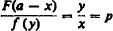
no longer have any significance if they cannot be satisfied by a positive y and by an x which it at the same time positive and smaller than a. If p has already become to small that x, and consequently y alto, are zero, the above equations must, if p continues to decreases, be replaced by x = 0, y = 0; that is to say, the possessor in question no longer exchanges at all.
If, on the contrary, x becomes equal to a, ρ increasing, then the possessor will tell at this price his whole supply of (A). If the price is a little higher still, he will generally, even at this price, exchange hit whole supply, but not more, since he does not possess any more of (A). Our equations must then in the first instance give way to the more simple relationships x = a,y = pa.
If, moreover, we consider the discontinuities of the individual consumption and demand, x and y can by no means be regarded as continuous functions of p.
64 Strictly speaking, however, this is generally only the case when the commodities (A) and (B) cannot replace each other, so that, as we have assumed above, the marginal utility of one of them depends simply on the quantity owned of this commodity or on the quantity acquired, and not at the same time on the quantity acquired or the quantity owned of the other commodity. But if both commodities can replace each other completely or partly, it is a different matter. Suppose, for instance, that (B) is wheat and (A) potatoes. If a possessor of wheat can cover with it the whole of his annual food requirements, but potatoes are cheaper in proportion to their nutritive value, then he will probably exchange every year a certain quantity of wheat for the cheaper potatoes. But if now the price of potatoes (expressed in terms of wheat) were to fall still lower, he could first of all procure for himself the same quantity of potatoes in exchange for a smaller outlay of wheat. But since he thus keeps more wheat, his annual requirements in the matter of food could be even more than covered in this way. Therefore, if it is for him only a question of satisfying these requirements, he will be able to keep without loss a still greater quantity of wheat and content himself with a smaller quantity of potatoes, so that his demand for potatoes would finally decrease with the falling price instead of increasing.
65 Of the production of goods no account is taken here, of course.
66 For, in accordance with his assumptions repeatedly mentioned, a simple marginal utility function (in respect of each of the commodities) was drawn, identical for both parties. Here, of course, the curves can only have one single (real) point of intersection in common.
67 In this case, the curves of the commodity (B) also would, of course, intersect at three points, lying vertically under the points of intersection of the curves of commodity (A).
68 Untersuchungen Uber die Theorie des Preises, Preface, p. XXIII.
69 In the case of three commodities, these are identical with equations (9).
70 In the case of three commodities the equations (7), with the help of the equations (8), may be considered solved in x, y, z, etc.; in which case the positive x’s and y’s are conceived as (individual) demands and the negative ones as supplies, etc. (the appropriate + or—sign must in this case, of course, be regarded as given by the nature of the task).
71 Even the exchange of finished goods requires time. In so far as it does this, it can be added to the production and is itself a source of capital interest.
72 We shall soon see what is meant by these according to Walras.
- 1Wicksell’s work was like a mountain from whose flanks divergent streams run down and bring fertility to widely separated fields, only to merge again later into a single broad river. For the fiercest and most exciting battle of economic theory in the first half of the twentieth century was that fought in the middle thirties between the adherents of Professor Hayek’s over-investment theory of the business cycle, on the one hand, and Lord Keynes and his lieutenants on the other. No two theories, it seemed at that time, could be more directly opposed to each other in method and conclusions. Yet in both of the books from which the controversy started, Keynes’s Treatise on Money which appeared in 1930 and Professor Hayek’s Prices and Production which was published in 1931, Wicksell’s name was prominent and the power and insight of his analysis acknowledged. And the solution of this paradox, as we can now discern it, is no less surprising: Lord Keynes was setting out the theory of under-employment and Professor Hayek that of over-employment; these were in a fundamental sense two sides of the same theory, one of them describing what happens when effective demand for productive resources is less than the available resources and the other explaining the mechanism of boom, crisis, and collapse which result from an attempt to use more resources than there are. The flat contradiction in which the two theories seemed to confront each other was illusory; they were no more contradictory than the two statements, that if a stone is denser than water it will sink, and if a cork is less dense than water it will float. The basis of Professor Hayek’s theory was the Austrian theory of capital, which Böhm-Bawerk had founded and Wicksell had interpreted and refined. Professor Hayek showed how the power of the banking system to create money and thus, through an ‘artificially’ low market rate of interest, delude the economy into thinking that it had a larger potential flow of real investible resources than in fact it had, could lead to a crisis where people might find themselves rich in half-constructed railways but starving for lack of today’s dinner; and it is precisely the mechanism and nature of the ultimate dependence of our choice of methods of production upon our available reserves of sustenance that Wicksell, following Böhm-Bawerk and in essence the wage-fund theorists, is concerned with in Über Wert, Kapital und Rente. The banks’ power to create money? But this is also what Keynes was concerned with in his Treatise, and again what Wicksell had been concerned with in his famous book Geldzins und Güterpreise, published in 1898, in which the essential and many-fold importance of time in the economic process is made the king-pin of a fundamental synthesis.
- 2In the early 1870’s Jevons, Menger and Walras had independently and almost simultaneously created the marginal utility theory of value, which explains how the ratios in which different goods exchange for one another are determined by the balancing of marginal subjective desires. But there was one startling omission from the list of things whose value in terms of each other could be thus accounted for. The subjective theory of relative prices depends on the principle of diminishing marginal utility; utility, that is to say, for purposes of consumption. But money is not consumed, it is merely exchanged or stored, its utility must therefore be of quite a different kind from that of consumable goods, and its value in terms of these goods must require some different principle for its explanation. In Wicksell’s own words ‘It is of no consequence whatever to a purchaser that he has to pay more for one commodity provided he can be certain of himself obtaining a correspondingly higher price for some other commodity.’ The general level of absolute or money prices was, in fact, left unexplained by the marginal utility theory of value, and some other account had to be given of it. Until the appearance of Geldzins und Güterpreise the prevailing explanation was the Quantity Theory, whose crude arithmetical argument presents a striking contrast, às Professor Hicks has pointed out, with the subtlety of the theory of value. The Quantity Theory assumes that the frequency with which money units change hands, when averaged over all the money units in existence, is fairly constant through time, and from this deduces that the total money value of transactions per unit of time is proportional to the number of money units in existence. Thus so long as the size of the stream of goods being bought and sold remains in some sense unchanging, the general level of prices will depend on the Quantity of Money, that is, on the number of money units in existence.
- 3Wicksell by no means rejected the Quantity Theory in toto, but he was disturbed by its dependence, in its classical form, on the assumption of a constant velocity of circulation of money: ‘The Quantity Theory,’ he says, ‘is theoretically valid so long as the assumption of ceteris paribus is firmly adhered to. But among the “things” that have to be supposed to remain “equal” are some of the flimsiest and most intangible factors in the whole of economics—in particular the velocity of circulation of money, to which, in fact, all the others can be more or less directly referred back.’ How strongly these words suggest Lord Keynes’s later pre-occupation with the elusive essence of money and its recalcitrance to a purely mechanical, non-psychological analysis. Ricardo had, of course, believed that there was an intimate and indeed an obvious connection between changes in the quantity of money, changes in the general level of prices (or its inverse, the value of money) and the level of the interest-rate. A willingness of the banking system to increase continually the outstanding amount of its loans or of its note issue could express itself, and become effective, only by a low rate of interest. As soon as the outflow of extra money into public circulation ceased, prices of goods would soon adjust themselves to this new larger quantity of the circulating medium; at these new higher prices, the quantity of money would no longer be in effect any greater than before, and the interest-rate would accordingly return to its former level. But Wicksell, though agreeing with Ricardo’s conclusion, did not think that Ricardo had penetrated deeply enough into the mechanism by which interest, the quantity of money, and the price-level are connected with each other. For what, he asked, is a low rate of interest? By what criterion do we judge when the rate of interest is low? By comparison with what is it low?
- 4In the early 1870’s Jevons, Menger and Walras had independently and almost simultaneously created the marginal utility theory of value, which explains how the ratios in which different goods exchange for one another are determined by the balancing of marginal subjective desires. But there was one startling omission from the list of things whose value in terms of each other could be thus accounted for. The subjective theory of relative prices depends on the principle of diminishing marginal utility; utility, that is to say, for purposes of consumption. But money is not consumed, it is merely exchanged or stored, its utility must therefore be of quite a different kind from that of consumable goods, and its value in terms of these goods must require some different principle for its explanation. In Wicksell’s own words ‘It is of no consequence whatever to a purchaser that he has to pay more for one commodity provided he can be certain of himself obtaining a correspondingly higher price for some other commodity.’ The general level of absolute or money prices was, in fact, left unexplained by the marginal utility theory of value, and some other account had to be given of it. Until the appearance of Geldzins und Güterpreise the prevailing explanation was the Quantity Theory, whose crude arithmetical argument presents a striking contrast, às Professor Hicks has pointed out, with the subtlety of the theory of value. The Quantity Theory assumes that the frequency with which money units change hands, when averaged over all the money units in existence, is fairly constant through time, and from this deduces that the total money value of transactions per unit of time is proportional to the number of money units in existence. Thus so long as the size of the stream of goods being bought and sold remains in some sense unchanging, the general level of prices will depend on the Quantity of Money, that is, on the number of money units in existence.
- 5Wicksell found the answer by looking back at that branch of economic theory which had been his earliest concern, and which he had expounded in Über Wert, Kapital und Rente, the theory of capital. The more highly articulated, specialized and elaborate the system of equipment becomes through which men apply their effort to their natural environment, the larger the ultimate reward to a given effort, but to carry the elaboration from a given degree to a still higher one implies the foregoing of, say, N units of consumable output which would have been available in year T in exchange for the prospect of an extra m units per year in perpetuity, beginning in year T + 1. The ratio then represents, nearly enough, what Wicksell called the natural rate of interest. It is a measure of the ‘worthwhileness,’ at any stage of the development of the economy’s total assemblage of productive equipment, of adding one more ‘unit’ to that equipment. How are such units to be defined? In making such an addition to their total equipment the people composing the economy are, in effect, postponing the consumption of some of the output which their current input of productive services entitles them to consume. The average time elapsing between the moment when a dose of work or of the services of nature is put into the productive process, and the moment when the dose of consumable product attributable to that dose of work comes out, is thus lengthened, and this average time, Böhm-Bawerk’s ‘average period of production,’ can serve as a measure of the size of the total capital equipment. A balanced assemblage of such capital equipment, comprising tools, machines, buildings, flocks and herds, growing crops, forests, mines, libraries, transportation systems, and indeed the whole material frame of civilized life, is like a great reservoir into which human effort has been poured and from which the means of living can be drawn off. The metaphor of a reservoir will serve to illustrate the meaning and use of the average period of production. If a heavy shower of rain falls on an actual reservoir on a particular day, some of this rainwater will flow out for use on that same day, but a large proportion will remain for many days or weeks mixed with the rest of the reservoir’s contents, and it would indeed be possible to describe the size of the reservoir by saying how long, on the average, with a given outflow, each drop of water that enters it remains in it. The natural rate of interest, then, is a measure of the strength of the inducement to increase the average period of production; and in a given set of other circumstances, the numerical value of the natural rate, the percentage , will be a decreasing function of the length of the average period of production. But these ‘Other circumstances’ are, of course, just as important, in determining the natural rate of interest, as the average period of production itself is. In Wicksell’s own words: ‘The natural rate is not fixed or unalterable in magnitude. ... In general, we may say, it depends on the efficiency of production, on the available amount of fixed and liquid capital, on the supply of labour and land, in short on all the thousand and one things which determine the current economic position of a community; and with them it constantly fluctuates.’ Now it was this natural rate of interest by comparison with which, at any time, the rate of interest charged by the banks for money loans could be said to be high or low. ‘Now let us suppose,’ says Wicksell, ‘that the banks and other lenders of money lend at a different rate of interest, either lower or higher, from that which corresponds to the current value of the natural rate of interest on capital. The economic equilibrium of the system is ipso facto disturbed. If prices remain unchanged, entrepreneurs will in the first instance obtain a surplus profit... over and above their real entrepreneur profit or wage. This will continue to accrue so long as the rate of interest [on loans of money] remains in the same relative position. They will inevitably be induced to extend their business in order to exploit to the maximum extent the favourable turn of events,... As a consequence, the demand for services, raw materials, and goods in general will be increased, and the price of commodities must rise.’
- 6Wicksell found the answer by looking back at that branch of economic theory which had been his earliest concern, and which he had expounded in Über Wert, Kapital und Rente, the theory of capital. The more highly articulated, specialized and elaborate the system of equipment becomes through which men apply their effort to their natural environment, the larger the ultimate reward to a given effort, but to carry the elaboration from a given degree to a still higher one implies the foregoing of, say, N units of consumable output which would have been available in year T in exchange for the prospect of an extra m units per year in perpetuity, beginning in year T + 1. The ratio then represents, nearly enough, what Wicksell called the natural rate of interest. It is a measure of the ‘worthwhileness,’ at any stage of the development of the economy’s total assemblage of productive equipment, of adding one more ‘unit’ to that equipment. How are such units to be defined? In making such an addition to their total equipment the people composing the economy are, in effect, postponing the consumption of some of the output which their current input of productive services entitles them to consume. The average time elapsing between the moment when a dose of work or of the services of nature is put into the productive process, and the moment when the dose of consumable product attributable to that dose of work comes out, is thus lengthened, and this average time, Böhm-Bawerk’s ‘average period of production,’ can serve as a measure of the size of the total capital equipment. A balanced assemblage of such capital equipment, comprising tools, machines, buildings, flocks and herds, growing crops, forests, mines, libraries, transportation systems, and indeed the whole material frame of civilized life, is like a great reservoir into which human effort has been poured and from which the means of living can be drawn off. The metaphor of a reservoir will serve to illustrate the meaning and use of the average period of production. If a heavy shower of rain falls on an actual reservoir on a particular day, some of this rainwater will flow out for use on that same day, but a large proportion will remain for many days or weeks mixed with the rest of the reservoir’s contents, and it would indeed be possible to describe the size of the reservoir by saying how long, on the average, with a given outflow, each drop of water that enters it remains in it. The natural rate of interest, then, is a measure of the strength of the inducement to increase the average period of production; and in a given set of other circumstances, the numerical value of the natural rate, the percentage , will be a decreasing function of the length of the average period of production. But these ‘Other circumstances’ are, of course, just as important, in determining the natural rate of interest, as the average period of production itself is. In Wicksell’s own words: ‘The natural rate is not fixed or unalterable in magnitude. ... In general, we may say, it depends on the efficiency of production, on the available amount of fixed and liquid capital, on the supply of labour and land, in short on all the thousand and one things which determine the current economic position of a community; and with them it constantly fluctuates.’ Now it was this natural rate of interest by comparison with which, at any time, the rate of interest charged by the banks for money loans could be said to be high or low. ‘Now let us suppose,’ says Wicksell, ‘that the banks and other lenders of money lend at a different rate of interest, either lower or higher, from that which corresponds to the current value of the natural rate of interest on capital. The economic equilibrium of the system is ipso facto disturbed. If prices remain unchanged, entrepreneurs will in the first instance obtain a surplus profit... over and above their real entrepreneur profit or wage. This will continue to accrue so long as the rate of interest [on loans of money] remains in the same relative position. They will inevitably be induced to extend their business in order to exploit to the maximum extent the favourable turn of events,... As a consequence, the demand for services, raw materials, and goods in general will be increased, and the price of commodities must rise.’
- 7Wicksell found the answer by looking back at that branch of economic theory which had been his earliest concern, and which he had expounded in Über Wert, Kapital und Rente, the theory of capital. The more highly articulated, specialized and elaborate the system of equipment becomes through which men apply their effort to their natural environment, the larger the ultimate reward to a given effort, but to carry the elaboration from a given degree to a still higher one implies the foregoing of, say, N units of consumable output which would have been available in year T in exchange for the prospect of an extra m units per year in perpetuity, beginning in year T + 1. The ratio then represents, nearly enough, what Wicksell called the natural rate of interest. It is a measure of the ‘worthwhileness,’ at any stage of the development of the economy’s total assemblage of productive equipment, of adding one more ‘unit’ to that equipment. How are such units to be defined? In making such an addition to their total equipment the people composing the economy are, in effect, postponing the consumption of some of the output which their current input of productive services entitles them to consume. The average time elapsing between the moment when a dose of work or of the services of nature is put into the productive process, and the moment when the dose of consumable product attributable to that dose of work comes out, is thus lengthened, and this average time, Böhm-Bawerk’s ‘average period of production,’ can serve as a measure of the size of the total capital equipment. A balanced assemblage of such capital equipment, comprising tools, machines, buildings, flocks and herds, growing crops, forests, mines, libraries, transportation systems, and indeed the whole material frame of civilized life, is like a great reservoir into which human effort has been poured and from which the means of living can be drawn off. The metaphor of a reservoir will serve to illustrate the meaning and use of the average period of production. If a heavy shower of rain falls on an actual reservoir on a particular day, some of this rainwater will flow out for use on that same day, but a large proportion will remain for many days or weeks mixed with the rest of the reservoir’s contents, and it would indeed be possible to describe the size of the reservoir by saying how long, on the average, with a given outflow, each drop of water that enters it remains in it. The natural rate of interest, then, is a measure of the strength of the inducement to increase the average period of production; and in a given set of other circumstances, the numerical value of the natural rate, the percentage , will be a decreasing function of the length of the average period of production. But these ‘Other circumstances’ are, of course, just as important, in determining the natural rate of interest, as the average period of production itself is. In Wicksell’s own words: ‘The natural rate is not fixed or unalterable in magnitude. ... In general, we may say, it depends on the efficiency of production, on the available amount of fixed and liquid capital, on the supply of labour and land, in short on all the thousand and one things which determine the current economic position of a community; and with them it constantly fluctuates.’ Now it was this natural rate of interest by comparison with which, at any time, the rate of interest charged by the banks for money loans could be said to be high or low. ‘Now let us suppose,’ says Wicksell, ‘that the banks and other lenders of money lend at a different rate of interest, either lower or higher, from that which corresponds to the current value of the natural rate of interest on capital. The economic equilibrium of the system is ipso facto disturbed. If prices remain unchanged, entrepreneurs will in the first instance obtain a surplus profit... over and above their real entrepreneur profit or wage. This will continue to accrue so long as the rate of interest [on loans of money] remains in the same relative position. They will inevitably be induced to extend their business in order to exploit to the maximum extent the favourable turn of events,... As a consequence, the demand for services, raw materials, and goods in general will be increased, and the price of commodities must rise.’
- 8Properly speaking, one therefore needs only to know the three ratios of these four values, as we shall see.
- 9Some Leading Principles of Political Economy newly expounded.
- 10Principles, Ch. I, Section V.
- 11It is said to have been in fact put forward by a certain Dr. Anderson before Adam Smith, but at that time remained unconsidered.
- 12There was, in my opinion, a good reason why Ricardo, in showing up these weaknesses, did not treat capital property in the same way as landed property. The former had, at least, the advantage over landed property that its object, capital, had first to be created; and the existence of large amounts of capital can only have beneficial consequences for society itself, which could hardly be affirmed of the monopoly of landed property. Adolf Held’s reproaches, Zwei Bücher zur sozialen Geschichte Englands, are therefore unfounded in my opinion. As to Ricardo’s alleged ‘harshness’ towards the working classes, it should be mentioned that he never represented the low level of wages as the only possible situation for workers, still less as something which is pleasant in itself. How in his opinion workers could achieve a better position at that time, Ricardo has partly shown directly, and partly indicated indirectly, by accepting Malthus’s doctrine. As I see it, men like Malthus and Ricardo, who tried to search out the true reason of social conditions and particularly of the low standard of living of workers, have done more for their welfare than those economists who sometimes make a great show of friendly feelings towards the workers, but do not want to learn the means which could really have remedied their situation. A German economist, very well known in recent times and very praiseworthy in different ways, has actually delivered an academic speech on the causes of social want without uttering a single word on the population question. In the Revue d’Economie politique of November 1891, the same author made the astonishing statement that Karl Marx has ‘refute la these, en consequence de laquelle le salaire devait dépendre de l’augmentation ou de la diminution de la population totale, au lieu de dépendre de l’excès existant dans chaque industrie, et cela de telle manière qu’elle ne devrait plus ètre soutenue dans les cercles scientifiques.’ Probably as a proof of this alleged victory of Marx over Ricardo and Malthus, it is later mentioned that the attempts of the coal-miners of Durham and Northumberland to improve their situation during the prosperous period that followed the Franco-Prussian war, failed because new workers from other branches of industry came from all parts of the United Kingdom. ‘Ce fut surtout des matelots qui s’y rendirent.’
- 13If I am not wrong, the so-called specular iron-ore.
- 14This expression occurs only here and there in Marx’s work—e.g. on page 96, n. 80, of the third edition of Das Kapital—but it expresses exactly his true meaning.
- 15If working time alone determined exchange value, it would make no difference to the value or to the quantity of the product whether, for example, 10 workers took 10 years to produce it or 100 workers a single year. This, in fact, cannot be true, because otherwise it would never be profitable to invest capital in the longer period of production.
- 16For one has, as can easily be seen,
- 17Considered geometrically, it is represented by a curve which can nearly always be replaced by a broken line, but not by one and the same straight line.
- 18In Jevons’s book these signs are represented by ϕ1( ), ϕ2( ), ψ1( ) and ψ2( ).
- 19Jevons’s formula could be applied in one case only, namely when the marginal utility function concerned may be replaced by an approximating function of the first degree which is identical for all members of the market party in question. (It is a somewhat less special case than the one mentioned above, where this function must be identical for the members of both parties.) Then, as can easily be seen, the arithmetical mean of all the marginal utility values would only be dependent on the acquired or remaining total supply of the community concerned and on the number of the possessors in question. Jevons’s formula, which in that case would probably assume the form
- 20Of other selling possibilities and of the production of the goods concerned, no account is taken here.
- 21Cf. the above treatment of this problem in respect of two exchanging persons.
- 22Launhardt reproached Walras with ‘great error’ in supposing that ‘what is generally best would most certainly be reached by the natural effect of the rule of free competition.’ As far as I know, however, Walras has never asserted this, although he expresses himself a little incautiously upon this subject.
- 23The problem of exchange of two commodities also could, of course, have been treated in this way. This would express the more general case, where each of the exchanging persons at first possess both commodities, and according to the level of prices acts as buyer of the one commodity and seller of the other, or vice versa.
- 24Obviously, any one of the commodities could itself be conceived as the standard of value, in which case the price of this commodity would = 1. For the sake of symmetry, however, we have adopted a different standard of value, as in fact, in most cases, agrees best with reality ; for even if two commodities are exchanged for each other in a simple way by reciprocal credit between two business-men, their value is initially almost always reckoned in money.
- 25In this case, the notation used above will have to be altered correspondingly.
- 26Theory of Political Economy, 2nd edition, p. 124 ff.
- 27We must here draw attention to tome discontinuities of our functions previously laid down, which we have not discussed so far. Our equations of value
- 28Strictly speaking, however, this is generally only the case when the commodities (A) and (B) cannot replace each other, so that, as we have assumed above, the marginal utility of one of them depends simply on the quantity owned of this commodity or on the quantity acquired, and not at the same time on the quantity acquired or the quantity owned of the other commodity. But if both commodities can replace each other completely or partly, it is a different matter. Suppose, for instance, that (B) is wheat and (A) potatoes. If a possessor of wheat can cover with it the whole of his annual food requirements, but potatoes are cheaper in proportion to their nutritive value, then he will probably exchange every year a certain quantity of wheat for the cheaper potatoes. But if now the price of potatoes (expressed in terms of wheat) were to fall still lower, he could first of all procure for himself the same quantity of potatoes in exchange for a smaller outlay of wheat. But since he thus keeps more wheat, his annual requirements in the matter of food could be even more than covered in this way. Therefore, if it is for him only a question of satisfying these requirements, he will be able to keep without loss a still greater quantity of wheat and content himself with a smaller quantity of potatoes, so that his demand for potatoes would finally decrease with the falling price instead of increasing.
- 29Of the production of goods no account is taken here, of course.
- 30For, in accordance with his assumptions repeatedly mentioned, a simple marginal utility function (in respect of each of the commodities) was drawn, identical for both parties. Here, of course, the curves can only have one single (real) point of intersection in common.
- 31In this case, the curves of the commodity (B) also would, of course, intersect at three points, lying vertically under the points of intersection of the curves of commodity (A).
- 32Untersuchungen Uber die Theorie des Preises, Preface, p. XXIII.
- 33In the case of three commodities, these are identical with equations (9).
- 34In the case of three commodities the equations (7), with the help of the equations (8), may be considered solved in x, y, z, etc.; in which case the positive x’s and y’s are conceived as (individual) demands and the negative ones as supplies, etc. (the appropriate + or—sign must in this case, of course, be regarded as given by the nature of the task).
- 35Even the exchange of finished goods requires time. In so far as it does this, it can be added to the production and is itself a source of capital interest.
- 36We shall soon see what is meant by these according to Walras.
- 37‘There remains, however, one outstanding attempt at a systematic treatment, namely Knut Wicksell’s Geldzins und Güterpreise, published in German in 1898, a book which deserves more fame and much more attention than it has received from English-speaking economists. In substance and intention Wicksell’s theory is closely akin ... to the theory of this Treatise.’
- 38Interest and Prices, by Knut Wicksell, translated by R. F. Kahn (Macmillan and Co. Ltd., London 1936) p. 39.
- 39Interest and Prices, p. 42.
- 40See ‘A suggestion for simplifying the theory of money,’ by J. R. Hicks, Economica, New Series, No. 5
- 41In Über Wert, Kapital und Rente Wicksell treated highly durable goods as ‘Rentengüter,’ that is, goods whose durability renders them economically akin to the self-maintaining forces of nature.
- 42Interest and Prices, p. 105.
- 43Interest and Prices, p. 106.
- 44In order to be able in this case to determine the constants α, β, α’, β’, it is necessary to know for at least two values of x which belong to this sphere, the corresponding four values of the functions of the marginal utilities F(a − x) and f (x). If we suppose that for x = b the marginal utility of corn is ν and the marginal utility of the corn converted into spirits ν’, and that for x = c their values are w and w’ respectively, α, β, α’, β’ can easily be expressed by ν, w, ν’ and w’, and we obtain
- 45As regards labour, this is a consequence of the reciprocal competition of workers, whereby wages are always reduced to one and the same level. Here, of course, one must meet the objection that in fact different kinds of labour are generally rewarded very unequally. Ricardo, indeed, has not given sufficient thought to this fact. He simply pointed—as Adam Smith did before him—to the effect of competition, which has apparently been the laying down of a fixed scale of reward for qualified labour which, during longer or shorter periods, remains unchanged. This is not correct, as Cairnes especially has shown in detail : between different grades of workers or of society in general no effective competition exists.
- 46The theoretical difficulty presented by this was not solved by Ricardo; and of course it never can be solved in such a way that this proportionality between prices and quantities of labour would still hold good. It should be remembered, however, that here, too, Ricardo has correctly understood the sequence of cause and effect; if money wages rise (which in his view could only happen over longer periods as a result of the greater difficulty in producing the means of maintenance of workers, although in general such a rise can be understood as the consequence of every increase of capital), then the introduction of machines which before proved unproductive will now become more profitable, as he has shown in an ingenious example. The price of machinery, that is to say, includes profit as well as wages. As this profit, like all the others, must fall when wages rise, the price of machines can consequently never rise in the same proportion as wages. According to the more modern terminology, this means that every increase of wages encourages a lengthening of the period of production, which occupies more time but is more productive, whereby the wage increase is partly compensated. Indeed, in this example of Ricardo’s, the fine theories with which Böhm-Bawerk has recently enriched the subject lie enclosed as in the bud. In these theories the relationships between the rate of interest and wages appear in a strong light, in which, however, they are seen to be less simple than was assumed in Ricardo’s ‘iron’ law of wages or in the wage fund theory.
- 47It is known that the last-mentioned point in particular gave rise to the ingenious theory of rent which bears Ricardo’s name, though it really originates from Malthus and Sir Richard West. With growth of population and increasing capital, the demand and prices for agricultural products rise, ceteris paribus; this leads to the cultivation of poorer land as well as a more intensive cultivation of land already under the plough. The owners of better land, or the landowners generally, are consequently able to appropriate to themselves as rent from this monopoly a greater and greater share, absolute and relative, of the yield of land. Only the poorest land gives no rent; the last labourer engaged in cultivation only raises products equal in value to his own means of maintenance (including the usual interest, in cases where these were advanced to him by the capitalist). At this extreme point the products of agriculture, in respect of their exchange value, come under the same rules as were valid in actual industry. It is the labour engaged on the poorest land, or, more generally speaking, that agricultural labour which provides no rent, but, nevertheless, does yield profit, that determines, in Ricardo’s view, the value of agricultural products. The rule of labour as a measure of value was therefore also applied in this connexion, though, as one finds, in an entirely formal manner. Proportionality of commodity prices with the quantity of labour employed in the production of these goods, is here no longer mentioned.
- 48A more searching analysis of economic phenomena would certainly have made possible a scientific extension of Ricardo’s theory of value. Such an extension, however, was not undertaken; on the contrary, this theory underwent a completely unscientific and paradoxical exaggeration at the hands of two completely opposed schools, the harmony economists (Bastiat among others) on the one hand, and the socialists on the other. The dispassionate and purely scientific investigation of the English scholars had unmercifully exposed the weaknesses of our modern economic life. It now became the task of the defender of the existing order of society to conceal or explain away these weaknesses as far as possible. It was the aggressors’ task, on the contrary, to show them in a particularly strong light. Both trends met strangely in the attempt to establish labour not only as a formal measure of exchange value, but—and from this attempt Ricardo wisely abstained—also as the real cause and substantial ground of value.
- 49In Ricardo’s system, as we have seen, not only labour, but also capital profit and ground-rent, claimed to get their share of the fruits of production. But are not the latter themselves products of labour? asked Bastiat and his school. Is not capital itself produced by labour, and does not the fertility of the cultivated land depend on the labour of former generations? They answered both these questions in the affirmative, and believed they had achieved by this a considerable improvement on Ricardo’s theory. All value became now an indirect or direct product of labour; not only the true capitalist but also the owner of landed property obtained as his profit only the reward of his own and his ancestors’ labour, or the reward of his renunciation in not having consumed the fruits of this labour. It needs few words to show how absurd this view is, especially as regards landed property. Let us look merely at the extreme cases. What human hand ever gave value to our forests, coal-fields, ore-seams, natural meadows and pastures, fish-ponds, etc.; what human hand ‘created’ the source of returns which they give to their owners? The matter does not wear a much better aspect if one tries to explain these un-produced values as the fruits of the industrial labour of the whole society, as Leroy-Beaulieu did in his work Repartition des Richesses. This is a point which, as is well known, Lasalle also tried to make, but in the socialist interest. A vacant building site in the middle of a well populated town has, as everybody knows, a very high value. Is this value also a product of the local industries? This is certainly a confusion of ideas. The real cause of this phenomenon is not the productivity of industry or labour, but the fact that this labour is not sufficiently productive. In spite of all hard work, all improvements of the means of communication, etc., a numerous town population cannot overcome the inconveniences which are caused by increasing distances. This is the cause of the high value of central building sites or open spaces. What is given for them may indeed be the creation of industry, but not their value itself, which, on the contrary, is determined by the sum of the needs which they satisfy. There can, of course, be cases where human thought or hand can sometimes give a high value to things which were hitherto worthless, without any direct influence. It is said, for instance, that, through the introduction of the Bessemer method in the iron-industry, certain ores which in former times were thought valueless have proved to be the best material for the new process, so that the owners of the ore-seams in question suddenly found themselves in possession of considerable wealth. Up to a certain point one can, of course, regard this value as a product of Bessemer’s inventive genius, but it would be quite absurd to try to find any proportion between the labour which in this case Bessemer employed for his invention (even if the labour of all his predecessors were included) and the values, perhaps quite unknown to him, which they later produced or, rather, revealed. Even Leroy-Beaulieu does not go so far.
- 50This is not the place to go into a more detailed analysis of the socialist doctrines, which in fact include many things which do not stand or fall by this or that economic theory. But in their criticism of the present system of production as well as in the estimate of economic resources which they themselves recommend, the socialist authors are to a great extent under the influence of the peculiar theory of value which, since the first writings of Marx, has become more and more the pillar of the socialist system. The so-called proof which Marx gives of his rule that labour is the substance of exchange value, whilst unpaid labour equals the profit of capitalists, on which his extensive work Das Kapital is only a continuous commentary, has, in fact, as is now most probably more and more admitted, scarcely the virtue of being able to be discussed seriously. It consists of a kind of free application of the principium exclusi tertii. If two commodities are exchanged against each other in the market, they must, says Marx, be equal in some one respect. But the equality cannot consist in the fact that they have the same value in use; on the contrary, this must necessarily be different, otherwise the exchange would be senseless. The values in use of different commodities are indeed incommensurable quantities (says Marx), and nothing is consequently left but that both commodities are the product of an equally long working time. Or, as the same thought is expressed by Marx elsewhere: If one divests commodities of the specific attributes which determine their values in use (which cannot be compared with one another), there is only one attribute left, namely that of being ‘labour jelly’ (Arbeitsgallerte), definite masses of ‘congealed labour time.’ The gaping holes in this argument hardly require special mention. Even if the values in use of two different commodities, or the utility which they have at any time, were quite incomparable magnitudes and could consequently not be taken into consideration, there could generally exist a great number of circumstances besides labour which together could, without being the same for both commodities, constitute the same exchange value. For instance, both have used a certain area of land for the production of raw material as well as for the production of the finished commodity; for both of them a certain quantity of power (coal) was needed to bring them to market, etc. But as regards working time, not only its length, but also the intervals between different stages of production, in other words the time during which the means of maintenance and of production for the workers must be advanced, have influence on the productivity of labour.
- 51This is not the place to go into a more detailed analysis of the socialist doctrines, which in fact include many things which do not stand or fall by this or that economic theory. But in their criticism of the present system of production as well as in the estimate of economic resources which they themselves recommend, the socialist authors are to a great extent under the influence of the peculiar theory of value which, since the first writings of Marx, has become more and more the pillar of the socialist system. The so-called proof which Marx gives of his rule that labour is the substance of exchange value, whilst unpaid labour equals the profit of capitalists, on which his extensive work Das Kapital is only a continuous commentary, has, in fact, as is now most probably more and more admitted, scarcely the virtue of being able to be discussed seriously. It consists of a kind of free application of the principium exclusi tertii. If two commodities are exchanged against each other in the market, they must, says Marx, be equal in some one respect. But the equality cannot consist in the fact that they have the same value in use; on the contrary, this must necessarily be different, otherwise the exchange would be senseless. The values in use of different commodities are indeed incommensurable quantities (says Marx), and nothing is consequently left but that both commodities are the product of an equally long working time. Or, as the same thought is expressed by Marx elsewhere: If one divests commodities of the specific attributes which determine their values in use (which cannot be compared with one another), there is only one attribute left, namely that of being ‘labour jelly’ (Arbeitsgallerte), definite masses of ‘congealed labour time.’ The gaping holes in this argument hardly require special mention. Even if the values in use of two different commodities, or the utility which they have at any time, were quite incomparable magnitudes and could consequently not be taken into consideration, there could generally exist a great number of circumstances besides labour which together could, without being the same for both commodities, constitute the same exchange value. For instance, both have used a certain area of land for the production of raw material as well as for the production of the finished commodity; for both of them a certain quantity of power (coal) was needed to bring them to market, etc. But as regards working time, not only its length, but also the intervals between different stages of production, in other words the time during which the means of maintenance and of production for the workers must be advanced, have influence on the productivity of labour.
- 52Of the two latter equations, however, each can be derived from the other with the help of the equations (4). We consequently obtain altogether 2(m + n) + 1 equations, which are independent of each other, or just as many as the number of the unknown magnitudes: x1 . . . xm, y1 . . . ym, x’1 . . . x’n, y’1 . . . y’n and p. Our problem is consequently theoretically solved. We will undertake the discussion of these equations and their discontinuities later on, when we deal with supply and demand.
- 53This observation, which is at any rate interesting, was made by Launhardt. It is open to doubt whether any practical importance can be attached to it. As we have already several times remarked, this rule can only be generally valid, i.e. valid for all forms of functions, if it is a question of very small deviations, that is to say, if all exchanging persons are from the outset or by previous exchange in possession of approximately equal quantities of the same commodity, so that the marginal utility of the commodity (A) as well as that of the commodity (B) is already nearly equal for all of them. This, however, will not often come about in reality; for even if the marginal utility function were identical throughout, the amounts of property would nevertheless be different. From this it follows that this function can indeed be replaced by a series of different approximating functions, but not by one and the same formula,as the validity of the rule requires.
- 54The treatment of the problem of exchange given above derives from Walras. Jevons, who has also availed himself of the mathematical method, but in a less correct way, believed that he could summarize the solution in two equations by regarding all possessors of the one as well as of the other commodity as a trading body. According to Jevons, for each of these trading bodies, in respect of each of the commodities, a kind of collective marginal utility holds good, which can be regarded as a function of the possessed or acquired total supply. If A and β are the total supplies of the commodities (A) and (B), and X and Y the exchanged total quantities of these, and if the mentioned collective marginal utility is expressed by F( ),J( ),f() and j( ) respectively, we obtain
- 55But Jevons never says clearly what is really meant by this collective marginal utility of a trading body, and it seems as if he himself had not formed a sufficiently clear idea of it. The marginal utility of a commodity for a trading body can scarcely be anything else but the average marginal utility, the arithmetical mean, or else any mean of the individual marginal utilities of its members. But neither is it clear how the proportion of exchange can depend on this average marginal utility in the way Jevons demands, nor can one understand how it could be conceived as a function of the size of the possessed total supply, since the average marginal utility in fact also depends on the distribution of this supply and, what is more, on the distribution after the exchange, which is still unknown.
- 56In the case of exchange in the open market also, as well as in the cases treated previously, a maximum problem is solved ; but only in the sense that each of the exchanging persons (and consequently all of them together) obtains the greatest possible gain of utility which can be attained by him (or them) at the price fixed on the market. On the other hand, this would obviously not be the case if a uniform price were fixed in advance in some other way, e.g. by governmental order. That being so, only one market party, the one not favoured, could exchange until saturation was reached; but at no time could all the members of the other party, or perhaps even a single member, sell such a great amount of their goods as would be profitable for them at this price. Equilibrium on the market would then be impossible, since the supply of the favoured commodity would always exceed the demand.
- 57Still less can it be asserted that the distribution of the com modities which is most favourable economically, that is to say, the greatest possible general satisfaction, arises from free competition. If this problem is conceived in the absolute sense, its solution, as can easily be seen, requires that the marginal utility of all exchanging persons should become the same in relation to each separate commodity. But this situation will quite often lie beyond the limits of the possible exchange, as it would bring to some of the exchanging persons loss instead of profit. This, however, does not prevent the problem from being solved in the relative sense, that is to say, in so far as it is compatible with the fundamental condition of exchange. But this could obviously only happen if the individual transactions were carried out at different prices, instead of at the single joint price required by free competition.
- 58Still less can it be asserted that the distribution of the com modities which is most favourable economically, that is to say, the greatest possible general satisfaction, arises from free competition. If this problem is conceived in the absolute sense, its solution, as can easily be seen, requires that the marginal utility of all exchanging persons should become the same in relation to each separate commodity. But this situation will quite often lie beyond the limits of the possible exchange, as it would bring to some of the exchanging persons loss instead of profit. This, however, does not prevent the problem from being solved in the relative sense, that is to say, in so far as it is compatible with the fundamental condition of exchange. But this could obviously only happen if the individual transactions were carried out at different prices, instead of at the single joint price required by free competition.
- 59In order to simplify the mathematical treatment of this problem as far as possible, it is perhaps best to unite the different possessors of commodities not in several, but in one single group, each of whose members is already from the outset conceived as possessor of certain quantities of all these goods, and therefore, on the assumption of only three commodities, as the possessor of all three. Initially, one or two of these quantities can, of course, be zero.
- 60If we further suppose that the equilibrium prices of the three commodities, measured according to an optional standard, are pa, pb and pc, the principle of thrift (the principle of the greatest possible profit for everyone) demands that the possessor in question exchange up to the point at which, for him, the marginal utilities of the three commodities stand in the same proportion as their prices. We consequently have, if the marginal utilities of the three commodities for him are expressed by Fr( ), Gr( ) and Hr( )
- 61On the other hand one could easily introduce the condition of direct exchange, if one conceived the three proportions of exchange between (A) and (B), between (A) and (C) and finally between (B) and (C) as three magnitudes which are independent of each other. The unknowns of the problem would then be increased by one, and would then amount to 3n + 3.
- 62This is how Jevons treats the problem, except that, as in the case of exchange between two commodities, he introduces the vague concept of the marginal utility of a ‘trading body,’ by which means he believes that he is able to reduce the number of equations to only 2 x 3 = 6.
- 63since all the x’ express here supply and all the y’ demand. p therefore denotes the price of the commodity (A) expressed in terms of (B); consequently or π denotes the price of the commodity (B) expressed in terms of (A).
- 64If, for instance, it is a matter of demand and supply of the commodity (A), it can generally be asserted that, if p [the price of (A) expressed in terms of (B)] increases, the demand for (A) always falls; if, on the contrary, p decreases, the demand for (A) will always increase. If we could now be certain that, on the contrary, the supply of (A), at least near the equilibrium price found [i.e. the value of p, ascertained from (10) or (11)] would increase when the price rose, and would decrease when the price fell, then the stability of the equilibrium would obviously be secured ; for in the case of an accidental deviation of the price upwards the supply would be greater than the demand; in the case of a deviation downwards, the demand would, on the contrary, exceed the supply; in both cases the inequality of supply and demand would necessarily drive back the price to approximately the earlier position.
- 65When the price rises, therefore, not only the demand but also the supply of the commodity in question can decrease. If, now, the demand decreases more rapidly than the supply (and therefore, on the contrary, increases more rapidly when the price falls), the stability of the equilibrium is, as can easily be seen, even in these circumstances still secured. But there is nothing to prevent from decreasing or increasing even more rapidly than ϕ(p), near the value of p in question, since supply and demand of the same commodity proceed from different persons and are consequently totally independent of each other.
- 66I reproduce on the next page Launhardt’s diagram, in which, certainly, the peculiarity mentioned above does not appear.Here, for the sake of greater clarity, two of these curves are drawn beneath the axis of the abscissae. If p is zero, i.e. if the commodity (A) is to be had for nothing, everybody, and consequently the possessors of (B) also, will provide themselves with it until saturation is reached, but they will not desire an infinite quantity of it. The demand curve therefore cuts the axis of ordinates at a certain distance from zero. If p increases, the demand for (A) on the part of the possessors of (B) decreases, and at a certain price this demand becomes zero.
- 67As regards the supply curve of the commodity (A) in particular, this has, as can be seen, a highest point and approaches afterwards the axis of the abscissae asymptotically. But although it is quite independent of the form of the demand curve of the same commodity, its intersection point with the latter can lie just as well on the right side of the highest point as on its left side (as in the figure). These two positions of the intersection point correspond to our two above-mentioned cases of stable equilibrium of the price. But this does not prevent these two curves from being able to have more than one point, and if so at least three points of intersection in common, as, for example, is shown by the dotted line [representing the demand for (A)] drawn in our figure. If this is the case, the two extreme intersection points, as we can easily convince ourselves, determine prices of stable equilibrium. The middle intersection point, on the contrary, shows no real equilibrium of prices, as was mentioned above, but only a temporary equality of supply and demand.
- 68This interesting result of the theory, which was first noticed by Walras, is impugned in the well-known work by Auspitz and Lieben, who assert that ‘the simultaneous validity of both demand curves [of the commodities (A) and (B)] is founded on assumptions which contradict each other.’ In this case, the authors go on to argue, one would have to assume firstly that ‘the prices or proportions of exchange of all other articles’ excluding the commodity (B) are constant against one another; and consequently, that the prices, on both sides, of all articles excluding the commodity (A), but including the commodity (B), are constant.
- 69When the proportions of exchange of three or several (m) commodities are to be found, we obviously have to consider the total supply and the total demand of each commodity as functions of all proportions of exchange or prices of the commodities concerned. The equalization of the supply and demand of each separate commodity supplies m equations, amongst which, however, only m — 1 are independent. The variable prices are here also m — 1 in number in that, for instance, one of the commodities itself is taken as the standard of value.
- 70When the proportions of exchange of three or several (m) commodities are to be found, we obviously have to consider the total supply and the total demand of each commodity as functions of all proportions of exchange or prices of the commodities concerned. The equalization of the supply and demand of each separate commodity supplies m equations, amongst which, however, only m — 1 are independent. The variable prices are here also m — 1 in number in that, for instance, one of the commodities itself is taken as the standard of value.
- 71But the matter is certainly not as simple as this. Here the well-known dictum of J. S. Mill (to which he himself, to be sure, gave quite an undue extension) is confirmed, that ‘demand for commodities is not demand for labour’ (or for the other productive services). Production requires time, and the sellers of the productive services will generally not be able or willing to await the completion of the commodities in order to secure their remuneration from the amount realized by the sale: they obtain this remuneration from the proceeds of the production periods already completed. Production will therefore, in reality, never be like the simple market; it consists rather of a series of acts of exchange performed at different times which together span the whole period from the beginning of the production to the sale of the commodity in question. Only if one takes this fact into consideration can one adequately explain to oneself the role of capital in production, that mysterious ‘productivity’ of capital, and obtain at the same time the main key to the phenomenon of capital interest. We shall discuss these questions in detail in the next chapter, where it will be our task to comment on the outstanding work done by Böhm-Bawerk. But first let us say something about the so-called law of costs in its older and newer forms.
- 72Walras sets out from the assumption that the real profit of enterprise is cancelled out by the reciprocal competition of entrepreneurs. Thus they are simply compensated for their work of managing the enterprise as other workers are, according to a measure fixed by competition. But then the assumption is made, or rather the fiction is introduced—and in this lies the weak point in Walras’s presentation—that the entrepreneurs would buy ‘on the market of the productive services’ the services needed for their production of goods, namely the use of land, the various uses of capital, and finally labour—but not against cash or commodities but simply against the promise to repay the same quantities of these services later after the conclusion of the production. But instead of really doing this, they would sell ‘on the market of the products’ the finished goods to those who offer the productive services and who appear now as consumers and, consequently, as buyers. In this way the entrepreneurs would be absolved from their promise to return the productive services as such; because the exchange value of the products must be equal to the productive services necessary for their production, if equilibrium between production and consumption is to exist and if the entrepreneurs are to have neither loss .nor profit. The productive services themselves, therefore, are here exchanged against each other ‘en fin de compte,’ as Walras explicitly remarks, and this according to the principle of marginal utility; since the existing productive services possess a certain utility and marginal utility—directly for the owners themselves, as well as indirectly, in the form of finished products, for the consumers of these products (who on their part have also to dispose of productive services).

