
Understanding the Dollar Crisis
VII. The Evolution Of The Present World Monetary Crisis
Since 1929, there have been many important monetary developments all over the world. However, most of the emphasis tonight will be on those in my country — the United States. Its monetary and economic situation is extremely important for other countries, because capitalism reached its highest development there, and the values of so many other currencies depend upon the value of the dollar. When anything happens to the value of the dollar, it affects both the trade and the currencies, and therefore the people, of the entire Western world. So we are all vitally interested in what happens to the dollar.
Before proceeding beyond 1929, let us review some of the important figures as they developed. In Table XXI, page 224, we showed the brokers’ loans.1 These are loans made on stock exchange securities. We spoke last night of how they went up in 1927 and alarmed some people. However, the politicians in office felt that this merely indicated that prosperity was here forever. By the end of June 1929, these loans, with the help of Federal Reserve policies, had risen to $7.1 billion, almost double what they had been in June 1927. The high point was reached at the end of September when they reached $8.5 billion. The crash very shortly reduced this figure — to $4 billion by the end of 1929. By the end of 1932, such loans were down to $300 million.
This drastic drop was largely due to the fact that many people had bought their stocks with a high percentage of borrowed money. They had put up only 15 or 20 percent of the price and borrowed the rest. When the market prices of their stocks dropped rapidly, the lending banks and brokers had to sell their customers’ stocks to protect their own loans. Many investors lost everything they had. Large numbers lost the savings of a lifetime. Many were also to lose their jobs in the depression period that followed.
In Table XXII, Page 228, we find the “money supply” figures. As you see, the “money supply” reached a peak of $46.4 billion by the end of 1928. Although the crash was still months away, it had receded somewhat by June 1929. The Federal Reserve officials were trying hard to slow down the credit expansion. However, the discount rate of 5 percent remained below both the call and the prime commercial interest rates. When the discount rate was finally raised to 6 percent on August 9, 1929, it put an end to credit expansion for business loans. However, it was still below the fluctuating call rates of more than 9 percent. Consequently, there was a rapid increase in security loans until the actual crash. By the end of 1929, the Federal Reserve had reduced the discount rate twice, down to 4½ percent. Of course, market interest rates were also falling fast, and commodity prices had begun to drop.
Deflation Followed Inflation
After the stock market crash, we experienced a period of great deflation. This seriously affected most business firms in the United States. Many consumers were no longer able to spend as much money as they had previously been spending. When the income tax figures were released for the year 1928, the last calendar year before the crash, they showed that 11 percent of the taxpayers’ incomes were realized from sales of securities or real estate that they had held for two or more years. This speculation, which had been so rife, had created many millionaires. But the paper profits crashed with the stock market and so did much of the luxury spending.
During the post-crash period, the “money supply” was rapidly contracted. (See Table XXIII.) The “money supply,” which had reached $46.4 billion by the end of 1928, had contracted by the end of 1932 to $34 billion, and by June 1933 to $30.8 billion. This was a drop of roughly one-third in the number of dollars available to market participants.
The Federal Reserve officials did not like this contraction. They tried every policy they knew to keep the “money supply” up. However, loans were called, banks were failing, and business activity was slowing down. Prices and wages fell somewhat, but there was considerable propaganda behind a strong movement attempting to keep them as high as possible. So they were held higher than free market forces could or would support. Actually, consumers, with their contracted savings and a much lower “money supply,” could not buy as much as they did before the crash unless prices and wages were allowed to drop in accordance with free market principles.
The Federal Reserve lowered the discount rate, as you can see, moving it down to 2 percent for a second time in 1933. The call rate went to less than 1 percent. People were not borrowing money to go into the stock market. The prime commercial interest rate went down below 1½ percent. Business firms were not borrowing either. Wage rates we’re too high to permit any general business expansion. This 2 percent discount rate was actually a penalty rate and, for the time being, it effectively ended any further credit expansion.
In an attempt to keep the “money supply” up, the Federal Reserve Banks were buying government securities. Their holdings had gone up from $228 million at the end of 1928 to almost $2.5 billion by the end of 1933. These government securities were largely bought with idle Federal Reserve Bank reserves. These were reserves accumulated by setting aside a part of the money that depositors kept in their bank accounts and felt they could withdraw at any time. The commercial banks were required by law, under the fractional reserve system, to keep a set percentage of all deposits with their Federal Reserve Banks. The Reserve Banks could then use these reserves to buy government securities. They did just this during the period under review, to the tune of more than $2 billion.
Table XXIII
______________
28.3% of total quantity of money.
3l3.0 of total quantity of money.
A New Administration
A new President, Franklin D. Roosevelt, took office on March 4, 1933. He inaugurated a vigorous program in an attempt to increase the “money supply.” He felt that if he could only get the “money supply” back up to where it had been, everybody would be prosperous. Both outgoing President Hoover and incoming President Roosevelt advocated keeping wages and prices high. They sincerely thought that high dollar incomes would produce prosperity. Unfortunately, with such high wage costs and a lower “money supply,” this theory could not and did not work. As a result of such policies, about ten million workers joined the ranks of the unemployed. This was the problem that Mr. Roosevelt faced when he came into office.
President Roosevelt, known popularly as FDR, tried a year of pump-priming in 1933. Here are his words from a Fireside Radio Chat on October 22, 1933, entitled “We Are on Our Way, and We Are Headed in the Right Direction”:
I repeat what I have said on many occasions, that ever since last March the definite policy of the Government has been to restore commodity price levels. The object has been the attainment of such a level as will enable agriculture and industry once more to give work to the unemployed. It has been to make possible the payment of public and private debts more nearly at the price level at which they were incurred. . . . It is the Government’s policy to restore the price level first. . . . When we have restored the price level, we shall seek to establish and maintain a dollar which will not change its purchasing and debt-paying power during succeeding generations. . . . I am going to establish a Government market for gold in the United States. . . . We are thus continuing to move toward a managed currency.4
“Managed” Money
This, of course, was not a free and unhampered market at work. It was a deliberate attempt of the Government to interfere with free market processes in an attempt to create a prosperity the program’s sponsors thought was no longer possible in a free market society. In so acting, the political managers of the economy ignored the fundamental eternal principles of economics outlined in our earlier lectures. Anyone who understood these principles could have foreseen that such interventions would only make matters worse, even from the viewpoint of those advocating them.
Roosevelt’s first scheme failed completely. Although he and a cooperative Federal Reserve System did everything they could with low discount rates and pump-priming purchases of an ever-increasing Government debt, their efforts only raised the “money supply” from $30 billion to $30.8 billion.
So at the end of January 1934, Roosevelt decided to devalue the dollar abruptly in terms of gold. In devaluing the dollar by 41 percent, he gave us what we in the United States called the 59¢ dollar. This automatically revalued the banking system’s gold stock of $4 billion at $6.8 billion. (See Table XXIV.) It also immediately lowered the prices of American goods to foreigners, but not to Americans. Foreigners started pouring in gold and the $6.8 billion at the end of January became $8.2 billion by the end of 1934. This helped create an upsurge in exports for a while, but it also increased the “money supply” to $35 billion. Meanwhile, the Federal Reserve had lowered the discount rate to 1½ percent in an attempt to expand credit and business activity.
Making a Market for Government Bonds
With the advent of the New Deal, a new factor appeared in the financial picture. The Government began buying its own bonds in large amounts. This was a nice new way to raise money for spending programs. Just force people to entrust their savings and retirement funds to the Government, replace these funds with Government bonds, and spend the proceeds. If you can do it, let me know how. The Government set up trust funds for the safekeeping of social security funds and pension funds for its own employees and then sold its bonds to the trust funds.
The Social Security Act was originally passed in 1935. During the 1936 Presidential election campaign, we were told how social security was going to eliminate poverty forevermore in the United States. It was going to take care of all the old folks, all the widows, all the orphans, and all the unemployed. These unfortunate groups were never going to be in need again. That was in 1936, after the law had been passed, but before it went into effect. The taxes did not start until January 1, 1937, after these promises had helped to win the November 1936 election. No benefits were paid before 1940, the next Presidential election year.
You will note in Table XXIV that the Government’s purchases of its own securities started upward with the New Deal. They went from less than a billion dollars at the end of 1933 to more than $5 billion by the end of 1938. You will also note that the pump-priming was successful in getting the “money supply” back up to the $46 billion figure which it had reached in 1928.
High Wage Rates as a Solution
As a result of the devaluation, large quantities of gold had come in from abroad. These gold imports increased our exports, and under our fractional reserve system also served as a base for puffing up our “money supply” still further. The Federal Reserve was holding the discount rate down to 1 percent. So the Federal Reserve System was doing everything it could to pump the “money supply” up. Their policies succeeded in doing this, but the larger “money supply” did not produce the prosperity the Administration had promised.
Now, as mentioned earlier, a major unemployment problem had developed in our country in the 1930s, a period we refer to as “the depression period.” Our labor, business, and political leaders had tried to keep both wage rates and prices up. This was the avowed policy of both the Hoover and Roosevelt Administrations. It was thought that if this were done, we should have prosperity once more. The well-meaning sponsors of this policy thought that, with a pre-crash “money supply,” high pre-crash wage rates would revive the purchasing power of the people.
Table XXIV
NEW DEAL PUMP PRIMING, 1933-1938
____________
5June figures.
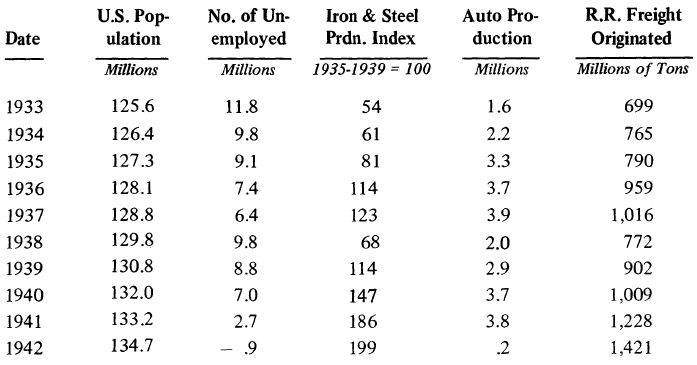
Table XXV shows some economic facts that tell the sad story of this attempt to keep wage rates above those that would have prevailed in a free market. During 1933, we had 11,800,000 men unemployed. Our iron and steel production index was only 54 as compared with an average of 100 for the later 1935-1949 period. Other production indices were also low, including auto production and railroad freight movements.
Prosperity by Law
Roosevelt persuaded Congress to pass the National Recovery Act, popularly called the NRA, and he signed it on June 16, 1933. This National Recovery Act took prices and wages out of market competition. Production and employment were no longer to be guided and shifted in accordance with consumers’ wishes as revealed by market forces, according to the principles presented in Lecture III. The Act enabled, even ordered, businessmen to get together and set high prices. It also permitted labor unions to get together and set high wages, which their employers would legally be compelled to pay. President Roosevelt and his supporters felt this would be helpful in pumping up purchasing power and prosperity. The NRA preamble stated that it would produce “national recovery.” Those who questioned the economic theory behind the Act were smeared as spokesmen for selfish interests more concerned with their own bank accounts than with “national recovery.”
Actually, as soon as the Act was passed, many business firms speeded up their production to beat the date when these new high industry-wide wage and price codes would become the law of the land. Consequently, production leaped up right away. But as soon as the codes went into operation, production slumped. Many small businessmen could no longer compete with the big ones. If they cut their prices, they were charged with a violation of the law. One small local tailor, who cleaned and pressed suits and trousers, tried to stay in business by cutting his prices below those set by the industry’s code. He was then prosecuted in the courts and put out of business. There was also the “sick chicken case,” involving a small company that tried to sell chickens for less than the NRA code’s prescribed prices.
Finally, the Supreme Court, on May 27, 1935, declared this National Recovery Act to be unconstitutional. You can see in Table XXV what happened after this Act had been declared unconstitutional in 1935. Unemployment dropped considerably. Employment increased and all basic production indices surged upward.
The Effect of Free Market Wage Rates
The New Deal Administration did not like the Supreme Court’s attempt to maintain traditional American freedom for market prices and wage rates. So the political party in power re-enacted Section 7A, the labor clause of the unconstitutional NRA. This new Act, officially the National Labor Relations Act, became known popularly as the Wagner Act. The country’s leading constitutional lawyers advised their clients, the nation’s largest employers, that this Act was just as unconstitutional as the National Recovery Act.
As a result, most big businesses simply ignored the Act and went merrily on their way, resorting to free market wage rates and prices to increase employment and production. Table XXV shows how unemployment went down from more than 11 million in 1933 to 6.4 million in 1937. Note also that the 1937 production of iron and steel was more than twice what it was in 1933 and 1934. Auto production for 1936 and 1937 was more than double that for 1933. Railroad freight loadings had gone up considerably, too.
The Effect of a Politically Controlled Labor Market
Then in 1937, the Supreme Court, in a series of 5 to 4 decisions, reversed its reasoning in the NRA case and upheld the Wagner Act as constitutional. Employers were then forced to deal with politically privileged labor unions and were no longer free to hire whomever they chose at free market wage rates.
One of the Wagner Act cases involved the Associated Press, a worldwide news service. This particular 5-4 decision was a body blow to the freedom of the press. The AP had fired a man who was very active in the Newspaper Guild, a union organized by Communists. This former employee rewrote news items from abroad for dispatches to our domestic papers. When the Court ruled that he had been fired for union activity, the AP was forced to re-hire him and pay him two years’ back pay. Since then, labor unions and their interventionist ideology have pretty well controlled employment on all major newspapers and news services.
With this Act declared constitutional, the labor unions were able to ask for, and get, higher than free market wages. You can see in Table XXV what then happened to unemployment. In one year, from 1937 to 1938, the number unemployed went from 6.4 million to 9.8 million. You can also see what happened to iron and steel production, auto production, and railroad freight tonnage. These production indices all dropped fast.
World War II Ends Unemployment
This was the situation when war broke out in Europe in the summer of 1939. It was this war, not New Deal interventionism, that put the American unemployed back to work. The French and the British sent their gold to the United States and started putting American men back to work in the fall of 1939. You can note the results in Table XXV. As more men went to work providing the sinews of war, every production index leaped upward. We were supplying France and England. Their desperate purchasing agents were willing to pay higher prices than American consumers could or would pay.
Table XXV
UNEMPLOYMENT AND PRODUCTION, 1933-1942
_______________
Note: According to a letter to the editor published in Life magazine, 6/26/70, the Dow Jones average dropped from 194.40 on 3/10/37 to 98.95 on 3/31/38 - a 49% drop.
Sources: Unemployment figures — The Economic Almanac for 1950 (N.Y.: Nat’l. Conference Board), p. 164. Production figures — Historical Statistics of the United States, 1789-1945 (U.S. Department of Commerce), pp. 180, 203, 223.
At the end of 1941, we got into the war. The official statistics show minus unemployment for 1942, because many women and children, not considered part of the regular working force, were going to work. This is how our mass unemployment of the depression period was ended. It was ended by a World War.
Politics in the Saddle
Here is a very interesting quotation from the diary of Henry Morgenthau, Jr., our Secretary of the Treasury at that time. On March 12, 1940, he attended a White House conference to discuss the French and British demands for war material. His diary quotes President Roosevelt as saying:
These foreign orders mean prosperity in this country and we can’t elect the Democratic Party unless we get prosperity and these orders are of the greatest importance. . . . let us be perfectly frank.6
Secretary Morgenthau, who quoted this statement of the President’s in his diary, added his own opinion: “And he is right!”
We could speak many hours on how the war ended the depression by putting men back to work. Let us merely note in passing that in 1940, FDR ran for an unprecedented third term. Ever since our first President, George Washington, declined a third term, no other President in over 150 years had ever dared to run for a third term. Roosevelt took some members of the opposition party into his Cabinet, and he promised the American public all through the 1940 election campaign that our boys were not going to fight in any foreign wars. Just before Election Day his words in Boston were:
And while I am talking to you mothers and fathers, I give you one more assurance. I have said this before, but I shall say it again and again and again. Your boys are not going to be sent into any foreign wars.7
This and other similar statements, along with high employment and business activity, helped him to win a landslide victory. Behind the scenes he was promising Britain that he would give them what they wanted after the election. Shortly after his re-election, he held a press conference and announced a program that later became known, when passed by Congress, as the Lend-Lease Program. Needless to say, the Lend-Lease Program was financed by inflation.
The Lend-Lease Solution
Table XXVI presents some of the pertinent monetary figures of the World War II situation. At the end of 1938, the money supply was $46.5 billion. By the end of 1941, it had risen to $64.5 billion. During the early war years, gold had flowed in from France and England. But France fell in June 1940, and could no longer send more gold. The United States was not able to capture what was left of the French gold, although it tried. By the summer of 1940, the British had pledged almost all their gold. Since the United States was then on a “cash-and-carry” basis, they could not place many more orders. However, to keep men working and the United States “prosperous,” Roosevelt asked for and got the Lend-Lease Act, which he financed by inflation.
Lend-Lease kept American workers working, producing for England and later for a growing “defense” program of the United States. The “money supply” figures for the end of 1941 reflect primarily the inflation due to Lend-Lease costs before the United States got into the war on December 7 of that year. Our “money supply” went up by more than a third from 1938 to the end of 1941, when it reached $64.5 billion. The discount rate was still at 1 percent, and the gold stock, which increased $4.4 billion in 1940, rose by less than a billion in 1941.
More Money in a Hurry
Then, the United States got into war. With four years of wartime inflation, the “money supply” more than doubled. It shot up to $132.5 billion. By the end of 1945, the Federal Reserve Banks held more than ten times the amount of Government securities they had held at the time of Pearl Harbor. The commercial banks held almost $91 billion, whereas they had held only $21 billion on December 31, 1941, and only $14 billion at the end of 1938. All through the war, the United States Government bought large quantities of its own bonds with Social Security and other trust funds, holding $27 billion of them at the end of 1945, compared with only $5.3 billion at the end of 1938. During all this time the discount rate remained at 1 percent. This was not free enterprise at work. It was a politically manipulated inflation with a vengeance.
Now, how did all this happen? Actually, it was very simple. When you have a fractional reserve system, you can very easily create “money” without anyone’s having to mine, earn, or save it. The Federal Reserve just opens, or adds to, accounts on the books of the commercial banks. The process was discussed in Lecture V. But don’t take my word for how this enormous inflation was created. Read the testimony of William McChesney Martin Jr., Chairman of the Federal Reserve Board, or of the Board of Governors of the Federal Reserve System, as it is now officially known. Mr. Martin testified before the Joint Economic Committee of Congress on March 7, 1961. This is his description of how World War II was financed:
Immediately upon the United States’ entry into World War II in December 1941, the Board of Governors announced that the Federal Reserve was prepared —
(1) “To use its powers to assure that an ample supply of funds is available at all times for the war effort, and
(2) “To exert its influence toward maintaining conditions in the U.S. Government security market that are satisfactory from the standpoint of the Government’s requirements.”
Making good on its words, the Federal Reserve saw to it that the banking system was supplied with ample lendable reserves to provide the Government with all the war-financing funds that it could not raise through taxation and through borrowing people’s savings.
It did so by buying outstanding Government securities on a huge scale. The Federal Reserve’s payments for these securities wound up in bank reserves. In turn, the banking system used these additional reserves to purchase new securities that the Treasury was issuing to obtain further funds to finance the war effort.
Table XXVI
__________
8. Gold stock as a % of total quantity of money: 12/40 - 37.9%; 12/45 - 15.2%.
9. U.S. Gov’t, deposits $24.6 billion, a record; 12/40, they had been $753 million.
To keep the process going the Federal Reserve in effect maintained a standing offer to buy Government securities in unlimited amount at relatively fixed prices, set high enough to assure that their interest rates or yields would be pegged at predetermined low levels. When no one else would accept those yields and pay those prices, the Federal Reserve did so. And in so doing, it helped to finance the war.
The process was successful for its emergency purpose. But the procedure of pegging Government securities at high prices and low yields entailed a price of its own that the economy — the people and the Government alike — would later have to pay. The results were twofold:
(1) During wartime, money was created rapidly and continually, in effect setting a time bomb for an ultimate inflationary explosion — even though the immediate inflationary consequences were held more or less in check by a system of direct controls over prices, wages, materials, manpower, and consumer goods.
(2) The market for Government securities became artificial. The price risks normally borne by participants in that market were eliminated: bonds not payable for 20 years or more became the equivalent of interest-bearing cash since they could be turned into cash immediately at par value or better — at the option of the owners, at any time.10
Inflation — A Harmful Illusion
Now, of course, all of this new money, all of this great increase in the quantity of money, meant that everybody who had earned or saved dollars beforehand held dollars that were losing value with every increase in the “money supply.” This inflation and credit expansion was also directing the economy in a direction quite different from the way the free market would have directed it. It was a manipulated and not a free economy.
Actually you do not need inflation in wartime any more than in peacetime. It merely helps to hide reality. If the politicians had felt that our people really wanted the war, they would have had no qualms about asking us to pay for it in the form of sufficiently higher taxes. In life, you do not really want anything unless you are willing to pay for it. But the Administration was afraid the American people did not want the war. So President Roosevelt and his subservient Congresses did not tax us sufficiently to pay the full costs of the war. Consequently, the Federal Reserve resorted to inflation, doubling the “money supply” during the period the United States was in the war. The quantity of money was now many times what it had been back in the 1920s, and free enterprise had had nothing to do with this increase, whereby some were helped at the expense of others.
Table XXVII
POST-WAR — MARSHALL PLAN, 1945-1950
___________
11Gold stock as a % of quantity of money: 16.6%, post-war year-end high.
Helping Our Allies
We faced another critical situation during the war period. As in World War I, we had to take care of our allies’ economic needs. Their able-bodied men were in uniform. They could neither tend their farms nor produce in factories the many things they needed for survival and the efficient waging of war. So we gave them many of the things they needed. This helped to win the war.
When the war ended, they still had a vital need for many of the things that we provided. So we continued to send them things free for another year or two. Much of this was paid for by inflating the “money supply.” You can see in Table XXVII that the “money supply” continued to rise from 1945 through 1947. Although the banks had started to unload some of their government securities, the Government itself had increased its holdings, which rose from $27 to $34.4 billions during these first two post-war years.
As you may remember, our farmers suffered considerably after World War I. During the war, they went heavily into debt in order to expand rapidly to help feed Europe. After the war, their markets and the prices for their products collapsed. So many, unable to maintain payments on their debts, lost their farms during the post-war deflation. This time they were more cautious. In order to persuade them to expand rapidly again, the Government passed a law that promised to support high farm prices for two years after World War II ended. This period turned out to be 1946 and 1947.
Helping Foreign Politicians
The next year, 1948, was a Presidential election year. The political party in power, foreseeing a collapse in farm prices, was very much worried that such a drop in prices might lead to its defeat. So, well in advance of the election, it came up with a plan to keep farm prices high until after the election. General George C. Marshall, a popular hero, was appointed Secretary of State. On June 5, 1947, in a Harvard University Commencement address, he proclaimed to the whole world that “Europe’s requirements for the next three or four years of foreign food and other essential products — principally from America — are so much greater than her present ability to pay that she must have substantial additional help.”12 A week later, he explained that he “had in mind the entire continent west of Asia — and including both the United Kingdom and the Soviet Union.”13 In short, he asked all European nations to get together and submit a list of their needs.
His proposal, first known as the European Recovery Program and later as the Marshall Plan, would be costly. However, the party in power did not plan to raise taxes. This plan could be, and was, financed by an inflation that kept farm prices high.
On September 27, 1947, the Bevin Report of the European governments found that during World War II:
Industrial production in Belgium, France and the Netherlands was reduced to 30-40 percent of pre-war, and in Italy to only 20 percent, production of bread grains fell to only two-thirds of pre-war . . . .
Nevertheless recovery proceeded well — indeed much faster than after the end of the first World War. Eighteen months after the end of the fighting in Europe, industry and transport were moving again vigorously. . . . By the end of 1946 industrial production in Belgium, France and the Netherlands had recovered to 85-95 per cent of the pre-war level, whilst Italian industrial production was back to 60 percent of pre-war level. In the United Kingdom the process of demobilisation of the war economy had been accomplished smoothly and the pre-war level of national output had been fully restored . . . .
In the case of agricultural production, which, though hard hit by the war, had not declined to the same extent as industrial production, the beginning of recovery was evident in all countries in 1946. . . . The devastated areas of France, Belgium and Western Germany have largely been put back into production; and even in the Netherlands, where inundation was added to physical destruction, land is quickly being restored to use. . . . The countries’ own efforts were supported by considerable assistance from the rest of the world.14
All of this meant that the European nations no longer needed as much American food and other things as they had previously. They were actually getting back on their own feet. Then, due to “unfavourable weather” and “comprehensive legislation,”15 the ever-present scapegoats of socialism and interventionism, “this improvement was not maintained.”16 Consequently the European politicians indicated that they would be happy to receive some free gifts of American goods that they could sell cheaply to their citizens.
Helping the Domestic Situation
Now, what was the situation in the United States? The 1948 Presidential election was approaching. The Administration’s Secretary of the Interior, a Mr. Krug, reported on October 9, 1947:
Tobacco exports and shipments in 1946-47 were over 500 million pounds, twice as high as during the war years and about a third higher than the average for the 1930’s. . . . Tobacco production in 1947 is estimated at 2.2 billion pounds, nearly 50 percent above prewar and second only to the record crop of 2.3 billion pounds in 1946. Domestic consumption . . . is expected to continue at about present levels. . . . Exports, however, are expected to decline from the current high rate toward the level of the 1930’s. . . . The present rate of production could be maintained, however, if sufficient outlets were found.17
The “sufficient outlets” were found in the greatest giveaway program the world has ever known. The Administration resorted to inflation to keep up agricultural “prosperity” by paying high prices for American farm products, particularly cotton and tobacco raised in those states that were most crucial to the winning of a Presidential election. These products were given to the politicians in power in the European countries. These politicians in turn sold the products to their own people in their local currencies. Large parts of the proceeds were used to nationalize a number of their industries, thus hurting European free enterprise.
Here is a part of the testimony of the Under Secretary of Agriculture before a Congressional Committee. It may help you understand why we undertook this supposedly very generous act.
The Under Secretary: If we lose our export markets, the prices are going to come down. .. .
Member of the Congressional Committee: I am a grain and cotton farmer. What will the effect of this program be on the price I am to get for my crop?
The Under Secretary: I think that any program of the magnitude of this with respect to food will assure you of getting a pretty fair price for your crops. Without such a program or something comparable, I think you could be fairly sure of a much lower price in this country. .. .
I have all the money I have invested in farming, and if you are going to cut down my production on the farm it means that I would have less income.18
That was an American politician “worrying” about the poor people in Europe.
In 1946, about 40 percent of our exports “were financed directly or indirectly by loans and grants-in-aid by the United States Government.”19 Without a continuation of such subsidies, our farmers and others interested in exports were bound to be hurt. In such an event the party in power might well lose the election. Domestic politics played a very big role in this so-called act of charity.
Effects of “Foreign Aid”
Even before the Marshall Plan, our giveaway policy had brought great distress to Greece and Turkey, normally large producers and exporters of wheat and tobacco. They could not sell their wheat and tobacco in competition with the United States giveaway. Their “surpluses” were piled up in warehouses. What was the result? The Communists had a heyday. The impoverished Greeks and Turks were ripe for Communist infiltration and promotion of social unrest. So we had previously had to make loans to help the Greek and Turkish governments combat the Communists. Note how one intervention only makes matters worse and creates a demand for further intervention.
This governmental “foreign aid” giveaway program also upset free enterprise. Remember, free enterprise, with its division of labor and specialization, tends to develop mass production for mass consumption. In a Europe divided into many small countries, you cannot have mass production unless you can sell beyond the borders of one country. This program of intergovernment subsidies made European mass production very difficult. Few privately owned European companies could sell their products in other countries in competition with gifts from the United States Government.
The “foreign aid” gifts also added to the difficulties of privately owned businesses by providing European politicians with funds to nationalize many industries and run them at a deficit. In England, for instance, the British government received free American tobacco and sold it to her citizens in the form of cigarettes, for British money, at something like 75 cents a pack, several times what our domestic smokers then paid. The government then used a good deal of the money from such sales to nationalize the medical profession. Thus, American taxpayers helped to underwrite socialized medicine in England.
Effects of Monetary Manipulation
Well, the Marshall Plan was passed, and it went into effect on July 1, 1948. During the first half of 1948, the “money supply” had been decreasing. We were having domestic difficulties. Farms and industries previously supported by newly created money were losing customers. So business activity started to slow down. With this new spending program, the “money supply” started moving up again. The commercial banks started buying government securities again, that is, the banks were buying them with their depositors’ money or with an expansion based on either their money or the government securities that were bought by increasing the Government’s bank accounts. The United States Government was also buying its own securities. All this inflation and government spending helped President Truman and his party win one of the closest elections in American history.
All this spending of newly created money was secretly but steadily taking wealth from one part of the population and giving it to another part. The spending also bought political popularity and thus helped win elections. It was probably the deciding factor in the 1948 election.
By the end of 1949, the effect of the Marshall Plan spending was beginning to wear off. Our politicians had to look elsewhere for a new spending program that would continue the illusion of prosperity promoted by inflation. Business conditions were getting worse. Production was falling while unemployment was rising. The inflated “money supply” was bringing higher prices and a demand from labor unions for higher wages. So, early in 1950, the President asked Congress for price and wage controls. This was the only way he knew to stop rising prices. After considerable public discussion, Congress defeated the proposal in the form of the “Spence Bill.” Congress would not endorse price and wage controls during peacetime.
Military Action to the Rescue
Well, if the Congress will not permit price and wage controls during peacetime, what can a President, who does not understand free market economics, do to remedy the situation? He can go to war. So we went into Korea. With unemployment at a post-war high and the “money supply” decreasing even with a discount rate of only 1¼ percent, the President ordered our Army into Korea.
This was not considered an act of war. The President called it a “police action.” War was never declared by Congress, but that did not stop the President. For “prosperity,” the President needed a spending program the people would accept. He had no power under the Constitution or even under the United Nations Charter to go to war. Nevertheless, in June 1950, we went into Korea.
Table XXVIII shows what happened to our “money supply” after June 1950. It went up again very rapidly. Many people were getting and spending some of the newly created “money supply.” Other people were getting less for the dollars they had earned or saved. At the same time our boys were getting maimed and killed on Korean battlefields thousands of miles away from home.
Labor Union Loophole
The President asked for price and wage controls. His proposal was quickly passed by the Congress that summer. However, there was a little loophole in the law to make it palatable to labor unions. While the law placed wage controls on labor, it provided that the controls apply only to current wages. Thus the law permitted employers to increase what we now call “fringe benefits.” These are largely retirement benefits. Organized labor could not strike for higher current wages, but union workers could demand and get extra allowances for hospitalization, pensions, and other such benefits that raised the labor costs of business firms. Yet many businesses could not ask for higher selling prices. This is part of the popular anticapitalistic mentality that seeks to soak savers and investors.
While union members could not spend pay raises put into pension funds, the Government could, because such funds were largely invested in government bonds. Of course, the future value of these bonds would depend on the purchasing power of the dollar at the time the individual workers retired. But most union members were not then aware of the ravages of inflation. So they were happy with this arrangement. With the Korean “police action” pumping up the “money supply” once more, business started up again. Many companies were doing fairly well with increased government orders for a war that was not a war. Of course, in addition to the battlefield casualties, many other people were hurt financially.
Table XXVIII
KOREA AND 1952
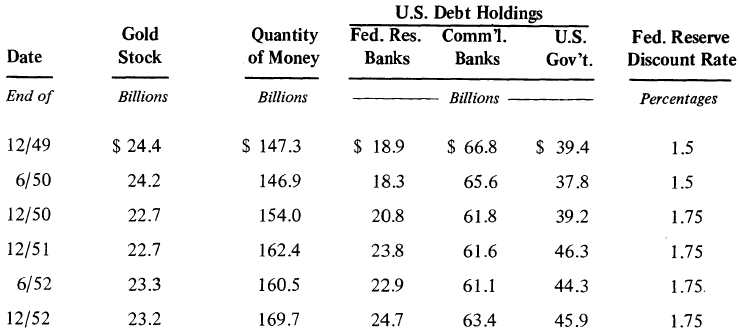
By the end of 1951, the “money supply” was up to $162.4 billion. The increased “money supply” built up a pressure on prices that the Government’s limited controls could not contain. The effects of Korea and the inflation gradually became apparent to more and more people. As a result, more and more Americans were becoming dissatisfied with the political situation.
The 1952 Election Situation
During the first half of 1952, the dollar supply had begun to contract, since the first stimulating effects of the Korean spending were wearing off. The Administration asked for still higher “defense” expenditures. A Presidential election was in the offing. The Democrats had been in power since 1933. Prices were going up. Social Security benefits were raised again, just before the November election. This added to the pressure on prices and government financing. Taxes were going up.
By this time the American people were a little fed up with the party in power. They did not like the rising prices resulting from the Government’s inflation of the “money supply.” The Korean incident, on which the inflation was blamed, was no longer popular, if it ever had been. The firing of General MacArthur, a popular hero, had not helped. With growing casualty lists and the limitations placed on our fighting forces, more and more Americans were demanding an end to the Korean “police action.”
Although the Administration succeeded in increasing the “money supply” considerably during the last half of 1952, in a last-ditch effort to win the election, it failed, and a new political party, the Republican Party, was brought to power. Many people thought the Republicans would return the nation to our more traditional policies of pre-Roosevelt, pre-New Deal days. This, however, was not to be the case.
“Natural Economic Forces” Repealed
After the election, President Truman, on January 14, 1953, during his last week in office, issued his final annual Economic Report. In it he said:
The Employment Act of 1946 is one of the most fundamental compacts in domestic affairs which the people through their Government have made during my tenure as President. It represents the refusal of Americans in all pursuits — in business, labor, agriculture and Government — to accept recurrent depression as a way of life. . . .
The Act is more than an essay in wishful thinking. . . . It is the purpose of the Employment Act — the one most widely recognized at the time of its passage — to prevent depressions. . . . The Employment Act stands as a pledge on the part of the people voiced through their laws that never again shall any such sacrifice be laid on the altar of “natural economic forces”. . . .
Thus . . . the Act rejects the idea that we are the victims of unchangeable economic laws, that we are powerless to do more than forecast what will happen to us under the operation of such laws.
Immediately after the Korean outbreak . . . the work under the Employment Act was fundamental to the program of over-all economic expansion which the Government adopted. . . . Our national output has risen from 285 billion dollars in 1948 (the peak before Korea) to an annual rate in excess of 350 billion dollars at the end of 1952.20
President Truman thought this was a remarkable record and that it represented the application of this Employment Act, popularly called the “Full Employment Act.” One of the better newspapermen called it the “Fool Employment Act.”
The Keynesian Revolution
This “Full Employment Act” was based on the Keynesian principle that when there is large unemployment the best way to reduce wages is to reduce the value of the monetary unit. This is done by increasing the “money supply” — inflation. Acting under the influence of the professed ideas of the late Lord Keynes, our politicians have been doing this ever since. Keynes’ theory, as we have mentioned, was written by Keynes in 1935 and published in 1936. It provided an academic justification for the policies which England had followed for years, and which had led to the devaluation of the British pound five years earlier, in 1931. This 1931 de jure devaluation was an official recognition of the de facto devaluation that had resulted from years of a politically manipulated increase in the “money supply.”
At the time of the 1931 devaluation, the British Government changed all its official index numbers. There was no way anyone could compare British prices after the 1931 devaluation with those before that date. The people, including union members, had to wait until a new set of statistics could be developed over a period of years before they, or the statisticians of the British labor unions, could find out what had been happening to prices. In this way, British wage rates were, for a few years, reduced without the workers’ knowledge or objection. However, as time passed the union statisticians learned from the new index numbers that prices were rising. Since then, organized labor has demanded higher money wages as the purchasing power of the pound has fallen. Union leaders in the United States have seldom permitted this method of devaluing the purchasing power of the dollar to fool them very long. As a matter of fact, most of our strong unions have pushed up the wages of their working members faster than the value of the dollar has fallen, with the effects mentioned in Lecture IV.
Change in Inflation Theory
In 1953, we had a new President in the United States. We also had a change in the philosophy of those directing financial policy. We could go into more details, but time does not permit. There was a shift away from the philosophy of President Truman and his political party, which held that higher national income and GNP (Gross National Product) dollar figures were signs of prosperity, neglecting for the most part the fact that the purchasing power of the dollar was falling. The new political leaders wanted to reduce the inflation. They wanted to reduce the increases in the “money supply.” They did not want the “money supply” to increase so much that it might raise prices. They intended to increase the “money supply” only enough to offset the effects of increased production.
In a free market, as production goes up, prices go down. The leaders of the new Administration wanted production to go up, but they did not want prices to go down. To prevent this, they intended to inflate the “money supply” only enough to prevent a drop in the so-called “price level.” The benefits of increased production, which a free market would allocate to consumers, was to be allocated by the Administration as it deemed best for the nation and its chances to remain in office. So when increased investments resulted in increased production, the Administration attempted to increase the “money supply” only to the extent that would maintain what was called a “stable price level.”
Inflation Continues — Gold Flight Starts
This effort failed. During the eight years of the Eisenhower Administration, from 1952 through 1960, the consumer price index rose by about 10 percent. Table XXIX shows how much the “money supply” was increased for each of these eight years, rising from $169.7 billion at the end of 1952 to $215.8 billion by the end of 1960. This was an increase of $46.1 billion, or more than 27 percent. While this was a slower rate of growth than under the Truman Administration, it was a great burden on those who had had to earn or save the dollars they spent.
Another item worth noting in Table XXIX is the drop in the gold stocks behind the nation’s “money supply.” Citizens of other countries were starting to lose some, but not all, of their confidence in the dollar. Although the discount rate wavered between 1½ and 4 percent, note that it was reduced twice during the 1960 Presidential election year. That has now become almost a normal procedure. The last column of figures shows the U.S. debt holdings of the United States Government. They went up slightly, about 10 percent, during the eight Eisenhower years.
Table XXIX
EISENHOWER ADMINISTRATION, 1953-1960
__________
21Date effective.
Reducing the Fractional Reserve
The Eisenhower Administration was less inflationary than the previous Administration. However, the effects of its inflation were felt, even though little understood. One of the main ways the Republicans managed their inflation was a method we have not mentioned since discussing the fractional reserve system in connection with the early days of the Federal Reserve System. The Eisenhower Administration did not launch any new large spending programs.22 In fact it reduced the expenditures in Korea considerably. The Republicans inflated primarily by reducing the percentage of reserves that banks were required to keep against their deposits. In 1952, before Eisenhower assumed office, commercial banks in the large reserve cities were required to keep 24 percent of their demand deposits, or checking accounts, with the Federal Reserve System. Table XXX shows that this requirement was reduced by the end of the Eisenhower Administration to 16 ½ percent.
Table XXX
SOME KEY MONETARY DATA, 1953-1960
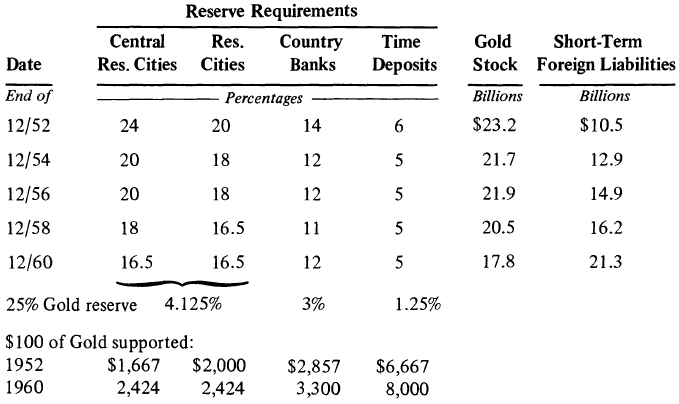
The significance of this is that in 1952 the actual money on hand in the banking system could be expanded, under the fractional reserve system, by roughly four times, whereas by 1960, at the end of the Eisenhower Administration, the actual cash in the reserves could be expanded more than six times. The required reserve for time deposits was also reduced by Federal Reserve regulations from 6 to 5 percent. This permitted quite an expansion of the “money supply” for the Administration to allocate as it approved.
Gold Liabilities to Foreigners
As mentioned previously, the gold stock had gone down by $5.4 billion. Table XXX includes a new column, not previously presented in these lectures — short-term foreign liabilities. These are the obligations of American banks to foreigners that are payable either on demand or within periods of less than a year. The amount of such liabilities more than doubled during Eisenhower’s Administration. They rose from $10.5 billion at the end of 1952 to $21.3 billion before Eisenhower left office. These short-term foreign liabilities represented a potential demand on the gold stock of our banking system. The foreign owners of these claims could legally turn them into gold by operating through their country’s central bank. Although Americans are not allowed to own monetary gold, a serious violation of free market principles, foreigners holding such liabilities could demand gold from our Federal Reserve System whenever their government or its central bank permitted them to do so.
In 1952, the gold stock of our banking system totalled $23.2 billion. This provided more than 200 percent coverage for the $10.5 billion of foreign short-term liabilities. But by the time Eisenhower left office, the gold stock was actually less than the short-term claim that foreigners could have presented for redemption in gold. This represented a serious deterioration in the monetary situation.
All of the $46 billion increase in the “money supply” during Eisenhower’s eight years was an artificial increase. The gold stock went down, not up. This inflation was helping some people and hurting others. It was affecting business, re-directing it in a way that was difficult to maintain without still more inflation at an ever-growing rate. It was not free enterprise.
Prosperity by Spending Newly Created Money
After Eisenhower, we had still another political Administration — an Administration that hoped to go far and do spectacular things, with a very young and attractive President, John F. Kennedy, the first President born in this century. It was a Democratic Administration. After Kennedy’s assassination in 1963, Lyndon B. Johnson, from Texas, became President.
The top line of figures in Table XXXI shows the averages under the Eisenhower Administration for the annual increases in the “money supply,” the annual losses of gold, and the annual increases in short-term liabilities to foreigners. The figures for 1961-1968, the Kennedy and Johnson Administration years, follow.
During the first year of the new Democratic Administration, we were told that prosperity was back to stay. Actually, on the surface, large corporations and their employees seemed to be enjoying prosperous times. In 1961, the “money supply” was increased by $16.9 billion. The following year, 1962, it took an increase that was larger by an additional billion, or $17.9 billion, to keep this apparent “prosperity” going. This was money artificially created by a Government-dominated banking system and spent in the market by persons who obtained it through special privileges. The new funds were first allocated to certain people, as directed by Governmental policies. When they spent the new money they reduced the purchasing power of all other people, who faced higher prices and thus a lower return for the dollars they had earned or saved. The next year, 1963, the increase in the quantity of money was $18.3 billion, or nearly a half billion greater than in 1962.
Now we come to 1964, a crucial Presidential election year. During this particular election year, the Administration, with the help of the Federal Reserve System, increased the “money supply” by $24.7 billion. That quantity of money could be used to buy a lot of votes. That, of course, is what most welfare state programs are — vote-buying programs. In any case, President Johnson won an overwhelming victory at the polls.
Table XXXI
YEARLY CHANGES, 1961-1968
(In billions of dollars)
| Year |
Quantity of Money23 |
Gold Stock |
Short-term Foreign Liabilities |
| 1953-6024 | + $5.8 | – $.7 | + $1.35 |
| 1961 | + 16.9 | – .9 | + 1.2 |
| 1962 | + 17.9 | – .9 | + 2.5 |
| 1963 | + 18.3 | – .45 | + .95 |
| 1964 | + 24.7 | – .125 | + 2.9 |
| 1965 | + 28.1 | – 1.7 | + 1.5 |
| 1966 | + 15.2 | – .5 | + 2.0 |
| 1967 | + 36.6 | – 1.2 | + 3.0 |
| 1968 | + 36.7 | – 1.6 | + .3 |
_________
25. Includes (1) currency outside of banks; (2) demand deposits; and (3) time deposits of commercial banks.
26. Average under Eisenhower Administrations.
The following year, 1965, the Administration’s fiscal and monetary policies resulted in adding $28.1 billion to the “money supply.” This, of course, kept many things humming. We were constantly reading in the newspapers about how each month set an ever-increasing record for continuous “prosperity” under the new Democratic Administration. This newly created money was all being pumped out in special privileges, helping some people at the expense of others. The politicians were appropriating and distributing more than the increase in production, because prices were actually rising, although only slowly during these first five years. The last column of Table XXXI shows, as you can see, that a significant portion of the increase in the “money supply” was going into short-term liabilities owned abroad, where much of it, combined with the gold outflow, was being used as a reserve for the inflation of foreign currencies.
Results Not All Desirable
We had a reaction in 1966. The Administration got scared. Prices were going up faster than the 2 percent those in office considered acceptable. So they cut back the increases in the “money supply.” They said they were going to stop inflation, by which they meant higher prices. So they increased the “money supply” less in 1966 than in any of their previous years. That year they increased the “money supply” by only $15.2 billion. This great decrease in the increase created a serious reaction in the country. The Administration’s favored people were getting less new money than previously. Hence they were no longer able to spend as much as they had been spending. This led to a slight recession that threatened to get worse. The reaction was actually a movement toward a free market adjustment or correction.
A recession occurs whenever free market forces are permitted to reassert themselves and correct the malproduction brought about by the inflation. The market forces, described in Lecture III, then redirect the economy away from producing so much for the spenders of newly created money and toward producing more for those spending money they have earned or saved. The recession is merely this readjustment period. It can be short or long, depending on how quickly prices, wage rates, and interest rates are able to shift so that they reflect the wishes of consumers.
The Administration did not feel it could politically withstand the rigors of such a free market correction. It would have required politically unpopular higher interest rates, and lower wage rates for many labor union members. So the Administration again resorted to inflation, increasing the “money supply” by almost $37 billion in 1967. In 1968, the Administration inflated the “money supply” at an even faster rate during the first part of the year. However, towards the end of the year, with prices starting to leap upward, the Administration got nervous and cut down the rate of increase in the “money supply.” As a result, the total increase for the full year of 1968 was just about the same as in 1967, which was more than twice that in 1966.
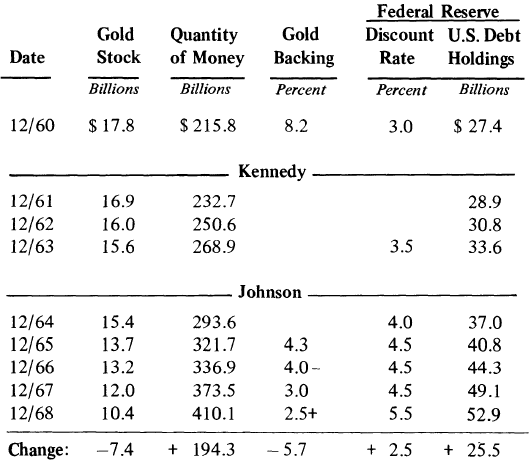
Moving on to another phase of the Administration’s monetary activities, Table XXXII reveals a drop of $7.4 billion in the gold stock during the eight years of the Kennedy-Johnson Administrations. By the end of 1968, the “money supply” had been increased by $194 billion, rising from $215 billion to $410 billion. The gold stock reserve had dropped from 8.2 percent of the “money supply” in 1952 to only 2½ percent by the end of 1968. Of course, the discount rate was kept low in comparison with market interest rates, permitting the expansion to go on almost as rapidly as the Administration desired. The Federal Reserve holdings of the United States Government debt almost doubled under the Kennedy-Johnson Administrations, rising from $27 billion to $53 billion. This meant bank depositors’ funds were being used to support the Government’s deficit spending.
Table XXXII
DEMOCRATIC ADMINISTRATIONS, 1961-1968
Who Buys Government Bonds
The problem of financing the Government’s debt is becoming a more and more serious question in the United States. It is a problem that is rapidly coming to a head. Table XXXIII presents four columns of figures. The first shows the ownership of the United States Government’s debt on December 31, 1960, at the end of Eisenhower’s Administration. The second column shows the ownership of the United States Government’s debt on December 31, 1968, after eight years of the Kennedy-Johnson Administrations. The third column shows the net changes during the eight Eisenhower years, while the fourth and last column shows the net changes in the eight Democratic years.
Table XXXIII
OWNERSHIP OF U.S. GOVERNMENT DEBT, 1953-1968
_______________
27 Savings & Loan, Foundations, Pension Funds, Brokers and Dealers.
During the eight Eisenhower years, the debt rose by $23 billion. Of that total, the Government itself took more than $9 billion of its own bonds. In short, the Government was “borrowing” this amount from moneys collected and held in trust for future pension and Social Security payments. State and local governments had special funds that took $7.6 billion of the increase. So that all governments took almost $17 billion of the $23 billion increase in the Federal Government’s debt. If you add to that the $2.9 billion the Federal Reserve Banks bought, the total comes pretty close to $20 billion out of the $23 billion total.
The commercial banks were actually selling off government securities during this period, because the interest rate paid on governments was not as attractive as those they could get from commercial loans. The same was true for savings banks, insurance companies, and “other corporations.” Individuals actually took less than $1 billion of the $23 billion increase. Foreigners and such miscellaneous buyers as savings and loan associations, foundations, private pension funds, brokers, and dealers, altogether, took more than half of the total increase.
Looking at the eight years of the Democratic Administrations, we find the total increase in the Federal Government’s debt came to $67.6 billion — almost three times that of the Eisenhower eight years. Of this total, our Federal, state, and local governments had taken close to $30 billion. That is almost half of the total. The Federal Reserve Banks took another $25.5 billion, while the commercial banks were again’ using depositors’ funds to add to their holdings of government securities. Thus, during these eight years of inflation, the various American governments and our politically regulated banks took $58.6 billion of the $67.6 billion increase in the Federal Government’s debt.
Supporting the Bond Market
In short, private buyers were not willing to lend their money to the Government on the terms offered. So the Treasury was forced to unload its debt in large measure on purchasers who did not represent private market forces. The Government, to a considerable extent, had to create a market for its own bonds and force the Federal Reserve and its member banks to make large parts of depositors’ funds available for government spending. The savings banks sold off more government securities than they bought, even though their deposits were increasing. Both insurance companies and “other corporations” also reduced their holdings of government securities.
Our Treasury was able to persuade individuals to buy only $9 billion of the $67.6 billion total. A large part of this was due to a campaign directed at large corporations, particularly those with government contracts, requesting them to pressure their employees to permit sums to be deducted from their paychecks for the purchase of these bonds. Government employees were also pressured to buy these bonds on the payroll deduction plan. The pressure at one time became so great that it produced a kick-back against the high-handed tactics used. There has been a falling off in such purchases recently, as the interest rate on the small denomination bonds has been below what can be obtained from savings banks. The increase in the government securities held abroad was only $ 1.8 billion.
What will happen to future increases in the Government’s debts? No one knows. In leaving office, President Johnson predicted a balanced budget for Mr. Nixon and left him the task of balancing it. So far, it is not in balance.
The columns in Table XXXIV show the yearly changes in the holding of the Federal Government’s debt by (a) the United States Government, (b) the Federal Reserve Banks, (c) the commercial banks, and (d) the total for all three of these sources, as compared with (e) the annual increases in the total debt. In 1967, these three sources, the Federal Government and the two groups of “fractional reserve” banks took more than the total increase in the debt. That meant, in effect, that other holders were dumping some of their previous holdings. This situation improved somewhat in 1968, when these three sources took only $8.8 billion out of a total of a little more than $13 billion. This is still a large part of the total. It essentially represents government spending over and beyond what taxpayers and the financial markets will support.
Table XXXIV
U.S. GOVERNMENT DEBT YEARLY CHANGES
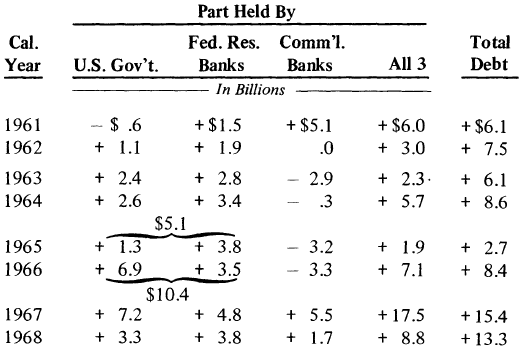
So the Treasury’s problem of placing the debt is an increasing one in the United States. Whether or not the debt increases, there remains the serious problem of persuading the public to keep their funds in the government securities they now hold. These securities pay very low rates of interest. These low rates are not high enough to attract private savings at a time when the dollar is losing 5 or 6 percent of its purchasing power each year.
Another part of the problem is that most of the United States Government’s debt is in very short-term paper. Congress has put a restriction on the rate of interest the Treasury can pay on long-term bonds. Since that limit is no longer realistic, a large part of the Government’s debt today is in short-term issues that must be constantly refinanced. The small savings bonds held by individuals can be redeemed at any time after they have been outstanding six months. Consequently, close to half of the Government’s debt could become due and payable in less than a year’s time.
More Money Not a Permanent Solution
In closing, I want to repeat the main thesis of this series of lectures. The recurring economic crises that we have been experiencing are nothing but the consequences of political attempts to stimulate economic activity by means of inflation and credit expansion — despite the warnings of economists. To paraphrase a quotation from Mises’ book on money, a passage he wrote in 1934:
Despite all the teachings of experience and all the warnings of economists, many still think that economic activity can be permanently stimulated by an artificial increase in the supply of money or credit. Most of our economic crises are merely the inevitable result of such politically directed attempts.28
In a market economy, a social order entirely founded on the use of money, in which all the accounting is done in terms of the monetary unit, the destruction of the monetary system means nothing less than the destruction of the basis of all exchange. How long could you exist without exchange?
The Economic Solution — Laissez Faire
Our modern high standard of living is based on the market system of voluntary social cooperation for the expected mutual benefit of all participants. The unhampered market system is a development of the Golden Rule that leads to a high degree of the division of labor and the investment of accumulated private savings in highly complicated production facilities. This capitalistic system provides workers with expensive, efficient equipment for the mass production of myriads of goods and services, which must be constantly moved to millions of consumers. This can be done satisfactorily only by the mutually profitable exchanges of the market place. Such exchanges require the use of a sound money in which the market participants have considerable confidence. Without such a sound money, the market system and the civilization it has built must collapse.
How long could you and your family exist on what you can produce? Not long. We are all dependent on each other. Without a market system of exchanges, millions will be doomed to the poverty, disease, starvation, and short lives of pre-capitalistic times. If we are to prevent such a catastrophe, we must stop inflation, that is, large increases in the quantity of money that eventually undermine public confidence in the monetary unit — the very keystone of the market system.
Illusions Cannot Last
Now we face great difficulties in solving this monetary problem. We have a two-price gold system. There are people in high political positions who think they can create “paper gold” with the value of gold. Possibly they believe politicians can also create glass diamonds if they want to. John Law tried something similar with his “Mississippi bubble.” His bubble collapsed. So will our present monetary programs. They are based on actions which are contrary to purpose. They do not properly or intelligently make use of the unalterable principles of human action, as outlined in the first three lectures.
Political Solutions
As a human being, I cannot know the future. No one can. But it would be my judgment, certainly not speaking as an economist or as a scientist, but rather as a pretty well-informed person, that there is a huge possibility that the United States may try to solve the problems resulting from inflation by going to war again. This is what many political leaders of the past have done. When those in high political positions are faced with difficult domestic economic conditions they cannot solve, they tend to look abroad for some foreign devil. They then blame their domestic troubles or their need for higher taxes or more controls on the policies of some foreign power. This is what Hitler did. This is what many political leaders have done in the past, even in my country. Eventually such policies must lead to war. Politicians in difficulty seldom admit their own errors. It is easier to blame their problems on foreigners. Today our leaders believe the American people will accept wage and price controls in wartime. So if they feel controls are necessary, they may well go to war.
If the United States should go to war in the near future, it would, of course, turn the country into a totalitarian society. Price, wage, and production controls of the type Hitler attempted would undoubtedly be enacted. In such a situation, the market would soon be in shackles. The present population could not then be supported at anywhere near its present standard of living. During peacetime, the people in my country would not peacefully accept a lower standard of living. During a war they might. But freedom would be dead and high living standards would be history.
If there is no war, a continuation of present interventionist policies, financed by inflation, will sooner or later lead to a breakdown in both the domestic and international monetary systems. This would greatly reduce both domestic and international trade. It would mean a great reduction in the division of labor and mass production for mass consumption. Economic conditions would deteriorate to the point at which it would be impossible to support the present population of the United States with anything like our present standard of living.
Present-Day Trends
Without the acceptance and adoption of free market principles, the outlook for western civilization is dark. Special subsidies and political privileges are now the order of the day. The poor, the sick, the young, the colleges, their students, the farmers, the small businessmen, the large corporations, the unemployed, the union members, government employees, the senior citizens, and every minority group, including those who want to go to Mars, want their “fair share” of government spending and special privileges. None are satisfied with what they now get, and everyone knows taxes are too high.
We have already experienced riots on city streets and college campuses. Such violence and disrespect for law and private property may well be a forerunner of what is to come. When people see no peaceful way out of their difficulties, they do not lie down and starve quietly. Unfortunately, the persons who are likely to suffer most are those in the lower income brackets. They are usually the most ignorant and the least capable of adjusting to new and less favorable conditions, so they are the ones most likely to resort to force, violence, and the destruction of private property.
The only satisfactory solution to the present economic and monetary problems is a rebirth of the free market ideology. This is always a possibility. Trends can and do change. They change more quickly and frequently than we think.
Let me cite two examples in my country. President Hoover went into office in 1928 as one of the most popular Presidents we had ever had. Four years later, after the depression had started with the stock market crash, he went out of office the most unpopular man in the land. During World War II, our political leaders did everything they could to help our “peace-loving ally,” the Soviet Union, through Lend-Lease and other programs, including favorable propaganda for their way of life. Yet after President Truman met the Russians at Potsdam in July 1945, American public opinion very quickly turned against the Soviet Union. So trends can and do change, and quickly.
At present, however, there is very little indication of any trend toward free market principles. In the United States all the media of mass communication and education are manned by persons with a statist ideology. They see the answer to every social problem, and I mean every social problem, in still larger government expenditures and, of course, no higher taxes. They thus furnish the fuel for further inflation.
Free Enterprise Has Never Failed
The popular opinion makers consider free market ideas simplistic, old-fashioned, and doomed to fail, because, in their minds, the free market failed in 1929. This is why it is so important for people to realize that it was political manipulation of the quantity of money, not free enterprise, that failed in 1929.
QUESTIONS AND ANSWERS
Setting Up a Gold Standard
Q. What are the steps that you would advocate to have the banking system go back to 100 percent gold reserve?
A. First, it would not be going back, because we have never really had such a system in modern times. Second, the problem is primarily one of education. We could very easily move toward a free economy if we had a sufficient popular understanding and acceptance of the free market ideology. The need is for an educational program. You cannot impose an ideology by force. You cannot just pass laws that the people do not understand and do not accept. For example, in my country and, I understand, in this country, the government insures bank deposits against losses. So long as such programs exist, people do not consider or question banking policies. They act as though their deposits are safe and do not watch them or question what their bank does with them. In a free market society, you would not put your money in a bank unless you trusted that bank. You would watch the bank’s operations very carefully. So the chances of establishing a gold standard depend largely on education. The mechanics would be simple, but the education is not.
Why Central Banks
Q. Should the central banks exist?
A. In general, the short answer is that they serve very little useful purpose. There could be some kind of an association of banks on a private basis to take care of exchange operations and check-clearing costs within a country. This is the one useful service that central banks now provide. In most countries a check from one part of the country can be cashed for the full amount in any part of the country. You do not have to pay any collection costs, as was the case in the United States before the formation of the Federal Reserve System. These costs, small for each check, could involve considerable bookkeeping, if you had to figure the collection cost for each individual out-of-town check, such as a New York check cashed or deposited in San Francisco. However, the main purpose of most modern central banks is to provide a centralization of cash reserves for the greater expansion of credit. Their sponsors believe such a centralization makes it safe to operate with a lower fractional reserve. This, in their opinion, is a more efficient use of the available “money supply.” Of course, central banks also serve as a convenient device for financing a government’s debt at lower than free market interest rates. Incidentally, our Federal Reserve Banks once a year return to the Treasury a good part of the interest they receive on the government securities they hold.
Gold and the Depression
Q. How did the 1929 depression take place if you had the gold standard? Or did you really have the gold standard?
A. Well, we did not have a sound 100 percent gold standard. Basically, this was the problem. We had a system which permitted, in fact encouraged, the credit expansion that we discussed in some detail in last night’s lecture. This inflated the “money supply,” making it impossible for the banking system to maintain specie payments at all times. Then, when the crash came the system had to contract. This crash was really precipitated by a movement back toward a gold standard. The demand of depositors for gold helped to touch off the depression and limit any further expansion at that time. Today, in my country, there is no such limitation on the expansion. There does not legally have to be any gold behind any dollar issued by either the United States Government or the Federal Reserve System. The Federal Reserve System is now free to print as many dollars as its Board wants to. This was not true before. Up until 1968, there was a legal limit on the credit expansion possible in the United States. However, in 1929, when the credit expansion reached the psychological breaking point, the Federal Reserve had to stop it and go into reverse with a credit deflation.
On Velocity of Circulation
Q. Does the velocity of the circulation of money have something to do with inflation?
A. Not directly, no. If anything, it is the other way around. An awareness of inflation encourages people to reduce their cash holdings. This means many will then spend their money faster than they would if they were not aware of the inflation.
On a Dollar Crisis
Q. What would happen if the dollar went into a crisis?
A. Of course, I do not know. However, as I mentioned earlier, in my opinion, there is a good chance that if those in political power saw this coming, they would involve us in a war. In any case, given the present ideology, they would ask for controls. Since a controlled economy is not as productive as a free economy, serious economic difficulties would soon reduce production and living standards as mentioned a few minutes ago.
Effect of Hoarding Money
Q. If people keep money out of circulation, is that a cause or an effect of the depression?
A. It has nothing to do with the depression. People save in the form of money when they think the value, or purchasing power, of the monetary unit is going to go up. The more money people hold out of circulation, including out of banks, the more prices will tend to be lower than they otherwise would have been. Thus such withholding may reduce or offset the effects of an increase in the “money supply.” But when people become aware of an inflation, and expect prices to rise, they are not likely to hold on to more money than is needed for expected cash transactions. If they do increase their cash holdings during an inflation, this permits an equal amount of inflation to continue unnoticed. However, such increases in cash holdings tend to build up when a deflation seems inevitable. During a depression period, when many people believe prices will go still lower, there is a tendency for such people to increase their cash holdings.
The IMF
Q. What is your opinion of the International Monetary Fund?
A. Well, the IMF is less useful than a fifth wheel on an automobile. It is no real help at all. It is an international attempt to maintain inflation on a basis whereby a number of countries try to bail each other out when market forces reveal their financial difficulties. During the early part of 1945, I spent considerable time analyzing the Bretton Woods Agreement and preparing testimony against it. I know no reason to change my opinion of 24 years ago. The IMF provides nice trips and expense accounts for some gentlemen. But so far, all it has really accomplished is to make it easier for inflation to continue unchecked on a worldwide basis. This will make the inevitable readjustment problems all the greater.
The Fractional Reserve System
Q. Would you please explain the fractional reserve system?
A. Supposing you put $ 100 cash in a bank that belonged to a banking system operating with 20 percent reserve. If your bank deposited this $100 cash with the central bank, then the bank in which you deposited your $100 would be allowed to have liabilities up to $500. In addition to the $100 account against which you can draw checks, it can also lend out up to $400 to others in the form of bank accounts. It would hold, as assets against these loans, the promissory notes of the people who borrowed the $400. In this way, the bank can increase the $100 cash to $500 of bank accounts. The bank’s books would balance at $500 with assets of $100 cash plus notes for $400 and liabilities of $ 100 to the original depositor and $400 in the accounts of the borrowers.
A fractional reserve system develops very slowly over a long period of time. Banks get to rely on people using checks and rarely withdrawing cash from the banking system. Under this system, the title to cash is merely transferred from one bank depositor to another on the bank’s books, or from the books of one bank to the books of another bank. As long as this continues, the banks do not need cash. In my country today this expansion could happen as quickly as I have described it only if someone brought gold into the bank and the gold was immediately deposited, as required by law, as part of that bank’s reserve with its Federal Reserve Bank.
Quantity Theory of Money
Q. What do you think of the quantity theory of money?
A. I subscribe to the Mises theory, which is a form of the Quantity Theory. However, it is not the Simple Quantity Theory. The Mises theory holds that any increase in the quantity of monetary units tends to reduce the purchasing power of each unit. Likewise any decrease in the supply of monetary units tends to increase the purchasing power of each unit. However, in the Mises theory there is no proportional relationship. The immediate change in the monetary unit’s purchasing power depends on the individual actions of the market participants, how they spend it and how they change their cash holdings. If the quantity of money is increased 5 percent and production remains unchanged — that is, if you could freeze production, which you cannot — all prices would not go up by 5 percent. How much they would go up, no one can tell.
Economics is not a science of measurement. It is a science of human tendencies, of what human beings tend to do under given situations, of how they tend to act to improve their situations. If the “money supply” increases, there is a tendency for prices to be higher than they would have been if the “money supply” had not been increased. Any person who has more money tends to spend more, and in so doing he drives prices higher than they would otherwise have been. Of course, if production increases considerably, a small increase in the “money supply” may not result in higher prices, but prices will be higher than they would have been if the “money supply” had not been increased.
In this connection, the increase in the “money supply” in my country in recent years has not had anywhere near a corresponding effect on prices, because (1) production has increased enormously. Our people have continued to save and invest in expanding business operations. Consequently most Americans have not fully realized how much of the value of the additional production has been politically confiscated and redistributed. And (2) large quantities of the increased “money supply” have been either transferred to foreign ownership or actually exported to other countries. Such funds have either been hoarded or used as a fractional reserve for the inflation of foreign currencies. One of the things to which Mr. Rueff29 so wisely objects is the so-called gold exchange standard, whereby foreign central banks consider every dollar in their reserves as the equivalent of 1/35th of an ounce of gold. So under the fractional reserve system, each dollar they hold permits them to increase their credit expansion to the extent permitted by their laws.
On Wage Rates and Inflation
Q. In order to reduce inflation, is it necessary to have flexibility in wages, that is, a free market for labor?
A. No, but there is no doubt that such flexibility would help reduce one of the pressures for inflation. One of the great modern problems that I have tried to make clear in these lectures is the fact when organized labor is able to ask for, and get, higher than free market wages, it displaces labor. It leads to either more unemployment or more misemployment of available labor. When the result is more unemployment, this creates, under present-day ideologies, a demand for governmental action that politicians now meet by a “full employment” policy, which, according to the Keynes formula, is to increase the “money supply.” This lowers the prevailing real wage and permits more people to be hired at the wage rate they have demanded. People are unemployed for only one reason — they will not take a job at wages that consumers will pay (through their purchases) for their contributions to society. The Government tries to meet this situation by lowering the value of the monetary unit. Then union members can be paid the money wage rates they demand, but the increased “money supply” tends to reduce the purchasing power of each monetary unit and thus results in a lower real wage than the higher wage rate would have represented before this inflation. In short, the higher money wages no longer provide workers the standard of living that they would have provided had there been no inflation of the “money supply.”
Mises: The Monetary Theorist
Q. Is the original explanation of the monetary theory of the trade cycle from Mises or from Hayek?
A. It is from Mises, and Mises alone. This is one of the many great contributions that Mises has made. He extended the subjective theory, the marginal theory of value, to the monetary field; carrying it to its highest stage. Hayek was Mises’ assistant for many years in Austria. Then Hayek went to the London School of Economics. His book, published while he was in England, was the first one on this monetary theory to appear in English. So the first presentation of the Mises theory in English was by Hayek. Unfortunately the Hayek presentation had some errors in it. This was undoubtedly one reason why the theory has not been received as well as it deserves to be, or even as well as it has been received in German-speaking countries.30
On SDRs
Q. What is the SDR?
A. Well, it is actually a bookkeeping entry by which the International Monetary Fund seeks to allocate a certain bookkeeping item. The SDR stands for “Special Drawing Right.” Supposedly it will have a value tied to gold. It is something that will exist only on the books of the central banks and the International Monetary Fund. No individual person, customer, or commercial bank will get an SDR or ever see one. It is just something that will appear as a bookkeeping entry on the books of central banks according to the distribution set up and approved by the IMF. The central banks are expected to transfer SDRs as a means of settling balances with each other. There is likely to be great friction over their allotment. However, no one can foresee the future. How they will work remains largely a psychological question. Most people today, particularly in my country where we have not been allowed to own monetary gold since 1933, do not see or understand the significance of gold. Most people do not realize there is an inflation problem until they are faced with higher prices. So the SDRs, a fictitious money, may, like the fictitious new clothes of Hans Christian Anderson’s emperor, go undetected for a while.
Relationship of Fractional Reserve and Deficit Spending
Q. Do you think that the fractional reserve banking system is more dangerous than deficit spending or inflation?
A. Deficit spending would not be a serious problem if it were not for the fractional reserve credit expansion system. The governments would then have to finance their deficits by selling their securities to private investors in the open market at market rates of interest, unreduced by any special discount rates of their central banks. This means they would have to sell their securities on terms that people would voluntarily buy. Under today’s conditions, that interest rate would be much higher than governments are now paying. How high it would be, I do not know. Of course, if you had free market conditions, there would be no politically manipulated inflation. Consequently, there would be no need to include the expected inflation factor in the market interest rate.
You cannot compare the difficulties of the fractional reserve system with those of deficit spending, because deficit spending creates a difficult economic situation only when it is financed through a credit expansion made possible by the fractional reserve system. If there were no fractional reserve system, there would be no credit expansion and the market would handle government deficits satisfactorily. There are cases where deficit spending may be helpful to a nation. If a country is attacked, it needs to increase its military expenditures immediately. It cannot raise the necessary funds by taxation immediately. So it must then resort to the loan market for the needed funds. If it sells securities in the market, paying market interest rates, and then raises taxes as soon as possible to balance the budget and pay off the debt, the nation’s freedom might be saved by such temporary deficit financing. Of course, if the nation’s citizens were patriotic and considered the war a just one for the defense of their freedom, they would be glad to help their country in its time of need in any way they could. This would include buying its securities bearing low interest rates, and paying taxes to retire the debt as soon as possible.
Ignorance of Significance of Fractional Reserve System
Q. Do people realize what is happening under the fractional reserve system?
A. Unfortunately, few do. The dangers are not generally taught or understood. As we tried to show in Lecture VI, this is a sort of semi-hidden technique that developed slowly within the banking profession over a period of 250 years or more. The reserve fraction dropped so slowly that most people were not aware of what was happening. At one time, a 90 percent reserve was considered sufficient to be safe from runs. Years later, 80 percent was considered safe. Then it was 70 percent, and so on down, until now, with reserves almost completely centralized and available to all member banks in need, the legal reserve for demand deposits in large city banks is down to 16½ percent in the United States. The people have not been aware of the significance of what was happening. It is somewhat like the question of the significance of gold in my country. The longer people are prohibited from owning monetary gold, the fewer people there are likely to be who understand the importance of the right of people to redeem their paper money in gold. There are millions of people alive today who have never held gold certificates or seen gold money outside of a museum. Such people have little realization of gold’s important monetary role. The longer this goes on, the fewer people there will be who understand the principles involved. The fractional reserve system has now been accepted for a century or more, without a moment’s thought, by 99.99 percent of the people. That does not make it right or helpful.
Deficit spending
Q. Is selling bonds deficit spending?
A. Yes, unless the Treasury is just issuing new bonds to replace outstanding bonds coming due. Such a refinancing does not increase the debt. Deficit spending results in an increase in the amount of outstanding government securities. Of course, as mentioned earlier, so much of the United States Government debt is short-term that the Treasury is refinancing a part of it every week. Only that part which represents an increase in the total debt outstanding constitutes deficit spending.
The Gist of Marxism
Q. What would you say is the essence of the Marxian theory?
A. Well, we could have another series of lectures on that. The essence of Marxian theory, of course, is ignorance of the principles of human action and the erroneous belief that in a free market society the rich necessarily get richer while the poor become poorer. Marxists thus believe there is no hope of improving conditions for working people in a free market society. They seek the salvation of the poor in socialism. They then claim that socialism is bound to come eventually and demand it now.
Parallel Inflation
Q. How is it that we can keep the peso at 350 to the dollar while we still have a fractional reserve banking system and deficit spending?
A. Please remember that the dollar is depreciating too. While I am not equipped to speak about the Argentine monetary problem, let me say that the inflation in the United States is pushing up the dollar prices of consumers’ goods now at an annual rate of close to 7 percent. That means that the purchasing power of the dollar is going down by about 7 percent a year. Under the purchasing power parity theory, this also means that when the ratio of pesos to the dollar remains unchanged, the purchasing power of 350 pesos is going down by about 7 percent too. So the drop in the value of the peso is hidden from you by the drop in the value of the dollar. This is one thing the international monetary people are attempting to do — have every nation inflate its currency evenly. Then they hope people will say: “Look, we have no inflation! There is no deterioration in foreign exchange rates when 350 pesos will still buy a U.S. dollar!” However, remember the value of the dollar is going down.
Methodology
Q. As neither austerity nor deflation is a solution for an inflation-ridden country, what principal measures would you apply if you were in charge, with full powers?
A. I would have to follow the teachings of my great teacher, Ludwig von Mises, and resign. No one man can control or change these things by himself. Changes can only be made with the approval and acceptance of the majority of the actively interested people. Many people are apathetic. They neither endorse nor oppose changes until they believe they are affected. However, to make changes you have to have the backing of the majority of the people who concern themselves with the matters under consideration. Therefore, I consider the most valuable contribution I can make is to become a teacher and do what I can to give more people a better understanding of free market economics. The politicians in power will always do what they think the majority of concerned people want. In fact, our last President in the United States, President Johnson, was a good example of this. He operated almost entirely with the help of public opinion polls. He first found out where the public stood on an issue. Then he took steps, as he saw fit, either to change their opinions or follow their wishes. The problem is one of changing public opinion, and obtaining the acceptance of sound economic ideas. This is the task of an educator, not of a dictator. A dictator is strong only so long as he is popular. Once he loses his popularity, he soon loses his power and sometimes his head, if he does not go into exile.
Program for Argentina
Q. I imagine you have collected much information about Argentina’s inflation during your stay in this country. According to this information, what steps should be taken to control this inflation?
A. My answer must be to follow the general policies outlined in these lectures. The first step is always to stop increasing the quantity of money artificially. This is a very simple statement to make, but it is an extremely difficult thing for those in power to do. Let us remember that politicians are human beings. They are in the same position as all other human beings. They are trying to improve their respective situations, each from his own point of view. The politician’s point of view is that he can best improve his personal situation by winning the next election or staying in power. Today, this means he must advocate spending programs and oppose unpopular taxes, while asking the Treasury to provide the needed sums. This means inflation. Your problem in Argentina, like ours in the United States, is to promulgate sound free market ideas — promote sound economic education.
On Need for More Bank Reserves
Q. What do you think of the statement frequently made that the present level of international reserves is insufficient to finance an increase in international trade?
A. People who say such things could not have graduated from the high school I attended back in 1919-1923. We were then taught that you do not need any more money to increase trade. If market participants are left free to adjust prices, all trades that benefit both parties will be made. In international trade, the payment for exports is imports. If they both increase equally, you would not even need any change in prices. Only the balance needs to be settled in cash. If the balance remains the same, the same amount of money will settle the balance. For example, if you increase your exports by a billion dollars and increase your imports by a billion dollars, the balance that needs to be settled remains the same.
The important thing to remember is that prices do not have to remain the same. Prices can go down. What we are interested in as individuals is not whether all prices are high or low. We are interested in the relative differences in prices. We are particularly interested in the relationship between the prices that contribute to our income and the prices of what we want to buy. The man who makes shirts is primarily interested in the relationship of the price of cotton cloth to the price of shirts. If one goes up, market competition tends to send the other up. If they go up or down together, it does not affect him. If, after he has manufactured shirts with, say, 25 cent cotton, the price of shirts goes down because a decrease in the “money supply” has raised the purchasing power of money, he need not lose any of his business capital, because he can replace his raw material at a lower price. However, if the price of shirts goes down and the price of cotton cloth goes up, he is hurt. On the other hand, if the price of shirts goes up and the price of cotton cloth goes down, he may temporarily make a high profit.
It is the relationship between different prices that interests us. We do not need any more money to determine the relative values of various goods and services. As was said in Lecture V (especially pages 147 and 160-161), any quantity of money is sufficient to do for society all that any other quantity of money can do — facilitate mutually advantageous transactions. When you increase the quantity of money, you only help those who receive it first at the expense of those who do not. An increase in the quantity of money does not help society. Those who advocate an increase in international reserves, such as the SDRs, are merely trying to get something for politicians at the expense of others — the producers and savers upon whom our civilization rests.
Credit Expansion Without Central Banks
Q. Do you think you could prevent the banks from creating money by expanding credit even if there were no central banks? If so, how?
A. Well, the question is, do you think you could prevent credit expansion in the absence of central banks? With all modesty, I must say I could not. No one person could. This is an educational problem. It requires general acceptance. Unfortunately, some people may have to lose their savings before they learn the lesson. If their bank deposits were not insured by the government and depositors suffered losses from putting their money in banks that expanded credit, they would soon learn. In a free economy, people would soon learn not to put their money in banks that cannot be trusted. There would be competition among banks for deposits based on the soundness of each bank’s policies. This would require a considerable change in present-day thinking. Some people now profiting from political privilege would undoubtedly suffer, as they must temporarily in any move toward a free society, because a free society means the elimination of special privileges. In the end, and it would not take long, the failure of a few banks would soon reveal credit expansion as the reason why the depositors in such banks had lost their money. People would soon learn not to put their money in banks that expanded credit.
When I was a youngster, people in my country were very careful about putting their money in banks. In the early days, few working men used banks. This was largely due to the fact that they did not understand them. People should not use things they do not understand. Before the New Deal, we had in our country double liability for bank stockholders. If a bank failed, the stockholders were called upon to put up additional sums equal to the amount of money they had previously invested in bank stock. For example, if they held a $100 par share and the bank failed, they could be assessed another $100. This made them watch the bank’s operations carefully. Depositors also watched the banks carefully. Under such free market conditions, the consumers are sovereign. Bank failures will then be limited, because bad bankers will attract neither investors nor depositors.
On Safe Savings
Q. In your opinion what is today the safest way to save in the long run?
A. That is a question people ask me very regularly. As mentioned in answer to an earlier question, everyone is interested in trying to improve his situation. For most of us, this means trying to remove our uneasiness about inflation. This is a part of everyone’s problems. I face it personally just as each one of you does.
Perhaps one of the most important conclusions to be drawn from these lectures is that you cannot save yourself if the society goes down. The problem is primarily one of saving the free market society — the capitalistic system. If the system fails, we shall all flounder.
Let me give you a quick and simple illustration. For centuries Christians were taught by their churches that lending money at interest was an immoral, unchristian action. So the money-lending business was left to the Jews. A number of them became the chief money experts of the world. Many of them realized what was happening in Germany in 1920, 1921, and 1922. They went into Germany and bought everything they could, paying 10, 15 or 20 percent down, and assuming mortgages or other debts for the balance. In 1923, when the mark went to zero, their debts were wiped out. These financially intelligent Jews then became the sole owners of most of the business enterprises and investments in Germany. They found a solution — a personal solution — for the inflation.
The Jews had not caused the inflation. It was not a Jewish plot. The inflation was produced by the German politicians in power after the war. They were trying to get out of what they considered the onerous terms of the Versailles Treaty. However, some intelligent Jews who understood what was happening sought to improve their situation financially. They were merely acting as all human beings do. They were using their knowledge and understanding to improve their situation from their viewpoint. In our first lecture, it was pointed out that this is the a priori reason for every human action.
Most Germans had thought they were improving their situation by placing their savings in banks, bonds, insurance annuities, mortgages, and other assets with fixed values in marks. When the mark collapsed, these innocent but financially ignorant German people lost all of their savings. The value of their life insurance policies was wiped out. Their government bonds were worthless. All their savings in German marks had evaporated. The savings of generations of thrift were wiped out. Then, all around them, they saw Jews profiting, getting rich, seemingly at their expense. Envy and resentment soon gave way to a strong tide of anti-Semitism. This in turn led to the election of Adolf Hitler and all the ugly results that flowed out of his dictatorship. A few fortunate Jews escaped from Germany, with or without their wealth, but many did not.
So if you find a way to profit from this inflation, or even to save what wealth you have, you can be sure you will be considered a public enemy by all the suffering people around you. If you have wealth while those around you are starving, your life will not be worth much. It will not be worth any more than the lives of the Jews in Germany during the final days of Hitler.
There are, of course, some things that are a better form of savings than others. I would have to say paper money is not one of them. Some people say buy stocks. Others say buy real estate. However, let us remember that you cannot just buy stocks. You have to buy particular stocks. Some may go up. Some may go down. The same is true of real estate. If I were to get facetious, I would advise you to buy 100 shares of the “Cost of Living Index.” We can be sure that will go up!
The problem is one of saving the system. We are all in it together. It is as though we were all out in a life boat in the middle of the ocean. If the boat goes down, being the richest man in the lifeboat will not save your life. It will not do you any good to own great wealth if the society is not saved. If one of you, or a few of you, could own or get title to all of Buenos Aires, it would be worthless to you without the cooperation of your fellowmen. The lights would go out. The gasoline pumps would not work. Your physical wealth would be completely without value without the social cooperation of your fellowmen. It is the free market society that must be saved.
_____________
31. Data through 1941 are taken from Banking and Monetary Statistics (Board of Governors of the Federal Reserve System, 1943). Figures from 1941-1960 were taken from the pertinent sections of Supplements to Banking and Monetary Statistics. Still later figures have appeared in monthly issues of the Federal Reserve Bulletin, also published by the Board of Governors of the Federal Reserve System.
32. F.D. Roosevelt, The Public Papers and Addresses, Vol. II, 1933, pp. 425-427.
33. From the Morgenthau Diaries: Years of Urgency, 1938-1941, edited by John Morton Blum (Houghton Mifflin, 1965), p. 118.
34. F.D. Roosevelt, op. cit., Vol. IX, p. 517.
35 This testimony appeared in the Commercial and Financial Chronicle, March 16, 1961, and the Federal Reserve Bulletin for March 1961. It was reprinted separately by the Board of Governors of the Federal Reserve System under the title, “Federal Reserve Operations in Perspective.”
36 This speech was widely reprinted. This sentence can be found in the General Report of the Committee of European Economic Cooperation, Department of State, Vol. I, pp. 9-10.
37 Ibid., p. 10.
38 Ibid., Vol. I, p. 7 and Vol. II, p. 25.
39 Ibid., Vol. II, p. 25.
40 Ibid., Vol. I, p. 7.
41 Report of J.A. Krug, Secretary of the Interior, Natural Resources and Foreign Aid, October 9, 1947, p. 39.
42 Hearings before the Committee on Appropriations, House of Representatives (80th Congress) on the Foreign Aid Appropriation Bill for 1949. Part 1, pp. 323, 326 and 329, April 23, 1948.
43 From an October 10, 1947 statement of Benjamin W. Cohen, Counsellor, Department of State.
44 President Truman’s The Economic Report of The President, 1953, pp. 8, 10, 13 and 17.
45 The only new major spending program, Federal government road building, was financed by taxes imposed on the supposed beneficiaries. PLG.
46 Ludwig von Mises, The Theory of Money And Credit (Yale, 1953), p. 21.
47 M. Jacques Rueff, eminent French statesman and economist, who played a major role in re-establishing the French franc after the inflations of both World Wars; author of The Age of Inflation, The Monetary Law of the West, and others.
48 The first German edition of Mises’ The Theory of Money and Credit appeared in 1912; second German edition, 1924; first English edition, 1934; first Spanish edition, 1936; and first Japanese edition, 1949. Mises’ Geldwertstabilisierung und Konjunkturpolitik, which dealt specifically with “monetary stabilization and cyclical policy,” was published in 1928; Italian translation, 1935. Hayek’s Monetary Theory and the Trade Cycle, an expansion of a September 1928 paper, first appeared in German in 1929; English edition, 1933.
- 1 American Opinion, March 1967.
- 2DEFLATION, 1928-1933
- 3
- 4 John Maynard Keynes, The General Theory of Employment, Interest and Money (Macmillan & Co., Ltd., London, 1936).
- 5
- 6Ibid., p. 53.
- 7Karl Marx, Capital, The Communist Manifesto, and Other Writings, edited by Max Eastman (Carlton House, 1932), p. 36. See also his Capital, edited by Frederick Engels and later by Ernest Untermann (Kerr, 1906-1909), Vol. I. pp. 190-191:
- 8WORLD WAR II MONETARY TABLEAU, 1938-1945
- 9
- 10 Marx (Eastman ed.), pp. 24-25. See also Marx (Kerr ed.), Vol. 1, Chs. V & VII; Vol. III, Ch. I.
- 11
- 12 Marx (Kerr ed.), Vol. III, p. 51.
- 13. In the terminology of Hermann Heinrich Gossen, “Werth der letzten Atome.”
- 14. Carl Menger, Principles of Economics (Free Press, 1950), p. 132.
- 15. W. Stanley Jevons, The Theory of Political Economy (Macmillan, 1924), p. 51.
- 16. Léon Walras, Elements of Pure Economics (Allen & Unwin, 1954), pp. 119 & 146.
- 17. Eugen von Böhm Bawerk, Capital and Interest (Libertarian Press, 1959), Vol. II, pp. 142-143.
- 18. Ludwig von Mises, Human Action, 3rd Ed. (Regnery, 1966), p.123.
- 19. Professor Benjamin A. Rogge, Wabash College.
- 20. Anderson, op. cit., p. 117.
- 21
- 22. B. M. Anderson, “The Report of the Dawes Committee,” Chase Economic Bulletin, Vol. IV, #1, April 24, 1924, p. 27.
- 23. Includes (1) currency outside of banks; (2) demand deposits; and (3) time deposits of commercial banks.
- 24. Average under Eisenhower Administrations.
- 25Quantity of Money
- 261953-60
- 27
- 28. Cited in B. M. Anderson, Economics and the Public Welfare, p. 182. In testimony before the Senate Banking and Currency Committee, May 1935, Professor H. Parker Willis stated: “Coolidge in his radio address on the night before he was re-elected as President said ‘ . . . that his Administration had always favored low discount rates and it always would do so.’”
- 29. Memorandum of December 26, 1924, as cited by Chandler, op. cit., pp. 242-246.
- 30The first German edition of Mises’ The Theory of Money and Credit appeared in 1912; second German edition, 1924; first English edition, 1934; first Spanish edition, 1936; and first Japanese edition, 1949. Mises’ Geldwertstabilisierung und Konjunkturpolitik, which dealt specifically with “monetary stabilization and cyclical policy,” was published in 1928; Italian translation, 1935. Hayek’s Monetary Theory and the Trade Cycle, an expansion of a September 1928 paper, first appeared in German in 1929; English edition, 1933.
- 31As Mises has written (1967): “Inflationism is not a variety of economic policies. It is an instrument of destruction; if not stopped very soon, it destroys the market entirely. . . . Inflationism cannot last; if not radically stopped in time, it must inexorably lead to a complete breakdown. It is an expedient of people who do not care a whit for the future of their nation and its civilization. It is Madame de Pompadour’s policy: Après nous le déluge.”
- 32Now I shall quote from a gentleman with whom I do not always agree. In fact, I disagree with him rather basically in many ways. However, I am in agreement with this statement that the late Lord Keynes wrote on the last page of his General Theory: “The ideas of the economists and political philosophers, both when they are right and when they are wrong, are more powerful than is commonly understood. Indeed the world is ruled by little else. Practical men, who believe themselves to be quite exempt from any intellectual influences, are usually the slaves of some defunct economist.”
- 33Then, he went on in the next few pages to define the market price. He wrote: “The market price of labour is the price which is really paid for it, from the natural operation of the proportion of the supply to the demand; labour is dear when it is scarce and cheap when it is plentiful. However much the market price of labour may deviate from its natural price, it has, like commodities, a tendency to conform to it. . . . When, however, by the encouragement which high wages give to the increase of the population, the number of labourers is increased, wages again fall to their natural price, and indeed from a reaction sometimes fall below it.”
- 34This was the status of economic thought when Karl Marx appeared on the scene. His Das Kapital was based entirely on this labor theory of value. In the first volume of Das Kapital, he wrote: “The value of labour power, like that of every other commodity, is determined by the working-time necessary for its production, consequently also for its reproduction. Labour power exists solely as an attribute of a live individual, and hence it presupposes the latter’s existence. A live individual needs a certain amount of necessaries in order to sustain himself. The working-time necessary for the production of labour power resolves itself, therefore, into the working-time required for the production of such necessaries of life, in other words, the value of labour power is the value of the necessaries required to sustain its proprietor.”
- 35Marx wrote in Volume I of Das Kapital: “But how can profit derive ‘spontaneously’ from capital? For the production of any commodity the capitalist needs a certain sum, say $25. In this sum are included all the costs of the production. . . . He subsequently sells the finished commodity for $27.50. . . . The idea of something being thus created out of nothing is unacceptable to human reason. . . . When this process is finished the capitalist has only in his possession an object of the same value as previously.”
- 36Later, he wrote in Volume III: “It is inexplicable that more value should come out of production than went into it, for something cannot come out of nothing.” In other words, it’s nonsense to say that goods are sold for a higher price than they are worth. So if they are sold for $27.50 they must have been worth $27.50 in the beginning, and that $27.50, except for the cost of raw materials and depreciation, should all be paid to labor.
- 37Now, what is the definition of this last unit that determines marginal value? There has been some refinement in the definition over the years. Here are the definitions of the top economists of their time. First, Gossen wrote in 1854 that the marginal value was “the value of the last atom.” In 1871, Menger’s book stated that marginal value was “the importance of the satisfactions of least importance among those assured by the whole quantity and achieved with any equal portion.”
- 38Now, what is the definition of this last unit that determines marginal value? There has been some refinement in the definition over the years. Here are the definitions of the top economists of their time. First, Gossen wrote in 1854 that the marginal value was “the value of the last atom.” In 1871, Menger’s book stated that marginal value was “the importance of the satisfactions of least importance among those assured by the whole quantity and achieved with any equal portion.”
- 39Jevons, whose book was published a few months later in 1871, not then knowing what Menger had stated, wrote that the marginal value is “the final degree of utility, the degree of utility of the last addition, or the next possible addition of a very small, or infinitely small quantity to the existing stock.”
- 40Walras, writing in 1874, without knowledge of what either Menger or Jevons had written, used the French term rareté, which he got from his father, another economist. This he defined as “the source of the effective utility on account of the quantity owned . . . the intensity of the last need satisfied by any given quantity consumed of a commodity.”
- 41We move on to Böhm Bawerk (1851-1914), who followed Menger in the Austrian School and was the teacher of Mises. He defined the value of the marginal unit as “that concrete want or partial want which has the lowest degree of urgency among the wants that can be covered by the available supply of goods of the same kind.”
- 42Now we come to my teacher, Mises (1881- ). In 1949, Mises wrote in Human Action that the marginal value is the “value attached to one unit of a homogeneous supply on the basis of the value of the least important use of the units of the whole supply.”
- 43A. Of course, what I’ve been trying to say is that I believe in equality before the law. Equality before the law means that we are going to be unequal. Actually, there is no way to make men equal. This is very fortunate, because some people have certain talents and can contribute certain things which others cannot contribute. We are all different and we profit from these differences. We are very unequal and there is no means to make us equal. These socialistic attempts to level fortunes, to level money income and wealth, are the basic problem of the day. They derive from the fact that we no longer believe in equality before the law. It used to be that we depicted Justice as a woman with a blindfold over her eyes so that she could not see who was in front of her. But now, as one of my friends says, Justice lifts up the blindfold and peeks to see who stands before her for judgment. If it is a member of a labor union, she renders one decision. If it is a member of the business community, she renders another decision. We no longer have equality before the law. This is one of our great difficulties in all countries. I know it is so in mine.
- 44The banking community and many economists were alarmed. Many appealed to the Secretary of the Treasury, Andrew Mellon, who also opposed the appointment. The Secretary went to the White House for a session with the President. The President is reported as having told his Secretary of the Treasury, “This appointment is very dear to my heart.” So the man at the head of the Federal Reserve System was a personal political friend of the President with no understanding of financial problems.
- 45By December 1923, Germany was in a state of economic collapse, both internally and externally. Her former European enemies wanted reparations, but they did not want German goods or worthless paper marks. In 1924, the Dawes Plan attempted to put Germany back on her feet financially. It granted Germany a foreign loan with which to stabilize the mark and re-establish the gold standard. In return, Germany had to accept foreign supervision of an internal taxation system intended to raise funds for repayment of the loan and reparations payments according to a prescribed “index of prosperity.”
- 46Just before the election President Coolidge, in a campaign speech, said, “It has been the policy of this Administration to reduce discount rates.” The party in power was doing everything it could to create “easy money” conditions before the election.
- 47Benjamin Strong, Governor of the Federal Reserve Bank of New York, was really a strong man. He dominated many of the policies of the Federal Reserve System from its early years until his death in 1928. He felt these 1924 policies were necessary to head off “some recession in business.” In December 1924, he wrote that they had helped develop “a greater feeling of tranquility and contentment throughout the country.” There were some who believed that if Mr. Strong had lived longer, his skill and ability in manipulating monetary policies might have averted the 1929 depression. His official biographer, Professor Chandler, has this to say:
- 48A. It is from Mises, and Mises alone. This is one of the many great contributions that Mises has made. He extended the subjective theory, the marginal theory of value, to the monetary field; carrying it to its highest stage. Hayek was Mises’ assistant for many years in Austria. Then Hayek went to the London School of Economics. His book, published while he was in England, was the first one on this monetary theory to appear in English. So the first presentation of the Mises theory in English was by Hayek. Unfortunately the Hayek presentation had some errors in it. This was undoubtedly one reason why the theory has not been received as well as it deserves to be, or even as well as it has been received in German-speaking countries.

