
Understanding the Dollar Crisis
VI. The Cause Of The 1929 Depression
Of The
1929 Depression
This lecture is long and a little complicated. However, it is very important, because millions of people, who once had great faith in the free market economy, have been led to believe that it was the failure of the free market that produced the depression of 1929. As a result, they have accepted government intervention as necessary to save free enterprise from itself.
The Problem Is Ideological
This is basically a Marxian idea. It holds that the free enterprise system contains within itself the seeds of its own destruction, and that, if allowed free rein, free enterprise will destroy itself, with the rich getting richer and the poor getting poorer until the poor revolt in favor of socialism or communism. In more modern terms, it holds that monopolies will arise and dominate the situation until the time is ripe for a socialist revolution.
One of the great men of my country, Abraham Lincoln, quite early in life said:
At what point then is the approach of danger to be expected? I answer, if it ever reaches us it must spring up amongst us; it cannot come from abroad. If destruction be our lot, we must ourselves be its author and finisher. As a nation of free men, we must live through all time, or die by suicide.1
In these days many people are seriously worried about the economic and military strength of the Soviet Union and its Communist satellites in a war that might end civilization. This is not my worry. When you understand the strength of a free market economy, you know better. What we have to worry about is destroying ourselves by destroying the free market. Only the gradual acceptance of communist ideas can do that. The strongest weapon the communists have is the ability of their ideas to destroy the American dollar. Inflation is their Trojan horse in our midst. The ruination of the dollar by inflation would be the greatest victory the communists could ever win. It is communist ideas, not Communist armies, that we should fear most.
Monetary Problems Are Not New
This problem that we deal with tonight is like a snarled ball of yarn. It takes very little effort to snarl up a ball of yarn, but it takes a great deal of effort, patience, and intelligence to untangle it. This evening we shall try to unsnarl the monetary tangle resulting from years of political manipulations of the money supply.
A gentleman whom I consider the first economist of my country, Pelatiah Webster (1726-1795), a great man of our Revolutionary period, gave our forefathers sound advice on a number of occasions. As an older man during the Revolutionary War, he wrote a series of essays advising the new nation against inflation. He strongly opposed the printing of the Continental currency, which set our country back considerably. In fact, this inflation was the underlying cause of Valley Forge, the very nadir of our war for freedom. In his essays he wrote: “An error in finances, like a leak in a ship, may be obvious in the fact, alarming in its effects, but difficult to find.”2 This is the problem that we are probing this evening. We are trying to find the leaks in the ships of “modern” finance. They are rather difficult to locate.
Webster also said: “The first thing necessary to correcting an error is to discover it, the next is to confess it, and the last to avoid it.”3 Another interesting statement of this gentleman was: “Money in a state is like salt in cookery; some of it is very necessary, but too much of it spoils every dish, and renders the whole dinner unsavory to the taste, and hurtful to the health.”4
The Consequences of Inflation
Next, we shall quote from John Maynard Keynes, a gentleman with whom sound economists disagree on many things. However, all good economists can agree with one statement that he made early in life in his 1919 book, The Economic Consequences of the Peace, which helped make him a public figure. Mr. Keynes then wrote, and it is well worth taking the time to read:
Lenin is said to have declared that the best way to destroy the Capitalist System was to debauch the currency. By a continuing process of inflation, governments can confiscate, secretly and unobserved, an important part of the wealth of their citizens. By this method they not only confiscate, but they confiscate arbitrarily; and, while the process impoverishes many, it actually enriches some. The sight of this arbitrary rearrangement of riches strikes not only at security, but at confidence in the equity of the existing distribution of wealth. Those to whom the system brings windfalls . . . become “profiteers,” who are the object of hatred of . . . [those] whom the inflationism has impoverished. . . . As the inflation proceeds . . . the process of wealth-getting degenerates into a gamble and a lottery.
Lenin was certainly right. There is no subtler, no surer means of overturning the existing basis of society than to debauch the currency. The process engages all the hidden forces of economic law on the side of destruction, and does it in a manner which not one man in a million is able to diagnose. . . . The governments of Europe . . . are fast rendering impossible a continuance of the social and economic order of the 19th century.5
Tonight, we shall try to help some of you qualify for this “one man in a million” group. It is a complicated subject, and while it is doubtful that Lenin ever made the quoted statement, it would seem that Keynes once understood the problem, if not the answer.
Defining “Inflation”
Before proceeding further, we should first define some of our terms. “Inflation,” as we shall use the term, is any increase in the quantity of money other than an increase resulting from a switch of the money commodity, gold, from non-monetary uses to monetary uses. For example, the melting down of gold ornaments to increase the quantity of gold coins is not inflation. This is merely a market transaction. Inflation results from (1) new discoveries or mining of gold, and (2) the artificial creation of additional quantities of legal media of exchange.
This is the old and, to a large extent, traditional definition of inflation. However, in our day this definition has been changed. The popular definition is no longer an increase in the quantity of money. Today inflation is defined as one of the results of such an increase — higher prices. Today almost all radio and TV commentators, as well as newspaper writers, use “inflation” as meaning higher prices. Higher prices, of course, are one, but only one, of the important consequences of an increase in the quantity of money.
The Significance of the Altered Definition
In all older books, those written fifty or more years ago, inflation was always treated as an increase in the quantity of money. Almost everyone knows who increases the quantity of money. However, those who increase the quantity of money do not want the public to know who is responsible for inflation, which everyone admits is bad. So those in high places, and their sycophants, have twisted the definition of inflation around to one of its consequences — higher prices.
Who raises prices? Why, the businessmen, of course. So, if inflation is defined as higher prices, it becomes easy to say that businessmen are responsible for inflation. Today, they are usually blamed for it. In recent years, more and more people have been taught that businessmen are responsible for all the evils and suffering resulting from inflation.
Of course, businessmen raise prices. Every businessman would like to raise his prices every day. Employees would also like to raise their wages and salaries every day. Why don’t they do it? Why don’t businessmen raise their prices every day? You and I know why. They cannot get the higher prices. However, in times of inflation, when there is more money, when the government has created more money, there is more money in the market place bidding for their goods. Then they can ask for, and get, higher prices. The party responsible for inflation is the party that increases the quantity of money. This party is not the businessmen who ask higher prices, nor even the labor unions who ask for higher wages, and get them when there is more money or when laws no longer protect free competition for jobs.
Defining “Credit Expansion”
There is another subpart of inflation that is called “credit expansion.” We shall be dealing with this also. Some economists say inflation is just an increase in the quantity of money. They differentiate inflation from credit expansion. However, they are both a part of the general overall increase in the quantity of legal money available to market participants.
There is a helpful comic strip that appeared in the Washington Star some years ago. In the first cartoon, the banker, sitting behind his desk, says: “Jeff, you have overdrawn your checking account three dollars.” Little Jeff replies: “Oh — I’ll just write you a check.” In the second cartoon, the banker, rather alarmed, says: “Just a minute! You haven’t any money in the bank! You overdrew what you had! Now you are using the bank’s money!” Little Jeff, not to be taken aback, asks in the third cartoon: “Oh — do you use my money when I have it in the bank?” The banker, astonished, replies: “Er — why, yes, of course!” Jeff then demands: “Well, why can’t I use yours?”
MUTT AND JEFF
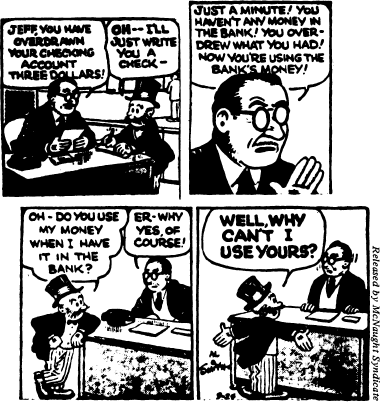
This is what has been happening for a good many years. You put your money in the bank. You think it is there. Yet the bank has been using it. It has been lending your money to others. This double use of the same money is called “credit expansion.”
“Credit expansion” is any increase in the number of monetary units loaned that do not represent an equal number of saved monetary units voluntarily made available for lending. Any increase in the purchasing power units of a borrower not offset by an equal decrease in the purchasing power units of a saver is credit expansion, while an increase in borrowing and lending, which is merely an equal transfer of purchasing power units from a lender to a borrower, is not credit expansion.
If you save some money and lend it to somebody else, this is not credit expansion. But if a bank lends money to someone that no one has saved and deposited for lending, if the bank merely creates money by opening or adding to a depositor’s account, no matter what the laws or rules are, it is, of course, expanding credit. The bank has increased the quantity of money, but there has been no increase in vendible goods. This means there is more money bidding for the same previously existing quantity of goods. This leads to the great disarray in the market place that we shall be discussing as we proceed.
Governmental Honesty Important
The first aim of a sound monetary policy must be to prevent governments from embarking on inflation and from creating conditions that encourage banks to expand credit. This is very different from a political program that attempts to stabilize purchasing power. There are in the sphere of human actions no such things as stability or security, and no political endeavors are powerful enough to bring them about. Unfortunately, many people and many governments have tried and failed. They may manipulate the money system to increase the security of some people, but in so doing they not only decrease the security of others, they also undermine the very foundations of society.
One of the better economists of forty years ago was Benjamin M. Anderson, for many years the economist for the Chase National Bank. In his great book, Economics and the Public Welfare, he wrote:
There is no need in human life so great as that men should trust one another and should trust their government, should believe in promises, and should keep promises in order that future promises may be believed in and in order that confident cooperation may be possible. Good faith — personal, national, and international — is the first prerequisite of decent living, of the steady going on of industry, of governmental financial strength, and of international peace.6
As mentioned last night, an increase in the quantity of money does not benefit society, merely those who spend it first at the expense of those who do not. An increase in the quantity of money adds no new wealth. It merely redistributes existing wealth and misdirects production in a manner which cannot be maintained. So when governments increase the quantity of money, they are not helping society; they are just helping those who get the new money first.
The Effects of Inflation and Credit Expansion
Inflation and credit expansion are also the hidden causes of corruption and chicanery. They breed uneconomic spending merely for the sake of spending, and the immoral desire to get something that is not yours by the political process of majority votes and government-granted privileges or subsidies. Inflation and credit expansion, like other forms of political favoritism, foster group hatreds that finally result in civil disorders and even wars. In the end, the mirage of politically created prosperity disintegrates, revealing reality. Production is then found to be out of line with human wants.
When an inflation or credit expansion starts, it is not noticed by many people. As a result, the quantity of money is increased without having its full effect immediately. Many housewives, noting higher prices, tend to hold back their money, waiting for prices to fall. Consequently, prices do not go up as fast as the quantity of money is increased. Then, later as the inflation proceeds, a second stage is reached. Then the housewives begin to think that prices are going to keep on rising. They face a very serious problem. Some then decide to buy things before they really need them, and prices rise faster than the quantity of money is currently increasing.
On Borrowing and Lending
As mentioned in the last lecture, money is the most important commodity in the market society. It is at least one side of every market transaction, and sometimes both sides. Lending money is a very helpful and profitable transaction in a free market society. It often happens that savers, saving up to send children to college, for later vacations, or for their old age, want to put their savings to work earning interest until they are needed. There are other people who have an urgent need for money that they have not yet earned or saved. They are willing to pay interest to have it now. They may be people who have just gotten out of school and need a car to take a job, or people who have many different immediate needs for borrowing money. They are happy to pay the market interest rate to have things money can buy when they are most needed. This is just a matter of time preference. They prefer to have these things now, instead of later, and they are willing to pay the price — interest.
Banks perform a very useful service when they act as middlemen between borrowers and savers. The borrowers and savers are both willing to pay a small fee for this service. This is a great service to society, like all transactions by middlemen in a free market society. They help move the savings to where their value is higher. The transaction not only helps borrowers, but it also provides savers with an interest income, which they prefer over letting their savings remain idle, earning nothing. This is a valuable social function of banks — one of two major ones.
On the Safekeeping of Money
The other major function of banks in a free society is to act as warehouses, keeping their customers’ cash and making it available to them when they want it. This warehouse function was performed in the early days in Great Britain by goldsmiths and silversmiths. They had two functions. They would lend out their own money, plus any money left with them for lending. They would also receive and keep, as a warehouse, the money that depositors might want at any time, yet did not want to carry on their persons or keep on their premises, because of a fear that it might be stolen. The “smiths” performed a very valuable service for their clients, both those who wanted to borrow or lend money and those for whose money they provided safe storage.
Under this system, when the depositors wanted their money, they presented their receipts and got their money immediately. They would then take the money and transfer it to persons to whom they owed, or wanted to pay, money. But as time went on, depositors found that all this was not necessary. Instead of going to the goldsmith or silversmith and withdrawing their cash in gold or silver coins, they would just endorse the receipt over to the person to whom they wanted to pay the money. So these receipts for specific amounts of money, representing actual gold or silver left on deposit with goldsmiths or silver-smiths, became negotiable paper. They would pass from one person to another without being presented for redemption in gold or silver. This was much easier when the amounts were in round numbers.
As this custom grew, the goldsmiths and silversmiths became aware of what was happening. Some of them decided that perhaps they could lend out “receipts” for which they had no gold and silver on hand. Some did just this. At first, they issued just a few extra “receipts” for not more than five or ten percent above the quantity of gold and silver they had on hand. This increased the number of purchasing power units on the market, but not the available quantity of goods. The result was a tendency for prices to rise. The people who borrowed this newly created “money” got the advantage of it. They could buy more things than they could have without the newly created “money.” The people who did not get any of these newly created receipts then found fewer goods and services in the market place. Consequently, they had to pay higher prices for the fewer goods that were left.
This also changed the direction of production. Goods and services were produced for those who were spending the new “money” as well as for those who were spending the gold and silver they had earned or saved.
How “Runs” Got Started
As time passed, some depositors got suspicious of what was happening. They presented their receipts for redemption in gold and silver. They started a “run.” Some goldsmiths and silversmiths were then in trouble. Those who had overissued their receipts could not meet the demand. They had to close their doors. They had certified to receipt holders that they could deliver on demand more gold or silver than they actually could. They had misrepresented themselves as warehouses whose receipts represented items actually on hand, just as warehouses now give receipts for pieces of furniture stored with them for safekeeping. But they did not have on hand the goods for which they had issued receipts.
As this process progressed, the goldsmiths and silversmiths got together in a sort of trade association. Then when there was a run on one, the others would try to help out their unfortunate colleague. This, of course, raised great difficulties. Instead of just one or two dishonest goldsmiths or silversmiths closing their doors when depositors panicked, none closed their doors until they all did.
Later, the goldsmiths and silversmiths became known as bankers. As bankers, they followed the same procedure. Every once in a while, they would overissue receipts, or open accounts on their books for more gold or silver than they had on hand. This was the start of what is now called “the fractional reserve system.” It is a system of telling people that paper receipts or bank accounts are the equivalent of a precious metal, even when the precious metal is not 100 percent readily available. As time passed, the fraction, or reserve, that banks kept on hand kept decreasing, and the overissue, or credit expansion, became a larger and larger percentage of the “money supply.”
These policies led to the periodic panics, recessions, and depressions of the nineteenth century. We had them in my country and in every other country where the banks adopted the fractional reserve system. Every once in a while bank depositors would get nervous. They would ask for “their” money and the banks would not have it on hand. The banks would then have to close their doors. We had such panics or recessions in my country in 1873, in 1884, in 1893, and in 1907.
Development of Banknotes
In the early days, most people had little use for banks or paper money, which was only issued in large denominations. Many workers were servants or farm hands, most of whose needs were supplied by their employers. Others were largely self-sufficient, producing most of their necessities on the farm and swapping some of their surplus crops for the goods and services they got from others. For their few market transactions, they used coins — “hard money.” Only a few rich and supposedly well-informed persons used banks and carried on their affairs with bank accounts, bank checks, and large-denomination bank-issued paper receipts. They were chiefly the large traders in securities, foreign exchange, and internationally traded commodities. This wealthy minority became known as the “financial community.”
At first, it was only these members of the financial community who were seriously affected by the bank closings, first known as money panics and later as financial panics. However, as the division of labor progressed, fewer and fewer families and local communities were self-sufficient. With the growth of trade, there was a greater and greater demand for money and bank services. More and more people bought a larger and larger part of their needs in the market place. Consequently, their need for, and use of, money increased. The money receipts, or “banknotes” as they became known, were issued in smaller denominations, and their use, along with bank accounts and checks, became more popular. So, with each succeeding series of bank closings, a larger and larger percentage of the population was affected by the ensuing hardships that resulted when depositors were not able to withdraw “their” money when they needed it.
When a bank overissues its bank notes, it has to be very careful. The issuing bank must avoid any action that will cause users to lose confidence in the issuer’s ability to redeem his banknotes. How far a bank or banking system can go in overissuing banknotes depends on psychological conditions. How long will the people trust them? The increase must not be so fast that the users believe that the resulting rise in prices will continue endlessly at an ever faster pace. Once the people believe this, there will be a flight into “real values” and a crack-up boom. The first manifestation of such a disaster is a loss of confidence in the banks or the paper money.
If the government frees the banks from the necessity of redemption, the banknotes become either credit or fiat money. If there is such a suspension of specie payments, the banks become bureaus of the treasury. All their operations are then subject to special regulations. In effect, the banks have been nationalized.
Inevitable Results of Monetary Expansion
Politically sponsored inflation or credit expansion produces three results, in addition to higher prices:
(1) It must lead to overconsumption and malinvestment. When people get more money, they tend to spend more than they would have if the money had not been created artificially. They thus tend to consume more than they otherwise would, and as they spend the newly created money, they are redirecting business, and this brings about a malinvestment of available savings.
(2) It does not remove the necessity of adjusting production and reallocating resources, that is, the factors of production, to the changing wishes of consumers. It only postpones the date.
(3) It cannot be a permanent policy. If it is not stopped soon enough, it must eventually break down the monetary system. As prices rise, larger and larger increases in the quantity of money are needed to maintain the same kind and amount of activity. Sooner or later, the psychological point is reached where people lose confidence in the future value of the monetary unit. The inflation or credit expansion is then at an end.
What we need, in reality, is an increase in the production of wealth, that is, of goods and services, not an increase in consumption or an increase in spending. It is the production of wealth that helps all people, and not the production of money.
Development of Federal Reserve System
As previously mentioned, we had a great panic in my country in 1907. It caused many people to stop and reflect about this whole business. Many groups were appointed to study the issues. They studied them at home and they studied them abroad. They went all over the world studying foreign banking systems. Bankers studied them. Politicians studied them. Economists studied them. In the end, most of them came up with pretty much the same answers, with only small differences in details. The result was the formation of the Federal Reserve System of the United States of North America.
Our Federal Reserve System was originally based, to a large extent, on the principles and policies of the German Reichsbank. The German Reichsbank was formed to function only in emergencies, somewhat like a fire department. Whenever there was a panic or a run on the banks, the Reichsbank was to supply the banks that had sound loans outstanding with any money they needed to satisfy their depositors. However, the Reichsbank would do this at a penalty rate; that is, for bailing the banks out of their difficulties, the Reichsbank would charge a higher discount or interest rate than the banks were paid on the loans they cashed or redeemed at the Reichsbank. The extra cost of this higher penalty rate was expected to keep bank credit expansions within reasonable limits. Such provisions for emergencies and the financing of governments were the original purposes of starting a central bank.
My country had an antipathy toward central banks. We had had two of them early in our history. We had learned the hard way that they were detrimental to the welfare of the nation. So, instead of calling the Federal Reserve System a central bank, which it really was, we set up twelve different Federal Reserve Banks in twelve different parts of the country. In the beginning, each was supposed to operate separately.
More Money for More Business
Each of the banks was to provide an “elastic money supply” for its own “District.” The “money supply” would expand to meet what was called “the needs of business.” It would contract whenever the “needs of business” no longer required such a large quantity of money. The Federal Reserve Banks would be free to create all the money required for the “needs of business,” but no more than that amount.
It was felt that, before the creation of the Federal Reserve System, difficulties arose from the ability of the banks to inflate the quantity of money without limit. It was thought they overexpanded beyond the real “needs of business.” The new system was going to cure this situation. The banks would no longer be able to lend as much as they might like to lend. They were to be restricted to the “needs of business” by a system of what was called “three-name short-term paper.”
The origin of this idea can be traced back to the famous “note du Havre.” A finance minister of France advised Napoleon I, who sent this note from Le Havre to the Bank of France on May 29, 1810. This idea holds that credit expansion is safe if it is limited to short-term loans, loans for no longer than ninety days, backed by regular business transactions, represented by written promises to pay that have been endorsed by both the buyers and sellers. In the case of the Federal Reserve, the endorsement of a bank was also required. It was felt that these requirements would limit the banks in their expansion of credit to actual business transactions, that is, to the actual “needs of business.”
Elastic Money Operations
This is how it was supposed to work: There was to be a flexible or “elastic money supply” that expanded and contracted to meet the “needs of business.” These flexible banknotes were to be called Federal Reserve Notes. They were to be backed by short-term business paper, and partly by a reserve of gold. Originally, the gold reserve requirement was 40 percent. During World War II, the gold reserve was reduced to 25 percent. On March 18, 1968, this gold reserve was entirely eliminated. There is no longer any gold reserve requirement for the issuance of Federal Reserve Notes. But originally, the Federal Reserve Notes were backed by 40 percent gold, plus 100 percent in amounts of business transactions represented by three-name short-term paper. This paper was to be a note signed by (1) a buyer, (2) a seller who discounted the note with a member bank, and (3) the bank, which, when in need of cash, rediscounted it with the Federal Reserve Bank for Federal Reserve Notes. When the note was paid by the buyer, the Federal Reserve Notes originally issued in the amount of the loan were withdrawn from circulation.
It was thought that these requirements would stop any overexpansion because the quantity of Federal Reserve Notes outstanding would always be strictly limited to the “needs of business.” At the same time, the banks, by discounting their short-term notes, would always be able to get enough Federal Reserve Notes to meet the demands of their depositors. This, it was thought, would eliminate all “runs” on banks and thus prevent the panics and recessions that followed when large numbers of banks, unable to meet depositors’ demands, were forced to close their doors.
A typical transaction might be the Ford Motor Company selling Fords to a dealer in San Francisco. The dealer would sign a note in which he agreed to pay for these cars at the end of ninety days. Then, if the Ford Motor Company did not want to wait ninety days for its money, it would take this note to its bank. It would endorse the note and discount it at the current rate of interest. It would then get the money, less the interest charged. Then, if the bank should need more cash, the bank could take this note to its Federal Reserve Bank and rediscount it, at the Federal Reserve discount rate, for Federal Reserve Notes. Everybody would then be happy, and when the Ford dealer paid off the note, Federal Reserve Notes equal to the amount of the loan would be withdrawn from circulation.
This is how the Federal Reserve System was supposed to provide an elastic currency to meet the “needs of business” and at the same time prevent runs on banks. There were people who saw some dangers in it. Some Senators objected to the proposal on the Senate floor. One, Elihu Root, a prominent American statesman, opposed the Act. He is reported as telling the Senate:
We are all optimists in this country. That means we are all inflationists. The direction of the Reserve Banks will all be optimists. They will be inflationists.7
But the opposition was not heeded, and the Act became law on December 23, 1913.
Changing the “Needs of Business”
In 1922, I was taught in a high school economics course that this was a very good thing. It not only limited the expansion of the quantity of money to the “needs of business,” but it would also provide banks with a ready means for getting cash to meet any withdrawal demands of their depositors. This, in return, was expected to prevent the recurrence of depressions. Later, as a college undergraduate, and still later, as a graduate student, I was taught the same reasoning. It was not until about fifteen years ago that my great teacher, Ludwig von Mises, revealed to me the error inherent in the “needs of business” fallacy.
An understanding of this error is fundamental for an intelligent comprehension of modern inflation and depression problems. The fallacy involved is simply this: by lowering the interest rate artificially, the banking systems can increase the so-called “needs of business” at will.
For example, if you are considering a project that requires borrowing money, you call up the bank and ask the terms of a loan. The bank says: “We can let you have the needed amount with interest at 6 percent.” So you calculate all your costs, and conclude that with interest at 6 percent there is no chance to make a profit. Accordingly, you decide not to go ahead with the project. Then, the next day the bank calls back and says: “We can now let you have this money for 5 percent.” You quickly recalculate your lower costs. You decide a profit is now possible. So you borrow the money and proceed with the project.
There will always be some business transactions that will seem to be profitable with funds available at 5 percent that will not seem to be profitable with interest at 6 percent. So, by reducing the interest rate, banks can increase the “needs of business.” In doing this, banks may spur business activities that misdirect the use of available labor and other resources.
Lower Interest Rates
What caused the bank to call back and offer the loan at 5 percent, one percent lower than the day before? Let us look at two possibilities: (1) a free market drop in interest rates, and (2) a bank-decreed drop in interest rates. If someone had saved that money and could not lend it at a higher rate, and was now willing to take one percent less, the bank would merely be offering a normal middleman free market service. It would merely be an offer to transfer the purchasing power of the saver to the borrower. It would not change the total monetary units available on the market. It would merely transfer them for the period of the loan from one person to another.
But this is not always the way the banks do it. Under the fractional reserve system, they can and do reduce the interest rate even when there has been no increase in savings available for lending. They merely open, or increase the amount of, an account on their books, and allow the borrower to draw checks against this account. Of course, as long as the borrower uses the loan by writing checks; and the checks remain in the banking system, there is no need for more cash. The effect is similar to that of the overissue of money receipts, or banknotes. However, if there is a need for cash, the bank can go through the channels provided by law, and discount some loans at its Federal Reserve Bank in exchange for the “needed” money in the form of newly created Federal Reserve Notes.
This was the system that was supposed to put an end to depressions forever. The proponents of the law thought they had found the solution. Amen! This law was passed in December 1913. War broke out in Europe during the summer of 1914. As a result, the Federal Reserve System was quickly organized and got under way in the fall of 1914, a little earlier than originally planned.
Early Federal Reserve Operations
Before the law went into effect, large New York banks were operating on the basis of a 25 percent reserve for checking accounts. That meant that they could make loans until their deposits, including those created by their loans, rose to four times their cash on hand. The original Federal Reserve Act set the legal reserve for major city banks at 18 percent, thus permitting a credit expansion to more than six times their cash reserves. After we entered World War I, the Federal Reserve Board recommended reduction of this legal reserve to 13 percent, and Congress amended the Act on June 21, 1917, to provide for this reduction, thus permitting a still greater expansion of bank credit.
Here is a quotation from a Princeton University professor, Lester Chandler, the official biographer of Benjamin Strong, the first head of the Federal Reserve Bank of New York. Professor Chandler writes:
With the entrance of the United States into the war in April 1917, the Federal Reserve entered a new phase. A system originally established to “accommodate commerce and industry” became one to “accommodate the Treasury.” Its overriding objective became that of assuring the success of war borrowing. The first important monetary action of the Federal Reserve was to serve as a handmaiden of inflation.8
Professor Chandler considers laissez-faire economics and the gold standard obsolete. He is the author of a popular textbook on money and banking, widely used for some time in American colleges and universities. He is among those who accept political monetary management as a proper means for promoting the stability of business activity and of “price levels.” So he is not trying to testify in favor of a laissez-faire free market economy.9
World War I Financing
How was the Federal Reserve used during the war? As mentioned, it was originally thought that the Federal Reserve System would charge a penalty rate when discounting “commercial paper” for Federal Reserve Notes. The idea of setting the discount rate below market interest rates came up first, not in connection with business loans, but in connection with financing the war. This is how it was done: High-pressure campaigns were launched to sell war bonds to the public. Bright young fellows in Boy Scout uniforms — I was one of them — went around and rang doorbells. In every movie house they had three-minute speakers. Posters were everywhere, and everyone was urged, as a patriotic duty, to buy Liberty Bonds.
Of course, most people did not have a lot of spare cash in their pockets or bank accounts. How could they buy these Liberty Bonds? They paid 5 to 10 percent down and borrowed the rest from the banks. The interest the bond buyers paid the banks was equal to what the government paid on the amount borrowed, so the loans cost the bond buyers nothing. They kept the interest on that part of the bonds for which they had paid, and reduced the bank loans as fast as they could. In any case, the government got the full 100 percent right away.
How was this possible? This is what happened: There were four Liberty Loan drives during the War, and a fifth drive after the Armistice, called the Victory Loan. The sales totaled about $21 billion. Each bond issue paid interest rates a little higher than the Federal Reserve discount rates. So the government would pay the higher interest rates, and the banks, if they needed cash, could discount the bond buyers’ notes at the lower discount rates and make money. The banks made the money immediately available to the Treasury. The “money supply” was thus pumped up as fast as the government wanted more money. The banks made money by making money. On the First Liberty Loan they got 3½ percent for their loan, which, if they needed cash, they could discount at 3 percent at their Federal Reserve Bank, and thus make ½ percent. They did this whenever they did not have enough depositors’ money to use as a reserve for their credit expansion.
During this period the bond interest rates and discount rates varied. (See Table XV.) However, the banks were always able to make money on the spread, and the government was able to draw checks for all the money that it felt it needed to finance the war.
Table XV
LIBERTY LOANS, 1917-1919
Reserve requirements reduced 6/12/17:
From 18% to 13% for central reserve cities; 15% to 10% for reserve cities; 12% to 7% for country banks; and 5% to 3% for time deposits.
____________
10 Tax-exempts, 3¾%.
When the Federal Reserve Act was passed, the sponsors had not given any thought to the possibility of credit expansion for the “needs of government.” The debt of the Federal government at the time the law was passed was only $1.3 billion. Today, with a debt in excess of $350 billion, we would call that “peanuts.”11
Effect on “Money Supply”
Now just take a look at Table XVI, which shows what happened during this period. The gold stock went up, of course, as the Europeans shipped gold to this country. The “money supply,”12 which had been $16.1 billion on June 30, 1914, before the Federal Reserve was formed, went up to $29.7 billion by June 30, 1919. By that date the banks were also holding more government bonds. The Federal Reserve Banks owned almost $300 million, while the commercial banks held $5,147 million. These government bonds were all bought with bank depositors’ funds, or by means of credit expansion using such deposits as the fractional reserve.
Table XVI
WORLD WAR I MONETARY TABLEAU, 1914-1920
Gold stock as a % of quantity of money: 6/14–9.9%; 6/20–7.6%
U.S. debt as a% of quantity of money: 6/14–5.1%; 6/19–18.3%; 6/20–12.0%
______________
131920 call–High, 9.9% in February; Low, 6.96% in December.
This great expansion of the “money supply” was brought about by the fractional reserve system and holding the Federal Reserve discount rates below the call rates and the prime commercial rates in New York City. The banks lent money out at the higher interest rates and, when they needed cash, discounted their loans with their Federal Reserve Banks at the lower discount rates. This perfectly legal process pyramided the “money supply.” The “money supply” went up all through the war and kept booming after the Armistice. This credit expansion was not based on commercial paper. It was based primarily on notes secured by government loans. By 1919, about 95 percent of all Federal Reserve advances were based on government securities.14
At that time, there were some people in office who had some idea of the problem. One of these was a member of the Federal Reserve Board to whom I shall be referring frequently, Adolph C. Miller, a former economics professor at the University of California. On February 26, 1919, he wrote a letter to Benjamin Strong, the Governor of the Federal Reserve Bank of New York, saying:
The most serious part of inflation is, after all, the aftermath. We sow the wind to reap the whirlwind. Somehow or other we have got to come down off the perch. But this is an uncomfortable process for nearly everybody and, for some, a very costly and ruinous one. We shall be fortunate in this country if we get off without some serious financial troubles and some very serious political troubles growing out of the currency and credit disorders. That has always been true in the past and I am terribly afraid it will be true in the present instance. . . . There has got to be liquidation.15
Post-War Consequences
So the Federal Reserve System decided upon liquidation. For millions of poor farmers with heavy mortgages and other debts acquired in expanding for the war effort, this liquidation was rather hard to take. For many of them liquidation meant lower prices for farm products, bankruptcy, and loss of their farms. We do not have time to go into all the details. There are more important things we must consider.
The “money supply” kept increasing until it reached $34.2 billion on June 30, 1920. This was more than double the figure before the Federal Reserve System began. We had loaned the Allies $7 billion during the war. There were more loans to European countries after the war. Post-war loans to foreign governments amounted to over $3.8 billion. During the war, the British pound had been pegged at $4.76 by J.P. Morgan and Co. In the spring of 1919, the Morgan company stopped pegging the pound and its value on foreign exchange markets promptly dropped, hitting a low of $3.19 in February 1920.
What did the Federal Reserve do to liquidate? They put the discount rate up. They raised it to 6 percent in January 1920, and then to 7 percent on June 1, 1920. The market interest rates were just about the same. This resulted in a decrease in bank loans that reduced the “money supply” in a period of a year from $34.2 billion to $31.7 billion. (See Table XVII.) In about eighteen months the inflationary condition was largely corrected without much other government interference in the economy. The inflation was stopped, but of course the consequences could not be avoided. The farmers were hurt. In fact, all people in debt were badly hurt.
There were many serious problems, not only at home but also abroad. Our farmers and other exporters could not sell as much abroad, because the European men were back on their farms and in their factories producing many things they had gotten from us while they were busy fighting in uniforms. The railroads, operated by the government during the war, were turned back in poor condition to their private owners. Price controls, rationing, and other war controls had gone off. Many prices were rising; others, largely farm prices, were falling. War production employment and the “money supply” were going down. Many people were hurt.
But by and large the government kept out of it. There were no price and wage controls or other major government interferences with market processes. Wages, prices, and production were permitted to adjust quickly. The economy was able to recover fairly well in from twelve to eighteen months. Of course, many people were hurt. This always happens after an inflation. But the situation settled down, with rising production and little unemployment. Then, the Federal Reserve System dropped its discount rates below market interest rates again. The situation again started to deteriorate.
Post-War Political Changes
There were also many problems developing abroad. We do not have time to go into them in any detail. In 1920, we turned out the Democratic Party, which had been in power during the war. We elected the Republican Party, which was pledged to high tariffs. The Republicans first put in high agricultural tariffs, and then later passed the Fordney-McCumber Act, placing higher tariffs on industrial imports. These tariffs made it extremely difficult for Europeans to pay their debts to the United States. As a result, the international situation was deteriorating.
Table XVII
POST-WAR DEPRESSION, 1920-1923
Gold Stock as a % of quantity of money: 6/20 – 7.6%; by 6/22 – over 10%.
__________
16Effective starting date.
There is one other factor that should be mentioned. There had been growing differences between the President of the United States and the Federal Reserve Board. When the Federal Reserve Board Chairman’s term expired on August 9, 1922, the President refused to reappoint him. It was nine months before a new man was appointed. This gentleman’s name was Daniel R. Crissinger. Nobody had ever heard of him. Prior to the Republican Administration, he had had no experience worth mentioning in banking or economics. Nonetheless, he was appointed to the top position of this important agency.
Who was he? He had been the prosecuting attorney and city solicitor for Marion, Ohio, President Harding’s home county and city.
The banking community and many economists were alarmed. Many appealed to the Secretary of the Treasury, Andrew Mellon, who also opposed the appointment. The Secretary went to the White House for a session with the President. The President is reported as having told his Secretary of the Treasury, “This appointment is very dear to my heart.”17 So the man at the head of the Federal Reserve System was a personal political friend of the President with no understanding of financial problems.
A Look at Europe
In the meantime, there were other important developments. On June 19, 1923, the Anglo-American debt settlement was signed, providing for the repayment of the British war loans with reduced interest rates on the amounts outstanding. The German inflation reached its climax later that year when the mark, worth 23.82 cents before the war, went to 16 trillion to the dollar. It was later stabilized at only 4 trillion to the dollar.
By December 1923, Germany was in a state of economic collapse, both internally and externally. Her former European enemies wanted reparations, but they did not want German goods or worthless paper marks. In 1924, the Dawes Plan attempted to put Germany back on her feet financially. It granted Germany a foreign loan with which to stabilize the mark and re-establish the gold standard. In return, Germany had to accept foreign supervision of an internal taxation system intended to raise funds for repayment of the loan and reparations payments according to a prescribed “index of prosperity.”18
Table XVIII
MONETARY EXPANSION, 1922-1924
_____________
19Date effective.
Inflation in the United States
Meanwhile, in the United States the “money supply” was again increasing. By holding the discount rate below the call and prime interest rates, the “money supply” had been expanded between June 1922 and the end of 1923 by roughly 10 percent. (See Table XVIII.) As a result of this misdirection of the economy, the free market processes were unable to correct the increasing imbalances, and there was a slowdown in business that worried a number of people.
Moving into 1924, a Presidential election year, those in political office had to have prosperity at any price. So the Federal Reserve System, with its new Chairman taking a leading part, lowered the discount rates three times in 1924 before Election Day: first on May 1, to 4 percent; then on June 12, to 3½ percent; and lastly, on August 8, to 3 percent. This was a deliberate attempt to create enough money and spending to make it look as though the country was very prosperous. It was expected that the voters would then keep the party responsible in power.
The Federal Reserve Banks were also using “their” reserves to buy government securities. Their holdings of government securities, as you can see in Table XVIII, went up $406 million in 1924. Actually, in the twelve months before the election, they increased by $472 million. These funds found their way into the market place, driving up prices and reducing the purchasing power of every dollar.
Just before the election President Coolidge, in a campaign speech, said, “It has been the policy of this Administration to reduce discount rates.”20 The party in power was doing everything it could to create “easy money” conditions before the election.
These policies did increase the “money supply,” which in turn stimulated business activity and security speculations. Prices also started to rise. So right after the election, the Federal Reserve attempted to slow down the economy. In five months, the Reserve Banks sold off $226 million of government securities, and in February 1925 the discount rate was raised to 3½ percent.
Prosperity by Political Promotion
Benjamin Strong, Governor of the Federal Reserve Bank of New York, was really a strong man. He dominated many of the policies of the Federal Reserve System from its early years until his death in 1928. He felt these 1924 policies were necessary to head off “some recession in business.” In December 1924, he wrote that they had helped develop “a greater feeling of tranquility and contentment throughout the country.”21 There were some who believed that if Mr. Strong had lived longer, his skill and ability in manipulating monetary policies might have averted the 1929 depression. His official biographer, Professor Chandler, has this to say:
The easy-money policy of 1924 was of historical importance. It was the first large and aggressive easing action deliberately taken by the Federal Reserve for the purpose of combatting a decline of price levels and business activity and of encouraging international capital loans.
So the party in power was returned to office with the help of an inflation deliberately sponsored by the Federal Reserve System, which was supposed to be an independent Supreme Court of monetary policy and economics that was above party politics. Permit me to remind you, as I shall from time to time, that this was not free enterprise operating. It was political intervention manipulating the quantity of money, the most important commodity in a market economy. Every such change in the quantity of money not only affected the value of every dollar, but it also upset the free market price relationship of every transaction. It thereby misdirected business production away from the first choices of consumers.
A Look at England
Meanwhile, there was another important overlapping development. In the spring of 1924, Mr. Strong, the head of the Federal Reserve Bank of New York, wrote to the Secretary of the Treasury, Andrew Mellon:
At the present time it is probably true that British prices for goods internationally dealt in are as a whole, roughly, in the neighborhood of 10 percent above our prices and one of the preliminaries of the reestablishment of the gold payment by Great Britain will be to facilitate a gradual adjustment of these price levels before monetary reform is undertaken. . . . This . . . can be facilitated by cooperation between the Bank of England and the Federal Reserve System in the maintaining of lower interest rates in this country and higher interest rates in England. . . . It will be difficult politically and socially for the British Government and the Bank of England to force a price liquidation in England. . . . Their trade is poor and they have over a million unemployed people receiving government aid.22
In Sir Henry Clay’s official biography of the late Lord Norman (Montagu Norman), head of the Bank of England from 1920 to 1944, we read:
It did not, however, turn out to be easy to regulate credit in America in such a way as to meet both London’s requirements and domestic needs. . . . In January 1924 Strong was again writing that Coolidge’s . . . election and European recovery might start a speculative outbreak difficult to control; rates could not be put up. . . . He leaned rather to open market operations. In June New York had put its rate below London with the deliberate intention of helping London back to the Gold Standard, but he still thought higher rates would be needed to check inflation in the New Year.23
In the same biography of Montagu Norman, we read an October 16, 1924 letter of Mr. Norman to Mr. Strong. This was a letter from the head of the Bank of England to the head of the New York Federal Reserve Bank, just before our 1924 election. Mr. Norman wrote:
I agree entirely that we shall need some sort of understanding between us as to the future gold policy. I think you are helping to this end if you keep your rates as low as possible and lend freely to the rest of the world as your Market is now doing.24
There were many more letters. I have not time to read them all. But let me remind you, these were not free market operations.
England Asks for Help
On December 28, 1924, right after Christmas, Montagu Norman arrived in New York, where he had a private luncheon with Benjamin Strong and Secretary of the Treasury Andrew Mellon. He was looking for a pledge of $500 million to help England go back on the gold standard. He got a pledge of $200 million, at no cost, from the Federal Reserve Bank of New York, with later Federal Reserve Board approval. Mr. Strong felt “that [central bank] operations for profit of a competitive character in any market are a mistake. . . . Reserve Banks . . . have the power to issue notes and . . . in effect manufacture the credit.”25
This was not free enterprise. Actually this was a pledge of bank depositors’ money, or a credit expansion based on their deposits.
For the other $300 million, Mr. Norman went to J.P. Morgan. Being a businessman, Mr. Morgan wanted to charge a fee for such a pledge, whether or not it was drawn upon. Discouraged, Mr. Norman contracted for a pledge of only $100 million from the Morgan company. He returned to Europe to get the rest of the backing.
Mr. Norman and certain Federal Reserve officials had agreed that it was essential to keep the Federal Reserve discount rate down below the bank rate of the Bank of England. Otherwise, gold would flow out of England. Mr. Strong recorded in January, 1925, that the only desire of Mr. Norman concerning Federal Reserve policies
. . . was to understand in a general way what we expected our policy to be, and to express the hope it would be directed toward maintaining as stable a price level as possible in the United States.26
Keep Congress in the Dark
Montagu Norman went home, attended to some affairs in London, and then, as all well-to-do Europeans of his time did, took a little vacation. On March 9, 1925, he wrote Benjamin Strong from the Riviera:
All official consideration of a gold program was deliberately pushed over to this month, so that nothing about it should come out until your Congress should have adjourned.27
Before the days of Franklin D. Roosevelt, our Congresses expired on March 4, every second year. The new Congress did not meet until the following December. So Mr. Norman was referring to the fact that our Congress had to go home on March 4. He continued:
If we begin consideration next week (as I expect), we cannot expect a final decision before early or middle April — meanwhile I shall hope to have it all kept secret, and of course out of Parliament till the end.28
Table XIX
EFFECTS OF HELPING ENGLAND, 1924-1927
_______________
29Date effective.
Free enterprise? No. This was political manipulation of monetary systems, all with the very best intentions.
On April 2, 1925, the Federal Reserve Bank of New York officially approved the principles of the agreement with the Bank of England. On April 23, the specific details which guaranteed a pledge of $200 million to Great Britain were approved. Then on April 28, 1925, Great Britain announced she would henceforth redeem paper pounds in gold at the pre-war rate of $4.86. At about the same time, the Bank of England raised her bank, or discount, rate from 4 percent to 5 percent. The Federal Reserve discount rate remained at 3½ percent for the rest of 1925.
So England returned to the gold standard, backed by a pledge of money that Americans had put in their bank accounts, and which they thought was there for them to draw out at any time. This was also done with the understanding that our Federal Reserve System would keep our discount rate low, below that of the Bank of England, and, incidentally, below free market interest rates. This resulted, of course, in a great expansion of the “money supply” of the United States. In short, inflation or credit expansion was the avowed policy of our monetary officials.
Manipulating the Quantity of Money
The gold stock stayed about the same from the end of 1924 to the end of 1927. (See Table XIX.) The “money supply” went up from under $40 billion to over $45 billion. The Federal Reserve holdings of government securities fluctuated, but almost doubled during 1927. The discount rate remained much below the call rate. The call rate is the interest rate paid for money borrowed to buy or hold stock exchange securities. Such loans can be called on demand. Then the borrower has to pay his loan on demand, or his securities are sold and the loan is repaid from the proceeds. In 1926, the banks could lend money on stock at 5 percent plus, and then discount eligible loans at 4 percent at their Federal Reserve Banks. This was a very profitable and an entirely legal business for commercial banks.
As a result, stock market prices started to move up. They moved up faster and faster as time passed. All through 1925, Mr. Strong opposed raising the discount rate, although domestic conditions seemed to call for it. As one Board member expressed it in his diary on October 13, 1925:
Strong is thinking more of the effect of rate increases on Great Britain than in the United States. Platt and Miller (Board members) believe rates should be increased and I am inclined to the same view, especially in view of the stock speculation movement in New York.30
On December 1, 1925, Governor Strong was saying privately that an increase in discount rates might result in drawing gold from Great Britain and further unstabilize her economy, while creating deflation and uncertainty in the domestic business of the United States. The discount rate was finally raised from 3½ percent to 4 percent on January 7, 1926. At the time, one major New York bank was reported as borrowing $ 115 million from its Federal Reserve Bank on fifteen-day notes and lending it on stock exchange securities at from 6 percent to 7 percent. Nice business, if you can get it, and all perfectly legal.
Whenever business turned down, the Federal Reserve Banks bought government securities. They would buy these governments with a fraction of every bank depositor’s money that by law had to be kept with a Federal Reserve Bank, supposedly as a safety measure. So under this system, if you were a bank depositor, a certain percentage of your money was used by the Federal Reserve System to buy government securities. When the sellers of the securities spent their proceeds, the depositors’ own money was actually competing in the market against depositors, raising prices higher than they would have been in a free market. In any case, the Federal Reserve operations were not free market operations.
Mr. Hamlin’s Diary
This lecture will run long, I am sorry to say, but there are some important quotations from the diary of Mr. Charles S. Hamlin that just cannot be omitted. Mr. Hamlin was appointed by President Wilson as the original head of the Federal Reserve Board from 1914 to 1916. He remained a member of the Federal Reserve Board until 1936, when the changes signed into law by Franklin Delano Roosevelt became effective. He kept a diary in which he scribbled what happened at every meeting of the Federal Reserve Board and at many of its committee meetings during the twenty-two years he was a Board member.
Herbert Hoover had been Secretary of Commerce from 1921 until 1929 and then President during the early depression years (1929-1933). In the volume of his memoirs devoted to the depression, his account differed somewhat from that in Benjamin Anderson’s book, to which I have referred. Benjamin Anderson, whom I had met, had already passed on. As I had had some connections with President Hoover, I wrote him, asking for his explanation of these differences. He referred me to this personal diary of Mr. Hamlin. It was written in ink in Mr. Hamlin’s own handwriting with his own abbreviations, some of which were difficult to decipher. I have spent many fascinating days in the Manuscript Room of the Library of Congress in Washington reading this diary with his accounts of what happened behind closed doors at these all important Federal Reserve meetings. The following inside information comes from this diary.
Prevent a Recession: Inflate
From his entry on March 20, 1926:
Strong says a business recession has started. We must be prepared to cope with it. If it continued to increase “we” should ease up the situation by further investments in government securities.
Four days later he noted:
Strong says New York banks are rediscounting heavily, tending to put pressure for liquidation of customers’ loans. Conditions in Europe bad, feared recessions. We should buy government securities to ease the money market; that this money would return in the shape of paid off rediscounts; thus giving greater facility for enlarging customers’ loans. He also said “reducing discount rates would only make it easier for member banks to carry their rediscounts.” Open Market Committee unanimous it be given permission in case of emergency to buy between now and April 15th not to exceed $90 millions of government securities in addition to replacing maturities.
Miller violently objected. He said “we would be hauled before a Congressional Committee and that talk of depression was rot and that real reason was to help the stock market.”
Mr. Hamlin himself “feared increase in recession and that European conditions might become worse at any moment.” On March 25, we read:
[Secretary of the Treasury] Mellon said: “undoubtedly a recession in business.” He favored liberality looking towards increased credit.
The motion to buy more government securities was then passed by a vote of 4 to 3. This was under a Republican Administration, and the crucial vote was cast by Mr. Hamlin, a Democrat then seeking reappointment. He thought that if he voted with the Administration he might be reappointed. He was, later.
On April 13, we read:
Strong told CSH [Hamlin] he was very much aroused by Miller’s statements re his being influenced by stock market needs and intended to speak of it to [a Congressional] Banking and Currency Committee. Mellon also indignant and had told him. CSH advised against bringing in open, said “Miller, perhaps unconsciously, was a rabid deflationist.” He said Miller, Willis, the Commercial and Financial Chronicle all heaped together in the interest of radical deflation.
He was referring to H. Parker Willis, one of the young men who helped to write the original Federal Reserve Act in 1913 and then in 1914 became the Board’s first Secretary. In 1918, Dr. Willis resigned to become Professor of Banking at Columbia University, where he was later my teacher.
Land and Security Speculations
As some of you may know, we had a land boom in Florida in the mid 1920s. People from all forty-eight states were eager to buy almost any kind of real estate in that sunny state, supposedly ideal for vacations or retirement. Some were even buying lots that were under water at high tide. Banks that had lent money on the boom prices of Florida real estate were in trouble when the high land prices broke early in 1926. We learn from Mr. Hamlin’s diary that a man from the Federal Reserve Bank of Atlanta appeared before the Board in Washington on April 21, 1926. He told them the “collapse of the Florida real estate boom would probably involve 50 banks in failure.” He said the Governor and other directors of the Atlanta Reserve Bank wanted to assist the banks to the limit “without careful scrutiny of paper offered for rediscount. He and others opposed as banks were in insolvent condition. He urged closing the banks to prevent favoring public [government] deposits at the expense of small depositors.”
He feared that Federal Reserve support of these banks might wipe out the capital and surplus of the Atlanta Reserve Bank and leave it insolvent. The Board “agreed with his views but refused to issue any instructions prior to full discussion.”
That spring, 1926, there was also a corrective break in the stock market. Prices dropped about 10 percent. On April 22, the Reserve Board approved a lowering of the discount rate from 4 to 3½ percent, for the Reserve Bank of New York only. The cheaper credit helped to send stock prices soaring again. For months, Federal Reserve officials debated whether the law should be amended to permit Reserve Banks to refuse to discount eligible paper offered by member banks making security loans. On August 13, the New York discount rate was raised back to the 4 percent rate of the other eleven Reserve Banks.
This was a manipulated money market, not a free one. Mr. Hamlin, an original Democratic appointee, was nervously awaiting his reappointment by a Republican Administration. On June 13, 1926, he wrote in his diary that the Federal Reserve Board was “pretty well shot to pieces.” He felt that the President did not want to reappoint him and would do so only because of “dire necessity,” for implied political reasons. Then he noted: “The Federal Reserve Board has degenerated into a political appanage of this Administration.”
England’s Plight
This was the situation in the United States. Meanwhile, what was happening in England? When England went back on the gold standard in April 1925, with the pound valued at $4.86, she had raised the value of the pound about 10 percent above its average value of about $4.40 on the open market the previous year. This meant that England, which operated largely as a factory, importing raw materials and exporting finished goods, had raised its export prices by roughly 10 percent. For Americans, buying a British product that cost a pound sterling, the price was now $4.86 instead of the earlier $4.40.
Economics teaches that with higher prices you sell smaller quantities. Consequently, you produce less to sell. This means you employ fewer workers. So with the return to the gold convertibility of the British pound at $4.86, unemployment grew in England. This 1925 misadventure of the British was made while Winston Churchill was the Chancellor of the Exchequer. In overvaluing the pound, he was responsible for repeating the same error the British had made a century earlier, after the Napoleonic wars, which had produced great distress. The free market solution for this increased valuation of the pound would be to permit money wages to fall by about 10 percent. Such a drop in money wages would not affect real wages, because the pound was now worth approximately 10 percent more. Unfortunately, organized labor in England would not listen to this solution. Labor leaders and their followers wanted to keep this whole 10 percent gain for union members.
Lionel Robbins, the British economist, in his book, The Great Depression, tells us:
The effects of the over-valued exchange made themselves felt with great severity in the coal trade. Throughout 1926 there raged labour disputes, which were the direct consequences of these troubles — first the general strike. [This lasted from May 3-14, 1926, when all of organized labor stopped work in England.] Then a strike in the coal-fields which dragged out for over six months, still further endangering the trade balance. By 1927 the position was one of great danger.31
In addition to the general labor problems, German coal was getting back on the world market, and ships, which had used British coal for centuries, were switching to oil. So Britain’s coal exports were rapidly dwindling.
There was another important aspect of this problem. Before World War I, British labor unions had taken care of their own unemployed members by levying assessments on working members. Under this system, if wage rates and unemployment got too high, the assessments on the working union members soared to the point where they were willing to work for a lower wage rate, which, without the assessments for support of so many unemployed, provided a higher net income. But the Fabian Socialists had sold British workers and Parliament the idea of “unemployment insurance.” This effectively transferred the burden of supporting the unemployed from the working union members to the taxpayers. As a result, the unions were no longer interested in how much unemployment might result from their demands for higher wages. The British politicians felt themselves unable to oppose the demands and privileges of the entrenched unions. This political fear has been due to the erroneous belief that labor unions obtain “gains” for all workers, whereas in reality such “gains” are at the expense of consumers and other workers. This helps to explain the way England has drifted since World War I.
Prosperity by Political Pronouncements
Now, let us return to the United States. On New Year’s Day, 1927, our President, as was the custom, issued a very glowing statement about the prospects for the coming year. It was going to “be one of continued healthy business activity and prosperity.”32 In his opinion, the booming stock market merely reflected the growing wealth and power of the United States.
There were some businessmen who did not agree. One in the construction industry, a Mr. Strauss, said that commercial building “had reached the saturation point.”33 He felt there would be a down-turn in business activity. Now politicians in office cannot readily accept such a depressing outlook. The Secretary of the Treasury, Mr. Mellon, came to the rescue. He did not agree with the businessman. He said Mr. Strauss did not know what he was talking about and that the present was a good time to build from the point of view of costs.
Meantime, the stock market dipped down. Every time the market started to correct itself, Washington issued booming statements, and the market reacted by resuming an upward movement. Then it would gradually settle down again until some new statement was issued.
For example, after the market sagged a bit, Secretary of the Treasury Mellon announced on March 7, 1927, that the Treasury was going to refinance the Second Liberty Loan 4½ percent bonds with 3½ percent notes on November 14. This meant that the Federal Reserve would be expected to keep interest rates low until this refinancing was completed some eight months later. This told businessmen and investors they could operate with assurance that low interest rates were here to stay at least that long. Two days later, the New York Times report on the stock market stated: “Prices rose with a vigor . . . [there was] frequent comment in Wall Street that the ‘main advance’ had been resumed.”34
When the market went down again, Mr. Mellon gave the press another optimistic statement as he sailed for Europe. He saw “no evidence of overspeculation . . . an abundant supply of easy money should take care of any contingencies that may arise.” The government’s budget had a surplus and he saw no reason to raise the discount rate. “All signs and indications at the moment point to the country enjoying a successful business year.” As the New York Times reported, this “created a cheerful feeling in Wall Street.”35
French and British Financial Problems
Now, let us turn to some of the developments in Europe. The post-war French inflation had shaken public confidence in the franc. At one time in mid-1926, its value had dropped to just over two cents. For years, Frenchmen, as well as the Bank of France, had bought British pounds with their spare francs. The Bank of France also kept gold in London, where it was free from French laws limiting official transactions to the pre-war parity of 19.3 cents. However, by the end of 1926, a new French government had restored confidence in the franc. During 1927, it was trying to keep the value of the franc from rising above four cents and thus hurting French exports.
Meanwhile, the British situation was becoming increasingly critical. The French became worried about their British pounds. Some hoped the franc would go still higher. There was a flight from the pound to the franc. In May and June 1927, the Bank of France started withdrawing gold from London, sending some to New York. The Bank of France was trying to force the Bank of England to raise its discount rate.
All this worried our Federal Reserve officials. They feared that England’s loss of gold might weaken the British pound and interfere with her ability to control the monetary situation.
Here are some interesting entries from Mr. Hamlin’s diaries. For May 13, 1927:
Special meeting. Mellon presided. Miller opposed buying government securities up to $250 million. He claimed this would help the stock market and that there was no necessity of purchases now while if [we] waited until later, we might stimulate business in the Fall. . . . Platt’s motion to approve of slow buying up to $250 million . . . passed 7 to 1.
The June 22, 1927 entry informs us that the Federal Reserve Bank of New York, in order to help England, had bought $90 million of gold that France had on hand with the Bank of England.
$30 million shipped to New York when the Federal Reserve Bank of New York earmarked the remaining $60 million with [the] Bank of England. . . . [This was] later resold to the Bank of France, accepting as payment a sterling credit with Bank of England, which is to pay interest on the account or invest it in sterling bills for the Federal Reserve Bank of New York.
These complicated Federal Reserve moves, using the reserves of American bank depositors, were designed to permit France to convert her pounds into gold without any further loss of gold to England.
The June 23 entry indicated the “Bank of France wanted $100 million gold in its account” with the Federal Reserve Bank of New York. The discussion was on a motion to permit the System to buy more government securities to offset the transfer of gold to the Bank of France. The motion carried by a vote of 4 to 2. This meant the gold withdrawal would not be permitted to have the free market effect of reducing the “money supply.” This was a form of inflation. The same entry included the sentence:
All agreed [it] would have been inadvisable to put up [the] discount rate.
Governor Moreau of the Bank of France kept a diary too. He noted in it a June 20 letter from Governor Strong of the New York Reserve Bank in which Mr. Strong expressed a wish for the Bank of France to reduce its rates to take the pressure off of London. He also told M. Moreau that New York could neither lower nor raise its discount rate. The former, he said, would give support to stock exchange speculations, which were already too active, while the latter would hurt business and hinder the Treasury’s financial operations.
Foreign Bankers Visit United States
For July 1, 1927, we read in the Hamlin diary that Mr. Norman, the head of the Bank of England, Mr. Schacht, the head of the Reichsbank, and Mr. Rist, the Deputy General of the Bank of France,
. . . called at 1 p.m. The Board gave a luncheon for them at the Willard [a Washington hotel]. Governor Norman called and was with me nearly an hour. He believes present falling prices are due to an appreciation of gold. CSH said that in the United States at least, falling prices were not caused by any lack of credit which was cheap and abundant. He seemed to feel we ought not to keep our rates up to 4%. . . . I suspect they did not want to take the Board into their confidence . . . .
Under Secretary of the Treasury Mills had met them in New York and the papers said that Governor Crissinger returned to New York with them. I heard the Comptroller tell Strong he would be in New York tomorrow. Evidently there have been a series of conferences carefully kept from the Board. . . . Strong is showing poor judgment and a great lack of tact in this matter! in not discussing with the Board questions which he discussed in New York with Governors Norman, Rist and Schacht.
For July 13, we read:
Dr. Miller said he had a talk with Governors Norman, Rist and Schacht after the lunch, but found them aloof and evasive, evidently not wanting to discuss matters with him. Miller said if the reason for the Federal Reserve Bank of New York selling the $69 million in gold to France and accepting a Bank of England’s sterling credit was to help the gold standard in Great Britain we should get into an awful mess. . . . Miller leaves today for a two months trip in California.
Mr.Hamlin was out of Washington from July 14 to 24. He returned on July 25, when he noted:
Governor Crissinger tells me that there was a formal conference in New York between Norman, Rist and Schacht and the Governors of the Federal Reserve Banks etc. the day after they left Washington. Governor Crissinger said all the governors representing the Open Market Committee were there and others, that it was in every sense a formal conference although Governor Crissinger did not know this until he got there. Governor Norman unbosomed himself and told in what a critical position the Bank of England was as regards gold; that it must put up its discount rate to the injury of business, commerce, etc., unless the Federal Reserve Bank of New York should reduce its rate. Governor Strong was very short-sighted in ignoring the Federal Reserve Board (except for Governor Crissinger) in this conference. It will give some of the members, already sour, a reason for continuing so.
The Discount Rate Debate
Two days later, July 27, the Federal Reserve Board met with the System’s Open Market Committee. Mr. Hamlin noted:
Governor Strong spoke briefly — showed conditions in Europe — Great Britain cannot keep her gold unless: (1) she raises [her] bill rate or (2) we lower our rate. If she has to increase her rate it will be hard on her manufacturers and merchants and will interfere with her power to buy liberally our cotton, wheat, etc. Also, other European countries will increase their rates with the same results. He said that by lowering our rates we could do the financing for Great Britain of our exports which would be a great thing for the United States. He pointed out that discounts had fallen off materially at Federal Reserve Banks and that he believed that from the domestic point of view it would certainly be advisable to lower the New York rate, and he believed that it should be made a system matter and that all rates should be reduced and that it should be done now before the crop movement is financed. If we do not do it now, European Central Banks must put up [their] rates to protect their reserves, with the consequent injury to American exports.
There was some discussion.
Most of those present said that while there was no apparent demand for lower rates in their districts, they felt their directors would join in making it a system matter.
The Governor of the Federal Reserve Bank of Chicago objected.
[He] said his directors saw no need of rate reduction and intimated they would not be willing to join. CSH then read the resolution of the Federal Advisory Council in May 1927 that if business recession should continue, rates should not be reduced, the purpose of the declaration being to keep existing rates as an irreducible minimum. [Mr. Hamlin] favored a 3½% rate and a cautious buying of securities to make it effective.
All agreed, practically, that the only reason for not doing this would be that it might encourage stock speculation, but it was felt this should not be allowed to prevent doing what was best for commerce and agriculture and that direct action should be used to discourage speculation. [The index indicated that the Chicago Governor] was an exception.
On July 28, the Kansas City Reserve Bank asked the Board for permission to reduce its discount rate to 3½ percent. The official announcement the next day indicated that it was done to help the farmers. Nothing was said about helping England. By August 16, the Federal Reserve Bank of Chicago was the outstanding holdout against lowering the discount rate. After much debate behind closed doors, the Board ordered Chicago to reduce its rate, and it did so on September 7, seven weeks after Kansas City.
The official summary of the July 27 Open Market Investment Committee Meeting, prepared at the time by the Committee’s acting secretary, William Randolph Burgess, and made public years later, said:
The credit policy of the system was fully discussed. . . . It was felt that the only possible adverse development resulting from a general lowering of discount rates would be in the speculative security markets, but that this possibility should not stand in the way of the execution of an otherwise desirable policy.
This was not by any stretch of the imagination free enterprise at work.
Bank of France Not Fooled
M. Moreau, the head of the Bank of France, to whom Mr. Strong had written on June 20 that he could not lower the New York discount rate because such an action would stimulate an “already too active”36 stock market, was not fooled by the reason officially given for lowering the discount rate — to help improve conditions in the United States. On August 19, M. Moreau entered in his diary:
I receive a letter from Mr. Strong asking for information on our financial situation and giving me wrong [mauvaises] reasons to justify the recent lowering of the discount rate. I reply assuring him that our situation continues to be good. I add that we in Paris have understood he wanted to help Mr. Norman.37
A few days later, on August 24, we read in the same diary:
I receive Mr. Frank Altschul of the Lazard Bank at New York. He tells me that the reasons given by Mr. Strong for lowering the discount rate are not taken seriously by anyone, and that everybody in the United States is convinced that Mr. Strong wanted to help Mr. Norman support the pound.38
Mr. Altschul was speaking for the insiders and not for the general public, which was kept completely in the dark.
Production, Prices and “Money Supply”
We could go on here with many more details, but the time is growing late. Table XX shows what was happening in the United States. Production was going up fast. The right-hand column shows the annual rate of production changes for 1922-1927. Raw materials went up at a rate of 2½percent a year. Manufactured goods were up 4 percent a year. Ton miles of railroad freight were up 4 percent, petroleum up 12.6 percent, electric power 10.5 percent, and automobile production was up 4.2 percent per year. However, prices were hardly changing. The “money supply” had been increased rapidly, but prices were not going up.
However, the “money supply” was booming. In 1926, it had increased a half billion, to $43.1 billion. In 1927, it jumped $2.3 billion to a record high of $45.4 billion. Most of this was in the last five months, after the discount rate was lowered. During the last half of 1927, the Federal Reserve Banks used their reserves to increase their holdings of government securities by two-thirds, reaching a new record high. Most people were not aware of any inflation, because the increase in the “money supply” was being offset by increased production. In a free market, there would have been lower prices. Of course, the stock market was booming.
Table XX
AVERAGE ANNUAL RATE OF CHANGE, 1922-1927
In percentages
| Prices (up or down) | Production (up) | |||
| Wholesale commodities | - 0.1 | Raw materials | + 2.5 | |
| Farm products | + 1.2 | Manufactured goods | + 4.0 | |
| Building materials | - 1.3 | Ton miles, freight | + 4.0 | |
| Textile products | - 1.5 | Automobiles | + 4.2 | |
| Raw materials39 | + 0.5 | Electric power pdn. | + 10.5 | |
| Finished products40 | - 0.4 | Petroleum refining | + 12.6 | |
| Cost of living | + 0.7 | |||
Source: Recent Economic Changes, Report of President’s Committee, 1929, pp. 626-636.
____________
41 1923-1927
Prosperity on Credit
On January 4, 1928, an announcement was made public that bank loans on collateral to stock exchange brokers and dealers had increased by $341 million in December, reaching a record height of $4.4 billion. In Table XXI, we see what was happening to such bank loans on stock exchange securities. They had about doubled, from $1.7 billion in 1922 to $3.3 billion by the end of 1926. In the first six months of 1927, they rose by roughly 10 percent. However, by the end of 1927 they had risen by more than a billion, to $4.4 billion. A major part of this increase was in the last half of the year.
Table XXI
COLLATERAL LOAN DATA, 1922-1932
In billions
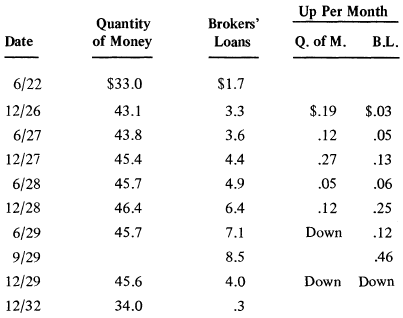
When the news of the rapid rise in security loans was printed, the stock market dropped sharply. It was a corrective move, but the Administration was unhappy. So we had a statement from the White House. The January 6th Associated Press story stated:
President Coolidge is of the opinion that the record breaking increase in brokers’ loans is not large enough to cause any unfavorable comment.42
The next day the New York Times reported:
Although loans to brokers and dealers . . . reached unprecedented heights . . ., President Coolidge does not see any reason for unfavorable comment. . . . The President, it was said at the White House today, believes that the increase represents a natural expansion of business in the securities market and sees nothing unfavorable in it.43
Stock market participants reflected overnight on the reassuring statement from a usually taciturn President. They concluded that such an unusual statement of confidence invited heavy buying. So the stock market started up again.
Two Cousins Chat
Well, Columbia University’s banking professor, H. Parker Willis, to whom we have previously referred, went down to Washington to testify before the Senate Banking Committee that the brokers’ loans were too high. After he testified, he stopped by the White House to have lunch with his cousin, Calvin Coolidge. In the course of his conversation, he told the President why he had come to Washington. William Allen White, in his biography of President Coolidge, quotes Professor Willis as follows:
President Coolidge, referring to what I had said, remarked that my opinion had seemed to show a great difference from his, but he added: “If I were to give my own personal opinion about it, I should say that any loan made for gambling in stocks was an excessive loan.”
I [Willis] replied: “I wish very much, Mr. President, you had been willing to say that instead of the public statement you did.”
“Why do you say that?” Mr. Coolidge queried.
“Simply because I think it would have had a tremendous effect in repressing an unwholesome speculation, with which, I now see, you have no sympathy.”
Mr. Coolidge thought this over for a moment and then he said: “Well, I regard myself as the representative of the government and not as an individual. When technical matters come up I feel called upon to refer them to the proper department of the government which has some information about them and then, unless there is some good reason, I use this information as a basis for whatever I have to say; but that does not prevent me from thinking what I please as an individual.”44
Meanwhile, the market was going up and up. People from all over the world were getting into it. We could go on with more details of the situation. Mr. Strong is quoted as saying privately on May 25, 1928: “Very few people indeed realized we were now paying the penalty for the decision reached early in 1924 to help the rest of the world back to a sound financial and monetary basis.”45
Proposed Remedy: More Money
Here is another quotation from Mr. Strong, one of the last before his death. On August 3, 1928, he wrote:
A gradual unwinding of the situation is quite possible and is the best bet. . . . The problem now is so to shape our policy as to avoid a calamitous break in the stock market, a panicky feeling about money, a setback to business because of the change in psychology. . . . I certainly think it can be done. . . . The very existence of the Federal Reserve System is a safeguard against anything like a calamity growing out of money rates. Not only have we the power to deal with such an emergency instantly by flooding the street with money, but I think the country is well aware of this. In former days the psychology was different because the facts of the banking situation were different. Mob panic, and consequently mob disaster, is less likely to arise.46
Mr. Strong thought that a calamity could be avoided by a “rational Federal Reserve Policy. Such a policy means anticipating the approach of the ‘breaking point’ by any one or a combination of four possible methods: (a) discount rate reduction; (b) extensive purchases of bills from dealers; (c) purchases of governments; (d) purchases of foreign exchange and the accumulation of a foreign portfolio.”47
Conditions Created by Credit Expansion
Years later, Mr. Miller described the situation:
The speculator did not ask what was the cost of money, but whether he could get it at any price. . . . In brief, a method of exercising a discriminating control over the extension of the Federal Reserve credit such as the purely technical and impersonal method of bank rate could not do. . . . To put it bluntly, though not elegantly, control by rate action in a speculative gale of such fury as swept the United States in 1929 is a good deal like spitting against the wind.48
The fury went on all through 1928. People sent money from abroad to get in on the stock market. Business firms floated new issues, putting the money back in the stock market with the call rate rising to 10 percent and more.
1928 was an election year. We had to have “easy money” and prosperous conditions in an election year. So the “money supply” kept going up. By the end of 1928, brokers’ bank loans had gone up to $6.4 billion. By June 30, 1929, they reached $7.1 billion. Before the crisis, they soared to $8.4 billion, more than twice the amount before the reduction of the discount rate in the middle of 1927.
In Table XXII we have the figures for the crisis. The “money supply” had gone up to a point where officialdom began to worry about it. However, the Federal Reserve System held the discount rate below the call and market rates, although the Reserve Banks did sell off some government securities. The call rate fluctuated violently. At one time it went to 20 percent. It was very difficult in an election year for political appointees to do anything to slow down the situation. The speculator did not ask the cost of money. He was trying to get it at any cost and often did not even ask or know the call rate he had to pay.
However, the Federal Reserve stopped pumping up the “money supply” after the end of 1928. They tried to put the brakes on, but they could not. After the discount rate was reduced to 3½ percent in 1927 to help England, it was raised three times in the election year of 1928. Finally, in August, it reached 5 percent, which was still below call and prime commercial rates. At the end of 1928, the call rate was fluctuating about 8.6 percent, while prime business borrowers were paying 5.4 percent.
Table XXII
________________
49Date effective.
508.3% of the total quantity of money.
In 1929, after the election, there was a long and bitter debate between the officials of the Federal Reserve Board in Washington and those of the Federal Reserve Bank of New York. Unfortunately there is not time to give you the details for the period from Mr. Hamlin’s diary. The New York Bank wanted Washington to approve a raise in the discount rate to 6 per cent. They asked them to do so ten times. The Federal Reserve Board in Washington refused to do so ten times. They said it would hurt business. If business had to pay such high rates there would be a recession. Stock market activities were not their prime concern. However, the Washington Board did send out a letter on February 2, 1929, to the twelve Federal Reserve Banks, warning them to use “direct pressure” on their member banks and “to take such measures as may be deemed suitable and effective . . . to restrain the use, either directly or indirectly, of Federal Reserve credit facilities in aid of the growth of speculative credit.”51
But it was perfectly legal to make brokers’ loans, and there was a great profit in them. So the commercial banks continued to make more such loans all through the first nine months of 1929, as Table XXI shows. Finally, on August 9, the discount rate was permitted to go up to 6 percent. But it was too little, too late. The crash came in late October. Call loans were called, and borrowers, not able to hold on to their securities, were sold out. The market plummeted. It was not free enterprise that produced this outcome.
Conclusion
Let me give you the judgment of Professor Lester Chandler, a staunch defender of governmental manipulations of the quantity of money. He states:
There can be no doubt that the international situation was the major reason for the 1927 easy-money policy, that Strong was motivated by an altruistic concern for European countries, especially Britain, and that at least the timing of the policy was related to the conferences with foreign central bankers in early July.52
Professor Miller, who, like Mr. Hamlin, was a member of the Federal Reserve Board from its beginning in 1914 up to 1936, had this to say in his 1931 testimony two years after the crash:
We had something of an obsession for easy money in the system, a feeling that it makes the atmosphere of business, that it can stop a recession of business and turn a period of depression into one of recovery.53
Still later he testified before the Senate Banking and Currency Committee on May 22, 1935, in my presence:
The gold standard ended in 1914 in an economic sense, not the legal sense. Since then it has been managed . . . .The gold standard, in an economic sense, is a device . . . for maintaining a condition of balance among the countries of the world, and among industries within any country, by accurately and quickly detecting and registering the slightest departure from that balance and setting in motion at once corrective forces. . . . It tells you when something is getting out of joint . . . .54
In a 1935 magazine article, Mr. Miller is quoted as saying that:
The easy-going credit policy of 1927, which was father and mother to the subsequent 1929 collapse, was originated by Governor Strong, of the New York Federal Reserve Bank, and it did not represent a policy either developed or imposed by the Board on the Reserve Banks against their will.
The policy was the result of a visit of the Governors of foreign central banks, who unequivocally stated in New York that unless the United States did adopt it there would be a collapse in Europe. It was a European policy, adopted by the United States to prevent a world calamity.55
It was not free enterprise that failed in 1929. It was political intervention. It was the political manipulation of the quantity of money by well-meaning politicians attempting to produce permanent prosperity. They thought that an increase in the quantity of money would solve all economic problems and make everybody happy. Instead, it misdirected investments and production, helping a few temporarily while eventually creating misery for millions of innocent people throughout the civilized world.
Unfortunately, that lesson has not yet been learned. As the Federal Reserve Board member, Adolph Miller, testified in 1935:
Up to this day it has never yet been demonstrated that any agency can be invented to which power to govern the currency could be entrusted without ultimately disastrous consequences.56
____________________
57. Speech given at Springfield, Illinois, January 27, 1837.
58. Pelatiah Webster, Political Essays on the Nature and Operation of Money, Public Finances and Other Subjects (1791), “Third Essay on Free Trade and Finance” (1780), p.51.
59. Ibid.
60. Ibid., “Second Essay on Free Trade and Finance” (1779), p. 37.
61. J.M. Keynes, The Economic Consequences of the Peace (Harcourt, Brace and Howe, 1920), pp. 235-237.
62. B. M. Anderson, Economics and the Public Welfare (New York: D. Van Nostrand Co., Inc., 1949), pp. 317-318.
63. Quoted by Adolph C. Miller, Federal Reserve Board member 1914-1936, in testimony before the Senate Committee on Banking and Currency, May 22, 1935, p. 721. This statement was preceded by: “Senator Root of New York came pretty near the truth when he opposed the Act on the ground that . . .”
64. Lester V. Chandler, Benjamin Strong: Central Banker (Brookings, 1958), p. 16.
65. Ibid. See especially pp. 14 and 477.
66. The U.S. government’s public debt, December 31, 1972–$449.3 billion.
67. As used in these lectures and tables, the “money supply” or “quantity of money” includes (1) currency outside of commercial banks, (2) demand deposits or checking accounts of banks, and (3) time deposits of commercial banks. The Federal Reserve System does not include time deposits of commercial banks in its “money supply” figures. It treats such deposits as a “Related Item.” However, they have been included in this study, because time deposits of commercial banks are in practice generally withdrawable on demand and, as the Federal Reserve System operates, are subject to an even greater “credit expansion” than demand deposits. Their required reserves are much lower. This is not true in the case of mutual savings banks. They cannot expand credit by lending out more than the funds available from their capital account and cash deposits. Accordingly, their deposits are not included in the “money supply,” except for the cash they have on hand, which is included in “currency outside of commercial banks.”
All financial figures and statistics for the United States appearing in the text and Tables of this lecture are taken from Banking and Monetary Statistics (Board of Governors of the Federal Reserve System, 1943), which includes data through 1941.
68. Chandler, op. cit., p. 118.
69. Ibid., p. 138.
70. Anderson, op. cit., p. 117.
71. B. M. Anderson, “The Report of the Dawes Committee,” Chase Economic Bulletin, Vol. IV, #1, April 24, 1924, p. 27.
72. Cited in B. M. Anderson, Economics and the Public Welfare, p. 182. In testimony before the Senate Banking and Currency Committee, May 1935, Professor H. Parker Willis stated: “Coolidge in his radio address on the night before he was re-elected as President said ‘ . . . that his Administration had always favored low discount rates and it always would do so.’”
73. Memorandum of December 26, 1924, as cited by Chandler, op. cit., pp. 242-246.
74. Letter of May 27, 1924, to Mellon, cited by Chandler, op. cit., pp. 283-284.
75. Sir Henry Clay, Lord Norman (London, Macmillan, 1957), pp. 142-143.
76. Ibid., p. 151.
77. Hearing before House Banking and Currency Committee, April 1926, reprinted in Interpretations of Federal Reserve Policy, ed. by W. Randolph Burgess (Harper, 1930), p. 265.
78. Chandler, op. cit., p. 315.
79. Montagu Norman’s Personal Letters. See Andrew Boyle, Montagu Norman: A Biography (London: Cassell), p. 187. See also Chandler, op. cit., p. 316.
80. Ibid.
81. This and immediately succeeding quotations are taken from Charles S. Hamlin’s Diaries in the Manuscript Room of the Library of Congress (Washington, D.C.).
82. Lionel Robbins, The Great Depression (Macmillan, 1934), p. 52
83. Ralph Robey, “The Capeadores of Wall Street,” Atlantic Monthly, Sept. 1928.
84. Ibid.
85. Ibid.
86. Ibid.
87. Emile Moreau, Souvenirs d’un Gouverneur de la Banque de France (Librairie de Medicis), p. 360, “Une spéculation déjà trop audacieuse.” For date of letter, see Stephen V.O. Clarke, Central Bank Cooperation, 1924-1931 (Fed. Res. Bank of N.Y., 1967), p. 127.
88. Ibid., pp. 382-383. Translation from the French is by the author. Original text in French is as follows: “Je reçois une lettre de M. Strong me demandant quelques renseignements sur notre situation fìnancière, et me donnant de mauvaises raisons pour justifier la baisse du taux d’escompte à laquelle il va procéder. Je lui réponds pour le rassurer sur notre situation qui continue à être bonne. J’ajoute que nous avonsparfaitement compris à Paris qu’il voulait venir en aide à M. Norman. ”
89. Ibid., p. 385. “Je reçois M. Frank Altschul, associé de la Banque Lazard à New-York. Il me dit que les raisons données par M. Strong pour justifier la reduction du taux de l’escompte ne son t prises au sérieux par per sonne, et que tout le monde, aux États-Unis, est convaincu que M. Strong a voulu aider M. Norman à soutenir la livre. ”
90. Robey. op. cit.
91. See also Wm. Allen White, A Puritan in Babylon (Macmillan, 1938), p. 390.
92. Ibid., pp. 390-391.
93. Chandler, op. cit., p. 281.
94. Ibid., p. 461.
95. Ibid., p. 460.
96. Adolph C. Miller, “Responsibility for Federal Reserve Policies, 1927-1929,” American Economic Review, September 1935, pp. 455-456.
97. Quoted by Adolph C. Miller, op. cit., p. 454.
98. Chandler, op. cit., p. 440.
99. Adolph C. Miller in 1931 testimony before the Senate Committee on Banking and Currency, as quoted by Professor Edwin W. Kemmerer (Princeton University) in the May 1935 Hearings of the Senate Committee on Banking and Currency, p. 339.
100. Ibid., May 22, 1935, pp. 675, 680 and 683.
101. Sphere, July 1935. Substantially this same statement appears in Memoirs of Herbert Hoover: The Great Depression, 1929-1941 (Macmillan, 1952), p. 13.
102. Hearings before the Senate Committee on Banking and Currency, May 1935, p. 745.
- 1 American Opinion, March 1967.
- 2 John Maynard Keynes, The General Theory of Employment, Interest and Money (Macmillan & Co., Ltd., London, 1936).
- 3Ibid., p. 53.
- 4Karl Marx, Capital, The Communist Manifesto, and Other Writings, edited by Max Eastman (Carlton House, 1932), p. 36. See also his Capital, edited by Frederick Engels and later by Ernest Untermann (Kerr, 1906-1909), Vol. I. pp. 190-191:
- 5 Marx (Eastman ed.), pp. 24-25. See also Marx (Kerr ed.), Vol. 1, Chs. V & VII; Vol. III, Ch. I.
- 6 Marx (Kerr ed.), Vol. III, p. 51.
- 7. In the terminology of Hermann Heinrich Gossen, “Werth der letzten Atome.”
- 8. Carl Menger, Principles of Economics (Free Press, 1950), p. 132.
- 9. W. Stanley Jevons, The Theory of Political Economy (Macmillan, 1924), p. 51.
- 10
- 11. Léon Walras, Elements of Pure Economics (Allen & Unwin, 1954), pp. 119 & 146.
- 12. Eugen von Böhm Bawerk, Capital and Interest (Libertarian Press, 1959), Vol. II, pp. 142-143.
- 13
- 14. Ludwig von Mises, Human Action, 3rd Ed. (Regnery, 1966), p.123.
- 15. Professor Benjamin A. Rogge, Wabash College.
- 16
- 17. Anderson, op. cit., p. 117.
- 18. B. M. Anderson, “The Report of the Dawes Committee,” Chase Economic Bulletin, Vol. IV, #1, April 24, 1924, p. 27.
- 19
- 20. Cited in B. M. Anderson, Economics and the Public Welfare, p. 182. In testimony before the Senate Banking and Currency Committee, May 1935, Professor H. Parker Willis stated: “Coolidge in his radio address on the night before he was re-elected as President said ‘ . . . that his Administration had always favored low discount rates and it always would do so.’”
- 21. Memorandum of December 26, 1924, as cited by Chandler, op. cit., pp. 242-246.
- 22. Letter of May 27, 1924, to Mellon, cited by Chandler, op. cit., pp. 283-284.
- 23. Sir Henry Clay, Lord Norman (London, Macmillan, 1957), pp. 142-143.
- 24. Ibid., p. 151.
- 25. Hearing before House Banking and Currency Committee, April 1926, reprinted in Interpretations of Federal Reserve Policy, ed. by W. Randolph Burgess (Harper, 1930), p. 265.
- 26. Chandler, op. cit., p. 315.
- 27. Montagu Norman’s Personal Letters. See Andrew Boyle, Montagu Norman: A Biography (London: Cassell), p. 187. See also Chandler, op. cit., p. 316.
- 28. Ibid.
- 29
- 30. This and immediately succeeding quotations are taken from Charles S. Hamlin’s Diaries in the Manuscript Room of the Library of Congress (Washington, D.C.).
- 31. Lionel Robbins, The Great Depression (Macmillan, 1934), p. 52
- 32. Ralph Robey, “The Capeadores of Wall Street,” Atlantic Monthly, Sept. 1928.
- 33. Ibid.
- 34. Ibid.
- 35. Ibid.
- 36. Emile Moreau, Souvenirs d’un Gouverneur de la Banque de France (Librairie de Medicis), p. 360, “Une spéculation déjà trop audacieuse.” For date of letter, see Stephen V.O. Clarke, Central Bank Cooperation, 1924-1931 (Fed. Res. Bank of N.Y., 1967), p. 127.
- 37. Ibid., pp. 382-383. Translation from the French is by the author. Original text in French is as follows: “Je reçois une lettre de M. Strong me demandant quelques renseignements sur notre situation fìnancière, et me donnant de mauvaises raisons pour justifier la baisse du taux d’escompte à laquelle il va procéder. Je lui réponds pour le rassurer sur notre situation qui continue à être bonne. J’ajoute que nous avonsparfaitement compris à Paris qu’il voulait venir en aide à M. Norman. ”
- 38. Ibid., p. 385. “Je reçois M. Frank Altschul, associé de la Banque Lazard à New-York. Il me dit que les raisons données par M. Strong pour justifier la reduction du taux de l’escompte ne son t prises au sérieux par per sonne, et que tout le monde, aux États-Unis, est convaincu que M. Strong a voulu aider M. Norman à soutenir la livre. ”
- 39* 1923-1927
- 40* 1923-1927
- 41Raw materials*
- 42. Robey. op. cit.
- 43. See also Wm. Allen White, A Puritan in Babylon (Macmillan, 1938), p. 390.
- 44. Ibid., pp. 390-391.
- 45. Chandler, op. cit., p. 281.
- 46. Ibid., p. 461.
- 47. Ibid., p. 460.
- 48. Adolph C. Miller, “Responsibility for Federal Reserve Policies, 1927-1929,” American Economic Review, September 1935, pp. 455-456.
- 49DEVELOPMENT OF THE CRISIS, 1927-1929
- 50
- 51. Quoted by Adolph C. Miller, op. cit., p. 454.
- 52. Chandler, op. cit., p. 440.
- 53. Adolph C. Miller in 1931 testimony before the Senate Committee on Banking and Currency, as quoted by Professor Edwin W. Kemmerer (Princeton University) in the May 1935 Hearings of the Senate Committee on Banking and Currency, p. 339.
- 54. Ibid., May 22, 1935, pp. 675, 680 and 683.
- 55. Sphere, July 1935. Substantially this same statement appears in Memoirs of Herbert Hoover: The Great Depression, 1929-1941 (Macmillan, 1952), p. 13.
- 56. Hearings before the Senate Committee on Banking and Currency, May 1935, p. 745.
- 57As Mises has written (1967): “Inflationism is not a variety of economic policies. It is an instrument of destruction; if not stopped very soon, it destroys the market entirely. . . . Inflationism cannot last; if not radically stopped in time, it must inexorably lead to a complete breakdown. It is an expedient of people who do not care a whit for the future of their nation and its civilization. It is Madame de Pompadour’s policy: Après nous le déluge.”
- 58Now I shall quote from a gentleman with whom I do not always agree. In fact, I disagree with him rather basically in many ways. However, I am in agreement with this statement that the late Lord Keynes wrote on the last page of his General Theory: “The ideas of the economists and political philosophers, both when they are right and when they are wrong, are more powerful than is commonly understood. Indeed the world is ruled by little else. Practical men, who believe themselves to be quite exempt from any intellectual influences, are usually the slaves of some defunct economist.”
- 59Then, he went on in the next few pages to define the market price. He wrote: “The market price of labour is the price which is really paid for it, from the natural operation of the proportion of the supply to the demand; labour is dear when it is scarce and cheap when it is plentiful. However much the market price of labour may deviate from its natural price, it has, like commodities, a tendency to conform to it. . . . When, however, by the encouragement which high wages give to the increase of the population, the number of labourers is increased, wages again fall to their natural price, and indeed from a reaction sometimes fall below it.”
- 60This was the status of economic thought when Karl Marx appeared on the scene. His Das Kapital was based entirely on this labor theory of value. In the first volume of Das Kapital, he wrote: “The value of labour power, like that of every other commodity, is determined by the working-time necessary for its production, consequently also for its reproduction. Labour power exists solely as an attribute of a live individual, and hence it presupposes the latter’s existence. A live individual needs a certain amount of necessaries in order to sustain himself. The working-time necessary for the production of labour power resolves itself, therefore, into the working-time required for the production of such necessaries of life, in other words, the value of labour power is the value of the necessaries required to sustain its proprietor.”
- 61Marx wrote in Volume I of Das Kapital: “But how can profit derive ‘spontaneously’ from capital? For the production of any commodity the capitalist needs a certain sum, say $25. In this sum are included all the costs of the production. . . . He subsequently sells the finished commodity for $27.50. . . . The idea of something being thus created out of nothing is unacceptable to human reason. . . . When this process is finished the capitalist has only in his possession an object of the same value as previously.”
- 62Later, he wrote in Volume III: “It is inexplicable that more value should come out of production than went into it, for something cannot come out of nothing.” In other words, it’s nonsense to say that goods are sold for a higher price than they are worth. So if they are sold for $27.50 they must have been worth $27.50 in the beginning, and that $27.50, except for the cost of raw materials and depreciation, should all be paid to labor.
- 63Now, what is the definition of this last unit that determines marginal value? There has been some refinement in the definition over the years. Here are the definitions of the top economists of their time. First, Gossen wrote in 1854 that the marginal value was “the value of the last atom.” In 1871, Menger’s book stated that marginal value was “the importance of the satisfactions of least importance among those assured by the whole quantity and achieved with any equal portion.”
- 64Now, what is the definition of this last unit that determines marginal value? There has been some refinement in the definition over the years. Here are the definitions of the top economists of their time. First, Gossen wrote in 1854 that the marginal value was “the value of the last atom.” In 1871, Menger’s book stated that marginal value was “the importance of the satisfactions of least importance among those assured by the whole quantity and achieved with any equal portion.”
- 65Jevons, whose book was published a few months later in 1871, not then knowing what Menger had stated, wrote that the marginal value is “the final degree of utility, the degree of utility of the last addition, or the next possible addition of a very small, or infinitely small quantity to the existing stock.”
- 66Walras, writing in 1874, without knowledge of what either Menger or Jevons had written, used the French term rareté, which he got from his father, another economist. This he defined as “the source of the effective utility on account of the quantity owned . . . the intensity of the last need satisfied by any given quantity consumed of a commodity.”
- 67We move on to Böhm Bawerk (1851-1914), who followed Menger in the Austrian School and was the teacher of Mises. He defined the value of the marginal unit as “that concrete want or partial want which has the lowest degree of urgency among the wants that can be covered by the available supply of goods of the same kind.”
- 68Now we come to my teacher, Mises (1881- ). In 1949, Mises wrote in Human Action that the marginal value is the “value attached to one unit of a homogeneous supply on the basis of the value of the least important use of the units of the whole supply.”
- 69A. Of course, what I’ve been trying to say is that I believe in equality before the law. Equality before the law means that we are going to be unequal. Actually, there is no way to make men equal. This is very fortunate, because some people have certain talents and can contribute certain things which others cannot contribute. We are all different and we profit from these differences. We are very unequal and there is no means to make us equal. These socialistic attempts to level fortunes, to level money income and wealth, are the basic problem of the day. They derive from the fact that we no longer believe in equality before the law. It used to be that we depicted Justice as a woman with a blindfold over her eyes so that she could not see who was in front of her. But now, as one of my friends says, Justice lifts up the blindfold and peeks to see who stands before her for judgment. If it is a member of a labor union, she renders one decision. If it is a member of the business community, she renders another decision. We no longer have equality before the law. This is one of our great difficulties in all countries. I know it is so in mine.
- 70The banking community and many economists were alarmed. Many appealed to the Secretary of the Treasury, Andrew Mellon, who also opposed the appointment. The Secretary went to the White House for a session with the President. The President is reported as having told his Secretary of the Treasury, “This appointment is very dear to my heart.” So the man at the head of the Federal Reserve System was a personal political friend of the President with no understanding of financial problems.
- 71By December 1923, Germany was in a state of economic collapse, both internally and externally. Her former European enemies wanted reparations, but they did not want German goods or worthless paper marks. In 1924, the Dawes Plan attempted to put Germany back on her feet financially. It granted Germany a foreign loan with which to stabilize the mark and re-establish the gold standard. In return, Germany had to accept foreign supervision of an internal taxation system intended to raise funds for repayment of the loan and reparations payments according to a prescribed “index of prosperity.”
- 72Just before the election President Coolidge, in a campaign speech, said, “It has been the policy of this Administration to reduce discount rates.” The party in power was doing everything it could to create “easy money” conditions before the election.
- 73Benjamin Strong, Governor of the Federal Reserve Bank of New York, was really a strong man. He dominated many of the policies of the Federal Reserve System from its early years until his death in 1928. He felt these 1924 policies were necessary to head off “some recession in business.” In December 1924, he wrote that they had helped develop “a greater feeling of tranquility and contentment throughout the country.” There were some who believed that if Mr. Strong had lived longer, his skill and ability in manipulating monetary policies might have averted the 1929 depression. His official biographer, Professor Chandler, has this to say:
- 74At the present time it is probably true that British prices for goods internationally dealt in are as a whole, roughly, in the neighborhood of 10 percent above our prices and one of the preliminaries of the reestablishment of the gold payment by Great Britain will be to facilitate a gradual adjustment of these price levels before monetary reform is undertaken. . . . This . . . can be facilitated by cooperation between the Bank of England and the Federal Reserve System in the maintaining of lower interest rates in this country and higher interest rates in England. . . . It will be difficult politically and socially for the British Government and the Bank of England to force a price liquidation in England. . . . Their trade is poor and they have over a million unemployed people receiving government aid.
- 75It did not, however, turn out to be easy to regulate credit in America in such a way as to meet both London’s requirements and domestic needs. . . . In January 1924 Strong was again writing that Coolidge’s . . . election and European recovery might start a speculative outbreak difficult to control; rates could not be put up. . . . He leaned rather to open market operations. In June New York had put its rate below London with the deliberate intention of helping London back to the Gold Standard, but he still thought higher rates would be needed to check inflation in the New Year.
- 76I agree entirely that we shall need some sort of understanding between us as to the future gold policy. I think you are helping to this end if you keep your rates as low as possible and lend freely to the rest of the world as your Market is now doing.
- 77On December 28, 1924, right after Christmas, Montagu Norman arrived in New York, where he had a private luncheon with Benjamin Strong and Secretary of the Treasury Andrew Mellon. He was looking for a pledge of $500 million to help England go back on the gold standard. He got a pledge of $200 million, at no cost, from the Federal Reserve Bank of New York, with later Federal Reserve Board approval. Mr. Strong felt “that [central bank] operations for profit of a competitive character in any market are a mistake. . . . Reserve Banks . . . have the power to issue notes and . . . in effect manufacture the credit.”
- 78. . . was to understand in a general way what we expected our policy to be, and to express the hope it would be directed toward maintaining as stable a price level as possible in the United States.
- 79All official consideration of a gold program was deliberately pushed over to this month, so that nothing about it should come out until your Congress should have adjourned.
- 80If we begin consideration next week (as I expect), we cannot expect a final decision before early or middle April — meanwhile I shall hope to have it all kept secret, and of course out of Parliament till the end.
- 81Strong is thinking more of the effect of rate increases on Great Britain than in the United States. Platt and Miller (Board members) believe rates should be increased and I am inclined to the same view, especially in view of the stock speculation movement in New York.
- 82The effects of the over-valued exchange made themselves felt with great severity in the coal trade. Throughout 1926 there raged labour disputes, which were the direct consequences of these troubles — first the general strike. [This lasted from May 3-14, 1926, when all of organized labor stopped work in England.] Then a strike in the coal-fields which dragged out for over six months, still further endangering the trade balance. By 1927 the position was one of great danger.
- 83Now, let us return to the United States. On New Year’s Day, 1927, our President, as was the custom, issued a very glowing statement about the prospects for the coming year. It was going to “be one of continued healthy business activity and prosperity.” In his opinion, the booming stock market merely reflected the growing wealth and power of the United States.
- 84There were some businessmen who did not agree. One in the construction industry, a Mr. Strauss, said that commercial building “had reached the saturation point.” He felt there would be a down-turn in business activity. Now politicians in office cannot readily accept such a depressing outlook. The Secretary of the Treasury, Mr. Mellon, came to the rescue. He did not agree with the businessman. He said Mr. Strauss did not know what he was talking about and that the present was a good time to build from the point of view of costs.
- 85For example, after the market sagged a bit, Secretary of the Treasury Mellon announced on March 7, 1927, that the Treasury was going to refinance the Second Liberty Loan 4½ percent bonds with 3½ percent notes on November 14. This meant that the Federal Reserve would be expected to keep interest rates low until this refinancing was completed some eight months later. This told businessmen and investors they could operate with assurance that low interest rates were here to stay at least that long. Two days later, the New York Times report on the stock market stated: “Prices rose with a vigor . . . [there was] frequent comment in Wall Street that the ‘main advance’ had been resumed.”
- 86When the market went down again, Mr. Mellon gave the press another optimistic statement as he sailed for Europe. He saw “no evidence of overspeculation . . . an abundant supply of easy money should take care of any contingencies that may arise.” The government’s budget had a surplus and he saw no reason to raise the discount rate. “All signs and indications at the moment point to the country enjoying a successful business year.” As the New York Times reported, this “created a cheerful feeling in Wall Street.”
- 87M. Moreau, the head of the Bank of France, to whom Mr. Strong had written on June 20 that he could not lower the New York discount rate because such an action would stimulate an “already too active” stock market, was not fooled by the reason officially given for lowering the discount rate — to help improve conditions in the United States. On August 19, M. Moreau entered in his diary:
- 88I receive a letter from Mr. Strong asking for information on our financial situation and giving me wrong [mauvaises] reasons to justify the recent lowering of the discount rate. I reply assuring him that our situation continues to be good. I add that we in Paris have understood he wanted to help Mr. Norman.
- 89I receive Mr. Frank Altschul of the Lazard Bank at New York. He tells me that the reasons given by Mr. Strong for lowering the discount rate are not taken seriously by anyone, and that everybody in the United States is convinced that Mr. Strong wanted to help Mr. Norman support the pound.
- 90President Coolidge is of the opinion that the record breaking increase in brokers’ loans is not large enough to cause any unfavorable comment.
- 91Although loans to brokers and dealers . . . reached unprecedented heights . . ., President Coolidge does not see any reason for unfavorable comment. . . . The President, it was said at the White House today, believes that the increase represents a natural expansion of business in the securities market and sees nothing unfavorable in it.
- 92Mr. Coolidge thought this over for a moment and then he said: “Well, I regard myself as the representative of the government and not as an individual. When technical matters come up I feel called upon to refer them to the proper department of the government which has some information about them and then, unless there is some good reason, I use this information as a basis for whatever I have to say; but that does not prevent me from thinking what I please as an individual.”
- 93Meanwhile, the market was going up and up. People from all over the world were getting into it. We could go on with more details of the situation. Mr. Strong is quoted as saying privately on May 25, 1928: “Very few people indeed realized we were now paying the penalty for the decision reached early in 1924 to help the rest of the world back to a sound financial and monetary basis.”
- 94A gradual unwinding of the situation is quite possible and is the best bet. . . . The problem now is so to shape our policy as to avoid a calamitous break in the stock market, a panicky feeling about money, a setback to business because of the change in psychology. . . . I certainly think it can be done. . . . The very existence of the Federal Reserve System is a safeguard against anything like a calamity growing out of money rates. Not only have we the power to deal with such an emergency instantly by flooding the street with money, but I think the country is well aware of this. In former days the psychology was different because the facts of the banking situation were different. Mob panic, and consequently mob disaster, is less likely to arise.
- 95Mr. Strong thought that a calamity could be avoided by a “rational Federal Reserve Policy. Such a policy means anticipating the approach of the ‘breaking point’ by any one or a combination of four possible methods: (a) discount rate reduction; (b) extensive purchases of bills from dealers; (c) purchases of governments; (d) purchases of foreign exchange and the accumulation of a foreign portfolio.”
- 96The speculator did not ask what was the cost of money, but whether he could get it at any price. . . . In brief, a method of exercising a discriminating control over the extension of the Federal Reserve credit such as the purely technical and impersonal method of bank rate could not do. . . . To put it bluntly, though not elegantly, control by rate action in a speculative gale of such fury as swept the United States in 1929 is a good deal like spitting against the wind.
- 97In 1929, after the election, there was a long and bitter debate between the officials of the Federal Reserve Board in Washington and those of the Federal Reserve Bank of New York. Unfortunately there is not time to give you the details for the period from Mr. Hamlin’s diary. The New York Bank wanted Washington to approve a raise in the discount rate to 6 per cent. They asked them to do so ten times. The Federal Reserve Board in Washington refused to do so ten times. They said it would hurt business. If business had to pay such high rates there would be a recession. Stock market activities were not their prime concern. However, the Washington Board did send out a letter on February 2, 1929, to the twelve Federal Reserve Banks, warning them to use “direct pressure” on their member banks and “to take such measures as may be deemed suitable and effective . . . to restrain the use, either directly or indirectly, of Federal Reserve credit facilities in aid of the growth of speculative credit.”
- 98There can be no doubt that the international situation was the major reason for the 1927 easy-money policy, that Strong was motivated by an altruistic concern for European countries, especially Britain, and that at least the timing of the policy was related to the conferences with foreign central bankers in early July.
- 99We had something of an obsession for easy money in the system, a feeling that it makes the atmosphere of business, that it can stop a recession of business and turn a period of depression into one of recovery.
- 100The gold standard ended in 1914 in an economic sense, not the legal sense. Since then it has been managed . . . .The gold standard, in an economic sense, is a device . . . for maintaining a condition of balance among the countries of the world, and among industries within any country, by accurately and quickly detecting and registering the slightest departure from that balance and setting in motion at once corrective forces. . . . It tells you when something is getting out of joint . . . .
- 101The policy was the result of a visit of the Governors of foreign central banks, who unequivocally stated in New York that unless the United States did adopt it there would be a collapse in Europe. It was a European policy, adopted by the United States to prevent a world calamity.
- 102Up to this day it has never yet been demonstrated that any agency can be invented to which power to govern the currency could be entrusted without ultimately disastrous consequences.

