
Theory of Money and Fiduciary Media
13. Mises’s Theory of Money and Credit: Arguments Against Central Banking
Thorsten Polleit
Mises’s Theory of Money and Credit: Arguments Against Central Banking
I. Introduction
“The Austrian theory of money virtually begins and ends with Ludwig von Mises’s monumental Theory of Money and Credit, published in 1912.”1 Mises’s Theory of Money and Credit (TM&C) is indeed a most remarkable contribution to monetary theory. In the book Mises extended the marginal utility theory to the value of money; showed that money cannot, be “neutral”; corrected the commonly used interpretation of the quantity theory of money and exploded the “price index regime” developed by Irving Fisher (1867–1947) as unscientific; provided an economically sound explanation of inflation and deflation; and developed, in particular in the second edition of TM&C published in 1924, the foundations of the Austrian trade cycle theory. On the basis of his monetary theory insights Mises called for free banking with a 100-percent gold backed currency, which effectively amounts to ending central banking—which is what Mises did in his 1952 essay Monetary Reconstruction, which was added as part four in the second English edition of TM&C.
Mises’s theoretical findings and conclusions stand in sharp contrast to today’s mainstream economics point of view, which considers central banking as the state-of-the-art concept for organizing monetary affairs. In short, central banking rests on four main characteristics: (1) a state sponsored central bank holds the money production monopoly, (2) the commercial banking sector operates on fractional reserves, (3) money is produced through bank lending, and (4) money is irredeemable into anything, that is it is unbacked paper, or fiat, money. Central banking is typically perceived as securing the purchasing power of money, thereby contributing to output and employment gains, helping to smooth business cycles and serving as a “policy instrument” for “fighting” financial and economic crises (with the central bank acting as a “lender of last resort”).2
Firmly rooted in the monetary theory as laid out in TM&C and fully integrated in the libertarian philosophy based on Mises’s praxeology, Murray N. Rothbard (1926–1995) demystified central banking, laying bare its economic and ethical deficiencies:
The Central Bank eliminates hard and noninflated money, and substitutes a coordinated bank credit inflation throughout the nation. That is precisely its purpose. In short, the Central Bank functions as a government cartelizing device to coordinate the banks so that they can evade the restrictions of free markets and free banking and inflate uniformly together. The banks do not chafe under central banking control; instead, they lobby for and welcome it. It is their passport to inflation and easy money.3
The objective of this article is to review the major monetary theory insights developed in TM&C and contrast them with today’s mainstream-economic point of view. It will be shown that TM&C actually contains all the (logical-) theoretical arguments for making a convincing economic and ethical case against central banking. The rest of this article has been structured as follows. The major characteristics of today’s central banking regime will be outlined in section II. Then in section III money will be defined, and it will be explained why any quantity of money is “sufficient.” Mises’s view regarding inflation and deflation is explained in section IV. What then follows is a critique of the theory underlying price-level stabilization policies in section V, and a brief explanation of the Austrian trade cycle theory in section VI. Mises’s regression theorem will briefly be reconsidered in section VII, revealing the unethical nature of central banking. Section VIII concludes with taking a look ahead.
II. The Central Banking Regime
In today’s mainstream economics, central banking is considered the state-of-the-art organization of monetary affairs. Central banking is widely seen as an indispensable institution for safeguarding “stable money” and “financial market stability” and “fighting” financial and economic crises.4 Over the last decades, central banking has become increasingly uniform across most currency areas in terms of policy goals, policy instruments, and actual policy making. In fact, one can identify at least seven elements that form the core of today’s central banking regimes.
1. Central banks are government owned agencies that hold the money production monopoly. They determine the quantity of base money, and they also determine part of the demand for base money through setting minimum reserve requirements.
2. In a central banking regime, commercial banks are allowed to create additional money (commercial bank money), heaped on top of the quantity of base money.
3. Under central banking, money is typically produced through the expansion of bank credit, or in Mises’s terminology, bank circulation credit, meaning that the quantity of money is increased if and when banks extend loans.
4. Commercial banks operate on the basis of fractional reserves, thereby creating additional commercial bank money through lending which is not backed by real savings.
5. The primary objective of central banking has become to maintain price level stability, which typically means that the annual increase in the consumer price index shall remain within the range of, say, zero to 3 percent.
6. To achieve their policy goals, central banks have a number of instruments. For instance, they set short- and long-term interest rates for loans granted to commercial banks, thereby exerting a major influence on other market interest rates. By setting minimum reserve requirements, central banks influence the scope of commercial banks’ credit expansion and their credit funding costs and thus the funding costs in credit markets in general.
7. Central banks have been made politically independent, for this is said to ensure lower inflation and thus a more stable economic and financial environment:5 Monetary policy decision makers are not allowed to take instructions from government representatives or special interest groups.
Central banking has not developed in an ideological-political and theoretical vacuum. In particular mainstream economic theory has been instrumental in legitimizing central banking and shaping its objectives, instruments, and policy responses to economic and financial developments. However, the theoretical insights Mises developed in his groundbreaking TM&C amount to a refutation of basically all mainstream political-economic arguments in favor of central banking—and Mises published his work at a time when monetary affairs had only a faint resemblance with today’s central banking regime. To set the ball rolling, one should start with addressing a very fundamental question: What is money?
III. What Money Is, and Why any Existing Quantity of Money is “Sufficient”
It is a widely held view that money has four functions in the economy: exchange function, unit of account function, store of value function, and means of deferred payment function. In TM&C Mises disagreed. He pointed out that money, the universally accepted means of exchange, has only one function: the means of exchange function. The unit of account function, the store of value function, and the function as a means of deferred payment are simply sub-functions (or: secondary functions) of money’s means of payment function.6
Mises argued that money is neither a production nor a consumption good, but that it represents a third category: a medium of exchange—thereby siding with the position expressed by Karl G. A. Knies (1821–1898) in his Geld und Credit (1885).7
To Mises, money is an economic good. As such, it is subject to the irrefutably true law of diminishing marginal utility.8 Because of the importance of this insight it seems worthwhile to briefly review Mises’s line of argumentation for integrating the value of money into the marginal utility theory.
To start with, Mises distinguishes between an objective use-value, a subjective use-value, and an objective exchange-value of money. The effectively technologically-determined objective use-value denotes whether a good is a means for attaining a definitive end.
The subjective use-value denotes a good’s position on an individual’s value scale (and is not always based on the good’s true objective use-value); and the objective exchange-value, which is a good’s purchasing power—its command over other goods—as established in the market place.
As money’s sole function is the means of exchange function, Mises concludes: “In the case of money, subjective use-value and subjective exchange value coincide.”9
And further: “[T]he subjective estimates of individuals are the basis of the economic valuation of money just as of that of other goods.”10 From the law of diminishing marginal utility it follows that any rise in the quantity of money in someone’s portfolio must necessarily lead to a decline in the marginal utility of the money unit.
As money will then be increasingly exchanged for goods and services, the money prices of these vendible items will rise (above the level that would prevail had the quantity of money remained unchanged); likewise, any decline in the quantity of money must be accompanied by a rise in the marginal utility of the money unit, leading to a decline in the money prices of goods.11
This, in turn, yields a highly important (and actually praxeological) insight, namely that any prevailing quantity of money in the economy is “sufficient,” meaning that any change in the economy’s money stock doesn’t confer any social benefit.12
Such a conclusion stands in sharp contrast to today’s monetary policy doctrine, which deliberately seeks to expand the quantity of money over time. The explanation is that money’s sole function is the means of exchange function. An increase in the quantity of money dilutes the exchange value of money—which follows from the law of diminishing marginal utility—, thereby reducing money’s effectiveness for exchange purposes.
What an increase in the quantity of money does is to benefit some at the expense of others—an insight often referred to as “Cantillon Effect.” Writes Mises in TM&C:
The increase in the quantity of money does not mean an increase of income for all individuals. On the contrary, those sections of the community that are the last to be reached by the additional quantity of money have their incomes reduced, as a consequence of the decrease in the value of money called forth by the increase in its quantity . . .13
From this it follows that an expansion of the quantity of money through central bank action is, and necessarily so, a form of (as will be pointed out later: coercive) redistribution of income and wealth among market participants—where the early receivers benefit at the expense of those who receive the new money at a later point or do not receive anything from the new money at all:
As money can never be neutral and stable in purchasing power, a government’s plans concerning the determination of the quantity of money can never be impartial and fair to all members of society. Whatever a government does in the pursuit of aims to influence the height of purchasing power depends necessarily upon the rulers’ personal value judgments. It always furthers the interests of some groups of people at the expense of other groups. It never serves what is called the commonweal or the public welfare.14
That said, central banking is never “neutral,” it creates winners and losers, and necessarily so.
IV. On Inflation and Deflation
Central banks’ monetary policies by and large aim at achieving price (level) stability, with the latter typically denoting the absence of inflation and deflation. In mainstream economics, inflation and deflation are defined in terms of changes in the economy’s consumer price level: Inflation denotes an ongoing rise in the price index (of no more than, say, 2 or 3 percent per annum), deflation refers to an ongoing decline in the price index over time. In TM&C Mises took the side of defining inflation and deflation in terms of changes in the purchasing power of money.15 He noted:
In theoretical investigation there is only one meaning that can rationally be attached to the expression Inflation: an increase in the quantity of money (in the broader sense of the term, so as to include fiduciary media as well), that is not offset by a corresponding increase in the need for money (again in the broader sense of the term), so that a fall in the objective exchange-value of money must occur. Again, Deflation (or Restriction, or Contraction) signifies: a diminution of the quantity of money (in the broader sense) which is not offset by a corresponding diminution of the demand for money (in the broader sense), so that an increase in the objective exchange-value of money must occur.16
At the same time, however, Mises saw that the terms inflation and deflation were actually contradictory, as there could be no thing as stable money: “If we so define these concepts, it follows that either inflation or deflation is constantly going on, for a situation in which the objective exchange value of money did not alter could hardly ever exist for very long.”17 Mises was already relatively close to the viewpoint he would develop later on when his praxeological approach to the science of human action had been fully developed.18
In Human Action, published in 1949 as the rewritten English version of Nationalökonomie (1940), Mises identified inflation and deflation with changes in the quantity of money (which he termed “cash-induced changes”): “[I]nflation was applied to signify cash-induced changes resulting in a drop in purchasing power, and the term deflation to signify cash-induced changes resulting in a rise in purchasing power.”19 Such a definition of inflation and deflation is not only broader than the one put forward in TM&C. It also captures the effect a change of the quantity of money has on money’s exchange value, including the counterfactuals from a change in the quantity of money: namely the forgone effects on the exchange value of money had there been no change in the quantity of money.
Perhaps the most important point Mises made in the debate about inflation and deflation is that the subjective exchange value of money is not, and cannot be constant, or stable over time: “[T]he increase in individuals’ stocks of money which results from the inflow of the additional quantity of money must bring about a change in the subjective valuations of the individuals, and that this occurs immediately and begins immediately to have an effect in the market, can hardly be denied.”20 The latter is expressive of Mises’s insight that, from the individual viewpoint, the value of money is subjective and determined by the law of diminishing marginal utility.
In Human Action, with his praxeology fully developed, Mises emphasized that changes in the (objective) exchange value of money are the logical consequence of human action. In fact, changes in the exchange value of money, which are termed inflation or deflation in today’s terminology, are inevitable:
The notions of inflation and deflation are not praxeological concepts. They were not created by economists, but by the mundane speech of the public and of politicians. They implied the popular fallacy that there is such a thing as neutral money or money of stable purchasing power and that sound money should be neutral and stable in purchasing power.21
Finally it should be noted here that in Human Action Mises emphasized the (political-economic) problems that result if and when people do not have a sound understanding of the causes and the symptoms of inflation or deflation, that is if people identify inflation and deflation with changes in prices rather than changes in the quantity of money:
What many people today call inflation or deflation is no longer the great increase or decrease in the supply of money, but its inexorable consequences, the general tendency toward a rise or a fall in commodity prices and wage rates. This innovation is by no means harmless. It plays an important role in fomenting the popular tendencies toward inflationism.22
In other words: The lack of a clear-cut understanding of the true cause of inflation and deflation, said Mises, can be politically instrumentalized: Inflation will be blamed, for instance, on greedy businessmen, unyielding trade unions, excess demand, capitalism, or even bad weather; deflation will be blamed on a lack of aggregate demand, excess supply or a lack of government spending. All these explanations effectively work in favor of more government interventionism for “fighting” the politically undesirable effects ascribed to inflation and deflation. However, it is impossible for the quantity of money to increase or decrease according to any of these politically instrumentalized explanations.
V. Critique of Price Level Stabilization
In mainstream economics a stable price level is seen as contributing positively to economic growth and employment gains. As a result,virtually all central banks have nowadays adopted the monetary policy of “inflation targeting.”23 At the heart of inflation targeting is keeping a price index, typically a consumer price index, stable over time. The idea is to prevent the price index from rising (persistently) by more than, say, 2 percent on an annual basis, and preventing it from (persistently) declining over time.
The idea of “stabilizing” the economy’s price level goes back to the American economist Irving Fisher (1867–1947).24 In The Purchasing Power of Money (1911) Fisher put forward his concept of a “compensated dollar”—meant to give the U.S. dollar a constant purchasing power and ending its definition in terms of the weight of gold. Fisher saw a price level stabilization policy as a way to eliminate, or at least mitigate, economic crises. By arguing that a rise or fall in the economy’s price level is harmful, he called for monetary interventionism: that is increasing the quantity of money whenever prices fall (and thus money’s purchasing power rises), and decreasing it whenever prices rise (and thus money’s purchasing power drops).
In TM&C Mises had, in an impressively foresighted manner, already seen the severe economic problems that would come if and when Fisher’s price index concept would become a generally accepted doctrine. Mises pointed out that Fisher’s whole idea rested on an erroneous and contradictory notion, namely that there could be a good—in this case money—of unchanging (objective) exchange value:
The fact that such goods are inconceivable needs no further elucidation. For a good of this sort could exist only if all the exchange-ratios between all goods were entirely free from variations. With the continually varying foundations on which the exchange-ratios of the market ultimately rest, this presumption can never be true of a social order based upon the free exchange of goods.25
From the false notion of money having an unchanged exchange value springs the equally false idea of money being a measure of value: “So long as the subjective theory of value is accepted, this question of measurement cannot arise.”26 The explanation is that when it comes to subjective value, there is only grading on an individual’s value scale, but no measuring. Nor is money a measure of price, as Fisher maintains27: “Neither is objective exchange-value measurable, for it too is the result of the comparisons derived from the valuations of individuals.”28 That said, Mises exploded Fisher’s idea of measuring the subjective use-value of money by the mathematical method as scientifically untenable: “All index-number systems . . . are based upon the idea of measuring the utility of a certain quantity of money.”29 “For this, recourse must be had to the quite nebulous and illegitimate fiction of an eternal human with invariable valuations.”30
Mises also pointed out that the exchange ratio between the money unit and vendible items originates from the money side and/or commodity side. This is an important analytical insight, as the idea of keeping a price index unchanged over time is based on the notion that changes stemming from the commodity side, and which affect money prices, cancel each other out—if and when the quantity of money and the income velocity of money remain constant as the quantity theory assumes.31 For keeping the purchasing power of a money unit stable, Fisher recommended to increase (decrease) the quantity of money whenever the purchasing power of a money unit rises (falls).32
However, Mises rejected the “mechanistic” interpretation of the quantity theory, which assumes that a constant relation exists between changes in the quantity of money and changes in the money unit’s purchasing power: “Thorough comprehension of the mechanism by means of which the quantity of money affects the prices of commodities makes their point of view altogether untenable.”33 Mises argued that a rise in the quantity of money will, and necessarily so, affect different prices at different times and to a different degree. A rise in the quantity of money does therefore not have a proportional effect on prices (and thus the purchasing power of the money unit). Mises thereby actually refuted the notion of the neutrality of money, which holds that an increase in the quantity of money (above the increase in output, adjusted for the change in the income velocity of money) will only affect prices but leave output unchanged.
Mises explains:
Since the increased quantity of money is received in the first place by a limited number of economic agents only and not by all, the increase of prices at first embraces only those goods that are demanded by these persons; further, it affects these goods more than it afterwards affects any others. When the increase of prices spreads farther, if the increase in the quantity of money is only a single transient phenomenon, it will not be possible for the differential increase of prices of these goods to be completely maintained; a certain degree of adjustment will take place. But there will not be such a complete adjustment of the increases that all prices increase in the same proportion. The prices of commodities after the rise of prices will not bear the same relation to each other as before its commencement; the decrease in the purchasing power of money will not be uniform with regard to different economic goods.34
Mises’s rejection of the notion of a constant relation between changes in the quantity of money and changes in prices (and thus the purchasing power of money) makes central banking pursuing “inflation targeting” a source of economic destabilization.35 Finally, at a more statistical-technical level, Mises saw insurmountable problems of identifying and calculating an appropriate price index. First, including prices of vendible items paid at different places and different times would be appropriate only if and when these goods would have the same quality from the viewpoint of the individuals; lumping together those goods which are said to be of equal quality due to statistical-technological concepts wouldn’t be a scientifically satisfying procedure. Second, deciding about the coefficients of importance (weightings) of the goods included in the index is, and necessarily so, arbitrary. A statistical price index, by whatever “ideal formula” it is calculated, would therefore be devoid of any scientific meaning.36 Of course, the unscientific nature of the price index concept makes it particularly susceptible to political manipulation.37
On the Role of Asset Prices in Today’s Monetary Policy
The majority of the supporters of the price index regime argues for using consumer price indices as central banks’ “target variable.” It is a widely held view that asset prices (that are the prices for stocks, bonds, real estate, etc.) should not be included in such a price index—in contrast to, for instance, the seminal work of Alchian and Klein (1973), who wrote: “The analysis in this paper bases a price index on the Fisherian tradition of a proper definition of intertemporal consumption and leads to the conclusion that a price index used to measure inflation must include asset prices.”38
U.S. Profits: Financial Sector and Total Corporate Sector: Q1 1950 to Q2 2012*
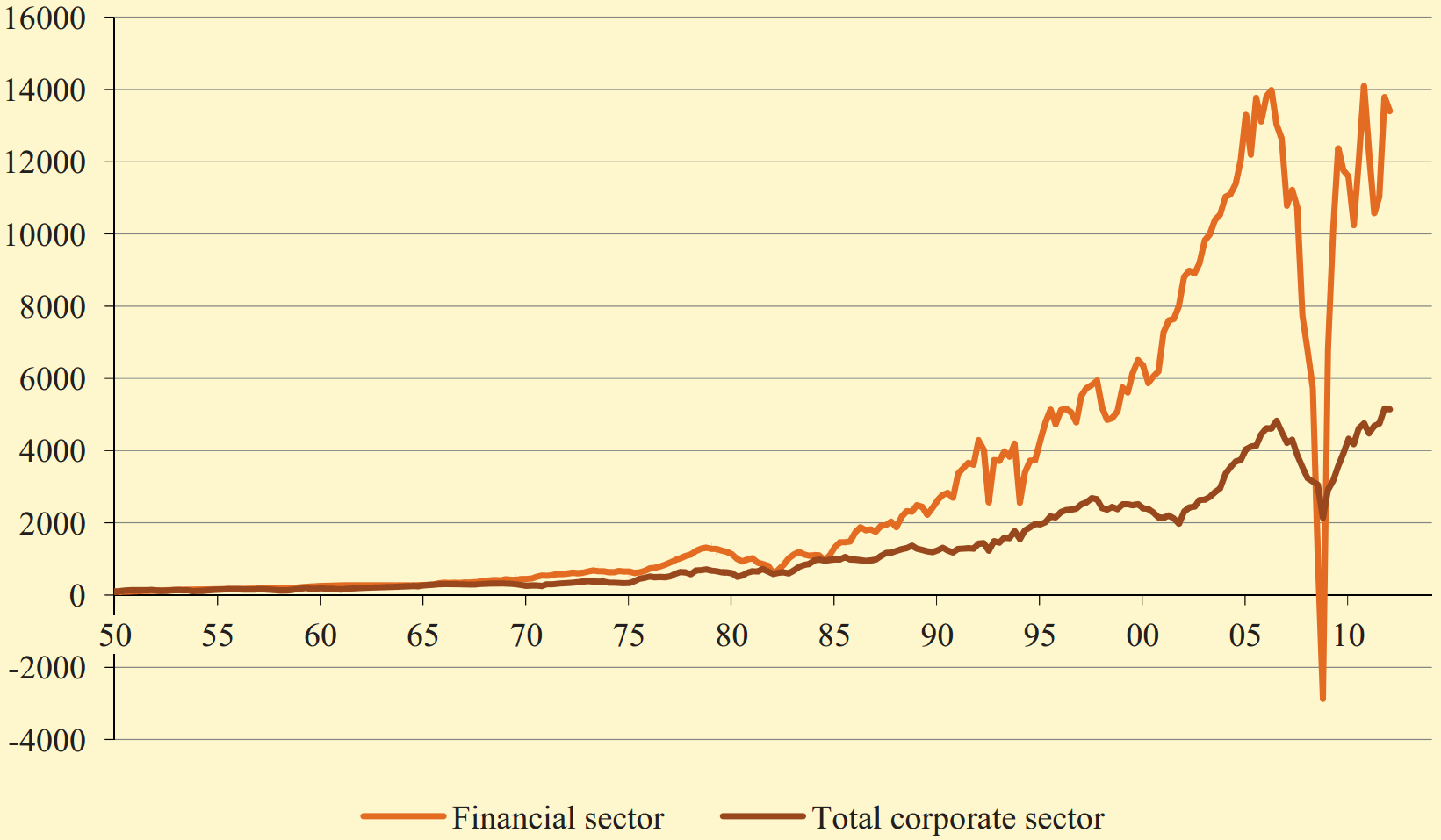
Source: Bloomberg, own calculations. Profits with inventory valuation and capital consumption adjustment. All indices are seasonally adjusted at annual rates. *Series are indexed (Q1 1950 = 100).
While it is beyond the scope of this article to provide a detailed overview about the arguments in the debate about how monetary policy should deal with changes in asset prices, it should be noted here that confining “inflation targeting” to keeping a consumer price index stable over time has a great attraction for those benefitting from “asset price inflation.” This is because excluding asset prices from the price index targeted by the central bank actually allows for a fairly inflationary policy.
Consider the case in which the central bank expands, via an increase in bank circulation credit, the quantity of money (fiduciary media). Assume further that the rising quantity of money does not show up in higher consumer prices but leads to rising prices for, say, stocks and housing. In such a situation the central bank, if and when its policy is determined by changes in consumer prices, will continue to allow banks to churn out ever more money—which, in turn, keeps inflating asset prices.
Such an inflationary monetary policy is of course beneficial to the financial industry and the banking industry in particular. An increase in bank circulation credit is, first and foremost, a profitable business for banks. In addition, a growing quantity of credit and money results in a growing financial market. It brings additional profitable business opportunities such as, for instance, trading, hedging, settlement, and custodian services.
The finding that central banking and money creation through bank circulation credit expansion benefits, in particular, the financial industry, especially when asset price inflation is basically ignored by central banks, can be illustrated quite nicely by, for instance, U.S. data. After the end of (what little was left of) the (pseudo-) gold standard in August 1971, which resulted in a world-wide unfettered paper money regime, profit growth in the financial industry as a whole started outpacing profit growth of the total economy, especially from the middle of the 1980s.
VI. The Destabilizing Effects of Central Banking—The “Boom-and-Bust Cycle”
In TM&C Mises had already refuted the notion that money can have “stable value”: By having succeeded in extending marginal utility theory to the value of money, Mises showed that any notion of “stable money” would be an “empty and contradictory notion,”39 as he put it later. This insight is actually derived from praxeology, as the very notion of stability in human affairs is:
founded on the illusory image of an eternal and immutable being who determines by the application of an immutable standard the quantity of satisfaction which a unit of money conveys to him. It is a poor justification of this ill-thought idea that what is wanted is merely to measure changes in the purchasing power of money. The crux of the stability notion lies precisely in this concept of purchasing power.40
In Human Action, Mises put forward an explanation of the popularity of the notion of stable money, namely that people are in favor of stabilization policies because they would not understand that it is government, not the free market, that is held to be responsible for causing financial and economic crises: “Shortcomings in the governments’ handling of monetary matters and the disastrous consequences of policies aimed at lowering the rate of interest and at encouraging business activities through credit expansion gave birth to the ideas which finally generated the slogan “stabilization.”41 Mises saw that the erroneous notion of stable money would not only pave the way towards even more interventionism in monetary affairs, it would also provide government with a legitimization to monopolize money production and replace commodity money with unbacked paper, or: fiat, money.42 Money will then be produced through bank credit expansion, thereby creating fiduciary media: money not backed by real savings. The issuance of fiduciary media through bank credit is at the heart of the Austrian monetary trade cycle theory, which was developed in the TM&C by integrating three hitherto separated theories: (1) the Currency School, (2) the capital and interest rate theory of Eugen von Böhm-Bawerk (1851–1914), and (3) the theory of the divergence of the market interest rate from the “natural interest rate” as developed by Knut Wicksell (1851–1926).
The increase in bank circulation credit lowers, and necessarily so, the market interest rate below the natural interest rate (which is determined by societal time preference). This, in turn, induces an artificial boom. The artificially lowered interest increases consumption at the expense of savings (out of current income), and, in addition, leads to a rise in investment. The economy starts living beyond its means. Once the injection of fiduciary media has run its course, market agents start readjusting their dispositions. As the societal time preference hasn’t changed, there are insufficient savings and, therefore, insufficient real resources to complete all new investment projects. Investments, provoked by the artificial lowering of the market interest rate, become unprofitable. A liquidation process sets in, and the boom turns into a bust.
Central banking plays a crucial role for the boom-and-bust cycle. For under central banking the disciplinary checks on inflation, which prevail under free-market conditions, are removed. Commercial banks can embark upon a policy of issuing ever greater amounts of circulation credit and fiduciary media without having to fear adverse consequences. For the central bank stands ready to act as a “lender of last resort,” bailing out ailing banks with newly issued (base) money. While central banking is a device for increasing inflation drastically, it cannot, of course, overcome economic laws. That a fiduciary media induced boom will, and inevitably so, ultimately result in a bust was unmistakably formulated in TM&C:
Certainly, the banks would be able to postpone the collapse; but nevertheless, as has been shown, the moment must eventually come when no further extension of the circulation of fiduciary media is possible. Then the catastrophe occurs, and its consequences are the worse and the reaction against the bull tendency of the market the stronger, the longer the period during which the rate of interest on loans has been below the natural rate of interest and the greater the extent to which roundabout processes of production that are not justified by the state of the capital market have been adopted.43
Mises, after weighing the pros and cons of fiduciary media, came to the conclusion that the issue of fiduciary media should be suspended:
It has gradually become recognized as a fundamental principle of monetary policy that intervention must be avoided as far as possible. Fiduciary media are scarcely different in nature from money; a supply of them affects the market in the same way as a supply of money proper; variations in their quantity influence the objective exchange-value of money in just the same way as do variations in the quantity of money proper. Hence, they should logically be subjected to the same principles that have been established with regard to money proper; the same attempts should be made in their case as well to eliminate as far as possible human influence on the exchange-ratio between money and other economic goods. The possibility of causing temporary fluctuations in the exchange-ratios between goods of higher and of lower orders by the issue of fiduciary media, and the pernicious consequences connected with a divergence between the natural and money rates of interest, are circumstances leading to the same conclusion. Now it is obvious that the only way of eliminating human influence on the credit system is to suppress all further issue of fiduciary media.44
In TM&C Mises identified central banking and fractional reserve banking as a source of economic and financial calamity, pointing out that central banking has not prevented but lent impetus to these unfavorable developments:
Since the time of the Currency School, the policy adopted by the governments of Europe and America with regard to the issue of fiduciary media has been guided, on the whole, by the idea that it is necessary to impose some sort of restriction upon the banks in order to prevent them from extending the issue of fiduciary media in such a way as to cause a rise of prices that eventually culminates in an economic crisis. But the course of this policy has been continually broken by contrary aims. Endeavours have been made by means of credit policy to keep the rate of interest low; “cheap money” (i.e., low interest) and “reasonable” (i.e., high) prices have been aimed at. Since the beginning of the twentieth century these endeavours have noticeably gained in strength; during the War and for some time after it they were the prevailing aims.45
These words already echo Mises’s later (and much more explicitly expressed) conclusion, namely that central banking not only destabilizes the economy but leads to a recurrence of boom-and-bust. Under central banking, per Mises, the boom-and-bust is thus not just a one-off affair, it becomes chronic. His political-economic explanation is as follows:
The boom produces impoverishment. But still more disastrous are its moral ravages. It makes people despondent and dispirited. The more optimistic they were under the illusory prosperity of the boom, the greater is their despair and their feeling of frustration. The individual is always ready to ascribe his good luck to his own efficiency and to take it as a well-deserved reward for his talent, application, and probity. But reverses of fortune he always charges to other people, and most of all to the absurdity of social and political institutions. He does not blame the authorities for having fostered the boom. He reviles them for the inevitable collapse. In the opinion of the public, more inflation and more credit expansion are the only remedy against the evils which inflation and credit expansion have brought about.46
VII. The Regression Theorem: The Ethical Case Against Central Banking
In Principles of Economics (1871), Carl Menger (1840–1914) had put forward a theory of the origin of money. He argued that money emerged spontaneously in the free market, and out of a commodity. In his logic-historical account, Menger concluded:
The origin of money (as distinct from coin, which is only one variety of money) is, as we have seen, entirely natural and thus displays legislative influence only in the rarest instances. Money is not an invention of the state. It is not the product of a legislative act. Even the sanction of political authority is not necessary for its existence. Certain commodities came to be money quite naturally, as the result of economic relationships that were independent of the power of the state.47
In TM&C Mises developed the regression theorem, which (1) gave Menger’s theory of the origin of money effectively a praxeological fundament and (2) solved the alleged “Austrian circle,” with the latter denoting the critique of not having succeeded in applying the marginal utility theory to money.48 The “Austrian circle” denoted the following problem: The exchange value of money would be determined by the supply of and demand for money in the market. However, money is demanded because it has pre-existing purchasing power. Accordingly, one seems to get entangled in a circular reasoning: Money is demanded because it has purchasing power, but the latter is determined by the demand for and supply of money.
Mises, however, solved this problem, recognizing that money’s exchange value has a time dimension: The exchange value of money in period t is determined by money’s purchasing power in period t–1. Such a backward (regressive) reasoning ends precisely at the point in time when money was useful only as a non-monetary commodity. The regression theorem thus yields two important insights, proving Menger’s claims: namely that (1) money must have emerged from a market process, and (2) money can only emerge from a commodity (such as, for instance, precious metals). Money cannot be established by government decree or by a social contract—as argued most prominently by Georg F. Knapp (1842–1926) in his “state theory of money” in 1905.
The regression theorem explains why (intrinsically) worthless paper, or fiat, money cannot emerge out of the free market, but must have been launched by an act of expropriation, that is by having coercively severed the link between money proper (as established in the free market) and money substitutes, representing a claim on money proper. Hülsmann puts this insight succinctly: “Paper money has never been introduced through voluntary cooperation. In all known cases it has been introduced through coercion and compulsion, sometimes with the threat of the death penalty.”49
VIII. Looking Ahead
Mises’s theoretical insights developed in TM&C haven’t found their way into the monetary theory of mainstream economics and, as a result, practical monetary policy making. In particular the institutional set-up of monetary affairs virtually all over the world has been following more or less Keynesian and Monetarist doctrines. This outcome, however, does by no means speak against the truth value of Mises’s insights as laid out in TM&C. Quite to the contrary.
The current international financial and economic crisis, which started around the middle of 2007 in the United States and then developed into a truly global malaise, must be understood as a crisis of central banking—a monetary order in which money production is monopolized, where irredeemable fiat currencies, produced through bank circulation credit out of thin air, serve as money; and where boom-and-bust cycles and the accumulation of ever greater amounts of debt (relative to economic income) is the inevitable consequence.
In fact, the demise of the international fiat money system—which is actually what the current international financial and economic crisis stands for—is an empirical illustration of what Mises basically pointed out in his TM&C in 1912: A regime of central banking—that is government control over money production will result in an economic and political catastrophe on the grandest scale.
Mises formulated this insight as follows:
[T]he [fiat money induced, TP] boom cannot continue indefinitely. There are two alternatives. Either the banks continue the credit expansion without restriction and thus cause constantly mounting price increases and an ever-growing orgy of speculation, which, as in all other cases of unlimited inflation, ends in a “crack-up boom” and in a collapse of the money and credit system. Or the banks stop before this point is reached, voluntarily renounce further credit expansion and thus bring about the crisis. The depression follows in both instances.50
In the 1953 edition of TM&C Mises recommended a return to sound money, formulating the sound money principle: “[T]he sound-money principle has two aspects. It is affirmative in approving the market’s choice of a commonly-used medium of exchange. It is negative in obstructing the government’s propensity to meddle with the currency system.”51 And further: “It is impossible to grasp the meaning of the idea of sound money if one does not realize that it was devised as an instrument for the protection of civil liberties against despotic inroads on the part of governments. Ideologically it belongs in the same class with political constitutions and bills of rights.”52
To Mises, sound money is money determined by the demand for and supply of money in the free market place, and it is a defense line against government interference in individual freedom. It is against this backdrop that Mises put forward a plan for returning a fiat money system to a monetary order based on gold, effective gold coin circulation, and 100 percent reserve banking. The upshot of his proposal is the elimination of government interference in the fields of money production and the banking business altogether. To Mises, sound money effectively implies the privatization of money production, free banking with 100-percent reserve banking, and gold serving as money proper.53
References
Alchian, A.A., and B. Klein. 1973. “On a Correct Measure of Inflation.” Journal of Money, Credit and Banking 5, No. 1, Part 1 (February): 173–91.
Bank for International Settlement. 2009. Issues in the Governance of Central Banks. Bank for International Settlement (May): Chapter 2, pp. 17–55.
Barro, R., and D. Gordon. 1983. “A positive theory of monetary policy in a natural rate model.” Journal of Political Economy 91: 589–610.
Belke, A., and T. Polleit. 2009. Monetary Economics in Globalised Financial Markets. Berlin, Heidelberg: Springer.
Cachanosky, N. 2009. “The Definition of Inflation According to Mises: Implications for the Debate on Free Banking.” Libertarian Papers 1, No. 43.
Calvo, G. 1978. “On the time consistence of optimal policy in a monetary economy.” Econometrica 46: 1411–28.
Cecchetti, S. G., H. Genberg, J. Lipsky, and S. Wadhwani. 2000. “Asset Prices and Central Bank Policy.” The Geneva Report on the World Economy No. 2 (May 30). Published by ICMB and the CEPR.
Eijffinger, S. C. W., J. De Han. 1996. “The Political Economy of Central-Bank Independence.” Special Papers in International Economics No. 19 (May). Department of Economics, Princeton University.
European Central Bank. 2005. Asset Price Bubbles and Monetary Policy (April): 47–60.
Fisher, I. [1911] 1963. The Purchasing Power of Money: Its Determination and Relation to Credit, Interest, and Crises. New York: Macmillan. Reprinted, New York: Augustus M. Kelley.
Goodhart, C. 2001. “What Weight Should be Given to Asset Prices in the Measurement of Inflation?” The Economic Journal 111, No. 472, Features (June): F335–56.
Helfferich, K. [1903] 1923. Das Geld. 6th ed. Leipzig: Verlag von C. L. Hirschfeld.
Hoppe, H.H. 2006. “How is Fiat Money Possible?–or, The Devolution of Money and Credit.” The Economics and Ethics of Private Property, Studies in Political Economy and Philosophy. 2nd ed. Auburn, Ala.: Ludwig von Mises Institute.
——. 1995. Economic Science and the Austrian Method. Auburn, Ala.: Ludwig von Mises Institute.
Humphrey, T. M. 1997. “Fisher and Wicksell on the Quantity of Theory.” Federal Reserve Bank of Richmond, Economic Quarterly 83, No. 4 (Fall): 71–90.
Hülsmann, J. G. 2008. “Mises on Monetary Reform: the Private Alternative.” Quarterly Journal of Austrian Economics 11: 208–18.
——. 2008. The Ethics of Money Production. Auburn, Ala.: Ludwig von Mises Institute.
——. 2007. The Last Knight of Liberalism. Auburn, Ala.: Ludwig von Mises Institute.
——. [1960] 2003. Epistemological Problems of Economics. 3rd ed. Auburn, Ala.: Ludwig von Mises Institute.
Issing, O. 2009. “Asset Prices and Monetary Policy.” Cato Journal 29, No. 1 (Winter): 45–51.
Knies, K. 1885. Geld und Credit. Erste Abteilung, zweite verbesserte und vermehrte Auflage. Berlin: Weidmannsche Buchhandlung.
Kohn, D. L. 2008. “Monetary Policy and Asset Prices Revisited.” Cato Journal 29, No. 1 (Winter): 31-44.
Kydland, F., and E. Prescott. 1977. “Rules Rather than Discretion: The Inconsistency of Optimal Plans.” Journal of Political Economy 85: 473–92.
Menger, C. [1871] 2007. Principles of Economics. Auburn, Ala.: Ludwig von Mises Institute.
Mises, L. v. 1996. Human Action. 4th ed. San Francisco: Fox & Wilkes.
——. [ 1940] 1998. Interventionism: An Economic Analysis. Irvington-on-Hudson, N.Y.: The Foundation for Economic Education.
——. 1953. The Theory of Money and Credit. New Haven, Conn.: Yale University Press.
Patinkin, D. 1993. “Irving Fisher and His Compensated Dollar Plan.” Federal Reserve Bank of Richmond, Economic Quarterly 79, No. 3: 1–34.
Polleit, T. 2011. “A Priori and Sound Money.” Daily Article (November 17). Ludwig von Mises Institute.
Polleit, T., and D. Gerdesmeier. 2005. “Measures of Excess Liquidity.” Working paper series, No. 65, Frankfurt School of Finance and Management.
Rothbard, M. N. 2011. “The Austrian Theory of Money.” Economic Controversies. Auburn, Ala.: Ludwig von Mises Institute. Pp. 685–707.
——. [1983] 2008. The Mystery of Banking. Auburn, Ala.: Ludwig von Mises Institute.
——. [1962] 2001. Man, Economy and State. Auburn, Ala.: Ludwig von Mises Institute.
——. 1999. “Ludwig von Mises: The Dean of the Austrian School.” 15 Great Austrian Economists. Auburn, Ala.: Ludwig von Mises Institute. Pp. 143–65.
Salerno, J. T. 2010. “Ludwig von Mises’s Monetary Theory in Light of Modern Monetary Thought.” Money: Sound and Unsound. Auburn, Ala.: Ludwig von Mises Institute. Pp. 61–114.
——. 2010. “White contra Mises on Fiduciary Media.” Daily Article (May 14). Ludwig von Mises Institute.
Smith, V. C. [1936] 1990. The Rationale of Central Banking and the Free Banking Alternative. Reprint, Indianapolis: Liberty Press.
White, W. R. 2006. Is Price Stability Enough? BIS Working Paper, No. 205 (April).
Thorsten Polleit is Honorary Professor at the Frankfurt School of Finance & Management, Frankfurt, Germany.
An increase in a community’s stock of money always means an increase in the amount of money held by a number of economic agents, whether these are the issuers of fiat or credit money or the producers of the substance of which commodity money is made. For these persons, the ratio between the demand for money and the stock of it is altered; they have a relative superfluity of money and a relative shortage of other economic goods. The immediate consequence of both circumstances is that the marginal utility to them of the monetary unit diminishes. This necessarily influences their behavior in the market. They are in a stronger position as buyers. They will now express in the market their demand for the objects they desire more intensively than before; they are able to offer more money for the commodities that they wish to acquire. It will be the obvious result of this that the prices of the goods concerned will rise, and that the objective exchange value of money will fall in comparison. But this rise of prices will by no means be restricted to the market for those goods that are desired by those who originally have the new money at their disposal. In addition, those who have brought these goods to market will have their incomes and their proportionate stocks of money increased and, in their turn, will be in a position to demand more intensively the goods they want, so that these goods will also rise in price. Thus the increase of prices continues, having a diminishing effect, until all commodities, some to a greater and some to a lesser extent, are reached by it.
- 1The other three treatises are Socialism (Indianapolis: Liberty Fund, 1981), Human Action (Auburn, Ala.: Mises Institute, 1998), and Theory and History (Auburn, Ala.: Mises Institute, 1985). See the complete Mises bibliography at http://mises.org/misesbib.asp. For general biographical information on Mises see Murray Rothbard, Ludwig von Mises: Scholar, Creator, Hero (Auburn, Ala.: Mises Institute, 1988), Israel Kirzner, Ludwig von Mises: The Man and His Economics (Wilmington, Del.: ISI Books, 2001), and J.G. Hülsmann, Mises: The Last Knight of Liberalism (Auburn, Ala.: Mises Institute, 2007).
- 2Keynes had written a book review of Mises’s treatise, stating it “is the work of an acute and cultivated mind. But it is critical rather than constructive, dialectical and not original. The author avoids all the usual pitfalls, but he avoids them by pointing them out and turning back rather than by surmounting them.” (Economic Journal, September 1914, p. 417). Sixteen years later he stated that “in German, I can only clearly understand what I know already!—so that new ideas are apt to be veiled from me by the difficulties of language.” Keynes, A Treatise on Money (London: Macmillan, 1930), vol. I, p. 199, note 2.
- 3The 1953 edition (New Haven, Conn.: Yale University Press) included an additional fourth part on “monetary reconstruction” that Mises had written for this new edition. In that form the book was published again three more times: 1971 (Irvington-on-Hudson, N.Y.: Foundation for Economic Education; second print in 1978), 1981 (Indianapolis: Liberty Fund), and 2009 (Auburn, Ala.: Mises Institute).
- 4Several Spanish translations (La Teoría del Dinero y Del Crédito) have been made: one by Antonio Riaño, published in 1936 (Madrid: M. Aguilar), one by José Ma. Claramunda Bes (Barcelona: Ediciones Zeus, 1961), and one by Juan Marcos (Madrid: Union Editorial, 1997).
- 5The Japanese translation was made from the second German edition by Yoneo Azuma: Kahei oyobi Ryütüjshudan no Riron (Tokyo: Jitsugyo no Nipponsha, 1949) and re-published in 1980 (Tokyo: Nihon Hyöron-Sha).
- 6Translated by H.P. Yang (Taiwan: Taiwan Bank, Economic Research Department, 1969).
- 7The Russian translation, along with annotations, was made by G. Sapov who used both the American edition and the second German edition: Теория денег и кредита (Chelyabinsk: Sotsium, 2012).
- 8The French edition (La Théorie de la monnaie et du crédit) is incomplete and only available on the Internet (http://herve.dequengo.free.fr/Mises/Tmc/TMC_1_1.htm). A print edition is forthcoming along with a preface from Antoine Gentier (Paris: Editions de l’Institut Charles Coquelin).
- 9Brad Delong, “Paul Krugman Asks a Question: On the ‘Austrian’ Hatred of Fractional Reserve Banking, Paper Money, etc. Weblogging” (http://delong.typepad.com/sdj/2012/09/paul-krugman-asks-a-question-on-the-austrian-hatred-of-fractional-reserve-banking-paper-money-etc-weblogging.html#more; accessed on 3 October 2012, at 9h32 CET)
- 10On the shortcomings of the Batson translation, see chap. 1, below.
- 11He calls money also “money in the narrow sense.” Most economists today call it “base money.” Notice that Mises argued that the essential function of money is to serve as a generally accepted medium of exchange. All other functions are consecutive functions. They are derived from this primary one (A10–12). Mises endorsed Knies classification of money as a good sui generis, that is, as distinct from consumers’ goods and from capital goods. The reason is, again, that these three types of goods are subject to different laws of valuation and pricing (A79).
- 12Mises argued most notably that the fatal error of the Currency School, which otherwise had sound conceptions that he endorsed in his book, was to regard banknotes as some form of money, whereas it considered demand deposits as pure credit instruments and not as a form of money. This was in Mises’s eyes a distinction without a difference and it led to the practical failure of Peel’s Act. We will deal with this issue in more detail below.
- 13During WWI, Mises refuted the assignment theory in a 1916 journal article “on the classification of monetary theories.” This paper would then be incorporated into the 1924 edition of his Theorie des Geldes und der Umlaufsmittel (chapter 9 of the second part; see B242–63) and remained as an appendix in the 1953 edition (see C503–24).
- 14See North (1993, p. 159).
- 15They are not different in all respects. For example, increasing the supply of fiduciary tends to entail an increase of the price level, just as it would be in the case of an increased supply of money proper or of money certificates.
- 16Unfortunately, the English rendering as Theory of Money and Credit obscured this central theme. We will address the problems of this translation below.
- 17See Menger (1968 [1909], pp. 73–75, 80–91. In the English edition the distinction between inner and outer exchange value was completely dropped. In a footnote (on p. C146) Batson explains: “Since this distinction has not been usual in English terminology, it has been omitted from the present version; and, in what follows, wherever ‘the objective exchange value of money’ is referred to, it is the innere exchange value that is meant unless the contrary is explicitly stated.”
- 18He repeatedly referred to Mathus’s Principles of Political Economy. See especially Menger (1968 [1909], p. 82).
- 19See Menger (1968 [1909], p. 75.
- 20In a passage where he explained that distinction (not translated into English), he stated (A132f., B104): “Both expressions are somewhat odd. But they have become accepted in science ever since Menger used them. Therefore they shall be used where appropriate in the following investigations.” (Beide Ausdrücke sind nicht gerade glücklich gewählt. Aber sie haben einmal in der Wissenschaft das Bürgerrecht erlangt, seit Menger sie verwendet hat; darum sollen sie auch in den folgenden Untersuchungen dort gebraucht werden, wo dies mit Nutzen geschehen kann.)
- 21B200, my emphasis JGH. The word “inner” lacks in the English edition, see C272. Similarly, see the definition of the term “inflationism” on A265 (deleted from the second edition). Mises was reluctant to use the term inflation at all, referring to the reservations expressed by Pigou. He thought scientific analysis could do without them. For a penetrating history of the common definitions of the terms inflation and deflation see Bryan (1997).
- 22A246, B200. Again, the English edition lacks the words “inner” (see C248). The translator, Batson, also tried to make a distinction between Geldwertpolitik, Geldpolitik, and Währungspolitik (see C247, footnote), whereas Mises used all three terms synonymously, as is common in the German-language literature. Similarly, Mises stated that monetary policy in that sense is the “complement” or “corollary” (Gegenstück) of policies designed to influence the prices of single commodities or groups of commodities. Batson translates Gegenstück out of context as “antithesis.”
- 23Amadeus Gabriel highlights the interesting fact that the core idea of the regression theorem can be traced back to the contemporary German literature. See Gabriel (2012) in the present volume, chapter 2.
- 24See A154f., B122f., C164.
- 25In a passage deleted as from the second edition (see A244f.), Mises discusses Irving Fisher’s attempt to empirically validate his contention about the relationship between real and nominal interest rates. Mises points out that Fisher succeeded only in those cases in which the inter-temporal exchange (the credit) involved several currencies; but not in those cases in which the credit was given and returned in terms of a commodity money.
- 26A78, C101f. See also A263, A402f.
- 27At one point he almost justified his repetitiveness, stating: “This was not recognized for a long time and to a large extent it is not recognized even nowadays” (A403, C379).
- 28The monetary interventionism recommended by mercantilist authors such as John Law was therefore not modern monetary policy in Mises’s sense. The mercantilists wished to increase the money stock, but they did not wish to diminish the PPM (even though they might have accepted this consequence as a collateral effect of their policies). See A263f.
- 29C250, A250, B203.
- 30He points out that the monetary history of Austria-Hungary in the nineteenth century was one of the most important cases of deflationist policies (A257).
- 31C264, A261, B217. At this point he quotes Bentham’s In Defence of Usury (1790).
- 32In the second edition, too, he characterizes a stable inner objective exchange value of money as a—yet unattainable—ideal of monetary policy (see B401).
- 33C269f., B222, A288. Notice that the English text falsely translates Sachgeld (commodity money) as metallic money.
- 34C270, B222, A290.
- 35AIV. The original text: “Manche ihrer Fehler sind von Tooke und Fullarton mit Recht getadelt worden. Aber das, was diese beiden an die Stelle der Currency-Theorie gesetzt haben, ist mit nichten eine brauchbare Theorie. Die Banking-Theorie enthält nicht nur Irrtümer, sie fehlt schon in ihrer Problemstellung.”
- 36A417, C390. Mises mentions the circumstance that explains this neglect: Currency School and Banking School agreed amongst themselves that there could be no such thing as costless credit. See A406f., C381.
- 37See A410, A412, A415–17, A428–30.
- 38This distinction is one of the central concepts to which Mises refers constantly through the entire book. See pp. A80, A145, A353, A358, A358, A419, A422, A429, A430f., A432, A435f., A445, A452.
- 39The only exception concerns commodity money. Here an increase in the demand for money tends to entail increases of the interest rate; but Mises contends that this fact is without practical significance. For a more recent re-interpretation of the significance of this fact see J.G. Hülsmann, “The Demand for Money and the Time Structure of Production,” Hülsmann and Kinsella, eds., Property, Freedom, and Society: Festschrift for Hans-Hermann Hoppe (Auburn, Ala.: Mises Institute, 2009); Dan Mahoney, “Free Banking and the Structure of Production: A Contrast of Competing Banking Systems,” Libertarian Papers 3, no. 14 (2011).
- 40A428f., B369f., C399.
- 41A430f. In the second edition, he modified the argument concerning the nature of the impossibility of artificially lengthening the period of production. He stated “and so, although it is in the last resort inadmissible and impracticable, a lengthening of the period of production promises for the time to be profitable” (C399; emphasis JGH). The original text of the second edition: “damit wird die Verlängerung der Produktionsperiode, obwohl in letzter Linie unzulässig und undurchführbar, zunächst scheinbar rentabel” (B371). The original text of the first edition reads: “damit wird die Verlängerung der Produktionsperiode, obwohl volkswirtschaftlich unzulässig und undurchführbar, privatwirtschaftlich zunächst rentabel” (A430). Thus whereas Mises argued at first that the artificial expansion of the money supply entailed a contradiction between overall possibilities and the individual assessment of those possibilities, he later argued that it temporarily entailed illusory profits. Clearly this new argument is problematic, because not all profits in the boom phase are illusory. The main motivation behind the change of argument seems to be Mises’s general quest, in the second edition, to get rid of all references to an overall or macroeconomic (volkswirtschaftlich) point of view, to emphasize methodological individualism, and to deny the existence of possible contradictions between individual interests and the common good. Thus we find in the new chapter on “the monetary policy of étatism” the following statement: “In this case, as in all others in which similar assertions are made, it is not true that there exists an opposition between the interests of the individual and the interests of the community” (B240, C290).
- 42The chapter title has subsequently been changed into “Pre-war policy problems relating to fiduciary media” (Probleme der Umlaufsmittelpolitik in der Zeit vor dem Kriege; English translation: “Problems of credit policy before the war”). The concluding fourth part of the first edition (A467–76) has subsequently been deleted respectively integrated into the final pages of the last chapter of part three.
- 43“It would be a mistake to assume that the modern organization of exchange is bound to continue to exist. It carries within itself the germ of its own destruction; the development of the fiduciary medium must necessarily lead to its breakdown” (A472, B419, C448).
- 44A444, C411. See also A360, A420, and A425.
- 45“We know . . . that all credit-issuing banks endeavor to extend their circulation of fiduciary media as much as possible, and that the only obstacles in their way nowadays are legal prescriptions and business customs concerning the covering of notes and deposits, not any resistance on the part of the public” (A426, C397).
- 46A noteworthy minor change, for example, is Mises’s acknowledgement that index numbers can “perform useful workaday services for the politician” if they are based on “points of time that lie close to one another” (C222, B177). The section where he makes this concession to the practical utility of index numbers has been added to the second edition of the book. Another intriguing minor change is the footnote on B347 (C378), in which Mises for the first time expresses his reservations about Böhm-Bawerk’s theory of interest. He also presents his theory of the business cycle as a full theory in its own right, not just one possible explanation of economic crises to be used in conjunction with other explanations (compare A433–36 with B374, C403f.; see also Hülsmann 2007, p. 506). Finally, we also consider the already-mentioned addition of the chapter on the classification of monetary theories, first published as a journal article in 1916, to be a minor addition.
- 47See A107, A110, A157, A181, A181f., A192, A383, A411
- 48See A15, A16, A119, A130, A178, A234.
- 49See B187–89, C235f.
- 50See Mises (1919a, pp. 129ff.).
- 51See B190, C236f.
- 52C252f., B204f. See also C255, B208.
- 53A224. The original text: “Wer lange laufende Abschlüsse ohne Baisse- und Hausseklausel und ohne die Sicherung der entsprechenden Deckungsgeschäfte auf dem Terminmarkt getätigt hat, wird durch jede nachträglich eintretende Preisverschiebung, die er nicht vorausgesehen und mitkalkuliert hat, wesentlich betroffen.”

