
The Tariff History of the United States
Chapter I. Protection to Young Industries as Applied in the United States

CHAPTER I
Protection to Young Industries as Applied in The United States
I. The Argument for Protection to Young Industries
OF THE ARGUMENTS in favor of protection, none has been more frequently or more sincerely urged than that which is expressed in the phrase “protection to young industries.” None has received so generally the approval of economists, even of those little disposed to acknowledge the validity of any reasoning not in accordance with the theory of free exchange. Mill gave it the weight of his approval in a passage which has been frequently cited. Later English writers have followed him in granting its intrinsic soundness. The reasoning of List, the most prominent protectionist writer among the Germans, is based, so far as it is purely economic, on this argument, and since List’s time the argument has taken an established place in German treatises on political economy, even though it be admitted that the conditions to which it fairly applies belong to the past.
The argument is, in brief, that it may be advantageous to encourage by legislation a branch of industry which might be profitably carried on, which is therefore sure to be carried on eventually, but whose rise is prevented for the time being by artificial or accidental causes. The essential point of the argument lies in the assumption that the causes which prevent the rise of the industry, and render protection necessary, are not natural and permanent causes,—not such as would permanently prevent, under a state of freedom, the growth of the industry. Let it be supposed, for instance, that the industry to be encouraged is the cotton manufacture. The natural advantages of a given country for making cotton cloths are good, we may suppose, in comparison with the advantages for producing other things. The raw material is cheap, power for machinery is abundant, the general intelligence and industry of the people—which, since they admit of but very slow change, must be considered natural advantages—are such as to fit them for complex industrial operations. There is no permanent cause why cotton goods should not be obtained at as low cost by making them at home as by importing them; perhaps they can even be produced at lower cost at home. But the cotton manufacture, let it be further supposed, is new: the machinery used is unknown and complicated, and requires skill and experience of a kind not attainable in other branches of production. The industry of the country runs by custom in other grooves, from which it is not easily diverted. If, at the same time, the communication of knowledge be slow, and enterprise be hesitating, we have a set of conditions under which the establishment of the cotton manufacture may be prevented, long after it might have been carried on with advantage. Under such circumstances it may be wise to encourage the manufacture by duties on imported goods, or by other analogous measures. Sooner or later the cotton manufacture will be introduced and carried on, even without assistance; and the government’s aid will only cause it to be established with less friction, and at an earlier date, than would otherwise have been the case.
It may illustrate more clearly the conditions under which such assistance may be useful, to point out those under which it is superfluous. The mere fact that an industry is young in years—has been undertaken only within a short period of time—does not supply the conditions under which protection is justified by this argument. An industry recently established, but similar in kind to other branches of production already carried on in the country, would hardly come within its scope. But where the industry is not only new, but forms a departure from the usual track of production; where, perhaps, machinery of an entirely strange character, or processes hitherto unknown, are necessary; where the skill and experience required are such as could not be attained in the occupations already in vogue; under these circumstances protection may be applied with good results, if no natural disadvantages, in addition to the artificial obstacles, stand in the way. The manufacture of linen goods in the United States, at the present time, probably supplies an example of an industry which, though comparatively new, can hardly be said to deserve protection as a young industry. The methods and machinery in use are not essentially different from those of other branches of textile manufactures. No great departure from the usual track of production is necessary in order to make linens. Manufactures of the same general character are established on all sides. Work-people and managers with experience in similar work can be easily found. Moreover, the means of obtaining and communicating knowledge at the present time are such that information in regard to the methods and machinery of other countries can be easily obtained, while workmen can be brought from abroad without difficulty. Those artificial obstacles which might temporarily prevent the rise of the industry do not exist, and it may be inferred that, if there are no permanent causes which prevent linens from being made as cheaply in the United States as in other countries, the manufacture will be undertaken and carried on without needing any stimulus from protecting duties.
There are two sets of conditions under which it is supposable that advantages not natural or inherent may be found in one country as compared with another, under which causes merely temporary and accidental may prevent the rise of certain branches of industry in the second country, and under which, therefore, there may be room for the application of protection. These are, first, the state of things in a new country which is rapidly growing in population, and in which, as population becomes more dense, there is a natural change from exclusive devotion to the extractive industries toward greater attention to those branches of production classed as manufactures. The transition from a purely agricultural state to a more diversified system of industry may be retarded, in the complete absence of other occupations than agriculture, beyond the time when it might advantageously take place. Secondly, when great improvements take place in some of the arts of production, it is possible that the new process may be retained in the country in which they originate, and may fail to be applied in another country, through ignorance, the inertia of habit, and perhaps in consequence of restrictive legislation at the seat of the new methods. Here, again, the obstacles to the introduction of the new industry may be of that artificial kind which can be overcome most easily by artificial means. Now, both these sets of conditions seem to have been fulfilled in the United States in the beginning of the 19th century. The country was normally emerging, to a considerable extent, from that state of almost exclusive devotion to agriculture which had characterized the colonies. At the same time great changes were taking place in the mechanical arts, and new processes, hardly known outside of England, and held under a practical monopoly there, were revolutionizing the methods of manufacturing production. Under these circumstances there would seem to have existed room for the legitimate application of protection for young industries.
The more detailed examination in the following pages of the industrial condition of the country during the earlier part of the 19th century will bring out more clearly the reasons why protection may then have been useful. It may be well, however, to notice at this point one difference between those days and the present which must seriously affect the application of the argument we are considering. Even if we were to suppose the conditions of 1810 to exist now; if the country were now first beginning to attempt manufactures, and if a great revolution in manufacturing industry happened to make the attempt peculiarly difficult; even then the obstacles arising from the force of custom, and from the want of familiarity with new processes, would be much more easy to overcome now than sixty years ago. The ties of custom in industry have become much loosened in the last half century; capital and labor turn more easily to new employments. The railroad, the telegraph, the printing-press, the immense increase in the facility of communication, the constant change in methods of production in all industries, have tended to make new discoveries and inventions common property, and to do away with advantages in production based on other than permanent causes. It is true that there are still appreciable differences in the arts of production in different countries, and that some may have a superiority over others based on the merely accidental or temporary possession of better processes or more effective machinery. But the United States hardly lag behind in the industrial advance of the present day, and where they do labor under artificial or factitious disadvantages, these cannot endure long or be of great consequence under a system of freedom.
Eighty years ago, however, the state of things was very different. The conditions were then in force under which protection might be needed to enable useful industries to be carried on. The argument for protection to young industries was accordingly the most effective of those urged in favor of the protective policy. During the twenty years which followed the war of 1812 the protective controversy was one of the most important features in the political life of the nation; and the young industries argument was the great rallying-cry of the protectionists. It is of interest to examine how far protection of the kind advocated was actually applied, and how far it was the cause, or an essential condition, of that rise of manufactures which took place. The object of this paper is to make such an investigation.
II. The Industrial History of the United States, and the Course of Protective Legislation, from 1789 To 1838
The early economic history of the United States may be divided into two periods. The first, which is in the main a continuation of the colonial period, lasted till about the year 1808; the embargo marks the beginning of the series of events which closed it. The second began in 1808, and lasted through the generation following. It was during the second period that the most decided attempt was made to apply protection to young industries in the United States, and with this period we are chiefly concerned.
During the first period the country was, on the whole, in the same industrial condition in which the colonies had been. The colonies had been necessarily engaged almost exclusively in agriculture, and in the occupations closely connected with it. The agricultural community could not get on without blacksmiths, carpenters, masons, shoemakers, and other artisans, and these existed side by side with the farmers. In those days, it must be remembered, handicraft workmen of this kind occupied a more important place in industrial organizations than they do at the present time. They made many articles and performed many services which are now the objects of manufacturing production and of extensive trade, and come within the range of international dealings. Many tools were then made by individual blacksmiths, many wares by the carpenter, many homespun cloths fulled and finished at the small fulling-mill. Production of this kind necessarily takes place at the locality where consumption goes on. In those days the division of labor between distant bodies of men had been carried out to a comparatively slight extent, and the scope of international trade was therefore much more limited. The existence of these handicraft workmen accounts for the numerous notices of “manufactures” which Mr. Bishop industriously collected in his “History of Manufactures,” and is not inconsistent with the mainly extractive character of the industry of the colonies. What could be imported at that time was imported, and was paid for by the exportation of agricultural produce. The exportation took place, so far as the northern colonies were concerned, largely to the West Indies. From the West India trade the means for paying indirectly for the imported goods were mainly obtained. There were some important exceptions to this general state of things. Ship-building was carried on to a considerable extent in New England, where abundance of material and the necessity of transportation by water made such an industry natural. The production of unmanufactured iron was carried on to a considerable extent; for at that time the production of pig and bar iron tended to fix itself in those countries where wood, the fuel then used, was abundant, and was therefore an industry much more analogous to agriculture than it has been since the employment of coal as fuel. In the main, however, the colonies made only such manufactures as could not be imported. All manufactured goods that could be imported were not made at home, but obtained in exchange for agricultural exports.
This state of things was little changed after the end of the Revolutionary war and the adoption of the Constitution. The year 1789 marks no such epoch in economic as it does in political history. Agriculture, commerce, and the necessary mechanic arts, continued to form the main occupations of the people. Such goods as could be imported continued to be obtained from abroad in exchange for exports, mainly of agricultural produce. The range of importable articles was, it is true, gradually extending. Cloths, linens, and textile fabrics were still chiefly homespun, and fine goods of this kind were still in the main the only textile fabrics imported. But with the great growth of manufacturing industry in England during this time, the range of articles that could be imported was growing wider and wider. During the Napoleonic wars the American market was much the most important for the newly established English manufactures, Large quantities of cotton and woollen goods were imported, and the importations of manufactures of iron, in regard to which a similar change in production was then taking place, also increased steadily. Sooner or later the change in the course of production which was going on in England must have had, and did have, a strong influence on the economic condition of the United States; but for the time being this influence was little felt, and the country continued in the main to run in the grooves of the colonial period.
This absence of development was strongly promoted by the peculiar condition of the foreign trade of the country up to 1808. The wars of the French Revolution opened to this country profitable markets for its agricultural products in the West Indies and in Europe, and profitable employment for its shipping, both in carrying the increased exports and in a more or less authorized trade between the belligerent countries and their colonies. For many years the gains arising from these sources, though not regular or undisturbed, were great, and afforded every inducement to remain in the occupations that yielded them. The demand for agricultural products for exportation to the belligerent countries and their colonies was large, and the prices of wheat, corn, and meat were correspondingly high. The heavy exports and the profits on freights furnished abundant means for paying for imported goods. Importations were therefore large, and imported goods were so cheap as to afford little inducement for engaging in the production of similar goods at home.1
The tariff legislation of this period was naturally much influenced by the direction taken by the industries of the country. The peculiarly favorable conditions under which agriculture and commerce were carried on prevented the growth of any strong feeling in favor of assisting manufactures. Much has been said in the course of the protective controversy about the views of the fathers of the republic. But for nearly twenty years after the formation of the Union other subjects so absorbed the attention of public men that no distinct opinion appears in their utterances for or against protective duties. Considering the state of economic knowledge in those days, the example set by European countries, and the application of the colonial system before the days of independence, we cannot be surprised that some disposition was shown to impose protective duties. It is curious that in the first session of Congress these were advocated most earnestly by the representatives from Pennsylvania, who took their stand from the first as unflinching advocates of a protective policy. On the other hand, the current toward more liberal views, which had set in so strongly after the writings of the French economists and the publication of the “Wealth of Nations,” had made its way to the United States. One might expect to find its influence most strong among the followers of Jefferson, whose political philosophy led them in general to oppose government interference. But both Federalists and Republicans were influenced in their attitude to the question of protection most of all by its bearing on the other more prominent questions on which parties began to be divided.
Madison had maintained the principle of free intercourse in 1789,2 and Jefferson in 1787 had extolled the virtues of a simple agricultural State.3 But in 1793, when the Federalists and Republicans began to differ on questions of foreign policy, and especially on the attitude the country should take in the wars of the French Revolution, Jefferson advocated vigorous measures of protection directed against England, and Madison brought forward a set of resolutions based on his recommendations.4 On the other hand, Fisher Ames had said, in 1789, that the general government should nurture those industries in which the individual States had an interest; but in 1794, when his political views led him to oppose Madison’s resolutions, he called the whole theory of protection an exploded dogma.5 The first tariff act, that of 1789, was protective in intention and spirit. The Congress of the Confederation had framed a plan for a general five per cent. duty, with a few specific duties on articles like tea, coffee, and sugar,—a plan whose failure was one of the most important events leading to the adoption of the Constitution. When Congress met in 1789, this scheme, which had aimed solely at procuring the needed revenues, was presented anew by Madison, who advocated it not only on financial grounds but on the general principles of free trade. But several of the States, especially Massachusetts and Pennsylvania, had imposed protective duties before 1789; and they were desirous of maintaining the aid then given to some of their industries. Moreover, the feeling of resentment against Great Britain was strong. Consequently, Madison’s simple proposal was replaced by a more complicated scheme. The general duty of five per cent. was retained on all goods not otherwise enumerated. On certain articles of luxury, higher ad valorem rates were fixed, the highest, on carriages, being fifteen per cent. Specific duties were imposed on some selected articles, such as hemp, cordage, nails, manufactures of iron, and glass. These articles were selected, and made subject to the specific duties, with the clear intent of stimulating domestic production. The general range of duties was by no means such as would have been thought protective in later days; but the intention to protect was there.6
The legislation of the next twenty years, however, brought no further appreciable development of the protective policy. For a short time after 1789, it may be possible to detect a drift in favor of protective duties, which doubtless was strengthened by the powerful advocacy of protection in Hamilton’s “Report on Manufactures” (1792). But that famous document had little, if any, effect on legislation. The moderate policy of 1789 was maintained. The duties were increased from time to time as more revenue was needed, but they were in all cases moderate. Those which were most distinctly protective had no appreciable influence in diverting the industry of the country into new channels. No action at all was taken for the encouragement of the production of textiles, of crude iron, and of the other articles which later became the great subjects of dispute in the protective controversy.
The industrial situation changed abruptly in 1808. The complications with England and France led to a series of measures which mark a turning point in the industrial history of the country. The Berlin and Milan decrees of Napoleon, and the English orders in Council, led, in December, 1807, to the Embargo. The Non-Intercourse Act followed in 1809. War with England was declared in 1812. During the war, intercourse with England was prohibited, and all import duties were doubled. The last-mentioned measure was adopted in the hope of increasing the revenue, but had little effect, for foreign trade practically ceased to exist. This series of restrictive measures blocked the accustomed channels of exchange and production, and gave an enormous stimulus to those branches of industry whose products had before been imported. Establishments for the manufacture of cotton goods, woollen cloths, iron, glass, pottery, and other articles, sprang up with a mushroom growth. We shall have occasion to refer more in detail to this growth when the history of some of these manufactures comes to be considered separately. It is sufficient here to note that the restrictive legislation of 1808–15 was, for the time being, equivalent to extreme protection. The consequent rise of a considerable class of manufacturers, whose success depended largely on the continuance of protection, formed the basis of a strong movement for more decided limitation of foreign competition.
Some signs of the gradual growth of a protective feeling appear before the close of the war.7 It was natural that the patriotic fervor which the events of the period of restriction and war called out for the first time in our history, should bring with it a disposition to encourage the production at home of a number of manufactured articles, of which the sudden interruption in the foreign supply caused great inconvenience. Madison, whose views on this subject, as on others, shifted as time went on and circumstances changed, recommended the encouragement of manufactures; and in some of Clay’s earlier speeches we can see the first signs of the American system of the future.8 The feeling in favor of the manufactures that had sprung up during the time of restriction obtained some clear concessions in the tariff act of 1816. The control of the policy of Congress at that time was in the hands of a knot of young men of the rising generation, who had brought about the war and felt in a measure responsible for its results. There was a strong feeling among these that the manufacturing establishments which had grown up during the war should be assisted. There was little feeling, however, either in Congress or among the people, such as appeared in later years, in favor of a permanent strong protective policy. Higher duties were therefore granted on those goods in whose production most interest was felt, textile fabrics; but only for a limited period. Cotton and woollen goods were to pay 25 per cent. till 1819; after that date they were to pay 20 per cent. A proviso, intended to make more secure this measure of protection, was adopted in regard to a minimum duty on cotton goods, to which reference will be made in another connection. These and some other distinctly protective provisions were defended by Calhoun, mainly on the ground of the need of making provision for the exigencies of another war; and on that ground they were adopted, and at the same time limited. The general increase of duties under the act of 1816, to an average of about twenty per cent., was due to the necessity of providing for the payment of the interest on the heavy debt contracted during the war.
For some time after the close of the war and the enactment of the tariff of 1816, there was no pressure for a more vigorous application of protective principles. The general expectation was, that the country would fall back into much the same state of things as that which had existed before 1808; that agriculture and commerce would again be as profitable as during the previous period, and would be as exclusively the occupations of the people. Such an expectation could not in the nature of things be entirely fulfilled, but for a time it was encouraged by several accidental circumstances. The harvests in Europe for several seasons were bad, and caused a stronger demand and higher price for the staple food products. The demand for cotton was large, and the price high. Most important of all, the currency was in a state of complete disarrangement, and concealed and supported an unsound economic condition. Under cover of the excessive issues of practically irredeemable bank-notes, the prices of all commodities were high, as were the general rates of wages and rents. The prices of bread-stuffs and provisions, the staples of the North, and of cotton and tobacco, the staples of the South, were high, not only absolutely, but relatively, and encouraged continued large production of these articles The prices of most manufactured goods were comparatively low. After the war the imports of these from England were very heavy. The long pent-up stream of English merchandise may be said to have flooded the world at the close of the Napoleonic wars. In this country, as in others, imports were carried beyond the capacity for consumption, and prices fell much below the normal rates. The strain of this over-supply and fall of prices bore hard on the domestic manufacturers, especially on those who had begun and carried on operations during the restrictive period; and many of them were compelled to cease production and to abandon their works.
This abnormal period, which had its counterpart of feverish excitement and speculation in Europe, came to an end in 1818–19. The civilized world then settled down to recover slowly from the effects of a generation of war and destruction. In the United States the currency bubble was pricked in the latter part of 1818. Prices began to fall rapidly and heavily, and continued to fall through 1819. The prices of the agricultural staples of the North and South underwent the greatest change, for the harvests in Europe were again good in 1818, the English corn-laws of 1816 went into operation, and the demand for cotton fell off. A new scale of monetary exchange gradually went into operation. During the period of transition there was, as there always is in such periods, much suffering and uneasiness; but gradually the difficulties of adjusting old contracts and engagements were overcome, and the habits of the people accommodated themselves to the new régime. Within three or four years after 1819 the effects of the crash were no longer felt in most parts of the country.
Two results which it is important to note in this connection followed from the crisis of 1819: first, a great alteration in the position and prospects of manufacturing industries; and second, the rise of a strong public feeling in favor of protecting these industries, and the final enactment of legislation for that purpose. The first of these results was due primarily to the fact that the fall in prices after 1819 did not so greatly affect most manufactured goods as it did other articles. The prices of manufactured goods had already declined, in consequence of the heavy importations in the years immediately following the war. When, therefore, the heavy fall took place in 1819 in the prices of food and of raw materials, in the gains of agriculture, in money wages and money rents, the general result was advantageous for the manufacturers. They were put into a position to produce with profit at the lower prices which had before been unprofitable, and to meet more easily foreign competition. After the first shock was over, and the system of exchange became cleared of the confusion and temporary stoppage which must attend all great fluctuations in prices, this result was plainly felt.9 It is easy to see that the whole process was nothing more than the evolution of the new state of things which was to take the place of that of the period before 1808. In that earlier period manufactured goods, so far as they could be obtained by importation at all, were imported cheaply and easily by means of large exports and freight earnings. These resources were now largely cut off. Exports declined, and imports in the end had to follow them. The tightening of the English corn-law, and the general restriction of trade and navigation by England and other countries, contributed to strengthen this tendency, and necessarily served to stimulate the growth of manufactures in the United States. That growth was indeed complicated and made more striking by the revolution which was then taking place in many departments of manufacturing industry. Especially in the production of textile fabrics, machinery was rapidly displacing—in England had already largely displaced—production by hand on a small scale. Home-spun textiles were gradually making room for the products of the spinning-jenny and the power-loom. The state of things that followed the crisis of 1818–19 was favorable to the rise of manufactures; but the change took place not so much by an increase in the relative number of persons engaged in such occupations, as in the substitution of manufactures in the modern sense for the more simple methods of the previous period.10
The second effect of the change that followed the financial crisis of 1819, was the strong protective movement which exercised so important an influence on the political history of the next generation. The diminution of the foreign demand, and the fall in the prices of staple products, naturally gave rise to a cry for a home market. The absence of reciprocity and the restrictive regulations of England, especially in face of the comparatively liberal import duties of this country, furnished an effective argument to the advocates of protection. Most effective, however, was the argument for protection to young industries, which was urged with persistency during the next ten or fifteen years. The character and history of this early protective movement will be discussed elsewhere.11 Here it is sufficient to note that its effect on legislation was not merely to maintain the protective provisions of the tariff of 1816, but much to extend the protective element in tariff legislation. Already in 1818 it had been enacted that the duty of 25 per cent. on cottons and woollens should remain in force till 1826, instead of being reduced to 20 per cent. in 1819, as had been provided by the act of 1816. At the same time the duty on all forms of unmanufactured iron was considerably raised; a measure to which we shall have occasion to refer in another connection. In 1820, while the first pressure of the economic revulsion bore hard on the people, a vigorous attempt was made to pass a high protective tariff, and it barely failed of success, by a single vote in the Senate. In 1824 the protectionists succeeded in passing the tariff of that year, which increased all duties considerably. Four years later, in the tariff of 1828, the protective movement reached its highest point. The measures which followed in 1832 and 1833 moderated the peculiarly offensive provisions of the act of 1828, but retained the essential parts of protection for some years longer. On the whole, from 1816 on, there was applied for some twenty years a continuous policy of protection; for the first eight years with much moderation, but after 1824 with high duties, and stringent measures for enforcing them.
III. The Cotton Manufacture
We turn now to the history of some of the industries to which protection was applied during this long period, in order to determine, so far as this is possible, how far their introduction and early growth were promoted or rendered possible by protection. We shall try to see how far and with what success protection to young industries was applied. The most important of them, on account both of its magnitude and of the peculiarly direct application of protection to it, is the cotton manufacture; and we are fortunate in having, at the same time, the fullest and most trustworthy accounts of the early history of this industry.12
During the first of the two periods into which we have divided the early economic history of the United States, several attempts were made to introduce the manufacture of cotton by the machinery invented by Hargreaves and Arkwright in the latter part of the 18th century. One or two of these attempts succeeded, but most of them failed, and the manufacture, which then was growing with marvelous rapidity in England, failed to attain any considerable development in this country. In 1787 a factory using the new machinery was established at Beverly, Mass., and obtained aid from the State treasury; but it was soon abandoned. Similar unsuccessful ventures were made at Bridgewater, Mass., Norwich, Conn., and Pawtucket, R. I., as well as in Philadelphia. The spinning-jenny was introduced in all these, but never successfully operated.13 The first successful attempt to manufacture with the new machinery was made by Samuel Slater, at Pawtucket, R. I. Slater was a workman who had been employed in Arkwright’s factories in England. He joined to mechanical skill strong business capacity. He had become familiar with the system of carding, drawing, roving, and mulespinning. Induced to come to the United States in 1798 by prizes offered by the Philadelphia Society for Promoting Manufactures, he took charge in the following year of a cotton-factory which had been begun and carried on with little success by some Quakers of Pawtucket. He was successful in setting up the Arkwright machinery, and became the founder of the cotton manufacture in this country. Through him machinery, and instruction in using it, were obtainable; and a few other factories were begun under his superintendence. Nevertheless, the manufacture hardly maintained its hold. In 1803 there were only four factories in the country.14 The cotton manufacture was at that time extending in England at a rapid rate, and the imports of cotton goods from England were large. The Treasury reports of those days give no separate statements of the imports of cotton goods; but in 1807 it was estimated that the imports of cotton goods from England amounted to eleven million dollars’ worth—a very large sum for those days.15 The consumption of cotton goods was large; but only an insignificant part of it was supplied by home production, although later developments showed that this branch of industry could be carried on with distinct success. The ease with which these imports were paid for, and the stimulus which this period, as described in the preceding pages, gave to agriculture and commerce, account in part for the slowness with which the domestic manufacture developed. The fact that raw cotton was not yet grown to any considerable extent in the country, together, doubtless, with the better machinery and larger experience and skill of the English, account for the rest.
When, however, the period of restriction began, in 1808, the importation of foreign goods was first impeded, and soon entirely prevented. The domestic manufacture accordingly extended with prodigious rapidity. Already during the years 1804–8 greater activity must have prevailed; for in the latter year fifteen mills had been built, running 8,000 spindles. In 1809 the number of mills built shot up to 62, with 31,000 spindles, while 25 more mills were in course of erection.16 In 1812 there were 50 factories within thirty miles of Providence, operating nearly 60,000 spindles, and capable of operating 100,000.17 During the war the same rapid growth continued, rendered possible as it was by the increasing supply of raw cotton from the South. The number of spindles was said to be 80,000 in 1811, and 500,000 in 1815. In 1800, 500 bales of cotton had been used; in 1805, 1,000 bales. In 1810 the number consumed rose to 10,000; in 1815, it was 90,000.18 These figures cannot be supposed to be at all accurate; but they indicate clearly an enormously rapid development of the manufacture of cotton.
The machinery in almost all these new factories was for spinning yarn only. Weaving was still carried on by the hand-loom, usually by weavers working in considerable numbers on account for manufacturers. Toward the end of the war, however, a change began to be made almost as important in the history of textile manufactures as the use of the spinningjenny and mule: namely, the substitution of the power-loom for the hand-loom. The introduction of the power-loom took place in England at about the same time, and some intimation of its use seems to have reached the inventor in this country, Francis C. Lowell. He perfected the machine, however, without any use of English models, in the course of the year 1814. In the same year it was put in operation at a factory at Waltham, Mass. There for the first time the entire process of converting cotton into cloth took place under one roof. The last important step in giving textile manufactures their present form was thus taken.19
When peace was made in 1815, and imports began again, the newly established factories, most of which were badly equipped and loosely managed, met with serious embarrassment. Many were entirely abandoned. The manufacturers petitioned Congress for assistance; and they received, in 1816, that measure of help which the public was then disposed to grant. The tariff of 1816 levied a duty of 25 per cent. on cotton goods for three years, a duty considered sufficiently protective in those days of inexperience in protective legislation. At the same time it was provided that all cotton cloths, costing less than 25 cents a yard, should be considered to have cost 25 cents and be charged with duty accordingly; that is, should be charged 25 per cent. of 25 cents, or 6¼ cents a yard, whatever their real value or cost. This was the first of the minimum valuation provisos which played so considerable a part in later tariff legislation, and which have been maintained in large part to the present time. A similar minimum duty was imposed on cotton-yarns.20 At the time when these measures were passed, the minimum provisos hardly served to increase appreciably the weight of the duty of 25 per cent. Coarse cotton cloths were then worth from 25 to 30 cents, and, even without the provisos, would have paid little, if anything, less than the minimum duty. But, after 1818, the use of the power-loom, and the fall in the price of raw cotton, combined greatly to reduce the prices of cotton goods. The price of coarse cottons fell to 19 cents in 1819, 13 cents in 1826, and 8½ cents in 1829.21 The minimum duty became proportionately heavier as the price decreased, and, in a few years after its enactment, had become prohibitive of the importation of the coarser kinds of cotton cloths.
During the years immediately after the war, the aid given in the tariff of 1816 was not sufficient to prevent severe depression in the cotton manufacture. Reference has already been made to the disadvantages which, under the circumstances of the years 1815–18, existed for all manufacturers who had to meet competition from abroad. But when the crisis of 1818–19 had brought about a rearrangement of prices more advantageous for manufacturers, matters began to mend. The minimum duty became more effective in handicapping foreign competitors. At the same time the power-loom was generally introduced. Looms made after an English model were introduced in the factories of Rhode Island, the first going into operation in 1817; while in Massachusetts and New Hampshire the loom invented by Lowell was generally adopted after 1816.22 From these various causes the manufacture soon became profitable. There is abundant evidence to show that shortly after the crisis the cotton manufacture had fully recovered from the depression that followed the war.23 The profits made were such as to cause a rapid extension of the industry. The beginning of those manufacturing villages which now form the characteristic economic feature of New England falls in this period. Nashua was founded in 1823. Fall River, which had grown into some importance during the war of 1814, grew rapidly from 1820 to 1830.24 By far the most important and the best known of the new ventures in cotton manufacturing was the foundation of the town of Lowell, which was undertaken by the same persons who had been engaged in the establishment of the first power-loom factory at Waltham. The new town was named after the inventor of the power-loom. The scheme of utilizing the falls of the Merrimac, at the point where Lowell now stands, had been suggested as early as 1821, and in the following year the Merrimac Manufacturing Company was incorporated. In 1823 manufacturing began, and was profitable from the beginning; and in 1824 the future growth of Lowell was clearly foreseen.25
From this sketch of the early history of the cotton manufacture we may draw some conclusions. Before 1808 the difficulties in the way of the introduction of this branch of industry were such that it made little progress. These difficulties were largely artificial; and though the obstacles arising from ignorance of the new processes and from the absence of experienced workmen, were partly removed by the appearance of Slater, they were sufficient, when combined with the stimulus which the condition of foreign trade gave to agriculture and the carrying trade, to prevent any appreciable development. Had this period come to an end without any accompanying political change—had there been no embargo, no non-intercourse act, and no war with England—the growth of the cotton manufacture, however certain to have taken place in the end, might have been subject to much friction and loss. Conjecture as to what might have been is dangerous, especially in economic history, but it seems reasonable to suppose that if the period before 1808 had come to an end without a jar, the eager competition of well-established English manufacturers, the lack of familiarity with the processes, and the long-continued habit, especially in New England, of almost exclusive attention to agriculture, commerce, and the carrying trade, might have rendered slow and difficult the change, however inevitable it may have been, to greater attention to manufactures. Under such circumstances there might have been room for the legitimate application of protection to the cotton manufacture as a young industry. But this period, in fact, came to an end with a violent shock, which threw industry out of its accustomed grooves, and caused the striking growth of the cotton manufacture from 1808 to 1813. The transition caused much suffering, but it took place sharply and quickly. The interruption of trade was equivalent to a rude but vigorous application of protection, which did its work thoroughly. When peace came, in 1815, it found a large number of persons and a great amount of capital engaged in the cotton manufacture, and the new processes of manufacture introduced on an extensive scale. Under such circumstances the industry was certain to be maintained if it was for the economic interest of the country that it should be carried on.
The duties of the tariff of 1816, therefore, can hardly be said to have been necessary. Nevertheless, they may have been of service. The assistance they gave was, it is true, insignificant in comparison with the shelter from all foreign competition during the war. Indeed, most manufacturers desired much higher duties than were granted.26 It is true, also, that the minimum duty on cottons was least effective during the years immediately after the war, when the price of cottons was higher, and the duty was therefore proportionately less high. But these years between the close of the war and the general fall of prices in 1819 were trying for the manufacturers. The normal economic state, more favorable for them, was not reached till the crisis of 1818–19 was well over. During the intervening years the minimum duty may have assisted the manufacturers without causing any permanent charge on the people. The fact that careful and self-reliant men like the founders of the Waltham and Lowell enterprises, were most urgent in advising the adoption of the rates of 1816—at a time, too, when the practice of appealing to Congress for assistance when in distress had not yet become common among manufacturers—may indicate that those rates were of service in encouraging the continuance of the manufacture. How seriously its progress would have been impeded or retarded by the absence of duties, cannot be said. On the whole, although the great impulse to the industry was given during the war, the duties on cottons in the tariff of 1816 may be considered a judicious application of the principle of protection to young industries.
Before 1824, the manufacture, as we have seen, was securely established. The further application of protection in that and in the following years was needless, and, so far as it had any effect, was harmful. The minimum valuation was raised in 1824 to 30 cents, and in 1828 to 35 cents. The minimum duties were thereby raised to 7½ and 8¾ cents respectively. By 1824 the manufacture had so firm a hold that its further extension should have been left to individual enterprise, which by that time might have been relied on to carry the industry as far as it was for the economic interest of the country that it should be carried. The increased duties of 1824 and 1828 do not come within the scope of the present discussion.
IV. The Woollen Manufacture
The sudden and striking growth of the cotton manufacture in the last hundred years has caused its history, in this country as in others, to be written with comparative fulness. Of the early history of the manufacture of woollen goods in the United States we have but scanty accounts; but these are sufficient to show that the general course of events was similar to that in cotton manufacturing. During the colonial period and the years immediately after the Revolution, such woollen cloths as were not spun and woven in households for personal use were imported from England. The goods of household manufacture, however, formed, and for many years after the introduction of machinery continued to form, by far the greater part of those in use. The first attempt at making woollens in large quantities is said to have been made at Ipswich, Mass., in 1792; but no machinery seems to have been used in this undertaking. In 1794 the new machinery was for the first time applied to the manufacture of wool, and it is noteworthy that, as in the case of the cotton manufacture, the machinery was introduced by English workmen. These were the brothers Arthur and John Schol-field, who came to the United States in 1793 and in the next year established a factory at Byfield, Mass. Their machinery, however, was exclusively for carding wool, and for dressing (fulling) woollen goods; and for the latter purpose it was probably in no way different from that of the numerous fulling-mills which were scattered over the country during colonial times. Spinning and weaving were done, as before, on the spinning-wheel and the hand-loom. The Scholfields introduced carding-machinery in place of the hand-cards, and seem to have carried on their business in several places with success. A Scotchman, James Saunderson, who emigrated in 1794, also introduced carding-machines at New Ipswich, N.H. in 1801. Their example, however, was followed by few. Carding-machines were introduced in a few other places between 1800 and 1808; but no development of the business of systematically making cloth, or preparing wool for sale, took place. The application of machinery for spinning does not seem to have been made at all.27 One great difficulty in the way of the woollen manufacture was the deficient supply and poor quality of wool. The means of overcoming this were supplied when in 1802 a large flock of fine merino sheep was imported from Spain, followed in 1809 and 1810 by several thousand pure merinos from the same country.28 But imports from England continued to be large, and those woollen cloths that were not homespun were obtained almost exclusively from the mother country.29
When the period of restriction began in 1808, the woollen manufacture received, like all other industries in the same position, a powerful stimulus. The prices of broadcloth, then the chief cloth worn besides homespun, rose enormously, as did those of flannels, blankets, and other goods, which had previously been obtained almost exclusively by importation. We have no such detailed statements as are given of the rise of the cotton manufacture. It is clear, however, that the manufacture of woollen goods, which had had no real existence before, began, and was considerably extended. The spinning of wool by machinery was introduced, and goods were made for sale on a large scale. As early as 1810 the carding and spinning of wool by machinery was begun in some of the cotton mills in Rhode Island.30 In Northampton, Mass., Oriskany, N.Y., and other places, large establishments for the manufacture of woollen goods and of satinets (mixed cotton and woollen goods) sprang up. The value of woollen goods made in factories is said to have risen from $4,000,000 in 1810 to $19,000,000 in 1815.31
After 1815 the makers of woollens naturally encountered great difficulties in face of the renewed and heavy importations of English goods. The tariff of 1816 gave them the same duty that was levied on cottons, 25 per cent., to be reduced in three years to 20 per cent. The reduction of the duty to 20 per cent., which was to have taken place in 1819, was then postponed, and in the end never took place. No minimum valuation was fixed for woollen goods; hence there was not, as for cotton goods, a minimum duty. Wool was admitted at a duty of 15 per cent. The scheme of duties, under the tariff of 1816, thus afforded no very vigorous protection. Nor did the provisions of the act of 1824 materially improve the position of the woollen manufacturers. The duty on woollen goods was in that act raised to 30 per cent. in the first instance, and to 33⅓ per cent, after 1825. At the same time the duty on wool (except that costing ten cents a pound or less) was raised to 20 per cent. in the first place, to 25 per cent. after 1825, and to 30 per cent, after 1826. If foreign wool had to be imported to supplement the domestic supply,—and such a necessity has constantly existed in this country since 1816,—the increased price of wool in this country, as compared with other countries which admitted wool free or at a lower duty, would tend to make the effectual protection to woollen manufacturers far from excessive.
Notwithstanding the very moderate encouragement given from 1816 to 1828, the woollen manufacture steadily progressed after the crisis of 1819, and in 1828 was securely established. During the years from the close of the war till 1819 much embarrassment was felt, and many establishments were given up; but others tided over this trying time.32 After 1819 the industry gradually responded to the more favorable influences which then set in for manufactures, and made good progress. During 1821 and 1822 large investments were made in factories for making woollen cloths, especially in New England.33 In 1823 the manufacturers of woollens in Boston were sufficiently numerous to form an independent organization for the promotion of their interests, which were, in that case, to secure higher protective duties.34 The best evidence which we have of the condition of the industry during these years is to be found in the testimony given in 1828 by various woollen manufacturers before the Committee of the House of Representatives on Manufactures. This testimony shows clearly that the industry was established in 1828 on such a scale that the difficulties arising from lack of skill and experience, unfamiliarity with machinery and methods, and other such temporary obstacles, no longer had influence in preventing its growth.35 The capital invested by the thirteen manufacturers who testified before this committee varied from $20,000 to $200,000, the average being $85,000. The quantity of wool used by each averaged about 62,000 pounds per year. These figures indicate a scale of operation very considerable for those days. Six of the factories referred to had been established between 1809 and 1815. With the possible exception of one, in regard to which the date of foundation was not stated, none had been established in the years between1815 and 1820; the remaining six had been built after 1820. Spinning-machinery was in use in all. Some used power-looms, others hand-looms. The application of the power-loom to weaving woollens, said one manufacturer, had been made in the United States earlier than in England.36 An indication, similar to this, of the point reached by the American producers in the use of machinery, was afforded by the difference of opinion in regard to the comparative merits of the jenny, and of the “Brewster,” a spinning-machine of recent invention. Goods of various kinds were made—broadcloths, cassimeres, flannels, satinets, and kerseys. The opinion was expressed by several that the mere cost of manufacturing was not greater in the United States than in England; that the American manufacturer could produce, at as low prices as the English, if he could obtain his wool at as low prices as his foreign competitor.37
This testimony seems to show conclusively that at the time when it was given the woollen manufacture had reached that point at which it might be left to sustain itself; at which accidental or artificial obstacles no longer stood in the way of its growth. That many of the manufacturers themselves wanted higher duties, is, for obvious reasons, not inconsistent with this conclusion. Progress had been less certain and rapid than in the case of the kindred cotton manufacture, for the conditions of production were less distinctly favorable. The displacement of the household products by those of the factory was necessarily a gradual process, and made the advance of the woollen manufacture normally more slow than that of the kindred industry. But the growth of the cotton manufacture, so similar to that of wool, of itself removed many of the obstacles arising from the recent origin of the latter. The use of machinery became common, and, when the first great steps had been taken, was transferred with comparative ease from one branch of textile production to another. In 1828, when for the first time heavy protection was given by a complicated system of minimum duties, and when the actual rates rose, in some cases, to over 100 per cent., this aid was no longer needed to sustain the woollen manufacture. The period of youth had then been past.
It appears that direct protective legislation had even less influence in promoting the introduction and early growth of the woollen than of the cotton manufacture. The events of the period of restriction, from 1808 to 1815, led to the first introduction of the industry, and gave it the first strong impulse. Those events may indeed be considered to have been equivalent to effective, though crude and wasteful, protective legislation, and it may be that their effect, as compared with the absence of growth before 1808, shows that protection in some form was needed to stimulate the early growth of the woollen manufacture. But, by 1815, the work of establishing the manufacture had been done. The moderate duties of the period from 1816 to 1828, partly neutralized by the duties on wool, may have something to sustain it; but the position gained in 1815 would hardly have been lost in the absence of these duties. By 1828, when strong protection was first given, a secure position had certainly been reached.
V. The Iron Manufacture
We turn now to the early history of the iron manufacture,—the production of crude iron, pig and bar. We shall examine here the production, not of the finished article, but of the raw material. It is true that the production of crude iron takes place under somewhat different conditions from those which affect cotton and woollen goods. The production of pig-iron is more in the nature of an extractive industry, and, under ordinary circumstances, is subject in some degree to the law of diminishing returns. To commodities produced under the conditions of that law, the argument for protection to young industries has not been supposed, at least by its more moderate advocates, to apply, since the sites where production will be carried on to best advantage are apt to be determined by unalterable physical causes.38 It happens, however, that changes in the processes of production, analogous to those which took place in the textile industries, were made at about the same time in the manufacture of crude iron. These changes rendered more possible the successful application of the principle of protection to young industries, and make the discussion of its application more pertinent. There is another reason why we should consider, in this connection, the raw material rather than the finished article. The production of the latter, of the tools and implements made of iron, has not, in general, needed protection in this country, nor has protection often been asked for it. The various industries by which crude iron is worked into tools and consumable articles were firmly established already in the colonial period, and since then have maintained themselves with little difficulty. The controversy on the protection of the iron manufacture has been confined mainly to the production of pig- and bar-iron. It is to this, therefore, that we shall direct our attention. The production of pig- and bar-iron will be meant when, in the following pages, the “iron manufacture” is spoken of.
During the eighteenth century, England was a country importing, and not, as she is now, one exporting, crude iron. The production of pig- and bar-iron was accordingly encouraged in her colonies, and production was carried on in them to an extent considerable for those days. Large quantities of bar-iron were exported from the American colonies to England.39 The manufacture of iron was firmly established in the colonies according to the methods common at the time. During the second half of the eighteenth century, however, the great change took place in England in the production of iron which has placed that country in its present position among iron-making countries, and has exercised so important an influence on the material progress of our time. Up to that time charcoal had been used exclusively for smelting iron, and the iron manufacture had tended to fix itself in countries where wood was abundant, like Norway, Sweden, Russia, and the American colonies. About 1750 the use of coke in the blast furnace began. The means were thus given for producing iron in practically unlimited quantities, without dependence for fuel on forests easily exhaustible; and in the latter part of the century, when the steam-engine supplied the motive power for the necessary strong blast, production by means of coke increased with great rapidity.40 At the same time, in 1783 and 1784, came the inventions of Cort for puddling and rolling iron. By these the transformation of pig-iron into bar-iron of convenient sizes was effected in large quantities. Before the inventions of Cort, pig-iron had been first converted into bar under the hammer, and the bar, at a second distinct operation in a slitting mill, converted into bars and rods of convenient size. The rolled bar made by the processes of puddling and rolling—which are still in common use—is inferior in quality, at least after the first rolling, to the hammered and slit iron, known as hammered bar, produced by the old method. Cort’s processes, however made the iron much more easily and cheaply, and the lower price of the rolled iron more than compensated, for most purposes, for its inferior quality. At the same time these processes made easy and fostered the change from production on a small scale to production on a large scale. This tended to bring about still greater cheapness, and made the revolution in the production of iron as great as that in the textile industries, and similar to it in many important respects.
During the period 1789–1808 these changes in the iron manufacture were too recent to have had any appreciable effect on the conditions of production and supply in the United States. The manufacture of iron, and its transformation into implements of various kinds, went on without change from the methods of the colonial period. Pig-iron continued to be made and converted into hammered bar in small and scattered works and forges.41 No pig-iron seems to have been imported. Bar-iron was imported, in quantities not inconsiderable, from Russia;42 but no crude iron was imported from England. The importations of certain iron articles, not much advanced beyond the crude state, such as nails, spikes, anchors, cables, showed a perceptible increase during this period.43 Whether this increase was the result of the general conditions which tended to swell imports during this period or was the first effect of the new position which England was taking as an iron-making country, cannot be determined. Information on the state of the industry during this period is meagre; but it seems to have been little affected by the protective duties which Congress enacted on nails, steel, and some other articles. No protection was attempted to be given to the production of pig or bar-iron, for it was thought that the domestic producers would be able to compete successfully with their foreign competitors in this branch of the iron-trade.
During the period of restriction from 1808 to 1815, the iron and manufactures of iron previously imported, had to be obtained, as far as possible, at home. A large increase in the quantity of iron made in the country accordingly took place. The course of events was so similar to that already described in regard to textile manufactures that it need not be referred to at length. When peace came, there were unusually heavy importations of iron, prices fell rapidly, and the producers had to go through a period of severe depression.
In 1816 Congress was asked to extend protection to the manufacture of iron, as well as to other industries. The tariff of 1816 imposed a duty of 45 cents a hundred-weight on hammered-bar iron, and one of $1.50 a hundred-weight on rolled bar, with corresponding duties on sheet, hoop, and rod iron. Pig-iron was admitted under an ad valorem duty of 20 per cent. At the prices of bar-iron in 1816, the specific duty on hammered bar was equivalent to about 20 per cent.,44 and was, therefore, but little higher than the rates of 15 and 17½ per cent, levied in 1804 and 1807. The duty on rolled bar was much higher, relatively to price, as well as absolutely, than that on hammered bar, and was the only one of the iron duties of 1816 which gave distinct and vigorous protection. These duties were not found sufficient to prevent the manufacturers from suffering heavy losses, and more effective protection was demanded. In 1818, Congress, by a special act, raised the duties on iron considerably, at the same time, as was noted above,45 that it postponed the reduction from 25 to 20 per cent. on the duty on cottons and woollens. Both of these measures were concessions to protective feeling, and they may have been the result of an uneasy consciousness of the disturbed state of the country and of the demand for protection which was to follow the financial crisis of the next year.46 The act of 1818 fixed the duty on pig-iron at 50 cents per hundredweight—the first specific duty imposed on pig-iron; hammered bar was charged with 75 cents a hundredweight, instead of 45 cents, as in 1816; and higher duties were put on castings, anchors, nails, and spikes.47 These duties were comparatively heavy; and with a steady fall in the price of iron, especially after the crisis of 1818–19, they became proportionately heavier and heavier. Nevertheless, in the tariff of 1824 they were further increased. The rate on hammered bar went up to 90 cents a hundredweight; that on rolled bar still remained at $1.50, as it had been fixed in 1816. In 1828 a still further increase was made in the specific duties on all kinds of iron, although the continual fall in prices was of itself steadily increasing the weight of the specific duties. The duty on pig-iron went up to 64 cents a hundred-weight; that on hammered bar to a cent a pound (that is, $1.12 a hundred-weight); that on tolled bar to $37 a ton. In 1832 duties were reduced in the main to the level of those of 1824, and in 1833 the Compromise Act, after maintaining the duties of 1832 for two years, gradually reduced them still further, till in 1842 they reached a uniform level of 20 per cent. On the whole, it is clear that after 1818 a system of increasingly heavy protection was applied to the iron manufacture, and that for twenty years this protection was maintained without a break. From 1818 till 1837 or 1838, when the reduction of duty under the Compromise Act began to take effect to an appreciable extent, the duties on iron in its various forms ranged from 40 to 100 per cent. on the value.
It is worth while to dwell for a moment on the heavy duty on rolled iron—much higher than that on hammered iron—which was adopted in 1816, and maintained throughout this period. Congress attempted to ward off the competition of the cheaper rolled iron by this heavy discriminating duty, which in 1828 was equivalent to one hundred per cent. on the value. When first established in 1816, the discrimination was defended on the ground that the rolled iron was of inferior quality, and that the importation of the unserviceable article should be impeded for the benefit of the consumer. The scope of the change in the iron manufacture, of which the appearance of rolled iron was one sign, was hardly understood in 1816 and 1818, and this argument against its use may have represented truthfully the animus of the discriminating duty. But in later years the wish to protect the consumer from impositions hardly continued to be the motive for retaining the duty. Rolled bar-iron soon became a well-known article, of considerable importance in commerce. The discriminating duty was retained throughout, and in 1828 even increased; it was still levied in the tariff of 1832; it reappeared when the Whigs carried the tariff of 1842 and it did not finally disappear till 1846. The real motive for maintaining the heavy tax through these years undoubtedly was the unwillingness of the domestic producers to face the competition of the cheaper article. The tax is a clear illustration of that tendency to fetter and impede the progress of improvement which is inherent in protective legislation. It laid a considerable burden on the community, and, as we shall see, it was of no service in encouraging the early growth of the iron industry. It is curious to note that the same contest against improved processes was carried on in France, by a discriminating duty on English rolled iron, levied first in 1816, and not taken off till 1860.48
After 1815 the iron-makers of the United States met with strong foreign competition from two directions. In the first place, English pig and rolled iron was being produced with steadily decreasing cost. The use of coke became universal in England, and improvements in methods of production were constantly made. Charcoal continued to be used exclusively in the furnaces of this country; for the possibility of using anthracite had not yet been discovered, and the bituminous coal fields lay too far from what was then the region of dense population to be available. While coke-iron was thus driving out charcoal-iron for all purposes for which the former could be used, the production of charcoal-iron itself encountered the competition of Sweden and Russia. As the United States advanced in population, the more accessible forests became exhausted, and the greater quantity of charcoal-iron needed with the increase of population and of production, could be obtained at home only at higher cost. The Scandinavian countries and Russia, with large forests and a population content with low returns for labor, in large part supplied the increased quantity at lower rates than the iron-makers of this country. Hence the imports of iron show a steady increase, both those of pig-iron and and those of rolled and hammered bar; the rolled bar coming from England, and the hammered bar from Sweden and Russia. The demand for iron was increasing at a rapid rate, and there was room for an increase both of the domestic production and of imports; but the rise in imports was marked. Notwithstanding the heavy duties, the proportion of imported to domestic iron from 1818 to 1840 remained about the same.49
Since importations continued regularly and on a considerable scale, the price of the iron made at home was clearly raised, at the seaboard, over the price of the foreign iron by the amount of the duty. The country, therefore, paid the iron tax probably on the greater part used, whether of foreign or domestic origin, in the shape of prices from forty to one hundred per cent. higher than those at which the iron could have been bought abroad.
The fact that the manufacture, notwithstanding the heavy and long-continued protection which it enjoyed, was unable to supply the country with the iron which it needed, is of itself sufficient evidence that its protection as a young industry was not successful. It is an essential condition for the usefulness of assistance given to a young industry, that the industry shall ultimately supply its products at least as cheaply as they can be obtained by importation; and this the iron manufacture failed to do. There is, however, more direct evidence than this, that the manufacture was slow to make improvements in production, which might have enabled it eventually to furnish the whole supply needed by the country, and in this way might have justified the heavy taxes laid for its benefit. Pig-iron continued to be made only with charcoal. The process of puddling did not begin to be introduced before 1830, and then inefficiently and on a small scale.50 Not until the decade between 1830 and 1840, at a time when the Compromise Act of 1833 was steadily decreasing duties, was puddling generally introduced.51 The iron rails needed for the railroads built at this time—the first parts of the present railroad system—were supplied exclusively by importation. In 1832 an act of Congress had provided that duties should be refunded on all imported rails laid down within three years from the date of importation. Under this act all the first railroads imported their rails without payment of duty. Finally, the great change which put the iron manufacture on a firm and durable basis did not come till the end of the decade 1830–40, when all industry was much depressed, and duties had nearly reached their lowest point. That change consisted in the use of anthracite coal in the blast-furnace. A patent for smelting iron with anthracite was taken out in 1833; the process was first used successfully in 1836. In 1838 and 1839 anthracite began to be widely used. The importance of the discovery was promptly recognized; it was largely adopted in the next decade, and led, among other causes, to the rapid increase of the production of iron, which has been so often ascribed exclusively to the protection of the tariff of 1842. With this change the growth of the iron manufacture on a great scale properly begins.52
It seems clear that no connection can be traced between the introduction and early progress of the iron manufacture, and protective legislation. During the colonial period, as we have seen, under the old system of production of iron, the country had exported and not imported iron. The production of charcoal-iron and of hammered bar was carried on before the adoption of the Constitution. During the first twenty years after 1789, the iron-makers still held their own, although the progress of invention elsewhere, and the general tendency in favor of heavy imports, caused a growing importation from abroad. The production of iron by the old methods and with the use of charcoal was therefore in no sense a new industry. If the business of making charcoal-iron could not be carried on or increased during this and the subsequent period, the cause must have lain in natural obstacles and disadvantages which no protection could remove. After 1815, the new régime in the iron trade had begun; the use of coke in the blast-furnace, and the production of wrought-iron by puddling and rolling, had changed completely the conditions of production. The protective legislation which began in 1818, and continued in force for nearly twenty years, was intended, it is true, to ward off rather than to encourage the adoption of the new methods; but it is conceivable that, contrary to the intentions of its authors, it might have had the latter effect. No such effect, however, is to be seen. During the first ten or fifteen years after the application of protection, no changes of any kind took place. Late in the protective period, and at a time when duties were becoming smaller, the puddling process was introduced. The great change which marks the turning-point in the history of the iron manufacture in the United States—the use of anthracite—began when protection ceased. It is probably not true, as is asserted by advocates of free trade,53 that protection had any appreciable influence in retarding the use of coal in making iron. Other causes, mainly the refractory nature of the fuel, sufficiently account for the failure to use anthracite at an earlier date. The successful attempts to use anthracite were made almost simultaneously in England and in the United States.54 The failure to use coke from bituminous coal, which had been employed in England for over half-a-century, was the result of the distance of the bituminous coal-fields from the centre of population, and of the absence of the facility of transportation which has since been given by railroads. It is hardly probable, therefore, that protection exercised any considerable harmful influence in retarding the progress of improvement. But it is clear, on the other hand, that no advantages were obtained from protection in stimulating progress. No change was made during the period of protection which enabled the country to obtain the metal more cheaply than by importation, or even as cheaply. The duties simply taxed the community; they did not serve to stimulate the industry, though they probably did not appreciably retard its growth. We may therefore conclude that the duties on iron during the generation after 1815 formed a heavy tax on consumers; that they impeded, so far as they went, the industrial development of the country; and that no compensatory benefits were obtained to offset these disadvantages.
VI. Concluding Remarks
The three most important branches of industry to which protection has been applied, have now been examined. It has appeared that the introduction of the cotton manufacture took place before the era of protection, and that—looking aside from the anomalous conditions of the period of restriction from 1808 to 1815—its early progress, though perhaps somewhat promoted by the minimum duty of 1816, would hardly have been much retarded in the absence of protective duties. The manufacture of woollens received little direct assistance before it reached that stage at which it could maintain itself without help, if it were for the advantage of the country that it should be maintained. In the iron manufacture twenty years of heavy protection did not materially alter the proportion of home and foreign supply, and brought about no change in methods of production. It is not possible, and hardly necessary, to carry the inquiry much further. Detailed accounts cannot be obtained of other industries to which protection was applied; but so far as can be seen, the same course of events took place in them as in the three whose history we have followed. The same general conditions affected the manufactures of glass, earthenware, paper, cotton-bagging, sail-duck, cordage, and other articles to which protection was applied during this time with more or less vigor. We may assume that the same general effect, or absence of effect, followed in these as in the other cases. It is not intended to speak of the production of agricultural commodities like sugar, wool, hemp, and flax, to which also protection was applied. In the production of these the natural advantages of one country over another tell more decidedly and surely than in the case of most manufactures, and it has not often been supposed that they come within the scope of the argument we are considering.
Although, therefore, the conditions existed under which it is most likely that protection to young industries may be advantageously applied—a young and undeveloped country in a stage of transition from a purely agricultural to a more diversified industrial condition; this transition, moreover, coinciding in time with great changes in the arts, which made the establishment of new industries peculiarly difficult—notwithstanding the presence of these conditions, little, if anything, was gained by the protection which the United States maintained in the first part of this century. Two causes account for this. On the one hand, the character of the people rendered the transition of productive forces to manufactures comparatively easy; on the other hand, the shock to economic habits during the restrictive period from 1808 to 1815 effectually prepared the way for such a transition. The genius of the people for mechanical arts showed itself early. Naturally it appeared with most striking results in those fields in which the circumstances of the country gave the richest opportunities; as in the application of steam-power to navigation, in the invention and improvement of tools, and especially of agricultural implements, and in the cotton manufacture. The ingenuity and inventiveness of American mechanics have become traditional, and the names of Whitney and Fulton need only be mentioned to show that these qualities were not lacking at the time we are considering. The presence of such men rendered it more easy to remove the obstacles arising from want of skill and experience in manufactures. The political institutions, the high average of intelligence, the habitual freedom of movement from place to place and from occupation to occupation, also made the rise of the existing system of manufacturing production at once more easy and less dangerous than the same change in other countries. At the same time it so happened that the embargo, the non-intercourse acts, and the war of 1812 rudely shook the country out of the grooves in which it was running, and brought about a state of confusion from which the new industrial system could emerge more easily than from a well-settled organization of industry. The restrictive period may indeed be considered to have been one of extreme protection. The stimulus which it gave to some manufactures perhaps shows that the first steps in these were not taken without some artificial help. The intrinsic soundness of the argument for protection to young industries therefore may not be touched by the conclusions drawn from the history of its trial in the United States, which shows only that the intentional protection of the tariffs of 1816, 1824, and 1828 had little effect. The period from 1808 till the financial crisis of 1818–19 was a disturbed and chaotic one, from which the country settled down, with little assistance from protective legislation, into a new arrangement of its productive forces.
The system of protective legislation began in 1816, and was maintained till toward the end of the decade 1830–40. The Compromise Act of 1833 gradually undermined it. By 1842 duties reached a lower point than that from which they had started in 1816. During this whole period the argument for protection to young industries had been essentially the mainstay of the advocates of protection, and the eventual cheapness of the goods was the chief advantage which they proposed to obtain. It goes without saying that this was not the only argument used, and that it was often expressed loosely in connection with other arguments. One does not find in the popular discussions of fifty years ago, more than in those of the present, precision of thought or expression. The “home market” argument, which, though essentially distinct from that for young industries, naturally suggests itself in connection with the latter, was much urged during the period we are considering. The events of the War of 1812 had vividly-impressed on the minds of the people the possible inconvenience, in case of war, of depending on foreign trade for the supply of articles of common use; this point also was much urged by the protectionists. Similarly the want of reciprocity, and the possibility of securing, by retaliation, a relaxation of the restrictive legislation of foreign countries, were often mentioned. But any one who is familiar with the protective literature of that day,—as illustrated, for instance, in the columns of “Niles’s Register,”—cannot fail to note the prominent place held by the young-industries argument. The form in which it most commonly appears is in the assertion that protection normally causes the prices of the protected articles to fall,55 an assertion which was supposed, then as now, to be sufficiently supported by the general tendency toward a fall in the price of manufactured articles, consequent on the great improvement in the methods of producing such articles.
Shortly after 1832, the movement in favor of protection, which had had full sway in the Northern States since 1820, began to lose strength. The young-industries argument at the same time began to be less steadily pressed. About 1840 the protective controversy took a new turn. It seems to have been felt by this time that manufactures had ceased to be young industries, and that the argument for their protection as such, was no longer conclusive. Another position was taken. The argument was advanced that American labor should be protected from the competition of less highly paid foreign labor. The labor argument had hardly been heard in the period which has been treated in the preceding pages. Indeed, the difference between the rate of wages in the United States and in Europe, had furnished, during the early period, an argument for the free-traders, and not for the protectionists. The free-traders were then accustomed to point to the higher wages of labor in the United States as an insuperable obstacle to the successful establishment of manufactures. They used the wages argument as a foil to the young-industries argument, asserting that as long as wages were so much lower in Europe, manufacturers would not be able to maintain themselves without aid from the government. The protectionists, on the other hand, felt called on to explain away the difference of wages; they endeavored to show that this difference was not so great as was commonly supposed, and that, so far as it existed, it afforded no good reason against adopting protection.56 About 1840, the positions of the contending parties began to change.57 The protectionists began to take the offensive on the labor question: the free-traders were forced to the defensive on this point. The protectionists asserted that high duties were necessary to shut out the competition of the ill-paid laborers of Europe, and to maintain the high wages of the laborers of the United States. Their opponents had to explain and defend on the wages question. Obviously this change in the line of argument indicates a change in the industrial situation. Such an argument in favor of protection could not have arisen at a time when protective duties existed but in small degree, and when wages nevertheless were high. Its use implies the existence of industries which are supposed to be dependent on high duties. When the protective system had been in force for some time, and a body of industries had sprung up which were thought to be able to pay current wages only if aided by high duties, the wages argument naturally suggested itself. The fact that the iron manufacture, which had hitherto played no great part in the protective controversy, became, after 1840, the most prominent applicant for aid, accounts in large part for the new aspect of the controversy. The use of the wages argument, and the rise of the economic school of Henry C. Carey, show that the argument for young industries was felt to be no longer sufficient to be the mainstay of the protective system. The economic situation had changed, and the discussion of the tariff underwent a corresponding change.
________________
1 The following tables of imports and exports show the influence of these circumstances on the foreign trade of the country. The exports of foreign produce show the swelling the of the carrying-trade. The price of flour shows the effect on the prices of agricultural produce. The influence of the temporary stoppage of the war in Europe during the time of the Peace of Amiens is clearly seen.
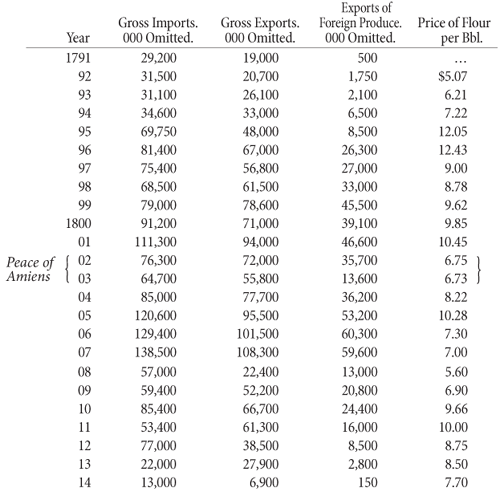
The tables of imports and exports are from the Treasury Reports. The last table, giving the price of flour, is in “American State Papers, Finance.” III., 536.
2 “Annals of Congress,” 1789, pp. 112–114.
3 “Notes on Virginia, Works,” VIII., 404.
4 See Jefferson’s “Report on Commerce, Works,” VII., 637; and Madison’s resolutions of 1794, based on Jefferson’s Report “Annals of Congress,” 1794, pp. 155, 209.
5 “Annals of Congress,” 1789, p. 221; 1794, p. 342.
6 On the act of 1789, see the monograph by William Hill, “The First Stages of the Tariff Policy of the United States,” in Publications of the American Economic Association, vol. VIII., No. 6. This valuable paper has led to a modification of the account of the act of 1789 given in previous editions of the present book.
7 It is curious to note that in 1802–04, during the temporary lull that followed the Peace of Amiens, the committee reports seem to show a drift toward protection. See “American State Papers, Finance,” II., pp. 29, 80, and the report on the Barbary Powers Act of 1804, “Annals of Congress,” 1804, pp. 946–950.
8 See Madison’s message of 1809, “Statesman’s Manual,” I., 289; and Clay’s speech of 1810, “Works,” I., 195. Madison never gave up his general acceptance of the principle of free trade, but admitted it to be inapplicable to articles needed in time of war, and in circumstances to which the young-industries’ argument applied. See his “Works,” III., 42.
9 “The abundance of capital, indicated by the avidity with which loans are taken at the reduced rate of five per cent., the reduction in the wages of labor, and the decline in the price of property of all kinds, all concur favorably for domestic manufactures.”—Clay Speech of 1820. “Works,” I., 419.
10 According to the census returns of 1820 and 1840, the only two of the earlier returns in which occupations are enumerated, there were engaged in manufactures and the mechanic arts in 1820, 13.7 per cent. of the working population in 1840, 17.1 per cent. In New England 21 per cent. were so engaged in 1820, 30.2 per cent, in 1840; in the Middle States 22.6 per cent. in 1820, 28 per cent. in 1840. Mac Gregor, “Progress of America,” II., 101. There are no census figures before 1820. In 1807 it was loosely estimated that out of 2,358,000 persons actively employed, 230,000 were engaged in mechanics and manufactures—less than 10 per cent. Blodgett, “Thoughts on a Plan of Economy,” etc. [1807] p. 6. The fluctuations in the exports of wheat flour, which was the most important article of export among agricultural products during the early part of the century, tell plainly the story of the country’s foreign trade. They were as follows, the figures indicating millions of dollars:
Yearly average |
1803–07 (expanded trade) |
8.2 |
|
1808–1810 (restriction) |
4.0 |
|
1810–12 (restrictions removed) |
13.5 |
|
1813–15 (war) |
5.5 |
|
1816–17 (temporary revival) |
14.5 |
|
1818 |
6.0 |
|
1819 |
5.0 |
|
1820 |
4.3 |
During the decade 1820–1830, when matters settled down to a normal state, the yearly export was between four and five millions of dollars. See “Quarterly Reports of the Bureau of Statistics,” 1883–84, No. 4, pp. 523, 524.
11 In the next essay, pp. 63–95.
12 In S. Batchelder’s “Introduction and Early Progress of the Cotton Manufacture in the U.S.” (1863); G. S. White’s “Memoir of Samuel Slater” (1836); and N. Appleton’s “Introduction of the Power-loom and Origin of Lowell” (1858).
13 Batchelder, p. 26 seq.; White, ch. III. The cotton-mill at Norwich, built in 1790, was operated for ten years, and then abandoned as unprofitable.—Caulkins, “Hist. of Norwich,” p. 696.
14 Bishop, “Hist. of Manufactures,” II., 102.
15 See the pamphlet by Blodgett “On a Plan of Economy,” etc., already cited, p. 26.
16 Gallatin’s Report on Manufactures in 1810; “Amer. State Papers. Finance,” II., 427.
17 White: “Memoir of Slater,” p. 188.
18 See the Report of a Committee of Congress on the Cotton Manufacture in 1816; “Amer. State Papers, Finance,” III, 82, 84. This estimate refers only to the cotton consumed in factories, and does not include that used in household manufacture. The number of spindles for 1815, as given in this report, is probably much too large. In Woodbury’s Report of 1836 on cotton, the number of spindles in use in factories is given as follows:
Year |
No. of Spindles |
1805 |
4,500 |
1807 |
8,000 |
1809 |
31,000 |
1810 |
87,000 |
1815 |
130,000 |
1820 |
220,000 |
1821 |
230,000 |
1825 |
800,000 |
“Exec. Doc.,” 1 Sess., 24 Congr., No. 146, p. 51. It need not be said that these figures are hopelessly loose but they are sufficient to support the general assertions of the text.
19 Appleton, pp. 7–11; Batchelder, pp. 60–70.
20 The minimum system seems to have been suggested by Lowell. Appleton, p. 13. Compare Appleton’s speech in Congress in 1833.—“Congressional Debates,” IX., 1213.
21 Appleton, p. 16.
22 Appleton, p. 13; Batchelder, pp. 70–73.
23 The following passage, referring to the general revival of manufactures, nay be quoted: “The manufacture of cotton now yields a moderate profit to those who conduct the business with the requisite skill and economy. The extensive factories at Pawtucket are still in operation…. In Philadelphia it is said that about 4,000 looms have been put in operation within the last six months, which are chiefly engaged in making cotton goods, and that in all probability they will, within six months more, be increased to four times that number. In Paterson, N. J., where, two years ago, only three out of sixteen of its extensive factories were in operation … all are now in vigorous employment.”—“Niles’s Register,” XXI., 39 (1821). Compare Ibid., XXII., 225, 250 (1822) XXIII., 35, 88 (1823); and passim. In Woodbury’s cotton report, cited above, it is said (p. 57) that “there was a great increase [in cotton manufacturing] in 1806 and 1807; again during the war of 1812; again from 1820 to 1825; and in 1831–32.”
24 Fox’s “History of Dunstable”; “Earl’s History of Fall River,” p. 20 seq.
25 See the account in Appleton, pp. 17–25. One of the originators of the enterprise said in 1824: “If our business succeeds, as we have reason to expect, we shall have here [at Lowell] as large a population in twenty years from this time as there was in Boston twenty years ago.”—Batchelder, p. 69. In Bishop, II., 309, is a list of the manufacturing villages of 1826, in which some twenty places are enumerated.
26 “In 1816 a new tariff was to be made. The Rhode Island manufacturers were clamorous for a very high specific duty. Mr. Lowell’s views on the tariff were much more moderate, and he finally brought Mr. Lowndes and Mr. Calhoun to support the minimum of 6¼ cents a yard, which was carried.”—Appleton, p. 13.
27 See a sketch of the early history of the woollen manufacture in Taft’s “Notes on the Introduction of the Woollen Manufacture” Compare the same writer’s account in “Bulletin National Ass. of Wool Manufacturers,” II., 475–485 and the scattered notices in Bishop, “Hist. of Manufactures,” I., 421, and II., 106, 109, 118, etc.
28 Bishop, II., 94, 134.
29 The United States were important customers of woollens for England, as appears from the following figures, which give in millions of pounds sterling the total exports of woollens from England, and those of exports to the United States.
Year |
Total |
To the U.S. |
1790 |
5.2 |
1.5 |
1791 |
5.5 |
1.6 |
1792 |
5.5 |
1.4 |
1793 |
3.8 |
1.0 |
1794 |
4.4 |
1.4 |
1795 |
5.2 |
2.0 |
1796 |
6.0 |
2.3 |
1797 |
4.9 |
1.9 |
1798 |
6.5 |
2.4 |
1799 |
6.9 |
2.8 |
Brothers, “Wool and Wool Manufactures of Great Britain,” 143, 144.
30 Gallatin’s report of 1810, “Am. State Papers, Finance,” II. 427; Taft, 44.
31 “Bulletin Wool Manufacturers,” II., 486. This is hardly more than a loose, though significant, guess.
32 Thus a large factory in Northampton, built in 1809 (Bishop, II., 136), was still in operation in 1828 (“Am. State Papers, Finance,” V., 815). In Taft’s “Notes” there is mention (pp. 39–40) of the Peacedale Manufacturing Company, which began in 1804, and has lasted to the present time. It is said that the spinning-jenny was first applied to wool in this factory.
33 Bishop, II., 270, 294; Niles, XXII., 225.
34 Niles, XXV., 148, 189.
35 The testimony is printed in full in “American State Papers, Finance,” V., 792–832.
36 Testimony, p. 824. The same statement is made by Bishop, II., 317. In Taft’s “Notes,” p. 39, there is an account of the application of the power-loom to weaving saddlegirths as early as 1814. In 1822 the power-loom for weaving broadcloths seems to have been in common use.—Taft, p. 43.
37 “Broadcloths are now (1828) made at much less expense of labor and capital than in 1825, by the introduction of a variety of improved and labor-saving machinery, amongst which may be named the dressing-machine and the broad power-loom of American invention” (p. 824). The power-loom was very generally used. “Since the power-looms have been put in operation, the weaving costs ten cents per yard, instead of from eighteen to twenty-eight cents” (p. 814). Shepherd, of Northampton, to whose factory reference has already been made (ante p. 44 note 1), said: “The difference in price of cloths (in the United States and in England) would be the difference in the price of the wool, as, in my opinion, we can manufacture as cheap as they (the English) can” (p. 816). In the same connection another manufacturer said: “The woollen manufacture is not yet fairly established in this country, but I know no reason why we cannot manufacture as well and as cheap as they can in England, except the difference in the price of labor, for which, in my opinion, we are fully compensated by other advantages. Our difficulties are not the cost of manufacturing, but the great fluctuations in the home market, caused by the excessive and irregular foreign importations. The high prices we pay for labor are, in my opinion, beneficial to the American manufacturer, as for those wages we get a much better selection of hands, and those capable and willing to perform a much greater amount of labor in a given time. The American manufacturer also uses a larger share of labor-saving machinery than the English” (p. 829).
38 See, for instance, List, “System of National Economy,” Phila., 1856, pp. 296–300.
39 See the tables in Bishop, I., 629, and Scrivenor, “History of the Iron Trade,” p. 81. In 1740 the total quantity of iron produced in England was about 17,000 tons; at that time from 2,000 to 3,000 tons annually were regularly imported from the American colonies.
40 See the good account of the importance of the use of coke (coal) in Jevons, “The Coal Question,” ch. XV., pp. 309–316.
41 French, “Hist. of Iron Manufacture,” p. 16.
42 Ibid., p. 13.
43 The imports of iron, so far as separately stated in the Treasury reports, may be found in Young’s Report on Tariff Legislation, pp. XXVI. XXXVI. Cp. Grosvenor, “Does Protection Protect?” pp. 174, 175.
44 See the tables of prices in French, pp. 35, 36.
45 Ante, p. 27.
46 There is nothing in the Congressional debates on the acts of 1818 to show what motives caused them to be passed.
47 “Statutes at Large,” III., 460.
48 Amé, “Études sur les Tarifs de Douanes,” I., 145.
49 On the production and imports of iron in the years after 1830 the reader is referred to the remarks on p. 124, and to the “Quarterly Journal of Economics,” vol. II., p. 377. Until the middle of the decade 1820–30 the annual product of pig-iron is supposed to have been about 50,000 tons, while in the second half of the decade it is put at 100,000 tons and more. The imports of crude iron averaged about 20,000 tons per year in 1818–21, about 30,000 tons in 1822–27, and rose to an average of about 40,000 tons in 1828–30. These figures as to imports refer mainly to bar-iron and as it required in those days about 1 tons of pig to make a ton of bar (French, p. 54), some additions must be made to the imports of bar before a proper comparison can be made between the domestic and the imported supply. An addition must also be made for the considerable imports of steel, sheet-iron, anvils, anchors, and other forms of manufactured iron. Figures of imports are given in Grosvenor, pp. 198, 199; of domestic production, by R. W. Raymond, in A. S. Hewitt’s pamphlet on “A Century of Mining and Metallurgy,” page 31.
50 See an excellent article, by an advocate of protection, in the American Quarterly Review, Vol. IX. (1831), pp. 376, 379, which gives very full information in regard to the state of the iron manufacture at that date.
51 French, p. 56.
52 Swank’s Report on “Iron and Steel Production,” in the Census of 1880, p. 114. A fuller discussion of the introduction of the use of anthracite, and of the effect of protective duties after this had been done, will be found at pages 122–134.
53 E.g., Grosvenor, p. 197.
54 Swank, pp. 114, 115.
55 See, for instance, the temperate report of J. Q. Adams, in 1832, in which this is discussed as the chief argument of the protectionists. Adams, though himself a protectionist, refutes it, and bases his faith in protection chiefly on the loss and inconvenience suffered through the interruption of foreign trade in time of war. The report is in “Reports of Committees,” 22d Congress, 1st Session, vol. V., No. 481.
56 See, among others, Clay’s Tariff Speech of 1824,”Works,” I., 465–466.
57 Same signs of the appeal for the benefit of labor appear as early as 1831 in a passage in Gallatin’s “Memorial,” p. 31, and again in a speech of Webster’s in 1833, “Works,” I., 283. In the campaign of 1840, little was heard of it, doubtless because other issues than protection were in the foreground. Yet Calhoun was led to make a keen answer to it in a speech of 1840, “Works,” III., 434. In the debates on the tariff act of 1842, we hear more of it; see the speeches of Choate and Buchanan, Congr. Globe, 1841–42, pp. 950, 953, and Calhoun’s allusion to Choate, in Calhoun’s “Works,” IV., 207. In 1846 the argument appeared full-fledged, in the speeches of Winthrop, Davis, and others, Congr. Globe, 1846, Appendix. pp. 967, 973, 1114. See also a characteristic letter in Niles, vol. 62, p.262. Webster’s speech in 1846, “Works,” V., 231, had much about protection and labor, but in a form somewhat different from that of the argument we are nowadays familiar with. See also the monograph by C.B. Mangold, “The Labor Argument in the American Protective Tariff Discussion,” Bulletin of the University of Wisconsin, No. 246 (1908).

